Skip to content
Artwork for Additive Snack
TechnologyScience

Additive Snack

EOS

Join host Fabian Alefeld and a range of guests as they discuss all things additive manufacturing (AM) and 3D printing news, with interviews and real-world stories to educate and entertain. Each episode, Fabian talks to AM experts, professionals in specialist fields, and 3D printing users from all walks of life to deliver a well-rounded view on the state of AM.

Cut through the confusion surrounding polymer and metal additive manufacturing solutions with our digestible, down-to-earth discussions that deliver insights into common mistakes and best practice tips so you can get a clear understanding of AM — layer for layer.

Whether you’re curious about 3D printing technology for the aerospace industry, a deep dive into post processing, or applications of injection molding — we leave no spare parts behind. We want to provide you with the additive insight needed to stay laser focused and leverage every opportunity 3D printing materials have to offer.

Join us for an Additive Snack and we’ll help you and your business achieve growth and success through the latest developments in AM.

No marketing B.S. and no product pitches. Just the education, inspiration and information you and your organization need to drive business growth, brought to you by global AM leader EOS.

Get ready to feed your AM knowledge and find your path to success!

Play
  • 20 episodes
  • fortnightly
  • Avg 58 min
  • English
  • S10 · E41
    Tuesday · 55 min

    The AM Sasquatch: Challenging AM Qualification with Math, Physics, & AI

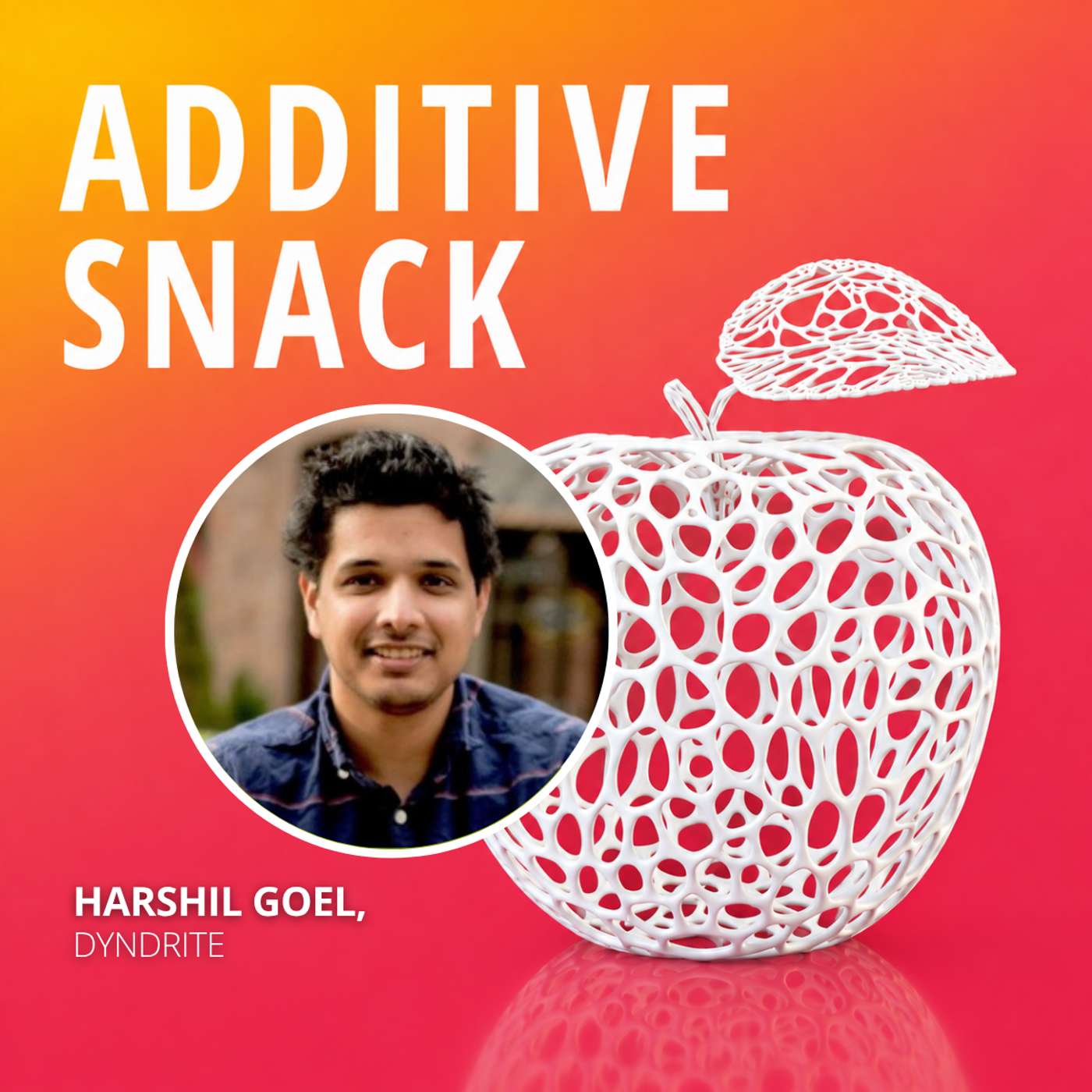
    Fabian Alefeld welcomes back Harshil Goel, founder and CEO of Dyndrite, to discuss how current additive manufacturing (AM) qualification practices limit advanced laser powder bed fusion toolpaths by locking variables such as software, machine, strategy, layer height, and material. Harshil reviews MQ, IQ, OQ, and PQ, noting cost and rigidity increase toward part qualification. They discuss Dyndrite’s roles in multiple America Makes efforts: AI4AM to reduce the specimen counts needed for material allowables (starting with 17-4PH) using improved statistical methods; DeltaQual 2.0 to enable “bracketed qualification” so parameter changes within a defined process window don’t retrigger requalification (including varying layer heights within a part); and Gotham to transfer scalable, qualified parameter approaches across different machines and sizes using materials like Scalmalloy. Harshil describes “Sasquatch,” a physics-based KPV framework using ratios (e.g., energy density, enthalpy, melt pool dimensions) to bound process windows and increase confidence without relying solely on sensors or simulation, and highlights software and AI accelerating DOE and parameter iteration with a target program timeline of about two years. 01:34 What Dyndrite Builds 02:11 Why Qualification Blocks Innovation 03:58 IQ OQ PQ MQ Explained 08:22 PQ Locks Everything Down 09:00 America Makes Program Overview 09:57 AI4AM Materials Allowables 12:39 Process Windows Not Fixed Params 14:57 Delta Qual 2 Bracketed Qual 17:38 Partners Sensors And Confidence 19:25 Sasquatch New KPVs 25:33 Gotham Scaling Across Machines 27:07 Future Less PQ More Reuse 28:39 Industry Impact Of Faster Qual 29:52 Customer Owned Parameters 30:54 Additive As Moat 32:13 Microstructure Driven IP 33:12 Selling Machine Control 34:31 Breaking Vendor Silos 35:36 Two Year Timeline 37:57 Risks And Adoption 41:23 Software As Glue 42:11 AI Accelerated DOE 45:34 Math Meets Empiricism 49:48 Future Outlook Wrap

  • S10 · E40
    August 25 · 1 hr 8 min

    AM as a Moat: How Annihilator Created a Competitive Advantage in Broadhead Manufacturing

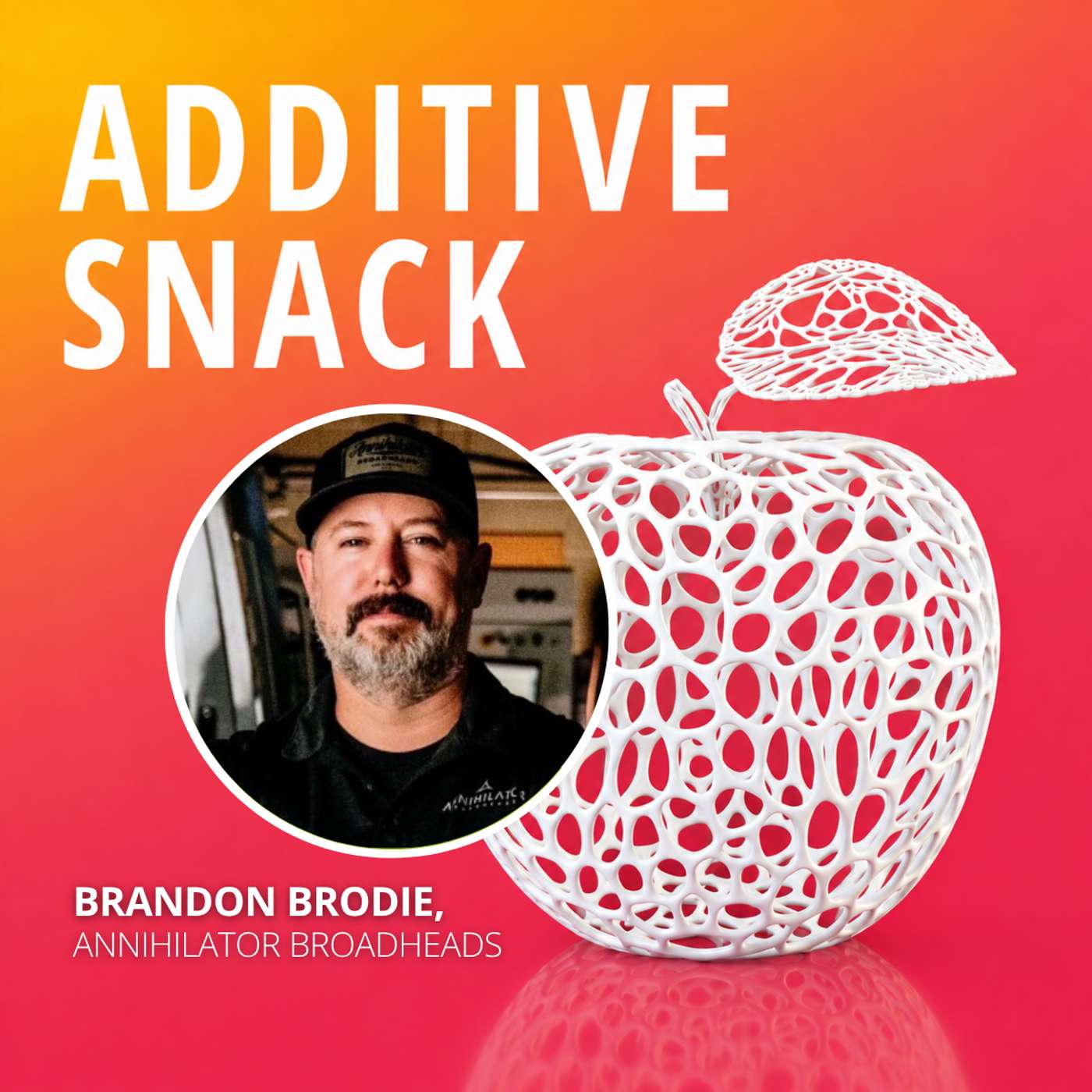
    Fabian Alefeld interviews Brandon Brodie, co-founder and CEO of Annihilator Broadheads, about how an Idaho elk hunt and a lost bull sparked a new broadhead concept sketched by Brandon’s future partner Micah. They describe turning the 2D sketch into plastic CAD prototypes via Boise State, a makeshift “wind tunnel” test using Instant Pot steam, and early performance goals of flight, penetration, durability, and lethality. Field and improvised tests (steel drum, long-range accuracy, animal kills) plus third-party fluid dynamics modeling suggested Annihilator’s design created unusually large high-pressure and low-tension effects. After major supply failures with investment casting and metal injection molding - causing shortages, high scrap rates, and lost dealers - Brodie brought manufacturing in-house, adopting metal laser powder bed fusion, improving repeatability and enabling new geometries like the Katana. He outlines ongoing innovation, potential adjacent products, and plans to leverage Annihilator’s additive capabilities for partnerships and contract manufacturing. 02:26 Elk Camp Origin 06:43 Sketch to Prototype 11:36 Instant Pot Wind Test 14:44 Performance Pillars 18:41 Steel Drum Proof 22:45 Real Hunt Validation 26:45 Fluid Dynamics Breakthrough 30:41 Engineering Led Marketing 33:32 Manufacturing Growing Pains 34:27 Industry Award Surprise 35:53 COVID Demand Crunch 36:54 Casting Supplier Failures 39:40 MIM Tooling Disaster 42:30 Additive Breakthrough 46:35 Learning Metal Printing 49:55 Repeatability and Materials 52:56 Katana Broadhead Innovation 57:49 Scaling R&D Team

  • S10 · E39
    August 18 · 49 min

    AI Is Getting Hot: Can Additive Manufacturing Help Cool It Down?

    Host Fabian Alefeld interviews Professor PS Lee, Head of National University of Singapore Mechanical Engineering & Program Director of STDCT, and founder of CoolestDC, about heat as a key constraint in AI infrastructure as data centers shift from CPU-heavy to GPU-dense systems with higher power density, hotspots, and bursty workloads. Lee explains why cooling must be treated as an integrated “chip to grid” system spanning cold plates, racks, CDUs, piping, controls, and operations, and discusses single-phase versus two-phase direct-to-chip liquid cooling and the added need for condensation in closed loops. Professor Lee describes how additive manufacturing (AM) enables complex fin structures and unibody cold plates that reduce leakage risk, lower junction temperatures (~10°C), cut pumping power (60–70%+), and reduce material use, while requiring TCO evaluation. At NUS’s live testbed (22 liquid-cooled racks, ~500 kW), AM cold plates are being deployed and show promising thermal, power, and compute-performance improvements; future work includes two-phase cooling and broader system-level heat rejection, warm-water operation, and waste-heat reuse, plus a discussion of challenges and potential AM roles in space-based data centers. 02:13 Meet Professor Lee 05:26 Chip To Grid Cooling 10:22 Liquid Cooling Maturity 14:15 Two Phase Explained 18:12 Cold Plate Tradeoffs 20:40 AM Unibody Cold Plates 24:41 Benchmarking AM Gains 30:18 AM For CDUs 34:13 Inside STDC Testbed 38:09 Reliability And Leakage 39:00 Next Phase Roadmap 42:31 Orbital Data Centers

  • S10 · E38
    July 21 · 1 hr

    Inside GM's Additive Industrialization Center with Ante Lausic

    In this episode, Fabian Alefeld sits down with Ante Lausic, Lead Process Engineer at General Motors' Additive Industrialization Center (AIC), to explore what it takes to successfully scale additive manufacturing (AM) in the automotive industry. Ante explains why automotive manufacturing demands more than innovative technology - it requires AM-native designs, cost-effective production, automotive-qualified materials, and repeatable processes capable of supporting high-volume manufacturing. He also shares how GM has evolved from using AM primarily for rapid prototyping to establishing the Additive Industrialization Center in 2020 to evaluate new technologies, validate production readiness, and strengthen collaboration across the supply chain. The conversation highlights real-world production applications, including the Cadillac Celestiq, which incorporates more than 130 AM components, such as a safety-critical binder-jetted stainless steel seatbelt guide and aluminum steering wheel trim. Ante also discusses the rapid growth of additive manufacturing for tooling, including die-casting inserts, plant fixtures, and end-of-arm tooling, and offers his perspective on where the technology is delivering the greatest value for automotive manufacturers today. 01:56 Scaling AM in Automotive 05:10 Value and Cost Reality 07:27 GM Additive Center Origins 11:02 Educating Engineers and Suppliers 14:34 Celestiq AM Success Stories 19:44 Supplier Freedom and Standards 23:00 Tooling Inserts Big Wins 27:50 End of Arm Tooling Growth 29:36 Motorsports and F1 Links 32:10 Aftermarket Digital Warehousing 33:39 Materials and PPAP Hurdles 36:14 PPAP Explained Simply 38:43 Rethinking Qualification Costs 41:07 Scaling to Corvette Volumes

  • S10 · E36
    July 14 · 1 hr 14 min

    Why AM and Orthotics & Prosthetics are the Perfect Fit

    Fabian Alefeld interviews certified prosthetist/orthotist and EastPoint Prosthetics VP Brent Wright about his career path into O&P, his shift from being anti-digital to adopting scanning and additive manufacturing, and the impact on patient care and global access. Wright describes traditional fabrication workflows (casting, plaster positives, vacuum forming thermoplastics for orthoses, and carbon fiber/resin layups for prostheses) as artistic but time-consuming, hazardous, and lacking records. His digital journey accelerated after a Guatemala trip with Life Enabled highlighted the need to scale care; he focused on scanning, digital modification, and later powder-bed fusion, moving toward SLS with materials like PK5000 and TPU. He emphasizes pressure casting for prosthetic sockets, the value of digital records for insurance, and how AM can change socket “dynamics” to improve comfort and heal wounds. The discussion also covers RADii’s data-driven fitting approach, Life Enabled’s mix of traditional and 3D-printed solutions (including pediatric feet), modular “kit” concepts for developing regions, and barriers to sensors/actuators in the US due to reimbursement. 02:33 Brent Origin Story 09:30 Why Go Digital 11:17 Scaling Global Access 17:32 Traditional O&P Workflow 20:02 Casting And Fabrication Steps 24:07 Digital Workflow And Scanning 33:22 Benefits Of Digital Records 36:36 Flexible Liner Heals Wound 40:47 RADii Data Meets Craft 46:06 Life Enabled Model 01:01:50 Democratizing via Manufacturing 01:08:01 Sensors vs Simplicity

  • S10 · E37
    July 7 · 41 min

    AM at a Crossroads: Incodema3D Proves What's Possible at Scale

    Fabian Alefeld sits down with Sean Whittaker, founder, president, and CEO of Incodema3D, to discuss the company's journey from a sheet metal prototyping business to one of North America's largest metal additive manufacturing operations. Sean shares why he invested in metal AM early, how Incodema3D built a production-first business model, and what it takes to scale additive manufacturing beyond prototypes. The conversation explores the evolution of Laser Powder Bed Fusion (LPBF) technology, the importance of vertically integrated manufacturing, and how improvements in machines, materials, software, and Design for Additive Manufacturing (DfAM) are making production at scale a reality. Sean also discusses growing demand driven by reshoring, defense, aerospace, and energy applications, Incodema3D's specialization in aluminum thermal management components and high-volume Inconel production, and how AFM Capital's investment is accelerating expansion through new equipment, automation, and future U.S. manufacturing sites. Episode Chapters 01:41 Sean's Origin Story 05:13 Taking the Leap into Metal Additive Manufacturing 07:05 From Prototypes to Production 08:07 The Advantage of Vertical Integration 10:54 The Maturity of Additive Manufacturing and DfAM 15:46 Thermal Management, Inconel, and Consumer Applications 19:21 Defense, Energy, and Replacing Cast Components 21:28 Accelerating Growth with AFM Capital 25:49 Cycle Times, ROI, and Production Flexibility 30:07 Automation and Building the AM Workforce 34:50 Reshoring, Expansion, and the Future of Production 39:50 Wrap-Up

  • S10 · E35
    June 23 · 1 hr 58 min

    AM Rocket Engines and Space Nuclear Power with Omar Mireles

    Fabian Alefeld interviews Omar Mireles, Director of Manufacture and Materials at Space Nuclear Power Corporation (Space Nukes), about his career spanning NASA, Oak Ridge, and Los Alamos and how additive manufacturing (AM) reshaped space hardware development. Omar describes early exposure to SLS prototyping, graduate work in nuclear materials and propulsion, building nuclear materials labs at NASA Marshall, and later leading AM efforts for liquid rocket engines and refractory metals. He explains how AM accelerates iteration, enables complex geometries, part consolidation, and weight reduction, and where traditional methods still dominate depending on production rate. The conversation covers refractory metal challenges (supply chain, oxygen sensitivity, post-processing, inspection) and nuclear reactor basics, generations, and regulatory barriers to AM adoption. Omar outlines Space Nukes’ goal of delivering safe, affordable, reliable power anywhere in the solar system, noting heat rejection as a key space constraint, Krusty’s 2018 test heritage, potential AM roles in heat exchangers, and an aggressive ~2-year flight timeline depending on regulation and mission. 02:26 Omar Early Motivation 03:08 NASA Co-ops and First AM 07:59 Stirling Radiation Research 20:07 Refractory Metals AM Lab 21:31 Los Alamos to Space Nukes 25:14 Did AM Change Space Race 31:46 Where AM Flies Today 37:41 Rocket Engines Print vs Traditional 41:15 Refractory Alloys Challenges 46:39 Where Refractories Make Sense 47:05 Will Refractory AM Grow 49:39 NASA Metal AM Handbook Origins 56:37 How Nuclear Reactors Work 01:13:02 Additive Manufacturing in Nuclear 01:18:31 What Space Nukes Builds 01:19:36 Why Space Nuclear Power Matters 01:25:20 Why Space Needs Nukes 01:37:47 Krusty Test Proof 01:41:18 Heat Rejection Challenge 01:49:25 Timeline and First Missions

  • S10 · E34
    June 2 · 57 min

    The Manufacturing Comeback: Dean Bartles on Defense, AI, and the Next Industrial Revolution

    Host Fabian Alefeld interviews Dean Bartles, President and CEO of the Manufacturing Technology Deployment Group (behind NCDMM, Advanced Manufacturing International, and America Makes), about manufacturing’s evolution, defense industrial base challenges, and additive manufacturing. Bartles recounts his career from shop-floor machining and industrial engineering to international defense manufacturing programs and 31 years through successive owners culminating in General Dynamics, then leading NCDMM and forming a parent organization to expand technology deployment. They discuss consolidation and contracting barriers that pushed small/medium firms out of defense, productivity gains from automation, reshoring momentum driven by tariffs and new investment, and workforce shortages and training pathways via trades, community colleges, and SME/Tooling U. Bartles highlights AI for process monitoring and adaptive control in laser powder bed fusion, the promise of low-cost desktop FFF for drones, the need for shared data and improved repeatability, and sustainability efforts including the Additive Manufacturing Green Trade Association. 00:00 Welcome and Guest Intro 02:54 Dean Manufacturing Origins 04:18 Global Defense Career Path 06:05 Leading NCDMM and America Makes 10:44 Defense Base Decline and Industry 4.0 18:14 Reshoring and Global Models 22:17 AI Capital and Process Control 35:25 Open Data and Repeatability Challenge 38:24 Defense Adoption and Drone Boom 44:08 Workforce Pathways and Community Colleges 50:04 Sustainability and Greener AM 54:27 Closing ABL Always Be Learning

  • S10 · E33
    May 26 · 1 hr 11 min

    From Hypersonics to AI Workflows: How Ursa Major Is Scaling Rocket Production

    Fabian Alefeld welcomes back Thomas Pomorski of Ursa Major to discuss developments over the past year across three focus areas: hypersonics, solid rocket motors, and in-space propulsion. Pomorski reports more than nine hypersonic missions flown with the reusable, ~80% 3D-printed Hadley engine and two successful test flights of the storable Draper engine with AFRL, plus progress on Ursa’s LINX solid rocket motor manufacturing approach using additive for tooling and cases to enable flexible “unit cell” scaling. They cover key hypersonics challenges around affordability and manufacturability and why a storable liquid rocket approach can reduce testing complexity. Much of the conversation focuses on AI’s current value in development: rapidly prototyping slicer features and scan strategies, building data-fusion and monitoring tools via EOS APIs, and enabling small teams to operate with much higher productivity, while noting production validation remains challenging. 00:00 Welcome Back Thomas 01:48 Ursa Major Year Update 02:37 Hypersonic Flight Milestones 04:05 Solid Motors and LINX 05:21 Additive Scale Up Tools 06:39 Hypersonic Cost Challenge 11:58 Solid Motor Unit Cells 15:37 Additive Geometry vs Supply 18:01 AI in Additive Workflows 24:33 AI Productivity Multiplier 29:33 Live Claude Slicer Demo 35:13 Prompting Claude Code 36:35 Sharing Team Workflows 38:40 Production AI Readiness 42:20 Slicer Feature Results 44:49 Closed Loop Optimization 46:46 AI Built Web Monitor 52:59 Automation Roadmap 01:00:12 Verifying Hatch Strategy 01:03:07 Advice For Students 01:08:29 Wrap Up And Thanks

  • S10 · E32
    May 15 · 52 min

    Printing Batteries, how AM is changing Battery Manufacturing and Performance

    Fabian Alefeld hosts Karl Littau, CTO of Sakuu, to discuss why rechargeable battery manufacturing has changed little in decades and how Sakuu is rethinking it with additive approaches. Littau explains conventional thick-film slurry coating and stacked anode/cathode layers, noting heavy use of copper and aluminum and high costs driven largely by bill of materials. He outlines battery basics (anode, cathode, electrolyte) and contrasts lithium-ion with solid-state concepts, where solids replace liquid electrolytes but face commercialization challenges. Sakuu’s initial product targets electrode coating by shifting from wet, solvent-based processes to dry powder-bed methods, enabling powder reclaim/reuse, removing toxic solvents, reducing equipment size (e.g., long drying ovens), and potentially increasing throughput. The conversation also covers future possibilities like multi-material patterning, arbitrary shapes, bipolar designs that reduce metal, and broader impacts on EVs, grid storage, and electrification. 00:00 Welcome and Topic 01:32 Why Batteries Need Change 04:13 Cost Drivers Today 07:53 Sakuu Additive Approach 13:09 Battery Basics Explained 18:30 Dry Powder Manufacturing 26:10 Speed and Footprint Gains 28:47 Scaling and Supply Chain 32:27 Future Shapes and Structures 35:42 Solid State Readiness 37:48 Sakuu Origin Story 40:31 Roadmap and Industry Impact 42:34 Electrification Future Vision 49:48 Wrap Up and Thanks

  • S10 · E31
    May 6 · 55 min

    Simulation as an Enabler: Pan Michaleris & Erik Denlinger on the Evolution of Additive FEA

    Fabian Alefeld hosts Pan Michaleris, founder of PanOptimization (PanX), and Erik Denlinger, co-founder and chief engineer, to discuss the evolution and role of simulation and finite element analysis (FEA) in additive manufacturing. Pan shares his background as a Penn State professor and entrepreneur (including a prior company acquired by Autodesk) and explains how simulation helps reduce costly trial-and-error builds by predicting distortion, temperature, stress, buckling, cracking, and recoater risks, while moving toward closed-loop manufacturing-to-design workflows and property prediction. Erik outlines PanX’s commercial capabilities - fast thermo-mechanical simulation for very large parts, distortion compensation, and dwell-time optimization - and describes proof-of-concept work on controlling melt quality and hardness via parameter modulation. They cover adoption in aerospace/defense and new space, qualification implications, integration with build-prep workflows (e.g., EOS/Velosis), and cautious, validation-focused views on AI surrogate models. 00:00 Welcome and Episode Preview 01:13 Meet Pan and Erik 01:59 Pan’s Journey to PanX 03:59 Erik’s Origin Story 05:10 FEA History and the Elephant Test 08:32 Why Additive Needs Simulation 10:23 Closing the Design Manufacturing Loop 14:33 PanX Today Core Capabilities 17:30 From Distortion to Material Properties 20:25 Making Simulation Usable for Engineers 27:06 Workflow Integration and Automation 29:44 From Failures to Design 30:41 Who Uses PanX Today 32:41 Simulation for Qualification 35:17 Layerwise Parameter Control 38:51 Why FEA Is Hard 41:38 AI and Surrogate Models 46:53 Future Material Tailoring 48:37 Roadmap Workflow Integration 52:27 Closing Thoughts and Wrap

  • S10 · E30
    April 10 · 59 min

    The State of AM in Asia

    Host Fabian Alefeld speaks with Japan-based additive manufacturing consultant Peter Rogers about the state of additive manufacturing across Asia Pacific. Rogers contrasts Japan’s advanced but risk-averse manufacturing culture - strong in incremental optimization, with slower certification (notably medical) and limited defense budgets - with faster-moving but smaller markets like Australia/New Zealand, where mining drives demand for rapid, remote part supply. They discuss China’s manufacturing scale and government support, its growing dominance in desktop FDM, and how low-cost Chinese metal PBF machines can win and retain service-bureau business despite Western strengths in quality and productivity. Singapore is highlighted for academia and MRO, while Korea spans shipbuilding, semicon, automotive, and defense. Southeast Asia is still production-focused with limited local R&D, whereas India is rising as an English-speaking engineering and R&D hub for global OEMs. Both see lowering costs and AI enabling broader, consumer-facing AM applications. 00:00 Welcome and Guest Intro 01:49 Peter Rogers Background 03:32 Moving to Japan 05:12 APAC Additive Overview 09:23 China Manufacturing Dynamics 13:27 Reshoring and Kaizen Mindset 18:45 Traditional Skills vs Additive 20:57 Japan Nearing Inflection Point 25:06 Top APAC Applications 29:02 Japan Korea Industry Mix 30:31 China Scale And Funding 33:18 FDM Race To Bottom 34:27 Bambu Ecosystem Advantage 36:53 Metal AM Price Expansion 38:23 Chinese Metal Machines Case 40:30 Competing On Productivity 44:10 Southeast Asia Adoption 47:06 India RnD Powerhouse 49:46 Future Consumer Breakthroughs 52:40 Japan Pushing DED Limits 55:30 AI Lowers Barriers 57:13 Wrap Up And Farewell

  • S10 · E29
    March 25 · 58 min

    From Fashion to Metal AM: Scaling Additive Manufacturing into Production

    Host Fabian Alefeld interviews Erin Mastroni, President and founder of I3D Manufacturing (founded 2013), about building one of the largest additive-focused contract manufacturers and the industry’s shift from prototyping to production. Mastroni describes moving from fashion retail and trend forecasting to an MBA in sustainable business, spotting production AM as a key trend, and launching a metal powder bed fusion business in Oregon with limited traditional manufacturing experience. She recounts early funding challenges, using SBA/New Market Tax Credits, and landing Blue Origin as an early customer, which helped establish I3D as a fast-moving development partner known for tackling difficult materials like titanium and new nickel alloys with EOS. I3D grew from 5 people and two machines to two campuses, ~30 machines, and 54 employees, is launching an internal “I3D Academy,” navigated a severe COVID revenue drop without layoffs, and was acquired in 2023 by BTX Precision (L Squared Partners), expanding into turnkey CNC and broader capabilities while discussing PE’s role, production scalability, and emerging AI opportunities. 00:00 Podcast welcome 01:47 Fashion to additive 04:27 Funding and mission 06:52 Blue Origin breakthrough 08:27 Becoming a dev partner 12:19 I3D today scale 15:29 Growing talent academy 17:05 Growth phases and pandemic 20:22 Acquisition and turnkey expansion 22:06 Private equity tipping point 27:43 Private Equity Momentum 28:41 Flow Driven Applications 32:54 Supply Chain Use Cases 35:12 Scaling Production Know How 40:21 One Stop Shop Strategy 43:14 Customers Get Smarter 47:31 Next Wave Breakthroughs 53:03 AI In Additive Manufacturing 57:25 Closing Thanks

  • S10 · E28
    March 4 · 56 min

    AI Update in Additive Manufacturing: Design, Process, Workforce and Industry impact

    Fabian Alefeld hosts Duann Scott on the Editor Snack podcast to discuss how AI is evolving in additive manufacturing, moving from “AI-washing” and impractical text-to-mesh hype toward more capable tools using language models, visual language models, surrogate models, and emerging foundational models. Scott describes testing tools by trying to make them fail and highlights a recent success with the Raven plugin for Rhino/Grasshopper, which generated a parametric VESA mount and tripod adapter from minimal prompts, then iteratively added fillets and an isogrid structure and produced a printable part within hours. They discuss constraints like missing engineering training data and design intent, the promise of AI for toolpath and process optimization (including transfer of parameter knowledge across materials), and the role of the 3MF format in capturing toolpath and metadata to enable richer, searchable datasets. Scott previews CDFAM events in Barcelona, DC, and Tokyo and emphasizes that progress requires significant data work and investment. 00:00 Welcome and Guest Intro 02:18 AI Hype to Real Progress 04:13 Testing AI Design Tools 04:46 Data Gaps and Design Intent 07:15 Two Paths for AI Design 10:15 Raven Grasshopper Breakthrough 13:17 Pushing Parametric Complexity 20:28 Limits of Black Box Optimization 22:40 Toolpath and Material Transfer 26:18 Alloy Discovery and Qualification 28:05 3MF Role Teaser 28:18 3MF Format Overview 29:17 Smarter Toolpath Extensions 32:31 Metadata for AI Training 35:43 Data Ownership and Synthetic Data 39:59 AI Impact on Additive 44:10 Workforce and Reshoring 47:22 What Is CDFAM 49:49 CDFAM Audience and Format 51:43 DC Event and Government 54:05 Wrap Up and Thanks

  • S10 · E27
    January 27 · 37 min

    Beyond the Printer: Automation’s Role in the Next Generation of AM

    In this episode of the Additive Snack Podcast, host Fabian Alefeld is joined by Oliver Elbert, Head of Additive Manufacturing at Grenzebach, to discuss the pivotal role of automation in scaling additive manufacturing. They delve into Grenzebach’s extensive expertise in industrial automation and its recent ventures into additive manufacturing. The conversation covers the challenges and benefits of automating post-processing tasks, increasing equipment efficiency, and optimizing labor dynamics. They also explore notable projects like the Next Gen AM and the Polyline project, highlighting how automation can significantly enhance production availability and reduce manual intervention. Oliver provides insights into the integration of automated guided vehicles (AGVs), robots, and job exchangers in additive manufacturing, and discusses the future potential of fully automated production environments. 00:00 Introduction to Additive Snack Podcast 00:18 The Challenge of Automating Additive Manufacturing 01:07 Introducing Grenzebach and Oliver Elbert 02:22 History and Evolution of Grenzebach 06:33 Grenzebach’s Entry into Additive Manufacturing 08:31 The Slow Adoption of Automation in Additive Manufacturing 14:34 The Dual Setup Station and Its Impact 19:25 Automation Solutions for Various Industries 23:52 The Future of Automation in Additive Manufacturing 24:48 Challenges and Opportunities in Automation 34:13 The Role of Humanoids in Industrial AM 36:20 Conclusion and Future Outlook

  • S10 · E26
    January 22 · 38 min

    How AM is Supporting the Grid

    In this episode of the Additive Snack Podcast, host Fabian Alefeld welcomes Kristin Mulherin, the Director of Additive Manufacturing Technology at Hubbell Inc., to discuss the creation and development of an additive manufacturing center of excellence within a 150-year-old corporation. Kristin shares her extensive journey through various roles in the additive industry, from Northrop Grumman to HP, and her significant input in initiatives like Women in 3D Printing. She discusses Hubbell's historical background and the strategic decisions behind establishing the AM center, including technology choices, cost management, and internal education to drive innovation. The episode covers specific applications, the challenges of shifting from prototyping to production, and the importance of cross-departmental education within the company to leverage the full potential of additive manufacturing. 00:00 Introduction to the Additive Snack Podcast 01:40 Meet Kristen Mulherin: A Journey in Additive Manufacturing 05:07 Kristen's Role at Hubbell Inc. and Industry Insights 06:11 Women in 3D Printing and Leadership 07:46 Building Hubbell Inc.’s Additive Manufacturing Center of Excellence 15:25 Technology Stack and Future Plans at Hubbell 19:30 Exploring New Opportunities in Additive Manufacturing 21:38 Balancing Cost and Lead Time in Additive Manufacturing 22:08 Value Drivers in Additive Manufacturing

  • S10 · E25
    January 6 · 1 hr 1 min

    Education, Investment & the Additive Workforce with America Makes - Part 2

    In the second part of this two-part episode series of the Additive Snack Podcast, host Fabian welcomes Dr. Edward Herderick, Director of Education and Workforce Development at America Makes, to discuss the maturation of additive manufacturing. They delve into the evolution of the technology, its impact on the industry, and the importance of specialized education to foster a capable workforce. Dr. Herderick shares insights on the integration of creative and engineering disciplines, the need for hands-on experience, and the role of the investment community in driving the industry's growth. The conversation also touches on the significance of industry partnerships in reshaping education, making additive manufacturing more accessible, and preparing the next generation of skilled professionals. 01:33 The Evolution of Additive Manufacturing 02:12 Integration of Art and Engineering 05:00 Specialization in Additive Manufacturing 08:44 Industry Trends and Workforce Development 15:25 Additive Manufacturing in Education 39:50 Hands-On Experience and T-Shaped Expertise 50:55 Investment and Market Segmentation

  • S10 · E24
    Dec 16, 2025 · 54 min

    Policy, Innovation & Defense Additive Manufacturing: A Deep Dive with America Makes - Part 1

    In this episode of the Additive Snack Podcast, host Fabian Alefeld is joined by Kimberly Gibson from America Makes for the first part of a two-part series focusing on the advancements and policy drivers in additive manufacturing in the U.S. Kimberly dives into the history and mission of America Makes, provides insights on policy innovation, industrial resilience, and how these factors are converging to reshape U.S. and global manufacturing landscapes. Highlighting the critical roles of workforce development, digital manufacturing, and ecosystem integration, Kimberly also discusses the importance of diversifying the industrial base's focus beyond defense and shares updates on current legislative initiatives like the National Defense Authorization Act. Don't miss this in-depth discussion on the transformative potential of additive manufacturing. 00:30 Meet Kimberly Gibson and Ed Herrick from America Makes 01:26 Kimberly's Journey and the Evolution of America Makes 03:35 The Role of America Makes in US Manufacturing 06:28 Challenges and Opportunities in Additive Manufacturing 11:49 The Importance of Digital Manufacturing and Cybersecurity 19:22 Government's Role in Accelerating Additive Manufacturing 25:07 Diversifying Beyond Defense Contracts 28:54 Congress Signals Support for Advanced Manufacturing 29:33 Senate Bill 2214 and the Additive Industry 31:44 Challenges in the Additive Manufacturing Sector 33:41 Right to Repair and Sustainment Issues 35:53 Unprecedented Demand for Additive Manufacturing 37:54 Additive Manufacturing in Various Sectors 43:39 Energy Sector and Additive Manufacturing 46:32 Additive Construction and Future Prospects 49:14 Teaming and Collaboration Opportunities 50:23 Final Thoughts and Future Outlook

  • S10 · E23
    Dec 9, 2025 · 1 hr 1 min

    AM in Turbomachinery: Deep dive in Applications, Materials, Production & Qualification

    In this episode of the Additive Snack Podcast, host Fabian Alefeld delves into the technically demanding world of gas turbines with Dr. Ilya Fedorov, an R&D project manager at Siemens Energy. The discussion covers the transformative impact of additive manufacturing on turbo machinery, touching on innovations in combustion systems, turbine blades, and repair processes. Dr. Fedorov explains how Siemens Energy harnesses additive manufacturing to improve performance, strengthen supply chains, and embrace green fuels like hydrogen. The episode also explores the rigorous qualification processes for additive components, the development of new materials, and the potential future advancements in the sector. Long-Term Lifetime Validation of Hot Turbine Guide Vanes Manufactured by Laser Powder Bed Fusion | J. Eng. Gas Turbines Power | ASME Digital Collection 00:00 Introduction to Additive Manufacturing in Gas Turbines 01:47 Ilya Fedorov's Journey into Additive Manufacturing 05:00 The Light Bulb Moment: Realizing Additive's Potential 09:49 Siemens Energy's Additive Manufacturing Strategy 15:03 Challenges and Innovations in Gas Turbine Environments 19:25 Additive Manufacturing Applications in Gas Turbines 25:11 Repair and Longevity of Gas Turbine Components 36:52 Qualification and Testing of Additive Components 44:57 Materials and Process Development in Additive Manufacturing 49:39 Future Directions and Challenges in Additive Manufacturing 59:05 Conclusion and Final Thoughts

  • S10 · E22
    Nov 14, 2025 · 43 min

    Breaking - Euler Launch: AI & the Future of AM Monitoring

    In this episode of the Additive Snack Podcast, host Fabian Alefeld welcomes Eythor Eiriksson, founder and CEO of euler, a company revolutionizing process monitoring and quality assurance in additive manufacturing. They delve into how euler leverages AI and data from existing sensors to improve print outcomes without requiring additional hardware. Eiriksson shares his journey from Iceland to founding euler, the company's objectives, and their strategies for problem-solving in the additive manufacturing space. The discussion also touches on the practical applications of AI, user experiences, and the future of additive manufacturing technology. Eiriksson talks about euler’s upcoming product launch at Formnext and its potential to transform the industry by providing real-time monitoring and predictive alerts, ultimately aiming to ensure high-quality prints and reduce costly failures. 00:00 Welcome to Additive Snack Podcast 00:10 Guest Introduction: Eythor Eiriksson and euler 01:21 Eythor's Journey and Background 03:03 Challenges in Additive Manufacturing 04:43 Founding of euler and Initial Steps 05:41 Comparison with Tesla's Autonomous Strategy 07:22 euler's Mission and Vision 09:35 Product Launch and User Experience 15:00 Technical Insights and Failure Detection 28:59 Future of AI in Additive Manufacturing 42:24 Closing Remarks

Showing 1–20 of 20 episodes