The Government Pays This Man More Than The President | Logically Answered
The Government Pays This Man More Than The President
Earn Cash Back On Stocks: Up To $5,000 Per Yearhttps://www.silomarkets.com/logicWe all know that government salaries are generally less lucrative than private company salaries, but governments generally offer much better worklife balance, more job security, and just overall less stress. So, the tradeoffs for government jobs were usually worth it for a good portion of the population. However, over the past 10 to 20 years, the disparity between government salaries and corporate salaries has ballooned to significant levels. Before you might’ve been able to make an additional $20 or $30K per year by switching to a company, but nowadays, you can often double your salary by switching to corporate. This has made the argument to get a government job significantly weaker, and this is especially true with current inflation. But, why do governments pay so bad when they have access to so much money? Well, some of the main reasons are that they have terrible financial management, ineffective spending strategies, and a significant number of complacent employees. This video explains the difference between government wages and corporate wages and how government salaries got so bad. Earn Interest From The Government & Top Corporations:(iOS App for US Residents)https://www.silomarkets.com/waitinglistpageFree Weekly Newsletter With Insiders:https://logicallyanswered.co/Socials:https://www.instagram.com/hariharan.jayakumar/Discord Community: https://discord.gg/SJUNWNtTimestamps:0:00Garbage Salaries2:24Funding5:32Complacent Employees8:26No Choice10:56The State Of Government JobsThumbnail Credits:Wesley Hitt/Getty Imageshttps://bit.ly/3YPb8CFResources: https://pastebin.com/aDGH14DhDisclaimer:This video is not a solicitation or personal financial advice. All investing involves risk. Please do your own research. https://www.silomarkets.com/disclosures
Logically Answered is centered around explaining the economics of tech and social media. These sectors are generally analyzed through the lenses of finance and economics to determine which industries and companies will thrive and which will fall. In addition to this analysis, the content is often focused on the stories of various famous entrepreneurs such as Elon Musk, Steve Jobs, and Jeff Bezos. Logically Answered also cover the rise and fall of several interesting companies and services that we come across on a daytoday basis. There have been so many companies that have risen to fame and then died out in a single generation. The most interesting companies are the ones that were able to save themselves and avoid bankruptcy. Feel free to follow the podcast if you would like to see any of these topics Logically Answered.
Find Logically Answered on YouTube: https://www.youtube.com/@LogicallyAnswered/
Disclaimer: This podcast is an independently created audio adaptation of content originally published by Logically Answered. This is a fan made podcast that appreciates the channel’s insightful approach to knowledge and aims to make it accessible to those who prefer listening over watching. This podcast is not affiliated with, endorsed by, or officially connected to Logically Answered in any way. All rights to the original content belong to Logically Answered. If you have any concerns, please reach out.
-----------
Keywords: economic analysis, big tech, corporate analysis, tech business, startup failures, economic commentary, business analysis
Learn more about your ad choices. Visit megaphone.fm/adchoices
Today · 16 min
SS
Sage Sociology
Armed Forces & Society - Ethical Lapses and the Military Profession Three Problems and a Solution AI Pod
This episode of the Armed Forces & Society AI podcast series is a conversational-style AI summary of Thomas Crosbie and Meredith Kleykamp's article entitled, 'Ethical Lapses and the Military Profession Three Problems and a Solution'.
All podcasts, videos, and content listed below are AI-generated adaptations of scholarly articles originally published in Armed Forces & Society. These derivative products are intended solely as supplementary means of engaging with academic research.
The content was generated using Google's NotebookLM and does not constitute an authoritative or complete representation of the original article. While care has been taken to reflect the themes and arguments of the source material, AI-generated summaries may contain omissions, simplifications, or inaccuracies.
Use the original articles to verify all claims and to cite the work. The AI-generated media is not for citation. Audiences seeking a full, accurate, and nuanced understanding of the research should consult the original published work.
The authors have elected to give permission for Armed Forces & Society to derive AI-generated videos and podcasts from their work. Because of the possibility for AI to misconstrue or misrepresent the author's original work, Armed Forces & Society and Sage absolve the authors from all responsibility for the AI-generated statements and inferences.
All rights to the original articles and any derivative media are reserved by the authors, Armed Forces & Society, and Sage Publishing.
Today · 24 min
WW
Was wäre wenn - What If Deutsch
Als die prähistorische Erde wunderschön… und tödlich war
Die prähistorische Erde war ein faszinierender und gefährlicher Ort. In dieser Episode werfen wir einen Blick auf die Welt vor Millionen von Jahren – als Dinosaurier die Erde beherrschten und extreme Naturgewalten die Landschaft formten. Was war das Leben damals wirklich? Wunderschön, aber auch tödlich.
🔔 Abonnieren für mehr spannende Einblicke in die Vergangenheit!
💬 Schreib uns deine Gedanken in die Kommentare: Welche prähistorischen Tiere faszinieren dich am meisten?
Abonniere auch: http://bit.ly/subscribetowhatifdeutsch
What If elsewhere:
What If in English: http://bit.ly/facebook-whatif
What If in Spanish: http://bit.ly/YT-Spanish-what-if
What If in Mandarin: http://bit.ly/YT-Chinese-what-if
What If in Hindi: http://bit.ly/what-if-hindi-youtube
What If in French: http://bit.ly/Et-si-youtube
What If in Portuguese: http://bit.ly/E-se-youtube
What If in Italian: http://bit.ly/Cosa-succederebbe-se
„Was wäre wenn“ ist eine dokumentarische Web-Serie, die dich zu einer monumentalen Reise durch hypothetische Welten und Möglichkeiten entführt. Folge uns auf unserem Abenteuer durch Zeit, Raum und Wahrscheinlichkeiten, während wir komplexe Sachverhalte mit Spaß auf ein (hoffentlich) verständliches Maß mit einem hohen Entertainment-Faktor runter kochen.
Mit Liebe gemacht von Underknown in Toronto: https://underknown.com
This project has been made possible [in part] by the Government of Canada.
#prähistorischeErde #Dinosaurier #Naturgewalten #Unterhaltung #HypothetischeWelten #Dokumentation #Waswärewenn
See show notes: https://inlet.fm/what-if-deutsch/episodes/690578bb3168768011ee9cd9
Learn more about your ad choices. Visit podcastchoices.com/adchoices
Today · 31 min
DA
David A. Hughes
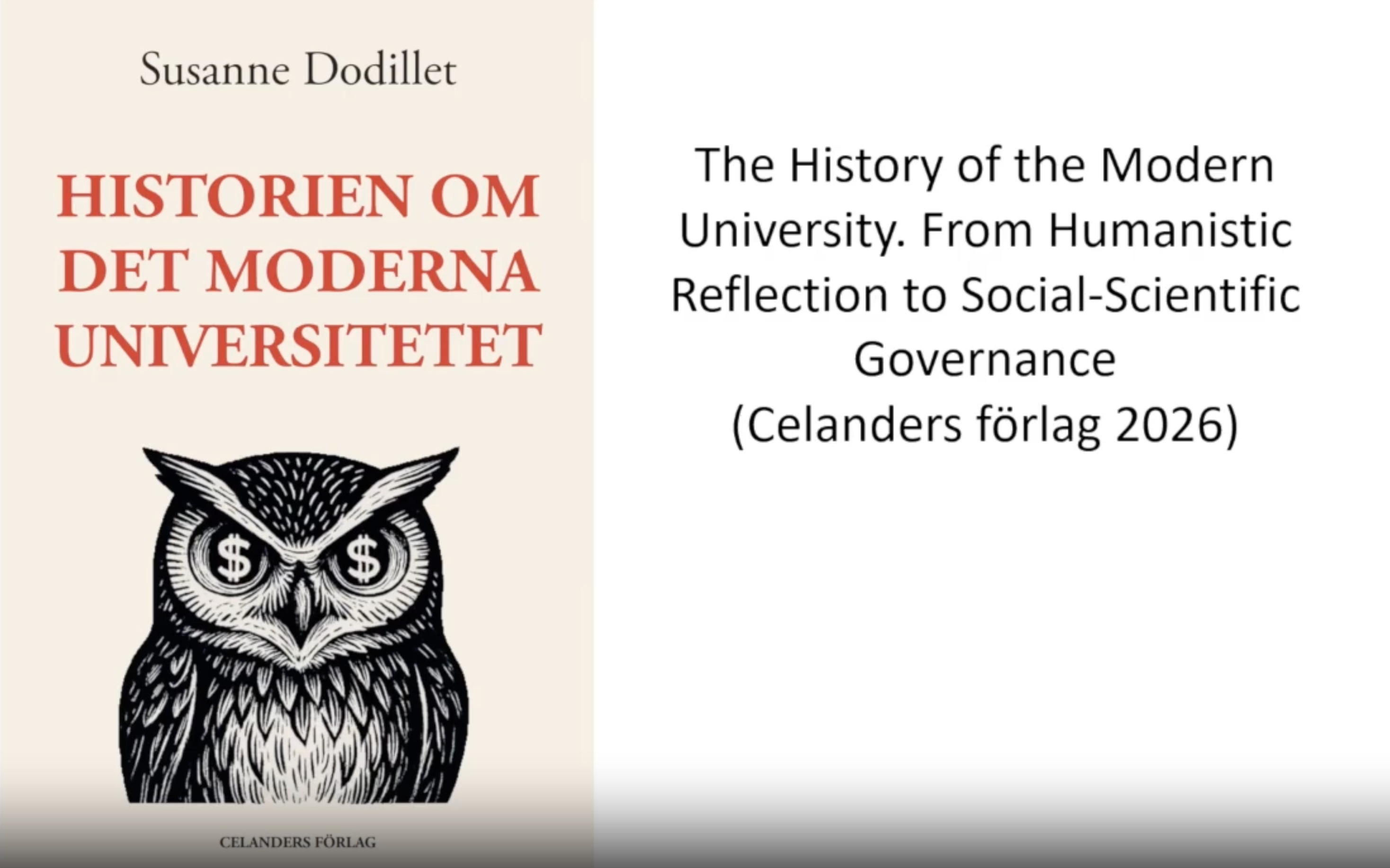
Susanne Dodillet, “From Humanist Reflection to Social-Scientific Governance: The Corruption of the Modern University”
Abstract
The university is usually pictured as a free sphere, a place of disinterested inquiry, critical thinking and individual responsibility, insulated from politics and the market. Even its critics tend to treat whatever falls short of this ideal as an unfortunate aberration rather than an expression of the institution itself. This talk takes a more sober starting point. My claim is not that particular studies are biased or particular fields compromised, but that the modern university as a whole operates as a propaganda instrument: not an autonomous sphere but both an object and an instrument of governance, and the keystone of the technocratic expert society we inhabit.
Working from the Swedish case, I trace how the university was remade over the twentieth century from a site of humanist reflection into an apparatus of social-scientific governance. The decisive impulse came from American research philanthropy, whose large-scale investments built up an empirical social science designed to make society measurable and steerable: an instrument of social control. Once social questions were recast as objects of measurement, the social ceased to be a moral and political matter and became a technical one, and those who paid for the mapping also defined the problems to be mapped and the direction in which they were to be solved. A welfare state grew up around these structures that cared for people while quietly disarming their capacity to resist the concentration of power that built it. What made this possible was not any single discipline but the institution as a whole: nothing conceals an apparatus of governance better than the good name of free, truth-seeking science.
This is what makes the modern university corrupt in a structural rather than an anecdotal sense: it is not the quality of thought but the interests of its funders that decide which questions are asked and which answers gain authority. Today the expansion of steerability takes new forms: information-gathering intensified through digitalization and ever denser surveillance, with the university still serving as the developer that realizes it, as newly endowed research centres present new technologies as science and public benefit that everyone is expected to welcome.
This talk draws on my book Historien om det moderna universitetet. Från humanistisk reflektion till samhällsvetenskaplig styrning (Celanders, 2026).
Support Our Work
The time, expertise, and effort required to produce these presentations is considerable, and we put them out for free.
If you are able to support our work financially, please consider making a donation at https://opencollective.com/omniwar.
This is a public episode. If you would like to discuss this with other subscribers or get access to bonus episodes, visit dhughes.substack.com


 Logically Answered