Skip to content
Artwork for Zero Click Marketing
BusinessMarketingEducationHow To

Zero Click Marketing

Amanda Natividad

Zero Click Marketing is a marketing strategy podcast about content marketing, audience research, and how brands grow when clicks matter less. Hosted by Amanda Natividad, Chief Evangelist at SparkToro and Co-Author of the book, "Zero Click Marketing," the show explores how marketers reach audiences, build influence, and earn attention in a zero-click internet. New to the show? Start with Episode 2: What Zero Click Marketing Actually Is.

Play
  • 31 episodes
  • weekly
  • Avg 22 min
  • English
Counted on this page — what you have heard stays on this device, so it is not something the list can be paged by.
  • #19
    June 9 · 29 min

    The Content Strategy Frameworks AI Can't Beat (with Kaleigh Moore)

    I chat with writer and strategist Kaleigh Moore about how content teams can adapt to AI search without sacrificing quality. Kaleigh shares her “source signal stack” framework, explains why third-party validation matters, and makes the case for treating LinkedIn, Reddit, YouTube, newsletters, and employee-led content as part of one larger visibility ecosystem. Timestamps 00:00 — Why employee experts are such a powerful source of original content 03:06 — How Kaleigh started learning AI tools and GEO/AEO hands-on 05:46 — The “source signal stack” and how LLMs evaluate content 09:40 — The messy reality of measuring AI visibility and attribution 12:57 — Durable marketing bets in a fast-changing AI landscape 17:09 — What effective employee advocacy can look like in practice 20:43 — How internal talks can become LinkedIn, YouTube, and recruiting content 26:07 — Kaleigh’s underrated tactic: syndicating newsletters on LinkedIn 28:08 — Where to follow Kaleigh and read her newsletter, Context Window Connect with Kaleigh Moore: https://www.linkedin.com/in/kaleighmoore/ Learn more about Kaleigh Moore: https://www.kaleighmoore.com/ Subscribe to Context Window: https://kaleigh-moore.kit.com/ Learn more: zeroclickmarketing.co Connect with Amanda Natividad (@amandanat): LinkedIn | Substack | Instagram | Threads This episode was produced in partnership with Share Your Genius www.shareyourgenius.com

    • Transcript
  • #18
    June 2 · 33 min

    Why B2B Is MORE Emotional Than B2C (with Talia Wolf)

    B2B buyers like to pretend decisions are purely rational. But when your job, reputation, budget, and team trust are on the line? That’s emotional as hell. I sat down with Talia Wolf, founder of GetUplift and author of Emotional Targeting, to dig into customer research, pricing transparency, AI search, and how emotional targeting helps marketers create messaging that actually resonates. Talia also shares a case study on how her team helped one company increase free trials by 54% through emotionally resonant comparison pages. Timestamps 00:00 — Why B2B purchases are deeply emotional 01:36 — How emotional targeting and zero-click marketing fit together 04:47 — Talia’s three-step framework: research, audit, test 05:11 — Why buying B2B software carries more emotional risk than B2C 09:27 — The qualitative research that reveals what buyers actually care about 11:00 — How Teamwork.com used comparison pages to increase free trials by 54% 16:50 — Why honest comparison content can attract better-fit customers 19:37 — Why pricing transparency matters more in the AI search era 25:41 — The KPIs Talia’s team tracked beyond free trials 28:10 — The problem with A/B testing and what to do about it Resources: Unlock better marketing with Emotional Targeting by Talia Wolf. Get your copy now Connect with Talia Wolf: https://www.linkedin.com/in/taliagw/ Learn more about GetUplift: https://getuplift.co/ Learn more: zeroclickmarketing.co Connect with Amanda Natividad (@amandanat): LinkedIn | Substack | Instagram | Threads This episode was produced in partnership with Share Your Genius www.shareyourgenius.com Learn more: zeroclickmarketing.co Connect with Amanda Natividad (@amandanat): LinkedIn | Substack | Instagram | Threads

    • Transcript
  • #17
    May 27 · 13 min

    Your Marketing Stack Is About to Get Smaller

    The best-of-breed marketing stack made sense when traffic was cheap. But in a zero-click world, every lead is harder to earn — and every tool handoff is another place for that lead to die. In this episode, I make the case for rethinking bloated marketing stacks, explain why small teams may need fewer tools instead of "the best" tool for every job, and share how Typeform’s Growth Flow turns forms into richer workflows for capture, enrichment, automation, and reporting. Timestamps: 00:00 — The best-of-breed era is ending 01:00 — How we got from monoliths to unbundled SaaS stacks 04:30 — What changed in a zero-click world 07:00 — The hidden cost of handoffs 11:00 — Typeform Growth Flow and built-in enrichment 14:00 — The DTC skincare quiz funnel example 18:00 — Five places a lead can die 23:00 — The new question: “What’s the fewest tools I can run this through?” For the full DTC workflow, read my newsletter, "Your Marketing Stack Is About to Get Smaller." This episode is sponsored by Typeform. It features my honest take on Growth Flow. Learn more: zeroclickmarketing.co Connect with Amanda Natividad (@amandanat): LinkedIn | Substack | Instagram | Threads

    • Transcript
  • #16
    May 19 · 9 min

    A Form Fill Is Not Demand Generation

    Here's my new rule for demand generation: Ungate the argument. Gate the utility. Ungate the point of view — and ungate the template, tool, deeper cuts, or genuinely useful live experience. Buyers now have more ways to get answers without entering your funnel: AI search, Reddit, YouTube, private communities, and competitors’ ungated posts. And if your best educational content is locked behind a form, it's not shaping your public record. The better question isn’t “should we gate this?” It’s: what should be freely available so buyers can understand, trust, remember, cite, and share your ideas — and what is valuable enough that someone would reasonably trade their information for it? Because in a zero-click world, changing someone’s mind without relying on clicks and form fills is the whole game. Timestamps: 00:00 — The old B2B bargain: email address for the thing 02:04 — Buyers have more ways to get answers without you 03:03 — AI search makes the gated content problem more obvious 04:00 — Why the public record matters in a zero-click world 05:00 — Ungate the argument, gate the utility 06:00 — Buyers want to engage on their own terms 07:07 — A form fill is not the same thing as demand 07:26 — Three questions to ask before gating content 08:05 — Good gates vs. lazy gates Sources & Tools: What is Gated Content? And How to Make It Discoverable to AI Bots by Conductor Gated Content and AI Search: Why It’s Invisible by Ziptie Gartner Sales Survey Finds 67% of B2B Buyers Prefer a Rep-Free Experience 10 Minute Email - 10minuteemail.com SparkToro - sparktoro.com Alertmouse - alertmouse.com Pre-order the book: Zero Click Marketing (zeroclickmarketing.co/book) Learn more: zeroclickmarketing.co Connect with Amanda Natividad (@amandanat): LinkedIn | Substack | Instagram | Threads This episode was produced in partnership with Share Your Genius www.shareyourgenius.com

    • Transcript
  • #15
    May 12 · 20 min

    GEO Is What Happens When Search Becomes Zero-Click

    AI search is changing SEO, but not because SEO is dead. It’s changing because search is becoming more zero-click. In this episode, I explain GEO — Generative Engine Optimization — and why it’s less about chasing AI hacks and more about making your content easier to retrieve, understand, cite, trust, and remember. I break down four practical mechanics of GEO: retrievability, extractability, credibility, and public evidence — and show why good AI visibility still starts with good marketing. Timestamps 00:00 Why AI search is changing SEO 01:35 What GEO actually means 03:10 Why GEO is a zero-click marketing problem 04:30 The four mechanics of GEO, beginning with retrievability 08:30 Extractability: can your content be understood and reused? 11:00 Credibility: why generic SEO content falls short 13:30 Public evidence: why your brand’s off-site record matters 18:45 Why GEO is not magic — it’s good marketing Resources: Ahrefs study: AI Overviews Reduce Clicks by 58% Pre-order the Zero Click Marketing book (yes, there’s a chapter on AI marketing!) Learn more: zeroclickmarketing.co Connect with Amanda Natividad (@amandanat): LinkedIn | Substack | Instagram | Threads This episode was produced in partnership with Share Your Genius www.shareyourgenius.com

    • Transcript
  • #14
    May 7 · 2 min

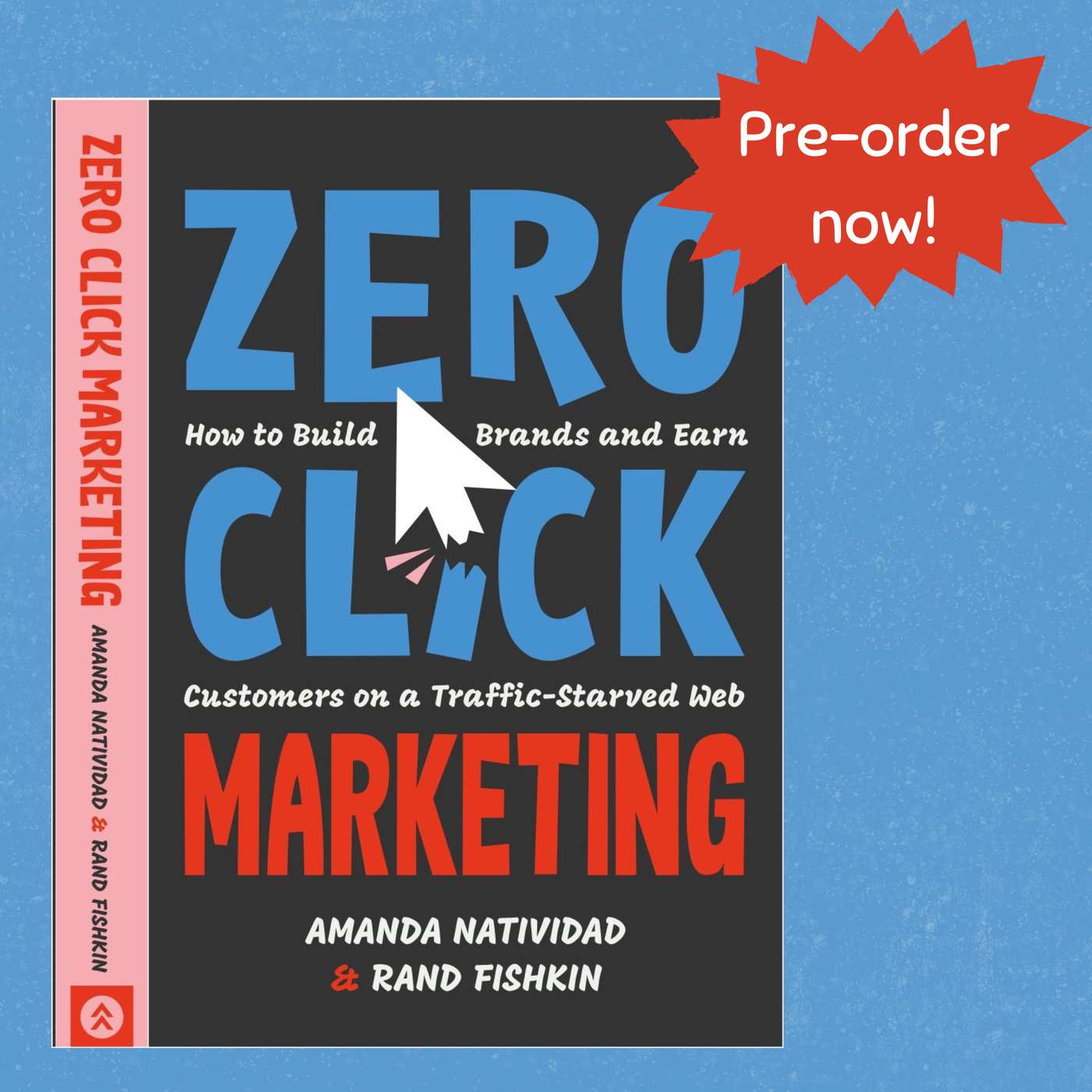
    Announcing: Zero Click Marketing — The Book!

    Zero Click Marketing: How to Build Brands and Earn Customers on a Traffic-Starved Web is officially available for pre-order. YOU HEARD RIGHT, CUTIES! I announce my and Rand Fishkin's upcoming book, explain why pre-orders matter, and tell you how to claim the pre-order bonuses. Pre-order the book at zeroclickmarketing.co/book. Learn more: zeroclickmarketing.co Connect with Amanda Natividad (@amandanat): LinkedIn | Substack | Instagram | Threads

    • Transcript
  • #13
    May 5 · 13 min

    Why Marketers Make Content for Dashboards (Not Their Audience)

    Marketers say they want good strategy. Then they optimize for whatever’s easiest to measure. This episode is about why easy-to-see metrics like traffic, likes, attributed pipeline, and rankings can create false confidence. Instead, better measurement can look like this: off-platform sharing, stronger sales conversations, customer education, adoption of your language, and content that does more than one job. In a zero-click world, the easiest metric to report is not always the one that matters most. Timestamps 00:00 Why marketers optimize for what’s easiest to measure 01:36 How SEO gets too much credit for capturing demand 04:23 The Fitbit B2B example and content as a service 06:09 Better ways to judge content quality 07:54 Why the best content does more than one job 11:12 What better measurement looks like in a zero-click world You can do audience research with all kinds of tools and networks like Google Trends, Exploding Topics, Reddit, and of course, my employer, SparkToro. You can create an always-free account and get 5 reports per month on sparktoro.com. Learn more: zeroclickmarketing.co Connect with Amanda Natividad (@amandanat): LinkedIn | Substack | Instagram | Threads This episode was produced in partnership with Share Your Genius www.shareyourgenius.com

    • Transcript
    • Chapters
  • #12
    April 28 · 7 min

    The End of the “Ultimate Guide” Strategy

    For years, marketers were told to create the ultimate guide: one page that covers everything on a topic. That advice worked when the goal was to rank, earn the click, and keep people on your site. But that era is coming to an end. In this episode, I walk through new research on Google and ChatGPT that points in the same direction: broad, catch-all content is getting weaker, while focused, hard-to-replace value is getting stronger. I break down what winning websites actually have in common, why relevance now beats comprehensiveness, and how to rethink your content strategy for a zero-click world. Research cited in this episode: 5 Data-Backed Features of Websites Winning Google in 2026 by Cyrus Shepard The Fan-Out Effect: What Happens Between a Query and a Citation by Kevin Indig and AirOps Timestamps: 00:00 Intro 00:21 The rise of the “ultimate guide” playbook 00:53 Why broad, catch-all content is getting weaker 01:00 What Google’s winners have in common 02:19 The difference between reading and doing 02:36 Why destination sites win 02:57 Brand vs. discoverability 03:52 What ChatGPT actually rewards 04:30 Why answering one question beats answering five 04:56 The new standard: defensibility + focus 05:55 How to rethink your content strategy 06:36 Why brand matters more than ever 07:00 Final takeaways Learn more: zeroclickmarketing.co Connect with Amanda Natividad (@amandanat): LinkedIn | Substack | Instagram | Threads This episode was produced in partnership with Share Your Genius www.shareyourgenius.com

    • Transcript
    • Chapters
  • #11
    April 21 · 10 min

    The Beige of Marketing

    Best practices can help you avoid obvious mistakes — but they can also make your marketing forgettable. In this episode, I explain why the real problem isn’t best practices themselves, but using them without personalization, taste, or audience insight. Drawing on my experience at Fitbit, I’ll show you how audience research leads to stronger content, smarter channel choices, and more compelling marketing — plus a few practical ways to get started without spending much money or time. This episode is an expansion of my blog post, “Best Practices Are Meaningless Without Audience Research.” Timestamps: 00:00 How best practices turn into beige marketing 01:27 The antidote: audience research 02:01 The Fitbit example and the real B2B challenge 03:43 Good marketers have always done some version of this 05:08 More examples: marketers, skincare, and sports betting 06:36 How to start doing audience research 07:40 How to spot patterns faster 09:38 Best practices only tell you the format 10:05 How audience research improves taste 11:02 Best practices get you on the field. Audience research helps you win. You can do audience research with all kinds of tools and networks like Google Trends, Exploding Topics, Reddit, and of course, my launch sponsor, SparkToro. You can create an always-free account and get 5 reports per month on sparktoro.com. Learn more: zeroclickmarketing.co Connect with Amanda Natividad (@amandanat): LinkedIn | Substack | Instagram | Threads This episode was produced in partnership with Share Your Genius www.shareyourgenius.com

    • Transcript
  • #10
    April 14 · 11 min

    A Playbook for Shaping What the Internet Says About You

    Before someone clicks your website, they may already have formed an opinion about your brand from the public record — snippets, Reddit threads, reviews, and AI answers. So today, I’m sharing a 7-step playbook for shaping your brand’s public record. I’ll help you audit what’s visible, identify weak claims versus strong facts, publish more credible proof, make that proof easier to retrieve and cite, and track whether the public story around your brand is getting stronger over time. It’s a practical episode about reputation, visibility, and what marketers can still influence in a world of fragmented discovery. This episode pairs nicely with the previous week’s “Why Better Attribution Won’t Fix Your Measurement Problem.” You might want to check that one out after this one. :) Timestamps: 00:00 Why your brand’s public record matters 02:00 The 7-step playbook 02:35 Audit the story the internet is already telling about you 04:00 Treat third-party services as an extension of your brand 05:25 Separate weak claims from strong facts 07:22 Make your content easy to retrieve, cite, and summarize 09:01 Measure whether your public record is getting stronger Resources: Wil Reynolds’s “GEO Experiment: How AI highlighted the 1 bad review we got in 24 years” Ross Simmonds’s “Reddit’s Impact on B2B Search” study Search Engine Land’s “Why your content doesn’t appear in AI Overviews” Alertmouse for brand monitoring SparkToro for audience research Learn more: zeroclickmarketing.co Connect with Amanda Natividad (@amandanat): LinkedIn | Substack | Instagram | Threads This episode was produced in partnership with Share Your Genius www.shareyourgenius.com

    • Transcript
  • #9
    April 7 · 11 min

    Why Better Attribution Won’t Fix Your Measurement Problem

    A lot of marketers say they want better measurement. Usually, what they really want is cleaner attribution. In this episode, I argue that those are two different jobs. Attribution tends to reward the channel that captured demand once the buyer was already in motion. SparkToro's latest research proves that influence happens everywhere. So what we really need is better measurement — to help us understand lift: are more people searching for you, remembering you, mentioning you, and showing up ready to buy? If you confuse the two, you’ll keep overvaluing what’s easiest to credit and underestimating what actually drives demand. Timestamps: 00:00 The real problem: buyers are influenced before the click 01:41 Attribution vs. measurement: two different jobs 04:33 Stop giving the wrong channels all the credit... 05:10 ...because influence happens everywhere! 08:05 Why measurement needs to get broader and simpler 09:30 Why we (accidentally?) end up starving our demand creation channels 10:47 Measurement needs to grow up. 11:24 Next week: influencing the public record Learn more: zeroclickmarketing.co Connect with Amanda Natividad (@amandanat): LinkedIn | Substack | Instagram | Threads This episode was produced in partnership with Share Your Genius www.shareyourgenius.com

    • Transcript
Showing 21–31 of 31 episodes