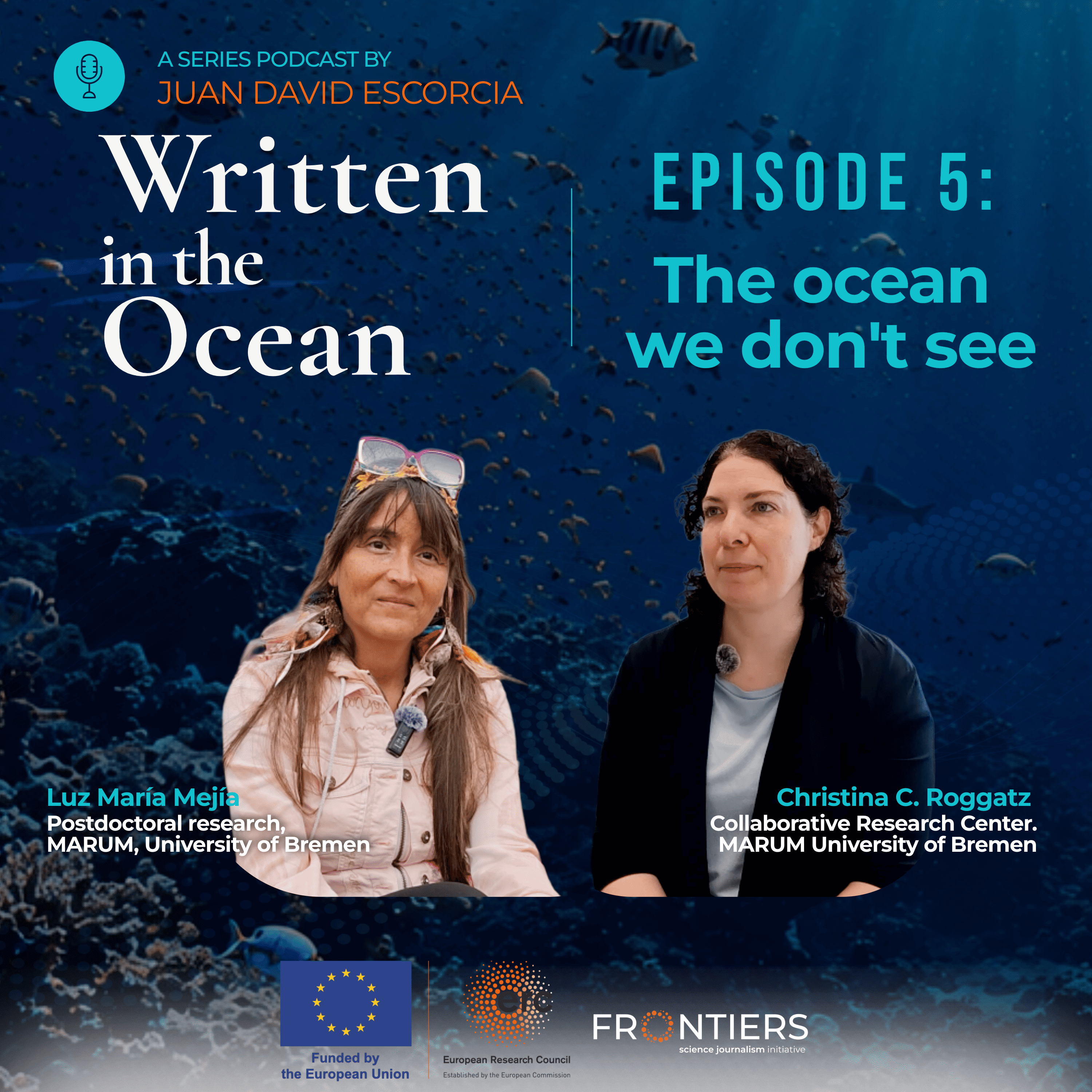
The Ocean we don't see
What if the most important things happening in the ocean are the ones we cannot see? Half of every breath you take comes from the ocean. But what happens inside that system — at a microscopic level — is almost entirely invisible to us. This episode takes us to three places from everyday life: a kitchen and a concert hall. Each one is a window into a different invisible process happening right now in the ocean. Doctor Christina Roggatz, researcher at the CONCENTRATE Collaborative Research Center at MARUM, studies the sugar molecules that algae produce during photosynthesis — and why bacteria don't always eat them. The answer to that question could reshape how we understand carbon storage in the deep ocean. Doctor Luz María Mejía-Ramírez studies microscopic algae called coccolithophores — single-celled organisms that produce tiny calcite shells, sink to the ocean floor when they die, and carry in their chemistry a record of past ocean temperatures. She is the first scientist to apply clumped isotope analysis to these organisms, opening a new window into the climate history of our planet. The ocean is working for us every day. This episode explains how, and why it matters more than ever. Written in the Ocean was produced as part of the FRONTIERS Science Journalism Fellowship, funded by the European Research Council under the European Union's Horizon Europe research and innovation programme. Info. The residency was carried out at MARUM, Center for MArine ENvironmental Sciences at the University of Bremen. Info. Disclaimer: The background image was generated using Leonardo.ai. All other design elements, including text and layout, were created using conventional editing tools.