
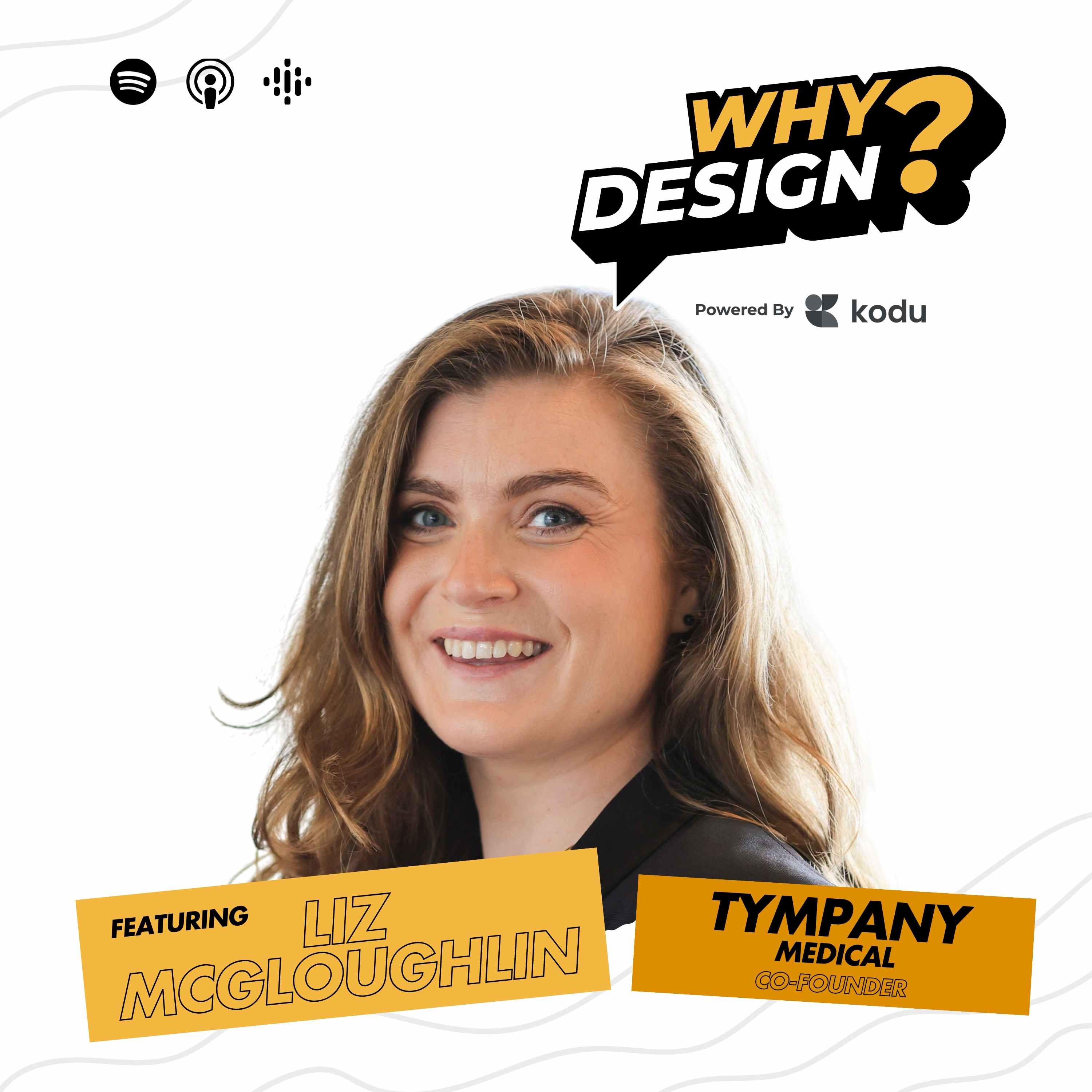
Why Nobody Fixed This $12 Billion Surgical Problem, Until Now | Liz McGloughlin
Streams straight from the publisher. podnod never proxies or re-hosts episode audio.
What does it take to redesign a surgical instrument that nobody has touched in sixty years?
In this episode of Why Design?, Liz McGloughlin shares the belief that sits at the heart of her work: that hardware problems worth solving are the ones nobody has bothered to solve yet, and that the best place to find them is not a trend report but an operating room.
Rather than following a conventional route into medical devices through engineering alone, Liz brought a clinical lens to a design problem, co-founding Tympany Medical after watching surgeons work around tools that were slowing them down, damaging their bodies, and limiting what they could see.
That decision led to a startup building the first variable-angle, single-use rigid endoscope platform, backed by clinicians at some of the most respected hospitals in the world.
This conversation is not about disruption for its own sake.
It is about the discipline of needs-led innovation: what it means to validate a problem before you fall in love with a solution.
It is about building hardware in a jurisdiction that gives you support but not quite enough, and staying in the game anyway.
It is about what kind of person survives the founding years of a medical device company with two small children at home and no desire to work weekends.
Listen in on this exclusive episode.
Join the Why Design? community - teamkodu.com/whydesign
What You'll Learn
- 🔬 Why needs-led innovation, not trend spotting, produces the problems worth solving in MedTech.
- 🛠 How the MVP model must be reframed in a regulated industry, and what the real test cycle looks like.
- 💡 Why customer conversations in 2023 narrowed Tympany's engineering roadmap and made the product more attainable.
- ⚖️ What it actually costs to be a hardware founder with young children, and why delegation is a pay equity issue.
- 🏥 How to build clinical credibility from Galway with surgeons at Mayo Clinic, UPenn, and Johns Hopkins.
- 🤝 What Liz looks for in early hires, and why character and cultural instinct matter more than CV at the founding stage.
Memorable Quotes
"I fundamentally believe that if we stop developing hardware, we're ghosts."
"Instinct is a combination of knowledge and a community around you. I don't think it happens in isolation."
"The first people in the door are make or break."
"Keep talking to your customers. We were sending prototypes to clinicians, and we still couldn't nail whether we were getting it right. You have to keep going back."
"I sat in the front room of a house with no furniture, on the phone to Rory, and I thought: hold on, this could go anywhere."
Resources and Links
🎧 Listen on Spotify, Apple Podcasts, YouTube and Amazon - whydesign.club
👥 Join the Why Design? community - teamkodu.com/whydesign
📸 Follow @whydesignxkodu on Instagram
🎥 Watch full episodes - https://www.youtube.com/@whydesignpod
🔗 Follow Chris Whyte - linkedin.com/in/mrchriswhyte
🔗 Explore Tympany Medical - tympanymedical.com
🔗 Connect with Liz McGloughlin - https://www.linkedin.com/in/liz-mcgloughlin/
About the Episode
Why Design? is powered by Kodu, a specialist recruitment partner for the hardware and physical product development industry.
Through honest conversations with designers, engineers and creative leaders, we explore not just what they build but why they build it; the beliefs, decisions and responsibility behind meaningful work.
About Kodu
Why Design? is produced by Kodu, a recruitment partner for ambitious hardware brands, design consultancies and product-led start-ups.
We help founders and leadership teams hire exceptional talent across industrial design, mechanical engineering and product leadership bringing structure and clarity to one of the hardest parts of scaling.
🔗 Learn more - teamkodu.com
teamkodu.com/whydesign
teamkodu.comwhydesign.club
whydesign.clubInstagram
instagram.comhttps://www.youtube.com/@whydesignpod
youtube.comlinkedin.com/in/mrchriswhyte
linkedin.comtympanymedical.com
tympanymedical.com

- 0:00Introduction
- 0:38Clinical immersion and the Bioinnovate programme: seeing the gap in the operating room
- 1:40What surgeons were actually doing: changing tools to change angles
- 3:09The surgeon who had been thinking about the same problem the night before 04:06 Why conviction that you can fix a problem is nonlinear
- 4:06Why conviction that you can fix a problem is nonlinear
- 9:21Tympany Medical: the elevator pitch
- 10:13Why Design? is treated as a nice-to-have in medtech, and what that costs
- 11:33Why science and engineering dominate medtech funding while design gets squeezed
- 13:00How to defend design choices when regulatory pressure pushes toward compromise
- 14:00Competing with sixty years of entrenched technology and why clinicians do change
- 14:25The case for single-use: why just making the same product disposable is not enough
- 15:52The ergonomic dividend: discovering the product was dramatically lighter than expected
- 17:25Why the weight was always going to drop: camera at tip vs camera at back
- 17:40The one design principle worth stealing: keep talking to your customers
- 18:08How customer conversations in 2023 narrowed the engineering roadmap from ten angles to two
- 19:29Why MVP works differently in medical devices
- 20:44What defines Tympany as a company: disciplined de-risking, not romantic instinct
- 21:22The hardest market quantification problem in medtech: instruments and tools
- 23:41Hardware is hard, and why that matters
- 24:51The biggest surprise in turning clinical need into a fundable business
- 26:32Enterprise Ireland, the commercialisation fund, and how the Irish ecosystem works
- 29:20The Disruptive Technology Innovation Fund and building a consortium
- 31:38What Liz learned about herself through the process
- 33:06Founding a company while becoming a parent: two children under seven
- 34:56How Liz balanced it all: the honest version
- 38:10The real cost of delegation, and why female founders need to be paid more
- 39:37Team structure at Tympany: twelve people, lean, and growing
- 40:34Why Liz moved from founding CEO to clinical and strategy role
- 41:18What you can accomplish with a small team when you have to
- 42:04Remote work and hardware: why presence matters in product development
- 43:29Healthcare course applications tripling in Irish universities
- 45:23Location and hiring: Galway, the housing crisis, and the medtech talent pool
- 47:15Early hiring mistakes and why instinct about culture fit matters more early on
- 49:36Character and soft skills in a founding-stage team
- 50:38Hiring experienced people into a young company: VP of R and D and the board
- 51:31Convincing Charlie Wilhelm, former COO of Karl Storz USA, to chair the board
- 53:48Building US clinical relationships from Ireland: UPenn, Mayo, Johns Hopkins, Imperial
- 54:18The one interview question Liz relies on: tell me about yourself
- 56:36What kind of person thrives at Tympany and what kind struggles
- 58:35Roles Tympany is hiring for over the next twelve months
- 59:59The mission: rigid endoscope technology as the standard of care for rigid visualisation