Skip to content
Artwork for TODOS Podcast

TODOS Podcast

TODOS Mathematics for ALL

The TODOS: Mathematics for ALL Podcast amplifies the mission of TODOS through conversations exploring the intersection of mathematics education, social justice, and identity.

Season 5 brings together in new host Shakiyya Bland to join Theodore Chao and Shari Kaku as they explore the TODOS publication, Antiracist Mathematics Education: Stories of Acknowledgement, Action, and Accountability. Each episode features conversations with select book's chapter authors, diving into the ideas, stories, and classroom realities behind the work. The season is organized around the book's four sections: Students, Administrators, Teachers, and Parents/Caregivers & Community Members, and serves as an audio companion for the TODOS Book Club, running from September 2025 through June 2026.

Join us in these conversations, these personal narratives, grounded in the real experiences of people doing this work. Whether you're reading along with the Book Club or simply curious about what it looks like to teach mathematics with equity and justice at the center.

Whether you're an educator, advocate, or simply curious about how math intersects with identity and justice, the TODOS Podcast invites you to join these conversations and explore the transformative power of mathematics to uncover hidden narratives, foster solidarity, and reimagine equitable education.

Thank you to Dr. Maria Zavala, founder and previous host of the TODOS: Mathematics for ALL podcast. And special thanks to Vector Hold for the amazing synthwave music.

Join the TODOS Book Club and keep listening to the TODOS podcast!

Bonus content, such as transcripts and files for Season 5 can be found here.

Play
  • 21 episodes
  • Avg 55 min
  • English
Counted on this page — what you have heard stays on this device, so it is not something the list can be paged by.
  • S5 · E8
    August 25 · 1 hr 8 min

    S5E8 TODOS Book Club with Luz Maldonado Rodríguez and Monica Gonzalez

    This is it, the last episode of Season 5! Theodore, Shari, and Shakiyya close out the season with a conversation about the TODOS Book Club, the year-long companion project that ran alongside the podcast all season. Theodore and Shari sit down with Luz Maldonado Rodríguez, a professor at Texas State University and longtime chair of the TODOS PD Committee, and Monica Gonzalez, a professor at East Carolina University and author of a new book on equity in elementary math instruction. Both are Texans, and both have known Theodore for years through TODOS work. Luz and Monica walk through how the book club came together, starting from a publicity committee meeting where the idea first came up, through a board pitch at the TODOS Conference at Cal State Fullerton. The book club became four online sessions built around the book's five sections culminating in a session at the TODOS conference. They talk about the choices that shaped it: keeping sessions unrecorded so people could speak freely, using the discussion questions the chapter authors had already written, and eventually inviting those same authors to join live so members could ask questions beyond what came up on the podcast. They also get honest about what worked and what didn't, like realizing an hour wasn't nearly enough time once people started digging into an action step, not just a discussion. The biggest takeaway: Community. Luz talks about how the book club, like TODOS itself, gives people a place to talk about math inequity with others who already get it, without having to explain or convince anyone first. Monica and Luz also thank the long list of PD committee volunteers: Josh Males, Kyndall Brown to Rosa Chávez, Crystal Kalinec-Craig, Dee Crescitelli, Kelly Costner, Karen Recinos, and Bob McDonald, who kept the sessions running behind the scenes. Of course, no TODOS episode wraps without food. Luz talks about growing up crossing the border from El Paso for pan dulce, and how she still can't resist the tray-and-tongs bakery experience whenever she finds it. Monica shares how moving to North Carolina meant giving up fresh HEB tortillas, so she taught herself to make her own, and now it's the one thing everyone in her life asks her to bring. Before signing off, Luz and Monica each share a guiding phrase. Monica keeps a Maya Angelou quote on her office door: do the best you can until you know better, and when you know better, do better. Luz's comes from Dr. Erika Bullock's work on systemic change in math education: we've been asking the wrong question. In the reflection that follows, Teddy, Shari, and Shakiyya look back on the whole season, from the authors they interviewed to the book study itself as a model for how educators can learn from each other's stories. It's a warm, grateful send-off to a season built on connection. Thank you to everyone who listened this year. If this episode has you curious about the book itself, Antiracist Mathematics Education: Building a Practice of Equity and Justice is available through TODOS, and you can catch up on any Season 5 episode you missed wherever you listen to podcasts.

    • Transcript
  • S6 · E7
    June 23 · 1 hr 1 min

    S5E7 Editing the Antiracist Mathematics Education Book

    In this episode, hosts Teddy Chao, Shari Kaku, and Shakiyya Bland sit down with the editorial team behind Antiracist Mathematics Education: Building a Practice of Equity and Justice, the TODOS publication that anchors this entire season of the podcast. It turns out this is the first time the four editors have been together since the book came out, and that reunion energy carries through the whole conversation. Teddy calls the book a love letter to the TODOS community, and it shows. Linda Fulmore, who led the project and was TODOS president when the work began, traces the book back to the 2020 antiracist mathematics statement, written in the middle of the pandemic and in the wake of George Floyd's murder. Marilyn Strutchens, professor of mathematics education at Auburn University, describes how she pulled the rest of the editorial team together in a single ten minute phone call. Gladys Krause, of William and Mary, led the student section after volunteering with immigrant high schoolers who were not getting math instruction because their schools focused only on English. Dorothy White, University of Georgia, took on the parent section and speaks openly about the risks of doing antiracist work in a state where the word itself has become contested. Along with Jennifer Bay-Williams, the editors walk through how the book is organized, by students, teachers, parents, administrators, and community members, and why they built it so any chapter can stand on its own. Dorothy even jokes that you can read it backwards if you want to, choose your own adventure style. They talk about asking authors to root their writing in the original 2020 statement, about the discussion questions placed at the end of each chapter so readers can use the book in classrooms and book clubs, and about wanting a text that amplified voices rather than smoothing them over. Of course, no TODOS episode skips the food talk. Marilyn has just discovered smash burgers and is trying, unsuccessfully, to stay away from them. Gladys shares the story of her son in Austin smoking a brisket for Mother's Day. Linda is currently devoted to Trader Joe's tofu ice cream, chocolate syrup included, eaten within her intermittent fasting window. The conversation closes on legacy. Linda recalls telling the team that they had simply tried to do their part when it was their turn. Now that work passes to the next generation of TODOS leaders, including everyone listening. If this book has shaped how you show up for your students, your colleagues, or yourself, the editors hope you keep passing it on. Join us at the TODOS Conference, June 25 to 26, 2026 in Garden Grove, California, where this season's Book Club journey comes full circle.

    • Transcript
  • S5 · E6
    April 7 · 58 min

    S5E6: Equity Math Modeling with Delia Sotelo Fierros and Jennifer Suh

    What does it look like when elementary students use math to make sense of their own communities? In this episode, hosts Shari Kaku and Shakiyya Bland sit down with Dr. Jennifer Suh, Professor of Mathematics Education at George Mason University, and Delia Sotelo Fierros, a third-grade teacher in Tucson, Arizona, to dig into Chapter 9 of Antiracist Mathematics Education: Building a Practice of Equity and Justice: "Cultivating Equity and Empathy in Community-Focused Elementary Math Modeling." Jennifer and Delia are part of the EQSTEMM Project, an NSF-funded collaboration focused on equity in STEM education. Together, they explore how mathematical modeling can become a space for student voice, cultural connection, and genuine problem-solving when it's rooted in what kids actually know and care about. Delia opens up about her own journey as a first-generation Mexican American growing up in Arizona, where math meant speed and accuracy and nothing more. It wasn't until she encountered the concept of funds of knowledge as an undergraduate student at the University of Arizona that something shifted. Suddenly, she saw a different vision for what math class could be: a space where students' histories, families, and lived experiences don't wait at the door. She shares how something as simple as Monday morning catch-up conversations, or swapping out textbook names for students' family members, can transform engagement for kids who rarely see themselves in the curriculum. Jennifer traces her own path from lesson study to the EQSTEMM project, and reflects on what it meant to grow up in spaces where her culture was never really invited in. She lifts up the work of their co-author and math coach Holly Tate, whose lesson around indigenous land loss in Virginia shows just how deep math modeling can go when it's paired with historical awareness and civic engagement. Second graders weren't just learning about area. They were reckoning with real stories of land taken from Native nations, and they got to hear from a member of the tribal council directly. The conversation also touches on what it means to shift your own math identity. Delia reflects on moving from "I follow the steps correctly" to "I am a problem solver," and why that shift matters for the students she teaches now. Jennifer reminds us that cultural humility has to accompany all of this: you can't know every child's world, but you can stay curious. Jenn closes with a story about eating Tteokguk, Korean rice cakes, every New Year, and also imperfections when her family makes dumplings, which is the whole point. Delia makes the case for Tucson's 23 miles of Mexican food and recommends Antojo Poblano for dishes from Puebla. Finally, before you go, write this down: Look around you. Where do you see math? Don't miss the hosts' reflection at the end of the episode. And mark your calendars for the TODOS Conference, June 25-26, 2026 in Garden Grove, California!

    • Transcript
  • S5 · E5
    March 3 · 52 min

    S5E5: Cracking the Code with Sylvia Celedón-Pattichis, Carlos LópezLeiva, and Marios Pattichis

    What happens when mathematics, computer programming, and bilingual education come together in an afterschool program for Latine elementary students? And what does it look like when those same kids become the teachers? In this episode, Theodore sits down with three co-authors of Chapter 10: Learning More Mathematics by Cracking the Code: Promoting Algebraic Thinking through Computer Programming from Antiracist Mathematics Education, Dr. Carlos LópezLeiva, Dr. Sylvia Celedón-Pattichis, and Dr. Marios Pattichis. Together, they share the story behind AOLME (Advancing Out-of-school Learning in Mathematics and Engineering), a program born out of the belief that students in Title I, bilingual communities deserve access to the same doors that computer science and engineering can open. The conversation traces a 20-year arc, from the early days of CEMELA and the inspiration of La Clase Mágica, to after-school programs where kids used Legos to understand pixels and came up with their own ways of explaining hashtags and coding syntax, in Spanish, in English, and in their own language. One student, a decade ago, looked at a computer and said, "computer, write me a program." He was right on time with predicting how we use AI to code today. What makes this episode special is how personal it gets. Marios learned to code from an English textbook while he was still learning English. Sylvia and Carlos made the push to bring this work from out-of-school spaces into classrooms, so it wouldn't just reach the kids who chose to show up. The students who went through the program came back as co-facilitators, teaching older students, building identity, and in some cases going on to study engineering. And their daughters were part of the story too. Shari, Shakiyya, and Teddy then reflect on what this chapter means for the moment we're in now, a moment when AI is everywhere and the math education community is still figuring out how to respond. Should students be coding? Should we be teaching them to think critically about the systems being built around them? And what does it look like to use mathematics not just to solve problems, but to create something? Shakiyya closes with a question from page 140 of the book: "How often do your students use mathematics to create something?" Plus, the food! Huevos rancheros, red and green chile, chicken mole enchiladas, Greek salad with New Mexico chili, and piñon coffee! This episode is part of the Season 5 TODOS Book Club series, aligned to the Teachers section of Antiracist Mathematics Education. The next Book Club meeting is March 25. Join us! The transcript. Links to Resources: Web App for Image Generator http://ivpcl.unm.edu/ivpclpages/Research/aolme/app/interactive-img-v2.html AOLME/ESTRELLA Curriculum https://aolme.unm.edu/WebsiteModel/template/index.html AIML Project: https://github.com/pattichis/AIML https://github.com/pattichis/AI4All-Med

    • Transcript
  • S5 · E4
    February 3 · 53 min

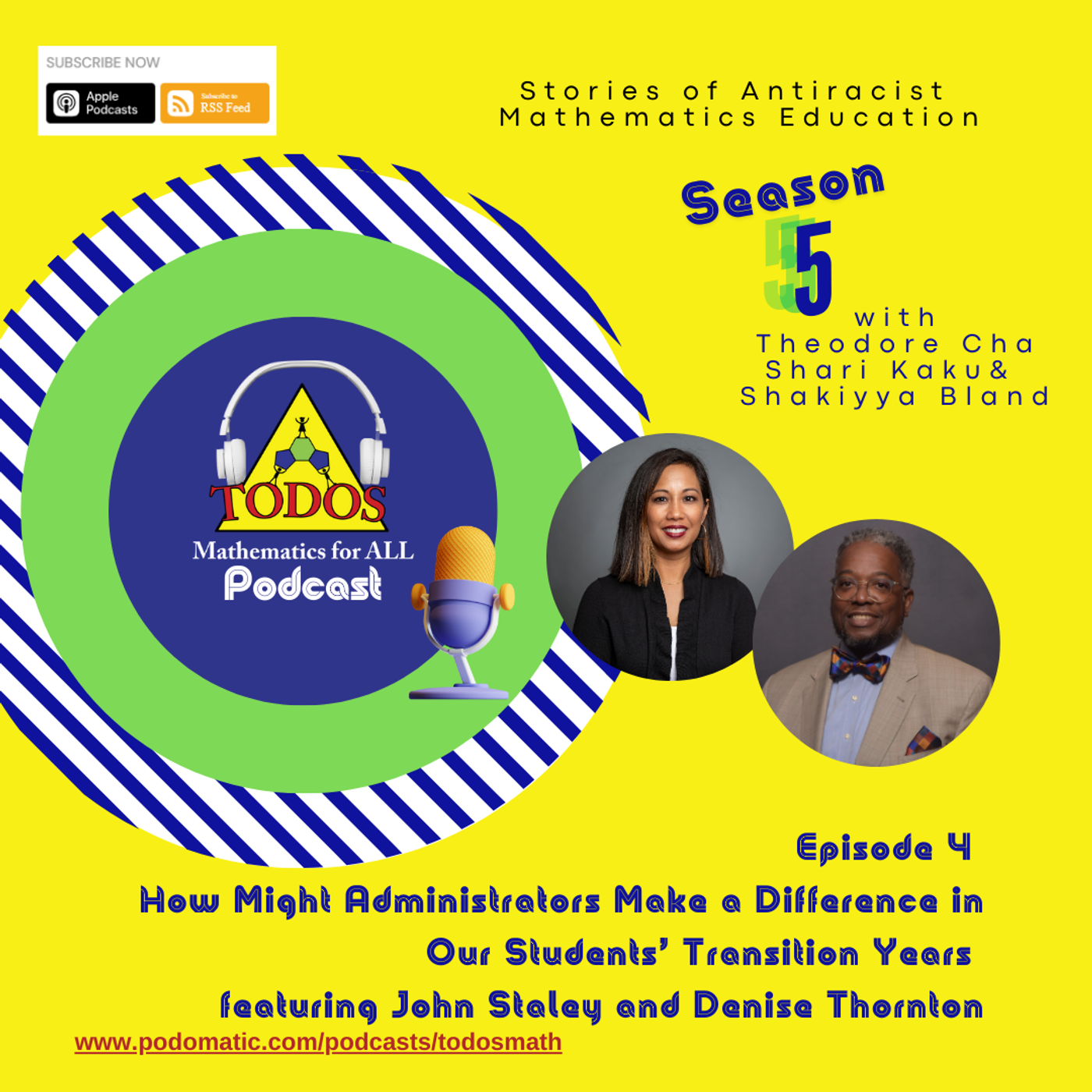
    S5E4: How Administrators Make a Difference with John Staley & Denise Thornton

    In this episode, John Staley and Denise Thornton share how administrators can create antiracist mathematics spaces by prioritizing relationships and showing up for students. John reflects on his early teaching at a juvenile correctional facility, where he learned that it's not about the math topics but about the students you teach. Denise shares how her student Natalia shaped her understanding of barriers students face and the power of believing in their potential. Together, they discuss practical ways educators can connect with students outside the classroom, from attending soccer games to shopping at local grocery stores, and why these small moments matter for building trust and dismantling math trauma. They also explore how administrators can support authentic family engagement and examine the beliefs that shape student experiences. Resources Mentioned Launch Years Initiative Launch Years Math Organizations Leadership Network Dana Center Transition-Year Resources The Season 4, Episode 4 transcript.

  • S5 · E3
    Nov 18, 2025 · 45 min

    S5E3: Grounded in Place with Guadalupe Lozano

    In this episode, we delve into the world of place-based mathematics education with Guadalupe I. Lozano, author of Grounded in Place: A Culturally Affirming Precalculus Curriculum, the first chapter in the TODOS Antiracist Mathematics Education book. New host, Dr. Shakiyya Bland joins Shari Kaku to discuss the importance of integrating cultural narratives and community connections into math teaching and exploring how these elements can transform educational experiences. Dr. Lozano shares insights on creating a curriculum that builds from students' identities and the land they inhabit, offering a fresh perspective on the role of mathematics in our lives. Dr. Lozano also mentions a few other pieces of her writing: A forthcoming book called Being and Becoming to Change the World, not Toward Embodying Critically Conscious Mathematics Teaching and a forthcoming book chapter available now, Towards Embodying Critical Conscious Mathematics Teaching: Tools, Craft, and Practices, that extends on this work and is availably here. And, the Season 5 Episode 3 Transcript Available here.

  • S5 · E2
    Nov 12, 2025 · 46 min

    S5E2: Enacting Antiracist Teaching Practices through Math Modeling with Will Tidwell

    In this episode of the TODOS Podcast, Theodore Chao and Shari Kaku engage in a profound discussion with Dr. Will Tidwell about the intersection of mathematical modeling and social justice. Dr. Tidwell was part of the authorship team of Drs. Cynthia O. Anhalt, Ricardo Cortez, and Brynja Kohler who wrote Chapter 4, “Enacting Antiracist Teaching Practices Through Mathematical Modeling” for the TODOS Book, “Antiracist Mathematics Education”. Listen as they explore the historical context of Native American land rights, delving into a conversation around how mathematical modeling can illuminate societal injustices and engage educators to foster critical thinking. Join us as we honor Native American History Month and reflect on the transformative power of culturally relevant mathematics education. Full Transcript of S5E2.

  • S5 · E1
    Nov 4, 2025 · 16 min

    S5E1: Teaser

    In this first episode of Season 5 of the TODOS podcast, hosts Theodore Chao, Shakiyya Bland, and Shari Kaku introduce themselves and discuss their backgrounds in education and advocacy. They delve into the theme of Antiracist Mathematics Education, which connects to the recent book published by TODOS. And they emphasize the importance of community engagement and diverse perspectives in shaping math identity. The conversation highlights the significance of storytelling and personal narratives in education, and the hosts express excitement for future discussions and collaborations within the TODOS community. Welcome to Season 5! Episode 1 Transcript.

  • S4 · E16
    Oct 14, 2025 · 1 hr

    S4E16 Season 4 Reflection

    In this reflection episode of the TODOS podcast, hosts Theodore Chao and Shari Kaku discuss their experiences and insights from focus on Asian American identity within mathematics education. They explore the impact of the Teaching for Justice Conference, the implications of the model minority stereotype, and the importance of storytelling in mathematics education. This emotional conversation highlights personal narratives, the challenges faced by Asian American mathematics educators, and the need for community and social-emotional learning in math education. Thank you for joining us on our journey into podcasting and telling stories long hidden in our field. Transcript can be found here.

  • S4 · E15
    Jul 15, 2025 · 1 hr 5 min

    S4E15: Susie Håkansson

    In this powerful episode of the TODOS Podcast, legendary mathematics educator Susie Håkansson opens up about her Chinese American identity and what it was like growing up as a Toisan American in 1940s–50s Los Angeles. A pioneering leader with over 60 years of leadership in mathematics education, Susie shares how her cultural identity shaped her journey as a teacher, mentor, and advocate. Tune in to hear deeply personal reflections on invisibility, resilience, and how one woman helped build a more just and equitable world in mathematics education. This is our last interview episode of the season, an interview that we've been wanting to do for more than 20 years! Transcripts for this episode are in this folder.

  • S4 · E14
    Jun 17, 2025 · 1 hr 10 min

    S4E14: Rebalancing Math Education with Niral Shah

    Dr. Niral Shah joins the TODOS Podcast to explore the complexities of Asian American identity in mathematics education. Reflecting on his experiences as a South Asian student and teacher, Shah unpacks how racialized narratives like the model minority myth both hypervisibilize and dehumanize Asian learners. He introduces the metaphor of a “bubble level” to describe how racial discourse positions Asian and Black students at opposite ends of a spectrum, with whiteness centered as the norm. The conversation delves into Shah’s research on race and STEM, including his Harvard Educational Review article “Asians Are Good at Math” Is Not a Compliment, and is informed by thinkers such as Vijay Prashad, W.E.B. Du Bois, and Zeus Leonardo. Shah also shares a parenting story about his son calling out white supremacy on the playground, offering a vision of anti-racism grounded in nuance and empathy. This episode addresses classroom practice, intra-Asian diversity, anti-Blackness, and the importance of moving beyond binaries to humanize all students. Episode transcript is here. Reflection transcript is here.

  • S4 · E13
    May 20, 2025 · 56 min

    S4E13: Home is the Pacific Islands with Richard Velasco

    In this powerful episode, Dr. Richard Velasco shares his journey from Guam to the U.S. mainland and back—through teaching, research, and a deep sense of purpose. As a Filipino Guamanian mathematics educator, Richard reflects on growing up in a U.S. territory, navigating racialized spaces in predominantly white communities, and now leading a groundbreaking data science project that centers indigenous values and local knowledge in Guam and Saipan. We talk about military occupation, decolonizing data, the meaning of Inafa’maolek, and what it truly means to give back. Transcripts are available here.

  • S4 · E12
    Apr 15, 2025 · 1 hr 3 min

    S4E12: Teaching, Community, and Change with Bobson Wong

    What does it mean to build authentic, sustaining communities as a math educator—and why is it so hard to find those spaces? In this episode, we talk with Bobson Wong, a high school math teacher, local and national educational leader, and author of The Math Teacher’s Toolbox, about his ongoing journey through teaching, identity, and advocacy. Bobson reflects on how community has played a central role in his growth as an educator—from finding support through Math for America to pushing for systemic change at the state level in New York. He introduces a powerful three-part vision of community: spaces for emotional support, spaces for professional development, and spaces for enacting educational policy. We also dig into the isolation many teachers face, the invisibility of Asian American educators, and the importance of being able to show up fully—without having to explain yourself. Along the way, Bobson shares how ideas about language, culture, and yes, bean soup, inform his thinking about what it means to teach, to lead, and to stay connected. If you’ve ever craved a deeper sense of belonging in your work, this episode is for you. Transcripts are available here.

  • S4 · E11
    Mar 18, 2025 · 57 min

    S4E11: The Role of Hope with Francis Su

    In this episode, we sit down with renowned mathematician Francis Su to explore the intersections of Asian American identity, mathematics, and visibility. As the first non-white president of the Mathematical Association of America and author of Mathematics for Human Flourishing, Francis shares his personal journey—from grappling with stereotypes to discovering the joy of mathematics through inquiry and community. We also discuss the model minority myth, the power of belonging in math spaces, and why math should be about human connection, not just achievement. Plus, we chat about about red bean buns, childhood nostalgia, and food memories! To learn more about Francis's work and to get a copy of his book (in multiple languages), go here: https://www.francissu.com/ Transcripts for this podcast can be found here.

  • S4 · E10
    Feb 13, 2025 · 1 hr 15 min

    S4E10: Asian American Math SiSTARhood with Kari Kokka

    What happens when three Asian American women math educators come together to reflect on their journeys, activism, and the role of mathematics in justice? In this powerful episode, Dr. Kari Kokka—math educator, social justice advocate, and former high school teacher—joins hosts Shari Kaku and Michelle Lo for an inspiring conversation about searching for our own stories, math identity, and community organizing. From her experiences growing up in diverse San Jose, to teaching in New York, to her deep commitment to solidarity and reparations work, Dr. Kokka shares how mathematics can be a tool for justice. Join us for a discussion covers everything from Asian American identity in math education to the importance of centering students’ voices and lived experiences in the classroom. And to learn more about the many resources on this episode, check out these links: Red Cards for knowing our immigrant rights: https://www.ilrc.org/red-cards-tarjetas-rojas SEARAC: https://searac.org/ Tsuru for Solidarity: https://tsuruforsolidarity.org/ Social Justice Math Resources: www.mathsocialissues.com A Love Letter to Women, Femme, and Nonbinary Critical Scholars of Color: Theorizing the Four I’s of Love in SiSTARhood by Kari Kokka, Rochelle Gutiérrez, and Marrielle Myers (the article, so email Dr. Kokka if you would like a copy) https://journals.sagepub.com/doi/abs/10.1177/10778004241269909?download=true&journalCode=qixa) Critical Math Drop Podcast: www.criticalmathdrop.com

  • S4 · E9
    Feb 13, 2025 · 1 hr 15 min

    S4E9: Unfolding the Beauty of Math with David Masunaga

    David Masunaga, geometry education expert, MC Escher enthusiast, and origami aficionado, shared his passion and creativity for student thinking in the classroom with Teddy and Shari. In this episode, David delves into his journey as an Asian American educator in Hawaiʻi, reflecting on the cultural forces that shape who gets to teach math, the untold stories of his own Asian American teachers, and the beauty of mathematics as a shared experience. We ask why haven’t more people heard of David Masunaga? And what can we learn from his deep, thoughtful approach to math education? And, please click on these links to learn more about the work that David does! The 17-sided symmetrical pattern tie that David references can be seen here and here. And, here's David making making one modular origami box, putting the boxes together, and then fusing a large group of boxes together at the Museum of Math. Finally, here's a video of David using a Basho haiku to promote his NCTM session this spring. Transcripts for this episode are here.

  • S4 · E8
    Jan 21, 2025 · 1 hr 1 min

    S4E8: Solidarity with L.A. Teachers Eugene Hung and Janet Lee Ortiz

    We change things up this episode. Due to the devastating wild fires in Southern California, we take some time to connect with two L.A.-based Asian American Mathematics Teachers. We start our conversation with Eugene Hung, a high school math teacher and advocate for women's rights. Then, we connect with Janet Lee Ortiz, LAUSD’s Teacher of the Year and a middle school math and science educator. Both educators share their deeply personal journeys navigating teaching in Southern California amidst recent wildfires and reflect on how their Asian American identities shape their approaches to math education. Eugene discusses breaking down stereotypes, fostering inclusivity, and emphasizing the historical and cultural contributions to mathematics. Janet opens up about overcoming personal challenges, connecting math to social justice, and building meaningful relationships with students through authentic storytelling and creativity. Together, they discuss their passion for making math human, relevant, and engaging. And finally, they share about their love of food, culture, and community. Transcripts of this episode are available here.

  • S4 · E7
    Dec 17, 2024 · 1 hr 3 min

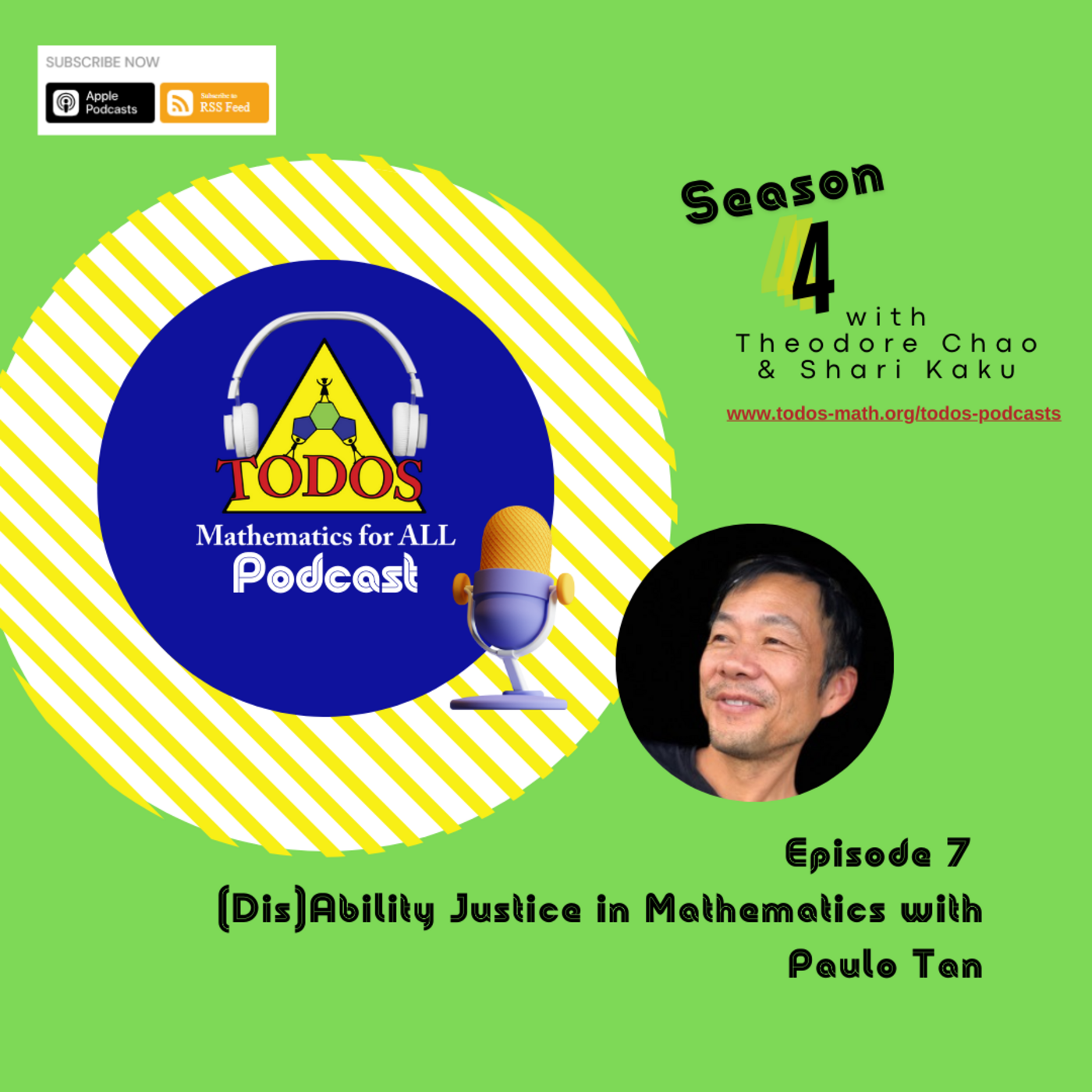
    S4E7: (Dis)Ability Justice in Mathematics with Paulo Tan

    In this episode, Dr. Paulo Tan shares his powerful journey as a critical special education math educator navigating Asian American identity, assimilation, and advocacy for disability justice. Together with hosts Theodore Chao and Shari Kaku, Paulo reflects on the systemic inequities of mathematics education, the isolation of marginalized students, and the need for a revolutionary shift toward truly inclusive and humanizing classrooms. From personal stories of his immigrant experiences to reimagining "math of all students," this episode challenges listeners to rethink ableism, stereotypes, and what it means to agitate for justice in math education. Transcript for the main session is here. Transcript for the reflection is here.

  • S4 · E1
    Nov 19, 2024 · 51 min

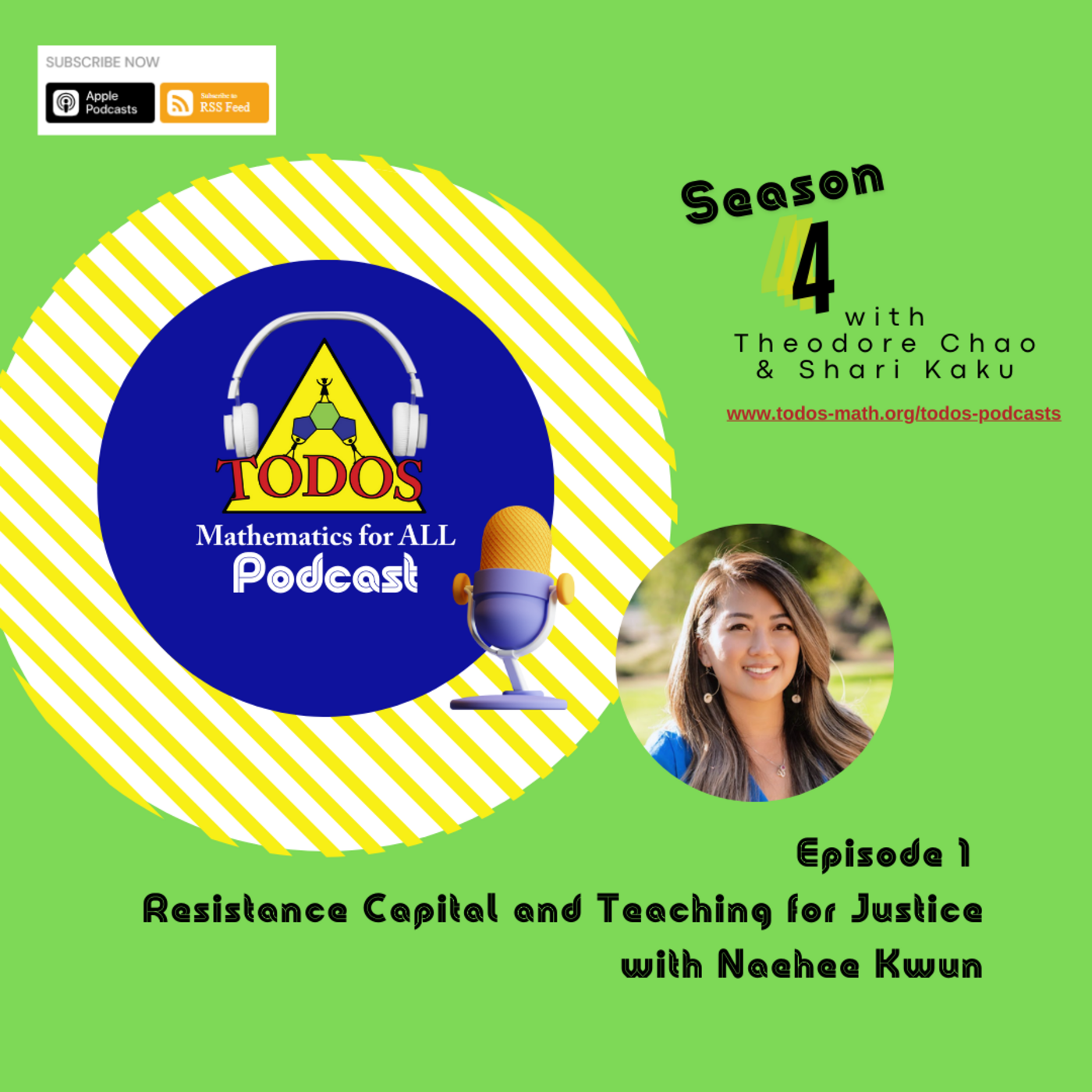
    S4E1: Resistance Capital and Teaching for Justice with Naehee Kwun

    The TODOS Podcast is back! Join us for a fresh new season with new hosts, Theodore Chao and Shari Kaku, as we dive into issues of equity in mathematics education through the lens of Asian American identity. In Episode 1, we chat with Naehee Kwun about her work as a social justice-oriented mathematics educator and one of the founders of the Teaching for Justice conference. Naehee also shares about her identity as a first-generation Korean American mathematics educator and the way she used Resistance Capital in her own mathematics journey. Learn more about Naehee's work at PoweredByMathematics.org.

  • S4 · E2
    Nov 19, 2024 · 1 hr 2 min

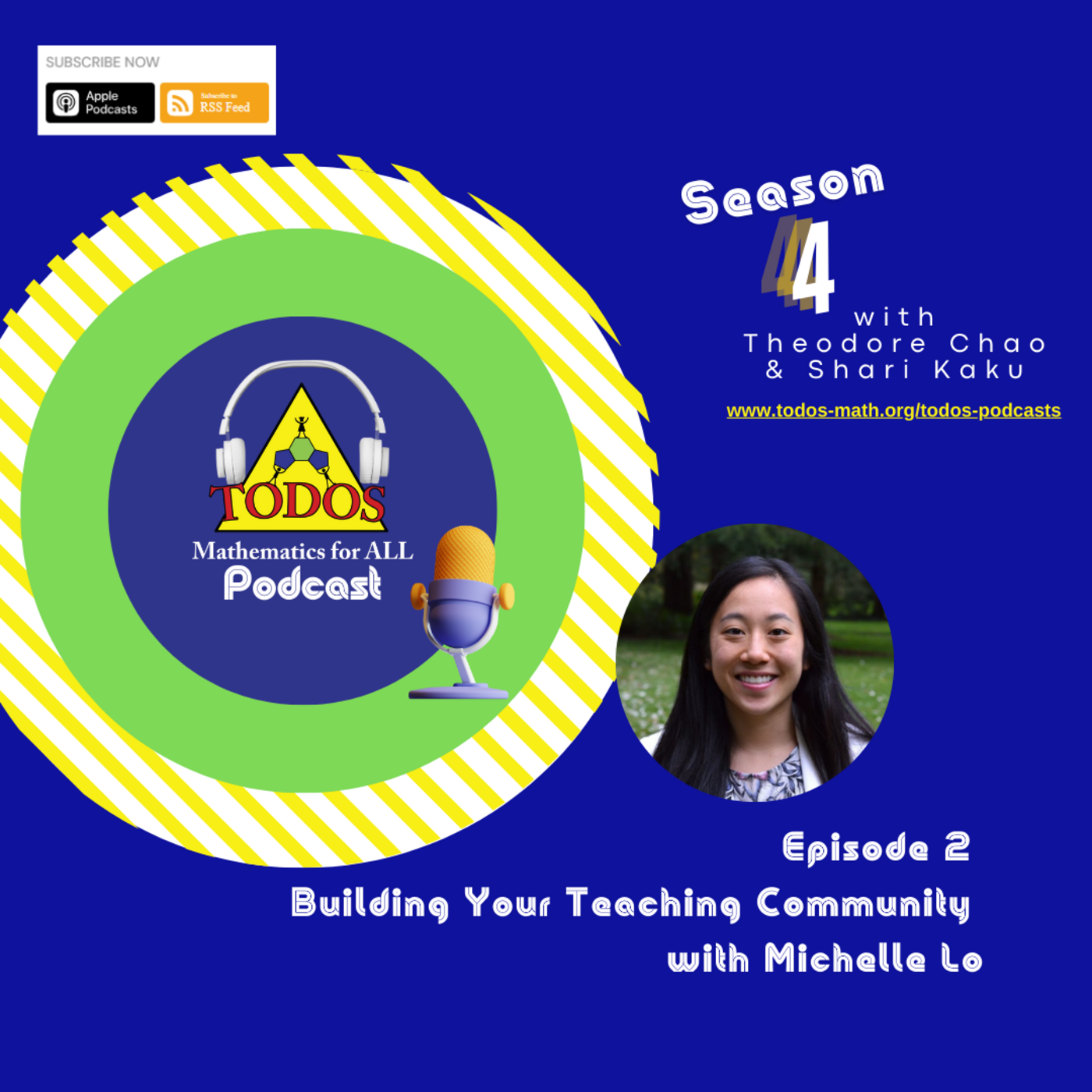
    S4E2: Building Your Teaching Community with Michelle Lo

    In Episode 2, high school math teacher and TODOS Member Services Director, Michelle Lo shares her journey as a second-generation Taiwanese American navigating identity and teaching. Michelle reflects on the impact of her upbringing, the pressures of the model minority myth, and her commitment to resisting traditional norms in the classroom. She discusses fostering a student-centered environment, building solidarity, and embracing the power of community spaces like TODOS and the miseducAsian Twitter collective. This thoughtful conversation explores how Michelle’s experiences as a student and teacher shape her work to deconstruct stereotypes and advocate for justice in education.

Showing 1–20 of 21 episodes