Skip to content
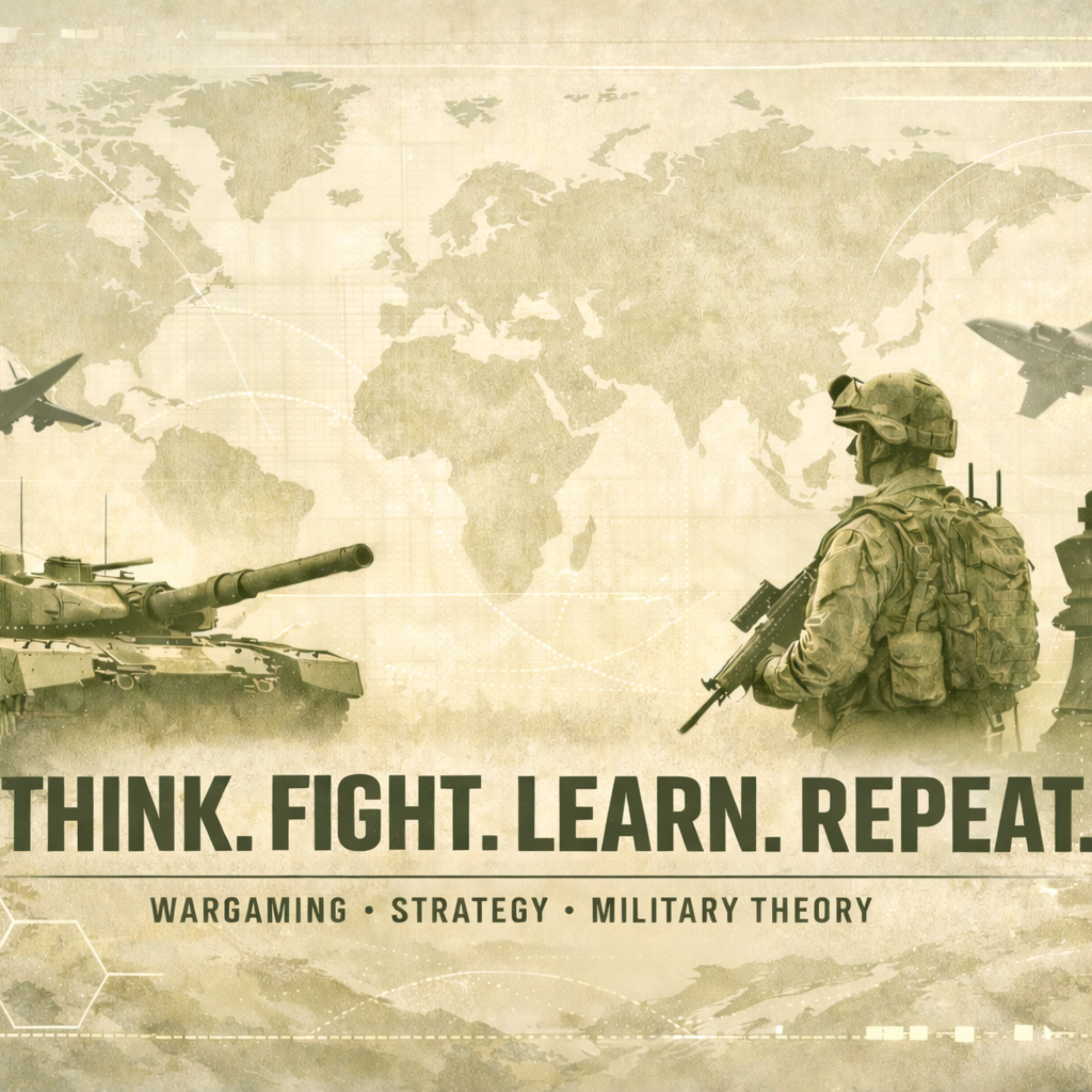
Artwork for Think.Fight.Learn.Repeat.
ScienceSocial Sciences

Think.Fight.Learn.Repeat.

Fight Club International

Think. Fight. Learn. Repeat. is a podcast dedicated to exploring wargaming, military theory, and strategy. In each episode, we speak with leading thinkers and practitioners in these fields to uncover their motivations, examine their ideas, and challenge conventional assumptions.

Learn more at www.fightclubinternational.org

Play
  • 18 episodes
  • weekly
  • Avg 44 min
  • English
  • August 30 · 1 hr 3 min

    John Boyd: A YouTube Personality in an Analog Age with Ian Brown

    Everyone knows John Boyd as "the OODA loop guy," but he was much more than that. In this episode, I sit down with Ian Brown, a Boyd historian who spent nearly a decade inside the archives poring over decades of briefings, transcripts, and slides to separate the man from the meme. We dig into why Boyd refused to publish a formal book, why he wouldn't let anyone walk away with his slides without sitting through the briefing, and why his 1976 essay, Destruction and Creation, and not the OODA loop, is the framework behind his thoughts and presentations. Drawing on Ian's two books, A New Conception of War and the newly released Snowmobiles and Grand Ideals, he makes the case that Boyd was never really finished thinking and that reducing him to four boxes and an arrow loses almost everything that made him worth listening to in the first place.

  • August 16 · 59 min

    AI, Command, and the Character of War with Dr. Anthony King

    In this episode, we sit down with Dr. Anthony King to discuss his new book, AI, Automation, and War, and what the rise of artificial intelligence actually means for the future of military command and conflict. Moving beyond the familiar “killer robots” narrative, Dr. King argues that AI is more likely to augment military decision making than replace human judgment. We explore how AI is being absorbed into the increasingly collective nature of modern command, whether algorithms could transform the relationship between commanders and staff, and whether human oversight risks becoming a rubber stamp.

  • August 9 · 36 min

    After Ukraine: Russia and the Baltics with Lt. Gen. Ben Hodges

    The war in Ukraine will end sometime, but what happens next? In this episode, retired Lt. Gen. Ben Hodges, former Commanding General of U.S. Army Europe, joins us to break down the next flashpoint on NATO's map: the Baltics. We discuss why he believes Crimea will decide the outcome of the War in Ukraine, why he calls Russia's nuclear threats a "myth" designed to freeze Western decision making, and whether that logic changes once you're talking about a NATO member state. We get into the hard geography of the Baltics and what Russia's Eastern Flank pressure campaign of drones, sabotage, and gray zone warfare really mean to NATO.

  • August 3 · 39 min

    Systems Theory and The Taiwan Contingency with Dan Rice - Part 2

    In part 2 of my conversation with Dan Rice, Co-Director of the US Marine Corps War College's China Warfighting Initiative, we go deeper into the doctrinal weeds and the stakes get higher. From the structural similarities between MDO and China's Systems Warfare approach, to the terrifying escalation ladder of striking dual-use targets on the Chinese mainland, this episode focuses on a difficult question - are we prepared for a moment where operational assumptions may prove false?

  • July 27 · 45 min

    The Taiwan Contingency with Dan Rice - Part 1

    In the first part of a two part episode, Lex sits down with Dan Rice, Deputy Director of the US Marine Corps War College's China Warfighting Initiative, to break down the doctrinal concepts underpinning how the PLA thinks about and plans for modern warfare, with a focus on the Taiwan Contingency. From Mao-era strategic principles to cutting-edge systems destruction warfare, Dan pulls back the curtain on how China's military thinks about conflict not as a clash of platforms, but as a competition between opposing operational systems, and why that distinction matters for how the US and its allies prepare.

  • July 18 · 33 min

    Sharpening the Sword - The Conception of Fight Club International with Arnel David

    What does it take to build a grassroots movement inside rigid institutions like Western Armed Forces? In this episode of Think.Fight.Learn.Repeat., we sit down with Colonel Arnel David, US Army Special Operations veteran, NATO strategist, and co-founder of Fight Club International (FCI), to trace his journey from Infantry Officer to Co-Founder. Arnel opens up about the frustration that sparked Fight Club and a hunch that commercial-off-the-shelf games and simulations could do more. From there, we discuss what makes Fight Club fundamentally different from traditional wargaming organizations, how a rankless, volunteer-run community became a testing ground for AI, LLMs, and unconventional strategy, and why he believes the confidence to be disruptive is in short supply in the military and beyond. We also talk about growing pains, like what happens when a grassroots idea scales faster than expected and how founders learn to lean on each other's strengths to keep the momentum going.

  • June 29 · 55 min

    Repurposing the British Army with Nick Moran

    Western Armies are trying to do too many things with too few resources. That's not a controversial statement, in fact it's the opening line of a paper that's been turning heads in defence circles since it landed in April 2026. In this episode, we sit down with Nick Moran, a 20-year British Army veteran who served in the Special Mission Unit community, with NATO, and alongside the Royal Gurkha Rifles, to dig into his RealClearDefense piece, "Repurposing the British Army." Nick argues that what's needed isn't a minor adjustment. It's a fundamental reframing of how the British Army thinks about itself. We get into the case for anchoring British force design to the Nordic region, why geography has to come before capability, and what Norway has to do with UK national security. We talk about the three master effects of land power: Hold, Turn, andStrike, and whether the British Army has quietly lost the art ofdefence after two decades of counterinsurgency. We also tackle the hardest question of all: how do you generate mass in war when you're running a professional army in peace? Nick also pulls no punches on conscription, the vague "three years to be ready" warning, and what the lessons of Ukraine actually mean for how Britain should be building its force today.

  • June 14 · 53 min

    Training for Arctic Warfare with Dylan Abbott

    The Arctic doesn't forgive mistakes, it punishes them. In this episode, I sit down with Dylan Abbott, an instructor at the Canadian Army's Advanced Warfare Centre, where he teaches Arctic warfare and survival. Dylan breaks down what it truly takes to operate in one of the most unforgiving environments on earth, from the core skills every soldier must master to the mindset required to keep going when the cold, the isolation, and the terrain are working against you. We cover the most common mistakes soldiers make when they first encounter the Arctic, why small errors can become life-threatening problems fast, how much equipment actually matters versus skills and discipline, and what modern forces still get wrong about operating in the high north. If you've ever wanted to understand what Arctic warfare really demands of the people involved, this one's for you.

  • June 4 · 35 min

    Task Force Maven with Col Arnel David

    What does AI actually look like inside the world's most powerful military alliance? As the Director of Task Force Maven at NATO's Supreme Headquarters Allied Powers Europe (SHAPE) Colonel Arnel David has spent years at the intersection of artificial intelligence and national defence. This week we discuss his team's efforts in aligning AI adoption across dozens of allied nations. In this episode, we go beyond the headlines. We break down what Task Force Maven really is, why multinational AI deployment is harder than it sounds, and what the ethical debates inside defence institutions actually look like, versus how they're portrayed publicly. If you've ever wondered how AI is reshaping modern warfare, deterrence, and alliance politics, this is the conversation to start with.

  • May 21 · 37 min

    Chinese Strategic Thinking with Phillip Colon

    How do historical assumptions shape strategic decisions and what happens when we get them wrong? In this episode, Phillip Colon, a wargame analyst at Group W, part of Systems Planning and Analysis, joins the podcast to explain why understanding China requires more than analyzing current events. We explore how China’s pre-modern political traditions, the Century of Humiliation, and the Chinese Communist Party’s interpretation of history continue to shape Beijing’s strategic behavior today. Phillip discusses the enduring influence of Confucianism and Legalism, the operational lessons of the Opium Wars and China’s internal conflicts, and why historical memory remains central to issues like sovereignty, legitimacy, and competition below the threshold of armed conflict. For military professionals, strategists, and anyone seeking to better understand China as a long-term competitor, this episode is essential to understanding the context behind modern Chinese decision-making.

  • May 11 · 38 min

    Multi-Domain Operations - From Concept to Practice with Col Elizabeth Pham - Part 2

    In Part 2 of our conversation with Colonel Elizabeth Pham, we go deeper into how NATO’s Multi-Domain Operations course is transforming the way warfighters think, decide, and act in contested environments. Colonel Pham explains how the course moves beyond doctrine and PowerPoint to immerse students in AI-enabled planning, kill web design, cyber and space integration, and resilient command and control. We discuss how students use tools like Maven Smart System to build and test real-time operational concepts under pressure such as fighting through cyber attacks, electronic warfare, satellite denial, and information manipulation. This episode also explores the human side of innovation, why changing mindsets is harder than adopting technology, how leaders build intuition in complex adaptive systems, and why future conflicts will be decided by action and decision advantage rather than platform superiority. If Part 1 introduced the vision, Part 2 shows how that vision is being turned into practical warfighting capability across the Alliance.

  • May 4 · 48 min

    Multi-Domain Operations - From Concept to Practice with Col Elizabeth Pham - Part 1

    What does it actually take to fight and win in a world where every domain is contested, data moves at machine speed, and decisions matter more than platforms? In this first part of a two part episode, we sit down with Colonel Elizabeth Pham, Director of Joint Plans and Operations at the NATO School in Oberammergau, Germany, to unpack how Multi-Domain Operations (MDO) is moving from concept to execution. Drawing on her experience from early U.S. Marine Corps experimentation with information warfare and “kill web” design to building NATO’s cutting-edge MDO course, Col Pham breaks down the real challenges of connecting sensors to shooters across cyber, space, maritime, land, and air, fast enough to matter in a fight. We explore the gap between doctrine and reality, why traditional planning processes fall short in contested environments, and how AI, data, and resilient networks are reshaping the modern battlespace. She also shares how her team partnered with the Naval Postgraduate School to build a course that doesn’t just teach theory, but forces warfighters to think, adapt, and fight under pressure. This conversation goes beyond buzzwords like “convergence” and “synchronization” to answer the hard question: how do you actually achieve decision advantage in real time? If you’re interested in the future of warfare, NATO transformation, or how leaders are preparing forces to operate in denied, disrupted, and degraded environments, then this episode is for you.

  • April 21 · 32 min

    Decision Forcing Cases with Kevin Johnston and Kathleen O'Brien

    What happens when there’s no clear right answer? In this episode, we sit down with Kevin Johnston and Kathleen O’Brien from Fight Club International to explore the power of Decision Forcing Cases, a method designed to put people directly into moments of uncertainty, ambiguity, and pressure. Instead of teaching what to think, Decision Forcing Cases challenge participants to decide, often with incomplete information and no perfect solution. The result is a learning experience that goes beyond theory and forces a deeper understanding of judgment, leadership, and decision-making. We dig into what makes these cases different from traditional wargaming, why discomfort is essential to the process, and how discussion after the decision can reveal more than the decision itself. Throughout our discussion, Kevin and Kathleen share insights on designing compelling cases, common mistakes participants make, and how this approach applies far beyond the military. If you’re interested in how people think under pressure, and how to get better at it, this conversation is for you.

  • April 6 · 1 hr 1 min

    10 Ukrainians vs NATO: The Impetus for Adaptation with Bryan Daugherty

    What happens when a small team of Ukrainian soldiers outperforms two NATO battalions in a major military exercise? In this episode, we sit down with defence expert Bryan Daugherty to unpack his provocative War on the Rocks article of NATO’s recent training with Ukrainian forces, and why it reveals the importance of training to failure to adapt and innovate. Bryan explains how Ukraine has developed a faster, more adaptive way of fighting, one built on rapid innovation, decentralized decision-making, and real-world combat feedback. During our discussion, we explore NATO's Exercise Hedgehog 2025, where expectations diverged from reality, and why that gap matters far beyond the training environment. The conversation also dives into the evolving NATO–Ukraine partnership, the challenges of integrating hard-earned battlefield lessons, and the risks of misinterpretation.

  • March 31 · 40 min

    Hybrid Deterrence and Countering China with Lucas Ziller

    This week, we sit down with Lucas Ziller, U.S. Army officer and military scholar, to explore modern strategic competition and deterrence in the Indo-Pacific. Lucas is the author of the article, “A Hybrid Deterrence Model for Countering China,” published in the Spring 2026 issue of Parameters. In this episode, we discuss: The limits of traditional deterrence in addressing China’s coercive strategies How a hybrid approach combining diplomatic, informational, military, and economic tools can strengthen U.S. strategic posture Practical frameworks for countering Chinese influence below the threshold of armed conflict Insights from Lucas’s military and academic experience on modern deterrence Read Lucas’s article: A Hybrid Deterrence Model for Countering China Whether you’re a student of international security, military strategy, or global affairs, this episode provides a deep dive into one of today’s most pressing strategic challenges.

  • March 25 · 1 hr 1 min

    Manoeuvre Warfare in the Baltics with Lukas Milevski

    Further Reading & References Manoeuvre Warfare in the Baltic Revisiting the Idea of Sanctuary Russia Targeting the Russian Rear Zone in a Hypothetical Baltic War Strategic Theory and Clausewitz’s Trinitarian Test In this episode, we sit down with Lukas Milevski to discuss his 2024 RUSI Journal article on manoeuvre warfare in the Baltic region. Together, we explore how geography, force posture, and geopolitical constraints shape the challenges of modern warfare on NATO’s northeastern flank. Lukas breaks down the core principles of manoeuvre warfare and examines whether they remain viable in the uniquely constrained and contested environment of the Baltics. From questions of speed, surprise, and initiative to the realities of terrain, logistics, and adversary capabilities, this conversation dives into the tension between theory and practice. Whether you're a student of military history, a defence professional, or simply interested in contemporary security issues, this episode offers a jarring look at one of today’s most strategically significant regions.

  • S1 · E2
    March 17 · 31 min

    What is Fight Club with Ed Farren - Part 2

    In the second half of my conversation with Fight Club International co-founder Ed Farren, we explore how he envisions Fight Club fitting into the broader wargaming community, along with its future projects and his long-term vision for the organization.

  • S1 · E1
    March 13 · 28 min

    What is Fight Club with Ed Farren - Part 1

    In the inaugural episode of Think. Fight. Learn. Repeat., host Lex Luciak speaks with Ed Farren, co-founder of Fight Club International, a global network dedicated to improving how professionals think about conflict through wargaming and debate. In Part 1 of this conversation, they explore the origins of Fight Club and why critical thinking and wargaming matter more than ever in defence and today's strategic environment.

Showing 1–18 of 18 episodes