Skip to content
Artwork for The Organizational  Gravity Podcast
BusinessManagementCareers

The Organizational Gravity Podcast

A podcast about why organizations get heavier, why people become the middleware, and how to reduce complexity before change collapses under its own weight.

The Organizational Gravity Podcast explores why organizations become heavier, more complex, and harder to change. Hosted by Gabe Rybicki, the show examines Human Middleware, Reductive Change, operating design, governance, and the hidden work people perform to keep disconnected systems and teams moving. For project leaders, operators, transformation teams, and executives who want to reduce complexity instead of managing around it.

organizationalgravity.substack.com
Play
  • 20 episodes
  • Avg 29 min
  • English
  • S1 · E10
    Thursday · 50 min

    Talking AI: Trust Me?

    Who do we trust when the technology, companies, and rules are changing this fast? This week, Gabe and Kelly start with a deceptively simple question: who do you actually trust in AI? Is it easier to trust Google because it has been part of our lives for decades? Can newer companies like OpenAI and Anthropic build that same trust—or are they trying to manufacture it faster than trust normally develops? From there, the conversation gets bigger. We talk about the difference between trusting an AI company and trusting what the AI actually tells you; why hallucinations and sycophantic behavior change the relationship; and what happens when AI starts sounding, responding, and even speaking more like another person. If a particular voice feels more familiar, reassuring, or authoritative, does that change how willing we are to believe the answer? Then trust moves from AI into the workplace. Can you trust your manager while distrusting the company? What do leaders really mean when they ask employees to “trust the process” during change? And when we introduce AI into that process, are we automating work—or quietly moving trust from a person into a system? That becomes the Organizational Gravity question at the center of the episode: Does the organization work because it's trustworthy—or because trustworthy people keep making it work? That question matters even more as AI begins taking over pieces of Human Middleware: the people who connect systems, interpret ambiguity, know where the exceptions live, and keep work moving when the formal process is not enough. We also cover AI security, the 2026 Hugging Face incident, Anthropic’s new Public Benefit Fund, the enormous amount of money flowing through AI, and whether corporate visibility and public promises actually build trust—or just create presence. And finally, we turn the question back on leadership. Being trusted doesn’t automatically mean you’re right. Fixing something doesn’t automatically earn trust in the next change. And sometimes one of the clearest ways a leader can demonstrate trust is surprisingly simple: Let go. Not completely. Not irresponsibly. But enough to let someone else own the work, make decisions, and prove what they can do. Maybe trust isn’t something we can announce, market, automate, or demand. Maybe it has to accumulate. And maybe that’s exactly what makes this moment in AI so difficult. In this episode: * Why longevity and familiarity matter when we decide which technology companies to trust * Trust in an AI company vs. trust in an AI answer * Hallucinations, sycophancy, and the danger of confident language * Human-like AI, voice, anthropomorphism, and emotional trust * Why “trust the process” usually shows up during change * AI security and what the Hugging Face incident exposed * Whether public-benefit commitments build trust or simply build presence * Trust between employees, managers, leadership, and the larger organization * Human Middleware and the people quietly holding organizations together * Why being trusted is not proof that you’re right * Delegation, letting go, and trust as a leadership behavior The Gravity Audit:Where does trust actually live in your organization? If the person everyone relies on disappeared tomorrow, would the process still work? And if AI replaces part of what that person does, what exactly are you transferring to the machine—the task, the judgment, or the trust? Get full access to Organizational Gravity at organizationalgravity.substack.com/subscribe

  • October 17 · 1 hr 8 min

    A Different Kind of Middleware

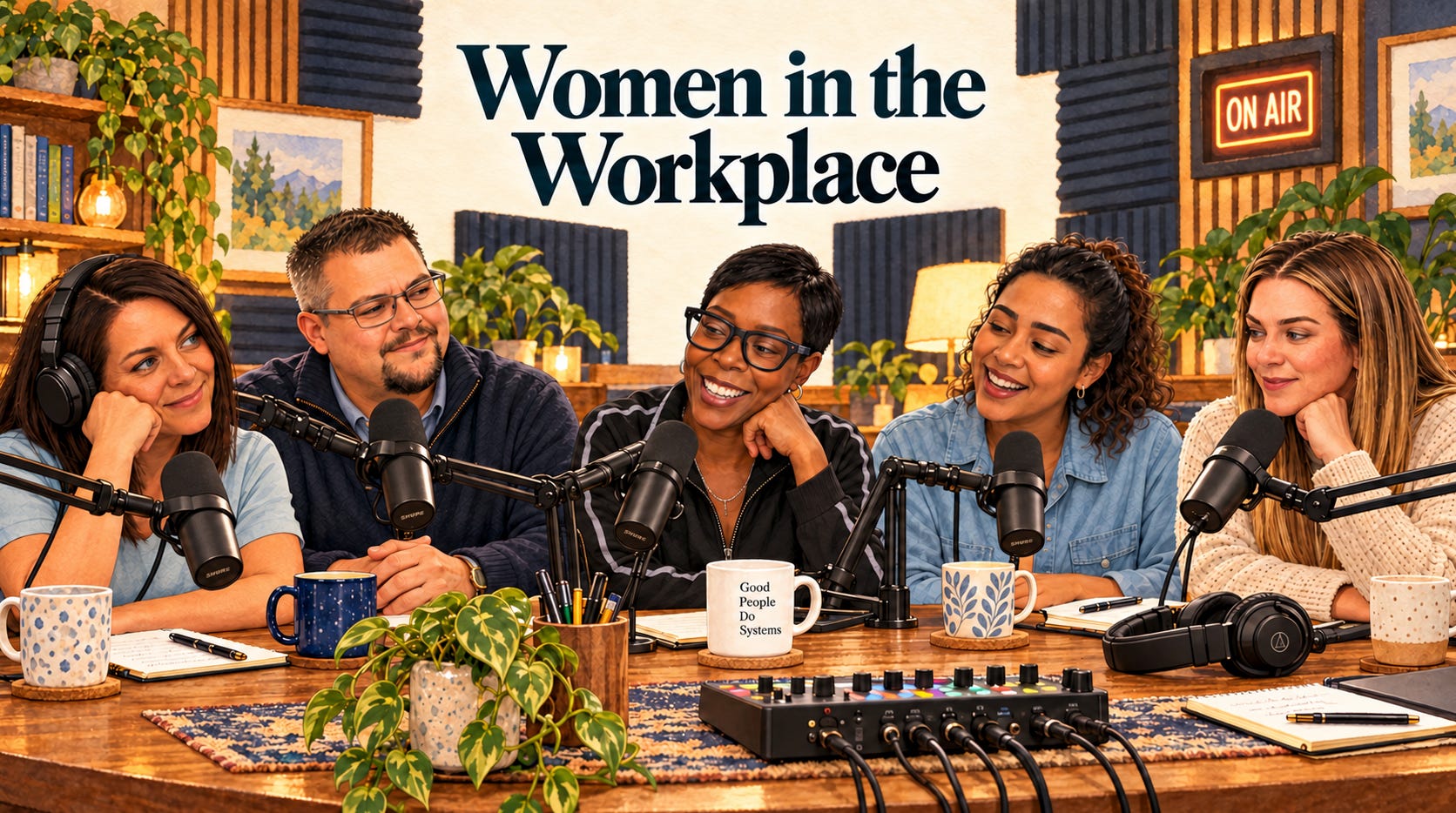
    Episode Description We’ve spent a lot of time discussing Human Middleware: the invisible work people do to keep organizations running. But what happens when that invisible work falls disproportionately on women? And what happens when the people doing it aren’t recognized for their contributions? For this episode of the Organizational Gravity Podcast, Gabe and Kelly join Audrey Johnson and Kay Turner for a personal conversation about women in the workplace, leadership, motherhood, compensation, professional expectations, and AI's growing influence. These women have worked together across multiple organizations and bring years of experience in project management, operations, and organizational change. Rather than simply discussing workplace statistics, they share their own experiences, including the moments that shaped their careers, the obstacles they’ve encountered, and the opportunities they see ahead. Kelly Sheahan — The Hidden Expectations of Being Dependable Invisible work and unequal expectations Kelly opens the conversation by describing how women often take on extra responsibilities without being asked whether they belong to them. She recalls an executive requesting a presentation at 4:59 PM, due by 8 AM the next morning. Her question: Why was she the person expected to take care of it? Navigating male-dominated industries Kelly discusses the differences between working in female-dominated and male-dominated industries, particularly the expectations surrounding assertiveness, communication, appearance, and professional behavior. She describes the fine line women often navigate between speaking their minds and being perceived as aggressive or difficult. Motherhood and returning to work Kelly shares the challenges of returning from maternity leave, balancing professional responsibilities with motherhood, and keeping pace with rapidly changing technology. She also questions why maternity and paternity leave remain so inconsistent. Pay equity and professional recognition Kelly recounts discovering that a less-experienced employee reporting directly to her earned about the same salary, despite her additional management responsibilities. She questions how organizations evaluate experience, determine compensation, and account for subjective judgments in promotion decisions. AI as an opportunity to do more valuable work Kelly sees AI as an opportunity to move beyond repetitive tasks and toward higher-value contributions. She also challenges the assumption that lower recognition of women’s AI use necessarily means women use it less. Audrey Johnson — Making Invisible Work Visible Recognizing the value of work that happens behind the scenes Audrey challenges the idea that invisible work is somehow less valuable. Much of project management involves connecting people, solving problems, coordinating activities, and keeping work moving. Her central question is how women can make those contributions visible and demonstrate their value. Executive presence versus authenticity Audrey discusses feedback on her executive presence and reconsiders what the phrase actually means. Was she being encouraged to become a stronger leader, or being asked to behave in a way that matched someone else’s expectations? She argues that authenticity matters because maintaining a professional persona that isn’t genuinely yours is ultimately unsustainable. Visibility, promotion, and communicating business value Audrey reflects on the importance of discussing accomplishments, communicating financial impact, and ensuring leadership understands the value of work being performed. She also acknowledges that promotion decisions often involve visibility and relationships, not simply performance. Motherhood and career decisions Audrey shares how having a daughter influenced her willingness to travel as a project manager. She describes feeling less visible on her own projects when colleagues traveled more frequently and wondered whether those differences would affect her advancement. AI, learning, and career opportunity Audrey encourages women to become curious about AI, invest time in learning it, and use it to reduce repetitive work. She sees AI proficiency as a potential path toward better roles, greater responsibility, and improved compensation. Finding your voice in the room Audrey discusses learning when to interrupt, redirect a conversation, and insist on finishing a thought. She argues that women should feel comfortable exercising authority in meetings rather than automatically yielding the floor. Kay Turner — Recognition, Opportunity, and the Cost of Speaking Up When other people receive credit for your work Kay argues that much of women’s work isn’t invisible. Rather, organizations have become accustomed to expecting women to perform it. She describes how women can contribute substantially while someone else receives the recognition, and how that experience can undermine confidence. Assertiveness and unequal standards Kay reflects on being a direct, outspoken woman in corporate environments and the professional consequences of refusing to back down. She questions whether the same traits that can advance a man’s career sometimes limit a woman’s opportunities. The career opportunities women sacrifice Kay shares a pivotal moment when a female executive recognized her potential and offered her a director position that required relocating. She declined because of her responsibilities as a mother and still wonders how her career might have developed had she accepted. A serious accident and unequal compensation One of the episode’s most difficult stories comes when Kay describes a car accident that left her unable to work for three months. Despite managing a project for 14 months before the accident and returning to complete it, she received only 15% of the project bonus, while the colleague who temporarily replaced her received 85%. Kay discusses the humiliation, frustration, and lasting effects of that decision. Race, bias, and advancement Kay shares her experiences navigating corporate America as a Black woman and discusses how personal relationships, unconscious bias, and expectations about who fits a leadership role can affect career progression. She challenges the assumption that promotions are always determined primarily by skill and performance. AI access and opportunity For Kay, the question isn’t simply whether women are willing to use AI. It’s whether they have the access, exposure, training, and opportunities to develop meaningful capabilities with it. Leadership is a collective effort Kay closes with a reminder that productive disagreement is not an attempt to undermine leadership. Teams succeed when people challenge one another constructively, recognize their shared responsibilities, and work toward collective success. The Gravity Beat — What Are We Actually Recognizing? Throughout the discussion, one question continues to surface: If organizations depend on invisible work, why do they struggle to recognize the people performing it? The conversation explores how performance expectations, leadership behaviors, career interruptions, and organizational structures can create additional burdens that aren’t always reflected in job descriptions or compensation. AI creates an interesting possibility. Some of the repetitive and administrative work that has historically occupied employees may become easier to automate. But removing the task doesn’t automatically correct the organizational assumptions that made the work invisible in the first place. And without equitable access to technology and career opportunities, organizations risk carrying those same problems into a new generation of work. A Personal Thank You Gabe closes by reflecting on the women who shaped his life and career. From his grandmother, who taught him to read, to his aunt, whose career helped shape his understanding of business, to Star, whose continued support makes so much of his professional and creative work possible. He also thanks Kelly, Audrey, and Kay for years of collaboration, honest feedback, and their willingness to challenge him. The conversation ends with a reminder from Kay that nobody succeeds entirely alone. Behind successful people are often partners, friends, colleagues, and families whose contributions deserve recognition. Join the Conversation Are organizations recognizing the people who keep work moving, or simply rewarding the outcomes? As AI takes on more administrative and coordination work, will it create better opportunities for women, or will the same patterns of recognition and advancement continue? Get full access to Organizational Gravity at organizationalgravity.substack.com/subscribe

  • October 8 · 44 min

    AI Gave Us Time Back. We Filled It With More Work.

    AI is supposed to make work easier. So why are we using the time it saves to take on even more? This week, Gabe and Kelly explore an uncomfortable possibility: what if the biggest obstacle to eliminating unnecessary work isn’t the technology, but our own behavior? We revisit Human Middleware, the invisible work people do to keep disconnected systems, processes, and organizations running. But the conversation takes an unexpected turn when Gabe admits something he got wrong in his original thinking: even when technology removes the need for people to stand in the middle, we often choose to put ourselves right back there. We discuss the difference between getting work done and creating value, the instant gratification of AI systems that agree with us, and the growing responsibility of managing teams of AI agents without necessarily having the experience to question their outputs. We also introduce three lenses for understanding Human Middleware: structural, behavioral, and social. Some of that work should disappear. Some may be worth protecting. And perhaps the biggest question: if AI accelerates everything we do, are we also accelerating the organizational and personal habits we should have left behind? In this episode * 01:00 — AI makes us faster, but are we doing less? * 07:12 — The danger of an AI partner that always agrees * 11:04 — Why judgment matters more than producing another PowerPoint * 16:20 — Everyone becomes a founder: managing your own AI agents * 24:14 — The three forms of Human Middleware * 28:10 — Why human relationships and experience still matter * 34:27 — What Gabe got wrong about Human Middleware * 39:26 — Why removing tasks doesn’t necessarily improve work * 40:20 — The tool changed. We didn’t. Join the conversation What happens when you eliminate unnecessary work? Do you actually reclaim the time, or do you find something else to fill it? We’d like to hear where you see Human Middleware in your organization, which parts should disappear, and which parts represent something genuinely valuable. Subscribe to Organizational Gravity for more conversations, essays, and practical perspectives on organizational design, technology, AI, and the way we work. Get full access to Organizational Gravity at organizationalgravity.substack.com/subscribe

  • S1 · E9
    October 2 · 45 min

    Would Your Hiring Process Screen Out Your Best Employee?

    Would Your Hiring Process Screen Out Your Best Employee? A résumé gives us the polished version: the roles, the accomplishments, the software, the results. It rarely tells us what went wrong, what remained unfinished, or how someone developed the judgment they bring to work. In this episode of Organizational Gravity, Gabe and Kelly explore what gets lost when hiring becomes an exchange between optimized résumés and automated screening systems. They discuss transferable skills, the responsibility of hiring managers to define a role clearly, and the uncomfortable experience of writing a failure CV. The conversation returns to human middleware—the people who keep work moving between systems, teams, and processes. Before handing their work to an agent, there are questions worth asking: Why was this process built this way? What experience shaped it? And what could this person contribute if they had more time? In this episode: * 00:15 — AI résumés, automated screening, and the first human contact * 04:52 — Who checks which candidates the system rejects? * 07:08 — Recognizing transferable experience * 08:46 — When the hiring manager defines the wrong job * 11:13 — The uncomfortable work of writing a failure CV * 18:19 — Looking beyond polished accomplishments * 20:13 — Vulnerability and sharing professional failures * 24:08 — Human middleware and the judgment behind a process * 27:49 — Interview credibility and first impressions * 35:21 — Degrees, gender, and screening bias * 38:36 — Recognizing skills gained in other industries * 40:06 — Automation, hiring uncertainty, and time to think A few clarifications belong alongside this conversation. Automated screening can exclude qualified candidates, particularly when employers use overly restrictive requirements. That concern is documented in Harvard Business School and Accenture’s Hidden Workers research. But screening systems vary, and a missing keyword does not automatically mean rejection. A lack of response also does not establish that AI rejected someone or that an AI-written résumé would have changed the outcome. Read the research. Our discussion of body language went further than the evidence supports. Eye direction is not a reliable way to determine whether someone is lying. Looking away, checking notes, or keeping a camera off does not establish dishonesty. A stronger approach is to ask consistent, job-related questions and evaluate the substance of the answers. We also used “imposter syndrome” when discussing possible misrepresentation; those are different things. Eye-direction study, structured-interview guidance. The Fortune 100 or Fortune 500 did not collectively eliminate college-degree requirements. Some employers removed them for particular roles, and research found that those announcements often produced limited changes in who was actually hired. HBS and Burning Glass report. Women earned the majority of U.S. bachelor’s and master’s degrees in the 2021–22 data cited here. That does not, by itself, tell us whether women are being hired at higher or lower rates. Research has documented gender and racial bias in particular hiring settings and AI screening experiments, but those findings should not be treated as a description of every employer or tool. NCES undergraduate data, graduate data, AI screening study. Our comments about women being better multitaskers or project managers reflect personal impressions, not an established general advantage. The multitasking study linked here found no significant gender differences in the tasks it tested. The broader hiring question remains useful: are we recognizing the skills a person has demonstrated, including those developed outside a conventional career path? Read the study. We also discuss whether uncertainty about AI is holding back hiring. That is a possibility raised in the conversation, not a demonstrated explanation. The August 2026 BLS release, published after the recording, reported hiring little changed over the month and year; it does not establish AI as the cause of hiring trends. BLS report. A few smaller points: the “8%” reference was not tied to an identifiable source and should not be treated as a verified statistic. Professional résumé writers still exist. The Martha Stewart story is Gabe’s recollection and interpretation, rather than a verified quotation. And a failure CV is presented here as an exercise in reflection, not a tested strategy for getting through an application system. Professional résumé-writing association. The “un-resume” discussion draws on Jasmine LeFlore’s TEDx talk, It’s Not Only the Resume, It’s also the Un-resume, which explores the experiences and unseen work behind conventional credentials. Watch the talk. What experience made you better at your work but never made it onto your résumé? Get full access to Organizational Gravity at organizationalgravity.substack.com/subscribe

  • September 23 · 56 min

    Governance at Machine Speed

    Fresh off Dreamforce, Gabe and Kelly dig into the increasingly loud debate around slowing down AI. The interesting part isn’t simply whether AI should move faster or slower. It’s deciding what should be allowed to move quickly, where the boundaries belong, who can stop something, and what evidence allows it to move again. In other words: governance. The technical gap is collapsing. Something that once took ten months to build might now take ten days. So what should we do with the time we just got back? Our argument: don’t immediately spend all of it going faster. Use some of it to understand the process. Reduce what shouldn’t be there. Define what the system should never do. Test the assumptions. Then automate. We also get into one of the stranger consequences of automation: the people entering the workforce may not be cognitively offloading work they already understand. They may never cognitively onboard that knowledge in the first place. That problem isn’t new. In 1983, psychologist Lisanne Bainbridge described what she called the Ironies of Automation: as systems become more automated, the human operator can become even more important when something unusual happens. “The more advanced a control system is, so the more crucial may be the contribution of the human operator.” More than forty years later, that sounds a lot like the human-in-the-loop conversation we’re having about AI. In this episode 00:00 — Governance at machine speedDreamforce, the “slow down AI” debate, guardrails, process, and why governance suddenly seems to be everywhere. 02:25 — What shouldn’t we build?AI changes an old requirements question. It’s no longer enough to ask what a system should do. We also need explicit boundaries around what it must not do. 05:00 — Cognitive onboardingWhat happens when automation removes the work people once used to develop judgment, experience, and understanding? 05:50 — The Ironies of AutomationWhy a paper from 1983 may be one of the most useful things to read about AI automation today. 07:30 — What exactly are we slowing down?Frontier research, business implementation, process design, and why “slow down AI” becomes much more useful once we get specific. 09:40 — Spend some of the speedIf development drops from ten months to ten days, maybe five of those days should be spent understanding and reducing the process before automating it. 14:50 — Speed versus safety is really a governance questionWhat crossed the boundary? Who has authority to stop it? What evidence allows it to continue? 17:15 — AI cults, hype, and fearWhy the AI conversation can quickly drift from legitimate safety concerns into religion, apocalypse, politics, capital, and social-media amplification. 24:10 — Is your organization actually ready for AI?Process understanding, data foundations, iteration, and why automating something you don’t understand just accelerates the problem. 31:50 — The Gravity AuditOld permissions. Unclear ownership. Disconnected systems. Exceptions. Informal workarounds. AI didn’t create any of this, but it will inherit all of it. 39:30 — Humans in the loopAI and humans can both accumulate organizational mass. Both need monitoring, reduction, and intentional design. 47:15 — What AI is making visibleAI may be exposing Organizational Gravity that was always present but difficult to see. 51:35 — Can governance become something people actually want to participate in?Making process work visible, useful, fast, and tangible instead of making governance feel like policing. 53:40 — Where Gabe might be wrongMaybe people won’t willingly expose every workaround and task they perform, particularly when automation creates fear about what happens to their role afterward. That makes trust part of the governance problem. References mentioned Lisanne Bainbridge — “Ironies of Automation” (1983)Automatica, Vol. 19, No. 6, pp. 775–779.DOI: 10.1016/0005-1098(83)90046-8 Caitlin Malone — Linear DigressionsThe discussion that sent Gabe back to Bainbridge and the much older research behind today’s human-versus-automation questions. Mike Krieger — Anthropic LabsInstagram co-founder and current head of Anthropic Labs, whose Dreamforce discussion helped frame the conversation around how quickly AI-native work is changing. The Daily — “The Techno-Religion at the Center of the A.I. Debate”A look at the communities, ideologies, and “doomsday cult” criticism surrounding parts of the AI safety debate. The bigger idea AI didn’t create Organizational Gravity. It inherited it. The danger isn’t simply that machines will move too fast. It’s that we’ll use their speed to automate old permissions, bad processes, undocumented exceptions, unclear ownership, and decades of accumulated organizational mass. Governance at machine speed doesn’t mean making governance instantaneous. It means using the speed of the machine to give humans more time to understand what should exist in the first place. And maybe that’s the real opportunity: not simply faster automation, but better-designed work. Corrections from the episode Jon KrohnIn the recording, the name came out as “John Crone.”Correct: Jon Krohn, host of the Super Data Science: ML & AI Podcast. Dr. Katie MaloneIn the recording, I referred to her as “Dr. Caitlin Malone.” She publishes and podcasts as Dr. Katie Malone. She was the guest on Jon Krohn’s September 22, 2026 episode. Linear DigressionsNot “Linear Degressions.”Katie Malone hosts the AI, machine learning, and data science podcast Linear Digressions. Lisanne BainbridgeIn the recording, I said “Larissa Bainbridge.”Correct: Lisanne Bainbridge. Her 1983 paper is: Bainbridge, Lisanne. “Ironies of Automation.” Automatica, Vol. 19, No. 6, November 1983, pp. 775–779. DOI: 10.1016/0005-1098(83)90046-8 The paper’s core argument is even more relevant today: automating routine work can leave humans responsible for abnormal situations while simultaneously giving them less practice and less direct involvement in the work. Mike KriegerThe former Instagram leader I was trying to remember was Mike Krieger, co-founder and former CTO of Instagram. He joined Anthropic as Chief Product Officer in 2024 and moved into Anthropic Labs in 2026. He spoke at Dreamforce 2026. NVIDIA / Hugging FaceI said at one point that NVIDIA had “bought” Hugging Face. More precisely: NVIDIA entered into a definitive agreement to acquire Hugging Face in September 2026. The transaction has been announced but has not yet closed. NVIDIA said it expects the deal to close in the first half of 2027, subject to customary conditions and regulatory approvals. The New York Times / AI “cult” discussionThe episode I was referring to was The Daily episode: “The Techno-Religion at the Center of the A.I. Debate” — September 18, 2026 One clarification: the episode is more nuanced than saying AI executives themselves have formed a “cult.” It looks at the ideologies around AI development and safety, along with the backlash that has characterized some AI-safety advocates as a “doomsday cult.” Sources & Further Reading Lisanne Bainbridge — “Ironies of Automation” (1983)The foundational paper behind our discussion of automation, declining human practice, and why human expertise can become more important rather than less important as automation improves. Super Data Science Podcast — Episode 1029“How AI Brought a Podcast Back From the Dead, with Linear Digressions’ Katie Malone”Jon Krohn with Dr. Katie Malone, September 22, 2026. The discussion of Bainbridge’s Ironies of Automation begins around 41:39. Linear Digressions — Katie MaloneKatie Malone’s podcast covering AI, machine learning, data science, agents, benchmarks, and the human consequences of automation. Mike Krieger — Anthropic LabsKrieger co-founded Instagram, joined Anthropic as Chief Product Officer, and moved into Anthropic Labs in 2026 to work on experimental products at the frontier of Claude’s capabilities. The Daily — The New York Times“The Techno-Religion at the Center of the A.I. Debate”September 18, 2026. A discussion of AI safety, technological ideology, and the political and industry backlash around calls for stronger AI guardrails. NVIDIA — Hugging Face AcquisitionNVIDIA announced an agreement to acquire Hugging Face on September 3, 2026. The related SEC filing states that the transaction is expected to close in the first half of 2027, subject to customary closing conditions. Get full access to Organizational Gravity at organizationalgravity.substack.com/subscribe

  • September 23 · 13 min

    Live with Gabe | Organizational Gravity

    Agents Don’t Complain What if AI could ride my bike for me, do the laps, and somehow give me all the physical benefits? That sounds great. It also gets at something that worries me about how we’re approaching AI at work. Agents don’t complain. Humans do. And I’m starting to think that’s much more valuable than we give it credit for. For years, I looked at some of the friction around process change as something to remove. People had their spreadsheets, workarounds, swivel-chair processes, exceptions, and ways of doing the work that weren’t always documented. We call that human middleware. AI changes how I think about it. Those people aren’t just carrying inefficient processes. They’re often carrying years of experience: the exceptions, risks, judgment calls, and institutional knowledge that never made it into the system. If we automate the work without understanding that experience, the machine won’t complain when something is wrong. It will just keep doing it. That creates another problem for the people coming behind us. Experienced workers may have cognitively offloaded parts of their work to technology after years of learning the job. New workers could enter an automated environment without ever cognitively onboarding that experience in the first place. That’s why human-in-the-loop matters. And it’s why I keep coming back to the same idea about governance: Governance has to understand the work, not just the output. The goal shouldn’t be to turn every task that once took two days into something that takes five seconds. AI can give us time back. We can use some of that time to scrutinize the work, understand why an answer is correct, improve the process, train people, and build better systems. Automation should remove unnecessary work. It shouldn’t remove our understanding of the work. In this live * Why “agents don’t complain” is both the promise and the risk of automation * Human middleware as a source of institutional knowledge * The difference between cognitive offloading and never cognitively onboarding * Why employee friction can actually be valuable feedback * Human-in-the-loop as more than an AI safety mechanism * Using AI to accelerate process design and feedback rather than simply accelerate output * Why governance needs visibility into the steps that produce an answer * What happens when experienced people leave and nobody understands what was encoded into the machine The question I’m left with:If the machine does the work perfectly, but nobody understands why the work is done that way anymore, what exactly have we automated? Get full access to Organizational Gravity at organizationalgravity.substack.com/subscribe

  • S1 · E7
    September 16 · 42 min

    Organizational Gravity- Episode 7

    AI is supposed to save time. So why does so much of that time seem to disappear? In this episode, Gabe and Kelly dig into Glean’s 2026 Work AI Index and two terms that capture a growing problem at work: bot sitting—the human effort required to feed, monitor, correct, and clean up after AI—and botshitting—sending AI-generated work downstream without really understanding or validating it. That leads to a bigger Organizational Gravity question: what if AI is making work faster without actually making the system lighter? We talk about where those supposed productivity gains go, why human review is different from babysitting a poorly designed bot, and how unverified AI output can move risk downstream faster than the old process ever could. The conversation also puts pressure on Organizational Gravity itself. I have often treated friction as evidence of unnecessary organizational weight, but AI exposes an important exception: some friction is doing real work. Verification, judgment, accountability, experience, and safety can all slow a process down for good reasons. The goal cannot be zero friction. It has to be the right friction, scaled to the consequence of getting something wrong. In this episode 00:00 — Bot sitting and botshittingWhat the terms mean and why individual AI productivity does not always translate into better organizational performance. 04:25 — Who botshits more?A funny statistic about men and women turns into a more serious conversation about confidence, scrutiny, and how people review their work. 07:35 — Human in the loop or babysitting the bot?Where useful supervision ends and poor system design begins. 09:05 — Why are people shipping work they cannot defend?Deadline pressure, trust in the technology, weak review practices, and the widening technology gap. 17:11 — The Gravity AuditBot sitting starts to look a lot like Human Middleware. Are we adding AI without removing the process that created the work in the first place? 25:00 — The 4:30 PM testThe deadline is real, you are tired, and AI gave you something usable. Do you ship it or tell people you will be late? 27:34 — Where is Gabe wrong?We put Organizational Gravity itself under pressure. 28:29 — Not all friction is badRemoving every manual check can also remove the judgment that keeps bad information from moving downstream. 33:41 — Zero friction is the wrong targetGovernance should create the right amount of friction based on the consequences of the decision. 37:00 — A revised rule for frictionRemove friction caused by poor design. Preserve friction that creates judgment, accountability, or safety—and periodically prove that it still does. 40:34 — Three questions before you automateWhat should actually disappear? What judgment still belongs to a person? How will we know the whole process got better? The takeaway AI can make work move faster while Organizational Gravity continues accumulating underneath it. If humans are constantly feeding the bot, checking whether the bot is functioning, repairing bad output, and carrying knowledge that never made it into the system, we have not necessarily removed the weight. We may have just compressed it and accelerated it. The better question may not be: How much work can we automate? It may be: What should become easier, and what do humans still need to struggle with long enough to understand? And that leaves us with a question for the next episode: maybe Human Middleware should not disappear entirely. Maybe the real question is: What should humans still be in the middle of? Source: Glean Work AI Institute, The Work AI Index 2026: Botsitting, botshitting, and the hidden human labor of AI at work (2026) Get full access to Organizational Gravity at organizationalgravity.substack.com/subscribe

  • S1 · E6
    September 9 · 41 min

    The Organizational Gravity Podcast - Episode 6 - We Keep Changing the Work. Why Haven’t We Changed the Training?

    Show Notes This week, Gabe and Kelly take on one of the least glamorous but most important parts of organizational change: training. The conversation starts with a simple problem. Organizations are changing the technology around work much faster than they are changing how people learn. Training is still too often treated as something completed once during onboarding or rolled out through a video, an SOP, or a compliance module, with the assumption that people will remember what they need months later. That leads to a bigger distinction between training, learning, and performance. When is someone struggling because they were never given the information at the moment they needed it? When does repetition become learning? And when does a recurring problem stop being a training issue and become a performance conversation? The episode also explores point-of-need learning. Instead of expecting people to remember everything in advance, what if technology could provide guidance in the moment the work is happening? The idea is not just to make training easier, but to move learning closer to practice, where repetition, feedback, and context can turn information into capability. That creates another question: what happens when technology gets too good at remembering for us? Gabe and Kelly discuss cognitive offloading, judgment, and the risk of providing so much support that people stop gaining the experience they need to handle exceptions. AI may be able to guide someone through the standard process, but organizations still need to decide where human judgment belongs and when a leader should step in. The conversation then moves into Reductive Change. Gabe references Leidy Klotz’s work on subtraction and the tendency people have to add rather than remove. The same instinct shows up in training and process design: a problem appears, so organizations add another step, another document, another control, or another training requirement. AI may give us a chance to do something different by first removing unnecessary friction, then using technology where it genuinely helps. Klarna also comes up as an example of the tension between automation and human knowledge. In 2024, Klarna said its AI assistant was doing work equivalent to roughly 700 full-time customer-service agents. Later, CEO Sebastian Siemiatkowski said the company had pushed too far toward AI-driven cost-cutting and had begun rebuilding access to human customer support. The lesson is less that AI failed and more that automation can expose how much context, judgment, and relationship knowledge people were carrying. The episode closes on a different way of thinking about reskilling. Maybe the goal is not simply teaching people how to work alongside AI. Maybe it is helping people let go of repetitive work technology should carry, then using the recovered time to build judgment, relationships, communication, and the parts of work that remain distinctly human. Topics discussed Training vs. learningCompliance vs. adoptionPoint-of-need trainingPerformance vs. training issuesCognitive offloadingRepetition and consistencyLeadership reinforcementAI and exception handlingReductive ChangeKlarna and human customer supportThe value of recovered timeWhat reskilling should look like in an AI-enabled workplace References Leidy Klotz, Subtract: The Untapped Science of LessAdams et al., “People systematically overlook subtractive changes,” Nature, 2021Klarna, AI customer-service assistant announcement, 2024Research and practice around the 70-20-10 workplace learning model and experiential learning Get full access to Organizational Gravity at organizationalgravity.substack.com/subscribe

  • S1 · E5
    September 2 · 34 min

    The Gravity Audit

    Episode blurb LinkedIn shipped a button that lets anyone report your post as AI slop, the same day it removed its own AI writing tool. On a network where reach is proximity to a job, that isn’t moderation. It’s a permission structure, and the people most exposed are the ones who already write like everyone else because they were trained to. Also this week: Pew put a number on how much of the web is written by AI, and a federal research office said that same kind of detector can’t stand alone as evidence of anything. The institution with more at stake demanded more evidence. Longer description On 30 July, LinkedIn added “Seems like AI slop” to the menu on every post and removed Enhance Post, its own AI writing tool, the same day. The order matters. The platform built the tool, the tool produced the output, the platform took the tool away and handed everyone a button to report each other for it. Nobody planned that, which is exactly what makes it gravity rather than malice. What it does to a person is the part worth sitting with. LinkedIn isn’t where people go to tell stories; it’s where they go to be employed, so a reach penalty isn’t a content-moderation outcome. It’s an economic one, applied silently, by a stranger, at no cost to them and with no appeal for you. And the people most exposed are the ones taught to write in corporate templates, the non-native speakers whose careful prose reads smooth, the juniors imitating a senior to be taken seriously. That sits inside a bigger story. Pew Research published a census-scale estimate of how much of the web is AI-written, and the number came out of a detector. Pew did the work carefully and documented it all — the threshold, the agreement statistic, the false-positive warning, the dating limitation. What happens next isn’t Pew’s fault. It’s what always happens: the caveats fall away, and the number travels alone. Meanwhile, the HHS Office of Research Integrity looked at the same class of instrument and said it can’t be the sole basis for a misconduct finding. And in Where I’m Wrong: I thought training was the easy part of governance. Three studies took that apart, and the one that moved me most wasn’t the one saying training fails. In this episode Pew’s census-scale estimate of AI-written pages, and the caveat that decides what the number means Why only 10 to 15 percent of sampled pages could even be dated, and what that does to the headline The HHS Office of Research Integrity guidance, and why a federal office demanded more evidence than a publishing platform did What it means to admit a probabilistic estimator into a fact-producing role without treating it as a change The structural middleware underneath the whole story: a 490,000-page apparatus built to approximate a fact every generator knew with certainty and discarded LinkedIn’s slop button, the removal of Enhance Post, and the order those two things happened in Why a reach penalty on a professional network is an economic outcome, not a moderation one Who’s actually most exposed: the people trained to write like everyone else Where I’m Wrong: training, and the difference between a content problem and a conditions problem Key ideas Organizational Gravity — organizations accumulate mass faster than they shed it. Here it shows up as a measurement admitted into the operating model with none of the questions a change would have to answer. Governance is not measurement — the order is issue, root cause, control, then measurement. This story runs it backwards: the detector arrives first and becomes the fact. Structural middleware — when no provenance layer connects generation to publication, somebody has to build a 490,000-page estimator to recover what was known for free at the moment of writing. That’s incomplete architecture, and the fix is integration. The permission structure — a report button between peers on a network where reach is proximity to a job isn’t moderation, it’s a mechanism. Sources Segment 1 — the news hit Pew Research Center, “How much of the internet is written with AI?” (20 August 2026) — the primary study. 490,000 English-language pages sampled across 49 Common Crawl snapshots, January 2021 to July 2026. Supports the 10 percent raw July 2026 figure, the “over one third” figure for pages with a detectable post-ChatGPT publication date, and the methodology caveats including the dating limitation. Also carries Pew’s own false-positive warning and stated threshold — worth reading before repeating either number. HHS Office of Research Integrity, guidance on generative AI in federally funded research (14 August 2026) — the second institution. Supports the central claim that detector output may constitute evidence but that ORI recommends against relying on such tools as the sole basis for a misconduct finding. Also covers disclosure expectations and the penalty framing. Segment 2 — the Gravity Audit Tech Times, “LinkedIn pulls its own AI writing feature, crowdsources slop detection” (31 July 2026) — supports both halves of the sequence: the addition of “Seems like AI slop” to the post menu and the removal of Enhance Post on the same day. Also carries the reporting on how flagging feeds LinkedIn’s classifiers and affects recommended-feed distribution. The 40-plus percent figure for fully AI-generated LinkedIn long-form content is Pangram’s research, not LinkedIn’s — attribute it that way on air and in writing. Segment 3 — Where I’m Wrong: training Arthur, Bennett, Edens & Bell (2003), “Effectiveness of Training in Organizations: A Meta-Analysis of Design and Evaluation Features,” Journal of Applied Psychology 88(2), 234–245 — free full-text PDF. 397 findings across roughly forty years and about 33,000 people. Supports the claim that the average trained person outscored about three of four untrained people. Note the measures are largely taken at the end of training, which is the limitation that sets up the next study. Park, “Does Compliance Training Decrease Corporate Misconduct? Evidence From Field Data” (Harvard DASH) — five years of internal records from one multinational manufacturer, roughly 100,000 employees across about 100 countries, alongside 2,237 misconduct allegations. Supports the no-meaningful-association finding on average, the roughly two-month decay of in-person effects, the null result for video, and small classes outperforming large ones by around ten to one. Say on air that this is a dissertation, not peer-reviewed, one company, and compliance training specifically. Also available as Harvard Law Olin Center fellows paper 89. Blume, Ford, Baldwin & Huang (2010), “Transfer of Training: A Meta-Analytic Review,” Journal of Management 36(4), 1065–1105 — free full-text PDF from an author’s site; journal version at SAGE. Eighty-nine studies, roughly 12,500 people. Supports the finding that work-environment support — manager backing, a job that rewards the new behavior — predicted transfer better than trainee motivation, which ranked near the bottom. This is the study behind “it’s the room they go back to.” Read the full version This week’s newsletter went out on training — all three studies, the long version, and the part I didn’t get to on air: LinkedIn newsletter Subscribe I’m writing a book out loud, thinking it through in public, one essay and one episode at a time. Subscribe, and you’ll watch it take shape: Gabe | Organizational Gravity Note Stories on this show are anonymized. Names and identifying details are always changed. Get full access to Organizational Gravity at organizationalgravity.substack.com/subscribe

  • S1 · E4
    August 18 · 10 min

    The Organizational Gravity Podcast - Episode 4

    Frank runs a transformation at a company you’d recognize. He didn’t buy the agents — but he answers for all of them. This episode: why AI transformations keep failing, what organizational gravity has to do with it, and why the loudest warnings are coming from the companies selling the tools. The essay version of this argument — told as a bar story — is on the Substack: THE NUMBERS FROM THIS EPISODE, WITH SOURCES. Check the math — it holds. IBM Institute for Business Value, C-suite study on AI control and governance (June 2026) — 2,000 technology executives, 33 geographies: * Two-thirds (~1,333) are held accountable for AI systems they don’t fully control * 70% (1,400) say teams across the business are deploying faster than IT can track * 11% (220) believe they’re ready for the scale of agent deployment expected next yearhttps://newsroom.ibm.com/2026-06-08-new-ibm-study-finds-cios-and-ctos-face-growing-ai-control-gap-as-enterprise-deployment-scales MIT NANDA, “The GenAI Divide: State of AI in Business 2025” — 95% of corporate generative AI pilots (19 out of 20) fail to deliver ROI:https://finance.yahoo.com/news/mit-report-95-generative-ai-105412686.html OpenAI, “Work at the Frontier” (July 2026) — of 800,000+ work-related messages analyzed, 43.5% (~350,000) were tasks outside the user’s own occupation:https://openai.com/index/how-ai-is-expanding-what-people-do-at-work/ Anthropic, “The Founder’s Playbook: Building an AI-Native Startup” (2026) — 42% of startups failed because they built something nobody wanted; “that failure rate is only going to climb”:https://cdn.prod.website-files.com/6889473510b50328dbb70ae6/69fe2a55b93bb0732b1fe33c_The-Founders-Playbook-05062026_v3%20(1).pdf Moffatt v. Air Canada (2024 BCCRT 149) — the tribunal held Air Canada liable for its chatbot’s invented policy:https://www.mccarthy.ca/en/insights/blogs/techlex/moffatt-v-air-canada-misrepresentation-ai-chatbot Morgan Stanley × OpenAI — evaluation-first GPT-4 deployment; 98% advisor-team adoption:https://openai.com/index/morgan-stanley/ The Organizational Gravity Podcast. New episodes weekly. Get full access to Organizational Gravity at organizationalgravity.substack.com/subscribe

  • S1 · E3
    August 9 · 24 min

    The Organizational Gravity Podcast - Episode 3 - The Weight Nobody Chose

    The Organizational Gravity Podcast Episode 3 — The Weight Nobody Chose Runtime: 24:04 Linda inherited a project that was already half-built. The software was chosen. The contracts were signed. Everyone who made those decisions was gone. She thought she was inheriting a project — she was inheriting years of other people’s reasonable choices, piled into one system she was now supposed to make work. She told me none of it ever felt unusual at the time. It just felt like the work. That’s the episode. Every change model we run starts after the design is finished. Nobody owns the stage before it — the one where somebody asks how much the future state should weigh. This episode names that stage, gives it a formula, and finishes the model the first two episodes started. Episodes 1 and 2 were the diagnosis. This one is the treatment. The model, end to end Four parts. Gravity is the disease. Middleware is who pays for it. Reduction is the treatment. Governance is how it doesn’t come back. 1. Organizational gravity Organizations gain mass by default, and every individual decision that adds mass is reasonable on the day it’s made. Nobody approves the accumulation. There’s no meeting where a company decides to become slower and harder to change. There’s a meeting where somebody adds an approval after a bad quarter, and a meeting where somebody builds a report because an executive asked a fair question, and a meeting where somebody grants an exception because a real customer had a real problem. Each one is defensible in isolation. None of them are ever revisited. Gravity is the sum. It is cumulative, it is invisible while it accumulates, and it pulls in one direction only. Addition is cheap, fast, visible, and rewarded. Removal is expensive, slow, invisible when it works, and rewarded by nobody. The diagnostic: if you can’t name what came out the last time something went in, gravity is winning. 2. Human middleware People become the connective tissue holding accumulated mass together, and that work is invisible because it looks like competence. The spreadsheet that reconciles two systems that were supposed to talk. The handoff that only works because one person knows to check. The report someone rebuilds by hand every month because the automated one has been wrong since 2019. None of it is in a job description. All of it is load-bearing. Middleware is what makes gravity survivable, and it’s also what makes gravity invisible — because from the outside, an organization held together by people looks like an organization that works. Nobody walked past Linda’s office and saw a woman carrying years of other people’s decisions. They saw someone doing her job. The diagnostic: when a person leaves and something breaks that nobody knew existed, you found middleware. Too late. 3. Reductive change Remove the complexity before adoption begins, instead of managing its pain all the way through. This is the treatment, and it belongs to a stage no change model teaches: the stage before the future state is designed. Before requirements are gathered. Before anything is bought. Reductive change goes after the weight itself rather than after people’s willingness to carry it. It refuses the standard opening move. Most transformations begin by documenting the current state — which sounds like diligence and is actually a trap, because the moment a piece of the current state gets named, it acquires a plausible defense. The question quietly changes from should this exist to how do we carry it forward, and nobody notices the swap. Reductive change asks different questions. What does this need to produce? Who uses it? What decision does it support? How small can this be and still work? It is not cutting. Cutting is indiscriminate and reduction is not — the whole skill is sorting dead weight from load-bearing weight before you build. The diagnostic: does your transformation have a deletion plan? If not, it isn’t a transformation. It’s a move. 4. Adaptive governance A small number of real controls, asked on a schedule, with the authority to change the build. Governance is not a measurement. This is the load-bearing distinction of the whole model, and it’s the one most organizations get backwards. A measurement reports a condition. A control changes it. A measurement can be green while the entire thing is sinking — Birmingham’s milestones were tracked and its reports were filed the whole way down. A control has three properties a measurement doesn’t: * It asks a question that can change the outcome. Should this customization exist? is a control. Are we on schedule? is a measurement. * It runs on a schedule, not on alarm. A control that only fires when someone escalates is not a control. It’s luck. * Someone has the standing authority to act on the answer. A question nobody is allowed to ask in year three is not governance. It’s adaptive because gravity doesn’t stop pulling after go-live. The weight starts coming back the day you stop watching. Governance is the standing guard over the room you just cleared. The diagnostic: name one question your organization asks on a schedule that has the power to stop or change work already in flight. If you can’t, you have measurement. Define zero. Prove one. Earn two. The math of reductive change. It replaces builder’s math — one plus one equals two, and two is better than one — with a sequence that makes addition earn its place. Run it in order. The order is the mechanism. Define zero Start from nothing and state out loud what the thing has to produce. Not what it does today. Not what the old system did. What it has to produce — the outputs, the decisions it supports, the obligations it satisfies. Zero is a blank page with a purpose written at the top, and it is the only moment in a transformation when nothing has a defense yet. Defining zero is the hardest of the three, because it means refusing to open with the current-state inventory that everyone in the room expects. If you start with the list of forty-seven reports, you have already lost — you’re now negotiating removals instead of establishing additions. Zero is not “we’re building nothing.” Zero is “nothing is in yet.” Prove one Everything that wants to come along has to prove it belongs. Nothing rides for free. One at a time, each candidate makes its case against the definition of zero. Who reads this? What decision does it support? What breaks if it’s gone? Two things make this work. First, the burden of proof sits with the thing, not with the person questioning it — the default is out, and inclusion is the exception that needs an argument. Second, the answer has to come from a named person, not a role. “Finance, I think” is not proof. Asking finance is proof. This is also where reduction protects rather than cuts. Report thirty-one goes to the auditors at year end. It proved it belongs. It stays. The formula working looks exactly like that. Prove one is a filter, not a target. There’s no quota. Earn two Only then does anything new get added. Addition is earned, never assumed. New capability comes last, and it comes with the same burden as everything else. This is the step organizations skip straight to, because it’s the fun one — the demo, the roadmap, the thing you can announce. Earning two means the new thing enters a system whose weight is known, against a baseline that was deliberately set rather than inherited. It also means the capacity to absorb it actually exists. The capacity to do the new thing doesn’t arrive when you install the system. It arrives when the weight comes off. If two is earned before one is proven, you have bought a faster version of the problem. Why the order matters Run it out of order and it collapses into the thing it replaces. Start at one and you’re auditing a current state you’ve already implicitly approved. Start at two and you’re adding to a foundation nobody measured. Zero has to come first, because zero is the only place where the question should this exist is still a real question. And it’s the shape of the J curve. How deep the valley goes is decided before anyone walks into it. Reduction pulls the left side up — not by pushing people through the change harder, but by handing them something lighter to carry down. The AI stakes AI doesn’t ask whether a process should exist. It learns what you already do and does it faster. Hand it the current state — every approval nobody remembers adding, every report nobody opens, every exception nobody can explain — and it won’t question any of it. It will automate all of it and run it ten thousand times. Carol’s report gets a robot. The approval that has nothing left to catch gets optimized from two days to two hours. Weight nobody chose becomes weight nobody can see. And getting it back out won’t be a cleanup — it’ll take a whole change effort just to unpack what got automated without asking. The window for asking is now, before the automation, not after. The one rule Every transformation gets two plans. A change plan — what gets built. The whole field already knows how to make that one. A deletion plan — what gets removed. Almost nobody makes that one. If your transformation has no deletion plan, it isn’t a transformation. It’s a move. You’re carrying everything you own into a new house. Good intentions don’t survive the third steering committee. A rule does. Chapters * Cold open — Linda inherits somebody else’s decisions * The middle of the story — transformation never begins at the beginning * The J curve everyone budgets for — the gym, the shirt, and the weight you walked in with * The stage before the model — Lewin, Kotter, ADKAR, Bridges, and the question none of them ask * The elephant: AI automates the current state * Reductive change — define zero, prove one, earn two * What reduction actually looks like — report twelve, Carol, and the approval with nothing left to catch * The proof — Birmingham City Council * Naming the model — gravity, middleware, reduction, governance * One rule — the deletion plan * The far side — what Linda’s team got back * Sign-off Sources Birmingham City Council and Oracle Everything cited in the episode, with the primary reporting behind it. Figures verified August 2026. The programme. Birmingham City Council — the largest local authority in Europe — set out in 2018 to replace its finance and HR systems with Oracle Cloud Fusion. The initial estimate was £19 million plus £1 million contingency. Rather than change decades of legacy process to fit the software, the council customised the software to fit the legacy process, including a bespoke bank reconciliation module Oracle was never designed to run. Go-live. Originally planned for December 2020 (finance and procurement) and February 2021 (HR and payroll). Replanned and taken live in April 2022. * Computer Weekly — Birmingham City Council’s Oracle implementation explained: what went wrong: https://www.computerweekly.com/news/366572935/Birmingham-City-Councils-Oracle-implementation-explained-What-went-wrong * Computer Weekly — Why did IT suppliers allow Birmingham City Council to go live with Oracle?: https://www.computerweekly.com/news/366620333/Why-did-IT-suppliers-allow-Birmingham-City-Council-to-go-live-with-Oracle The go-live decision. External auditors Grant Thornton found the programme steering committee failed to adequately scrutinise the information available to it. A Financial Impact Assessment warning of “major problems transacting” was published on 24 March 2022; there is no evidence it was discussed at the steering committee meeting on 25 March 2022 that approved go-live. The cash management module was reported as “Green” while staff were raising concerns about going live on an unstable solution. Grant Thornton’s conclusion: had the quality and completeness of testing been presented clearly, “it is unlikely that the program would have approved the decision to go live.” * The Register — How mega city council’s failure to act on Oracle rollout crashed its financial controls (27 Feb 2025): https://www.theregister.com/2025/02/27/birmingham_oracle_auditors/ * The Register — Birmingham council had no understanding of its Oracle system (25 Feb 2025): https://www.theregister.com/2025/02/25/birmingham_oracle_latest/ The controls that weren’t there. No audit trail for fraud detection was in place for an 18-month period after the April 2022 go-live. Oracle’s audit features had never been turned on. Segregation-of-duties controls — who can view and who can authorise a transaction — were non-functional. Director of finance Fiona Greenway told the audit committee that the decision “to switch off the one thing that could give us the assurance within the control environment” left the council unable to test for fraud, and that she would never give 100 percent assurance on the period. * The Register — Birmingham City Council’s Oracle audit trail failure (25 Apr 2024): https://www.theregister.com/2024/04/25/birmingham_oracle_audit_trail/ * Local Government Lawyer — Auditors highlight poor oversight and reporting at city council over troubled IT programme: https://www.localgovernmentlawyer.co.uk/projects-and-regeneration/403-projects-news/60078-auditors-highlight-poor-oversight-and-reporting-at-city-council-over-troubled-it-programme The accounts. Roughly £2 billion in transactions allocated to the wrong year. The council could not produce reliable accounts, and could not monitor budgets well enough to deliver planned savings — £69m of 2023/24 savings were written off. Section 114. Birmingham issued a section 114 notice — the local-government equivalent of declaring itself effectively bankrupt — on 5 September 2023. The notice itself cites an equal pay liability of £650m–£760m and an in-year budget gap of roughly £87m. Oracle is not named in the notice; it is widely reported as a compounding factor, and it is the reason the council could not produce the accounts to see its own position. * Birmingham City Council — Statement regarding section 114 notice: https://www.birmingham.gov.uk/news/article/1381/statement_regarding_section_114_notice * Section 114 notice (PDF): https://www.birmingham.gov.uk/download/downloads/id/27958/section_114_notice.pdf * The Conversation — How Birmingham city council’s ‘equal pay’ bankruptcy provided cover for ongoing Oracle IT disaster: https://theconversation.com/how-birmingham-city-councils-equal-pay-bankruptcy-provided-cover-for-ongoing-oracle-it-disaster-224416 * Audit Reform Lab, University of Sheffield — Value for money and accountability: a report on the Birmingham City Council section 114 bankruptcy (19 August 2024): https://auditreformlab.group.shef.ac.uk/value-for-money-and-accountability/ The bill. Forecast programme cost through 2027/28: £144.4 million, against an initial estimate of £19 million plus £1 million contingency — roughly seven times. A 2024 assessment put the council’s total loss at £216.5 million through April 2026, counting both direct programme cost and the savings the council could no longer deliver because it could not monitor its own budgets. The council is reimplementing Oracle from scratch; as of January 2026 the relaunch had slipped several months past its April target. A note on which budget number you use. Three figures circulate and they measure different things: £19m + £1m contingency is the initial estimate, £131m is the revised budget approved in 2024 including the reimplementation, and £216.5m is the assessed total loss including forfeited savings. The “seven times over budget” framing measures £144.4m against the initial estimate. Against the 2024 revised budget it is roughly break-even — which is its own governance story, and arguably the more damning one. * The Register — Birmingham Oracle ERP fiasco now £144M and still not working (29 Jan 2026): https://www.theregister.com/software/2026/01/29/birmingham-oracle-erp-fiasco-now-144m-and-still-not-working/4238750 * The Register — Birmingham council faces £216.5M loss over Oracle debacle (20 Aug 2024): https://www.theregister.com/software/2024/08/20/birmingham-council-faces-2165m-loss-over-oracle-debacle/1519213 * The Register — Birmingham’s Oracle finance system falls short 2.5 years on (29 Jan 2025): https://www.theregister.com/software/2025/01/29/birminghams-oracle-finance-system-falls-short-25-years-on/548607 The change models discussed * Kurt Lewin — unfreeze / change / refreeze. The sequence begins from a change that has already been decided. * John Kotter — the eight-step process. Builds urgency, coalition, and vision around a future state that has already been shaped. * Prosci ADKAR — awareness, desire, knowledge, ability, reinforcement. Walks each person to adopt a change that already exists. Certification is built around applying the methodology to an active project: https://www.prosci.com/solutions/training-programs/change-management-certification-program · methodology overview: https://www.prosci.com/methodology-overview * William Bridges — transitions, and the human experience of endings. Carries people toward a destination that is already set. None of these are wrong, and all of them have helped thousands of organizations. The observation in this episode is what they share: they engage after the future state has been designed. The design is where they start. It’s never the thing they question. “A journey, not a destination” The industry slogan referenced in the episode: * https://quisitive.com/transformation-is-a-journey-not-a-destination/ * https://digitaltonto.com/2019/transformation-is-always-a-journey-never-a-destination/ Related Read the companion newsletter — four rules for leaders; the episode covers the one I’d start tomorrow. Previous episodes — Ep. 1 on how organizations gain mass, Ep. 2 on the human middleware holding it together. This episode completes the model, but it stands on its own. The Organizational Gravity Podcast is written and hosted by Gabe Rybicki. Stories from practice are real and the people in them are protected — anonymized, composited, and never identifiable. Nobody in these episodes is the villain. That’s what makes the problem hard. Get full access to Organizational Gravity at organizationalgravity.substack.com/subscribe

  • August 2 · 19 min

    Organizational Gravity - Bonus Episode 1

    Special edition. This week I’m reading you my newest essay, If Only I Were More Human — out loud, in my actual voice, the one format you can’t run through a detector. The short version: Substack turned on an AI detector called Pangram, and it scored an essay I wrote alone on the Fourth of July at 83% AI. This episode is my answer. It’s a story about how I actually write—the chaos, the em dashes, my wife catching my comma splices—and about what the detector actually measures. Spoiler: it isn’t humanity. The part I really want you to hear is the governance. A platform had a real problem, skipped the root cause, and deployed a measurement dressed up as a control. No intake. No root cause. Just symptom to solution. Governance is not measurement. In this episode: * Why a human writing process trips an AI detector * The teaching trap: to score more human, I’d have to become less useful * Editing has always been assistance—and assistance has always been bought * What a legitimate control requires: explainable and actionable Read the essay: If I Were Only More Human Try it yourself: run your own writing through a detector and tell me what you score. The Organizational Gravity podcast — how organizations accumulate complexity, and how to take it back out. Get full access to Organizational Gravity at organizationalgravity.substack.com/subscribe

  • July 27 · 7 min

    The Organizational Gravity Podcast — Episode 2

    Every month somebody at your company produces a number that goes all the way up to the board. It looks clean, on time, like the system just spit it out. Usually it didn’t. It’s a person reconciling two systems that don’t agree, doing it by hand, because if they don’t, nobody else can. This episode is about that work. I call it human middleware. It’s what people do to hold a company together when the systems and teams underneath them don’t actually connect. And it tends to land on your best people, which is the part that should worry you. In this episode: - what human middleware actually is - why it lands on your most capable people - the cost nobody puts in a budget - the risk that stays at zero until the day it doesn’t - why AI exposes this work before it ever removes it -“The organization isn’t integrated. The people are.” The full written version is in the newsletter: Beautiful Chaos I am writing a book out loud, one essay and one episode at a time. Subscribe and follow as it gets built. *Stories on the show are anonymized. Names and details are always changed. Get full access to Organizational Gravity at organizationalgravity.substack.com/subscribe

  • S1 · E1
    July 19 · 11 min

    Episode 1 — The Ones Holding It Together

    The Organizational Gravity Podcast — Episode 1: The Ones Holding It Together You saw it coming before anyone else did. You said so. And by the end of the meeting, somehow you were the problem, not the thing you pointed at. This first episode is for you. For the people who hold organizations together without the authority to run them, and get taught, one meeting at a time, to go quiet. It's about why that happens. It gives you two names for what you've been up against all these years, Organizational Gravity and Human Middleware. And it introduces a guy named Dave, whose spreadsheet turned out to be running his whole company, right up until leadership decided to automate it. Dave's story is really a story about how the work survives AI, and how the people who understand it survive too. If you've ever been the one who saw it coming, press play. A quick note: I added the full audio, but the whole transcript is below too, so you can read it if that's easier or more accessible for you. If this sounds like you, or like someone on your team, forward it to them. And here's the standing invitation for this show. If you're the Dave in your building, or you're fighting a gravity nobody around you will name, I want to hear about it. Just reply to this email. I'll protect you, no company names, first names or none, and nothing goes out without your okay. Subscribe to get every episode and essay, written for the people holding it together. — Gabe Transcript You've been in the meeting where the date was set before anyone asked how long the work would actually take. Where the estimate got sharpened until it won the deal, and then you were the one held to a number you never agreed to. Where the status stayed green because green was the only color anyone upstairs wanted to see. You're the project manager, the planner, the estimator, the one in supply chain who can see the lead time coming months before it lands. You're the director who put it in the risk report, and the VP who said it out loud in the room, and watched it change nothing. You saw it. You said so. And somehow, by the end of the meeting, you weren't the person who caught the problem. You'd become the problem. I've watched this meeting for twenty years, and here's what I keep seeing. The person who speaks up is rarely making it up. They've usually caught something real, just a little before anyone else is ready to hear it. And that's the whole trap. Early and difficult look the same from across a conference table. So here's how it tends to go. The thing you flagged comes true, more or less on schedule. And by then, nobody remembers that you called it. What they remember is that you were hard to work with that day. So the next time you see something coming, you think twice about saying it out loud. And here's what really gets me. You did all of it without the authority to make any of it easier. No title that made people listen, no power to overrule a bad call. You had to talk a skeptical manager into it, and move a team you couldn't give a single order to. And you did it anyway. Because you actually care about the work. If that's you, then welcome to the Organizational Gravity podcast. I'm Gabe Rybicki, your host, and your confidant in a fight you've mostly been having alone. Those meetings train you to go quiet. I want to do the opposite. Give you the language for what you're actually up against, the stories of people who found a way through it, and a reason to keep speaking up. Stay with me. Let me be specific about who I'm talking to. Not only the person at the top of the org chart. The person a level or two down who has to make things better anyway. You're asked to align stakeholders you have no authority over. To fix a process, but not allowed to touch the thing that's actually broken. To own the outcome with none of the control. I've sat in the leader's chair too, so let me tell you a secret from it. A lot of the real work of change doesn't happen there. It happens with you. The seat you're in is where organizations actually turn, and it's the seat almost nobody makes a show for. So I am. There's a subtle power in naming things, and I want to give you that power. Because once you can name a thing, it stops being your fault and starts being a problem you can point at. So here are two names for things you've felt for years, and maybe never had the words for. The first one is Organizational Gravity. It's the reason your company is harder to change every year. Organizations pull weight toward themselves. A little at a time. A new process here, an exception there, another system, another approval, another report someone needs. Nobody decides to make it heavier. It just accumulates faster than anyone stops to question it. That's gravity. It's constant, it's cumulative, and there's no villain anywhere in it. Which is exactly why willpower can't fix it. You cannot try hard enough to escape a force that never stops pulling. The second one is the one I really want you to hear. Human Middleware. Middleware is the software that sits between two systems that were never designed to talk to each other, quietly translating so they can work. And in most companies, that software is a person. It's you. You're the one reconciling the numbers from two tools that don't connect. Rebuilding the context that got dropped in a handoff. Remembering the rule nobody wrote down. Translating the same thing between two departments for the tenth time. That work is invisible, it's exhausting, and it builds nothing, because it only exists to cover for a design that's broken underneath you. You are the connective tissue holding a disconnected organization together by hand. And nobody put that on your job description. I'm not telling you this to make you feel stuck. I'm telling you because there's a way through it, and it starts with seeing it clearly. Let me show you what I mean, with one person. So there's this guy. I'll call him Dave. Every morning, before he opened anything else, Dave opened one file. A model he'd built himself. It had too many tabs, because his process had too many exceptions. It had formulas buried inside other formulas, because the answer was never in just one place. Vendor notes. Cost flags. Margin warnings. Little bits of logic he'd added over the years, every time he watched the same mistake get expensive. People called it Dave's model. A little with affection, a little with judgment. Like it was just a quirk of his. But that file was doing something nobody ever said out loud. It was protecting the company's margins from scope creep. It was catching the assumptions nobody would admit they were making. Really, it was the operating system the whole business ran on, and nobody had ever admitted it existed. Then leadership decided to automate more of the work. And Dave pushed back. Now, you already know this story. The veteran with the spreadsheet who won't let go. The blocker. Arms crossed in the doorway of the future. That's what the room saw. And honestly, for a few days, that's about what Dave gave them. Every time someone asked if a step could be automated, he explained the exception that made it harder than it looked. And the more he explained, the more he sounded like a guy defending the past. But here's the thing. Dave was right about the work. He was just standing in the wrong place. He was defending the file, like the file was the point. It wasn't. That model was never sacred. It was evidence. Every tab in it marked a spot where the official process had quietly failed, and somebody had to cover for it by hand. Every workaround was a confession the company had never read out loud. And the day Dave understood that, everything changed. He stopped trying to prove automation would fail. He started telling them what the new system would have to understand to actually work. Where the requests really came from, which was never where the workflow said. Which numbers were real, and which ones were guesses everybody had started treating as facts. How a project could slide into the red while everyone swore they were just moving money around. The room got less comfortable. And a lot more useful. Because Dave wasn't fighting automation anymore. He was making sure it didn't just inherit all the old confusion and run it faster. He didn't get through that change by caring less about the work. He got through it by getting more precise about what the work actually was. He stopped being the guy guarding an old file, and became the guy holding the only honest map of how the business really ran. I tell you about Dave because Dave is you. And Dave isn't a level on the org chart. He's the analyst holding the numbers together, and he's the director holding the strategy together. He's anyone, anywhere in the building, who actually understands how the work fits, and gets treated like a blocker for saying what they see. And there's a fear running underneath all of this right now, so let me say it plainly. A lot of you are afraid that AI is coming for exactly the work you do. The reconciling, the translating, the remembering, the cleaning up. And you're not wrong to notice it. That is the work that's easiest to automate. But here's what Dave figured out. The task is not the value. Anyone can see the task. The value is that you know why the task exists. What it protects. Where it's fragile. What breaks if someone automates the visible steps and ignores the hidden ones. A machine can do the reconciling. It cannot tell you why the reconciling was ever necessary, or what quietly falls apart when it stops. So the move, when the work starts coming for you, isn't to defend the task. It's to explain what the task has been holding together. Make the real work legible. Where it starts, what it protects, where the judgment lives, where the risk hides. Because the more clearly you can explain the real work, the harder it becomes for anyone to automate a bad version of your expertise. You don't want to be Human Middleware forever. Nobody should. The goal was never to keep you doing the translating by hand. The goal is to turn what you know into the design of something better, so you stop being the duct tape and start being the person who decides what gets built. That's not surviving the change. That's leading it, from a seat that never gave you permission to. So here's where I'm going with this show. I'm going to keep telling these stories. The people who fight gravity without the authority to command it. The ones who refuse to quietly become middleware. The ones staring down AI and figuring out how to stay indispensable in a way that's actually about their judgment, not their job title. And eventually, I don't want to just tell these stories. I want to sit down with the people living them. With you. If something in this hit close, if you're the Dave in your building, or you're fighting a gravity nobody around you will name, I want to hear about it. You can reach me at the newsletter, and I'll leave a way in the show notes. And here's my promise. I will protect you. No company names. First names or no names. You'll hear anything before it ever goes out, and you can pull any of it. This show is on your side, on the record, and it will stay that way. Because you've spent enough of your career being unseen. Not here. I'm Gabe Rybicki. This has been the Organizational Gravity podcast. If you've ever been the person who saw it coming and got called the problem for saying so, come back next time. I've got more of your story to tell. Get full access to Organizational Gravity at organizationalgravity.substack.com/subscribe

Showing 1–20 of 20 episodes