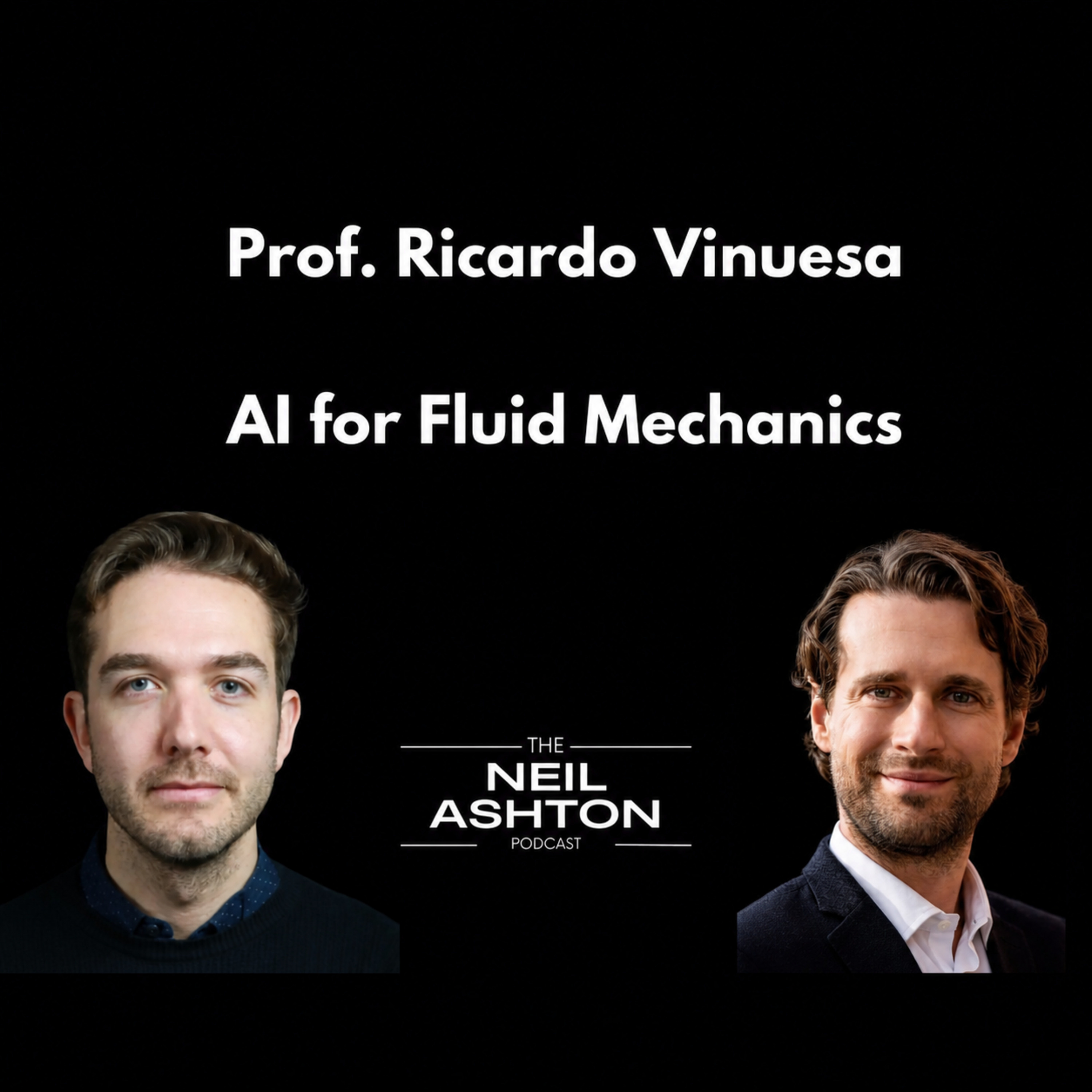
S4 EP3 - Prof. Ricardo Vinuesa on AI for Fluid Mechanics
transcript
show notes
Foundation models, explainable AI and autonomous discovery in fluid mechanics are the focus of this conversation with Professor Ricardo Vinuesa, Associate Chair for Research and Associate Professor of Aerospace Engineering at the University of Michigan. Neil and Ricardo discuss latent representations, turbulence, reduced-order modeling, flow control and whether AI can discover physical mechanisms that humans might miss.
Full episode, corrected transcript and resources:
https://neilashton.co.uk/podcasts/s4-e3-prof-ricardo-vinuesa-on-ai-for-fluid-mechanics/
Topics
Can fluid mechanics have a “ChatGPT moment”?
Foundation models and latent representations for turbulent flows
Explainable AI, causality and identifying the mechanisms that matter
Why classical coherent structures may tell only part of the turbulence story
Physics-informed vs purely data-driven machine learning
Reduced-order modeling, autoencoders, transformers and nonlinear compression
Deep reinforcement learning for flow control and optimization
Agentic AI and autonomous scientific discovery in PDE-governed systems
How academia, computer science and engineering education must adapt to AI
Papers
Agentic Exploration of PDE Spaces using Latent Foundation Models for Parameterized Simulations — Abhijeet Vishwasrao et al.
https://arxiv.org/abs/2604.09584
Multi-agent LLMs and latent foundation models autonomously explore flow physics in a tandem-cylinder problem.
Enhancing computational fluid dynamics with machine learning — Ricardo Vinuesa, Steven L. Brunton
https://doi.org/10.1038/s43588-022-00264-7
A roadmap for useful ML in CFD, including faster simulations, turbulence models and reduced-order models.
Identifying regions of importance in wall-bounded turbulence through explainable deep learning — Andrés Cremades et al.
https://doi.org/10.1038/s41467-024-47954-6
Explainable AI identifies flow structures that matter for prediction and control.
β-Variational autoencoders and transformers for reduced-order modelling of fluid flows — Alberto Solera-Rico et al.
https://doi.org/10.1038/s41467-024-45578-4
Disentangled latent spaces, autoencoders and transformers support interpretable reduced-order models.
Improving turbulence control through explainable deep learning — Miguel Beneitez et al.
https://arxiv.org/abs/2504.02354
Explainable AI and deep reinforcement learning target turbulence-sustaining mechanisms.
Links
VinuesaLab
https://www.vinuesalab.com/
Ricardo Vinuesa — University of Michigan Aerospace Engineering
https://aero.engin.umich.edu/people/ricardo-vinuesa/
AI and ML for Fluid Dynamics course — Ricardo Vinuesa and Sergio Hoyas
https://www.flowthermolab.com/courses/ai-ml-for-fluids/
VinuesaLab YouTube channel
https://www.youtube.com/@VinuesaLab
AI for Fluid Mechanics, Sustainability & XAI — Ricardo Vinuesa
https://www.youtube.com/watch?v=TOfwf4ffPnU
Modelling and controlling turbulent flows through deep learning — Ricardo Vinuesa
https://www.youtube.com/watch?v=0AOY_agZ8WM
Chapters
00:00 Podcast intro
03:20 The Evolution of Foundation Models in Fluid Dynamics
10:22 Understanding Explainable AI in Fluid Mechanics
15:34 Challenges in Data Fidelity for Foundation Models
20:29 Machine Learning vs. Reduced-Order Modeling
24:22 The Shift from Turbulence Modeling to Surrogate Models
29:48 Exploring Agentic Systems for Scientific Discovery
37:21 Exploring Latent Representations in Fluid Dynamics
40:40 The Role of AI in Autonomous Discovery
41:57 Bridging Fluid Mechanics and Computer Science
45:28 Data-Driven vs. Physics-Driven Models
51:34 The Role of Academia in AI and Fluid Mechanics
56:27 Optimization and Control in Machine Learning
01:00:28 The Future of AI in Fluid Dynamics: Beyond ChatGPT