Skip to content
Artwork for The Manufacturers Network
BusinessManagementEducationSelf-Improvement

The Manufacturers Network

Lisa Ryan

The Manufacturers’ Network is where manufacturing leaders, plant managers, and industry innovators come to talk straight about what’s working and what’s not, on the shop floor and beyond.

Each week, host Lisa Ryan sits down with people who live and breathe this business: operations executives, HR directors, engineers, and founders who are building stronger teams and smarter systems in the face of nonstop change.

Listeners gain real-world insights on:
• Employee retention and workforce engagement
• Automation, AI, and the future of skilled trades
• Supply chain and operations leadership
• Safety, sustainability, and company culture that lasts

If you’re tired of generic “leadership talk” and want practical conversations from people who get it, this podcast is for you.

New episodes drop every Monday and are short enough for your commute, sharp enough to shape your week.

Subscribe and be part of the conversation that’s connecting manufacturers across industries, one story at a time.

Play
  • 21 episodes
  • weekly
  • Avg 29 min
  • English
Counted on this page — what you have heard stays on this device, so it is not something the list can be paged by.
  • S5 · E27
    Monday · 33 min

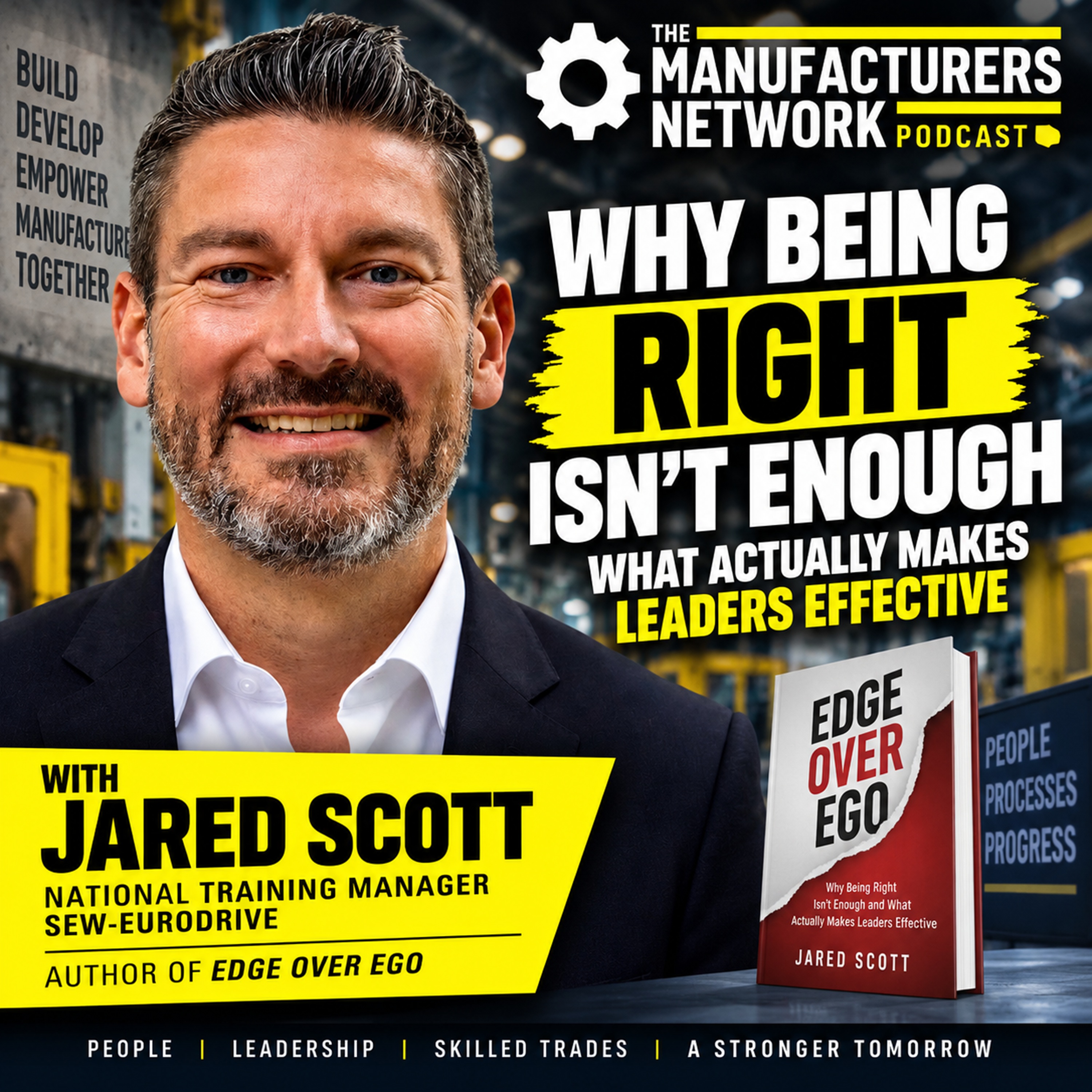
    Manufacturing Leadership: Why Being Right Isn’t Enough with Jared Scott

    What happens when a manufacturing leader’s experience becomes the very thing keeping the operation from improving? In this episode of The Manufacturers Network Podcast, Lisa Ryan talks with Jared Scott, National Training Manager at SEW-EURODRIVE and author of Edge Over Ego: Why Being Right Isn’t Enough and What Actually Makes Leaders Effective, about manufacturing leadership, workforce development, technical training, AI, and the generational shift happening across the industry. Jared has worked in manufacturing since 1995, starting with hands-on industrial maintenance before moving into workforce training and leadership development. He has watched manufacturing change dramatically, but one challenge remains: experienced leaders can become so accustomed to how things are done that they stop noticing what could be better. That’s where ego gets expensive. Jared shares a story from early in his career when he found a simple way to grease tapered bearings more efficiently using a basketball needle. Instead of considering the idea, the experienced employee training him rejected it because Jared hadn’t “paid his dues.” It’s a great example of how manufacturers can lose good ideas, efficiency improvements, and employee engagement because experience becomes a reason to stop listening. Lisa and Jared discuss a question every manufacturing leader should consider when a new employee challenges an established process: What if they’re right? As manufacturers face skilled labor shortages, retiring experienced workers, AI adoption, automation, and rapidly changing technology, leaders can’t afford to confuse experience with infallibility. Jared describes the “boiled frog” problem in manufacturing. When you’ve worked inside the same operation for years, problems can become so familiar that you stop seeing them. The pothole everyone drives over. The inefficient process everyone works around. The machine problem everyone tolerates. The procedure nobody questions because “that’s how we’ve always done it.” New employees may notice those problems immediately because they haven’t learned to ignore them yet. Manufacturing leaders don’t have to implement every suggestion. They do need to create an environment where employees can question a process, offer an idea, or point out a problem without being dismissed because of tenure or job title. Human Judgment, AI and Manufacturing Lisa and Jared also explore what happens as artificial intelligence and automation become more prevalent in manufacturing. AI can increase capability, but manufacturers still need people who understand equipment, processes, troubleshooting, and what actually happens on the shop floor. At the same time, experienced workers are retiring with decades of practical manufacturing knowledge. Younger employees may enter with less experience but different technical skills, fresh perspectives, and access to new tools. The leadership challenge is connecting those capabilities instead of allowing generations to dismiss each other. Why Manufacturing Training Fails Jared’s work in manufacturing training has taught him that theory alone doesn’t prepare someone to troubleshoot equipment, machine a component, wire a motor, or solve a real production problem. Effective manufacturing training requires practical application and instructors who understand the work. Employees also want to know why a new process is better, how it helps them do their jobs, and whether their experience and feedback matter. Jared shares how employee feedback has led his team to change training because workers discovered a better way to perform the work. Ego, Listening and Better Decisions One of Jared’s simplest leadership practices is also one of the hardest: Don’t respond immediately when you feel challenged. When a leader’s first instinct is to prove they’re right, pause before responding. Then get curious. “Help me understand what you mean.” “What made you think this would work better?” “How could we implement this idea?” The objective isn’t to give up decision authority. It’s to understand the information before deciding what to do with it. In this episode: • How ego can block continuous improvement in manufacturing • Why experienced leaders stop noticing familiar operational problems • The “boiled frog” effect and what it costs manufacturers • How frontline employees uncover waste and inefficiency leaders may no longer see • Why listening to an idea doesn’t mean you have to implement it • Manufacturing’s generational leadership shift • Retiring workers and the loss of practical manufacturing knowledge • Why vocational education, mechatronics, and skilled trades matter • AI, automation, and the continuing value of hands-on technical skills • How ego affects listening and decision-making • Mental health and workplace well-being in production environments • How to design technical training that actually sticks • Why practical experience matters when training frontline workers Manufacturing needs experienced people. It also needs experienced people willing to reconsider what they know. The competitive advantage may come from knowing when experience should guide the decision, when a new idea deserves attention, and when being right matters less than getting to a better answer. Guest: Jared Scott National Training Manager, SEW-EURODRIVE Author of Edge Over Ego: Why Being Right Isn’t Enough and What Actually Makes Leaders Effective #Manufacturing #ManufacturingLeadership #WorkforceDevelopment #SkilledTrades #ManufacturingTraining #AIinManufacturing #Automation #ContinuousImprovement #HumanJudgment #ManufacturersNetwork

  • S5 · E26
    September 14 · 35 min

    Leadership Under Pressure: Burnout, Communication & Human Judgment in Manufacturing with Kabrina Ashley

    What happens on the manufacturing floor when pressure goes up, communication shuts down, and your best employees stop speaking up? In this episode of The Manufacturers Network Podcast, Lisa Ryan talks with leadership consultant, speaker, and applied neuroscience practitioner Kabrina Ashley about how stress and burnout affect communication, decision-making, safety, employee retention, and human judgment in manufacturing. One of the earliest warning signs isn't always poor performance. It's silence. An experienced employee notices something doesn't sound right. A high performer sees a potential problem but stops mentioning it. Someone has an instinct that a machine, process, or production line needs attention, but they've learned that speaking up may get them dismissed as overly cautious. Kabrina explains how sustained pressure can narrow attention and create tunnel vision. Employees become focused on completing the immediate task, protecting themselves from criticism, and getting through the shift. That can mean missing the small warning signs that could prevent a larger safety, quality, or production problem. Lisa and Kabrina also discuss the growing importance of human judgment as manufacturers adopt AI and automation. Technology can provide data, dashboards, and alerts, but experienced workers carry what Lisa calls a "sensory library." They can hear, feel, smell, notice, remember, and recognize patterns that may never appear on a dashboard. The challenge for manufacturing leaders is creating an environment where people still use that judgment and feel safe enough to speak up. The conversation also explores burnout in manufacturing and the warning signs leaders often miss. High performers may continue producing excellent work while quietly withdrawing. They stop volunteering ideas. They stop staying the extra five minutes. They stop fixing problems nobody asked them to fix. Eventually, the manufacturer risks losing an employee whose knowledge may take two or three people to replace. Kabrina shares practical, brain-based leadership strategies plant managers and frontline supervisors can use under pressure, including slowing down before reacting, using breathing to regain composure, paying attention to physical signs of stress, and asking better questions instead of settling for "Everybody good?" In this episode: • Why silence can be an early warning sign of burnout and disengagement • How chronic pressure affects attention, communication, and decision-making • Why psychological safety matters for manufacturing safety and quality • How AI and automation increase the importance of human judgment and communication • Why experienced workers' tribal knowledge and sensory knowledge need to be protected • How generational differences can create communication breakdowns on the shop floor • Why leaders often repeat the management behaviors they experienced themselves • Early signs that a high-performing employee is mentally checking out • Why rewarding your best employees with more work can eventually drive them away • How breathing and emotional regulation can help leaders make better decisions under pressure • Why employee behavior that looks like a bad attitude may have another explanation • How leaders can ask better questions to uncover problems before they become bigger problems One practical change manufacturing leaders can make immediately: stop asking questions that make "yes" the easiest answer. Instead of "Everybody good?" or "Did everybody get it?" ask employees what they're noticing. Ask what's working with a new machine or process and what isn't. Ask what they see that leadership may be missing. When manufacturers invest in AI, automation, and smarter technology, human judgment doesn't become less important. The ability to notice, question, communicate, and intervene may become even more valuable. #Manufacturing #ManufacturingLeadership #AIinManufacturing #Leadership #EmployeeRetention #ManufacturingWorkforce #Burnout #HumanJudgment #WorkplaceSafety #Automation #ManufacturersNetwork

  • S5 · E25
    September 7 · 31 min

    Manufacturing Cybersecurity, AI Adoption, and the Future of Frontline Work with Denis O'Shea

    Manufacturers are investing millions in AI, Microsoft 365, automation, and digital transformation. Yet many organizations are still struggling with the same challenge: getting employees to actually use the technology while keeping operations secure. In this episode of The Manufacturers Network Podcast, I sit down with Denis O'Shea, Founder and CEO of Mobile Mentor, to discuss what manufacturers need to know about cybersecurity, AI adoption, Microsoft Copilot, and protecting frontline workers. Drawing on more than two decades of helping organizations bridge the gap between technology and employee adoption, Denis explains why technology alone never solves the problem. Success depends on helping people understand, trust, and use the tools they're given. We also explore one of the biggest security risks facing manufacturers today: shared passwords. Denis explains why eliminating passwords, moving to cloud-based security, and properly supporting frontline workers can dramatically reduce cyber risk while improving productivity. If you're a manufacturing executive, plant manager, HR leader, IT professional, or operations leader trying to balance innovation with security, this conversation offers practical guidance you can implement immediately. In this episode, you'll learn: Why manufacturers struggle to get full value from Microsoft 365 and AI investments The biggest cybersecurity threats facing manufacturing companies today Why shared passwords create unnecessary security risks How manufacturers can better support frontline employees using AI tools What Microsoft Copilot, AI agents, and workflow automation mean for manufacturing Why employee adoption matters as much as technology selection The advantages of cloud security over aging on-premise systems How to improve both productivity and cybersecurity without overwhelming your workforce Key Takeaways Technology is evolving faster than people can adopt it. Organizations often purchase powerful software but use only a fraction of its capabilities because employees lack training, confidence, or support. Frontline workers are frequently overlooked during digital transformation initiatives. While executives receive AI training and new tools, employees on the plant floor often receive little guidance, creating both productivity and security gaps. Manufacturers should prioritize eliminating shared passwords wherever possible. According to Denis, compromised credentials remain one of the leading causes of security breaches, particularly in environments where multiple employees share devices and accounts. Cloud-based platforms continue to provide stronger security protections than many organizations can maintain on their own, making cloud migration an important long-term cybersecurity strategy. As AI capabilities expand, organizations also need to monitor usage and costs. New AI assistants, agents, and automated workflows create tremendous opportunities, but they also introduce new budgeting and governance challenges that leaders should understand before scaling adoption. About Denis O'Shea Denis O'Shea is the Founder and CEO of Mobile Mentor, a global Microsoft partner specializing in helping organizations improve cybersecurity, modern workplace productivity, AI adoption, and employee technology experiences. After spending 15 years with Nokia during its rise to global leadership, Denis founded Mobile Mentor to help organizations close the gap between rapidly advancing technology and real-world employee adoption. Connect with Denis O'Shea Learn more about Mobile Mentor and Denis's work helping organizations strengthen cybersecurity, improve Microsoft adoption, and prepare for the future of AI in the workplace. Listen If You Want To Learn About: Manufacturing cybersecurity AI in manufacturing Microsoft Copilot for manufacturers Frontline worker technology Manufacturing digital transformation Cybersecurity best practices Passwordless authentication Microsoft 365 adoption Cloud security AI governance Employee technology adoption Manufacturing leadership Industrial cybersecurity Recommended Resources If you enjoyed this conversation, check out other episodes of The Manufacturers Network Podcast, where manufacturing leaders share practical insights on workforce development, leadership, technology, retention, automation, and building stronger organizations. Keywords: manufacturing cybersecurity, AI adoption, Microsoft Copilot, manufacturing technology, industrial cybersecurity, frontline workers, digital transformation, cloud security, Microsoft 365, passwordless authentication, manufacturing leadership, cybersecurity best practices, AI governance, manufacturing innovation, employee technology adoption.

  • S5 · E24
    August 31 · 29 min

    AI That Actually Works on the Factory Floor with Mike Fedorov

    Artificial intelligence is everywhere. Unfortunately, so is AI hype. Manufacturers are hearing promises about smarter factories, automated planning, and AI-powered decision making. But what actually works inside a real manufacturing operation where data is messy, production schedules change hourly, and experienced employees solve problems machines never see coming? In this episode of The Manufacturers Network Podcast, Lisa Ryan talks with Mike Fedorov, Co-CEO and COO of Applied AI Labs and former manufacturing leader at Mars and Accenture. Together, they cut through the AI buzzwords and focus on practical strategies manufacturers can implement today. Instead of chasing shiny technology, Mike explains why successful AI projects begin with operational pain points, involve frontline employees from day one, and focus on delivering measurable business value quickly. If you're wondering how artificial intelligence fits into manufacturing without replacing your workforce or sacrificing human judgment, this conversation is a must-listen. What You'll Learn Why more than 80% of AI projects fail before delivering meaningful results How manufacturers can identify the best first AI project Why employee buy-in matters more than software selection The difference between AI demonstrations and real factory floor solutions How AI can improve production planning and sequencing Why dirty manufacturing data shouldn't stop your AI journey How experienced employees and AI create stronger decisions together The biggest mistakes companies make when implementing AI Why resilience still matters even in highly automated operations How manufacturers can begin using AI without a massive technology budget Key Takeaways Solve Real Problems First The best AI projects don't begin with technology. They begin with the biggest frustrations employees experience every day. Instead of asking, "Where can we use AI?" ask: What's slowing us down? What's costing us money? What repetitive work frustrates our people? Those answers often reveal the highest-return automation opportunities. Human Judgment Still Wins AI is remarkably good at processing data. Experienced people are remarkably good at recognizing when something doesn't feel right. The future of manufacturing isn't AI replacing people. It's AI helping experienced employees make faster, better decisions while preserving the judgment developed over decades on the plant floor. Don't Wait for Perfect Data Many organizations delay AI because they believe their data isn't clean enough. Mike argues that's the wrong approach. Real manufacturing environments always contain incomplete, inconsistent, or messy data. The goal isn't perfection. It's building AI systems that can operate successfully in the real world. Start Small. Win Early. Manufacturers don't need million-dollar AI initiatives. Choose projects that are: Easy to implement Highly valuable Capable of delivering measurable ROI quickly Early wins build confidence throughout the organization and create momentum for larger AI initiatives. AI Should Strengthen Your Workforce The strongest manufacturing organizations combine: Experienced people Practical AI tools Operational expertise Continuous improvement Technology doesn't replace great employees. It helps them spend less time fighting systems and more time solving problems that matter. Featured Guest Mike Fedorov is the Co-CEO and COO of Applied AI Labs, helping mid-market manufacturers deploy practical AI solutions that improve operations, production planning, and business performance. Before founding Applied AI Labs, Mike spent 25 years leading manufacturing, supply chain, and consulting initiatives at Mars and Accenture. Connect with Mike Fedorov LinkedIn: Mike Fedorov Applied AI Labs Email: mike@aalc.ai About The Manufacturers Network Podcast Hosted by Lisa Ryan, CSP, founder of Grategy and author of Smart Plant: Aligning AI, Automation, and People, The Manufacturers Network Podcast features conversations with manufacturing leaders, innovators, and experts who are helping organizations build stronger cultures, improve employee retention, develop frontline leaders, and prepare for the future of manufacturing. Whether you're a manufacturer, plant manager, operations leader, HR professional, or executive, each episode delivers practical strategies you can apply immediately to improve workforce performance and business results. Keywords: AI in manufacturing, manufacturing AI, artificial intelligence for manufacturers, factory automation, manufacturing leadership, AI adoption, manufacturing operations, production planning, production scheduling, AI agents, manufacturing technology, digital transformation, frontline leadership, employee retention, manufacturing culture, operational excellence, Industry 4.0, smart manufacturing, production optimization, manufacturing workforce, manufacturing podcast, manufacturing innovation, manufacturing productivity, human judgment, manufacturing efficiency

  • S5 · E23
    August 24 · 31 min

    The Future of Manufacturing Workforce Development, AI, and Digital Transformation with Bryce Carpenter

    How can manufacturers solve workforce shortages while embracing artificial intelligence, automation, and digital transformation? In this episode of The Manufacturers Network Podcast, Lisa Ryan sits down with Bryce Carpenter, Executive Vice President and Chief Operations & Strategy Officer at Conexus Indiana, to discuss how one of America's strongest manufacturing states is preparing its workforce for the future. Bryce shares how manufacturers, educators, policymakers, and economic development organizations can work together to strengthen talent pipelines, accelerate technology adoption, and help small and mid-sized manufacturers compete in an increasingly digital economy. From apprenticeships and plant tours to AI use cases and workforce partnerships, this conversation is packed with practical ideas for manufacturing leaders looking to attract talent, improve operations, and future-proof their organizations. In This Episode You'll Learn Why workforce development remains manufacturing's biggest challenge and biggest opportunity How AI is helping reshape the image of modern manufacturing careers Why apprenticeships and work-based learning outperform traditional recruiting methods How manufacturers can partner with schools to build long-term talent pipelines Why digital transformation creates higher-paying jobs instead of replacing workers How manufacturers are successfully introducing AI without creating employee resistance Why sharing best practices across manufacturers accelerates innovation The value of plant tours, peer networking, and manufacturing associations How Conexus Indiana collected more than 100 real-world AI manufacturing use cases Why collaboration between industry, education, and government is essential for workforce success Key Topics Discussed Workforce development Manufacturing workforce shortages AI in manufacturing Digital transformation Advanced manufacturing Manufacturing leadership Apprenticeships Work-based learning Career and technical education (CTE) Community colleges Employee retention Workforce recruitment Manufacturing technology Industrial automation Cobots Manufacturing associations Economic development Manufacturing innovation Supply chain development Manufacturing careers Memorable Quotes "The day I started, the biggest challenge was workforce. Today, it's still workforce." "AI is helping manufacturers show young people what modern manufacturing really looks like." "Technology is additive to workers, not a replacement for workers." "You don't have to solve these problems on your own. Someone has already learned the lessons." Why This Conversation Matters Manufacturers everywhere are competing for skilled workers while simultaneously navigating artificial intelligence, automation, and rapid technological change. Bryce explains that success isn't just about adopting new technology. It's about building partnerships that connect manufacturers with schools, community colleges, policymakers, and each other. The companies that thrive won't necessarily be the ones with the biggest budgets. They'll be the organizations that embrace collaboration, invest in people, and create cultures where technology helps employees do more meaningful work. For manufacturers wondering how to recruit younger workers, introduce AI successfully, or build stronger workforce pipelines, this episode offers a practical roadmap. About Bryce Carpenter Bryce Carpenter is the Executive Vice President and Chief Operations & Strategy Officer at Conexus Indiana, where he helps strengthen Indiana's advanced manufacturing and logistics ecosystem through workforce development, digital transformation, economic strategy, and collaboration between industry, education, and government. Conexus Indiana works with more than 130 manufacturing and logistics partners to advance innovation, workforce readiness, and competitiveness across one of the nation's largest manufacturing economies. Connect Learn more about Conexus Indiana: https://www.conexusindiana.com Connect with Bryce Carpenter on LinkedIn. Connect with Lisa Ryan: https://www.LisaRyanSpeaks.com Learn more about Smart Plant: Aligning AI, Automation, and People https://www.SmartPlantBook.com Listen to more episodes of The Manufacturers Network Podcast: https://www.TheManufacturersNetworkPodcast.com Recommended For Manufacturing CEOs Plant Managers Operations Leaders HR Leaders Workforce Development Professionals Manufacturing Executives Community College Leaders Economic Development Organizations Manufacturing Associations Career and Technical Education (CTE) Leaders Industrial Engineers State Manufacturing Partnerships Government Workforce Agencies

  • S5 · E22
    August 17 · 29 min

    AI, Supply Chains, and Global Logistics: How Manufacturers Can Build More Resilient Operations with Phil Rees

    What happens after your product leaves the factory may determine your profitability just as much as what happens inside it. In this episode of The Manufacturers Network Podcast, Lisa Ryan talks with Phil Rees, founder of ShipMax and a supply chain strategist with more than 20 years of experience helping manufacturers, retailers, and global brands improve fulfillment, warehousing, customs compliance, and international logistics. Phil explains why many manufacturers focus heavily on production efficiency while overlooking logistics decisions that quietly increase costs, delay shipments, and create unnecessary risk. He also shares how artificial intelligence is transforming warehousing and fulfillment, why companies should rethink inventory strategies, and what changing global trade regulations mean for manufacturers expanding into international markets. If you're responsible for manufacturing operations, supply chain management, distribution, procurement, or business growth, this episode offers practical strategies for building a more resilient, efficient supply chain. In This Episode You'll Learn The biggest logistics mistakes manufacturers make after products leave the factory Why HS (Harmonized System) codes have a major impact on customs clearance and import costs How manufacturers can reduce supply chain costs by minimizing border crossings When reshoring, nearshoring, or regional inventory makes financial sense How AI is improving warehouse management, fulfillment, inventory forecasting, and logistics planning What manufacturers should know about tariffs, customs regulations, and global trade changes Why supply chain strategy should be reviewed continuously instead of treated as a one-time project Practical ways manufacturers can begin using AI immediately to improve operations Key Topics Discussed Manufacturing supply chains Global logistics Warehousing Fulfillment Distribution strategy Customs compliance HS Codes International shipping Tariffs Reshoring Nearshoring Fourth-party logistics (4PL) Warehouse automation Robotics Artificial intelligence in manufacturing AI for supply chain management Inventory optimization Manufacturing operations Global trade Memorable Quotes "Supply chain compliance is a journey, not a destination." "Every time you cross a customs border, you add cost." "If you put garbage into AI, you'll get garbage out." "Manufacturers that aren't experimenting with AI risk falling behind." Why This Conversation Matters Manufacturers spend enormous resources improving production efficiency, yet many overlook opportunities to optimize what happens after products leave the factory. As tariffs evolve, customer expectations change, and artificial intelligence reshapes logistics, manufacturers need supply chains that are flexible, data-driven, and globally competitive. Phil explains why resilient supply chains depend on more than transportation. They require smarter inventory placement, better customs planning, AI-powered decision-making, and continuous adaptation to changing global markets. Whether you're shipping across the country or around the world, these strategies can help reduce costs, improve customer experience, and strengthen your competitive advantage. About Phil Rees Phil Rees is the founder of ShipMax, where he helps manufacturers, retailers, and growing brands optimize fulfillment, warehousing, logistics, and international distribution. With more than two decades of experience in global supply chain management, Phil specializes in helping organizations simplify complex logistics while preparing for future growth through automation and artificial intelligence. Connect Learn more about ShipMax: https://www.shipmax.co.uk Connect with Phil Rees on LinkedIn. 🎯Phil Rees | LinkedIn Connect with Lisa Ryan: https://www.LisaRyanSpeaks.com Learn more about Smart Plant: Aligning AI, Automation, and People Amazon.com: Smart Plant: 9798995174707: Ryan, Lisa: Books Listen to more episodes of The Manufacturers Network Podcast: https://www.manufacturers-network.com/ Recommended For Manufacturing CEOs Operations Leaders Supply Chain Directors Plant Managers Logistics Managers Procurement Professionals Distribution Leaders Warehouse Managers Manufacturing Executives Business Owners Industrial Engineers International Trade Professionals

  • S5 · E21
    August 10 · 23 min

    How Manufacturers Can Attract Gen Z Talent Through Apprenticeships with 2026 Apprentice of the Year Sarah Morgan

    Why do so many manufacturers struggle to attract younger workers while companies with strong apprenticeship programs have candidates lining up? In this episode of The Manufacturers Network Podcast, Lisa Ryan sits down with Sarah Morgan, Toolmaking Apprentice at R&D Leverage (an Adler Company) and the 2026 Apprentice of the Year recognized by the Mold Technologies Division. Sarah shares how a high school manufacturing tour changed the direction of her career, why apprenticeships are one of manufacturing's strongest recruiting tools, and what employers can do differently to attract, train, and retain the next generation of skilled trades professionals. Whether you're a manufacturing executive, HR leader, plant manager, educator, or parent exploring career options, this conversation offers practical insights into workforce development, mentorship, and succession planning. In This Episode You'll Learn Why high school manufacturing tours influence career decisions How apprenticeship programs help solve the skilled labor shortage What Gen Z employees look for in manufacturing employers Why visibility and outreach matter more than ever for recruiting The importance of mentorship and knowledge transfer before experienced employees retire How reverse mentoring strengthens relationships between experienced workers and younger employees Why manufacturing careers offer multiple career paths without requiring a traditional four-year degree How tuition reimbursement and continuous learning improve employee retention Ways manufacturers can partner with local schools to build future talent pipelines Key Topics Discussed Manufacturing apprenticeships Workforce development Skilled trades careers Toolmaking Plastic injection mold manufacturing Manufacturing career pathways Employee development Succession planning Knowledge transfer Reverse mentoring High school career exploration Manufacturing education Recruiting younger workers Gen Z workforce Manufacturing leadership Employee retention Manufacturing workforce shortages Memorable Quotes "We'll teach you if you don't know." "Recognition doesn't have to be a big thing. People notice when you care." "There are so many different jobs in manufacturing. You can find your niche." "I'm learning something new every day." Why This Conversation Matters Manufacturing companies across North America are facing an aging workforce, increasing retirements, and a growing shortage of skilled workers. Sarah's story demonstrates that attracting younger talent isn't simply about higher wages or better technology. It's about visibility, mentorship, career pathways, and creating opportunities for people who may never have considered manufacturing. Her experience also highlights the importance of structured apprenticeship programs, partnerships with schools, and transferring critical institutional knowledge before experienced employees retire. About Sarah Morgan Sarah Morgan is a Toolmaking Apprentice at R&D Leverage, an Adler Company, and the recipient of the 2026 Apprentice of the Year Award from the Mold Technologies Division. She is currently completing her Toolmaking degree while working full-time and serves on her local ITEC advisory board, helping strengthen partnerships between manufacturers and schools. Connect Learn more about R&D Leverage: https://www.rdleverage.com Connect with Lisa Ryan: https://www.LisaRyanSpeaks.com Learn more about Smart Plant: Aligning AI, Automation, and People https://www.amazon.com/dp/B0H2FVPZZ5 Listen to more episodes of The Manufacturers Network Podcast: https://www.manufacturers-network.com/ Recommended For Manufacturing CEOs Plant Managers HR Professionals Operations Leaders Manufacturing Executives Workforce Development Professionals Technical Education Leaders Career and Technical Education (CTE) Instructors Apprenticeship Coordinators Manufacturing Association Leaders Students exploring manufacturing careers Parents and educators

  • S5 · E20
    August 3 · 27 min

    Why AI Pilots Fail in Manufacturing (and How to Fix It) with Russell Halper

    AI pilots look great in a controlled environment. Then they hit the real shop floor and quietly fall apart. In this episode, Lisa Ryan talks with Russell Halper, founder and managing director of Insight Kitchen, about why so many manufacturing AI initiatives stall after deployment and what leaders can do differently before they ever write the first prompt. Russell's path here is unusual. He started a PhD in mathematics under a founder of chaos theory, moved into operations research (one of the earliest forms of data science), worked at UPS, then went in-house as an internal consultant for a major consumer goods manufacturer. From there, he spent eight years at a boutique Palo Alto consulting firm, helped grow it from 16 to 100 people, saw it acquired by a large global consultancy, and ran its West Coast Generative AI practice. Two years ago, he left to found Insight Kitchen, a boutique data science and AI consultancy focused on operational AI in manufacturing and supply chain. Key Takeaways for Manufacturing Leaders A pilot is not a proof point; it is a rehearsal for scale. Most organizations design pilots to prove AI works in a controlled setting. Russell argues the real work is designing the pilot to surface the change management, data, and complexity issues that will show up at full scale, before you ever roll it out plant-wide. A 95 percent solution can be a catastrophic failure. In operational environments, the last few percentage points of accuracy often carry the most real-world risk. Before adopting an AI tool, define what "good enough" actually means for that specific decision, because the threshold changes by use case. Watch for compounding error, not just error rate. If an AI model is 99 percent as good as your best people but making decisions much faster, small errors can compound quickly. Ask whether faster, slightly less accurate decisions are actually creating value or just creating a bigger mess sooner. Usage is your earliest warning sign. If the people on the floor are not acting on the AI's recommendations, you already have your answer. A model nobody trusts is not a decision-making tool, no matter how sophisticated it is. Your senior operators know things your data never captured. A 40-year machine operator who says "something's off with this machine" is picking up on signals that never made it into a sensor feed. When leadership overrides that instinct because "the dashboard is green," they lose the tribal knowledge as retiring workers walk out the door. "Clean data first" can be a stall tactic. Russell has seen organizations spend endless cycles perfecting data before doing anything with it. His advice: work the actual business problem and pull the data along with you. You will often learn more about your data by using it than by polishing it in isolation. Start with the business problem, not the technology. The mechanics of building a financial case for an AI project look almost identical to the case for any other software investment. Start with the outcome you want (efficiency, reduced reject rate, faster throughput) and work backward to whether AI is the right tool, not the other way around. Mid-market manufacturers may have a real speed advantage right now. Fewer legacy systems, more focused operations, and lower internal liability friction mean mid-sized manufacturers can often move faster on AI adoption than large enterprises, which are weighed down by legacy tech and internal politics. As AI gets better, ask whether your business is getting better with it. Russell's framework: track whether your organization's capability is compounding alongside the technology, or whether you are just layering new tools onto the same old process. Discussion Questions for Your Leadership Team Where are we chasing a "bright, shiny" AI tool instead of a defined business outcome? What does our frontline team know that never makes it into our systems, and how are we capturing it before they retire? If usage of a tool dropped to zero tomorrow, would we notice, and would it matter? About Russell Halper Russell Halper is the founder and managing director of Insight Kitchen, a boutique data science and AI consultancy that embeds AI directly into the processes that run supply chain, manufacturing, and revenue management operations. He holds a PhD in Applied Mathematics and brings over 20 years of experience at the intersection of applied mathematics, operations research, and AI, having advised startups, private equity-backed SaaS companies, and Fortune 500 organizations across retail, consumer goods, manufacturing, high-tech, and logistics. Before founding Insight Kitchen, Russell was a partner at End-to-End Analytics (acquired by Accenture) and later led Accenture's West Coast Generative AI practice as Managing Director. Connect with Russell: Insight Kitchen: insightkitchen.ai LinkedIn: linkedin.com/in/russellhalper About the Host Lisa Ryan, CSP, MBA, is the founder of Grategy® and Chief Appreciation Strategist. She hosts the Manufacturers Network Podcast and speaks to manufacturing, industrial, skilled trades, and healthcare audiences on employee retention, workplace culture, and the human side of AI and automation. Her newest book, Smart Plant: Aligning AI, Automation, and People, explores how manufacturers can adopt AI without losing the judgment and tribal knowledge their people bring to the floor. Book Lisa Ryan for your next event, conference, or leadership training on AI, culture, and workforce retention: Website: LisaRyanSpeaks.com Email: lisa@grategy.com Connect and Subscribe Listen to more episodes of the Manufacturers Network Podcast Learn more about Grategy at LisaRyanSpeaks.com Get Smart Plant: Aligning AI, Automation, and People: amazon.com/dp/B0GZMFBVZ2

  • S5 · E19
    July 27 · 27 min

    The Recognition Mistake Costing You Your Best People with Michelle Kozin

    Lisa Ryan sits down with Michelle Kozin, an organizational strategist who uses behavioral science to help manufacturers connect people strategy with business strategy. Michelle's background in change management started with large-scale ERP implementations, where she learned that the technology was never the hard part. The people were. In this conversation, Michelle and Lisa unpack why the same recognition can motivate one employee and completely miss the mark with another, why pay is rarely the real reason a skilled tradesperson walks out the door, and why role clarity might matter more than personality type when it comes to unlocking performance. They also look ahead to a shift already underway on plant floors: leaders who will soon manage AI agents alongside human teams, and what that means for trust, communication, and job design. What You'll Learn Why change triggers fear of loss, not fear of change itself, and what that means for how leaders communicate The difference between extrinsic and intrinsic motivators, and why money is rarely the true reason someone starts job hunting How to recognize employees according to how they're wired, not how you'd want to be recognized yourself Why treating everyone "the same" often reads as unfair, and what real fairness looks like instead The difference between behavioral assessments and job assessments, and why role clarity solves more retention problems than personality typing does How AI and automation are reshaping job expectations the same way ERP implementations did two decades ago One question every plant manager can ask before their next one-on-one to build more trust this week Key Quotes Michelle Kozin on why people resist change: people aren't afraid of change itself, they're afraid of what they might lose, whether that's control, influence, or relationships. Michelle on recognition: a gift lands based on the person opening it, not the person giving it, and that means leaders need to know how each team member is wired before deciding how to show appreciation. Michelle on fairness: real fairness means matching your approach to the person in front of you, using the same standard of communication but a different path to get there. Lisa Ryan on AI and human judgment: machines will be right the vast majority of the time, but the small percentage where human judgment matters is exactly where tribal knowledge and critical thinking need to be protected and passed down. Actionable Takeaways for Plant and Operations Leaders Before your next one-on-one, ask yourself one question. How does this person want to be led, similarly to you or differently? Let the answer shape how you open the conversation. Audit your recognition approach by employee, not by policy. Some people want public praise. Others want a quiet handshake and a private word. Find out before you plan the next round of engineering week gifts or service awards. Separate role clarity from personality typing. Before investing in another behavioral assessment, make sure every person on your team can answer this: what does success in my role actually look like right now? Over-communicate during any transformation, especially the uncomfortable parts. Sharing the good, the bad, and the ugly builds more trust than protecting people from bad news ever will. Get ahead of AI-driven job redesign the way you'd handle any major system change. As AI takes on more tasks, job descriptions and expectations will shift. Name that shift out loud instead of letting people guess at what their role now requires. Watch for the quiet quitters. Most people disengage long before they resign. Treat consistent, values-aligned recognition as a retention tool, not an afterthought. About Michelle Kozin Michelle Kozin is an organizational strategist who helps companies and leaders connect people strategy with business strategy using behavioral science. She has spent 20 years using the Predictive Index methodology to help organizations improve hiring, define roles, and unlock performance through better leadership. Her work centers on how trust and connection form under pressure, particularly during periods of organizational change like digital transformation, technology implementation, and now the rise of AI in the workplace. Connect with Michelle on LinkedIn or visit predictiveadvisors.com. About the Host Lisa Ryan, CSP, MBA, is the founder of Grategy® and host of the Manufacturers Network Podcast. She works with manufacturing, industrial, and skilled trades organizations on employee retention, workplace culture, and the human side of AI and automation. Her newest book, Smart Plant: Aligning AI, Automation, and People, is available now on Amazon. Connect Explore more episodes of the Manufacturers Network Podcast Learn more about Grategy at LisaRyanSpeaks.com Get Smart Plant: Aligning AI, Automation, and People: https://www.amazon.com/dp/B0GZMFBVZ2

  • S5 · E18
    July 20 · 33 min

    When the Expert Retires, Does the Answer Leave with Them? with Brian Kaufman

    Brian Kaufman is co-founder and chief product officer at Strudel, an AI startup that gives technical support teams real-time context when issues hit and detects error patterns before they become customer-facing problems. His background is in software product development and healthcare technology, but the problems he solves map directly onto what manufacturing companies face every day: institutional knowledge that lives in people's heads instead of in systems, and support teams solving the same problems over and over from scratch. Brian and Lisa dig into what it actually costs when undocumented knowledge walks out the door, how AI can serve as a partner to experienced technicians without replacing their judgment, and what a realistic starting point looks like for manufacturers considering AI-assisted support. Key Takeaways for Manufacturing Leaders The information exists. It just isn't findable. Most organizations aren't starting from zero. The knowledge is in old tickets, emails, PDFs, and people's heads. The first step is figuring out where it lives, not waiting until it's gone to wish you'd captured it. Start before someone gives notice. The best time to document institutional knowledge is before retirement is on the horizon. If the person with 30 years of experience is leaving in two months, you're already behind. Build the habit now. Ask the question nobody's asked. One of the most powerful knowledge-capture prompts: "What do you know that nobody's ever asked you about?" Experienced technicians have built sensory libraries over decades, knowing what a machine sounds like, feels like, and smells like when something's about to go wrong. That knowledge doesn't survive a standard exit interview. AI should be an investigator, not an oracle. Strudel presents troubleshooting suggestions as hypotheses grounded in real historic tickets, not confident declarations. When a technician is standing at a machine, that distinction matters. Build trust by showing your work, not by pretending to be certain. Machine context cuts investigation time dramatically. Knowing the model, firmware version, and configuration immediately narrows the problem space. A known defect affecting machines shipped between two specific dates becomes a one-step fix rather than a multi-hour troubleshooting process. Don't use LLMs for everything. Strudel uses traditional statistical analysis and machine learning for the heavy lifting, reserving large language models for last-mile summarization. The result is fewer hallucinations and answers that are easier to monitor and evaluate for quality. Your most skeptical expert is your most important early win. Find the team member with deep expertise who doubts new tools and figure out what task they hate doing most. Solve that one problem well, and you've turned your biggest skeptic into your biggest advocate. Start small, find wins, then expand. Don't try to solve everything at once. Pick one product line, one process, one team. Get good at that before scaling. Build in an early checkpoint to evaluate and adjust. Involve your people before you buy anything. Coming back from a trade show with a shiny new system your team had no input on is a reliable way to end up with a system nobody uses. Ask what's causing the most pain. Start there. Working top of license matters on the shop floor too. When your most experienced technician is answering the same question for the fifth time, that's a waste. Free those people up for novel problems, mentoring, and process improvement. About Strudel Strudel embeds directly into existing support ticketing systems and generates troubleshooting steps within 15 to 20 seconds of a ticket coming in, drawing on historical tickets and documentation specific to the machine, software version, and configuration in question. As more tickets are resolved, that knowledge becomes part of the system, making new staff onboarding faster and institutional knowledge more durable. Connect with Brian Kaufman Email: brian@strudel.io Website: www.strudel.io The Manufacturers Network Podcast features long-form conversations with leaders, practitioners, and experts across manufacturing, the skilled trades, and industrial sectors. Host Lisa Ryan, CSP, MBA, is a keynote speaker, author of 13 books, and founder of Grategy.

  • S5 · E17
    July 13 · 32 min

    Why Women Leave the Trades (And What Stops Them) with Samantha Kaye Harris

    Samantha Kaye Harris spent 27+ years in structural maintenance leadership at JFK Airport, managing teams of 100+ people in one of the most male-dominated environments in the trades. She started as a general maintainer, learned paving, roofing, sheet rock, and concrete work from the ground up, and earned her way into leadership one job at a time. Today she helps women in manufacturing, the trades, and industrial environments own their voice, stay in the room, and get paid for the value they bring. Lisa and Samantha dig into what it actually costs when women go silent on the shop floor, why psychological safety and physical safety are directly connected, and what plant managers and operations leaders can do right now to change the dynamic on their teams. Key Takeaways for Manufacturing Leaders Retention starts with safety, not perks. Women don't leave because the pay is bad. They leave because they don't feel safe speaking up, asking for what they need, or being heard without having their competence questioned. Fix the environment before you worry about the benefits package. The fear cycle is a real retention risk. Samantha describes a predictable pattern: a woman arrives, over-performs to prove herself, gets worn down by constant testing and second-guessing, goes silent, starts hiding, and eventually leaves. Recognizing where someone is in that cycle is the first step to stopping it. "Are you sure?" is a red flag phrase. Asking a leader whether she's sure, or checking her answer with another supervisor, sends a clear message about whose judgment is trusted. Leaders need to monitor this in their own behavior and in their teams. PPE that doesn't fit is a safety and morale issue. One-size-fits-all gear made for male bodies signals that women weren't considered when the workplace was designed. Getting the right fit is a practical step that communicates respect. Psychological safety connects directly to physical safety. When a woman is spending mental energy calculating how to avoid being dismissed, she's not focused on the work. In an environment with heavy equipment and real hazards, that's not just a morale problem. Don't send the complaint back to the floor. When a woman raises a concern and leadership takes it straight back to the crew, her colleagues often figure out exactly who said what. That's when isolation and retaliation start. Handle issues with confidentiality and intention. One woman in a safety or HR-adjacent role changes things. Having someone on staff who has actually done the work, who gets the environment, gives women a place to raise issues without fear of being laughed off or ignored. Community is a retention strategy. Women's groups, networking events, and peer connections within associations are growing fast because they work. If your industry association doesn't have a women's group, it's worth asking why not. Training boxes don't change behavior. Computer-based compliance training may satisfy HR requirements, but it doesn't change what happens on the shop floor. Real culture change takes conversation, modeling, and accountability. When women stop hiding, companies win. Samantha is direct about this: when a woman feels safe enough to fully show up, use her voice, and go after advancement, productivity goes up, teams communicate better, and the company starts attracting more skilled talent. The ROI is real. Samantha's Truth Methodology Samantha works with women one-on-one and through 30-day intensives to help them understand the internal patterns holding them back, learn where those patterns came from, and build the self-trust to use their voice, ask for what they want, and step fully into their power. Connect with Samantha Kaye Harris Email: info@samanthakayeharris.com (Note: Kaye is spelled K-A-Y-E) The Manufacturers Network Podcast features long-form conversations with leaders, practitioners, and experts across manufacturing, the skilled trades, and industrial sectors. Host Lisa Ryan, CSP, MBA is a keynote speaker, author of 13 books, and founder of Grategy.

  • S5 · E16
    July 6 · 24 min

    Stop Competing on Price: How to Find and Tell Your Company's Story with Lauren Kwedar Cockerell

    If your sales team keeps losing deals on price, the problem might not be your pricing. It might be your story. Lauren Kwedar Cockerell, founder and president of Kwedar & Co., a strategic communications firm based in Fort Worth, joins Lisa to talk about why so many manufacturers struggle to articulate what makes them genuinely different, and what to do about it. Lauren has spent 23 years in public relations working with B2B companies, with deep roots in manufacturing and industrial sectors. Her firm helps companies excavate what's already there, that unique thread hiding in plain sight, and turn it into messaging that resonates with customers, prospects, and the talent they're trying to attract. What You'll Learn in This Episode Why "our people" and "our quality" aren't differentiators. Every competitor is saying the same thing. Lauren explains why surface-level answers won't cut it and how to dig multiple levels deeper to find what's actually distinctive about your operation. The "yeah, duh" trap. The things your team dismisses as obvious are often the most compelling to your buyers. The challenge is that it's hard to read the label from inside the bottle. The Thread: Lauren's four-stage methodology Excavate. Deep discovery through conversations, competitive review, and a close look at everything you've built Surface. Finding that through line, the offhand comment you almost threw away that turns out to be the whole thing Articulate. Translating the story into language that resonates across every channel and audience Activate. Putting it out into the world on your website, in media, in sales conversations, and in internal communications Where AI fits and where it falls short. AI can help you iterate content once you have a strong narrative, but it cannot create one for you. Without a distinctive source document, you are just replicating what already exists and creating volume no one is listening to. The new visibility equation. Trade journals, podcasts, and consistent digital content are not just good marketing. They are signals that AI-powered search uses to determine relevancy and authority. If your messaging is inconsistent or generic, the LLMs cannot distinguish you from a competitor either. Signs your messaging problem is costing you real money. You are losing deals on price alone, your salespeople are delivering inconsistent pitches, you are attracting candidates who do not fit, and the marketing firms you have hired just cannot seem to nail it. The first thing to do this week. Pull up your website headline, take away your logo, and ask: could this apply to any other industry? If the answer is yes, you have work to do. Connect with Lauren Website: KwedarCo.com LinkedIn: Lauren Kwedar Cockerell The Manufacturers Network Podcast is hosted by Lisa Ryan, CSP, founder of Grategy and Chief Appreciation Strategist. Lisa helps manufacturing and industrial organizations build cultures where people want to stay.

  • S5 · E15
    June 22 · 21 min

    How Manufacturing Leaders Can Build Resilient Supply Chains, Strong Culture, and Smarter Automation with JC Carr

    In this episode of the Manufacturers Network Podcast, Lisa Ryan sits down with JC Carr, Territory Account Manager at World Emblem and founder of Whips Miami, to talk about the future of manufacturing leadership, supply chain resilience, automation, and workforce culture. JC shares his unconventional path from launching an exotic car brokerage during COVID to becoming a rising voice in manufacturing with a growing social media following focused on the human side of industry. The conversation explores what manufacturing leaders are getting right and wrong about automation, digital transformation, workforce engagement, and operational growth. JC also shares lessons learned from working inside large-scale supply chain environments, including Amazon, and why community involvement, leadership accountability, and employee connection still matter in highly automated operations. If you’re a manufacturing executive, plant manager, HR leader, or operations professional trying to balance technology with people, this episode offers practical insight grounded in real-world experience. In This Episode: How JC Carr built a business during COVID selling exotic car lease deals What manufacturing can learn from Amazon’s supply chain systems Why automation should eliminate frustration, not human value The difference between digital transformation and culture transformation How manufacturing leaders can improve workforce retention and engagement Why simple tools often outperform expensive technology investments What manufacturers should consider during mergers, acquisitions, and consolidation The hidden risks of fragmented supply chains How community involvement strengthens leadership and workforce loyalty Why younger workers want purpose, connection, and impact from employers About JC Carr JC Carr is a Territory Account Manager at World Emblem, one of North America’s largest emblem and embroidery manufacturers. Having worked across nearly every department in the company, he brings a full-spectrum understanding of manufacturing operations and customer experience. He is also the founder of Whips Miami, an exotic car brokerage launched during college, and has built a social media following of more than 120,000 people by highlighting the human side of manufacturing, leadership, and modern industry. Connect with JC Carr LinkedIn: https://www.linkedin.com/in/jc-carr/ Instagram: https://www.instagram.com/jc.carr/ Company: https://www.worldemblem.com/ Key Takeaway Technology can improve efficiency. But manufacturing still runs on people. The companies that win long-term will be the ones that use automation to support human judgment, strengthen culture, and create workplaces where employees feel valued and connected.

  • S5 · E14
    June 8 · 35 min

    How Great Leaders Create More Leaders with Scott Burgmeyer

    Leadership development is not about creating people who can follow instructions. It’s about creating people who can think. In this episode of the Manufacturers Network Podcast, Lisa Ryan talks with Scott Burgmeyer about leadership growth, succession planning, emotional intelligence, and why so many organizations struggle to develop future leaders before it’s too late. With more than 30 years of experience in manufacturing, operations, consulting, and organizational development, Scott shares practical lessons from working with companies ranging from small manufacturers to organizations like Google, Procter & Gamble, and Bridgestone. The conversation explores: Why leaders struggle to let go and delegate How to transfer knowledge before experienced employees retire The difference between managing people and developing leaders Why employees need permission to think and make decisions The hidden cost of constantly answering every question yourself How emotional intelligence impacts operational performance Why strategic plans fail after the meeting ends The danger of confusing activity with results Succession planning mistakes that create tension and chaos How personal growth directly affects company culture and retention Scott also explains why leadership teams must stop focusing only on technical performance and start investing in the growth of people at every level of the organization. One of the biggest takeaways from this episode: Organizations rarely outperform the growth level of their leaders. Actionable Ideas from This Episode Ask more questions instead of immediately giving answers Create low-risk opportunities for employees to make decisions Focus on outcomes, not just activity Build leadership systems that continue beyond one generation Evaluate whether your strategic plan is actually moving key metrics Develop future leaders before you urgently need them Make professional and personal growth part of your leadership expectations Use feedback early instead of waiting until problems grow Scott’s “Growth Questions” When trying something new, ask: What worked? What didn’t work? What do I need to do differently? Connect with Scott Burgmeyer Website: Become More Group LinkedIn: Scott Burgmeyer on LinkedIn Connect with Lisa Ryan Website: Lisa Ryan, CSP / Grategy If you enjoyed this episode, share it with a manufacturing leader, operations executive, HR professional, or business owner working to strengthen culture, retention, and leadership development inside their organization.

  • S5 · E13
    May 25 · 25 min

    What Happens When Your Business Outgrows Your People with Mike Krupit

    Manufacturing companies don’t usually fail because of bad products. They fail because growth exposes leadership gaps nobody wanted to deal with. In this episode of the Manufacturers Network Podcast, Lisa Ryan talks with leadership advisor and Trajectify founder Mike Krupit about what really happens when organizations grow faster than their people, systems, and communication. Mike shares lessons from decades in Silicon Valley startups and explains why retention problems are often clarity problems, leadership problems, and culture problems disguised as “people issues.” The conversation covers: Why companies outgrow key employees and founders How poor communication quietly destroys trust The difference between employees who “get it, want it, and are capable” Why psychological safety matters on the shop floor What leaders miss when they blame workers for disengagement How to manage up when leadership refuses to change Why “this is how we’ve always done it” is dangerous in manufacturing The connection between AI, workforce change, and leadership adaptability Practical ways manufacturers can rethink scheduling, culture, and retention One of the biggest takeaways from this episode: You cannot build a future-ready company with leadership habits designed for the past. Mike also shares actionable ideas leaders can use immediately to evaluate whether they truly have the right people in the right seats before growth turns into chaos. Actionable Questions from This Episode What assumptions are we making that may no longer be true? Are we measuring outputs clearly enough for people to succeed? Do employees feel safe trying new ideas or making mistakes? Are leaders communicating enough, especially across shifts and teams? Is the organization growing faster than the people leading it? What is one thing leadership could change tomorrow? Connect with Mike Krupit LinkedIn: Mike Krupit on LinkedIn Website: Trajectify Connect with Lisa Ryan Website: Grategy / Lisa Ryan, CSP If you enjoyed this episode, share it with a manufacturing leader, HR professional, or operations executive who’s trying to build a stronger workplace culture while navigating growth and change.

  • S5 · E12
    May 11 · 25 min

    What It Really Takes to Scale E-Commerce Without Breaking Your Operations with Ethan Giffin

    E-commerce looks easy… right up until it isn’t. More orders. More customers. More growth. And then everything starts to crack. In this episode of The Manufacturers Network Podcast, I sit down with Ethan Giffin to talk about what really happens when e-commerce businesses try to scale. Not the highlight reel. The operational reality behind it. We get into fulfillment pressure, inventory accuracy, customer expectations, and why so many companies focus on growth before they’ve built the foundation to support it. Because here’s the truth…You don’t rise to the level of your marketing. You fall to the level of your operations. What You’ll Learn Why scaling e-commerce creates operational challenges most teams underestimate The pressure fulfillment puts on systems, people, and decision-making Where inventory accuracy becomes a make-or-break issue How customer expectations are reshaping operations Why growth exposes weaknesses instead of fixing them The role your team plays when systems fall short What leaders need to get right before pushing for scale The Conversation Ethan Giffin brings a practical lens to e-commerce. No hype. Just how things actually work when volume increases. What stood out in this conversation is how quickly things get complicated. At low volume, you can get away with inefficiencies. At scale, those same issues turn into daily problems. Orders increase. Returns increase. Customer expectations tighten. And suddenly, your operation isn’t just fulfilling orders… it’s reacting all day long. Even with automation in place, the reality doesn’t change. When something breaks, it’s your people stepping in to fix it. That’s where a lot of companies get surprised. They invest in systems… but forget to build the operational discipline behind them. Key Takeaways E-commerce is an operations business Marketing brings the orders in. Operations decides whether customers come back. Speed raises the stakes The faster you promise delivery, the less room you have for error. Inventory accuracy drives everything If your numbers are off, every decision downstream gets harder. Growth magnifies what’s already broken What works at 100 orders a day rarely works at 1,000. People are still the safety net When systems fail, your team is the one holding it together. Moments Worth Replaying The realities of fulfillment as order volume increases Where inventory issues start and how they impact everything else The pressure created by faster delivery expectations How small operational gaps turn into major customer problems About Ethan Giffin Ethan Giffin works in the e-commerce space, focused on helping businesses navigate the operational side of growth, from fulfillment to inventory management to scaling systems that actually hold up under pressure. He brings a straightforward, practical perspective to challenges that are easy to underestimate and hard to fix once they show up. Final Thought Selling online is the easy part. Delivering on that promise… consistently… under pressure… is where most companies struggle. And when things go wrong, they don’t get fixed by software. They get fixed by people. Gratitude is a strategy.

  • S5 · E11
    May 4 · 27 min

    What Automation Gets Wrong About People, Culture, and Judgment with Rylan Pyciak

    Here’s what nobody says out loud. You can automate a facility, install the dashboards, optimize the flow… and still lose the people who make it all work. In this episode of The Manufacturers Network Podcast, I sit down with Rylan Pyciak to talk about what’s really happening inside modern supply chains. Not the polished version. The real one. We get into the tension between automation and human judgment, why most leaders are spending money in the wrong places, and how culture quietly becomes the difference between a system that scales and one that stalls. Because the truth is simple. If your people don’t feel ownership, your systems don’t matter. What You’ll Learn Why “fully automated” operations still depend heavily on people The difference between scale, speed, and true orchestration How to build accountability into your operation without micromanaging Where most manufacturers waste money on technology Why culture is the #1 failure point in M&A activity How community involvement impacts retention more than most leaders realize What leaders miss when trying to modernize legacy industries The Conversation Rylan’s background spans everything from large-scale fulfillment environments to third-party logistics and fragmented legacy industries. That perspective shows up fast. He breaks down what it actually takes to scale operations without losing control. And more importantly, without losing your people. One thing that stood out right away… Even in highly automated environments, you’re still managing thousands of employees across multiple shifts. That creates a different challenge. Not just operations. Consistency, communication, and culture across a 24/7 workforce. And that’s where most leaders underestimate the work. Key Takeaways Accountability beats intelligence You don’t need a room full of geniuses. You need a team that owns results, learns from mistakes, and adjusts quickly. Start simple before you get fancy Some of the best operational insights still come from a whiteboard on the floor. Not a screen. Not a dashboard. Just people talking about what broke and why. Automation should remove frustration If you want buy-in, start with the work people hate doing. That’s where automation earns trust. Culture is not optional in M&A Too many leaders treat people integration like a detail. It’s not. It’s the difference between success and failure. Top-down vision. Bottom-up execution Leaders define where you’re going. The people closest to the work figure out how to get there. Skip that and everything slows down. Community drives retention When companies invest outside their walls, employees feel it. And they stay longer because of it. Moments Worth Replaying The reality behind large-scale automated facilities and workforce demands Why expensive tech often replaces simple, effective communication tools The mindset shift from “spend money” to “solve the right problem” What actually happens after an acquisition when culture is ignored About Rylan Pyciak Rylan Pyciak is a supply chain and operations leader focused on building scalable, resilient systems across complex environments. His work spans automation, logistics networks, and integrating fragmented industries into high-performing operations. He brings a practical, no-nonsense approach to solving problems most leaders overcomplicate. Final Thought You can build the smartest system in the world. But if you’ve designed it without your people in mind, it’s fragile. You just don’t see it yet. Gratitude is a strategy. And in a world that’s moving faster every day, it might be the one thing that keeps your people grounded enough to stay.

  • S5 · E10
    April 27 · 26 min

    The 401K Fees Every Manufacturer Is Paying But Never Sees with Paul Sippil

    Lisa Ryan welcomes Paul Sippil, forensic 401K consultant and self-described 401K vigilante. Over 17 years, Paul has analyzed thousands of public retirement plan filings and documented more than 1,300 cases of apparent excessive fees. His central argument is simple and uncomfortable: most American employers, including manufacturers, have never seen the true cost of their 401K plan, and the structure of the industry is specifically designed to keep it that way. From Recovering CPA to 401K Vigilante Paul describes himself as a recovering CPA who knew from his very first day as an auditor that the path wasn't right for him. His career shifted into financial advising focused on estate and succession planning for business owners until a conversation with a colleague revealed that retirement plan tax forms were publicly available online. That discovery changed everything. When Paul began calling business owners to alert them to the fees he was seeing in their own public filings, he expected to be a hero. Instead, he got a response that told him everything he needed to know about the industry: I'm not paying anything and my friend handles that. The disconnect between what employers believed and reality was so profound that Paul realized he could build an entire career consulting in just this one area and he did. The Invisible Fee Problem The reason most employers have no idea what their 401K plan actually costs is simple: there is no invoice. Fees don't arrive as a bill. They flow silently through the structure of the plan itself: embedded in mutual fund management fees, deducted directly from participant accounts, or buried in arrangements between advisors and record keepers that employers never see or negotiate. The major fee categories Paul walks through include: Mutual fund fees: unavoidable, but can be minimized by choosing index or passively managed funds Record-keeping and administration fees: charged by providers like Principal, Voya, Fidelity, John Hancock, Paychex, and ADP, often as a percentage of total plan assets Financial advisory fees: either embedded as broker commissions within fund costs, or charged as a separate percentage of assets by registered investment advisors Custodial fees: charged by institutions like Charles Schwab that hold the assets The compounding problem: because fees are typically percentage-based, they grow automatically as the plan grows — with no increase in services provided. The Case That Says It All Paul shares a story that captures everything wrong with this industry in one example. A company with just three employees paid out over $49,000 in broker commissions between 2019 and 2024, to an advisor they didn't even know they had. When the HR director called to find out who the broker was, a quick Google search revealed the broker had been dead since 2014. When Paul raised this publicly, an industry administrator pushed back saying "everybody's gotta get paid." Paul's response: you first have to be living. The story isn't just an anomaly, it's a window into an industry structurally incentivized for advisors to do nothing, stay invisible, and hope clients never think to ask questions. What Manufacturers Are Leaving on the Table The financial stakes for manufacturers are significant, particularly for business owners who often hold the largest account balances within their own plans. Paul walks through several practical opportunities most plan sponsors don't know they have: Negotiate record-keeping fees. Simply asking, no financial sophistication required, can reduce percentage-based fees that providers don't automatically lower as plan assets grow. On a $3 million plan, reducing the fee by 0.1% saves $3,000 every year, permanently. Negotiate or eliminate advisory fees. In many cases, advisors aren't performing active management; they're waiting for participant phone calls. Participants direct their own investments from a list of fund choices. The advisor isn't making buy-sell decisions for anyone. Demand dollar-denominated answers. Fee disclosures required since 2012 exist, but they're often expressed as percentages, buried in documents few people know to look for, and disconnected from any real-time cost experience. Asking "how much have you made off our plan in actual dollars, for each of the last three years?" is a question every plan sponsor should ask every provider. Consider paying fees at the employer level. Employers can choose to pay plan fees directly rather than passing them to participants. The benefit: employer-paid fees are tax-deductible business expenses, and the business owner, who typically holds the largest share of the plan balance, stops paying non-deductible fees out of a tax-advantaged account. The Department of Labor has published research showing that an extra 1% in annual fees costs a 35-year-old participant with a $25,000 balance approximately $64,000 over 30 years; roughly 28% of their ending balance. For participants with larger balances, the damage is proportionally greater. Why the Industry Doesn't Change on Its Own Paul draws a sharp distinction between price transparency - being able to see fees - and price literacy, having enough context to know whether what you're seeing is reasonable. Even when fees are disclosed, there's no easy way to comparison-shop the way you would for a car or a cell phone. Providers don't make their pricing easy to compare. RFP processes often result in manufacturers switching from one expensive provider to another without meaningfully reducing costs. The root cause, as Paul frames it, echoes economist Milton Friedman's four ways to spend money: the people making purchasing decisions about the plan often hold a small fraction of the assets, while the people whose money is actually at stake — participants and business owners — have little or no say. That misalignment is what keeps the market from behaving like a competitive one. Paul is actively working with the Department of Labor to push for guidance — not mandates — that would require providers to send actual invoices reflecting fees in plain dollar terms. His view: if employers received invoices the way they receive bills from attorneys or accountants, the industry would change overnight. Actionable Takeaways for Listeners Find out the name of every provider involved in your plan. Record keeper, administrator, advisor, custodian — list them all. More people may be getting paid than you realize. Ask every provider the same question in plain English: How much money have you made from our plan, in dollars, for each of the last three years? Don't accept a percentage as an answer. Push for actual dollar amounts. Fee disclosure documents exist but are often deliberately opaque. Negotiate. You don't need a financial background to pick up the phone and ask your record keeper to reduce your percentage fee. The worst they can say is no. Ask your advisor how many hours they've spent servicing your account, who they spoke to, and what they discussed. If the answer is vague, the fee is worth questioning. Consider whether you need an advisor at all. In participant-directed plans, advisors often aren't making any investment decisions. If services aren't being provided, fees shouldn't be either. Look into flat-fee providers. Companies like Ascensus and Employee Fiduciary offer low-cost, transparent, flat-fee structures that are often comparable in service quality to far more expensive alternatives. Think about paying plan fees at the employer level. It creates cost sensitivity, generates a tax deduction, and protects the tax-advantaged growth inside participant accounts. Connect with Paul Sippil: paulsippil.com : resources, contact info, and more 📧 psippil@paulsippil.com

  • S5 · E9
    April 13 · 28 min

    Stop Hiring the Wrong People: A Manufacturer's Guide to Getting It Right with Friddy Hoegner

    Lisa Ryan welcomes Friddy Hoegner, founder of Scope Recruiting and a former procurement and supply chain leader. Friddy helps manufacturing and supply chain companies build the teams that actually keep operations moving and he does it from a perspective most recruiters simply don't have: he's lived the job himself. From Global Supply Chain to the Recruiting Desk Friddy's career began in Germany with ABB in a global rotational supply chain program, where he eventually became a global commodity manager following ABB's acquisition of Thomas & Betts. He later moved into a supply chain manager role with a furniture manufacturer in North Carolina before co-founding Scope Recruiting in 2017 with his wife, who had already identified a critical gap in the market: recruiting firms that specialized in supply chain were staffed almost entirely by people with HR backgrounds, not supply chain experience. That insight became Scope's founding principle. Rather than teaching supply chain professionals how to recruit, Friddy and his wife hired people with supply chain backgrounds and taught them the recruiting side of the business. The result is a firm that clients and candidates alike describe as refreshingly different, because the recruiters actually understand what the job requires. The Hiring Mistake That's Killing Retention Friddy's most consistent finding across years of working with manufacturers is that retention problems almost always start with the hiring process; specifically, with a failure to define who you're actually looking for before you start looking. The pattern is predictable: a hiring manager submits a generic job description, different stakeholders have entirely different ideas about what the role should accomplish, and the organization moves forward without alignment. The hiring manager wants procurement expertise. The director of operations wants logistics. No one compared notes. The wrong person gets hired. And months later, the company wonders why they have a turnover problem. Friddy's solution is to work with all stakeholders upfront to build an ideal candidate profile; a detailed picture of the skills, experience, and behaviors the role actually requires, along with a clear definition of what success looks like at 6 months and 12 months. From that profile comes a scorecard, submitted with every candidate, that creates a consistent and less biased basis for evaluation. Why ChatGPT Can't Save a Bad Interview Process Candidates today can walk into any interview with a ChatGPT-prepared answer to every standard question. Friddy argues this makes the ideal candidate profile and structured interview process more important than ever, not less. When you know the job deeply, you can ask follow-up questions that no AI can prepare someone for. The first answer is rehearsed. The second and third follow-up questions reveal whether someone actually knows what they're talking about. This is precisely where Scope's supply chain background pays off. Generic recruiters can be fooled by a polished surface. Recruiters who've done the job can dig into the weeds and expose the gap between what someone says and what they actually know how to do. Hiring for an AI-Disrupted Future As automation and AI reshape manufacturing operations, Friddy cautions against hiring for narrow, specific skill sets that may be obsolete in two to three years. The manufacturers best positioned for the future aren't hiring for what they need today; they're hiring for adaptability, mental aptitude, and a demonstrated willingness to embrace change. Friddy points to a striking example from his time at ABB: a football field-sized factory in Germany producing miniature circuit breakers at the same cost as factories in Indonesia and Argentina, because there were almost no people on the floor. A handful of engineers and maintenance staff. That future, he argues, is closer than most manufacturers realize, which means the people you hire now need to be able to pivot as the environment shifts around them. Competing for Talent When You Can't Win on Salary The majority of Scope's clients are mid-market and family-owned manufacturers who will never outspend a Fortune 500 company on compensation or benefits. Friddy's advice: stop trying to compete on salary and start competing on impact. The candidates most valuable to smaller manufacturers are often the ones who've grown frustrated with corporate bureaucracy: the pace, the layers of approval, the distance from real decision-making. Smaller companies can offer something larger ones genuinely cannot: the ability to talk directly to the owner, change something meaningful in a day, and actually see the results of your work. That's a powerful draw for the right candidates, and it costs nothing to offer. Why the Best Candidates Aren't on Job Boards Friddy is direct about the limits of posting and praying. The top 10% of talent in any field are rarely browsing job boards. Many have never applied for a job in their lives; they get recruited from one role to the next. Reaching them requires dedicated outreach to passive candidates: contacting 100, hearing back from 15 to 20, submitting 3 to 4. It's time-intensive, unglamorous work — but it's how you find the people who are genuinely performing in their current roles rather than actively looking to leave. Red Flags That Signal the Wrong Hire Two interview warning signs Friddy's team watches for consistently: The "my way or the highway" attitude. Candidates who are so confident in how they've done things before that they can't adapt to a new environment. You can hear it in interviews: an overconfidence that signals they'll push their previous playbook regardless of context, without the sensitivity required to build buy-in. The inability to get specific. Candidates who speak in broad strokes about what "we" accomplished but struggle to articulate their own role, the steps they took, or the details of how it actually worked. Behavior-based questions that require specifics will surface this every time. Friddy's Mic-Drop Closing Tip When you've done the work of defining your ideal candidate profile and you find someone who checks every box, don't hesitate. Don't manufacture reasons to interview three more candidates. The right people are rare, and the hiring process itself can cost you them. Actionable Takeaways for Listeners Align all stakeholders before you write a job description. Disconnected expectations between hiring managers and leadership are one of the most common and costly hiring mistakes in manufacturing. Build an ideal candidate profile, not just a job posting. Define what success looks like at 6 and 12 months before you evaluate a single resume. Use a scorecard for every candidate. Consistency reduces bias and helps you make better decisions — especially when interviews are spread over days or weeks. Ask behavior-based questions and follow up twice. The first answer is rehearsed. The follow-up questions reveal whether the knowledge is real. Hire for adaptability, not just current skills. In a rapidly automating environment, the ability to pivot matters more than a narrow set of technical expertise. Lead with impact, not salary, when competing against larger companies. Speed of decision-making, access to leadership, and the ability to drive real change are advantages small manufacturers genuinely have. When you find the right person — move. Connect with Friddy Hoegner: scoperecruiting.com: hiring resources, candidate scorecards, and contact info

  • S5 · E8
    March 30 · 30 min

    He Built an 8-Figure Business Sending Handwritten Notes with Rick Elmore

    Lisa Ryan welcomes Rick Elmore, founder and CEO of Simply Noted, a 100% bootstrapped, handwritten mail automation company powered by patented robotics and AI-driven personalization. A former NFL athlete turned 9-patent tech founder, Rick scaled Simply Noted to $10 million-plus in revenue by combining manufacturing, automation, and disciplined sales systems, all without a single dollar of outside investment. From the NFL to the Factory Floor Rick's path to building a robotics company is anything but conventional. Drafted to the Green Bay Packers in 2011, he played for six teams in three years before facing what he describes as an identity crisis at 25. He took the transferable skills of an elite athlete: grit, discipline, competitiveness, and the willingness to embrace a process, and applied them first to corporate sales, where he became a consistent top 1% performer, and then to entrepreneurship. The spark came during his MBA program when a marketing professor closed a three-hour lecture with a simple observation: handwritten notes get opened 99% of the time and the mailbox is empty. Rick tested the idea with a pen plotter, 500 targeted prospects, and sold $300,000 in six weeks on a $50,000 quota. The entrepreneurial seizure, as he calls it, had arrived. Building What Didn't Exist What followed was eight years of over-engineering everything. Because no off-the-shelf solution existed, Rick had to build it from scratch: robots, software, algorithms, and all. Key milestones include: Going through 14 engineering firms over more than a year, using each proposal to sharpen the next, before committing to a single partner Spending three years building the technology in chunks, funded entirely by customer revenue, with Thursday-night engineering sessions running from 2 PM to 10 PM Developing intelligent handwriting algorithms that understand context — an "E" at the start of a word is drawn differently than an "E" in the middle or at the end Building 220 custom handwriting robots in a 10,000 square foot facility, holding real pens, replaced twice a day by human attendants Earning 9 patents along the way — and openly sharing why he now thinks they may not have been worth it Personalization at Scale: What Simply Noted Actually Does Simply Noted has made handwritten mail as automatable and trackable as email. Clients can start simple: a spreadsheet with first name, last name, and address. or go deep with full CRM integration, LLM-powered personalized messaging, QR code tracking, delivery notifications, and trigger-based workflows. Examples include: A lead moving to "closed" in Salesforce automatically triggers a personalized handwritten thank-you note A complaint in a ticketing system pulls the complaint data, drafts a custom apology via an LLM, and sends a pen-written note to keep bad reviews offline E-commerce brands sending anniversary notes on the date of a customer's first purchase — completely automated QR codes on notes that, when scanned, automatically alert a sales rep via text message to follow up in real time Why the Mailbox Is the Last Uncluttered Channel Ads are ignored. Inboxes are buried. Social feeds are sponsored noise. But the physical mailbox is nearly empty, and something that looks genuinely handwritten stops people cold. Rick shares how a single handwritten note from a window contractor led Lisa's family to refer over $100,000 in business. That story, he says, is exactly why relationship-based businesses: real estate, home services, financial services, nonprofits, e-commerce see the strongest results. The Athlete Mindset Applied to Entrepreneurship Rick draws a direct line between fifteen years of athletic training and his ability to build slowly, stay disciplined, and not quit when things got hard. He pushes back against the social media myth of overnight success, pointing out that most "overnight" stories hide decades of accumulated domain expertise. Compounding success over time, he argues, is as fundamental in business as it is in sport. Actionable Takeaways for Listeners Start with a crawl-walk-run approach. Request a sample kit, test a simple send, then integrate; don't try to fully automate on day one. Relationship building works best consistently over time. A one-time campaign won't move the needle. The businesses getting the most value from Simply Noted are using it month after month, year after year. The mailbox is your competitive advantage. If everyone you compete with is fighting for inbox and ad space, stepping into a nearly empty channel is an asymmetric opportunity. Personalization doesn't require complexity. Even a simple mail merge with first names on a templated message outperforms nearly any digital equivalent in open rates and memorability. Patents are lawsuit coupons. Protect your business by being so difficult to copy that competitors exhaust themselves trying — not by relying on legal protection alone. Connect with Rick Elmore: LinkedIn: Rick Elmore simplynoted.com to request a free sample kit directly from the homepage

Showing 1–20 of 21 episodes