Skip to content
Artwork for The Lucas Bean Show
BusinessHistory

The Lucas Bean Show

Lucas Bean

Sharing insights on psychology, History, human behavior, politics, new technology and business | Author, Scientist, Podcast Host | I make videos & I try to tell good stories.

lucasbean.substack.com
Play
  • 99 episodes
  • daily
  • Avg 3 min
  • English
Counted on this page — what you have heard stays on this device, so it is not something the list can be paged by.
  • October 16 · 1 min

    MAGA is a Daycare for Adult Children

    In the summer of 2025, psychologist Craig Neumann did something no researcher had done at this scale before. He measured the empathy profiles of over 9,000 American adults, mapped those profiles against their political affiliations and views of Donald Trump, and published what he found in the Journal of Research in Personality. The results did not reveal what most people expected. The common assumption is that Trump supporters lack empathy, that something is missing, that there is a deficit or a gap where the ability to recognize and respond to suffering should be. That assumption is wrong, and what Neumann actually found is considerably worse. Trump supporters are not blind to your pain. They can see it perfectly well. They enjoy it. The Three Dimensions of Empathy Understanding what Neumann’s data shows requires understanding that empathy is not a single capacity. It is at least three distinct psychological processes, each operating through different neural pathways, each measurable independently, and each telling a different story about how a person relates to the suffering of others. Cognitive empathy is the ability to perceive and understand what another person is feeling. It is a perceptual skill, closer to reading comprehension than to emotional experience. A person with high cognitive empathy can look at someone’s face and know they are in pain. They can read body language, vocal tone, and social cues with accuracy. Cognitive empathy does not require caring about what you perceive. It only requires perceiving it. Psychopaths typically score high on cognitive empathy. They are excellent at reading people. That is often what makes them effective manipulators. They can see exactly what you are feeling. They simply do not care. Affective empathy is the capacity to feel what another person feels. It is the process by which observing someone else’s pain produces a corresponding emotional response in your own nervous system. When you see someone stub their toe and you wince, that is affective empathy. When a child cries and your chest tightens, that is affective empathy. It is automatic, involuntary, and operates below the level of conscious decision-making. Affective empathy is what makes cruelty feel wrong. It is the internal alarm that fires when you witness suffering, the signal that tells your brain that what is happening to that person matters. Without it, the suffering of others is neutral information, the way a stock ticker is neutral to someone with no money in the market. Dissonant empathy is the third dimension, and it is the one that changes everything. Dissonant empathy is not the absence of a response to another person’s pain. It is the presence of the wrong response. A person with high dissonant empathy sees suffering and experiences pleasure. The signal fires, but it fires in the wrong direction. Where affective empathy produces discomfort at the sight of someone in pain, dissonant empathy produces satisfaction. This is not sadism in the clinical sense, though the overlap is significant. Dissonant empathy describes a specific empathic inversion: the neural architecture for responding to others’ emotional states is intact and functional, but the valence is reversed. Pain in others registers as reward in the observer. What Neumann Found Neumann and his co-author Darlene Ngo surveyed over 9,000 American adults across two national samples, one collected before the pandemic and one during it. They measured a comprehensive battery of personality traits, empathy dimensions, and political attitudes, including favorability toward Donald Trump. Three findings emerged that, taken together, paint a portrait of a political base that is psychologically distinct from the general population in ways that go far beyond policy disagreement. First, Trump supporters scored the same as everyone else on cognitive empathy. They can read the room. They can see what you are feeling. They understand facial expressions, social cues, and emotional states at the same level as moderates and liberals. There is no perceptual deficit. Second, Trump supporters scored significantly lower on affective empathy. They are measurably less likely to feel distress when observing another person’s suffering. The internal alarm that makes cruelty feel wrong fires less strongly in this population than in the general public. Third, and most critically, Trump supporters scored significantly higher on dissonant empathy. They are measurably more likely to experience pleasure or satisfaction when observing another person in pain. These three findings together produce a profile that is qualitatively different from what most critics of MAGA assume they are dealing with. The common framing is that Trump supporters “lack empathy,” as though there is a hole where empathy should be. Neumann’s data suggests the picture is more disturbing. They do not lack the ability to perceive suffering. That ability is fully intact. What is different is what happens after the perception registers. In most people, perceiving suffering produces discomfort. In this population, perceiving suffering produces satisfaction. They are not missing your pain. They are consuming it. The Emotional Regulation Problem This finding connects to a body of research on emotional self-regulation that has been developing independently of political psychology for decades. Healthy emotional development produces an adult who can generate positive internal states, feelings of purpose, satisfaction, pride, and contentment, from internal resources. They do not need external inputs to feel good about themselves. They have a functional internal emotional economy. Developmental psychology has long established that this capacity is built in childhood through consistent, responsive caregiving. The child learns to regulate their own emotions because they first experienced having their emotions regulated by someone else. The caregiver mirrors the child’s feelings, validates them, and models how to manage them. Over time, the child internalizes this process and becomes capable of doing it independently. When this process is disrupted, whether through neglect, abuse, emotional invalidation, or chaotic household environments, the result is an adult who cannot self-regulate. They cannot generate positive emotional states on their own. They become dependent on external sources for emotional regulation, whether through substances, chaotic relationships, or the emotional reactions of other people. This is the connection that Neumann’s data illuminates without explicitly stating. A population that scores high on dissonant empathy is a population that is using other people’s pain as an emotional regulation tool. The suffering of others produces a feeling in them, a feeling of power, superiority, and satisfaction, that they cannot produce on their own. Without that external input, they are emotionally empty. This is not a description of strong people being cruel. This is a description of emotionally dependent people who need a supply of suffering the way a child needs a parent to soothe them. They cannot feel good on their own. They need someone else to feel bad first. The Rally as Emotional Feeding This framework transforms how we understand Trump rallies. A rally is not a political event. It is a mass emotional feeding. Trump identifies a target. The crowd watches the target be humiliated. The crowd experiences satisfaction. The satisfaction is the product. Nothing else at the rally matters. Watch the audience at the moments Trump is cruelest. When he mocks a disabled reporter. When he describes violence against immigrants. When he calls an opponent an ugly name. The crowd does not respond with the uncomfortable silence of people witnessing cruelty. They respond with joy. They cheer. They laugh. They lean forward in their seats. That response is dissonant empathy operating in real time. They are perceiving pain and they are experiencing pleasure. This is also why Trump ral… This is a public episode. If you'd like to discuss this with other subscribers or get access to bonus episodes, visit lucasbean.substack.com/subscribe

    • Transcript
  • October 15 · 2 min

    Fox News Is Making You Dumber

    In 2012, a research team at Fairleigh Dickinson University’s PublicMind poll set out to answer a straightforward question: how well do Americans who consume different news sources understand basic current events? The study was not designed to embarrass any particular network. It was designed to measure knowledge, the kind of factual awareness a functioning democracy requires of its citizens in order to make informed decisions. The researchers surveyed 1,185 Americans nationwide. They asked each respondent which news sources they had consumed in the previous week, then posed a set of questions about domestic and international affairs. The questions were not obscure or tricky. They covered things like which party controls the House of Representatives, what economic sanctions against Iran are intended to accomplish, and whether the Arab Spring uprisings in Egypt and Syria had succeeded in overthrowing their governments. The kind of basic information that anyone following the news in any meaningful capacity should know. The results produced a ranking that has since been replicated, cited, and expanded upon by researchers across multiple institutions and disciplines. NPR listeners scored highest. Viewers of Sunday morning political talk shows scored nearly as well. Viewers of The Daily Show with Jon Stewart, a comedy program, outperformed viewers of every cable news network. Fox News viewers scored lowest. Not just among cable news viewers. Among everyone. People who reported consuming no news at all answered more questions correctly than people whose primary news source was Fox News. The lead researcher, Dan Cassino, a professor of political science at Fairleigh Dickinson, was explicit about what the data showed. Controlling for education, partisanship, and other demographic variables, the study found that Fox News had a measurable negative effect on knowledge. Someone who watched only Fox News would be expected to answer 1.04 out of 5 domestic questions correctly, a score significantly worse than someone who reported watching no news of any kind. On international affairs the pattern held, with Fox News viewers scoring 1.08 out of 4 questions correctly, again behind those who consumed no news at all. Not One Study The Fairleigh Dickinson findings were not an anomaly. They were a data point in a growing body of research that consistently arrives at the same conclusion. In 2010, two years before the Fairleigh Dickinson study, researchers at the University of Maryland’s Program on International Policy Attitudes conducted a similar analysis following the 2010 midterm elections. They surveyed 848 voters and found that greater exposure to Fox News was associated with increased misinformation on a range of factual questions, including the state of the economy, climate science, and the content of the Affordable Care Act. The more someone watched Fox News, the more misinformed they became, and this effect was not explained by partisan identity. It held even after controlling for political affiliation. In 2020, a study published in Frontiers in Psychology by Lindsay Dhanani and Franz at the University of Delaware examined how media consumption patterns affected Americans’ knowledge about COVID-19, their endorsement of pandemic-related misinformation, and their levels of prejudice toward Asian Americans during the early months of the crisis. Fox News viewers demonstrated lower factual knowledge about how the virus spreads, higher rates of belief in misinformation about treatments and origins, and significantly higher levels of prejudice toward Asian Americans. Those who consumed NPR and the New York Times scored higher on knowledge, lower on misinformation endorsement, and expressed substantially lower levels of racial prejudice. In 2022, researchers at Yale and several other institutions designed one of the most rigorous tests of Fox News’s effect on viewers ever conducted. They recruited a sample of regular Fox News viewers, verified their viewing habits through actual television data rather than self-reporting, and paid them to switch to CNN for a month. The researchers then measured whether the switch changed the participants’ factual beliefs. It did. Viewers who switched from Fox to CNN became measurably more accurate in their understanding of current events, even though they remained politically conservative. When the incentive ended and participants returned to Fox News, their factual accuracy reverted. This study is significant because it addresses the most common objection to the earlier research: that Fox News does not cause misinformation but merely attracts people who are already misinformed. The Yale study showed that when you change the input, the output changes. Fox News viewers who were given accurate information updated their factual beliefs accordingly. When the accurate information was removed and replaced with Fox News, the misinformation returned. The effect is causal, not merely correlational. How Information Displacement Works The question the data raises is not whether Fox News viewers are less informed. That is established. The question is why. What is the mechanism by which watching more news makes a person know less than someone who watches none? The answer lies in what researchers describe as information displacement. Fox News does not leave viewers with no information. It leaves them with false information that occupies the cognitive space where accurate information would otherwise reside. The viewer is not uninformed. They are misinformed, which is measurably worse because a person who knows nothing is at least open to learning. A person who believes something false will actively resist the correct information because accepting it requires first admitting they were wrong. This is a critical distinction. An uninformed person has an empty glass. A misinformed person has a glass full of something contaminated. You cannot fill a glass that is already full, even if what is in it is poison. The person has to first recognize what they have been drinking and choose to pour it out. And the entire architecture of Fox News’s programming is designed to ensure that never happens. Fox News achieves this displacement through a specific structural feature of its programming that distinguishes it from other news sources. The network presents opinion content in formats that are indistinguishable from news reporting. The visual cues are identical: the anchor desk, the chyrons, the breaking news graphics, the tone of authority. Viewers who lack media literacy, which is a skill, not an intelligence measure, process opinion as news because nothing in the presentation signals that they should do otherwise. The result is that a Fox News viewer who watches three hours of evening programming believes they have consumed three hours of news. They have not. They have consumed a small amount of selectively reported factual content embedded in a large volume of editorial narrative, emotional provocation, and tribal reinforcement, all delivered through the visual grammar of legitimate journalism. They believe they are informed because they feel informed. And the feeling of being informed is, for the human brain, functionally indistinguishable from actually being informed. The Dunning-Kruger Dimension This mechanism interacts with one of the most well-documented findings in cognitive psychology: the Dunning-Kruger effect. In 1999, psychologists David Dunning and Justin Kruger at Cornell University demonstrated that people who are least competent in a given domain are also the least capable of recognizing their incompetence. They consistently overestimate their abilities because they lack the very skills that would allow them to see what they are missing. Fox News exploits this dynamic at industrial scale. It tells viewers that they are the smart ones. It tells them the experts are lying, the scientists are corrupt, the professors are brainwashing children, the journalists are manufac… This is a public episode. If you'd like to discuss this with other subscribers or get access to bonus episodes, visit lucasbean.substack.com/subscribe
    • Transcript
  • October 14 · 2 min

    Why Losers Loved Charlie Kirk

    Charlie Kirk never graduated from college. He applied to West Point, was rejected, and instead of trying again somewhere else, he built a career telling other people that college was the problem. That decision, and the audience it attracted, is one of the cleanest real-world examples of a psychological phenomenon that researchers have been studying for years. In 2020, psychologist Hallgeir Sjåstad at the Norwegian School of Economics published a study with co-authors Roy Baumeister at the University of Queensland and Michael Ent at Towson University that investigated what happens inside a person’s psychology after they fail to reach a goal they genuinely wanted. The finding was not that people feel bad and move on. The finding was that people rewrite the goal itself. After failure, the thing they wanted becomes the thing they never really wanted in the first place. Sjåstad and his co-authors called this the sour-grape effect, after Aesop’s fable of the fox who, unable to reach the grapes hanging above him, walked away declaring they were probably sour anyway. The most striking part of the research was that this revision is not a conscious lie. Participants in Sjåstad’s experiments genuinely believed their diminished assessment of the goal was what they had always felt. The original desire had been overwritten. The failure was not denied. It was erased and replaced with a new narrative that never included wanting the thing in the first place. This is the psychological engine that powered Charlie Kirk’s entire career. The Audience Kirk Built Kirk’s audience was not random. It was psychologically specific. His core following was built from young men in their twenties and thirties who did not go to college and needed a story for why that was the right outcome. Some of them could not afford it. Some were not academically prepared. Some were afraid to leave their small towns. The reasons varied but the emotional need was the same. They needed college to be a scam so that not going to college was not a failure. Kirk provided that story on camera, over and over, hundreds of times. He would walk onto college campuses with a microphone and a film crew and engage college students in exchanges designed to produce a very specific visual: a confident adult making a teenager look foolish. The format was rigged from the start. Kirk was thirty years old, had spent years practicing rapid-fire talking points, and controlled the microphone. The students were eighteen or nineteen, standing in public, often encountering these arguments for the first time. The outcome was never in question. But the content of those exchanges was almost irrelevant. What mattered was the image. A man who did not go to college standing on a college campus and appearing to dominate the people who did. For Kirk’s audience, every one of those clips was a piece of evidence in the story the sour-grape effect had already written for them. College is worthless. The people who go there are not that smart. Not going was the right call. The fact that Kirk’s method relied on talking over people, cutting off responses, and rattling through false claims faster than anyone could fact-check them in real time did not matter to his audience. They were not watching for intellectual rigor. They were watching for confirmation. And Kirk delivered it by the hour. What the Research Tells Us About Why This Worked Sjåstad’s study revealed something important about who is most susceptible to the sour-grape effect. Not everyone in his experiments responded to failure by devaluing the goal. People with high achievement motivation, those who were internally driven and comfortable with setbacks, were less likely to revise their assessment. They could fail and still acknowledge the goal was worth pursuing. The people most prone to the sour-grape effect were those whose self-worth was tied to external validation and who lacked the psychological resources to sit with failure. For these individuals, the pain of admitting they wanted something and could not get it was so acute that the rewrite happened automatically. This maps directly onto Kirk’s audience. These were not people who carefully evaluated the costs and benefits of higher education and made a rational decision. These were people who, in many cases, watched their friends leave for college while they stayed behind. That experience, repeated across millions of households in towns where opportunity was already shrinking, created a massive psychological market for someone who would tell them what they needed to hear. Kirk filled that market. He did not create the need. He exploited it. The Function Kirk Actually Served Understanding Kirk through the sour-grape effect reframes what he was actually doing. He was not an educator. He was not a debater. He was not even a political commentator in any meaningful sense. He was a psychological service provider. His product was a narrative that protected his audience from a truth they could not face. Every campus visit, every viral clip, every instance of a flustered college freshman failing to respond to a rapid-fire string of misleading claims served the same function. It told his audience: you are smarter than these people. You did not miss out on anything. The thing you did not get was never worth getting. This is why correcting Kirk’s claims with facts never worked on his audience. You cannot fact-check a defense mechanism. The sour-grape effect operates below the level of conscious reasoning. His audience did not believe college was a scam because Kirk presented compelling evidence. They believed it because they needed to believe it, and Kirk gave them permission. Sjåstad’s research also showed that the sour-grape effect is not permanent in controlled conditions. When participants in his studies eventually achieved the goal they had previously devalued, their original positive assessment returned. The grapes tasted sweet after all. But this only happened when the failure was reversed. For Kirk’s audience, the failure was not reversible. They were not going back to college at thirty-five. The revision was permanent because the underlying situation was permanent. What His Death Revealed When Kirk died, the public grief from his audience was real but psychologically revealing. The mourning was not proportional to a media figure passing away. It was closer to the grief of losing something structural. Kirk was not just a person they liked. He was the load-bearing wall of a psychological defense they had spent years building. Without him producing new content, new clips, new campus confrontations, the supply of evidence for their revised narrative would slow down. The story would get harder to maintain. They were not mourning a man. They were mourning the permission he gave them to feel good about a failure they could not undo. And that kind of grief does not resolve with time. It resolves only when the person finds a new source of the same permission, or when they finally confront the truth the sour-grape effect was built to hide from them. The psychology of the sour-grape effect suggests most of them will find a new source long before they confront anything. Sources: Sjåstad, H., Baumeister, R. F., & Ent, M. (2020). Greener grass or sour grapes? How people value future goals after initial failure. Journal of Experimental Social Psychology, 88, 103965. Elster, J. (1983). Sour Grapes: Studies in the Subversion of Rationality. Cambridge University Press. Robson, D. (2022). The Smart Way to Learn from Failure. BBC Future. This is a public episode. If you'd like to discuss this with other subscribers or get access to bonus episodes, visit lucasbean.substack.com/subscribe
    • Transcript
  • October 13 · 1 min

    The Psychology of Narcissistic Collapse

    In 1975, psychoanalyst Otto Kernberg published Borderline Conditions and Pathological Narcissism, a book that would reshape how the field understood the most dangerous personality structure in clinical psychology. Kernberg, working at Cornell University’s Institute for Personality Disorders, spent decades studying patients whose entire sense of self was built on a fabrication. Not a white lie or a small exaggeration. A complete psychological architecture designed to replace the real person underneath with a version that could never be challenged, never be wrong, and never be seen as weak. Kernberg called this the pathological self-structure. Most people build their identity from a mix of real experiences, real strengths, and real failures. A narcissist builds theirs from a fantasy. And that fantasy requires constant maintenance. This is where the concept of narcissistic supply becomes essential. Narcissistic supply is the fuel the false self runs on. Admiration. Attention. Fear. Obedience. Any response from the outside world that confirms the narcissist’s inflated self-image counts as supply. When the supply is flowing, the narcissist functions. They can appear confident, charismatic, even competent. The mask holds because the world is reflecting back the image the narcissist needs to see. But supply is not infinite. And when it starts to dry up, or worse, when the world starts reflecting back something the narcissist cannot accept, the system begins to fail. The Sequence Kernberg and his contemporaries, including Heinz Kohut at the University of Chicago, described a predictable sequence that unfolds when a narcissist’s false self is threatened. It begins with what clinicians call narcissistic injury. This is not ordinary embarrassment or disappointment. It is a psychological wound that strikes at the foundation of the narcissist’s identity. A public loss. A legal defeat. A betrayal. Any event that forces the narcissist to confront the possibility that they are not who they have been pretending to be. The first response is almost always narcissistic rage. Kernberg described this as a disproportionate, explosive anger directed at whoever or whatever caused the injury. The rage is not strategic. It is not calculated. It is panic dressed up as aggression. The narcissist is not attacking because they are strong. They are attacking because the mask just slipped and they will do anything to shove it back into place. If the injuries keep coming and the rage doesn’t restore the false self, what follows is narcissistic collapse. The entire psychological structure begins to destabilize. The lies get bigger because the truth is getting closer. The threats escalate because the narcissist is running out of tools that work. The behavior becomes increasingly erratic, impulsive, and destructive, not because the narcissist has lost touch with reality in a psychotic sense, but because the only reality they have ever known, the one they built for themselves, is falling apart. Why Collapse Is Dangerous The clinical literature is clear on one point: a narcissist in collapse does not become less dangerous. They become more dangerous. Kernberg noted that the aggression underlying narcissistic pathology, which is normally channeled into manipulation and control, becomes raw and uncontained during collapse. The narcissist stops caring about consequences because their psychological survival feels more urgent than anything happening in the outside world. This is why narcissistic leaders in collapse pose a specific and well-documented threat. Political psychologist Jerrold Post spent his career studying this exact phenomenon for the CIA. He observed that narcissistic leaders in crisis escalate rather than retreat. They create external conflicts to distract from internal disintegration. They purge allies who reflect uncomfortable truths back at them. They surround themselves with increasingly sycophantic inner circles because those are the only people still providing the supply the false self needs to hold together. The escalation is not a strategy. It is a symptom. The Followers There is a second layer to narcissistic collapse that Kernberg’s clinical framework anticipated but never fully explored in a political context. The followers of a narcissistic leader are not passive observers. Many of them have invested their own identities in the leader’s false self. They have adopted the narcissist’s worldview, repeated the narcissist’s lies, and defended the narcissist’s image as if it were their own. Because in a psychological sense, it is. When the leader’s mask begins to crack, the followers face their own narcissistic injury. If the leader is a fraud, then they were fooled. If the leader is weak, then they chose weakness. If the leader was never who he said he was, then they have to explain why they believed him so completely for so long. Most people cannot tolerate that realization. So they do what the narcissist does. They double down. They deny. They rage. They treat any evidence of the leader’s collapse as an attack on themselves. The collapse of the leader and the denial of the followers become a feedback loop, each reinforcing the other, each making the eventual reckoning worse. The cruelest thing about narcissistic collapse is not what it does to the narcissist. It is what it does to everyone around them. A narcissist in collapse will burn relationships, institutions, and entire systems to the ground before they will sit with the knowledge that they were never who they said they were. The people closest to them, the people who believed in them the most, are always the last to see it and the first to get burned. That is the psychology of collapse. Not a breakdown. Not a surrender. A controlled demolition of everything and everyone within reach, carried out by someone who would rather destroy the building than let anyone see what was never inside it. I am about to crack 100,000 subscribers on YouTube. If you don’t follow me there please go and do so. This is a huge milestone for me. I could not do it without you. Click the video below and you can follow me there and if you want like and comment on the video also. Sources: Kernberg, O. F. (1975). Borderline Conditions and Pathological Narcissism. Jason Aronson. Kernberg, O. F. (1984). Severe Personality Disorders: Psychotherapeutic Strategies. Yale University Press. Kohut, H. (1977). The Restoration of the Self. University of Chicago Press. Post, J. M. (2004). Leaders and Their Followers in a Dangerous World: The Psychology of Political Behavior. Cornell University Press. Ronningstam, E. (2016). Pathological Narcissism and Narcissistic Personality Disorder: Recent Research and Clinical Implications. Current Behavioral Neuroscience Reports, 3(1), 34-42. This is a public episode. If you'd like to discuss this with other subscribers or get access to bonus episodes, visit lucasbean.substack.com/subscribe
  • October 12 · 2 min

    The Biology of Fear: Why Your Brain Picks Your Politics

    Something doesn’t add up about American politics. Millions of people vote against their own healthcare. They vote against their own wages. They vote against clean air and clean water in their own neighborhoods. And when you show them the data, when you lay out the numbers, when you present the evidence that the policies they support will hurt them personally, they don’t change their minds. They get angry. They dig in deeper. They call you the enemy. This has confused political strategists, journalists, and psychologists for decades. How do you explain a voting population that consistently rejects evidence? The answer is not about education. It is not about media literacy. It is not about access to information. The answer is about a small, almond-shaped structure buried deep inside every human brain. It is called the amygdala. And it might be running the entire show. Two Brains, Two Worldviews In 2011, neuroscientist Ryota Kanai at University College London published a study in the journal Current Biology that quietly changed the way scientists think about political identity. Kanai and his team used structural MRI to scan the brains of young adults and then compared the scans to self-reported political attitudes. They were not looking at what people think. They were looking at the physical shape of the brain itself. The actual gray matter. Conservatives had significantly more gray matter volume in the right amygdala. That is the region of the brain responsible for detecting threats, processing fear, and triggering the fight-or-flight response. Liberals had significantly more gray matter volume in the anterior cingulate cortex. That is the region responsible for processing conflicting information, tolerating ambiguity, and managing complex or uncertain situations. Kanai was careful. He said political orientation is probably not directly encoded in brain structure. He said more research was needed. He said the relationship could go in either direction, that experiences might shape the brain just as much as the brain shapes political behavior. But the structural difference was there. It was measurable. It was statistically significant. And it opened a door that other researchers walked through. The 82.9 Percent Study In 2013, neuroscientist Darren Schreiber at the University of Exeter published a study in PLOS ONE that took Kanai’s structural finding and tested it functionally. Schreiber put 82 participants into an fMRI scanner and had them play a simple gambling game. While they played, the scanner recorded which regions of their brains were most active during risk-taking decisions. Then Schreiber looked up each participant’s actual voter registration in public records. Republicans showed significantly greater activity in the right amygdala during the task. Democrats showed significantly greater activity in the left insula, a region associated with social awareness and self-reflection. Using only the brain activity data, Schreiber’s model predicted each person’s political party affiliation with 82.9 percent accuracy. That outperformed a model based on the political party of their parents, which only hit 69.5 percent. It also outperformed a model based on brain structure alone, which hit 71.6 percent. Your brain activity during a gambling task predicted your politics better than your parents did. That is not opinion. That is a peer-reviewed finding published in one of the most widely cited open-access journals in the world. What the Amygdala Actually Does The amygdala is old. In evolutionary terms, it is one of the most ancient structures in the human brain. It has been doing the same job for roughly fifty thousand years. That job is threat detection. The amygdala is the reason you jump before you know what made the noise. It is the reason your heart races when you see a shadow move in the dark. It processes danger faster than any other part of the brain. Faster than language. Faster than logic. Faster than conscious thought. For most of human history, that speed was a survival advantage. The humans who froze when they heard rustling in the grass got eaten. The humans whose amygdala fired first, who ran before they thought about running, passed their genes to the next generation. But the amygdala was designed for a world that no longer exists. It was designed for physical threats. Predators. Hostile strangers. Things that could kill you in the next thirty seconds. It was not designed for immigration policy. It was not designed for cultural change. It was not designed to evaluate whether a person speaking Spanish at a grocery store is a threat to your way of life. And yet the amygdala does not know the difference. It cannot tell the difference. A social threat and a physical threat produce the same neurological response. The same cortisol spike. The same elevated heart rate. The same narrowing of attention to the perceived danger. When someone with a larger, more reactive amygdala encounters cultural change, the brain does not process that change as neutral information. It processes it as threat. Not because the change IS dangerous. But because the amygdala’s job is to flag anything unfamiliar as potentially dangerous and let the body react first. Why Facts Don’t Work This is the part that matters most for understanding American politics. The amygdala processes threats faster than the prefrontal cortex processes language. By the time you have constructed a sentence with data and evidence and logic, the person you are talking to has already experienced the full neurological cascade of a fear response. Cortisol is elevated. Heart rate is up. The body is in a defensive posture. Presenting facts to a brain in that state is like showing a pie chart to someone who just saw a bear. The pie chart might be accurate. It is also completely irrelevant to the part of the brain that is currently in charge. This is not a metaphor. This is measurable biology. When a conservative voter hears that immigration actually lowers crime rates, their prefrontal cortex may start to process the data. But their amygdala has already flagged the topic itself as a threat category. The emotional response arrives before the rational one. And in a contest between the amygdala and the prefrontal cortex, the amygdala wins almost every time because it had a fifty-thousand-year head start. This is why political arguments feel so pointless. You are not arguing with a person’s beliefs. You are arguing with their threat detection system. And their threat detection system does not speak the language of evidence. It speaks the language of danger and safety, us and them, familiar and foreign. The Replication Good science requires replication. One study is interesting. Two studies in the same direction are worth paying attention to. A pattern across multiple independent teams starts to look like reality. In 2024, researchers Petalas and colleagues published the largest preregistered replication study in political neuroscience to date. They used 928 subjects instead of Kanai’s original 90. They used a more diverse, more representative sample. They preregistered their hypotheses, which means they committed to their methods before seeing the data so they could not massage the results after the fact. They confirmed the finding. Amygdala gray matter volume correlated positively with conservatism. The association between brain structure and political orientation that Kanai found in 2011 with 90 college students held up in 2024 with a sample more than ten times larger. The anterior cingulate cortex finding from Kanai’s original study was not replicated as cleanly. The science on that side of the equation is still developing. But the amygdala result survived the most rigorous test that political neuroscience has thrown at it so far. What This Does and Does Not Mean Kanai was honest about the limits of his findings and that honesty matters. Brain structure does not determine political belief the way a gene determines eye color. The relationship … This is a public episode. If you'd like to discuss this with other subscribers or get access to bonus episodes, visit lucasbean.substack.com/subscribe
  • October 11 · 12 min

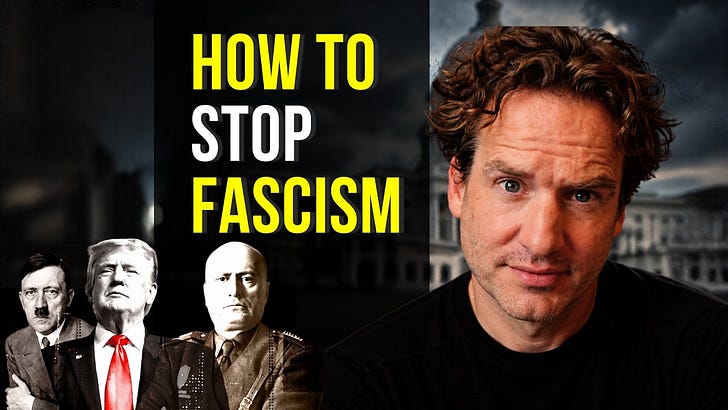
    How to Stop Fascism

    Most people who recognize what is happening in their country right now share one thing in common. They don’t know what to do about it. They vote. They post. They argue at Thanksgiving. And then they go back to their lives and hope someone else figures it out. This is not cowardice. It is the absence of a plan. And the absence of a plan is one of the most studied problems in the history of political science. For the better part of a century, researchers across psychology, political science, and conflict studies have been asking the same question: what actually stops authoritarian movements? Not in theory. Not in a seminar. In practice, in the real world, with real dictators and real populations. The answers they found are remarkably consistent, remarkably specific, and remarkably underused. This piece walks through six researchers whose work, taken together, forms a blueprint for how ordinary people defeat fascism. Not with armies. Not with violence. With behavior. The Playbook That Toppled Dictatorships Gene Sharp never held public office, never led a protest, and never ran an organization with more than three employees. For the last fourteen years of his life, he ran the Albert Einstein Institution out of two rooms in a brick townhouse in East Boston, near Logan Airport, where he also grew rare orchids. He was, by almost every account, the most consequential political scientist of the twentieth century that most people have never heard of. Sharp was born in 1928, the son of a traveling minister in Ohio. As a young man, he refused the draft during the Korean War and spent nine months in federal prison in Danbury, Connecticut. While preparing for his sentence, he wrote a letter to Albert Einstein at Princeton asking if the physicist would contribute an introduction to his book on Gandhi. Einstein, a pacifist, agreed. Sharp later named his institution after him. Over the next five decades, Sharp produced an enormous body of work on a single subject: the mechanics of political power. His central insight was deceptively simple. All political power, including the power of dictators, depends on the obedience and cooperation of the population. No regime can function when enough of its people withdraw that cooperation. The military can’t deploy if soldiers refuse. The economy can’t run if workers stop. The government can’t govern if citizens stop complying. In 1973, Sharp published his three-volume masterwork, The Politics of Nonviolent Action, in which he catalogued 198 specific methods of nonviolent resistance. Boycotts. Strikes. Sit-ins. Tax refusal. Slow compliance. Deliberate inefficiency. Each method was documented from real historical examples. Twenty years later, in 1993, a Burmese exile asked Sharp to write something shorter. Something that ordinary people could read and use in the field. The result was From Dictatorship to Democracy, a 93-page manual that compressed four decades of research into a step-by-step framework for dismantling authoritarian regimes without firing a single shot. The Burmese military junta sentenced anyone caught with the book to seven years in prison. That did not stop it from spreading. The book was translated into more than 30 languages. It was smuggled into Serbia, where the student resistance movement Otpor used it as a field manual to organize the campaign that brought down Slobodan Milosevic in 2000. Oleh Kryenko, one of the leaders of Ukraine’s Orange Revolution, said publicly that Sharp’s book was “the bible” of the resistance. In Egypt, copies circulated in Tahrir Square during the 2011 revolution. Sharp died in January 2018, at ninety years old, in the same East Boston townhouse where he had worked for decades. His obituary in the Washington Post called him a “preacher’s son whose own gospel of nonviolent struggle inspired velvet revolutions that toppled dictators on four continents.” A Scottish journalist who made a documentary about him summed it up differently: “In South America, they’re not tweeting Che Guevara. They’re tweeting Gene Sharp.” Sharp’s work established the theoretical foundation. The researchers who followed him tested it. Why We Won’t Say the Word Robert Altemeyer spent his entire career at the University of Manitoba studying a single question: why do some people follow authoritarian leaders without hesitation, even when doing so conflicts with their own values and interests? In 1981, he published his first major book, Right-Wing Authoritarianism, in which he introduced the RWA scale, a psychometric instrument that measures three interlocking personality traits. The first is authoritarian submission: a willingness to defer to perceived legitimate authorities and to accept their statements without scrutiny. The second is authoritarian aggression: a readiness to attack, condemn, or punish people who the authorities designate as threats or deviants. The third is conventionalism: a strong attachment to traditional social norms and a hostility toward anyone who violates them. The word “right-wing” in Altemeyer’s usage does not refer to political conservatism per se. He uses it in the psychological sense of submission to established authority, as opposed to rebellion against it. But his data consistently showed that people who scored high on the RWA scale clustered overwhelmingly on the political right. They attended authoritarian churches. They consumed authoritarian media. They followed authoritarian leaders. And when those leaders told them to attack, they attacked. Altemeyer spent 40 years tracking this pattern across thousands of subjects, publishing updated findings in 1988 and 1996, and releasing a free online book, The Authoritarians, in 2006. His findings were remarkably stable. The traits that predicted authoritarian followership in the 1980s predicted it in the 1990s and 2000s with virtually no variation. But the most relevant finding for the current moment is not about the followers. It is about everyone else. Altemeyer documented that the rise of authoritarianism depends less on the strength of the authoritarian leader or the size of the authoritarian base than on the passivity of the rest of the population. The majority of people in any society are not authoritarian followers. But the majority of people are also reluctant to name what they are seeing until it becomes undeniable. They call fascism “political polarization.” They describe the systematic dismantling of democratic norms as “both sides going too far.” They minimize, euphemize, and wait. This is not a failure of intelligence. It is a function of how the brain responds to threats that feel too large to confront. The brain’s threat response system is calibrated for manageable problems. When a threat exceeds that threshold, the brain does not escalate its response. It downgrades the threat. It reclassifies it as something smaller and less dangerous. It files fascism under “politics,” because politics is a category the brain knows how to process. Fascism is not. The implication is straightforward. The single most consequential behavior available to the average citizen in the early stages of an authoritarian movement is the one that feels the most uncomfortable: saying the word. Out loud. Without softening it. The Conformity Trap In 1951, Solomon Asch, a Polish-born psychologist working at Swarthmore College, conducted a series of experiments that remain among the most cited in the history of social psychology. The setup was simple. A participant sat in a room with seven other people, all of whom were actors. The group was shown a card with a line on it and asked to match it to one of three comparison lines. The correct answer was obvious. The lines were not ambiguous. In control trials where participants answered alone, error rates were less than one percent. But when the seven actors unanimously chose the wrong answer, 75 percent of real participants conformed at least once over the course of the experiment. They said what they could see was wrong becau… This is a public episode. If you'd like to discuss this with other subscribers or get access to bonus episodes, visit lucasbean.substack.com/subscribe
  • October 10 · 1 min

    The Weight of the Person You Never Became

    There is a particular kind of anger that has nothing to do with what is happening in front of you. It is not a reaction to a policy, a headline, or a specific event. It is older than that. It sits underneath everything else, coloring every interaction, turning every perceived slight into proof of a story the person has been telling themselves for decades. It is the anger of someone who did not become who they thought they would be, and who has never found a way to say that out loud. James Gilligan spent his career sitting across from men who had committed acts of violence so extreme that most people would call them incomprehensible. He worked as a prison psychiatrist in the Massachusetts correctional system before directing the Center for the Study of Violence at Harvard Medical School. His patients were murderers, men convicted of assault so severe it bordered on attempted homicide, men who had destroyed other people’s lives and, in many cases, their own. The conventional understanding of these men was that they were evil, or broken, or wired wrong. Gilligan rejected all of it. What he found, documented in his 1996 book Violence: Reflections on a National Epidemic, was consistent to a degree that surprised even him. Underneath every act of violence he studied was the same emotion. Not anger. Anger was the surface. Underneath the anger was shame. And not shame in the colloquial sense of embarrassment or mild discomfort. Gilligan described what he observed as something he called the death of the self. A state in which the person’s internal sense of worth had been so thoroughly destroyed that they no longer experienced themselves as fully real. Violence, in this framework, was not an expression of power. It was the last remaining proof that they existed at all. The Mechanism Nobody Talks About Gilligan’s model rests on a distinction that most people outside of clinical psychology never encounter. There are two moral systems that govern human behavior: guilt ethics and shame ethics. Guilt says “I did a bad thing.” Shame says “I am a bad thing.” The difference is not semantic. It is structural, and it determines what a person does with the feeling once it arrives. Guilt is actionable. A person who feels guilty about something they did can, at least in theory, make amends. They can apologize, change their behavior, repair the damage. Guilt points outward, toward the act, and leaves the self intact. Shame offers no such exit. A person who feels shame is not responding to something they did. They are responding to something they believe they are. And you cannot apologize for existing. You cannot make amends for being insufficient. The only options are to sit with the feeling, which most people cannot tolerate for long, or to convert it into something that feels more survivable. For many men, the conversion is into rage. Rage has a direction. It has a target. It provides the momentary sensation of power, which is the precise opposite of what shame produces. And this is where Gilligan’s clinical findings intersect with something much larger than the prison system. The Gap Between the Man and the Myth There is a version of masculinity in American culture that is largely aspirational and almost entirely fictional. It is the man who builds things, provides for his family, earns respect through competence, and needs nothing from anyone. This version of manhood is presented as both natural and achievable, which makes it doubly punishing when reality does not cooperate. The men Gilligan studied in prison had, almost without exception, been measured against this standard and found wanting. They had not built the lives they were supposed to build. They had not earned the respect they were told they deserved. The world had not recognized them as the men they believed they were entitled to become. And because the cultural script offered no framework for processing that failure as a structural problem, or a matter of circumstance, or simply the way life works for most people, they processed it as a personal deficiency. Which produced shame. Which produced rage. Which produced destruction. The political version of this cycle does not end in a prison cell. It ends in a movement. When millions of people share the same unprocessed shame, they do not sit with it individually. They find each other. And when someone comes along who tells them that the shame is not their fault, that someone else is to blame, that the reason they are not living the life they imagined is because it was stolen from them by immigrants or liberals or college graduates or anyone with a vocabulary they do not share, the relief is so immediate and so total that it feels like salvation. Why the Targets Are Always the Same One of the most revealing aspects of the shame-to-rage conversion is the specificity of its targets. If the anger were really about policy, the targets would be policymakers. If it were about economics, the targets would be corporations or trade agreements. But the targets are almost never abstract. They are personal. They are people who represent, in the mind of the shamed individual, the life that was supposed to be theirs. College graduates. Professionals. People who moved away from their hometown and built something. People who speak a second language. People who read books. The hostility is not political. It is autobiographical. Each target is a mirror, and what the mirror reflects is the distance between where they are and where they told themselves they would be by now. This is why the phrase “coastal elite” carries so much venom despite being essentially meaningless as a demographic category. It is not describing a class of people. It is describing a feeling. The feeling of being looked down on. The feeling of being left behind. The feeling of suspecting, in the quiet moments, that maybe the reason things did not work out is not that the system was unfair but that you stopped trying. That is the thought that cannot be tolerated. And so it gets converted into something external. Into a villain. Into a conspiracy. Into a hat. The Shame Economy of MAGA What makes the current political landscape so resistant to factual correction is that the facts are not the point. The movement is not organized around a set of policy goals that can be debated on their merits. It is organized around the management of shame, and shame does not respond to evidence. Presenting a shamed person with proof that their leader is corrupt does not produce reconsideration. It produces a deeper defensive reaction, because the leader is not a politician to them. The leader is the vehicle through which their shame was temporarily converted into pride. Attacking the leader means attacking the conversion. And attacking the conversion means returning to the shame. Gilligan observed this pattern at the individual level in every violent man he treated. The man who committed the act of violence was not the person the world saw. The person the world saw was a mask constructed to keep the shame invisible. When the mask was threatened, the response was not adjustment. It was escalation. Because the mask was not a strategy. It was a survival mechanism. And threatening a survival mechanism produces the most dangerous version of the person wearing it. A political movement built on shame management operates by the same logic, only at scale. Every rally is a shame-suppression event. Every chant is a collective assertion that the shame belongs to someone else. Every attack on an outsider is a momentary transfer of the feeling from the inside to the outside. It works. For a few hours. And then the rally ends, and the man drives home to the same town, the same job, the same gap between who he is and who he was supposed to be. And the shame comes back. And it will keep coming back, because no amount of political theater can close a gap that was never political to begin with. What Gilligan Understood That We Still Refuse To The most uncomfortable conclusion in Gilligan’s work is not that shame produces violence. That is disturbing but intellectually manageable. The most uncomfortable conclusion is that the punitive response to shame-based behavior only deepens the shame, which guarantees more of the behavior it claims to address. Mocking these men does not correct them. Fact-checking their beliefs does not persuade them. Defeating their candidates does not cure the underlying condition. Every form of public humiliation reinforces the original wound, which reinforces the defensive structure, which reinforces the rage. This does not mean the behavior is acceptable. It does not mean the movement should be indulged or its consequences ignored. It means that understanding the mechanism is the first step toward recognizing that the millions of Americans currently converting their personal shame into collective political rage are not going to be argued out of it. They were not argued into it. They were shamed into it, by a culture that promised them a version of manhood they could never deliver, and then punished them for failing. Gilligan spent his career trying to explain that the most violent men in America were not monsters. They were men who had experienced what he called the death of the self and were trying, in the only way they knew how, to feel alive again. The political version of that desperation is quieter but no less destructive. It does not end in a prison cell. It ends in a voting booth. And the damage it produces is not measured in individual victims but in the slow, methodical dismantling of a democracy by people who would rather burn it down than admit they peaked twenty years ago and never found a way to live with it. Sources Gilligan, J. (1996). Violence: Reflections on a National Epidemic. Vintage Books. Gilligan, J. (2022). Holding a Mirror Up to Nature: Shame, Guilt, and Violence in Shakespeare. Cambridge University Press. Gilligan, J. (2019). Shame and Violence. Aggression and Violent Behavior, 46, 225-231. Richards, D.A.J., & Gilligan, J. (Eds.). (2022). Interdisciplinary Applications of Shame/Violence Theory. Springer. This is a public episode. If you'd like to discuss this with other subscribers or get access to bonus episodes, visit lucasbean.substack.com/subscribe
  • October 9 · 1 min

    Conservative Culture Produces Weak Men

    In 2012, researcher Brené Brown at the University of Houston published Daring Greatly, the result of over a decade spent studying shame across thousands of interviews. What she found about men was not what she expected. Brown went into her research focused on women. Shame in women, she found, orbits around appearance and motherhood. The pressure to be perfect while making it look effortless. That was the pattern she expected to find everywhere. Then the men started talking. At a book signing, a man approached her after a talk. He told her that his wife and three daughters would rather see him die on top of his white horse than watch him fall off it. That moment reframed her entire understanding of how shame operates across gender lines. Brown found that men carry a different set of shame triggers than women. Three primary ones: failure, being wrong, and appearing weak or afraid. But underneath all three was a single unrelenting message that showed up in every interview, every focus group, every data set. Do not be perceived as weak. Not “be strong.” That would imply there is a version of strength that includes emotional honesty. The message is more specific than that. It says: do not let anyone see anything that could be interpreted as weakness. Ever. Under any circumstances. This is the message conservative culture builds its entire model of masculinity around. Therapy is weakness. Asking for help is failure. Crying is something women do. Talking about your feelings means you can’t handle life. The boys who grow up in these homes don’t learn how to be strong. They learn how to perform the absence of vulnerability. And those are not the same thing. Brown’s research on shame resilience theory lays out what happens when people can’t process shame in healthy ways. Her model identifies four elements of shame resilience: recognizing your shame triggers, examining why those expectations exist, reaching out to other people, and speaking about the shame out loud. Shame, she found, cannot survive being spoken. It thrives in secrecy, silence, and judgment. The moment you say it out loud to someone who responds with empathy, it begins to lose its power. Conservative culture systematically removes every single one of these four elements from a boy’s life. You don’t recognize shame because you were never taught to identify your own emotions. You don’t examine expectations because questioning authority gets you punished. You don’t reach out because asking for help is weakness. And you don’t speak about shame because the people around you will use it against you. What’s left is a person with no tools to process emotional pain. And pain that has nowhere to go doesn’t disappear. Research from Tilburg University on shame and aggression found that unprocessed shame converts directly into aggressive behavior. The brain treats shame as a threat to social survival. When it can’t discharge that threat through connection or language, it redirects the energy into the only emotional channel still open. Rage. Conservative culture permits men exactly one emotional output: anger. Sadness is weakness. Fear is cowardice. Confusion is stupidity. But anger is masculine. Anger is strong. Anger means you are not to be messed with. So every emotion a conservative man feels gets compressed and filtered through the only acceptable outlet until rage is the only thing that comes out. This is why Brown’s work matters beyond therapy offices and self-help books. When you raise an entire generation of men to suppress every emotion except anger, you don’t get strong men. You get men who fall apart when life gets hard. Men who can’t maintain relationships because they were never taught how to be honest in one. Men who can’t process failure because they were taught that failure means they are worthless. Men who can’t ask for help because the people who were supposed to love them made help feel like humiliation. And then someone comes along and gives all that unprocessed rage a target. Not a solution. Not a path forward. Not a way to process the pain. Just someone to blame. Immigrants. Democrats. Women. The media. Anyone who can absorb the anger so these men never have to sit with the shame underneath it. Brown found something else in her research that conservative culture will never admit. The men who scored highest on shame resilience, the men who could process failure and fear and pain without collapsing or exploding, were the ones who had been taught that vulnerability is not weakness. They had relationships where they could say “I’m struggling” without being punished for it. They had the emotional vocabulary to name what they were feeling before it turned into something destructive. Progressive culture teaches boys that asking for help is intelligent. That therapy is maintenance, not repair. That emotional honesty is a skill, not a flaw. That you can be strong and scared at the same time and neither one cancels out the other. Conservative culture teaches boys that suffering in silence is the price of being a man. Brown’s research, across more than two hundred thousand data points, says that price produces the most emotionally fragile men in the room. Not the strongest. The weakest. Men held together by a performance of toughness that collapses the moment life asks them for something real. The loudest men at the rally are not there because they are strong. They are there because they were never given the tools to be anything else. Sources: Brown, B. (2012). Daring Greatly: How the Courage to Be Vulnerable Transforms the Way We Live, Love, Parent, and Lead. Gotham Books. Brown, B. (2007). I Thought It Was Just Me (But It Isn’t): Making the Journey from “What Will People Think?” to “I Am Enough.” Gotham Books. Brown, B. (2006). Shame Resilience Theory: A Grounded Theory Study on Women and Shame. Families in Society, 87(1), 43-52. Brown, B. (2012). Men, Women, and Worthiness: The Experience of Shame and the Power of Being Enough. Sounds True. Thomaes, S., Bushman, B.J., Stegge, H., & Olthof, T. (2008). Trumping Shame by Blasts of Noise: Narcissism, Self-Esteem, Shame, and Aggression in Young Adolescents. Child Development, 79(6), 1792-1801. Elison, J., Garofalo, C., & Velotti, P. (2014). Shame and Aggression: Theoretical Considerations. Aggression and Violent Behavior, 19(4), 447-453. This is a public episode. If you'd like to discuss this with other subscribers or get access to bonus episodes, visit lucasbean.substack.com/subscribe
  • October 8 · 54 sec

    Why Conservative Men Can’t Spell

    In 1963, historian Richard Hofstadter sat in his office at Columbia University and wrote a sentence that described MAGA sixty years before MAGA existed. He defined anti-intellectualism as “resentment of the life of the mind, and those who are considered to represent it; and a disposition to constantly minimize the value of that life.” Not ignorance. Resentment. That distinction is the key to understanding everything about the Republican Party’s relationship with education. They don’t attack experts because the experts are wrong. They attack experts because the experts make them feel stupid. And rather than do the work to stop feeling stupid, they declared that being stupid was a virtue and built an entire political identity around it. Hofstadter won the Pulitzer Prize for proving this pattern is older than the country itself. What Hofstadter Traced Anti-Intellectualism in American Life was not a polemic. It was a 464-page historical excavation of the American hostility toward the life of the mind spanning four hundred years. Hofstadter traced the pattern back to the earliest American religious movements. Revivalist preachers in the eighteenth century scorned the university-educated ministers of New England. They argued that genuine faith came from the heart, not from books. That God spoke to the simple and the humble, not to the learned. That education was a barrier to truth, not a path to it. The pattern migrated from religion to politics during the Jacksonian era. Andrew Jackson’s populism celebrated the common man and framed intellectual achievement as fundamentally anti-democratic. The expert was the enemy. The professor was the elitist. The person who had spent years studying a subject was, by definition, out of touch with the real Americans who lived it. Hofstadter showed that this pattern never disappeared. It ebbed and flowed with the political tides. It surged during McCarthyism, when intellectuals were treated as potential traitors. It surged again during the evangelical movements that declared secular education a threat to Christian values. And it is surging now, at an intensity Hofstadter could not have imagined, inside a political movement that has made the rejection of expertise into its core operating principle. The thread that connects all of these surges is the same thread Hofstadter identified in his opening definition. It was never about ignorance. It was always about resentment. The people who attack education are not people who don’t understand its value. They are people who understand its value perfectly and resent that they don’t have it. The Resentment Engine This is where Hofstadter’s framework becomes precise and devastating. Anti-intellectualism is not the absence of interest in ideas. It is the active hostility toward ideas and toward the people who carry them. And that hostility does not come from confidence. It comes from the opposite. A person who feels secure in their own intelligence does not feel threatened by a scientist explaining climate data. A person who feels confident in their own knowledge does not feel attacked when a historian corrects a false claim. A person who is comfortable with what they know and what they don’t know does not need to destroy the credibility of every expert who enters the room. The people who do feel threatened by those things are people who carry an unresolved wound about their own education, their own intellect, their own place in the social hierarchy organized around knowledge. The attack on the expert is not an argument with the expert’s position. It is a defense against the feeling the expert produces in them by existing. “Do your own research” is not a research methodology. It is a declaration of independence from the people who make them feel small. “College is a scam” is not an economic analysis of the return on tuition investment. It is a story a person tells themselves so they never have to sit with the question of what their life would look like if they had gone. This is the engine Hofstadter documented: resentment of what you don’t have, reframed as contempt for the thing itself. If I can’t have it, it must be worthless. If you have it and I don’t, you must be the enemy. The Data That Proves It In the 2024 presidential election, the education gap between the two parties reached its widest point in modern American history. Voters with a four-year college degree or higher favored the Democratic candidate by 16 percentage points. Voters without a college degree favored the Republican candidate by 14 points. The gap had been 9 points in 2016. It was 13 points in 2024 by some exit poll measures. Every election cycle, the divide grows wider. Among white voters, the gap is even more extreme. Sixty-four percent of white men without a college degree identify as Republican or Republican-leaning. Only 29 percent of white men without a degree voted for the Democratic candidate in 2024. The Republican Party is now, by the numbers, the party of people without college degrees. This is not an insult. It is a demographic fact measured in every major post-election analysis conducted by Pew Research Center, the Associated Press, NBC News, and the Chronicle of Higher Education. And the party’s response to this fact has not been to invest in education, to expand access to college, to improve schools, or to create pathways for their own voters to gain the knowledge they lack. The party’s response has been to attack education itself. To cut school funding. To defund universities. To demonize teachers. To call professors indoctrinators. To treat expertise as elitism and knowledge as a liberal conspiracy. Hofstadter would have recognized every word of it. The pattern is four hundred years old. The Hypocrisy That Reveals Everything The most revealing feature of anti-intellectualism in the modern Republican Party is not what they say about education. It is what they do. Every Republican senator who votes to cut public school funding sends their own children to private school. Ted Cruz went to Princeton and Harvard Law. Josh Hawley went to Stanford and Yale Law. Tom Cotton went to Harvard and Harvard Law. Ron DeSantis went to Yale and Harvard Law. Charlie Kirk built an entire media empire telling millions of people that college was a scam. He applied to West Point and was rejected. He enrolled at a community college and dropped out after one semester. Then he spent a decade walking onto real college campuses with a camera crew, screaming at teenagers who were doing the thing he couldn’t do, and selling the performance to millions of viewers who needed to believe that the thing they also couldn’t do was not worth doing. Every Republican who tells their base that education is worthless makes sure their own children are educated at the most expensive and prestigious institutions in the country. The message to the base is: you don’t need it. The message to their own families is: you absolutely need it. They are not opposed to education. They are opposed to their voters having education. Because an educated voter is harder to manipulate. An educated voter asks better questions. An educated voter can tell the difference between a policy proposal and a slogan. And an educated voter is significantly less likely to vote Republican. The anti-intellectualism is not a philosophy. It is a strategy. Keep them ignorant. Tell them ignorance is strength. And make sure your own children never suffer the same fate. Why “Do Your Own Research” Is the Most Revealing Phrase in American Politics There is no phrase in modern political discourse that better captures Hofstadter’s thesis than “do your own research.” It sounds like an appeal to independent thinking. It sounds like a call for critical inquiry. It sounds like exactly the kind of thing an intellectually serious person would say. It is none of those things. “Do your own research” does not mean: consult peer-reviewed studies, evaluate the methodology, examine the data, and reach a conclusion based on the weight of evidence. It means: Google something until you find a result that confirms what you already believe. Watch a YouTube video made by someone with no credentials. Read a Facebook post written by someone who misspelled three words in the first sentence. Screenshot a tweet and call it a source. This is anti-intellectualism in its purest form. It mimics the language of inquiry while rejecting every single standard that makes inquiry meaningful. It borrows the vocabulary of the thing it is trying to destroy. It says “research” and means “confirmation bias.” It says “think for yourself” and means “reject anyone who has actually studied this.” The person who says “do your own research” is not doing research. They are performing a rejection of the people whose research made them feel small. They are declaring that their 20 minutes on the toilet watching a conspiracy video on YouTube is equivalent to someone else’s 20 years of study. That is not confidence. That is the sound of resentment pretending to be intellect. What They Told You Being Stupid Was Hofstadter’s deepest insight was that anti-intellectualism does not just attack knowledge. It inverts the value system. It does not simply say “education doesn’t matter.” It says “education is the problem.” The expert is not just wrong. The expert is dangerous. The professor is not just out of touch. The professor is the enemy. The scientist is not just mistaken. The scientist is part of the conspiracy. This inversion is what makes anti-intellectualism so resistant to correction. You cannot educate someone out of a position that defines education as the threat. You cannot provide evidence to someone who has decided that evidence is the enemy. The more credentials you bring to the argument, the less credible you become in their eyes. Because your credentials are not proof that you know what you are talking about. Your credentials are proof that you are part of the system they have been taught to hate. They told you being stupid was patriotic. They told you not knowing things was freedom. They told you the experts were lying and the conspiracy theorist on YouTube was telling the truth. They told you college was a scam and your ignorance was a badge of honor. And while you were burning books, their kids were reading them at Harvard. That is anti-intellectualism in America. Not the absence of knowledge. The weaponization of resentment against the people who have it. A four-hundred-year tradition of attacking the thing you wish you had and calling the attack a virtue. Hofstadter documented it in 1963. He won the Pulitzer Prize for it. And sixty years later, the party that hates education still can’t figure out why they keep losing the people who have one. Sources Hofstadter, R. (1963). Anti-Intellectualism in American Life. Alfred A. Knopf. (Winner, 1964 Pulitzer Prize for General Nonfiction.) Hofstadter, R. (1964). The Paranoid Style in American Politics. Harper’s Magazine, November 1964. Pew Research Center. (2025, June 26). Voting Patterns in the 2024 Election. Pew Research Center. (2024, April 9). Partisanship by Race, Ethnicity and Education. The Chronicle of Higher Education. (2024, November 6). The College-Degree Divide Is Becoming a Chasm. Inside Higher Education. (2024, November 8). Education-Level Voting Gaps Are Highest Among Men, White People. Mooney, C. (2005). The Republican War on Science. Basic Books. Nichols, T. (2017). The Death of Expertise: The Campaign Against Established Knowledge and Why It Matters. Oxford University Press. Motta, M. (2018). The Dynamics and Political Implications of Anti-Intellectualism in the United States. American Politics Research, 46(3), 465-498. This is a public episode. If you'd like to discuss this with other subscribers or get access to bonus episodes, visit lucasbean.substack.com/subscribe
  • October 7 · 1 min

    A History of Trump Violence: Trump Incites Violence

    A timeline of Trump Stochastic Violence and laws broken at the bottom ↓↓ There is a reason political violence in America keeps happening and nobody in power ever takes the blame. It is not an accident. It is not random. It is not mental illness. It is a system. And it has a name. In 2021, FBI behavioral analyst Molly Amman and forensic psychologist J. Reid Meloy published a formal analysis in the peer-reviewed journal Perspectives on Terrorism. Their paper studied how public figures use mass communication to produce acts of violence without ever giving a direct order. They analyzed the mechanics of it, the psychology underneath it, and the specific real-world events where it played out, including the January 6th insurrection at the United States Capitol. They called it stochastic terrorism. The concept is pretty straightforward. A public figure with a large platform repeatedly demonizes a specific person or group. They use language that frames the target as a threat to everything the audience holds sacred. They call them invaders, traitors, vermin, enemies of the people. They do this over and over, day after day, to an audience of millions. And eventually, someone in that audience acts. The speaker never has to give the order. They just have to keep talking long enough for the math to work. The word stochastic comes from probability theory. It means random in its individual occurrence but statistically predictable across a large enough sample. You cannot predict which person will act. But you can predict with near certainty that someone will. The speaker knows this. That is the point. They get the violence they want while keeping their hands clean enough to deny responsibility. The Rallies Trump normalized calling for Violence. And what had been a pattern became a machine. In 2015, Trump launched his presidential campaign by calling Mexican immigrants rapists and criminals. Within months, two men in Boston beat a homeless Mexican-American man with a metal pipe and urinated on him. When police asked why, one of them said “Trump was right. All of these illegals need to be deported.” Trump’s response was to call his supporters “passionate.” By early 2016, his rallies had become recurring scenes of violence. At an Iowa rally in February, Trump told the crowd that if they saw someone about to throw a tomato, they should “knock the crap out of them.” He promised to pay their legal fees. At a Las Vegas rally he said he wanted to punch a protester in the face. In St. Louis he talked about the old days when protesters would be “carried out on a stretcher.” At a rally in Michigan he told supporters “I’ll beat the crap out of you.” Supporters punched, shoved, and attacked protesters at event after event and it was all caught on camera. In Fayetteville, North Carolina, a supporter sucker-punched a protester being escorted out by police. Trump said he did not condone violence. Then he told his staff to look into paying the man’s legal bills. In August 2016, Trump suggested that “Second Amendment people” could stop Hillary Clinton from appointing judges. Former Congresswoman Gabby Giffords, who survived being shot in the head at a political event, responded: “Unstable people with powerful guns and an unhinged hatred for Hillary are listening to you.” The Language Escalates The rhetoric never slowed down. It only got worse. In 2017, after a white supremacist rally in Charlottesville turned deadly, Trump said there were “very fine people on both sides.” That same year he told a crowd of police officers not to be “too nice” when arresting people. In 2019, he laughed when a rally attendee shouted about shooting asylum seekers at the border. That same year, a man drove ten hours from the Dallas area to a Walmart in El Paso, Texas, and murdered 22 people. His manifesto used the phrase “Hispanic invasion of Texas.” That language did not come from nowhere. It came directly from Trump’s rallies and tweets. He never met Trump. He never received an order. He absorbed the rhetoric and did the math himself. In May 2020, Trump retweeted a video of a supporter saying “the only good Democrat is a dead Democrat.” That same month, as Minneapolis erupted in protest, he tweeted “when the looting starts, the shooting starts.” January 6th On January 6, 2021, Trump told a crowd of thousands that they had to “fight like hell” or they would “not have a country anymore.” He told them to march to the Capitol. Hundreds of them broke through barricades, smashed windows, beat police officers with flagpoles, and stormed the building while Congress was certifying the presidential election. Over 200 defendants later told authorities they went to the Capitol because Trump told them to. One defendant told prosecutors he only decided to march on the Capitol because “President Trump made a statement about marching to the Capitol.” Amman and Meloy’s own paper uses the Capitol siege as one of its primary illustrations of how stochastic terrorism unfolds in real time. The speaker demonizes. The speaker points. The audience acts. The speaker denies. Trump was impeached by the House of Representatives for incitement of insurrection. He was acquitted by the Senate. The system held for the speaker. It did not hold for the people who died that day or the officers who took their own lives in the months that followed. Vermin By 2023, political scientists analyzing Trump’s speeches found that his use of violent vocabulary had nearly tripled since 2016, surpassing almost every other democratic politician and approaching the levels seen in authoritarian regimes. In September 2023, Trump posted on Truth Social suggesting that General Mark Milley, the former Chairman of the Joint Chiefs of Staff, should be executed for making a phone call after January 6th. In November 2023, he called his political opponents “vermin.” In December he said immigrants were “poisoning the blood of our country.” In March 2024, he warned of a “bloodbath for the country” if he was not reelected. That same month he shared a video on social media depicting President Biden bound in the back of a pickup truck. None of these are accidents. None of these are gaffes. This is the machine working exactly as designed. Seditious Behavior, Punishable by Death In November 2025, six Democratic lawmakers released a video urging military personnel to refuse illegal orders. Trump posted on Truth Social that their actions constituted “SEDITIOUS BEHAVIOR, punishable by DEATH!” He reposted messages from supporters calling for the lawmakers to be hanged. Senator Elissa Slotkin, one of the lawmakers targeted, reported a massive surge in death threats against her and her colleagues in the days that followed. The White House press secretary clarified that the president “does not want to execute members of Congress.” But the audience already heard what they were supposed to hear. That is how this works. The literal meaning is the shield. The operative meaning is the weapon. Rob Reiner In December 2025, beloved filmmaker Rob Reiner and his wife Michele were found dead in their Brentwood home, killed by their own son. While the country mourned, Trump posted on Truth Social that Reiner had died “due to the anger he caused others through his massive, unyielding, and incurable affliction with a mind crippling disease known as TRUMP DERANGEMENT SYNDROME.” Even fellow Republicans called the post inappropriate and disrespectful. Trump’s message was clear: if you oppose me and something terrible happens to you, you brought it on yourself. That is not a eulogy. That is a warning. Let Them Take Out Los Angeles Two days ago, at a rally in Nebraska, Trump singled out two American cities by name. Defending the war in Iran, he suggested that if Iran developed a nuclear weapon, they could destroy an American city. Then he named the cities. “Let them take out Los Angeles. Let them take out San Diego.” The crowd cheered. The President of the United States named two American cities as acceptable targets for a foreign enemy and his supporters applauded. Governor Newsom called the remarks deranged and dangerous. San Diego’s mayor said the city is “not collateral damage.” The White House insisted he was misunderstood. But that is not what he said. What he said was let them. And his audience heard it the way they were supposed to hear it. Those are liberal cities. Those are cities full of people Trump’s base already sees as the enemy. That is not a defense of the war effort. That is a president telling a crowd which American cities he would be willing to sacrifice and his crowd telling him they agree. The Gap What makes stochastic terrorism so effective is that it exploits the gap between what words technically say and what they actually do. No court can convict a speaker for saying that someone is a traitor or a baby killer or an invader or vermin. Those are opinions. They are protected speech. But when you say those things to millions of people every day for years, you are not just expressing an opinion. You are loading a weapon and pointing it in a direction. You do not have to pull the trigger. You just have to keep it aimed long enough. Amman and Meloy describe this process through what they call linguistic pragmatics. The literal meaning of the speaker’s words is not the operative meaning. When a president says a group of lawmakers committed sedition punishable by death, the literal defense is that he was simply stating the legal penalty for sedition. When he says let them take out Los Angeles, the literal defense is that he was making the case for why the war matters. The operative meaning, the one the audience receives, is that these people deserve to die. That those cities do not matter. The speaker hides behind the literal meaning while the audience acts on the operative one. That gap is where the violence lives. And it is designed to be impossible to prosecute. The Machine The conservative propaganda machine in America did not stumble into this by accident. It found a generation of people who were already angry, already afraid, and already primed to believe that their way of life was under attack. It gave them targets. It gave them language. And it gave them permission. This is a decade of escalation with a body count attached to it. From rally chants to manifestos to an insurrection to a sitting president naming American cities as acceptable casualties. Every year the rhetoric gets worse. Every year the violence follows. And every time someone acts on the words they were given, the speaker says the same thing: I never told anyone to do that. They never have to. That is the whole point. Fascism has always run on violence. Stochastic terrorism is how you produce that violence without ever giving a direct order. You just keep talking. And the machine keeps running. Timeline of Trump Stochastic Terrorism tied to the laws broken and charges that should have been filed June 2015 — Trump launches presidential campaign calling Mexican immigrants rapists and criminals.[Incitement to violence (18 U.S.C. § 373)]↳ August 2015 — Two men in Boston beat a homeless Mexican-American man with a metal pipe. One tells police “Trump was right.” February 2016 — Trump tells rally crowds to “knock the crap out of” protesters and promises to pay their legal fees.[Solicitation of assault (18 U.S.C. § 373) / Aiding and abetting (18 U.S.C. § 2)]↳ March 2016 — Supporter sucker-punches a protester in Fayetteville, North Carolina. Trump’s staff looks into paying the man’s legal bills. 2016 — University of Pennsylvania researchers find that cities hosting Trump rallies saw a 12 percent spike in reported assaults on rally days. Cities hosting Clinton rallies showed no change.[Documented pattern establishing mens rea for incitement] August 2016 — Trump suggests “Second Amendment people” could stop Hillary Clinton from appointing judges.[Incitement to violence (18 U.S.C. § 373) / Threatening a presidential candidate (18 U.S.C. § 879)] August 2017 — Trump says there were “very fine people on both sides” after a white supremacist rally in Charlottesville turns deadly.[Obstruction of justice (18 U.S.C. § 1503) — providing political cover for domestic terrorism] 2017 — Trump tells police officers not to be “too nice” when arresting people.[Deprivation of rights under color of law (18 U.S.C. § 242) — directing officers to use excessive force] May 2019 — Trump laughs when a rally attendee shouts about shooting asylum seekers at the border.[Incitement to violence (18 U.S.C. § 373)]↳ August 3, 2019 — A man drives ten hours to El Paso, Texas, and murders 22 people. His manifesto uses the phrase “Hispanic invasion of Texas.” May 2020 — Trump retweets “the only good Democrat is a dead Democrat.”[Incitement to violence (18 U.S.C. § 373) / True threat (18 U.S.C. § 875)] May 2020 — Trump tweets “when the looting starts, the shooting starts.”[Incitement to violence (18 U.S.C. § 373) — soliciting lethal force against civilians] January 6, 2021 — Trump tells a crowd to “fight like hell” and march to the Capitol.[Incitement of insurrection (18 U.S.C. § 2383) / Seditious conspiracy (18 U.S.C. § 2384) / Conspiracy to defraud the United States (18 U.S.C. § 371)]↳ Hundreds storm the building. Over 200 defendants later say they went because Trump told them to. Five people die. 140 officers injured. October 2022 — David DePape breaks into the Pelosi home and attacks Paul Pelosi with a hammer. Sentenced to life in state prison and 30 years federal.[Trump’s years of demonizing Nancy Pelosi — Incitement to violence (18 U.S.C. § 373)] December 2023 - January 2024 — Solomon Pena, a failed Republican candidate in New Mexico, pays four men to shoot up the homes of four Democratic state lawmakers. Sentenced to 80 years.[Product of rhetoric designating Democrats as enemies — Incitement to violence (18 U.S.C. § 373)] September 2023 — Trump posts that General Mark Milley should be executed.[Threatening a federal official (18 U.S.C. § 115) / Solicitation to commit murder (18 U.S.C. § 373)] November 2023 — Trump calls his political opponents “vermin.”[Incitement to violence (18 U.S.C. § 373) — dehumanization as precursor to violence] December 2023 — Trump says immigrants are “poisoning the blood of our country.”[Incitement to violence (18 U.S.C. § 373) — dehumanization targeting an ethnic group] March 2024 — Trump warns of a “bloodbath” if he is not reelected. Shares a video of Biden bound in the back of a pickup truck.[Threatening the President (18 U.S.C. § 871) / Incitement to violence (18 U.S.C. § 373)] October 2024 — A man fires shots at a Harris campaign office in Tempe, Arizona three separate times over the course of a month.[Product of sustained rhetoric targeting Democrats as enemies — Incitement to violence (18 U.S.C. § 373)] November 2025 — Trump posts that Democratic lawmakers committed “SEDITIOUS BEHAVIOR, punishable by DEATH!” Reposts messages calling for them to be hanged.[Threatening members of Congress (18 U.S.C. § 115) / Solicitation to commit murder (18 U.S.C. § 373)]↳ Senator Elissa Slotkin reports a massive surge in death threats against her and her colleagues. December 2025 — Rob Reiner and his wife are found dead.↳ Trump posts that Reiner died from “TRUMP DERANGEMENT SYNDROME.”[Intimidation / Implied justification of violence — Conspiracy against rights (18 U.S.C. § 241)] April 13, 2025 — A man scales the fence at Pennsylvania Governor Josh Shapiro’s official residence during Passover and firebombs the home with Molotov cocktails while Shapiro, his wife, and four children are sleeping inside.[Product of sustained demonization of Democratic officials — Incitement to violence (18 U.S.C. § 373)] June 14, 2025 — A man disguised as a police officer assassinates Minnesota House Democratic Leader Melissa Hortman and her husband in their home. Shoots Democratic State Senator John Hoffman and his wife multiple times the same night. Police find a hit list in his car that includes Rep. Ilhan Omar and Sen. Tina Smith.[Product of sustained rhetoric designating Democrats as enemies of the state — Incitement to violence (18 U.S.C. § 373) / Solicitation to commit murder (18 U.S.C. § 373)]↳ Governor Tim Walz calls it a “politically motivated assassination.” October 5, 2026 — Trump says “Let them take out Los Angeles. Let them take out San Diego.” The crowd cheers.[Incitement to violence (18 U.S.C. § 373) / Threatening domestic populations on behalf of a foreign adversary — Treason (18 U.S.C. § 2381)] Other Bill O’Reilly 2005-2009 — O’Reilly calls Dr. George Tiller “Tiller the Baby Killer” on 28 episodes of his Fox News show.[Incitement to violence (18 U.S.C. § 373 - Solicitation to commit a crime of violence)]↳ May 31, 2009 — George Tiller is shot and killed in his church in Wichita, Kansas. Tiller the Baby Killer Between 2005 and 2009, Fox News host Bill O’Reilly discussed abortion provider Dr. George Tiller on 28 episodes of his show. He called him “Tiller the Baby Killer” repeatedly. He compared him to Nazis, to al-Qaeda, to NAMBLA. He said Tiller had “blood on his hands” and that there was “a special place in hell” for him. He told his audience that Tiller “destroys fetuses for just about any reason right up until the birth date for $5,000.” He called his practice a “death mill.” On May 31, 2009, a man walked into Reformation Lutheran Church in Wichita, Kansas, and shot George Tiller in the head while Tiller was serving as an usher. His wife was in the congregation singing in the choir. O’Reilly never told anyone to kill George Tiller. He said his name 28 times on national television and painted him as a monster until someone decided to do something about it. When Tiller was murdered, O’Reilly denied any responsibility. That denial is built into the system. It is part of how stochastic terrorism works. Sources Amman, M. & Meloy, J.R. (2021). Stochastic Terrorism: A Linguistic and Psychological Analysis. Perspectives on Terrorism, 15(5). Amman, M. & Meloy, J.R. (2024). Incitement to Violence and Stochastic Terrorism. Terrorism and Political Violence, 36(2), 234-245. Winant, G. (2009). O’Reilly’s War on Tiller. Salon, May 31, 2009. Politifact (2017). Has Donald Trump Never Promoted or Encouraged Violence? Snopes. Donald Trump Incitement to Violence Timeline. FACTPAC. An Abridged Timeline of Trump’s Dangerous Rhetoric Encouraging Violence and Hate. Just Security (2021). Incitement Timeline: Year of Trump’s Actions Leading to the Attack on the Capitol. Citizens for Responsibility and Ethics in Washington (CREW). Incitement by the Numbers: January 6 Defendants. NPR (2025). Trump Says Democratic Lawmakers’ Video Is ‘Seditious Behavior, Punishable by Death.’ NBC News (2025). Trump Suggests Rob Reiner Died Because of His Anti-Trump Views. ABC News (2026). Trump Suggests Iran Could ‘Take Out’ Los Angeles and San Diego. Salon (2023). Trump Ramps Up Attack on Military with Call to Execute Top US General. Britannica. Stochastic Terrorism. This is a public episode. If you'd like to discuss this with other subscribers or get access to bonus episodes, visit lucasbean.substack.com/subscribe
  • October 6 · 1 min

    Christianity Is the Oldest Conspiracy Theory in Human History

    Something happened 100,000 years ago that changed everything. A bolt of lightning split a tree in front of a group of early humans. The tree exploded into fire. The ground shook. The air cracked with a sound louder than anything they had ever heard. Nobody died. But the brain needed to know why. Not what happened. Why. What caused it. Who caused it. What did it want. What does it mean. The brain could not tolerate not knowing. So it invented an answer. Something up there did that. Something powerful. Something invisible. Something with intentions. Something that could be angered and needed to be appeased. There was nothing up there. There was electrical discharge between clouds. But the brain was not built to accept that explanation. The brain was built to survive. And survival requires knowing who is in charge, even when nobody is. That moment, replicated millions of times across thousands of generations, is where religion began. Not in revelation. Not in truth. In a brain that could not handle uncertainty and invented an invisible agent to fill the gap. There is now a precise scientific framework explaining exactly how that happens and why the same mechanism is running inside MAGA right now. The Believing Brain In 2011, Michael Shermer, psychologist, science historian, and founder of the Skeptics Society, published The Believing Brain. Shermer holds a position at Chapman University and has spent decades studying why humans believe things that are not true. His central thesis overturned the assumption most people carry about how belief works. The common assumption is that people gather evidence, evaluate it rationally, and form beliefs based on what the evidence supports. Shermer showed the opposite. Beliefs come first. The evidence comes second. The brain forms the belief through fast, automatic, unconscious processes. Then it goes looking for evidence to support the belief it already holds. It finds confirming evidence easily. It discards contradicting evidence automatically. And the person experiences the entire process as rational, evidence-based thinking. Even when it is nothing of the kind. Shermer identified two cognitive processes that drive this engine. Together they explain everything from the origin of religion to the rise of QAnon. Patternicity The first process Shermer identified is patternicity. The tendency to find meaningful patterns in both meaningful and meaningless data. The human brain evolved in an environment where detecting patterns was essential to survival. A rustling in the grass could be the wind. It could also be a predator. The brain that assumed predator and ran survived. The brain that assumed wind and stayed did not. Over hundreds of thousands of years, natural selection built a brain that over-detects patterns. A brain that sees connections where none exist. A brain that finds signal in pure noise. Because the cost of a false positive, running from wind, is trivial. The cost of a false negative, ignoring a predator, is death. This is why humans see faces in clouds, hear messages in static, and find meaning in coincidence. The pattern detection system is running constantly, and it is calibrated toward over-detection. Seeing a pattern that isn’t there costs nothing. Missing a pattern that is there costs everything. Patternicity is the first stage of belief formation. The brain connects two dots. A black cat crossed my path and then something bad happened. I prayed and then my child recovered. A Democrat was elected and then the economy changed. The connection is not causal. But the brain registers it as a pattern. And once a pattern is registered, the second process takes over. Agenticity The second process Shermer identified is agenticity. The tendency to infuse patterns with meaning, intention, and agency. Patternicity finds the pattern. Agenticity assigns a mind behind it. Not just “these two things are connected” but “something intended for them to be connected.” Not just “this happened” but “someone made this happen.” Lightning is not an electrical discharge. It is a message from the sky. A drought is not a weather pattern. It is punishment. A child’s death is not the result of disease. It is part of a plan. A plan designed by an invisible agent with intentions, emotions, and demands. Shermer showed that agenticity is not a failure of intelligence. It is an evolutionary adaptation. In the ancestral environment, the most important patterns to detect were those created by agents: predators, rivals, potential mates. The brain that correctly identified agency survived. The brain that attributed the rustling in the grass to “just the wind” when it was actually a lion did not. The result is a brain that defaults to agent detection. When something happens and the cause is unclear, the brain does not default to “random physical process.” It defaults to “someone or something did this on purpose.” Shermer wrote that patternicity and agenticity together form the cognitive basis of shamanism, paganism, animism, polytheism, monotheism, and all modes of Old and New Age spirituality. They are also the cognitive basis of conspiracy theories. Because conspiracy theories and religions are built on exactly the same neural architecture. The God Template Every religion in human history follows the same cognitive template. Something happens that the brain cannot explain. The brain detects a pattern through patternicity. Then the brain assigns an invisible agent through agenticity. Then the community builds a story around the invisible agent. Then the story becomes doctrine. Then the doctrine becomes identity. Then the identity becomes untouchable. Lightning strikes a tree. The brain detects a pattern: something powerful and invisible caused this. Agenticity assigns an agent: a being in the sky with intentions. The community builds a story: the sky being is angry because we did something wrong. The story becomes doctrine: we must perform these rituals to appease the sky being. The doctrine becomes identity: we are the people who know about the sky being. And the identity becomes untouchable: questioning the sky being is heresy. That entire chain, from lightning to heresy, runs on two cognitive shortcuts that evolved to help us survive predators on the savanna. The brain was never designed to produce accurate beliefs about the nature of reality. It was designed to produce fast beliefs that kept you alive long enough to reproduce. Religion is what happens when the survival shortcuts are applied to questions they were never designed to answer. And the answers the brain produces, because they were never constrained by evidence, can become anything. Thunder gods. Divine punishment. Virgin births. Resurrection. Rapture. An invisible friend for adults who has a plan for everything and conveniently agrees with whatever you already believe. The Conspiracy Connection This is where Shermer’s framework reveals something that religious people will never accept. The cognitive process that produces religious belief is identical to the cognitive process that produces conspiracy theories. Not similar. Identical. The same patternicity. The same agenticity. The same chain from unexplained event to invisible agent to unfalsifiable narrative to identity to untouchable doctrine. A religious person sees a tragedy and says “God has a plan.” A conspiracy theorist sees a political event and says “the deep state has a plan.” Both are agenticity. Both are the brain assigning an invisible agent with intentions to an event it cannot fully explain. Both are unfalsifiable. Both resist counter-evidence. Both become identity. Both become untouchable. This is why the overlap between devout religious belief and conspiracy theory belief is so large that researchers can predict one from the other. A brain that has practiced agenticity through religion for decades is a brain that is primed to practice agenticity through conspiracy theories. The infrastructure is already built. The pattern detection is already calibrated to over-detect. The agent detection is already calibrated to assume invisible forces with intentions. All that changes is the story. God works in mysterious ways. Trump works in mysterious ways. God chose this nation. Trump was chosen to save this nation. The devil is trying to destroy what God built. The deep state is trying to destroy what Trump built. Question God and you lack faith. Question Trump and you lack patriotism. Same architecture. Same process. Same cognitive shortcuts running on the same neural hardware. Different century. Why Science Cannot Reach Them Shermer’s framework explains why evidence is useless against both religious belief and conspiracy thinking. Both were formed through processes that do not involve evidence. Patternicity does not consult data. Agenticity does not review studies. The belief was formed through a fast, automatic, unconscious process and then rationalized afterward. Presenting evidence to a person whose belief was formed through agenticity is like presenting a peer-reviewed study to a person who believes in ghosts. The belief was not formed through the system that processes peer-reviewed studies. It was formed through the system that detects agents in the dark. The two systems do not communicate. The evidence lands in the wrong part of the brain and gets discarded. This is why a MAGA supporter can look at 60 court rulings and say the election was still stolen. The belief was never formed by evaluating court rulings. It was formed by agenticity. An invisible agent, the deep state, stole the election. That belief lives in the same cognitive architecture as “God has a plan.” It is unfalsifiable by design. Any counter-evidence becomes proof that the invisible agent is even more powerful than originally believed. Science replaced the thunder god with meteorology. It replaced divine punishment with ecology. It replaced “God has a plan” with probability, genetics, and epidemiology. It answered the questions that religion was invented to answer. But the brain that invented religion is still running. The patternicity is still over-detecting. The agenticity is still assigning invisible agents to unexplained events. And for millions of people, the cognitive shortcuts that produced religion 100,000 years ago are now producing QAnon, election conspiracies, vaccine conspiracies, and the belief that a reality television host was chosen by God to save America. A thousand years of human progress and these people are still using the same software that invented thunder gods. Not because the answers aren’t available. Because their brains never learned to stop inventing invisible agents for things they are too lazy to understand. Sources Shermer, M. (2011). The Believing Brain: From Ghosts and Gods to Politics and Conspiracies: How We Construct Beliefs and Reinforce Them as Truths. Times Books. Shermer, M. (2009). Agenticity. Scientific American, 300(6), 36. Shermer, M. (2008). Patternicity: Finding Meaningful Patterns in Meaningless Noise. Scientific American, 299(6), 48. Barrett, J. L. (2000). Exploring the Natural Foundations of Religion. Trends in Cognitive Sciences, 4(1), 29-34. Guthrie, S. E. (1993). Faces in the Clouds: A New Theory of Religion. Oxford University Press. Douglas, K. M., Sutton, R. M., & Cichocka, A. (2017). The Psychology of Conspiracy Theories. Current Directions in Psychological Science, 26(6), 538-542. van Prooijen, J. W., & Douglas, K. M. (2018). Belief in Conspiracy Theories: Basic Principles of an Emerging Research Domain. European Journal of Social Psychology, 48(7), 897-908. This is a public episode. If you'd like to discuss this with other subscribers or get access to bonus episodes, visit lucasbean.substack.com/subscribe

  • October 5 · 1 min

    The MAGA Cult Is All Feelings and No Facts

    The MAGA Cult Is All Feelings and No Facts There is a question that haunts every person who has ever tried to have an evidence-based conversation with a MAGA supporter. How can they believe something with zero evidence behind it? The election was stolen. No evidence. Exposed in over 60 courts. They believe it. Immigrants are driving a crime wave. Every available dataset says the opposite. They believe it. Climate change isn’t real. The scientific consensus is near-unanimous. They believe it. Tariffs aren’t raising prices. They can see the higher prices at the register with their own eyes. They still believe it. The assumption most people make is that MAGA supporters have evaluated the evidence and reached a different conclusion. That somewhere in their reasoning process, they weighed the data and came out on the other side. That assumption is wrong. They never weighed anything. The reasoning process never started. And there is a specific, experimentally proven reason why. What Slovic Found In 2000, psychologist Paul Slovic at the University of Oregon, along with his colleagues Melissa Finucane, Ali Alhakami, and Stephen Johnson, published research that fundamentally changed how psychologists understand human decision-making. They had been studying how people evaluate risk. The traditional model assumed that when a person judges whether something is risky or beneficial, they analyze the available information, weigh the probabilities, and reach a rational conclusion. That model is how economists and policy makers assume people think. Slovic found that people do not do this. Instead, the brain consults something far simpler and far faster: a feeling. He called it the affect heuristic. “Affect” in psychology does not mean emotion in the dramatic sense. It means a faint whisper of good or bad that the brain attaches to everything it encounters. Every object, every person, every idea, every political candidate sits in what Slovic called the “affect pool,” tagged with a positive or negative feeling. When a judgment or decision is required, the brain does not pull up the data file. It checks the feeling. If the feeling is positive, the brain judges the thing as low-risk and high-benefit. If the feeling is negative, the brain judges the thing as high-risk and low-benefit. The judgment happens before any deliberation. Before any evidence is consulted. Before the conscious mind has even finished formulating the question. The affect heuristic is not a failure of reasoning. It is a replacement for reasoning. The feeling arrives first, occupies the judgment seat, and the reasoning process, if it happens at all, works backward from the conclusion the feeling already reached. How the Shortcut Becomes the Only Path Slovic’s most important contribution was not simply identifying the affect heuristic. It was documenting the conditions under which it dominates. In calm, low-stakes, time-abundant situations, people can override the affect heuristic. They can slow down, examine the evidence, and reach conclusions that contradict their initial feeling. The affect heuristic is the brain’s default shortcut, but it is not the only path available. Under two specific conditions, the shortcut becomes the only path. The first is cognitive load. When the brain is overwhelmed, when it is processing too much information or too many demands simultaneously, it does not have the resources for deliberative analysis. It falls back on the feeling. The second is emotional intensity. When a person is experiencing strong fear, strong anger, or strong disgust, the affect heuristic is not just the default. It is the only system running. The emotional intensity floods the brain’s processing capacity. The deliberative system is not overridden. It is drowned. Slovic and his colleague Ellen Peters developed a framework to describe these two systems operating simultaneously. They called them “risk as feelings” and “risk as analysis.” Risk as feelings is fast, instinctive, and automatic. Risk as analysis is slow, deliberate, and effortful. Both systems exist in every brain. But when fear and anger are high, risk as feelings wins every time. Now think about what MAGA supporters are exposed to every single day. Fox News does not present information and ask viewers to evaluate it. Fox News presents threats. Constant threats. The border is a crisis. Crime is surging. The left is destroying the country. Your way of life is under attack. The emotional intensity never drops. The fear never subsides. The anger is refreshed every hour. Under those conditions, Slovic’s research predicts exactly what happens. The deliberative system shuts down. The affect heuristic takes over completely. Every political judgment is made on feeling alone. And the feeling was installed by the same media ecosystem that ensures it is never interrupted long enough for analysis to begin. The Inverse Relationship That Explains Everything One of Slovic’s earliest and most replicated findings is something called the inverse relationship between perceived risk and perceived benefit. In the real world, risk and benefit are often positively correlated. Nuclear power produces enormous energy and also carries significant risk. A new pharmaceutical may provide substantial health benefits and also carry side effects. Activities that offer high rewards frequently involve high risks. But Slovic found that in people’s minds, risk and benefit are inversely correlated. If someone feels positively about something, they judge it as high-benefit AND low-risk. If they feel negatively, they judge it as low-benefit AND high-risk. The feeling doesn’t just influence one dimension of the judgment. It controls both dimensions simultaneously. This is why a MAGA supporter can look at the same set of facts as everyone else and reach the opposite conclusion on every dimension. Trump feels good to them. Therefore his policies are beneficial AND safe. Evidence of harm is rejected because the feeling already determined that harm is not present. Immigration feels bad to them. Therefore immigrants are harmful AND offer no benefit. Evidence of economic contribution, lower crime rates, and community building is rejected because the feeling already determined that no benefit exists. The affect heuristic does not distort one part of the judgment. It constructs the entire judgment from the feeling alone. Risk, benefit, probability, consequence are all downstream of the initial affective tag. Change the feeling and every conclusion changes with it. Keep the feeling constant and no evidence in the world will move a single conclusion. Why Fear and Anger Make It Permanent The relationship between emotional intensity and the affect heuristic creates a feedback loop that is almost impossible to break from the outside. Slovic’s research showed that the stronger the emotion, the more completely the affect heuristic dominates. Fear and anger are the two emotions that most powerfully suppress deliberative thinking. And the MAGA media ecosystem is a 24-hour fear and anger delivery system. The loop works like this. The media produces fear and anger. The fear and anger activate the affect heuristic. The affect heuristic produces judgments based entirely on feeling. Those judgments confirm the narrative the media is selling. The confirmed narrative produces more fear and anger. Which activates the affect heuristic more strongly. Which produces judgments more disconnected from evidence. Which confirms the narrative more completely. At no point in this loop does evidence enter the system. There is no stage where the person pauses, consults the data, and evaluates whether their fear is proportional to the actual threat. The feeling IS the evaluation. The feeling IS the evidence. The feeling IS the conclusion. This is why you cannot argue a MAGA supporter out of their position with facts. You are bringing evidence to a fight that is not about evidence. You are presenting data to a brain that is not running the system that processes data. The deliberative system is offline. The affect heuristic is the only thing operating. And the affect heuristic does not accept counterarguments. It accepts feelings. The Weaponization of Feeling Every effective piece of MAGA communication is designed to activate the affect heuristic and keep the deliberative system offline. Trump’s language is exclusively affective. “They’re poisoning the blood of our country.” That is not an argument. That is a feeling delivery system. It produces disgust, fear, and anger in a single sentence. The brain tags immigrants with those feelings. And from that moment forward, every judgment about immigration is downstream of those feelings. “The election was stolen.” That is not a claim that invites evaluation. That is a statement designed to produce rage. The rage activates the affect heuristic. The affect heuristic tags the 2020 election with a negative feeling. And from that moment forward, every piece of evidence showing the election was legitimate is processed not as information but as a threat to the feeling. Rally chants work the same way. “Build the wall.” “Lock her up.” “Send them back.” None of these are policy proposals that can be evaluated on their merits. They are rhythmic emotional activators. They produce a shared feeling in a crowd. And that shared feeling becomes the basis for every political judgment the crowd makes. The sophistication is not in the message. The message is simple by design. The sophistication is in the emotional targeting. Keep the fear high. Keep the anger hot. And the affect heuristic will do the rest. The brain will generate the conclusions you want without you ever having to provide a single fact. What a Platform Built on Feeling Looks Like A political movement built on deliberative reasoning has a platform. It has policy positions that can be evaluated, debated, and tested against outcomes. You can ask “did this policy achieve what it promised?” and the answer matters. A political movement built on the affect heuristic does not need a platform. It needs a feeling. And the feeling does not need to be justified by outcomes. It needs to be maintained by emotional intensity. This is why MAGA supporters cannot articulate a coherent policy agenda. Not because they are unintelligent. Because their political commitments were never formed through a process that involved policy analysis. Their commitments were formed through feelings. They feel like Trump is strong. They feel like immigrants are dangerous. They feel like the left is destroying the country. They feel like they are the real Americans. None of those feelings were formed by evaluating evidence. And none of them can be dislodged by presenting evidence. Because the evidence was never part of the process. The feeling was the process. The feeling was the beginning, the middle, and the end. Slovic’s research shows that the affect heuristic is a feature of every human brain, not a defect unique to conservatives. Everyone uses it. Everyone makes judgments based on feeling. The difference is the media environment. A person who consumes information from sources that present facts with appropriate emotional calibration still has the opportunity for their deliberative system to engage. A person who consumes information from a 24-hour fear and anger machine does not. MAGA does not have a platform. MAGA has a feeling. And as long as the machine keeps the fear and anger running, the feeling is the only thing their brains will ever produce. Their feelings don’t need facts. That is the whole point. Sources Finucane, M. L., Alhakami, A., Slovic, P., & Johnson, S. M. (2000). The Affect Heuristic in Judgments of Risks and Benefits. Journal of Behavioral Decision Making, 13(1), 1-17. Slovic, P., Finucane, M. L., Peters, E., & MacGregor, D. G. (2002). The Affect Heuristic. In T. Gilovich, D. Griffin, & D. Kahneman (Eds.), Heuristics and Biases: The Psychology of Intuitive Judgment. Cambridge University Press. Slovic, P., Finucane, M. L., Peters, E., & MacGregor, D. G. (2007). The Affect Heuristic. European Journal of Operational Research, 177(3), 1333-1352. Slovic, P., & Peters, E. (2006). Risk Perception and Affect. Current Directions in Psychological Science, 15(6), 322-325. Kahneman, D. (2011). Thinking, Fast and Slow. Farrar, Straus and Giroux. Loewenstein, G. F., Weber, E. U., Hsee, C. K., & Welch, N. (2001). Risk as Feelings. Psychological Bulletin, 127(2), 267-286. Slovic, P. (2010). The Feeling of Risk: New Perspectives on Risk Perception. Routledge. This is a public episode. If you'd like to discuss this with other subscribers or get access to bonus episodes, visit lucasbean.substack.com/subscribe
  • October 4 · 10 min

    Why Weak Americans Run Towards Fascism

    In 1941, a man who had just escaped Nazi Germany sat down at Columbia University and tried to answer the most important question of the twentieth century. It was not “how did Hitler take power?” Historians had already begun documenting that. The question Erich Fromm needed to answer was different. It was worse. Why did the people let him? Not the inner circle. Not the military leaders or the party functionaries or the industrialists who funded the operation. The ordinary people. The shopkeepers and teachers and factory workers and farmers who watched a democratic republic dismantle itself and did not just allow it to happen but cheered while it did. Fromm published his answer in a book called Escape from Freedom. The book argued that fascism is not imposed on a population from the outside. It is chosen from the inside. By people who are free. Who have the ability to think for themselves. And who voluntarily surrender that ability because the weight of freedom has become more than they can carry. Eighty-four years later, the book reads like a field manual for understanding the United States of America. The Core of Fromm’s Argument Fromm identified a paradox at the center of modern life that most political theorists had missed entirely. The modern era liberated human beings from the constraints that had organized their lives for centuries. Feudalism collapsed. The authority of the church weakened. Rigid class systems loosened. People gained the freedom to choose their own beliefs, their own careers, their own identities. For the first time in history, the individual was free. But Fromm saw what that freedom actually produced in millions of people. Not confidence. Not creativity. Not self-determination. Anxiety. Isolation. A paralyzing sense of insignificance. He called this the burden of freedom. The distinction he made was between two types of freedom. Freedom from is liberation from external constraints. You are free from the king, from the church, from the rigid hierarchy that told you who you were and what your life meant. Freedom to is the capacity to use that liberation productively. To create meaning. To build relationships. To construct a life that matters on your own terms. The modern world delivered freedom from. It did not deliver freedom to. Millions of people were liberated from the structures that had oppressed them and left standing in an open field with no direction, no community, no framework for meaning, and no one to tell them what to do next. For psychologically strong individuals, this is an opportunity. For everyone else, it is a crisis. Fromm argued that when the anxiety of freedom becomes unbearable, people do not fight to preserve it. They run from it. They seek out any structure, any leader, any movement that promises to take the burden away. They surrender their autonomy in exchange for certainty. They trade self-determination for belonging. They hand their freedom to someone else and feel relief, not loss. He called this the escape from freedom. And he identified three mechanisms through which it happens. The first is authoritarianism. The person submits to a leader and allows the leader to do their thinking for them. The submission feels like strength because the leader projects power and the follower absorbs it by association. The second is destructiveness. The person attempts to destroy the world that makes them feel small. If the institutions, the experts, the systems, the cultural changes are what make freedom feel unbearable, then destroying those things feels like liberation. The third is automaton conformity. The person abandons individual thought entirely and thinks whatever the group thinks. They adopt the opinions, the language, the values, and the emotional reactions of the crowd. They experience this as thinking for themselves because the group’s thoughts have replaced their own so completely that the substitution is invisible. MAGA does all three simultaneously. And six decades of psychological research have confirmed the mechanisms underneath each stage of the escape. Why They Were Primed Before Trump Arrived Fromm argued that the escape from freedom begins when people lose the belief that their actions can change their circumstances. Modern psychology has a precise term for this state and a body of experimental evidence showing exactly how it works. In 1967, psychologist Martin Seligman at the University of Pennsylvania published research showing that repeated exposure to uncontrollable negative events teaches the brain to stop trying. The brain learns, through experience, that effort does not produce results. Once that lesson is internalized, the person stops generating action plans even when the situation changes and escape becomes possible. Seligman called it learned helplessness. The research has been replicated hundreds of times across multiple species and multiple contexts. The finding is consistent: when the brain concludes that nothing you do matters, it shuts down the motivational system that would otherwise drive you to act. The communities where MAGA support runs deepest are communities where learned helplessness is not a laboratory finding. It is a lived experience spanning decades. Wages that did not rise. Jobs that disappeared and were not replaced. Towns that hollowed out. Schools that were defunded. Infrastructure that crumbled. Promises from politicians of both parties that were made and broken and made and broken until the brain learned the obvious lesson: nothing you do will change anything. Seligman’s research showed that learned helplessness produces a specific vulnerability. The person who has given up on their own agency becomes dependent on external sources of control. They stop generating their own plans and look for someone else to generate plans for them. Trump said “I alone can fix it.” That sentence is not a policy statement. It is the precise message that a brain trapped in learned helplessness is waiting to hear. Someone else will handle it. Someone else has the plan. You don’t have to try anymore. Just follow. Fromm predicted this exact dynamic in 1941. The person escaping freedom does not evaluate the leader’s competence. They evaluate the leader’s certainty. In a brain that has concluded effort is pointless, absolute certainty feels like the opposite of everything that has ever failed them. It does not matter whether the certainty is justified. It matters that it exists. Why They Cannot Leave the Group Fromm argued that the escape from freedom is not just about the leader. It is about the group. The movement provides something the modern world stripped away: a tribe. A community. A structure that tells you who you are, what you believe, and where you belong. In 1995, psychologists Roy Baumeister and Mark Leary published what became one of the most cited papers in social psychology. They reviewed decades of research on human connection and concluded that the need to belong is among the most powerful drives in the human brain. It is not a preference. It is a biological imperative. People will tolerate extraordinary costs, including abuse, deception, and the destruction of their own material interests, to maintain the feeling of belonging to a group. The research showed that the brain processes social exclusion using the same neural pathways it uses to process physical pain. Being cut off from a group does not just produce sadness. It produces a neurological response indistinguishable from a physical injury. Now consider what MAGA has replaced in the lives of its members. As they went deeper into the movement, they lost people. Friends who could not tolerate the politics stopped calling. Family members pulled away. Coworkers avoided them. Holiday dinners became arguments that ended relationships. And every one of those people was replaced by another MAGA supporter. Their entire social architecture was rebuilt inside the movement. Their friends, their news, their entertainment, their social media feeds, their daily vocabulary, their sense of humor, their rituals, their heroes, their enemies are all organized around one identity. Baumeister and Leary’s research predicts exactly what this means for the possibility of leaving. A person whose entire social world exists inside one group cannot leave that group without triggering a neurological event the brain processes as equivalent to a physical attack. The cost of leaving is not just loneliness. It is pain. Fromm described this in 1941 without the neuroscience. He wrote that the person who escapes into a group does not experience the group as a cage. They experience it as a home. The walls are invisible because the alternative, standing alone in the open field of freedom, is more terrifying than anything the group can do to them. How the System Disables Morality Fromm’s most disturbing observation was that people who escape into authoritarianism become capable of cruelty they would never have committed as free individuals. The group does not just provide belonging. It provides permission. In 1999, psychologist Albert Bandura at Stanford University published research that provided the mechanism Fromm had described but could not yet explain neurologically. Bandura showed that the human brain has a set of internal mechanisms that allow a person to selectively deactivate their own moral standards. The deactivation is temporary. It is targeted. And it is invisible to the person doing it. Bandura called it moral disengagement. He identified eight mechanisms and they map onto MAGA’s behavior with clinical precision. Moral justification reframes cruelty as service to a higher cause. Deporting families is not cruelty. It is protecting America. Euphemistic labeling changes the language so the cruelty does not sound like cruelty. Families are not destroyed. They are processed. Workers are not fired. They are part of efficiency gains. Dehumanization strips the victim of their humanity so the brain’s moral standards no longer apply to them. They are not people. They are illegals, vermin, animals, poison in the blood. Each mechanism does the same thing: it creates a gap between the act and the person’s self-concept just large enough for the cruelty to pass through without triggering guilt. And each successful act of moral disengagement makes the next one easier. The threshold moves. What was unthinkable six months ago becomes normal. What was normal becomes mild. Fromm observed this same escalation in Germany. Bandura proved how it works in the brain. And MAGA demonstrates it on live television every day. The Machine That Keeps It Running Fromm wrote Escape from Freedom in 1941. The primary delivery systems for the escape were radio broadcasts and party rallies. He could not have imagined the machine that now exists to maintain the escape at industrial scale. In 2017, psychologists William Brady and Jay Van Bavel at New York University published research in the Proceedings of the National Academy of Sciences analyzing over half a million social media posts. They found that every moral-emotional word in a political post increased its sharing rate by approximately 20 percent. The angrier and more morally charged the language, the faster and further it spread. The effect was bounded by group membership, meaning the outrage circulated inside the echo chamber, intensifying the group’s existing beliefs with every share. Brady and Van Bavel called it moral contagion. The algorithm does not reward accuracy. It rewards emotional intensity. It surfaces the most extreme version of whatever the group already believes and pushes it to the top of every feed. Every time you share it, the system feeds you more. This machine keeps every mechanism in the escape operational simultaneously. It keeps the learned helplessness active by telling the audience every day that the world is dangerous and getting worse. It keeps the belonging rewarded by flooding the feed with in-group validation. It keeps the moral disengagement running by providing a fresh supply of dehumanized enemies every news cycle. And it does all of this automatically, without a propaganda minister, without a centralized command, without any human being making a deliberate decision. The algorithm is the most efficient fascism delivery system ever built. Not because it was designed to produce fascism. Because it was designed to maximize engagement. And fascism is engaging. Why They Will Not Stop Fromm observed that people who have escaped into authoritarianism do not return on their own. The escape is self-reinforcing. Every day inside the movement makes leaving more costly and staying more automatic. In the 1970s, psychologist Barry Staw at UC Berkeley published research on what happens when people have invested heavily in a course of action that is clearly failing. The rational response would be to cut losses and change direction. Staw found that people do the opposite. They escalate. They invest more. They commit harder. Because stopping would mean the original investment was wasted. And the psychological cost of admitting waste is so high that the brain would rather keep losing than face it. Staw called it escalation of commitment. Applied to MAGA, the mechanism is devastating. Every act of loyalty a Trump supporter has performed is an investment they cannot write off without confronting what it cost. Every argument they started at a family dinner. Every friend they lost. Every relationship they destroyed. Every conspiracy theory they repeated to someone they loved. Every dollar they donated to a man who would not let them into his living room. Every time they defended something they knew was indefensible. Admitting Trump was a fraud does not mean changing a vote. It means admitting the last ten years were wrong. It means every family member they cut off was cut off for a lie. It means every person who tried to warn them was right. The brain will not allow that. It will protect the investment at any cost, including the cost of reality. So they keep going. Not because they believe. Because the alternative is looking back at what they have done and facing it without the story that made it all make sense. What Fromm Tried to Tell Us Erich Fromm spent the rest of his career refining and extending the argument he made in 1941. He wrote book after book warning that the escape from freedom is not a historical anomaly. It is a permanent vulnerability in the human psyche. It can be activated any time a population is isolated enough, helpless enough, and afraid enough to prefer a cage to an open field. The people deepest inside MAGA do not feel trapped. They feel free. They feel like fighters, like patriots, like rebels. That is how the escape works. It does not feel like surrender. It feels like purpose. It does not feel like giving up your freedom. It feels like finally using it. And that is what makes it so hard to break. The cage does not look like a cage from the inside. From the inside it looks like the only place in the world that makes sense. Fromm wrote this warning in 1941. Nobody listened. And the country that defeated fascism the first time is becoming one. Sources Fromm, E. (1941). Escape from Freedom. Farrar & Rinehart. Fromm, E. (1955). The Sane Society. Rinehart & Company. Seligman, M. E. P., & Maier, S. F. (1967). Failure to Escape Traumatic Shock. Journal of Experimental Psychology, 74(1), 1-9. Maier, S. F., & Seligman, M. E. P. (2016). Learned Helplessness at Fifty: Insights from Neuroscience. Psychological Review, 123(4), 349-367. Baumeister, R. F., & Leary, M. R. (1995). The Need to Belong: Desire for Interpersonal Attachments as a Fundamental Human Motivation. Psychological Bulletin, 117(3), 497-529. Bandura, A. (1999). Moral Disengagement in the Perpetration of Inhumanities. Personality and Social Psychology Review, 3(3), 193-209. Bandura, A. (2016). Moral Disengagement: How People Do Harm and Live with Themselves. Worth Publishers. Brady, W. J., Wills, J. A., Jost, J. T., Tucker, J. A., & Van Bavel, J. J. (2017). Emotion Shapes the Diffusion of Moralized Content in Social Networks. Proceedings of the National Academy of Sciences, 114(28), 7313-7318. Staw, B. M. (1976). Knee-Deep in the Big Muddy: A Study of Escalating Commitment to a Chosen Course of Action. Organizational Behavior and Human Performance, 16(1), 27-44. This is a public episode. If you'd like to discuss this with other subscribers or get access to bonus episodes, visit lucasbean.substack.com/subscribe
  • October 3 · 2 min

    The Space Between Ignorance and Fear: Why MAGA Conspiracy Theories Flourish

    There is a direct relationship between how well a person understands a system and how susceptible they are to conspiracy theories about that system. The relationship is not a subtle one. It is nearly mechanical. The less someone understands about how something works, the more likely they are to believe that something sinister is happening inside it. The more blackbox the system is, the larger the conspiracy it can support. This pattern holds across every major conspiracy theory in American political life. It explains, with uncomfortable precision, why the MAGA movement has become the most prolific generator of conspiratorial thinking in modern American history. The Blackbox Problem (opacity) Consider the difference between an abacus and a smartphone. An abacus is transparent. You can see every bead. You can watch the math happen. You can verify the output with your own eyes. There is no room for a conspiracy theory about an abacus because there is nowhere for a conspiracy to hide. The mechanism is fully visible. A smartphone is the opposite. It is a sealed box running processes that the vast majority of its users cannot see, cannot audit, and cannot understand. The average person knows their phone does things they did not ask it to do. It serves ads that seem to respond to conversations. It tracks location. It collects data in ways that are documented but not intuitive. All of this is real and verifiable. But the leap from “my phone collects data for advertising purposes” to “the government is monitoring my every thought through my phone” is not a leap supported by evidence. It is a leap enabled by opacity. The person making that leap cannot distinguish between what their phone actually does and what it theoretically could do because they cannot see inside the box. So they fill the gap with the worst possibility their imagination can produce. Not because they are paranoid by nature, but because the human brain is architecturally incapable of tolerating unexplained complexity without generating an explanation. This is the dynamic at the center of every MAGA conspiracy theory. The system is too complicated for the person to understand. The opacity creates a void. And the void gets filled with a villain. The Believing Brain In 2011, researcher Michael Shermer at Chapman University published “The Believing Brain: From Ghosts and Gods to Politics and Conspiracies.” Shermer had spent decades studying why people believe things that are not true, first as the founding publisher of Skeptic magazine, then as a researcher and author examining the cognitive machinery behind belief formation. “The Believing Brain” represents his most comprehensive analysis of why the human mind generates beliefs first and seeks evidence for them second, rather than the other way around. Shermer identified two cognitive processes that operate in tandem to produce conspiratorial thinking. The first he called patternicity: the tendency to find meaningful patterns in both meaningful and meaningless data. Humans evolved to detect patterns because pattern detection is a survival advantage. The ancestor who heard rustling in the grass and assumed a predator was more likely to survive than the ancestor who assumed it was the wind. The cost of a false positive (running from nothing) was low. The cost of a false negative (ignoring a real threat) was death. The result is a brain that is biased toward seeing patterns even when none exist. We see faces in clouds. We find meaning in coincidences. We connect events that have no causal relationship and construct narratives to explain the connection. This is not a defect. It is an evolutionary feature that produces a significant number of errors precisely because producing errors is less costly than missing real patterns. The second process Shermer identified is the one that turns false patterns into conspiracy theories. He called it agenticity: the tendency to infuse patterns with meaning, intention, and agency. Once the brain detects a pattern, real or imagined, it does not stop at recognition. It assigns a cause. And the cause it prefers is an intentional agent, a mind with a plan, a person or group with a motive. Agenticity is the reason that random misfortune feels personal. It is the reason people attribute natural disasters to divine punishment, market fluctuations to shadowy cabals, and bureaucratic incompetence to coordinated malice. The brain is not satisfied with randomness or complexity as explanations. It wants a who. And it will invent one if it has to. Where Conspiracy Meets Incomprehension Patternicity and agenticity are universal. Every human brain runs these processes. But conspiracy theories do not distribute evenly across the population. They cluster around specific topics, specific communities, and specific political movements. The variable that predicts where conspiracy theories will flourish is not ideology in the abstract. It is the gap between the complexity of a system and the ability of the person to understand that system. Consider the major conspiracy theories that define the MAGA movement and how each one maps directly onto a system the believer does not understand. Election fraud. The American election system is genuinely complicated. It involves different voting technologies across thousands of jurisdictions, a patchwork of state laws governing ballot counting, chain-of-custody procedures for physical ballots, certification processes that involve multiple independent actors, and statistical patterns in vote reporting that are counterintuitive to anyone without a background in quantitative analysis. The “red mirage” phenomenon, in which early returns favor Republicans and later-counted mail-in ballots shift results toward Democrats, has a simple explanation that election analysts understand and can demonstrate mathematically. But to someone who does not understand how differential vote-counting methods produce predictable temporal patterns in reporting, the visual experience of watching a lead evaporate on live television looks like fraud. The system is too opaque. The pattern (the lead disappeared) is real. The agent the brain invents to explain it (someone changed the votes) is not. Vaccine conspiracies. Immunology is one of the most complex fields in biology. The mechanism by which an mRNA vaccine produces an immune response involves molecular processes that require years of graduate-level education to understand at a technical level. The average person cannot see inside a vaccine. They cannot observe the immune response. They cannot verify the clinical trial data. The system is entirely opaque to them. So when the brain detects a pattern (I got vaccinated and then I felt sick, or I heard about someone who had a bad reaction), agenticity activates. The invisible agent the brain invents is not “my immune system mounted the expected inflammatory response.” The invisible agent is Bill Gates, or a microchip, or a depopulation scheme. The size of the conspiracy tracks directly with the size of the knowledge gap. The “deep state.” Federal bureaucracy is enormous, slow, and procedurally complex in ways that are genuinely difficult for outsiders to comprehend. Career civil servants operate under layers of regulation, interagency coordination, and institutional memory that are invisible to anyone who has not worked inside the system. When a policy initiative is slowed or blocked by bureaucratic process, the person who understands federal administration recognizes institutional friction. The person who does not understand it sees coordinated sabotage by invisible actors. The deep state conspiracy theory is not a description of how government actually works. It is what government looks like from the outside to someone who cannot see the machinery. Why MAGA Specifically The clustering of conspiracy theories within the MAGA movement is not coincidental, and attributing it entirely to individual gullibility misses the structural dynamic at work. Three factors converge to make this population uniquely susceptible. First, educational attainment. Polling data consistently shows that support for conspiracy theories correlates inversely with educational attainment, particularly in the sciences. This is not because education makes people smarter in some general sense. It is because education in specific domains reduces the opacity of specific systems. A person who has taken a statistics course is less likely to find election-night vote shifts suspicious because they understand how sampling and counting methodology produce those patterns. A person who has studied immunology is less likely to believe vaccine conspiracies because the system is not a black box to them. The knowledge gap is smaller, so there is less void for agenticity to fill. Second, the media ecosystem. Right-wing media does not merely fail to close knowledge gaps. It actively widens them. It replaces technical explanations with narrative ones. It substitutes invisible agents (George Soros, the deep state, globalist elites) for complex systemic causes. Fox News and its ecosystem function as agenticity amplifiers, providing pre-fabricated invisible villains that the brain can slot into any unexplained pattern without doing the cognitive work of actually understanding the system in question. Third, the leader himself. Trump does not explain systems. He does not describe mechanisms. He does not offer technical accounts of how anything works. He offers villains. Every problem has a who. Immigration is not a complex policy challenge involving labor economics, international law, and demographic trends. Immigration is an invasion orchestrated by Democrats. Inflation is not the result of supply chain disruption, monetary policy, and global commodity markets. Inflation is caused by Biden. The cognitive style Trump models for his followers is pure agenticity. Every pattern gets an agent. Every problem gets a villain. And the solution is always the same: give the leader more power to defeat the villain. The Simplicity Principle Shermer’s framework reveals something important about the relationship between truth and complexity. True explanations for how systems work tend to be complicated, boring, and unsatisfying. The real explanation for election-night vote shifts involves differential mail-in ballot processing timelines across jurisdictions. The real explanation for adverse vaccine reactions involves immune system variability and base-rate statistics. The real explanation for bureaucratic delay involves procurement regulations and interagency review processes. None of these explanations are dramatic. None of them have a villain. None of them produce the emotional satisfaction of identifying an enemy and feeling righteous anger toward them. They are true and they are tedious and they require the listener to tolerate complexity without resolving it into narrative. Conspiracy theories offer the opposite. They are simple, dramatic, and emotionally satisfying. They have clear villains, clear victims, and clear solutions. They transform the discomfort of not understanding something into the pleasure of having identified the hidden truth that everyone else is too blind to see. They convert ignorance into a feeling of superiority. This is why you cannot argue someone out of a conspiracy theory with facts. The conspiracy theory was never generated by facts. It was generated by a void, the gap between the complexity of a system and the person’s ability to understand it. You cannot fill that void with counterarguments. You can only fill it with understanding. And understanding requires exactly the kind of sustained, difficult, unglamorous cognitive work that the conspiracy theory was invented to avoid. The abacus does not need a conspiracy theory. You can see every bead. The simpler and more transparent a system is, the harder it is to lie about. The people who believe the most lies are not the most paranoid or the most politically extreme. They are the people for whom the most systems are opaque. They are the people living in the largest number of magic boxes, surrounded by machinery they cannot see into, filling every gap with the worst thing they can imagine. And right now, an entire media ecosystem is handing them the villains to fill those gaps with, 24 hours a day, 7 days a week, so they never have to do the difficult work of actually learning how anything works. Sources Michael Shermer, The Believing Brain: From Ghosts and Gods to Politics and Conspiracies, Times Books, 2011 Michael Shermer, “Patternicity: Finding Meaningful Patterns in Meaningless Noise,” Scientific American, December 2008 Michael Shermer, “Agenticity: The Tendency to Infuse Patterns with Meaning, Intention, and Agency,” Scientific American, June 2009 Daniel Kahneman, Thinking, Fast and Slow, Farrar, Straus and Giroux, 2011 Jan-Willem van Prooijen and Mark van Vugt, “Conspiracy Theories: Evolved Functions and Psychological Mechanisms,” Perspectives on Psychological Science, Volume 13, Issue 6, 2018 Joseph Uscinski and Joseph Parent, American Conspiracy Theories, Oxford University Press, 2014 This is a public episode. If you'd like to discuss this with other subscribers or get access to bonus episodes, visit lucasbean.substack.com/subscribe
  • October 2 · 1 min

    MAGA is Incapable of Complex Thought

    There is a way to measure how simply or complexly a person thinks. Not what they think. Not whether they are right or wrong. How their brain processes information. Whether it can hold one idea at a time or several. Whether it sees the world in two categories or twenty. Whether it can sit with a contradiction or needs to crush one side of it before the thinking can continue. Psychologists have been measuring this for over fifty years. And the results, applied to political extremism, are as clear as anything in the research literature. What Suedfeld Measured Peter Suedfeld, Dean Emeritus of Graduate Studies and Professor Emeritus of Psychology at the University of British Columbia, spent over three decades developing and applying a measurement system for the structural complexity of human thought. His work spanned more than 300 published studies across political psychology, crisis decision-making, leadership under stress, and extremism. The system he developed measures something called integrative complexity. It operates on a scale from 1 to 7, and it captures two distinct cognitive operations. The first is differentiation. This is the ability to recognize that a problem has more than one dimension. That a situation can be viewed from more than one perspective. That two things can both be true at the same time even if they seem to contradict each other. A person scoring low on differentiation sees every issue as having one side. One cause. One answer. A person scoring high on differentiation sees multiple dimensions operating simultaneously. The second is integration. This is the ability to draw connections between those different dimensions. To see how competing perspectives relate to each other. To build a framework that accounts for complexity rather than flattening it. Integration is the higher-order operation. You cannot integrate perspectives you never differentiated in the first place. A score of 1 means the person sees only one dimension and draws no connections. Everything is black or white. Good or bad. Us or them. A score of 7 means the person sees multiple dimensions and draws sophisticated connections between them. They can hold contradictions, tolerate ambiguity, and construct frameworks that account for competing truths. Suedfeld found, consistently, across decades of research and hundreds of analyses, that political extremists score the lowest on integrative complexity. This is not a finding about one party or one ideology. It applies to extremists on both ends of the political spectrum. But the application to the modern American right is devastating, because the MAGA movement has turned low integrative complexity into an identity. What Low Complexity Looks Like A person operating at level 1 integrative complexity processes the world the way a child processes the world before the age of eleven. One cause. One villain. One answer. No middle ground. No gray area. No possibility that the opposing side has a point. Every issue is sorted into exactly two categories: for us or against us. Immigrants are destroying the country. Not some immigration policies create economic tradeoffs that affect different communities in different ways. Immigrants are destroying the country. The media is the enemy of the people. Not some media outlets have institutional biases that should be critically evaluated. The media is the enemy. The election was stolen. Not the electoral system has weaknesses that should be addressed through institutional reform. It was stolen. These are level 1 statements. One dimension. No differentiation. No integration. No complexity of any kind. A ten-year-old could process them. And that is the point. Why They Are Proud of It This is where the MAGA movement does something that Suedfeld’s research framework was not designed to anticipate. They have turned cognitive simplicity into a virtue. They call it common sense. They call it cutting through the b******t. They call it telling it like it is. They call it being a straight shooter. They call it not being politically correct. Every one of those phrases is a rebranding of low integrative complexity. Every one of them is the celebration of a brain that cannot or will not hold two ideas at the same time. And every one of them is treated, inside the movement, as evidence of superior thinking. This inversion is critical to understanding why MAGA is so resistant to evidence, argument, and persuasion. They have not simply failed to develop complex thinking. They have constructed an identity around its absence. Complexity is the enemy. Nuance is weakness. Uncertainty is cowardice. The person who sees both sides is the person who doesn’t have the guts to pick one. Inside that framework, the smartest person in the room is always the one with the simplest answer. And the simplest answer is always Trump’s answer. Because Trump speaks exclusively at level 1. Every sentence. Every rally. Every post. One enemy. One solution. One leader. What the Research Shows About Extremism Suedfeld’s research on integrative complexity and political extremism has been replicated and extended across multiple countries and multiple decades. In 2003, psychologists Alain Van Hiel and Ivan Mervielde published research in Political Psychology measuring the relationship between cognitive complexity and political extremism directly. They found exactly what Suedfeld’s framework predicted. People at both extremes of the political spectrum scored lower on cognitive complexity than moderates. But the research consistently shows that the modern American right has concentrated low-complexity thinking to a degree that is historically unusual. A 2021 study published in PLOS ONE examined what happens to integrative complexity when people engage with extremist online communities over time. The researchers found that sustained engagement with ideologically extreme forums predicted lower integrative complexity scores. The communities were not just attracting simple thinkers. They were making people think more simply. The longer someone participated, the lower their complexity scores dropped. This is the feedback loop that makes MAGA so durable. The movement attracts people who already think in simple terms. The media ecosystem reinforces that simplicity every day. The social community punishes anyone who introduces complexity. And over time, the capacity for complex thought that the person may have once possessed atrophies from disuse. They did not evaluate nuance and reject it. Their brains stopped being able to process it. And the community they live inside made sure it stayed that way. Why Simple Answers Are Always Wrong There is a reason that every serious expert on every serious subject uses qualified language. “The data suggests.” “Based on current evidence.” “There are competing interpretations.” “It’s complicated.” That language is not uncertainty. It is the verbal signature of high integrative complexity. It is the sound of a brain that can see multiple dimensions and is trying to account for all of them. MAGA supporters hear that language and interpret it as weakness. If the expert isn’t sure, then the expert doesn’t know. And if the expert doesn’t know, then the guy who speaks with total certainty must be right. This is the Dunning-Kruger Effect operating at the level of cognitive structure. The person who cannot process complexity cannot recognize complexity when someone else is displaying it. They literally cannot see what the expert is doing. The nuance is invisible to them. The qualifications sound like hedging. The careful reasoning sounds like confusion. Meanwhile, Trump’s level 1 statements sound clear, strong, and true. Because they are operating at exactly the cognitive level his audience can process. Not above it. Not below it. Exactly at it. He is not simplifying for effect. He is communicating at the only level his audience can receive. And they love him for it because he is the first political figure who makes the world as simple as their brain needs it to be. The Cost of Simple Thinking Suedfeld’s research showed that integrative complexity is not just an academic measurement. It has real-world consequences for decision-making, conflict resolution, and the capacity to navigate a complex world. Leaders with high integrative complexity are more effective at resolving international crises without violence. They are better at anticipating the second and third-order effects of their decisions. They are better at maintaining stability during periods of rapid change. Leaders with low integrative complexity are more likely to escalate conflicts, more likely to pursue single-variable solutions to multi-variable problems, and more likely to make catastrophic errors of judgment. A movement that celebrates cognitive simplicity is a movement that will consistently choose the worst available option on every issue. Because the worst available option is always the simplest one. The one that ignores tradeoffs. The one that pretends consequences don’t exist. The one that sounds great in a rally chant and falls apart the moment it contacts reality. Build a wall. Lock her up. Drain the swamp. Mass deportation now. Every one of those is a level 1 statement. One action. One outcome. No complexity. No second-order effects. No consideration of what happens next. The wall doesn’t stop immigration. Locking her up doesn’t fix corruption. Draining the swamp fills it with worse people. Mass deportation destroys communities and economies that depend on the labor being deported. Every simple answer creates ten complex problems. But you can only see those problems if your brain can process complexity. And these brains can’t. MAGA supporters didn’t reject nuance because they evaluated it and found it lacking. They rejected it because their brains cannot process it. And the movement they belong to made sure they never have to try. A person who cannot hold two ideas at the same time will always pick the simpler one. And the simpler one is always wrong. Sources Suedfeld, P., & Tetlock, P. (1977). Integrative Complexity of Communications in International Crises. Journal of Conflict Resolution, 21(1), 169-184. Suedfeld, P. (2010). The Cognitive Processing of Politics and Politicians: Archival Studies of Conceptual and Integrative Complexity. Journal of Personality, 78(6), 1669-1702. Suedfeld, P., & Bluck, S. (1993). Changes in Integrative Complexity Accompanying Significant Life Events: Historical Evidence. Journal of Personality and Social Psychology, 64(1), 124-130. Van Hiel, A., & Mervielde, I. (2003). The Measurement of Cognitive Complexity and Its Relationship with Political Extremism. Political Psychology, 24(4), 781-801. Houck, S. C., Repke, M. A., & Conway, L. G. (2017). Understanding What Makes Terrorist Groups’ Propaganda Effective: An Integrative Complexity Analysis of ISIL and Al Qaeda. Journal of Policing, Intelligence and Counter Terrorism, 12(2), 105-118. Zmigrod, L., Rentfrow, P. J., & Robbins, T. W. (2020). The Partisan Mind: Is Extreme Political Partisanship Related to Cognitive Inflexibility? Journal of Experimental Psychology: General, 149(3), 407-418. Baker-Brown, G., Ballard, E. J., Bluck, S., De Vries, B., Suedfeld, P., & Tetlock, P. E. (1992). The Conceptual/Integrative Complexity Scoring Manual. In C. P. Smith (Ed.), Motivation and Personality: Handbook of Thematic Content Analysis. Cambridge University Press. This is a public episode. If you'd like to discuss this with other subscribers or get access to bonus episodes, visit lucasbean.substack.com/subscribe
  • October 1 · 1 min

    Why Trump Supporters Cannot Sit With Uncertainty

    Conspiracy theories are not beliefs. They are painkillers. In 1949, psychologist Else Frenkel-Brunswik at the University of California, Berkeley published a study that would reshape how we understand the relationship between personality and political behavior. She was not studying conspiracy theories. She was not studying politics at all. She was studying perception. Specifically, she was studying why certain people could not tolerate the experience of not knowing something. She called the trait intolerance of ambiguity. Frenkel-Brunswik found that some people can sit comfortably with uncertainty. They can hear a question and say they do not know the answer yet. They can hold two competing possibilities in their mind at the same time without distress. They can wait for evidence before arriving at a conclusion. Other people cannot do any of that. For them, uncertainty is not an intellectual state. It is a physical emergency. The absence of a clear answer produces anxiety so acute that the brain will seize on any available explanation just to make the discomfort stop. The quality of the explanation does not matter. The accuracy does not matter. What matters is that the uncertainty ends. The brain is not optimizing for truth. It is optimizing for relief. The Authoritarian Connection Frenkel-Brunswik did not study this trait in isolation. She was one of four researchers behind The Authoritarian Personality, published in 1950 alongside Theodor Adorno, Daniel Levinson, and Nevitt Sanford. The project set out to understand why certain people are drawn to authoritarian leaders and rigid ideological systems. Intolerance of ambiguity turned out to be one of the core traits in the authoritarian personality profile. The same people who scored highest on measures of authoritarianism, who wanted strong leaders and strict social hierarchies and harsh punishment for anyone who deviated from the rules, also scored highest on intolerance of ambiguity. The connection was not incidental. It was structural. The need for a strong leader and the need for a simple answer are the same need. Both eliminate uncertainty. Both replace the discomfort of not knowing with the relief of being told. A leader who says “I alone can fix it” is not making a political argument. He is offering a psychological service. He is removing ambiguity from the lives of people who experience ambiguity as pain. Why Conspiracy Theories Spread This is the mechanism that makes conspiracy theories so resilient inside authoritarian movements. A conspiracy theory is not an analysis. It is an anesthetic. It takes a complicated, ambiguous, uncertain situation and replaces it with a clean narrative that has clear villains and a simple explanation. Why did the economy collapse? Not because of a complex web of global financial interdependencies that no single actor controls. Because a shadowy cabal did it on purpose. Why did a pandemic kill a million people? Not because of a novel virus interacting unpredictably with immune systems, public health infrastructure, and human behavior in ways that epidemiologists are still studying. Because a lab built it as a weapon. Why did a candidate lose an election? Not because of demographic shifts, campaign strategy failures, and voter preferences distributed across millions of individual decisions. Because it was stolen. Each of these conspiracies does the same thing. It takes a situation saturated with ambiguity and replaces it with certainty. The certainty is wrong. But for someone whose nervous system treats uncertainty as a threat, being wrong and being certain feels better than being honest and being unsure. This is why you cannot argue someone out of a conspiracy theory with evidence. The conspiracy theory is not filling an information gap. It is filling an emotional gap. The person does not need better data. They need the discomfort of not knowing to go away. And the conspiracy theory already did that. Removing it means reintroducing the very feeling they adopted it to escape. The Asymmetry This creates a structural asymmetry between how authoritarian and non-authoritarian minds process information, and it explains why political discourse feels so impossible right now. Science operates on ambiguity. Every credible scientific statement is provisional. The evidence currently suggests. Based on what we know so far. Further research is needed. To a mind that can tolerate ambiguity, those qualifiers are signs of rigor. They mean the person speaking is being careful. They mean the conclusions have been tested and the speaker is honest about what remains uncertain. To a mind that cannot tolerate ambiguity, those same qualifiers are experienced as weakness. They sound like the person does not know. And if the scientist does not know, then the scientist is useless, because the entire point of consulting an authority is to get the uncertainty to stop. A demagogue who says the answer is simple and anyone who disagrees is lying will always feel more authoritative to an ambiguity-intolerant person than a scientist who says the situation is complicated and we are still learning. The demagogue is not smarter. The demagogue is just willing to lie with certainty. And for a person in the grip of ambiguity intolerance, confident lies will always beat honest uncertainty. What This Means Frenkel-Brunswik published her research 77 years ago. The trait she identified has not changed. The populations carrying it have not changed. What has changed is the information environment surrounding them. In 1949, a person with high intolerance of ambiguity still encountered ambiguity constantly. The newspaper printed competing perspectives. The nightly news aired stories without obvious ideological framing. Uncertainty was an unavoidable feature of daily information consumption. The trait existed, but the environment did not cater to it. That is no longer true. An entire media infrastructure now exists to eliminate ambiguity for people who cannot tolerate it. Every story has a villain. Every event has a simple cause. Every question has an immediate answer. And the answer is always the same: they are doing this to you, and only one person can stop it. Frenkel-Brunswik studied intolerance of ambiguity as a personality variable. What we are watching now is what happens when an entire political movement is engineered to exploit that variable at scale. The conspiracy theories are not a side effect of the movement. They are the product. They are what the machine was built to manufacture. Certainty, delivered on demand, to millions of people who experience uncertainty as suffering. The wrong answer will always beat no answer for someone wired this way. And right now there is a billion-dollar industry built on making sure the wrong answer gets there first. Sources Frenkel-Brunswik, E. (1949). Intolerance of Ambiguity as an Emotional and Perceptual Personality Variable. Journal of Personality, 18(1), 108-143. Adorno, T. W., Frenkel-Brunswik, E., Levinson, D. J., & Sanford, R. N. (1950). The Authoritarian Personality. Harper & Brothers. This is a public episode. If you'd like to discuss this with other subscribers or get access to bonus episodes, visit lucasbean.substack.com/subscribe
  • September 30 · 2 min

    Trump Has Not Been Held Accountable for What He Says

    There is a technique in rhetoric that allows a person to make the most dangerous, most inflammatory, most destructive statement possible and never have to defend a single word of it. The technique is simple. Say the outrageous thing. Wait for the reaction. When challenged, retreat to a safer version of the claim. When the scrutiny dies down, walk back out and say the outrageous thing again. The audience hears the outrageous thing. The media covers the retreat. The outrageous thing stays planted in millions of brains. And the speaker walks away clean every single time. This is not a failure of accountability. This is a technique specifically designed to make accountability impossible. And it has a name. What Shackel Identified In 2005, philosopher Nicholas Shackel at Cardiff University published a paper in the journal Metaphilosophy titled “The Vacuity of Postmodernist Methodology.” In that paper, he identified and named a rhetorical structure that he had observed operating across multiple fields of intellectual discourse. He called it the motte and bailey. The name comes from a type of medieval castle. A motte and bailey castle has two parts. The bailey is the open, comfortable land where people live and work. It is spacious and pleasant and desirable. But it is lightly defended. It is vulnerable to attack. The motte is a fortified stone tower built on a raised mound. It is dark, cramped, and unpleasant. Nobody wants to be there. But it is nearly impossible to breach. When attackers come, the people abandon the bailey and retreat to the motte. They hold out there until the attackers give up and leave. Then they walk back down to the bailey and resume living as if nothing happened. Shackel showed that this same structure operates in argument. The bailey is the bold, controversial claim that the speaker actually wants people to believe. It is provocative. It is powerful. And it is difficult to defend when challenged directly. The motte is the modest, reasonable-sounding version of the claim that the speaker retreats to when challenged. It is defensible. It is boring. And it is not what the speaker actually meant. The technique works because the speaker gets the full emotional and persuasive power of the bailey, the bold claim, while only ever having to defend the motte, the modest claim. They make the outrageous statement. They harvest the reaction. Then when someone challenges them, they say: “That’s not what I meant. You’re taking me out of context. It was just a figure of speech.” And the moment the challenger walks away, the speaker goes right back to the bailey and makes the outrageous statement again. How Trump Uses It Every Day Trump’s entire rhetorical strategy is the motte and bailey executed at industrial scale. The bailey: “Immigrants are poisoning the blood of our country.” That is a statement with direct historical parallels to the language of Nazi Germany. It dehumanizes an entire category of people. It frames their existence as contamination. It is the kind of statement that, in any functioning democracy, would end a political career. The motte: “I was talking about the border crisis. Everyone knows we need stronger immigration policy. I love legal immigrants.” The outrageous claim gets broadcast to millions. The retreat gets covered in a press conference. The outrageous claim stays planted. The bailey: “I’m running in 2028.” A sitting president announcing he intends to violate the constitutional two-term limit. The motte: “I was joking. Everyone knows I was joking. The media has no sense of humor.” The audience heard the claim. A percentage of them believe it. A percentage of them want it. The joke defense neutralizes the accountability. And the idea that Trump should remain in power beyond his constitutional limit is now in circulation, floating in the discourse, normalized one degree further. The bailey: Calling for the military to handle “the enemy from within,” referring to American citizens and political opponents. The motte: “I was talking about dangerous criminals. Everyone knows what I meant. The media twists everything.” The call for military action against political opponents gets broadcast on every channel. The modest reframing buries the story by the next news cycle. And the permission structure for political violence has been advanced another step. Why the Media Cannot Handle It The motte and bailey defeats modern journalism because modern journalism is structured around the assumption that public figures mean what they say and will be held to it. When Trump makes the bailey statement, the media covers it. They quote it. They fact-check it. They invite analysts to discuss how dangerous it is. Every major network runs the story. Then Trump retreats to the motte. He says it was a joke, a figure of speech, taken out of context. And the media covers the retreat. Now there are two stories: the outrageous claim and the walk-back. The audience is presented with both. And the format, the same false balance format that treats lies and facts as equally valid positions, tells the audience the truth is somewhere in the middle. But the truth is not in the middle. The bailey is what he meant. The motte is the escape hatch. And every journalist who covers the retreat as though it is a genuine clarification is helping the technique work. The motte and bailey exploits a structural weakness in journalism: the commitment to covering what a public figure says at face value. When a politician says “I was joking,” the journalist faces a choice. Report the retraction and move on, or insist that the original statement was serious and face accusations of bias, mind-reading, and editorializing. Most journalists choose to report the retraction. It is safer. It is professionally defensible. And it is exactly what the technique needs to succeed. Why Nobody Holds Him Accountable The motte and bailey does not just defeat the media. It defeats every accountability mechanism that exists. The courts cannot hold him accountable for a statement he has already retracted. A retraction, even a dishonest one, creates legal ambiguity. Was it a serious policy statement or political hyperbole? The motte provides just enough cover to prevent legal consequences for the bailey. His own party cannot hold him accountable because holding him accountable requires acknowledging that the bailey was the real statement. And acknowledging that means acknowledging that their leader is calling for political violence, proposing unconstitutional power grabs, and dehumanizing entire populations. They would rather accept the motte, the “he was joking” explanation, because accepting the bailey means confronting what they have enabled. The public cannot hold him accountable because the motte and bailey, executed thousands of times over ten years, has trained his audience to believe that every outrageous statement was taken out of context, every dangerous claim was just a figure of speech, and every call for violence was just Trump being Trump. The technique has created a state of permanent unaccountability. He can say anything. Anything at all. And the motte is always waiting. The escape hatch is always open. And by the time anyone tries to hold him to the original statement, he is already making the next one. The Repetition Problem Shackel’s original framework describes a single instance of the technique. But Trump does not use the motte and bailey once. He uses it every day, multiple times a day, on every platform, in every speech, in every press conference. The repetition does something the single instance cannot. It trains the audience to stop distinguishing between the bailey and the motte. After thousands of repetitions, the audience no longer processes the outrageous claim as outrageous. It has been said so many times, and walked back so many times, and then said again so many times, that it occupies a space in the discourse that is neither serious nor unserious. It just exists. Floating in the background. Normalized by repetition. Never defended but never abandoned. “Immigrants are poisoning the blood of our country” is no longer a shocking statement to his audience. They have heard it, heard the retreat, heard it again, heard the retreat, heard it again, until it became the background hum of their information environment. That is the real damage. Not any single bailey statement. The cumulative effect of thousands of them, each one advancing the boundary of what is acceptable to say in public, each one retreating just long enough to avoid consequences, and each one returning slightly further than the last. What Makes It Unbeatable The motte and bailey is nearly impossible to defeat in real time because every available response plays into the technique. If you ignore the bailey, the outrageous statement circulates unchallenged. The audience absorbs it as truth. If you challenge the bailey, the speaker retreats to the motte and you look like you are overreacting to a joke, a figure of speech, or a comment taken out of context. If you refuse to accept the motte and insist the bailey was the real statement, you are accused of bias, mind-reading, and refusing to take the speaker at their word. If you wait until the speaker returns to the bailey to challenge it again, they retreat to the motte again. The cycle repeats indefinitely. The only way to defeat the motte and bailey is to refuse to engage with the motte entirely. To say: “The retreat is not a clarification. It is part of the technique. The bailey is the statement. The motte is the escape hatch. And we are going to hold you to what you said, not what you pretended to mean afterward.” No major institution in America has done this consistently. Not the media. Not the courts. Not his own party. Because doing it requires something that every institution in America has decided is too costly: the willingness to call a liar a liar, in real time, every time, and accept the consequences. They would rather let the technique work than pay the price of stopping it. And Trump knows it. He has always known it. That is why he has never been held accountable for a single word. Not because the words don’t matter. Because nobody is willing to stand in the bailey and refuse to let him retreat. Sources Shackel, N. (2005). The Vacuity of Postmodernist Methodology. Metaphilosophy, 36(3), 295-320. Alexander, S. (2014). All in All, Another Brick in the Motte. Slate Star Codex. Boudry, M., & Braeckman, J. (2012). How Convenient! The Epistemic Rationale of Self-Validating Belief Systems. Philosophical Psychology, 25(3), 341-364. Aikin, S. F., & Casey, J. (2011). Straw Men, Weak Men, and Hollow Men. Argumentation, 25(1), 87-105. This is a public episode. If you'd like to discuss this with other subscribers or get access to bonus episodes, visit lucasbean.substack.com/subscribe

  • September 30 · 2 min

    Why Some People Can Never Admit They Are Wrong

    You’ve been in this conversation before. Someone does something wrong. You call them on it. With the thing they did right in front of both of you. And somehow, within five minutes, you are the one apologizing. You walked in holding the evidence. You walked out wondering if you were the problem. You were not the problem. You were on the receiving end of a psychological mechanism that has been identified, named, and experimentally proven to work on the people watching it happen, not just the person it is aimed at. What Freyd Found In 1997, psychologist Jennifer Freyd at the University of Oregon published research on a behavioral pattern she had observed repeatedly in perpetrators of interpersonal harm. When confronted with their own behavior, certain people do not apologize. They do not reflect. They do not even engage with the accusation on its merits. They execute a three-step maneuver that has the same structure every time. Freyd called it DARVO. Deny, Attack, Reverse Victim and Offender. Step one: deny. The person flatly denies the behavior even when the evidence is right in front of them. “I didn’t say that.” “That didn’t happen.” “You’re making it up.” The denial is not an honest disagreement about the facts. It is a wall. Its purpose is to force the accuser to spend their energy proving the obvious instead of addressing the harm. Step two: attack. The person attacks the credibility, character, or motives of the person confronting them. “You’re too sensitive.” “You always start fights.” “Maybe if you weren’t so difficult this wouldn’t happen.” The attack shifts the conversation from what the perpetrator did to what is wrong with the person who noticed. Step three: reverse victim and offender. The person who caused the harm declares themselves the victim. The person who was harmed is recast as the aggressor. “I can’t even have a conversation with you.” “You’re always attacking me.” “I’m the one being hurt here.” The entire moral framework of the situation is inverted. Figure and ground are completely reversed. The result is that the person who set a boundary, who pointed out a harm, who held someone accountable, walks away confused, doubting themselves, and sometimes apologizing for something they didn’t do. Freyd wrote that the strategy was so effective because it creates a situation where the real victim learns that speaking up produces more pain than staying silent. The victim gets the message: silence is safer. And the behavior continues. The Experimental Proof For years, DARVO was a conceptual framework based on clinical observation. In 2020, Freyd and her colleague Sarah Harsey published two experimental studies testing whether DARVO actually works on the people observing it. They gave participants vignettes describing interpersonal violence. In some vignettes, the perpetrator responded to the accusation with DARVO. In others, the perpetrator did not. Then they measured how the participants perceived the victim and the perpetrator. The results were devastating. Participants who were exposed to DARVO perceived the victim as less believable, more responsible for the violence, and more abusive. They perceived the perpetrator as less abusive and less responsible. DARVO did not just confuse people. It inverted their moral judgment. The person who caused the harm was seen as less culpable. The person who was harmed was seen as more culpable. The three-step maneuver, deny, attack, reverse, literally flipped reality in the observer’s mind. This is why DARVO works so well in families, in workplaces, and in politics. It does not just protect the perpetrator from accountability. It recruits the audience to the perpetrator’s side. The people watching the exchange walk away believing the wrong person. Why Some Brains Produce DARVO Automatically The script makes a point that the research supports: these people learned in childhood that being wrong felt like a threat to survival. DARVO is not a strategy in the way most people think of strategy. The person using it is not sitting in a room planning their three-step response. It is automatic. It fires before conscious thought has time to intervene. It is a defense mechanism that was installed early and runs without permission. Children raised in environments where mistakes were punished severely, where vulnerability was exploited, where the expression of fault led to rage or abandonment, learn that admitting wrong is dangerous. Their developing brain builds a system that prevents the admission from ever reaching the surface. Deny blocks the fact from being acknowledged. Attack eliminates the threat of the person who noticed. Reverse recasts the entire interaction so the child is never in the position of being wrong. That system does not shut off when the child grows up. It just finds bigger stages. A narcissist who was raised in an environment that punished failure does not process “you made a mistake” as information. They process it as an attack. And DARVO is the counterattack their brain launches automatically, before the conscious mind has even finished hearing the accusation. This is why arguing with someone in DARVO mode feels impossible. You are not arguing with a person who is choosing to be dishonest. You are arguing with a defense system that was built to prevent honesty from happening at all. Institutional DARVO Freyd did not stop at the interpersonal level. She identified a larger version of the same mechanism that operates at the institutional scale. She called it institutional DARVO. It occurs when the three-step pattern is executed by an organization, a political party, or a government, often with institutional complicity. Deny: “That didn’t happen.” “Those are false accusations.” “This is a hoax.” Attack: “The accusers are politically motivated.” “The media is the enemy of the people.” “The courts are corrupt.” “The investigators are on a witch hunt.” Reverse: “We are the real victims.” “This is a persecution.” “They are trying to destroy us.” The structure is identical to the interpersonal version. But the scale is national. And the observers, the American public, respond the same way Harsey and Freyd’s experimental participants responded. They perceive the actual victim as less credible and the actual perpetrator as less responsible. Every time Trump is confronted with evidence of wrongdoing, the response follows the DARVO pattern with mechanical precision. The behavior is denied regardless of evidence. The accuser is attacked regardless of their credibility. And the roles are reversed so that the person who committed the offense becomes the persecuted hero and the person or institution holding them accountable becomes the aggressor. The January 6th insurrection is denied. The prosecutors are attacked. The insurrectionists are reframed as political prisoners and patriots. Election fraud is denied by every court that examines it. The courts are attacked as corrupt. The people who tried to overturn the election are reframed as defenders of democracy. Sexual assault allegations are denied. The accusers are attacked. The accused is reframed as the victim of a conspiracy. The three steps. Every time. Without variation. Why DARVO Works on Crowds Harsey and Freyd’s experimental finding is the key to understanding why DARVO is so effective at scale. The mechanism does not require the observer to know the perpetrator personally. It does not require the observer to have any stake in the outcome. The structural pattern of deny, attack, reverse is enough, on its own, to shift how observers assign blame. This means DARVO works on television. It works on social media. It works at rallies. It works in press conferences. Every time a MAGA supporter watches Trump execute the three-step pattern, their brain processes the accuser as less credible and the accused as less responsible. Not because they evaluated the evidence. Because the pattern itself tells the brain who to believe. And every time they watch it work, every time the accuser backs down or the story moves on or the consequences never arrive, the pattern is reinforced. DARVO becomes the normal way conflict is processed. The framework through which all accusations are evaluated. If the accused denies loudly enough, attacks aggressively enough, and claims victimhood convincingly enough, the accusation must be false. The content doesn’t matter. The evidence doesn’t matter. The pattern is doing all the work. What Happens When You Hold the Line The script makes a point that matters more than anything else in this piece. When you don’t allow them to rewrite history, when you hold them accountable for their actions, they explode with rage. That explosion is not a sign that you went too far. It is a sign that DARVO failed. The denial didn’t work. The attack didn’t work. The reversal didn’t work. And the person is now exposed, standing in front of the truth they have spent their entire life building systems to avoid. For a person whose entire psychological architecture is organized around never being wrong, that moment of exposure is the most terrifying thing that can happen. It is not embarrassment. It is not discomfort. It is the collapse of the only defense system they have ever had. The rage is the sound of the wall coming down. And for a narcissist, what is behind the wall is so unbearable that they will burn down every relationship, every institution, and every norm rather than let you see it. Once you see DARVO, you can’t unsee it. And once you stop falling for it, the person using it has nothing left. Sources Freyd, J. J. (1997). Violations of Power, Adaptive Blindness, and Betrayal Trauma Theory. Feminism & Psychology, 7(1), 22-32. Harsey, S. J., Zurbriggen, E. L., & Freyd, J. J. (2017). Perpetrator Responses to Victim Confrontation: DARVO and Victim Self-Blame. Journal of Aggression, Maltreatment & Trauma, 26(6), 644-663. Harsey, S. J., & Freyd, J. J. (2020). Deny, Attack, and Reverse Victim and Offender (DARVO): What Is the Influence on Perceived Perpetrator and Victim Credibility? Journal of Aggression, Maltreatment & Trauma, 29(8), 897-916. Freyd, J. J. (2003). What is DARVO? University of Oregon. Veldhuis, C. B., & Freyd, J. J. (1999). Groomed for Silence, Groomed for Betrayal. In M. Rivera (Ed.), Fragment by Fragment: Feminist Perspectives on Memory and Child Sexual Abuse. Gynergy Books. Smith, C. P., & Freyd, J. J. (2014). Institutional Betrayal. American Psychologist, 69(6), 575-587. This is a public episode. If you'd like to discuss this with other subscribers or get access to bonus episodes, visit lucasbean.substack.com/subscribe
  • September 29 · 1 min

    Why MAGA Cult Boomers Are Selfish

    There is a particular kind of hypocrisy in American politics that we usually explain as selfishness. Someone takes advantage of a government program, then votes to eliminate it. Someone receives financial assistance, then complains about other people receiving financial assistance. Someone benefits from a social program for years, then suddenly becomes deeply concerned about government spending when someone else qualifies for it. We call these people hypocrites. But I think something more interesting is happening. Because hypocrisy describes the contradiction. It doesn’t explain it. The better question is this: Why would someone enthusiastically accept something for themselves, then become angry when somebody else receives exactly the same thing? I recently came across an almost perfect example. A conservative baby boomer was talking about student loan forgiveness. He explained that he had student loan debt himself and that his debt had been forgiven under Joe Biden. He accepted it. He benefited from it. But now that Donald Trump is president, his position is that other people shouldn’t have their student loan debt forgiven. His forgiveness was apparently justified. Yours isn’t. At first glance, this makes absolutely no sense. If student loan forgiveness is morally wrong, why did he accept it? If people have an obligation to repay the money they borrowed, why didn’t that obligation apply to him? If forgiving debt rewards irresponsible behavior, why wasn’t his forgiveness rewarding irresponsible behavior? You can keep asking questions like this forever, but you’re unlikely to find a consistent ideological principle. Because the principle might not actually be the point. The hierarchy might be. The Difference Between Having Something and Having More Than You Psychologists have spent years studying something called narcissistic rivalry. Researchers Mitja Back, Albrecht Küfner, Michael Dufner and their colleagues developed a model of grandiose narcissism that separates it into two different strategies. The first is narcissistic admiration. This is the part that attempts to elevate the self. Someone wants to be impressive, successful, admired or exceptional. But the second strategy is much darker. Narcissistic rivalry is about protecting a superior position by devaluing other people. That distinction is incredibly important. Imagine two people who both want to feel successful. The first person thinks: I want to succeed. The second thinks: I need to succeed relative to you. Those sound similar. Psychologically, they are very different. The first person can watch you become successful without losing anything. Your success doesn’t change theirs. The second person has a problem. Because if their psychological reward comes from occupying a superior position, your success threatens the distance between you. They don’t necessarily need to lose anything tangible for this to happen. They can have exactly as much money, exactly as much property and exactly as many opportunities as they had yesterday. But if you move closer to them, their relative position has changed. And sometimes relative position is the thing they actually value. What If the Point Isn’t Winning? Imagine you are the only person in your neighborhood with a swimming pool. Every summer, everyone sees your pool. You have something they don’t. Then every house on your street gets one. You haven’t lost your swimming pool. It’s exactly the same pool. It works exactly the same way. Its usefulness to you hasn’t changed at all. But one thing has disappeared. The distinction. You no longer have something everyone else doesn’t. For someone motivated primarily by enjoying the pool, that shouldn’t matter very much. For someone motivated by the status attached to owning the pool, it can matter enormously. That difference helps explain a lot more than swimming pools. It helps explain why people can support a benefit when it elevates them and oppose that same benefit when it elevates everybody else. Because sometimes what looks like a fight over resources is really a fight over relative status. Zero Sum Politics There is another psychological concept that helps explain this. Zero sum thinking. Zero sum thinking is the tendency to interpret one person’s gain as another person’s loss, even when the situation doesn’t actually require that tradeoff. If you win, I lose. If your life improves, my position declines. If your group advances, my group must be surrendering something. Researchers studying zero sum beliefs have found that these perceptions can emerge even when resources aren’t objectively zero sum. And this is where politics becomes interesting. Suppose the government forgives your neighbor’s student loan tomorrow. What happens to the student loan that was forgiven for you five years ago? Nothing. It remains forgiven. Suppose someone else gets access to healthcare. Do you lose your doctor? No. Suppose a poor family receives food assistance. Does food disappear from your refrigerator? No. Suppose another person gets an opportunity that helped you earlier in your life. Does your previous success disappear? Again, no. Yet these policies can still generate enormous resentment. Why? Because under zero sum thinking, we don’t necessarily evaluate outcomes according to what we possess. We evaluate them according to where we stand. And those are not the same thing. “But I Deserved It” There is still a psychological problem that has to be solved. Most people don’t want to think of themselves as hypocrites. You need some explanation for why taking the benefit was acceptable when you did it but unacceptable when someone else does it. Fortunately, the human mind is exceptionally good at creating one. I deserved it. That’s the escape hatch. My circumstances were different. I worked hard. I paid taxes. I made good decisions. I fell on hard times. I needed help. I earned it. But when someone else needs exactly the same assistance, we suddenly become forensic accountants examining every decision they have made since birth. Why didn’t they work harder? Why did they borrow the money? Why did they have children? Why don’t they get another job? Why should taxpayers pay for them? Notice what happened. When evaluating ourselves, we have access to the entire context of our lives. We know our struggles, our intentions, our sacrifices and our explanations. When evaluating somebody else, we can reduce their entire existence to a moral judgment. That creates an incredibly convenient political worldview. My benefits are earned. Your benefits are handouts. The Ladder Only Matters If Someone Is Below You This is why the phrase “pulling the ladder up behind you” has survived for so long. It captures something deeper than ordinary selfishness. You used the ladder. The ladder helped you climb. And once you’re safely at the top, you don’t merely stop caring whether the next person climbs. You actively remove the ladder. Why? Because leaving it there changes the hierarchy. This is the part of conservative politics that often gets disguised as individualism. There is nothing inherently individualistic about taking advantage of collective resources. Americans use collective resources constantly. Public roads. Public schools. Mortgage subsidies. Tax deductions. Social Security. Medicare. Business incentives. Agricultural subsidies. Government contracts. Disaster assistance. Student loan programs. The American economy is filled with mechanisms through which government distributes advantages, absorbs risks and creates opportunities. The argument is rarely whether government should influence people’s economic lives. It already does. The political fight is often over who deserves to benefit from it. And that is a very different argument. When Privilege Becomes Normal. There is another reason this psychology can be difficult to recognize. Benefits we receive for long enough stop feeling like benefits. They start feeling normal. Imagine two people standing on different platforms. One person is standing three feet higher than the other. After enough time passes, the person on the higher platform stops noticing the platform. From his perspective, that’s simply where the ground is. Now raise the other person three feet. The first person hasn’t moved. Nothing has been taken from him. But suddenly they are standing at the same height. If his identity was partly constructed around being above the other person, equality can feel surprisingly similar to losing something. That is one of the strangest things about status. You can lose status without losing a single possession. All that has to change is somebody else’s position. This Explains the Contradictions Once you start looking at politics through this lens, certain contradictions become easier to understand. Someone can accept a government subsidy and oppose subsidies. Someone can benefit from public assistance and attack public assistance. Someone can employ immigrant labor while demanding harsher immigration policies. Someone can take advantage of a government program and then demand that the program disappear. And someone can have his student loan debt forgiven and then insist that nobody else’s student loan debt should be forgiven. The behavior looks incoherent only if you assume the stated principle is the real motivation. But substitute another principle: I should be allowed to advance without allowing you to catch up. Suddenly the contradiction starts disappearing. The policy changes. The justification changes. The circumstances change. But the hierarchy remains intact. The Most Important Word Is “Relative” This is why conversations about inequality so often go nowhere. One side might be talking about absolute conditions. Does this policy make people’s lives better? Can more people afford healthcare? Can more people buy homes? Can families afford food? Can young people escape crushing debt? But another person can be evaluating the same policy through relative position. Who gets something? Who pays? Who deserves it? Who moves upward? Who becomes equal to me? Who is above whom? These are fundamentally different ways of evaluating society. One asks whether people are doing better. The other asks where everybody stands in relation to everybody else. And if your psychological satisfaction comes partly from being above someone, universal prosperity creates a strange problem. Everyone can become richer while you feel poorer. Everyone can gain rights while you feel you’ve lost rights. Everyone can gain opportunities while you feel opportunities have been taken from you. Nothing has necessarily been removed. The distance has simply gotten smaller. I Got Mine That brings us back to the man whose student loan was forgiven. His story is interesting precisely because nothing theoretical is required. He already answered the most important question. Do you believe student loan debt should ever be forgiven? Apparently yes. We know that because when his own debt was eligible for forgiveness, he accepted it. The disagreement begins only when the beneficiary changes. And that is where political psychology becomes far more interesting than political rhetoric. People will give you elaborate ideological explanations for their beliefs. Government spending. Personal responsibility. Fairness. Markets. Taxes. Freedom. But sometimes the easiest way to understand what someone actually believes isn’t to listen to what they say when somebody else receives something. Watch what they do when the opportunity is offered to them. Do they refuse the subsidy? Do they return the government check? Do they reject the tax deduction? Do they decline the loan forgiveness? Or do they take the benefit and discover their ideological objection afterward? Because sometimes the real political philosophy isn’t complicated at all. It’s four words. I got mine. You can’t have yours. Sources Back, M. D., Küfner, A. C. P., Dufner, M., Gerlach, T. M., Rauthmann, J. F., & Denissen, J. J. A. (2013). Narcissistic Admiration and Rivalry: Disentangling the Bright and Dark Sides of Narcissism. Journal of Personality and Social Psychology, 105(6), 1013-1037. DOI: 10.1037/a0034431. Grosz, M. P., Hartmann, I., Dufner, M., Leckelt, M., Gerlach, T. M., Rauthmann, J. F., Denissen, J. J. A., Küfner, A. C. P., & Back, M. D. (2022). A Process × Domain Assessment of Narcissism: The Domain-Specific Narcissistic Admiration and Rivalry Questionnaire. Assessment, 29(7). DOI: 10.1177/10731911211020075. Leckelt, M., Küfner, A. C. P., Nestler, S., & Back, M. D. (2015). Behavioral Processes Underlying the Decline of Narcissists’ Popularity Over Time. Journal of Personality and Social Psychology. DOI: 10.1037/pspp0000057. Davidai, S., & Tepper, S. J. (2023). The Psychology of Zero-Sum Beliefs. Nature Reviews Psychology, 2, 472-482. DOI: 10.1038/s44159-023-00194-9. Grove, J. L., Smith, T. W., Girard, J. M., & Wright, A. G. C. (2019). Narcissistic Admiration and Rivalry: An Interpersonal Approach to Construct Validation. Journal of Personality Disorders. This is a public episode. If you'd like to discuss this with other subscribers or get access to bonus episodes, visit lucasbean.substack.com/subscribe
  • September 27 · 18 min

    Is This Fascism? Yes

    In 1922, 30,000 men in black shirts marched on Rome and demanded control of the Italian government. The King of Italy could have used the military to stop them. He did not. He handed power to their leader, Benito Mussolini, rather than risk a civil war. Within three years Italy was a one-party fascist state. Within two decades tens of millions of people were dead. Fascism didn’t die with Mussolini or with Hitler. It’s a system. It has a structure. It has tactics that repeat across every country and every century where it appears. And in 2018, former Yale philosophy professor named Jason Stanley published a book identifying exactly what those tactics are. Stanley was the Jacob Urowsky Professor of Philosophy at Yale University. He is the child of refugees who escaped World War II Europe. He has spent his career studying authoritarianism and propaganda. His book “How Fascism Works: The Politics of Us and Them” identifies ten tactics that every fascist movement in history has used to take power. Not some of them. All of them. What Fascism Actually Is The word fascism gets used loosely. It gets thrown at anyone people disagree with. That carelessness is dangerous because fascism is not an insult. It is a system with a specific definition, a specific origin, and a specific set of mechanics. Fascism is a system where one man has total power over everything. The government. The military. The courts. The economy. And it is enforced by violence. You submit or you are punished. There is no middle ground. Fascism has no policies. It has no economic plan. No vision for how society should function. It is purely a mechanism for one man to seize absolute power and keep it. Everything else, the rallies, the slogans, the scapegoats, the culture wars, is just a tool to get there. Benito Mussolini invented it in Milan, Italy in 1919. The country had just come out of World War I on the winning side but got almost nothing from the peace deal. The economy was in ruins. People had no work. The national mood was humiliation and desperation. Mussolini exploited that desperation with three claims: your country used to be great, someone took that greatness from you, and democracy is too weak to get it back. His answer was to concentrate all power in a single leader, himself, who would punish the nation’s enemies and restore its strength. The trade was simple. Citizens give up their freedom, their right to question, their right to disagree. In return, the leader gives them someone to blame. That transaction sits at the center of every fascist movement in history. The leader needs an enemy because rage is the only glue holding the system together. Without someone to hate, the entire structure collapses. Fascism also leads with violence. Mussolini built a private militia called the Blackshirts. They attacked socialists, beat union organizers, and physically removed political opponents from local governments. Violence was not a byproduct of the movement. It was the operating system. In 1922, Mussolini marched 30,000 Blackshirts on Rome and demanded power. The King of Italy handed it to him rather than risk civil war. Hitler watched closely. He took Mussolini’s model and adapted it. Where Mussolini used brute force to seize power, Hitler used democracy itself. He ran in elections. He exploited free speech, free assembly, and every legal right available to citizens of a democratic republic. He used the system to get inside the system. Then he dismantled every one of those rights so no one could use them to challenge him. This is the mechanism that makes fascism uniquely dangerous among authoritarian systems. It weaponizes the openness of democracy against itself. It walks through the front door, smiles at everyone in the room, and then locks the door behind it. The Ten Tactics Jason Stanley’s framework is not a theory. It is a pattern extracted from the historical record of every fascist movement that has taken root over the past century. He drew on Mussolini’s Italy, Hitler’s Germany, Franco’s Spain, Orban’s Hungary, and dozens of other cases. He identified ten tactics that appear in every single one. What follows is each tactic, what Stanley found about how it operates, and what it looks like in practice in the United States right now. 1. The Mythic Past Every fascist movement begins with a fabricated golden age. The leader tells the public that the nation was once great, that the right people were in charge, and that a specific group of enemies destroyed that greatness. The historical accuracy of this claim is irrelevant. What matters is the emotional response it produces. Mussolini understood this completely. At the 1922 Fascist Congress in Naples, he told his followers openly: “We have created our myth. It is not necessary for it to be a reality or true.” The man who invented fascism admitted to his inner circle that the glorious past was a fabrication. He said it did not matter. The feeling was enough. Stanley’s research confirms that the mythic past serves a specific psychological function. It makes people feel robbed. And once people feel that something has been stolen from them, they will tolerate extreme measures to get it back. Mussolini promised to restore the Roman Empire. Hitler promised to restore a racially pure Germany. Neither past ever existed as described. Both populations believed in them anyway because the emotion was real even when the history was not. The Trump movement is organized entirely around four words: Make America Great Again. The slogan never identifies a specific era. It never points to a year, a decade, or a policy framework. It does not need to. It points to a feeling, the feeling that the country once belonged to a certain kind of person and that someone, immigrants, Democrats, intellectuals, took it from them. 2. Propaganda Fascist propaganda operates differently from ordinary political dishonesty. Standard political lies attempt to convince people that a false thing is true. Fascist propaganda does something far more destructive. It rewrites the shared framework through which people interpret reality so that the very concept of agreed-upon facts ceases to exist. Stanley found that the core function of fascist propaganda is to divide the world into friends and enemies. The political opponent is not merely someone who holds a different view on tax policy or foreign affairs. The political opponent is framed as a mortal threat to the survival of the nation itself. This distinction matters because it is the line between democratic politics and fascism. In a democracy, you disagree with your opponent. In fascism, your opponent is an enemy who must be eliminated. Hitler understood the role of media control in this process. He coined the term “Lugenpresse,” the lying press, and used it to discredit any outlet that reported unfavorably on his regime. Once the independent press was delegitimized, he replaced it with a state-controlled propaganda apparatus that told the German public what to think, who to fear, and who to hate. The parallels in the current American media landscape are difficult to ignore. Trump has called the press “the enemy of the people.” He has called Democrats “the enemy from within,” “vermin,” and said they are “more dangerous than Russia or China.” Fox News, Newsmax, and an ecosystem of aligned social media accounts repeat and amplify these characterizations nightly, labeling the political left as domestic terrorists, protesters as thugs, and anyone who dissents from the leader as a traitor. The result is not a news environment. It is a propaganda infrastructure operating around the clock, systematically constructing an enemy out of the leader’s own citizens. The language matters. When a political leader calls his opponents vermin and says they need to be rooted out, that is not hyperbole. That is the specific language fascist leaders have used historically in the period immediately before they began killing people. 3. Anti-Intellectualism In a functioning democracy, truth is determined by evidence, expertise, and institutional processes designed to separate fact from fiction. In a fascist system, truth is determined by the leader. Scientists, researchers, professors, and career civil servants are not just sidelined. They are cast as enemies of the people because they possess the tools to challenge the leader’s claims. Stanley found that fascist movements target education with particular intensity because critical thinking is the single greatest threat to fascist ideology. If citizens can evaluate evidence, weigh competing claims, and recognize propaganda, the entire system becomes vulnerable. The fascist response is to discredit the institutions that produce critical thinkers. The Trump administration has operationalized this tactic against American higher education with striking precision. It froze $2.2 billion in federal research funding to Harvard and demanded a $1 billion settlement when the university refused to comply with political demands. It cut $400 million from Columbia University. It fired the head of the Bureau of Labor Statistics for producing a jobs report that contradicted the administration’s preferred narrative and replaced him with a political loyalist. Beyond universities, allies of the movement have pushed book bans across the country, removing titles from school libraries that address race, gender identity, and periods of American history that conflict with the mythic past the movement requires. The goal is not merely to silence current critics. It is to ensure that the next generation lacks the intellectual framework to recognize what is being done to them. In a fascist system, you do not just control what adults are allowed to say. You control what children are allowed to learn. 4. Unreality Stanley identifies this as the most dangerous tactic on the list, and the research supports that assessment. Democracy functions on a foundation of shared truth. Citizens do not need to agree on policy, but they need to inhabit the same factual universe. They need to be able to point to the same set of facts and argue about what those facts mean. Fascism destroys that foundation deliberately. The mechanism is not simply lying. It is flooding the information environment with so many contradictions, conspiracy theories, and fabricated narratives that citizens eventually stop trying to determine what is true. They give up on the project of shared reality and retreat into tribal loyalty. Once that happens, the leader can say anything and it will be accepted by his base, not because they believe it is factually accurate, but because he is the one saying it. The 2020 election is the clearest example. Trump told the country the election was stolen. More than sixty courts reviewed the claims and rejected them. His own Attorney General said there was no evidence of widespread fraud. His own Director of Cybersecurity called it the most secure election in American history. Trump repeated the claim thousands of times anyway. Millions of Americans now believe something happened that did not happen. The lie became reality for a significant portion of the electorate. And the pattern has not stopped. When the Los Angeles wildfires broke out, Trump blamed Democrats and diversity programs before any investigation had been completed. Before the fires were even contained. The cause did not matter. The blame had already been assigned. The explanation arrived before the facts, which is exactly how unreality functions. The leader decides what happened, and the information environment rearranges itself to match. 5. Hierarchy Every fascist system is built on a rigid hierarchy of human worth. Citizens are sorted by race, religion, gender, and national origin into a ranked social order. The purpose of this ranking is not merely prejudice. It is control. Stanley found that once a hierarchy is established and internalized by the population, people are governed by a single mechanism: fear of losing their position. You do not need to physically restrain people if you can convince them they occupy a rung above someone else. They will defend the hierarchy voluntarily. They will police it for you. They will fight against any change that threatens it, because their entire sense of identity is built on the existence of someone beneath them. This is why fascist movements are obsessed with questions of belonging. Who is a real citizen. Who is a real American. Who deserves rights and who does not. The categories must be clear and they must be enforced, because if the lines blur, the hierarchy loses its power and the system built on top of it becomes unstable. Trump’s entry into national politics was the birther conspiracy, the claim that a Black president was not legitimately American. This was not a minor rhetorical flourish. It was foundational. It communicated to a specific audience exactly where they sat in the hierarchy and exactly who was threatening their position within it. Years later, Trump told a rally crowd that immigrants are “poisoning the blood of our country,” a phrase that appears in Mein Kampf and carries the same function: defining who belongs inside the national body and who is contaminating it. On his first day back in office in January 2025, Trump signed an executive order eliminating all diversity, equity, and inclusion programs across the entire federal government. Every agency, every department, every contractor. The policy position was explicit: any institutional effort to move toward equality is itself a threat. The hierarchy is not merely preferred. It is enforced by executive power. 6. Victimhood This tactic is the psychological engine that converts hierarchy into political energy. Once people believe they sit above another group in the social order, any movement toward equality is experienced not as progress but as persecution. Equality becomes the threat. The dominant group becomes the victim. Stanley found that fascist victimhood operates through three distinct mechanisms. First, the leader frames a narrative of national decline. The country has been stolen. The culture has been corrupted. Someone did this to you deliberately. Second, the leader inverts aggression. Every act of state power directed downward, every deportation, every crackdown, every use of force, is reframed as defensive. The dominant group is not attacking anyone. It is protecting itself from enemies who left it no choice. Third, and most critically, the enemy must occupy two contradictory positions simultaneously. The enemy must be weak enough to be mocked and ridiculed, dismissed as pathetic, degenerate, and inferior. But the enemy must also be powerful enough to constitute an existential threat to the entire nation. This contradiction is not a flaw in fascist logic. It is the engine. The simultaneous contempt and fear is what keeps the base in a permanent state of agitation. Every element of this structure is visible in the current political landscape. Trump framed the peaceful transfer of power in 2020 as an attack on his supporters personally, then used that manufactured grievance as the emotional fuel for January 6th. He describes undocumented immigrants as simultaneously subhuman, calling them “animals,” and as an overwhelming invading force sent to “replace” native-born Americans. He labels the free press, the judiciary, and the nonpartisan civil service as a “Deep State” whose sole purpose is the persecution of conservatives. When Trump told Fox News that the “enemy from within” should be handled “if necessary, by National Guard, or if really necessary, by the military,” and then named sitting members of Congress as examples, he framed the deployment of military force against American civilians not as authoritarian aggression but as necessary national self-defense. The victims are always his people. The aggressors are always everyone else. 7. Law and Order In a democracy, the law applies equally to every citizen regardless of power, status, or political alignment. In a fascist system, the law is a weapon. It is pointed outward at the leader’s enemies and never turned inward toward the leader himself. Stanley found that fascist “law and order” rhetoric serves a dual function. It casts minorities, immigrants, and political opponents as inherently criminal, dangerous, and deserving of punishment. Simultaneously, it places the leader and his allies above the law entirely. The result is not a justice system. It is a loyalty system. Compliance is rewarded. Dissent is criminalized. Trump campaigned on law and order while facing 91 felony charges across four separate indictments. On his first day back in office, he pardoned every defendant charged in connection with the January 6th attack on the Capitol and called them patriots and hostages. He rewrote the most significant assault on the seat of American government since the War of 1812 into a heroic act of patriotism. In January 2026, ICE agents conducting immigration operations in Minneapolis shot and killed two people: Renee Good and Alex Pretti. Pretti was a VA nurse. He was filming the agents with his phone when they pepper sprayed him, wrestled him to the ground, and shot him. No federal agent involved in either killing has been criminally charged. The law applies to everyone beneath the leader. It never applies to the leader or to those acting in his name. 8. Sexual Anxiety Every fascist system in the historical record is rigidly patriarchal. The hierarchy requires strict gender categories: men dominate, women submit, and anyone who exists outside traditional definitions of masculinity and femininity is treated as a structural threat to the social order. Stanley’s research shows that gender equity is not merely opposed by fascist movements. It is treated as a civilizational emergency. The reason is mechanical, not moral. The fascist pyramid depends on fixed categories. If those categories become fluid, if gender roles are questioned, if reproductive autonomy is asserted, the entire hierarchical structure becomes unstable. Policing gender is not a side project of fascism. It is a load-bearing wall. This explains the intensity of the current movement’s focus on gender and sexuality, an intensity that has no proportional relationship to the actual policy stakes involved. On January 27, 2025, Trump signed an executive order banning transgender people from military service, removing service members who were already serving, people who had volunteered to risk their lives for their country, on the basis of their gender identity alone. Trump has repeatedly identified the overturning of Roe v. Wade as one of his greatest accomplishments. In the states that subsequently banned abortion, the consequences have been measured in human lives. Women in states with abortion bans are now twice as likely to die during pregnancy or childbirth compared to women in states where abortion remains legal. Public health researchers have documented at least 59 deaths directly attributable to denied or delayed emergency abortion care. Several states have disbanded their maternal mortality review committees, the bodies responsible for investigating these deaths, to prevent the data from becoming public. The movement targets drag performances, transgender children, and reproductive freedom with an energy that cannot be explained by policy disagreement alone. It is structural. Women are dying as a direct consequence of these policies. And the system producing those deaths continues to describe itself as pro-life. 9. Sodom and Gomorrah Fascist movements require a geography of virtue and corruption. The nation must be divided into two moral territories: the pure heartland, where real citizens live and do honest work, and the decadent city, where elites, immigrants, and moral decay have taken root. Stanley found that this geographic division serves a specific political function beyond cultural resentment. It designates half the country as enemy territory. Once a city is labeled as corrupt, infested, or fallen, whatever is done to that city and its residents is preemptively justified. The people who live there are not fellow citizens with legitimate political differences. They are the other. They are the infection. And the leader’s base has been given permission to view their suffering as deserved. Trump has called American cities “war zones” and “infested.” He has described urban areas as being controlled by “radical left lunatics.” In June 2025, the administration deployed 4,000 National Guard troops and 700 Marines into Los Angeles over the direct objection of the governor of California. A federal judge ruled the deployment illegal. Regardless, over 5,000 troops occupied the city for months. In the first 40 days of the operation, those troops made exactly one temporary detainment. The deployment cost taxpayers $120 million. The operation was not designed to address a security threat. It was designed to demonstrate that the leader possesses the power to send the military into any American city that does not fall in line. That is the message. And it was received. 10. Dismantling Labor and Public Welfare Stanley titled this chapter after the phrase inscribed on the gates of Nazi concentration camps: Arbeit macht frei. Work shall make you free. In a fascist economy, the working class is not protected. It is exploited and redirected. Minorities and the political left are framed as lazy, parasitic, and undeserving of public support. Labor unions, the primary institutional vehicle through which workers exercise collective power, are branded as subversive organizations and dismantled. Public services are gutted. The only recognized virtue is hard labor by the underclass, the economic output of which flows upward to the people at the top of the hierarchy. Trump has attacked organized labor. He signed a tax cut that delivered the overwhelming majority of its benefits to the wealthiest Americans. His administration used DOGE to fire over 6,000 veterans from federal service across multiple agencies and reduced VA staffing to the point where 1.2 million veteran patients lost access to their assigned doctors. The political figure who most aggressively wraps himself in the American flag cut services to the people who fought under it. The oldest and most reliable trick in the fascist economic playbook is misdirection. You convince the working class that the threat to their livelihood comes from below, from immigrants, minorities, and people receiving public assistance, so they never look up. Because if they ever looked up and saw who is actually extracting wealth from their labor, the entire arrangement would collapse overnight. The Experts Who Wait Until It Is Too Late There is a class of expert, credentialed and cautious, who insists it is premature to apply the word fascism to what is happening in the United States. Their position is that fascism can only be identified after democracy has been fully and irreversibly destroyed. After every institution is gone. After the courts have been captured. After elections have been formally abolished. After the last door has been shut. That position is analytically useless. If the only moment an expert is willing to name fascism is the moment after there is nothing left to protect, then the expertise serves no protective function. It is not a warning. It is an autopsy. The entire purpose of identifying fascism as a system with recognizable tactics and stages is to create the possibility of intervention before it reaches its terminal phase. Waiting for certainty is not intellectual rigor. It is a way of avoiding the professional and social cost of saying something uncomfortable while it still matters. F**k The experts who wait to call it Fascism. This should not be a debate conducted on the model of climate change, where an industry of paid denialism was allowed to masquerade as legitimate scientific disagreement for decades while the damage compounded. The scholars who study fascism as a historical and political phenomenon are not evenly divided. The ones who recognize the pattern are raising the alarm. Some of them have left the country. The ones who say “not yet” are waiting for a finish line that, by definition, can only be crossed after it is too late to act. Fascism is a process. Not an endpoint. The people who insist on waiting for absolute confirmation before speaking are, historically, the people who lose everything. Jason Stanley did not write this book about Donald Trump. He wrote it about fascism as a historical system. He drew on Mussolini’s Italy, Hitler’s Germany, Franco’s Spain, and dozens of other movements across the twentieth century. He published it in 2018, before January 6th, before the pardons, before “vermin,” before “poisoning the blood,” before troops were deployed into American cities, before inspectors general were fired for insufficient loyalty, before the free press was labeled the enemy of the people. He described exactly how fascism works. And then he watched it happen. The scholars who study fascism for a living are not being hysterical. Some of them have already left the country. They are not leaving because they are prone to drama. They are leaving because they recognize what they are looking at. They have seen this before. And they know how it ends. Sources Jason Stanley, How Fascism Works: The Politics of Us and Them, Random House, 2018 Jason Stanley, “The Ten Tactics of Fascism,” Yale University lecture and Big Think, 2021 Jason Stanley, “America Is Now in Fascism’s Legal Phase,” The Guardian, December 22, 2021 American Oversight, “Trump’s Illegal Firing of Inspectors General,” April 2025 U.S. News, “Trump’s Higher Education Crackdown: Visa Revocations, DEI Bans, Lawsuits and Funding Cuts,” August 2026 Governor of California, “Trump’s Illegal National Guard Deployment in Los Angeles Cost Taxpayers $120 Million,” September 2025 Senate Veterans Affairs Committee, “Cuts, Cover-Ups, and Chaos: Report on Trump Administration’s Assault on Veterans,” January 2026 Congressional Oversight Report, Fatal Shootings of Renee Good and Alex Pretti, Minneapolis, Minnesota, 2026 Gender Equity Policy Institute, “Maternal Mortality in the United States After Abortion Bans,” April 2025 Ms. Magazine, “Say Their Names: The Women Who Died After Being Denied Emergency Abortion Care,” April 2026 Scripps News, “Trump’s Threat to Use Military Against ‘Enemy From Within,’” October 2024 This is a public episode. If you'd like to discuss this with other subscribers or get access to bonus episodes, visit lucasbean.substack.com/subscribe
Showing 41–60 of 99 episodes