Skip to content
Artwork for The Lucas Bean Show
BusinessHistory

The Lucas Bean Show

Lucas Bean

Sharing insights on psychology, History, human behavior, politics, new technology and business | Author, Scientist, Podcast Host | I make videos & I try to tell good stories.

lucasbean.substack.com
Play
  • 96 episodes
  • daily
  • Avg 3 min
  • English
Counted on this page — what you have heard stays on this device, so it is not something the list can be paged by.
  • November 2 · 2 min

    MAGA Hates Thinking: It Hurts Their Head

    Most people hear a claim and do something with it. They weigh it. They compare it to what they already know. They ask themselves whether it sounds right. That process happens automatically. It doesn’t require effort or education. It’s just what a working brain does when it encounters new information. But not everyone’s brain works that way. Some people hear a claim and have no internal process for evaluating it. Nothing fires. No comparison. No filter. The information just sits there, unprocessed, until someone they trust tells them whether to believe it or not. In 1962, psychologist Herman Witkin at the Educational Testing Service in Princeton, New Jersey, published Psychological Differentiation, the result of nearly two decades of research into how people perceive and process information. He called the concept field dependence. Witkin didn’t start with politics or persuasion. He started with a dark room, a glowing rod, and a tilted frame. Lucas Bean Daily is a reader-supported publication. To receive new posts and support my work, consider becoming a free or paid subscriber. The Experiment In the late 1940s, Witkin and his colleague Solomon Asch built a device called the Rod and Frame Test. The setup was simple. A person sat in a completely dark room. In front of them was a glowing square frame that could be tilted to the left or right. Inside the frame was a glowing rod, also tilted. The person’s only job was to adjust the rod so it was perfectly vertical. Here is where it got interesting. Some people ignored the tilted frame entirely. They used their own sense of gravity and balance to set the rod straight. The frame could be tilted at any angle and it didn’t matter. Their internal reference point worked on its own. Other people couldn’t do it. When the frame was tilted, they tilted the rod with it. Their brain treated the frame as reality. Whatever the surrounding environment told them was true, that became their truth. They couldn’t separate the rod from the frame. They couldn’t separate a single piece of information from everything around it. Witkin called the first group field independent. They could pull a signal out of the noise. They could evaluate a single piece of information without being distorted by its surroundings. He called the second group field dependent. They couldn’t separate information from its context. Their perception of reality was determined by the field around them. Beyond Perception What made Witkin’s work important wasn’t just the rod test. It was what came after. He developed a second test called the Embedded Figures Test, where participants had to find a simple shape hidden inside a complex pattern. Field-independent people found it quickly. Field-dependent people struggled because the surrounding pattern overwhelmed the target. But Witkin wasn’t just studying visual perception. He was studying something much deeper. Over the next two decades, his research demonstrated that field dependence wasn’t limited to how people see lines and shapes. It extended into how people process information, form judgments, and navigate social situations. Field-dependent people didn’t just lean on visual context. They leaned on social context. They were more likely to adopt the opinions of people around them. They were more influenced by authority figures. They were more compliant in group settings. In 1969, researchers tested Witkin’s prediction directly. They paired field-dependent and field-independent participants and asked them to work together on the rod test. Every single time, the field-dependent person shifted toward the field-independent person’s answer. Not the other way around. The field-dependent participants conformed to whoever was more certain, even when that person was wrong. In 1963, researcher Sue LeFebvre Nordquist at Texas Christian University tested the connection between field dependence and three types of conformity: peer conformity, authoritarian conformity, and religious conformity. For both men and women, field dependence correlated with religious conformity at a statistically significant level. The same pattern showed up for conformity to authority figures. People who couldn’t separate the rod from the frame also couldn’t separate their own beliefs from the beliefs of whatever authority was standing in front of them. Where It Comes From Witkin didn’t stop at describing the pattern. He wanted to know what built it. In 1965, researchers Ruth Dyk and Herman Witkin published a study on family experiences and cognitive differentiation in children. They identified what they called a “socialization cluster” of parenting behaviors that predicted field dependence. Parents who exercised strict, dominant control over their children produced children who tested as more field dependent. Parents who punished curiosity, demanded obedience, and discouraged independent decision-making raised children who could not evaluate information on their own. Parents who did the opposite, who encouraged questions, allowed autonomy, and tolerated disagreement, produced field-independent children. In 1977, Witkin and his colleague Donald Goodenough published a comprehensive review of the research. Their conclusion was direct: the development of field independence is enhanced by child-rearing practices that encourage separation from parental authority and by social structures that permit individual autonomy. Tight social structures that demand conformity produce field-dependent people. Loose structures that reward independence produce field-independent people. In 1974, Witkin led a cross-cultural study across three countries: Holland, Italy, and Mexico. In each country, two villages were selected. One village stressed conformity to family, religious, and political authority. The other did not. In every single comparison, children from the conformity-heavy village scored as more field dependent and showed less differentiated cognitive functioning than children from the village that allowed autonomy. The pattern held across every country and every age group tested. It wasn’t cultural. It wasn’t genetic. It was environmental. The degree to which a community demanded obedience directly predicted the degree to which its children grew up unable to think for themselves. What This Means for Persuasion In 1983, researchers studied how field dependence affected responses to persuasion. They gave field-dependent and field-independent participants speeches that were either well-argued or poorly argued, delivered by sources with either high or low credibility. Field-independent participants evaluated the arguments on their merits regardless of who delivered them. If the argument was weak, they rejected it, even from a credible source. Field-dependent participants responded differently. They only distinguished between strong and weak arguments when the source was highly credible. When a trusted authority delivered a weak argument, they accepted it. The quality of the evidence didn’t matter. What mattered was who said it. This is the cognitive profile of a Fox News viewer. This is the cognitive profile of a person who believes something because Trump said it. The argument doesn’t need to be good. It doesn’t even need to make sense. It just needs to come from the right mouth. The Assembly Line What Witkin’s research describes isn’t a political phenomenon. It is a developmental one. Millions of American adults were raised in homes where obedience was the highest value and questioning authority was punished. Evangelical households. Military households. Strict traditional households where children were told what to believe and never taught how to evaluate whether those beliefs were true. Those children grew into adults with no internal mechanism for processing information independently. They can hear a claim, but they can’t weigh it. They can repeat an argument, but they can’t evaluate whether the argument holds up. They need someone to tell them what’s true the same way they needed the… This is a public episode. If you'd like to discuss this with other subscribers or get access to bonus episodes, visit lucasbean.substack.com/subscribe

    • Transcript
  • November 1 · 10 min

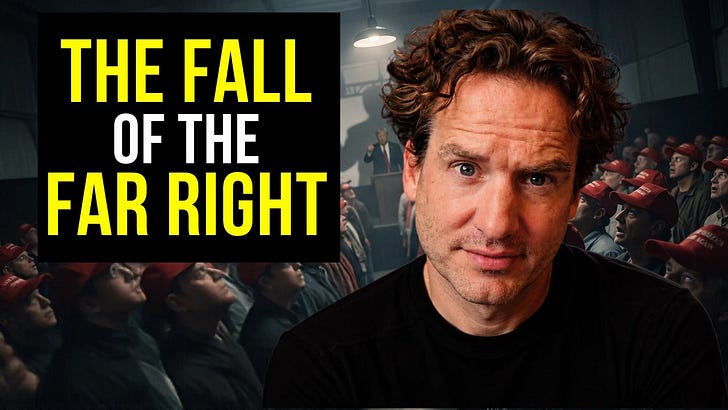
    The Fall of the Far Right and MAGA Cult

    In April 2026, Hungary voted out Viktor Orbán after 16 years. On October 25, students in Serbia toppled Aleksandar Vučić. On the same day, Lula beat Bolsonaro in Brazil. Within a single month, three far-right leaders on three continents were finished. This feels like a wave. But it is not a wave. It is a pattern. And the pattern has been studied for decades. The far right has a structural problem. Not a messaging problem. Not a branding problem. A design problem. The way authoritarian movements are built is the reason they always break. The very mechanics that make them powerful in the short term are the same mechanics that guarantee their collapse. Five distinct lines of research explain why. The Illusion of Support Every authoritarian leader believes they are more popular than they are. This is not arrogance. It is a structural blindness built into the system they created. In 1995, political economist Timur Kuran at Duke University published Private Truths, Public Lies, a book-length study of what he called preference falsification. The concept is simple: people misrepresent their real opinions when they believe the social cost of honesty is too high. They tell pollsters what feels safe. They tell neighbors what won’t start a fight. They perform loyalty in public while holding the opposite position in private. Kuran’s insight was that preference falsification doesn’t just affect individual behavior. It distorts entire information systems. When everyone is lying about what they believe, nobody can accurately assess how much real support a leader has. The leader included. The regime’s own intelligence apparatus feeds on the same contaminated data. Advisors tell the leader what he wants to hear because the system punishes honesty. And so the leader builds strategy on numbers that don’t exist. What makes this so dangerous for authoritarian systems is the cascade effect. Kuran showed that when one crack appears, when one visible defection signals that dissent is safe, it doesn’t produce a gradual shift. It produces a collapse. The opposition doesn’t need to be built. It was always there. It just needed permission to become visible. This is what happened in East Germany in 1989. The Stasi had files on millions of citizens. They monitored churches, workplaces, neighborhoods. And they could not see that the entire population was ready to walk. Because the monitoring itself was what kept people performing loyalty. The moment the Berlin Wall opened, the performance stopped and the regime was finished within weeks. Not because the opposition grew. Because the opposition was revealed. Kuran’s framework explains why authoritarian collapses always seem sudden. From the outside, they look like overnight revolutions. From the inside, they were decades in the making. The support was falsified from the beginning. Nobody could see it because the system was specifically designed to prevent anyone from seeing it. Orbán governed Hungary for 16 years with what looked like an iron grip. His Fidesz party controlled the courts, the media, the election apparatus. And when a credible challenger finally gave voters a real option, the country voted him out by a margin that shocked every analyst in Europe. The support had been performance. The opposition had been waiting. The Engine of Resistance Authoritarian leaders have one tool. Force. They restrict speech. They arrest protesters. They shut down media. And every time they use that tool, they create the exact thing they were trying to destroy. In 1966, psychologist Jack Brehm at Duke University published A Theory of Psychological Reactance. His core finding was that when a person perceives a threat to their freedom, they don’t just want that freedom back. They want it more intensely than they did before the threat. The act of restricting a behavior makes that behavior more desirable, not less. Brehm tested this with experiments as simple as giving children a choice of candy bars and then taking one option away. The removed candy bar immediately became the one they wanted most. It wasn’t about the candy. It was about the restriction. The human brain treats a loss of freedom as an attack, and the automatic response is to fight harder for the thing that was taken. What Brehm described in a lab, authoritarian movements produce at scale. Every censored journalist creates a hundred people who want to read what was censored. Every arrested protester makes the people who stayed home feel like cowards for not showing up. Every banned organization becomes more attractive than it was when it was legal. In Serbia, Vučić controlled every major television station. He sent police to beat students. He arrested organizers. And those students did not stop. They turned a protest into a political party and won a parliamentary majority. Fourteen years of suppression didn’t weaken the resistance. It was the fuel. This is the paradox that every authoritarian leader fails to understand. They believe force works because it produces immediate compliance. And it does. In the short term. But compliance is not the same as submission. Reactance operates underneath compliance like pressure building behind a dam. The longer the suppression continues, the more powerful the eventual break. Brehm and his wife Sharon expanded the theory in 1981, showing that reactance is not a personality trait. It is a universal motivational state. Anyone, in any culture, under any political system, experiences it when their freedom is threatened. Which means that every authoritarian regime in history has been generating resistance in the people it was trying to control, whether those people showed it or not. The Governance Trap Authoritarian movements are not designed to govern. They are designed to distribute resources to the people who keep the leader in power. The public is not part of that arrangement. In 2011, political scientist Bruce Bueno de Mesquita at New York University published The Dictator’s Handbook with his colleague Alastair Smith. Their framework, called selectorate theory, explains why authoritarian systems always fail at governing, and why that failure is a feature, not a bug. Every political system has three groups. The selectorate is everyone with some theoretical say in who leads. The winning coalition is the smaller group whose support the leader actually needs to stay in power. And the leader’s job, in Bueno de Mesquita’s framework, is to keep the winning coalition happy at the expense of everyone else. In a democracy, the winning coalition is large. Millions of voters. So leaders have to provide public goods. Roads, schools, hospitals, functioning courts. Things that benefit large numbers of people. Because if they don’t, the coalition replaces them at the next election. In an authoritarian system, the winning coalition is tiny. A handful of generals, oligarchs, media owners, and loyalists. The leader doesn’t need to build roads. He needs to keep those few people rich and protected. Public goods become a waste of resources that could be going to the coalition. So services decline. Infrastructure rots. Prices rise. Promises break. And the leader stays in power because the ten people who matter are still getting paid. The problem is that this arrangement is visible. Citizens can see the inner circle getting richer. They can see the leader’s allies buying properties and flying private while wages stagnate and grocery prices climb. The performance of populism collides with the reality of corruption, and over time, the gap becomes impossible to ignore. Bueno de Mesquita showed that this is not a moral failure. It is a logical outcome. Leaders in small-coalition systems are not behaving irrationally when they loot the state. They are following the only strategy that keeps them alive. A dictator who starts spending on public goods at the expense of his coalition gets replaced by someone who won’t. The system selects for corruption the same way evolution selects for survival trait… This is a public episode. If you'd like to discuss this with other subscribers or get access to bonus episodes, visit lucasbean.substack.com/subscribe

    • Transcript
  • October 31 · 38 sec

    A Perfect Metaphor of Modern Human Apathy

    A skateboarder went to France during the riots. Not to document the uprising, not to support the protesters and definitely not to understand why people were in the streets fighting for their rights. He went to make a skate video. He skated through burning streets and clashing crowds, filmed himself doing tricks against a backdrop of civil unrest, and posted it for likes. He laughs as he runs from street to street trying to avoid the violence. The apathy is so obvious and ugly it hurts me to watch it. This isn’t an isolated incident. It’s a pattern. And the psychology behind it explains something much larger than one skateboarder with a camera. The empathy collapse is measurable. In 2010, researcher Sara Konrath at the University of Michigan published a meta-analysis of 72 studies spanning 30 years, covering nearly 14,000 American college students. Her finding was stunning and precise. Empathy among young adults had dropped 40 percent compared to their counterparts in the 1980s and 1990s. The largest decline occurred after the year 2000, exactly when social media began reorganizing how young people relate to each other and the world. Konrath measured two specific dimensions. The first was empathic concern, the ability to feel tenderness and concern for people less fortunate. The second was perspective-taking, the ability to imagine how things look from someone else’s point of view. Both declined sharply. Students were less likely to agree with statements like “I often have tender, concerned feelings for people less fortunate than me” and “I sometimes try to understand my friends better by imagining how things look from their perspective.” That 40 percent decline isn’t abstract. It’s the difference between seeing a riot and feeling something about the people in it, and seeing a riot and thinking about what it would look like as a background for your skate video. The empathy that would make someone stop and say “this isn’t about me” has been measurably and empirically reduced. And the generation most affected is the one that grew up performing their lives for cameras. How social media turned empathy into a liability. Empathy requires one specific cognitive act: the temporary suspension of self-focus. To feel what someone else is feeling, you have to stop thinking about yourself long enough to think about them. Social media trains the exact opposite. Every platform is built around one question: how do I present myself? What do I post? How will this make me look? How many people will engage with my content? Jean Twenge, a psychologist at San Diego State University, spent two decades tracking this shift. Her research, conducted with Keith Campbell and published across multiple studies, showed that narcissistic traits among college students rose steadily from the late 1970s through the 2000s. Two-thirds of contemporary students scored above the narcissistic average of students tested in the early 1980s. Twenge and Campbell published their findings in the book The Narcissism Epidemic: Living in the Age of Entitlement, arguing that American culture had created a self-reinforcing system where self-promotion was rewarded, self-absorption was normalized, and self-focus became the default mode of existence. Social media didn’t create narcissism. But it created an economy that runs on it. Every like, every comment, every share, every follow is a unit of attention converted into a unit of perceived self-worth. And the platforms are designed, deliberately and with billions of dollars of engineering, to make that feedback loop as addictive as possible. Variable reinforcement, the same psychological mechanism that makes slot machines addictive, powers every notification. You don’t know when the next burst of attention is coming, so you keep posting. You keep performing. And the performance becomes the only thing that feels real. This is how a person skates through a riot and feels nothing about the riot. The riot is not a human event to him. It is content. It is background. It is production value. And the only feelings that register are the ones connected to the performance: will this get views? Will this go viral? Will this make me famous? Ethical fading: when the moral dimension disappears. In 2004, researcher Ann Tenbrunsel at the University of Notre Dame published a paper that identified a cognitive process she called ethical fading. Tenbrunsel found that people frequently make unethical decisions not because they consciously decide to do something wrong, but because the ethical dimension of the decision literally disappears from their awareness. When people focus heavily on some other aspect of a decision, such as winning, profit, or in this case, content, they stop seeing the ethical issue at all. Ethical fading is different from moral disengagement, where people actively restructure reality to justify harmful behavior. In ethical fading, the person doesn’t even register that there’s a moral question on the table. The ethics don’t get overruled. They get erased. This is what’s happening when someone skates through a riot and genuinely does not understand why people are upset. He isn’t suppressing guilt. He isn’t justifying his behavior by weighing it against some higher purpose. The ethical dimension of the situation, that real people around him are fighting for their lives and dignity, has faded completely from his awareness. All that remains is the content frame: will this clip work? Is the lighting good? Is the backdrop dramatic enough? Social media accelerates ethical fading because it trains people to see every moment through the content frame first. The question is never “what is happening here?” The question is “how can I use what’s happening here?” And once the content frame becomes the default, the ethical frame doesn’t stand a chance. It fades before it ever forms. The death toll of the content frame. This isn’t just about tone-deafness. People are dying for content. A study published in 2018 in the Journal of Family Medicine and Primary Care documented over 250 verified deaths from selfie-related incidents between 2011 and 2017, with an average age of 23. People falling from cliffs, drowning, being struck by trains, all while trying to get the shot. The researchers noted that the desire to be perceived as cool and the pursuit of likes and comments were primary motivators. But the selfie deaths are only the most literal version of the problem. The deeper damage is what happens when the content frame colonizes every human experience. Funerals become photo opportunities. Natural disasters become backdrops. Riots become aesthetic. Other people’s suffering becomes your production value. And the person doing it often has no awareness that anything is wrong, because ethical fading has done its work so completely that the moral dimension of the moment never enters their consciousness. The skateboarder in France is a perfect case study. He didn’t go to the riot and decide to ignore the suffering. He went to the riot and never perceived the suffering in the first place. In his world, the riot was always just a setting. The people were always just extras. And the star of the show was always him. How we got here. The question isn’t really why this one skateboarder did this. The question is how we built a world where this behavior makes sense to anyone. The answer is that we built an economy around attention and taught an entire generation that attention is the most valuable thing they can possess. We built platforms that reward self-promotion and penalize nuance. We built algorithms that amplify the most extreme, most provocative, most boundary-crossing content because that content generates the most engagement. And then we handed those platforms to people whose empathy had already been declining for decades and whose narcissistic traits had already been rising for just as long. The skateboarder is not an aberration. He is the system working exactly as designed. He is what you get w… This is a public episode. If you'd like to discuss this with other subscribers or get access to bonus episodes, visit lucasbean.substack.com/subscribe

    • Transcript
  • October 30 · 1 min

    Why MAGA Wants a Dictator

    In this week’s video, I talked about Bob Altemeyer’s research on right-wing authoritarianism and how people who score high on his scale grew up in households that trained them to see the world as dangerous. The video covers the basics. This piece goes deeper into the research, because the science behind the authoritarian brain is one of the most well-documented findings in all of political psychology. And it explains nearly everything about what we are watching right now. The researcher In 1981, psychologist Bob Altemeyer at the University of Manitoba published Right-Wing Authoritarianism, a book that refined decades of earlier work on the authoritarian personality. The original research started back in the 1950s at UC Berkeley, where a team of researchers created what they called the F-scale (F for fascism) to try to measure the kind of personality that goes along with authoritarian movements. That scale had serious problems. It was unbalanced, poorly validated, and easy to game. Altemeyer spent over a decade fixing it. What he built in its place was the RWA scale. Right-Wing Authoritarianism. He tested it across thousands of participants over the course of his career, from college students to sitting legislators. And it worked. It predicted behavior, attitudes, and political alignment with a consistency that surprised even other researchers. A note on the name. “Right-wing” in this context doesn’t mean Republican or conservative in the American political sense. Altemeyer used “right-wing” to describe submission to established authority, as opposed to left-wing authoritarianism, which is submission to authorities trying to overthrow the establishment. In practice, though, the political conservatives in North America consistently scored higher on his scale. That finding held up for decades. The three clusters Altemeyer didn’t find one trait. He found three. And they always showed up together. He called them the three attitudinal clusters of right-wing authoritarianism. The first is authoritarian submission. This is a reflexive willingness to obey whatever authority figure a person sees as legitimate. Not thoughtful agreement. Not carefully evaluated trust. Uncritical, automatic compliance. The kind of obedience that doesn’t ask questions because questions themselves feel like betrayal. The second is authoritarian aggression. This is hostility directed at whoever the authority figure identifies as a target. It doesn’t come from personal experience with the target. It comes from the authority’s say-so. If the leader says immigrants are the problem, immigrants become the enemy. If the leader says it’s the media or the schools or the trans community, the aggression shifts instantly. The aggression isn’t principled. It’s outsourced. The third is conventionalism. This is a rigid attachment to traditional social norms and a belief that everyone else should be forced to follow them too. Not a personal preference for tradition. A demand that it be imposed. In parenting, high-RWA individuals value obedience, neatness, and good manners in children above curiosity, independence, or creativity. These three traits don’t just correlate with each other. They predict prejudice, intolerance, and support for anti-democratic policies. Altemeyer spent his career documenting exactly how. The engine underneath In his later research, Altemeyer identified three personality traits sitting underneath those three attitudinal clusters. They are the engine that makes the whole system run. The first is self-righteousness. High-RWA individuals believe they are morally superior to others. Not in a quiet, internal way. In a way that gives them permission to punish. They see themselves as the last decent people in a world that has gone to rot, and that belief is what licenses the aggression. The second is fear of a dangerous world. This is the one I focused on in the video, because it is the fuel supply. High-RWA scorers genuinely believe the world is a more dangerous place than it actually is. They walk through life with an elevated threat response. New people, new ideas, new norms all feel like incoming danger. Not because they’ve evaluated any of it. Because their baseline fear is already running so high that anything unfamiliar registers as a threat. The third is mean-spiritedness. This one is uncomfortable, but it showed up in the data over and over. People who score high on RWA are more willing to inflict harm on others when they believe authority approves of it. They are less empathetic toward out-group members. They report more willingness to punish people who violate norms, even when the punishment is clearly disproportionate. Self-righteousness gives them permission. Fear gives them a target. Mean-spiritedness gives them enthusiasm. Fear is the strongest predictor Altemeyer was not the only researcher who found the fear connection. In 1998, psychologist Mark Eigenberger studied 522 participants using both the RWA scale and a separate fear assessment tool. He found that people who scored high on the RWA scale also reported significantly higher levels of fear, particularly fears related to social exclusion and the behavior of people outside their group. The fear item with the single highest correlation to RWA scores was “people associated with a cult.” The irony there writes itself. A later study published in Political Psychology asked 463 participants to rate their feelings of fear, concern, and anxiety across 93 potential threats, broken down into personal and social categories. The researchers found that all fear categories correlated with RWA scores. But the strongest correlation was with threats to the in-group. Social fears predicted RWA scores more strongly than personal fears. These people aren’t afraid for themselves. They’re afraid of what might happen to their group. And “their group” is defined by whoever the authority says is in it. What makes the fear finding so important is what it tells us about how authoritarian movements recruit and retain followers. You don’t need to convince these people that a specific policy is bad. You just need to make them afraid. The policy argument is irrelevant. The fear is the point. Manufacture a threat, point at a scapegoat, and the submission, aggression, and conventionalism activate on their own. The machine runs itself once you turn the fear on. Where the fear comes from Altemeyer’s original theory was that right-wing authoritarianism develops through social learning. Children raised in strict, punishment-based households where obedience was the highest value and the world was described as dangerous learned to adopt those attitudes. The parents modeled submission to authority. They punished questioning. They told the child the world was full of threats and that the only safety came from staying in line. The child learned that lesson not as a belief, but as a survival strategy. Research on the authoritarian personality going all the way back to Adorno and the original Berkeley team in the 1950s found similar patterns. People who scored high on authoritarianism reported being raised in strict, authoritarian households where fathers were distant and punitive. But the science didn’t stop there. A large twin study published in 1999 found that genetic factors account for approximately 50 percent of the variation in authoritarian attitudes, with unshared environmental factors making up about 35 percent. The childhood-rearing hypothesis didn’t hold up as the complete explanation. What this means is that some people are born with a temperament that makes them more fear-reactive, more submission-oriented, and more rigid. Upbringing matters. But it isn’t the whole story. Some of this is baked in. This is the part that makes the problem harder to solve. You can’t reason someone out of a fear response that’s partly neurological. You can’t fact-check someone into feeling safe. And you can’t debate someone out of an emotional architecture that was shaped before t… This is a public episode. If you'd like to discuss this with other subscribers or get access to bonus episodes, visit lucasbean.substack.com/subscribe

    • Transcript
  • October 29 · 59 sec

    MAGA is Obsessed with Other Men

    This week, Donald Trump stood on stage at a rally in North Carolina and told the crowd he’d been studying Jon Husted’s body. He described the senator’s backside as “like a pile of muscle.” He went through his shoulders, his jawline, his legs, his hands. He said tapping Husted’s shoulder actually hurt his hand. A few days before that, at a rally in Kentucky, he told the audience he’d “examined his ass.” At another rally in Georgia, he spent time comparing how attractive one male candidate was compared to another. This has been happening at rally after rally all month. The New York Times called his fixation on male bodies “puzzling.” Anderson Cooper aired a montage of all of it back to back. Seth Meyers looked into the camera and asked him directly, “Why are you so weird?” And not a single Republican said a word about any of it. In 1996, psychologist Henry Adams at the University of Georgia designed one of the most uncomfortable experiments in the history of psychology. He recruited 64 men who all described themselves as exclusively heterosexual, meaning they reported no homosexual arousal and no homosexual experiences. He then divided them into two groups based on their scores on a standardized homophobia scale. One group scored high in homophobia. The other scored low. Then he showed both groups three types of sexually explicit videos: heterosexual, lesbian, and gay male. He measured their physical arousal using a penile plethysmograph, a device that measures changes in penile circumference with clinical precision. There was no ambiguity in the data. There was no room for interpretation. The device measured what the body did regardless of what the mouth said. Both groups responded similarly to the heterosexual and lesbian content. The difference showed up only when the gay male content played. In the non-homophobic group, 66% showed no measurable arousal to the gay male video, and less than 25% showed a significant physical response. In the homophobic group, those numbers flipped. Over 54% of the men who scored highest on the homophobia scale showed a significant physical response to the gay male content. Only 20% of the homophobic men showed no arousal at all. And here’s the part that makes the study devastating: when the men were asked afterward to rate how aroused they felt during each video, the homophobic men significantly underestimated their arousal to the gay male content. Their bodies responded. Their conscious minds denied it. The data didn’t care. Adams published his findings in the Journal of Abnormal Psychology, one of the most respected journals in the field, under the title “Is Homophobia Associated with Homosexual Arousal?” The answer, according to the plethysmograph, was yes. The defense mechanism that explains everything The concept that explains Adams’ findings is not new. It was first described by Anna Freud in her 1936 book The Ego and the Mechanisms of Defense. She called it reaction formation, and it works like this: when a person experiences a feeling or impulse that produces intense anxiety or shame, they don’t just suppress it. They attack the opposite. They become the loudest, most aggressive opponent of the very thing they feel inside themselves. Reaction formation is not the same as simple disagreement or discomfort. The hallmark of reaction formation is disproportionate intensity. A person who is simply not attracted to the same sex doesn’t spend their career crusading against it. They don’t draft legislation about it. They don’t bring it up in every speech. They don’t think about it at all, because there is nothing to defend against. Reaction formation reveals itself through obsession. The volume of the outrage is the tell. What makes reaction formation so effective as a disguise is that it looks like conviction. It looks like moral clarity. The person performing it often doesn’t know they’re doing it. The defense mechanism works precisely because it operates below conscious awareness. The man who stands at a podium and delivers a passionate speech about the threat of homosexuality to the American family may genuinely believe every word he’s saying. His body, as Adams demonstrated, may be telling a completely different story. The study that connected it to childhood Adams’ 1996 study established the physical link between homophobia and homosexual arousal. Sixteen years later, a team of researchers led by Netta Weinstein at the University of Essex and Richard Ryan at the University of Rochester went deeper and asked a follow-up question that Adams never addressed: where does this internal conflict come from? In 2012, Weinstein, Ryan, and their colleagues published a series of six studies in the Journal of Personality and Social Psychology, one of the most rigorous journals in the field. They recruited 784 college students across the United States and Germany, measured their explicit sexual orientation by simply asking them, and then measured their implicit sexual orientation using a reaction-time computer test. In the test, participants sorted images and words associated with heterosexuality and homosexuality, and the speed of their sorting revealed unconscious associations that their self-reports might not. What they found was a population of people whose explicit identity and implicit identity didn’t match. People who described themselves as straight but whose unconscious reactions revealed significant same-sex attraction. And those people, the ones with the biggest gap between what they said and what the test revealed, were significantly more likely to express hostility toward gay people, support anti-gay policies, and assign harsher punishments to people they believed were homosexual. But the most important finding had nothing to do with sexuality itself. It had to do with parents. Weinstein and Ryan found that the participants who grew up with controlling, authoritarian parents were far more likely to show a discrepancy between their implicit and explicit sexual orientation. These were the people whose internal conflict was the deepest and whose homophobia was the most intense. Participants who grew up with supportive, accepting parents were more in touch with their implicit orientation, whatever it was, and showed significantly less anti-gay hostility. The implication is that reaction formation doesn’t begin in adulthood. It begins in childhood, in homes where certain feelings are made so dangerous that the only option is to bury them and build an identity on top of the burial site. The louder the parents’ rejection, the deeper the child buries. And the deeper they bury, the harder they attack what they see in other people, because other people walking freely in the world with the same feelings they were forced to destroy is unbearable. The pattern that keeps repeating If reaction formation only existed in laboratories, it would be an interesting finding and nothing more. But the real world keeps producing evidence that no laboratory could replicate. In 2007, U.S. Senator Larry Craig of Idaho, who had spent his entire career voting against gay rights and earning praise from organizations like the American Family Association, was arrested in a Minneapolis airport bathroom after an undercover officer reported that Craig had solicited sex from him through a series of signals in an adjacent stall. Craig pleaded guilty to disorderly conduct. In 2006, Ted Haggard, president of the National Association of Evangelicals and one of the most prominent anti-gay voices in American Christianity, was accused by a male escort of paying for sex and methamphetamine over a three-year period. Haggard initially denied everything. Then he admitted to some of it. His church removed him. George Rekers, a co-founder of the Family Research Council, one of the most powerful anti-gay lobbying organizations in the United States and a man who built a career publishing research claiming homosexuality was a mental illness, was photographed in 2010 returning from a … This is a public episode. If you'd like to discuss this with other subscribers or get access to bonus episodes, visit lucasbean.substack.com/subscribe

    • Transcript
  • October 28 · 9 min

    The Psychology of Halloween

    I needed a short break from politics, so I researched and made this video instead. I hope you like it. Back to politics tomorrow. Almost everyone has some degree of morbid curiosity, and most people don’t want to admit it. We slow down at car accidents. We binge true crime podcasts. We watch horror movies that we know will keep us up at night. And every October, we turn an entire holiday into a celebration of death, fear, and disguise. The question isn’t whether we’re drawn to dark things. The question is why. In 2021, behavioral scientist Coltan Scrivner at the University of Chicago published a paper in the journal Personality and Individual Differences that introduced the first psychometric tool for measuring this trait. He called it the Morbid Curiosity Scale, a 24-item assessment designed to measure how drawn a person is to information about things that are dangerous, threatening, or related to death. What Scrivner found is that morbid curiosity isn’t rare, and it isn’t a disorder. It’s a normally distributed psychological trait, which means most people fall somewhere in the middle. Almost everyone has some degree of it. The people who binge true crime podcasts, slow down to look at car accidents, and watch horror movies on purpose aren’t broken. They’re normal. And Scrivner’s research suggests there’s an evolutionary reason for that. Scrivner identified four dimensions of morbid curiosity: curiosity about the minds of dangerous people, curiosity about the supernatural, curiosity about body violation, and curiosity about violence. Each one maps onto a category of threat that would have mattered to our ancestors. Paying attention to predators, understanding what dangerous people might do next, and learning about physical harm without having to experience it firsthand would have given early humans an advantage. The people who paid attention to threats survived. The ones who looked away didn’t. Morbid curiosity is leftover survival wiring that most of us still carry. Halloween activates every single one of those dimensions at once. Monsters and ghosts hit the supernatural dimension. Gore and horror movies hit body violation. Scary costumes and jump scares hit violence. Haunted houses are designed to trigger all four. The reason millions of people line up to experience it every October is that the brain is already wired to seek it out. Halloween didn’t create our fascination with death. It just gave it a date on the calendar. Halloween vs. Día de los Muertos One of the most revealing things about Halloween is what it looks like when you put it next to another culture’s version of the same thing. Día de los Muertos, or Day of the Dead, is celebrated in Mexico on November 1st and 2nd, just one day after Halloween. Both holidays exist at the same time of year. Both are built around death. Both involve costumes, decorations, and gatherings. And they solve the exact same problem in completely opposite ways. Halloween was born from fear. The Celts believed the dead were dangerous. They lit fires to keep the darkness back. They wore disguises so the spirits wouldn’t recognize them. They sacrificed animals hoping their gods would protect them through the winter. The entire structure of Samhain was built on the idea that the dead were a threat and the living needed to defend themselves. Día de los Muertos was born from love. Its roots trace back to pre-Columbian Mesoamerican cultures, including the Aztecs and Maya, who viewed death not as an ending but as a continuation. When the Spanish arrived and brought Catholicism, those indigenous traditions blended with All Saints’ Day and All Souls’ Day into what the holiday is today. Families build altars called ofrendas and decorate them with marigolds, candles, food, and photographs of the people they’ve lost. They visit cemeteries, clean the graves, and sit with their dead. They tell stories about them. They cook their favorite meals. Sugar skulls and painted skeleton faces aren’t meant to frighten anyone. They’re meant to normalize death and celebrate the people who lived. Halloween hides from the dead. Día de los Muertos sits down to dinner with them. Both holidays are doing the same psychological work. They’re giving people a structured way to process the reality that everyone they love, and they themselves, will die. The difference is in the approach. Western cultures, and the Celtic tradition that became Halloween, tend to treat death as the enemy. Something to ward off, distract yourself from, and avoid thinking about for as long as possible. Mesoamerican cultures, and the traditions that became Día de los Muertos, tend to treat death as part of the family. Something to acknowledge, accept, and carry with you. Neither approach is wrong. But the contrast is striking. One culture builds a holiday around running from death. The other builds a holiday around sitting with it. And both cultures have kept doing it for thousands of years because the need is the same. The only thing that changes is whether you face it with fear or with flowers. Horror makes you stronger The script covers Marc Malmdorf Andersen’s recreational fear research and Margee Kerr’s work on how scary experiences boost confidence. But there’s a finding that goes even further, and it came from one of the most unexpected laboratories in recent psychology: the COVID-19 pandemic. In 2020, while the world was shutting down, Scrivner and his colleagues at the University of Chicago noticed something strange. Horror fans were reporting lower levels of psychological distress during the early months of the pandemic than people who didn’t watch horror. They weren’t just coping. They were coping better. Scrivner’s research found that people who regularly watched horror movies reported feeling more prepared for the pandemic and showed greater psychological resilience than people who avoided scary content. And fans of pandemic-specific movies like Contagion showed even higher levels of preparedness. They had already rehearsed the scenario in their heads. When it actually happened, their brains had a framework for it. This supports a theory that researchers in the field have been building for years: horror works as threat simulation. When you watch a scary movie or walk through a haunted house, your brain isn’t just getting a dopamine hit. It’s running a practice drill. It’s learning what fear feels like, how your body responds, and what it takes to get through it. The more you practice, the better you get at handling real fear when it actually shows up in your life. This reframes Halloween in a way that most people have never considered. Every haunted house, every horror movie, every moment of chosen fear is the brain rehearsing for something it hopes will never happen but knows it needs to be ready for. The Celts understood this instinctively when they built Samhain around the fear of death. They weren’t just performing rituals for the spirits. They were preparing their own minds for the darkest season of the year, when death was not symbolic but real. The digital mask The script covers Edward Diener’s 1976 Halloween study, where kids in costumes and groups stole candy at dramatically higher rates than kids who were alone and identifiable. The concept is deindividuation, and it explains one of the most powerful effects that Halloween has on human behavior. But what’s worth exploring is where that mask went after Halloween ended. In 1976, the mask came off on November 1st. Kids went back to school. Adults went back to work. Everyone returned to being identifiable and accountable, and their behavior went back to normal. That’s not how it works anymore. The internet gave everyone a permanent mask. Anonymous accounts, screen names, burner profiles, and faceless avatars create the same psychological conditions that Diener documented in his Halloween study, except they never turn off. You don’t need to wait for October 31st to become anonymous. You can do it every day from your pho… This is a public episode. If you'd like to discuss this with other subscribers or get access to bonus episodes, visit lucasbean.substack.com/subscribe

    • Transcript
  • October 27 · 2 min

    MAGA is a Support Group for Weak People

    There is a pattern that shows up in the research on authoritarianism that almost nobody talks about publicly. Not because it is hidden. Because it is uncomfortable. The people who fill megachurches on Sundays and the people who fill MAGA rallies on weeknights are, in disproportionate numbers, the same people. Not metaphorically. Psychometrically. They score the same on the same instruments, hold the same cluster of personality traits, and respond to the same structural incentives. Both institutions offer the same product, packaged differently but functionally identical: status and power distributed on the basis of loyalty, not competence. What Altemeyer Actually Measured Bob Altemeyer was a social psychologist at the University of Manitoba who spent his entire career studying a single question: what kind of person submits to authoritarian leaders, and why? In 1981, he published Right-Wing Authoritarianism, introducing the RWA scale, a psychometric instrument that measures three interlocking traits. He called them the Big Three. The first is authoritarian submission. This is not ordinary respect for authority. It is a blanket willingness to defer to whoever the individual perceives as a legitimate authority, and to accept their claims without scrutiny, even when those claims conflict with observable reality. High scorers on this trait will tell you that people should obey authority in virtually all circumstances. When given moral dilemmas, they default to “the law is the law” regardless of the situation. They do not evaluate whether an authority figure is competent, honest, or acting in good faith. They evaluate whether that figure occupies a position they recognize as legitimate. If so, they comply. The second is authoritarian aggression. This is a willingness to punish, condemn, or attack people that the authority figure has identified as threats or deviants. The aggression is not indiscriminate. It is directed. High scorers do not attack people in general. They attack whoever the leader points at. And they do so with a sense of moral righteousness, because the leader has told them the target deserves it. Altemeyer noted that authoritarian followers prefer to aggress when the odds are heavily in their favor. They are not courageous. They attack in groups, when they have numbers, or when they have institutional backing. They avoid anything approaching a fair fight. The third is conventionalism. This is an intense attachment to traditional social norms and a hostility toward anyone perceived as violating them. High scorers want everyone to live the way they live. They view deviation from their norms not as difference but as moral failure. They see the world in categories of “normal” and “deviant,” and they want deviance punished. These three traits form a self-reinforcing loop. You submit to the authority. You attack whoever the authority tells you to attack. And you demand that everyone conform to the norms the authority endorses. Submission fuels aggression. Aggression enforces conventionalism. Conventionalism justifies submission. Altemeyer tested this cluster across thousands of subjects over four decades. His results were remarkably stable. The personality profile he identified in the early 1980s predicted the same behaviors in the 1990s, 2000s, and 2010s. It predicted support for punitive policing, opposition to civil rights, endorsement of government surveillance, hostility toward immigrants, and consistent support for leaders who promised order through dominance. He published updated findings in 1988, 1996, and again in his free online book The Authoritarians in 2006. And then, with John Dean, in Authoritarian Nightmare: Trump and His Followers in 2020, he applied his scale directly to the MAGA movement and found exactly what his data had been predicting for four decades. The Dominators and the Followers Altemeyer’s framework has two halves, and most people only know the first. The authoritarian followers are the base. They are the submissive crowd. They want someone above them telling them what to do and someone below them to punish. They score high on the RWA scale. But Altemeyer also studied the leaders. He called them social dominators. These are the people who want to be submitted to. They score high on a different instrument, the Social Dominance Orientation scale, originally developed by Felicia Pratto and Jim Sidanius. Social dominators are characterized by a desire for personal power, a willingness to manipulate and deceive, low empathy, and opposition to equality. They see the world as a hierarchy and they want to be at the top. The two types need each other. Social dominators need a compliant base that will follow instructions without asking questions. Authoritarian followers need a leader who will tell them who to blame and who to punish. The relationship is parasitic but stable. The leader lies. The followers believe. The leader points. The followers attack. Neither side examines the arrangement because both sides are getting what they need. Then there are the Double Highs. These are the rare individuals who score high on both scales. They possess the cold, calculating ambition of the social dominator and the aggressive, punitive conventionalism of the authoritarian follower. In Altemeyer’s own words, they are the most dangerous people his research has identified. In simulation exercises with university students, Double Highs seized control of their groups, engaged in nuclear blackmail, made themselves wealthy through deception, and allowed billions of simulated people to die. Altemeyer repeatedly compared the personality profile of Double Highs to historical fascist leaders. The MAGA movement is a textbook instance of this dynamic. The leader is a social dominator. The base is composed overwhelmingly of authoritarian followers. And the movement produces Double Highs at every level of its hierarchy, from Congress to county commissions to school boards, people who combine the leader’s willingness to lie with the follower’s willingness to punish. The Megachurch Pipeline One of Altemeyer’s most consistent findings, repeated across decades of data, is the overlap between religious fundamentalism and right-wing authoritarianism. It is not a subtle correlation. It is one of the strongest relationships in his entire body of work. Religious fundamentalists consistently scored the highest on the RWA scale. Higher than political conservatives who were not religious. Higher than regular churchgoers who attended mainline denominations. The fundamentalist believer, the one who holds that there is one literal truth and their leader has access to it, is the person Altemeyer’s instrument was practically designed to detect. The structure of fundamentalist religion rewards and reinforces every trait Altemeyer spent 40 years measuring. You submit to the pastor. You enforce the congregation’s norms. You punish or exclude anyone who deviates. The institution does not require you to think independently, question authority, or tolerate difference. It requires you to obey, conform, and police. The megachurch model amplifies this. A megachurch is not a community in the traditional sense. It is a hierarchy that distributes titles, access, and social status based on loyalty. A 22-year-old with no degree, no training, and no credentials can become a youth pastor because they showed up, pledged allegiance, and told the senior pastor what he wanted to hear. They get a title. They get a microphone. They get unsupervised access to other people’s children. Not because they demonstrated competence or character, but because they demonstrated loyalty. The pattern of abuse that has come out of these institutions is what happens when you hand power to people based on obedience instead of qualification. Altemeyer’s research explains why. The same personality that craves external authority and punishes deviance is the same personality that, when given power, uses it to control and exploit … This is a public episode. If you'd like to discuss this with other subscribers or get access to bonus episodes, visit lucasbean.substack.com/subscribe

    • Transcript
  • October 26 · 3 min

    MAGA Uses Words They Don’t Understand

    There is a specific type of person who will tell you with complete confidence that socialism is destroying America but, cannot tell you what socialism is. Not in a vague, hand-wavy way. In a literal, recorded-on-camera, asked-four-times-and-still-couldn’t-answer way. This is not a failure of education or a failure of access to information. It is a measurable psychological phenomenon with decades of research behind it, and the explanation is less about politics than it is about personality. In 1990, psychologist Delroy Paulhus at the University of British Columbia developed what he called the Over-Claiming Questionnaire. The design was deceptively simple. Participants were given a long list of items across a range of knowledge domains and asked to rate how familiar they were with each one. Mixed into the list were items that did not exist. Fake names. Invented concepts. Events that never happened. The test was not measuring what people knew. It was measuring what people were willing to claim they knew, including things that were impossible to know because they were not real. The results were consistent across multiple studies conducted over the next two decades. Certain people reliably claimed familiarity with the fake items. They were not guessing randomly or hedging their guesses. They were stating, with confidence, that they were familiar with things that had been fabricated specifically to catch them. And when Paulhus examined which personality traits predicted this behavior, one trait stood above the rest. Narcissism. Not clinical narcissistic personality disorder in every case, but subclinical narcissistic traits as measured by standard personality instruments. This connection was significant and replicated across studies. People who scored higher in narcissism were significantly more likely to claim knowledge they did not have. The relationship held even when controlling for actual intelligence, meaning this was not simply a matter of smart people knowing more and occasionally overestimating. This was a personality-driven inflation of self-assessed knowledge that operated independently of how much someone actually knew. Why Narcissistic People Overclaim Understanding the mechanism behind overclaiming requires understanding what knowledge represents to a narcissistic person. For most people, not knowing something is a neutral event. It carries no emotional weight. You encounter a term you have never heard, you acknowledge the gap, and you either look it up or move on. The gap does not say anything about your value as a person. For someone with narcissistic traits, that same gap is experienced as a threat. Narcissistic self-esteem is not built on a stable internal foundation. It is built on the continuous external performance of competence, intelligence, and superiority. Every interaction is, on some level, an audition. And in that audition, not knowing something is not just uncomfortable. It is dangerous. Because if you do not know something, you are not the smartest person in the room. And if you are not the smartest person in the room, the entire self-image you have constructed begins to wobble. Paulhus and his colleague Peter Harms, in their 2004 follow-up research, found that overclaiming was specifically tied to what they called self-enhancement bias, a pattern of inflating one’s own qualities to maintain a favorable self-image. The overclaiming was not happening at a conscious, deliberate level for most participants. They were not strategically lying about what they knew. Their self-enhancement bias was operating automatically, filling in knowledge gaps before the person even registered them as gaps. The subjective experience, as far as the overclaimer was concerned, was not deception. It was genuine belief. They really did think they knew these things. Their personality would not let them feel otherwise. This is a critical distinction because it explains something that baffles many observers of political discourse. When that man on camera was asked to define socialism and clearly could not, the common assumption is that he was caught in a lie. But the research suggests something more unsettling. He may have genuinely believed he knew what socialism meant right up until the moment he was asked to produce the definition. The knowledge felt real to him. It was there in his head as a feeling of familiarity, a sense of confidence, a certainty that he understood this thing. What was not there was any actual content. The feeling of knowing had been generated by his narcissistic self-image. The knowledge itself had never been acquired. What Happens at the Moment of Exposure The most behaviorally interesting part of overclaiming is not the claim itself. It is what happens at the exact moment the overclaimer is forced to confront the fact that they do not actually know what they claimed to know. Paulhus’s research focused primarily on measuring the tendency to overclaim, not on documenting the behavioral response to exposure. But the broader narcissism literature, particularly the work of Brad Bushman at Ohio State University on narcissistic aggression, provides a clear and well-documented picture. In 2009, Bushman and his colleagues published research showing that narcissistic individuals respond to ego threats with significantly elevated levels of aggression compared to non-narcissistic individuals. The key finding was specificity. Narcissistic people did not show generally higher levels of aggression across all situations. They showed higher aggression specifically in response to ego threats, situations where their self-image was challenged or undermined. The aggression was not a personality baseline. It was a defense mechanism triggered by exposure. This maps precisely onto the behavior that plays out in political videos every day. A person confidently states a political position using terminology they cannot define. Someone asks them to define it. The request to define the term is, in psychological terms, an ego threat. It forces the narcissistic person into a situation where the only honest response, “I don’t know what that word means,” is the one response their personality structure cannot tolerate. So instead of answering, they escalate. They raise their voice. They talk over the person asking. They attack the question itself as stupid or irrelevant. They reframe their inability to answer as a choice not to answer, as if the question is beneath them. The line “I don’t need to go into big words or whatever” is a textbook example of what clinicians call narcissistic reframing. In one sentence, the speaker converts “I cannot answer your question” into “I am choosing not to answer your question because the question is beneath me.” The ignorance becomes a performance of toughness. The inability becomes a refusal. And the person asking the question is repositioned as the one with the problem. The Political Scale of the Problem Overclaiming as Paulhus studied it was an individual personality phenomenon measured in laboratory conditions. What American politics has produced over the past decade is something the research did not anticipate: a mass-scale version of the same behavior, reinforced by media ecosystems that reward confident assertion and punish nuance, curiosity, or the admission of uncertainty. The words that dominate conservative political rhetoric, socialism, communism, Marxism, fascism, critical race theory, are not being used as concepts with definitions. They are being used as sounds with emotional associations. The word “socialism” in a MAGA context does not refer to collective ownership of the means of production or any of the other definitional frameworks that political scientists would recognize. It refers to a feeling. The feeling is something like “the thing the bad people want.” That feeling was acquired through repetition in media, not through engagement with the concept. And because the feeling is real, the person experiencing it genuinel… This is a public episode. If you'd like to discuss this with other subscribers or get access to bonus episodes, visit lucasbean.substack.com/subscribe

    • Transcript
  • October 25 · 5 min

    MAGA Cult is Over

    Political movements do not collapse all at once. They collapse in layers, from the outside in, with the least committed leaving first and the most committed holding on until long after everyone else has moved on. This pattern is not unique to MAGA. It is one of the most consistent findings in the psychology of group identity, cult behavior, and political disillusionment. And the research that explains it stretches back over seventy years. What makes MAGA’s collapse worth studying is not that it is happening. It is that we already have a detailed historical model for exactly how it will play out, because it already happened once in postwar Germany. The timeline, the psychology, and the sequence of departures are remarkably similar. The research tells us who leaves first, who leaves last, and what happens to the people who never leave at all. Level One: The Identity Tourists In the 1970s, social psychologist Henri Tajfel at the University of Bristol conducted a series of experiments that became the foundation for one of the most cited theories in social psychology. Tajfel wanted to understand what it takes for a person to adopt a group identity. His findings were surprising in their simplicity. He discovered that people will identify with almost any group, even one assigned to them randomly, as long as that group provides them with a sense of positive distinctiveness. As long as belonging feels good, people stay. Tajfel called this Social Identity Theory, and its implications for political movements are enormous. People do not need to deeply understand a group’s ideology to join it. They do not need to agree with every position. They do not even need to care very much. They just need the group to make them feel like they are part of something that is winning. This explains the first wave of MAGA’s expansion and the first wave of its collapse. The casual MAGA supporters, the ones who wore the hats to rallies, flew the flags from their trucks, and posted memes online, were never ideologically committed. For many of them, especially younger voters in 2024, MAGA was social currency. It was something to do on a Saturday night in a town where nothing else was happening. The rallies felt like concerts. The online communities felt like belonging. The red hat was a ticket to a party that seemed, briefly, like the winning side. Tajfel’s research predicts exactly what happens to these members when the group stops feeling like a winner. They leave. Quietly, without explanation, without confrontation. One day the flag comes down. The hat goes in a drawer. The social media posts stop. They do not announce their departure because, psychologically, they were never deeply enough invested to require one. The identity was worn, not internalized. And worn identities are easy to take off. This is the level of MAGA that has already evaporated. These former supporters do not want to talk about politics anymore. They insist both sides are equally bad. They bristle when someone brings up the rallies they attended eighteen months ago. They are already rehearsing the line they will use for the rest of their lives: “I was never really into it.” Tajfel’s research tells us this level does not come back. Once the positive distinctiveness is gone, once the group stops providing the feeling of being on a winning team, low-commitment members do not reconnect. They find another source of identity. The group they left becomes something they would rather not remember. Level Two: The Invested The second level of departure is slower, more painful, and psychologically more complex. These are the people who did not just wear the hat. They built their social lives around it. Their friend groups became MAGA friend groups. Their media consumption became exclusively MAGA media. Their sense of who they were as people became inseparable from their political identity. Walking away from MAGA, for these members, is not like taking off a hat. It is like amputating a limb. The psychological mechanism at work here is what economists call the sunk cost fallacy: the tendency to continue investing in something because of how much you have already put into it, regardless of whether the investment is still rational. The more time, money, relationships, and credibility someone has poured into MAGA, the higher the psychological cost of admitting it was a mistake. Every argument they had with a family member. Every friendship they ended. Every Thanksgiving they ruined. All of it becomes retroactively meaningless the moment they admit they were wrong. The research on sunk cost psychology, developed extensively by behavioral economists Hal Arkes and Catherine Blumer in their 1985 study at Ohio University, shows that people are not weighing the current evidence when they decide to stay or go. They are weighing the past investment. The question is not “is this still worth supporting?” The question is “can I afford to admit that everything I already invested was wasted?” This is why the second level fractures rather than collapses. People at this level do not leave in a wave. They leave one at a time, each triggered by a different personal breaking point. The breaking point is almost never ideological. It is personal. A specific betrayal. A specific humiliation. A moment when the cost of staying finally exceeds the cost of admitting they were wrong. The media figures who helped build MAGA’s cultural infrastructure are instructive here. One by one, the podcasters and commentators who amplified the movement and drove voter turnout in 2024 have distanced themselves. The reasons they give vary, but the underlying psychology is the same. They hit a personal threshold where the brand damage of continued association outweighed the sunk cost of everything they had already invested. Their audiences, many of whom were at this same level, took the permission signal and followed. The departure of these figures matters psychologically because they served as identity anchors for their audiences. When a media personality that someone trusted, listened to daily, and built part of their worldview around publicly breaks from the movement, it creates a permission structure for the audience to do the same. The sunk cost feels lighter when someone you respected has already paid it first. But the departure at this level comes with a specific emotional residue that Tajfel’s casual members do not experience. The people at level two are not just quietly moving on. They are angry, embarrassed, and defensive. They do not want to talk about it, but not because they have forgotten. They do not want to talk about it because they remember everything and they cannot stand what it says about them. The narcissistic investment in having been right, in having seen something other people did not see, makes the admission of error feel like a public humiliation. Many of them will never fully admit they were wrong. They will simply stop talking and hope the conversation moves on without them. Level Three: The Unreachable In 1954, social psychologist Leon Festinger and his colleagues at the University of Minnesota infiltrated a small doomsday cult led by a woman named Dorothy Martin in suburban Chicago. Martin claimed to receive messages from extraterrestrial beings who warned that a great flood would destroy the world on a specific date. Her followers believed her completely. Some quit their jobs. Others gave away their possessions. They gathered together on the appointed night and waited. The flood did not come. The world did not end. And Festinger was there to document what happened next. The finding was counterintuitive and has become one of the most important discoveries in the history of social psychology. The members who had invested the least, who had kept their jobs and maintained outside relationships, left the group after the prophecy failed. But the members who had sacrificed the most did not leave. They became more committed. They generated new explanations for… This is a public episode. If you'd like to discuss this with other subscribers or get access to bonus episodes, visit lucasbean.substack.com/subscribe

    • Transcript
  • October 24 · 1 min

    MAGA is A Personality Disorder

    MAGA Isn’t a Political Movement. It’s a Personality Disorder Called Ressentiment. In 1887, Friedrich Nietzsche published On the Genealogy of Morals. It is one of the most disturbing books in the history of philosophy, and not because of its arguments about religion or power. It is disturbing because Nietzsche identified a psychological state that, once you see it, you cannot stop seeing it everywhere. He called it ressentiment. Not resentment. Ressentiment. Nietzsche deliberately used the French word because it described something more specific and more dangerous than ordinary anger. Resentment is a feeling. It comes, it burns, and eventually it passes or gets processed. Ressentiment is what happens when it doesn’t pass. When the anger has nowhere to go. When the person experiencing it is too powerless to act on it, too proud to admit it, and too fragile to let it go. The feeling stops being a reaction to something that happened. It becomes who they are. Nietzsche observed this most clearly in what he called “slave morality,” a value system created not by people who had something to offer the world, but by people who had nothing and needed a way to frame that nothing as moral superiority. Instead of striving for strength, they called strength evil. Instead of pursuing excellence, they called excellence arrogance. They didn’t build a worldview around what they valued. They built it around what they resented. The parallels to modern American politics should be impossible to miss. And yet, most political analysis continues to treat MAGA supporters as rational actors motivated by economic anxiety or cultural displacement. The research tells a different story. Scheler’s expansion: self-poisoning of the soul. Twenty-five years after Nietzsche, philosopher Max Scheler published the most thorough analysis of ressentiment ever written. His 1912 book, titled simply Ressentiment, took Nietzsche’s concept and mapped its psychology in granular detail. Scheler identified the key ingredient: powerlessness combined with awareness of that powerlessness. Ressentiment doesn’t grow in people who are simply angry. It grows in people who are angry and know they can’t do anything about it. They can’t fight the people they envy. They can’t achieve the things they resent others for having. They can’t change their circumstances through action. So the anger turns inward, curdles, and begins to poison the person’s entire value system. Scheler called this “self-poisoning.” The person in the grip of ressentiment doesn’t just resent specific individuals or outcomes. They begin to hate the values themselves that they cannot achieve. Education becomes elitism. Expertise becomes arrogance. Success becomes proof of corruption. The entire moral framework inverts, and what was once aspiration becomes the enemy. This is not metaphor. This is the observable psychology of the MAGA base. They don’t just disagree with liberal policies. They have come to hate the values that liberal life represents: education, professional achievement, cultural sophistication, cosmopolitanism, expertise. Not because those things are wrong, but because those things are reminders of choices they didn’t make and lives they didn’t build. Ressentiment provides the psychological architecture for reframing that failure as someone else’s fault. Lucas Bean Daily is a reader-supported publication. To receive new posts and support my work, consider becoming a free or paid subscriber. The modern research: ressentiment as the engine of grievance politics. In 2022, researchers Tereza Capelos at the University of Birmingham and Mikko Salmela at the University of Helsinki published a landmark empirical study titled “Grievance Politics: An Empirical Analysis of Anger Through the Emotional Mechanism of Ressentiment.” They analyzed 164 interview excerpts from three major works documenting American resentment: Arlie Russell Hochschild’s Strangers in Their Own Land, Michael Kimmel’s Angry White Men, and Susan Faludi’s Stiffed. Their findings cut through one of the biggest misconceptions in political psychology. The “angry citizen” isn’t angry. Not in the clinical sense. Anger is short-lived and action-oriented. A person who is truly angry about their economic circumstances would organize, protest, vote for change, and take concrete action to improve their situation. What Capelos and Salmela found instead were the markers of ressentiment. Victimhood without a specific perpetrator. Envy directed at groups rather than individuals. A chronic sense of powerlessness. And critically, the psychological defenses of splitting, projection, and denial. The subjects in these interviews had not experienced a specific injustice they were trying to correct. They had built entire identities around the feeling of having been wronged. The grievance was no longer a response to something. The grievance was the identity itself. This is the distinction that Nietzsche identified 135 years ago and that Capelos and Salmela confirmed empirically. There is a profound difference between a person who is angry about an injustice and a person whose entire sense of self depends on the belief that they are being victimized. The first person wants resolution. The second person needs the victimhood to continue, because without it, they have no idea who they are. Why facts don’t work and never will. This framework explains what no amount of political polling can. Why do facts not change their minds? Because facts are not the point. The grievance is the point. Correcting a factual claim about immigration, or the economy, or election fraud doesn’t address the underlying need. The false belief isn’t the problem. It’s the symptom. The problem is that the person’s entire identity is organized around being wronged, and any fact that threatens that organization is experienced not as information but as an attack on who they are. This is why debunking conspiracy theories has no measurable effect on belief in them. This is why presenting evidence of Trump’s failures doesn’t reduce support. Every fact that should reduce loyalty instead increases it, because the act of being challenged by people they already resent only confirms the narrative that everyone is against them. The ressentiment feeds on opposition the way fire feeds on oxygen. The target selection isn’t random. Nietzsche observed that ressentiment always needs an external target. Slave morality, he wrote, “always first needs an opposing, external world; it needs, physiologically speaking, external stimuli in order to act at all. Its action is fundamentally reaction.” This explains the rotating cast of enemies in MAGA politics. Immigrants. Trans people. Black Lives Matter. Antifa. The media. Universities. Scientists. The targets change, but the function is constant. Ressentiment requires someone to blame because the alternative, which is self-examination, would collapse the entire psychological structure. The person in the grip of ressentiment cannot ask why their life didn’t work out, because honestly answering that question would require confronting choices they made and opportunities they squandered. So they find someone to blame instead. And because the blame is serving a psychological need rather than responding to a real grievance, no resolution is possible. Resolve one complaint and another immediately takes its place. Immigrants didn’t actually take their job. Liberals aren’t actually the reason they didn’t go to college. Trans people aren’t actually threatening their way of life. But each of these targets serves the same function: they provide an external explanation for an internal problem, and that external explanation feels like morality. It feels righteous. It feels like justice. And that feeling is the entire point. Trump as the permission structure. The companion video to this piece explores five psychological mechanisms that explain Trump’s hold on his base, from antagonistic narcissism to everyday sadism to the dominance-… This is a public episode. If you'd like to discuss this with other subscribers or get access to bonus episodes, visit lucasbean.substack.com/subscribe

    • Transcript
  • October 23 · 1 min

    Why MAGA Men Drive Big Truck

    There is a particular kind of man who shows up to political rallies in body armor he bought online, drives a truck that has never hauled anything, and screams about strength while falling apart the moment someone disagrees with him. He is not hard to spot. He is the loudest person in any room he enters. He is also, according to decades of research, the most frightened. The video that accompanies this piece covers sociologist Robb Willer’s research on masculine overcompensation: the finding that men whose masculinity is threatened respond with exaggerated displays of dominance, aggression, and toughness. The effect is consistent and measurable. It shows up in attitudes toward war, attitudes toward gay people, and even in what kind of car a man wants to buy. But the research goes much deeper than one study, and the implications stretch far beyond a rally. Manhood Is Not a Permanent Condition Willer’s overcompensation research answers the question of what happens when a man’s masculinity is threatened. But the more fundamental question is why masculinity is so easy to threaten in the first place. In 2008, psychologists Joseph Vandello and Jennifer Bosson at the University of South Florida published a series of five studies on what they called precarious manhood. Their central finding was that across cultures and contexts, people treat manhood as a status that must be continuously earned and can be lost at any time. Womanhood, by contrast, is generally perceived as a biological inevitability. A girl becomes a woman. It happens. But a boy does not automatically become a man. He has to prove it, and he has to keep proving it, because the status can be revoked by the group at any moment. This distinction matters because it means that for men, gender identity is not a stable foundation they stand on. It is a performance they are always one mistake away from failing. Vandello and Bosson found that when they made the precarious nature of manhood salient through feedback suggesting a man had performed in a gender-atypical way, men experienced measurable increases in threat and anxiety. Women given equivalent feedback about their femininity showed no such response. In one experiment, Vandello and Bosson had men braid either a female mannequin’s hair or a gender-neutral rope. Afterward, they were given a choice between punching a bag or solving a puzzle. The men who had braided hair were significantly more likely to choose to punch something. The ones who braided rope were fine. That is not a metaphor for anything. That is the research result. A man braided fake hair and then needed to hit something to feel like a man again. The implications of precarious manhood are enormous. If your sense of your own gender can be undermined by braiding a mannequin’s hair, imagine what happens when the entire economy shifts, when manufacturing jobs disappear, when your wife earns more than you, when the culture tells you that the things that used to make you a man no longer count. You don’t just feel uncomfortable. You feel like you’re losing something fundamental about who you are. And because manhood is defined by what you do rather than what you are, the only way to get it back is to do something aggressive, dominant, and loud enough to prove you still have it. The Testosterone Factor Willer’s early research on masculine overcompensation was conducted at Cornell University in 2005. He gave undergraduate men a gender identity survey and then provided randomly assigned fake feedback telling some men their responses were more feminine than masculine. Those men subsequently expressed more homophobic attitudes, stronger support for the Iraq War, greater interest in buying an SUV, and more feelings of shame, guilt, hostility, and general upset. In 2013, now at UC Berkeley, Willer and his colleagues published an expanded version of this research in the American Journal of Sociology. The paper, titled “Overdoing Gender,” included four studies and added a critical biological layer to the findings. In the fourth study, the research team tracked participants’ testosterone levels before and after the masculinity threat. They found that men with high baseline testosterone showed significantly stronger overcompensation responses than men with low testosterone. The threat itself did not raise testosterone levels. What it did was activate a stronger reaction in men who already had more of it. This means masculine overcompensation is not purely a cultural phenomenon. It has a hormonal moderator. Men with higher testosterone are more reactive to perceived threats to their status, which means they are more likely to swing toward aggression, dominance, and hostility when they feel their position is challenged. This does not excuse the behavior. But it helps explain why some men seem unable to tolerate even the mildest questioning of their authority. A Country Built on Precarious Manhood Willer’s research also extended beyond the laboratory. In a nationally representative survey of 2,700 Americans, he found that men who perceived the nation’s masculine culture as eroding or threatened were significantly more likely to express sexist views, homophobic attitudes, support for war, belief in male superiority, and greater desire to advance in dominance hierarchies. No equivalent effects were found for women. This finding connects the individual psychology to the political movement. MAGA is not a policy platform. It is a masculinity restoration project. The entire aesthetic of the movement, from the trucks to the flags to the guns to the worship of a man who performs dominance without ever demonstrating competence, is a collective overcompensation response to a perceived loss of masculine status. The men at those rallies are not responding to immigration policy or trade deficits or tax rates. They are responding to a world that no longer confirms their masculinity the way it used to. The factory closed. The wife got a degree. The culture moved. And instead of adapting, they found a movement that tells them the problem is not inside them but out there, in the people who changed the rules. Vandello’s global research makes the stakes even clearer. In a study of 33,417 people across 62 nations published in Psychology of Men and Masculinity, Vandello and his colleagues found that men in countries with high precarious manhood beliefs live an average of six and a half fewer years than men in countries where those beliefs are low. The correlation held even after controlling for economic development, access to healthcare, and gender equality. Countries where men feel the most pressure to prove their masculinity are countries where men die younger, from liver disease, from transportation accidents, from the accumulated weight of a lifetime spent performing strength they do not feel. Precarious manhood does not just make men angry. It kills them. And it kills them slowly enough that they never connect the cause to the effect. The Loudest Man Is the Most Afraid The line from the video bears repeating here because the research supports it completely: the weaker a man feels on the inside, the louder he performs on the outside. Every oversized truck with a political flag on it is a man trying to outrun a feeling he cannot name. Every screaming confrontation at a school board meeting is a man whose sense of himself depends on the room agreeing with him. Every online threat from an anonymous account is a man who cannot tolerate being challenged because he has built his entire identity on never being wrong. These are not strong men. Strength does not require volume. Strength does not require an audience. Strength is the ability to sit with discomfort without converting it into someone else’s problem. By that definition, the men who overcompensate the hardest are the weakest people in the room, and they are drawn to leaders and movements that reward them for performing a version of masculinity that exists only as a defense mechanism agains… This is a public episode. If you'd like to discuss this with other subscribers or get access to bonus episodes, visit lucasbean.substack.com/subscribe

    • Transcript
  • October 22 · 1 min

    People Trying to Quietly Quit MAGA

    There’s a familiar ritual that happens every time an authoritarian movement begins to collapse. The supporters disappear. Not physically. Psychologically. They scrub the evidence, rewrite the timeline, and emerge on the other side with a story they’ve rehearsed just enough to almost believe. “I never really supported him.” “I just voted against the Democrats.” “I don’t talk about politics anymore.” This is happening right now across America. The yard signs are coming down. The hats are going into drawers. The Facebook posts are being deleted. And millions of people who spent a decade loudly and publicly cheering for cruelty are quietly trying to exit the building before someone turns the lights on. The companion video to this piece says what needs to be said plainly: they’re not confused. They’re lying. They know what they did. They know what they defended. And they’re trying to erase the evidence before accountability arrives. This Substack examines why that matters, why it won’t work this time, and what history tells us about populations that try to pretend they were never part of the thing they spent years supporting. This has happened before. It looked exactly the same. In the months after the fall of Nazi Germany, something remarkable happened. The Nazis disappeared. Not into hiding. Into denial. Across the occupied zones, Allied forces encountered a population in which, suddenly, nobody had ever been a Nazi. Nobody had supported the regime. Nobody had cheered at the rallies. Nobody had turned in their neighbors. The denazification tribunals established by the Allied powers categorized former participants into five groups, from major offenders to exonerated persons. The category that swallowed the vast majority of the German population was Mitläufer: fellow travelers. Passive followers. People who went along with it but didn’t really mean it. People who were just following orders, just keeping their heads down, just trying to survive. In 1946, the German writer Luise Rinser, who had herself been arrested under the Nazi regime, wrote a letter responding to Hermann Hesse’s criticisms of postwar Germany. Her assessment was devastating. “Nobody did it,” she wrote. “Everyone wants to be de-Nazified.” She found it despicable that people were claiming to have been mere passive followers, as if that were something to be proud of rather than ashamed of. “Better an evil, real Nazi, driven by the Devil, than a mere passive follower,” she wrote. “What lack of pride and insight.” Rinser saw something that most political analysts then and now tend to miss. The denial wasn’t a psychological phenomenon. It was a moral one. These people knew exactly what they had done. They had attended the rallies. They had displayed the flags. They had reported their neighbors. They had benefited from the regime. And when the regime fell, they didn’t experience sudden clarity about what they had supported. They experienced sudden fear about what supporting it was going to cost them. The psychology didn’t change. The incentives did. The totalitarian ego. Social psychologist Anthony Greenwald at the University of Washington published a landmark paper in 1980 describing what he called the totalitarian ego. Greenwald argued that the self operates like a totalitarian regime’s propaganda ministry: it ruthlessly destroys information that threatens its positive self-image and rewrites personal history from the standpoint of the victor. But Greenwald made an important distinction. A totalitarian dictator rewrites history to deceive future generations. The totalitarian ego rewrites history to deceive itself. The goal isn’t to fool other people. The goal is to maintain a version of yourself that you can live with. And the mechanism is automatic, continuous, and largely invisible to the person doing it. This is the layer the video companion deliberately cuts through. The script says they’re just lying. And that’s true. But the Substack can hold a more uncomfortable truth at the same time: they’re lying to us and they’re lying to themselves, and over time, the lie they tell themselves becomes harder to distinguish from what they actually remember. Conway and Ross, in a 1984 study on self-serving memory distortion, showed that people routinely revise their memories of their own past beliefs to make those beliefs consistent with their current views. The researchers called it “getting what you want by revising what you had.” If you now believe Trump was a mistake, your memory helpfully adjusts to suggest you always had doubts. The yard sign you put up with enthusiasm in 2016 gets mentally reclassified as something you did reluctantly, under pressure, because your spouse wanted it, because you were really voting against Hillary. None of that is true. But the totalitarian ego doesn’t care about truth. It cares about maintaining a livable self-image. And a person who cheered for cruelty for ten years needs a very aggressive propaganda ministry to keep that self-image intact. But this is the part that should terrify them. Every previous generation of people who tried to deny what they supported had one enormous advantage: the evidence was perishable. In postwar Germany, the rally photos could be buried. The party membership cards could be burned. The letters could be destroyed. The neighbors who saw you turn someone in could be pressured into silence. The physical evidence of complicity was finite, and destroying it was possible. The MAGA generation has no such advantage. Every Facebook post, every tweet, every Instagram story, every YouTube comment, every TikTok reaction, every text message sent to every group chat is stored, screenshotted, cached, and archived in ways that no amount of deleting will fully erase. The internet doesn’t forget. And the people who watched them do it don’t forget either. When someone deletes their pro-Trump Facebook posts in 2026, they are not erasing evidence. They are creating it. The deletion itself is the confession. You don’t scrub your social media history unless you know there’s something on it you’re ashamed of. And the people who screenshotted your posts before you deleted them know exactly what was there. This is the historical variable that has never existed before. In every previous collapse of an authoritarian movement, the supporters could plausibly deny what they had done because the evidence was gone. The Mitläufer defense worked, at least partially, because proving individual complicity required witnesses, documents, and records that were often destroyed. The MAGA Mitläufer don’t have that escape hatch. The record is permanent, distributed, and in the hands of millions of people who have no incentive to let them pretend. What they’re actually doing when they say “I never supported him.” There are three distinct behaviors hiding inside that sentence, and it’s worth separating them because each one reveals something different about the person saying it. The first is strategic reputation management. Some people know exactly what they did and are making a calculated decision to deny it because they believe the social consequences of honesty are worse than the social consequences of lying. This is the most straightforward version. They’re not confused. They’re doing math. And the math says that lying is cheaper than accountability. For now. The second is what researchers on autobiographical memory call hindsight bias operating on personal history. These people are genuinely beginning to misremember their own enthusiasm. The totalitarian ego is doing its work. The rallies they attended with excitement are being mentally recategorized as events they went to out of curiosity. The posts they wrote with conviction are being remembered as things they shared casually without thinking about. The votes they cast with satisfaction are being reframed as reluctant, lesser-evil decisions. This isn’t a deliberate lie. It’s a self-serving memory distortion that happens automatically, and it ac… This is a public episode. If you'd like to discuss this with other subscribers or get access to bonus episodes, visit lucasbean.substack.com/subscribe

    • Transcript
  • October 21 · 10 min

    Have These People Always Been Cruel? MAGA Antagonistic Narcissism

    Most political analysis starts with policy. Voters chose this candidate because of the economy, immigration, healthcare, taxes. And for most voters in most elections, that’s probably true. But Donald Trump is not most candidates. And the question that keeps surfacing isn’t why people agree with him. It’s why they love him more every time he does something cruel. The mockery. The insults. The attacks on disabled reporters, Gold Star families, and women. Behavior that would end any other political career has somehow become the foundation of his. In 2021, psychologist Matthew Yalch at Palo Alto University published a study in PLOS ONE titled “Dimensions of pathological narcissism and intention to vote for Donald Trump.” And what he found should make everyone uncomfortable, including the people it describes. Narcissism predicted the worst part of Trump supporters Yalch didn’t just measure whether Trump supporters were narcissistic. He wanted to know which kind of narcissism predicted voting for Trump. Because narcissism isn’t one thing. It’s a hierarchy of related traits, and researchers have long distinguished between its two major expressions. Grandiose narcissism is the loud version. The inflated self-image, the need for admiration, the belief that you’re special and everyone should recognize it. Vulnerable narcissism is quieter and more defensive. The fragile ego, the hypersensitivity to criticism, the constant feeling that you’re being undervalued. Both types share a common core: antagonism, entitlement, manipulation, and a lack of empathy. Using a statistical technique called principal components analysis, Yalch mapped the hierarchical structure of pathological narcissism and tested which level of that hierarchy best predicted the intention to vote for Trump in 2020. The answer wasn’t general narcissism. It wasn’t even the grandiose or vulnerable distinction. It was a specific cluster that sat deeper in the hierarchy. The antagonistic and indifferent facets of narcissism, what researchers describe as self-centered hostility toward others combined with a lack of concern for the damage caused, predicted Trump voting over and above demographic variables like age, race, and education. In other words, the thing that set Trump supporters apart wasn’t just that they had big egos. It was that they were hostile, contemptuous, and indifferent to other people’s suffering. The cruelty wasn’t incidental. It was structural. Where antagonistic narcissism comes from. The developmental literature on narcissism makes the picture worse, not better. Research on the childhood origins of narcissistic traits has consistently pointed to a few recurring environments. Children raised in homes where emotional vulnerability was punished tend to develop defensive personality structures that protect them from the shame of being seen as weak. Children raised by permissive parents who never set boundaries tend to develop inflated self-concepts that collapse under real-world accountability. And children raised in environments of conditional approval, where love was earned through performance rather than given freely, tend to build what clinicians call a “false self,” a constructed identity that requires constant external validation to survive. The grandiose version of this false self seeks admiration. The antagonistic version seeks dominance. And when dominance is unavailable, it settles for contempt. Looking down on immigrants, gay people, trans people, anyone who can be framed as lower on the hierarchy so that the narcissist doesn’t have to sit at the bottom. This isn’t born cruelty. It’s manufactured cruelty. Built in childhood, reinforced through adolescence, and calcified into a personality structure that can’t process accountability without experiencing it as an existential threat. For people with this profile, being told they’re wrong doesn’t register as feedback. It registers as annihilation. The five mechanisms working as a system. Yalch’s study answers the first question: who are these people? But the video companion to this piece lays out five interconnected mechanisms that explain how Donald Trump turned their personality traits into political loyalty. The first is recognition. People with antagonistic narcissistic traits see themselves in Trump. His behavior mirrors theirs. His refusal to apologize, his hostility toward critics, his contempt for vulnerability all feel familiar. They’re not attracted to a politician. They’re attracted to a reflection. The second is validation through motivated reasoning. Ziva Kunda’s landmark 1990 research at Princeton demonstrated that when people are motivated to reach a particular conclusion, their brains selectively gather supporting evidence and ignore contradictions, all without conscious awareness. For someone who has spent years being told their cruelty is wrong, watching a man with identical traits become president isn’t processed as politics. It’s processed as proof. The third is behavioral disinhibition. Albert Bandura’s social learning theory, developed at Stanford in the 1970s, showed that people learn what behaviors are acceptable by observing powerful models and the consequences they face. When a powerful figure performs prohibited behaviors and faces no consequences, observers’ internal restraint weakens. The behavior that was suppressed becomes expressed. And this effect is strongest in people who already have the impulse. Trump doesn’t create cruelty. He gives it permission to come out of hiding. The fourth is sadistic gratification. Erin Buckels’ 2013 research at the University of British Columbia on everyday sadism demonstrated that ordinary, non-criminal individuals can experience genuine pleasure from observing others’ suffering, and will even perform tedious, unrewarded work just for the opportunity to harm someone who hasn’t provoked them. Trump rallies function as organized public performances of humiliation. The target changes. The pleasure doesn’t. The fifth is vicarious dominance. Joey Cheng and Jessica Tracy’s dominance-prestige model, also developed at the University of British Columbia, showed that there are two distinct pathways to leadership: prestige, earned through competence and respect, and dominance, imposed through intimidation and force. People are drawn to dominant leaders even when prestigious alternatives are available, and this tendency is strongest in people who feel powerless in their own lives. Trump supporters don’t just want a leader who shares their values. They want a bully who will punish the people they resent on a national stage. These five mechanisms don’t operate independently. They form a self-reinforcing system. Recognition draws them in. Validation keeps them invested. Disinhibition gives them permission to act. Sadistic pleasure makes the experience rewarding. And vicarious dominance makes it addictive. Each mechanism feeds the others, and the whole system intensifies every time Trump crosses another line without consequence. What Yalch himself said about the implications. Yalch was careful to note that his findings do not mean all Trump supporters are narcissists, or that all narcissists voted for Trump. Pathological narcissism is one variable among many that influence political behavior. But what he did say is worth sitting with. In an interview with PsyPost, Yalch observed that Trump ran his 2020 campaign and his presidency more broadly on the exact dimensions of narcissism highlighted in the study. Antagonism and indifference, Yalch noted, appeared to be guiding principles of the Trump era, both implicitly and explicitly. And he added that a platform rooted in animosity toward others can generate significant angry enthusiasm, but may not be convincing to the majority of people. The researchers also concluded that when considered alongside the fact that Trump lost the 2020 election, the findings suggest that appealing to the darker aspects of personality may not be the most effective strategy f… This is a public episode. If you'd like to discuss this with other subscribers or get access to bonus episodes, visit lucasbean.substack.com/subscribe

    • Transcript
  • October 20 · 2 min

    Why MAGA is Filled With Really Lonely People

    In February 2025, researchers at the University of Amsterdam published a study in Social Science & Medicine that should have rewritten every conversation about why people join the far right. They tracked over 40,000 people across nine countries, with data spanning fifteen years. They controlled for income, education, immigration attitudes, and political ideology. They wanted to know what actually predicts whether someone will support the populist radical right. The answer wasn’t immigration. It wasn’t economics. It wasn’t religion. It was loneliness. Lonelier individuals were consistently more likely to support radical right movements, with the association holding across all fifteen years of Dutch data and appearing across multiple European countries. The researchers noted that the effect sizes were comparable to the known health correlates of loneliness, meaning that the connection between loneliness and far-right support was statistically as meaningful as the connection between loneliness and heart disease, high blood pressure, and depression. A 2021 RAND Corporation study of former extremists and their families confirmed this from the other direction. Half of the former extremists surveyed said feelings of marginalization drove them toward radicalization, with most citing isolation and loneliness specifically. Individuals reported that the social benefits of joining extremist organizations, the friendship, the camaraderie, the sense of finally belonging somewhere, were among the most powerful forces keeping them in. These people didn’t join a movement because they were convinced by policy arguments. They joined because someone finally made them feel like they weren’t alone. And that tells us more about what MAGA actually is than any analysis of tariffs or border policy ever could. The factory that produces lonely men. The script that accompanies this piece makes a claim that deserves a deeper examination: conservative culture is to blame for the loneliness epidemic in its own base. The research supports this more directly than most people realize. Ron Levant, a former president of the American Psychological Association, spent decades studying how traditional masculine socialization affects emotional functioning in men. His research, conducted across multiple studies and institutions, identified a pattern he called normative male alexithymia. Alexithymia is the clinical term for difficulty identifying and describing one’s own emotions. Levant’s argument was that traditional masculine socialization doesn’t just discourage men from expressing emotions. It actively degrades their ability to recognize what they’re feeling in the first place. In a 2014 study published in Psychology of Men and Masculinity, Levant and his colleagues demonstrated that the mechanism behind normative male alexithymia is suppression, not repression or dissociation. This distinction matters. Repression and dissociation are unconscious. Suppression is conscious. These men are actively, deliberately pushing their emotions down because they have been taught that feeling them is weakness. And the research showed that men who scored highest on masculine norm conformity showed the greatest deficits in processing emotions related to vulnerability and attachment, which are the exact emotions required to build and maintain close relationships. A 2025 study published in Sex Roles extended this model further, testing 740 men across the United States and United Kingdom. The researchers found that three specific masculine norms were most strongly associated with emotional dysfunction: emotional control, self-reliance, and primacy of work. These norms predicted higher alexithymia, which predicted greater difficulty regulating emotions, which predicted higher rates of depression and anxiety. The pathway was sequential and measurable. Traditional masculinity teaches emotional suppression. Emotional suppression produces alexithymia. Alexithymia produces emotional dysregulation. Emotional dysregulation produces misery. And critically, 2024 research highlighted that conforming to traditional masculine norms increases men’s vulnerability to loneliness and social disconnection. The pipeline isn’t theoretical. It’s empirical. Conservative culture teaches men to suppress. Suppression degrades their ability to connect. The inability to connect produces loneliness. And loneliness, as the Amsterdam researchers showed, is one of the strongest predictors of far-right radicalization. Conservative culture doesn’t just fail to prevent loneliness in men. It manufactures it. What loneliness actually does to the brain. To understand why lonely people are vulnerable to movements like MAGA, you have to understand what loneliness does neurologically. The Amsterdam researchers theorized that loneliness has a physiologically dysregulating impact on the nervous system that facilitates greater susceptibility to radical right parties. That’s academic language for something much simpler and much worse. Chronic loneliness puts the nervous system into a state of persistent threat detection. The brain of a chronically lonely person is scanning for danger at all times. It processes neutral social information as potentially hostile. It interprets ambiguity as threat. It experiences the world as fundamentally unsafe. This is not a character flaw. It’s a neurological response to prolonged social isolation. The brain adapts to isolation the same way it adapts to any chronic stressor: by becoming hypervigilant. And a hypervigilant brain is exactly the kind of brain that is receptive to a political message built on threat. They’re coming for your jobs. They’re replacing you. They want to destroy your way of life. The enemies are everywhere. A person with healthy social connections hears that message and filters it through the perspectives of the people around them. A lonely person hears it and has no filter. No one to check the claim against. No one to say “that sounds extreme.” No competing social input at all. Just the message, and a nervous system that was already primed to believe the world is dangerous. MAGA as the loneliness cure that makes everything worse. The RAND study found that former extremists consistently reported social benefits as one of the main reasons they stayed in extremist organizations. Friendship. Camaraderie. A sense of belonging. The feeling that someone finally gave a damn about them. This is what Trump and the MAGA movement provide. Not policy. Not governance. Not even coherent ideology. Belonging. When Trump says “we” and “us” and “our movement,” a lonely person doesn’t hear a political speech. They hear the first invitation they’ve received in years. The rallies aren’t political events. They’re the only social gathering some of these people attend. The online communities aren’t policy forums. They’re the only place some of these people feel recognized. And this is where the trap closes. Because the belonging MAGA offers is conditional. It requires an enemy. You belong because they don’t. You’re us because they’re them. The warmth of the group is inseparable from the hatred of the outgroup. And a lonely person who finally found somewhere they belong isn’t going to question the hatred, because questioning the hatred risks losing the belonging. And they can’t lose the belonging. It’s the only thing they have. So the loneliness that conservative culture created gets temporarily relieved by a movement that conservative culture produced. But the relief is fake. It’s not real connection. It’s shared hostility. It’s not intimacy. It’s tribalism. And the distinction matters, because tribalism doesn’t actually cure loneliness. It masks it. The underlying isolation, the inability to be vulnerable, the alexithymia, the emotional suppression, all of it remains untouched. The man who couldn’t open up to his wife or his friends before MAGA still can’t. He just has a rally to go to now. Why therapy is the real threat to the movement. … This is a public episode. If you'd like to discuss this with other subscribers or get access to bonus episodes, visit lucasbean.substack.com/subscribe

    • Transcript
  • October 19 · 2 min

    Narcissistic MAGA Boomer Wants Control Back

    A woman stood up at a political rally and asked a sitting congressman to create a federal law that would force her adult daughter to let her see her grandchildren. Not a therapy session. Not a family mediator. Not a phone call to her daughter asking what went wrong. A federal law. That single moment contains more psychology than most textbooks. Because what she revealed, in front of cameras and a cheering crowd, wasn’t a grandmother’s heartbreak. It was a narcissist’s playbook when someone finally tells them no. How a boundary becomes a theft. In 2002, psychologist Roy Baumeister at Case Western Reserve University published a theory that combined two existing psychological frameworks into something new. The first was narcissism, the personality structure built around an inflated self-image that requires constant validation. The second was psychological reactance, a concept developed by Jack Brehm at the University of Kansas in 1966, which describes the motivational state people enter when they perceive their freedom as restricted. Brehm found that when people believe a choice or behavior has been taken from them, they experience an intense drive to restore it, often wanting the restricted option more than they did before it was restricted. Baumeister’s insight was that narcissism supercharges reactance. When an ordinary person encounters a boundary, they may be disappointed, but they can process it. When a narcissist encounters a boundary, they don’t experience disappointment. They experience theft. The boundary isn’t perceived as another person’s valid choice. It’s perceived as something that belongs to them being taken away. And they feel entitled to take it back by whatever means necessary. Baumeister called it narcissistic reactance. This grandmother didn’t process her daughter’s boundary as a painful but legitimate decision by an autonomous adult. She processed it as her property being stolen. Those grandchildren aren’t people her daughter is protecting. In her mind, they are hers. Access to them is her right. And no one, not even their own mother, gets to take what’s hers. What the estrangement research actually shows. The grandmother at the rally is operating from a narrative that most Americans have been raised to accept without question: family is family, and children owe their parents access. But the research on family estrangement tells a completely different story. Cornell sociologist Karl Pillemer conducted the first large-scale national survey of family estrangement in the United States. His findings were staggering. Twenty-seven percent of Americans aged 18 and older had cut off contact with a family member. This isn’t a fringe behavior. It’s more than one in four. Psychologist Joshua Coleman, author of Rules of Estrangement, has spent decades studying why adult children cut ties with their parents. His consistent finding is that adult children rarely cut off contact without years of distress and failed attempts to repair the relationship. The cutoff is almost never impulsive. It’s the final step in a long process of trying everything else first. Lindsay Gibson, author of Adult Children of Emotionally Immature Parents, puts it more directly. Persistent boundary violations force adult children to choose between constant conflict and walking away. When every conversation becomes a negotiation, when every visit comes with conditions, when every boundary is treated as an attack, the adult child eventually runs out of strategies. Walking away isn’t the first resort. It’s the last one. The research also reveals something important about who these adult children are. They are, overwhelmingly, the calm ones. The reflective ones. The ones who went to therapy, did the work, and arrived at the painful conclusion that no version of the relationship was going to work. They are not the dramatic ones throwing tantrums. They are the ones who quietly reduced contact after decades of exhaustion. Which means the grandmother at the rally almost certainly isn’t a victim of a sudden, unexplained cutoff. She’s the end product of years of behavior that her daughter tried to address, tried to work around, and eventually could no longer tolerate. The daughter didn’t abandon her mother. She survived her. Lucas Bean Daily is a reader-supported publication. To receive new posts and support my work, consider becoming a free or paid subscriber. Why she went to a rally instead of a therapist. This is where Baumeister’s narcissistic reactance meets the broader psychology of MAGA. A narcissist who has been told no needs two things. They need the boundary to be overruled, and they need to be told that the boundary was wrong in the first place. A therapist would give them neither of those things. A therapist would ask what they did to contribute to the estrangement. A therapist would ask them to consider their daughter’s perspective. A therapist would tell them that their grandchildren are not their property and that access to them is a privilege that has to be earned through safe behavior. A political rally does the opposite. A political rally tells her she’s right. That her daughter is the problem. That the world has gone soft. That kids today have no respect. That family values are under attack. That someone in power should step in and restore what was taken from her. The rally doesn’t challenge her narcissism. It validates it. It gives her a room full of people who will clap when she frames her daughter’s healthy boundary as an injustice. And it gives her a politician who will nod along because her pain is useful to him. Not because he cares about her grandkids. Because her grievance is fuel for his movement. This is what MAGA provides for people like this grandmother. Not policy. Not governance. Permission to never look inward. Permission to frame every consequence of their own behavior as someone else’s fault. Permission to feel righteous about the exact patterns that drove their children away. The grandparent rights movement as narcissistic reactance at scale. The push for grandparent rights legislation is not new. Organizations have lobbied for it for decades. And some cases involve genuinely heartbroken grandparents caught in custody disputes or divorce fallout. Those cases are real and painful. But mixed into that legitimate pain is something else entirely. A growing cohort of estranged grandparents who don’t want to repair relationships. They want to bypass them. They don’t want to understand why their children set boundaries. They want the government to override those boundaries by force. This is narcissistic reactance scaled up into policy advocacy. The same psychological mechanism Baumeister identified in individual behavior, the narcissist’s inability to accept a boundary and their drive to restore access through force, expressed as a legislative demand. The narcissist can’t overpower their adult child alone. So they appeal to a higher authority. First it’s the family. Then it’s the church. Then it’s a politician at a rally. The target changes but the mechanism stays the same. Someone make my child obey me. And MAGA is the perfect vehicle for this because MAGA runs on exactly the same fuel. The belief that your pain is someone else’s fault. The belief that accountability is oppression. The belief that the people who set boundaries against your behavior are the real aggressors. The grandmother at the rally and the movement she’s begging for help are psychologically identical. Both are built on the refusal to look inward and the demand that the world rearrange itself around their wound. What she’s actually asking for. Strip away the political framing and what this grandmother is requesting is chilling. She wants the state to compel her adult daughter to give her access to her daughter’s children, against her daughter’s judgment, overriding whatever reasons her daughter has for protecting those children from her. She doesn’t know those reasons, or won’t acknowledge them. She hasn’t as… This is a public episode. If you'd like to discuss this with other subscribers or get access to bonus episodes, visit lucasbean.substack.com/subscribe

    • Transcript
  • October 18 · 6 min

    How Plato Predicted Trump

    There is a specific kind of frustration that comes from watching something fall apart in exactly the way someone told you it would. Not vaguely. Not in broad metaphorical strokes. In order. Step by step. With the stages so clearly defined that anyone paying attention can call the next one before it happens. Plato had that frustration 2,400 years ago. He lived through it. He watched the Athenian democracy, the most advanced political experiment in the ancient world, turn on itself. He watched it execute Socrates, his teacher, arguably the sharpest mind in the city, for the crime of asking uncomfortable questions. And instead of moving on, Plato spent the rest of his life trying to explain how a society capable of producing genius could also be stupid enough to kill it. The result was The Republic. And while most of the book covers justice, education, and the nature of reality, Book Eight is something different entirely. Book Eight is a manual. It is Plato at his most concrete, walking through the specific sequence of events that takes a functioning democracy and turns it into a dictatorship. Not in abstract terms. In stages. With causes, mechanisms, and outcomes laid out in an order that has repeated across civilizations for two millennia. Why the First Casualties Are Always the Competent The first stage is the one most people recognize but misunderstand. The common assumption is that authoritarian leaders remove their opponents. That is true, but it is incomplete. Plato observed something more specific. The tyrant does not begin by targeting enemies. He begins by targeting the capable. The courageous. The independent-minded. People who have done nothing wrong except be good at what they do. The reason this happens first is not strategic in the way most political commentary assumes. It is psychological, and it is reflexive. In 2001, Carolyn Morf and Frederick Rhodewalt at the University of Utah published a model of narcissistic personality functioning that illuminates the mechanism precisely. Their research described a personality structure they called the grandiose yet vulnerable self. The narcissist projects an image of supreme confidence, but that image is a construction, not a foundation. Underneath it is emptiness. And that emptiness does not simply coexist with the grandiosity. It creates a specific kind of threat detection system. When a narcissistic leader encounters genuine competence in another person, the experience is not neutral. It is not even competitive in the ordinary sense. It is existential. The competent person, simply by being competent, threatens to expose the distance between what the narcissist claims to be and what the narcissist actually is. A secure leader absorbs that competence and puts it to use. A narcissistic leader cannot, because using it means acknowledging that someone else has something he does not. And that acknowledgment is the one thing the narcissistic structure cannot survive. Plato described this with a medical analogy that has never been improved upon. A doctor purges a body by removing the disease and leaving what is healthy. The tyrant performs the opposite operation. He removes the healthiest parts of the state and keeps the sickness. The result is not just a weakened government. It is a government that has been specifically engineered to contain no one capable of recognizing what is happening. The Geometry of Captive Loyalty The second stage solves a problem created by the first. Once the competent are gone, the tyrant is exposed. He is surrounded by a population that increasingly despises him, and he has no one qualified to help him govern. He needs bodies. He needs protection. And he cannot get either from people who watched him gut the institutions they relied on. Plato’s answer was the concept of the drone. In Athenian beekeeping, drones were the members of the hive that consumed resources without producing anything. Plato borrowed the term for the class of people who fill the vacuum around a tyrant. They are not selected for skill. They are selected for dependency. The more a person needs the tyrant in order to survive, the more reliable that person becomes. Not because they are loyal in any meaningful sense. Because their personal destruction is structurally tied to his. What makes this dynamic so durable is that it escalates on its own. The initial selection is based on existing vulnerability. A person with a damaged reputation, a history of failure, or a public disgrace has fewer options than a person with a clean record. Hand that damaged person power and their dependency on the source of that power becomes total. But the tyrant does not stop at the initial appointment. He engineers situations that force the drone to cross additional lines. Each transgression eliminates another possible exit. Each public defense of an indefensible position burns another bridge back to legitimacy. At a certain point, the drone and the tyrant are fused. Not by ideology. Not by shared vision. By mutual destruction insurance. Every authoritarian regime in modern history has reproduced this structure. The pattern is so consistent that it functions less as a political observation and more as an engineering principle. You do not build a loyal inner circle by finding people who agree with you. You build it by finding people who cannot afford to disagree. Why the People Who Suffer Most Complain Least The third stage is the cruelest, and the one that requires the most psychological explanation, because on its surface it makes no sense. By this point in the cycle, the tyrant has consolidated power. The competent are gone. The inner circle is staffed with people whose survival depends on his. But governing costs money. Drones need to be paid. Loyalty purchased through dependency still requires funding. And eventually, the only source of revenue left is the public. Plato described the outcome with his most famous metaphor from Book Eight. The people, trying to escape the smoke of one form of subjugation, fall directly into the fire of a worse one. They voted for freedom. They got chains. And the chains were forged by the person they voted for. The psychological question is not why this happens. It is why the response to it is not revolt but defense. Why do the people absorbing the most damage become the most vocal defenders of the system producing that damage? John Jost’s system justification theory, published in 1994 at Yale, provides the clearest answer available. Human beings are not simply motivated to see themselves positively or to see their group positively. They are also motivated to see the systems they live under as legitimate, fair, and justified. This motivation operates even when the system in question is demonstrably producing unequal or harmful outcomes. The brain generates this motivation because the alternative is psychologically catastrophic. To conclude that the system is broken requires concluding that your participation in it was a mistake. That the leader you championed was a fraud. That the future you believed in was a fiction. And for most people, continued material suffering is less painful than that reckoning. Jost’s research revealed something counterintuitive. System justification tendencies are strongest not among those who benefit most from the system, but among those who are most dependent on it. The people with the fewest alternatives defend the status quo most aggressively, precisely because they cannot afford for it to be wrong. This is not ignorance. It is the brain performing triage, deciding that the pain of economic loss is survivable in a way that the pain of total psychological re-evaluation is not. The Sequence That Never Learns Plato did not write The Republic as prophecy. He wrote it as diagnosis. He had already lived through the disease. He had watched Athenian democracy produce Socrates, the greatest questioner the city had ever seen, and then vote to kill him for the crime of making people uncomfo… This is a public episode. If you'd like to discuss this with other subscribers or get access to bonus episodes, visit lucasbean.substack.com/subscribe

    • Transcript
  • October 17 · 1 min

    MAGA Thinks Like Seven-Year-Old Children

    Every parent who has ever caught a child doing something wrong has heard the same defense. “But I didn’t get in trouble for it.” The child does not argue that the action was right or that the action was justified. The child’s entire moral framework rests on a single variable: did punishment follow? If the answer is no, the child concludes the action was acceptable. This reasoning is normal in a seven-year-old. It is evidence of a brain that has not yet developed the capacity for abstract moral thought. The child will grow out of it, given adequate development, socialization and guidance. Most children do grow out of it. Some adults never do. In 1958, psychologist Lawrence Kohlberg began the research that would produce the most influential model of moral development in the history of psychology. Working from his doctoral thesis at the University of Chicago, Kohlberg interviewed 72 boys between the ages of 10 and 16, presenting them with moral dilemmas and analyzing the reasoning behind their answers. He was not interested in what they decided. He was interested in how they decided. The structure of their reasoning, not its conclusions, was the object of study. What emerged from that research was a six-stage model of moral development organized into three levels, each representing a fundamentally different relationship between the individual and the concept of right and wrong. The Three Levels Kohlberg’s first level is preconventional morality. This is the level at which most young children operate, and it contains two stages. Stage one is what Kohlberg called the obedience and punishment orientation. At this stage, an action is wrong only if it results in punishment. No punishment, no wrongdoing. The physical consequences of behavior are the sole basis for moral judgment. A child at stage one does not steal a cookie because they will get sent to their room, not because stealing is wrong. If nobody catches them, the cookie was fair game. Stage two, still within the preconventional level, is the self-interest orientation. Morality at this stage operates like a marketplace. Right action is whatever satisfies your own needs, and cooperation with others happens only when it benefits you directly. “You scratch my back, I’ll scratch yours” is the highest moral principle available at this stage. Kohlberg’s second level is conventional morality, which typically develops during adolescence. At stage three, moral reasoning is driven by social approval, the desire to be seen as a good person by the people around you. At stage four, the individual develops a broader sense of law and social order, recognizing that rules exist to maintain a functioning society regardless of whether breaking them would benefit the individual. Most adults in functioning democracies operate somewhere between stages three and four. They follow laws not because they fear punishment but because they understand that a society without shared rules collapses. The third level is postconventional morality, which Kohlberg acknowledged most adults never reach. Stage five involves an understanding of social contracts, the idea that laws are agreements among citizens that can and should be changed when they fail to serve justice. Stage six, the rarest of all, involves reasoning from universal ethical principles, moral commitments that hold regardless of law, social convention, or personal consequence. Kohlberg placed figures like Martin Luther King Jr. at this level, people who broke unjust laws because a higher moral principle demanded it. Where MAGA Lives in This Framework The framework is descriptive, not political. Kohlberg did not design it to critique any ideology. But when you apply the model to the observable moral reasoning of the MAGA movement, the result is difficult to look away from. The argument that Trump did nothing wrong on January 6th because he was not convicted is stage one reasoning. The action is evaluated exclusively by its consequences for the actor. The insurrection was broadcast live. The violence was documented from hundreds of angles. Police officers were beaten with flagpoles. Members of Congress were hunted through hallways. The entire country watched it happen in real time. None of that enters the moral calculus for a stage one reasoner. The only question that matters is: did punishment follow? Trump was impeached but not convicted. He was indicted but the cases were delayed. He was not imprisoned. For a person operating at stage one, that sequence of events does not mean Trump was lucky, or that the system failed, or that political dynamics prevented accountability. It means he was innocent. Because innocence, at stage one, is defined as the absence of punishment. This reasoning appears with remarkable consistency across MAGA defenses. “If it was really a crime, why wasn’t he arrested?” “If he really did something wrong, why is he still free?” “If January 6th was an insurrection, why wasn’t he charged with insurrection?” Each question applies the same moral logic a child uses when arguing that eating cookies before dinner was fine because nobody stopped them. The Leader Who Models the Reasoning The framework becomes particularly revealing when applied to the leader himself. Trump’s public behavior maps almost perfectly onto preconventional moral reasoning. His moral vocabulary consists almost entirely of winners and losers, punishment and reward, loyalty and betrayal. He does not frame his actions in terms of whether they served the public good, upheld constitutional principles, or advanced justice. He frames them in terms of whether he won or lost, whether he was punished or got away with it, whether the people around him were loyal or disloyal. When Trump pardoned every January 6th defendant on his first day back in office, he did not argue that their actions were constitutionally protected or morally justified. He called them “hostages” and “patriots,” reframing the question away from the morality of their actions entirely. The pardon removed the punishment. And in a stage one framework, removing the punishment removes the wrongdoing. If the president says you are free, you did nothing wrong. This is not a sophisticated legal argument. It is the reasoning of a child who was told by a parent that the rules no longer apply. Why They Never Moved Past It Kohlberg’s model assumes that moral development proceeds through the stages in sequence, and that progression requires certain conditions: exposure to moral reasoning above your current stage, social environments that reward more complex thinking, and the cognitive capacity for abstraction. What happens when those conditions are absent or actively reversed? Kohlberg’s own research suggested that environments which reward obedience to authority and punish independent moral reasoning can freeze development at the preconventional level. If the only moral framework available to you is one in which power determines right and wrong, you will never develop the capacity to evaluate actions on their own merits. Consider what 25 years of right-wing media has done to moral reasoning. Fox News and its ecosystem operate on an explicit moral framework: our side is good, their side is evil, and the leader is always right. Complexity is weakness. Nuance is betrayal. Questioning the leader is disloyalty. This is not an environment that encourages progression to conventional or postconventional morality. It is an environment specifically designed to keep its audience at stage one. Obey the authority. Avoid punishment from the in-group. Evaluate every action by whether our side won or lost. The result is tens of millions of adults whose moral reasoning has been systematically held at the level Kohlberg documented in young children. They did not arrive there because they are unintelligent. Many of them are perfectly capable of complex thought in other domains. They arrived there because the information environment they inhabit has spent decades training t… This is a public episode. If you'd like to discuss this with other subscribers or get access to bonus episodes, visit lucasbean.substack.com/subscribe

  • October 16 · 1 min

    MAGA is a Daycare for Adult Children

    In the summer of 2025, psychologist Craig Neumann did something no researcher had done at this scale before. He measured the empathy profiles of over 9,000 American adults, mapped those profiles against their political affiliations and views of Donald Trump, and published what he found in the Journal of Research in Personality. The results did not reveal what most people expected. The common assumption is that Trump supporters lack empathy, that something is missing, that there is a deficit or a gap where the ability to recognize and respond to suffering should be. That assumption is wrong, and what Neumann actually found is considerably worse. Trump supporters are not blind to your pain. They can see it perfectly well. They enjoy it. The Three Dimensions of Empathy Understanding what Neumann’s data shows requires understanding that empathy is not a single capacity. It is at least three distinct psychological processes, each operating through different neural pathways, each measurable independently, and each telling a different story about how a person relates to the suffering of others. Cognitive empathy is the ability to perceive and understand what another person is feeling. It is a perceptual skill, closer to reading comprehension than to emotional experience. A person with high cognitive empathy can look at someone’s face and know they are in pain. They can read body language, vocal tone, and social cues with accuracy. Cognitive empathy does not require caring about what you perceive. It only requires perceiving it. Psychopaths typically score high on cognitive empathy. They are excellent at reading people. That is often what makes them effective manipulators. They can see exactly what you are feeling. They simply do not care. Affective empathy is the capacity to feel what another person feels. It is the process by which observing someone else’s pain produces a corresponding emotional response in your own nervous system. When you see someone stub their toe and you wince, that is affective empathy. When a child cries and your chest tightens, that is affective empathy. It is automatic, involuntary, and operates below the level of conscious decision-making. Affective empathy is what makes cruelty feel wrong. It is the internal alarm that fires when you witness suffering, the signal that tells your brain that what is happening to that person matters. Without it, the suffering of others is neutral information, the way a stock ticker is neutral to someone with no money in the market. Dissonant empathy is the third dimension, and it is the one that changes everything. Dissonant empathy is not the absence of a response to another person’s pain. It is the presence of the wrong response. A person with high dissonant empathy sees suffering and experiences pleasure. The signal fires, but it fires in the wrong direction. Where affective empathy produces discomfort at the sight of someone in pain, dissonant empathy produces satisfaction. This is not sadism in the clinical sense, though the overlap is significant. Dissonant empathy describes a specific empathic inversion: the neural architecture for responding to others’ emotional states is intact and functional, but the valence is reversed. Pain in others registers as reward in the observer. What Neumann Found Neumann and his co-author Darlene Ngo surveyed over 9,000 American adults across two national samples, one collected before the pandemic and one during it. They measured a comprehensive battery of personality traits, empathy dimensions, and political attitudes, including favorability toward Donald Trump. Three findings emerged that, taken together, paint a portrait of a political base that is psychologically distinct from the general population in ways that go far beyond policy disagreement. First, Trump supporters scored the same as everyone else on cognitive empathy. They can read the room. They can see what you are feeling. They understand facial expressions, social cues, and emotional states at the same level as moderates and liberals. There is no perceptual deficit. Second, Trump supporters scored significantly lower on affective empathy. They are measurably less likely to feel distress when observing another person’s suffering. The internal alarm that makes cruelty feel wrong fires less strongly in this population than in the general public. Third, and most critically, Trump supporters scored significantly higher on dissonant empathy. They are measurably more likely to experience pleasure or satisfaction when observing another person in pain. These three findings together produce a profile that is qualitatively different from what most critics of MAGA assume they are dealing with. The common framing is that Trump supporters “lack empathy,” as though there is a hole where empathy should be. Neumann’s data suggests the picture is more disturbing. They do not lack the ability to perceive suffering. That ability is fully intact. What is different is what happens after the perception registers. In most people, perceiving suffering produces discomfort. In this population, perceiving suffering produces satisfaction. They are not missing your pain. They are consuming it. The Emotional Regulation Problem This finding connects to a body of research on emotional self-regulation that has been developing independently of political psychology for decades. Healthy emotional development produces an adult who can generate positive internal states, feelings of purpose, satisfaction, pride, and contentment, from internal resources. They do not need external inputs to feel good about themselves. They have a functional internal emotional economy. Developmental psychology has long established that this capacity is built in childhood through consistent, responsive caregiving. The child learns to regulate their own emotions because they first experienced having their emotions regulated by someone else. The caregiver mirrors the child’s feelings, validates them, and models how to manage them. Over time, the child internalizes this process and becomes capable of doing it independently. When this process is disrupted, whether through neglect, abuse, emotional invalidation, or chaotic household environments, the result is an adult who cannot self-regulate. They cannot generate positive emotional states on their own. They become dependent on external sources for emotional regulation, whether through substances, chaotic relationships, or the emotional reactions of other people. This is the connection that Neumann’s data illuminates without explicitly stating. A population that scores high on dissonant empathy is a population that is using other people’s pain as an emotional regulation tool. The suffering of others produces a feeling in them, a feeling of power, superiority, and satisfaction, that they cannot produce on their own. Without that external input, they are emotionally empty. This is not a description of strong people being cruel. This is a description of emotionally dependent people who need a supply of suffering the way a child needs a parent to soothe them. They cannot feel good on their own. They need someone else to feel bad first. The Rally as Emotional Feeding This framework transforms how we understand Trump rallies. A rally is not a political event. It is a mass emotional feeding. Trump identifies a target. The crowd watches the target be humiliated. The crowd experiences satisfaction. The satisfaction is the product. Nothing else at the rally matters. Watch the audience at the moments Trump is cruelest. When he mocks a disabled reporter. When he describes violence against immigrants. When he calls an opponent an ugly name. The crowd does not respond with the uncomfortable silence of people witnessing cruelty. They respond with joy. They cheer. They laugh. They lean forward in their seats. That response is dissonant empathy operating in real time. They are perceiving pain and they are experiencing pleasure. This is also why Trump ral… This is a public episode. If you'd like to discuss this with other subscribers or get access to bonus episodes, visit lucasbean.substack.com/subscribe

    • Transcript
  • October 15 · 2 min

    Fox News Is Making You Dumber

    In 2012, a research team at Fairleigh Dickinson University’s PublicMind poll set out to answer a straightforward question: how well do Americans who consume different news sources understand basic current events? The study was not designed to embarrass any particular network. It was designed to measure knowledge, the kind of factual awareness a functioning democracy requires of its citizens in order to make informed decisions. The researchers surveyed 1,185 Americans nationwide. They asked each respondent which news sources they had consumed in the previous week, then posed a set of questions about domestic and international affairs. The questions were not obscure or tricky. They covered things like which party controls the House of Representatives, what economic sanctions against Iran are intended to accomplish, and whether the Arab Spring uprisings in Egypt and Syria had succeeded in overthrowing their governments. The kind of basic information that anyone following the news in any meaningful capacity should know. The results produced a ranking that has since been replicated, cited, and expanded upon by researchers across multiple institutions and disciplines. NPR listeners scored highest. Viewers of Sunday morning political talk shows scored nearly as well. Viewers of The Daily Show with Jon Stewart, a comedy program, outperformed viewers of every cable news network. Fox News viewers scored lowest. Not just among cable news viewers. Among everyone. People who reported consuming no news at all answered more questions correctly than people whose primary news source was Fox News. The lead researcher, Dan Cassino, a professor of political science at Fairleigh Dickinson, was explicit about what the data showed. Controlling for education, partisanship, and other demographic variables, the study found that Fox News had a measurable negative effect on knowledge. Someone who watched only Fox News would be expected to answer 1.04 out of 5 domestic questions correctly, a score significantly worse than someone who reported watching no news of any kind. On international affairs the pattern held, with Fox News viewers scoring 1.08 out of 4 questions correctly, again behind those who consumed no news at all. Not One Study The Fairleigh Dickinson findings were not an anomaly. They were a data point in a growing body of research that consistently arrives at the same conclusion. In 2010, two years before the Fairleigh Dickinson study, researchers at the University of Maryland’s Program on International Policy Attitudes conducted a similar analysis following the 2010 midterm elections. They surveyed 848 voters and found that greater exposure to Fox News was associated with increased misinformation on a range of factual questions, including the state of the economy, climate science, and the content of the Affordable Care Act. The more someone watched Fox News, the more misinformed they became, and this effect was not explained by partisan identity. It held even after controlling for political affiliation. In 2020, a study published in Frontiers in Psychology by Lindsay Dhanani and Franz at the University of Delaware examined how media consumption patterns affected Americans’ knowledge about COVID-19, their endorsement of pandemic-related misinformation, and their levels of prejudice toward Asian Americans during the early months of the crisis. Fox News viewers demonstrated lower factual knowledge about how the virus spreads, higher rates of belief in misinformation about treatments and origins, and significantly higher levels of prejudice toward Asian Americans. Those who consumed NPR and the New York Times scored higher on knowledge, lower on misinformation endorsement, and expressed substantially lower levels of racial prejudice. In 2022, researchers at Yale and several other institutions designed one of the most rigorous tests of Fox News’s effect on viewers ever conducted. They recruited a sample of regular Fox News viewers, verified their viewing habits through actual television data rather than self-reporting, and paid them to switch to CNN for a month. The researchers then measured whether the switch changed the participants’ factual beliefs. It did. Viewers who switched from Fox to CNN became measurably more accurate in their understanding of current events, even though they remained politically conservative. When the incentive ended and participants returned to Fox News, their factual accuracy reverted. This study is significant because it addresses the most common objection to the earlier research: that Fox News does not cause misinformation but merely attracts people who are already misinformed. The Yale study showed that when you change the input, the output changes. Fox News viewers who were given accurate information updated their factual beliefs accordingly. When the accurate information was removed and replaced with Fox News, the misinformation returned. The effect is causal, not merely correlational. How Information Displacement Works The question the data raises is not whether Fox News viewers are less informed. That is established. The question is why. What is the mechanism by which watching more news makes a person know less than someone who watches none? The answer lies in what researchers describe as information displacement. Fox News does not leave viewers with no information. It leaves them with false information that occupies the cognitive space where accurate information would otherwise reside. The viewer is not uninformed. They are misinformed, which is measurably worse because a person who knows nothing is at least open to learning. A person who believes something false will actively resist the correct information because accepting it requires first admitting they were wrong. This is a critical distinction. An uninformed person has an empty glass. A misinformed person has a glass full of something contaminated. You cannot fill a glass that is already full, even if what is in it is poison. The person has to first recognize what they have been drinking and choose to pour it out. And the entire architecture of Fox News’s programming is designed to ensure that never happens. Fox News achieves this displacement through a specific structural feature of its programming that distinguishes it from other news sources. The network presents opinion content in formats that are indistinguishable from news reporting. The visual cues are identical: the anchor desk, the chyrons, the breaking news graphics, the tone of authority. Viewers who lack media literacy, which is a skill, not an intelligence measure, process opinion as news because nothing in the presentation signals that they should do otherwise. The result is that a Fox News viewer who watches three hours of evening programming believes they have consumed three hours of news. They have not. They have consumed a small amount of selectively reported factual content embedded in a large volume of editorial narrative, emotional provocation, and tribal reinforcement, all delivered through the visual grammar of legitimate journalism. They believe they are informed because they feel informed. And the feeling of being informed is, for the human brain, functionally indistinguishable from actually being informed. The Dunning-Kruger Dimension This mechanism interacts with one of the most well-documented findings in cognitive psychology: the Dunning-Kruger effect. In 1999, psychologists David Dunning and Justin Kruger at Cornell University demonstrated that people who are least competent in a given domain are also the least capable of recognizing their incompetence. They consistently overestimate their abilities because they lack the very skills that would allow them to see what they are missing. Fox News exploits this dynamic at industrial scale. It tells viewers that they are the smart ones. It tells them the experts are lying, the scientists are corrupt, the professors are brainwashing children, the journalists are manufac… This is a public episode. If you'd like to discuss this with other subscribers or get access to bonus episodes, visit lucasbean.substack.com/subscribe

    • Transcript
  • October 14 · 2 min

    Why Losers Loved Charlie Kirk

    Charlie Kirk never graduated from college. He applied to West Point, was rejected, and instead of trying again somewhere else, he built a career telling other people that college was the problem. That decision, and the audience it attracted, is one of the cleanest real-world examples of a psychological phenomenon that researchers have been studying for years. In 2020, psychologist Hallgeir Sjåstad at the Norwegian School of Economics published a study with co-authors Roy Baumeister at the University of Queensland and Michael Ent at Towson University that investigated what happens inside a person’s psychology after they fail to reach a goal they genuinely wanted. The finding was not that people feel bad and move on. The finding was that people rewrite the goal itself. After failure, the thing they wanted becomes the thing they never really wanted in the first place. Sjåstad and his co-authors called this the sour-grape effect, after Aesop’s fable of the fox who, unable to reach the grapes hanging above him, walked away declaring they were probably sour anyway. The most striking part of the research was that this revision is not a conscious lie. Participants in Sjåstad’s experiments genuinely believed their diminished assessment of the goal was what they had always felt. The original desire had been overwritten. The failure was not denied. It was erased and replaced with a new narrative that never included wanting the thing in the first place. This is the psychological engine that powered Charlie Kirk’s entire career. The Audience Kirk Built Kirk’s audience was not random. It was psychologically specific. His core following was built from young men in their twenties and thirties who did not go to college and needed a story for why that was the right outcome. Some of them could not afford it. Some were not academically prepared. Some were afraid to leave their small towns. The reasons varied but the emotional need was the same. They needed college to be a scam so that not going to college was not a failure. Kirk provided that story on camera, over and over, hundreds of times. He would walk onto college campuses with a microphone and a film crew and engage college students in exchanges designed to produce a very specific visual: a confident adult making a teenager look foolish. The format was rigged from the start. Kirk was thirty years old, had spent years practicing rapid-fire talking points, and controlled the microphone. The students were eighteen or nineteen, standing in public, often encountering these arguments for the first time. The outcome was never in question. But the content of those exchanges was almost irrelevant. What mattered was the image. A man who did not go to college standing on a college campus and appearing to dominate the people who did. For Kirk’s audience, every one of those clips was a piece of evidence in the story the sour-grape effect had already written for them. College is worthless. The people who go there are not that smart. Not going was the right call. The fact that Kirk’s method relied on talking over people, cutting off responses, and rattling through false claims faster than anyone could fact-check them in real time did not matter to his audience. They were not watching for intellectual rigor. They were watching for confirmation. And Kirk delivered it by the hour. What the Research Tells Us About Why This Worked Sjåstad’s study revealed something important about who is most susceptible to the sour-grape effect. Not everyone in his experiments responded to failure by devaluing the goal. People with high achievement motivation, those who were internally driven and comfortable with setbacks, were less likely to revise their assessment. They could fail and still acknowledge the goal was worth pursuing. The people most prone to the sour-grape effect were those whose self-worth was tied to external validation and who lacked the psychological resources to sit with failure. For these individuals, the pain of admitting they wanted something and could not get it was so acute that the rewrite happened automatically. This maps directly onto Kirk’s audience. These were not people who carefully evaluated the costs and benefits of higher education and made a rational decision. These were people who, in many cases, watched their friends leave for college while they stayed behind. That experience, repeated across millions of households in towns where opportunity was already shrinking, created a massive psychological market for someone who would tell them what they needed to hear. Kirk filled that market. He did not create the need. He exploited it. The Function Kirk Actually Served Understanding Kirk through the sour-grape effect reframes what he was actually doing. He was not an educator. He was not a debater. He was not even a political commentator in any meaningful sense. He was a psychological service provider. His product was a narrative that protected his audience from a truth they could not face. Every campus visit, every viral clip, every instance of a flustered college freshman failing to respond to a rapid-fire string of misleading claims served the same function. It told his audience: you are smarter than these people. You did not miss out on anything. The thing you did not get was never worth getting. This is why correcting Kirk’s claims with facts never worked on his audience. You cannot fact-check a defense mechanism. The sour-grape effect operates below the level of conscious reasoning. His audience did not believe college was a scam because Kirk presented compelling evidence. They believed it because they needed to believe it, and Kirk gave them permission. Sjåstad’s research also showed that the sour-grape effect is not permanent in controlled conditions. When participants in his studies eventually achieved the goal they had previously devalued, their original positive assessment returned. The grapes tasted sweet after all. But this only happened when the failure was reversed. For Kirk’s audience, the failure was not reversible. They were not going back to college at thirty-five. The revision was permanent because the underlying situation was permanent. What His Death Revealed When Kirk died, the public grief from his audience was real but psychologically revealing. The mourning was not proportional to a media figure passing away. It was closer to the grief of losing something structural. Kirk was not just a person they liked. He was the load-bearing wall of a psychological defense they had spent years building. Without him producing new content, new clips, new campus confrontations, the supply of evidence for their revised narrative would slow down. The story would get harder to maintain. They were not mourning a man. They were mourning the permission he gave them to feel good about a failure they could not undo. And that kind of grief does not resolve with time. It resolves only when the person finds a new source of the same permission, or when they finally confront the truth the sour-grape effect was built to hide from them. The psychology of the sour-grape effect suggests most of them will find a new source long before they confront anything. Sources: Sjåstad, H., Baumeister, R. F., & Ent, M. (2020). Greener grass or sour grapes? How people value future goals after initial failure. Journal of Experimental Social Psychology, 88, 103965. Elster, J. (1983). Sour Grapes: Studies in the Subversion of Rationality. Cambridge University Press. Robson, D. (2022). The Smart Way to Learn from Failure. BBC Future. This is a public episode. If you'd like to discuss this with other subscribers or get access to bonus episodes, visit lucasbean.substack.com/subscribe

    • Transcript
Showing 21–40 of 96 episodes