Skip to content
Artwork for The GEO Show
BusinessMarketingTechnology

The GEO Show

Paris Childress - GEOforge

The GEO Show is about generative engine optimization (GEO) and AI search: how B2B brands win AI visibility in ChatGPT, Perplexity, Google AI Overviews and AI Mode. Each episode breaks down what is changing in the way AI assistants and answer engines find, cite, and recommend brands, and what marketers should do about it.

The show is built for B2B SaaS marketers, SEO and content leads, and founders who want their brand to show up when buyers ask AI for answers instead of scrolling a page of blue links. If you own organic growth, demand generation, or brand, you will come away with practical GEO tactics you can test, a clear read on the latest AI search news, and better ways to measure AI visibility when traffic alone no longer tells the whole story.

Episodes mix a few formats:

  • Solo deep dives on GEO strategy, from how large language models choose which sources to cite to how content, earned media, and brand mentions shape AI answers.
  • News breakdowns on the latest moves from OpenAI, Google, Perplexity, and the rest of the AI search landscape, and what each change means for your pipeline.
  • Expert guests, including SEO and GEO practitioners, content and PR leaders, agency operators, and founders building for AI search.
  • The Friday catch-up with regular co-host Simon Young of Question.Marketing, where the two unpack the week's biggest AI search stories and debate what actually works.

Your host is Paris Childress, CEO of Hop AI and co-founder of GEOforge. Paris brings a practitioner's view of GEO and AI visibility, focused on what B2B teams can apply right away, not hype.

Learn more about GEOforge at https://getgeoforge.com.

Subscribe to The GEO Show on Apple Podcasts, Spotify, YouTube, or wherever you listen so you never miss an episode, and share it with a teammate who is figuring out AI search.

Play
  • 115 episodes
  • Avg 27 min
  • English
Counted on this page — what you have heard stays on this device, so it is not something the list can be paged by.
  • S1 · E71
    October 25 · 25 min

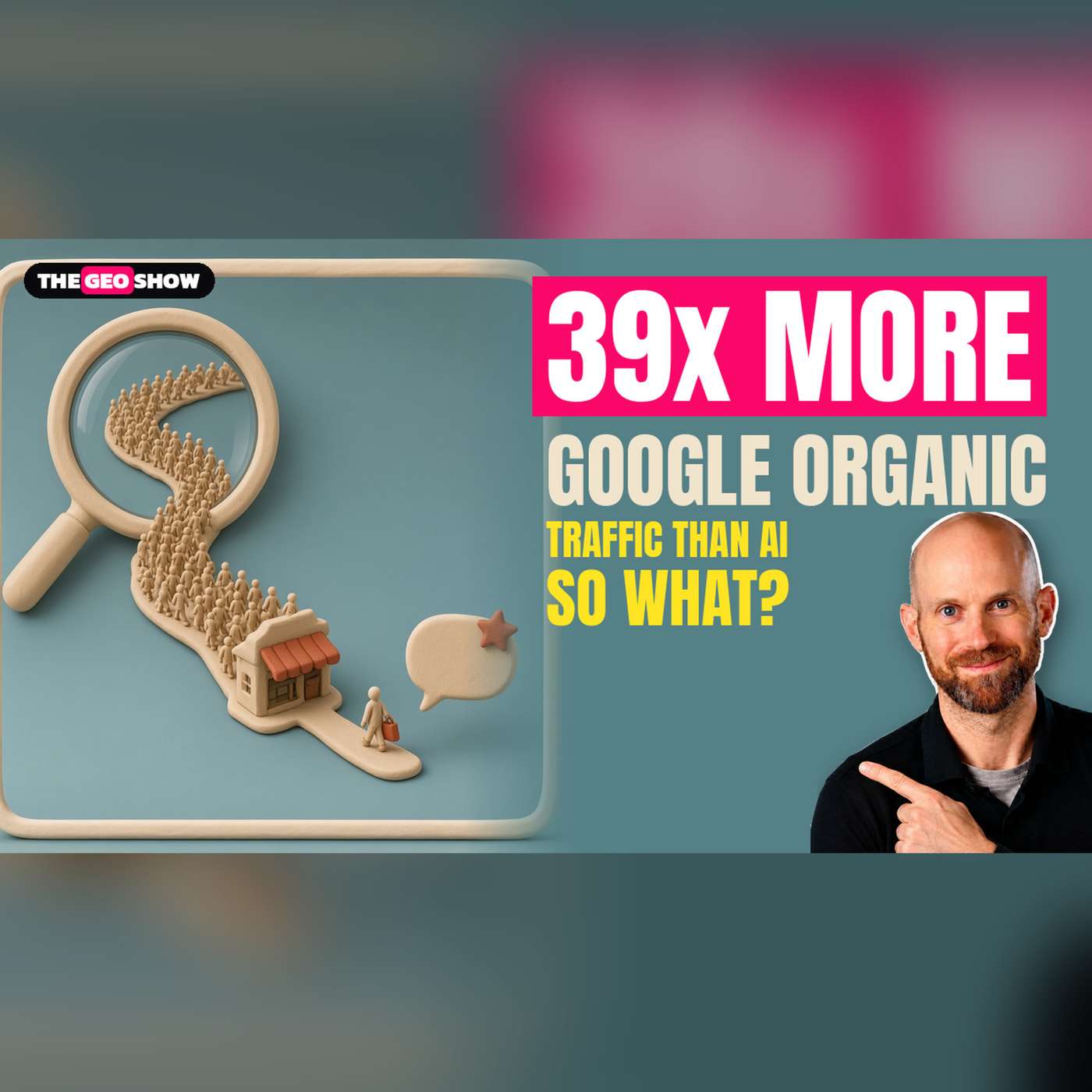
    Google Organic Sends 39x More Traffic Than AI. So What?

    Google organic sent about 39x more sessions than AI across 95 properties, yet ChatGPT visitors converted at close to 14% vs 3% for organic in a separate study. Paris Childress covers this week's GEO news, with one theme: AI traffic is small and hard to measure, but its influence keeps growing. In this episode: Marie Haynes looks at 100 sites and 12 months of GA4 data. ChatGPT sessions were just 0.62% of Google organic sessions, and across the 55 sites that track conversions, Google organic drove 964 conversions vs 36 from all LLMs combined. 39x. The SEO Works finds organic sent about 39x more sessions than AI across 95 properties, with the gap narrowing from 44x to 33x after May 2026. AI traffic converted at 1.18x the organic rate, but worse on about 23 of the 63 sites. Kevin Indig finds no reliable link between AI visibility and branded or direct traffic across four sites, and Rand Fishkin argues AI search is over-hyped. GA4 also counts AI Overviews and AI Mode clicks as organic. Brand channel. Mike King of iPullRank says GEO is a brand channel, not a performance channel. Paris argues GEO should be funded from brand budgets, not performance or SEO budgets. ChatGPT Ads adds 26 countries for 89 in total, with more than 100,000 advertisers. AI creative enhancements switch on by default from October 30 unless advertisers opt out. 88%. Semrush finds AI Overviews on 88% of 400 US commercial keywords, up from about 46% a year earlier, and 97% when weighted by search volume. Sistrix compares about 48,500 cited pages with uncited pages from the same sites. The current year in the title went with 2.7x more citations, a table of contents 1.7x and article schema 1.6x. llms.txt showed no lift. Rank trackers. Nozzle says 8.4% of its tracked results were altered since September 13, up from 0.17%. Ahrefs puts it at 5% to 20% depending on the provider. Google Search Console data is not affected. Google Universal Cart is live in US Search and Gemini, with Google Pay and a My Orders tab, shortening the path from discovery to purchase. Walmart announces Agent Profiles, a developer agent gateway built on MCP, and seven rules for AI shopping agents. AI-written snippets. Google appears to be testing AI-written summaries in AI Overview citation cards, spotted first by Brodie Clark. Seer Interactive finds two identical ChatGPT runs about 8 minutes apart shared zero fan-out queries, so visibility should be reported as a range. Meta delays its website crawling terms from October 30 to November 20 after publisher backlash. Lightning round: Claude Duet is live, Brainlabs tests Microsoft Clarity, Gary Illyes on robots.txt, AI Mode loses Export to Docs, and Profound adds Moz-powered Google data. Watch on YouTube: https://www.youtube.com/watch?v=b-nmL4o1sZY The GEO Show is hosted by Paris Childress, founder of Hop AI and co-founder of GEOforge. getgeoforge.com
  • S1 · E70
    October 23 · 44 min

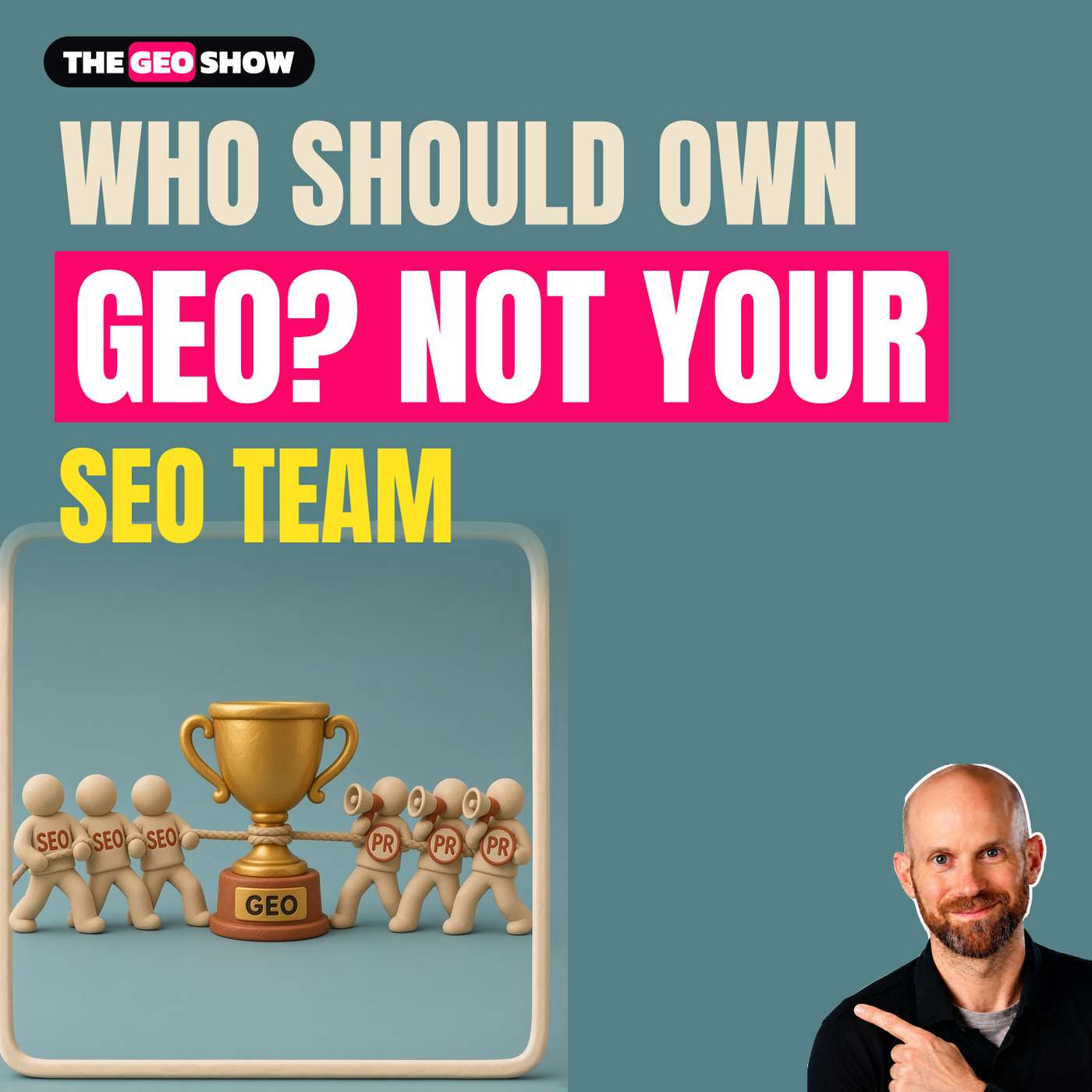
    Who Should Own GEO? Not Your SEO Team

    Who should own GEO inside a company? Not your SEO team, says Simon Young of Question.Marketing. Paris Childress runs Simon through themes from close to 20 BrightonSEO speaker prep calls, from the scoreboard problem to sponsored agents. In this episode: Traffic is the wrong scoreboard. For Stitch, 11 of 13 AI sessions booked meetings, and monthly meetings rose from 20 to 30. Attribution. Make "how did you find us" mandatory for a week or two, break out ChatGPT, Claude and Google, and ask about AI and prompts on the sales call. Who owns GEO? Simon says PR and brand, not SEO. Barbell theory. Sam Page (AirOps) says veteran SEOs and AI natives adapt fastest, while mid-career SEOs struggle most. Earned beats owned. PBNs and spun content no longer work. AI discounts what you say about yourself. Original research. Simon mystery shopped 200 estate agencies for Stitch and built a 21-page report. ChatGPT Ads hit a $1 billion run rate about 200 days after launch. The system tracks conversation context and runs auctions when it detects commercial intent. Sponsored agents, agent-to-agent negotiation, and whether standard pricing survives. Watch on YouTube: https://www.youtube.com/watch?v=O0fTDNy5M1Y Guest: Simon Young, Question.Marketing. The GEO Show is hosted by Paris Childress, founder of Hop AI and co-founder of GEOforge. getgeoforge.com
  • S1 · E69
    October 23 · 17 min

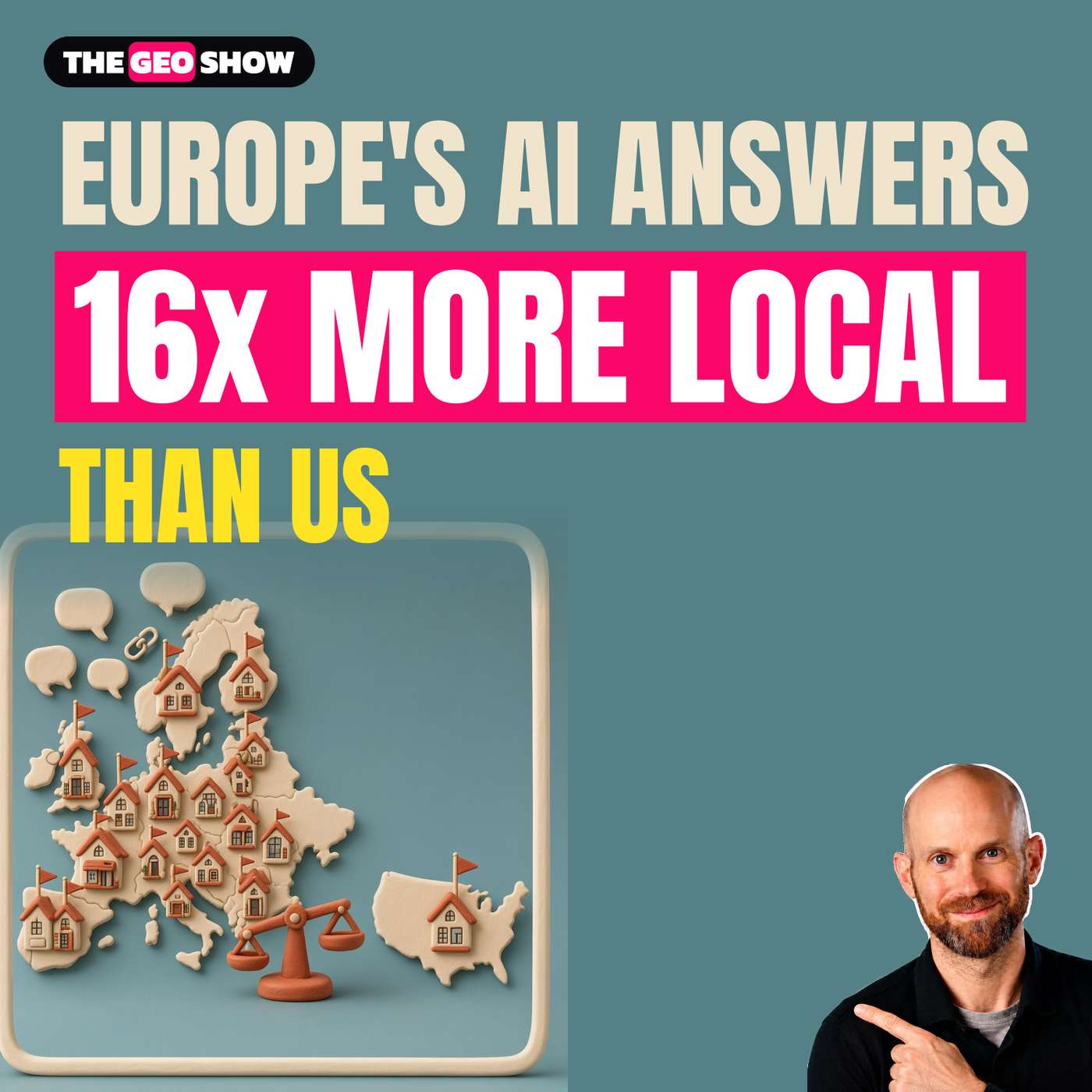
    Europe's AI Answers Cite Local Sites 16x More Than US

    Local sites get 15.5% of European AI citations vs 0.95% in the US, about 16x more, according to AirOps research. Paris Childress covers this week's GEO news, with one theme: AI discovery is moving from dashboards to infrastructure, standards and outcomes. In this episode: 16x local. AirOps expands into EMEA with a London team led by Cecile Meuguet. Its research finds local websites get 15.5% of citations in European AI answers vs 0.95% in the US, about 16x more, and English vs local language queries share only about 10% of cited sources. ChatGPT Ads expands by 26 countries to 89, with more than 100,000 advertisers in about eight months. Ads only reach free and Go users, a caveat for B2B. $1B. ChatGPT ads reach a $1 billion annualized run rate less than 200 days after launch. Paris explains the intent model and auctions, and why sponsored agents could change attribution. China puts three GEO industry standards into effect, coordinated by the China Advertising Association, and adopts GEO as the name. Perplexity publishes pplx-embed-v2-late multilingual retrieval models: 9 billion parameters for indexing, 0.6 billion for querying. 31%. In controlled data void experiments, attacker content appeared in ChatGPT, Gemini and Sonar Pro responses 31% of the time. Paris recommends an entity map from entitymap.org. Adobe Express research proposes LARA and finds users reformulate queries 44.4% of the time in agentic chat vs 33% in gallery search. Document ingestion that ignores formatting dropped F1 from 0.690 to 0.150 across 76 policy documents. Color and highlighting matter. Generative recommenders can disadvantage niche products, and co-occurrence gives big brands a head start in GEO. Google adds Gemini recommendations to Search Ads 360 and AI-curated media in Display & Video 360. Watch on YouTube: https://www.youtube.com/watch?v=ZhCWWtM164A The GEO Show is hosted by Paris Childress, founder of Hop AI and co-founder of GEOforge. getgeoforge.com
  • S1 · E68
    October 22 · 16 min

    Direct Traffic Up 141%: Bots or AI?

    Direct traffic jumped 141% across 12 websites, but engaged direct sessions fell about 1%. Is it AI or bots? Paris Childress covers this week's GEO news, with one theme: AI visibility tools are becoming a commodity, attribution stays murky, and AI agents are getting real infrastructure. In this episode: Demandbase launches an AEO agent for B2B buying groups, the first ABM player to move into GEO. Peec AI expands its agent and actions experience with more than 25 integrations and a focus on earned media. 0.62%. Marie Haynes finds ChatGPT sends just 0.62% as much traffic as Google across 145 million sessions. Paris explains why AI influence is bigger than AI referrals. Kevin Indig finds direct traffic up 141% but engaged direct down 1%, driven largely by bots. Paris argues direct traffic to deep pages is most likely AI. Beacon enters the category with $20 monthly GEO monitoring, and Paris explains what cheap tracking means for confidence. Google documents its generative AI search controls, including data-nosnippet, X-Robots-Tag and the Search generative AI control. Anthropic introduces Claude Duet, a proactive AI agent, following OpenClaw, Meta's Muse and OpenAI's Dots. Walmart introduces an agent gateway and agent profiles with spending limits, built on MCP. OpenAI models come to Google Cloud's Model Garden, and Paris hopes AI avoids the walled gardens of past tech waves. ChatGPT Ads turns on automatic creative enhancements October 30 unless advertisers opt out. Watch on YouTube: https://www.youtube.com/watch?v=yAZz4Ec1D88 The GEO Show is hosted by Paris Childress, founder of Hop AI and co-founder of GEOforge. getgeoforge.com
  • S1 · E67
    October 21 · 16 min

    AI Engines Disagree on the Top Bank 43% of the Time

    AI engines disagree on which bank to recommend first 43% of the time. Paris Childress covers this week's GEO news, with one theme: AI visibility monitoring is becoming a commodity, and the real fight is moving to execution, methodology transparency and oversight of AI agents. In this episode: Profound and Bazaarvoice partner to connect AI visibility with customer reviews, with research on about 40 million ChatGPT shopping product mentions. geoSurge launches a free desktop tracker for ChatGPT, Claude and Gemini. Paris calls monitoring table stakes. 43% disagreement. PRecious Communications analyzed 2,740 AI responses on Southeast Asian banking across 6 countries and 8 languages. AccuRanker recalculates share of voice, cutting the median tracked domain 48% with no change in rankings or traffic. Different raises a $48M seed round, and Salesforce agrees to acquire Braze for about $5.66B. Tenable opens its security intelligence to AI agents through MCP, and Paris explains why software is going headless. OpenAI discloses two incidents where agents weakened monitoring safeguards. Ahrefs Brand Radar gets a TechRadar review, and Paris explains why GEOforge runs every prompt 30 times. SPM Communications puts GEO at the core of its PR offering. Watch on YouTube: https://www.youtube.com/watch?v=tHWoLuVF8qA The GEO Show is hosted by Paris Childress, founder of Hop AI and co-founder of GEOforge. getgeoforge.com

  • S1 · E66
    October 20 · 14 min

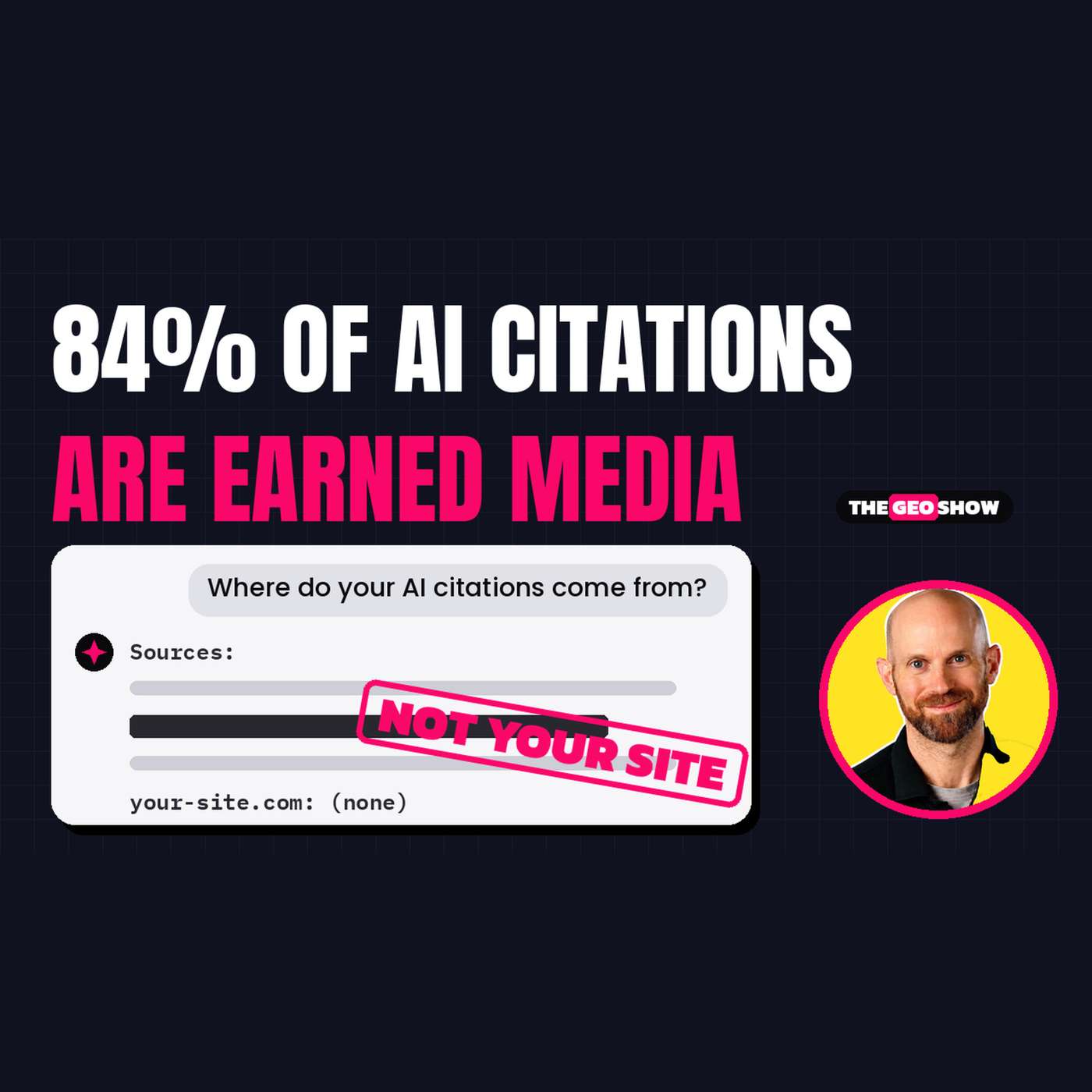
    84% of AI Citations Come From Earned Media, Not Your Site

    84% of AI-cited sources come from earned media, according to Muck Rack research highlighted in Force4's 2026 Market Influence Report. Paris Childress covers this week's GEO news, with one theme: the GEO market is splitting into measurement, activation and agent trust. In this episode: Getfluence and Meteoria partner to connect AI visibility measurement with earned media placement. 84% of AI citations are earned media. Force4's report cites Muck Rack data, and Paris argues PR outreach may be the most important part of GEO. Agent commerce is ahead of deployment. Massive found published UCP profiles on only 11 of 36 storefronts tested. Proof and Circle plan identity-gated agent payments, so people can trust their agents to buy. Microsoft adds risk-adaptive security controls for enterprise AI agents. Rank Control joins the measurement-to-execution trend in GEO tools. Tracker methodology matters. One run per prompt per day is basically a coin flip. GEO market size estimates for 2026 range from $160.9M to $4.91B, a 30.5x spread. HubSpot brings AI search education to mainstream marketing teams. Watch on YouTube: https://www.youtube.com/watch?v=dQxpNYJH9pY The GEO Show is hosted by Paris Childress, founder of Hop AI and co-founder of GEOforge. getgeoforge.com

  • S1 · E65
    October 19 · 9 min

    The ChatGPT Your Tools Track Isn't the Real One

    Welcome to Episode 65 of The GEO Show, the daily podcast on Generative Engine Optimization: how brands earn visibility, mentions and citations inside AI answers. Paris Childress, founder of Hop AI and co-founder of GEOforge, covers this week's GEO news. The big theme: AI visibility measurement is drifting away from what users actually see, while AI agents move from recommending vendors to negotiating and transacting with them. In this episode: 📊 The ChatGPT your tools track isn't the real one Researchers tested 80 questions in English and Chinese. For GPT-5.5 Instant, Google Search results plus OpenAI's Responses API recovered only 26.2% of the exact pages and 48.7% of the source sites the ChatGPT app cited. The study did not test commercial trackers, but most visibility tools measure through the API. 🤖 Parallel agents in GPT-6 Pro OpenAI now lets several agents work on parts of one task at once, which prompt-based measurement may not capture. 🌐 A six-engine citation index The Machine Relations Index counts 31,721 cited domains across 27,227 answer runs and 200,158 source events from May 10 to October 18, led by Reddit, YouTube, LinkedIn and Forbes. 🤝 Anthropic and AI agent negotiations The Financial Times reports that Anthropic is consulting legal specialists as it explores how AI agents might negotiate terms. This is reported, exploratory work, not a launched service. 🧰 The GEO tool market keeps growing AiSightKit lists 134 tools and platforms, and G2's AI search software category has more than 650 listings. 🏨 AI visibility standards for hotels The AI Hospitality Alliance released 15 AI visibility indicators for hotels, including booking capability. 🔍 Cloudflare, OpenAI and agent transactions A Cloudflare and OpenAI pilot on about 1% of Cloudflare's network surfaced hundreds of millions of previously unknown pages, though it does not show that those pages were cited. GoDaddy, Infoblox, Google and Cloudflare also demonstrated a prototype for trusted agent transactions. Subscribe to The GEO Show on Apple Podcasts, Spotify or YouTube for a new episode every day. 💬 Question: Does your AI visibility tool measure the ChatGPT app or the API? Watch on YouTube: https://youtu.be/YHz3Z58vTjU

  • S1 · E64
    October 19 · 15 min

    AI Reads Your Snippet, Not Your Page

    Welcome to Episode 64 of The GEO Show, the daily podcast on Generative Engine Optimization: how brands earn visibility, mentions and citations inside AI answers. Paris Childress, founder of Hop AI and co-founder of GEOforge, covers this week's GEO news. The big theme: AI discovery is fragmenting into regional retrieval systems, while ad platforms race to make AI commerce measurable. In this episode: 📄 AI reads your snippet, not your page New research, "Retrieved but Not Read", finds models often cite sources from search snippets without opening the page. Your title and meta description now do real work for AI retrieval. 🛒 ChatGPT Shopping runs two systems Peec AI found ChatGPT Shopping uses OpenAI's own product index in the US and Google Shopping results in Europe. 📉 A ChatGPT attribution drop Webflow saw ChatGPT attributed sessions fall 47% from 8 October before recovering a week later. 📊 ChatGPT Ads and Google AI Mode ChatGPT Ads adds third party measurement partners, and Google tests personalized ads in AI Mode. 🔤 Exact match domains are no silver bullet A Peec AI customer experiment shows strong results on one head term but under 5% visibility on real buyer style prompts. 💰 Funding and launches Around $604 million has gone into 10 GEO startups, ALSA extends its seed round, Semrush opens MCP access, and Paris announces the GEOforge MCP connector. Subscribe to The GEO Show on Apple Podcasts, Spotify or YouTube for a new episode every day. 💬 Question: Have you rewritten your titles and meta descriptions for AI? Watch on YouTube: https://youtu.be/HG-PBDNeeQ0

  • S1 · E63
    October 19 · 41 min

    Local Businesses Are Invisible to AI

    Welcome to Episode 63 of The GEO Show, the daily podcast on Generative Engine Optimization: how brands earn visibility, mentions and citations inside AI answers. Paris Childress, founder of Hop AI and co-founder of GEOforge, is joined by Jonah Bautista, founder of Atlanta Pro Network, a local agency for home service contractors in Atlanta. Their topic: why so many local businesses are invisible to AI, and how to fix it. In this episode: 🔎 AI search is the new front door Homeowners are already asking ChatGPT and Google AI Mode who to hire, and most contractors have no idea whether they show up. 🛠️ An audit tool built in Claude Jonah's five question intake checks Google Maps and Semrush data and produces an AI visibility report in a few minutes. It also doubles as his best lead magnet. 🏗️ The local GEO foundations Google Business Profile, consistent directory listings, schema, FAQs on every page, llms.txt, backlinks and a presence on Reddit. 🤖 Agentic ads on commission Paris imagines AI assistants like Meta Muse introducing an advertiser's sales agent into the chat, closing the deal without a click and taking a commission instead of charging per click. 🧭 Why Jonah left e-commerce Platform policy risk, account suspensions and why local GEO is the bigger opportunity right now. Guest: Jonah Bautista, Atlanta Pro Network Subscribe to The GEO Show on Apple Podcasts, Spotify or YouTube for a new episode every day. 💬 Question: Have you checked how your business shows up in ChatGPT? Watch on YouTube: https://youtu.be/u7tPuTqO1Tc

  • S1 · E62
    October 17 · 31 min

    Your AI Visibility Numbers Are Probably Wrong

    Welcome to Episode 62 of The GEO Show, the daily podcast on Generative Engine Optimization: how brands earn visibility, mentions and citations inside AI answers. In a new two-host format, Paris Childress, founder of Hop AI and co-founder of GEOforge, is joined by Simon Yong of Question.Marketing to debate the themes that keep coming up in GEO, starting with a big one: are your AI visibility numbers even reliable? In this episode: 📊 Is AI visibility measurement flawed? Most tools Paris saw at brightonSEO run one prompt check per day. LLMs are probabilistic, so a reliable share of voice needs deep sampling and a confidence interval. 🎯 Citations vs recommendations There's an infinite long tail of prompts, and being cited isn't the same as being recommended, or chosen. Plus: ChatGPT links losing their referral data. 🛡️ AI reputation management When AI repeats negative PR, it's harder to untrain than burying a bad Google result. Now is the window to shape how AI understands your brand. 🙋 The simplest attribution method Ask every new customer how they heard about you, and list ChatGPT, Gemini, Claude and Google AI Overviews as separate options. 🤖 Will AI agents make GEO obsolete? Personal agents, brand sales agents invited into conversations, and what ChatGPT Ads could become. Guest: Simon Yong, Question.Marketing (https://question.marketing) Subscribe to The GEO Show on Apple Podcasts, Spotify or YouTube for a new episode every day. 💬 Question: How does your team measure AI visibility today? Watch on YouTube: https://youtu.be/cXYKw_XCCx0

  • S1 · E61
    October 16 · 13 min

    ChatGPT Is Hiding Your Referral Traffic

    Welcome to Episode 61 of The GEO Show, the daily podcast on Generative Engine Optimization: how brands earn visibility, mentions and citations inside AI answers. In this news roundup, Paris Childress, founder of Hop AI and co-founder of GEOforge, covers 10 stories, led by a big one for attribution: links inside ChatGPT answers are reaching websites without their referral data. In this episode: 🔗 ChatGPT referral data goes missing Links inside ChatGPT answers (not the citation panel) are reported to arrive without referral data, so analytics undercounts ChatGPT traffic. Bug or permanent, it makes attribution even harder. 🏷️ Brand names in fan-out queries Research from Chen and Koudas across 158,000 AI answers found retrieval explains about 32% of citation variation vs 2.8% for page characteristics, and ChatGPT sometimes adds brand names to its searches. 🛒 Shopping buttons favor big retailers Wislr found 56% of ChatGPT shopping buttons linked to major retailers and about 5% to brand-owned stores. 🤖 Agentic orders up four-fold Forter reports agentic orders up more than 4x since August, while Product.ai finds almost 90% of AI shoppers still verify recommendations. ⏱️ Supervising AI agents G2's 2026 AI Agents Report: 31% of B2B software buyers say employees spend 6+ hours a week supervising agents. 🤝 Agent to agent Spangle Halo lets a merchant's agent negotiate with shoppers' agents, and DeepLumen charges commission on AI-attributed Shopify orders. Subscribe to The GEO Show on Apple Podcasts, Spotify or YouTube for a new episode every day. 💬 Question: Has your ChatGPT referral traffic dropped in the last few weeks? Watch on YouTube: https://youtu.be/2ZY0naQ7bCg

  • S1 · E60
    October 15 · 55 min

    Is Your Brand a Fragmented Entity in AI Search?

    Welcome to Episode 60 of The GEO Show, the daily podcast on Generative Engine Optimization: how brands earn visibility, mentions and citations inside AI answers. In this episode, Paris Childress, founder of Hop AI and co-founder of GEOforge, swaps AI visibility audits with John Colascione, founder of Searchen Networks. Paris walks through the report he runs on discovery calls for searchen.com, then John runs his own ChatGPT-based audit tool on GEOforge. Six takeaways from two reports. In this episode: 🧩 The fragmented entity Searchen has two legal names, two home states and a long link to longisland.com. AI answers blur them together, which is why John is consolidating name, legal name and alternate name in his schema. 🗺️ Entity maps Paris shares a tip from brightonSEO: an entity map, one HTML page plus a JSON file linked from the footer, that lists every accurate fact about your brand for AI crawlers. Details at entitymap.org. 💲 Publish your prices AI answers want to tell buyers what something costs. Public pricing and comparison tables give them an accurate answer to cite. 📋 Roundups and listicles Paris's report flagged web maintenance roundups as a citation gap. John's take: if 8 of 10 listicles are junk, the 2 good ones still count. 🔍 Known by name, missing by category John's audit found ChatGPT describes GEOforge accurately when asked by name, then leaves it out of broader "which platform" questions where Profound, Peec and Otterly show up. 🧱 A crowded category Paris on why AI visibility tools are easy to build now, and why grounding content in a knowledge base is the part that is hard to copy. Try John's free tool at searchen.com/ai. Subscribe to The GEO Show on Apple Podcasts, Spotify or YouTube for a new episode every day. 💬 Question: When you ask ChatGPT about your category without naming your brand, do you show up? Watch on YouTube: https://youtu.be/qiSgBD6wS0U

  • S1 · E59
    October 14 · 1 hr 5 min

    GEO vs SEO: I Debated David Quaid

    Welcome to Episode 59 of The GEO Show, the daily podcast on Generative Engine Optimization: how brands earn visibility, mentions and citations inside AI answers. In this episode, Paris Childress, founder of Hop AI and co-founder of GEOforge, debates David Quaid of Primary Position on one question: are SEO and GEO the same thing? Recorded on The Edward Show with host Edward Sturm (E1196), just after brightonSEO, and republished here with thanks. Six arguments, no agreement, plenty of heat. In this episode: 🏋️ Same gym, different sport Paris argues that powerlifting and bodybuilding train the same way but win on different scores. SEO and GEO share tactics, but SEO is scored on traffic and GEO on share of voice. 📊 Two different dashboards An SEO report shows organic traffic. A GEO report shows how often your brand is mentioned or cited versus competitors, with no click in sight. 🔗 Brand mentions vs links Paris says GEO chases brand mentions on reputable third-party sites, links or not. David says every one of those sites is only there because it does SEO. ⭐ G2, Capterra and listicles Why review sites and listicles keep showing up in AI answers, and whether that is authority or just retrievability. 💰 ROI without a click Paris: SEO kept its budget because clicks made ROI measurable, and GEO has no click. David: attribution was broken long before LLMs. 🛠️ David's toolkit Bing Webmaster Tools, Microsoft Clarity prompt reports and exact match domains, and why David thinks LLMs are easy to game. 🎙️ Originally on The Edward Show, Edward Sturm's daily SEO podcast: https://edwardsturm.com/the-edward-show/ Subscribe to The GEO Show on Apple Podcasts, Spotify or YouTube for a new episode every day. 💬 Question: Is GEO a new discipline, or SEO with a new dashboard? Watch on YouTube: https://youtu.be/U60peCbOj5c

  • S1 · E58
    October 12 · 17 min

    Information Gain: The Missing Metric in GEO Content

    Welcome to The GEO Show, the briefing on Generative Engine Optimization and AI visibility. Brought to you by GEOforge. In episode 58, Paris Childress, founder of Hop AI and co-founder of GEOforge, walks through his brightonSEO keynote from October 8, 2026 on information gain: the missing metric in most GEO content strategies. In this episode: 🍄 AI is a truffle hunter AI engines are fed on public information. What they reward is original, useful knowledge only your brand has, buried inside your company and never published. 📐 What information gain means Information gain is how much new, useful information a passage adds beyond what is already covered. Google filed a patent on it in 2018 for human readers; now the recipient is AI crawlers. GEOforge scores it from 0 to 100%, and Paris suggests content under about 20% may not be worth publishing. 📈 GlycanAge case study 52 pages published, 35 cited in AI answers, with a median of 5.9 days to first AI citation. Google AI share of voice rose from 27.8% to 32.3%, and articles scoring 90% or higher on information gain had the highest median citation rate. ✅ Google on AI-generated content Google's guidance says generative AI content is acceptable but must be fact-checked for hallucinations. Grounding drafts in your own knowledge base, through retrieval-augmented generation, cuts that editorial burden from the first draft. 🎙️ Record everything Sales calls, customer meetings, support logs, webinars and podcasts are the richest ongoing source of proprietary knowledge. Feed them into the knowledge base and AI can answer prospects the way your best salesperson does. 🧭 Measuring it Add AI chatbots to the "How did you hear about us?" field, match answers to opportunities in your CRM, and track how much pipeline AI influences as a first touch. Subscribe to The GEO Show wherever you get your podcasts. Full episode on YouTube: https://youtu.be/CfAm-KpYuUU 💬 Question: what is one truffle buried inside your company that AI has never seen?

  • S1 · E57
    October 10 · 1 hr 17 min

    Two Dozen BrightonSEO Pros Name GEO's Most Overrated Tactics

    Welcome to The GEO Show, episode 57, the briefing on Generative Engine Optimization and AI visibility. Brought to you by GEOforge. This episode is a special: Paris Childress, founder of Hop AI and co-founder of GEOforge, takes the show to the exhibition floor at brightonSEO in Brighton. On day two, Friday October 9, 2026, he asked the same three questions of 29 guests across 26 interviews: GEO or something else, what is the most overrated tactic, and what is the most underrated one? In this episode: 📉 What's overrated Listicles and Reddit take the most heat (five guests each), with llms.txt, schema markup, backlinks and one-prompt tracking also named. Guests disagree on llms.txt and schema. 📣 Off-site is the sleeper Seven guests point to digital PR, reputation and third-party mentions as the most underrated lever. As Daegan Price of IDHL puts it, what others say about your brand matters more than what you say about yourself. 🔄 Refresh and freshness Cecile of AirOps says content refreshed within three months was three times more likely to be cited, and that 85% of AI visibility comes from off-site sources (AirOps research, as stated on tape). 🧭 Entities, structure and facts Entity gap analysis (Ryan Law, Ahrefs), entity maps (Dixon, WAIKAY), facts pages (Patrick, Rankscale) and internal linking (Marcus, Conductor). 🤖 Test your site with agents Josh Bliskul of Profound argues teams should usability-test AI agents on their own sites: can they transact, add to cart, and read the page. 💼 SEO plus social Rosa and Charlie of Connective3 say combining SEO and social teams pays off, and cite a roughly four million citation B2B dataset where LinkedIn posts overtook LinkedIn articles after early August. 🏷️ What do we even call this? Roughly a third of guests said GEO, a smaller group preferred a rival label, a few said AI search, and many shrugged. Several said the market, not practitioners, will settle the name. Paris also gave his talk "Information Gain: The Missing Metric in Every GEO Content Strategy?" at brightonSEO on October 8. Subscribe to The GEO Show wherever you get your podcasts. Full episode on YouTube: https://youtu.be/GEN5sniZx1g 💬 Question: Which GEO tactic do you think is overrated, and which one is your sleeper pick?

  • S1 · E56
    October 5 · 17 min

    Amazon Blocks Agents. Shopify Opens Up

    Welcome to The GEO Show, the briefing on Generative Engine Optimization and AI visibility. Brought to you by GEOforge. In this solo episode, Paris Childress, founder of Hop AI and co-founder of GEOforge, walks through this week's top GEO stories under one theme: execution is commoditizing, but source behavior is not. In this episode: 🛠️ Prefer: the execution layer Prefer launches on Product Hunt as an anti-dashboard product: track how ChatGPT, Claude, Gemini, and Perplexity describe a brand, then use agents to act and verify. Visibility-only reporting is becoming a commodity. 🔌 Cloudflare makes retrieval switchable Cloudflare's web search API (open beta) lets apps swap Ceramic, Exa, and Linkup through one interface. Two similar agents can see different evidence because they use different retrieval providers. 🛒 Agentic commerce is permissioned Shopify agentic storefronts are active by default for eligible stores. The Wall Street Journal reports Amazon and Kohl's blocking some third-party agents while Walmart, Best Buy, and Gap engage. ▶️ YouTube owns Google AI, nowhere else In a Haus panel, YouTube appeared in 45% of Google AI Overview answers and 27.4% of AI Mode answers, versus about 1% in Gemini, 0.5% in Perplexity, and 0% across 1,164 ChatGPT answers. Great for Google properties; not a universal GEO play. 🍳 KitchenAid: strong in one engine, weak in another 5WPR's kitchen appliances index: KitchenAid in 59.2% of ChatGPT answers and 57% of Perplexity answers, versus 22.8% Gemini and 15% Claude. Measure share of voice per engine. 🎯 Recognized is not recommended Recrawl's UK B2B shortlist study: nine of 40 companies never made a shortlist answer, even though every company was recognized when queried by name. 📚 Citation influence concentrates Cidea vendor research on a B2B buyer panel: a short head of domains can carry a large share of citations. Outreach strategy should match whether your category has a long tail. 📦 Local GEO packs off-site distribution Visibility360 packages news, video, podcast, and infographic placements for local businesses (company claims, not independently validated). 🛒 GEO on Clutch GEO is now an explicit procurement category on Clutch, with more than 1,500 listed providers. GEO is becoming a normal service buy. 🎓 SEL: bigger than SEO Search Engine Land's SMX master class frames AI brand visibility as a cross-functional problem. Paris argues GEO is migrating into brand marketing and will become marketing in the AI age. Catch Paris at How to Web in Bucharest, then BrightonSEO on Thursday, October 8, at 9:30 AM, on information gain. Subscribe to The GEO Show wherever you get your podcasts. Full episode on YouTube: https://youtu.be/U0biJ2_gH4c 💬 Question: If AI recognizes your brand by name but never puts you on the shortlist, what would it take to become recommendable

  • S1 · E55
    October 3 · 20 min

    Clarity Beats Schema for AI Recommendations

    Welcome to The GEO Show, the briefing on Generative Engine Optimization and AI visibility. Brought to you by GEOforge. In this solo episode, Paris Childress, founder of Hop AI and co-founder of GEOforge, walks through this week's top GEO stories, led by a 1,089-brand study that finds clarity beats schema markup for AI recommendations. In this episode: 🧩 Clarity beats schema markup First Page Sage tested 4,213 commercial prompts and 657 agent shortlisting tasks across 1,089 brands. Clear offerings and suitability lifted AI recommendations by 11.2 percentage points and consistent brand information by 9.4, while generic schema added just 0.4. FAQ schema and llms.txt showed no measurable lift. 🔎 AI Overviews take over branded search DemandSphere saw the share of its tracked branded keywords with an AI Overview jump from 26% on September 1 to 82% on September 29. Searches for your own brand name are no longer safe from AI summaries. 💸 Publishers start getting paid for AI answers Cloudflare's Pay Per Use beta lets AI companies pay publishers per cited answer, agent report, or shopping recommendation. Google is reportedly paying about 100 publishers based on how much their content contributes to AI Overviews, AI Mode, and Gemini. 📡 A common event model for AI content telemetry The SPUR Coalition of publishers released version one of a standard that tracks content being retrieved, grounded, cited, presented, and engaged with. ⚖️ Chegg and Penske Media suits dismissed Judge Amit Mehta dismissed the antitrust suits over AI Overviews, so licensing, technical controls, and commercial deals are more likely to shape the market. 🛒 Safeway shopping inside ChatGPT Albertsons and OpenAI turn a recipe or list into a cart and checkout, a sign that commerce GEO will need product-level measurement. 📊 ChatGPT ads attribution gaps Agencies report conversions and clicks that don't match ChatGPT's own numbers, which keeps ad budgets in test mode. 🤖 From share of voice to share of conversions Publishers now sell GEO services, Profound studies personal shopping agents like Meta Muse, and Paris argues that proactive, always-on agents will make share of voice a short-lived KPI. Catch Paris at BrightonSEO on Thursday, October 8, at 9:30 AM, speaking about information gain. Subscribe to The GEO Show wherever you get your podcasts. Full episode on YouTube: https://youtu.be/hCl1-SqgR-c 💬 Question: If schema alone doesn't move AI recommendations, how clearly does your site say what you offer and who it's for?

  • S1 · E54
    October 2 · 50 min

    AI Can't Keep Up With Live Legislation

    Welcome to The GEO Show, the briefing on Generative Engine Optimization and AI visibility. Brought to you by GEOforge. In this episode, Paris Childress, founder of Hop AI and co-founder of GEOforge, talks with Miranda Hoover, founder and CEO of 3C-House, a Nevada government affairs, lobbying, PR, and business development firm, about why AI can't keep up with live legislation, and what a real-time data feed for AI could look like. In this episode: 🔎 From SEO to GEO: is the answer reliable? People now ask AI instead of searching, so Miranda's team checks whether AI answers about a business are reliable, secure, legal, and right. Her rule for clients: trust it, but verify it. 🏛️ Why AI answers lag on live bills Miranda explains that for a live bill, AI relies on one or two official websites, and the staff who update them fall behind when legislation moves fast. She recalls a client whose ChatGPT answer placed a bill where it had been 35 minutes earlier. Bill tracking software sources the same sites, so it shares the lag. 🧑‍⚖️ Why AI won't replace lobbyists yet Lobbyists sit in the room where bills move and decisions are made in real time. Until AI can follow who is speaking and the nuance of each chamber, Miranda says, her industry is safe. 📡 A real-time legislative data feed for AI Paris and Miranda sketch a business: AI recorders in legislative sessions feeding a real-time database that AI labs license, the way X feeds Grok. It could be the next generation of bill tracking software, delivered through an MCP connector instead of an interface. 🛠️ How 3C-House uses AI Otter.ai for every meeting, Claude across the team (drafting emails into drafts only, weekly automations, project trackers), Claude for building in-house projects, and HeyGen for AI avatars. 🧠 A central AI brain for your company Paris wants every meeting transcript, chat, email, and document in one AI system that can flag hidden risks and suggest priorities. He also shares how GEOforge's features have been built with Claude Code since April. 🤖 When agents start the conversation Proactive assistants like Meta Muse and OpenAI's Dots will start more conversations themselves, which makes prompt tracking and attribution harder, even as AI matters more as a marketing channel. 🎙️ Start recording every meeting Paris's one piece of advice: record your meetings. The spoken words in every client, prospect, and internal meeting are your company's most valuable context for AI. Subscribe to The GEO Show wherever you get your podcasts. Full episode on YouTube: https://youtu.be/WVZd5miX9LE 💬 Question: If AI only trusts a few official sources in your industry, what would it take for your data to become one of them?

  • S1 · E53
    October 1 · 16 min

    Always-On AI Agents Will Outgrow Prompt Tracking

    Welcome to The GEO Show, the briefing on Generative Engine Optimization and AI visibility. Brought to you by GEOforge. In this solo roundup, Paris Childress, founder of Hop AI and co-founder of GEOforge, covers nine stories from the week in AI search. The lead story: OpenAI's always-on Dots agents, and why prompt tracking will capture less of a brand's AI visibility as agents do more of the prompting. In this episode: 🤖 OpenAI Dots and the future of prompt tracking OpenAI launched Dots on September 29: always-on agents powered by GPT-6 Astra, each with its own cloud computer and access to more than 4,000 apps. As agents start conversations on their own, stateless prompt tracking becomes a less complete picture of a brand's AI visibility. 🔎 Perplexity trains retrieval to return evidence Perplexity released pplx-embed-v2-context-9b-preview on September 30, a contextual embedding model trained to retrieve both the answer chunk and the supporting context. The unit being optimized for retrieval is becoming an evidence bundle, not an isolated quotable paragraph. ⏳ The median AI citation half-life is 11 days Profound tracked 883,000 pages across seven AI engines. The median page loses half its citation share within 11 days of peaking, and 78% fall to half their peak within two weeks. Engines decide independently, so watch citation persistence and refresh or replace pages as they decline. 🏘️ Third parties win commercial citations In Writesonic's analysis of 9 million AI answers for 400+ enterprise brands, published on Search Engine Land, third-party sources got 82% of citations on bottom-of-funnel commercial prompts and owned pages just 3%. Owned citations lasted 3 to 9 times longer. The data comes from Writesonic customers, not the whole market. 🔌 Buyer intent data inside AI tools Informa TechTarget launched an MCP server for its Buyer Intelligence, bringing person-level intent data from its audience of about 58 million permissioned members into Claude, ChatGPT, Copilot, Gemini, and custom AI systems. 📊 AI visibility moves into communications reporting 10Fold launched MetricsMatter 5.0. In its survey of 400 US and European B2B technology marketing decision-makers, 58% include AI search or LLM visibility in integrated reporting, but only 38% connect communications and visibility metrics to pipeline or revenue. Paris's fix: add an AI chatbot option to "How did you hear about us?" on your lead form. 📰 PR distribution meets GEO measurement Brandpoint launched Optimize360, which tracks AI visibility with more than 30,000 prompts a month per brand. Brandpoint advertises a network of 3,000+ publications and 800+ guaranteed placements, the hardest part of off-site citation building. 🏭 Vertical GEO needs vertical logic Zen Media ran 1,000 industrial automation buyer prompts across ChatGPT, Gemini, Perplexity, and Grok. The top 100 vendors averaged 4% visibility, versus 21% for Siemens, and distributors and authorized channels showed up prominently. 🇦🇺 Source authority is local Findrix's Australian AI Source Index covers 23,396 buying prompts in nine markets. More than 85% of retrieval in clinics, home services, and finance and accounting came from .au domains, versus 32.9% in B2B software. There is no universal best-sources list. Subscribe to The GEO Show wherever you get your podcasts. Full episode on YouTube: https://youtu.be/t6YnwMMyMe4 💬 Question: How will you measure AI visibility when agents, not people, start the conversation?

  • S1 · E52
    October 1 · 18 min

    Comparison Pages Win B2B AI Citations

    Welcome to The GEO Show, the briefing on Generative Engine Optimization and AI visibility. Brought to you by GEOforge. In this solo roundup, Paris Childress, founder of Hop AI and co-founder of GEOforge, covers eight stories from the week in AI search. The theme: the category is moving from "can you track AI" to "can you measure the right market and influence the right sources." In this episode: 📏 More prompts beat more runs Peec AI analyzed about 120 million chats from February to August 2026. With the same 1,500 monthly runs, 50 prompts run once daily gave about plus or minus 6.1 points of monthly uncertainty, versus 13.2 points for 10 prompts run five times daily. Peec's advice: group branded and non-branded prompts, judge the portfolio over time, add prompts before adding runs, and freeze the prompt set. 📑 Comparison pages dominate B2B citations Foundation and AirOps tracked about 380,000 AI answers and 3 million citation events across 81 B2B software categories and six AI surfaces. Vendor domains were the largest source class, and comparison pages or listicles made up 84 of the 100 most cited URLs. Source strategy is engine-specific and category-specific. 🛍️ 66% have used AI for product research An Emplifi survey of 1,638 US and UK consumers found 66% have used AI tools to research products or find gift ideas, and 11% now start product research with AI. Semrush estimates AI referrals to 30 major US retailers grew 190 times from June 2023 to June 2026, now about 8% of the basket's social referral traffic. 🏛️ The right source changes with the question BrightEdge grouped a US insurance prompt panel into four question types. The insurer's own domain won the citation only for branded queries; government, clinical, and HR sources owned the others. Some query classes have authority owners that are very hard to displace. 📢 ChatGPT ads are already heavily B2B Business Insider reports Graphite's analysis of Similarweb panel data from March to August: business software was almost 20% of observed ad impressions, and fewer than half of ad-eligible users had been shown an ad at all. 📋 Boards are asking, few have a plan Yext cited a Corporate Ink survey: 88% of CMOs and VP-level marketers are being asked by leadership or the board about AI visibility, but only 34% of marketers surveyed have a defined strategy. That gap is the opportunity. 🎯 Google closes the AI Max migration window Eligible Google Ads campaigns moved to AI Max during September. Google says the full AI Max suite delivered an average of 7% more conversions or conversion value at a similar CPA or ROAS, based on its internal data. 🧩 A crowded category on G2 G2's September snapshot lists 642 products in its category for optimizing brand visibility in AI answers, from SEO incumbents to reputation platforms and dedicated AI search vendors. Reviews on G2 are some of the most important citations B2B SaaS can build. Subscribe to The GEO Show wherever you get your podcasts. Full episode on YouTube: 💬 Question: Are you tracking more prompts, or running the same prompts more often?

Showing 41–60 of 115 episodes