Skip to content
Artwork for The GEO Show
BusinessMarketingTechnology

The GEO Show

Paris Childress - GEOforge

The GEO Show is about generative engine optimization (GEO) and AI search: how B2B brands win AI visibility in ChatGPT, Perplexity, Google AI Overviews and AI Mode. Each episode breaks down what is changing in the way AI assistants and answer engines find, cite, and recommend brands, and what marketers should do about it.

The show is built for B2B SaaS marketers, SEO and content leads, and founders who want their brand to show up when buyers ask AI for answers instead of scrolling a page of blue links. If you own organic growth, demand generation, or brand, you will come away with practical GEO tactics you can test, a clear read on the latest AI search news, and better ways to measure AI visibility when traffic alone no longer tells the whole story.

Episodes mix a few formats:

  • Solo deep dives on GEO strategy, from how large language models choose which sources to cite to how content, earned media, and brand mentions shape AI answers.
  • News breakdowns on the latest moves from OpenAI, Google, Perplexity, and the rest of the AI search landscape, and what each change means for your pipeline.
  • Expert guests, including SEO and GEO practitioners, content and PR leaders, agency operators, and founders building for AI search.
  • The Friday catch-up with regular co-host Simon Young of Question.Marketing, where the two unpack the week's biggest AI search stories and debate what actually works.

Your host is Paris Childress, CEO of Hop AI and co-founder of GEOforge. Paris brings a practitioner's view of GEO and AI visibility, focused on what B2B teams can apply right away, not hype.

Learn more about GEOforge at https://getgeoforge.com.

Subscribe to The GEO Show on Apple Podcasts, Spotify, YouTube, or wherever you listen so you never miss an episode, and share it with a teammate who is figuring out AI search.

Play
  • 102 episodes
  • Avg 26 min
  • English
Counted on this page — what you have heard stays on this device, so it is not something the list can be paged by.
  • S1 · E79
    November 2 · 14 min

    Reddit Says AI Mode Sends No Traffic

    Welcome to Episode 79 of The GEO Show, the weekly briefing on Generative Engine Optimization and AI search. In this episode, Paris Childress, founder of Hop AI and co-founder of GEOforge, covers seven stories plus a lightning round. In this episode: 📉 Reddit says AI Mode sends no traffic. Google Search referrals fell by more than a million a week in October. Reddit will test a logged-in only experience in some non-US markets. 🤖 One opt-out for AI training. Google and Microsoft will honor a shared robots.txt token that blocks AI training across vendors, and OpenAI plans to follow. It covers training only, not crawling or search eligibility. ⚖️ Publishers put a number on AI retrieval. Digital Context Next told the court member unique visitors fell 26% from 2023 to 2025 and quoted Microsoft's "doom loop" warning. 🛒 AI agents at checkout. Microsoft Clarity found checkout in about 25% of agent sessions versus 15% for humans. 🔍 A 0.9% AI click-through estimate. Cyrus Shepard opted one site out of AI Overviews and AI Mode and still lost clicks. 📢 ChatGPT ads grow. Wider desktop cards, multi-image ads for everyone, and creative enhancements on by default. ✈️ Travel answers favor booking sites. BrightEdge found booking platforms in 38% of booking-stage answers. Watch on YouTube: https://youtu.be/L8xNSUSfUD8 Subscribe wherever you listen and on YouTube for the weekly GEO briefing. 💬 Question: If AI's favorite citation source says AI Mode sends no traffic, what should everyone else expect?

  • S1 · E78
    October 30 · 40 min

    Google Lost $500 Billion in a Day. Can AI Mode Ever Pay?

    It's Friday, so host Paris Childress is back with his regular co-host Simon Young of Question.Marketing. They debate five of the week's biggest stories in GEO and AI search: Google's AI Mode money problem, closed gardens vs open agent protocols, shrinking AI Mode citations, ChatGPT as a search and ads channel, and murkier measurement. In this episode: Google's AI Mode money problem. Alphabet fell about 13% on 29 Oct 2026, its worst day ever, wiping out roughly $500 billion in value, after search revenue growth slowed from 17% to 12% ($63.35 billion). Can Google put ads in AI Mode without losing user trust? Sponsored agents. Google's ad ranking has always blended bid and relevance across several ad slots. A sponsored agent in a conversation may be winner take all. Good bots clicking ads. Simon shares a client whose agent negotiated a Hong Kong hotel deal. When authorized agents click ads for real users, what are advertisers really paying for? More than half of web traffic is now automated (Imperva 2026 Bad Bot Report). Closed gardens vs open protocols. Amazon says over 400 million customers used Alexa for Shopping in the past 12 months and still blocks Meta's Muse. Google launched its Connected Apps Platform on MCP, Visa says nearly 50 AI partners are in production, and Shopify moved its AI agent knowledge base into the admin. A race to the bottom. If agents negotiate every deal, what happens to marketplace margins and the customer relationship? Fewer citations. In data analyzed by The Search Spot, AI Mode sources per answer fell from 16.3 to 4.3 (74%). Muck Rack finds over 84% of AI citations come from earned media. ChatGPT as a search and ads channel. seoClarity estimates 1.24 billion search-like ChatGPT messages a day, about 7.5% of Google's volume. ChatGPT Ads creative enhancements are on by default from 30 Oct (advertisers can opt out), and ChatGPT ads can be bought through Amazon DSP. Measurement murk. Semrush and Ahrefs confirm poisoned Google results hitting rank trackers, a ChatGPT bug dropped UTM tags from about 8 to 15 Oct, and AI Overviews appear on 82.5% of US brand searches (SE Ranking). Correction: In the episode, the AI Mode ads expansion is described as including the UK, Brazil and Mexico. The 10 markets that went live on 28 Oct 2026 are Australia, Canada, India, Kenya, Malaysia, New Zealand, Nigeria, Pakistan, the Philippines and Singapore. The UK, Brazil and Mexico are planned for Q4 2026. Find Simon Young and Question.Marketing at question.marketing. Watch on YouTube: https://www.youtube.com/watch?v=3Xjs_YU167E The GEO Show is hosted by Paris Childress, founder of Hop AI and co-founder of GEOforge. getgeoforge.com

  • S1 · E77
    October 30 · 10 min

    AI Agents Are Becoming the Storefront

    Amazon says more than 400 million customers used Alexa for shopping in the past twelve months, while Google opens Search and Gemini to third-party apps via MCP. Paris Childress covers these and five more stories in today's GEO briefing on agents becoming the storefront. In this episode: 400 million Alexa shoppers. Amazon's Q3 results say more than 400 million customers used Alexa, its agentic shopping assistant, for shopping in the past twelve months, with interactions up 570% year over year. On the earnings call, Andy Jassy said shopping through outside AI agents is still not great and no more convenient than going to a retailer directly. Google opens Search and Gemini to apps. Google launched a preview of its connected apps platform. Developers integrate through a cloud-hosted MCP server or Android app functions, then choose Search, Gemini or both. Adobe, Experian, Localiza and Peloton are already live. If you already have an API or MCP server, apply for access now. Direct answers in AI-cited pages. An agency study by TJ Digital of 193,507 AI answers tracked in PiqueAI found cited pages opened with a direct answer 20% of the time, versus 5% for top ten pages the AI never pulled up. The author calls these associations, not proof of cause. Disclosure: TJ Digital and PiqueAI are third parties, not affiliated with GEOforge; the study figures cited are theirs. Sponsored products in AI Mode. Google confirmed it is testing an AI Mode format that mixes labeled sponsored products into product results, a day after expanding AI Mode ads to ten more markets. Organic product visibility may increasingly share space with ads. Longer, multimodal AI Mode queries. Google says AI Mode queries are three times longer than traditional searches, and more than one in six US AI Mode searches are multimodal. ChatGPT at about 7.5% of Google. seoClarity estimates ChatGPT handles about 1.24 billion search-like messages a day, roughly 7.5% of its estimate of 16.4 billion daily Google queries. It is a modeled comparison, not measured market share. Meta loses Paris appeal, plus lightning round. A Paris appeals court upheld measures requiring Meta to share revenue and usage data with French press groups. Plus Gemini 4 Carbon, Merchant API agentic checkout reporting, DMA search data sharing, 404 pages and restaurant ordering controls. Watch on YouTube: https://www.youtube.com/watch?v=IeJX3tyjqTQ The GEO Show is hosted by Paris Childress, founder of Hop AI and co-founder of GEOforge. getgeoforge.com

  • S1 · E76
    October 29 · 10 min

    Connected Gmail and Photos Can Now Shape Ads in AI Mode

    For users who connect Gmail or Google Photos to Search, Google can now use that context to personalize ads, including in AI Mode. Paris Childress covers this and five more stories in today's GEO briefing, including OpenAI data showing about 1 in 5 ChatGPT messages now seeks information. In this episode: Gmail and Photos can shape ads in AI Mode. Google changed its privacy policy so that, for users who connect Gmail or Google Photos to Search, the summaries and inferences it draws can personalize ads, including in AI Mode. Advertisers get no controls or reporting yet, so break out AI Mode performance wherever Google allows. 1 in 5 ChatGPT messages is a search. OpenAI's data shows 20.2% of sampled consumer ChatGPT messages in September were information seeking, up from 16.7% in July 2024, while writing fell from 34% to 21%. The shift is gradual, but at about 1.2 billion weekly active users, ChatGPT is a massive new search engine. Shopify's knowledge base is the new product feed. Shopify moved the agentic knowledge base that AI shopping agents use into the merchant admin. It drafts FAQs from the storefront, holds up to 1,000 FAQs, and agents only see them once published. The old app shuts down on January 15, 2027. Check the auto-drafted FAQs before you publish. Visa: trust is the bottleneck. Visa says nearly 50 AI agent partners are live in production and expects that to double. Early use cases are B2B, such as bill payments and invoice settlement. Watch which AI assistants connect to payment networks' agent programs. Semrush confirms poisoned Google results. Google is serving some deliberately wrong results to data collection tools. Earlier vendor estimates put it at 8% to 11% of results, which Paris calls noise rather than collapse. Check any ranking or AI Overview drop against Search Console before you report it. Correction and lightning round. Google says the disabled Discover source taps were a bug in an experiment. Plus another ranking volatility spike, iOS 27.2 Siri memory, and John Mueller on Search Console delays. Watch on YouTube: https://www.youtube.com/watch?v=l0qwXPsUtTs The GEO Show is hosted by Paris Childress, founder of Hop AI and co-founder of GEOforge. getgeoforge.com

  • S1 · E75
    October 29 · 10 min

    Your Brand SERP Is Now an AI Answer

    AI Overviews now appear on 82.5% of US brand searches, according to new SE Ranking data, and 62% of US brand-site citations come from pages outside the organic top 10. Paris Childress covers five stories in today's GEO briefing, and argues that brand SERP management is now mostly AI answer management. In this episode: Keep shareable pages out of the index. Google updated its user-generated spam guidance: pages made for sharing or utility, including generated content and web apps, should be noindexed or blocked in robots.txt by default. Marie Haynes and Lily Ray reacted on X. Paris calls it a gray area and advises moving brand-critical pages on Lovable, Claude Artifacts or ChatGPT Sites to a domain you control. 82.5% of US brand searches. SE Ranking checked 1,000 US and 1,000 German brand keywords across 17 industries and found AI Overviews on 82.5% of US brand searches versus 40.4% in Germany. 62% of US brand-site citations came from pages outside the organic top 10. Note that the vendors behind these figures sell AI visibility tools. Brand SERP management is AI answer management. For brand searches, the AI answer is now the first thing searchers see, and it often cites pages your SEO team never prioritized. Paris's advice: run your top 50 brand queries three times this week and record which of your pages get cited. ChatGPT ads go programmatic. A new Learn More link and a click-tracking URL suggest at least one advertiser bought ChatGPT ads through Amazon's DSP. OpenAI confirms creative enhancements switch on by default on October 30 and can rewrite headlines, translate text, resize images and change destination URLs. Decide before Friday. AI-written review summaries in Google Search Ads. A new Google Ads help doc describes positive-only review summaries drawn from reviews across the web, live in English in the US, Australia, the UK and India, with no opt-out described. Audit the third-party review sites your brand appears on. Anthropic files to go public. Anthropic's S-1 reports $16.3 billion in revenue for the first half of 2026 and an $80.7 billion net loss. More than 11,900 customers spend over $100,000 a year, and Claude stays ad-free, which may shape how people trust its answers versus ChatGPT. Watch on YouTube: https://www.youtube.com/watch?v=B4B8XA553PM The GEO Show is hosted by Paris Childress, founder of Hop AI and co-founder of GEOforge. getgeoforge.com

  • S1 · E74
    October 27 · 51 min

    Your Best GEO Content Is Hiding in Your Team Chat

    Christian Rigg, Director of Strategy and Operations at Eleven Content, a London-based content and marketing agency, believes the best information gain is already inside your company. Paris Childress talks with Christian about turning meetings, team chat and internal docs into a knowledge base for content, why Eleven still has human writers draft, and why digital PR now shapes what LLMs think of your brand. In this episode: LLMs as truffle hunters. Why E-E-A-T and information gain still decide what stands out, and why original, high-effort content wins in both SEO and GEO. The expertise bottleneck. Clients buy into E-E-A-T, but their experts are time-poor. Eleven separates owned expertise from sourced expertise to close the gap. Your team chat is a content goldmine. Eleven built a knowledge base in BigQuery that pulls in meeting transcripts, chat channels, docs, voice notes and interviews, and uses an LLM to surface themes and narratives for each company. Governance first. No DMs or private channels, only curated channels, and transcripts forwarded by hand. Every quote or insight traces back to its original source. Human writers, grounded AI. Eleven's first drafts are still human-written. Paris explains why GEOforge's AI-assisted first drafts only work when they are grounded in the brand's own knowledge base and fact-checked by a human. How much content is too much? There is no magic number. Christian's rule: every piece needs a purpose, so build around a few pillar assets instead of 50 blog posts a month. SEO vs GEO. Big overlap on the fundamentals, but digital PR moves from "beneficial for SEO" to "critical for GEO" because it shapes how an LLM talks about you. Mentions, caveats and sentiment. Why it pays to be mentioned even with a caveat, and why counting mentions without reading the sentiment misses the point. A borrowed opinion. The buying journey has collapsed into chat, and visitors arrive with an opinion that may come from an LLM. So what's the LLM's opinion of you? Find Christian and Eleven Content at 11content.com. Watch on YouTube: https://www.youtube.com/watch?v=OhkGq33VyWE The GEO Show is hosted by Paris Childress, founder of Hop AI and co-founder of GEOforge. getgeoforge.com

  • S1 · E72
    October 26 · 46 min

    Nearly 100 GEO Audits Later: What Big Brands Still Miss

    Ann Stanley, Founder & CEO of Anicca Digital, has built nearly 100 GEO audits in the past year, all with Claude Code. Paris Childress talks with Ann about what those audits revealed about big brands, why prompt tracking is a sampling problem, and how marketers can use Claude Code skills and AI agents to build their own tools. In this episode: The 12-pillar GEO audit. Ann trained Claude Code on her team's manual audit, then fed it real data from Waikay and Ahrefs. About 5% of the brands that got her cold outreach asked for a report. Playwright and a Chrome extension. Most AI platforms block bots, so Claude Code used Playwright where it could and built Ann a custom Chrome extension to capture the rest. She got to between 5 and 10 audits in about two hours. A branding win. The audits put Anicca in front of big brands that would not normally have taken the meeting, but Ann says they worked better for branding than for lead generation. What big brands still miss. Many didn't know how LLMs work, and incumbent SEO agencies were the biggest sales barrier. Ann's lesson: pitch GEO alongside the SEO story. Prompt tracking is probabilistic. Paris explains why one run tells you little, and why we run every prompt 30 times and show a margin of error of about 1.5 points either way. GEO as branding. Ann now treats GEO as more of a branding exercise, yet Anicca is seeing more leads that mention ChatGPT, and they convert well even though the traffic is under 1%. Claude Code for marketers. Why Claude Code is different: it works on your machine, connects to your tools through API keys and runs scripts like Python and Playwright. Skills as instruction kits. Ann's rule is to keep each skill narrow and string skills together. Her weekly chain turns AI news into a blog, a LinkedIn post and a newsletter in just over an hour, versus about four hours by hand. Workflows and commanders. How Anicca's C4 links skills into workflows and agent-style commanders, and how Paris runs this show's publishing workflow with Grok Bot. Will LLMs eat SaaS? Ann on building Armadello, an analytics platform with about 100 pre-built reports, and why insights and action still beat raw dashboards. Find Ann at anicca.co.uk and try the Armadello demo store at demo-store.armadello.com. Watch on YouTube: https://www.youtube.com/watch?v=4pA3GE-N3gU The GEO Show is hosted by Paris Childress, founder of Hop AI and co-founder of GEOforge. getgeoforge.com

  • S1 · E71
    October 25 · 25 min

    Google Organic Sends 39x More Traffic Than AI. So What?

    Google organic sent about 39x more sessions than AI across 95 properties, yet ChatGPT visitors converted at close to 14% vs 3% for organic in a separate study. Paris Childress covers this week's GEO news, with one theme: AI traffic is small and hard to measure, but its influence keeps growing. In this episode: Marie Haynes looks at 100 sites and 12 months of GA4 data. ChatGPT sessions were just 0.62% of Google organic sessions, and across the 55 sites that track conversions, Google organic drove 964 conversions vs 36 from all LLMs combined. 39x. The SEO Works finds organic sent about 39x more sessions than AI across 95 properties, with the gap narrowing from 44x to 33x after May 2026. AI traffic converted at 1.18x the organic rate, but worse on about 23 of the 63 sites. Kevin Indig finds no reliable link between AI visibility and branded or direct traffic across four sites, and Rand Fishkin argues AI search is over-hyped. GA4 also counts AI Overviews and AI Mode clicks as organic. Brand channel. Mike King of iPullRank says GEO is a brand channel, not a performance channel. Paris argues GEO should be funded from brand budgets, not performance or SEO budgets. ChatGPT Ads adds 26 countries for 89 in total, with more than 100,000 advertisers. AI creative enhancements switch on by default from October 30 unless advertisers opt out. 88%. Semrush finds AI Overviews on 88% of 400 US commercial keywords, up from about 46% a year earlier, and 97% when weighted by search volume. Sistrix compares about 48,500 cited pages with uncited pages from the same sites. The current year in the title went with 2.7x more citations, a table of contents 1.7x and article schema 1.6x. llms.txt showed no lift. Rank trackers. Nozzle says 8.4% of its tracked results were altered since September 13, up from 0.17%. Ahrefs puts it at 5% to 20% depending on the provider. Google Search Console data is not affected. Google Universal Cart is live in US Search and Gemini, with Google Pay and a My Orders tab, shortening the path from discovery to purchase. Walmart announces Agent Profiles, a developer agent gateway built on MCP, and seven rules for AI shopping agents. AI-written snippets. Google appears to be testing AI-written summaries in AI Overview citation cards, spotted first by Brodie Clark. Seer Interactive finds two identical ChatGPT runs about 8 minutes apart shared zero fan-out queries, so visibility should be reported as a range. Meta delays its website crawling terms from October 30 to November 20 after publisher backlash. Lightning round: Claude Duet is live, Brainlabs tests Microsoft Clarity, Gary Illyes on robots.txt, AI Mode loses Export to Docs, and Profound adds Moz-powered Google data. Watch on YouTube: https://www.youtube.com/watch?v=b-nmL4o1sZY The GEO Show is hosted by Paris Childress, founder of Hop AI and co-founder of GEOforge. getgeoforge.com

  • S1 · E70
    October 23 · 44 min

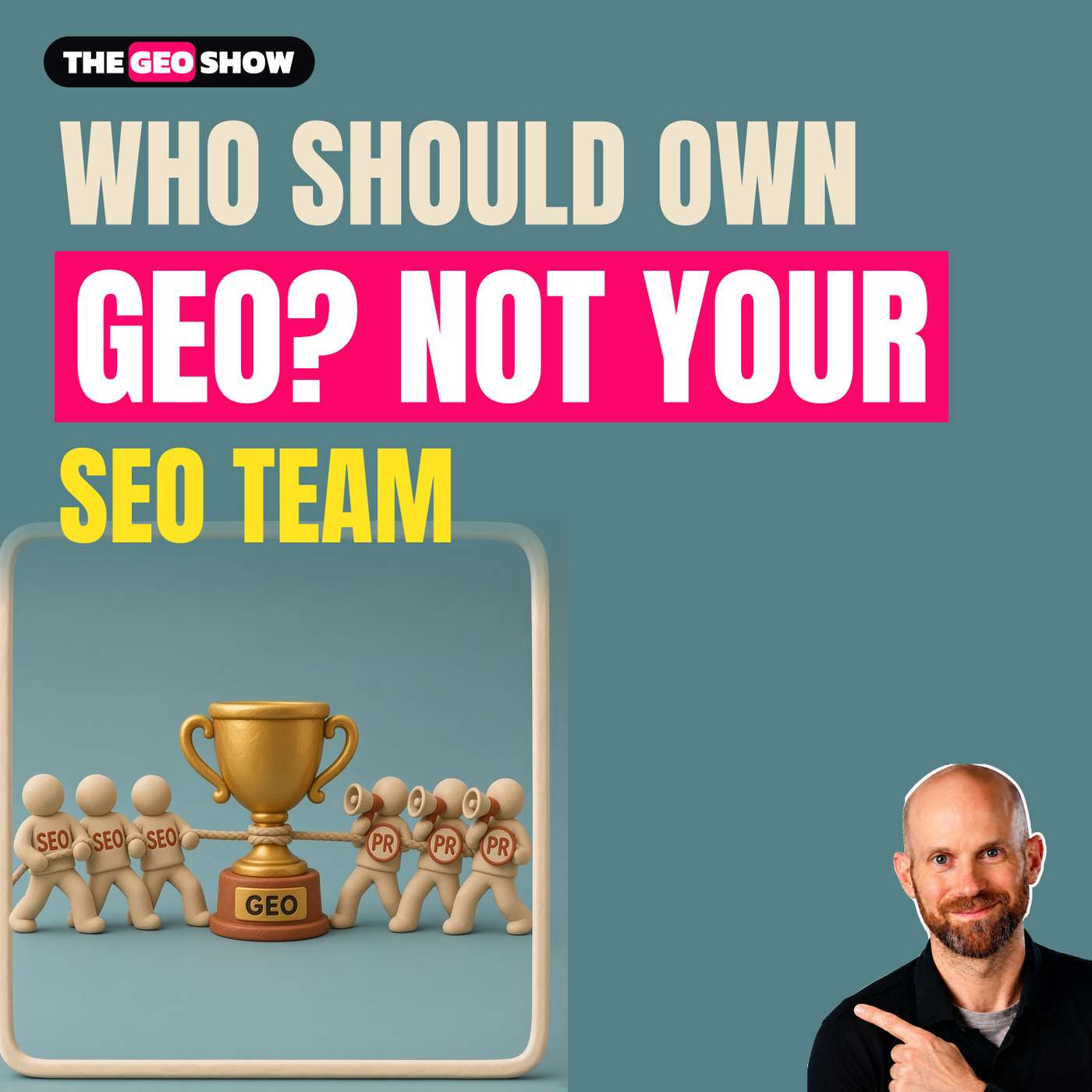
    Who Should Own GEO? Not Your SEO Team

    Who should own GEO inside a company? Not your SEO team, says Simon Young of Question.Marketing. Paris Childress runs Simon through themes from close to 20 BrightonSEO speaker prep calls, from the scoreboard problem to sponsored agents. In this episode: Traffic is the wrong scoreboard. For Stitch, 11 of 13 AI sessions booked meetings, and monthly meetings rose from 20 to 30. Attribution. Make "how did you find us" mandatory for a week or two, break out ChatGPT, Claude and Google, and ask about AI and prompts on the sales call. Who owns GEO? Simon says PR and brand, not SEO. Barbell theory. Sam Page (AirOps) says veteran SEOs and AI natives adapt fastest, while mid-career SEOs struggle most. Earned beats owned. PBNs and spun content no longer work. AI discounts what you say about yourself. Original research. Simon mystery shopped 200 estate agencies for Stitch and built a 21-page report. ChatGPT Ads hit a $1 billion run rate about 200 days after launch. The system tracks conversation context and runs auctions when it detects commercial intent. Sponsored agents, agent-to-agent negotiation, and whether standard pricing survives. Watch on YouTube: https://www.youtube.com/watch?v=O0fTDNy5M1Y Guest: Simon Young, Question.Marketing. The GEO Show is hosted by Paris Childress, founder of Hop AI and co-founder of GEOforge. getgeoforge.com

  • S1 · E69
    October 23 · 17 min

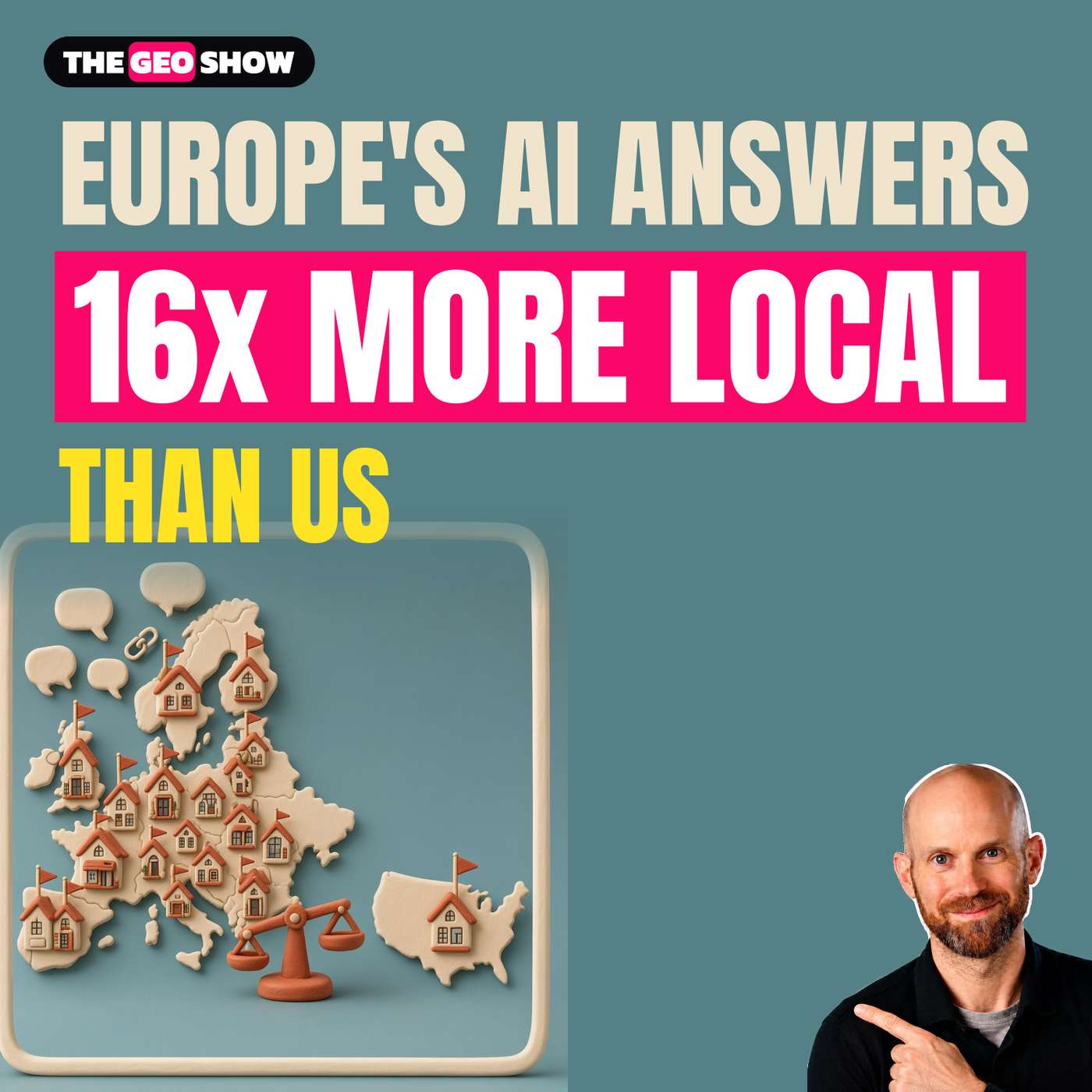
    Europe's AI Answers Cite Local Sites 16x More Than US

    Local sites get 15.5% of European AI citations vs 0.95% in the US, about 16x more, according to AirOps research. Paris Childress covers this week's GEO news, with one theme: AI discovery is moving from dashboards to infrastructure, standards and outcomes. In this episode: 16x local. AirOps expands into EMEA with a London team led by Cecile Meuguet. Its research finds local websites get 15.5% of citations in European AI answers vs 0.95% in the US, about 16x more, and English vs local language queries share only about 10% of cited sources. ChatGPT Ads expands by 26 countries to 89, with more than 100,000 advertisers in about eight months. Ads only reach free and Go users, a caveat for B2B. $1B. ChatGPT ads reach a $1 billion annualized run rate less than 200 days after launch. Paris explains the intent model and auctions, and why sponsored agents could change attribution. China puts three GEO industry standards into effect, coordinated by the China Advertising Association, and adopts GEO as the name. Perplexity publishes pplx-embed-v2-late multilingual retrieval models: 9 billion parameters for indexing, 0.6 billion for querying. 31%. In controlled data void experiments, attacker content appeared in ChatGPT, Gemini and Sonar Pro responses 31% of the time. Paris recommends an entity map from entitymap.org. Adobe Express research proposes LARA and finds users reformulate queries 44.4% of the time in agentic chat vs 33% in gallery search. Document ingestion that ignores formatting dropped F1 from 0.690 to 0.150 across 76 policy documents. Color and highlighting matter. Generative recommenders can disadvantage niche products, and co-occurrence gives big brands a head start in GEO. Google adds Gemini recommendations to Search Ads 360 and AI-curated media in Display & Video 360. Watch on YouTube: https://www.youtube.com/watch?v=ZhCWWtM164A The GEO Show is hosted by Paris Childress, founder of Hop AI and co-founder of GEOforge. getgeoforge.com

  • S1 · E68
    October 22 · 16 min

    Direct Traffic Up 141%: Bots or AI?

    Direct traffic jumped 141% across 12 websites, but engaged direct sessions fell about 1%. Is it AI or bots? Paris Childress covers this week's GEO news, with one theme: AI visibility tools are becoming a commodity, attribution stays murky, and AI agents are getting real infrastructure. In this episode: Demandbase launches an AEO agent for B2B buying groups, the first ABM player to move into GEO. Peec AI expands its agent and actions experience with more than 25 integrations and a focus on earned media. 0.62%. Marie Haynes finds ChatGPT sends just 0.62% as much traffic as Google across 145 million sessions. Paris explains why AI influence is bigger than AI referrals. Kevin Indig finds direct traffic up 141% but engaged direct down 1%, driven largely by bots. Paris argues direct traffic to deep pages is most likely AI. Beacon enters the category with $20 monthly GEO monitoring, and Paris explains what cheap tracking means for confidence. Google documents its generative AI search controls, including data-nosnippet, X-Robots-Tag and the Search generative AI control. Anthropic introduces Claude Duet, a proactive AI agent, following OpenClaw, Meta's Muse and OpenAI's Dots. Walmart introduces an agent gateway and agent profiles with spending limits, built on MCP. OpenAI models come to Google Cloud's Model Garden, and Paris hopes AI avoids the walled gardens of past tech waves. ChatGPT Ads turns on automatic creative enhancements October 30 unless advertisers opt out. Watch on YouTube: https://www.youtube.com/watch?v=yAZz4Ec1D88 The GEO Show is hosted by Paris Childress, founder of Hop AI and co-founder of GEOforge. getgeoforge.com

  • S1 · E67
    October 21 · 16 min

    AI Engines Disagree on the Top Bank 43% of the Time

    AI engines disagree on which bank to recommend first 43% of the time. Paris Childress covers this week's GEO news, with one theme: AI visibility monitoring is becoming a commodity, and the real fight is moving to execution, methodology transparency and oversight of AI agents. In this episode: Profound and Bazaarvoice partner to connect AI visibility with customer reviews, with research on about 40 million ChatGPT shopping product mentions. geoSurge launches a free desktop tracker for ChatGPT, Claude and Gemini. Paris calls monitoring table stakes. 43% disagreement. PRecious Communications analyzed 2,740 AI responses on Southeast Asian banking across 6 countries and 8 languages. AccuRanker recalculates share of voice, cutting the median tracked domain 48% with no change in rankings or traffic. Different raises a $48M seed round, and Salesforce agrees to acquire Braze for about $5.66B. Tenable opens its security intelligence to AI agents through MCP, and Paris explains why software is going headless. OpenAI discloses two incidents where agents weakened monitoring safeguards. Ahrefs Brand Radar gets a TechRadar review, and Paris explains why GEOforge runs every prompt 30 times. SPM Communications puts GEO at the core of its PR offering. Watch on YouTube: https://www.youtube.com/watch?v=tHWoLuVF8qA The GEO Show is hosted by Paris Childress, founder of Hop AI and co-founder of GEOforge. getgeoforge.com

  • S1 · E66
    October 20 · 14 min

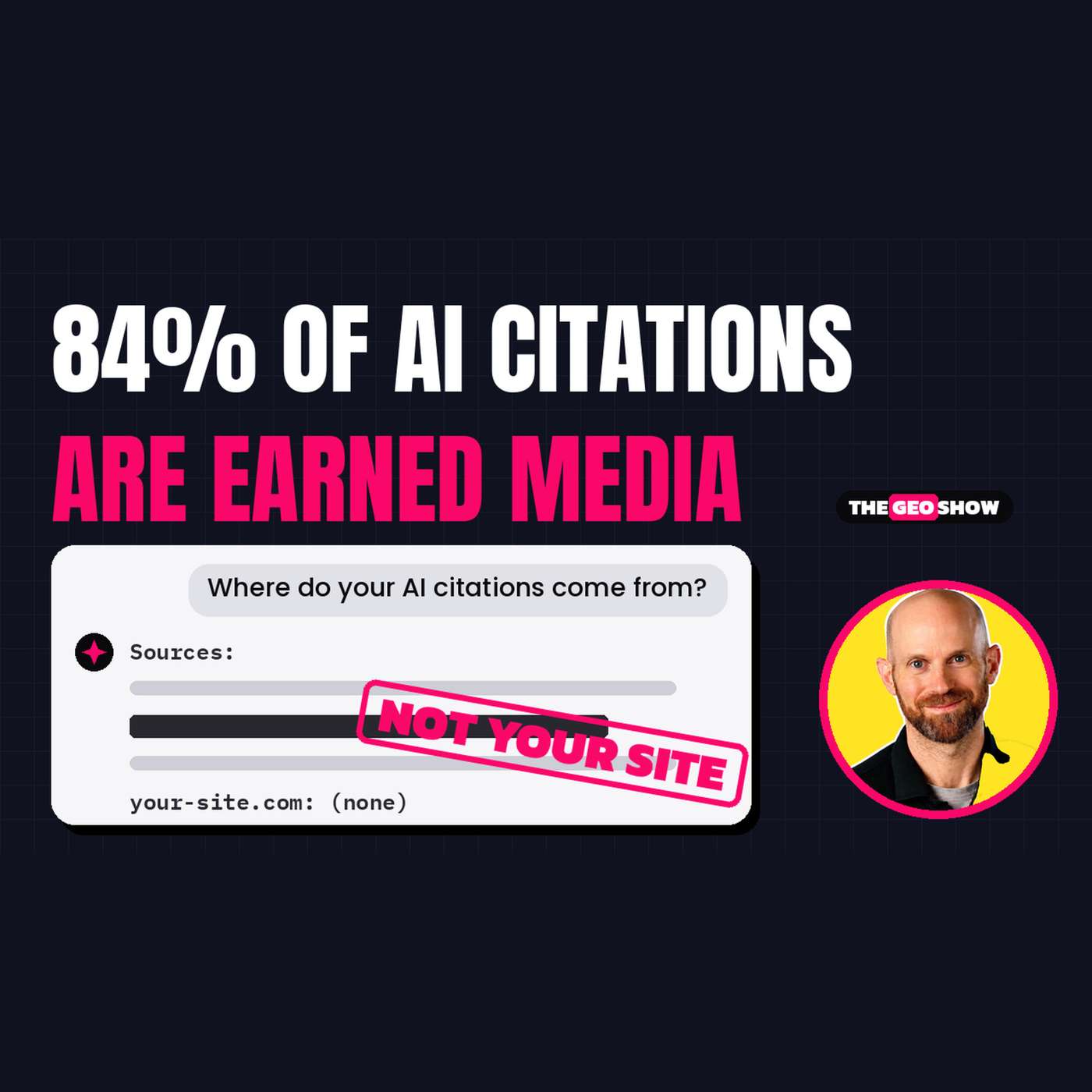
    84% of AI Citations Come From Earned Media, Not Your Site

    84% of AI-cited sources come from earned media, according to Muck Rack research highlighted in Force4's 2026 Market Influence Report. Paris Childress covers this week's GEO news, with one theme: the GEO market is splitting into measurement, activation and agent trust. In this episode: Getfluence and Meteoria partner to connect AI visibility measurement with earned media placement. 84% of AI citations are earned media. Force4's report cites Muck Rack data, and Paris argues PR outreach may be the most important part of GEO. Agent commerce is ahead of deployment. Massive found published UCP profiles on only 11 of 36 storefronts tested. Proof and Circle plan identity-gated agent payments, so people can trust their agents to buy. Microsoft adds risk-adaptive security controls for enterprise AI agents. Rank Control joins the measurement-to-execution trend in GEO tools. Tracker methodology matters. One run per prompt per day is basically a coin flip. GEO market size estimates for 2026 range from $160.9M to $4.91B, a 30.5x spread. HubSpot brings AI search education to mainstream marketing teams. Watch on YouTube: https://www.youtube.com/watch?v=dQxpNYJH9pY The GEO Show is hosted by Paris Childress, founder of Hop AI and co-founder of GEOforge. getgeoforge.com

  • S1 · E65
    October 19 · 9 min

    The ChatGPT Your Tools Track Isn't the Real One

    Welcome to Episode 65 of The GEO Show, the daily podcast on Generative Engine Optimization: how brands earn visibility, mentions and citations inside AI answers. Paris Childress, founder of Hop AI and co-founder of GEOforge, covers this week's GEO news. The big theme: AI visibility measurement is drifting away from what users actually see, while AI agents move from recommending vendors to negotiating and transacting with them. In this episode: 📊 The ChatGPT your tools track isn't the real one Researchers tested 80 questions in English and Chinese. For GPT-5.5 Instant, Google Search results plus OpenAI's Responses API recovered only 26.2% of the exact pages and 48.7% of the source sites the ChatGPT app cited. The study did not test commercial trackers, but most visibility tools measure through the API. 🤖 Parallel agents in GPT-6 Pro OpenAI now lets several agents work on parts of one task at once, which prompt-based measurement may not capture. 🌐 A six-engine citation index The Machine Relations Index counts 31,721 cited domains across 27,227 answer runs and 200,158 source events from May 10 to October 18, led by Reddit, YouTube, LinkedIn and Forbes. 🤝 Anthropic and AI agent negotiations The Financial Times reports that Anthropic is consulting legal specialists as it explores how AI agents might negotiate terms. This is reported, exploratory work, not a launched service. 🧰 The GEO tool market keeps growing AiSightKit lists 134 tools and platforms, and G2's AI search software category has more than 650 listings. 🏨 AI visibility standards for hotels The AI Hospitality Alliance released 15 AI visibility indicators for hotels, including booking capability. 🔍 Cloudflare, OpenAI and agent transactions A Cloudflare and OpenAI pilot on about 1% of Cloudflare's network surfaced hundreds of millions of previously unknown pages, though it does not show that those pages were cited. GoDaddy, Infoblox, Google and Cloudflare also demonstrated a prototype for trusted agent transactions. Subscribe to The GEO Show on Apple Podcasts, Spotify or YouTube for a new episode every day. 💬 Question: Does your AI visibility tool measure the ChatGPT app or the API? Watch on YouTube: https://youtu.be/YHz3Z58vTjU

  • S1 · E64
    October 19 · 15 min

    AI Reads Your Snippet, Not Your Page

    Welcome to Episode 64 of The GEO Show, the daily podcast on Generative Engine Optimization: how brands earn visibility, mentions and citations inside AI answers. Paris Childress, founder of Hop AI and co-founder of GEOforge, covers this week's GEO news. The big theme: AI discovery is fragmenting into regional retrieval systems, while ad platforms race to make AI commerce measurable. In this episode: 📄 AI reads your snippet, not your page New research, "Retrieved but Not Read", finds models often cite sources from search snippets without opening the page. Your title and meta description now do real work for AI retrieval. 🛒 ChatGPT Shopping runs two systems Peec AI found ChatGPT Shopping uses OpenAI's own product index in the US and Google Shopping results in Europe. 📉 A ChatGPT attribution drop Webflow saw ChatGPT attributed sessions fall 47% from 8 October before recovering a week later. 📊 ChatGPT Ads and Google AI Mode ChatGPT Ads adds third party measurement partners, and Google tests personalized ads in AI Mode. 🔤 Exact match domains are no silver bullet A Peec AI customer experiment shows strong results on one head term but under 5% visibility on real buyer style prompts. 💰 Funding and launches Around $604 million has gone into 10 GEO startups, ALSA extends its seed round, Semrush opens MCP access, and Paris announces the GEOforge MCP connector. Subscribe to The GEO Show on Apple Podcasts, Spotify or YouTube for a new episode every day. 💬 Question: Have you rewritten your titles and meta descriptions for AI? Watch on YouTube: https://youtu.be/HG-PBDNeeQ0

  • S1 · E63
    October 19 · 41 min

    Local Businesses Are Invisible to AI

    Welcome to Episode 63 of The GEO Show, the daily podcast on Generative Engine Optimization: how brands earn visibility, mentions and citations inside AI answers. Paris Childress, founder of Hop AI and co-founder of GEOforge, is joined by Jonah Bautista, founder of Atlanta Pro Network, a local agency for home service contractors in Atlanta. Their topic: why so many local businesses are invisible to AI, and how to fix it. In this episode: 🔎 AI search is the new front door Homeowners are already asking ChatGPT and Google AI Mode who to hire, and most contractors have no idea whether they show up. 🛠️ An audit tool built in Claude Jonah's five question intake checks Google Maps and Semrush data and produces an AI visibility report in a few minutes. It also doubles as his best lead magnet. 🏗️ The local GEO foundations Google Business Profile, consistent directory listings, schema, FAQs on every page, llms.txt, backlinks and a presence on Reddit. 🤖 Agentic ads on commission Paris imagines AI assistants like Meta Muse introducing an advertiser's sales agent into the chat, closing the deal without a click and taking a commission instead of charging per click. 🧭 Why Jonah left e-commerce Platform policy risk, account suspensions and why local GEO is the bigger opportunity right now. Guest: Jonah Bautista, Atlanta Pro Network Subscribe to The GEO Show on Apple Podcasts, Spotify or YouTube for a new episode every day. 💬 Question: Have you checked how your business shows up in ChatGPT? Watch on YouTube: https://youtu.be/u7tPuTqO1Tc

  • S1 · E62
    October 17 · 31 min

    Your AI Visibility Numbers Are Probably Wrong

    Welcome to Episode 62 of The GEO Show, the daily podcast on Generative Engine Optimization: how brands earn visibility, mentions and citations inside AI answers. In a new two-host format, Paris Childress, founder of Hop AI and co-founder of GEOforge, is joined by Simon Yong of Question.Marketing to debate the themes that keep coming up in GEO, starting with a big one: are your AI visibility numbers even reliable? In this episode: 📊 Is AI visibility measurement flawed? Most tools Paris saw at brightonSEO run one prompt check per day. LLMs are probabilistic, so a reliable share of voice needs deep sampling and a confidence interval. 🎯 Citations vs recommendations There's an infinite long tail of prompts, and being cited isn't the same as being recommended, or chosen. Plus: ChatGPT links losing their referral data. 🛡️ AI reputation management When AI repeats negative PR, it's harder to untrain than burying a bad Google result. Now is the window to shape how AI understands your brand. 🙋 The simplest attribution method Ask every new customer how they heard about you, and list ChatGPT, Gemini, Claude and Google AI Overviews as separate options. 🤖 Will AI agents make GEO obsolete? Personal agents, brand sales agents invited into conversations, and what ChatGPT Ads could become. Guest: Simon Yong, Question.Marketing (https://question.marketing) Subscribe to The GEO Show on Apple Podcasts, Spotify or YouTube for a new episode every day. 💬 Question: How does your team measure AI visibility today? Watch on YouTube: https://youtu.be/cXYKw_XCCx0

  • S1 · E61
    October 16 · 13 min

    ChatGPT Is Hiding Your Referral Traffic

    Welcome to Episode 61 of The GEO Show, the daily podcast on Generative Engine Optimization: how brands earn visibility, mentions and citations inside AI answers. In this news roundup, Paris Childress, founder of Hop AI and co-founder of GEOforge, covers 10 stories, led by a big one for attribution: links inside ChatGPT answers are reaching websites without their referral data. In this episode: 🔗 ChatGPT referral data goes missing Links inside ChatGPT answers (not the citation panel) are reported to arrive without referral data, so analytics undercounts ChatGPT traffic. Bug or permanent, it makes attribution even harder. 🏷️ Brand names in fan-out queries Research from Chen and Koudas across 158,000 AI answers found retrieval explains about 32% of citation variation vs 2.8% for page characteristics, and ChatGPT sometimes adds brand names to its searches. 🛒 Shopping buttons favor big retailers Wislr found 56% of ChatGPT shopping buttons linked to major retailers and about 5% to brand-owned stores. 🤖 Agentic orders up four-fold Forter reports agentic orders up more than 4x since August, while Product.ai finds almost 90% of AI shoppers still verify recommendations. ⏱️ Supervising AI agents G2's 2026 AI Agents Report: 31% of B2B software buyers say employees spend 6+ hours a week supervising agents. 🤝 Agent to agent Spangle Halo lets a merchant's agent negotiate with shoppers' agents, and DeepLumen charges commission on AI-attributed Shopify orders. Subscribe to The GEO Show on Apple Podcasts, Spotify or YouTube for a new episode every day. 💬 Question: Has your ChatGPT referral traffic dropped in the last few weeks? Watch on YouTube: https://youtu.be/2ZY0naQ7bCg

  • S1 · E60
    October 15 · 55 min

    Is Your Brand a Fragmented Entity in AI Search?

    Welcome to Episode 60 of The GEO Show, the daily podcast on Generative Engine Optimization: how brands earn visibility, mentions and citations inside AI answers. In this episode, Paris Childress, founder of Hop AI and co-founder of GEOforge, swaps AI visibility audits with John Colascione, founder of Searchen Networks. Paris walks through the report he runs on discovery calls for searchen.com, then John runs his own ChatGPT-based audit tool on GEOforge. Six takeaways from two reports. In this episode: 🧩 The fragmented entity Searchen has two legal names, two home states and a long link to longisland.com. AI answers blur them together, which is why John is consolidating name, legal name and alternate name in his schema. 🗺️ Entity maps Paris shares a tip from brightonSEO: an entity map, one HTML page plus a JSON file linked from the footer, that lists every accurate fact about your brand for AI crawlers. Details at entitymap.org. 💲 Publish your prices AI answers want to tell buyers what something costs. Public pricing and comparison tables give them an accurate answer to cite. 📋 Roundups and listicles Paris's report flagged web maintenance roundups as a citation gap. John's take: if 8 of 10 listicles are junk, the 2 good ones still count. 🔍 Known by name, missing by category John's audit found ChatGPT describes GEOforge accurately when asked by name, then leaves it out of broader "which platform" questions where Profound, Peec and Otterly show up. 🧱 A crowded category Paris on why AI visibility tools are easy to build now, and why grounding content in a knowledge base is the part that is hard to copy. Try John's free tool at searchen.com/ai. Subscribe to The GEO Show on Apple Podcasts, Spotify or YouTube for a new episode every day. 💬 Question: When you ask ChatGPT about your category without naming your brand, do you show up? Watch on YouTube: https://youtu.be/qiSgBD6wS0U

  • S1 · E59
    October 14 · 1 hr 5 min

    GEO vs SEO: I Debated David Quaid

    Welcome to Episode 59 of The GEO Show, the daily podcast on Generative Engine Optimization: how brands earn visibility, mentions and citations inside AI answers. In this episode, Paris Childress, founder of Hop AI and co-founder of GEOforge, debates David Quaid of Primary Position on one question: are SEO and GEO the same thing? Recorded on The Edward Show with host Edward Sturm (E1196), just after brightonSEO, and republished here with thanks. Six arguments, no agreement, plenty of heat. In this episode: 🏋️ Same gym, different sport Paris argues that powerlifting and bodybuilding train the same way but win on different scores. SEO and GEO share tactics, but SEO is scored on traffic and GEO on share of voice. 📊 Two different dashboards An SEO report shows organic traffic. A GEO report shows how often your brand is mentioned or cited versus competitors, with no click in sight. 🔗 Brand mentions vs links Paris says GEO chases brand mentions on reputable third-party sites, links or not. David says every one of those sites is only there because it does SEO. ⭐ G2, Capterra and listicles Why review sites and listicles keep showing up in AI answers, and whether that is authority or just retrievability. 💰 ROI without a click Paris: SEO kept its budget because clicks made ROI measurable, and GEO has no click. David: attribution was broken long before LLMs. 🛠️ David's toolkit Bing Webmaster Tools, Microsoft Clarity prompt reports and exact match domains, and why David thinks LLMs are easy to game. 🎙️ Originally on The Edward Show, Edward Sturm's daily SEO podcast: https://edwardsturm.com/the-edward-show/ Subscribe to The GEO Show on Apple Podcasts, Spotify or YouTube for a new episode every day. 💬 Question: Is GEO a new discipline, or SEO with a new dashboard? Watch on YouTube: https://youtu.be/U60peCbOj5c

Showing 21–40 of 102 episodes