Skip to content
Artwork for The Common Reader
ArtsBooksSociety & Culture

The Common Reader

Henry Oliver

Literary discussion

www.commonreader.co.uk
Play
  • 22 episodes
  • monthly
  • Avg 1 hr 4 min
  • English
Counted on this page — what you have heard stays on this device, so it is not something the list can be paged by.
  • October 7 · 52 min

    James Marriott and the Death of Civilization

    Obviously, this is mostly about the literacy crisis, whether we understand it properly, whether it is happening in Spain, whether the PISA data supports James’ thesis, and so on. I began by asking James Marriott how things might work out for the best… OLIVER: So the book is about the reading crisis and the risk it poses to liberal democracy. I want you to tell me, what is the most likely optimistic outcome? You might think that the odds of everything going well are very low, but if we do scrape through, what will it look like? MARRIOTT: That’s such a good question, and nobody has ever asked me that question before. Seeking optimism from me is a unique idea. I think the most likely optimistic outcome, as I think so often in history, is stagnation and more of the same, and things don’t change. We also talked about AI as a transmission of liberal democracy, a means of distributing James’ own work, and things like that. At the end, we had some fun about literary critics and Shakespeare which is much more civilized that arguing about the literacy crisis. MARRIOTT: Yes, I’m keen to read The Winter’s Tale, and I’ve got it, actually. It came in my little set. OLIVER: I think you’ll be pleasantly surprised, and then you can read Northrop Frye’s book about it. MARRIOTT: Yes. OLIVER: Which would be James Marriott–coded. MARRIOTT: Yes, good. I am very biased towards things that are James Marriott–coded. The Frye book I had in mind was A Natural Perspective. James is also going to read A.C. Bradley and we might record another podcast about that. Bradley being one of the greats. Transcript HENRY OLIVER: Today I am talking to James Marriott. James is a Times columnist, a Substacker—he writes Cultural Capital—and he has a new book called The New Dark Ages. James, welcome. JAMES MARRIOTT: Thanks very much for having me. The Reading Crisis OLIVER: So the book is about the reading crisis and the risk it poses to liberal democracy. I want you to tell me, what is the most likely optimistic outcome? You might think that the odds of everything going well are very low, but if we do scrape through, what will it look like? MARRIOTT: That’s such a good question, and nobody has ever asked me that question before. Seeking optimism from me is a unique idea. I think the most likely optimistic outcome, as I think so often in history, is stagnation and more of the same, and things don’t change. And I guess I think there are a lot of reasons to be pessimistic. I think societies have a remarkable capacity to go on stagnating or declining slowly and imperceptibly for a very long time, and often much longer than we think. I know that’s pretty tepid optimism. Probably in the general scheme of the sort of takes that I offer, that is quite optimistic. But yes, I always think that stagnation and drifting and can-kicking are underrated forces in history. OLIVER: Are we not going to stagnate at quite a high level? MARRIOTT: Yes. OLIVER: So is the pessimism sort of misplaced, in the sense that even a relatively bad outcome for us would be really quite good by the standards of human history? MARRIOTT: Yes, of course. Although, I mean, the standards of human history are an appallingly low bar. And I think any of us asked to try to eke out an existence in pre-industrial modernity would view that with more horror than a prison sentence or being sent to almost any country in the modern world. To live in a sort of pre-industrial, pre-democratic state would be pretty terrible, so that’s a low bar. That said, I think the main lesson from history is that—and I guess this is one of the points that is in the background of the book—is that we are living extraordinarily anomalous lives. To live in a literate and democratic culture is overwhelmingly not the norm through the entirety of human history. And I think sometimes humans have an extraordinary capacity for complacency, and the thing that comes back to me more and more, the more history I read, is how unusual and how fragile the modern world is. We are not the norm. This is weird. And that’s a cause in some ways for great optimism, and if things do stagnate, they’ll stagnate with living standards that most of our ancestors would have viewed as almost miraculous. But I think an awareness of how anomalous it is to live in a literate and democratic society can be quite, I don’t know, maybe chastening isn’t the word, but salutary perhaps. The Impact of AI OLIVER: Now, AI is bringing a huge amount of writing into the world. Some of it’s slop, but some of it’s going to be quite good, and it’s going to get better. Is there a future in which the overall balance is quite different but is either sufficient to sustain democracy or produce something, you know, better? MARRIOTT: Yes, I thought there’s an interesting point that you made in your piece. I’ve seen Dan Williams make the same argument, that the biases of—I guess is what you’re referring to, that we know the biases of artificial intelligence machines are basically Enlightenment liberal. AI is basically a centrist dad when you quiz it about politics. Yes, I think that’s definitely a cause for optimism. I think that talking to AI through text about politics is probably a minority experience of artificial intelligence. I think most people’s political exposure to AI is much more likely to be image-based and is much more likely to be seeing slop memes on TikTok or Twitter or something like that. And I think if you are using AI to write questions to ask it about policy, you’re probably in a very small minority. If you are seeing, I don’t know, racist AI-generated memes on Twitter or TikTok, you’re probably much closer to what the majority experience of the political implications of AI are. So that would be my take. I don’t discount the fact that AI is often more reliable in its political takes than a lot of newspapers. I think that’s just a minority experience of AI for politics. OLIVER: But the AI is going to be integrated into all sorts of things: in corporate life, in politics directly, in newspapers, and it’s going to be the major transmission mechanism to get the old liberal Enlightenment view from the old world into the new world. So could it be, in a way, a replacement for print culture? MARRIOTT: Good question. OLIVER: Obviously, a very imperfect substitute and very different thing, and the overall balance of good and bad will change significantly. But it might just be the thing that gets print into the future. MARRIOTT: Maybe, but I guess my feeling would be that this move from a literate culture to a visual one has been in train for a long time now. And I think we worry a lot about AI writing, and we worry about university students getting AI to write their essays, and we view this deluge of artificially generated text as a major story of AI. And I guess I would just come back to the previous point, which is that I think a lot of people’s major interactions with AI are probably more likely to be visual than they are to be text-based. And also, anybody trying to monetize AI for commercial purposes will find themselves susceptible to exactly the same commercial impulses that social media is susceptible to, that newspapers are susceptible to. So although AI, if you talk to it as an individual user, may give you a sort of wet centrist dad on the one hand, on the other, “maybe we should be fiscally responsible” sort of answer. I think AI, as utilized by companies seeking to make a profit from it, will probably be drawn into the general direction of discourse that I think is now more than half a century old, which is more tribal, more emotional, more extreme. That would be my view. OLIVER: Okay, so imagine, though, that we create a sort of James Marriott AI, and it takes all of you, all of your writing, all of your ideas, and it makes a little James Marriott avatar. And it puts you on TikTok or wherever it is that people are going to be, and you are part of this visual, video-based world. Is there not a sort of sense in which the playing field can be… This is a public episode. If you would like to discuss this with other subscribers or get access to bonus episodes, visit www.commonreader.co.uk

  • September 2 · 1 hr 28 min

    Philip Hensher: How Can You Kill a Book Like That?

    Philip Hensher and I discussed the history of the novel in Britain from Defoe to Hollinghurst. Philip is remarkably well-read and happy to share his real opinions. He can go from Swift to Fitzgerald on the turn of a pin, isn’t shy about holding his ground, and has some very firm views. People who read novels are protected against becoming violent. Ideas are not important in most novels. Walter Scott isn’t very good. Arnold Bennett is a top 20 novelist. Rachel Cusk has the best chance of being read in 100 years. That sort of thing. Here’s one exchange where we disagreed about what a novel is. HENSHER: Oh, Henry, Henry, how can you kill a book like that? How can you— OLIVER: Look, you can’t have Jane Austen without the Enlightenment, and you can’t have George Eliot without the secularization of Jesus, and you can’t have Tolstoy without all the slightly incredible things that he believed. HENSHER: No, let’s not talk about Tolstoy. OLIVER: No, but the list goes on, right? Henry James even, who is often called a man of no ideas, he’s an incredibly good liberal. He might be the best novelist about the liberal idea that one person should not be allowed to dominate over another, in private conditions rather than just government. These ideas are, in a way, they’re the thing that distinguish those writers. Jane Austen knows how to observe and how to present because she’s thinking about what it means underneath. HENSHER: I don’t know. I don’t know about that. OLIVER: I don’t even think you can have Middlemarch without John Stuart Mill’s political economy, in a way. HENSHER: Yes, that’s probably true. But George Eliot’s an unusual sort of novelist. Jane Austen, I mean, how do we know what did she—what did Jane Austen think about slavery in the boldest and most extreme form? I think we can deduce that she thought that people involved in the slave trade or who came near it, like Mrs. Elton, were not at all the sort of people that she would altogether like to hang out with. I think the same is true of Sir Thomas Bertram, and the weakness of his imagination is somehow tied in with the fact that he has a plantation where he doesn’t really think about the people that it affects. But already we’re into speculation. I don’t know what we can really deduce about Jane Austen’s idea, because she’s such a polyphonic novelist that we don’t find an idea being put forward without being able to find a character who’s saying the exact opposite. And sometimes one side of the argument is eventually dismissed, but not always, I think. I said this at the conference we had a discussion with. I think that when you boil a novel down to its absolute irreducible essentials, I think what you have is not a proposal or a view of society or anything like that. It’s Charles Pooter painting his bath red, or the moment in Ivy Compton-Burnett’s Mother and Son when the son irrevocably falls out with his mother by telling her that he doesn’t want to have sugar in his tea anymore. From the very beginning, novelists have said, “What I’m writing about, I’m writing about nothing, and this is the virtue of what I’m doing. I’m writing about the utter triviality of everyday life.” And that, for me, is the enchantment. OLIVER: Well, some novelists have said that. HENSHER: A lot. OLIVER: Samuel Richardson didn’t say that. Samuel Richardson’s quite an important exception. HENSHER: No, but people said it about Richardson. OLIVER: I don’t think we—yes, but we can’t believe it. HENSHER: People definitely said—no, I think we can. OLIVER: Pamela is a novel of ideas. HENSHER: Well, it’s a novel that contains some ideas. OLIVER: Yes. Transcript HENRY OLIVER: Today I am talking to Philip Hensher. Philip is a British novelist. He’s written books like The Northern Clemency, King of the Badgers, The Emperor Waltz, and now he’s got a new book, A History of the Novel in Britain, and you can see it there. It looks very pretty with Alice in Wonderland on the front. Philip, hello. PHILIP HENSHER: Hello, Henry. Novels Are for Everyone OLIVER: Now, to begin with, tell me about your grandmothers. HENSHER: Oh, okay. Yes, well, I finished the book because—I kept my story out of it, largely. I thought that I should go back to a time when everybody read novels. It wasn’t a specialist interest as it seems to be turning into. And I thought I would talk about my two grandmothers, both of whom left school when they were 14. They worked in very ordinary and hard jobs in factories all their lives, and they were passionate readers of novels. My paternal grandmother loved Dickens. She had a complete set of Dickens, which, I’ve discovered after some research, was issued as an offer by the Daily Express sometime in the 1930s. I’ve still got it, actually. I’m going to go and get a sample volume. It’s terribly cheaply produced. OLIVER: Oh, I’ve got that set. That’s great, yes. HENSHER: Yes. The publisher is otherwise only noted as a printer. The typeface is absolutely tiny. OLIVER: It’s painful. HENSHER: It’s painful to read. But she had it. She loved Dickens. My maternal grandmother, I don’t have any of her books, I’m afraid. I would say that she loved stories of family lives, of people interacting with each other. She loved Catherine Cookson, a now slightly forgotten popular novelist of the 1950s, 1960s, 1970s. But she read an enormous amount. I mean, she must have read one or two novels a week, every week of her life. I think that the thing that has disappeared since my grandmothers’ generation is the idea that everybody can read novels. They speak to everybody. They explore every part of life, potentially. What seems to be happening now, and I greatly regret it, is that it’s passing into the property of expensively educated people, people who have gone to private schools, perhaps, have certainly gone to university. And the sort of reader like my grandmother, who read Bleak House with a lot of pleasure, seems to be disappearing. So that was one of the reasons why I wanted to write the book, to make the case for how wonderfully enjoyable novels are. They’re not a duty, or they shouldn’t be a duty. They should just be founded in pleasure, however complex that pleasure might be. And I wanted to finish the book by citing my two grandmothers, who were such great readers. OLIVER: And as well as inheriting that reading culture from them, you got a lot of that at your school, didn’t you? HENSHER: Yes, I suppose I did. I think that it’s hard for me to say because I was in at the beginning of a sort of curriculum change, where there was an idea that we ought to give the kids things that are relevant or are going to appeal to their social concerns. So, I mean, this is going back to the very early 1980s. My set novel for A-level was The Grapes of Wrath, a classic tale of victimhood, really. Classic approved message. And the thing was, I think what started me off as a passionate reader of novels was a sort of rebellious turn away from that sort of thing. I read Jane Austen off my own bat. I read a lot of Dickens before I left school—things that we weren’t taught at all. And that’s always been the sort of reader that I am, saying, “Oh, we’re not supposed to be reading this,” you know? “It’s not on the curriculum.” Parliament and Thatcher OLIVER: What was it like working in the House of Commons? HENSHER: It was fine. [laughter] It was a very unusual experience. I don’t think it was a job that most people would’ve known existed. When people said to me, “Well, what do you actually do?” I used to say, “Well, you know the guys with wigs who sit in front of the Speaker? They’re my bosses.” And it was a strange, ritualistic experience, and you were physically in the middle of all these political dramas. When I started work, I started work in the House of Commons the beginning of September—this is September 1990. And six weeks later, there was all the drama of Mrs. Thatcher being thrown out, which I saw physically very close up. I didn’t have anything to do with it. You weren’t aware of what really w… This is a public episode. If you would like to discuss this with other subscribers or get access to bonus episodes, visit www.commonreader.co.uk

  • June 3 · 50 min

    Zena Hitz: Gulliver's Travels and the Failures of Human Understanding

    What a lot of fun I had talking to Zena Hitz about Gulliver’s Travels. As well as discussing Swift, slavery, genocide, rationality, Christianity, and science, Zena told me that good philosophy is like a box of cake mix and that a liberal education requires you to be freed of false expertise. I also took Zena on a detour to discuss Iris Murdoch, the Catherine Project, and modern philosophy. TRANSCRIPT HENRY OLIVER: Today I am talking to Zena Hitz. Zena is a tutor at St. John’s College. She is a philosopher, the author of Lost in Thought. She runs the Catherine Project. She’s famous on Twitter. We don’t know how she does it all. Zena, welcome. ZENA HITZ: Thank you, Henry. It’s great to be here. OLIVER: And we’re talking about Gulliver’s Travels because it is 300 years since it was published, and it’s a book that you love. HITZ: A book that I’ve loved for a long time. First Encounter with Gulliver’s Travels OLIVER: So tell me, when did you first read it? HITZ: Well, it was an important moment for me. I was in high school, and I was admitted to a scholarship summer program which offered college courses at different campuses. There were some normal-looking college courses at normal-looking colleges. And then there was this course at St. John’s called Science as Literature, Literature as Science. [laughs] It had this description that was just unbelievable. And I thought to myself, “This is the one, obviously the one to go to.” So I went, and we read books that no one in their right mind would assign to high school students now, and maybe not then. The fragments of Parmenides, Plato’s Timaeus, selections from Aristotle’s Physics, Gulliver’s Travels. After reading a number of—preface to Ptolemy’s Almagest, geocentric astronomy. And we read Gulliver’s Travels after reading selections from Hooke’s Micrographia, so the inventor of the microscope, and Galileo’s Starry Messenger, which is one of the great first uses of the telescope to discover the nature of the moon and the satellites of Jupiter. So then we read Gulliver’s Travels. We also read Emma and Flannery O’Connor and various other things. And one of the faculty who was running it said at one point, “Well, we thought we’d throw a bunch of things together and see what you could do, what you could make of it. We didn’t actually have an idea of how these all fit together,” which I think was probably true. At any rate, I think I came to Gulliver’s Travels thinking about these scientists who were looking at very large things and very small things, and thinking in general about the follies of human perception, whether that was shown in literature or philosophy or what have you, the ways in which human perception and knowledge don’t work very well. And I think Swift is still one of the best people to—Gulliver’s Travels is still one of the best books about that because it’s in the mode of a travel diary, an eyewitness account. Gulliver is trained as a surgeon, by his own account. He at one point says he was a bit of a projector in his younger days, someone who undertook scientific projects. And he’s a terrible observer, the worst imaginable observer, and Swift so brilliantly lets us see through his eyes, lets us see all the things he doesn’t see. And I think it’s not just about seeing and knowing. It has a very profound, I think, moral and political set of commitments. So it’s a very humane book. It’s social criticism, but from a point of view of a very deep humanity. So I’ve always loved the book for these reasons since then. I came back to it more recently because it is part of the curriculum at St. John’s. So when I came back to teach there, I began to reread it. The other experience I had was that I wrote a long essay on it when I was an undergraduate. So those are my—I’m not any kind of expert. My knowledge of the historical context of the book is limited. It’s not zero, but it’s limited. But I have always loved it as an account of human understanding and its failures and the way that might impact how we live and how happy we can be. The Houyhnhnm Problem OLIVER: Have you changed how you think about it as you’ve taught it? HITZ: I have not really changed the way I think about it. It gets more—like all of these books, the more you read them, the more comes out of them, the more details come up. Hilarious. The more jokes you get, the more . . . I think the one more recent insight I had was, I hadn’t understood the full horror of the Houyhnhnms in the last book until relatively recently. I think that took me some time to really take on. It’s one of the cases where Gulliver’s misperceptions are a bit harder to see, and I think many readers just assume that Swift is endorsing the praise of the Houyhnhnms in some sense or other. OLIVER: There are some very serious critics in the past who have called them Swift’s ideal beings. Which at this point in history seems unthinkable, but it has been a belief among serious readers. HITZ: Yes, yes. And also common among students. Yes, it’s absolutely one of the wrongest opinions you could have about anything, I think. OLIVER: Why does Swift allow us to make that mistake? Are we bad readers out of the context, or has he made too good a job of his diversions and concealments and ironies? HITZ: That’s a great question, and I’ll just take a stab at it. I think that he has hit on a mode of misperception which is very deep to us, and it’s something that we’re much more guilty of. We could imagine that if we were in a place where everyone was small or everyone was large, we might make mistakes like Gulliver makes. But we all live, I think, in communities that are a bit like the Houyhnhnms. And so we are all very subject to these kinds of deceptions, and I think that’s how he gets us. That’s not to really excuse the bad readings because, you know, Gulliver does leave the land of the Houyhnhnms with a boat made out of human skin, which should—I think that moment should make you realize, if you haven’t yet, that something is very seriously wrong with Gulliver. Gulliver has been kind of destroyed as a person by his travels, and especially by this last trip. But if you pass over that little detail, maybe you think, “Oh, wow, he found some very simple beings.” OLIVER: Well, there’s also the great council where they debate the genocide of the Yahoos. HITZ: [laughs] Yes. OLIVER: And it directly contradicts several things Gulliver has come to believe about the Houyhnhnms, about the Yahoos, and about himself. And he’s completely unaware of these contradictions and so in awe of the Houyhnhnms that he doesn’t quite understand, I think, that he’s accounting a genocide. HITZ: That’s right. That’s right. OLIVER: Even though he uses a phrase from Genesis that’s very unmistakable. It’s a sort of remarkable moment of—particularly to us, having had the 20th century. I think that’s why Swift came back into favor in a way, because people used to say, Swift’s unbearable view of human nature . . . This is a great bit in Boswell’s Life of Johnson where, when they’re traveling through Scotland, they’re with a lady, and she says to Johnson, “Is any man naturally good?” And Johnson says, “No, no more than a wolf.” And Boswell says, “Well, sir, what about ladies?” And Johnson says, “God, no, absolutely not.” And this woman says, “Oh my God, this is worse than Swift,” utterly horrific view of human nature. But of course, we can actually say, did he go far enough? [laughter] I mean, Swift clearly understands something very real and deep. The council of genocide is horrifyingly familiar to us. And I think that’s much to Swift’s credit that he can see that, and to show that Gulliver would blind himself to it. And people still blind themselves to it, right? HITZ: That’s right. And I wonder—you would know more about this than me because it is a bit of a historical question, but my understanding is that quite a lot of the savagery, the worst parts of rule over men that we see in Gulliver’s Travels are pictures of Ireland in the 17th, 18th centuries. … This is a public episode. If you would like to discuss this with other subscribers or get access to bonus episodes, visit www.commonreader.co.uk
  • May 6 · 1 hr 14 min

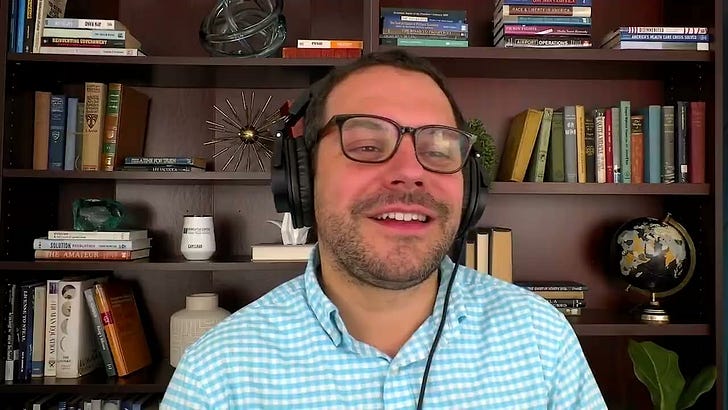
    Oliver Traldi: Jane Austen and the Defence of Virtue

    My colleague Oliver Traldi recently published an essay called ‘Jane Austen’s Virtuous Liberalism’. It’s a very nice discussion of the ways in which Austen understand the challenges of character formation. Virtue, as Austen sees it, faces two tough challenges. First, people whose characters are not yet formed must see how to be virtuous rather than vicious. Then, the virtuous must somehow find a way to succeed in their struggles against the vicious without adopting vicious means. In this episode, Oliver and I discussed Austen’s ideas of virtue, what that has to do with liberalism, the relationship between philosophy and literature more broadly, as well as poetry and ideas about the Great Books. We also talked about the Keira Knightly Pride and Prejudice. Yes, we both liked it. Here is why Oliver thinks Jane Austen is so popular among philosophers. TRALDI: And so I do think that even though she’s not making arguments, she’s not laying out philosophical theories, there is a level of precision in her thinking about virtue, which I do think is something that it took me a little aback. And I think it’s part of why—one person who quote-tweeted my article was Daniel Kodsi, who’s a friend of our colleague John Maier and his coauthor often. And he runs this magazine called The Philosophers’ Magazine, which I had written before. And Daniel quote-tweeted my article with something like, “Add Oliver to the list of all the philosophers who love Austen.” OLIVER: And it’s a long list. TRALDI: And I think it’s a long list. And I do think this precision is part of it that she does, that it is—again, it’s not like a philosophy journal article, but it is an intellectual sophistication that is often not present in novelists that we really appreciate. And here is an extract about Austen, Smith, and the wonderfully fertile period at the end of the eighteen century. TRALDI: But yes, I think it’s obvious—without knowing the background, I’m sure there are scholarly questions about, how much Smith did Austen read? And they’re both 250th—a lot was happening in 1775 and 1776. OLIVER: Those were great years. Those were the good old days. TRALDI: They were great years. In the great books syllabus, you get to the end of the 1700s and suddenly there’s this—you have Smith, you have Kant, you have the American Revolution, you have the French Revolution, you have Burke. Rousseau is right before, Montesquieu is right before. I mean, it was a real— OLIVER: It’s a great time. TRALDI: It was a great time. A lot was being done. And obviously, you know, I love the 1800s. I love the Romantics. But you could teach a whole great books course from 1750 to 1800, probably. OLIVER: You’ve also got all the dictionaries and all that kind of work going on as well. It’s a very, very fertile—explorations. TRALDI: Yes, yes. There’s all sorts of—yes, it was an amazing time. OLIVER: So did you, having read these two, Austen and Smith, close together— TRALDI: Yes, and I should say that my reading of Austen was much more careful than my reading of Smith. OLIVER: Sure, but you wrote this before you read Smith. TRALDI: Yes, absolutely. OLIVER: Or at least you fully conceived it. Do you see a lot of Smith in Austen? TRALDI: “A lot” might be— This was my favourite bit. TRALDI: Yes. But this is one of the great—I know we talked about this, but it’s one of the great—you see this in Smith, you see this in Austen—commerce has its own virtues, and they are very traditional virtues. You have to be trustworthy. You have to be pleasant. You can’t really be wholly self-interested in every moment because people have to be willing to deal with you given your—I mean, think about Yelp reviews or even just word of mouth. “Oh, that person screwed me over.” OLIVER: There’s a discussion in one of Hayek’s papers, which is—it’s a very Smithian point he makes about, the nature of the knowledge problem means that it’s not so much that I’m trying to get information about the thing you’re trying to sell me, but I’m really trying to get information about you and whether you are someone I should be buying from. Which is exactly the project that the novelists and Smith—there’s a sort of period between Smith and the early novelists, running through Austen to George Eliot, when they’re all working on that problem together. TRALDI: Yes. I do think in Austen, it’s often—the real puzzle is, how do you make out somebody else’s character? OLIVER: Exactly. TRALDI: This is a phrase that Lizzy Bennet does use with regard to Darcy. And how do we actually figure out who the trustworthy and untrustworthy people are? OLIVER: And if you’re too philosophical about that, in the sort of analytic sense, I think you can end up not paying enough attention to the particulars of that question. TRALDI: Yes. OLIVER: Because when you actually try and do it, it’s really, really hard. TRALDI: Yes. And I think this is the sort of—reading Austen, you get a sense of—and there are very few philosophy papers on things like this. Reading Austen, you get a sense of, what sorts of details in a normal life are the ones that I can extract information from to make out somebody else’s character? Oliver is an analytical, political philosopher. You can find out more about his work here. Here he is on Twitter. His Substack is orting. You can watch the episode on YouTube here. Transcript HENRY OLIVER: Today I am talking to Oliver Traldi. Oliver is an assistant professor of philosophy at the University of Toledo in Ohio. He is my colleague on the Emerging Scholars Program at the Mercatus Center, and he’s written a book about political beliefs as well as many other articles for magazines, online. He’s got a Substack. He’s maybe the most prominent political and epistemological young philosopher of his generation. [laughter] But most importantly for us, he is interested in Jane Austen and the idea of virtue. Oliver, welcome. OLIVER TRALDI: Thank you so much for having me. Reading Austen as a Philosopher OLIVER: Let’s just start—before we get to this article you’ve written, tell me about being a philosopher but reading Jane Austen, because she’s often read and commented on by people who are not philosophers or who are only philosophers by acquaintance or whatever. TRALDI: Right. OLIVER: Is it different reading as a philosopher, do you think? TRALDI: I think yes and no. One thing as a philosopher, there are—contemporary philosophy, we have very exacting standards of rigor and clarity. And when we look for a theory, we want something that’s been improved by hundreds of people and thousands of journal articles. And so, if you were to simply extract a theory of virtue from a novel and say, “Does this—is this the end-all, be-all of moral thinking?” obviously you’re going to be disappointed. So I think as a philosopher, you have to look for other types of things, other types of sensitivities rather than logical sensitivity. You have to say, how sensitive is the author to the different types of situations where people’s virtue can be exhibited or challenged? Or how sensitive is the author to the different types of pressures that a character’s convictions can be put under, or the different sorts of compromises that they might have to make, or the different sorts of people who might not be virtuous who they might have to interact with and sort of, you know, contract with or avoid? And what are going to be the impacts of different kinds of choices in those situations? So the novelists, I think, tend—if they do it well, a novelist who’s interested in morality will understand living morally probably better than a philosopher, while maybe not understanding, say, arguments about whether morality supervenes on reality or vice versa, or what grounds morality, or different theories of meta-ethics or whatever. OLIVER: I mean, there are obviously some novelists who do have a better appreciation of those things than others, we should say. TRALDI: Yes, I think that’s absolutely true. And as I wrote in my article, I do think Austen in particular had an appreciation fo… This is a public episode. If you would like to discuss this with other subscribers or get access to bonus episodes, visit www.commonreader.co.uk
  • April 1 · 1 hr 20 min

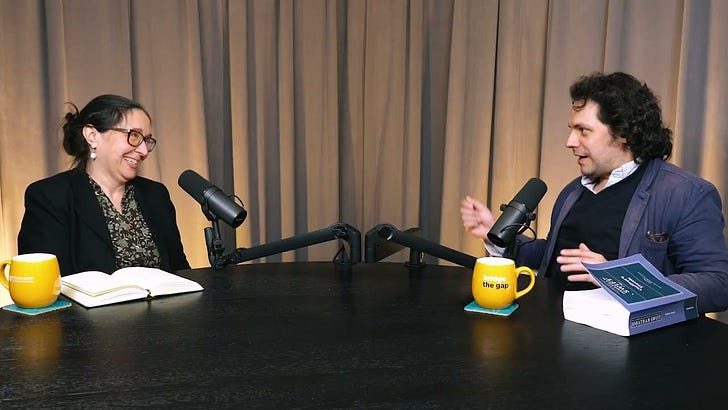
    Laura Thompson on Agatha Christie: Shakespeare, Murder, and the Art of Simplicity

    What a delight to talk to laura thompson about Agatha Christie. Above all, this episode was fun. Laura really does know more than anyone about Agatha and we covered a lot. What did Agatha Christie read? What did she love about Shakespeare? Was she pro-hanging? Why so much more Poirot than Marple? Why was she so productive during the war? We also talked Wagner, modern art, the other Golden Age writers, nursery rhymes, TV adaptations, poshness, nostalgia, Mary Westmacott, and plenty more. Transcript HENRY OLIVER: Today I am talking to the very splendid Laura Thompson. All of you will know Laura’s Substack. She has also written books about the Mitfords, heiresses, Lord Lucan, many other subjects, and most importantly today, Agatha Christie, who died 50 years ago. And there’s a new book coming from Laura about Agatha Christie’s 1926 disappearance. Laura, welcome. LAURA THOMPSON: So lovely to be here, Henry. I’m such a fan of your Substack, as you know. OLIVER: Well, same. Same. This is a mutual admiration call. THOMPSON: Well, thank you. Well, that’s what we like. Christie’s Favorite Writers OLIVER: Now tell me, what did Agatha Christie like to read? THOMPSON: Oh, a lot the same as us. I discovered she was a huge fan of Elizabeth Bowen, as we are. And Nancy Mitford, Muriel Spark. But her big love really was Dickens. She absolutely adored Dickens. I mean, she grew up in a house full of books, you know, and she wrote a screenplay of Bleak House for which she was handsomely paid. And it was never—I know, don’t you long to know what that was like? Can you imagine— OLIVER: We’ve lost it? We don’t have the typescript? THOMPSON: I’ve never seen it. I mean, maybe—I don’t know whether it exists somewhere. But I just wonder how she tackled it, what she did. But yes, so that happened. And of course, Shakespeare, as we know from her books, which are full of subliminal and—I mean, you kind of notice them, but you don’t have to. OLIVER: Yes. There’s Shakespeare in every book? THOMPSON: No, but it’s there, particularly Macbeth, which I suppose figures. OLIVER: Yeah. THOMPSON: Like The Pale Horse is completely Macbeth themed. And when I was a kid reading them, I think she really—Tennyson she uses a lot—she affected my reading in a good way. OLIVER: She sent you back to Shakespeare and the poets? THOMPSON: Well, sent me to them as a kid, probably. And also, there’s a lot of Bible in her books, as I’m sure you’ve noticed. OLIVER: Yes. Yes. THOMPSON: Very easy facility with quoting the Bible. Christie and Shakespeare OLIVER: Now, what did she learn from Shakespeare? Because she clearly knows the plays in detail. She sees them a lot. She reads them. She and he are, I think, quite good plotters. THOMPSON: Is she even better than he is? OLIVER: Well, let’s not get into that. But there is a sort of, in a funny way, a kind of affinity between them as writers. THOMPSON: That’s so interesting. OLIVER: What do you think she learned from him? THOMPSON: Tell me how you—how you see that. OLIVER: Well, do you know that Margaret Rutherford adaptation, which probably you don’t like and I do— THOMPSON: Go on. OLIVER: It’s called Murder Most Foul, isn’t it? THOMPSON: Yes. OLIVER: And there’s something about the way that they can both walk the line between the sort of dark and deadly and the histrionic. Margaret Rutherford can’t walk that line, but Agatha Christie can, right? THOMPSON: That’s really interesting. OLIVER: And Miss Marple could come onstage in a couple of the plays. She’s not so far off from being a Queen Margaret or some—in her angry moments maybe, do you think? THOMPSON: More rational, maybe. OLIVER: Much more rational. THOMPSON: Not so mad. Well, she’s not mad, Margaret, is she? But she’s upset. OLIVER: She starts off as a much sort of nastier character—Murder at the Vicarage, right? THOMPSON: Yes, she does. She was more acidic and then gradually— OLIVER: Waspish. THOMPSON: Waspish, and sort of mellowed. I see what you mean. And almost in the way that she calls herself—although that’s obviously not Shakespeare—calls herself Nemesis. OLIVER: And the sense of atmosphere. THOMPSON: Yes, and the way they’re structured. That’s not necessarily just true of Shakespeare, but there is this sort of act three entanglement and this beautiful act five resolution that goes on with a soliloquy, I suppose. OLIVER: And some people think they both get confused in act four, but that’s obviously not true, that this is the real mess of the plot. I think she might have learned quite a lot from Shakespeare, right? THOMPSON: That’s really interesting. But, you know, the way she writes about Shakespeare in her letters to her second husband, Max, because when she was living in London during the war and almost at her most productive—I mean, her productivity levels are insane. And hitting every ball for six, really, you know: Towards Zero, Five Little Pigs, a couple of Westmacotts, which I’m sure we’ll talk about. But she spent a lot of time going on her own to see Shakespeare. She’s very—I hope I’m right in saying this—she’s very sort of Ernest Jones [CB1] in her approach. She doesn’t regard them so much as the products of words on a page; she regards them as rounded characters. Why were Goneril and Regan the way they were? What’s wrong with Ophelia? You feel like saying, “Well, whatever Shakespeare wanted it to be,” but she sees them in that way. And Iago particularly— OLIVER: Yes. THOMPSON: —is the one that gets her. Yes. In one of her, I better not say which, but a major, major novel. And the book that she wrote under the name Mary Westmacott, The Rose and the Yew Tree, which I think might well be her best book of all. I think—well, I’ll just say she wrote these six books under a pseudonym, Mary Westmacott. People call them romantic novels; that’s sort of the last thing they are. And they’re very, very interesting mid-20th-century human condition novels, and they’re full of lots of stuff that she had to distill for the detective fiction. And she talks a lot about Iago in The Rose and the Yew Tree really interestingly, I think. Christie on Shakespeare? OLIVER: Now, Max said she should just write a book about Shakespeare, all this Shakespeare all the time. But she didn’t. Why? THOMPSON: No. I don’t think she ever liked being told what to do. OLIVER: [laughs] THOMPSON: His letters to her are quite annoying, aren’t they? OLIVER: Yes, yes. I’ve only read what’s in your book, but yes, I didn’t warm to him. THOMPSON: I’m glad because people do. He gets a really good press even though he was unfaithful. But it worked, the marriage, because they both got what they wanted from it. But he said that, yes, and she says, “Oh no, they’re just thoughts for you.” I don’t think she would’ve felt the need, somehow. I think she liked saying things in her own more oblique way. OLIVER: Save it for the novels. THOMPSON: Yes, she’s a great mistress of the indirect, I think, really. The way she writes about Macbeth in The Pale Horse, which I think is a really underrated novel, including thoughts on how it should be staged, which are really interesting and very, very good. I think she would’ve preferred to do that and use it to her ends. And of course, she has an incredibly powerful sense of evil, which I suppose is also in Shakespeare. Hers is a Christian sensibility, I mean, no question. People never talk about that, but it really is. OLIVER: Was she pro hanging? THOMPSON: Well, I think she took a kind of utilitarian approach that the innocent must be protected. And she took a view that if you’ve killed once, it becomes very easy to kill again because something in you has shifted, so you become a danger to the community. So I suppose in that sense she was. I mean, Miss Marple was. She’s quite—“I really feel quite glad to think of him being hanged.” OLIVER: It’s one of her most striking lines. THOMPSON: It is, isn’t it? OLIVER: Yes. THOMPSON: So I suppose she was. I mean, I suppose she was. You know, she’s very modern, she’s very subtle in her thinking, but at the same time, she is a late Victo… This is a public episode. If you would like to discuss this with other subscribers or get access to bonus episodes, visit www.commonreader.co.uk
  • March 18 · 1 hr 1 min

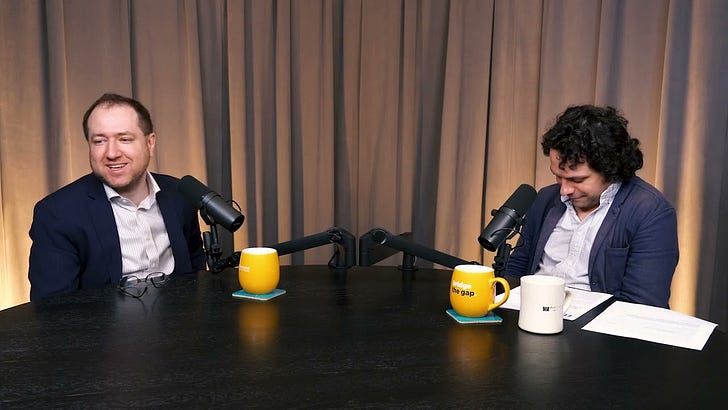
    Ruth Scurr: The Life and Work of John Aubrey

    What a pleasure it was to talk to Ruth Scurr, author of John Aubrey: My Own Life, about the great man himself, who was born four hundred years ago this month. Aubrey is best know for his splendid Brief Lives but he preserved a huge amount of knowledge which historians still rely on. There are many things we only know because of Aubrey—things about people Hobbes and Hooke, Stonehenge, architectural history. We also talked about Janet Malcom, the genre of biography, and modern fiction. HENRY OLIVER: Today I’m talking to Ruth Scurr. Ruth is a fellow of Gonville and Caius College in the University of Cambridge, where she specializes in the history of political thought. But more importantly, she is the biographer of John Aubrey, one of my favorite writers, who is celebrating 400 years of his birth this year. Ruth, hello. RUTH SCURR: Hi, Henry. OLIVER: Can you begin by giving us a brief life of John Aubrey? SCURR: So born in 1626, 17th-century antiquarian, collector, early fellow at the Royal Society. Well connected to scientific and the literary circles of his day. Someone who sees himself more as a whetstone: a person who could help sharpen other people’s ideas. As a recorder, someone who treasured the details, the minutiae of the lives he encountered, and pass those details on to posterity. He’s nonjudgmental, witty, kind, inventive. Very, very sociable. Very good friend. But he’s hopeless at self-advancement. Begins his life as a gentleman, but he inherits debts from his father and he can never really achieve financial stability. Never marries, ends up homeless and worried about being arrested for his debts. And he has to sell his precious collection of books periodically through his life to raise some much-needed cash, but he keeps his manuscripts safe. And he does this at the end of his life by putting them into the Ashmolean Museum in Oxford, afterwards known as the Bodleian, and where they still are today. OLIVER: So how many manuscripts did he save for us? SCURR: Of his own manuscripts or other people’s manuscripts? OLIVER: Other people’s. Because he was collecting all sorts of precious things. SCURR: Oh, absolutely. He was the person who, when someone died, would go round if he could to their house and ask what was happening about the manuscripts. He’s particularly concerned, obviously, with his friends. So he had a close relationship with Robert Hooke and he wanted to make sure that Hooke’s many inventions and scientific contributions were recorded. And he has this wonderful line in the life of Hooke where he says, “It’s so hard to get people to do right by themselves.” And in his childhood, he had seen the fallout from the dissolution of the monasteries. He’d become very troubled by the habit of using manuscript pages which had been displaced in the dissolution. He saw them being used in schools to cover textbooks. He saw them being used to—or he heard about them at least being used—to wrap up gloves or to create stoppers in bottles. And this really troubled him from, from a very early age. And I think he has another beautiful line where he says after the dissolution of the monasteries, whereas these manuscripts had been kept safe, they flew around like butterflies. And he wanted to catch them and preserve them and to stop people letting the papers and the precious manuscripts of their relatives do the same. So he was very instrumental in rescuing manuscripts, other people’s manuscripts. And then fortunately with his own, he knew Ashmole and they had the shared astrology interest. Ashmole was a very different sort of person who basically said to Oxford, look, I’ll give you my collections, but there has to be a museum for them. And luckily Aubrey was able to use that museum as a safe place for his own manuscripts. OLIVER: So we know things about Robert Hooke and Thomas Hobbes and all these other luminaries of the 17th century, thanks to Aubrey. What else do we know, thanks to him? SCURR: We know what Stonehenge looked like in his day because he was a very good draftsman. He drew pictures of Stonehenge. He’d grown up in Wiltshire, he’d known those stones from childhood. He understood that Avebury nearby was a comparable monument, and he took Charles II to see it, and persuaded the king to get the locals to stop breaking up the stones, to reuse the stones, which was the practice. He also made drawings of windows because he was possibly the first person as a historian of architecture to realize that you could date buildings by the style of their windows. So we have those drawings. He was also interested in the history of costume. He did a survey of Surrey, of Wiltshire. So these are all sort of focuses in his manuscripts and people who’ve used them come to really appreciate how pioneering Aubrey was. But of course he doesn’t finish them. He doesn’t publish those manuscripts. So it’s very easy really to overlook the innovation and the contribution and the wonderful imagination that he had. OLIVER: You mean if he’d published a book, he would have a much bigger reputation? SCURR: Well, I think there’s two things. Yes, but in a sense, you know, the Brief Lives have been published after his death in various forms. But I think one of the most engaging things about Aubrey is that he’s a modest and self-effacing person. And I already mentioned the idea he had of himself as a whetstone to other people’s talents. There aren’t that many people—certainly not in my life, maybe there are in yours—but who would effortlessly describe themselves as a whetstone to other people’s talents. Most people want to be at the center. They’re happy to have clever and literary friends, but they want a place there at the table as well. And Aubrey really was very, very invested in helping other people to do right by themselves, as he said about Hooke. And he very movingly—this is one of the inspirations really for my book that I wrote about him—he spent all that time collating the information about other people’s lives. And for his own life, he puts down a few lines, a couple of facts and everything. He says, well, this could be used as the binding of a book. You know, it’s sort of waste paper really. So he doesn’t write his own life. Other people’s lives he’s going to convey to posterity. He doesn’t see his own life as really being at that level of needing the attention that he gave, for example, to Milton or to Harvey or Hobbes, as you mentioned. OLIVER: He’s born the year after Charles I comes to the throne. So he obviously lives through a fairly terrible period of history and very tumultuous, changeable in lots of different ways. The new world, the new learning, new religion, new politics, everything is changing. And he’s obsessed with the old ways. How did these historical events—is he reacting against his time? Is he just born in a lucky time in a way? SCURR: So he was a student in Oxford during the Civil War. And you are right. The upheaval is very disturbing for his generation. It means he gets called back from Oxford by his father because it’s dangerous to be there. And he’s really, really upset by that because, it’s like us, when we were students or our students today. You finally get away from your family and there you are in this place with all these exciting peers and access to books that you’ve never had before or at least to that extent, libraries, et cetera. And suddenly there’s a war on and you’ve got to go home. So there’s that disturbance. Then there is the fact that actually he was close to Hobbes. Hobbes actually was a Malmesbury man, so Wiltshire, very near Aubrey. And had come back to visit the school where Hobbes had been, which was where Aubrey was at school. And so they had met in Aubrey’s childhood, and then he would’ve been aware of Hobbes having to go into exile. And then Hobbes coming back, of course. And that’s a very important time in his life. And it’s not an accident that Hobbes asks Aubrey to write his life because Hobbes knows how careful Aubrey is. And he knows tha… This is a public episode. If you would like to discuss this with other subscribers or get access to bonus episodes, visit www.commonreader.co.uk
  • March 4 · 53 min

    Naomi Kanakia: How Great Are the Great Books?

    Ahead of her new book What’s So Great About the Great Books? coming out in April, Naomi Kanakia and I talked about literature from Herodotus to Tony Tulathimutte. We touched on Chaucer, Anglo-Saxon poetry, Scott Alexander, Shakespeare, William James, Helen deWitt, Marx and Engels, Walter Scott, Les Miserables, Jhootha Sach, the Mahabharata, and more. Naomi also talked about some of her working habits and the history and future of the Great Books movement. Naomi, of course, writes Woman of Letters here on Substack. Transcript Henry Oliver: Today, I am talking with Naomi Kanakia. Naomi is a novelist, a literary critic, and most importantly she writes a Substack called Woman of Letters, and she has a new book coming out, What’s So Great About the Great Books? Naomi, welcome. Naomi Kanakia: Thanks for having me on. Oliver: How is the internet changing the way that literature gets discussed and criticized, and what is that going to mean for the future of the Great Books? Kanakia: How is the internet changing it? I can really speak to only how it has changed it for me. I started off as a writer of young adult novels and science fiction, and there’s these very active online fan cultures for those two things. I was reading the Great Books all through that time. I started in 2010 through today. In the 2010s, it really felt like there was not a lot of online discussion of classic literature. Maybe that was just me and I wasn’t finding it, but it didn’t necessarily feel like there was that community. I think because there are so many strong, public-facing institutions that discuss classic literature, like the NYRB, London Review of Books, a lot of journals, and universities, too. But now on Substack, there are a number of blogs—yours, mine, a number of other ones—that are devoted to classic literature. All of those have these commenters, a community of commenters. I also follow bloggers who have relatively small followings who are reading Tolstoy, reading Middlemarch, reading even much more esoteric things. I know that for me, becoming involved in this online culture has given me much more of an awareness that there are many people who are reading the classics on their own. I think that was always true, but now it does feel like it’s more of a community. Oliver: We are recording this the day after the Washington Post book section has been removed. You don’t see some sort of relationship between the way these literary institutions are changing online and the way the Great Books are going to be conceived of in the future? Because the Great Books came out of a an old-fashioned, saving-the-institutions kind of radical approach to university education. We’re now moving into a world where all those old things seem to be going. Kanakia: Yes. I agree. The Great Books began in the University of Chicago and Columbia University. If you look into the history of the movement, it really was about university education and the idea that you would have a common core and all undergraduates would read these books. The idea that the Great Books were for the ordinary person was really an afterthought, at least for Mortimer Adler and those original Great Books guys. Now, the Great Books in the university have had a resurgence that we can discuss, but I do think there’s a lot more life and vitality in the kind of public-facing humanities than there has been. I talked to Irina Dumitrescu, who writes for TLS (The Times Literary Supplement), LRB (The London Review of Books), a lot of these places, and she also said the same thing—that a lot of these journals are going into podcasts, and they’re noticing a huge interest in the humanities and in the classics even at the same time as big institutions are really scaling back on those things. Humanities majors are dropping, classics majors are getting cut, book coverage at major periodicals is going down. It does seem like there are signals that are conflicting. I don’t really know totally what to make of it. I do think there is some relation between those two things. Ted Gioia on Substack is always talking about how culture is stagnant, basically, and one of the symptoms of that is that “back list” really outsells “front list” for books. Even in 2010, 50 percent of the books that were sold were front-list titles, books that had been released in the last 18 months. Now it’s something like only 35 percent of books or something like that are front-list titles. These could be completely wrong, but there’s been a trend. I think the decrease in interest in front-list books is really what drives the loss of these book-review pages because they mostly review front-list books. So, I think that does imply that there’s a lot of interest in old books. That’s what our stagnant culture means. Oliver: Why do you think your own blog is popular with the rationalists? Kanakia: I don’t know for certain. There was a story I wrote that was a joke. There are all these pop nonfiction books that aim to prove something that seems counterintuitive, so I wrote a parody of one of those where I aim to prove that reading is bad for you. This book has many scientific studies that show the more you read, the worse it is because it makes you very rigid. Scott Alexander, who is the archrationalist, really liked that, and he added me to his blog roll. Because of that, I got a thousand rationalist subscribers. I have found that rationalists at least somewhat interested in the classics. I think they are definitely interested in enduring sources of value. I’ve observed a fair amount of interest. Oliver: How much of a lay reader are you really? Because you read scholarship and critics and you can just quote John Gilroy in the middle of a piece or something. Kanakia: Yeah. That is a good question. I have definitely gotten more interested in secondary literature. In my book, I really talk about being a lay reader and personally having a nonacademic approach to literature. I do think that, over 15 years of being a lay reader, I have developed a lot of knowledge. I’ve also learned the kind of secondary literature that is really important. I think having historical context adds a lot and is invaluable. Right now I’m rereading Les Miserables by Victor Hugo. When I first read it in 2010, I hardly knew anything about French history. I was even talking online with someone about how most people who read Les Miserables think it’s set in the French Revolution. That’s basically because Americans don’t really know anything about French history. Everything makes just a lot more sense the more you know about the time because it was written for people in it. For people in 1860s France, who knew everything about their own recent history, that really adds a lot to it. I still don’t tend to go that much into interpretive literature, literature that tries to do readings of the stories or tell me the meaning of the stories. I feel like I haven’t really gotten that much out of that. Oliver: How long have you been learning Anglo-Saxon? Kanakia: I went through a big Anglo-Saxon phase. That was in 2010. It started because I started reading The Canterbury Tales in Middle English. There is a great app online called General Prologue created by one of your countrymen, Terry Richardson [NB it is Terry Jones], who loved Middle English. In this app, he recites the Middle English of the General Prologue. I started listening to this app, and I thought, I just really love the rhythms and the sounds of Middle English. And it’s quite easy to learn. So then, I got really into that. And then I thought, but what about Anglo-Saxon? I’m very bad at languages. I studied Latin for seven years in middle school and high school. I never really got very far, but I thought, Anglo-Saxon has to be the easiest foreign language you can learn, right? So, I got into it. I cannot sight read Anglo-Saxon, but I really got into Anglo-Saxon poetry. I really liked the Anglo-Saxon Chronicle. Most people probably would not like the Anglo-Saxon Chronicle because it’s very repeti… This is a public episode. If you would like to discuss this with other subscribers or get access to bonus episodes, visit www.commonreader.co.uk
  • February 4 · 56 min

    Hermione Lee: Tom Stoppard. “It’s Wanting to Know That Makes Us Matter”

    Hermione Lee is the renowned biographer of Virginia Woolf, Edith Wharton, Penelope Fitzgerald, and, most recently, Tom Stoppard. Stoppard died at the end of last year, so Hermione and I talked about the influence of Shaw and Eliot and Coward on his work, the recent production of The Invention of Love, the role of ideas in Stoppard’s writing, his writing process, rehearsals, revivals, movies. We also talked about John Carey, Brian Moore, Virginia Woolf as a critic. Hermione is Emeritus Professor of English Literature at the University of Oxford. Her life of Anita Brookner will be released in September. Transcript Henry Oliver: Today I have the great pleasure of talking to Professor Dame Hermione Lee. Hermione was the first woman to be appointed Goldsmiths’ Professor of English Literature at the University of Oxford, and she is the most renowned and admired living English biographer. She wrote a seminal life of Virginia Woolf. She’s written splendid books about people like Willa Cather, Edith Wharton, and my own favorite, Penelope Fitzgerald. And most recently she has been the biographer of Tom Stoppard, and I believe this year she has a new book coming out about Anita Brookner. Hermione, welcome. Hermione Lee: Thank you very much. Oliver: We’re mostly going to talk about Tom Stoppard because he, sadly, just died. But I might have a few questions about your broader career at the end. So tell me first how Shavian is Stoppard’s work? Lee: He would reply “very close Shavian,” when asked that question. I think there are similarities. There are obviously similarities in the delighting forceful intellectual play, and you see that very much in Jumpers where after all the central character is a philosopher, a bit of a bonkers philosopher, but still a very rational one. And you see it in someone like Henry, the playwright in The Real Thing, who always has an answer to every argument. He may be quite wrong, but he is full of the sort of zest of argument, the passion for argument. And I think that kind of delight in making things intellectually clear and the pleasure in argument is very Shavian. Where I think they differ and where I think is really more like Chekov, or more like Beckett or more in his early work, the dialogues in T. S. Elliot, and less like Shaw is in a kind of underlying strangeness or melancholy or sense of fate or sense of mortality that rings through almost all the plays, even the very, very funny ones. And I don’t think I find that in Shaw. My prime reading time for Shaw was between 15 and 19, when I thought that Shaw was the most brilliant grownup that one could possibly be listening to, and I think now I feel less impressed by him and a bit more impatient with him. And I also think that Shaw is much more in the business of resolving moral dilemmas. So in something like Arms and the Man or Man and Superman, you will get a kind of resolution, you will get a sort of sense of this is what we’re meant to be agreeing with. Whereas I think quite often one of the fascinating things about Stoppard is the way that he will give all sides of the question; he will embody all sides of the question. And I think his alter ego there is not Shaw, but the character of Turgenev in The Coast of Utopia, who is constantly being nagged by his radical political friends to make his mind up and to have a point of view and come down on one side or the other. And Turgenev says, I take every point of view. Oliver: I must confess, I find The Coast of Utopia a little dull compared to Stoppard’s other work. Lee: It’s long. Yes. I don’t find it dull. But I think it may be a play to read possibly more than a play to see now. And you’re never going to get it put on again anyway because the cast is too big. And who’s going to put on a nine-hour free play, 50 people cast about 19th-century Russian revolutionaries? Nobody, I would think. But I find it very absorbing actually. And partly because I’m so interested in Isaiah Berlin, who is a very strong presence in the anti-utopianism of those plays. But that’s a matter of opinion. Oliver: No. I like Berlin. One thing about Stoppard that’s un-Shavian is that he says his plays begin as a noise or an image or a scene, and then we think of him as this very thinking writer. But is he really more of an intuitive writer? Lee: I think it’s a terribly good question. I think it gets right at the heart of the matter, and I think it’s both. Sorry, I sound like Turgenev, not making my mind up. But yes, there is an image or there is an idea, or there are often two ideas, as it were, the birth of quantum physics and 18th-century landscape gardening. Who else but Stoppard would put those two things in one play, Arcadia, and have you think about both at once. But the image and the play may well have been a dance between two periods of time together in one room. So I think he never knew what the next play was going to be until it would come at him, as it were. He often resisted the idea that if he chose a topic and then researched it, a play would come out of it. That wasn’t what happened. Something would come at him and then he would start doing a great deal of research usually for every play. Oliver: What sort of influence did T. S. Elliot have on him? Did it change the dialogue or, was it something else? Lee: When I was working with him on my biography, he gave me a number of things. I had extraordinary access, and we can perhaps come back to that interesting fact. And most of these things were loans he gave them to me to work on. Then I gave them back to him. But he gave me as a present one thing, which was a black notebook that he had been keeping at the time he was writing Rosencrantz and Guildenstern, and also his first and only novel Lord Malquist and Mr. Moon, which is little known, which he thought was going to make his career. The book was published in the same week that Rosencrantz came up. He thought the novel was going to make his career and the play was going to sink without trace. Not so. In the notebook there are many quotations from T. S. Elliot, and particularly from Prufrock and the Wasteland, and you can see him working them into the novel and into the play. “I am not Prince Hamlet nor was meant to be.” And that sense of being a disconsolate outsider. Ill at ease with and neurotic about the world that is charging along almost without you, and you are having to hang on to the edge of the world. The person who feels themself to be in internal exile, not at one with the universe. I think that point of view recurs over and over again, right through the work, but also a kind of epigrammatical, slightly mysterious crypticness that Elliot has, certainly in Prufrock and in the Wasteland and in the early poems. He loved that tone. Oliver: Yes. When I read your paper about that I thought about Rosencrantz and Guildenstern quite differently. I’ve always disliked the idea that it’s a sort of Beckett imitation play. It seems very Elliotic having read what you described. Lee: There is Beckett in there. You can’t get away from it. Oliver: Surface level. Lee: Beckett’s there, but I think the sense of people waiting around—Stoppard’s favorite description of Rosencrantz was: “It’s two journalists on a story that doesn’t add up, which is very clever and funny.” Yes. And that sense of, Vladimir going, “What are we supposed to be doing and how are we going to pass the time?” That’s profoundly influential on Stoppard. So I don’t think it’s just a superficial resemblance myself, but I agree that Elliot just fills the tone of that play and other things too. Oliver: In the article you wrote about Stoppard and Elliot, the title is about biographical questing, and you also described Arcadia as a quest. How important is the idea of the quest to the way you work and also to the way you read Stoppard? Lee: I took as the epigraph for my biography of Stoppard a line from Arcadia: “It’s wanting to know that makes us matter, otherwise we’re going out the way we came in.” So I think … This is a public episode. If you would like to discuss this with other subscribers or get access to bonus episodes, visit www.commonreader.co.uk
  • January 7 · 1 hr 3 min

    Literature, politics, and the future of the humanities

    This episode of The Common Reader podcast is a little different. I spoke to both Jeffrey Lawrence and Julianne Werlin about literature, politics, and the future of the academic humanities. Questions included: what do we mean when we talk about literature and markets? Can we leave politics out of literary discussion? Should we leave it out? If we can’t leave it out, can we have nice friendly conversations about it? What is academic Marxism? We also talked about whether Stephen Greenblatt is too ideological and why universities are necessary to literary culture, academics on Substack. Julianne writes Life and Letters. Jeffrey writes Avenues of the Americas. Here is Julianne’s interview in The Republic of Letters. Transcript (AI generated, will contain some errors) Henry Oliver (00:00) Today I am talking to Jeffrey Lawrence and Julianne Werlin. Jeffrey is a professor of English literature and comparative literature at Rutgers University. He specializes in the 20th and 21st century and he writes the sub stack, Avenues of America. Julianne probably needs no introduction to a sub stack audience. She writes Life and Letters, one of my favorite sub stacks. She’s a professor of English at Duke University, where as well as specializing in early modern poetry, she is interested in sociological and demographic studies of literature. and we are going to have a big conversation about literature and markets, politics, what do we mean when we talk about literature and markets, can we leave politics out of literary discussion, should we leave it out, if we can’t leave it out, can we have nice friendly conversations about it, and also maybe what is academic Marxism and what should it be and why is it so confusing? Jeffrey and Julianne, hello. Julianne (00:59) Hi. Jeffrey Lawrence (01:01) Hi, thanks for having us. Julianne (01:02) Yeah, thank you. Henry Oliver (01:04) I am going to start by referencing an interview that you did, Julianne, for Republic of Letters, which everyone has been reading. And you said, I’ve printed it out wrong, so I can’t read the whole quote. But you said something like, you joined Substack because you wanted people to talk with and because you felt a lack of debate in your academic field. There are lots of good things about scholarship being slow and careful, but it also needs to be animated by debate and conversation. and a sense of the stakes of what we’re doing, and that is eroding in the academy. So I want you both to talk about that. Why is that happening? How much of a problem is it? How much is Substack or the internet more generally the solution? What should we be doing? Why don’t we go to Julianne first, because it’s your quote. Julianne (01:54) Sure, I mean, won’t go on too long ⁓ since I have already spoken about this, but my sense within English departments is, you know, they’re becoming smaller, fewer people are taking our classes, we have much less of a role in public conversation and public debate, except as kind of a stalking horse for certain types of arguments. And certainly, if you are an early modernist, it’s very hard to locate a kind of a... Henry Oliver (02:14) You Julianne (02:25) discrete set of debates within early modern literature because there is so little public salience to literary fields. And I think this is happening in all literature. It’s especially pronounced if you’re working in the earlier periods. So my sense in joining SUBSTAC was that perhaps there will be debates by people who are not already so deep within the particular professional and disciplinary structures of a field that they can find new points of connection between literature and public life along different ⁓ axes that we have maybe not explored adequately within English departments and are maybe becoming harder to explore as English departments contract and recede from public life. Henry Oliver (03:04) Mm-hmm. So we’re bringing Milton back to the people and also finding out why they care about him at all. ⁓ What do you think about it, Geoff? Julianne (03:16) Well, hopefully. I mean, that’s the goal. Jeffrey Lawrence (03:21) Great, ⁓ so I actually restacked that specific quote from Julianne because it resonated so much with me. Yeah, I mean, my sense is that as someone who works on 20th and 21st century literature, there is more crossover there, I would say, between sort of academic scholarship and public debate. But I really wanna just echo what Julianne said there, that ⁓ I have gotten the feeling that within let’s call it like the legacy media. There are particular arguments that come from academia that are pushed forward and that become representative of the field of 20th and 21st century literature as a whole. And those kind of come to stand in for academic debate more generally. And I think it becomes very difficult. One of the things that I was noticing so much is that the people who had access to those legacy journals, are places like the Atlantic, the New York Times, that those began to dominate the debates and people just aren’t recognizing that in scholarships. So one of the things I particularly like about Substack is that I feel like although it has some of the same problems as social media more generally about kind of like who gets to participate and algorithmic culture and all of that sort of stuff. I did feel like the ideological diversity both left and right compared to the sort of a kind of monoculture, mono, you know, sort of academic argument that I found over and over in these legacy magazines, that Substack was the place where a lot of these debates are happening. And I only joined maybe four or five months ago, but for me, ⁓ sort of just in terms of my relationship to the Academy, it’s really changed my sense of what can be said and what’s being said by academics. Henry Oliver (05:17) feels to me like in some way humanities academia needs deregulating because there’s all sorts of things people can’t feel like they can’t say and can’t do. But it’s such a tangled mess that the easiest thing is for you all to just go to Substack and do it there and just try and avoid the bureaucracy because it’s gone too far. But when you’re on Substack... I feel like you’re often faced with people saying, these English literature academics, it’s all woke BS. They don’t know anything. They’ve killed this, right? You’re simultaneously in a kind of semi hostile environment. How do you, how does that seem to you? Julianne (05:56) Yeah, mean, that’s certainly true. I think that we are avatars on Substack for a kind of authority that we feel in our own lives we do not possess in any way. So we’re in this position where, you know, at least I feel this, I’m responding to comments that are, you know, very much, by people who very much feel that they’re attacking authority figures. And I’m, you know, I’m just a person on the internet, you know, talking with them when I’m on Substack. What I like about it is precisely that it levels any kind of authority structures insofar as they exist, which is debatable at this phase. But that’s not always the reality on Substack. I also feel there’s an additional thing, again, as an early modernist, where you feel like, you you don’t have... Henry Oliver (06:27) Yeah. Julianne (06:52) there’s not a lot of interest by people who are kind of on the left in contemporary politics in the Renaissance. It’s seen as kind of a conservative, canonical thing to study. And there’s a lot of pushback. even within English departments, there’s a lot of pushback ⁓ surrounding the idea that people should study Shakespeare or study Milton. It’s seen as kind of old and fussy and conservative. And then at the same time, you go on the internet and you’re the kind of ⁓ exemplar. Henry Oliver (06:59) Mmm. Yeah. Mmm. Julianne (07:22) of woke cultural discourse. So you feel like as a Renaissance scholar, you can’t win. You’re nobody’s idea of what people should be doing intellectually or culturally. Henry Oliver (07:25) Hahaha Do you think, someone asked me this the other day about why academics write in this funny way and why no one reads their books and all this. That wa… This is a public episode. If you would like to discuss this with other subscribers or get access to bonus episodes, visit www.commonreader.co.uk
  • Dec 12, 2025 · 1 hr 11 min

    John Mullan. What makes Jane Austen great?

    Tuesday is the 250th anniversary of Jane Austen’s birth, so today I spoke to John Mullan, professor of English Literature at UCL, author of What Matters in Jane Austen. John and I talked about how Austen’s fiction would have developed if she had not died young, the innovations of Persuasion, wealth inequality in Austen, slavery and theatricals in Mansfield Park, as well as Iris Murdoch, A.S. Byatt, Patricia Beer, the Dunciad, and the Booker Prize. This was an excellent episode. My thanks to John! Transcript Henry Oliver (00:00) Today, I am talking to John Mullen. John is a professor of English literature at University College London, and he is the author of many splendid books, including How Novels Work and the Artful Dickens. I recommend the Artful Dickens to you all. But today we are talking about Jane Austen because it’s going to be her birthday in a couple of days. And John wrote What Matters in Jane Austen, which is another book I recommend to you all. John, welcome. John Mullan (00:51) It’s great to be here. Henry Oliver (00:53) What do you think would have happened to Austin’s fiction if she had not died young? John Mullan (00:58) Ha ha! I’ve been waiting all this year to be asked that question from somebody truly perspicacious. ⁓ Because it’s a question I often answer even though I’m not asked it, because it’s a very interesting one, I think. And also, I think it’s a bit, it’s answerable a little bit because there was a certain trajectory to her career. I think it’s very difficult to imagine what she would have written. John Mullan (01:28) But I think there are two things which are almost certain. The first is that she would have gone on writing and that she would have written a deal more novels. And then even the possibility that there has been in the past of her being overlooked or neglected would have been closed. ⁓ And secondly, and perhaps more significantly for her, I think she would have become well known. in her own lifetime. you know, partly that’s because she was already being outed, as it were, you know, of course, as ⁓ you’ll know, Henry, you know, she published all the novels that were published in her lifetime were published anonymously. So even people who were who were following her career and who bought a novel like Mansfield Park, which said on the title page by the author of Sense and Sensibility and Pride and Prejudice, they knew they knew. John Mullan (02:26) were getting something by the same author, they wouldn’t necessarily have known the author’s name and I think that would have become, as it did with other authors who began anonymously, that would have disappeared and she would have become something of a literary celebrity I would suggest and then she would have met other authors and she’d have been invited to some London literary parties in effect and I think that would have been very interesting how that might have changed her writing. John Mullan (02:54) if it would have changed her writing as well as her life. She, like everybody else, would have met Coleridge. ⁓ I think that would have happened. She would have become a name in her own lifetime and that would have meant that her partial disappearance, I think, from sort of public consciousness in the 19th century wouldn’t have happened. Henry Oliver (03:17) It’s interesting to think, you know, if she had been, depending on how old she would have been, could she have read the Pickwick papers? How would she have reacted to that? Yes. Yeah. Nope. John Mullan (03:24) Ha ha ha ha ha! Yes, she would have been in her 60s, but that’s not so old, speaking of somebody in their 60s. ⁓ Yes, it’s a very interesting notion, isn’t it? I mean, there would have been other things which happened after her premature demise, which she might have responded to. I think particularly there was a terrific fashion for before Dickens came along in the 1830s, there was a terrific fashion in the 1820s for what were called silver fork novels, which were novels of sort of high life of kind of the kind of people who knew Byron, but I mean as fictional characters. And we don’t read them anymore, but they were they were quite sort of high quality, glossy products and people loved them. And I’m I like to think she might have reacted to that with her sort of with her disdain, think, her witty disdain for all aristocrats. know, nobody with a title is really any good in her novels, are they? And, you know, the nearest you get is Mr. Darcy, who is an Earl’s nephew. And that’s more of a problem for him than almost anything else. ⁓ She would surely have responded satirically to that fashion. Henry Oliver (04:28) Hahaha. Yes, and then we might have had a Hazlitt essay about her as well, which would have been all these lost gems. Yes. Are there ways in which persuasion was innovative that Emma was not? John Mullan (04:58) Yes, yes, yes, yes. I know, I know. ⁓ gosh, all right, you’re homing in on the real tricky ones. Okay, okay. ⁓ That Emma was not. Yes, I think so. I think it took, in its method, it took further what she had done in Emma. Henry Oliver (05:14) Ha ha. This is your exam today, John Mullan (05:36) which is that method of kind of we inhabit the consciousness of a character. And I I think of Jane Austen as a writer who is always reacting to her own last novel, as it were. And I think, you know, probably the Beatles were like that or Mozart was like that. think, you know, great artists often are like that, that at a certain stage, if what they’re doing is so different from what everybody else has done before, they stop being influenced by anybody else. They just influence themselves. And so I think after Emma, Jane Austen had this extraordinary ⁓ method she perfected in that novel, this free indirect style of a third-person narration, which is filtered through the consciousness of a character who in Emma’s case is self-deludedly wrong about almost everything. And it’s... brilliantly tricksy and mischievous and elaborate use of that device which tricks even the reader quite often, certainly the first time reader. And then she got to persuasion and I think she is at least doing something new and different with that method which is there’s Anne Elliot. Anne Elliot’s a good person. Anne Elliot’s judgment is very good. She’s the most cultured and cultivated of Jane Austen’s heroines. She is, as Jane Austen herself said about Anne Elliot, almost too good for me. And so what she does is she gives her a whole new vein of self-deception, which is the self-deception in the way of a good person who always wants to think things are worse than they are and who always, who, because suspicious of their own desires and motives sort of tamps them down and suppresses them. And we live in this extraordinary mind of this character who’s often ignored, she’s always overhearing conversations. Almost every dialogue in the novel seems to be something Anne overhears rather than takes part in. And the consciousness of a character who doesn’t want to acknowledge things in themselves which you and I might think were quite natural and reasonable and indeed in our psychotherapeutic age to be expressed from the rooftops. You still fancy this guy? Fine! Admit it to yourself. ⁓ No. So it’s not repression actually, exactly. It’s a sort of virtuous self-control somehow which I think lots of readers find rather masochistic about her. Henry Oliver (08:38) I find that book interesting because in Sense and Sensibility she’s sort of opposed self-command with self-expression, but she doesn’t do that in Persuasion. She says, no, no, I’m just going to be the courage of, no, self-command. know, Eleanor becomes the heroine. John Mullan (08:48) Yes. Yes, yes, yes, yes, yes, yes. But with the odd with the odd burst of Mariannes, I was watching the I thought execrable Netflix ⁓ persuasion done about two or three years ago ⁓ with the luminous Dakota Johnson as as you know, as Anne Elliot. You could not believe her bloom had faded one little bit, I think. John Mullan (09:23) And ⁓ … This is a public episode. If you would like to discuss this with other subscribers or get access to bonus episodes, visit www.commonreader.co.uk
  • Nov 25, 2025 · 1 hr 11 min

    Rebecca Lowe: the container theory of time in On the Calculation of Volume

    I was delighted to talk to Rebecca Lowe, who is, like me, a great admirer of Solvej Balle’s On the Calculation of Volume series. We discussed Calculation as a philosophical novel: how it’s narrative voice is like that of a philosopher, the thought-experiments of the plot, and whether, as Rebecca thinks, the whole series is an argument for the container theory of time. Rebecca is a fellow at the Mercatus Center and writes the Substack the ends don't justify the means. Rebecca and I also recently started a joint Substack about classical liberal ideas. So if you want to read even more of our work together, have a look at The Pursuit of Liberalism. This is a public episode. If you would like to discuss this with other subscribers or get access to bonus episodes, visit www.commonreader.co.uk
  • Nov 1, 2025 · 17 min

    Peter Pan video

    I made a video of my recent essay ‘What I Learned Reading Peter Pan to my Children’. I made this video because it is one of the things I am most pleased with having written. You can watch it on YouTube or if you want audio only, that’s available here too. This is a public episode. If you would like to discuss this with other subscribers or get access to bonus episodes, visit www.commonreader.co.uk

  • Oct 25, 2025 · 53 min

    Shanon Chamberlain: what is a novel?

    Shannon Chamberlain is a former tutor at St. Johns College, an expert in the influence of fiction upon Adam Smith, a mystery writer, Substacker, and amateur pilot. She is no longer an academic, and now works as a writer and editor. We talked about the history of the novel (Defoe, Swift, Fielding, Richardson), the links between Smith and Austen, epistolatory fiction, what Free Indirect Style actually is, fan fiction and the history of the novel, moral ambivalence, Adam Smith as a literary critic, what Ian Watt got right and wrong, and much more. My thanks to Shannon for a very interesting conversation! You can also watch this podcast on YouTube. This is a public episode. If you would like to discuss this with other subscribers or get access to bonus episodes, visit www.commonreader.co.uk
  • Sep 25, 2025 · 1 hr 22 min

    Rhodri Lewis: Shakespearean Tragedy

    I was delighted to talk to Rhodri Lewis, author of Shakespeare’s Tragic Art. We discussed Shakespeare’s most under appreciated plays, the best films, how to teach Shakespeare, humanism, personae, Frank Kermode, the future of the humanities, being supervised by John Carey, A.C. Bradley, what we have learned about Francis Bacon, and more. There’s a transcript below and you can also watch the whole conversation on YouTube if you wish. We also covered Rhodri’s love of Pevsner architectural guides. Timestamps 00:00:00 Introduction 00:00:21 Shakespeare's best and worst plays 00:03:14 Performing Shakespeare 00:07:33 Pragmatism 00:09:13 Early experiences with Shakespeare 00:13:52 Teaching Shakespeare 00:17:08 Taming of the Shrew, Romeo and Juliet 00:19:38 Which five critical works? 00:23:37 Francis Bacon 00:31:31 What have we learned about Shakespeare? 00:34:32 Too much Shakespeare? 00:41:57 Tragedy 00:49:04 Humanism 00:54:00 Kermode 01:03:59 Quickfire questions This is a public episode. If you would like to discuss this with other subscribers or get access to bonus episodes, visit www.commonreader.co.uk
  • Jul 6, 2025 · 1 hr 5 min

    Frances Wilson: T.S. Eliot is stealing my baked beans.

    Frances Wilson has written biographies of Dorothy Wordsworth, Thomas De Quincey, D.H. Lawrence, and, most recently, Muriel Spark. I thought Electric Spark was excellent. In my review, I wrote: “Wilson has done far more than string the facts together. She has created a strange and vivid portrait of one of the most curious of twentieth century novelists.” In this interview, we covered questions like why Thomas De Quincey is more widely read, why D.H. Lawrence’s best books aren’t his novels, Frances’s conversion to spookiness, what she thinks about a whole range of modern biographers, literature and parasocial relationships, Elizabeth Bowen, George Meredith, and plenty about Muriel Spark. Here are two brief extracts. There is a full transcript below. Henry: De Quincey and Lawrence were the people you wrote about before Muriel Spark, and even though they seem like three very different people, but in their own way, they're all a little bit mad, aren't they? Frances: Yes, that is, I think, something that they have in common. It's something that I'm drawn to. I like writing about difficult people. I don't think I could write about anyone who wasn't difficult. I like difficult people in general. I like the fact that they pose a puzzle and they're hard to crack, and that their difficulty is laid out in their work and as a code. I like tackling really, really stubborn personalities as well. Yes, they were all a bit mad. The madness was what fuelled their journeys without doubt. Henry: This must make it very hard as a biographer. Is there always a code to be cracked, or are you sometimes dealing with someone who is slippery and protean and uncrackable? And. Henry: People listening will be able to tell that Spark is a very spooky person in several different ways. She had what I suppose we would call spiritual beliefs to do with ghosts and other sorts of things. You had a sort of conversion of your own while writing this book, didn't you? Frances: Yes, I did. [laughs] Every time I write a biography, I become very, very, very immersed in who I'm writing about. I learned this from Richard Holmes, who I see as a method biographer. He Footsteps his subjects. He becomes his subjects. I think I recognized when I first read Holmes's Coleridge, when I was a student, that this was how I also wanted to live. I wanted to live inside the minds of the people that I wrote about, because it was very preferable to live inside my own mind. Why not live inside the mind of someone really, really exciting, one with genius? What I felt with Spark wasn't so much that I was immersed by-- I wasn't immersed by her. I felt actually possessed by her. I think this is the Spark effect. I think a lot of her friends felt like this. I think that her lovers possibly felt like this. There is an extraordinary force to her character, which absolutely lives on, even though she's dead, but only recently dead. The conversion I felt, I think, was that I have always been a very enlightenment thinker, very rational, very scientific, very Freudian in my approach to-- I will acknowledge the unconscious but no more. By the time I finished with Spark, I'm pure woo-woo now. Transcript Henry: Today, I am talking to Frances Wilson. Frances is a biographer. Her latest book, Electric Spark, is a biography of the novelist Muriel Spark, but she has also written about Dorothy Wordsworth, Thomas De Quincey, DH Lawrence and others. Frances, welcome. Frances Wilson: Thank you so much for having me on. Henry: Why don't more people read Thomas De Quincey's work? Frances: [laughs] Oh, God. We're going right into the deep end. [laughter] Frances: I think because there's too much of it. When I chose to write about Thomas De Quincey, I just followed one thread in his writing because Thomas De Quincey was an addict. One of the things he was addicted to was writing. He wrote far, far, far too much. He was a professional hack. He was a transcendental hack, if you like, because all of his writing he did while on opium, which made the sentences too long and too high and very, very hard to read. When I wrote about him, I just followed his interest in murder. He was fascinated by murder as a fine art. The title of one of his best essays is On Murder as One of the Fine Arts. I was also interested in his relationship with Wordsworth. I twinned those together, which meant cutting out about 97% of the rest of his work. I think people do read his Confessions of an English Opium-Eater. I think that's a cult text. It was the memoir, if you want to call it a memoir, that kick-started the whole pharmaceutical memoir business on drugs. It was also the first addict's memoir and the first recovery memoir, and I'd say also the first misery memoir. He's very much at the root of English literary culture. We're all De Quincey-an without knowing it, is my argument. Henry: Oh, no, I fully agree. That's what surprises me, that they don't read him more often. Frances: I know it's a shame, isn't it? Of all the Romantic Circle, he's the one who's the most exciting to read. Also, Lamb is wonderfully exciting to read as well, but Lamb's a tiny little bit more grounded than De Quincey, who was literally not grounded. He's floating in an opium haze above you. [laughter] Henry: What I liked about your book was the way you emphasized the book addiction, not just the opium addiction. It is shocking the way he piled up chests full of books and notebooks, and couldn't get into the room because there were too many books in there. He was [crosstalk]. Frances: Yes. He had this in common with Muriel Spark. He was a hoarder, but in a much more chaotic way than Spark, because, as you say, he piled up rooms with papers and books until he couldn't get into the room, and so just rented another room. He was someone who had no money at all. The no money he had went on paying rent for rooms, storing what we would be giving to Oxfam, or putting in the recycling bin. Then he'd forget that he was paying rent on all these rooms filled with his mountains of paper. The man was chaos. Henry: What is D.H. Lawrence's best book? Frances: Oh, my argument about Lawrence is that we've gone very badly wrong in our reading of him, in seeing him primarily as a novelist and only secondarily as an essayist and critic and short story writer, and poet. This is because of F.R. Leavis writing that celebration of him called D.H. Lawrence: Novelist, because novels are not the best of Lawrence. I think the best of his novels is absolutely, without doubt, Sons and Lovers. I think we should put the novels in the margins and put in the centre, the poems, travel writing. Absolutely at the centre of the centre should be his studies in classic American literature. His criticism was- We still haven't come to terms with it. It was so good. We haven't heard all of Lawrence's various voices yet. When Lawrence was writing, contemporaries didn't think of Lawrence as a novelist at all. It was anyone's guess what he was going to come out with next. Sometimes it was a novel [laughs] and it was usually a rant about-- sometimes it was a prophecy. Posterity has not treated Lawrence well in any way, but I think where we've been most savage to him is in marginalizing his best writing. Henry: The short fiction is truly extraordinary. Frances: Isn't it? Henry: I always thought Lawrence was someone I didn't want to read, and then I read the short fiction, and I was just obsessed. Frances: It's because in the short fiction, he doesn't have time to go wrong. I think brevity was his perfect length. Give him too much space, and you know he's going to get on his soapbox and start ranting, start mansplaining. He was a terrible mansplainer. Mansplaining his versions of what had gone wrong in the world. It is like a drunk at the end of a too-long dinner party, and you really want to just bundle him out. Give him only a tiny bit of space, and he comes out with the perfection that is his writing. Henry: De Quincey and Lawrence were the people you wrote about before Muriel Spark, and even though they seem like three very different people, but in their own way, they're all a little bit mad, aren't they? Frances: Yes, that is, I think, something that they have in common. It's something that I'm drawn to. I like writing about difficult people. I don't think I could write about anyone who wasn't difficult. I like difficult people in general. I like the fact that they pose a puzzle and they're hard to crack, and that their difficulty is laid out in their work and as a code. I like tackling really, really stubborn personalities as well. Yes, they were all a bit mad. The madness was what fuelled their journeys without doubt. Henry: This must make it very hard as a biographer. Is there always a code to be cracked, or are you sometimes dealing with someone who is slippery and protean and uncrackable? Frances: I think that the way I approach biography is that there is a code to crack, but I'm not necessarily concerned with whether I crack it or not. I think it's just recognizing that there's a hell of a lot going on in the writing and that, in certain cases and not in every case at all, the best way of exploring the psyche of the writer and the complexity of the life is through the writing, which is a argument for psycho biography, which isn't something I necessarily would argue for, because it can be very, very crude. I think with the writers I choose, there is no option. Muriel Spark argued for this as well. She said in her own work as a biographer, which was really very, very strong. She was a biographer before she became a novelist. She thought hard about biography and absolutely in advance of anyone else who thought about biography, she said, "Of course, the only way we can approach the minds of writers is through their work, and the writer's life is encoded in the concerns of their work." When I was writing about Muriel Spark, I followed, as much as I could, to the letter, her own theories of biography, believing that that was part of the code that she left. She said very, very strong and very definitive things about what biography was about and how to write a biography. I tried to follow those rules. Henry: Can we play a little game where I say the names of some biographers and you tell me what you think of them? Frances: Oh my goodness. Okay. Henry: We're not trying to get you into trouble. We just want some quick opinions. A.N. Wilson. Frances: I think he's wonderful as a biographer. I think he's unzipped and he's enthusiastic and he's unpredictable and he's often off the rails. I think his Goethe biography-- Have you read the Goethe biography? Henry: Yes, I thought that was great. Frances: It's just great, isn't it? It's so exciting. I like the way that when he writes about someone, it's almost as if he's memorized the whole of their work. Henry: Yes. Frances: You don't imagine him sitting at a desk piled with books and having to score through his marginalia. It sits in his head, and he just pours it down on a page. I'm always excited by an A.N. Wilson biography. He is one of the few biographers who I would read regardless of who the subject was. Henry: Yes. Frances: I just want to read him. Henry: He does have good range. Frances: He absolutely does have good range. Henry: Selina Hastings. Frances: I was thinking about Selina Hastings this morning, funnily enough, because I had been talking to people over the weekend about her Sybil Bedford biography and why that hadn't lifted. She wrote a very excitingly good life of Nancy Mitford and then a very unexcitingly not good life of Sybil Bedford. I was interested in why the Sybil Bedford simply hadn't worked. I met people this weekend who were saying the same thing, that she was a very good biographer who had just failed [laughs] to give us anything about Sybil Bedford. I think what went wrong in that biography was that she just could not give us her opinions. It's as if she just withdrew from her subject as if she was writing a Wikipedia entry. There were no opinions at all. What the friends I was talking to said was that she just fell out with her subject during the book. That's what happened. She stopped being interested in her. She fell out with her and therefore couldn't be bothered. That's what went wrong. Henry: Interesting. I think her Evelyn Waugh biography is superb. Frances: Yes, I absolutely agree. She was on fire until this last one. Henry: That's one of the best books on Waugh, I think. Frances: Yes. Henry: Absolutely magical. Frances: I also remember, it's a very rare thing, of reading a review of it by Hilary Mantel saying that she had not read a biography that had been as good, ever, as Selina Hastings' on Evelyn Waugh. My goodness, that's high praise, isn't it? Henry: Yes, it is. It is. I'm always trying to push that book on people. Richard Holmes. Frances: He's my favourite. He's the reason that I'm a biographer at all. I think his Coleridge, especially the first volume of the two-volume Coleridge, is one of the great books. It left me breathless when I read it. It was devastating. I also think that his Johnson and Savage book is one of the great books. I love Footsteps as well, his account of the books he didn't write in Footsteps. I think he has a strange magic. When Muriel Spark talked about certain writers and critics having a sixth literary sense, which meant that they tuned into language and thought in a way that the rest of us don't, I think that Richard Holmes does have that. I think he absolutely has it in relation to Coleridge. I'm longing for his Tennyson to come out. Henry: Oh, I know. I know. Frances: Oh, I just can't wait. I'm holding off on reading Tennyson until I've got Holmes to help me read him. Yes, he is quite extraordinary. Henry: I would have given my finger to write the Johnson and Savage book. Frances: Yes, I know. I agree. How often do you return to it? Henry: Oh, all the time. All the time. Frances: Me too. Henry: Michael Holroyd. Frances: Oh, that's interesting, Michael Holroyd, because I think he's one of the great unreads. I think he's in this strange position of being known as a greatest living biographer, but nobody's read him on Augustus John. [laughs] I haven't read his biographies cover to cover because they're too long and it's not in my subject area, but I do look in them, and they're novelistic in their wit and complexity. His sentences are very, very, very entertaining, and there's a lot of freight in each paragraph. I hope that he keeps selling. I love his essays as well, and also, I think that he has been a wonderful ambassador for biography. He's very, very supportive of younger biographers, which not every biographer is, but I know he's been very supportive of younger biographers and is incredibly approachable. Henry: Let's do a few Muriel Spark questions. Why was the Book of Job so important to Muriel Spark? Frances: I think she liked it because it was rogue, because it was the only book of the Bible that wasn't based on any evidence, it wasn't based on any truth. It was a fictional book, and she liked fiction sitting in the middle of fact. That was one of her main things, as all Spark lovers know. She liked the fact that there was this work of pure imagination and extraordinarily powerful imagination sitting in the middle of the Old Testament, and also, she thought it was an absolutely magnificent poem. She saw herself primarily as a poet, and she responded to it as a poem, which, of course, it is. Also, she liked God in it. She described Him as the Incredible Hulk [laughs] and she liked His boastfulness. She enjoyed, as I do, difficult personalities, and she liked the fact that God had such an incredibly difficult personality. She liked the fact that God boasted and boasted and boasted, "I made this and I made that," to Job, but also I think she liked the fact that you hear God's voice. She was much more interested in voices than she was in faces. The fact that God's voice comes out of the burning bush, I think it was an image for her of early radio, this voice speaking, and she liked the fact that what the voice said was tricksy and touchy and impossibly arrogant. He gives Moses all these instructions to lead the Israelites, and Moses says, "But who shall I say sent me? Who are you?" He says, "I am who I am." [laughs] She thought that was completely wonderful. She quotes that all the time about herself. She says, "I know it's a bit large quoting God, but I am who I am." [laughs] Henry: That disembodied voice is very important to her fiction. Frances: Yes. Henry: It's the telephone in Memento Mori. Frances: Yes. Henry: Also, to some extent, tell me what you think of this, the narrator often acts like that. Frances: Like this disembodied voice? Henry: Yes, like you're supposed to feel like you're not quite sure who's telling you this or where you're being told it from. That's why it gets, like in The Ballad of Peckham Rye or something, very weird. Frances: Yes. I'm waiting for the PhD on Muriel Sparks' narrators. Maybe it's being done as we speak, but she's very, very interested in narrators and the difference between first-person and third-person. She was very keen on not having warm narrators, to put it mildly. She makes a strong argument throughout her work for the absence of the seductive narrative. Her narratives are, as we know, unbelievably seductive, but not because we are being flattered as readers and not because the narrator makes herself or himself pretty. The narrator says what they feel like saying, withholds most of what you would like them to say, plays with us, like in a Spark expression, describing her ideal narrator like a cat with a bird [laughs]. Henry: I like that. Could she have been a novelist if she had not become a Catholic? Frances: No, she couldn't. The two things happened at the same time. I wonder, actually, whether she became a Catholic in order to become a novelist. It wasn't that becoming a novelist was an accidental effect of being a Catholic. The conversion was, I think, from being a biographer to a novelist rather than from being an Anglican to a Catholic. What happened is a tremendous interest. I think it's the most interesting moment in any life that I've ever written about is the moment of Sparks' conversion because it did break her life in two. She converted when she was in her mid-30s, and several things happened at once. She converted to Catholicism, she became a Catholic, she became a novelist, but she also had this breakdown. The breakdown was very much part of that conversion package. The breakdown was brought on, she says, by taking Dexys. There was slimming pills, amphetamines. She wanted to lose weight. She put on weight very easily, and her weight went up and down throughout her life. She wanted to take these diet pills, but I think she was also taking the pills because she needed to do all-nighters, because she never, ever, ever stopped working. She was addicted to writing, but also she was impoverished and she had to sell her work, and she worked all night. She was in a rush to get her writing done because she'd wasted so much of her life in her early 20s, in a bad marriage trapped in Africa. She needed to buy herself time. She was on these pills, which have terrible side effects, one of which is hallucinations. I think there were other reasons for her breakdown as well. She was very, very sensitive and I think psychologically fragile. Her mother lived in a state of mental fragility, too. She had a crash when she finished her book. She became depressed. Of course, a breakdown isn't the same as depression, but what happened to her in her breakdown was a paranoid attack rather than a breakdown. She didn't crack into nothing and then have to rebuild herself. She just became very paranoid. That paranoia was always there. Again, it's what's exciting about her writing. She was drawn to paranoia in other writers. She liked Cardinal Newman's paranoia. She liked Charlotte Brontë's paranoia, and she had paranoia. During her paranoid attack, she felt very, very interestingly, because nothing that happened in her life was not interesting, that T.S. Eliot was sending her coded messages. He was encoding these messages in his play, The Confidential Clerk, in the program notes to the play, but also in the blurbs he wrote for Faber and Faber, where he was an editor. These messages were very malign and they were encoded in anagrams. The word lived, for example, became devil. I wonder whether one of the things that happened during her breakdown wasn't that she discovered God, but that she met the devil. I don't think that that's unusual as a conversion experience. In fact, the only conversion experience she ever describes, you'll remember, is in The Girls of Slender Means, when she's describing Nicholas Farrington's conversion. That's the only conversion experience she ever describes. She says that his conversion is when he sees one of the girls leaving the burning building, holding a Schiaparelli dress. Suddenly, he's converted because he's seen a vision of evil. She says, "Conversion can be as a result of a recognition of evil, rather than a recognition of good." I think that what might have happened in this big cocktail of things that happened to her during her breakdown/conversion, is that a writer whom she had idolized, T.S. Eliot, who taught her everything that she needed to know about the impersonality of art. Her narrative coldness comes from Eliot, who thought that emotions had no place in art because they were messy, and art should be clean. I think a writer whom she had idolized, she suddenly felt was her enemy because she was converting from his church, because he was an Anglo-Catholic. He was a high Anglican, and she was leaving Anglo-Catholicism to go through the Rubicon, to cross the Rubicon into Catholicism. She felt very strongly that that is something he would not have approved of. Henry: She's also leaving poetry to become a prose writer. Frances: She was leaving his world of poetry. That's absolutely right. Henry: This is a very curious parallel because the same thing exactly happens to De Quincey with his worship of Wordsworth. Frances: You're right. Henry: They have the same obsessive mania. Then this, as you say, not quite a breakdown, but a kind of explosive mania in the break. De Quincey goes out and destroys that mossy hut or whatever it is in the orchard, doesn't he? Frances: Yes, that disgusting hut in the orchard. Yes, you're completely right. What fascinated me about De Quincey, and this was at the heart of the De Quincey book, was how he had been guided his whole life by Wordsworth. He discovered Wordsworth as a boy when he read We Are Seven, that very creepy poem about a little girl sitting on her sibling's grave, describing the sibling as still alive. For De Quincey, who had lost his very adored sister, he felt that Wordsworth had seen into his soul and that Wordsworth was his mentor and his lodestar. He worshipped Wordsworth as someone who understood him and stalked Wordsworth, pursued and stalked him. When he met him, what he discovered was a man without any redeeming qualities at all. He thought he was a dry monster, but it didn't stop him loving the work. In fact, he loved the work more and more. What threw De Quincey completely was that there was such a difference between Wordsworth, the man who had no genius, and Wordsworth, the poet who had nothing but. Eliot described it, the difference between the man who suffers and the mind which creates. What De Quincey was trying to deal with was the fact that he adulated the work, but was absolutely appalled by the man. Yes, you're right, this same experience happened to spark when she began to feel that T.S. Eliot, whom she had never met, was a malign person, but the work was still not only of immense importance to her, but the work had formed her. Henry: You see the Wasteland all over her own work and the shared Dante obsession. Frances: Yes. Henry: It's remarkably strong. She got to the point of thinking that T.S. Eliot was breaking into her house. Frances: Yes. As I said, she had this paranoid imagination, but also what fired her imagination and what repeated itself again and again in the imaginative scenarios that recur in her fiction and nonfiction is the idea of the intruder. It was the image of someone rifling around in cupboards, drawers, looking at manuscripts. This image, you first find it in a piece she wrote about finding herself completely coincidentally, staying the night during the war in the poet Louis MacNeice's house. She didn't know it was Louis MacNeice's house, but he was a poet who was very, very important to her. Spark's coming back from visiting her parents in Edinburgh in 1944. She gets talking to an au pair on the train. By the time they pull into Houston, there's an air raid, and the au pair says, "Come and spend the night at mine. My employers are away and they live nearby in St. John's Wood." Spark goes to this house and sees it's packed with books and papers, and she's fascinated by the quality of the material she finds there. She looks in all the books. She goes into the attic, and she looks at all the papers, and she asks the au pair whose house it is, and the au pair said, "Oh, he's a professor called Professor Louis MacNeice." Spark had just been reading Whitney. He's one of her favourite poets. She retells this story four times in four different forms, as non-fiction, as fiction, as a broadcast, as reflections, but the image that keeps coming back, what she can't get rid of, is the idea of herself as snooping around in this poet's study. She describes herself, in one of the versions, as trying to draw from his papers his power as a writer. She says she sniffs his pens, she puts her hands over his papers, telling herself, "I must become a writer. I must become a writer." Then she makes this weird anonymous phone call. She loved the phone because it was the most strange form of electrical device. She makes a weird anonymous phone call to an agent, saying, "I'm ringing from Louis MacNeice's house, would you like to see my manuscript?" She doesn't give her name, and the agent says yes. Now I don't believe this phone call took place. I think it's part of Sparks' imagination. This idea of someone snooping around in someone else's room was very, very powerful to her. Then she transposed it in her paranoid attack about T.S. Eliot. She transposed the image that Eliot was now in her house, but not going through her papers, but going through her food cupboards. [laughs] In her food cupboards, all she actually had was baked beans because she was a terrible cook. Part of her unwellness at that point was malnutrition. No, she thought that T.S. Eliot was spying on her. She was obsessed with spies. Spies, snoopers, blackmailers. Henry: T.S. Eliot is Stealing My Baked Beans would have been a very good title for a memoir. Frances: It actually would, wouldn't it? Henry: Yes, it'd be great. [laughter] Henry: People listening will be able to tell that Spark is a very spooky person in several different ways. She had what I suppose we would call spiritual beliefs to do with ghosts and other sorts of things. You had a sort of conversion of your own while writing this book, didn't you? Frances: Yes, I did. [laughs] Every time I write a biography, I become very, very, very immersed in who I'm writing about. I learned this from Richard Holmes, who I see as a method biographer. He Footsteps his subjects. He becomes his subjects. I think I recognized when I first read Holmes's Coleridge, when I was a student, that this was how I also wanted to live. I wanted to live inside the minds of the people that I wrote about, because it was very preferable to live inside my own mind. Why not live inside the mind of someone really, really exciting, one with genius? What I felt with Spark wasn't so much that I was immersed by-- I wasn't immersed by her. I felt actually possessed by her. I think this is the Spark effect. I think a lot of her friends felt like this. I think that her lovers possibly felt like this. There is an extraordinary force to her character, which absolutely lives on, even though she's dead, but only recently dead. The conversion I felt, I think, was that I have always been a very enlightenment thinker, very rational, very scientific, very Freudian in my approach to-- I will acknowledge the unconscious but no more. By the time I finished with Spark, I'm pure woo-woo now. Anything can happen. This is one of the reasons Spark was attracted to Catholicism because anything can happen, because it legitimizes the supernatural. I felt so strongly that the supernatural experiences that Spark had were real, that what Spark was describing as the spookiness of our own life were things that actually happened. One of the things I found very, very unsettling about her was that everything that happened to her, she had written about first. She didn't describe her experiences in retrospect. She described them as in foresight. For example, her first single authored published book, because she wrote for a while in collaboration with her lover, Derek Stanford, but her first single authored book was a biography of Mary Shelley. Henry: Great book. Frances: An absolutely wonderful book, which really should be better than any of the other Mary Shelley biographies. She completely got to Mary Shelley. Everything she described in Mary Shelley's life would then happen to Spark. For example, she described Mary Shelley as having her love letters sold. Her lover sold Mary Shelley's love letters, and Mary Shelley was then blackmailed by the person who bought them. This happened to Spark. She described Mary Shelley's closest friends all becoming incredibly jealous of her literary talent. This happened to Spark. She described trusting people who betrayed her. This happened to Spark. Spark was the first person to write about Frankenstein seriously, to treat Frankenstein as a masterpiece rather than as a one-off weird novel that is actually just the screenplay for a Hammer Horror film. This was 1951, remember. Everything she described in Frankenstein as its power is a hybrid text, described the powerful hybrid text that she would later write about. What fascinated her in Frankenstein was the relationship between the creator and the monster, and which one was the monster. This is exactly the story of her own life. I think where she is. She was really interested in art monsters and in the fact that the only powerful writers out there, the only writers who make a dent, are monsters. If you're not a monster, you're just not competing. I think Spark has always spoken about as having a monster-like quality. She says at the end of one of her short stories, Bang-bang You're Dead, "Am I an intellectual woman, or am I a monster?" It's the question that is frequently asked of Spark. I think she worked so hard to monsterize herself. Again, she learnt this from Elliot. She learnt her coldness from Elliot. She learnt indifference from Elliot. There's a very good letter where she's writing to a friend, Shirley Hazzard, in New York. It's after she discovers that her lover, Derek Stanford, has sold her love letters, 70 love letters, which describe two very, very painfully raw, very tender love letters. She describes to Shirley Hazzard this terrible betrayal. She says, "But, I'm over it. I'm over it now. Now I'm just going to be indifferent." She's telling herself to just be indifferent about this. You watch her tutoring herself into the indifference that she needed in order to become the artist that she knew she was. Henry: Is this why she's attracted to mediocrities, because she can possess them and monsterize them, and they're good feeding for her artistic programme? Frances: Her attraction to mediocrities is completely baffling, and it makes writing her biography, a comedy, because the men she was surrounded by were so speck-like. Saw themselves as so important, but were, in fact, so speck-like that you have to laugh, and it was one after another after another. I'd never come across, in my life, so many men I'd never heard of. This was the literary world that she was surrounded by. It's odd, I don't know whether, at the time, she knew how mediocre these mediocrities were. She certainly recognised it in her novels where they're all put together into one corporate personality called the pisseur de copie in A Far Cry from Kensington, where every single literary mediocrity is in that critic who she describes as pissing and vomiting out copy. With Derek Stanford, who was obviously no one's ever heard of now, because he wrote nothing that was memorable, he was her partner from the end of the 40s until-- They ceased their sexual relationship when she started to be interested in becoming a Catholic in 1953, but she was devoted to him up until 1958. She seemed to be completely incapable of recognising that she had the genius and he had none. Her letters to him deferred to him, all the time, as having literary powers that she hadn't got, as having insights that she hadn't got, he's better read than she was. She was such an amazingly good critic. Why could she not see when she looked at his baggy, bad prose that it wasn't good enough? She rated him so highly. When she was co-authoring books with him, which was how she started her literary career, they would occasionally write alternative sentences. Some of her sentences are always absolutely-- they're sharp, lean, sparkling, and witty, and his are way too long and really baggy and they don't say anything. Obviously, you can see that she's irritated by it. She still doesn't say, "Look, I'm going now." It was only when she became a novelist that she said, "I want my mind to myself." She puts, "I want my mind to myself." She didn't want to be in a double act with him. Doubles were important to her. She didn't want to be in a double act with him anymore. He obviously had bought into her adulation of him and hadn't recognised that she had this terrifying power as a writer. It was now his turn to have the breakdown. Spark had the mental breakdown in 1950, '45. When her first novel came out in 1957, it was Stanford who had the breakdown because he couldn't take on board who she was as a novelist. What he didn't know about her as a novelist was her comic sense, how that would fuel the fiction, but also, he didn't recognize because he reviewed her books badly. He didn't recognise that the woman who had been so tender, vulnerable, and loving with him could be this novelist who had nothing to say about tenderness or love. In his reviews, he says, "Why are her characters so cold?" because he thought that she should be writing from the core of her as a human being rather than the core of her as an intellect. Henry: What are her best novels? Frances: Every one I read, I think this has to be the best. [laughter] This is particularly the case in the early novels, where I'm dazzled by The Comforters and think there cannot have been a better first novel of the 20th century or even the 21st century so far. The Comforters. Then read Robinson, her second novel, and think, "Oh God, no, that is her best novel. Then Memento Mori, I think, "Actually, that must be the best novel of the 20th century." [laughs] Then you move on to The Ballad of Peckham Rye, I think, "No, that's even better." The novels landed. It's one of the strange things about her; it took her so long to become a novelist. When she had become one, the novels just landed. Once in one year, two novels landed. In 1959, she had, it was The Bachelors and The Ballad of Peckham Rye, both just completely extraordinary. The novels had been the storing up, and then they just fell on the page. They're different, but samey. They're samey in as much as they're very, very, very clever. They're clever about Catholicism, and they have the same narrative wit. My God, do the plots work in different ways. She was wonderful at plots. She was a great plotter. She liked plots in both senses of the world. She liked the idea of plotting against someone, also laying a plot. She was, at the same time, absolutely horrified by being caught inside someone's plot. That's what The Comforters is about, a young writer called Caroline Rose, who has a breakdown, it's a dramatisation of Sparks' own breakdown, who has a breakdown, and believes that she is caught inside someone else's story. She is a typewriter repeating all of her thoughts. Typewriter and a chorus repeating all of her thoughts. What people say about The Comforters is that Caroline Rose thought she is a heroine of a novel who finds herself trapped in a novel. Actually, if you read what Caroline Rose says in the novel, she doesn't think she's trapped in a novel; she thinks she's trapped in a biography. "There is a typewriter typing the story of our lives," she says to her boyfriend. "Of our lives." Muriel Sparks' first book was about being trapped in a biography, which is, of course, what she brought on herself when she decided to trap herself in a biography. [laughs] Henry: I think I would vote for Loitering with Intent, The Girls of Slender Means as my favourites. I can see that Memento Mori is a good book, but I don't love it, actually. Frances: Really? Interesting. Okay. I completely agree with you about-- I think Loitering with Intent is my overall favourite. Don't you find every time you read it, it's a different book? There are about 12 books I've discovered so far in that book. She loved books inside books, but every time I read it, I think, "Oh my God, it's changed shape again. It's a shape-shifting novel." Henry: We all now need the Frances Wilson essay about the 12 books inside Loitering with Intent. Frances: I know. [laughter] Henry: A few more general questions to close. Did Thomas De Quincey waste his talents? Frances: I wouldn't have said so. I think that's because every single day of his life, he was on opium. Henry: I think the argument is a combination of too much opium and also too much magazine work and not enough "real serious" philosophy, big poems, whatever. Frances: I think the best of his work went into Blackwood's, so the magazine work. When he was taken on by Blackwood's, the razor-sharp Edinburgh magazine, then the best of his work took place. I think that had he only written the murder essays, that would have been enough for me, On Murder as a Fine Art. That was enough. I don't need any more of De Quincey. I think Confessions of an English Opium-Eater is also enough in as much as it's the great memoir of addiction. We don't need any more memoirs of addiction, just read that. It's not just a memoir of being addicted to opium. It's about being addicted to what's what. It's about being a super fan and addicted to writing. He was addicted to everything. If he was in AA now, they'd say, apparently, there are 12 addictions, he had all of them. [laughs] Henry: Yes. People talk a lot about parasocial relationships online, where you read someone online or you follow them, and you have this strange idea in your head that you know them in some way, even though they're just this disembodied online person. You sometimes see people say, "Oh, we should understand this more." I think, "Well, read the history of literature, parasocial relationships everywhere." Frances: That's completely true. I hadn't heard that term before. The history of literature, a parasocial relationship. That's your next book. Henry: There we go. I think what I want from De Quincey is more about Shakespeare, because I think the Macbeth essay is superb. Frances: Absolutely brilliant. On Knocking at the Gate in Macbeth. Henry: Yes, and then you think, "Wait, where's the rest of this book? There should be an essay about every play." Frances: That's an absolutely brilliant example of microhistory, isn't it? Just taking a moment in a play, just the knocking at the gate, the morning after the murders, and blowing that moment up, so it becomes the whole play. Oh, my God, it's good. You're right. Henry: It's so good. What is, I think, "important about it", is that in the 20th century, critics started saying or scholars started saying a lot, "We can't just look at the words on the page. We've got to think about the dramaturgy. We've got to really, really think about how it plays out." De Quincey was an absolute master of that. It's really brilliant. Frances: Yes. Henry: What's your favourite modern novel or novelist? Frances: Oh, Hilary Mantel, without doubt, I think. I think we were lucky enough to live alongside a great, great, great novelist. I think the Wolf Hall trilogy is absolutely the greatest piece of narrative fiction that's come out of the 21st century. I also love her. I love her work as an essayist. I love her. She's spooky like Spark. She was inspired. Henry: Yes, she is. Yes. Frances: She learnt a lot of her cunning from Spark, I think. She's written a very spooky memoir. In fact, the only women novelists who acknowledge Spark as their influencer are Ali Smith and Hilary Mantel, although you can see Spark in William Boyd all the time. I think we're pretty lucky to live alongside William Boyd as well. Looking for real, real greatness, I think there's no one to compare with Mantel. Do you agree? Henry: I don't like the third volume of the trilogy. Frances: Okay. Right. Henry: Yes, in general, I do agree. Yes. I think some people don't like historical fiction for a variety of reasons. It may take some time for her to get it. I think she's acknowledged as being really good. I don't know that she's yet acknowledged at the level that you're saying. Frances: Yes. Henry: I think that will take a little bit longer. Maybe as and when there's a biography that will help with that, which I'm sure there will be a biography. Frances: I think they need to wait. I do think it's important to wait for a reputation to settle before starting the biography. Her biography will be very interesting because she married the same man twice. Her growth as a novelist was so extraordinary. Spark, she spent time in Africa. She had this terrible, terrible illness. She knew something. I think what I love about Mantel is, as with Spark, she knew something. She knew something, and she didn't quite know what it was that she knew. She had to write because of this knowledge. When you read her, you know that she's on a different level of understanding. Henry: You specialise in slightly neglected figures of English literature. Who else among the canonical writers deserves a bit more attention? Frances: Oh, that's interesting. I love minor characters. I think Spark was very witty about describing herself as a minor novelist or a writer of minor novels when she was evidently major. She always saw the comedy in being a minor. All the minor writers interest me. Elizabeth Bowen, Henry Green. No, they have heard Elizabeth Bowen has been treated well by Hermione Lee and Henry Green has been treated well by Jeremy Treglown. Why are they not up there yet? They're so much better than most of their contemporaries. I am mystified and fascinated by why it is that the most powerful writers tend to be kicked into the long grass. It's dazzling. When you read a Henry Green novel, you think, "But this is what it's all about. He's understood everything about what the novel can do. Why has no one heard of him?" Henry: I think Elizabeth Bowen's problem is that she's so concise, dense, and well-structured, and everything really plays its part in the pattern of the whole that it's not breezy reading. Frances: No, it's absolutely not. Henry: I think that probably holds her back in some way, even though when I have pushed it on people, most of the time they've said, "Gosh, she's a genius." Frances: Yes. Henry: It's not an easy genius. Whereas Dickens, the pages sort of fly along, something like that. Frances: Yes. One of the really interesting things about Spark is that she really, really is easy reading. At the same time, there's so much freight in those books. There's so much intellectual weight and so many games being played. There's so many books inside the books. Yet you can just read them for the pleasure. You can just read them for the plot. You can read one in an afternoon and think that you've been lost inside a book for 10 years. You don't get that from Elizabeth Bowen. That's true. The novels, you feel the weight, don't you? Henry: Yes. Frances: She's Jamesian. She's more Jamesian, I think, than Spark is. Henry: Something like A World of Love, it requires quite a lot of you. Frances: Yes, it does. Yes, it's not bedtime reading. Henry: No, exactly. Frances: Sitting up in a library. Henry: Yes. Now, you mentioned James. You're a Henry James expert. Frances: I did my PhD on Henry James. Henry: Yes. Will you ever write about him? Frances: I have, actually. Just a little plug. I've just done a selection of James's short stories, three volumes, which are coming out, I think, later this year for Riverrun with a separate introduction for each volume. I think that's all the writing I'm going to do on James. When I was an academic, I did some academic essays on him for collections and things. No, I've never felt, ever, ready to write on James because he's too complicated. I can only take tiny, tiny bits of James and home in on them. Henry: He's a great one for trying to crack the code. Frances: He really is. In fact, I was struck all the way through writing Electric Spark by James's understanding of the comedy of biography, which is described in the figure in the carpet. Remember that wonderful story where there's a writer called Verica who explains to a young critic that none of the critics have understood what his work's about. Everything that's written about him, it's fine, but it's absolutely missed his main point, his beautiful point. He said that in order to understand what the work's about, you have to look for The Figure in the Carpet. It's The Figure in the Carpet It's the string on which my pearls are strung. A couple of critics become completely obsessed with looking for this Figure in the Carpet. Of course, Spark loved James's short stories. You feel James's short stories playing inside her own short stories. I think that one of the games she left for her biographers was the idea of The Figure in the Carpet. Go on, find it then. Find it. [laughs] The string on which my pearls are strung. Henry: Why did you leave academia? We should say that you did this before it became the thing that everyone's doing. Frances: Is everyone leaving now? Henry: A lot of people are leaving now. Frances: Oh, I didn't know. I was ahead of the curve. I left 20 years ago because I wasn't able to write the books I wanted to write. I left when I'd written two books as an academic. My first was Literary Seductions, and my second was a biography of a blackmailing courtesan called Harriet Wilson, and the book was called The Courtesan's Revenge. My department was sniffy about the books because they were published by Faber and not by OUP, and suggested that somehow I was lowering the tone of the department. This is what things were like 20 years ago. Then I got a contract to write The Ballad of Dorothy Wordsworth, my third book, again with Faber. I didn't want to write the book with my head of department in the back of my mind saying, "Make this into an academic tome and put footnotes in." I decided then that I would leave, and I left very suddenly. Now, I said I'm leaving sort of now, and I've got books to write, and felt completely liberated. Then for The Ballad of Dorothy Wordsworth, I decided not to have footnotes. It's the only book I've ever written without footnotes, simply as a celebration of no longer being in academia. Then the things I loved about being in academia, I loved teaching, and I loved being immersed in literature, but I really couldn't be around colleagues and couldn't be around the ridiculous rules of what was seen as okay. In fact, the university I left, then asked me to come back on a 0.5 basis when they realised that it was now fashionable to have someone who was a trade author. They asked me to come back, which I did not want to do. I wanted to spend days where I didn't see people rather than days where I had to talk to colleagues all the time. I think that academia is very unhappy. The department I was in was incredibly unhappy. Since then, I took up a job very briefly in another English department where I taught creative writing part-time. That was also incredibly unhappy. I don't know whether other French departments or engineering departments are happier places than English departments, but English departments are the most unhappy places I think I've ever seen. [laughter] Henry: What do you admire about the work of George Meredith? Frances: Oh, I love George Meredith. [laughs] Yes. I think Modern Love, his first novel, Modern Love, in a strange sonnet form, where it's not 14 lines, but 16 lines. By the time you get to the bottom two lines, the novel, the sonnet has become hysterical. Modern Love hasn't been properly recognised. It's an account of the breakdown of his marriage. His wife, who was the daughter of the romantic, minor novelist, Thomas Love Peacock. His wife had an affair with the artist who painted the famous Death of Chatterton. Meredith was the model for Chatterton, the dead poet in his purple silks, with his hand falling on the ground. There's a lot of mythology around Meredith. I think, as with Elizabeth Bowen and Henry Green, he's difficult. He's difficult. The other week, I tried to reread Diana of the Crossways, which was a really important novel, and I still love it. I really recognise that it's not an easy read. He doesn't try, in any way, to seduce his readers. They absolutely have to crawl inside each book to sit inside his mind and see the world as he's seeing it. Henry: Can you tell us what you will do next? Frances: At the moment, I'm testing some ideas out. I feel, at the end of every biography, you need a writer. You need to cleanse your palate. Otherwise, there's a danger of writing the same book again. I need this time, I think, to write about, to move century and move genders. I want to go back, I think, to the 19th century. I want to write about a male writer for a moment, and possibly not a novelist as well, because after being immersed in Muriel Sparks' novels, no other novel is going to seem good enough. I'm testing 19th-century men who didn't write novels, and it will probably be a minor character. Henry: Whatever it is, I look forward to reading it. Frances Wilson, thank you very much. Frances: Thank you so much, Henry. This is a public episode. If you would like to discuss this with other subscribers or get access to bonus episodes, visit www.commonreader.co.uk
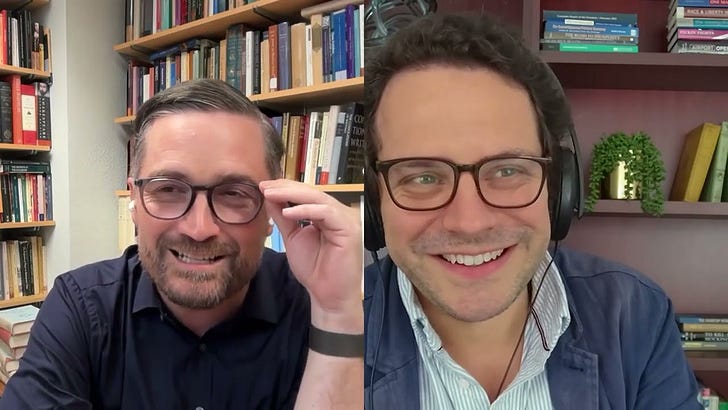
  • Jun 22, 2025 · 1 hr 3 min

    Victoria Moul. Poetry for life.

    Victoria Moul has been reading and memorising poetry since she was nine. She recites it at the dentist (‘Aubade’, rather alarmingly) and she recited poems all through her labours when she gave birth. We talked about all sorts of poetry, from ancient to living poets. What I really admire about Victoria is how at ease she is with poems across many centuries and how she can read as a scholar and with great personal emotion. Her Substack Horace & friends is one of my favourites. For the last quarter of this interview, Victoria recited poems which we discussed very briefly, mostly from memory. She must know hundreds by heart. We talked about * Horace * Shakespeare * Ovid * Claudian * Prudentius * Homer * Pindar * Sophocles * George Herbert * John Milton * Ben Jonson * Thomas Hardy * W. H. Auden * Keith Douglas * A. E. Housman * Basil Bunting * Ezra Pound * François de Malherbe * Philip Gross * Chris Childers (anthologist) * Michael Schmidt (anthologist) * Donald Davie * Gillian Allnutt * Marcel Proust * Diana Wynne Jones This is a public episode. If you would like to discuss this with other subscribers or get access to bonus episodes, visit www.commonreader.co.uk
  • Jun 12, 2025 · 1 hr 7 min

    Lamorna Ash. Don't Forget We're Here Forever

    In this interview, Lamorna Ash, author of Don’t Forget We’re Here Forever: A New Generation's Search for Religion, and one of my favourite modern writers, talked about working at the Times Literary Supplement, netball, M. John Harrison, AI and the future of religion, why we should be suspicious of therapy, the Anatomy of Melancholy, the future of writing, what surprised her in the Bible, the Simpsons, the joy of Reddit, the new Pope, Harold Bloom, New Atheism’s mistakes, reading J.S. Mill. I have already recommended her new book Don’t Forget We’re Here Forever, which Lamorna reads aloud from at the end. Full transcript below. Uploading videos onto Substack is too complicated for me (it affects podcast downloads somehow, and the instructions to avoid this problem are complicated, so I have stopped doing it), and to upload to YouTube I have to verify my account but they told me that after I tried to upload it and my phone is dead, so… here is the video embedded on this page. I could quote the whole thing. Here’s one good section. Lamorna: Which one would you say I should do first after The Sea, The Sea? Henry: Maybe The Black Prince. Lamorna: The Black Prince. Great. Henry: Which is the one she wrote before The Sea, The Sea and is just a massive masterpiece. Lamorna: I'll read it. Where do you stand on therapy? Do you have a position? Henry: I think on net, it might be a bad thing, even if it is individually useful for people. Lamorna: Why is that? Henry: [laughs] I didn't expect to have to answer the question. Basically two reasons. I think it doesn't take enough account of the moral aspect of the decisions being made very often. This is all very anecdotal and you can find yourself feeling better in the short term, but not necessarily in the long-- If you make a decision that's not outrageously immoral, but which has not had enough weight placed on the moral considerations. There was an article about how lots of people cut out relatives now and the role that therapy plays in that. What I was struck by in the article that was-- Obviously, a lot of those people are justified and their relatives have been abusive or nasty, of course, but there are a lot of cases where you were like, "Well, this is a long-term decision that's been made on a short-term basis." I think in 10 years people may feel very differently. There wasn't enough consideration in the article, at least I felt, given to how any children involved would be affected later on. I think it's a good thing and a bad thing. Lamorna: I'm so with you. I think that's why, because also the fact of it being so private and it being about the individual, and I think, again, there are certain things if you're really struggling with that, it's helpful for, but I think I'm always more into the idea of communal things, like AAA and NA, which obviously a very particular. Something about doing that together, that it's collaborative and therefore there is someone else in the room if you say, "I want to cut out my parent." There's someone else who said that happened to me and it was really hard. It means that you are making those decisions together a little bit more. Therapy, I can feel that in friends and stuff that it does make us, even more, think that we are these bounded individuals when we're not. Henry: I should say, I have known people who've gone to therapy and it's worked really well. Lamorna: I'm doing therapy right now and it is good. Transcript Henry: Today I am talking to Lamorna Ash. Lamorna is one of the rising stars of her generation. She has written a book about a fishing village in Cornwall. She's written columns for the New Statesman, of which I'm a great admirer. She works for a publisher and now she's written a book called, Don't Forget, We're Here Forever: A New Generation's Search for Religion. I found this book really compelling and I hope you will go and read it right now. Lamorna, welcome. Lamorna Ash: Thank you for having me. Henry: What was it like when you worked at the Times Literary Supplement? Lamorna: It was an amazing introduction to mostly contemporary fiction, but also so many other forms of writing I didn't know about. I went there, I actually wrote a letter, handwritten letter after my finals, saying that I'd really enjoyed this particular piece that somehow linked the anatomy of melancholy to infinite jest, and being deeply, deeply, deeply pretentious, those were my two favorite books. I thought, well, I'll apply for this magazine. I turned up there as an intern. They happened to have a space going. My job was Christmas in that I just spent my entire time unwrapping books and putting them out for editors to swoop by and take away. I'd take on people's corrections. I'd start to see how the editorial process worked. I started reading. I somehow had missed contemporary fiction. I hadn't read people like Rachel Kask or Nausgaard. I was reading them through going to the fiction pages. It made me very excited. Also, my other job whilst I was there, was I had the queries email. You'd get loads of incredibly random emails, including things like, you are cordially invited to go on the Joseph Conrad cycle tour of London. I'd ask the office, "Does anyone want to do this?" Obviously, no one ever said yes. I had this amazing year of doing really weird stuff, like going on Joseph Conrad cycling tour or going to a big talk at the comic book museum or the new advertising museum of London. I loved it. I really loved it. Henry: What was the Joseph Conrad cycling tour of London like? That sounds- Lamorna: Oh, it was so good. I remember at one point we stopped on maybe it was Blackfriars Bridge or perhaps it was Tower Bridge and just read a passage from the secret agent about the boats passing underneath. Then we'd go to parts of the docks where they believe that Conrad stayed for a while, but instead it would be some fancy youth hostel instead. It was run by the Polish Society of London, I believe-- the Polish Society of England, I believe. Again, each time it was like an excuse then to get into that writer and then write a little piece about it for the TLS. I guess, it was also, I was slightly cutting my teeth on how to do that kind of journalism as well. Henry: What do you like about The Anatomy of Melancholy? Lamorna: Almost everything. I think the prologue, Democritus Junior to the Reader is just so much fun and naughty. He says, "I'm writing about melancholy in order to try and avoid melancholy myself." There's six editions of it. He spent basically his entire life writing this book. When he made new additions to the book, rather than adding another chapter, he would often be making insertions within sentences themselves, so it becomes more and more bloated. There's something about the, what's the word for it, the ambition that I find so remarkable of every single possible version of melancholy they could talk about. Then, maybe my favorite bit, and I think about this as a writer a lot, is there's a bit called the digression of air, or perhaps it's digression on the air, where he just suddenly takes the reader soaring upwards to think about air and you sort of travel up like a hawk. It's this sort of breathing moment for a reader where you go in a slightly different direction. I think in my own writing, I always think about digression as this really valuable bit of nonfiction, this sense of, I'm not just taking you straight the way along. I think it'd be useful to go sideways a bit too. Henry: That was Samuel Johnson's favorite book as well. It's a good choice. Lamorna: Was it? Henry: Yes. He said that it was the only book that would get him out of bed in the morning. Lamorna: Really? Henry: Because he was obviously quite depressive. I think he found it useful as well as entertaining, as it were. Should netball be an Olympic sport? Lamorna: [laughs] Oh, it's already going to be my favorite interview. I think the reason it isn't an Olympic-- yes, I have a vested interest in netball and I play netball once a week. I'… This is a public episode. If you would like to discuss this with other subscribers or get access to bonus episodes, visit www.commonreader.co.uk
  • May 18, 2025 · 1 hr 11 min

    Helen Castor: imagining life in the fourteenth century.

    I was delighted to talk to the historian Helen Castor (who writes The H Files by Helen Castor) about her new book The Eagle and the Hart. I found that book compulsive, and this is one of my favourite interviews so far. We covered so much: Dickens, Melville, Diana Wynne Jones, Hilary Mantel, whether Edward III is to blame for the Wars of the Roses, why Bolingbroke did the right thing, the Paston Letters, whether we should dig up old tombs for research, leaving academia, Elizabeth I, and, of course, lots of Shakespeare. There is a full transcript below. Henry: Is there anything that we fundamentally know about this episode in history that Shakespeare didn't know? Helen: That's an extremely good question, and I'm tempted now to say no. Helen told me what is hardest to imagine about life in the fourteenth century. I think it's relatively easy to imagine a small community or even a city, because we can imagine lots of human beings together, but how relationships between human beings happen at a distance, not just in terms of writing a letter to someone you know, but how a very effective power structure happens across hundreds of miles in the absence of those things is the thing that has always absolutely fascinated me about the late Middle Ages. I think that's because it's hard, for me at least, to imagine. Good news to any publishers reading this. Helen is ready and willing to produce a complete edition of the Paston Letters. They were a bestseller when they were published a hundred years ago, but we are crying out for a complete edition in modern English. Henry: If someone wants to read the Paston Letters, but they don't want to read Middle English, weird spelling, et cetera, is there a good edition that they can use? Helen: Yes, there is an Oxford World's Classic. They're all selected. There isn't a complete edition in modern spelling. If any publishers are listening, I would love to do one. Henry: Yes, let's have it. Helen: Let's have it. I would really, really love to do that. Full Transcript Henry: Today I am talking to the historian, Helen Castor. Helen is a former fellow of Sydney Sussex College in Cambridge. She has written several books of history. She is now a public historian, and of course, she has a Substack. The H Files by Helen Castor We are going to talk mostly about her book, The Eagle and the Hart, which is all about Richard II and Henry IV. I found this book compulsive, so I hope you will read it too. Helen, welcome. Helen: Thank you very much for having me, Henry. Henry: You recently read Bleak House. Helen: I did. Henry: What did you think? Helen: I absolutely loved it. It was a long time since I'd read any Dickens. I read quite a lot when I was young. I read quite a lot of everything when I was young and have fallen off that reader's perch, much to my shame. The first page, that description of the London fog, the London courts, and I thought, "Why have I not been doing it for all these years?" Then I remembered, as so often with Dickens, the bits I love and the bits I'm less fond of, the sentimentality, the grotesquerie I'm less fond of, but the humour and the writing. There was one bit that I have not been able to read then or any of the times I've tried since without physically sobbing. It's a long time since a book has done that to me. I don't want to spoil it for anyone who hasn't read it, but-- Henry: I'm sure I know what you mean. That's quite a sentimental passage. Helen: It is, but not sentimental in the way that I find myself objecting to. I think I really respond viscerally to this sentimentalising of some of his young women characters. I find that really off-putting, but I think now I'm a parent, and particularly I'm a parent of a boy [laughter]. I think it's that sense of a child being completely alone with no one to look after them, and then finding some people, but too late for a happy ending. Henry: Too late. Helen: Yes. Henry: You've been reading other classic novels, I think, Moby Dick? Helen: I'm in the middle of Moby Dick as we speak. I'm going very slowly, partly because I'm trying to savour every sentence. I love the sentence so much as a form. Melville is just astonishing, and also very, very funny in a way I hadn't expected to keep laughing out loud, sometimes because there is such humour in a sentence. Sometimes I'm just laughing because the sentence itself seems to have such audacity and that willingness to go places with sentences that sometimes I feel we've lost in the sort of sense of rules-based sentences instead of just sticking a semicolon and keep going. Why not, because it's so gorgeous and full of the joy of language at that point? Anyway, I'm ranting now, but-- Henry: No, I think a lot of rules were instituted in the early 20th century that said you can and cannot do all these things, and writers before that point had not often followed those rules. I think what it has led to is that writers now, they can't really control a long sentence, in the sense that Melville and Dickens will do a long sentence, and it is a syntactically coherent thing, even though it's 60, 70 longer words. It's not just lots of stuff, and then, and then. The whole thing has got a beautiful structure that makes sense as a unit. That's just not obvious in a lot of writing now. Helen: I think that's exactly right. Partly, I've been reading some of the Melville out loud, and having just got onto the classification of whales, you can see I'm going very slowly. Those sentences, which are so long, but it's exactly that. If you read them out loud, and you follow the sense, and the punctuation, however irregular it might be in modern terms, gives you the breathing, you just flow on it, and the excitement of that, even or perhaps especially when one is talking about the classification of whales. Just joyful. Henry: Will we be seeing more very long sentences in your next book? Helen: I think I have to get a bit better at it. The habit that I was conscious of anyway, but became acutely so when I had to read my own audiobook for the first time is that I think I write in a very visual way. That is how I read because mostly it's silent. I discovered or rediscovered that often what I do when I want to write a very long sentence is I start the sentence and then I put a diversion or extra information within em dashes in the middle of the sentence. That works on the page because you can see spatially. I love that way of reading, I love seeing words in space. A lot of different kinds of text, both prose and poetry, I read in space like that. If you're reading to be heard, then the difficulty of breaking into a sentence with, whether it's brackets or em dashes or whatever, and then rejoining the sentence further down has its own challenges. Perhaps I ought to try and do less of that and experiment more with a Melvillian Dickensian onward flow. I don't know what my editor will think. Henry: What has brought you back to reading novels like this? Helen: I was wondering that this morning, actually, because I'm very aware having joined Substack, and of course, your Substack is one of the ones that is leading me further in this direction, very inspiringly, is discovering that lots of other people are reading and reading long novels now too. It reminded me of that thing that anyone with children will know that you have a baby and you call it something that you think only you have thought of, and then four years later, you call and you discover half the class is called that name. You wonder what was in the water that led everybody in that direction. I've just seen someone tweet this morning about how inspired they are by the builder next door who, on the scaffolding, is blasting the audiobook Middlemarch to the whole neighborhood. Henry: Oh my god. Amazing. Helen: It's really happening. Insofar as I can work out what led me as opposed to following a group, which clearly I am in some sense, I think the world at the moment is so disquieting, and depressing, and unnerving, that I think for me, there was a wish to escape into another world and another world that wo… This is a public episode. If you would like to discuss this with other subscribers or get access to bonus episodes, visit www.commonreader.co.uk
  • Apr 27, 2025 · 1 hr 21 min

    Clare Carlisle: George Eliot's Double Life.

    Clare Carlisle’s biography of George Eliot, The Marriage Question, is one of my favourite modern biographies, so I was really pleased to interview Clare. We talked about George Eliot as a feminist, the imperfections of her “marriage” to George Henry Lewes, what she learned from Spinoza, having sympathy for Casaubon, contradictions in Eliot’s narrative method, her use of negatives, psychoanalysis, Middlemarch, and more. We also talked about biographies of philosophers, Kierkegaard, and Somerset Maugham. I was especially pleased by Clare’s answer about the reported decline in student attention spans. Overall I thought this was a great discussion. Many thanks to Clare! Full transcript below. Here is an extract from our discussion about Eliot’s narrative ideas. Clare: Yes, that's right. The didactic thing, George Eliot is sometimes criticized for this didacticism because what's most effective in the novel is not the narrator coming and telling us we should actually feel sorry for Casaubon and we should sympathize with him. We'd be better people if we sympathize with Casaubon. There's a moralizing lecture about, you should feel sympathy for this unlikable person. What is more effective is the subtle way she portrays this character and, as I say, lets us into his vulnerabilities in some obvious ways, as you say, by pointing things out, but also in some more subtle ways of drawing his character and hinting at, as I say, his vulnerabilities. Henry: Doesn't she know, though, that a lot of readers won't actually be very moved by the subtle things and that she does need to put in a lecture to say, "I should tell you that I am very personally sympathetic to Mr. Casaubon and that if you leave this novel hating him, that's not--"? Isn't that why she does it? Because she knows that a lot of readers will say, "I don't care. He's a baddie." Clare: Yes I don't know, that's a good question. Henry: I'm interested because, in The Natural History of German Life, she goes to all these efforts to say abstract arguments and philosophy and statistics and such, these things don't change the world. Stories change the world. A picture of life from a great artist. Then when she's doing her picture of life from a great artist she constantly butts in with her philosophical abstractions because it's, she can't quite trust that the reader will get it right as it were. Clare: Yes, I suppose that's one way of looking at it. You could say that or maybe does she have enough confidence in her ability to make us feel with these characters. That would be another way of looking at it. Whether her lack of confidence and lack of trust is in the reader or in her own power as an artist is probably an open question. Transcript Henry: Today I am talking to Clare Carlisle, a philosopher at King's College London and a biographer. I am a big fan of George Eliot's Double Life: The Marriage Question. I've said the title backwards, but I'm sure you'll find the book either way. Clare, welcome. Clare Carlisle: Hi, Henry. Nice to be here. Henry: Is George Eliot a disappointing feminist? Clare: Obviously disappointment is relative to expectations, isn't it? It depends on what we expect of feminism, and in particular, a 19th-century woman. I personally don't find her a disappointing feminist. Other readers have done, and I can understand why that's the case for all sorts of reasons. She took on a male identity in order to be an artist, be a philosopher in a way that she thought was to her advantage, and she's sometimes been criticized for creating heroines who have quite a conventional sort of fulfillment. Not all of them, but Dorothea in Middlemarch, for example, at the end of the novel, we look back on her life as a wife and a mother with some sort of poignancy. Yes, she's been criticized for, in a way, giving her heroines and therefore offering other women a more conventional feminine ideal than the life she managed to create and carve out for herself as obviously a very remarkable thinker and artist. I also think you can read in the novels a really bracing critique of patriarchy, actually, and a very nuanced exploration of power dynamics between men and women, which isn't simplistic. Eliot is aware that women can oppress men, just as men can oppress women. Particularly in Middlemarch, actually, there's an exploration of marital violence that overcomes the more gendered portrayal of it, perhaps in Eliot's own earlier works where, in a couple of her earlier stories, she portrayed abused wives who were victims of their husband's betrayal, violence, and so on. Whereas in Middlemarch, it's interestingly, the women are as controlling, not necessarily in a nasty way, but just that that's the way human beings navigate their relations with each other. It seems to be part of what she's exploring in Middlemarch. No, I don't find her a disappointing feminist. We should be careful about the kind of expectations we, in the 21st century project onto Eliot. Henry: Was George Henry Lewes too controlling? Clare: I think one of the claims of this book is that there was more darkness in that relationship than has been acknowledged by other biographers, let's put it that way. When I set out to write the book, I'd read two or three other biographies of Eliot by this point. One thing that's really striking is this very wonderfully supportive husbands that, in the form of Lewes, George Eliot has, and a very cheerful account of that relationship and how marvelous he was. A real celebration of this relationship where the husband is, in many ways, putting his wife's career before his own, supporting her. Lewes acted as her agent, as her editor informally. He opened her mail for her. He really put himself at the service of her work in ways that are undoubtedly admirable. Actually, when I embarked on writing this book, I just accepted that narrative myself and was interested in this very positive portrayal of the relationship, found it attractive, as other writers have obviously done. Then, as I wrote the book, I was obviously reading more of the primary sources, the letters Eliot was writing and diary entries. I started to just have a bit of a feeling about this relationship, that it was light and dark, it wasn't just light. The ambiguity there was what really interested me, of, how do you draw the line between a husband or a wife who's protective, even sheltering the spouse from things that might upset them and supportive of their career and helpful in practical ways. How do you draw the line between that and someone who's being controlling? I think there were points where Lewes crossed that line. In a way, what's more interesting is, how do you draw that line. How do partners draw that line together? Not only how would we draw the line as spectators on that relationship, obviously only seeing glimpses of the inner life between the two people, but how do the partners themselves both draw those lines and then navigate them? Yes, I do suggest in the book that Lewes could be controlling and in ways that I think Eliot herself felt ambivalent about. I think she partly enjoyed that feeling of being protected. Actually, there was something about the conventional gendered roles of that, that made her feel more feminine and wifely and submissive, In a way, to some extent, I think she bought into that ideal, but also she felt its difficulties and its tensions. I also think for Lewes, this is a man who is himself conditioned by patriarchal norms with the expectation that the husband should be the successful one, the husband should be the provider, the one who's earning the money. He had to navigate a situation. That was the situation when they first got together. When they first got together, he was more successful writer. He was the man of the world who was supporting Eliot, who was more at the beginning of her career to some extent and helping her make connections. He had that role at the beginning. Then, within a few years, it had shifted and suddenly h… This is a public episode. If you would like to discuss this with other subscribers or get access to bonus episodes, visit www.commonreader.co.uk
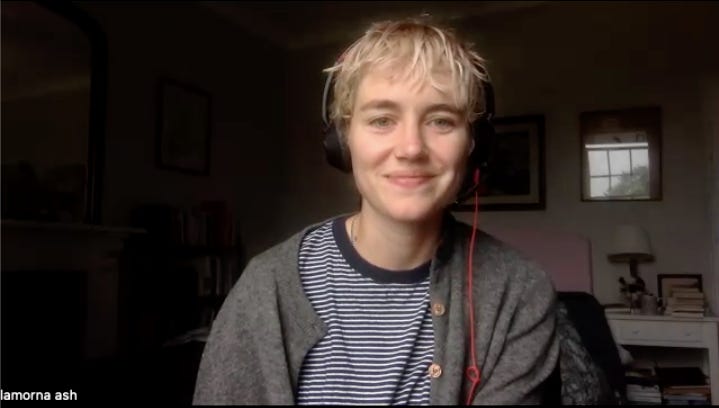
Showing 1–20 of 22 episodes