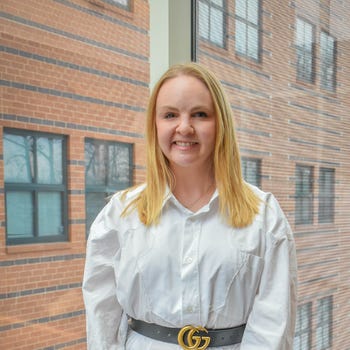
Nikki Keene Woods, Wichita State University - Why Patient Trust Determines Whether Technology Improves Care During Pregnancy
On Wichita State University Week: Technology can only help if people are willing to use it. Nikki Keene Woods, professor and chair of Public Health Sciences, reveals why some may not trust devices that could help them. Faculty Bio: Dr. Nikki Keene Woods is an applied behavioral scientist and public health professor. She joined WSU in 2012. She has master’s degrees in behavioral science and public health in addition to a PhD in Behavioral Psychology from the University of Kansas. She is a member of the American College of Healthcare Executives (ACHE) and the local chapter the Kansas ACHE. Her research centers on maternal/child health, with an emphasis on advancing health outcomes for women and underserved populations through applied interdisciplinary research. She has led or co-led numerous federally and state-funded projects, including a National Institutes of Health grant on wearable devices for fetal heart rate monitoring, a PCORI grant to improve women’s health, and authored more than 40 peer-reviewed publications. Dr. Keene Woods’ scholarship integrates community-engaged methods and applied data analytics to improve population health outcomes in Kansas and beyond. Transcript: When we think about new health technology, we often assume that better tools automatically lead to better care. But when it comes to care during pregnancy, that is not always the case. In my research, my team and I studied how women feel about using wearable devices that allow health care providers to remotely monitor a baby’s heart rate. These tools have great potential, especially for women in rural areas or communities with limited access to prenatal services. We surveyed women of reproductive age to understand what would make them willing or hesitant to use a remote fetal heart monitoring device. What we found was both practical and revealing. First, acceptance depended heavily on whether the technology fits into everyday life. Women were not opposed to technology, but they were clear about their expectations. Comfort and size mattered. Most women said the device would need to be small and fit easily into their daily routines. Second, age mattered in unexpected ways. Women in their thirties and forties were more accepting of the technology than younger women. We often assume that being younger automatically means being more comfortable or accepting of health technology, but pregnancy has a way of rewriting those assumptions. During pregnancy, trust, experience, and perceived risk may matter more than comfort with technology. Finally, privacy and accuracy were concerns as some women worried about who would have access to their data, and whether inconsistent readings might increase anxiety instead of providing reassurance. The takeaway is simple but important. If we want technology to improve care during pregnancy and reduce disparities, we have to design it with women. It’s about adding technology thoughtfully, in ways that make care feel more supportive, more human, and improve quality. Listening to women’s experiences and concerns is not a barrier to innovation. It is how innovation succeeds. Read More: Public Health Sciences at Wichita State University This is a public episode. If you would like to discuss this with other subscribers or get access to bonus episodes, visit www.academicminute.org