Skip to content
Artwork for TED-Ed
EducationScienceTechnology

TED-Ed

TED-Ed

TED-Ed’s mission is to create lessons worth sharing. Feed and expand your curiosity with our award-winning animated shorts - published on YouTube and available with supplemental learning materials on ed.ted.com.

Want to suggest an idea for a TED-Ed animation, nominate an educator or animator? Visit our website at: http://ed.ted.com/get_involved.

Consider backing us on Patreon. By doing so, you directly support our nonprofit mission to create free, high-quality educational content: https://www.patreon.com/teded

For more information on using TED-Ed content for commercial purposes (e.g. employee learning, in a film, or in an online course), please submit a Media Request using this link: https://media-requests.ted.com/

Play
  • 1,316 episodes
  • Avg 10 min
  • English

Episodes 1,316

Counted on this page — what you have heard stays on this device, so it is not something the list can be paged by.
  • August 26 · 8 min

    A brief history of alcohol - Rod Phillips

    Trace the 7,000 year old history of alcohol, from its first known origins in China to cultures all over the world fermenting their own drinks. -- Nobody knows exactly when humans began to create fermented beverages. The earliest known evidence comes from 7,000 BCE in China, where residue in clay pots has revealed that people were making an alcoholic beverage from fermented rice, millet, grapes, and honey. So how did alcohol come to fuel global trade and exploration? Rod Phillips explores the evolution of alcohol. Lesson by Rod Phillips, directed by Anton Bogaty. Animator's website: https://www.instagram.com/anton_bogaty/ Sign up for our newsletter: http://bit.ly/TEDEdNewsletter Support us on Patreon: http://bit.ly/TEDEdPatreon Follow us on Facebook: http://bit.ly/TEDEdFacebook Find us on Twitter: http://bit.ly/TEDEdTwitter Peep us on Instagram: http://bit.ly/TEDEdInstagram View full lesson: https://ed.ted.com/lessons/a-brief-hi... Thank you so much to our patrons for your support! Without you this video would not be possible! Mauricio Basso, Athena Grace Franco, Tirath Singh Pandher, Melvin Williams, Tsz Hin Edmund Chan, Nicolas Silva, Raymond Lee, Kurt Almendras, Denise A Pitts, Abdallah Absi, Dee Wei, Richard A Berkley, Tim Armstrong, Daniel Nester, Hashem Al, denison martins fernandes, Doug Henry, Arlene Spiegelman, Michał Friedrich, Joshua Wasniewski, Maryam Dadkhah, Kristiyan Bonev, Keven Webb, Mihai Sandu, Deepak Iyer, Javid Gozalov, Emilia Alvarado, Jaime Arriola, Mirzat Tulafu, Lewis Westbury, Felipe Hoff, Rebecca Reineke, Cyrus Garay, Victoria Veretilo, Michael Aquilina, William Biersdorf, Patricia Alves Panagides, Valeria Sloan Vasquez, Mike Azarkman, Yvette Mocete, Pavel Maksimov, Victoria Soler-Roig, Betsy Feathers, Samuel Barbas, Therapist Gus, Sai Krishna Koyoda, Elizabeth Parker, William Bravante, Irindany Sandoval and Mark wisdom. Learn more about your ad choices. Visit megaphone.fm/adchoices

  • August 26 · 21 min

    Science is for all people, kids included - Beau Lotto and Amy O'Toole

    What do science and play have in common? Neuroscientist Beau Lotto thinks all people (kids included) should participate in science and, through the process of discovery, change perceptions. He's seconded by 12-year-old Amy O'Toole, who, along with 25 of her classmates, published the first peer-reviewed article by schoolchildren, about the Blackawton bees project. It starts: "Once upon a time ... " Talk by Beau Lotto and Amy O'Toole. Learn more about your ad choices. Visit megaphone.fm/adchoices

  • August 26 · 27 min

    Let's transform energy -- with natural gas - T. Boone Pickens

    The US consumes 25% of the world's oil -- but as energy tycoon T. Boone Pickens points out onstage, the country has no energy policy to prepare for the inevitable. Is alternative energy our bridge to an oil-free future? After losing $150 million investing in wind energy, Pickens suggests it isn't, not yet. What might get us there? Natural gas. After the talk, watch for a lively Q&A with TED Curator Chris Anderson. Talk by T. Boone Pickens. Learn more about your ad choices. Visit megaphone.fm/adchoices

  • August 25 · 5 min

    Is space attempting to kill us? - Ron Shaneyfelt

    View full lesson: http://ed.ted.com/lessons/is-space-trying-to-kill-us-ron-shaneyfelt How likely is it that a massive asteroid will do major damage to Earth and its inhabitants? What about the sun -- is it dying out anytime soon? And the supermassive black hole at the center of the Milky Way -- should we be worried about that? Ron Shaneyfelt assesses the dangers of space. Lesson by Ron Shaneyfelt, animation by Retchy. Learn more about your ad choices. Visit megaphone.fm/adchoices
  • August 25 · 22 min

    Let's unite our medical data - John Wilbanks

    When you're getting medical treatment, or taking part in medical testing, privacy is important; strict laws limit what researchers can see and know about you. But what if your medical data could be used -- anonymously -- by anyone seeking to test a hypothesis? John Wilbanks wonders if the desire to protect our privacy is slowing research, and if opening up medical data could lead to a wave of health care innovation. Talk by John Wilbanks. Learn more about your ad choices. Visit megaphone.fm/adchoices

  • August 25 · 9 min

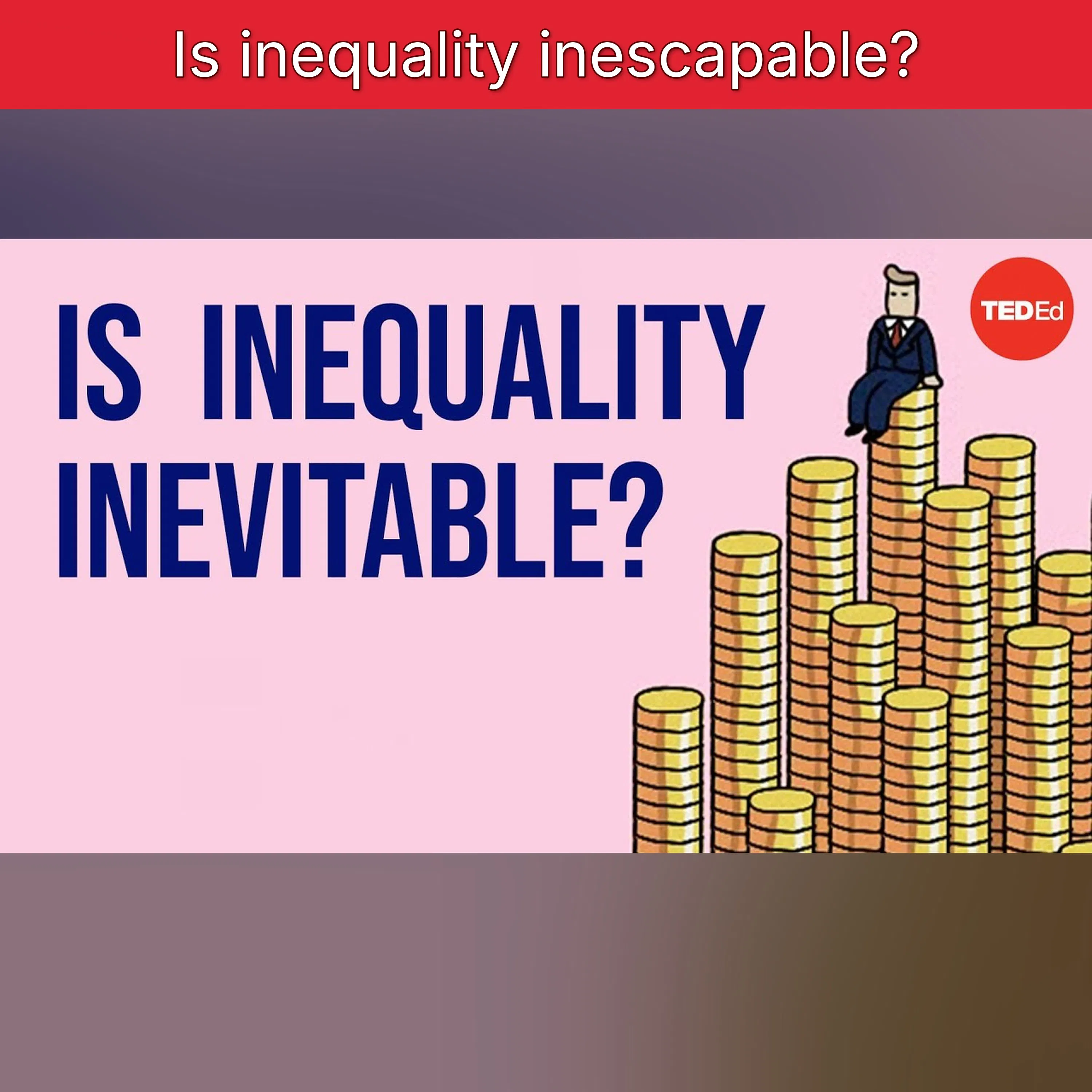
    Is inequality inescapable?

    Explore how economic inequality can be measured and how it is impacted by different governmental policy choices. -- Income and wealth inequality are not new. In fact, economists and historians who have charted economic inequality throughout history haven’t found a single society without it. Which raises a bleak question: is inequality … inevitable? Explore how economic inequality can be measured and how it is impacted by different governmental policy choices. Directed by Natália Azevedo Andrade, AIM Creative Studios. This video made possible in collaboration with World Economic Forum Learn more about how TED-Ed partnerships work: https://bit.ly/TEDEdPartners Support Our Non-Profit Mission ---------------------------------------------- Support us on Patreon: http://bit.ly/TEDEdPatreon Check out our merch: http://bit.ly/TEDEDShop ---------------------------------------------- Connect With Us ---------------------------------------------- Sign up for our newsletter: http://bit.ly/TEDEdNewsletter Follow us on Facebook: http://bit.ly/TEDEdFacebook Find us on Twitter: http://bit.ly/TEDEdTwitter Peep us on Instagram: http://bit.ly/TEDEdInstagram ---------------------------------------------- Keep Learning ---------------------------------------------- View full lesson: https://ed.ted.com/lessons/is-inequality-inevitable Dig deeper with additional resources: https://ed.ted.com/lessons/is-inequality-inevitable#digdeeper Animator's website: http://aimcreativestudios.com Music: https://soundcloud.com/aim-music ---------------------------------------------- Thank you so much to our patrons for your support! Without you this video would not be possible! Brad Sullivan, Karen Ho, Niklas Frimberger, Hunter Manhart, Nathan Nguyen, Igor Stavchanskiy, James R DeVries, Grace Huo, Diana Huang, Chau Hong Diem, Orlellys Torre, Corheu, Thomas Mee, Maryann H McCrory, Blas Borde, John Hellmann, Poompak Meephian, Chuck Wofford, Adam Pagan, Wes Winn, Conder Shou, ntiger, Noname, Hansan Hu, David D, Mac Hyney, Keith Ellison, robin valero walters, Lynne Truesdale, Gatsby Dkdc, Matthew Neal, Denis Chon, Julian Oberhofer, Monte Carroll, Eddy, Jay M, Constantino Victor Delgado, Andrea Galvagni, Andrew Tweddle, Laurel-Ann Rice, Fernando A. Endo, Helen Lee, pam morgan, sarim haq, Gerardo Castro, Michel-Ange Hortegat, Enes Kirimi, Amaury BISIAUX, ND and Samyogita Hardikar. Learn more about your ad choices. Visit megaphone.fm/adchoices

  • August 25 · 28 min

    Yup, I built a nuclear fusion reactor - Taylor Wilson

    Taylor Wilson believes nuclear fusion is a solution to our future energy needs, and that kids can change the world. And he knows something about both of those: When he was 14, he built a working fusion reactor in his parents' garage. Now 17, he takes the TED stage at short notice to tell (the short version of) his story. Talk by Taylor Wilson. Learn more about your ad choices. Visit megaphone.fm/adchoices

  • August 25 · 8 min

    Should you care what your parents value?

    Dig into the Romeo and Juliet Effect, which describes the tendency to find someone more desirable when met by parental opposition. -- In 1972, psychologists at the University of Colorado surveyed 140 couples to determine whether a relationship facing parental disapproval was more likely to strengthen or crumble under the pressure. Can long-term success of a romantic relationship be predicted by the perceived approval or disapproval of the couple’s friends and family? Dig into the trend known as the Romeo and Juliet Effect. Directed by Maryna Buchynska, and action creative agency. This video made possible in collaboration with Character Lab Learn more about how TED-Ed partnerships work: https://bit.ly/TEDEdPartners A special thanks to H. Colleen Sinclair and Diane Felmlee who provided information and insights for the development of this video. Support Our Non-Profit Mission ---------------------------------------------- Support us on Patreon: http://bit.ly/TEDEdPatreon Check out our merch: http://bit.ly/TEDEDShop ---------------------------------------------- Connect With Us ---------------------------------------------- Sign up for our newsletter: http://bit.ly/TEDEdNewsletter Follow us on Facebook: http://bit.ly/TEDEdFacebook Find us on Twitter: http://bit.ly/TEDEdTwitter Peep us on Instagram: http://bit.ly/TEDEdInstagram ---------------------------------------------- Keep Learning ---------------------------------------------- View full lesson: https://ed.ted.com/lessons/would-you-stop-dating-someone-your-parents-didn-t-like Dig deeper with additional resources: https://ed.ted.com/lessons/would-you-stop-dating-someone-your-parents-didn-t-like#digdeeper Animator's website: https://and-action.net/ ---------------------------------------------- Thank you so much to our patrons for your support! Without you this video would not be possible! Barbara Smalley, Megan Douglas, Tim Leistikow, Ka-Hei Law, Hiroshi Uchiyama, Mark Morris, Misaki Sato, EdoKun, SookKwan Loong, Bev Millar, Lex Azevedo, Michael Aquilina, Jason A Saslow, Yansong Li, Cristóbal Moenne, Dawn Jordan, Prasanth Mathialagan, Samuel Doerle, David Rosario, Dominik Kugelmann - they-them, Siamak Hajizadeh, Ryohky Araya, Mayank Kaul, Christophe Dessalles, Heather Slater, Sandra Tersluisen, Zhexi Shan, Bárbara Nazaré, Andrea Feliz, Victor E Karhel, Sydney Evans, Latora, Noel Situ, emily lam, Sid, Niccolò Frassetto, Mana, I'm here because of Knowledge Fight Facebook group., Linda Freedman, Edgardo Cuellar, Jaspar Carmichael-Jack, Michael Burton, VIVIANA A GARCIA BESNE, The Vernon's, Olha Bahatiuk, Jesús Bíquez Talayero, Chels Raknrl, Sai Pranavi Jonnalagadda, Stuart Rice, Jing Chen, Vector-Dopamine math, Jasper Song, Giorgio Bugnatelli, Chardon, Eddy Trochez, OnlineBookClub.org, Eric Shear, Leith Salem, Omar Hicham and Adrian Rotaru. Learn more about your ad choices. Visit megaphone.fm/adchoices

  • August 25 · 17 min

    Excuse me, may I borrow your car? - Robin Chase

    A decade ago, Robin Chase founded Zipcar in the US, now the largest car-sharing company in the world. Now she's exploring the next level of car-sharing: Buzzcar, a French startup that lets people rent their own cars to others. The details are fascinating (how does insurance work, exactly?), and the larger vision (she calls it Peers, Inc.) points to a new definition of ownership and entrepreneurship. Talk by Robin Chase. Learn more about your ad choices. Visit megaphone.fm/adchoices

  • August 25 · 7 min

    How art can help you analyze - Amy E. Herman

    View full lesson: http://ed.ted.com/lessons/how-art-can-help-you-analyze-amy-e-herman Can art save lives? Not exactly, but our most prized professionals (doctors, nurses, police officers) can learn real world skills through art analysis. Studying art like René Magritte's Time Transfixed can enhance communication and analytical skills, with an emphasis on both the seen and unseen. Amy E. Herman explains why art historical training can prepare you for real world investigation. Lesson by Amy E. Herman, animation by Flaming Medusa Studios Inc. Learn more about your ad choices. Visit megaphone.fm/adchoices

  • August 25 · 21 min

    The economic case for preschool - Timothy Bartik

    In this well-argued talk, Timothy Bartik makes the macro-economic case for preschool education -- and explains why you should be happy to invest in it, even if you don't have kids that age (or kids at all). The economic benefits of well-educated kids, it turns out, go well beyond the altruistic. (Filmed at TEDxMiamiUniversity.) Talk by Timothy Bartik. Learn more about your ad choices. Visit megaphone.fm/adchoices

  • August 25 · 9 min

    A cinematic tour through visual effects - Don Levy

    View full lesson: http://ed.ted.com/lessons/a-cinematic-journey-through-visual-effects-don-levy It's been 110 years since Georges Méliès sent a spaceship slamming into the eye of the man on the moon. So how far have visual effects come since then? Working closely with the Academy of Motion Picture Arts and Sciences, Don Levy takes us on a visual journey through special effects, from the fakery of early technology to the seamless marvels of modern filmmaking. Talk by Don Levy. Learn more about your ad choices. Visit megaphone.fm/adchoices

  • August 25 · 3 min

    Mysteries of vernacular: Initiate - Jessica Oreck

    View full lesson: http://ed.ted.com/lessons/mysteries-of-vernacular-inaugurate-jessica-oreck From avian omens to the beginning of a new policy or the reign of a new politician, Jessica Oreck follows the flight path of the word inaugurate. Lesson and animation by Jessica Oreck. Learn more about your ad choices. Visit megaphone.fm/adchoices

  • August 25 · 8 min

    Why you procrastinate even when it's unpleasant

    Explore what happens in the brain to trigger procrastination, and what strategies you can use to break the cycle of this harmful practice. -- The report you’ve been putting off is due tomorrow. It’s time to buckle down, open your computer ... and check your phone. Maybe watch your favorite YouTube channel? Or maybe you should just start in the morning? This is the cycle of procrastination. So, why do we procrastinate when we know it’s bad for us? Explore how your body triggers a procrastination response, and how you can break the cycle. Directed by Vitalii Nebelskyi, and action agency. This video made possible in collaboration with Character Lab Learn more about how TED-Ed partnerships work: https://bit.ly/TEDEdPartners A special thanks to Fuschia Sirois who provided information and insights for the development of this video. Support Our Non-Profit Mission ---------------------------------------------- Support us on Patreon: http://bit.ly/TEDEdPatreon Check out our merch: http://bit.ly/TEDEDShop ---------------------------------------------- Connect With Us ---------------------------------------------- Sign up for our newsletter: http://bit.ly/TEDEdNewsletter Follow us on Facebook: http://bit.ly/TEDEdFacebook Find us on Twitter: http://bit.ly/TEDEdTwitter Peep us on Instagram: http://bit.ly/TEDEdInstagram ---------------------------------------------- Keep Learning ---------------------------------------------- View full lesson: https://ed.ted.com/lessons/why-you-procrastinate-even-when-it-feels-bad Dig deeper with additional resources: https://ed.ted.com/lessons/why-you-procrastinate-even-when-it-feels-bad#digdeeper Animator's website: https://and-action.net ---------------------------------------------- Thank you so much to our patrons for your support! Without you this video would not be possible! Sandra Tersluisen, Zhexi Shan, Bárbara Nazaré, Andrea Feliz, Victor E Karhel, Sydney Evans, Latora, Noel Situ, emily lam, Sid, Niccolò Frassetto, Mana, I'm here because of Knowledge Fight Facebook group., Linda Freedman, Edgardo Cuellar, Jaspar Carmichael-Jack, Michael Burton, VIVIANA A GARCIA BESNE, The Vernon's, Olha Bahatiuk, Jesús Bíquez Talayero, Chels Raknrl, Sai Pranavi Jonnalagadda, Stuart Rice, Jing Chen, Vector-Dopamine math, Jasper Song, Giorgio Bugnatelli, Chardon, Eddy Trochez, OnlineBookClub.org, Eric Shear, Leith Salem, Omar Hicham, Adrian Rotaru, Brad Sullivan, Karen Ho, Niklas Frimberger, Hunter Manhart, Nathan Nguyen, Igor Stavchanskiy, James R DeVries, Grace Huo, Diana Huang, Chau Hong Diem, Orlellys Torre, Corheu, Thomas Mee, Maryann H McCrory and Blas Borde. Learn more about your ad choices. Visit megaphone.fm/adchoices

  • August 25 · 8 min

    How was the Great Pyramid of Giza built? - Soraya Field Fiorio

    Explore how the ancient Egyptians built the Great Pyramid, a tomb created for Pharaoh Khufu which took over 20 years to complete. -- As soon as Pharaoh Khufu ascended the throne circa 2575 BCE, work on his eternal resting place began. The structure’s architect, Hemiunu, determined he would need 20 years to finish the royal tomb. But what he could not predict was that this monument would remain the world’s tallest manmade structure for over 3,800 years. Soraya Field Fiorio digs into the construction of the Great Pyramid. Lesson by Soraya Field Fiorio, directed by Luísa M H Copetti, Hype CG. This video made possible in collaboration with Marriott Hotels Learn more about how TED-Ed partnerships work: https://bit.ly/TEDEdPartners Support Our Non-Profit Mission ---------------------------------------------- Support us on Patreon: http://bit.ly/TEDEdPatreon Check out our merch: http://bit.ly/TEDEDShop ---------------------------------------------- Connect With Us ---------------------------------------------- Sign up for our newsletter: http://bit.ly/TEDEdNewsletter Follow us on Facebook: http://bit.ly/TEDEdFacebook Find us on Twitter: http://bit.ly/TEDEdTwitter Peep us on Instagram: http://bit.ly/TEDEdInstagram ---------------------------------------------- Keep Learning ---------------------------------------------- View full lesson: https://ed.ted.com/lessons/how-did-they-build-the-great-pyramid-of-giza-soraya-field-fiorio Dig deeper with additional resources: https://ed.ted.com/lessons/how-did-they-build-the-great-pyramid-of-giza-soraya-field-fiorio#digdeeper Animator's website: https://www.hype.cg and https://www.luisacopetti.com.br ---------------------------------------------- Thank you so much to our patrons for your support! Without you this video would not be possible! Vanessa Graulich, Vandana Gunwani, Abdulmohsin Almadi, AJ Lyon, Geoffrey Bultitude, Mi Mi, Thomas Rothert, Brian Elieson, Oge O, Weronika Falkowska, Nevin Spoljaric, Sid Chanpuriya, Anoop Varghese, David Yastremski, Noah Webb, Roberto Chena, Oliver Koo, Luke Pisano, Andrea Gordon, Aleksandar Donev, Nicole Klau Ibarra, Jesse Lira, Ezekiel Raui, Petr Vacek, Dennis, Olivia Fu, Kari Teffeau, Cindy Lai, Rajath Durgada Manjunath, Dan Nguyen, Chin Beng Tan, Tom Boman, Karen Warner, Iryna Panasiuk, Aaron Torres, Eric Braun, Sonja Worzewski, Michael Clement, Adam Berry, Ghaith Tarawneh, Nathan Milford, Tomas Beckett, Alice Ice, Eric Berman, Kurt Paolo Sevillano, Jennifer Heald, Megulo Abebe, isolwi, Kate Sem and Ujjwal Dasu. Learn more about your ad choices. Visit megaphone.fm/adchoices

  • August 25 · 12 min

    The arts festival movement - David Binder

    David Binder is a major Broadway producer, but last summer he found himself in a small Australian neighborhood, watching locals dance and perform on their lawns -- and loving it. He shows us the new face of arts festivals, which break the boundary between audience and performer and help cities express themselves. Talk by David Binder. Learn more about your ad choices. Visit megaphone.fm/adchoices

  • August 25 · 3 min

    "Jabberwocky": One of literature's best bits of nonsense

    Dive into Lewis Carroll’s epic nonsense poem, “Jabberwocky” from his novel "Through the Looking-Glass, and What Alice Found There." -- As Alice wanders through the dreamscape of Looking-Glass Land in Lewis Carroll's "Through the Looking-Glass, and What Alice Found There," she happens across a book written in an unintelligible language. Inside, she discovers an epic poem filled with nonsense, fearsome creatures, and whimsical language. Dive into Carroll's legendary poem, "Jabberwocky" and see if you can make sense of the nonsense. Poem by Lewis Carroll, directed by Sjaak Rood. Sign up for our newsletter: http://bit.ly/TEDEdNewsletter Support us on Patreon: http://bit.ly/TEDEdPatreon Follow us on Facebook: http://bit.ly/TEDEdFacebook Find us on Twitter: http://bit.ly/TEDEdTwitter Peep us on Instagram: http://bit.ly/TEDEdInstagram View full lesson: https://ed.ted.com/lessons/jabberwocky-one-of-literature-s-best-bits-of-nonsense Thank you so much to our patrons for your support! Without you this video would not be possible! Della Palacios, Vik Nagjee, Hiroshi Uchiyama, Adi V, Andrew Bosco, Craig Sheldon, Rishi Pasham, Joanne Luce, Jason A Saslow, Mary Sawyer, Scott Gass, Ruth Fang, Mayank Kaul, Kathryn J Hammond, Max Shuai Tang, Terry Minion, Sami Khan, Rob Johnson, Abdullah Abdulaziz, Angelo Urzua-Milla, Tommy Lewis, leorene, Mahina Bachiller, Marcus Andre Nery, Bruce Vieira Lopes, Chef, Charmaine Hanson, Michael Goldberg, Lydia Pflieger, Paul Aldred-Bann, Manav parmar, Susan Wang, Utkarsh Dubey, Thawsitt, Xuebicoco, Jezabel, Maeve , Kim Humphrey, Kristen Damas, JackKeyton , Matthew D. Vigil, Amin Shahril, Adriano Fontes, Xiao Yu, Fatima Kried, Aravind Battaje, Melissa Suarez, Jason Duncan and Brian A. Dunn. Learn more about your ad choices. Visit megaphone.fm/adchoices

  • August 25 · 7 min

    Could a breathalyzer detect cancer? - Julian Burschka

    Discover how scientists are analyzing compounds in the breath to create a versatile breathalyzer capable of detecting disease. -- How is it that a breathalyzer can measure the alcohol content in someone’s blood, hours after they had their last drink, based on their breath alone? And could we use this same technology to detect disease by analyzing a person’s breath, without having to use more invasive diagnostic tools like biopsies, blood draws, and radiation? Julian Burschka details the complicated process. Lesson by Julian Burschka, directed by Cabong Studios. Animator's website: https://www.cabongstudios.com.br Sign up for our newsletter: http://bit.ly/TEDEdNewsletter Support us on Patreon: http://bit.ly/TEDEdPatreon Follow us on Facebook: http://bit.ly/TEDEdFacebook Find us on Twitter: http://bit.ly/TEDEdTwitter Peep us on Instagram: http://bit.ly/TEDEdInstagram View full lesson: https://ed.ted.com/lessons/could-a-breathalyzer-detect-cancer-julian-burschka Thank you so much to our patrons for your support! Without you this video would not be possible! Brighteagle, Beatriz Inácio, Mighterbump, Pamela Harrison, Maija Chapman, Liana Switzer, Curtis Light, The Brock, Dianne Palomar, Edgar Campos Barrachina, Maria Lerchbaumer, Ever Granada, Marin Kovachev, Ravi S. Rāmphal, Penelope Misquitta, Tekin Gültekin, Jhuval, Hans Peng, Gaurav Mathur, Erik Biemans, Tony, Michelle, Katie and Josh Pedretti, Vaibhav Mirjolkar, Thomas Bahrman, Allan Hayes, Aidan Forero, Uday Kishore, Mikhail Shkirev, Devesh Kumar, Sunny Patel, Anuj Tomar, Lowell Fleming, David Petrovič, Hoai Nam Tran, Stina Boberg, Alexandrina Danifeld, Kack-Kyun Kim, Travis Wehrman, haventfiguredout, Caitlin de Falco, Ken, zjweele13, Anna-Pitschna Kunz, Edla Paniguel, Elena Crescia, Thomas Mungavan, Alejandro Cachoua, Jaron Blackburn, Yoga Trapeze Wanderlust, Sandy Nasser and Venkat Venkatakrishnan. Learn more about your ad choices. Visit megaphone.fm/adchoices

  • August 25 · 8 min

    Is life meaningless? And other absurd questions - Nina Medvinskaya

    Dive into Albert Camus’ philosophy of the absurd, and explore the question: if the world is meaningless, could our lives still hold value? -- Albert Camus grew up surrounded by violence. His homeland of Algeria was mired in conflict. He lost his father in World War I. Seeing World War II's devastation, Camus grew despondent. What was the meaning behind all this endless bloodshed and suffering? And if the world was meaningless, could our individual lives still hold value? Nina Medvinskaya explores Camus’ philosophy of the absurd. Lesson by Nina Medvinskaya, directed by Avi Ofer. Animator's website: https://aviofer.com/ Sign up for our newsletter: http://bit.ly/TEDEdNewsletter Support us on Patreon: http://bit.ly/TEDEdPatreon Follow us on Facebook: http://bit.ly/TEDEdFacebook Find us on Twitter: http://bit.ly/TEDEdTwitter Peep us on Instagram: http://bit.ly/TEDEdInstagram View full lesson: https://ed.ted.com/lessons/is-life-meaningless-and-other-absurd-questions-nina-medvinskaya Thank you so much to our patrons for your support! Without you this video would not be possible! Carlos H. Costa, Eimann P. Evarola, Aleksandr Lyozin, Mohamed Elsayed, Alan Wilder, Marcus Appelbaum, Francisco Leos, Kevin O'Leary, Les Howard, Ten Cha, Mehmet Yusuf Ertekin, Arlene Weston, phkphk123321, Jennifer Kurkoski, Ryan B Harvey, Austin Randall, Abhishek Bansal, Jayant Sahewal, Dian Atamyanov, igor romanenko, Jose Arcadio Valdes Franco, Brandy Sarver, Guy Hardy, Tu-Anh Nguyen, Karl Laius, Madee Lo, JY Kang, Marc Bou Zeid, Abhishek Goel, Charles A Hershberger, Coenraad Keuning, Robert Seik, Heidi Stolt, Alexis Hevia, Todd Gross, Brady Jones, Christina Salvatore, Zhong Ming Zenny Tan, Karisa Caudill, Bruno Pinho, Derek Drescher, Mihail Radu Pantilimon, Amin Shahril, Mohamed Elsayed, Barthélémy Michalon, Chumi Ogbonna, Karlee Finch, Mohammad Said, jj5252 and Kelvin Lam. Learn more about your ad choices. Visit megaphone.fm/adchoices

  • August 25 · 7 min

    things all skilled listeners know

    Dig into different strategies that can improve your listening skills so you can become a high quality listener. -- It’s easy to tell when someone’s not paying attention, but it can be surprisingly tricky to know what good listening looks like. Good listening is one of the most important things we can do to improve our relationships, develop our worldview, and potentially change people’s minds. So what can we do to become better listeners? Dig into different strategies that can improve your listening skills. Directed by Maryna Buchynska, and action agency. This video made possible in collaboration with Character Lab Learn more about how TED-Ed partnerships work: https://bit.ly/TEDEdPartners A special thanks to Guy Itzchakov and Harry Reis who provided information and insights for the development of this video. Support Our Non-Profit Mission ---------------------------------------------- Support us on Patreon: http://bit.ly/TEDEdPatreon Check out our merch: http://bit.ly/TEDEDShop ---------------------------------------------- Connect With Us ---------------------------------------------- Sign up for our newsletter: http://bit.ly/TEDEdNewsletter Follow us on Facebook: http://bit.ly/TEDEdFacebook Find us on Twitter: http://bit.ly/TEDEdTwitter Peep us on Instagram: http://bit.ly/TEDEdInstagram ---------------------------------------------- Keep Learning ---------------------------------------------- View full lesson: https://ed.ted.com/lessons/4-things-all-great-listeners-know Dig deeper with additional resources: https://ed.ted.com/lessons/4-things-all-great-listeners-know#digdeeper Animator's website: https://www.and-action.net ---------------------------------------------- Thank you so much to our patrons for your support! Without you this video would not be possible! Matthew Neal, Denis Chon, Julian Oberhofer, Monte Carroll, Eddy, Jay M, Constantino Victor Delgado, Andrea Galvagni, Andrew Tweddle, Laurel-Ann Rice, Fernando A. Endo, Helen Lee, pam morgan, sarim haq, Gerardo Castro, Michel-Ange Hortegat, Enes Kirimi, Amaury BISIAUX, ND, Samyogita Hardikar, Vanessa Graulich, Vandana Gunwani, Abdulmohsin Almadi, AJ Lyon, Geoffrey Bultitude, Mi Mi, Thomas Rothert, Brian Elieson, Oge O, Weronika Falkowska, Nevin Spoljaric, Sid Chanpuriya, Anoop Varghese, David Yastremski, Noah Webb, Roberto Chena, Oliver Koo, Luke Pisano, Andrea Gordon, Aleksandar Donev, Nicole Klau Ibarra, Jesse Lira, Ezekiel Raui, Petr Vacek, Dennis, Olivia Fu, Kari Teffeau, Cindy Lai, Rajath Durgada Manjunath and Dan Nguyen. Learn more about your ad choices. Visit megaphone.fm/adchoices

Showing 581–600 of 1,316 episodes