Skip to content
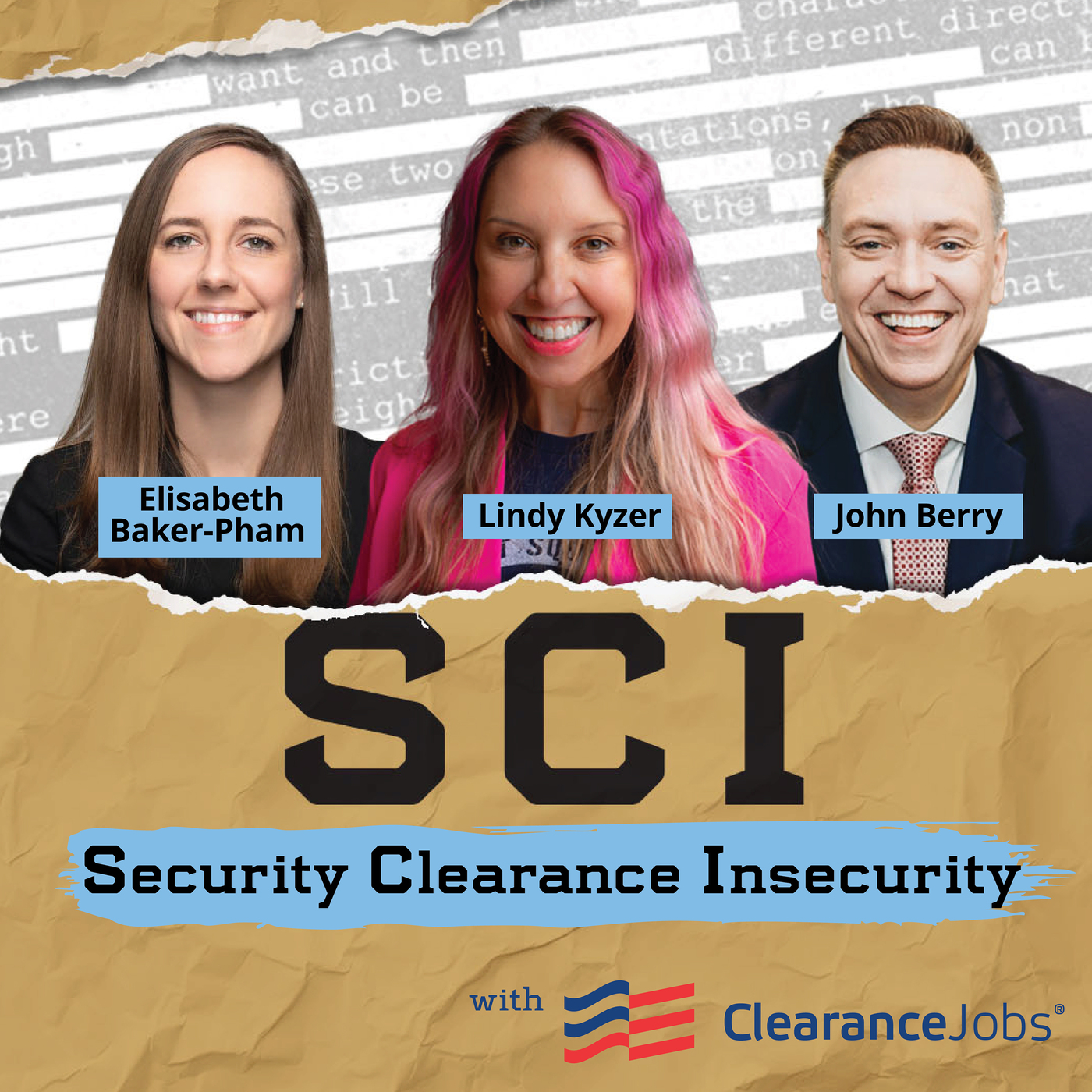
Artwork for Security Clearance Insecurity

Security Clearance Insecurity

Federal News Network | Hubbard Radio

Millions of jobs require a U.S. government security clearance. Getting or keeping one is an anxiety-inducing process shrouded in mystery, and sometimes, urban legend. From drug use and bankruptcy to cryptocurrencies and motorcycle gangs, we unpack all of your top (or most unexpected) security clearance questions. We also talk with some of the leading experts and government officials charged with overseeing the security clearance process and establishing security policies. Security Clearance Insecurity demystifies security clearances, delivers expert insight, and answers the questions you’d never ask at work. Hosted by ClearanceJobs.com's Lindy Kyzer and Sean Bigley, security clearance legal correspondent and regular ClearanceJobs contributor.

Play
  • 23 episodes
  • fortnightly
  • Avg 28 min
  • English
Counted on this page — what you have heard stays on this device, so it is not something the list can be paged by.
  • February 6 · 28 min

    Who’s Accountable When AI Shapes National Security Decisions?

    The federal government can no longer treat artificial intelligence as optional—but what does true AI readiness actually look like? On this episode of Security Clearance Insecurity, host Lindy Kyzer sits down with Jennifer Ewbank, former Deputy Director of the CIA for Digital Innovation, to unpack how AI is reshaping national security missions, workforce expectations, and accountability across government. Rather than focusing on tools or pilot programs, Ewbank makes the case for a mission-first approach to AI—one that prioritizes readiness, governance, and human judgment. The conversation explores why digital literacy must become foundational for the entire federal workforce, how AI and cybersecurity skills are increasingly intertwined, and why uniquely human skills like critical thinking, ethics, and adaptability matter more than ever. They also dive into the realities holding agencies back—from messy data environments and compliance-driven culture to slow hiring pipelines and outdated talent systems—and why the greatest risk to government may be standing still while technology accelerates. Whether you’re a clearance holder, hiring leader, policymaker, or technologist, this episode offers a clear-eyed look at what it will take to responsibly scale AI across federal missions—without losing accountability, transparency, or trust. See Privacy Policy at https://art19.com/privacy and California Privacy Notice at https://art19.com/privacy#do-not-sell-my-info.

  • January 23 · 28 min

    A New Era of Security Clearance Insecurity: New Legal Voices, Real-World Guidance for 2026

    The Security Clearance Insecurity podcast welcomes new legal contributors Elisabeth Baker-Pham of Kalijarvi, Chuzi, Newman & Fitch, P.C. and John Berry of Berry & Berry, PLLC to the mic. In this episode, the panel breaks down how security clearance decisions intersect with employment law, why agencies handle cases differently, and what cleared professionals should know before filling out an SF-86, responding to investigators, or facing a statement of reasons. A must-listen for anyone navigating the cleared workforce this year. See Privacy Policy at https://art19.com/privacy and California Privacy Notice at https://art19.com/privacy#do-not-sell-my-info.

  • January 9 · 28 min

    Why Workplace Flexibility Matters for the National Security Workforce

    What does flexibility really mean for the national security workforce—and why does it matter now? In this episode, ClearanceJobs’ Lindy Kyzer is joined by workforce strategist and former federal executive Mika Cross for a timely conversation on the future of federal and cleared work. Drawing from congressional testimony, workforce data, and decades of public service experience, they unpack how telework, hybrid models, and strategic flexibility directly impact mission readiness, talent retention, and national security outcomes. The discussion explores: Why flexibility is a national security imperative, not a workplace perk The real costs of losing high-performing cleared professionals Military spouse employment and its impact on readiness What the President’s Management Agenda signals for the federal workforce How national security agencies can lead on agility, trust, and innovation This episode offers critical insight for cleared professionals, federal leaders, recruiters, and policymakers navigating the evolving realities of government work. See Privacy Policy at https://art19.com/privacy and California Privacy Notice at https://art19.com/privacy#do-not-sell-my-info.

Showing 21–23 of 23 episodes