Skip to content
Artwork for Sanity and Society
Health & FitnessMental Health

Sanity and Society

Jeremy

Welcome to "Sanity and Society," where we peel back the layers of the modern mind and the cultural forces that shape it. I'm your host, a therapist with a passion for exploring the deep and sometimes daunting aspects of human psychology as they intersect with today's most pressing societal issues. Life doesn't come with an instruction manual, but you can think of this program as a guide for better understanding the complexities of the human psyche and the societal trends impacting us all.

psychfox.substack.com
Play
  • 20 episodes
  • Avg 50 min
  • English
  • August 31 · 58 min

    Attachment, Limerence, and the Crisis of Modern Dating

    Sometimes we aren't chasing a person; we're trying to prove that we can obtain a love that was lost to us. Why do we sometimes want the person who is least available to us? And how do you know whether the urge to leave a relationship is wisdom or an old attachment pattern coming back online? In Part 2 of my conversation with Dr. Nicole Ohebshalom, we move from trauma therapy into the psychology of relationships, dating, intimacy, shame, and repair. Even though you can listen to this episode completely independently without any confusion, part 1 is right here if you want to give it a listen. We talk about: * Avoidant and anxious attachment. * Relationship anxiety. * When breaking up is healthy versus defensive. * Red flags and relationship dynamics. * Affair recovery and rebuilding trust. * Emotional availability. * Hypervigilance and catastrophizing. * Why anxiety destroys curiosity. * EMDR negative cognitions. * Self-criticism and the inner judge. * Ego states and parts work. * Perfectionism in high performers. * Why not everything comes from childhood trauma. * Limerence and obsessive romantic attachment. * Intermittent emotional availability. * Repetition compulsion. * Dating apps and micro-rejection. * Modern dating culture. * Money, status, and gender expectations. * Changing ideas about masculinity and femininity. * Desire discrepancy. * Sexual intimacy. * Performance anxiety. * Feeling desired versus simply having more sex. * Playfulness and emotional safety. * Why your partner cannot realistically be everything. * And why curiosity may be one of the most important relationship skills we have. One theme runs through almost the entire conversation: We tend to confuse our predictions with reality. Trauma can make the mind certain that an old danger is happening again. Limerence can make emotional inconsistency feel like profound love. Perfectionism can make an ordinary mistake feel like evidence of inadequacy. And modern dating culture can train people to interpret every imperfect moment as a red flag. The antidote to this is curiosity. The ability to pause long enough to ask: What is actually happening here? Show Notes, Chapters and Timestamps 00:00 — Trauma, attachment & the urge to leaveHow do you distinguish an avoidant trauma response from realizing a relationship genuinely isn’t healthy? 01:10 — Relationship red flags & your role in the dynamicLooking beyond simplistic red-flag culture to understand how both people may contribute to a relationship pattern. 02:18 — Affair recovery, betrayal trauma & relationship repairWhat does the hurt partner actually need after infidelity?Being heard. Accountability. Emotional presence. Repair. 05:31 — Contempt, emotional availability & infidelity riskWhen partners stop feeling accessible and responsive to one another, something important begins to erode. 07:10 — Avoidant attachment, anxious attachment & emotional withdrawalWithdrawal doesn’t always mean someone stopped caring. Sometimes fear makes people quieter. 07:42 — Curiosity as an antidote to relationship anxietyInstead of immediately assuming rejection:Why are you moving away?What is happening between us? 08:29 — Anxiety, catastrophizing & the loss of curiosityAnxiety narrows perception.We begin treating assumptions as facts. 09:18 — Trauma & predictive processingHow past experiences shape what the brain expects to happen next — especially when the cost of being wrong once felt enormous. 10:08 — EMDR negative cognitions & the stories we tell ourselvesThe beliefs underneath our reactions.The “lie” we repeatedly tell ourselves about who we are. 10:46 — Why you shouldn’t believe every thought you haveSelf-critical thoughts. Worst-case scenarios. Rumination.Sometimes the mind is warning you about something that isn’t actually happening. 11:39 — Agency, identity & choosing who you becomeWe often forget that we have some capacity to choose which thoughts and identities we strengthen. 12:29 — Perfectionism, high performers & fear of failureWhat happens when competence becomes part of identity?Trying something new suddenly becomes psychologically dangerous. 13:42 — “Failing up” and high-achiever psychologyLearning through failure versus needing to remain ten steps ahead of everyone else. 15:13 — Shame, childhood & the inner criticWhere does chronic self-judgment come from? 15:48 — Ego states: the judging part vs. the wise partA simple parts-work framework for recognizing self-criticism without becoming consumed by it. 16:47 — Mindfulness, dopamine & changing self-critical habitsNotice the judging part.Pause.Ground.Then create enough space to respond differently. 17:57 — Imposter syndrome, introjects & EMDRCritical parents, teachers, internalized voices, and the possibility of building a more adaptive internal resource. 18:23 — Not everything is childhood traumaAn important corrective to pop psychology.Sometimes personality is personality.Temperament matters too. 20:05 — Rumination, analysis paralysis & changing the channelWhy endless analysis can reinforce the very loop you’re trying to escape. 20:57 — Psychological agency & the observing selfYou may have more room to respond differently than your emotional state initially suggests. 21:35 — Humanistic therapy & seeing more than pathologyA person isn’t merely a collection of trauma responses.Strengths, temperament, history, and personality matter. 23:38 — Is judgment learned or innate?Self-criticism, threat detection, temperament, hypervigilance, and the possible adaptive function of judgment. 26:08 — Intrusive thoughts, honesty & what love requiresYou can notice a thought without obeying it.The conversation turns toward honesty, kindness, and mature love. 27:26 — Attachment vs. limerenceFeeling seen and emotionally received is very different from romantic obsession. 28:51 — Serial limerence & idealizing unavailable peopleWhat are we actually chasing when we repeatedly fall for people who cannot fully meet us? 29:35 — Childhood attachment & intermittent loveA childhood doesn’t have to be overtly abusive for love to feel unpredictable. 31:08 — Repetition compulsion: trying to finally “win” unavailable loveWhy emotionally inconsistent partners can feel strangely familiar. 32:24 — Creating secure attachment in datingHow do you create steadiness when your own perception of relationships feels difficult to trust? 32:54 — Dating apps, micro-rejection & digital disconnectionConstant evaluation.Disposable options.Online self-objectification.And the psychological cost of dating through screens. 34:31 — Rejection sensitivity & why dating endings feel personalSometimes someone else’s withdrawal really isn’t about you. 35:09 — Why closure and honest communication matterA compassionate explanation can completely change how another person experiences rejection. 36:01 — Millennials, Gen Z & “getting your life together” before loveDo we really need to become fully optimized individuals before entering a relationship? 37:44 — Status anxiety, money & the dating marketplaceHas achievement become a prerequisite for feeling worthy of love? 38:22 — Dating apps and the illusion of infinite optionsWhen relationships start being evaluated like consumer products. 39:56 — Who pays for the date? Gender roles & modern dating scriptsChanging expectations around independence, provision, fairness, and being cared for. 42:47 — High-achieving women, identity & authenticityAfter achieving independence, what happens when someone realizes the life she built isn’t exactly the life she wants? 46:11 — Traditional gender roles without the gender warCan couples selectively create roles that actually work for them without turning relationships into ideological combat? 48:24 — Your partner cannot be everythingFriendship. Romance. Hobbies. Sexuality.What should a partner provide — and what should come from elsewhere? 49:28 — Desire discrepancy & mismatched sex drivesWhat happens when one partner wants sex much more frequently than the other? 50:50 — Do you want more sex — or do you want to feel desired?Sometimes the stated problem and the emotional need underneath it are not the same thing. 52:11 — Emotional safety, arousal & rebuilding intimacyPressure often reduces desire.Safety and playfulness can create room for it. 53:14 — Practical relationship advice: bring back playSmall shared activities can communicate something enormous:I see you.I care what you enjoy. 53:39 — The “us” factor vs. the “me” factorHealthy relationships sometimes require protecting the relationship itself from a culture of constant individual optimization. 54:19 — Curiosity might be the relationship superpowerCuriosity about yourself.Curiosity about your partner.Curiosity instead of certainty. 55:21 — Closing thoughts: trauma, couples therapy & repair 57:03 — Psychoanalysis, defense mechanisms & EMDRA brief closing conversation about integrating psychodynamic thinking with trauma therapy. Get full access to Next Level Psychology at psychfox.substack.com/subscribe

  • August 19 · 31 min

    Why You Can Understand Yourself and Still Be Stuck

    Introduction Dr. Nicole Ohebshalom joins me to talk about EMDR therapy, trauma,shame, attachment, the body, and high performers.We get into what happens when insight alone isn’t enough.Why some people intellectualize.Why not everyone experiences emotions strongly in their body.And why good trauma therapy involves much more than simply processingpainful memories. This episode begins with a conversation about shame, and bridges intomany relevant psychology topics.Dr. Nicole Ohebshalom and I talk about:• How relationships activate old beliefs.• Why knowing your patterns is different from changing them (whyinsight alone can fail to heal)• EMDR negative cognitions.• Attachment wounds.• The body in therapy.• Intellectualization.• High performers.• Parts work.• Resourcing.• Why not everybody experiences emotion somatically (physically)• and also, why good trauma therapy sometimes requires slowing down.We also get into a misconception I hear often:"EMDR is just eye movements."EMDR reprocessing matters, and so does everything that makes thereprocessing possible.This is part 1 of a 2 part series, so keep an eye (or an ear) out forthe next episode, releasing soon. Do you like mental health content that illuminates, rather than reduces or confuses?To receive new posts and support my work, consider becoming a free or paid subscriber. Show notes with Timestamps Chapters00:00 — Dr. Nicole Ohebshalom: EMDR, trauma therapy & sex therapyNicole's background in trauma studies, human sexuality, clinicalcounseling, EMDR, couples work, and women's health.00:44 — Shame, childhood trauma & attachmentWhere shame comes from.How early relationships shape adult intimacy.How shame becomes part of the dance between two people.01:42 — EMDR negative cognitions & fight-flight-freeze responsesThe beliefs underneath trauma."I'm not enough.""I'm too much.""I'll be left."How the body can continue reacting as though an old belief is still true.03:30 — EMDR reprocessing and changing relationship patternsWhat happens after a traumatic memory is processed?Can new relationship experiences help consolidate the change?04:12 — Couples therapy, attachment work, EFT & parts workIntegrating EMDR with relational therapy.Flash Technique.Emotionally Focused Therapy.Attachment figures.IFS and ego-state work.06:10 — Pelvic pain, vaginismus, anxiety & protective responsesHow physical symptoms can become part of a relationship cycle.One person pursues.The other withdraws.The body begins protecting itself.09:50 — The body in trauma therapyNicole's nursing background.Why she became interested in the connection between psychotherapy and the body.10:21 — “I'm not enough”: shame, schemas & negative beliefsThe beliefs people unconsciously organize their lives around.Self-concept.Intimacy.Abandonment.Dependency.The overlap between schemas and EMDR negative cognitions.11:31 — Attachment wounds and what the body remembersWhat message did your body pick up as a child?How early relational experiences become expectations about love,safety, and connection.13:46 — Emotional avoidance, defenses & blocking beliefsWhat happens when someone can't access emotion?Fear of feelings.Shame about emotion.And when emotional avoidance may function as a defense.14:17 — High performers, intellectualization & interoceptionA crucial distinction:Sometimes intellectualization is protective.Sometimes a person simply doesn't experience much sensation internally.Therapy shouldn't automatically pathologize that.15:19 — Is therapy too focused on “feeling it in your body”?The pendulum swing in modern trauma therapy.Why forcing emotional or somatic experience can itself become shaming.16:32 — Integration vs. catharsis in psychotherapyThe goal isn't necessarily to feel more:it's to integrate more.Why highly intelligent and high-achieving clients can understand allof their patterns and still remain stuck.18:12 — Trauma-informed pacing vs. avoidanceWhen should a therapist gently push?When should therapy slow down?How intellectualization can become an escape without becoming the enemy.19:21 — EMDR myths: it's not just eye movementsOne of the biggest misconceptions about EMDR therapy.Bilateral stimulation is only one part of the model.Case conceptualization, treatment planning, preparation, reprocessing,closure, and reevaluation all matter.21:17 — Why therapists shouldn't rush trauma processingThe temptation to immediately target a painful memory.Why good EMDR treatment planning asks what larger network that memorybelongs to.23:22 — High achievers, resilience & strengths-based trauma therapyTrauma survivors often arrive knowing everything that has gone wrong.What happens when therapy also helps them recognize what survived?24:48 — EMDR resourcing & the “positive memory playlist”Calm places.Wise figures.Nurturing figures.Past experiences of competence and strength.Building accessible memories that say: I can do this.25:51 — IFS, ego states & parts work in EMDRManagers.Firefighters.Protective parts.Addiction and emotional avoidance.Understanding what a protective part is actually afraid will happen.26:40 — Parts work, chronic PTSD & stabilizationWhy Nicole increasingly spends more time with parts of the self beforereprocessing.Creating internal resources before asking someone to approachtraumatic material.28:05 — Trauma preparation, containment & the window of toleranceSometimes slowing down makes the difficult work go more smoothly.Preparation isn't avoiding trauma work,It is part of trauma work.28:47 — Somatic therapy & body-based EMDR interweavesMovement during reprocessing.Getting out of the chair.Following physical impulses.Using curiosity when EMDR reaches a stuck point.29:38 — Movement, grounding & deeper trauma processingNicole describes using the environment and physical movement during anextended EMDR session.30:22 — EMDR 2.0, working memory & attention taxationMovement.Changing tasks.Additional attentional demands.And different ways of keeping one foot in the present while traumaticmaterial is being reprocessed. TopicsEMDR therapy • trauma therapy • PTSD • shame • attachment • childhoodtrauma • couples therapy • emotionally focused therapy • negativecognitions • fight-flight-freeze • somatic therapy • high performers •high achievers • intellectualization • emotional avoidance • IFS •Internal Family Systems • ego states • parts work • resilience •trauma processing • trauma-informed therapy • EMDR resourcing •nervous system regulation • window of tolerance • pelvic pain •psychotherapy Get full access to Next Level Psychology at psychfox.substack.com/subscribe

  • August 14 · 58 min

    The Psychology of Spider-Man: Brand New Day

    I wanted to talk about the new Spider-Man movie, Spider-Man: Brand New Day: grief, trauma, how those things mix together and resolve. I want to also address resilience, and how women and men have to work together for trauma recovery. Even if you have not seen the prior movies, you should be able to understand what I address in this article. Several years after No Way Home, Peter Parker lives alone and works almost exclusively as Spider-Man. That is his whole gig. Aunt May is no more after the attack by the Green Goblin. MJ and Ned are alive, but Doctor Strange’s spell has erased Peter from their memories. In order to protect the people he loved—his girlfriend and his best friend—Peter asked Doctor Strange to make everyone forget who he was. So he lost his support network. Peter visits Aunt May’s grave, watches his former friends from a distance, and channels nearly his entire existence into crime-fighting. He has become extremely effective as Spider-Man. But Peter Parker, as a human being, has almost ceased to have a personal life. The movie gives us three responses to traumatic grief. Peter throws himself into work that helps others. Frank Castle throws himself into work that avenges and punishes. Jean Grey throws herself into personal vengeance. Super-sadness versus super-anger: that is complexity. That is the human experience. Get full access to Next Level Psychology at psychfox.substack.com/subscribe

  • June 30 · 49 min

    The Anatomy and Causes of Family Estrangement

    Highlights from my conversation with Dr. Joshua Coleman on estrangement, recovered memory, and the validation vendor. Dr. Coleman has a saying: when an adult child cuts contact, “dads get mad and moms get sad.” The anger and grief are the same emotional pain routed through different defenses: externalization in one, rumination in the other. He pairs it with the reminder that, “you can be right, or you can be reconciled, but you usually cannot be both.” Please listen to/watch our latest interview for the rich conversation that addresses the nuances of estrangement, as well as a variety of other relevant psychotherapy topics, such as how therapists can better address trauma. A longer essay will be forthcoming, but as this is a podcast post, the video is the main course, while these notes function as garnish. Browse our menu of topics below, to get an idea of just how much we address: Timestamps for section chapters 00:00 Understanding Family Estrangement 02:48 Parenting Styles and Their Impact 05:24 The Shift in Family Dynamics 08:18 Generational Differences in Estrangement 11:11 The Role of Therapy in Healing 13:59 Memory and Trauma: A Complex Relationship 16:22 Navigating Parent-Child Relationships 19:16 Ethics in Therapy and Memory Recovery 20:04 The Complexity of Parenting and Mental Health 22:48 The Role of Therapists and the Importance of Choice 26:11 Accountability and Growth in Relationships 28:47 Understanding Estrangement in Family Dynamics 32:37 Radical Acceptance and Hope in Estrangement 35:54 Building Self-Compassion and Identity Beyond Parenting 37:42 Emotional Intelligence in Parenting Boys 40:28 Navigating Parental Investment and Modern Parenting Challenges 40:43 The Evolution of Parenting and Child Development 43:33 Differentiation and Emotional Boundaries 46:25 Cultural Perspectives on Parental Influence and Identity Thank you Megan Against Injustice, RN, PsyPhi, Geraldine A. V. Hughes, Brenda D, Sandi, and many others for tuning into my live video with Joshua Coleman, Ph.D. Join me for my next live video in the app. Get full access to Next Level Psychology at psychfox.substack.com/subscribe

  • June 23 · 1 hr 15 min

    Transforming Grief into Power with Stephen Seidel

    Stephen Seidel is a PR/media agency founder who believes in prioritizing connection, in a world that says “say it in a sentence or move on.” This healthy authenticity is a balm for modern masculinity, which is adrift in awful platitudes and misunderstandings. Please take a listen to our interview, in which Stephen addresses his “Reconnect, Rebuild, Reclaim” model for forging strength out of grief, both honoring the departed and fortifying our inner sense of self and purpose. Voices on Grief, Connection, and Showing Up (Quotes from our Podcast) Steve: “Vulnerability is invincibility. And only when we share our story do we allow ourselves to step into our power.” Steve: “When you get to a place where you’re willing to let go and take your fists and undo them and you can put your hand over your heart instead of being stuck in your head.” Jeremy: “Trauma was never your fault, but healing is always your choice and responsibility.” Jeremy: “Bitterness really slows you down, not the person who hurt you.” Steve: “It’s not what you do for people, it’s how you made them feel that they’re gonna remember the most.” Jeremy: “When kids know you’re there and that you care, at their core, they know that nothing’s gonna shake them. That buffers like a probiotic, a force field from trauma.” Steve: “Who do I identify with? Somebody who’s going to let the past dictate who I am, or somebody who’s going to lead by example for my daughter.” Jeremy: “What you practice, you become. We build ourselves through habit.” Steve: “On the deathbed, a lot of people who talk about their regrets, they just wish that they spent more time with their family.” Steve: “People are gonna say no. Try anyway.” Jeremy: “Being mindful means becoming the forecaster for the weather in our mind.” Steve: “Those fries at the bottom of the bag, which we overlook so much, those are the special moments that we look back on to savor.” Steve: “Goodbyes are for those who love with their eyes, because for those who love with their heart and soul, there is no such thing as separation.” Note: an essay that aggregates our conversation into a compendium of choice quotes is forthcoming, as well. Timestamps: 00:00 Introduction to Grief and Connection 02:55 Transforming Grief into Action 05:46 The Ongoing Relationship with Grief 08:43 Finding Glimmers in Grief 11:39 Men’s Mental Health and Balance 14:19 The Power of Connection and Legacy 23:15 The Importance of Male Emotional Connections 24:47 Exploring Masculinity in Modern Times 25:39 The Journey Deck: A Tool for Self-Discovery 26:35 Healing and Responsibility in Trauma 28:10 The Role of Journaling in Emotional Healing 29:32 Navigating Childhood Trauma and Parental Influence 31:39 Creating a Safe Emotional Environment for Children 33:15 Understanding Trauma and Identity 35:43 Overcoming Medical Trauma and Identity 38:47 The Impact of Medical Experiences on Mental Health 40:04 Curiosity vs. Judgment in Emotional Connections 42:34 The Power of Eye Contact and Connection 43:48 Mindfulness and the Present Moment 45:16 Creativity and Boredom: A Path to Self-Discovery 47:10 Fries at the Bottom of the Bag: Cherishing Moments 49:31 Creative Exercises and Their Impact 52:24 Lessons from the Entertainment Industry 57:02 The Importance of Connection and Community 59:49 Mindfulness and Mental Health 01:02:21 Reconnecting with Purpose 01:05:17 Experiences with Impractical Jokers 01:13:24 Upcoming Projects and Community Engagement Get full access to Next Level Psychology at psychfox.substack.com/subscribe

  • May 27 · 1 hr 53 min

    How to Think Like a Roman Emperor

    The Sentence Every CBT Therapist Repeats Without Knowing It I recorded a podcas tinterview with Donald Robertson (see above), the cognitive-behavioral psychotherapist who has spent two decades arguing that Stoicism is the unacknowledged parent of modern CBT. Robertson (2019) opened the case with a clinical detail most therapists have never heard. Albert Ellis, in the 1950s, used to hand patients a single line from Epictetus during the orientation phase of treatment and build the entire ABC model around it. “He said, read this quote from Epictetus, one of the main stoic teachers, it’s passage five of the Enchiridion, a handbook of Epictetus that says, it’s not things or events that upset us, but our opinions about them. And Ellis taught that, because it encapsulated what he called the ABC model.”` Read that again. The cognitive model of emotion, the load-bearing assumption of every CBT manual on the market, was lifted intact from a Greek slave who died in 135 CE. Beck (1976) was equally explicit when he traced the philosophical origins of cognitive therapy to the Stoic school. Robertson (2019) documents both attributions in detail in his Philosophy of Cognitive-Behavioural Therapy. The mechanism is the same one our patients are running every minute of every session. Stimulus arrives, appraisal fires, autonomic state shifts, behavioral output follows, downstream consequence locks the loop in place. Epictetus interrupts the loop at the appraisal step. Beck interrupted it at the appraisal step. The technology is identical. The licensure paperwork is different. What follows is an argument I have been making in clinical consultation for the better part of a year, and which Robertson sharpened across two hours of conversation. The cognitive model has a documented prior author. Modern psychotherapy has systematically forgotten the prior author. The forgetting costs us decades of clinical refinement, and I can name the specific decades. How a Therapist-Friendly Philosophy Got Sidelined Anyway Robertson noticed the asymmetry early. Laypeople found Stoicism. Therapists did not. “When I first started getting into stoicism, it was really a nerdy thing. And I didn’t have any little stoic friends at the time… weirdly, they seem to have kind of lagged behind a little bit the wave of popular interest in stoicism, which kind of surprised me.” Two explanations sit on top of each other. Robertson (2019) attributes the first to clinician reading budgets. CBT practitioners spend their professional hours inside outcome research and treatment manuals, leaving the philosophical literature to specialists. The second is linguistic. The lowercase English adjective “stoic” means emotionally shut down, which reads as the opposite of what therapy is supposed to deliver. Most clinicians I have consulted with carry that conflation without noticing. The conflation does material damage. Robertson made the corrective explicit in our conversation: “What they call a value, which is an intrinsic quality of action and character, seems to me a weirdly convoluted way of just referring to what any student of philosophy would immediately recognize is arete or virtue… They’ve kind of reintroduced it as it were. Right now it’s like a hot topic again in psychotherapy.” Hayes, Strosahl, and Wilson (2012) built acceptance and commitment therapy around values clarification as a third-wave innovation. The construct of values in ACT is arete in Stoicism. The framework was waiting on the shelf for two millennia, and Hayes rediscovered it under a new branding cycle without ever having to credit the source. I will name the pattern at the center of this essay. I call it the Citation Amnesia Problem: a discipline that re-derives its own techniques every two generations because its institutional memory only reaches back as far as the most recent peer-reviewed manual. The pattern is not aesthetic. It is iatrogenic. Why “CBT Already Does This” Misses What Got Left Behind The standard pushback when I introduce Stoic frames in clinical consultation runs like this: the relevant techniques are already inside CBT, so the philosophical scaffolding is decoration. Robertson conceded that Ellis and Beck imported pieces of Stoicism into the clinic. He also named what they left out. “There’s a difference between a bunch of techniques, or therapy is more than that, but it’s kind of moving in that direction and generalizing the whole thing so it becomes part of your identity and way of life… nowadays we’re more interested in prevention rather than cure. Resilience building is kind of the holy grail of psychotherapy… it’s dawning on people that if you want to do that, then you need to re-conceptualize the whole thing more in terms of a philosophy of life rather than a group of techniques or an intervention.” Stoicism delivers cognitive technology inside a coherent meaning structure. Modern CBT, in its lean evidence-based forms, delivers the same technology inside a fifty-minute reimbursement code. The patient learns to dispute automatic thoughts, scores lower on the PHQ-9 at termination, and drifts back to baseline at six months because the technique was never embedded in anything that asks why a person should bother regulating affect at all. Robertson framed it in evolutionary terms without quite using the word. Stoicism was designed as resilience training for a population that expected catastrophe as a baseline. How Behavioral Activation Got Lost for Forty Years The pattern of rediscovery has a specific, traceable case study. Beck, Rush, Shaw, and Emery (1979) published the standard treatment manual for depression with three major components stacked on top of each other: activity scheduling, automatic-thought disputation, and core-belief work targeting underlying schemas. Jacobson et al. (1996) ran the canonical dismantling study, randomizing 150 outpatients with major depression to the full Beck protocol, the protocol minus schema work, or behavioral activation in isolation. Across termination and six-month follow-up, Jacobson and colleagues found no advantage for the multi-component treatment over behavioral activation alone. Dimidjian et al. (2006) replicated and extended the finding in a four-arm trial. Behavioral activation now sits in its own evidence base as a first-line treatment for major depressive disorder. Lewinsohn (1974) developed the underlying reinforcement theory of depression years before Beck’s manual appeared in 1979. Robertson surfaced the lineage problem this exposes, and his tone shifted when he said it: “Beck’s seminal book on cognitive therapy, nowhere in that entire book does he mention Peter Lewinson, who developed behavior therapy for clinical depression a few years earlier… We already had like, you know, this was effective in itself. What Beck added to it works, but it didn’t really add anything to the efficacy. And so that kind of blinded us for decades to thinking, CBT for depression is this multi-component treatment that combines activity scheduling and cognitive disputation… We could have had half a century of ongoing research in psychotherapy.” Forty years. Patients with major depression received the full Beck package across that span, including the cognitive components that Jacobson (1996) eventually showed contributed no incremental benefit. Researchers who could have spent the same four decades refining the active ingredient spent them tracking redundant scaffolding. The mechanism that produced the drift was citation failure. Beck did not credit Lewinsohn. The field assumed the package was load-bearing in all its parts. The Citation Amnesia Problem then closed the loop. Robertson made the same point about Dubois (1909), the Swiss psychiatrist whose Psychic Treatment of Nervous Disorders described what we would now call cognitive psychotherapy. Dubois prescribed Seneca’s letters as bibliotherapy. He ran what we would now call cognitive disputation. The field absorbed Freud instead, forgot Dubois entirely, and then rediscovered the same territory under Ellis and Beck in the 1950s and 1960s. Robertson dates the loss at half a century. The Patient Who Cannot Stop Worrying, and the Sentence That Was Already There Picture a patient with generalized anxiety disorder. She presents with chronic perseverative worry, sleep-onset insomnia, somatic tension across the shoulders and jaw, and a metacognitive conviction that her worry is uncontrollable and dangerous. She has tried thought-stopping. She has tried distraction. She arrives in the consulting room expecting another technique to fail. Wells (2009), the developer of metacognitive therapy at the University of Manchester, opens treatment with an assessment move that should look familiar to anyone who has read the Enchiridion. He asks the patient to rate, from zero to one hundred percent, how much she believes she has voluntary control over the worrying itself. Patients with GAD score near zero on this rating. Wells then disproves the belief experimentally, through detached mindfulness drills and stimulus-control postponement, until the patient discovers that perseverative thinking is a high-level cognitive process she can interrupt. Robertson made an observation in our interview that I have not been able to stop thinking about: “Clients will say, I can’t control my worry… we can prove to them that actually they can take control over it. Like it’s a high level strategic cognitive process that you can actually, to some extent, stop doing or detach yourself from… people massively underestimate how much control they have over some of the things that are going on in their head. But equally, they’ll be trying to ignore, suppress, block out, automatically thoughts and feelings that they should just let be.” Epictetus, operationalized. The opening line of the Enchiridion partitions phenomena into what is up to us and what is not (Epictetus, ca. 125 CE/2018). My patient with GAD has the partition exactly backwards. She is expending voluntary effort on phenomena outside voluntary control (the intrusive image, the heart rate, the future outcome) while disclaiming voluntary control over the elaborative process that she can in fact interrupt (the rumination chain itself). The treatment task is to flip the partition. What Robertson said next deserves a slow read: “That’s so simple. You could write the instructions for it in the back of a business card… You can get them to evaluate their progress in applying it. It’s only really one basic strategy that they have to employ. It’s eminently testable, right?” The dichotomy of control is testable. Wells (2009) built metacognitive therapy around a structurally identical move and accumulated outcome data competitive with standard CBT for GAD. Nobody has yet isolated the dichotomy of control as a standalone intervention and run a dismantling study against multi-component CBT. Whether Epictetus-as-protocol would outperform Beck-as-package remains an open empirical question. The Citation Amnesia Problem closed it before anyone thought to ask. Pseudo-Passions and the Polyvagal Patient The objection I hear most when I import Stoic frames into trauma work is that the philosophy demands emotional suppression. The textual record contradicts that reading. Seneca, in De Ira, described what he called propatheiai, proto-passions: involuntary first movements that precede cognitive appraisal. His example was the reflexive blink when a finger approaches the eye. Robertson summarized the construct exactly as it appears in the Stoic literature: “Seneca says, it’s kind of like, his example is interesting. He says, it’s like if someone went to poke their finger in your eye and you blinked. He said, we have emotions that are like that… But the stoics, and even Beck, would say that the important thing is what happens next.” The mechanism Seneca described in the first century maps almost perfectly onto contemporary affective neuroscience. LeDoux (2015) describes a rapid subcortical thalamo-amygdalar pathway that activates autonomic reactivity before cortical appraisal completes. Porges (2011), in the polyvagal model, describes neuroception, an unconscious detection process that recruits autonomic state before any deliberate cognition arrives. Restate Seneca’s position in modern terms and you get the operating assumption of every credible trauma-informed clinician working today. Robertson told the story of an unnamed Stoic teacher caught in a storm at sea, recorded by Aulus Gellius. The teacher turned pale and shook with the rest of the passengers. After the ship reached harbor, Gellius confronted him. The teacher pulled a lost book of Epictetus from his satchel and explained that the autonomic reaction was shared with animals and seasoned sailors alike. The Stoic distinction was not the absence of the proto-passion. The Stoic distinction was the refusal to add rumination on top of it once the storm had passed. Two layers of intervention follow from this. The first-movement layer (the autonomic surge, the somatic intrusion, the reflexive startle) requires bottom-up work. Shapiro (2018) built EMDR around exactly this layer, using bilateral stimulation to uncouple somatic and emotional content from the source memory through the adaptive information processing mechanism. The second-movement layer (the interpretation, the elaborative meaning the patient assigns to the reactivation) requires cognitive work. Stoic-informed appraisal exercises target this layer directly. Conflating the two layers is a clinical error in both directions. I have watched cognitive-only protocols fail trauma patients because they pushed appraisal work onto first-movement reactivations the patient could not yet interrupt. I have also watched somatic-only protocols stall because they treated the second-movement appraisal as a fixed property of the body rather than a modifiable cognitive elaboration. The Stoics had the two-layer model two thousand years ago. The trauma field is still arguing about which layer to start with. What Stoicism Was Originally For Every clinical observation in this essay points back to one functional question. What did Stoicism, as a cultural artifact, originally do? Robertson’s answer reframes the entire renaissance of the philosophy. Stoicism functioned as a daily resilience-training regimen for a population that expected catastrophe as a baseline condition. Marcus Aurelius (ca. 170 CE/2002) wrote the Meditations during the Antonine plague, which killed an estimated five million people across the empire, while simultaneously prosecuting border wars and surviving a civil war launched by Avidius Cassius, one of his most senior generals. “Marcus must have felt his own mortality all the time, like he was surrounded by death. And so when in that book, when he talks over and over about coming to terms with his own mortality, it’s not a kind of abstract scholarly thing… he watched many of his friends die. He lost half of his children. He had about 12 or 14 children and about half of them died before he did.” The Stoic regimen was prophylactic. The view from above, premeditatio malorum, the daily dichotomy-of-control exercises, the regular contemplation of mortality, were all installed in fair weather so they would operate in foul. Robertson made the prophylactic logic explicit when he addressed how a Stoic would have responded to the COVID-19 pandemic: “Their main piece of advice would be nothing’s changed… You should have prepared for this in advance… The wise man or the wise women knows that. And they know to prepare for it long in advance.” Modern Western patients arrive in my consulting room without that scaffolding. The first major narrative violation hits, whether a diagnosis or a divorce or a death, and the patient enters treatment in active crisis with no prepared cognitive infrastructure. We then deliver crisis-only protocols, get partial symptom reduction, and discharge the patient without the resilience training that would have made the next narrative violation survivable. The Stoics would have called this clinical practice incomplete. Fox (2020) argued that interrupted goal pursuit creates a completion drive that drives perseverative cognition through the Zeigarnik mechanism. Stoic prophylaxis can be read as the inverse operation. The practitioner installs completed cognitive structures (a settled stance on mortality, a settled stance on what is and is not under one’s control, a settled stance on the indifference of external goods) before the disruptive event arrives. When the event arrives, the Zeigarnik signal does not fire as hard because the cognitive container is already there. This is the mechanism I want trauma-prevention researchers to test. What I Want Therapists to Do With This Three recommendations follow from the lineage I have laid out, and I want them on the record. First, read the primary source. Hays (2002) translated the Meditations for Modern Library in the most accessible English available. Hard and Gill (2011) published the most scholarly modern edition through Oxford World’s Classics. Either translation makes visible the through-line that the contemporary psychotherapy curriculum has obscured. Second, run the dichotomy-of-control intervention as a standalone construct with your patients with generalized anxiety. Wells (2009) has already shown that the metacognitive frame works. The Stoic version sits one layer beneath the metacognitive version, costs nothing to deliver, and can be assessed with a single visual analog scale. Track the data. Publish the data. Third, stop treating each new third-wave protocol as if it had emerged from the laboratory air. When Hayes et al. (2012) publish on values, ask what arete meant to Chrysippus. When the mindfulness literature cites Kabat-Zinn, look at Perls, Hefferline, and Goodman (1951) for the same exercises under a different name. The Citation Amnesia Problem only operates if we let it. Read Epictetus. The cognitive model was waiting there the whole time. References Beck, A. T. (1976). Cognitive therapy and the emotional disorders. International Universities Press. Beck, A. T., Rush, A. J., Shaw, B. F., & Emery, G. (1979). Cognitive therapy of depression. Guilford Press. Dimidjian, S., Hollon, S. D., Dobson, K. S., Schmaling, K. B., Kohlenberg, R. J., Addis, M. E., Gallop, R., McGlinchey, J. B., Markley, D. K., Gollan, J. K., Atkins, D. C., Dunner, D. L., & Jacobson, N. S. (2006). Randomized trial of behavioral activation, cognitive therapy, and antidepressant medication in the acute treatment of adults with major depression. Journal of Consulting and Clinical Psychology, 74(4), 658–670. https://doi.org/10.1037/0022-006X.74.4.658 Dubois, P. (1909). The psychic treatment of nervous disorders (the psychoneuroses and their moral treatment) (S. E. Jelliffe & W. A. White, Eds. & Trans.). Funk & Wagnalls. (Original work published 1904) Epictetus. (2018). The Enchiridion (G. Long, Trans.). Dover. (Original work composed ca. 125 CE) Fox, J. G. (2020). Recovery, interrupted: The Zeigarnik effect in EMDR therapy and the adaptive information processing model. Journal of EMDR Practice and Research. Hayes, S. C., Strosahl, K. D., & Wilson, K. G. (2012). Acceptance and commitment therapy: The process and practice of mindful change (2nd ed.). Guilford Press. Jacobson, N. S., Dobson, K. S., Truax, P. A., Addis, M. E., Koerner, K., Gollan, J. K., Gortner, E., & Prince, S. E. (1996). A component analysis of cognitive–behavioral treatment for depression. Journal of Consulting and Clinical Psychology, 64(2), 295–304. https://doi.org/10.1037/0022-006X.64.2.295 LeDoux, J. (2015). Anxious: Using the brain to understand and treat fear and anxiety. Viking. Lewinsohn, P. M. (1974). A behavioral approach to depression. In R. J. Friedman & M. M. Katz (Eds.), The psychology of depression: Contemporary theory and research (pp. 157–178). Wiley. Marcus Aurelius. (2002). Meditations (G. Hays, Trans.). Modern Library. (Original work composed ca. 170 CE) Marcus Aurelius. (2011). Meditations with selected correspondence (R. Hard, Trans.; C. Gill, Intro. & Comm.). Oxford University Press. (Original work composed ca. 170 CE) Perls, F., Hefferline, R., & Goodman, P. (1994). Gestalt therapy: Excitement and growth in the human personality. Gestalt Journal Press. (Original work published 1951) Porges, S. W. (2011). The polyvagal theory: Neurophysiological foundations of emotions, attachment, communication, and self-regulation. W. W. Norton. Robertson, D. (2019). The philosophy of cognitive-behavioural therapy (CBT): Stoic philosophy as rational and cognitive psychotherapy (2nd ed.). Routledge. Robertson, D. (2019). How to think like a Roman emperor: The Stoic philosophy of Marcus Aurelius. St. Martin’s Press. Seneca, L. A. (2010). Anger, mercy, revenge (R. A. Kaster & M. C. Nussbaum, Trans.). University of Chicago Press. (Original work composed ca. 45 CE) Shapiro, F. (2018). Eye movement desensitization and reprocessing (EMDR) therapy: Basic principles, protocols, and procedures (3rd ed.). Guilford Press. Wells, A. (2009). Metacognitive therapy for anxiety and depression. Guilford Press. Get full access to Next Level Psychology at psychfox.substack.com/subscribe

  • May 20 · 1 hr 10 min

    How to Create Positive Masculinity with Brian Maierhofer

    How men can develop confidence, competence, and quests to serve them well for a lifetime. A quote-driven compilation from my conversation with Brian on what the male nervous system actually needs Jeremy Fox, LPC Brian and I have been bouncing observations off each other on X for a while. When we finally sat down on his Sanity and Society podcast, the conversation moved faster than I expected. What follows is a compilation of what I think were the most clip-worthy lines from both of us, organized around the natural arc the conversation took. The framing is light. The quotes are doing the work. Where It Has Gone Wrong Brian opened with a wide-angle question: where, structurally, has the relationship between men and therapy broken down. My first answer was about venues. JEREMY: “The elimination of third spaces where you don’t have home and work, and now even that’s collapsed into one space. Men do really well with parallel play.” Brian picked up parallel play immediately and ran a clinical observation through it. BRIAN: “You put two men together and they’re building something or they’re chopping, they’re going to get vulnerable. They start talking about that, but they’re not looking at it.” The geometry of male connection is sideways rather than face-on. The activity is the medium. When the venues for shared activity vanish, the male coalition has nowhere to assemble, and what shows up in my consulting room is the downstream effect of that vacancy. Brian named the somatic component of it next. BRIAN: “So much of why men struggle today is because they are deeply, deeply disconnected from their own sense of pleasure, which exists in their body and is actually rooted in deep cultural homophobia.” I had not heard that exact framing before. BRIAN: “The moisture, the moisture, right? So many men are just so dry of the moisture of life, that Eros.” Coupling Off as the Default Male Strategy What men do, in the absence of a friendship coalition, is route the entire relational load onto a romantic partner. JEREMY: “Your best hope is to couple off, outsource the relational component to your wife, hope that that provides you a good social life, do stuff with other couples, maybe. But that’s not your only route to friendship as a guy.” Brian flagged the deeper cultural prohibition underneath that strategy. BRIAN: “The idea of relying on somebody as a man is such a thing there. We’re about to be the needless man.” He framed his own location on the cultural map honestly. BRIAN: “I’m kind of a 50 percent red pill, 50 percent therapy guy. I kind of split the difference a little bit because there’s a lot in there.” My corresponding observation was about the asymmetry between the sisterhood and the absence of any comparable brotherhood. JEREMY: “Some men, when they marry, it’s the wife and kid, they don’t pay forward or mentor other dudes. Women do that. There’s a sisterhood. There’s old wives’ tales. There’s women teaching other women how to attract, how to drop the handkerchief, so to speak.” Church culture illustrates the asymmetry at the scheduling level. JEREMY: “In the church, you’ll see tons of women’s Bible studies, which is amazing. And then you’ll see men’s stuff is usually sunrise, like start at six or seven, so that they’re not doing it at night and they can be home.” Self-Esteem and the Test Men Are Not Allowed to See Brian offered one of the cleanest lines of the conversation on the male route to a coherent sense of self. BRIAN: “For men, I feel that self-esteem is built through doing esteemable things. Where I feel like for women it’s way more relational.” I extended the point through the cultural script. JEREMY: “Women get told a lot, sometimes very directly, sometimes very rudely. Men aren’t given the answers to the test. Even if the answers are cruel and superficial, men are told figure out what’s on the test, but if you fail, you’re F’d.” Brian named the silent killer underneath this script. BRIAN: “The lie that there’s nothing expected of men in the world is a huge, huge thing. And it is a silent killer because it is communicated in every other way.” Anger, Aggression, and Meeting Amorality With Eyes Wide Open Brian opened the section on male aggression with what he frames as a cultural castration. BRIAN: “Men have been culturally conditioned away from their aggression, away from their anger, away from their sword. That fire in my belly, that is the same fuel that burns into my vitality.” My response leaned on the trauma piece. JEREMY: “Trauma teaches us to fear anything unknown or suspenseful. And that’s where fear of all male aggression or male anger or vitality comes from. It is trauma, and it’s curable, full stop.” The conversation moved to the meekness-versus-weakness distinction. The Christian formulation only works when the strength is real. JEREMY: “Meekness is not weakness. Meekness is a decision from strong men to lead in a righteous way. If you’re weak, you can’t really be meek, because you’re just afraid. You can only be righteous when you’re deciding against evil, not when you’re too scared to do evil.” Brian brought the dark triad framework in, and offered a coinage worth sitting with. BRIAN: “I only know true empathy through my own impulse for sadism. I only know altruism through my own instinct to be self-oriented and self-serving. You have to go through the negative polarities of this triangle to flip it on its head to get that light triad lifestyle.” Then he made the move that I think will travel furthest from this episode. BRIAN: “There are amoral men that exist, and a lot of these men run the f*****g world. I believe that there is a necessity for the good men to meet that amorality with eyes wide open. With eyes wide f*****g open.” I underscored the point from the religious tradition. JEREMY: “Anger isn’t a sin. The Bible says be angry and sin not. Great men throughout the Old Testament and the New have had anger. Peter cut off someone’s ear who was trying to arrest Christ on the day He was apprehended in Gethsemane.” Eros and the Body Brian returned the conversation to the body, which is where his most original work lives. BRIAN: “The people who are most seductive, they’re seducing life.” He described his own physical practice as a non-negotiable. BRIAN: “I have to have like skin-to-skin male contact in my life. Like pickup basketball, like wrestling, like activity. There is something singular that exists within a fully male space that has permissiveness for some of the aggression, some of the anger, some of the loudness, some of the messiness.” And then he named the political reason this is rare. BRIAN: “Groups of men that are cohesive and aligned and together in a group is very dangerous, right? To people. So I think it’s discounted. I think some of it is kind of intentional. They want men alone. They want them stripped away from the Eros.” My addition was about what happens to men who lose access to sensory aliveness entirely. JEREMY: “Men are paying for these retreats to go basically LARP, to live-action role-play as a soldier. They’re transmuting their desire for pleasure into this sort of almost desire for pain. There is a craving that men have to be in touch with sensory experiences, and the men who are the driest make really good defenders in some ways, or really good sacrifices, but they don’t have the Eros, they don’t have the joie de vivre.” Why Dating Apps Are the Wrong Fishing Rod Brian made one of the more original somatic observations of the conversation. BRIAN: “We’ve all been so trained and conditioned to this visual instinct, this visual impulse, this visual attraction. And I think that it really, really discounts our biology. Attraction is way more pheromonal, energetic.” My version of the same problem was structural. JEREMY: “We’re scaling and optimizing for addictiveness whenever it’s apps. Now that they’ve opened Pandora’s box on the trading-card facet of, get a little card, swipe left or right on it, that’s just the thing now. When that was discovered, that became the arms race ticket of the most addictive thing to suck the most of your time and money.” And the emotional consequence is exactly the kind of all-or-nothing mood pattern that I see clinically. JEREMY: “It’s almost like you acquire borderline personality disorder from dating apps, where everything becomes so all-or-nothing. There’s no savoring the experience. It becomes either your partner of all time, or, my gosh, what a waste.” Brian named the projection problem that compounds it. BRIAN: “You think you already know who this person is because of their job and they like this, and they show up and you’re showing up with this full loaded chamber of expectation and ideal.” My closing point on this section was about what the nervous system was actually designed to do. JEREMY: “Our nervous systems are not evolved for constant, chronic stress. Acute stress to fight and flee, fine. When you fled, your brain gets the signal, okay, I’m out of the danger. But chronic stress constant is so damaging and warps our sense of safety and what we move toward.” The Manosphere Filled the Vacuum the Field Left Open Brian raised the Louis Theroux Manosphere documentary. I had already responded to it with Dr. Paul. My take: the documentary surveys the surface and never explains why people wanted the Manosphere there in the first place. My deeper diagnosis ran underneath the documentary entirely. JEREMY: “We’ve taught men to hate each other and have a hyper-scarcity mindset. If you want to destroy people, you need to teach them to isolate. Teach them not to be excellent, to kind of just sit around and do nothing, give them endless dopamine, visual stimuli, and teach them that other men are always their enemies. And then they’ll destroy themselves for you.” Brian’s take on the documentary itself was unexpectedly contrarian, and I think he is right about it. BRIAN: “I’d much rather have those other guys next to my shoulder. And it’s not because they’re bigger or muscular. It’s because, I don’t like them, but at least there’s a little bit of trust and I know what I’m going to get.” The Manosphere voices were not better people than the documentarian. They were more predictable, which is its own form of trustworthiness for a male audience evaluating who to follow. My corresponding line was about why the legitimate alternative has not shown up. JEREMY: “Therapy gets this rap as being just talking. It isn’t just that. Many people in law enforcement and first responders, Army veterans, cops, have had EMDR therapy or exposure work for trauma and said, listen, this is not your grandma’s therapy. This stuff’s real.” What the Consumer Mode Costs You One of my favorite formulations from the conversation, and one I keep coming back to in practice. JEREMY: “When we’re good consumers, we’re bad lovers. When you learn that everything you want, you deserve, and you can click a button or swipe on it, you become horrible to deal with.” Brian located the same problem at the level of the nervous system. BRIAN: “Hyper-attunement. It’s a survival thing, because they’re too porous. Their nervous systems are too porous. Too many of the neuroceptive signals and everything from other people is getting in.” On Vulnerability and the Ick Brian asked one of the more useful questions of the conversation: women report wanting male vulnerability and then experience visceral disgust when they get it. He attributed the dissonance, in part, to specific kinds of vulnerability rather than to vulnerability as such. BRIAN: “A woman wanting vulnerability from their partner, and then they get it, and then it’s, but not, not that kind.” My read on it was that vulnerability needs a foundation. JEREMY: “Your vulnerability with a partner needs to come probably a little bit after you’ve established the attraction. If a man loses his job, guess what he didn’t lose? His competencies, the thing that helped him get the job, his mojo, whatever that is. Your verbal skill, your math skills, your charisma, your diligence, your endurance.” And the partner has work to do also. JEREMY: “Women need to know what gives them the ick. People say, I just do, or I don’t know, it just is. Well, you need to know. That doesn’t mean you owe the person to be with it even when you don’t feel it, but you need to understand yourself and others.” What This All Adds Up To The conversation closed with a familiar point: therapy is not weakness; therapy is what you do when your nervous system gets stuck in a particular gear and you want to change it to another. The hyper-stoic and hyper-therapeutic positions both miss the patient. The corrective is somewhere in the middle, and it requires male voices willing to show up at scale to claim the middle. I will leave the closing word with Brian. BRIAN: “I believe that a man really turns on his generative masculinity, his masculine fire, through his relationship to innocence and empathy.” And one final line of mine that I think captures the whole project. JEREMY: “No matter your height, no matter your weight, no matter your genetics, you can make yourself more appealing and show that you have something to offer. And other men aren’t your enemy. Everyone’s not going to take your girl.” You can hear the full conversation on Brian’s Sanity and Society podcast. Subscribe to my Substack at psychfox.substack.com for the longer-form clinical and cultural work this kind of conversation feeds into. Get full access to Next Level Psychology at psychfox.substack.com/subscribe

  • May 19 · 58 min

    Why Men Are Suffering and How to Stop It (with Lisa Britton)

    Where Male Ambition Goes When Nobody Wants It A conversation with Lisa Britton on undirected male energy, male-friendly therapy, and how men can survive and thrive in today’s world. NOTE: for timestamps of specific mic-drops and imprtant points, go to the botton of this article Lisa Britton came to the men’s mental health question from inside feminism. She volunteered abroad in Tanzania, the Middle East, and Central America (8:30), helped build a girls’ dormitory in a Tanzanian village where, in her words, they still see daughters being sold for the price of a goat (2:14). She returned to the United States, attended the first Women’s March in 2017, and described the moment that turned her: a small girl on her father’s shoulders, instilling a victimhood mentality in this little girl before she could even spell the word victim (3:15). She has been working on boys and men ever since. I wanted to interview her because her core observation maps onto my own clinical work. Britton argues that male ambition does not vanish when shamed, but instead relocates. Where it goes, and what it does once it gets there, is the basis of our conversation. Where the energy goes Britton’s recent viral piece on the demonization of male ambition came out of a Wall Street Journal article framing the male-dominated podcast space as a sexism problem (11:00). Her response is as follows: “If we try to shame male ambition and make men and women exactly the same, that might actually hurt our innovation.” — Britton (12:30) She described watching a friend’s boyfriend channel his striving into video games, raising the question of whether the gaming environment is now the de facto container for male ambition (13:35). I offered the evolutionary frame in reply: “Sports, when done well, approximate the ancestral male reward loop. You have the fighting and winning instinct that they can pursue. You have physical fitness and exhaustion, healthy exhaustion, healthy feeling of accomplishment. And you have team bonding dynamics.” — Fox (14:41) And then the clinical concept that names what is happening in the redirect: “There’s this concept of a super-stimulus, or an exaggerated artificial version of a natural stimulus. We love sweetness as human beings, fruit, other naturally occurring foods. But then you have super sugar saturated foods that we’ve got now that addict us to this new hypercharged version of something. Video games are super gamified competitive stimuli that don’t always add to your ability to earn money, provide for a partner, or climb a status hierarchy as a male.” — Fox (15:18) Britton agreed the redirect is real. The energy is still there, but the container has changed. Want to learn more ways psychology can improve your relationships? Consider becoming a free or paid subscriber. Capable, not confident The most generative reframe of the conversation came when Britton substituted the capable in place of confident (17:50). I had raised what I think is one of the most damaging cultural misconceptions about male psychology: “Men aren’t born confident. There’s a cultural misconception that women have to be taught confidence and boys and men are naturally born that way and need to be tamped down. But many aren’t, especially now where you’re not taught: go for the gold, constantly trying to shine. Men have to know when to lead, but they’re not supposed to practice it. You have to keep practicing this to get that up.” — Fox (17:00) Britton’s response did something better than agreement. She refused the word entirely: “You can do this for yourself by just waking up every day and being like, you are capable. You’re capable in almost imagining scenarios and how you would react in that scenario.” — Britton (18:14) She illustrated with a journalist whose wife went into labor in an ambulance: rolling up my sleeves, guess I gotta deliver this baby (19:30). The point being that capability is not waiting until you feel ready; it is cultiviating an internal belief that one may become competent. The reframe matters clinically because it sidesteps the cocky-versus-arrogant debate that derails most conversations about male confidence. As I put it in reply: “The a-hole factor is what we would call in behavioral science an intervening variable. It’s a variable that is not the key one. It’s confounding. It’s actually that competence and that self-assuredness. An after-effect of that is that some men just don’t care how they come across.” — Fox (20:33) The therapy problem When I asked what therapists should do better, Britton flagged a structural issue I have discussed for some time: “We seem to be almost blaming and shaming men... I don’t think we should be telling men they have to change for our mental health system. I think we should be changing our mental health system to better support men’s needs.” — Britton (22:10) Her argument is not that the feminine model is bad, but that we keep telling men they need to change to fit the system, rather than asking whether the system needs to change to fit them. She volunteered EMDR as one of the modalities that already does this differently, having done EMDR herself for a childhood accident (23:50). She described her therapist’s metaphor of a disorganized file folder, where reprocessing files the memory properly so the brain stops re-living it (25:30). That metaphor is essentially the Adaptive Information Processing model in everyday language. Then she said something that should be quoted at every continuing education event: “EMDR therapy for men should be promoted up the yin-yang. You don’t have to talk. It’s logical, it’s scientific. That’s an approach we should be promoting for men’s mental health.” — Britton (26:45) I elaborated on why and how EMDR fits the male presentation: “Men have what Roger Kingerlee would call this reflection abandonment mechanism. When they start getting in their own heads, they will push that away, and they experience externalizing symptoms of trauma, addiction, lashing out, anger, stuff that points to deeper hurt, but that doesn’t outwardly say I’m hurting. EMDR helps the person to lock into that signal of trauma, reprocess it with minimal verbalization. The therapy is very gamified. It’s very structured and sequential. You have a clear task there. It’s not pity-based. Pity for men in therapy is the kiss of death.” — Fox (27:25) This aligns with Kingerlee, Precious, Sullivan, and Barry (2014), whose work on engaging men in therapy through male-specific service design informs my clinical approach. Their argument is that less extreme forms of male distress routinely go unrecognized because men, and the people around them, abandon psychological reflection before symptoms even become visible. Britton then named the second structural problem. She described a moment when she shared a phrase with her own therapist, the future is everyone, and watched her therapist flinch and then circle back to call it offensive (35:00). She realized the relationship was over because the ideological mismatch had broken trust: “This must be how a lot of men feel when they go to therapy. If we did have that kind of trusting relationship, I’d have to walk on eggshells. That’s not the place you want to be as a client with a therapist, is to walk on eggshells to make sure you don’t make your therapist upset. That defeats the whole purpose.” — Britton (35:50) I responded with what I take to be the professional baseline: “It’s not our job as therapists to get offended. Certainly when someone shares an ideological difference with you as a therapist, it’s not my job to intervene and say, hi, I don’t like that. It’s my job to be respectful of their beliefs and work with them if I can. It’s always about the client needs. It’s not about our needs or comfort as a therapist.” — Fox (34:32) Holloway, Seager, and Barry (2018) confirmed empirically what Britton intuited experientially: male clients routinely identify systemic barriers to help-seeking that map onto exactly this dynamic. Walking on eggshells is completely counterproductive to a genuine therapeutic relationship. Male-only spaces and the man-keeping problem Britton turned next to a chart she had posted showing that liberal women are the demographic least likely to endorse male-only spaces as a net positive for society (45:30). Her response was direct: “We as a society need to recognize that male-only spaces are a positive thing for society. Let men have their spaces and their time together, their bonding. They’re not doing anything bad at six in the morning. They’re just working out with their friends and picking on each other.” — Britton (46:00) I framed it as a Rorschach test of how the question is asked: “With all-male spaces, I think we need to brand them differently. If you ask how positive are male-only spaces for society, that’s going to sound like men in some runaway, ooh, raw, masculine testosterone show. Reframe it: how important is it for men to have supportive friendship groups of just men? We’re talking about dudes meeting for bowling or to get their pump on at the gym.” — Fox (50:24) Then I pushed into some accountability territory: “Men aren’t sometimes doing that much to help themselves. Men need to learn that socialization is not just to get a date. You got to build up your male friendships. Up until the late twentieth century, dudes hung out with each other. That’s gone the way of the dodo. Men will do anything to earn a chance to be with women. And so what they do is they think saying, yeah, whatever you say, and being pliable is the way to do that. So you end up with men who are constitutionally emotionally weak, who will do anything to get female attention.” — Fox (43:35) Britton addressed man-keeping discourse, which she has been pushing back on since it emerged from Stanford and was picked up by the New York Times (53:00). Her objection is not abstract. She had been the partner of a man, now deceased, who self-medicated with alcohol. She tried to help him by referring him to a nutritionist, not understanding at the time that addiction is often self-medication for trauma (54:23): “If I had more awareness of how men deal with things, I might have been able to get them the help they truly needed back then. How about we take the energy that we’re putting into coming up with terms like man-keeping and saying it’s a burden on women, put that energy into creating something to help women help their men.” — Britton (54:48) I responded with a cinema-therapy reference that fits the spirit of what she was describing. The Northman (Eggers, 2022) features a disenfranchised Viking prince who meets a female character providing tactical wisdom and sorceress abilities. They make a pact, respect each other, feed off each other’s strengths. As I put it during the conversation: “She was able to see his trauma, hear his trauma, see him, work alongside him, not pity, but collaboration. It’s a beautiful tale of how the masculine and the feminine can get along.” — Fox (58:21) What needs to change Britton closed the interview on the federal Office of Men’s Health bill currently in Congress, noting that there are eight federal offices of women’s health and zero for men, even with male suicide running at roughly four times the rate of female suicide and most male suicide decedents having no prior mental health diagnosis (1:02:00; Fowler et al., 2022). Her ask is modest. Start with one. Build infrastructure that recognizes male symptom presentation, male help-seeking patterns, and male-friendly intervention models. My closing position, articulated to her near the end of the hour: “Men who say therapy is all bad. Well, what if I told you therapy helps you get over your approach anxiety and your inferiority so that you can talk to women? What if I told you, what if you opened your mind and listened to what desensitizing your trauma actually can do for you, not to die to yourself or become a doormat. We’re not reaching the people who love the manosphere because they think therapy is a psyop to make them have less success with women.” — Fox (1:00:04) Britton’s description of therapy for men is a useful place to conclude this article: “It’s not to weaken them. It’s to make you stronger. It’s to heal. It doesn’t matter who you are. We all have traumas from childhood. You can restructure that and be a confident, capable person.” — Britton (1:01:00) 00:00 Introduction to Men’s Mental Health Advocacy 05:39 The Shift Towards Supporting Boys and Men 08:04 Demonizing Male Ambition: A Cultural Analysis 10:24 Redirecting Male Energy: The Role of Sports and Gaming 13:23 Understanding Male Confidence and Capability 15:53 Reforming Mental Health Approaches for Men 18:42 The Importance of Male Therapists in Mental Health 21:22 EMDR Therapy: A Solution for Men’s Mental Health 24:07 Breaking Down Ideological Barriers in Therapy 30:48 Navigating Ideological Differences in Therapy 32:30 The Future is Everyone: Gender Perspectives 34:27 Expectations and Gender Roles in Relationships 38:29 The Importance of Male Friendships 42:11 Supporting Men’s Mental Health 50:29 Creating a Federal Office for Men’s Health References Eggers, R. (Director). (2022). The Northman [Film]. Focus Features. Fowler, K. A., Kaplan, M. S., Stone, D. M., Zhou, H., Stevens, M. R., & Simon, T. R. (2022). Suicide among males across the lifespan: An analysis of differences by known mental health status. American Journal of Preventive Medicine, 63(3), 419–422. https://doi.org/10.1016/j.amepre.2022.05.006 Holloway, K., Seager, M., & Barry, J. A. (2018). Are clinical psychologists, psychotherapists and counsellors overlooking the needs of their male clients? Clinical Psychology Forum, 309, 26–35. Kingerlee, R., Precious, D., Sullivan, L., & Barry, J. A. (2014). Engaging with the emotional lives of men: Designing and promoting male-specific services and interventions. The Psychologist, 27(6), 418–421. Get full access to Next Level Psychology at psychfox.substack.com/subscribe

  • May 12 · 1 hr 11 min

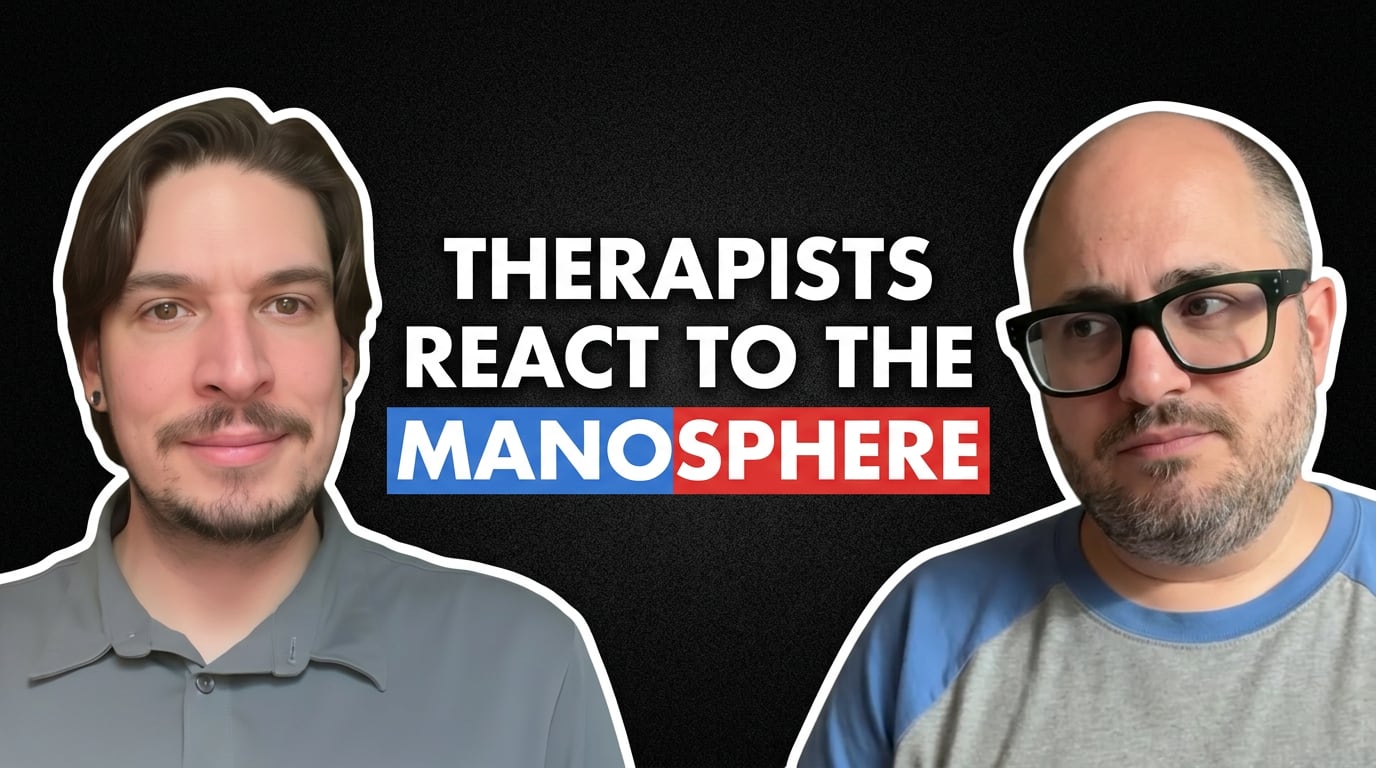
    The Resentment Industrial Complex: Why the Manosphere Keeps Winning

    The Manosphere Isn’t the Problem. The Empty Center Is. What a conversation with Dr. Nathalie Martinek clarified about why young men keep wearing identities like loaner cars. I sat down with Dr. Nathalie Martinek to talk about the Netflix Manosphere documentary. We discussed gender relations and algorithms, eventually reaching the topic of postmodern absence of identity. Nathalie said something that sticks: “There’s a lot of people walking around who have no actual center. They wear these different identities and absorb the belief systems associated with them. Now I’m a feminist. Now I’m an incel. Now I’m a this. They’re largely invisible to themselves.” That is an entire essay in one paragraph. The Manosphere functions as a vacancy filler, and its mirror image on the other side does the same job. Both keep working because the people downloading them have no stable internal structure to push back against the install. The Vacancy Came First Costello et al. (2022) profiled 151 self-identified incels and found 75 percent screened for moderate or severe depression and 67 percent for moderate or severe anxiety, with elevated loneliness and suicidal ideation. Fowler et al. (2022) reported that males accounted for nearly 80 percent of U.S. suicide deaths in 2019, with most male decedents carrying no known mental health diagnosis on record. The Manosphere is scavenging a demographic that has already been abandoned. Nathalie put it plainly: “There used to be an ecosystem around young men. Family, village, uncles, grandparents, religion. Secularization scattered it. Opportunists fill the void.” The Resentment Industrial Complex She has a phrase for what the opportunists sell: the resentment industrial complex. The cousin concept is Rob Henderson’s luxury beliefs, though resentment runs lower on the income ladder and hits its consumers harder. A creator notices what gets engagement, drifts toward it, and sells a worldview he may not personally believe to an audience whose entire life will be organized around it. I have written about this as digital dissociation and audience capture. Natalie sharpened the point: consumers “buy in, embed it into their identity, and just breed more resentment.” Frustration → algorithmic discovery of resentment-coded content → parasocial attachment → identity adoption → behavioral imitation → renewed frustration → re-engagement with the same source. The loop pays the creator and impoverishes the follower. The Fairytale Industrial Complex Halfway through, Nathalie cited a phrase from a writer named Francesca: the fairytale industrial complex. Men get sold the Beast-and-Aladdin arc where confidence plus grand gesture wins the girl. Women get sold the princess waiting to be seen and selected. Both scripts collapse on contact with adult life, and the participants cannot name what went wrong because the script was never visible to them as a script. This is what I call orphaned instincts. The evolved drives are intact. Men still want to provide and protect; women still want to assess and select. Legitimate channels have closed. The substitute channels (dating apps, parasocial influencers, sports betting, OnlyFans subscriptions) absorb the drive without satisfying it with human contact. Sympathetic nervous system debt does not get repaid by swiping. What Therapy Got Wrong Nathalie and I diagnosed the therapist class as the new clergy: pastoral authority paired with credentialing, often without the lived material to back either. The field has positioned itself adjacent to a demographic it has not bothered to learn how to reach. A profession that treats male ambition as suspect and male bluntness as aggression will not be the place where a struggling 22-year-old goes for help. He goes where someone tells him he is allowed to want things and offers him something to do about it. The Manosphere figured this out. Therapy mostly did not. What Replaces the Vacancy Communities are a need, not a luxury. Young men require ongoing relationships with trusted male elders who can correct them without performing it for an audience. Women need the same from women. Both need real friction with the other sex in person rather than the curated frictionlessness of an app. The Friction Thesis applies. The young man who builds skill, takes rejection in person, and gets corrected by an older man who actually likes him is doing the developmental work the Manosphere monetizes the absence of. Develop a center. Then the identities stop sticking. Dr. Nathalie Martinek writes at drnataliemartinek.substack.com. Her work on gurupreneurs and the resentment industrial complex shaped most of what is good in this piece. References Costello, W., Rolon, V., Thomas, A. G., & Schmitt, D. (2022). Levels of well-being among men who are incel (involuntarily celibate). Evolutionary Psychological Science, 8(4), 375–390. Fowler, K. A., Kaplan, M. S., Stone, D. M., Zhou, H., Stevens, M. R., & Simon, T. R. (2022). Suicide among males across the lifespan. American Journal of Preventive Medicine, 63(3), 419–422. Get full access to Next Level Psychology at psychfox.substack.com/subscribe

  • May 5 · 42 min

    The Powerful Psychology Secrets in the Star Wars Films

    It’s Star Wars Day as i’m writing this, and I’ve been thinking about why this saga keeps rewarding clinical re-reading. The sci-fi is the trimming. Lightsabers are amazing. The story underneath is one we have to help patients understand, because it is the same story we are running with them in session: a young man with great talent meets a calm voice offering solutions to the problems that voice secretly created. Palpatine is the master tactician. Anakin is fearful rage. As I said on the podcast: “Palpatine is pure unadulterated psychopathy. Anakin is fearful rage. There we go. That’s the master and the apprentice dynamic.” That is the relationship the entire nine-film arc is built on, and clinically it shows how political evil and personal evil colonize the same circuitry. Let me walk through it the way I’d walk through it with a client. A more thorough, written essay will be forthcoming later, but for now, check out the podcast. Get full access to Next Level Psychology at psychfox.substack.com/subscribe

  • April 28 · 46 min

    What Can We Learn from the Manosphere Documentary, and What Do Today's Men Need?

    This was a return to podcast form for my colleague Owen Scott Muir, M.D, DFAACAP and me. Since our earlier days of collaborating in the 2020s, awareness of “the manosphere,” a loose conglomeration of sometimes controversial, extremely online male-centric influencers, has skyrocketed, leaving us mental health professionals with the sacred task of educating ourselves on just what the men of the 2020s need, and how we can stay up to the ask of providing it. An informative written version of this interview will before forthcoming (think of it as an action-focused, research-laden transcript), but for now, here’s a succinct timestamp of our discussion, so you can navigate to the content relevant to your experiences or the needs of the ones in your life: 00:00 Introduction to the Conversation 00:15 Exploring Brain Medicine and Mental Health Tech 01:29 Understanding the Manosphere 03:05 The Exploitative Nature of the Manosphere 04:46 Dating Dynamics in the Modern Age 07:35 The Impact of Dating Apps on Men’s Mental Health 10:09 The Role of Male Friendship in Dating 12:59 Pain: Emotional vs. Physical 15:45 Rejection and Its Psychological Effects 18:42 The Importance of Interpersonal Skills 21:20 Modeling Healthy Masculinity 23:46 Equanimity and Emotional Regulation 26:15 Self-Fulfilling Prophecies in Dating 27:43 Navigating Date Dynamics 30:12 Understanding Online Dating Behavior 32:52 The Dark Triad and Attraction 36:41 Communication and Boundaries in Relationships 39:03 The Value of Connections Beyond Romance 42:45 Coffee Dates and Modern Dating Norms Get full access to Next Level Psychology at psychfox.substack.com/subscribe

  • Nov 21, 2025 · 37 min

    Psychology and survival in the AI age

    Most people think technology is changing their habits.They underestimate how much it is changing their psychology. In this episode, Dr. Paul and I traveled through embodiment, AI romance, transhumanism, dating apps, mirror neurons, the Zeigarnik loop, evolutionary psychology, and why your nervous system still thinks it is living in a tribe, and not an algorithmic casino. Below is a full walkthrough, with timestamps, quotes, why it matters, and core ideas for each moment. [00:00–00:54] What Tech Is Doing to Our Minds Jeremy: “We’ve heard all the storm and stress, all the fear mongering. I want to give people language they can hang their hat on, so they can stay human, stay mature, and stay sane.” Why We Care: Most people do not realize how much tech is rewiring their emotional expectations before they even notice the change. Core Idea: This is not another “phones bad” conversation.This is about attachment theory, developmental psychology, and the human nervous system, and crucially: how tech reshapes all three. The goal from the beginning was not to moralize.It was to name the mechanisms through which tech interferes with: * self development * attachment * embodiment * emotional literacy * agency Takeaway:Write your one sentence philosophy of tech: I will use technology for assistance, but never for attunement. If you cannot name the boundary, the erosion has already begun. [00:54–03:23] AI Is a “Massager,” Not a Partner Dr. Paul: “AI is aggregated data. It summarizes. It doesn’t think. It’s like a mechanical back massager. It can stimulate you, but it cannot adjust to your emotional or bodily reactions the way a real person does.” This was one of his strongest analogies.A massager loops the same pattern forever.A human hand responds to the micro shifts in your body. Tech gives stimulation.People give attunement. And the difference between the two is what makes emotional maturity possible. Why We Care: A machine can stimulate you.It cannot attune to you. Attunement is what builds a self; stimulation is what bypasses it. Core Idea: Tech delivers stimulation, not responsiveness.Human maturation requires responsiveness: the “I saw you wince, so I softened my touch” dynamic. Takeaway:Ask of any tech habit: Is this stimulating me or attuning to me? Only one of those advances emotional development. [03:23–05:18] Frankenstein, Emotion, and the Limits of Silicon Dr. Paul: “Emotion is energy. Chemical energy. It runs through flesh. Technology is stitched together in our image like Frankenstein’s monster, but it cannot feel anything through its own body.” Why We Care: Emotion is not data.It is chemistry, electricity, heart rate, breath, embodiment.AI has no nervous system, and therefore no emotional capacity. He raises a point people avoid:Emotion is not metaphorical energy.It is literal electrochemical activity in the limbic system powered by food, which is powered by the sun. Our nervous system is a solar-powered emotional engine.AI runs on electricity and statistical patterns. The substrate matters. Core Idea: Human emotion is solar-powered chemistry running through flesh.AI runs on electricity and statistical prediction.The substrates differ at the level that matters for consciousness. Takeaway: Never outsource emotional regulation to something that cannot feel. [05:18–07:50] Kohut’s Three Tasks and Why AI Fails All of Them Jeremy: “Kohut’s three tasks: mirroring, idealizing, and twinship, cannot be delivered by AI. You can get mirroring. You cannot get real idealization or twinship.” Why We Care: AI gives perfect mirroringbut zero rupture,zero resistance,zero challenge.And without rupture and repair, psychological adulthood never develops. Without frustration and limits, people remain adolescent psychologically. This is where we get into developmental theory: * Mirroring: AI can approximate. * Idealizing: You cannot grow toward it; it is not flesh. * Twinship: It has no parallel path, no mortality, no embodied stakes. Perfect validation without rupture = psychological adolescence. Bowlby and Ainsworth always emphasized rupture and repair.AI gives no rupture.It gives you everything instantly. And nothing stunts development like constant gratification.Core Idea: AI can simulate the appearance of empathy, but it cannot provide: * a human target for idealization * a shared developmental arc * twinship based on the human journey * co-regulated rupture and repair Takeaway:Once a week, intentionally choose a real interaction with the risk of misunderstanding or disagreement. That is adulthood training. [07:50–08:27] The Infinite Mind Problem Jeremy: “If you never forget anything, you never know when to stop thinking. A disembodied mind can get lost in infinite processing.” This is an overlooked part of embodiment:Forgetting is a safety mechanism.Fatigue is a safety mechanism.You stop thinking so you do not burn out. A disembodied mind has no natural “enough.”That is not transcendence.It is paralysis. Why We Care: Human cognition evolved with natural endpoints: hunger, fatigue, forgetting.Remove those limitations and you remove sanity’s guardrails. Core Idea: Embodiment provides boundaries.A purely digital mind has none, which leads to endless loops, obsessive thinking, and lack of closure. Takeaway: Practice intentional cognitive closure.Set daily “stop thinking now” points. [08:27–11:27] Why Transhumanism Will Be a Male Drug First Dr. Paul: “What the body is to the biologic female, tech is to the biologic male. Transhumanism will be the male version of plastic surgery.” Dr. Paul’s argument: * Women have historically needed to protect bodily integrity for survival and fertility. * Men externalize identity into tools, status, and cognition. * Therefore men will rush into cybernetic enhancement, cognitive implants, and augmentation. Women will do it reluctantly, if social or romantic pressure forces it. Why We Care: Men tend to externalize identity into tools, status, and cognitive enhancement.Women tend to guard bodily integrity due to biological investment. This asymmetry will shape the future of tech adoption. Core Idea: Men will rush toward cognitive augmentation.Women will be more ambivalent unless social pressure forces conformity. Takeaway:Ask: “Am I using tech to grow, or to escape myself?”Before tech answers that question for you. [11:27–15:02] The Surrogates Problem: When the Avatar Replaces the Body Jeremy: “In “Surrogates” [film], people live life through android doubles. It is a level of disembodiment we need to take seriously.” This part touched on: * the movie Surrogates * bodily risk * how women have historically had to guard the body * how men treat the body as an instrument of acquisition Disembodiment has different psychological costs depending on sex, history, and evolutionary pressures. Why We Care: Disembodiment creates psychological drift: * less agency * less courage * less resilience * more abstraction * more fantasy Historically, women have been more aware of bodily risk; men more willing to treat the body as a tool. Core Idea: When the avatar replaces the body, the psyche loses contact with consequence. Takeaway:Do one daily action that reconnects you to physical reality: handwriting, cooking, lifting, gardening, cold exposure, or walking barefoot outdoors. [15:02–18:29] Eggs, Energy, and Emotional Investment Dr. Paul: “An egg burns fifty thousand times the energy of a sperm. Women have two to three hundred eggs in a lifetime. That investment shapes psychology even after menopause.” He connects: * reproductive risk * energy expenditure * relationship selectivity * emotional commitment His conclusion: Men often stay in relationships they are not emotionally invested in because their focus is external.Women are more likely to leave if the emotional climate deteriorates. Why We Care: Evolutionary investment shapes: * attachment behavior * emotional thresholds * selectivity * break-up patterns * relational risk assessment Core Idea: Females evolved with high reproductive cost; males evolved with high exploratory and provisioning cost.This echoes in modern emotional needs and tolerances. Takeaway:Make the emotional climate in your relationships explicit, not just logistics. [18:29–21:07] AI Romance and the Narcissism Spiral Jeremy: “If AI gives you everything you want, one day you become unbearable to real people. No one challenges you. That is how narcissism is formed.” Here we compare: * the pop reaction (“that’s weird, dating a robot”) * the clinical reaction (“what need is this meeting?”) Katherine Dee told me: * For some, AI may be the only place they can get companionship. * For others, it will prevent them from becoming pro social. This is not about morality.It is about developmental arrest. Then Jeremy connected it to The Matrix: * The first Matrix was too perfect. * People died. * Humans require friction. Why We Care: AI companions give: * endless affirmation * endless patience * no rupture * no frustration * no competing subjectivity This is the recipe for fragility, the opposite of resilience. Core Idea: The first Matrix failed because it was too perfect.Humans die psychologically in perfection.We grow through friction. Takeaway:If AI comforts you, balance it with weekly “discomfort reps” in real relationships. [22:05–29:45] Why AI Cannot Be a Relationship Dr. Paul: “It is not a relationship unless it is mammalian. Real relationships are between nervous systems, not data sets.” He pulls together: * the triune brain * mirror neurons * story-based memory * the mammalian bonding system And he makes an underrated point about dating apps: “The matchmaker used to be an embodied mammal who knew each person. Dating apps replaced her with a calculator.” That replacement changed the entire structure of mate selection. Why We Care: Relationships require: * co-regulation * mirror neurons * rupture and repair * embodied presence * narrative continuity * sensory attunement AI offers none. Core Idea: Dating apps removed the mammalian matchmaker and replaced her with a silicon dataset matcher.AI partners repeat the same mistake, but deeper. Takeaway:Reintroduce mammalian matchmaking.Let real humans introduce you to real humans again. [29:45–36:14] The Heart, the Zeigarnik Loop, and the Chinese Room Jeremy: “When something triggers an epistemic feeling, the heart races, the body reacts, and the brain searches for closure. A disembodied system cannot replicate that.” Dr. Paul adds: “Avicenna’s Flying Man argued that mind exists even without sensation, but embodiment still shapes consciousness.” Dr. Paul adds: “Avicenna’s Flying Man argued that mind exists even without sensation, but embodiment still shapes consciousness and behavior.” This is where we fully close the argument: * AI can output language. * AI cannot feel urgency, mortality, fear, love, or desire. * AI is a Chinese Room, producing correct symbols without understanding. Real thinking requires: * brain * heart * body * stakes * narrative * emotion * vulnerability Why We Care: AI can produce symbols.It cannot experience urgency, danger, longing, confusion, or desire.It can output emotional language without ever having felt emotion. Core Idea: The Chinese Room argument applies:AI outputs correct symbols without understanding.Only embodied organisms feel the stakes behind meaning. Takeaway:Do something daily that combines risk and embodiment: art, performance, conflict, physical learning, deep conversation. These are the antidotes to the digital self. Final Reflection: What Keeps Us Human Across all ninety minutes, the thesis becomes unmistakable: Human psychology rests on three pillars: 1. Embodiment Why We Care: Your body is your boundary against dissociation.It provides fatigue, limits, hunger, desire, chemistry: in other words, the rules and bounds of human finitude. 2. Emotion Why We Care: Emotion is electrified flesh, not programming syntax.It is the mammalian glue that makes relationships real. 3. Shared Story Why We Care: Your nervous system bonds through narrative, rupture, repair, and memory shaped across time with another human. AI can simulate none.Dating platforms distort all three.Transhumanism threatens the continuity of all three.Social media numbs all three. To remain human is to protect: * your body * your ruptures * your limits * your stories * your emotional literacy * your real relationships Technology is not the problem.Disembodiment is. References (APA Style) Ainsworth, M. (1978). Patterns of attachment. Erlbaum.Bowlby, J. (1969). Attachment and loss: Vol. 1. Attachment. Basic Books.Bruner, J. (1990). Acts of meaning. Harvard University Press.Galloway, S. (2024). Notes on being a man. Portfolio.Goleman, D. (1995). Emotional intelligence. Bantam.Kohut, H. (1971). The analysis of the self. International Universities Press.Panksepp, J. (1998). Affective neuroscience. Oxford University Press.Searle, J. (1980). Minds, brains, and programs. Behavioral and Brain Sciences, 3(3), 417–424.Winnicott, D. W. (1965). The maturational processes and the facilitating environment. International Universities Press. Get full access to Next Level Psychology at psychfox.substack.com/subscribe

  • Oct 31, 2025 · 2 min

    Preview of Narcissism uncovered

    Stay tuned for more uploads from this livestream about how to survive narcissistic institutions and spiritual starvation. Get full access to Next Level Psychology at psychfox.substack.com/subscribe

  • Aug 21, 2025 · 53 min

    Frictionless Tech, Faster Mental Breakdowns

    Katherine Dee’s journalistic work in internet history and cultural analysis have spanned a variety of outlets and subjects, and I’ve long enjoyed bringing a clinical psychological lens to her illuminating social observations. Check out our first interview here, where we explore the origins of her name and her passion for internet history. Her recent focus has been directed to the phenomena of “AI Psychosis,” which is extremely relevant to my field, clinical psychology. Please Check out our video interview in which she and I analyze this subject from both clinical and cultural lenses. We also discuss her useful and descriptive proposed phenomenon of “Internet Overexposure Syndrome” and how it differs from and overlaps with actual clinical, psychiatric conditions. Let’s dive in. Digital Sophists, Fragile Minds: What “LLM Psychosis” Actually Is The internet didn’t suddenly give us a new disease. It gave us frictionless tools that magnify whatever we bring to them, and a literacy gap big enough to fall through. “It feels the same as someone with low media literacy seeing a barrage of TikToks for the first time. They don’t understand the LLM can be wrong.” —Katherine Dee (01:42) “LLMs are digital sophists; people expect digital philosophers.” —Jeremy Fox (09:34) Below are key, core ideas plus a practical “mental hygiene” toolkit at the end. This is for anyone who cares about how the web reshapes attention, emotion, and identity. Takeaways from the Interview 1) Not a new madness: mostly a literacy + vulnerability story Katherine’s main point lands early: what’s called “LLM psychosis” often looks less like schizophrenia and more like confusion at scale. If you don’t know that a language model will actually invent sources, you can easily be led down a rabbit hole of inaccuracy, especially if you prompt it for verdicts on fraught, personal topics (“Did this writer plagiarize me?”). “Ask ‘Are you sure?’ and the model changes its opinion… It isn’t a neutral tool.” —Dee (02:26) Fox agrees, with a clinical frame: psychosis has heavy genetic loading and well-studied environmental triggers; platforms can accelerate or orbit existing symptoms, but they’re rarely the origin story (Kapur, 2003). “Blaming AI for schizophrenia misses the genetic + environmental story; tech can be a kindling or orbit.” —Fox (03:32–05:40) Translation: Treat models as probabilistic talkers, not oracles. Treat claims of “AI made X happen” the way we treat claims about TV, radio, or TikTok: as force multipliers acting on prior vulnerabilities. 2) The real villain is frictionlessness “The lack of friction makes mental illness accelerate at an exponential level.” —Fox (05:40) Platform design strips out pauses, counter-speech, and human checks. What was once a slow burn (rumination, compulsions) becomes a feedback loop with instant reinforcement. This is the same logic that made micro-rejections on dating apps corrosive: you can be okay with five; you won’t be okay with five hundred (Finkel et al., 2012; Baumeister & Leary, 1995). Dee, on the same terrain, reframes the panic: instead of “you’ll catch a disorder from ChatGPT,” ask how media literacyand guardrails can slow the loop. 3) AI companions are not uniformly dystopian (sometimes they’re harm-reduction) Dee shares a story about a disabled man with an AI girlfriend: for him, the relationship isn’t just romantic; it’s creative and stabilizing, and likely healthier than volatile parasocial attachments to creators (Horton & Wohl, 1956). “Is it more tragic than him being alone… or saving up to see a sex worker once a year?” —Dee (19:55–21:03) Fox pushes the edge case (people high in narcissism/psychopathy might seek human targets rather than being verbally abusive to AI) but both land on a humane middle: safety rails + informed use instead of blanket prohibition. 4) Dating apps → IRL return, and the cost of micro-rejection Dee senses a cultural turn: people mock dating apps now; “return to IRL” feels cool again. Fox adds a clinical layer: “We aren’t built for rejection at scale.” “If it happens to you a bunch, eventually it wears on you and you start to ask questions.” —Dee (26:33) Think of this as developmental trauma by drip: no single event is catastrophic, but the system-level cadence of dismissal can reshape self-beliefs over time (Kross et al., 2013). 5) Internet Overexposure Syndrome: three archetypes, not diagnoses Dee’s signature frame argues that heavy, unbroken internet use produces behavioral archetypes that mimic clinical labels without meeting diagnostic thresholds: * Autist: hyper-fixation, pattern hunger * Schizotypal: connecting distant dots, conspiratorial patterning * Borderline: hyper-vigilance to social signals, abandonment alarms “They aren’t clinically significant, but they have the texture of these disorders.” —Dee (33:08–34:45) Fox plugs this into trauma science: adaptations are functional in context; the problem is gear-shift failure, when online adaptations “bleed” into offline life and won’t turn off. “When you can’t downshift, that’s the problem.” —Fox (34:45–35:35) 6) The Moloch trap and the new literacy divide Fox borrows Scott Alexander’s “Moloch” to name the arms race: opt out of AI and you fall behind; opt in and you accept risk, so you must build resilience and check systems (Alexander, 2014). Dee brings the class angle: thinking as a luxury good. Wealthier households can limit exposure (less iPad-as-babysitter) and teach tools fluently, widening the literacy gap later in school and work (see also Haidt, 2024, on generational screen effects). “Knowing how these tools work is how you protect your mind.” —Dee (14:08) 7) Post-COVID etiquette and the weirdness we feel now Time flattened in 2020, and days lost the markers that make memories stick. Fox notes the research version (sameness harms mood and recall); Dee narrates the lived version (socializing in a dreamlike, empty city). No wonder norms feel bent. The lesson isn’t “phones did it.” The lesson is: social life can’t be optional without deep personal, social cost. 8) After social media: ambient AI “We might end up getting off social media long term and AI will be integrated into our appliances.” —Dee (37:53–38:18) That forecast (less feed, more embedded assistance) fits the vibe shift already underway: IRL as status, feeds as utility, assistants as infrastructure. The mental health challenge will be the same one this conversation keeps naming: literacy, friction, and guardrails. A Mental Hygiene Toolkit for the Extremely Online 1) Treat LLMs as digital sophistsThey’re virtuosos of plausible language, and gifted speakers/writers, not ground truth (Bender et al., 2021). They are committed to providing pleasing, useful answers, rather than truth. Use them to draft, summarize, and brainstorm; verify anything that appears like a spurious fact. 2) Build friction back in * Write prompts offline first. * Add a “cooling timer” before posting. * Turn off infinite scroll in your browser, or route feeds through a daily digest. 3) Guard against micro-rejection overloadBatch your dating/app interactions into limited windows; measure how you feel after that dive into online dating. If your weekly average mood drops, change cadence or channel (Finkel et al., 2012). 4) Distinguish pathology from patternAsk: Is this a stable, offline impairment, or an online, contextual adaptation I can downshift from? If you can’t downshift, get help. Earlier is easier. 5) Parasocial vs. companionIf an AI companion improves mood, routine, or creativity, and you maintain safety rails (no self-harm prompts; no financial exploitation), that can be harm reduction. If it deepens isolation or magical thinking, pull back (Horton & Wohl, 1956). 6) Practice “source flipping”When an LLM makes a claim about a person/event, flip to primary sources or reputable databases. The move isn’t “Are you sure?”; it’s “Show me where that exists.” 7) Restore the offlineSchedule at least one non-instrumental IRL thing per week (no content, no networking, just presence). Rites of passage and shared meals are memory glue. Choice Quotes * “LLMs are digital sophists; people expect digital philosophers.” —Fox (09:34) * “Knowing how these tools work is how you protect your mind.” —Dee (14:08) * “We aren’t built for rejection at scale.” —Fox (26:46) * “They aren’t clinically significant, but they have the texture of these disorders.” —Dee (33:08–34:45) References Alexander, S. (2014). Meditations on Moloch.Bender, E. M., Gebru, T., McMillan-Major, A., & Shmitchell, S. (2021). On the dangers of stochastic parrots: Can language models be too big? Proceedings of FAccT ’21, 610–623.Baumeister, R. F., & Leary, M. R. (1995). The need to belong. Psychological Bulletin, 117(3), 497–529. Dee, K. (2025, March 6). Internet Overexposure Syndrome: A taxonomy of adaptations to online life. Comment Magazine. https://comment.org/internet-overexposure-syndrome/ Dee, K. (2025, June 14). Let’s Talk About ChatGPT‑Induced Spiritual Psychosis. Default Friend (Default.blog). Dee, K. (2025, August 11). The tulpa in your pocket. Default Friend (default.blog). 🏁Finkel, E. J., Eastwick, P. W., Karney, B. R., Reis, H. T., & Sprecher, S. (2012). Online dating: A critical analysis… Psychological Science in the Public Interest, 13(1), 3–66.Haidt, J. (2024). The anxious generation.Horton, D., & Wohl, R. R. (1956). Mass communication and para-social interaction. Psychiatry, 19(3), 215–229.Kapur, S. (2003). Psychosis as a state of aberrant salience. American Journal of Psychiatry, 160(1), 13–23. Get full access to Next Level Psychology at psychfox.substack.com/subscribe

  • Jun 17, 2025 · 39 min

    The Grief We Don’t Name: Exploring Ambiguous Loss and Connection in an Age of Disconnection

    In the latest Substack Live, I had the privilege of speaking with Barri Grant, a grief educator, writer, and group facilitator, about a theme that is as widespread as it is under-discussed: ambiguous loss. From friendship breakdowns to divorce and estrangement, Barri and I explored how grief manifests outside the realm of death, yet remains largely unrecognized, misdiagnosed, or pathologized in our cultural narrative. Check below for an essay based on the conversation, show notes, and timestamps. Thanks for reading Next Level Psychology. Subscribe for free to receive new posts about grief, trauma, anxiety, and many more timely subjects. Naming the Unnamable: Why Non-Death Losses Matter Barri brought into focus something that clinicians and clients alike often sense but don’t always articulate: grief that lacks ritual, recognition, or even a clear name still inhabits the body and mind. Divorce, the slow fading of a friendship, or navigating the distance created by illness or caregiving often evoke profound emotional responses, but they don’t come with casseroles, eulogies, or leave from work. As Barri put it, “We don't name these non-death losses. So we don't make space.” In psychological terms, ambiguous loss (a concept developed by Dr. Pauline Boss) refers to losses that remain unresolved, where a person is either physically absent but psychologically present (e.g., a missing loved one), or physically present but emotionally unavailable (e.g., dementia, estrangement, chronic illness, or relationship fracture). These losses are confounding because there is no closure, no clear ending, no container. The Biology of Grief and Ghosting Our discussion moved toward how ambiguous relational ruptures, such as ghosting, silent estrangements, drawn-out divorces, activate the nervous system. People often experience sympathetic arousal: elevated cortisol, rumination, disrupted sleep, inflammation. Even the dissolution of a once-trusted friendship can trigger physiological dysregulation akin to PTSD. And yet, many clients walk into therapy with vague physical symptoms: panic attacks, migraines, insomnia, and are asked to tick boxes on anxiety and depression inventories, rather than being invited to contextualize their experience within recent or unspoken losses. Barri shared a compelling anecdote: showing up at the ER with shingles during a post-separation period, her stress “wildly” manifesting in her body. The medical intake didn’t ask about emotional upheaval. “So I tell clients now: write it in. Fill it in yourself: ‘I’m going through a divorce.’ ‘My dad is dying.’ We need to say it.” Friendships: When Attachment Isn’t Final Friendship grief holds a particular kind of sting. The person is often still out there, on Instagram, at the same events, maybe even circling mutual friends, and the imagined future now unravels without them. That ambiguity can provoke the protest-despair cycle: yearning for reconnection, anger at the loss, bargaining with the “what ifs.” We discussed how today's friendship culture suffers from an allergy to discomfort. The cultural norm has become avoidance through cutoff rather than renegotiation through communication. We pathologize confrontation. Ghosting becomes self-care. But in many cases, the message being sent is: “I don’t have the emotional bandwidth to deal with this,” not necessarily “You’re toxic.” And for those left behind, that lands as abandonment. Diagnosing the Situation, Not the Self One point I raised was the fluidity of diagnosis. What many therapists see in practice is not chronic mental illness but acute adjustment disorder: grief in response to relational shock. A blindsiding divorce, a friendship’s sudden collapse, or the role reversal of caregiving can destabilize even the most resilient. Diagnostically, this fits, but few intake forms or medical spaces ask about life context. “People don’t even know that situational diagnoses exist,” I noted. “We get stuck in binary thinking: either I’m mentally ill, or I’m fine. But mental health exists on a spectrum.” A Return to Ritual: The Power of Groups Barri’s experience leading grief groups underscores how rituals of community can hold the weight of unspoken grief. Her widows’ group, for example, found unexpected laughter discussing Father’s Day: a blend of release and recognition, of finally being seen. These circles create a fourth space between therapy and everyday life, one where caretakers, divorced parents, and estranged children can speak honestly without the burden of protecting others. I added that for men especially, the mentorship model of groups like AA tends to resonate more than traditional talk therapy, which can seem emotionally performative or shame-based. In group, there’s room to dip in and out, to listen before speaking, to share wisdom rather than extract pity. Humor isn’t a distraction from healing; it’s a conduit. Cultivating Connection in a Culture of Cutoff The most poignant takeaway from our conversation was this: We’re lonelier than ever in an age of unprecedented connectivity. Cutoff culture, endless options, and the commodification of relationships leave us overwhelmed and disoriented. We’re primed to look for red flags, not yellow ones. We don’t know how to disagree without disappearing. As Barri put it, “We haven’t taught people how to be friends.” But the antidote is simple, if not easy: connection and belonging. Whether in a book club, support group, or a 12-minute chat that starts as small talk and turns into something more, we need to create micro-rituals and shared spaces that hold us. “Nobody needs to do this alone,” Barri said, and she’s right. Let’s end with that reminder: If you’re grieving something that doesn’t look like grief, whether friendship loss, divorce, caretaking, estrangement, you still deserve to be held. You still deserve a place to put it down. If you're looking for non-death grief resources, support circles, or therapeutic tools for ambiguous loss, reach out. You're not alone. Keywords sambiguous loss, non-death grief, therapy, relationships, communication, community, emotional expression, support groups, loneliness, healing Takeaways * Ambiguous losses are often overlooked in discussions about grief. * Non-death losses can lead to significant emotional distress. * The complexity of relationships can complicate the grieving process. * Divorce can result in multiple layers of grief, including loss of identity. * Therapy can help individuals process their grief and find coping strategies. * Communication is key in navigating friendships and confrontations. * Generational differences affect how emotions are expressed and managed. * Community and connection are essential for healing from grief. * Support groups provide a safe space for sharing experiences and emotions. * Humor can be a powerful tool in processing grief. SummaryIn this conversation, the speakers delve into the concept of ambiguous losses, particularly focusing on non-death losses such as divorce and friendship breakups. They discuss the emotional complexities associated with these types of grief, emphasizing the importance of naming and acknowledging these feelings. The conversation highlights the role of therapy in processing grief, the challenges of communication in relationships, and the generational differences in emotional expression. The speakers also stress the significance of community and support groups in healing, the need for rituals in grief, and the power of humor as a coping mechanism. Ultimately, they advocate for embracing connection and belonging as essential components of navigating grief. Titles * Navigating the Waters of Ambiguous Loss * The Hidden Grief of Non-Death Losses Sound Bites * "We often overlook ambiguous losses." * "Divorce can result in multiple layers of grief." * "The loneliness epidemic is a growing concern." Chapters 00:00 Understanding Ambiguous Losses 01:48 The Complexity of Non-Death Grief 04:08 Navigating Grief in Relationships 06:10 The Impact of Divorce on Identity 08:28 The Role of Therapy in Grief 10:29 Communication and Confrontation in Friendships 12:17 Generational Differences in Emotional Expression 14:21 The Importance of Community and Connection 16:05 Finding Support in Group Settings 18:07 The Need for Rituals in Grief 20:08 The Power of Humor in Healing 22:24 Building Resilience Through Connection 24:20 Conclusion: Embracing Vulnerability and Belonging Get full access to Next Level Psychology at psychfox.substack.com/subscribe

Showing 1–20 of 20 episodes