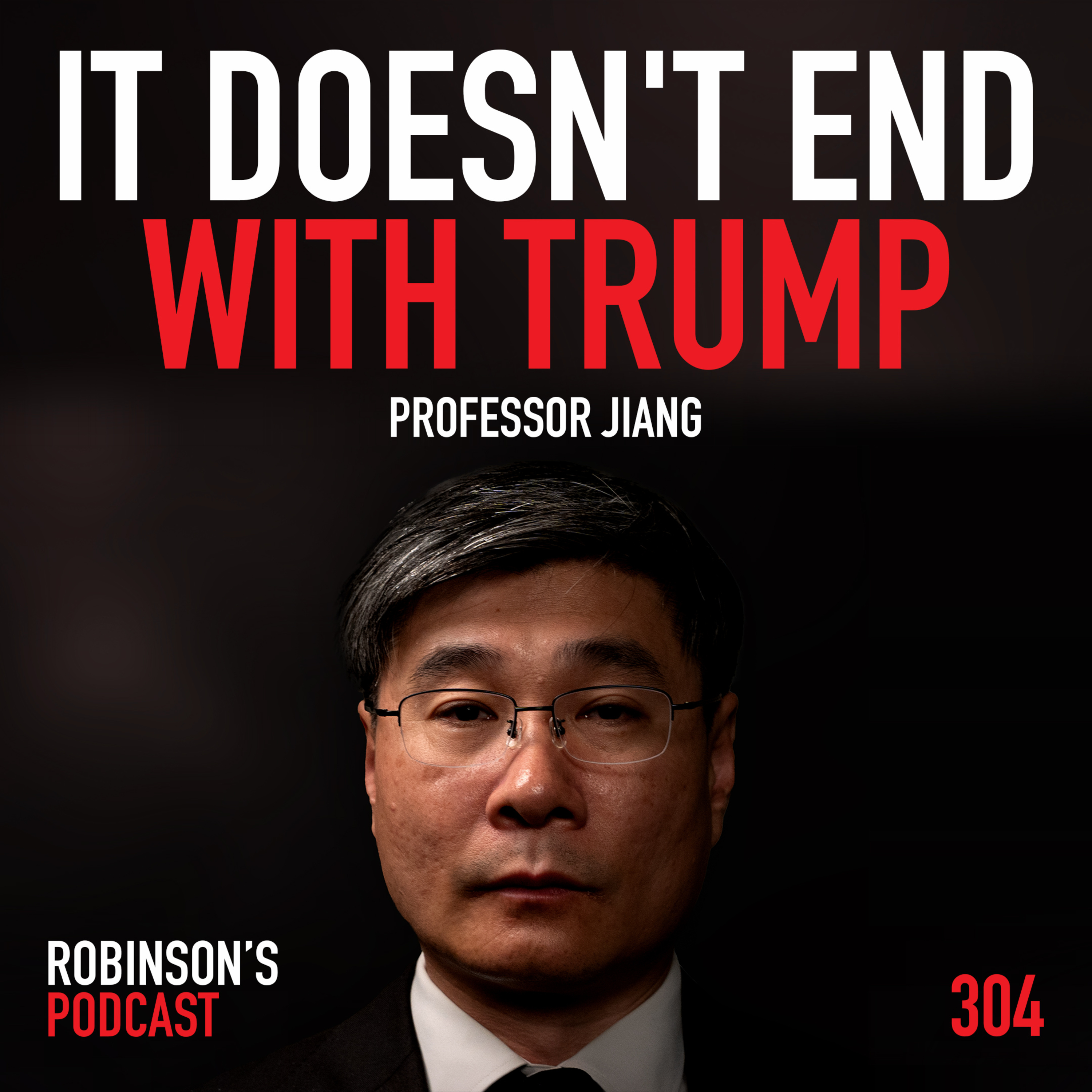
304 - Professor Jiang: Trump Was Never The Real Problem | On Musk, Secret Societies, & Conspiracy Theories
Support the Show: https://www.youtube.com/channel/UCsxwneBx6apV1mQ7CbWKfXQ/joinJiang Xueqin, known online as Professor Jiang, is a Chinese-Canadian educator and the creator of Predictive History on YouTube and Substack. In this second of three conversations, Jiang and Robinson discuss secret societies, conspiracy theories, and the relationship between money and political power. They talk about Donald Trump, Elon Musk, Mark Zuckerberg, and Sam Altman, as well as capitalism, the Opium Wars, the Spanish conquest of Mexico, and Sabbatean Frankism. Throughout the conversation, Robinson challenges Jiang on the evidence for his claims, the limits of historical analogies and thought experiments, and what would distinguish a plausible story from an established explanation.Jiang’s YouTube: https://www.youtube.com/@PredictiveHistoryJiang’s Substack: https://predictivehistory.substack.com/OUTLINE00:00 Introduction09:10 Who Can Tell the President No?18:50 The Bank of England and the British Empire26:20 Conquistadors and the Opium Wars36:09 What Counts as Historical Evidence?43:33 Elites and Counterelites48:25 Secret Societies and the Rothschilds55:54 Jiang’s Account of the Sabbatean Frankists1:05:35 Sabbatai Zevi and Messianic Movements1:11:18 The Kabbalah1:17:27 Esther, Jacob Frank, and Redemption Through Sin1:27:55 How Would Historians Assess Jiang’s Account?1:35:10 Are Secret Societies Active Today?1:43:05 Can People Coordinate Without Meeting?1:49:49 Could Trump’s Comeback Have Been Predicted?1:58:05 Zuckerberg, Altman, and the Meaning of Genius2:07:24 Facebook’s Investors, Data, and Control2:11:53 Business Success or Conspiracy?2:20:29 Skull and Bones: Existence vs. Influence2:31:06 The Gilded Age and Foreign Capital2:37:29 Which Conspiracy Theories Are Credible?2:47:52 OutroFURTHER READINGThese scholarly histories provide context and alternative accounts of topics raised in the interview. I’m not a specialist in these subjects, and I offer them as starting points for further reading. They do not resolve every claim made in the conversation.Matthew Restall, Seven Myths of the Spanish Conquesthttps://global.oup.com/academic/product/seven-myths-of-the-spanish-conquest-9780197537299Paweł Maciejko, The Mixed Multitude: Jacob Frank and the Frankist Movement, 1755–1816https://www.pennpress.org/9780812204582/the-mixed-multitude/A. B. Bosworth, Conquest and Empire: The Reign of Alexander the Greathttps://www.cambridge.org/core/books/conquest-and-empire/EBAE6ADF5821A05DA6B3ADE3BC49F356Context from Robinson: Virtually every speculative conclusion Jiang reaches strikes me as unsupported, or less well-supported than a competing explanation. The existence of social connections or a historical movement does not establish that a particular group is secretly coordinating to control institutions. Listening to a guest or granting a premise for the sake of argument does not mean that I accept it.Disclaimer: Robinson’s Podcast is a forum for open discussion. Guests’ views are their own and do not necessarily reflect Robinson’s. Hosting a guest does not imply that he endorses the views or opinions they express.Robinson’s Website: https://robinsonerhardt.com/Robinson Erhardt researches symbolic logic and the foundations of mathematics at Stanford University, where he is also a JD candidate in the Law School.