
October 12 · 26 min

Pastor Nicholas Schultz

This is a public episode. If you would like to discuss this with other subscribers or get access to bonus episodes, visit revschultz.substack.com

This past Sunday, I started a new series going through the book of Habakkuk. It starts with, “Why don’t you save?” It ends with, “I will take joy in the God of my salvation!” And in the middle, “The righteous shall live by faith.” Join us for the next seven weeks as we look at this beautiful lament which turns into a song of praise. This is a public episode. If you would like to discuss this with other subscribers or get access to bonus episodes, visit revschultz.substack.com

This is a public episode. If you would like to discuss this with other subscribers or get access to bonus episodes, visit revschultz.substack.com

This is a public episode. If you would like to discuss this with other subscribers or get access to bonus episodes, visit revschultz.substack.com

This is a public episode. If you would like to discuss this with other subscribers or get access to bonus episodes, visit revschultz.substack.com

There’s a grove of olive trees in the hill country that’s been tended, some say, for over a thousand years — and it holds the key to one of the most contested passages in all of Paul’s letters. In this eleventh installment of our Romans series, “Roots & Renewal,” Pastor Schultz brings us to the doxology that closes three long chapters of argument: has God’s word to Israel failed? Paul’s answer isn’t a diagram. It’s a song of praise, and it lands on a promise that reaches straight into anyone who has ever wondered whether they’ve finally used up God’s patience. Walking through Romans 11:25–36 (ESV), this sermon traces three simple prepositions — from him, through him, to him — that dismantle both spiritual smugness and spiritual despair. You’ll hear why Paul refuses to let his readers feel superior over anyone else’s unbelief, why the church’s long history of “displacement theology” gets confronted head-on by Paul’s own words, and why “God’s gifts and calling are irrevocable” is good news not just for Israel, but for you — for the doubt you can’t climb out of, the promise you’ve broken, the sense that grace might finally run out. It doesn’t. If you’ve ever caught yourself anxiously checking whether you’ve disqualified yourself from God’s mercy, this message is for you. Take a few minutes to listen in — and be reminded that salvation was never something you had to earn, protect, or hold together on your own. From him, through him, and to him are all things. To him be glory forever. Listening Guide Big Idea: Salvation is from God, through God, and to God — not a transaction you started, keep running, or get credit for. I. From Him — Salvation Did Not Start With You (vv. 25–29) — What is the “mystery” Paul discloses about Israel’s partial hardening (v. 25)? — Why does Paul warn the Gentile believers against being “wise in your own sight”? — How should God’s irrevocable gifts and calling (v. 29) shape the church’s posture toward the Jewish people — and toward anyone we’re tempted to write off? II. Through Him — Salvation Does Not Run on You (vv. 30–32) — Count how many times “mercy” appears in verses 30–32. What does that repetition emphasize? — Where are you tempted to anxiously “check” whether you’ve used up God’s patience? III. To Him — Salvation Does Not End at You (vv. 33–36) — Why does Paul answer his own argument with a doxology rather than a diagram? — What quiet “transactions with God” (self-improvement, prosperity thinking, etc.) does verse 35 rule out? Take It Home Read Romans 12:1. What would it look like to “present your body as a living sacrifice” this Tuesday? This is a public episode. If you would like to discuss this with other subscribers or get access to bonus episodes, visit revschultz.substack.com

Yesterday’s sermon on Romans 9:14–24 took up one of the most searching questions in all of Scripture: is God fair? We don’t get to dodge the question, because Paul himself doesn’t dodge it — he raises the objection to his own teaching out loud in verse 14, then answers it with the strongest denial in his vocabulary. The sermon reminded us that the moment we put God on trial for fairness, we’ve already made ourselves the judge and Him the defendant, and that reversal is the real injustice. Using the image of the potter and the clay, we were shown that the clay never had standing to question the potter’s right over it — and yet, remarkably, that isn’t where the passage leaves us. Fairness was never really the subject. Mercy was. From there the sermon walked through Paul’s use of Exodus — mercy spoken to Moses after the golden calf, and patience extended toward Pharaoh in the same redemptive story — to show that both mercy and hardening flow from the same God for the same ultimate purpose: that His name would be known. One of the more striking points was the careful attention to the order of events in Exodus itself: Pharaoh hardens his own heart first, repeatedly, before the text ever says the Lord hardened it. Hardening, we were reminded, is not a trap God springs on someone trying to obey — it’s what happens to a heart that keeps refusing to yield. As Romans 2:5 puts it, that heart is storing up wrath for itself. The sermon then turned pastoral in a way that will stay with many of us: what do we do with the nagging fear that we might secretly be a “vessel of wrath”? Drawing on Luther, Pastor Schultz reminded us that God’s hidden will was never given to us to search, and searching it will never bring comfort. What has been given to us is His revealed will — the promise of the gospel and the water and the Word already spoken over us in our own baptism. If that anxious question ever grips you, the answer isn’t to keep circling the hidden will of God, but to go back to what He has revealed and to when the Gospel was applied to you. The sermon closed on Paul’s declaration in verse 24 — “even us whom he has called” — and the assurance that if we belong to Christ, we are vessels He prepared beforehand, on purpose, in mercy, for glory, not because we earned a better shape than the lump next to us, but because the Potter had already turned toward us before we ever turned toward Him. It’s a rich, weighty passage, and one well worth sitting with again this week. If you missed it Sunday, or if you’d simply like to hear it once more, I’d encourage you to take the time to listen to “The Potter’s Mercy” — whether for the first time or the fifth. ~Pr. Schultz This is a public episode. If you would like to discuss this with other subscribers or get access to bonus episodes, visit revschultz.substack.com

As you step into a new week, remember the promise we heard yesterday: “There is therefore now no condemnation for those who are in Christ Jesus.” The door is already open. The verdict has already been spoken. And the Judge who declared it hasn’t stayed at a distance—He has moved in. The Holy Spirit who dwells in you is quietly resetting what your mind is set on, even in the middle of ordinary routines, busy schedules, and the noise that tries to claim your attention. If you missed the sermon—or if you’d like to hear it again—you can listen this week and let Romans 8 steady your heart. It’s a word meant to carry you through Monday morning and every morning: placed into Christ, and Christ placed into you. One gift. One promise. Already at work. This is a public episode. If you would like to discuss this with other subscribers or get access to bonus episodes, visit revschultz.substack.com
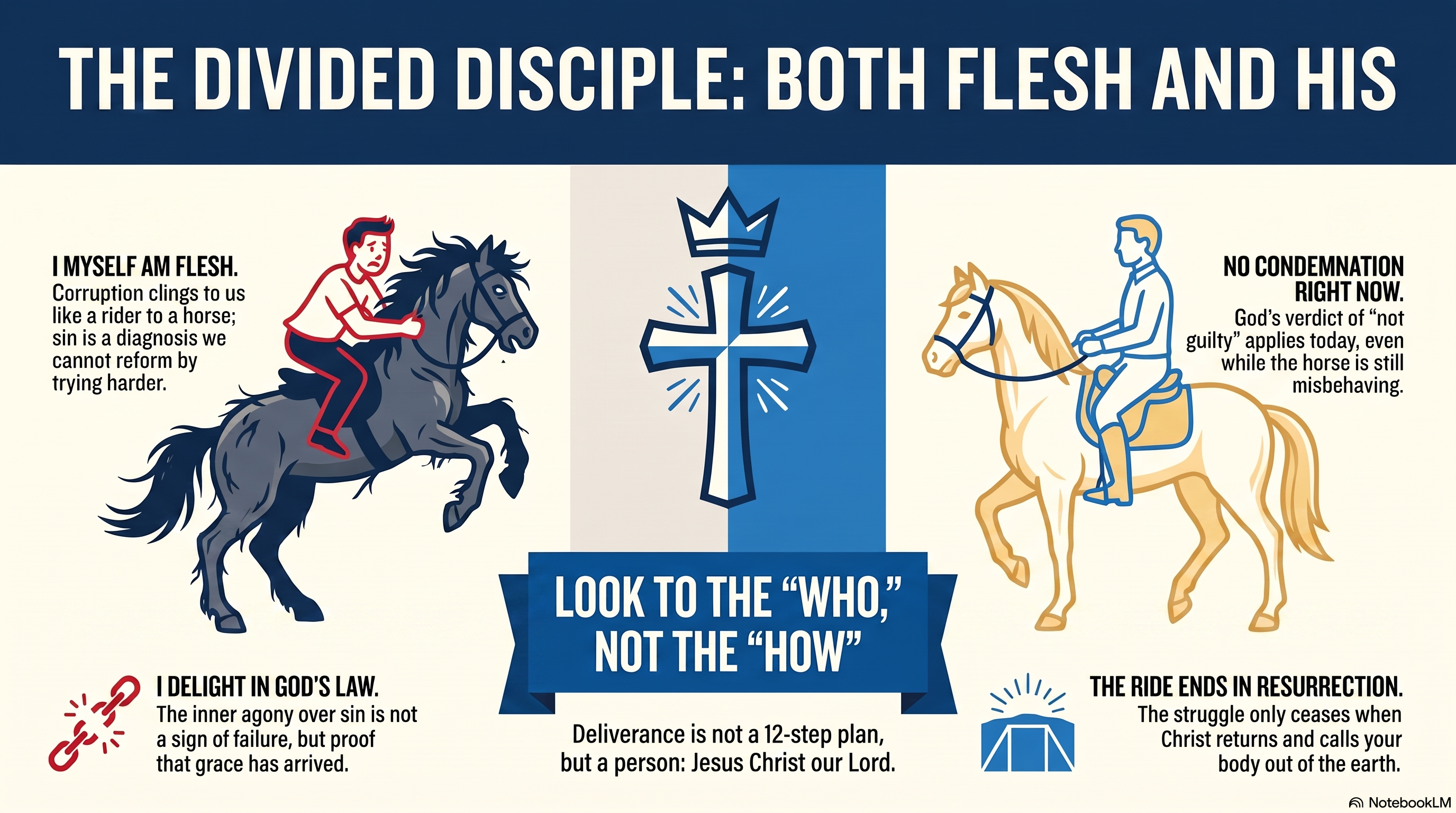
This is a public episode. If you would like to discuss this with other subscribers or get access to bonus episodes, visit revschultz.substack.com

The prodigal son is sitting in the far country, hungry, filthy, and rehearsing a speech he thinks he needs to give before he’s allowed home. It’s a picture of every one of us before Christ — weak, ungodly, and hostile toward God, with no peace, no access, and no hope of restoration on our own. In this sixth installment of our Romans series, “Peace With God Through Our Lord Jesus Christ,” Pastor Nick Schultz walks through Romans 5:1–11 to show that this is exactly where the gospel meets us. Paul declares that justification gives us far more than a legal verdict — it gives us peace with God, access into His grace, and a hope that will not put us to shame. But this sermon doesn’t stop at comfort in the abstract. It faces suffering honestly, exploring what Luther called the theology of the cross: the truth that God is at work even in our hardest trials, producing an endurance and a hope that ease alone could never produce. Whether you’re walking through a diagnosis, a loss, or a wandering child of your own, you’ll hear that none of it is wasted. At the heart of it all is Romans 5:8 — “while we were still sinners, Christ died for us.” Not after we cleaned ourselves up. Not once we took the first step home. While we were enemies, the Father ran. This sermon points you back to the cross and to your baptism, where that same embrace was placed on you by name, so that you don’t have to wonder whether God’s peace is really yours. Join us as we discover that in Christ, salvation gives us more than salvation. This is a public episode. If you would like to discuss this with other subscribers or get access to bonus episodes, visit revschultz.substack.com

* What does the term ‘justified by works’ mean in the context of this sermon? * How does the example of Abraham illustrate the concept of being justified by faith rather than works? * In what ways can we apply Abraham’s faith in God’s promises to our own lives today? * How do the concepts of faith and works interact in your daily Christian walk? * What are the key differences in the arguments presented by Paul and James regarding faith and works? * What was Abraham’s main quality that made him an example of faith? * Why does the sermon emphasize that both Jews and Gentiles are saved through faith? * How can knowing that our sins are forgiven through faith encourage us in our struggles? * How can we demonstrate our faith through our actions in school and with friends? * What does it mean that works are a fruit of faith? This is a public episode. If you would like to discuss this with other subscribers or get access to bonus episodes, visit revschultz.substack.com

This is a public episode. If you would like to discuss this with other subscribers or get access to bonus episodes, visit revschultz.substack.com

In this message from Romans 3:9–20, Pastor Schultz leads us into one of Scripture’s most sobering—and ultimately most hope‑filled—moments: the place where every human mouth is stopped and every defense falls silent before the holiness of God. With clarity, pastoral care, and deep reverence for the text, he shows how the Law exposes our need, quiets our self‑justification, and prepares us for the Gospel’s “But now.” If you’re longing for a word that tells the truth about the human condition and an even greater word that tells the truth about Christ’s mercy, I invite you to listen. This sermon will bring you to the silence of repentance—and then to the comfort of the Savior who speaks forgiveness into that silence. Come hear the good news that follows when every mouth is stopped. This is a public episode. If you would like to discuss this with other subscribers or get access to bonus episodes, visit revschultz.substack.com

In this sermon, Rev. Nicholas Schultz takes us into one of Scripture’s most unflinching diagnoses of the human heart—Romans 1:18–25. Paul begins not with human potential but with “the truth we suppress,” exposing the rebellion, idolatry, and self‑curvature that shape every fallen life. As the sermon states, “We do not lack evidence of God—we reject it.” Rev. Schultz teaches from Romans how suppressing the truth about God leads inevitably to suppressing the truth about ourselves—and why this makes the Gospel not optional but essential. Yet the message does not leave us in despair. It leads us to Christ, the true image we exchanged, who bears the wrath we deserve and restores the truth we cannot recover on our own. If you’re ready for a sermon that tells the truth about sin so it can tell the truth about Christ, listen to “The Truth We Suppress” and be strengthened by the God who refuses to abandon curved‑in hearts. This is a public episode. If you would like to discuss this with other subscribers or get access to bonus episodes, visit revschultz.substack.com

Paul, a servant of Christ Jesus, called to be an apostle, set apart for the gospel of God, which he promised beforehand through his prophets in the holy Scriptures, concerning his Son, who was descended from David according to the flesh and was declared to be the Son of God in power according to the Spirit of holiness by his resurrection from the dead, Jesus Christ our Lord, through whom we have received grace and apostleship to bring about the obedience of faith for the sake of his name among all the nations, including you who are called to belong to Jesus Christ, To all those in Rome who are loved by God and called to be saints: Grace to you and peace from God our Father and the Lord Jesus Christ. First, I thank my God through Jesus Christ for all of you, because your faith is proclaimed in all the world. For God is my witness, whom I serve with my spirit in the gospel of his Son, that without ceasing I mention you always in my prayers, asking that somehow by God’s will I may now at last succeed in coming to you. For I long to see you, that I may impart to you some spiritual gift to strengthen you— that is, that we may be mutually encouraged by each other’s faith, both yours and mine. I do not want you to be unaware, brothers, that I have often intended to come to you (but thus far have been prevented), in order that I may reap some harvest among you as well as among the rest of the Gentiles. I am under obligation both to Greeks and to barbarians, both to the wise and to the foolish. So I am eager to preach the gospel to you also who are in Rome. For I am not ashamed of the gospel, for it is the power of God for salvation to everyone who believes, to the Jew first and also to the Greek. For in it the righteousness of God is revealed from faith for faith, as it is written, “The righteous shall live by faith.” Grace to you and peace from God our Father and the Lord Jesus Christ. Amen. Today we begin our summer series in the Book of Romans—a book that has changed the world, changed the Church, and changed countless lives, including the life of a young Augustinian monk named Martin Luther. But before Romans ever changed Luther, before it ever changed the Reformation, before it ever changed the world, Romans begins by announcing something far more important: God’s action for sinners in His Son Jesus Christ. Romans does not begin with human effort. It does not begin with moral improvement. It does not begin with spiritual striving. Romans begins with God’s initiative, God’s movement toward us, God’s righteousness revealed and given in the Gospel. I. The Gospel Moves Toward Us Before We Move Toward God (vv. 1–1) Paul opens his letter with a sentence that is almost entirely about God. “Paul, a servant of Christ Jesus, called to be an apostle, set apart for the Gospel of God.” Notice the direction of movement. Paul is not climbing toward God; God is coming toward Paul. Paul is not volunteering for apostleship; he is called. He is not choosing his mission; he is set apart. He is not inventing a message; he is entrusted with the Gospel of God. The Gospel is not Paul’s idea. It is not humanity’s collective wisdom. It is not a philosophy discovered by human reason. It is God’s Gospel—God’s good news, God’s initiative, God’s saving action. And what is this Gospel about? Paul tells us immediately: it is “the Gospel concerning His Son.” The Gospel is not a set of principles. It is not a moral code. It is not a spiritual technique. The Gospel is a person—Jesus Christ, the Son of God. Paul then describes Jesus with two phrases that summarize the entire story of salvation. He is “descended from David according to the flesh”—true man, born into our world, sharing our humanity. And He is “declared to be the Son of God in power according to the Spirit of holiness by His resurrection from the dead”—true God, vindicated, triumphant, risen. In other words, the Gospel is the story of God coming down into our world, taking on our flesh, entering our history, bearing our sin, dying our death, and rising to give us life. The Gospel is not humanity reaching up to God. The Gospel is God reaching down to humanity. This is the first great truth of Romans: Before we ever move toward God, God has already moved toward us in Christ. And this is good news, because left to ourselves, we do not move toward God. Scripture says, “No one seeks God.” Our hearts are curved inward. Our wills are bound. Our desires are disordered. We do not climb to God; we run from Him. We do not seek His righteousness; we hide from it. But God seeks us. God comes for us. God moves toward us in His Son. Romans begins with God’s action because the Christian life begins with God’s action. Everything else in this letter—every command, every exhortation, every encouragement—flows from this first truth: God acts first. II. The Gospel Gives Identity Before It Commands Obedience (vv. 5–7) After describing the Gospel, Paul describes what the Gospel does. “Through Him we have received grace and apostleship.” Paul’s entire ministry—his calling, his mission, his authority—is something he has received. It is gift, not achievement. Grace precedes vocation. Identity precedes activity. And what is true for Paul is true for the Roman Christians. Paul calls them “those who are called to belong to Jesus Christ,” “those who are loved by God,” “those who are called to be saints.” Notice again the direction of movement. They are called—not self-made. They are loved—not self-secured. They are saints—not by moral accomplishment but by divine declaration. Romans begins by naming the Christians in Rome before it ever instructs them. God gives them an identity before He gives them commands. God tells them who they are before He tells them what to do. This is the pattern of the entire Christian life. God acts. God names. God gives. Only then does God command. This is why Paul speaks of “the obedience of faith.” That phrase does not mean moral performance. It does not mean human striving. It means the obedience that is faith—faith itself as the response created by the Gospel. Faith is not a work we perform; it is a gift God gives. Faith is not the cause of salvation; it is the means by which we receive salvation. And so Paul begins his letter with the words, “Grace to you and peace.” These are not polite greetings. They are theological declarations. Grace and peace are God’s opening move toward His people. Grace—God’s undeserved favor. Peace—God’s reconciliation through Christ. Before Romans ever commands, it gives. Before it ever instructs, it blesses. Before it ever exhorts, it proclaims. This is the second great truth of Romans: God’s action creates who we are before it shapes what we do. III. The Gospel Is God’s Power, Not Human Performance (vv. 14–15) Paul then speaks of his eagerness to preach the Gospel. “I am under obligation both to Greeks and to barbarians, both to the wise and to the foolish.” But this obligation is not guilt-driven. It is Gospel-driven. Paul is not compelled by fear or duty. He is compelled by the power of the message he carries. He is eager to preach because he knows what the Gospel is. He knows that the Gospel is not a human invention. It is not a human project. It is not a human performance. The Gospel is God’s power. Paul does not rely on his rhetorical skill, his cultural influence, or his personal charisma. He relies on the inherent power of the Gospel itself. The Gospel is not potential energy waiting for human activation. It is active power that creates faith, forgives sin, and brings life. This is why Paul is eager. This is why he is unashamed. This is why he is bold. Because the Gospel carries its own momentum. It moves Paul across cultures, languages, and continents. It moves the Church across centuries. It moves into hearts that were once closed. And it moves into your heart today. This is the third great truth of Romans: The Gospel does not depend on your strength—it supplies it. IV. The Righteousness of God: Revealed and Given, Not Demanded (vv. 16–17) Now we come to the heart of the passage—the thesis of the entire letter. “I am not ashamed of the Gospel, for it is the power of God for salvation to everyone who believes.” Why is the Gospel God’s power? Because “in it the righteousness of God is revealed.” This phrase—“the righteousness of God”—is the key to Romans. But it is also the phrase that once terrified Martin Luther. As a young monk, Luther understood “the righteousness of God” to mean God’s perfect, holy, punishing justice. He believed it referred to the righteousness by which God judges sinners. And because Luther knew he was a sinner, this phrase filled him with dread. He wrote that he “hated the righteous God who punishes sinners.” Luther tried everything to satisfy God’s righteousness. He fasted. He prayed. He confessed for hours. He punished his body. He exhausted himself. But the more he strove, the more he despaired. The righteousness of God seemed like a mountain he could never climb, a standard he could never meet. But then, while studying Romans 1:17 in the tower of the monastery in Wittenberg, Luther had a breakthrough. He realized that Paul was not speaking of the righteousness God demands but the righteousness God gives. Not the righteousness by which God condemns but the righteousness by which God saves. Luther wrote: “Here I felt that I was altogether born again and had entered paradise itself through open gates.” The righteousness of God is not a ladder we climb. It is a gift that descends. It is the righteousness of Christ, given to sinners, received by faith. The Miner Rescued From Above Lutheran preachers in Saxony often told the story of a miner trapped deep underground after a collapse—unable to climb upward, unable to dig himself out, able only to wait until rescuers opened the earth above him and pulled him out. They used it as a picture of grace: salvation comes from above, not from within. The story goes like this: A miner was working deep in the shafts when the timbers gave way and the tunnel collapsed. In an instant, he was sealed in darkness. His lamp was crushed. The air grew thin. He had no tools, no light, no strength to dig upward through tons of earth. He could not climb. He could not call out. He could not contribute anything to his rescue. All he could do was wait. Meanwhile, above ground, the rescue team began digging—slowly, carefully, relentlessly. They worked hour after hour, chipping away at the earth, listening for any sign of life. The miner later said that he had given up hope when suddenly he heard the faint sound of picks and shovels. Then a crack of light appeared. Then the opening widened. And finally, hands reached down into the darkness, grabbed hold of him, and pulled him out. He said afterward, “I did nothing. I could only wait. The earth above me opened, and hands reached down to pull me out.” That is the Gospel. We do not climb to God. We do not dig ourselves out. We do not contribute to our rescue. God comes down. God breaks through. God reaches into the darkness of sin and death and pulls us out by the righteousness of Christ. This is exactly what Paul means when he says, “The righteousness of God is revealed.” Not demanded. Revealed. Given. Lowered down into the pit where we lay helpless. And this is exactly what Luther discovered in the tower—that the righteousness of God is not the standard we must climb to reach Him, but the gift He brings down to us in Christ. Romans begins with God’s action so that the Christian life can begin with God’s gift. The Gospel moves toward us before we move toward God. The Gospel gives us an identity before it commands obedience. The Gospel supplies power rather than demanding performance. And the Gospel reveals a righteousness that comes from God, not from us. This is the foundation for the entire Book of Romans. This is the soil in which everything else grows. This is the root from which the whole letter blossoms. And this is the foundation for your life in Christ. You do not begin with your effort. You begin with God’s grace. You do not begin with your righteousness. You begin with Christ’s righteousness. You do not begin with your movement toward God. You begin with God’s movement toward you. This summer, as we walk through Romans together, we will see how this Gospel takes root, how it grows, how it bears fruit. But today, at the beginning of the series, we begin where Paul begins—with the Gospel of God, the righteousness of God, the power of God, the grace of God. Romans begins with God’s gift— His righteousness revealed, given, and growing in us. This is a public episode. If you would like to discuss this with other subscribers or get access to bonus episodes, visit revschultz.substack.com

This is a public episode. If you would like to discuss this with other subscribers or get access to bonus episodes, visit revschultz.substack.com

This is a public episode. If you would like to discuss this with other subscribers or get access to bonus episodes, visit revschultz.substack.com

This is a public episode. If you would like to discuss this with other subscribers or get access to bonus episodes, visit revschultz.substack.com

This is a public episode. If you would like to discuss this with other subscribers or get access to bonus episodes, visit revschultz.substack.com

This is a public episode. If you would like to discuss this with other subscribers or get access to bonus episodes, visit revschultz.substack.com