M365.FM - Modern work, security, and productivity with Microsoft 365 · Yesterday · 47 min
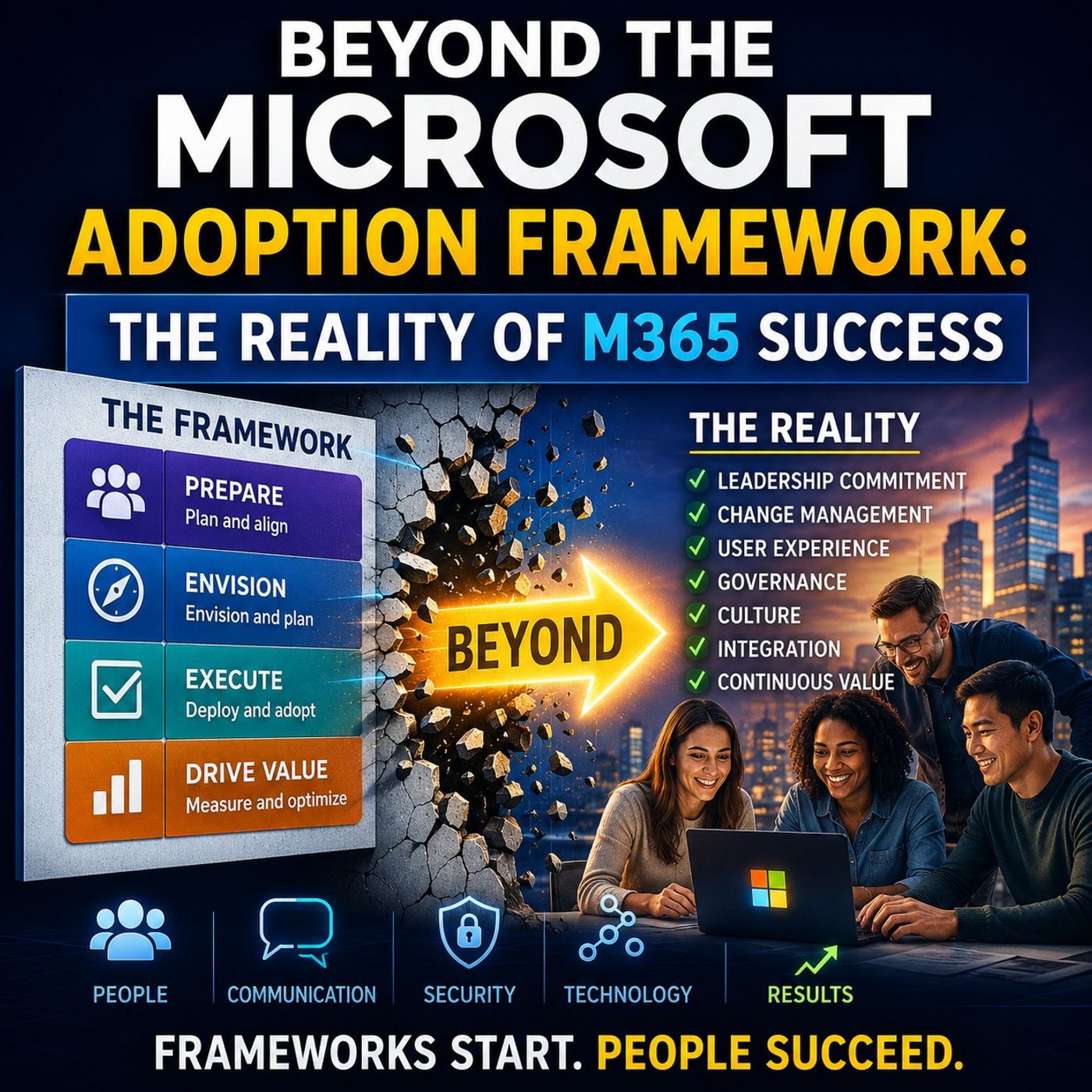
Beyond the Microsoft Adoption Framework: The Reality of M365 Success
0:00-47:07
transcript
show notes
Microsoft 365 transformation is often discussed as though success can be engineered by following the right framework closely enough. Define the strategy, prepare the environment, migrate workloads, establish governance, train users, measure adoption, and continue optimizing. On paper, the process appears logical and comprehensive. In practice, organizations can follow almost every recommended step, successfully deploy Microsoft Teams, SharePoint, OneDrive, Microsoft 365 Copilot, and the wider Microsoft cloud platform, and still discover that very little about the way the organization actually works has changed. That is the central problem explored in this episode. Microsoft 365 adoption rarely fails because the technology itself is incapable of supporting the organization. The more persistent failure occurs because deployment is treated as transformation, activity is interpreted as adoption, and a framework is expected to compensate for an operating model that was never redesigned. The result can be a technically successful Microsoft 365 implementation sitting on top of exactly the same organizational behaviors, unclear responsibilities, information silos, governance gaps, and inefficient processes that existed before the migration. The Microsoft Cloud Adoption Framework and Microsoft 365 adoption guidance remain useful, but they cannot answer the most important organizational questions on their own. They cannot decide who owns a Team after the project that created it has finished. They cannot determine where a business decision should be documented instead of remaining inside someone's inbox. They cannot force employees to stop recreating shared-drive structures inside SharePoint. They cannot determine which Copilot use cases matter to finance, legal, sales, operations, or HR. Most importantly, they cannot change the mental model employees and leaders have developed over years of working in a particular way.
THE FRAMEWORK IS A MAP, NOT THE TRANSFORMATION
Microsoft's adoption and cloud frameworks contain substantial experience accumulated across many implementations, but their usefulness depends on how organizations interpret them. A framework can provide direction, identify common failure points, describe architectural patterns, and force teams to consider questions they might otherwise overlook. What it cannot provide is a universal operating model suitable for every organization regardless of size, maturity, industry, risk profile, existing technology, and organizational culture. The source uses the analogy of replacing a policeman directing traffic at an intersection with a roundabout. The traditional environment is slower and more centralized because movement is controlled directly. The cloud introduces something closer to the roundabout: greater autonomy and speed combined with predefined lanes and guardrails. The infrastructure may be objectively better, but the infrastructure itself does not teach anyone how to behave inside it. Drivers still need to understand when to yield, how to enter, and how to leave safely. Microsoft 365 creates the same challenge. Teams, SharePoint, OneDrive, Copilot, identity services, security controls, retention capabilities, and governance tooling create an environment in which organizations can operate very differently from the traditional world of email, file servers, departmental applications, and manually controlled access. However, providing the environment does not automatically create the behavior required to use it effectively. The framework establishes the roads and guardrails, but the organization still needs to establish the traffic rules.
WHY TECHNICALLY SUCCESSFUL DEPLOYMENTS CAN STILL FAIL
A Microsoft 365 project can reach every conventional technical milestone and still fail as a transformation initiative. Mailboxes can be migrated successfully, identities synchronized, Teams enabled, SharePoint sites provisioned, policies configured, and Copilot licenses assigned without changing how employees think about collaboration or information. This happens partly because different groups define completion differently. IT naturally concentrates on technical readiness and may consider the project substantially complete once the environment is stable and users can access the required services. Employees experience the same event as a change in the tools available to perform their jobs. Leadership may interpret completion through budget, timeline, and project-status reporting. All three perspectives can be reasonable while still failing to describe whether adoption actually occurred. The critical gap exists between access to technology and changed behavior. License activation proves that an employee is technically capable of using a service. It does not prove that the employee understands why the service matters, which existing behavior it should replace, or how it should fit into a real business process. That distinction becomes increasingly important as Microsoft 365 expands beyond productivity applications into AI. Assigning a Copilot license can happen in minutes. Changing the way an employee prepares a report, analyzes information, documents a decision, evaluates AI-generated content, or collaborates with colleagues can take months.
WHY MORE MICROSOFT 365 ACTIVITY DOES NOT NECESSARILY MEAN MORE ADOPTION
Traditional adoption reporting tends to favor metrics that are easy for the platform to observe. Monthly active users, Teams messages, meetings, SharePoint edits, OneDrive activity, and Copilot prompts all provide useful information about what is happening inside the tenant, but none of these measurements independently establishes that the organization has improved. A rise in Teams messages could indicate that employees have successfully moved collaborative conversations into transparent team spaces. The same increase could indicate that communication has become fragmented across channels and employees are sending more messages simply to locate information. Increased SharePoint activity could represent successful co-authoring, or it could represent employees repeatedly moving and duplicating documents because nobody understands the information architecture. The source makes this distinction particularly important by arguing that confusion itself generates activity. A dashboard can therefore move upward while the quality of collaboration moves downward. Activity tells administrators that something is happening; it does not explain whether the behavior producing that activity represents the desired transformation. This is why Microsoft 365 success cannot be reduced to an adoption percentage derived exclusively from platform telemetry. Usage is evidence, but it requires context before it becomes evidence of success.
STRATEGY HAS TO EXIST BEFORE TECHNOLOGY BECOMES THE STRATEGY
One of the earliest problems appears when organizations begin with technology rather than with the business reason for change. A Microsoft 365 license agreement already exists, servers are approaching end of support, a merger creates pressure to consolidate environments, or executives decide that Copilot needs to be introduced quickly. Because the technology and deadline are already visible, the organization begins implementing before clearly defining what should become different as a result. The source distinguishes migration triggers from innovation triggers. Migration can be driven by cost, complexity, aging infrastructure, or operational risk, while innovation is driven by opportunities to create capabilities, enter new markets, increase scale, automate work, or introduce technologies such as AI. The distinction matters because the architecture, budget, timeline, and measurement model should change according to the objective. An organization trying to escape unsupported infrastructure may reasonably prioritize speed and risk reduction. An organization trying to redesign knowledge work around Copilot requires a very different program involving experimentation, process analysis, training, governance, and measurement. When these motivations are not explicit, organizations can become extremely efficient at implementing the wrong thing.
A DEADLINE CAN CREATE MOVEMENT WITHOUT CREATING DIRECTION
Urgency frequently disguises itself as strategy. Hardware reaches end of life, contracts expire, security requirements change, or executives commit publicly to an AI initiative, and suddenly the organization has a transformation program. The project has a deadline, a budget, and a list of deliverables, but it may still lack a destination. The source describes this effectively as a deadline wearing the clothes of strategy: the organization knows why it must leave the current state but has not clearly defined what the future state is supposed to achieve. This distinction becomes critical when costs begin increasing. Leadership can defend an investment when the expected business outcome is understood. It becomes considerably more difficult to defend additional spending when nobody can clearly explain whether the objective was cost reduction, improved collaboration, reduced risk, faster decision-making, AI-enabled productivity, or simply completing a migration before something stopped being supported. Strategy therefore needs to provide more than momentum. It needs to establish the criteria by which the organization will later decide whether the transformation was worthwhile.
Become a supporter of this podcast: https://www.spreaker.com/podcast/m365-fm-modern-work-security-and-productivity-with-microsoft-365--6704921/support.
THE FRAMEWORK IS A MAP, NOT THE TRANSFORMATION
Microsoft's adoption and cloud frameworks contain substantial experience accumulated across many implementations, but their usefulness depends on how organizations interpret them. A framework can provide direction, identify common failure points, describe architectural patterns, and force teams to consider questions they might otherwise overlook. What it cannot provide is a universal operating model suitable for every organization regardless of size, maturity, industry, risk profile, existing technology, and organizational culture. The source uses the analogy of replacing a policeman directing traffic at an intersection with a roundabout. The traditional environment is slower and more centralized because movement is controlled directly. The cloud introduces something closer to the roundabout: greater autonomy and speed combined with predefined lanes and guardrails. The infrastructure may be objectively better, but the infrastructure itself does not teach anyone how to behave inside it. Drivers still need to understand when to yield, how to enter, and how to leave safely. Microsoft 365 creates the same challenge. Teams, SharePoint, OneDrive, Copilot, identity services, security controls, retention capabilities, and governance tooling create an environment in which organizations can operate very differently from the traditional world of email, file servers, departmental applications, and manually controlled access. However, providing the environment does not automatically create the behavior required to use it effectively. The framework establishes the roads and guardrails, but the organization still needs to establish the traffic rules.
WHY TECHNICALLY SUCCESSFUL DEPLOYMENTS CAN STILL FAIL
A Microsoft 365 project can reach every conventional technical milestone and still fail as a transformation initiative. Mailboxes can be migrated successfully, identities synchronized, Teams enabled, SharePoint sites provisioned, policies configured, and Copilot licenses assigned without changing how employees think about collaboration or information. This happens partly because different groups define completion differently. IT naturally concentrates on technical readiness and may consider the project substantially complete once the environment is stable and users can access the required services. Employees experience the same event as a change in the tools available to perform their jobs. Leadership may interpret completion through budget, timeline, and project-status reporting. All three perspectives can be reasonable while still failing to describe whether adoption actually occurred. The critical gap exists between access to technology and changed behavior. License activation proves that an employee is technically capable of using a service. It does not prove that the employee understands why the service matters, which existing behavior it should replace, or how it should fit into a real business process. That distinction becomes increasingly important as Microsoft 365 expands beyond productivity applications into AI. Assigning a Copilot license can happen in minutes. Changing the way an employee prepares a report, analyzes information, documents a decision, evaluates AI-generated content, or collaborates with colleagues can take months.
WHY MORE MICROSOFT 365 ACTIVITY DOES NOT NECESSARILY MEAN MORE ADOPTION
Traditional adoption reporting tends to favor metrics that are easy for the platform to observe. Monthly active users, Teams messages, meetings, SharePoint edits, OneDrive activity, and Copilot prompts all provide useful information about what is happening inside the tenant, but none of these measurements independently establishes that the organization has improved. A rise in Teams messages could indicate that employees have successfully moved collaborative conversations into transparent team spaces. The same increase could indicate that communication has become fragmented across channels and employees are sending more messages simply to locate information. Increased SharePoint activity could represent successful co-authoring, or it could represent employees repeatedly moving and duplicating documents because nobody understands the information architecture. The source makes this distinction particularly important by arguing that confusion itself generates activity. A dashboard can therefore move upward while the quality of collaboration moves downward. Activity tells administrators that something is happening; it does not explain whether the behavior producing that activity represents the desired transformation. This is why Microsoft 365 success cannot be reduced to an adoption percentage derived exclusively from platform telemetry. Usage is evidence, but it requires context before it becomes evidence of success.
STRATEGY HAS TO EXIST BEFORE TECHNOLOGY BECOMES THE STRATEGY
One of the earliest problems appears when organizations begin with technology rather than with the business reason for change. A Microsoft 365 license agreement already exists, servers are approaching end of support, a merger creates pressure to consolidate environments, or executives decide that Copilot needs to be introduced quickly. Because the technology and deadline are already visible, the organization begins implementing before clearly defining what should become different as a result. The source distinguishes migration triggers from innovation triggers. Migration can be driven by cost, complexity, aging infrastructure, or operational risk, while innovation is driven by opportunities to create capabilities, enter new markets, increase scale, automate work, or introduce technologies such as AI. The distinction matters because the architecture, budget, timeline, and measurement model should change according to the objective. An organization trying to escape unsupported infrastructure may reasonably prioritize speed and risk reduction. An organization trying to redesign knowledge work around Copilot requires a very different program involving experimentation, process analysis, training, governance, and measurement. When these motivations are not explicit, organizations can become extremely efficient at implementing the wrong thing.
A DEADLINE CAN CREATE MOVEMENT WITHOUT CREATING DIRECTION
Urgency frequently disguises itself as strategy. Hardware reaches end of life, contracts expire, security requirements change, or executives commit publicly to an AI initiative, and suddenly the organization has a transformation program. The project has a deadline, a budget, and a list of deliverables, but it may still lack a destination. The source describes this effectively as a deadline wearing the clothes of strategy: the organization knows why it must leave the current state but has not clearly defined what the future state is supposed to achieve. This distinction becomes critical when costs begin increasing. Leadership can defend an investment when the expected business outcome is understood. It becomes considerably more difficult to defend additional spending when nobody can clearly explain whether the objective was cost reduction, improved collaboration, reduced risk, faster decision-making, AI-enabled productivity, or simply completing a migration before something stopped being supported. Strategy therefore needs to provide more than momentum. It needs to establish the criteria by which the organization will later decide whether the transformation was worthwhile.
Become a supporter of this podcast: https://www.spreaker.com/podcast/m365-fm-modern-work-security-and-productivity-with-microsoft-365--6704921/support.
links1