M365.FM - Modern work, security, and productivity with Microsoft 365
API Gateway - Simply Explained
July 15 · 12 min · Season 3 · 17.6 MB
0:00-12:14
Streams straight from the publisher. podnod never proxies or re-hosts episode audio.
Modern applications rarely consist of a single backend anymore. Instead, they're built from dozens of independent services handling authentication, payments, products, users, notifications, and much more. As this architecture grows, managing communication between clients and services quickly becomes complex. In this episode of m365.fm, we explain what an API Gateway is, why it has become a fundamental building block of modern cloud applications, and how it simplifies routing, security, traffic management, and monitoring. Whether you're building applications in Azure, AWS, Google Cloud, or any microservices environment, understanding the API Gateway pattern is essential for designing scalable, secure, and maintainable systems.
WHY MODERN APPLICATIONS NEED AN API GATEWAY
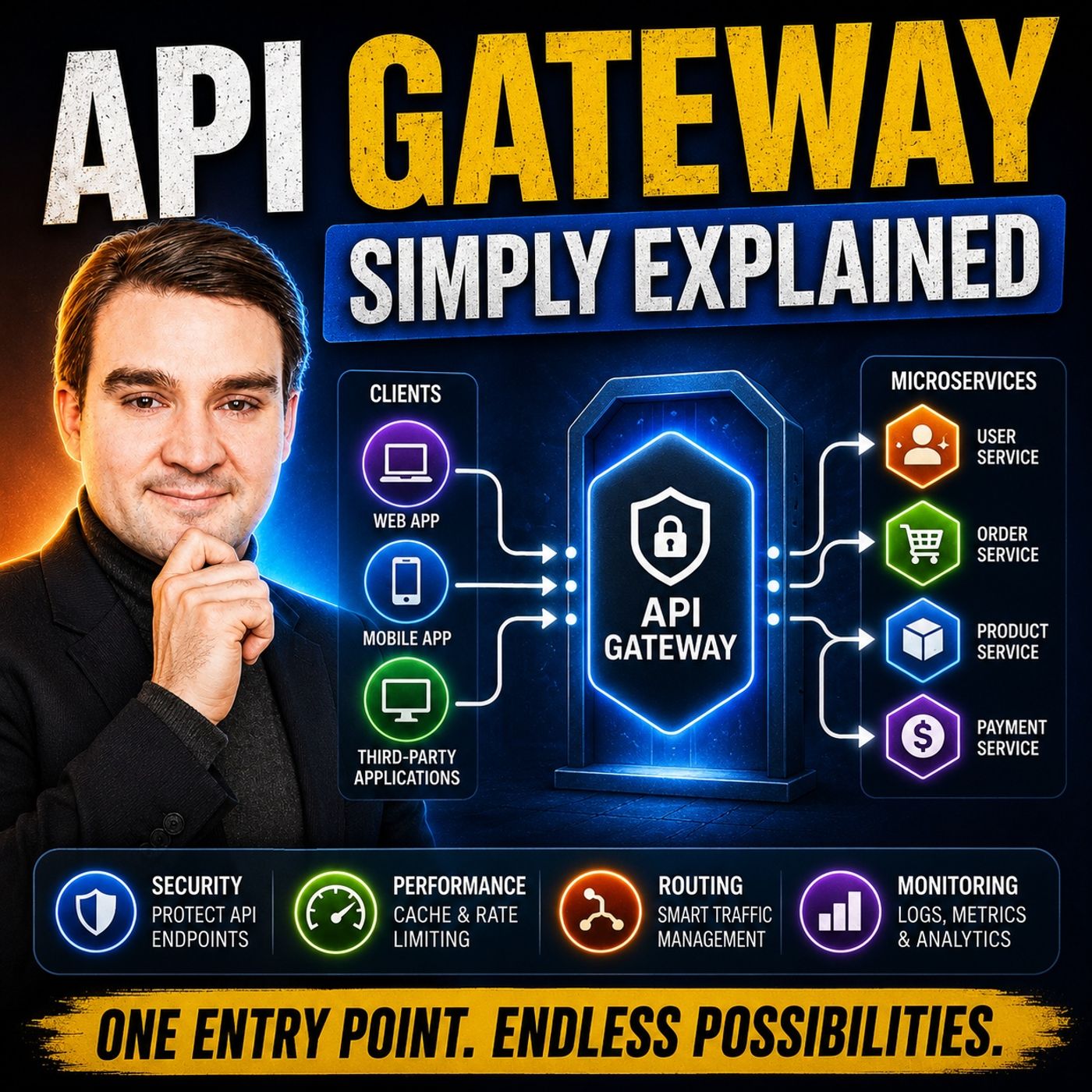
Without an API Gateway, every client application must communicate directly with multiple backend services, each with its own endpoint, authentication process, error handling, and security rules. This creates unnecessary complexity for developers while increasing operational risk. We explain how an API Gateway acts as a single front door for your entire application, hiding backend complexity from clients and providing one centralized entry point for every request. Through practical examples, you'll see how API Gateways dramatically simplify application architecture while improving scalability and reducing maintenance overhead.
ROUTING, SECURITY, AND TRAFFIC MANAGEMENT
An API Gateway does far more than simply forward requests. This episode explores its four core responsibilities: intelligent request routing, centralized authentication and authorization, traffic management through rate limiting and load balancing, and request/response transformation. Learn how API Gateways validate JWT tokens, OAuth credentials, API keys, and certificates before traffic reaches your services. We also cover request throttling, quotas, version management, health checks, regional routing, and automatic failover, showing how a gateway protects backend systems while ensuring consistent performance under heavy load.
DATA TRANSFORMATION AND OBSERVABILITY
One of the most powerful capabilities of an API Gateway is its ability to transform requests and responses without modifying either clients or backend systems. Discover how gateways translate between JSON and XML, modify headers, rewrite URLs, mask sensitive information, and support legacy applications alongside modern cloud-native services. We also explain how centralized logging, metrics, analytics, monitoring, and observability provide complete visibility into every API request, making troubleshooting and performance optimization significantly easier across distributed systems.
BUILDING A MODERN API PLATFORM
The episode concludes with practical guidance for implementing an API Gateway in real-world environments. Learn when a gateway becomes necessary, how to gradually introduce one into an existing architecture, and why centralizing authentication is often the best first step. We also compare popular gateway platforms including Azure API Management, Kong, AWS API Gateway, and other modern solutions while emphasizing that the architectural pattern matters more than the specific product. Whether you're designing your first microservices application or modernizing an enterprise platform, this episode provides a practical foundation for understanding one of the most important components in modern cloud architecture.
Become a supporter of this podcast: https://www.spreaker.com/podcast/m365-fm-modern-work-security-and-productivity-with-microsoft-365--6704921/support.
WHY MODERN APPLICATIONS NEED AN API GATEWAY
Without an API Gateway, every client application must communicate directly with multiple backend services, each with its own endpoint, authentication process, error handling, and security rules. This creates unnecessary complexity for developers while increasing operational risk. We explain how an API Gateway acts as a single front door for your entire application, hiding backend complexity from clients and providing one centralized entry point for every request. Through practical examples, you'll see how API Gateways dramatically simplify application architecture while improving scalability and reducing maintenance overhead.
ROUTING, SECURITY, AND TRAFFIC MANAGEMENT
An API Gateway does far more than simply forward requests. This episode explores its four core responsibilities: intelligent request routing, centralized authentication and authorization, traffic management through rate limiting and load balancing, and request/response transformation. Learn how API Gateways validate JWT tokens, OAuth credentials, API keys, and certificates before traffic reaches your services. We also cover request throttling, quotas, version management, health checks, regional routing, and automatic failover, showing how a gateway protects backend systems while ensuring consistent performance under heavy load.
DATA TRANSFORMATION AND OBSERVABILITY
One of the most powerful capabilities of an API Gateway is its ability to transform requests and responses without modifying either clients or backend systems. Discover how gateways translate between JSON and XML, modify headers, rewrite URLs, mask sensitive information, and support legacy applications alongside modern cloud-native services. We also explain how centralized logging, metrics, analytics, monitoring, and observability provide complete visibility into every API request, making troubleshooting and performance optimization significantly easier across distributed systems.
BUILDING A MODERN API PLATFORM
The episode concludes with practical guidance for implementing an API Gateway in real-world environments. Learn when a gateway becomes necessary, how to gradually introduce one into an existing architecture, and why centralizing authentication is often the best first step. We also compare popular gateway platforms including Azure API Management, Kong, AWS API Gateway, and other modern solutions while emphasizing that the architectural pattern matters more than the specific product. Whether you're designing your first microservices application or modernizing an enterprise platform, this episode provides a practical foundation for understanding one of the most important components in modern cloud architecture.
Become a supporter of this podcast: https://www.spreaker.com/podcast/m365-fm-modern-work-security-and-productivity-with-microsoft-365--6704921/support.