M365.FM - Modern work, security, and productivity with Microsoft 365
The Death of the Chatbot: Why Your Dataverse Strategy Is Broken
Wednesday · 1 hr 41 min · Season 2 · 146.6 MB
0:00-1:41:49
Streams straight from the publisher. podnod never proxies or re-hosts episode audio.
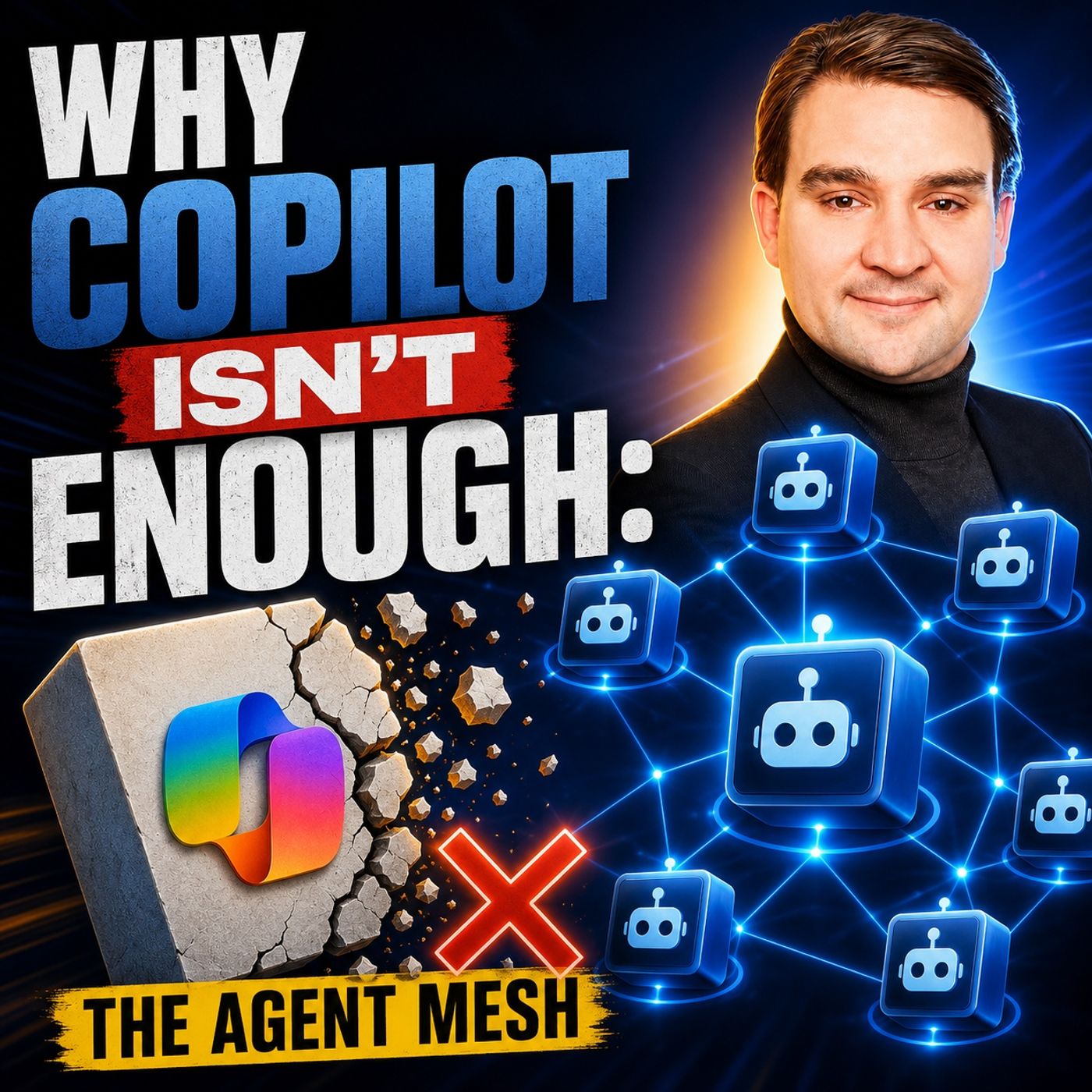
Microsoft Copilot has transformed how organizations interact with AI, making conversational experiences more accessible than ever. But while chat-based AI delivers immediate productivity gains, it does not provide the architectural foundation required for enterprise-scale autonomous agents. As organizations deploy more AI solutions across departments, they quickly encounter governance challenges, identity issues, fragmented integrations, and uncontrolled costs. Copilot is an excellent interface—but it is only one layer of a much larger AI ecosystem.
AGENT IDENTITY, GOVERNANCE, AND SECURITY FOR ENTERPRISE AI
One of the biggest challenges in enterprise AI is identity. Many organizations still allow AI agents to operate under shared service accounts or even employee credentials, making auditing nearly impossible. Every autonomous agent should have its own dedicated identity, least-privilege permissions, and complete traceability. Combined with centralized governance, organizations gain full visibility into who—or what—accessed sensitive data, ensuring compliance with standards such as GDPR, SOC 2, and industry-specific regulations.
FROM RAG TO ONTOLOGIES: BUILDING AGENTS THAT UNDERSTAND BUSINESS CONTEXT
Traditional Retrieval-Augmented Generation (RAG) systems retrieve documents and generate answers based on matching text. While useful, they rarely understand how a business actually operates. Agent Mesh architectures replace document-centric reasoning with ontologies that model customers, products, suppliers, policies, and business relationships. Instead of searching for words, AI agents reason over structured knowledge, dramatically improving accuracy, consistency, and decision-making across the enterprise.
THE AI LANDING ZONE: CENTRALIZED CONTROL FOR AGENT MESH
Scaling dozens or even hundreds of AI agents requires more than good prompts. Organizations need a dedicated AI Landing Zone that combines identity management, governance policies, model gateways, observability, cost controls, and centralized approval processes. Every model request flows through a governance layer where security, regional compliance, budget limits, and policy enforcement are applied automatically. This approach transforms isolated AI projects into a standardized enterprise platform capable of supporting large-scale autonomous operations.
AGENT 365, OBSERVABILITY, AND FINOPS FOR RESPONSIBLE AI
Managing AI at scale requires complete operational visibility. A centralized control plane such as Agent 365 enables organizations to inventory agents, monitor usage, assign ownership, retire unused "ghost agents," and analyze every model invocation. Combined with comprehensive observability and FinOps practices, businesses can optimize token consumption, enforce budgets, detect abnormal behavior, and maintain continuous compliance while significantly reducing operational costs.
THE FUTURE OF MICROSOFT AI: FROM COPILOT TO THE AGENT MESH
The next generation of enterprise AI is no longer about individual chatbots—it is about interconnected, governed, autonomous systems working together. Organizations that invest early in Agent Mesh architectures, centralized governance, ontology-driven reasoning, secure identities, and AI operating platforms will be able to scale hundreds of intelligent agents safely and efficiently. The future belongs to businesses that treat AI not as a feature, but as enterprise infrastructure capable of supporting continuous automation, intelligent decision-making, and long-term digital transformation.
Become a supporter of this podcast: https://www.spreaker.com/podcast/m365-fm-modern-work-security-and-productivity-with-microsoft-365--6704921/support.
AGENT IDENTITY, GOVERNANCE, AND SECURITY FOR ENTERPRISE AI
One of the biggest challenges in enterprise AI is identity. Many organizations still allow AI agents to operate under shared service accounts or even employee credentials, making auditing nearly impossible. Every autonomous agent should have its own dedicated identity, least-privilege permissions, and complete traceability. Combined with centralized governance, organizations gain full visibility into who—or what—accessed sensitive data, ensuring compliance with standards such as GDPR, SOC 2, and industry-specific regulations.
FROM RAG TO ONTOLOGIES: BUILDING AGENTS THAT UNDERSTAND BUSINESS CONTEXT
Traditional Retrieval-Augmented Generation (RAG) systems retrieve documents and generate answers based on matching text. While useful, they rarely understand how a business actually operates. Agent Mesh architectures replace document-centric reasoning with ontologies that model customers, products, suppliers, policies, and business relationships. Instead of searching for words, AI agents reason over structured knowledge, dramatically improving accuracy, consistency, and decision-making across the enterprise.
THE AI LANDING ZONE: CENTRALIZED CONTROL FOR AGENT MESH
Scaling dozens or even hundreds of AI agents requires more than good prompts. Organizations need a dedicated AI Landing Zone that combines identity management, governance policies, model gateways, observability, cost controls, and centralized approval processes. Every model request flows through a governance layer where security, regional compliance, budget limits, and policy enforcement are applied automatically. This approach transforms isolated AI projects into a standardized enterprise platform capable of supporting large-scale autonomous operations.
AGENT 365, OBSERVABILITY, AND FINOPS FOR RESPONSIBLE AI
Managing AI at scale requires complete operational visibility. A centralized control plane such as Agent 365 enables organizations to inventory agents, monitor usage, assign ownership, retire unused "ghost agents," and analyze every model invocation. Combined with comprehensive observability and FinOps practices, businesses can optimize token consumption, enforce budgets, detect abnormal behavior, and maintain continuous compliance while significantly reducing operational costs.
THE FUTURE OF MICROSOFT AI: FROM COPILOT TO THE AGENT MESH
The next generation of enterprise AI is no longer about individual chatbots—it is about interconnected, governed, autonomous systems working together. Organizations that invest early in Agent Mesh architectures, centralized governance, ontology-driven reasoning, secure identities, and AI operating platforms will be able to scale hundreds of intelligent agents safely and efficiently. The future belongs to businesses that treat AI not as a feature, but as enterprise infrastructure capable of supporting continuous automation, intelligent decision-making, and long-term digital transformation.
Become a supporter of this podcast: https://www.spreaker.com/podcast/m365-fm-modern-work-security-and-productivity-with-microsoft-365--6704921/support.