
LT
Let's Talk Quality
Hemish Ilangaratne
“Let’s Talk Quality” is a podcast that seeks to shine a light on quality assurance, a profession that acts as the cornerstone for bringing safer medicine to patients. For life science companies to continue to develop life-saving medicines, a culture of good quality must be driven across the industry, whether that be an early phase gene therapy biotech or a global pharma organisation. This podcast aims to drive that mission forward through inviting industry leaders, experts, and visionaries to share their knowledge, experiences, and strategies for achieving quality excellence. Join us on a journey of discovery as we unravel the importance of quality and its profound impact on businesses and society. Get ready to engage in insightful discussions, gain valuable perspectives, and unlock the secrets to fostering a culture of quality in every aspect of life. Tune in and let’s embark on this exciting quality-driven adventure together.
- 21 episodes
- weekly
- Avg 33 min
- English
Counted on this page — what you have heard stays on this device, so it is not something the list can be paged by.
- LT
 S4 · E25October 6 · 50 min· Video
Maja Pedersen on AI, Strategic Leadership, and Evolving as a Quality Leader
Maja Pedersen says following a process is what she does least, and she built a career in Quality because a clear framework gives people room to make pragmatic decisions. Maja Pedersen on AI, Strategic Leadership, and Evolving as a Quality Leader In today's episode, we revisit a conversation with Maja Pedersen from July 2025. Maja is now President and Chief Operating Officer at FUJIFILM Biotechnologies. When we recorded this conversation she was Chief Quality Officer, responsible for six sites with a seventh being built in Japan. I really wanted to bring this conversation back because she moved from a TrackWise rollout in medical devices to leading Quality, IT, digitalization and science across a global CDMO. She is at the forefront of AI adoption, and her approach to Quality leadership is built around people and a pragmatic framework. We talk about: How Maja went from a TrackWise rollout in medical devices to leading a Quality team early in her career Taking over a Quality team of roughly 30 at Cook Medical and understanding people before trying to be understood Becoming site head of Quality at Biogen in Hillerød and learning to perform through her team Leading a global team across six sites, including four in-person meetings a year and meditation at the last leadership summit Why she wants Quality to move from correction to prediction, and why she recommends putting Quality and IT under one leader Thank you Maja for sharing your journey. Timestamps: (00:00) Quality, IT, digitalization and science under one leader (02:45) Why following a process is what she does least (13:34) Inheriting a team of 30 and presenting yourself as a human being (21:56) Moving from tactical to strategic thinking (27:32) Too loud about AI, and how IT landed on her desk (33:06) A global team that meets four times a year and meditates together (38:51) At least an hour and a half of daylight, every day (42:28) Corrections more than preventions: where Quality goes next
- Chapters
- LT
 S4 · E24September 29 · 41 min· Video
Colleen Walson-Billin on Building a Quality Career Without a Science Degree
Colleen Walson-Billin was told she was not eligible to progress in Quality without a science degree, and went on to lead a full GxP Quality function at a biologics startup. Colleen Walson-Billin on building a Quality career without a science degree. In today's episode I was joined by Colleen Walson-Billin, Vice President & Head of GxP Quality & Compliance at Jade Biosciences. I wanted to speak to Colleen because her route into Quality started with a business degree and a role as administrative assistant to a director of Quality at Amgen. From there she moved through QA, corporate and international Quality, served twice as chief of staff to the head of Quality, and now leads Quality across GMP, GCP, GLP and pharmacovigilance. We talk about: Starting in Quality as an administrative assistant, and telling her first boss up front that the role was her foot in the door Being told she was not eligible to progress without a science degree, and building her technical knowledge on the job Serving twice as chief of staff to the head of Quality, and what she learned at the table with the leadership team Leaving Amgen for smaller companies, and picking up GCP, GLP and pharmacovigilance for the first time Leading executive and senior directors, stepping back from being the doer, and positioning Quality as a partner from the start Thank you Colleen for sharing your journey. Timestamps: (00:00) Introduction (00:46) "My foot in the door": business degree to admin assistant (05:02) "You're just not even eligible" (08:51) The advice that made the degree stop mattering (12:34) A career with no plan, built by putting her hand up (19:14) Leaving Amgen for a smaller company (22:01) Employee number 24, and "enough to be dangerous" across GxP (25:14) Why the degree becomes almost irrelevant at 20 years (29:50) Roadblocks, naysayers and the police: old school Quality (35:06) Selling Quality to a room of college students (40:03) Inspired by what she did not want to become
- Chapters
- LT
 S4 · E23September 22 · 41 min· Video
Geetu Abbi on When to Build a Digital Quality Function
Geetu Abbi was handed the GAMP guide as a new validation engineer at Genzyme, and in 2024 she co-led one. Geetu Abbi on When to Build a Digital Quality Function In today's episode I was joined by Geetu Abbi, Head of Digital Quality Assurance at Alkermes. I wanted to speak to Geetu because Digital Quality was not a job title eight to ten years ago, and she has grown into the role from computer systems validation. She moved from software testing into validation at Siemens without a life sciences background, and in 2024 she co-led the GAMP guide for GCP and clinical trials. We talk about: - Moving from software testing into validation at Siemens, with no prior exposure to Part 11 or 21 CFR 820 - What Digital Quality is, and the gap it fills between site Quality and clinical Quality - Data lifecycle mapping, and why validation now has to be revisited with every change - Delivering seven validated systems in eight months to support the Alkermes-Mural Oncology separation in 2023 - Her advice to the next generation of Quality professionals on why they don't have to solve everything alone Thank you Geetu for sharing your journey. Timestamps: (00:00) Introduction and guest background (03:42) From QA to validation (08:00) Career turning point (13:04) What digital quality means (22:28) Digital quality as a career opportunity (29:58) How the team is structured (34:06) Advice for future quality leaders
- Chapters
- LT
 S4 · E22September 11 · 36 min· Video
Isha Patel on the Overnight Career Plan That Took Her from Associate Director to SVP
Naymisha (Isha) Patel has spent thirty years in Quality and regulatory compliance across pharmaceuticals, biologics, medical devices and combination products. She is now Senior Vice President of Quality at AirNexis Therapeutics, a seven-month-old startup developing a combination product for COPD, where she is the first Quality hire. In this episode Isha talks about the ten-year career plan she wrote overnight in 2005 after a hiring VP at Nektar asked what she wanted, and how it carried her from associate director to senior vice president. She explains why she moved to Boston in a blizzard to lead Quality at Ocular Therapeutix, a one-product company with two FDA complete response letters, and what she found in the inspection scribe notes. She walks through the reorganisation, letting go of people whose skill sets did not match the product classification, and the FDA inspection that ended in approval with no post-approval commitments. Isha also covers building Tenaya's Quality function, closing that same manufacturing facility four and a half years later, and choosing between consultants and permanent headcount. Topics covered: - Why a career plan written on paper beats a vague ambition - Reading the scribe notes, not just the CRL - Letting people go for skill fit, not performance - What FDA inspectors want to see when you are not finished - Green flags when a CEO hires their first head of Quality - Consultant or permanent hire: the two-year vision test - Why Quality is missing from early-stage boards - Quality as navigating grey zones, not yes or no Timestamps: (00:00) Introduction and guest background (02:52) Transitioning into Quality leadership (06:34) Career moves and a pivotal opportunity (08:38) A practical career plan (13:13) Turning around a Quality system (20:21) Building Quality in gene therapy (22:14) Choosing the right startup role (25:42) Building a lean Quality team (28:09) C-suite and board aspirations (30:10) Advice for aspiring Quality leaders
- Chapters
- LT
 S4 · E21September 1 · 39 min· Video
Dawn Houlihan on Her Journey From Ireland Big Pharma to the Boston Start-Up World
Dawn Houlihan started out as the person manufacturing teams went quiet around, and spent the next twenty years proving that quality works better as a partner than a police force. Dawn Houlihan on Her Journey From Ireland Big Pharma to the Boston Start-Up World In today's episode I was joined by Dawn Houlihan. I wanted to speak to Dawn because she has built a quality function from nothing, and has done it across almost every stage and modality the industry has to offer. She spent half her career with Janssen in Ireland, moved to Scotland and then to Boston, and has since led quality through phase three, commercial approval and cell and gene therapy in two small companies where everything was outsourced. We talk about: What quality was actually like on the manufacturing floor in Ireland in the mid two thousands The mentor who told her to say yes to a project she did not have time for Switching CDMO in the middle of phase three and still hitting commercial approval Why saying no to everything is the easy road, and what it costs a small company Being the first quality hire at Ensoma and building the culture from scratch Timestamps: (00:00) Introduction and Dawn's background in pharma (05:03) Quality's evolution: from policing to partnership (07:20) Mentorship, Scotland, and the move to Boston (13:10) Building quality teams in biotech startups (19:09) Trust, risk, and leading through partnership (29:29) Building quality from the ground up (34:16) The future of quality leadership and career advice
- Chapters
- LT
 S4 · E20August 25 · 39 min· Video
Luciana Mansolelli on Her First Year as CQO in the CDMO World
Luciana Mansolelli spent twenty years on the sponsor side. One question from a board chairman moved her to a CDMO. Luciana Mansolelli on her first year as CQO in the CDMO world. In today’s episode I was joined by Luciana Mansolelli, Chief Quality Officer at Minaris Advanced Therapies. I wanted to speak to Luciana because she has now led quality on both sides of the same relationship - Novartis and J&J on the sponsor side, and now a 200-person global quality organisation across the US, Germany and Japan. We talk about: • The moment she realised she had stopped learning, and why she left • Why framing speed against quality is the wrong model in advanced therapies • How she structured a global quality team around the science rather than the org chart • What she assesses for when she hires, beyond technical competence • Turnover in the CDMO world, and why she thinks capability is the fix Thank you Luciana for sharing your journey. Timestamps: (00:00) Introduction to Luciana Monsolelli (01:01) Journey into Pharmaceutical Sciences (02:41) The Evolution of Quality in Pharma (05:32) Transitioning from Big Pharma to CDMO (08:30) Challenges in the CDMO Landscape (14:00) Building a Quality Culture at Minaris (19:00) Talent Management and Capability Development (27:00) Leadership Style and Team Dynamics (37:00) Future Aspirations in Advanced Therapies
- Chapters
- LT
 S4 · E19July 30 · 16 min
My Thoughts on Quality Leadership, Halfway Through Season Four
Season Four is at its halfway point, so instead of a guest this week I’ve gone back over the conversations so far and pulled out the theme that came up most often. The quality leader whose main function is to say no is finished. This episode is four clips from Season Four guests on that theme, with my own thoughts in between. I also talk about why I think this matters for your career and not just for your working relationships, which comes from the other half of my week, placing quality leaders and hearing what hiring managers are actually asking for. Get in touch If you’re going through that step up at the moment, I’d be interested to hear about it. Find me on LinkedIn, or book a conversation here: https://calendly.com/h-ilangaratne/meeting-with-hemish-rx-group If there’s a topic you’d like covered on a future solo episode, send it over. Timestamps: (00:00) - Intro - Halfway Through Season Four (01:50) - The Old Reputation - Tim Mitchell (03:30) - Hemish's Take - Reputation vs. Reality (04:23) - Saying No Is the Easy Option - Kim Garko (05:51) - Hemish's Take - The Career Angle (07:21) - Translating Risk for the Business - Jamey Lindholm (10:02) - Hemish's Take - Practical Application (10:59) - Partnership Over Policing - Rex Ready (14:21) - Closing Thoughts - What This Means for Quality Leaders
- Chapters
- LT
 S4 · E18July 21 · 38 min· Video
Speaking the Language of the Business, with Jamey Lindholm
Quality culture isn't built by SOPs. It's built in the small moments when a leader reinforces the right behaviour or lets the wrong one slide. Speaking the Language of the Business, with Jamey Lindholm. In today's episode I was joined by Jamey Lindholm, Vice President of Quality at R1 Therapeutics. I really wanted to speak to Jamey because she has led Quality through nearly every stage a career in this industry can throw at you: a first-in-class FDA approval at Seres Therapeutics, an acquisition by Merck KGaA at Springworks, and now building a Quality function completely from zero as R1's very first Quality hire. She has strong, hard-won views on how to get each of those right. Jamey's journey started almost by accident. She fell into a QC chemistry job at a small biotech straight out of university, got laid off a year later when the company ran out of funding, and then spent the next 20 years at Biogen, where she built the foundation of what she now calls "what good looks like" in Quality. From there she moved to Seres Therapeutics, where she led end to end Quality through the first FDA approval of a microbiome-derived oral therapy, then to Springworks through its acquisition by Merck KGaA, and now to R1 Therapeutics as its first Quality hire. What comes through across the whole conversation is a leader who has thought deeply about the difference between compliance and culture. Jamey is clear that Quality earns its seat at the leadership table not by enforcing SOPs, but by translating compliance into risk, into regulatory consequence, into business decisions that leadership teams actually understand. She is equally clear that the industry has a visibility problem. Almost nobody chooses Quality as a career at school, and she believes that is something the industry has an obligation to fix. We talk about the following: Why 20 years at a large pharma company can make the move into a startup harder, not easier The difference between managing Quality operations and being responsible for end-to-end Quality at a small company Why "quality risks are business risks" changes how a leadership team makes decisions What actually builds quality culture, and why it isn't SOPs The moment Seres received FDA approval for Vowst, and why it felt different from anything Jamey experienced at Biogen Why it's never too early to bring in a permanent Head of Quality, and what that decision signals about a company's culture Why Quality is invisible as a career choice to STEM students, and what the industry can do about it Jamey is a thoughtful, pragmatic quality leader who understands how to balance compliance, collaboration and business reality in complex development environments. If you are a quality professional working in an early-stage biotech and trying to build the right systems with limited resources, then this episode is for you. Thank you Jamey for sharing your incredible journey. Hope everyone enjoys the show. WHO THIS EPISODE IS FOR A Head of Quality or VP Quality building a function from scratch at a startup A big pharma quality professional considering a move into biotech A founder or CEO deciding when to bring in a permanent Head of Quality A quality manager trying to build genuine culture, not just documentation A STEM student or early-career scientist who has never considered Quality as a career path Timestamps: (00:00) Introduction to Jamey Lindholm and Her Career Journey (02:41) Transitioning from Big Pharma to Startups (05:14) Navigating Quality in Complex Environments (07:38) The Role of Quality in Business Strategy (10:16) Building a Quality Culture in Startups (13:14) Hiring for Quality in Startups (15:42) The Visibility of Quality Careers in STEM (18:29) Demystifying Quality for Future Generations (21:12) Inspiring the Next Generation in Quality Science (22:40) The Emotional Impact of FDA Approvals (26:46) The Importance of Quality Leadership in Startups (31:30) Building a Quality Culture from the Ground Up (34:50) Advice for Future Quality Professionals (37:03) Making the Case for a Career in Quality
- Chapters
- LT
 S4 · E17July 14 · 29 min· Video
The Big Pharma Habits You Have to Unlearn in a Startup, with Dawn Lundin
Twenty years at Merck, then a leap into academia and psychedelic medicine - here is how Dawn Lundin built a quality career on instinct. Dawn Lundin on the big pharma habits you have to unlearn in a startup. In today's episode I was joined by Dawn Lundin, founder of her own quality consultancy and a fractional Head of Quality across biotech and psychedelic-medicine companies. I really wanted to speak to Dawn because her path is nothing like the typical quality leader's. She didn't stay inside big pharma and climb one ladder. She spent twenty years at Merck, then walked into academia, then into one of the most stigmatised fields in medicine, and she made each move work. Dawn started as a bench chemist and grew through GLP, clinical packaging, GCP auditing and pharmacovigilance, eventually heading up issues management and co-authoring the first quality manual for Merck's research division. Then, on the morning of her twentieth anniversary, she resigned. She moved to the University of Pennsylvania to build fit for purpose quality systems for both sponsor and site research, a system still in use today. From there she stepped into psychedelic medicine for mental health, a move driven as much by personal loss as by professional curiosity. What runs through Dawn's whole story is a refusal to lead by importing an old playbook. In a smaller, faster environment she learned to do quality with far less, to put relationships before procedures, and to build trust before she changed a single thing. Her line for it has stuck with me: she did quality "one cup of coffee at a time." We talk about the following: Why she left twenty years at Merck on the exact morning of her anniversary The big pharma habits leaders have to unlearn in academia and startups How to build a fit for purpose quality system with a fraction of the resources Why relationships, not procedures, carry a quality programme in a small organisation The personal story that drew her into psychedelic medicine and mental health Dawn Lundin is a thoughtful, pragmatic quality leader who understands how to balance compliance, collaboration and business reality in complex development environments. If you are a quality professional working in an early-stage biotech and trying to build the right systems with limited resources, then this episode is for you. Thank you Dawn for sharing your incredible journey. Hope everyone enjoys the show. WHO THIS EPISODE IS FOR Quality leaders moving from big pharma into a startup, scale-up or academia Hiring managers building a first quality team and weighing up big pharma candidates Early-stage biotech founders who need fit for purpose quality without the overhead Quality professionals weighing a bold or unconventional career move Anyone drawn to how mental health and psychedelic medicine are being built responsibly Timestamps: (00:00) - Introduction to Dawn Lundin (01:15) - Dawn's Journey into Science and Quality (05:05) - Career Growth at Merck (11:16) - Transitioning from Big Pharma to Academia (17:34) - Navigating Startup Challenges (22:54) - Current Consultancy and Future Aspirations
- Chapters
- LT
 S4 · E16July 7 · 33 min· Video
How Quality Stopped Being Black and White, with Tim Mitchell
Forty seven years in quality, and Tim Mitchell says the job he started is nothing like the one he does today. Tim Mitchell on how quality stopped being black and white In today's episode I was joined by Tim Mitchell, Vice President of Quality at Aktis Oncology, a radiopharmaceutical company in Boston developing treatments across several types of cancer. I really wanted to speak to Tim because very few people have watched quality evolve the way he has. He started in 1980, when the GMP regulations were barely a year and a half old and a quality assurance function did not really exist yet. Tim's story begins in a loud, industrial antibiotic fermentation plant, monitoring sixty to ninety thousand gallon fermenters that ran into the ground. His father worked in the neighbouring department at Eli Lilly, and an internship near his hometown turned into fourteen years at Lilly and a career that carried him from big pharma through to the start-up world he works in now. Along the way he moved from manufacturing into a validation team, without knowing what validation even was, and found that quality suited him. What comes through most is his view of the role itself. Tim does not see quality as a police force. He sees it as a collaborative partner to the rest of the business, a role that demands technical depth, patience and judgement. He talks openly about how the work has moved from black and white rule-following to something far more gray, especially in early-stage biotech where the science is moving faster than the rulebook. We talk about the following: How the quality function grew from a paperwork desk job into a value-adding partnership Why some of the best quality people come from manufacturing backgrounds The case for learning proper GMP systems in big pharma before joining a start-up What good mentoring actually looks like, and why annual reviews are not enough How the relationship between the FDA and biotech is becoming genuinely collaborative Tim Mitchell is a thoughtful, pragmatic quality leader who understands how to balance compliance, collaboration and business reality in complex development environments. If you are a quality professional working in an early-stage biotech and trying to build the right systems with limited resources, then this episode is for you. Thank you Tim for sharing your incredible journey. Hope everyone enjoys the show. WHO THIS EPISODE IS FOR Quality professionals moving from big pharma into a clinical-stage biotech Managers building or scaling a quality management system from scratch Manufacturing and technical operations people considering a move into quality VPs and Directors of Quality thinking about how they mentor their teams Anyone early in their quality career trying to understand where the role is heading Timestamps: (00:00) Introduction to Tim Mitchell and His Journey (02:27) Evolution of Quality in the Pharmaceutical Industry (05:07) The Changing Landscape of Quality Roles (07:59) Skills for Modern Quality Professionals (10:29) Mentorship and Team Development (13:16) The Future of Quality Leadership (16:20) Navigating the Transition from R&D to Commercialization (19:01) The Role of Quality in Biotech Innovation (21:12) Challenges and Opportunities in Quality Management (24:38) The Importance of Collaboration in Quality (27:07) Advice for Aspiring Quality Leaders
- Chapters
- LT
 S4 · E15May 26 · 41 min· Video
Swetha Krishnan on her journey from Individual Contributor to Inspiring People Leader
She came to the US with her first year's tuition and figured the rest out from there. What followed is one of the most grounded quality leadership journeys I have heard - and one we felt was worth bringing back. Swetha Krishnan on Building a Quality Mindset from the Ground Up This is a rerelease of one of our favourite episodes from two years ago. In today's episode I was joined by Swetha Krishnan. I really wanted to bring this conversation back because Swetha's route into quality was entirely unplanned - and the way she has turned that unplanned start into a clear leadership philosophy is something every quality professional should hear. Swetha came to the US from India to complete a master’s in bioengineering at the University of Toledo. She needed work, she needed a visa sponsor, and she found her way into a contractor role at Pfizer in Connecticut doing technical writing and validation. It was not the destination she had mapped out, but two years of being moved from role to role - quality management systems, regulatory content authoring, client-facing support - gave her a cross-functional view of how a pharma company actually operates. From there she moved through roles at Biogen, Sanofi Genzyme, and Alkermes before taking on her current position leading quality across all GXPs at Mural Oncology, a clinical-stage biotech focused on cytokine-based immunotherapies for cancer. Swetha leads with a combination of strategic clarity and genuine warmth. She is honest about the things she struggled with early on - particularly the belief that credibility required having all the answers - and equally clear about what changed that. She talks about the boss at Alkermes who told her she would one day be head of quality before she believed it herself, the nine-month Women Unlimited LEAD program that gave her two external mentors, and the MIT Leadership Signature course that asked her to examine what in her personal history shapes how she shows up every day. We talk about the following: • How a bioengineering thesis on non-invasive glucose measurement for diabetics led to an unexpected start in quality • Starting as a contractor at Pfizer and what wearing so many hats in two years taught her about the whole product life cycle • Why validation gave her a quality mindset before she had ever formally joined a quality team • The shift from individual contributor to manager to leader of teams - and why it forced her to rethink everything she thought she knew about credibility • The nine-month Women Unlimited LEAD program at Alkermes and the boss who saw her potential before she saw it herself • Quality by design in practice - being involved in CRO selection from the start, not after the contract is signed • How she manages prioritisation, managing up, and keeping her team grounded in a lean, fast-moving clinical-stage biotech • Her 4C model for aspiring quality leaders: challenge, curiosity, collaboration, and compassion Swetha is a thoughtful, pragmatic quality leader who understands how to balance compliance, collaboration and business reality in complex development environments. If you are a quality professional working in an early-stage biotech and trying to build the right systems with limited resources, then this episode is for you. You can watch on LinkedIn Live at 12pm EST today or listen via Apple or Spotify. Thank you Swetha for sharing your incredible journey. Hope everyone enjoys the show. Who This Episode Is For • Quality managers and directors in clinical-stage biotech who are building systems and leading teams without large headcounts or unlimited budgets • Aspiring heads of quality who are in the transition from individual contributor to people leader and finding that shift harder than they expected • Quality professionals who came into the function from validation, technical writing, or another non-traditional route and are still making sense of how it all connects • Senior quality leaders who want a practical framework for developing the next generation on their team • Anyone in pharma or biotech who has ever felt like asking for help put their credibility at risk Timestamps: (00:00) Introduction to Swetha Krishnan and Mural Oncology (05:08) The Importance of Quality in Biotech (11:00) The Role of Quality in Driving Strategy (16:39) Managing Stress and Prioritization (21:55) Self-Development and Continuous Learning (26:44) Advice for Aspiring Quality Leaders
- Chapters
- LT
 S4 · E14May 19 · 35 min· Video
Building Quality That Scales, with Laura Singer
What does it really take to build a quality organization from the ground up - and do it again, and again, across multiple companies? Laura Singer on building quality that scales. In today's episode I was joined by Laura Singer, Vice President of Quality and Compliance at Loyal. I really wanted to speak to Laura because she has spent the better part of two decades walking into an early-stage biotech and building everything from scratch. Each time, a different product, a different regulatory landscape, a different team. And each time, the same fundamental challenge: how do you build quality infrastructure that is fit for today, but will not break tomorrow? Laura's career is a study in what it means to grow as a quality leader. She started in quality systems, realized she wanted more breadth, and made a deliberate move into a full GXP leadership role at Amicus as VP of Quality - a company that was developing its first commercial product for a rare disease. She came in as a senior director, proved herself, and earned the VP title. From there she spent six years at Heron Therapeutics building out an international quality function, and has since continued that pattern in successive roles. What makes Laura a compelling guest is not just the technical expertise - it is her philosophy. She talks about quality not as a compliance function, but as a business partner. She talks about leadership not as direction-giving, but as creating the conditions for other people to own their work. And she talks about the job of a quality head at the executive level with unusual clarity: you walk in with a plan, you are calm, you translate the regulations for the people around you, and you do not retreat when things go wrong. We talk about the following: • What it means to find your niche as a quality leader and how Laura discovered hers • Making the leap from a specialist quality systems role to a full GxP VP position without a network inside the company • How to communicate with a C-suite and executive team as a quality leader - and where most people get it wrong • What actually breaks in a quality system when a company scales from 40 to 140 people • How to define inspection readiness in practice, including the CDMO piece that often gets underestimated • Leadership philosophy, hiring for fit, and the importance of executive presence in quality Laura is a thoughtful, pragmatic quality leader who understands how to balance compliance, collaboration and business reality in complex development environments. If you are a quality professional working in an early-stage biotech and trying to build the right systems with limited resources, then this episode is for you. Thank you Laura for sharing your incredible journey. Hope everyone enjoys the show. WHO THIS EPISODE IS FOR • Quality leaders at VP and SVP level who are navigating the transition from compliance-focused to business-aligned quality leadership • Heads of Quality at early-stage biotechs who are building or scaling their quality function for the first time • Senior Directors and Directors of Quality who are ready to make the step up to VP and want to understand what that leap really looks like • Quality professionals at any level who want to build stronger relationships with their C-suite and executive team • Anyone in the life sciences who wants to understand what good quality leadership actually looks like in practice Timestamps: (00:00) Introduction to Laura Singer's Career Journey (05:47) Navigating Organizational Challenges (08:55) Effective Communication with Executives (12:06) Scaling Quality Systems in Organizations (17:34) Leadership Philosophy and Team Building (20:47) Managing Upwards and Sideways (24:26) Future Aspirations and Career Advice
- Chapters
- LT
 S4 · E13May 12 · 37 min· Video
From Virologist to CTO: Leading Quality Through Crisis, with Kimberly Garko
From the lab bench to the C-Suite - and every crisis in between. In today's episode I was joined by Kimberly Garko, former Senior Vice President and Chief Technical Officer at Akebia Therapeutics. I really wanted to speak to Kim because her career trajectory is unlike almost anyone else I have interviewed on this show. She is a PhD virologist who began her career in the QC lab at Biogen, and over the following two decades built herself into one of the most accomplished quality and technical operations executives in the industry. She has led through warning letters, product recalls, complete response letters, workforce reductions, and commercial drug launches - often all at the same organisation. Her story is one of relentless curiosity, self-belief, and a genuine commitment to the patient at every stage. Kim talks about the pivotal moment early in her Biogen career when she was pulled out of the lab to help lead the effort to return Tysabri to market following its voluntary withdrawal. She discusses how that experience raised her ceiling permanently, and why she has never been able to go back to a smaller version of herself since. She shares how she thinks about building quality culture, identifying real leaders within an organisation, and what it actually takes to lead a team through a product recall at 3am on a Tuesday. We talk about the following: • How a JC virus safety crisis at Biogen changed the entire direction of Kim's career • What she looks for when she joins a new organisation and how she scales quality teams without losing culture • Her philosophy on 'creative compliance' and why the answer in quality is never just no • How to lead through warning letters, product recalls, and complete response letters without losing the team • The knowledge management crisis that follows every reduction in force and why most organisations are not prepared • What the Vafseo launch felt like after everything Akebia had been through • Her advice to quality leaders who want to reach the C-Suite Kimberly Garko is a thoughtful, pragmatic quality leader who understands how to balance compliance, collaboration and business reality in the most complex development environments imaginable. She has done this across biologics, oral solid dose, devices, and combination products at every stage from early clinical through to commercial launch. If you are a quality professional at any stage of your career - whether you are building your first team or trying to figure out what comes after VP - this episode is for you. Thank you Kim for sharing your incredible journey. Hope everyone enjoys the show. WHO THIS EPISODE IS FOR: • Quality leaders at director and VP level who are navigating high-pressure compliance situations and want a practical framework for crisis response • Aspiring quality executives who want to understand what it actually takes to move from functional leader to Chief Technical Officer • Quality managers in biologics, pharma, and biotech who want to build stronger, more resilient teams • Anyone who has ever had to manage a recall, a warning letter, or a workforce reduction and wants to hear from someone who has been through all three • Early-career scientists and QC professionals wondering whether there is a path to leadership from the lab bench Timestamps: (00:00) Introduction and Origin Story (03:41) The Tysabri Crisis and What It Built (09:48) Leadership Philosophy: People, Culture, and Scaling Quality (17:34) Turnarounds, Recalls, and Crisis Leadership (29:55) The Human Side: Celebration, Female Leadership, and Career Advice
- Chapters
- LT
 S4 · E12May 7 · 34 min
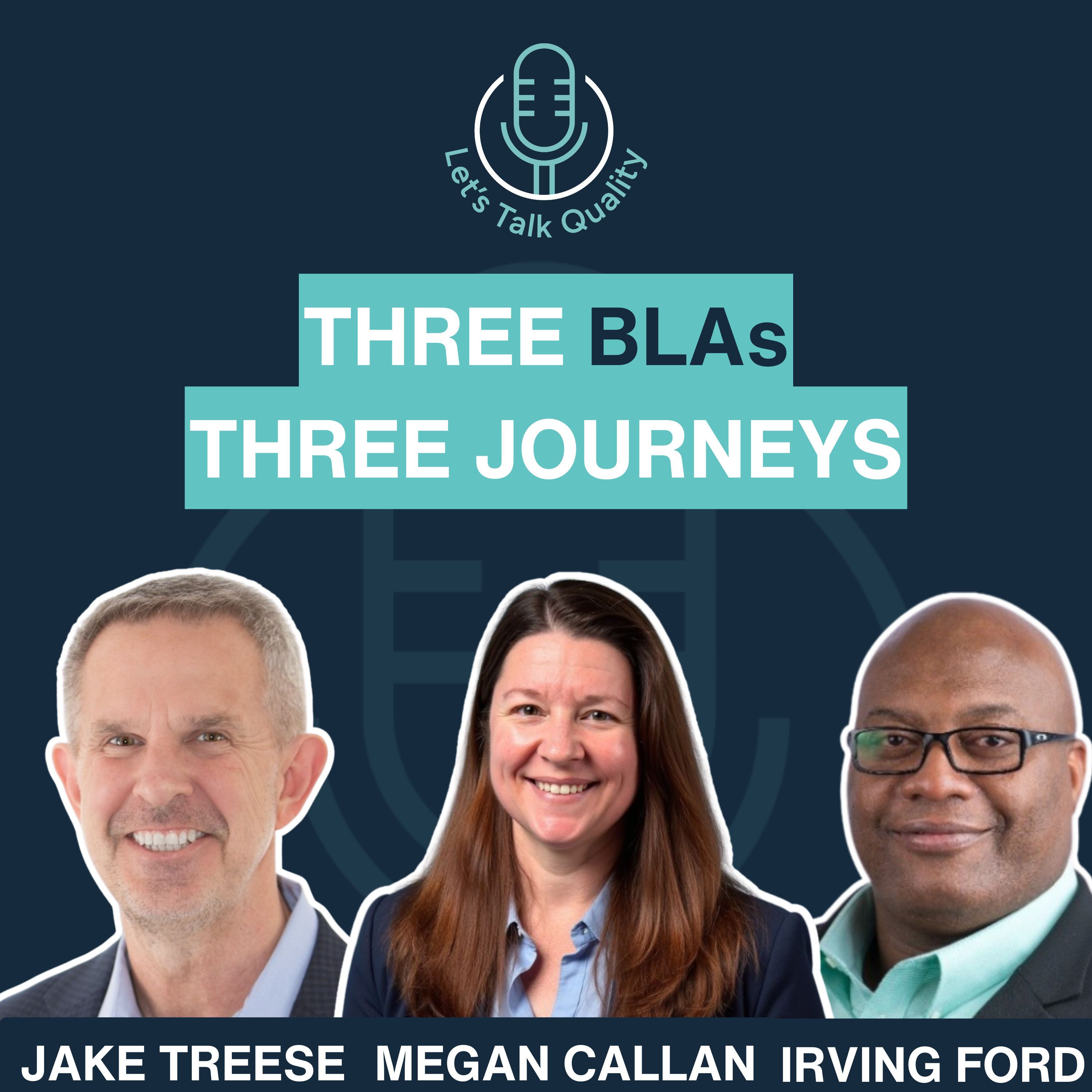
Three BLAs, Three Journeys, with Irving Ford, Megan Callan, and Jake Treese
Three BLAs. Three companies. One industry-defining challenge. Jake Trees, Irving Ford, and Megan Callan on What It Really Takes to Cross the Commercial Line in Cell and Gene Therapy In this special compiled episode of Let's Talk Quality, Hemish Ilangaratne brings together three quality leaders who have each led their organisation through one of the most demanding transitions in the industry: from clinical development to commercial manufacturing for a cell or gene therapy product. Jake Trees spent five years at Bristol Myers Squibb leading the quality function through the approval and launch of Abecma and Breyanzi, two of the first commercially approved CAR T cell therapies in the world. Irving Ford was the first quality hire at the Celgene cell therapy facility in New Jersey, built the QC organisation from nothing, and has since led quality through four BLA approvals across multiple cell therapy companies, most recently at Adaptimmune for the approval of Aucatzyl. Megan Callan is VP of Quality at Abeona Therapeutics, where she guided the quality team through the FDA approval of Zevaskyn, the first ever approved topical gene therapy for a rare genetic skin disorder. These are three distinct products, three distinct companies, and three distinct leadership journeys. But across all three conversations, the same themes surface: what it takes to build a quality team from scratch, how to shift the mindset of a clinical organisation towards commercial standards, and what the moment of approval actually feels like after years of sustained effort. In this episode, you will hear the following: Jake Trees on the setbacks on the road to BLA approval, including a refusal to file, cell growth failures during scale-up, and leading through a pandemic while hosting three health authority inspections Irving Ford on being the first quality hire at a new commercial cell therapy facility, building a team that grew to over 200 people, and why working in the gray is not a compromise but a core competency in this field Megan Callan on taking a quality team from five people to more than 60, coaching a clinical workforce into a commercial mindset, and what it means to empower people to make fast decisions when the patient is waiting This episode is for anyone who is working towards a first commercial approval, scaling a quality function in cell or gene therapy, or trying to understand what it takes to lead through the most demanding regulatory and operational environment in modern pharma. Thank you to Jake, Irving, and Megan for sharing their journeys. Hope everyone enjoys the show.
- LT
 S4 · E11April 28 · 28 min· Video
The Non-Linear Path to Quality Leadership, with Cinta Burgos
The non-linear path is often the most powerful one. Cinta Burgos on Building a Career Across Functions, Modalities, and Mindsets. In today's episode I was joined by Cinta Burgos, Senior Vice President of Quality and Regulatory CMC at New Amsterdam Pharma. I really wanted to speak to Cinta because her career does not follow the path you might expect for someone at SVP level. She has moved across pharma, medical devices, and biologics, held roles in quality engineering, validation, regulatory, and consulting, and built her executive presence not through a linear climb but through curiosity, flexibility, and a willingness to take opportunities as they came. Cinta's journey began with a biophysics degree, a near-completed master's in mechanical engineering, and early laboratory work on human growth factors and the varicella zoster vaccine. Life changed direction more than once - moving across the country, starting a family, building a consulting practice that spanned 17 years - and through each transition, she added a new dimension to her expertise. Today she leads quality assurance, quality control, quality systems, and CMC regulatory at a company she describes as scientifically driven, ethically led, and genuinely exciting. What stands out about Cinta is her philosophy of leadership. She talks about moving from task-oriented thinking to big-picture ownership, about not micromanaging the talented people around you, and about the importance of keeping a personal board of directors - mentors you check in with at different stages of your career. She is also candid about the moments where she did not immediately see an opportunity for what it was, and honest about what that taught her. We talk about the following: - How a biophysics background and an unfinished master's became an asset in a 30-year career - Why Cinta moved from R&D to validation to quality and what each transition taught her - The value of 17 years in consulting and the leadership jump it created - How quality professionals can move from task-oriented contributors to big-picture leaders - The role of AI in quality and manufacturing, and why human oversight is non-negotiable - Why quality voices are still largely absent from board-level conversations - What it means to treat everyone in your company as a quality professional Cinta Burgos is a thoughtful, pragmatic quality leader who understands how to balance compliance, collaboration and business reality in complex development environments. If you are a quality professional working in an early-stage biotech and trying to build the right systems with limited resources, then this episode is for you. Thank you Cinta for sharing your incredible journey. Hope everyone enjoys the show. Timestamps: (00:00) Cinta's Background and Career Start (03:14) Career Path: Pharma, Devices, and Biologics (06:02) Moving Across Functions: R&D, Validation, Quality (10:59) The Value of Cross-Functional Skills (14:17) Industry Collaboration and Remote Work (20:26) Future of Quality at the Board Level (22:55) AI in Pharma and Manufacturing (25:20) Advice for Aspiring Quality Leaders
- Chapters
- LT
 S4 · E10April 21 · 35 min· Video
From the Graveyard Shift to the Frontier of Cell Therapy, with Mike Ruane
From a graveyard shift in a generic drug lab to leading quality for one of the most advanced cell therapy programs on the planet - Mike Ruane's story is one every quality professional needs to hear. In today's episode I was joined by Mike Ruane, Head of Quality for In Vivo CAR-T at Bristol Myers Squibb. I really wanted to speak to Mike because his career is one of the more fascinating journeys I have come across in quality leadership. He has spent nearly two decades within what is effectively the same organisation, yet has lived through multiple acquisitions, spin-offs and complete pivots in therapeutic modality - each time emerging in a stronger, more interesting role than before. Mike began his career at APP Pharmaceuticals on a midnight QC shift, testing in-process samples on a graveyard schedule. From there, he followed the Abraxane asset into aBraxis Bioscience, built out supplier quality relationships across Central and South America, and eventually relocated from Chicago to New Jersey when Celgene consolidated its operations. That move opened the door to something entirely new - a CAR-T therapy program called BB2121 - a field Mike had never worked in and knew little about. Eight years later, he is now heading quality for in vivo CAR-T, one of the most cutting-edge modalities in all of biopharma. What makes Mike Ruane such a compelling guest is not just the breadth of his experience but his philosophy. He is a first-principles thinker who has thrived precisely because he never assumed the existing process was the right one. He asks the uncomfortable questions, encourages his team to do the same, and believes deeply that curiosity is the most underrated skill in quality. We talk about the following: How working in a lean generic drug environment early in his career shaped his mindset forever Navigating multiple acquisitions and spin-offs within a single career arc What it takes to step into an entirely new therapeutic modality with no prior experience Why curiosity and asking the right questions is the real engine of career growth in quality How he interviews candidates and what most people get wrong when they are being interviewed Mike Ruane is a thoughtful, pragmatic quality leader who understands how to balance compliance, collaboration and business reality in complex development environments. If you are a quality professional working in an early-stage biotech and trying to build the right systems with limited resources, then this episode is for you. Thank you Mike Ruane for sharing your incredible journey. Hope everyone enjoys the show. Timestamps: (00:00) Introduction to Mike's Career Journey (02:01) Transitioning Through Acquisitions and Roles (06:39) Navigating Supplier Quality and External Partnerships (11:05) The Shift to CAR T Therapy (16:05) The Importance of Asking Questions (20:48) Advice for Future Generations
- Chapters
- LT
 S4 · E9April 14 · 38 min· Video
Laurie Adami on Life After CAR-T, and the Reality Patients Still Face
CAR-T Saved Her Life. Why Can’t Most Patients Access It? In today’s episode I was joined by Laurie Adami, cancer survivor, patient advocate, and one of the most impactful voices I’ve had on the podcast. I first spoke to Laurie a couple of years ago, and her episode is still one of the most listened to we’ve had. Laurie went through a 12-year cancer journey, six lines of therapy, multiple relapses, clinical trials… and ultimately, in 2018, her 7th treatment, CAR T-cell therapy which saved her life and finally for the first time in 12 years put her in a complete remission. Now, two years on, she’s back. Still in a complete remission and requiring no further treatment nearly 8 years post CAR T infusion, Laurie is now considered cured even though her cancer is still labeled incurable. But what stood out to me in this conversation is that while the science has progressed… many of the systemic challenges patients face haven’t. We talk about the following: · What life actually looks like after being “cured” of cancer · The long-term side effects of 12 years of treatment · Why most biotech and pharma professionals have never spoken to a patient · The reality behind “patient centricity” in the industry · Why 80% of eligible patients still can’t access CAR-T therapy · The biggest bottlenecks in access - awareness and insurance · The financial burden of cancer treatment in the US · Where real progress is being made in cell and gene therapy · The future of CAR-T in autoimmune diseases and beyond · Laurie’s memoir and why every biotech employee should read it This is an honest conversation about the gap between scientific progress and real-world patient impact. A huge thank you to Laurie for returning to the show and tell her story again! The work she is doing to help raise awareness is inspiring, and I’d urge anyone to connect with Laurie and follow her journey. If you work in biotech, pharma, healthcare, or you’d like to learn more about the challenges this industry still faces… this is one you need to hear. Timestamps: (00:00) A Journey of Survival and Remission (02:28) Life After CAR-T: Misconceptions and Realities (05:35) The Ongoing Battle: Side Effects and Daily Life (08:30) Patient Advocacy: Bridging the Gap with Pharma (11:00) The Disconnect: Patient Needs vs. Industry Understanding (13:48) Access and Awareness: The Challenges of CAR-T Therapy (16:36) The Future of CAR-T: Innovations and Progress (19:30) Writing a Memoir: Sharing the Patient Experience
- Chapters
- LT
 S4 · E8March 31 · 29 min· Video
How to Drive KPI's the Right Way in Global Quality, with Burak Begen
Perseverance, perspective and people-first leadership in a global quality role. In today's episode I was joined by Burak Begen, Head of Global Manufacturing Quality at Siemens Healthineers. I really wanted to speak to Burak because he’s built his career across multiple countries, cultures and challenges, and now leads quality across global manufacturing sites. His journey gives a very real view of what it actually takes to operate at that level. Burak’s career hasn’t been linear or easy. From starting his career in Turkey, moving to the US for his PhD, rebuilding his career from scratch, and navigating setbacks like job losses and site closures - his story is defined by perseverance and resilience. What stood out is how those experiences shaped the way he leads today. He leads from the front, sets high standards, but always stays close to his teams. Whether it’s staying late to close records or travelling globally to connect with people on site, his leadership is grounded in accountability and support. We talk about the following: Why perseverance is a defining trait for quality leaders Leading global teams across time zones and cultures Building a partnership mindset in quality instead of a “policing” approach Creating the right KPI culture and avoiding “watermelon metrics” Empowering teams to make decisions and building psychological safety If you are a quality professional managing multiple sites a leader struggling with KPIs, culture or engagement across sites, or someone who wants to step into a larger global role, then this episode is for you. Thank you Burak for sharing your incredible journey. Hope everyone enjoys the show. Timestamps: (00:00) Introduction to Burak Begen (06:00) The Importance of Quality in Leadership (10:39) Cultural Influences on Leadership (16:11) Navigating Time Zones and Cultural Differences (21:03) The Role of KPIs in Quality Management (27:51) Looking Ahead: Future Aspirations
- Chapters
- LT
 S4 · E7March 24 · 25 min· Video
Developing Future A-Player Quality Leaders, with Melodie Bryce
Great quality leaders don’t just build systems - they build people, culture and confidence. In today's episode I was joined by Melodie Bryce, Chief Quality Officer at Kincell Bio. Melodie’s journey is a brilliant example of how diverse experience across manufacturing, supply chain, training and quality can shape a well-rounded quality leader What stood out most is her approach to leadership. Melodie focuses heavily on building strong teams, developing future leaders and creating an environment where people are supported but also expected to take ownership. She combines high standards with a genuine commitment to coaching and mentorship. We talk about the following: · How to assess a quality organisation when you first join · Why hiring “stronger than you” is critical to building high-performing teams · What makes a great quality leader in fast-growing biotech environments · The importance of being a self-starter in quality roles · How to develop future leaders through coaching and mentorship · What to look for in the first two weeks of hiring someone · Leading through remediation and why it accelerates growth · Building a quality culture where everyone takes ownership · Balancing compliance with real-world decision making in cell therapy · Why “digging deep” is the foundation of leadership success Melodie is a thoughtful, pragmatic quality leader who understands how to balance compliance, collaboration and business reality in complex development environments. If you are a quality leader looking to develop stronger teams and future leaders, then this episode is for you. Thank you Melodie for sharing your incredible journey. Hope everyone enjoys the show. Timestamp: (00:00) Introduction to Quality Leadership (04:01) Challenges in Quality Leadership (06:15) Developing Future Leaders (08:33) Hiring for Success (11:01) Assessing New Hires (13:57) Leadership Evolution (16:04) Cultural Insights in Quality (18:56) Advice for Aspiring Leaders
- Chapters