Skip to content
Artwork for Lazar Focus
NewsNews CommentaryReligion & SpiritualityJudaism

Lazar Focus

The Times of Israel

Diplomatic correspondent Lazar Berman explores what's behind the news that spins the globe

Play
  • 25 episodes
  • weekly
  • Avg 37 min
  • English
Counted on this page — what you have heard stays on this device, so it is not something the list can be paged by.
  • April 3 · 35 min

    What does history of air power tell us about Iran war?

    Welcome to The Times of Israel's Lazar Focus. Each Friday, join host diplomatic correspondent Lazar Berman for a deep dive into what's behind the news that spins the globe. The US and Israel are trying to drastically weaken Iran, and maybe even bring down the regime, entirely from the air. They are certainly not the first combatants to strive for far-reaching goals through air power. In fact, countries have tried to win wars from the air for over a century. Airpower has a tendency to capture the imagination of civilian and military planners, leading them to believe that this time, new technology will give them the edge needed to transform warfare and avoid long, costly ground campaigns. But strategic air campaigns almost always fall short of their goals. They do not topple regimes, do not cause the public to rise up (and often create solidarity among the enemy public), and achieve results that are anything but decisive. Airpower certainly has its place, especially in destroying specific targets and supporting ground forces. Israel has taken that further, eliminating layers of Iranian, Hezbollah, and Hamas leadership from the air. Can the two most capable air forces in the world win the war against Iran from the air? Or will this be the latest case study that shows how difficult it is to achieve strategic goals from the air? Joined by diplomatic reporter Nava Freiberg, Lazar walks the listener from the 18th century, through the world wars, Vietnam, and Kosovo to explain what air power can accomplish -- and what mistakes overoptimistic planners continue to make. Lazar Focus can be found on all podcast platforms. This episode was produced by Gabriella Jacobs and video edited by Ari Schlacht. See omnystudio.com/listener for privacy information.
  • March 27 · 34 min

    Raz Zimmt: Iran's new leadership and the coming escalation

    Welcome to The Times of Israel's Lazar Focus. Each Friday, join host diplomatic correspondent Lazar Berman for a deep dive into what's behind the news that spins the globe. The war in Iran has reached a new, somewhat odd, phase. After hammering the Islamic Republic for four weeks, US President Donald Trump dropped a bombshell announcement this week -- that he was in talks with Tehran over an end to the war. Iran initially denied the talks, then acknowledged that there were contacts, and released a series of demands for the war to end. Now, the US and Israel continue to strike Iran, the Strait of Hormuz remains closed, and Trump talks about Iran talks. Raz Zimmt, Iran expert at the Institute for National Security Studies, joins Lazar to make sense of what is happening inside Iran, and where the war might go from here. He explains who is running Iran, and why the country is moving in an even more hardline direction. Zimmt argues that Iran's motivation for building a nuclear weapon has gone up drastically, and Ali Khamenei's fatwa against one is no longer in place now that he is dead. The regime shows no signs of cracking, Zimmt argues, though its military industries and capabilities have been badly degraded. If talks with the US fail, he says, the war seems headed for further escalation. That may come in the form of an invasion of Kharg Island, which Zimmt says is the wrong way to force Iran to open the Strait of Hormuz. Lazar Focus can be found on all podcast platforms. This episode was produced by Gabriella Jacobs and video edited by Yitzhak Ledee. See omnystudio.com/listener for privacy information.

  • March 20 · 34 min

    Caroline Glick: Why we went back to war in Iran

    Welcome to The Times of Israel's Lazar Focus. Each Friday, join host diplomatic correspondent Lazar Berman for a deep dive into what's behind the news that spins the globe. Almost three weeks of the US-Israeli war on Iran have gone by. There are undoubtedly important achievements. This week, Israel assassinated Ali Larijani, perhaps the most important leader left in the Islamic Republic. It also took out leaders of the brutal Basij force, and there is no question that Iran's ability to launch ballistic missiles and drones at its enemies has been severely degraded. Top officials in Gulf states are speaking out more openly about Iranian attacks, with a senior UAE adviser saying that the strikes will push the Gulf closer to Israel. Despite the impressive -- even unprecedented tactical achievements -- key questions remain. How does this war end? How will Israel "create the conditions" for Iran's people to topple the regime, and will we be back at war again in the coming years if they don't? Caroline Glick, a veteran journalist who has served as Prime Minister Benjamin Netanyahu's international affairs adviser during both Iran wars, lays out why Israel is fighting against Iran less than a year after Netanyahu declared that the 12-day war last June achieved a historic victory. She says that Netanyahu and US President Donald Trump are aligned on the goals on the campaign, and reports of discord do not reflect reality. Glick makes clear that it is up to the Iranian people to achieve their freedom, but Israel is doing what it can to pave the way from the air. Lazar Focus can be found on all podcast platforms. This episode was produced by Gabriella Jacobs and video edited by Yitzy Ledee. See omnystudio.com/listener for privacy information.

  • March 13 · 35 min

    Gallia Lindenstrauss: Iran war reaches Kurds, Turkey and Azerbaijan

    Welcome to The Times of Israel's Lazar Focus. Each Friday, join host diplomatic correspondent Lazar Berman for a deep dive into what's behind the news that spins the globe. Two weeks into the war against Iran, the Islamic Republic has made good on its threats and attacked all the Gulf Arab states. But while the focus on reporting has been on those countries, players on Iran's northern border are also under fire. Iran has fired two missiles at Turkey, a major regional power; has hit targets in Azerbaijan; continues to pound Iraqi Kurdistan; and Iran's proxy Hezbollah even attacked British zones in Cyprus. The northern theater should not be overlooked. Each of these actors has a complex relationship not only with Iran, but also with Israel. Some, like Cyprus and Azerbaijan, are close allies, while Turkey has turned into a leading adversary and a backer of Hamas. Gallia Lindenstrauss, a leading Turkey expert, examines how each is reacting to the outbreak of war, and what might lie ahead in their ties with Israel. Lazar Focus can be found on all podcast platforms. This episode was produced by Gabriella Jacobs and video edited by Ari Schlacht. See omnystudio.com/listener for privacy information.
  • March 6 · 31 min

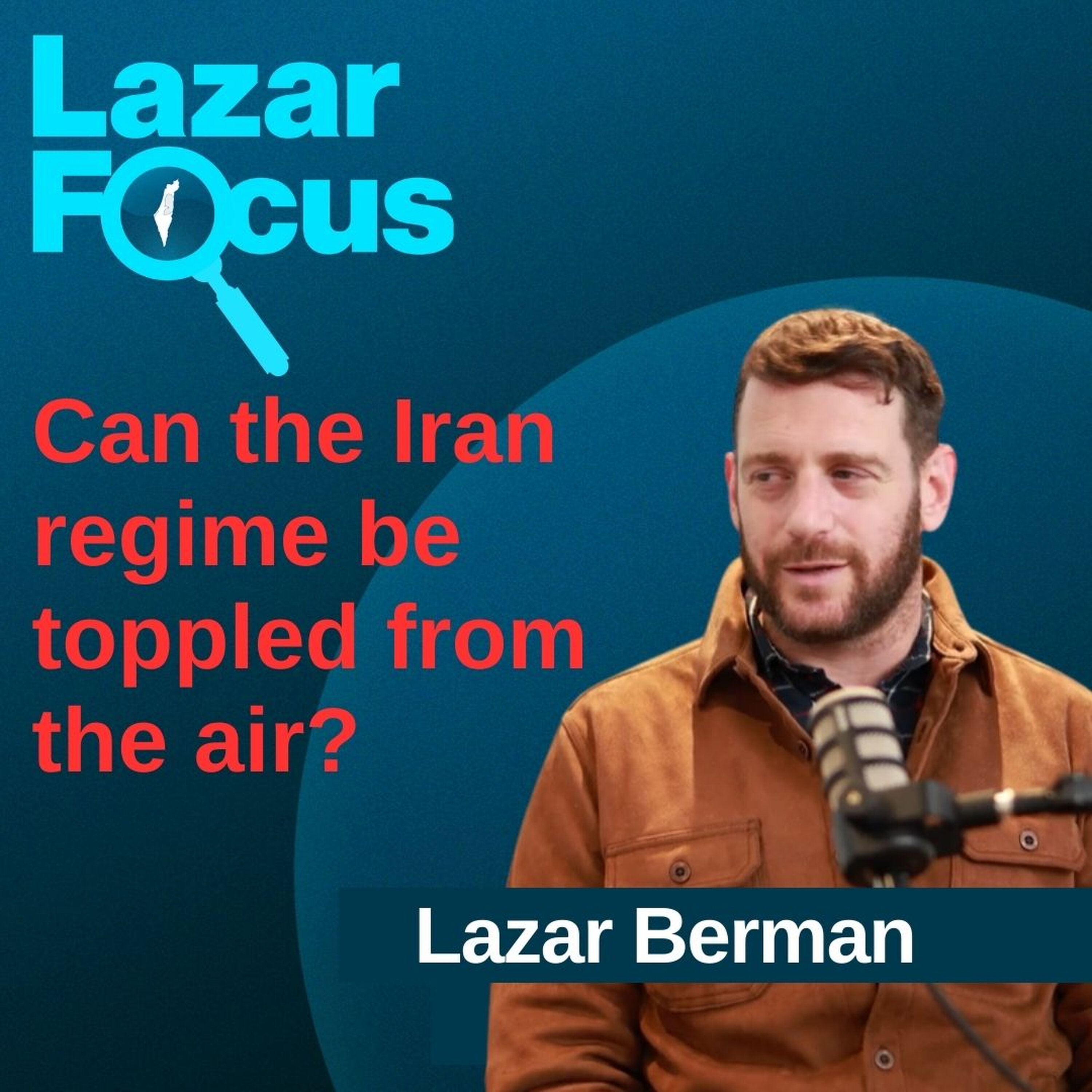
    Can the Iran regime be toppled from the air?

    Welcome to The Times of Israel's Lazar Focus. Each Friday, join host diplomatic correspondent Lazar Berman for a deep dive into what's behind the news that spins the globe. We are one week into a stunning US-Israel bombing campaign against the Islamic Republic. Senior Iranian leaders, including Supreme Leader Ayatollah Ali Khamenei, have been eliminated, and Iran's ability to attack its neighbors and to defend itself has been severely damaged. But it is still fighting, and launching attacks on countries across the region. What are US President Donald Trump and Prime Minister Benjamin Netanyahu trying to achieve in this war? And if it is regime change, is that even possible without sending in ground troops? A possible way to thread that needle -- to avoid committing US or Israeli forces but to still take ground from the Islamic Republic -- is to use local opposition forces. The Kurds are being talked about as a possible vanguard of ethnic uprisings against the regime. That is probably overambitious. There are only a few thousands Iranian Kurds under arms, and they have ample reasons to be wary of American promises. Still, every day that goes by sees the US and Israel degrade Iranian forces, while they gain more freedom of action over the country. But there is still a long way to go before Trump and Netanyahu can consider ending the campaign while still achieving their goals. Lazar Focus can be found on all podcast platforms. This episode was produced by Gabriella Jacobs and video edited by Ari Schlacht. See omnystudio.com/listener for privacy information.
Showing 21–25 of 25 episodes