Skip to content
Artwork for KacheliTV

KacheliTV

KacheliTV

KacheliTV — the world's stories, read aloud.

Looking for a story to fall asleep to, to ride with on a long drive, or to share at bedtime? Start here.

We read the folk tales and classics of every culture on Earth — complete and unabridged, never excerpts — in fresh English translations, performed by our cast of voices. The fairy tales of Ireland and Japan. The legends of India and Nigeria. Jamaica, the Netherlands, the Cherokee, the Norse — and the Russia of Pushkin and Krylov. The stories your grandmother knew, and stories from shores you've never heard — every culture in the spotlight, no one missed.

New tales arrive every week. Pick a shelf, press play, and let the world's grandmothers talk you to sleep.

Free always — here and on every podcast app. Prefer no commercials? Find us on Apple Podcasts.

From The Dog You Chose LLC, Gulfport, Florida. Public-domain sources, told with respect.

Find us:

YouTube — https://www.youtube.com/@KacheliTVFlorida

Telegram — https://t.me/kacheliTV

Website — https://dogyouchose.com

The Dog You Chose books — https://www.amazon.com/dp/B0FYSTBLQ3

Our cast is a company of AI-generated voices, performing fresh in-house translations of public-domain works from every culture.

Play
  • 420 episodes
  • Avg 27 min
  • English
Counted on this page — what you have heard stays on this device, so it is not something the list can be paged by.
  • S16 · E15
    October 15 · 24 min

    Fairy Tales of Japan — Part 15 of 24 (The Ogre of Rashomon · How an Old Man Lost His Wen)

    Two tales from old Japan. First, the Ogre of Rashomon: all Kyoto fears to pass the great gate after sunset, and Watanabe, one of Raiko's five knights, rides out on a wager to prove the ogre a rumor — and comes home with the ogre's own huge arm as his trophy, sealed in an iron-banded box that he will show to no one, until one night his old nurse comes knocking. In keeping with this series' practice, the reading does not narrate the stroke at the gate itself; the arm, and all that follows from it, stand complete in Ozaki's own words, and no completeness is claimed for that stroke. Then, How an Old Man Lost His Wen: a good old man shelters from a storm in a hollow tree, finds himself the hidden guest at a feast of demons, and dances for them so well that their chief takes the hated lump from his cheek as his pledge — while his wicked neighbor, who cannot dance at all, goes to win the same favor by imitation. Chapters: 00:05 The Ogre of Rashomon 12:39 How an Old Man Lost His Wen From Japanese Fairy Tales by Yei Theodora Ozaki (1908), public domain; told in fresh in-house renderings. KacheliTV — world classics, read aloud.

    • Transcript
  • S16 · E14
    October 15 · 24 min

    Fairy Tales of Japan — Part 14 of 24 (Momotaro, or the Story of the Son of a Peach)

    An old man and an old woman, childless all their lives, find a great peach floating down the river — and inside it a beautiful boy, Heaven's answer to their long lament. They name him Momotaro, Son of a Peach. At fifteen he is taller and far stronger than any boy in the country, and he asks his foster-parents' leave to sail to the island in the north-eastern sea, the stronghold of a band of devils who have robbed and terrified the land for years. On the road he wins three companions with shares of his mother's rice-cakes — a dog, a monkey and a pheasant — and leads them across the sea to the devils' castle. There the chief of the devils, his strength spent, kneels before Momotaro, breaks off his own horns in token of submission, and gives up all the treasure hidden in the castle; the captives are set free, and Momotaro returns home in triumph to the old couple's joy. In keeping with this series' practice, the reading leaves out the battle on the island itself and passes from the little company's entry into the castle to the chief's surrender; no completeness is claimed for that scene. From Japanese Fairy Tales by Yei Theodora Ozaki (1908), public domain; told in a fresh in-house rendering. KacheliTV — world classics, read aloud.

    • Transcript
  • S20 · E8
    October 15 · 24 min

    Hungarian Folk Tales — Part 8 (The Green King)

    A rich shopkeeper's youngest son will not tell his dream — and so he is left at home when his brothers ride to the Green King's court, and on the road back he is pushed from the great sea-bridge and given up for lost. But a barge is drifting on the sea, and in it the Green King's stolen youngest daughter; and beyond it lies an island where every soul stands turned to stone, three marble palaces shine, and three giants wait upon threshing floors of lead, of silver and of gold. The tale is told whole, as Benedek wrote it: the giants fall to the hero's sword, one stroke each upon their floors; the stone people wake to life again; and when the false daughters and sons-in-law who threw their own father into a dungeon are sentenced by the lords to a terrible death, it is the wronged youngest son himself who pleads for their lives — and has them swept out of the country instead, coming into his kingdom by mercy, as his tale has always told it. From Benedek Elek, Magyar mese- és mondavilág (Athenaeum, 1894–96), public domain; told in a fresh in-house rendering. KacheliTV — world classics, read aloud.

    • Transcript
  • S21 · E6
    October 15 · 23 min

    The Gatiloke — Part 6 of 23 (The Sage Dhananjaya and the Scholars of Lanka · King Bimbisara's Ministers and Prince Ajatasattu · The Elder Dhaniya and the Chief Accountant)

    The Gatiloke turns to the wise — and to what a wise man is worth. A scholar of Lanka comes to break the sages of Ayutthaya in a duel of riddles, and Dhananjaya answers him with a circle of arms, a fist and five fingers — and afterwards answers a minister who comes fishing for the meaning with a riddle of fish-traps and dried fish. A prince steals into his father's palace with a knife at his waist, and three companies of the king's watch give three judgements: death for all, death for two, or no judgement at all until the king has heard. And a monk asks a king's clerk for the royal timber, and the clerk — who never stops to ask — gives away the king's stores, and gives the Buddha's monks their rule against taking what is not given. Chapters: 00:04 — The Sage Dhananjaya and the Scholars of Lanka 10:04 — King Bimbisara's Ministers and Prince Ajatasattu 15:05 — The Elder Dhaniya and the Chief Accountant From the Gatiloke by Suttantaprija Ind (1859–1924), Cambodia's treasury of Khmer folk tales, first published in parts in Phnom Penh in 1914–1921 — public domain, and told here in a fresh in-house English rendering made from the Khmer text, in the book's own order. One question-chapter near the collection's opening is held back under house rule — its matter is murder itself, and such a tale is not read until it is ruled on; it stands recorded in the collection's written register, in its place. One further tale of the book's second part — the tale of Bhikkhu Sok, the Pnong teacher — is likewise held back under house rule: its matter is a whole lineage put to death, and such a tale is not read until it is ruled on; it stands recorded in the register, in its place. KacheliTV — world classics, read aloud.

    • Transcript
  • S23 · E2
    October 15 · 24 min

    Folk Tales of the Philippines — Part 2 (The King's Decisions · The Four Blind Brothers · Juan the Blind Man · Teofilo the Hunchback and the Giant · Juan and the Buringcantada · The Manglalabas)

    Part 2 of Folk Tales of the Philippines opens with a king whose judgments are as absurd as they are famous, and then settles into the book's own family of five tellings of one beloved story: two poor companions — one who cannot see, one who cannot walk — who bluff giants, robbers, and a ghost out of a rich house with nothing but a rope, an axe, and a drum. "The King's Decisions" brings three quarrels before the king: a starving man fed by the smell of a rich man's dinner is told to pay for it with the smell of money; a horse loses its tail in a helping pull; and a sleepless household meets a midnight fright. The king's answers settle all three, and satisfy nobody. Told by José M. Hilario, a Tagalog from Batangas, who heard it from his father. Between this tale and Part 1 stands "How Suan became Rich," held at this shelf's gate for a ruling and not read here. Then the five tellings. In "The Four Blind Brothers," three brothers fall from the same broken coconut tree, and the fourth, sheltered by the spirits of the grove, wins a two-headed giant's house with the tail of a sting-ray shown for a hair. "Juan the Blind Man" counts seven friends down from the typhoon-broken stumps in song, then frightens a house full of outlaws with a rusted axe for a tooth. "Teofilo the Hunchback, and the Giant" is the slightest and slyest of the five: a rope for a hair, a duck for a louse, and a voice like burning coals. In "Juan and the Buringcantada," a lazy son and his mother answer a one-eyed giant's challenges from his own ceiling. And in "The Manglalabas," blind Bulag and hunchbacked Cuba spend a night in a haunted house and dig up the treasure the ghost itself was guarding. A word on the hard beats, told plainly. The falls in the first two tellings are the tales' own grim joke, each over in a clause, exactly as the book counts them; no one is harmed by anyone's hand in any of the five, and every giant, robber, and ghost is frightened away unhurt. The healings that end two tellings are the storytellers' slapstick, instant and kind. In the first tale, the wife's loss stands in a single sober clause, and the horse's broken tail in another, both as the book tells them. No completeness is claimed for this stretch of the book. The book's storytellers, kept with honour: José M. Hilario of Batangas ("The King's Decisions"); Eutiqiano Garcia, a Pampangan ("The Four Blind Brothers"); Pedro D. L. Sorreta of Virac, Catanduanes ("Juan the Blind Man"); Loreta Benavides ("Teofilo the Hunchback, and the Giant"); Pacifico Buenconsejo ("Juan and the Buringcantada"); Arsenio Bonifacio ("The Manglalabas"). Chapters: 00:11 — The King's Decisions 03:30 — The Four Blind Brothers 07:24 — Juan the Blind Man 13:25 — Teofilo the Hunchback, and the Giant 16:13 — Juan and the Buringcantada 20:14 — The Manglalabas Source: Dean S. Fansler (ed.), Filipino Popular Tales, Memoirs of the American Folk-Lore Society, Vol. XII (1921) — the tales written down in English by the Filipino narrators credited above; public-domain 1921 edition (Project Gutenberg eBook #8299). The collectors' notes stand in the book, unread here. Our telling is a fresh in-house rendering of the 1921 text. Music: gentle instrumental bed under the narration. Thank you for listening — Part 3 of the Philippine tales follows on this shelf. 🔊 The KacheliTV podcast carries a new world folk tale every day — follow the show so the next story finds you.

    • Transcript
  • S24 · E2
    October 15 · 26 min

    Folk Tales of the Netherlands — Part 2 (The Princess with Twenty Petticoats · The Cat and the Cradle)

    Part Two of Folk Tales of the Netherlands continues William Elliot Griffis's Dutch Fairy Tales for Young Folks of 1918 in our own telling, with the book's third and fourth tales, in his order. "The Princess with Twenty Petticoats" is the little princess who gazed at her face in the pools, stamped her foot at the stone comb, and called her governess an aurochs. In keeping with this shelf's practice, the tale stands as Griffis told it: the governess's failed correctives stand in one reported sentence, the hunters' killing of the calf's mother in one reported clause, and the great oak and the old aurochs die as their thousand-year enchantment ends, foretold and mourned; no completeness is claimed beyond what is read here. Out of the fallen oak come a wooden petticoat and a comb of horn, and out of the blue flower that follows, the linen of Holland, and a fashion of twenty petticoats that endures. "The Cat and the Cradle" is the Kinderdijk legend. It opens in the hard old days of the ancestors, when, as Griffis tells it, a house council decided whether a newborn child should be raised, and no child who had tasted food could be refused life. The pagan grandmother's cruel intent against the baby Honig-je is thwarted by the midwife's drop of honey and never becomes a deed; the tale stands at the book's own weight. Then comes the great flood, and Dub-belt-je, the cat who loved the child better than her own kittens, rides the cradle through the night and cries the village awake. Chapters: 00:10 — The Princess with Twenty Petticoats 12:37 — The Cat and the Cradle Source: William Elliot Griffis, Dutch Fairy Tales for Young Folks (New York: Thomas Y. Crowell Company, 1918), from the public-domain 1918 edition (Project Gutenberg eBook #7871). Griffis retold these tales in his own English; our telling is a fresh in-house rendering of his 1918 text. Music: gentle instrumental bed under the narration. Thank you for listening — Part 3 of the Dutch tales follows on this shelf. 🔊 The KacheliTV podcast carries a new world folk tale every day — follow the show so the next story finds you.

    • Transcript
  • S8 · E354
    October 15 · 26 min

    The Thousand and One Nights — Attaf the Generous — Part Two

    Giafar rides out of Damascus with the bride Attaf surrendered to him — but slander follows her litter home. A body planted in a garden, a confession made to spare his neighbours, a rope at the gallows, and a jailer who keeps faith: the book's remaining pages come true, until Attaf himself stands before the caliph and asks mercy for the man who tried to destroy him. Attaf the Generous — Part Two of Two. Fresh in-house English rendering from Caussin de Perceval's continuation of Les mille et une nuits (Le Normant, 1806). KacheliTV — world classics, read aloud.

    • Transcript
  • S19 · E9
    October 15 · 51 min

    Japanese Ghost Tales — Part 9 of 19 (A Passional Karma)

    Hearn's telling of the Romance of the Peony-Lantern, entire. Hagiwara Shinzaburō, a young hatamoto's son, meets the beautiful O-Tsuyu at the Bon festival, and she comes to him night after night through the summer dark, her maid O-Yoné going before her with a lantern painted with peonies, the sound of their geta — kara-kon, kara-kon — crossing the garden before them. When his servant Tomozō, watching through a crack in the shōji, sees what his master cannot, the house turns to the old doctor Yusai and to Ryōseki, chief priest of Shin-Banzui-In, for a protective mamori and sacred o-fuda pasted over every door — and the visits change their nature. All seventeen of Hearn's own notes are spoken where he set them, and the tale closes inside its storyteller's frame, where the listeners argue about what O-Tsuyu did, and why. Under the shelf's standard one passage is carried as report rather than display: what the dawn discovers behind the mosquito-net is left undescribed, per the exclusion register — the death itself stands, as the book reports it, and no completeness is claimed beyond what is told. Chapters: 0:05 A Passional Karma From In Ghostly Japan by Lafcadio Hearn (1899), public domain — the ghost tales of Hearn's Japanese collections, told in his own order within each book, in Hearn's own prose, lightly modernized. KacheliTV — world classics, read aloud.

    • Transcript
  • S25 · E1
    October 15 · 19 min

    Folk Tales of Jamaica — Part 1 (The Fish-basket · The Storm · Tiger as Riding-horse · Tiger's Sheep-skin Suit · The Substitute · Tiger's Breakfast · Eggs and Scorpions · Tiger's Bone-hole · The Christening)

    KacheliTV opens a new shelf: the folk tales of Jamaica, in Martha Warren Beckwith's Jamaica Anansi Stories of 1924 — tales Jamaican storytellers told her, and she wrote down with their names. Anansi the spider-man — small, hungry, and quick — is the hero of them all, and his great victim is Brer Tiger: big, rough, and sure that strength is the same thing as sense. Part 1 begins where the book begins, with the animal stories. "The Fish-basket" and "The Storm" are the book's two tellings of the tying of Tiger: once by his long hair to a fruit-tree, over a basket of stolen fish; once to his own mango-tree, under a law Anansi invented on the spot. "Tiger as Riding-horse" settles an insult before witnesses — with a saddle, a bridle, spurs, and a whip, each one explained away. In "Tiger's Sheep-skin Suit" Anansi, himself the thief of Mr. Mighty's sheep, dresses Tiger for a ball and sings the accusation aloud. "The Substitute" trades a spoiled bird, night by night, for a whole sheep-pen. "Tiger's Breakfast" swaps breakfast scams both ways, and ends on the hill-side with the reason Anansi's belly is white. In "Eggs and Scorpions," Blinkie does not keep the egg pact. "Tiger's Bone-hole" hides a whole family where the bones are thrown. And "The Christening" names three children — Top take off, Catch in the middle, and Lick clean — over a keg of butter that two friends found together. Three of the book's tales stand held for a ruling, and are not read here: the two tellings under "Tiger as Substitute," whose substitutions turn on a copper of hot water and a heated iron, and "The Escape," whose sheep is not a sheep. Four more stand excluded at this shelf's gate, recorded plainly: "In the House-top," where Anansi's own family pays the price of his escape; both tellings of "Eating Tiger's Guts"; the three tellings of "Day-time Trouble," which turn on the killing of Tiger's young; and "New Names," whose bargain costs three mothers their lives. Within the tales read here, two hard beats stand as told, a clause apiece: a hunter finds the tied Tiger and kills him, in the book's own closing sentence of "The Fish-basket"; and a little bird is killed in a single clause to set "The Substitute" in motion. No completeness is claimed for this stretch of the book. The book's storytellers, kept with honour: George Parkes of Mandeville ("The Fish-basket", "Tiger's Sheep-skin Suit"); Vivian Bailey of Mandeville ("The Storm"); William Forbes of Dry River ("Tiger as Riding-horse", "Eggs and Scorpions", "Tiger's Bone-hole"); Samuel Christie of St. Ann's Bay ("The Substitute"); Richard Morgan of the Santa Cruz Mountains ("Tiger's Breakfast"); and Charles Wright of Maroon Town ("The Christening"). Chapters: 00:29 — The Fish-basket 04:18 — The Storm 06:13 — Tiger as Riding-horse 08:08 — Tiger's Sheep-skin Suit 11:31 — The Substitute 13:10 — Tiger's Breakfast 15:04 — Eggs and Scorpions 16:30 — Tiger's Bone-hole 18:08 — The Christening Source: Martha Warren Beckwith, Jamaica Anansi Stories, Memoirs of the American Folk-Lore Society, Vol. XVII (1924) — the tales told by the Jamaican storytellers credited above; public-domain 1924 edition (Project Gutenberg eBook #72735). The collector's notes stand in the book, unread here. Our telling is a fresh in-house rendering of the 1924 text. Music: gentle instrumental bed under the narration. Thank you for listening — Part 2 of the Jamaican tales follows on this shelf. 🔊 The KacheliTV podcast carries a new world folk tale every day — follow the show so the next story finds you.

    • Transcript
  • S15 · E11
    October 15 · 16 min

    Folk Tales of India — Part 11 of 81 (The Story of a Hiraman)

    A fowler catches a beautiful hiraman parrot — who speaks, and sets his own price: ten thousand rupees. In the palace the bird recites the names of all the gods, outwits six jealous queens, and sends his king across the seven oceans and thirteen rivers after a lady of peerless beauty. When the king falls into the hands of an enemy and loses his sight, it is the little parrot who flies back across the world to cure him. From Folk-Tales of Bengal by Lal Behari Day (1883), public domain; told in a modern in-house rendering. KacheliTV — world classics, read aloud.

    • Transcript
  • S15 · E12
    October 15 · 29 min

    Folk Tales of India — Part 12 of 81 (The Origin of Rubies · The Match-making Jackal · The Ghost who was Afraid of being Bagged)

    Three shorter tales. The first tells how rubies came out of the sea, from a palace beneath a whirlpool where a lady lies in a trance deeper than sleep beside the god Siva. The second follows the cleverest match-maker in Bengal — a jackal, who chews betel-leaves like a lord and marries a poor weaver to a king's daughter. The third is the barber who frightened a ghost with nothing but a looking-glass, and got a granary of gold for his wit. From Folk-Tales of Bengal by Lal Behari Day (1883), public domain; told in a modern in-house rendering. Chapters: 00:00 The Origin of Rubies 09:01 The Match-making Jackal 24:09 The Ghost who was Afraid of being Bagged KacheliTV — world classics, read aloud.

    • Transcript
  • S18 · E10
    October 15 · 26 min

    Northern Tales — Part 10 of 22 (The Carrier of Seaweed · The One without Arms · The Girl who watched in the Night-Time · Creation of the World · The Old Woman and the Wild Beasts · The Man who used Magic against the Storm)

    Ten tales from the Siberian Eskimo villages of Bogoras's The Eskimo of Siberia — the whole buildable corpus of the book in a single sitting. A boy carries his seaweed home through the eye of a needle; the One without Arms, born of a finger-long Fish-Woman, spins through the air above two villages and sends his enemies into the sea as guillemots; a girl keeps the night-watch with a lasso and catches the Fox who has been carrying off the boys; Raven and his wife make the world out of an eider-duck's nose, a belt-knife and a scabbard button; an old woman smokes the wild beasts out of her house; a young man calls down the storm in a starving village and the sea-game come ashore of themselves; Raven swallows the shore blubber and brings it home by the sledge-load; the Creator presses St. Lawrence Island out of a handful of sea-sand, and its orphan, healed in the house of the Upper God's women, wins the whales from the Sun-Man; a small plover breaks a giant's hips with a single stone; and the shaman Abla chases a tornarak the length of the island to win back a lost boy — and comes home with a new name. Chapters: 00:04 — The Carrier of Seaweed 00:56 — The One without Arms 06:56 — The Girl who watched in the Night-Time 11:31 — Creation of the World 11:58 — The Old Woman and the Wild Beasts 13:59 — The Man who used Magic against the Storm 15:50 — Raven swallows Blubber 16:38 — Creation of St. Lawrence Island 22:08 — The Contest between the Giant and the Plover 22:44 — The Shaman Abla From The Eskimo of Siberia (1913) by Waldemar Bogoras — Part III of The Jesup North Pacific Expedition, Vol. VIII (Memoirs of the American Museum of Natural History). Public domain. The Carrier of Seaweed, The One without Arms, The Girl who watched in the Night-Time and Creation of the World were told by Nipewgi, an Asiatic Eskimo man, in the village of Unisak, at Indian Point, 1901; The Old Woman and the Wild Beasts and The Man who used Magic against the Storm were told by Talimak, an Asiatic Eskimo man, in the same village, 1901; Raven swallows Blubber was told by Milutarak, an Asiatic Eskimo man, on St. Lawrence Island, 1901; Creation of St. Lawrence Island and The Contest between the Giant and the Plover were told by Aleqat, an Asiatic Eskimo man, on St. Lawrence Island, 1901; and The Shaman Abla was told by Acunarak, an Asiatic Eskimo man, on St. Lawrence Island, 1901. Fresh English rendering by KacheliTV. The One without Arms stands as Bogoras printed it — the press of the crowd at his exhibition and the two self-sought duels are the book's own brief telling. The Girl who watched in the Night-Time is heard without the book's mentions of the girl's nakedness; the lasso-watch, the Fox's bargain and the secret enemy's shame stand whole. The Shaman Abla is heard with its opening contest softened, per the shelf's screening ledger — Abla's arrow strikes the rich man down and the rivalry ends there; the rescue of the lost boy and the exchange of names stand as printed. Northern Tales gathers the Chukchi, Siberian Eskimo, Koryak, Yukaghir and Even tales from Bogoras's Jesup North Pacific Expedition volumes, in the books' own order. KacheliTV — world classics, read aloud.

    • Transcript
  • S24 · E1
    October 15 · 22 min

    Folk Tales of the Netherlands — Part 1 (The Entangled Mermaid · The Boy Who Wanted More Cheese)

    KacheliTV opens a new shelf: the folk tales of the Netherlands, in William Elliot Griffis's Dutch Fairy Tales for Young Folks of 1918 — the old tales of Holland as Griffis retold them for young readers, and read here in our own telling. Part 1 begins where the book begins, with the first two tales in his order. "The Entangled Mermaid" tells of the mere folk, the people of the pools, who kept their great pool at the river's mouth clean and quiet, and of their Queen, proudest of her beauty, who would not believe the young merman who swam in, weeping salt tears, to warn her that the men in wooden shoes were coming with pickaxes, spades and pumps to drain the pool and dyke out the sea. She slept too long, and woke to a drained land, a new dyke, and a fence she could not pass. In keeping with this shelf's practice, the tale stands as Griffis told it: the Queen's death in the showman's tub is a single clause, and what the learned men of Leyden made of her afterwards is the book's own folk ending, told in its two sentences; no completeness is claimed beyond what is read here. "The Boy Who Wanted More Cheese" is Klaas Van Bommel, twelve years old, rosy-cheeked, and never, at any table, given cheese enough. Scolded and sent to his garret bed with a stomach as heavy as lead, he hears a voice in the night, promising plenty of cheese, and follows the ladies of the wood to the fairies' ring in the pine woods — where the Dutch fairies, who never get tired, set him dancing, and then set him eating. It is a dream tale, and he wakes at sunrise exactly as a boy should. Chapters: 00:10 — The Entangled Mermaid 11:32 — The Boy Who Wanted More Cheese Source: William Elliot Griffis, Dutch Fairy Tales for Young Folks (New York: Thomas Y. Crowell Company, 1918), from the public-domain 1918 edition (Project Gutenberg eBook #7871). Griffis retold these tales in his own English; our telling is a fresh in-house rendering of his 1918 text. Music: gentle instrumental bed under the narration. Thank you for listening — Part 2 of the Dutch tales follows on this shelf. 🔊 The KacheliTV podcast carries a new world folk tale every day — follow the show so the next story finds you.

    • Transcript
  • S22 · E4
    October 15 · 15 min

    Folk Tales of France — Part 4 (Jean the Sharp and Jean the Fool · The Jaguens' Journey to Paris · The King of France's Son and the Jaguen · The Rector Robbed)

    Part Four of Folk Tales of France opens the book's second section, the jests and merry tricks, with four Breton farces in our own translation: two brothers, one sharp and one simple; a whole village that sails to Paris and back without leaving home; a fishmonger who carries great news to the king; and a rector who sings his stolen money back into the light. Between them in the book stands tale XXXVI, excluded at this shelf's gate, while tale XXXIV stands held for a ruling and tale XXXVIII waits in the register for a legible copy; no completeness is claimed for the stretch. Jean the Sharp and Jean the Fool are brothers begging their way from farm to farm, the first cunning and the second a simpleton who takes everything literally. The Fool gives his bread to the frogs, chews straw while his brother dines, and stops his supper when the cat walks across his foot; in the night he follows a thread with a kind gift of porridge for his brother, and delivers it to entirely the wrong sleeper. The men of Saint-Jacut rig their donkey cart with a ship's mast, a sail and a grapnel, and set out to see Paris. They bathe in the great salt sea, which is a field of blue flax; they count themselves and come up one short; and they drive home again persuaded that Paris is a poor, small place whose women are strangely forward, and strangely like their own wives. A fishmonger of Saint-Jacut rides to Paris with the news that Dinan is retaken from the English, and shouts his way into the palace. Rewarded with a dinner in the castle kitchen, he eats in peace until the little dauphin, the king's young son, slips under the table to pull the long red hairs on his bare legs once too often. A poor rector scrapes together three hundred francs and hides them in the head of a wooden Saint John, writing beneath the statue: "Here there are." A ruined nobleman reads it, takes the money, and adds one letter, so that it reads "There are none"; and when the rector, sworn to silence at the point of a sword, keeps his word in his own way, he sings the whole theft into the Preface of the Mass, with the gendarmes listening. Told in Ercé-près-Liffré, Matignon, Ploubalay and Trébry, and collected by Paul Sébillot (1843–1918). Chapters: 00:08 Jean the Sharp and Jean the Fool 05:54 The Jaguens' Journey to Paris 09:40 The King of France's Son and the Jaguen 12:42 The Rector Robbed From Paul Sébillot, Contes populaires de la Haute-Bretagne, Tome I (Paris: G. Charpentier, 1880), public domain; told in a fresh in-house rendering from the French. The grous of the first tale are a porridge of buckwheat, as the book's own note explains; the Jaguens' broad Breton speech is carried lightly, as the book prints it. Four Breton farces from the old province — a fool's kindness, a village's voyage, a fishmonger's plain speaking, and a rector's revenge in chant. More of Brittany follows in Part Five. 🔊 Listen to the podcast: https://rss.com/podcasts/kachelitv/

    • Transcript
  • S15 · E14
    October 15 · 9 min

    Folk Tales of India — Part 14 of 81 (The Field of Bones, Part Two)

    The escape by ship, and a princess abandoned by the very friends she saved — who walks to their own city, proclaims herself a heaven-born dice-player, and wins back everything, including the prince who doubted her. Then the four friends return at last to the field of bones, to turn the hermit's gift to its true purpose: a city of the dead, called back to life. From Folk-Tales of Bengal by Lal Behari Day (1883), public domain; told in a modern in-house rendering. KacheliTV — world classics, read aloud.

    • Transcript
  • S23 · E1
    October 15 · 21 min

    Folk Tales of the Philippines — Part 1 (Suan's Good Luck · Suan Eket · Suac and his Adventures · The Three Friends)

    KacheliTV opens a new shelf: the folk tales of the Philippines, in Dean S. Fansler's Filipino Popular Tales of 1921 — stories Filipino storytellers wrote down in English before the First World War. Part 1 begins where the book begins — the two tellings of the Suan cycle — and goes on to the book's fourth tale, Suac's adventures and the three friends. "Suan's Good Luck" is the first telling: a poor farmer's son who loses everything he earns, until one day his luck turns all at once — three pieces of good fortune in one day, the last a lost ring found in the most unlikely place, and a bride whose father had despaired of marrying her to anyone. "Suan Eket" tells the same story at full length — the great tale of the lucky guesser. A ring is lost at sea and Suan names where it lies; a king's letter is read by a boy who cannot read; and when Suan, overwhelmed, rows out alone in a tub to end his trouble, he overhears the very words that save him — and talks his way, charm by charm and guess by guess, to a princess and a kingdom. Written down by Manuel Reyes, a Tagalog of Rizal province, who heard it from his grandfather. "Suac and his Adventures" changes the key from luck to strength of wit. Suac hunts on Mount Telapayong with Sunga and Sacu, and three times the spirit Pugut comes down to steal the hunters' dinner. Twice he succeeds. The third time the cook is Suac — and Pugut, who got his kinky beard in a fire of his own making, meets the boy who does not run. Told by Anastacia Villegas of Arayat, Pampanga, who heard it from her grandmother. "The Three Friends" — a monkey, a dog, and a carabao — leave the city to hunt, each in turn staying home to cook while the laughing giant Bungisngis comes calling. The carabao is thrown knee-deep into the earth; the dog is thrown down, his dinner eaten; but the monkey digs a pitfall before he lights the stove, and after that the story is his — a beehive mistaken for the king's bell, and a belt that is no belt at all. Told by José M. Hilario, a Tagalog from Batangas. Two of the book's tales stand outside this episode, recorded plainly: the second, "The Charcoal-Maker who became King," ends in an enacted revenge of whippings and deaths and is excluded at this shelf's gate; the third, "The Story of Carancal," whose strong man burns his enemy bound and helpless, stands held for a ruling and is not read here. Within the tales read here, a few hard beats stand as told, a clause apiece: a turkey and geese give up the rings hidden inside them; the spirit Pugut and a man-eating giant fall in summary, as folk tales have always made such falls; escaping the monkey's pit, the giant kills the dog in a single sentence; and Suan's despair at sea is kept at source weight, a breath long. No completeness is claimed for this stretch of the book. The book's storytellers, kept with honour: Macaria Garcia, a Pampangan ("Suan's Good Luck"); Manuel Reyes of Rizal ("Suan Eket"); Anastacia Villegas of Arayat ("Suac and his Adventures"); José M. Hilario of Batangas ("The Three Friends"). Chapters: 00:11 — Suan's Good Luck 03:53 — Suan Eket 13:13 — Suac and his Adventures 16:53 — The Three Friends Source: Dean S. Fansler (ed.), Filipino Popular Tales, Memoirs of the American Folk-Lore Society, Vol. XII (1921) — the tales written down in English by the Filipino narrators credited above; public-domain 1921 edition (Project Gutenberg eBook #8299). The collectors' notes stand in the book, unread here. Our telling is a fresh in-house rendering of the 1921 text. Music: gentle instrumental bed under the narration. Thank you for listening — Part 2 of the Philippine tales follows on this shelf. 🔊 The KacheliTV podcast carries a new world folk tale every day — follow the show so the next story finds you.

    • Transcript
  • S16 · E13
    October 15 · 12 min

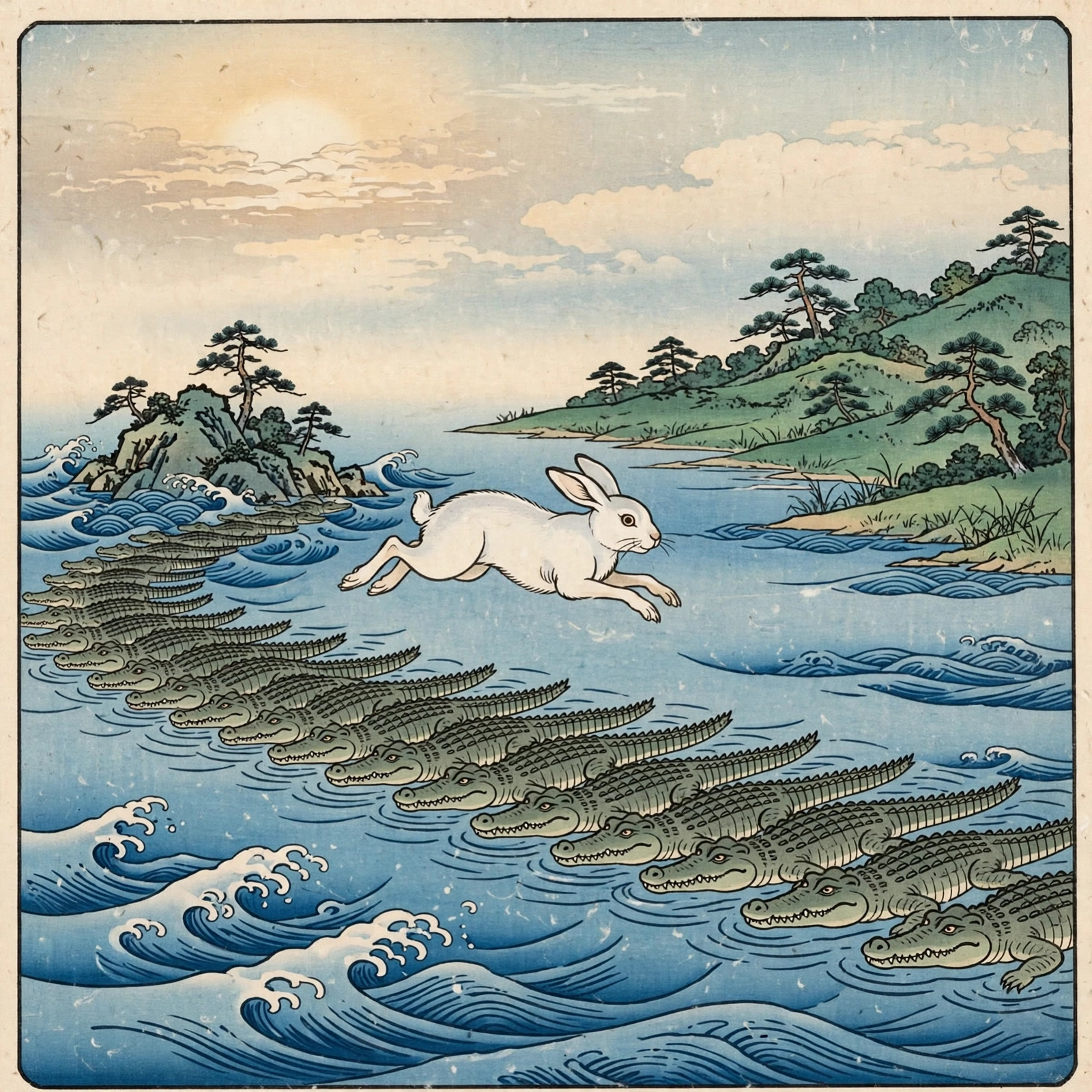
    Fairy Tales of Japan — Part 13 of 24 (The White Hare and the Crocodiles)

    A little white hare on the island of Oki longs to cross the sea to Inaba, and wins his way by a trick: he coaxes a crocodile into a contest of numbers and talks the whole company into lying back to back across the water, then hops over them, counting aloud, until he stands safe on the mainland — and jeers at them instead of giving thanks. What follows is the old Kojiki tale of the White Hare of Inaba: the hare bare and weeping on the beach, the fine brothers who pass him by with a remedy worse than the hurt, and the last brother of all, the god Okuni-nushi, who stops, listens, and heals him with pond water and the pollen of the kaba flowers — and wins a princess by his kindness. In keeping with this series' practice, the reading leaves out the crocodiles' revenge itself and continues from the hare as they left him; no completeness is claimed for that scene. From Japanese Fairy Tales by Yei Theodora Ozaki (1908), public domain; told in a fresh in-house rendering. KacheliTV — world classics, read aloud.

    • Transcript
  • S20 · E7
    October 15 · 19 min

    Hungarian Folk Tales — Part 7 (The Psalm-Singing Bird)

    A god-fearing king builds a church of gold and diamonds — and will not set foot in it until someone brings him the psalm-singing bird, wherever in the world it may be. His youngest son rides a táltos horse past three enchanted wells, where three maidens wait out twelve years of captivity, and across the Red Sea to the castle of the twelve-headed dragon — and wins the bird at last not by the sword, but by mercy. But the road home holds the tale's true trial: the elder brothers, ransomed from slavery by his own gold, repay him with a cruelty that only a wonder-lake can undo — and it falls to the bird itself, mute for every other soul, to sing the truth into the king's church. From Benedek Elek, Magyar mese- és mondavilág (Athenaeum, 1894–96), public domain; told in a fresh in-house rendering. KacheliTV — world classics, read aloud.

    • Transcript
  • S17 · E10
    October 15 · 10 min

    Nasreddin Hodja — Part 10 of 20 (Don't Believe It)

    Twelve more anecdotes of the Hodja, from the minaret of Konia to the door of the Kaaba and home to the neighbours and animals of the old folk book. Playing hide-and-seek, he leaves Akschehir altogether and hides for days in a minaret, calling down to the searchers: bring the money, I have won. Pressed into service as a guide, he answers that he is a servant of the Most High — and providence answers for him. Fallen from the roof, he asks his visitors for a comrade in the fall; a guest in his poverty-struck house is blanketed with a ladder and a trough still full of water; and a young man who pays his porter in three counsels — do not believe it — learns the fourth at the top of the stairs. A summer afternoon is weighed against three whole days in winter; at the Kaaba door the Hodja rebukes the crowd that mocks a black pilgrim; a mighty wind is blamed for a sackful of vegetables; the Ramadan pot reckons the forty-fifth day of the month; a stolen calf is demanded back as an ox; a horse that will not be mounted hears the truth about worse fellows; and a great cudgel, raised against a dog on a burial ground, is quietly lowered: go on, friend, go on. From Der Hodscha Nasreddin by Albert Wesselski (1911), public domain; told in a fresh in-house rendering. KacheliTV — world classics, read aloud. Chapters: 0:00 Opening 0:04 I Have Won 1:07 A Servant of the Most High 2:34 Fallen from the Roof 2:58 The Ladder and the Trough 4:38 Don't Believe It 6:17 Three Days in Winter 6:44 Blacker Than He 7:14 The Wind Blew Me In 8:01 The Forty-Fifth Day 9:04 An Ox for a Calf 9:36 Worse Fellows than the Horse 10:00 Go On, Friend

    • Transcript
  • S21 · E7
    October 15 · 19 min

    The Gatiloke — Part 7 of 23 (The Worship of the Pond Water · The Dangko Tree · The Black Bull · Grandmother Tep · Mount Krom and Mount Trangil · Ta Hua Lan and His Two Sons-in-Law · The Fool Who Rode the Buffalo)

    The Gatiloke opens the treatise of the Eight Worldly Conditions — gain and loss, fame and disgrace, blame and praise, pleasure and pain — and turns on what foolish people worship when they will not stop to think. A buffalo's healed eyes make a shrine of a pond, until the authorities come to forbid it. A fallen tree rises a little, by the pull of its own roots, and is stripped of its bark and roots for medicine until it dies. A stray black bull is taken for the Sacred Bull come home from Siam, and the crowd that chases it with offerings is scattered by the beast itself. An image of Grandmother Tep is worshipped by people who cannot say who she ever was. Two bare mountains are explained by the hairs of Hanuman. A father-in-law's old tales are answered, one after another, by the son-in-law who thinks. And a man rides his buffalo to the field carrying the rice on his own head, out of pity for the buffalo — and will not hear it that he is a fool. Chapters: 00:04 — The Worship of the Pond Water 01:02 — The Worship of the Dangko Tree 02:10 — The Worship of the Black Bull 07:50 — The Worship of Grandmother Tep 11:09 — Mount Krom in Siem Reap and Mount Trangil 12:33 — Ta Hua Lan and His Two Sons-in-Law 16:09 — The Fool Who Rode the Buffalo and Carried the Rice Himself From the Gatiloke by Suttantaprija Ind (1859–1924), Cambodia's treasury of Khmer folk tales, first published in parts in Phnom Penh in 1914–1921 — public domain, and told here in a fresh in-house English rendering made from the Khmer text, in the book's own order. One question-chapter near the collection's opening is held back under house rule — its matter is murder itself, and such a tale is not read until it is ruled on; it stands recorded in the collection's written register, in its place. One further tale of the book's second part — the tale of Bhikkhu Sok, the Pnong teacher — is likewise held back under house rule: its matter is a whole lineage put to death, and such a tale is not read until it is ruled on; it stands recorded in the register, in its place. One further tale of the treatise — the tale of the Singha-To who wanted the chief's daughter — is likewise held back under house rule: its close is a beating given to a creature first stripped of its defences, and such a tale is not read until it is ruled on; it stands recorded in the register, in its place. KacheliTV — world classics, read aloud.

    • Transcript
Showing 401–420 of 420 episodes