Skip to content
Artwork for Interconnects
TechnologyScience

Interconnects

Nathan Lambert

Audio essays about the latest developments in AI and interviews with leading scientists in the field. Breaking the hype, understanding what's under the hood, and telling stories.

www.interconnects.ai
Play
  • 30 episodes
  • Avg 16 min
  • English
Counted on this page — what you have heard stays on this device, so it is not something the list can be paged by.
  • May 26 · 9 min

    Some ideas for what comes next, May 2026

    As the years of AI progress go by, it’s been accompanied by a slowly rising tide of consequence. Models are getting more capable, how we work is changing quickly, economics of AI are becoming real, just as real-world risks come to the forefront. 2026 is the first year where I don’t think there’ll be any breaks from this. The hard part to prepare for is that there’s a good chance things just continue to ratchet up from here – more disruption, more surprises, more stakes. On my end, there’s been a growing list of topics that are very fateful to how I see the current state of AI, but I haven’t even gotten to write about them (at least not from all the angles I want to)! All of these are closely related to the implications of different models reaching new capability levels and how I use that to infer what may come next. 1. Open models haven’t had their true agent moment like Opus 4.5 The time gap between open and closed models is very often discussed, but the reality is that we have a nice time-gating that’s independent of debatable benchmarks – if open-weight models do or do not become super useful in agentic harnesses. The Opus 4.5 in Claude Code moment of December 2025 was so loud and obvious, that if open models hit this performance level for price points as low as $5/month, there will be an explosion in usage. Right now we are about 5-6 months in with no equivalent open model. I suspect the robustness of the best closed frontier models that I write about could make this moment take a good amount longer, say closer to 12+ months. In this time, Claude Code and Codex may seem like different categories of products. In the standard flurry of new, state-of-the-art open models from a variety of labs, benchmarks will definitely keep climbing, but the open-closed gap should become more interpretable as real-world use becomes the real litmus test. 2. Gemini still doesn’t have a meaningful competitor for Claude Code and Codex The best exclamation point I can offer to reinforce my prediction that open models are further behind than the benchmarks claim is that even the mighty Google doesn’t have a clear competitor for Claude Code and Codex. I’m sure the Gemini team is pushing very hard on this. I still need to do a lot more testing on Gemini 3.5 Flash, but reading reviews makes it clear that it’s not a substitute for how I’m working today. It’s maybe not the Gemini team explicitly specializing for Google’s existing products (search, YouTube, etc.), but the model seems to suit them. If Google doesn’t have a powerful tool here soon, I don’t expect the open model labs to either. The open models are going to be used more for automated, enterprise agents and low-cost domains, rather than being the driving tool of modern knowledge work. This will feed directly into the economic engine of funding future models, where the agents like Claude Code and Codex are the current best path to massive AI revenue growth. I discussed how the current environment is quietly driving labs in China to specialize on AI Proem with Grace Shao and this is central to my expectations of open models specializing over the next few years instead of competing with OpenAI, Anthropic, and Google. Interconnects AI is a reader-supported publication. Consider becoming a subscriber. 3. I don’t expect an open-weights Mythos this year While I don’t think Mythos is a general “god model” that will crush the competition in every domain, I do think it’s a remarkable technical achievement in software engineering and cybersecurity. Mythos is obviously a watershed moment for those fields. Having spoken to most of the Chinese labs – particularly those with the most prominent, large, open MoE models like Kimi, Z.ai, DeepSeek, and Qwen – I think they’re heavily resource limited and don’t have an immediate path to scaling up training processes like the big labs in the U.S. For the labs which are more corporate, which comes with more resources, such as Alibaba and Bytedance, they also have more conservative stances on safety and security.Mythos is a bellwether of the massive acceleration in training and research compute available to the largest American companies. Epoch AI recently had a nice piece on the compute available to various labs (~Google 25%, Meta 11%, OpenAI 11%, Anthropic 6%). All of these numbers are vastly higher than any Chinese lab. 4. American open models are slowly gaining steam Nvidia with Nemotron, Google with Gemma, Arcee AI and others are slowly stabilizing the open model ecosystem in the U.S. There’s a lot that’s hard to measure here, especially in the rise of local agents like OpenClaw and Hermes, but there are adoption numbers of American models that we haven’t seen since Llama 3.Gemma 4’s models are all tying or outperforming the equivalently sized Qwen 3.5/3.6 models — where Qwen has for years now been the default open model at these sizes. These Qwen 3.5/3.6 models have been tricky to get working in a lot of post-training research, partially due to architecture/tooling and partially likely due to modeling (i.e. the model is not easy to finetune for some training decision). I’ve heard few complaints about Gemma, but it also could be because Gemma is not yet the researcher default. There's a simple reality that we've seen recently with models like GPT-OSS, Nemotron 3, and now Gemma 4, that if a model is in the right range of benchmarks and released by an American lab with a truly permissive license, it'll get a large amount of adoption (in this cycle, recall that Gemma 4 adopted the Apache 2.0 License, changing from one with use-case restrictions on earlier Gemmas). This early phase of American growth in open models is establishing key brands directly with developers. The consensus is that more neolabs like Reflection and Thinking Machines are likely to participate in this space, but being too patient will lose the time when new agentic workflows and enterprise relationships are built. 5. Anthropic and OpenAI are just getting up to speed in model iterations I expect the rest of this year to be a ruthless competition between these two flagship companies. I’m at an interesting balance where I think GPT 5.5 is a bit smarter of a model and I love the Codex App, so I’m structuring much of my work to be possible there. At the same time, for a lot of writing-related and broader surface area tasks I really still love Claude. These models are rapidly changing how we work, I run Codex from my phone while doing other things, am setting up automated open model analysis jobs on the back of agents, and expect to be able to scale the research side of Interconnects widely. AI is beginning to drive companies to the two extremes in the scaling era. The biggest companies will be way bigger than ever, using resources and mass talent to have sustained progress at the frontier of raw AI capabilities. On the other side, tiny businesses like Interconnects thrive by using agents to refine, present, and sell niche expertise. The mass social job displacement that’ll come is going to reduce employability for various knowledge workers that don’t fit into either of these extremes for the raw technical side (big or small companies), while sustaining and maybe even amplifying careers that interface directly with humans (e.g. doctors) or other power structures with means to sustain themselves (law/government). 6. More existing power structures will assert themselves on AI Just in the last few days while writing this, we had the Pope release an over 40,000 word document on where AI is going and China expand personnel movement restrictions on top AI researchers across industry. At the same time, the U.S. has designated Anthropic a supply chain risk and continues to use its models for national security. The list of news like this is only going to grow. Existing power structures are realizing there’s a finite time window for them to exert themselves in the AI dynamic — an intuition that could be mapped to influence going down as AI models get… This is a public episode. If you'd like to discuss this with other subscribers or get access to bonus episodes, visit www.interconnects.ai/subscribe

  • May 7 · 16 min

    Notes from inside China's AI labs

    Staring out the window on a new, high-speed train from Hangzhou to Shanghai I’m gifted with views of dramatic ridgelines speckled with wind turbines that are silhouetted against the setting sun. The mountains cast a backdrop to a mix of spanning fields and clustered skyscrapers. I’m returning from China with great humility. It’s a very warming, human experience to go somewhere so foreign and be so welcomed. I had the honor of meeting so many people in the AI ecosystem who I knew from afar, and they greeted me with big smiles and cheer, reminding me how global my work and the AI ecosystem is. Interconnects AI is a reader-supported publication. Consider becoming a subscriber. The mentality of Chinese researchers The Chinese companies building language models are set up as the perfect fast-followers for the technology, building on long-standing cultural traditions in education and work, along with subtly different approaches to building technology companies. When you look at the outputs, the latest, biggest models enabling agentic workflows, and the ingredients, excellent scientists, large-scale data, and accelerated computing, the Chinese and American labs look largely similar. The lasting differences emerge in how these are organized and conditioned. I’ve long thought that a reason that the Chinese labs are so good at catching up and keeping up with the frontier is that they’re culturally aligned for this task, but without talking to people directly I felt like it wasn’t my place to attribute substantial influence to this hunch. Speaking with many wonderful, humble, and open scientists at the leading Chinese labs has crystallized a lot of my beliefs. So much of building the best LLMs today comes down to meticulous work across the entire stack, from data to architecture details and RL algorithm implementations. All points of the model can give some improvements, and fitting them in together is a complex process where the work of some brilliant individuals needs to get shelved in favor of the overall model maximizing a multi-objective optimization. Where American researchers are obviously also brilliant at solving the individual components, there’s more of a culture of speaking up for yourself in the U.S. As a scientist, you’re more successful when you speak up for your work and modern culture is pushing the new path to fame of “leading AI scientists”. This results in direct conflict. The Llama organization is heavily rumored to have collapsed under the political weight of these interests embedding themselves in a hierarchical organization. I’ve heard of other labs saying that it can be needed to pay off a top researcher to get them to stop complaining about their idea not making it in the final model. Whether or not that’s exactly true, the idea is clear. Ego and desires for career advancement do get in the way of making the best models. A small, directional shift in this sort of culture between the U.S. and China can have a meaningful impact on the final outputs. Some of this has to do with who is building the models in China. There’s an immediate reality at all of the labs that a large proportion of the core contributors are active students. The labs are quite young, and it reminds me of our setup at Ai2, where students are seen as peers and directly integrated in the LLM team. This is incredibly different from the top labs in the US, where the likes of OpenAI, Anthropic, Cursor, etc. simply don’t offer internships. Other companies like Google nominally have internships related to Gemini, but there’s a lot of concern about whether your internship will be siloed and away from anything real. To summarize how the slight change in culture can improve the ability to build models: * More willingness to do non-flashy work in order to improve the final model, * People new to building AI can be free of prior phases of AI hype cycles, allowing them to adapt to the new modern techniques faster (in fact, one of the Chinese scientists I talked to really actively attached to this strength), * Less ego enabling org charts to scale slightly, as there’s less gamifying the system, and * Abundant talent well-suited to solving problems with a proof of concept elsewhere, etc. This slight inclination towards skills that complement building today’s language models stands in contrast to a known stereotype that Chinese researchers tend to produce less creative, field-spawning, 0-to-1 academic style research. Among the more academic lab visits on our trip, many leaders talk about cultivating this more ambitious research culture. At the same time, some technical leaders we talked to were skeptical about whether such a rewiring in the approach to science is likely in the near term, because it’ll take a redesign of the education and incentive systems that is too big to happen within the current economic equilibrium. This culture seems to be training students and engineers that are excellent at the LLM building game. They also, of course, have an extremely abundant quantity. These students told me about a similar brain drain happening in China as in the U.S., where many who previously considered academic paths now intend to stay in industry. The funniest quote was from a researcher who was interested in being a professor to be close to the education system, but remarked that education is solved with LLMs – “why would a student talk to me!” The students have a benefit of coming at LLMs with fresh eyes. Over the last few years we’ve seen the key paradigm of LLMs shift from scaling MoE’s, to scaling RL, to enabling agents. Doing any of these well involves absorbing an insane amount of context quickly, both from the broader literature and the technical stack at your company. Students are used to doing this and excited to humbly drop all presumptions about what should work. They dive in head first and dedicate their life to getting the chance to improve the models. These students are also so magically direct and free of some of the philosophical chatter that can distract scientists. When asking questions on how they feel about the economics or long-term social risks of models, far fewer Chinese researchers have sophisticated opinions and a drive to influence this. Their role is to build the best model. This difference is subtle, and easy to deny, but it is best felt when having long conversations with an elegant, brilliant researcher who can clearly communicate well in English, basic questions on more philosophical aspects of AI hang in the air with a simple confusion. It’s a category error to them. One researcher even quoted the famous Dan Wang premise of China being run by engineers, relative to the lawyers of the U.S. when probing in these areas, to emphasize their desire to build. There’s no track in China that systematically enables the growth of star power for Chinese scientists, akin to mega mainstream podcasts like Dwarkesh or Lex. Trying to get Chinese scientists to comment on the coming economic uncertainty fueled by AI, questions beyond the capabilities of simple AGI, or moral debates on how models should behave all served to capture the upbringing and education of these scientists (edited). They are extremely dedicated to their work, but have grown up in a system where debates and opinions on how society should be structured and changed are not encouraged. Zooming out — Beijing especially felt much like the Bay Area, where a competitive lab is a short walk or Uber away. I got off a flight and stopped by Alibaba’s Beijing campus on the way to the hotel. Then, in 36 hours we went to all of Z.ai, Moonshot AI, Tsinghua University, Meituan, Xiaomi, and 01.ai. Travel by Didi is easy, and if you select an XL in China you’re often paired with electric mini vans that have massage chairs. We asked the researchers about the talent wars, and they said it’s very similar to what we’re experiencing in the U.S. It’s normal for researchers to bounce around, and much of where people choose to go is based on the best current vibes. In China, the LLM community feels far more like an ecosystem than battling tribes. Across many off the record conversations, it’s nothing but respect for peers. All of the Chinese labs fear Bytedance with their popular Doubao model, which is the only frontier closed lab in China. At the same time, all of the labs have massive respect for DeepSeek as the lab with the best research taste in execution. When you meet with lab members off the record in the States, sparks fly quickly. The most striking part of the humility of Chinese researchers is how they also often shrug on the business side, saying it’s not their problem, where everyone in the U.S. seems to be obsessed with various ecosystem-level industrial trends, from data sellers to compute or fundraising. Where China’s AI industry differs (and matches) the Western labs The thing that makes building an AI model today so interesting is that it’s not just about getting a group of great researchers in one building together to produce an engineering marvel. It used to be this, but to sustain AI businesses, the LLMs are becoming a mix of building, deploying, funding, and getting adoption for this creation. The leading AI companies exist in complex ecosystems that supply money, compute, data and more in order to keep pushing the frontier. The integration of these various inputs to creating and sustaining LLMs is fairly well conceptualized and mapped for the Western ecosystem, as typified by Anthropic and OpenAI, so finding big differences in how the Chinese labs think about it points at where the different companies can be making meaningfully different bets on the future. Of course, these futures can be heavily dictated by the constraints on funding and/or compute. I’ve documented the biggest “AI Industry” level take-aways from talking to these labs: * Early signs of domestic AI demand. There’s a much-touted hypothesis that the Chinese AI market will be smaller because Chinese companies don’t tend to pay for software – thus, never unlocking a giant inference market supporting labs. This is only true for software spend that maps to the SaaS ecosystem, which is historically tiny in China, where on the other hand there is obviously still a large cloud market in China. A crucial unanswered question – one which the Chinese labs themselves debate – on if spending for AI in the enterprise tracks the SaaS market (small) or the cloud market (fundamental). On net, it feels like AI is trending closer to the cloud, and no one was actively worried about a market growing around the new tools. * Most developers are Claude-pilled. Most of the AI developers in China are obsessed with Claude and how it’s changed how they build software, despite Claude nominally being banned in China. Just because China has historically been hesitant to buy software does not give me the impression that there won’t be a massive surge in inference demand. Chinese technical staff are so practical, humble, and motivated – a fact that seems stronger than any commitment to previous habits in not spending.Some Chinese researchers mention building with their own tools, such as the Kimi or GLM CLIs, but all of them mention building with Claude. There were also surprisingly few mentions of Codex, which is definitely surging in popularity in the Bay Area. * Chinese companies have a technology ownership mentality. The Chinese culture is combining with a roaring economic engine to create unpredictable outcomes. I’m left with a lasting feeling that the numerous AI models reflect a practical, current equilibrium of the many technology businesses here. There’s no master plan. The industry is defined by a respect for ByteDance and Alibaba, the incumbents expected to win large portions of all markets with their substantial resources. DeepSeek is the respected technical leader, but far from a market leader. They set the direction, but aren’t set up to win economically.This leaves companies like Meituan or Ant Group, where people in the West can be surprised they’re building these models. In reality, they see LLMs obviously as being central to future technology products, so they need a strong base. When they fine-tune the strong, general purpose model it hardens their stack from getting the open community to provide feedback on it, and they can keep internal, fine-tuned versions of the model for their products. The “open-first” mentality in the industry is largely defined by practicality — it helps make their models get strong feedback, it gives back to the open-source community, and empowers their mission. * Government aid is real, but unclear how big. It’s often asserted that the Chinese government is actively helping with the open LLM race. This is a government that’s decentralized across many levels, each of which doesn’t have a clear playbook for what exactly they do. Neighborhoods in Beijing compete for tech companies to house their offices there. The “help” offered to these companies almost certainly involved removing bureaucratic red tape like permits, but how far does it go? Can levels of the government help attract talent? Can they help smuggle chips? Across the visit, there were many mentions of government interest or help, but far too little to report the details as assertive or have a confident worldview of how government can bend the trajectory of AI in China. There were certainly no hints of the top levels of the Chinese government influencing any technical decisions in the models. * The data industry is far less developed. Having heard so much about the likes of Anthropic or OpenAI spending $10M+ for single environments, with cumulative spend on the order of hundreds of millions per year to push the frontier of RL, we were eager to know if Chinese labs are either buying the same environments from companies in the U.S. or supported by a mirrored domestic ecosystem. The answer was not quite complete that there’s no data industry, but rather that their experience was that the data industry was relatively poor quality and it is often better to build the environments or data in-house. Researchers themselves spend meaningful time making the RL training environments, and some of the bigger companies like ByteDance and Alibaba can have in-house data labelling teams to support this. This all mirrors the build-not-buy mentality from the previous bullet. * Desperation for more Nvidia chips. Nvidia compute is the gold-standard for training and everyone is limited in progress by not having more of it. If supply was there, it is obvious that they would buy it. Other accelerators, including but not limited to Huawei, were spoken positively of for inference. Countless labs have access to Huawei chips. These points paint a very different picture of an AI ecosystem, where quickly mapping how Western labs operate to their Chinese counterparts will often result in a category error. The crucial question is if these different ecosystems will produce meaningfully different types of models, or if the Chinese models will always be explained by being similar to the U.S. frontier models of 3-9 months ago. Conclusion: The global equilibrium I knew so little about China going into the trip and came out with the feeling of just starting to learn. China isn’t a place that can be expressed by rules or recipes, but one with very different dynamics and chemistry. The culture is so old, so deep, and still completely intertwined with how domestic technology is built. I have much more learning ahead. So much of the current power structures in the US use their current worldviews of China as crucial mental devices for decision making. Having talked, in person, either formally or informally to pretty much every leading AI lab in China, there are a lot of qualities and instincts in China that’ll be very hard to model with Western decision making. Even after asking directly about why these labs release their top models openly, the intersection between ownership mentality and genuine ecosystem support is hard for me to connect the dots on. The labs here are practical and not necessarily absolutists around open-source, where every model they build would be released openly, but there’s a deep intentionality in supporting developers, the ecosystem, and using it as a way to learn more about their models. Almost every major Chinese technology company is building their own general purpose LLMs, as we see with the likes of Meituan (delivery service) and Xiaomi (broad consumer technology company) releasing open weight models. The equivalent companies in the U.S. would just buy services. These companies aren’t building LLMs out of a race to be relevant with the hot new thing, but a deep fundamental yearning to control their own stack and develop the most important technologies of the day. When I look up from my laptop and always see bunches of cranes on the horizon, it obviously fits in the with the broader culture and energy around building in China. The humanity, charm, and genuine warmth of Chinese researchers is extremely humanizing. At a personal level, the cut-throat geopolitical conversation we’re used to in the U.S. hasn’t permeated them at all. The world can use more of this simple positivity. As a citizen of the AI community, I currently worry more about the fissures appearing within members and groups around labels of nationality. I’d be lying if I said I didn’t want US labs to be clear leaders in every part of the AI stack — especially with open models where I spend my time — I’m American, and that’s an honest preference. With this, I want the open ecosystem itself to thrive globally, as this can create safer, more accessible, and more useful AI for the world, and right now the question is whether American labs will take the steps to own that leadership position. As of finishing this piece, more rumors are swirling of executive orders influencing open models, which can further complicate this synergy between American leadership and the global ecosystem — it doesn’t fill me with confidence. Thank you to all the wonderful people I got to talk to at Moonshot, Zhipu, Meituan, Xiaomi, Qwen, Ant Ling, 01.ai, and others. Everyone has been so welcoming and gracious with their time. I’ll keep sharing my thoughts on China as they crystallize, across culture generally and AI specifically. It is obvious that this knowledge will be directly relevant to the story unfolding at the frontier of AI development. This is a public episode. If you'd like to discuss this with other subscribers or get access to bonus episodes, visit www.interconnects.ai/subscribe
  • May 4 · 8 min

    The distillation panic

    ‘Distillation attacks’ is a horrible term for what is happening right now. Yes, some Chinese labs are hacking or jailbreaking APIs to attempt to extract more signal from model APIs — stopping this is important to maintain the U.S.’s lead in AI capabilities. Referring to this as distillation attack is going to irrevocably associate all distillation with this behavior, and distillation generally is a core technique needed to diffuse AI capabilities broadly through academic and economic activities. We went through this sort of language transition with the open source vs open weight debate. All the terms just reduced to open models – very few people in the large AI community know exactly how open-source differs from open-weights. And terminology matters, as the less informed people who still care about — and influence — the technology are bound by different terms they use. If we’re not careful with the discourse around distillation, many people could associate this broad technique used for research and development of new models as an act at the boundary of corporate manipulation and crime. I’ve recently written a more technical piece on estimating how impactful state-of-the-art distillation methods are on leading Chinese models, and this piece follows to push for caution in any hasty actions to target the methods with policy. To set the stage, recall Anthropic’s recent blog post where they detailed “distillation attacks” made by 3 Chinese labs. These labs used a technique called “distillation,” which involves training a less capable model on the outputs of a stronger one. Distillation is a widely used and legitimate training method. For example, frontier AI labs routinely distill their own models to create smaller, cheaper versions for their customers. But distillation can also be used for illicit purposes: competitors can use it to acquire powerful capabilities from other labs in a fraction of the time, and at a fraction of the cost, that it would take to develop them independently. This is a clever paragraph, where they normalize distillation generally and explain how a few people can use it illicitly, without detailing how illicit use often involves other more explicit behavior like jailbreaking, hacking, or identity spoofing of the API. Distillation itself is an industry standard. It’s used extensively, primarily in post-training, by smaller players to create specialized or smaller models. In my book coming this summer, I describe it as follows: The term distillation has been the most powerful form of discussion around the role of synthetic data in language models. Distillation as a term comes from a technical definition of teacher-student knowledge distillation from the deep learning literature. Distillation colloquially refers to using the outputs from a stronger model to train a smaller model. In post-training, this general notion of distillation takes two common forms: * As a data engine to use across wide swaths of the post-training process: Completions for instructions, preference data (or Constitutional AI), or verification for RL. * To transfer specific skills from a stronger model to a weaker model, which is often done for specific skills such as mathematical reasoning or coding. With this definition, it’s easy to see how distillation takes many forms. Of course, if you just take the outputs from GPT-5.5 and train a recent open-weight base model with them to host a competitive product, that’s one thing. But, a lot of the things that fall under the bucket of distillation are complex, multi-stage processes that muddle the exact impact of the model you distilled from. Modern LLM processes could look like using a GPT API to build an initial batch of synthetic data to build a specialized small data-processing model. A good example is a model like olmOCR (or many other models in this category) that are trained to convert PDFs to clean text. This specialized model would be used to create large amounts of data. Finally, you train another model (often from scratch) with the new data you created. Is this final model distilled from GPT? When done via a closed, API-based model, distillation sits in the grey area of the terms of service that you agree to when signing up to the Claude or GPT platform. They generally forbid the use of the API to create competing language model products, but this term has largely gone unenforced. The open-source community used to worry deeply at being cut off from these cutting-edge APIs for doing research or creating public datasets, but to date only one prominent case of corporate accounts being restricted exists (at least until the recent Chinese companies). This is all to say that distillation is an industry standard technique, and the use of closed APIs to perform distillation has always been a grey area. Nvidia’s latest Nemotron models, as one of the only models with open post-training datasets, are technically in large part distilled from Chinese, open-weight models. The Olmo models we’ve built at Ai2 are distilled from a mix of open and closed models. This grey area was brought to the forefront again when it turned out that xAI has been distilling from OpenAI. Quoting from the recent trial proceedings between Elon and OpenAI: OpenAI’s counsel asked Musk whether xAI has ever “distilled” technology from OpenAI. Musk: “Generally AI companies distill other AI companies.” “Is that a yes?” Savitt asked. Musk: “Partly.” xAI is likely the largest, and most successful AI company willing to thread the grey area that is distillation from their competitors. On the other side, the majority of startups and research groups with fewer resources than them have very likely engaged in distillation of some capacity from Claude, GPT, or Gemini models. Interconnects AI is a reader-supported publication. Consider becoming a subscriber. In the above Anthropic blog post, the problem with the distillation attacks by a few Chinese labs is less the distillation and more the means of attack. It is documented that Chinese labs are actively working to get around the intended use of the API, e.g. to provide additional reasoning data that is very useful for training. Of course no one should be able to access information from a model that a developer didn’t intend to reveal in their APIs (e.g., reasoning traces which would be helpful for training). Associating all of distillation with these attacks, which is to date an industry standard for post-training, from open and closed models alike will be a massive own goal. What these few labs are doing should be referred to as jailbreaking or abuse, rather than distillation. The discourse around these actions is creating a troubling discussion that’s marching towards a mix of regulatory capture or regulatory exuberance that’s most likely to harm the U.S.’s ecosystem more than China’s. Even if we ban, most likely through potential legal action and other penalties, this type of API abuse, the Chinese companies will likely still do it. We’ve seen this playbook with Chinese multimedia models taking a flexible view of copyrighted content that no U.S. player is willing to take the risk on. This distillation discussion has quickly snowballed, with a bill moving out of a committee in Congress, an executive order pushing for action, and congressional oversight targeting U.S. companies building on Chinese models (which are downstream of distillation). This multi-pronged regulatory environment could yield truly horrible outcomes – such as figuring out a way to effectively ban open-weight models in the U.S. that are built in China by groups abusing closed LLM APIs. It is obvious that no bill will literally ban open models, but they can create grey area that exposes entities to unwanted risk or require certain provisions that are bureaucratically very challenging to fulfill, squashing small open source contributors. In that scenario, the groups who lose are Western academics and smaller companies building models for the long-tail of AI uses. The ecosystem here could be made permanently irrelevant with the removal of nearly all Chinese open-weight models. There is no immediate substitute and building new models with meaningful community adoption has a lead time measured in 6+ months. In the time it takes to build a new domestic open-source ecosystem, countless researchers would’ve moved onto closed training platforms or into new areas. Altogether, I’m hoping this flurry of discussion around distillation becomes a nothing-burger and not a hasty, multi-pronged policy push. We need to avoid two things: * A wholesale negative connotation of the word distillation, which is used extensively across the AI ecosystem. * A domestic ban of the open-weight models built by organizations engaged in some portion of distillation. In addition to this, I want the leading U.S. AI companies to be able to provide their APIs without having their IP leak. They should share more information on why it is hard for them to secure their APIs, but that’s an issue out of scope for my expertise. I’ll conclude with a proposal from my friend Kevin Xu at Interconnected Capital (and great Substack) on why this current distillation dynamic may actually be good for the leading labs. If all the Chinese companies are addicted to distillation as a way of getting close to the frontier, then they’ll never actually learn the techniques needed to take an outright lead. If we cut off the Chinese’s obvious crutch in model building, we’ll gain a short-term lead in AI, but in the long-term that may be what they needed to get on a more competitive long-term trajectory. This is the same debate we’re having with other technologies where the U.S. currently has a lead, e.g. with advanced semiconductor technologies. So I understand the trade-offs, but we not should crack down on all of distillation. This is a public episode. If you'd like to discuss this with other subscribers or get access to bonus episodes, visit www.interconnects.ai/subscribe

  • April 15 · 6 min

    My bets on open models, mid-2026

    We’re living through the period of time when we’ll learn if open models can keep up with closed labs. The obvious answer is that no, they won’t. This answer is a form of saying they won’t keep up in every area. This framing closes off a popular prediction where the open models completely catch up, as in all models saturate and open and closed models only become increasingly similar. In living through this, it’s evidently very unclear when the longer-term stable balance of capabilities will solidify. This is a very complex dynamic, where the core point we monitor is a capability gap between models. At the same time, this gap is intertwined with evolving dynamics in the funding of open models, who builds open models, how techniques like distillation that enable fast-following translate through new application domains, potential regulation hampering the open-source AI ecosystem, and of course who actually uses open models. The capabilities gap is one signal in a complex sea of forces, pushing supply and demand into different shapes. In many cases the demand — where obviously tons of individuals, organizations, and sovereigns want, or need, open models — is largely separated from supply. Supply is fully dictated by economics. The question of “which business strategies support releasing open models” is still at stake. Interconnects AI is a reader-supported publication. To receive new posts and support my work, consider becoming a subscriber. With this complexity, I wanted to distill my key beliefs down into a clear list. These are downstream of 10+ pieces I’ve written or recorded on open models this spring (which are linked throughout). * It’s surprising that the top closed models did not show a growing capability margin over open models, based on compute differences for training and research, especially in the second half of 2025 and through today. * Open model labs are technically very strong at keeping pace on well-established benchmarks. This will continue and reflects a balance of abundant talent and sufficient computing power. * Chinese open-weight labs focus slightly more on benchmark scores than comparable closed labs in the U.S. Distillation helps the Chinese LLM companies do so, but it’s not a panacea. Changes in the distillation dynamic (e.g. regulation) will not be a determining factor on the balance of capabilities. This increase in focus is a natural evolution of their incentives in keeping the narrative on keeping up with the frontier alive, which is crucial to fundraising and adoption. * To date, closed models tend to be more robust and generally useful than similarly scoring open models. Closed models have certain hard-to-measure qualities that are not well captured in current or past benchmarks. This will be key to enabling closed models to dominate in markets where an individual user constantly presents new challenges, i.e. supporting knowledge workers as a direct assistant. * The open vs. closed model race, as monitored through benchmarks, will largely be a game of economic staying power and fast-following, until the market structure constricts. I expect Chinese open-weight labs to face funding difficulties first, as soon as later this year. Funding difficulties will be seen in different capability trajectories 3-9 months later. * The RL dominated training era has increased the relevance of distribution to real-world use-cases as a key factor in continued capabilities improvements. These are tasks where users directly use tools like Claude Code or Codex to solve problems in their job with agents. This is the first clear technical area that closed labs can dominate open-weight models on capabilities, potentially leveraging online RL directly based on user feedback. * Open models will be increasingly adopted in repetitive automation tasks, as measured in the relative share of the API market, for repetitive tasks across the ecosystem. This takes the form of many new AI-native applications, business backend automation, etc. The success of this will drive more investment in domain-specific, efficient open models. This is a complex picture, where the long-term trajectory is more of an economics question rather than an ability one. Many other outlets can paint a far more simplistic narrative that “China will assuredly catch us in AI” and get more distribution because it is a simple story. The reality is complex. Only real AI revenue begets more investment, eventually that’ll be linked to the ability to keep improving models at a rapid rate. Economic realities have not yet impacted scaling open models, as a general category. This economic-focused angle relates to my positions on the open model ecosystem more broadly. * Recurring calls to ban certain types of open models will continue to come but are in practice impossible to implement. Training strong AI models (i.e. near but not at the frontier) is a relatively small cost compared to large-scale deployments. E.g. if the U.S. bans open models over a certain compute threshold, another sovereign entity will eventually train them and release them publicly, with the models entering the U.S. market with less oversight. * The second derivative of influence on open models has shifted, and the U.S. will slowly regain ground in adoption metrics of open models starting in early 2027 (it takes a long time for China’s velocity to slow, then flip). Examples include Google’s Gemma 4 (a wild success), Nvidia’s Nemotron, and Arcee AI. * As ever-stronger closed models are built, previewed, and released, there will be more safety-shocks saying that open-weight versions of the strongest AI models never can be allowed to exist, similar to reactions to Claude Mythos. These can spur burdensome regulation on open models. * With the above, there will also be increased long-term interest in open models, as sovereign entities and existing power structures realize the coming, super powerful AI tools cannot land in the hands of only one or a few companies. These entities will see open models as a different governance paradigm. * New funding structures for open models will emerge, as many stakeholders realize dependencies on single, for-profit companies for access to intelligence are unreliable. * Local agents, OpenClaw, and other personal agents represent a large, to date, mostly ignored market for open model usage. It is a sort of dark matter, with pervasive, massive potential for influence on the balance of open-to-closed models. A single word governs this post and is intentionally repeated — complex. This complex reality has been driving me to think more deeply about how to clearly describe the open model gap, and why I can hold it in my head that I expect American closed labs to clearly draw ahead, despite the fairly unequivocal evidence in support of the capabilities of recent open-weight models. More on the nuance in the open-closed gap in another piece coming soon, so please subscribe! Let me know any positions that I missed. This is a public episode. If you'd like to discuss this with other subscribers or get access to bonus episodes, visit www.interconnects.ai/subscribe

  • April 11 · 5 min

    The inevitable need for an open model consortium

    Recently, I was talking with Percy Liang, Stanford professor and lead of the Marin project (another fully-open model lab), and it set in on me that there will eventually be a consortium of companies funding a foundational set of open models used across industry. It’s not clear when this’ll emerge, and Nemotron (Coalition) is Nvidia’s attempt to bankroll and bootstrap this approach within a single wealthy company, but a consortium is the only long-term stable path to well-funded, near-frontier open models. In recent months, we’ve seen a lot of turnover in open model labs, with high-profile departures at Qwen and Ai2 (my comment). This shouldn’t be super surprising to followers of the ecosystem — it’s happened before with Meta shifting its focus away from Llama, and it’ll only happen more as the cost of trying to keep pace at the frontier of AI only increases. The other leading labs with models available today include Chinese startups such as Moonshot AI, MiniMax, and Z.ai — all of which look precarious on their ability to fund continued growth in the cost of training or R&D. Releasing one’s strongest models openly today is in active tension with the option of spending focus and resources on AI products that can currently generate meaningful revenue (and profits). We’re going to see business models emerge around releasing some, or even many, models openly, but these will largely be smaller models that enable a long-tail of functionality, rather than models at the absolute frontier. This class of companies that’ll release many, strong fine-tunable models will include the likes of Arcee AI, Thinking Machines, OpenAI, Google with Gemma, and more in that class. The cost and relative advantage of keeping the best models closed in a business environment with many opportunities for revenue are too high. To summarize — there will be an ever increasing number of companies releasing models that are good for creating a lively niche of smaller, custom models, but an ever decreasing number of companies willing to release fully open, near-frontier models. This is the core thesis of why I’m pushing hard for more people to do more research on how these smaller models can complement the best closed agents, the science of finetunability, etc. See my post below — it’s about creating a sustainable open model ecosystem, whether or not the frontier of open keeps paced with closed: It’ll take years for this equilibrium to become more obvious, seen through the lens of more open model families coming and going. This year, it seems likely we’ll see Nvidia’s Nemotron reach new heights, Reflection AI challenge some of the Chinese models with a strong, large MoE, maybe Meta releases a new open-weight model, and so on. True pressure to change strategy will only come when the capital environment punishes the less efficient spend on resources (e.g. giving away your competitive advantage, in having an in-house model). This pressure will likely hit Chinese startups training these models first. All of Moonshot AI, MiniMax, and Zhipu AI will show signs of financial challenge in the coming years if they retain their strategy, on top of their models falling further behind the best open models in terms of generality. This is inevitable pressure to evolve open models to areas that are profitable and complementary of the frontier of AI. Nvidia, which is best positioned to support the open ecosystem in the near term to support its core GPU business, could face many pressures to pull back its open model efforts. It could: * Realize it’s too competitive to their biggest customers as they succeed too much with Nemotron, * Fall to competition on their core business and lose the free cash flow buffer needed to fund this (e.g. it’s 2031 and OpenAI, Anthropic, Google, and the other frontier labs are worth so much they build their own chips). * Start succeeding beyond their initial goals and keep the chips for them to build ASI themselves, as a closed-weight model. The pressures for new funding mechanisms for open models are based on the assumptions of continued, substantive progress on the capabilities of frontier models. Mechanisms such as self-improvement and scaling all stages of the training pipeline are underway. This progress of capabilities will only increase the potential profit in selling models as and in products, not giving them away. The scale of investment required has already begun to push away non-profits from the game of making truly frontier-scale models. Capitalism is designed to make companies ruthless and chase down leads on profitability, not donate technology as charity. As the economic environment shifts companies away from releasing the strongest models openly, more companies that rely on these models will look for an outlet of securing model access into the future. This is going to be compounded by a growing group of companies who come to rely on open-weight models for their workflows. These points loop back into how model training is getting more expensive, so where desire to have the models will go up, ability to procure them will go down for many players. There are x-factors that could multiply the demand for institutions to ensure the existence of open models, such as the best frontier models not even being available via API (such as if Claude Mythos never goes general access). As training relevant models is shifting to cost billions of dollars, rather than millions, few companies well be able to afford it. many companies will bite at the cost of paying 1/10th of the cost to train a frontier model, or if the consortium works, 1/50th. The upside for companies will be some mechanism to steer development (e.g. model sizes) or getting early access to develop internal and open-source tooling for the model. It is in my nature to, by default, say this idea will fail, as training models is inherently a complex and high-focus endeavor, one that requires integration of every part of the stack and focusing specifically on your own vision and needs, rather than trying to serve every possible user. Eventually the need for open intelligence — and economic pressure to build it — will make a model consortium inevitable. This is a public episode. If you'd like to discuss this with other subscribers or get access to bonus episodes, visit www.interconnects.ai/subscribe
  • April 9 · 8 min

    Claude Mythos and misguided open-weight fearmongering

    With the announcement of the Claude Mythos model this week and the admittedly very strong stated abilities, especially in cybersecurity, a new wave of anti open-weight AI model narratives surged. The TL;DR of the argument is that our digital infrastructure will not be ready in time for an open-weight version of this model, which will allow attacks to be conducted by numerous parties. The backlash against open models in the wake of the Mythos news conflates too many general unknowns into a simple, broad policy recommendation that could actually further weaken cybersecurity readiness. We’ve been here before – open-weight models were discussed as being extremely dangerous when OpenAI withheld GPT-2 weights in 2019, and when OpenAI released GPT-4 in 2023. Both of these waves came and went. The core mistake that is being made is the composition of two issues: 1) the acceptance of the open-closed model gap being static in time and 2) linking open-weight viability generally to specific issues. I’ve written at length recently on how I think that the best, frontier-level open weight models are going to fall behind the best closed models in overall capabilities in the near future. I’ve also written about how the open-weight ecosystem needs to adapt to accept this reality. This is one of the times for the AI industry where I will repeat that it’s a total blessing to have the 6-18 month delay from when a certain capability is available within a closed lab to it being reproduced in the open. It’s a good balance of safety and monitoring the frontier of AI systems while allowing a useful open-source ecosystem to exist and thrive. The core argument I’ve focused on in the open-closed model time gap has been in general capabilities – i.e. for general purpose, frontier models such as Claude Opus 4.X or GPT Thinking 5.X. The abilities of these closed models to robustly solve and work in diverse situations as agents remains out of scope of the best open-weight models. What the open-weight models have tended to be better at is quickly keeping pace on key benchmarks (which admittedly is helped to some extent, but not necessarily substantially by distillation). This discussion is entirely different, it has to do with if open weight models can keep pace on the specific skills related to cybersecurity, and when we could expect an open version of this model to be available to the world. The case of a Claude Mythos level open weight model is admittedly more nuanced to me than the previous few anti-open weight narratives the community has experienced. Where GPT-4 was about a more hypothetical risk, especially in areas like bio-risk, the clear and present reality of cyber infrastructure being prone to attack is far more tangible. Still, much of this nuance in the moment comes down to not knowing the full details of what the system can actually do (i.e. Mythos), and the state of the environment it would act in (i.e. our digital infrastructure). To properly assess this risk, we need to know what it takes to build and deploy a Claude Mythos scale model. This entails three pieces: 1) training and releasing the weights, 2) the harness that gives the model effective tools it knows how to use, and 3) the inference compute and software. (Below I make some model size & price estimates to show my thinking, these should not be taken as ground truth.) Current estimates put the size ranges of leading models like Claude Opus 4.6 or GPT 5.4 as being around 3-5T parameters. Currently, the largest open-source models, which have been coming from Chinese labs, are around 1T parameters. Claude Mythos’s preview pricing is 5X Opus, which could come from a simple multiplicative increase in active parameters (with the same serving system design), far higher inference-time scaling, more complex harnesses that make inference less efficient, lower utilization expectations, and so on. The simplest guess is that it’s a mix of all of the above, something like 2X bigger in parameters and much less efficient to serve. That’s a huge model, likely something similar to GPT 4.5, but actually post-trained well (GPT 4.5 was ahead of its time, infra-wise). With size comes the challenge actually training the model, as bigger models always come with new technical problems that must be solved to unlock the capabilities. For the case of cybersecurity, my guess is that most of the capabilities can be learned by training a model to be superhuman on coding. Unlike some capabilities such as knowledge work, medicine, law, etc., coding can be studied and improved substantially with public data like GitHub. I’m far more optimistic in open-weight models staying fairly close to the frontier in narrow domains of code execution and processing, but I don’t understand the full scope of skills needed to be superhuman in cybersecurity understanding. How much expert knowledge and special sauce went into training Claude Mythos? That’s a substantial source of my error bars on the impact. Second, we know nothing about how the model works under the hood. Today, models are complex systems that entail far more than just weights. They require complex tools and infrastructure to run them, of which Claude Code is the one we are most used to. Mythos very likely has its own innovations here. My estimate for how many GPUs you’d need to serve an 8T parameter, modern MoE is something like O(100) H100 GPUs, which costs something like $10K a day (and this may be very slow in terms of tok/s). Heck, the official marketing copy of the Nvidia GB200 VL72 system is “Unlocking Real-Time Trillion-Parameter Models” on the rack. Does Mythos fit on one rack? The point isn’t to rely on my specific estimate as a policy reference, but to repeat that running leading AI systems is very expensive and not something you can just do on a laptop or self-service cloud portals. There are far fewer actors who can get their hands on these resources, relative to those who can download the model. Of course, there are still many, but it’s important to flesh out all the details of what it would take to proliferate the capabilities of a Mythos-like model. In summary, tools like Mythos will make the best attackers have more powerful tools of the trade, but it won’t be handing a nuke to every teenager connected to the internet. Interconnects AI is a reader-supported publication. Consider becoming a subscriber. Personally, I do acknowledge there’s a chance that cybersecurity abuse is a red line that makes releasing open-weight text models above a certain capability threshold morally grey. Many people thought this red line would come far earlier, somewhere in between GPT-2 and GPT-4, through the harm axis of mis/disinformation, but that had different bottlenecks. For image generation models, we’re well past the first red line which is enabling non-consensual AI deepfakes with readily available open-weight models. We’re balancing the reality of these fears having come and gone before with a technology that’s becoming increasingly capable. So, my second large source of error bars is “how bad is it actually” with respect to the state of cybersecurity. How much can humans clean up in the most important software with months of private access to a model like Claude Mythos? What will never get fixed? For example, if we get open-weight models that are close to the capabilities of Claude Mythos, could those be fine-tuned by organizations to harden the security of their tools? Currently, it’s too soon to call it as a general reason to stop progress in open models. When Claude Mythos is closed to so few partners, in some ways having strong open models close to the threshold makes assessing the danger easier. Having to rely fully on a single private company to determine the security of essential, international infrastructure is not a tenable equilibrium. So, in conclusion, I urge people to further study three things: * How do we measure cybersecurity related capabilities across open and closed models. With this, are open models truly keeping up at a 6-9month lag, or are they only maintaining performance relevance in other areas of coding? * How do we independently measure the true impact of Claude Mythos and Project Glasswing on existing cybersecurity concerns? * If it is the case that the models are keeping up and the defensive capabilities of Claude Mythos are weak, how do we better monitor (and if needed, try to regulate) the targeted capabilities of open-weight models in narrow domains? The goal is to encourage fears about open models remaining very specific. Any general ban on open models in a nation will immediately and likely irrevocably remove that entity’s ability to influence a crucial, and amorphous technology. If we stop building the best open models in the U.S., then another country will do this and become the center of the technology. There’s no way to fully kill open models, only influencing, understanding, and steering. This is a public episode. If you'd like to discuss this with other subscribers or get access to bonus episodes, visit www.interconnects.ai/subscribe

  • April 3 · 8 min

    Gemma 4 and what makes an open model succeed

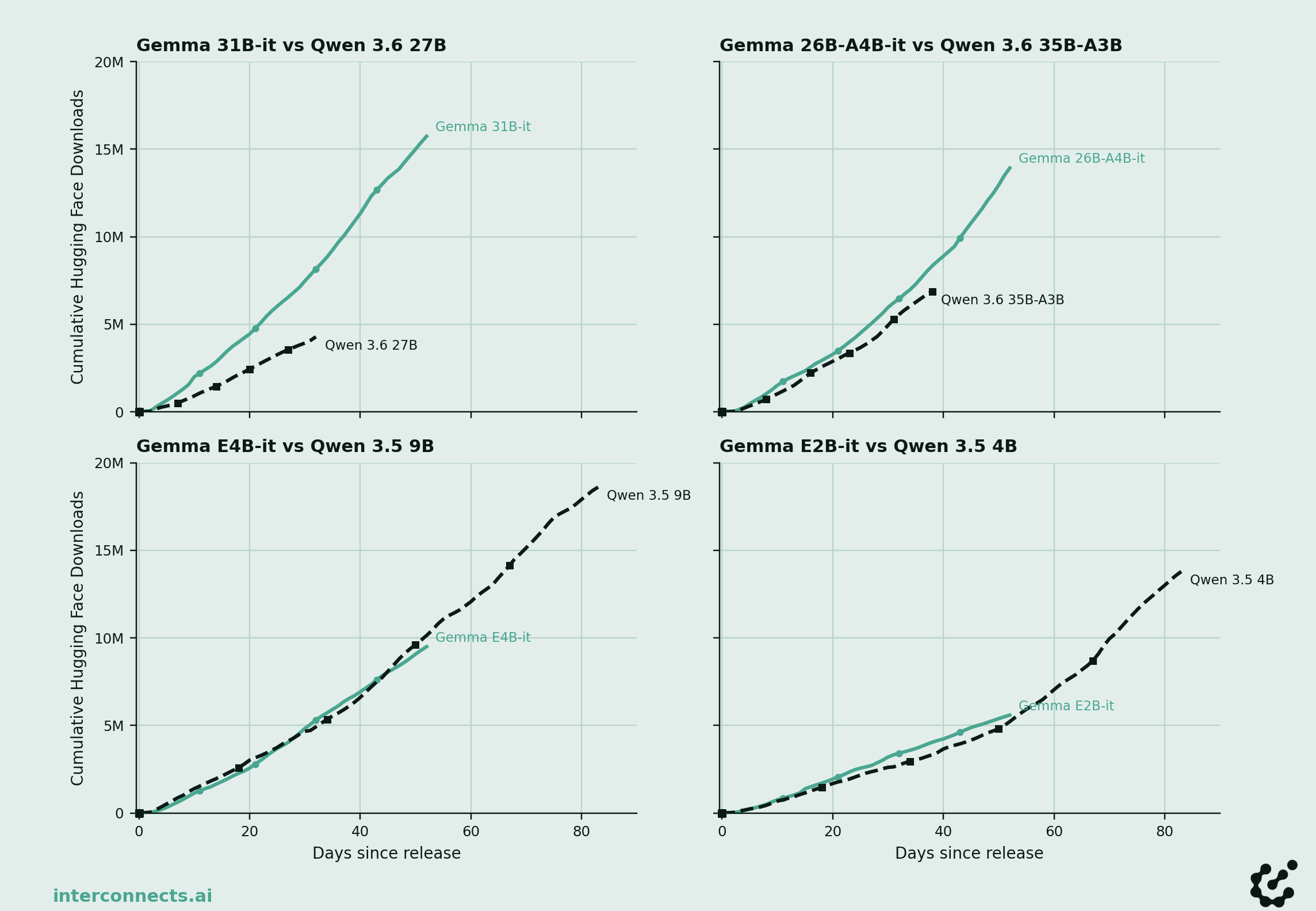
    Having written a lot of model release blog posts, there’s something much harder about reviewing open models when they drop relative to closed models, especially in 2026. In recent years, there were so few open models, so when Llama 3 was released most people were still doing research on Llama 2 and super happy to get an update. When Qwen 3 was released, the Llama 4 fiasco had just gone down, and a whole research community was emerging to study RL on Qwen 2.5 — it was a no brainer to upgrade. Today, when an open model releases, it’s competing with Qwen 3.5, Kimi K2.5, GLM 5, MiniMax M2.5, GPT-OSS, Arcee Large, Nemotron 3, Olmo 3, and others. The space is populated, but still feels full of hidden opportunity. The potential of open models feels like a dark matter, a potential we know is huge, but few clear recipes and examples for how to unlock it are out there. Agentic AI, OpenClaw, and everything brewing in that space is going to spur mass experimentation in open models to complement the likes of Claude and Codex, not replace them. Especially with open models, the benchmarks at release are an extremely incomplete story. In some ways this is exciting, as new open models have a much higher variance and ability to surprise, but it also points at some structural reasons that make building businesses and great AI experiences around open models harder than the closed alternatives. When a new Claude Opus or GPT drops, spending a few hours with them in my agentic workflows is genuinely a good vibe test. For open models, putting them through this test is a category error. Something else to be said about open models in the era of agents is that they get out of the debate of integration, harnesses, and tools and let us see close to the ground on what exactly is the ability of just a model. Of course, we can’t test some things like search abilities without some tool, but being able to measure exactly the pace of progress of the model alone is a welcome simplification to a systematically opaque AI space. The list of factors I’d use to assess a new open-weight model I’m considering investing in includes: * Model performance (and size) — how this model performs on benchmarks I care about and how it compares to other models of a similar size. * Country of origin — some businesses care deeply about provenance, and if a model was built in China or not. * Model license — if a model needs legal approval for use, uptake will be slower at mid-sized and large companies. * Tooling at release — many models release with half-broken, or at least substantially slower, implementations in popular software like vLLM, Transformers, SGLANG, etc due to pushing the envelope of architectures or tools. * Model fine-tunability — how easy or hard it is to modify the given model to your use-case when you actually try and use it. The core problem is that some of these are immediately available at release, e.g. general performance, license, origin, etc. but others such as tooling take day(s) to week(s) to stabilize, and others are open research questions — with no group systematically monitoring fine-tunability. In the early era of open models, the days of Llama 2 or 3 and Qwen pre v3.5, the architectures were fairly simple and the models tended to work out of the box. Some of this was due to the extremely hard work of the Llama, Qwen, Mistral, etc. developer teams. Some is due to the new models being genuinely harder to work with. When it comes to something like Qwen 3.5 or Nemotron 3, with hybrid models (either gated delta net or mamba layers), the tooling is very rough at release. Things you would expect to “just work” often don’t. I’ve been following this area closely since we released Olmo Hybrid with a similar architecture, and Qwen 3.5 is just starting to work well in the various open-source tools that need to all play nice together for RL research. That’s 1.5 months after the release date! This is just to start really investing more into understanding the behavior of the models. Of course, others started working on these models sooner by investing more engineering resources or relying on partially closed software. The fully open and distributed ecosystem takes a long time to get going on some new models. All of this is lead-in for the most important question for open models — how easy is it to adapt to specific use-cases? This is a different problem for different model sizes. Large MoE open-weight models may be used by entities like Cursor who need complex capabilities in their domain, e.g. Composer 2 trained on Kimi K2.5. Other applications can be built on much smaller models, such as Chroma’s Context-1 model for agentic search, built on GPT-OSS 20B. The question of “which models are fine-tunable” is largely background knowledge known by engineers across the industry. There should be a thriving research area here to support the open ecosystem model. The first step is to understand characteristics of different base and post-trained models to understand what they look like. The second step is to tune pretraining recipes for open models so they’re more flexible. Interconnects AI is a reader-supported publication. Consider becoming a subscriber. For The ATOM Project and other Interconnects endeavors, we’ve put in substantial effort to measuring adoption trends in the open ecosystem. Everything takes a long time to unfold after a model is first publicly available — and adaptability is why. What we know for sure now, when Qwen has been going from strength to strength with its releases, is that technical staff across the industry has gotten comfortable working with Qwen models. Countless research methods and datasets were made to work with Qwen. It’ll take patience for any other model family to get to this point — a patience I’m not sure many open model builders have. This takes us to Gemma 4, Google’s latest open models. Gemma 3 was released more than a year ago, in March of 2025, and is a bit underrated. Gemma 4 comes in 4 sizes for now, with a bigger, MoE model of over 100B total parameters rumored but not released yet. The models we have today come in sizes of ~5B dense, 8B dense, 26B total 4B active MoE, and 31B dense. I’m most excited that they’re finally adopting a standard Apache 2.0 open source license. This’ll massively boost adoption. The standard of better licenses for strong open-weight LLMs was set by mostly Chinese open model labs in the last 1-2 years, and now U.S. companies are following suit. I will personally be so happy if the horrible Llama licenses and Gemma terms of service were an ~18-month transient dynamic of the industry being nervous about releasing strong open models. The Gemma 4 scores look very solid, the small models have incredible benchmark scores (especially in general domains like LMArena) and the 31B model rivals the recent Qwen 3.5 27B, which is the leading member of that class. The ~30B size range is an important one, as it’s accessible both to researchers and to enterprises looking to deploy the model in real use-cases. Where the 7B model scale is the default for tinkering and research, a 30B model is the default for seeing if an open model can unlock substantial value in your specific workflow — a good mix of intelligence, low price, tractability for downstream training, etc. This takes us back to the above adoption criteria I mentioned for open models and the bigger question — do I think Gemma 4 will be an overwhelming success? Previous Gemma models have been plagued by tooling issues and poorer performance when being finetuned. Gemma 4’s success is going to be entirely determined by ease of use, to a point where a 5-10% swing on benchmarks wouldn’t matter at all. It’s strong enough, small enough, with the right license, and from the U.S., so many companies are going to slot it in. I’m cautiously optimistic that Gemma 4 is going to work better here. Winds are shifting for open models built in America. We saw GPT-OSS go through a bumpy launch to become an overwhelming success. There’s a collective energy around the likes of Reflection, Arcee, Nemotron, Gemma, Olmo, and peers that show substantial demand for building new stacks around open models. There’s capital to be spent on AI stacks across the economy by those who want more ownership of everything, including the model. After launching The ATOM Project 240 days ago, the conversation is shifting into the next stage. Summer of 2025 was a crisis moment where the U.S. AI scene realized it can’t wait and figure out open models after building AGI. The two markets will capture different areas and proceed in parallel. Now that more companies in the U.S. are releasing strong models, we need to improve the ecosystem so that these models are easy to use, understand, and build value around. It’s the hard work to build another inflection point in these adoption plots I’ve been updating consistently, but that’s the work to be done. Join me in it. More data coming soon! Here’s a sneak peek: This is a public episode. If you'd like to discuss this with other subscribers or get access to bonus episodes, visit www.interconnects.ai/subscribe

  • March 22 · 13 min

    Lossy self-improvement

    Fast takeoff, the singularity, and recursive self-improvement (RSI) are all top of mind in AI circles these days. There are elements of truth to them in what’s happening in the AI industry. Two, maybe three, labs are consolidating as an oligopoly with access to the best AI models (and the resources to build the next ones). The AI tools of today are abruptly transforming engineering and research jobs. AI research is becoming much easier in many ways. The technical problems that need to be solved to scale training large language models even further are formidable. Super-human coding assistants making these approachable is breaking a lot of former claims of what building these things entailed. Together this is setting us up for a year (or more) of rapid progress at the cutting edge of AI. We’re also at a time where language models are already extremely good. They’re in fact good enough for plenty of extremely valuable knowledge-work tasks. Language models taking another big step is hard to imagine — it’s unclear which tasks they’re going to master this year outside of code and CLI-based computer-use. There will be some new ones! These capabilities unlock new styles of working that’ll send more ripples through the economy. These dramatic changes almost make it seem like a foregone conclusion that language models can then just keep accelerating progress on their own. The popular language for this is a recursive self-improvement loop. Early writing on the topic dates back to the 2000s, such as the blog post entirely on the topic from 2008: Recursion is the sort of thing that happens when you hand the AI the object-level problem of “redesign your own cognitive algorithms”. And slightly earlier, in 2007, Yudkowsky also defined the related idea of a Seed AI in Levels of Organization in General Intelligence: A seed AI is an AI designed for self-understanding, self-modification, and recursive self-improvement. This has implications both for the functional architectures needed to achieve primitive intelligence, and for the later development of the AI if and when its holonic self-understanding begins to improve. Seed AI is not a workaround that avoids the challenge of general intelligence by bootstrapping from an unintelligent core; seed AI only begins to yield benefits once there is some degree of available intelligence to be utilized. The later consequences of seed AI (such as true recursive self-improvement) only show up after the AI has achieved significant holonic understanding and general intelligence. It’s reasonable to think we’re at the start here, with how general and useful today’s models are. Generally, RSI can be summarized as when AI can improve itself, the improved version can improve even more efficiently, creating a closed amplification loop that leads to an intelligence explosion, often referred to as the singularity. There are a few assumptions in this. For RSI to occur, it needs to be that: * The loop is closed. Models can keep improving on themselves and beget more models. * The loop is self-amplifying. The next models will yield even bigger improvements than the current ones. * The loop continues to run without losing efficiency. There are not added pieces of friction that make the exponential knee-capped as an early sigmoid. While I agree that momentous, socially destabilizing changes are coming in the next few years from sustained AI improvements, I expect the trend line of progress to be more linear than exponential when we reflect back. Instead of recursive self-improvement, it will be lossy self-improvement (LSI) – the models become core to the development loop but friction breaks down all the core assumptions of RSI. The more compute and agents you throw at a problem, the more loss and repetition shows up. Interconnects AI is a reader-supported publication. Consider becoming a subscriber. I’m still a believer that the complexity brake on advanced systems will be a strong counterbalance to the reality that AI models are getting substantially better at every narrow task we need to compose together in making a leading AI model. I quoted this previously in April of 2025 in response to AI 2027. Microsoft co-founder Paul Allen argued the opposite of accelerating returns, the complexity brake: the more progress science makes towards understanding intelligence, the more difficult it becomes to make additional progress. A study of the number of patents shows that human creativity does not show accelerating returns, but in fact, as suggested by Joseph Tainter in his The Collapse of Complex Societies, a law of diminishing returns. The number of patents per thousand peaked in the period from 1850 to 1900, and has been declining since. The growth of complexity eventually becomes self-limiting, and leads to a widespread “general systems collapse”. There are plenty of examples in how models are already trained, the deep intuitions we need to get them right, and the organizations that build them that show where the losses will come from. Building leading language models is incredibly complex, and only becoming more-so. There are a few core frictions in my mind. 1. Automatable research is too narrow First, it is clear that language models this year will already be useful tools at optimizing localized tasks like lowering the test loss of a model. Andrey Karpathy recently launched his autoresearch that popularized doing just this. This allows AI agents to play directly on GPUs to target tasks like lowering the loss on the test set. This approach works in narrow domains, i.e. one general test loss or one overall reward. The problem is that there’s a long-standing gap between an on-paper more accurate model and models that users find more productive. The most provocative case is for pretraining, which was discussed more at length around scaling laws. Scaling laws show us that the loss will continue going down, but we don’t know if that’ll be economically more valuable. In post-training, reinforcement learning algorithms are at least more directly tied to specific performance gains as most RL training environments can be used directly as an evaluation. Still, I worry about generalization and tying back to models that are better at the specific task of improving themselves. It’s a big leap from models get better at some things to that necessarily translating to models that are better at building themselves and designing experiments. We’ve seen many AI capabilities sort of saturate at certain levels of human taste, such as writing quality. AI research is a bit different here, as there is a very high ceiling to climb up to. Where models mostly saturate on writing because there’s inherent tension in preferences, models will saturate on research because the search space and optimization target is too wide. The early benchmarks for measuring this sort of ability all fall prey to the same problem – narrow scope. Agents will do well at optimizing single metrics, but the leap required to navigate many metrics at once is a very different skill set. That is actually what the best researchers do — they make many scalable ideas work together. The most related benchmark we have to measure this is PostTrainBench, which is quite fun, but progress will very rapidly get distorted on this. Over 90% of the challenge in doing post-training well is getting the last 1-3% of performance, especially without cooking the model in out-of-domain tasks. Post-training a general, leading model is extremely complex, and only getting more complex. I could go on and on about this. Another example is from during my Ph.D. (2017-2022), when there was immense hype around a field called “AutoML” which aimed to use techniques like Bayesian Optimization to find new architectures and parameters for models. The hype never translated into changing my job. Language models will do more than this, but not enough to take jobs away from top AI researchers any time soon. The core currency of researchers is still intuition and managing complexity, rather than specific optimization and implementation. 2. Diminishing returns of more AI agents in parallel The biggest problem for rapid improvement in AI is that even though we’ll have 10,000 remote workers in a datacenter, it’ll be nearly impossible to channel all of them at one problem. Inherently, especially when the models are still so similar, they’re sampling from the same distribution of solutions and capabilities while being bottlenecked by human supervision. Adding more agents will have a strict saturation in the amount of marginal performance that can be added – the intuition of the best few researchers (and time to run experiments) will be the final bottleneck. A common idea to illustrate this is Amdahl’s law, which is taken from computer architecture and shows that a given task can only generate a fixed speedup proportional to how much can be parallelized and how many parallel workers exist. An illustration is below: In AI this should be relatively easier to convey, as the low-level operating details of computers are fairly mysterious. Consider an AI researcher on the transition from writing code by hand to using AI autocomplete assistance to now using autonomous coding agents. These are all massive gains. Let us continue. Now this researcher uses 3-4 agents working on different sub-tasks or approaches to the problem at hand. This is still a large gain. Now consider this single researcher trying to organize 30-40 agents with tasks to do every day. Some people can get more value out of this scale, but not many. How many people do you think could come up with 300-400 tasks for AI agents every day? Not many. This problem will hit the AI models soon enough as well. 3. Resource bottlenecks and politics Fundamentally, all the AI companies are walking a fine line of acquiring substantial capital, converting new compute resources to revenue via sufficient demand, and repeating the process all-the-while spending an extreme amount on research. With the scale of resources here, there will always be political bottlenecks on who gets resources and what gets bet on. In this layer, research leadership sits above the AIs and the researchers. Even as models continue to improve, this source of friction will never get removed. It isn’t a substantial friction, but the AI models are fundamentally operating in organizations where humans are the bottleneck on resources. The early scale of improvements with language models is local optimizations, where the resources used cost <$1M per day. With my other views on the frictions of AI, this is on its own a very minor impact on the rate of improvement, but for those with worries of fast take-off, RSI, and loss of control to AIs, it should be obvious that billions of dollars of compute resources for research are unlikely to be totally isolated for end-to-end experimentation of AI models. The conclusion here is that because we’re at the early stages of using AI assistance, autonomously and at scale for AI-development, we’re collectively discovering the ways that AI can help us massively. We’re all applying these tools to capture the low-hanging fruit we see and our jobs are literally changing to be higher paced and more productive. The problem is that all of these axes have clear human, political, or technical complexity bottlenecks. The bottom of every sigmoid feels like an exponential. We’ve ridden multiple exponentials in the era of language models, in 2023 we scaled to huge models and GPT-4 felt like magic, by 2025 we added inference-time scaling with o1 and reasoning models — they let us “solve” math and coding, now we’re going to take a big step by polishing the entire AI workflow (all the while scaling training compute massively). 2026 will feel like a huge step, but it doesn’t have a fundamental change convincing me that progress will begin to take off. This could still cross the colloquial threshold for AGI, which is a drop-in replacement for most remote workers, which would be an incredible milestone. Much of the challenge in the debate of if we hit AGI in the coming years is that AI models are jagged and smart in different ways than humans, so they won’t look like drop-in replacements for remote workers, but in many cases just using AI will be far more effective than trying to work with a human. It’s reshaping what jobs are. Let us consider the scenarios we’re working through. * Engineering is becoming automated today. Humans are way more productive, models can scale through complex infrastructure deployments much faster, run with higher GPU utilization, etc. Infrastructure gains become fixed improvements in the rate and scale of experimentation, the fundamental units of progress in AI. * Basic AI model research and optimization will be automated. The AI models are expanding in scope – they transition from writing kernels to deciding on architectures. This is moving from improving the experimentation toolkit to running minor experiments themselves. Configs, hyperparameters, etc. become the domain of the AI assistants. These are both real. The problem is that a third era doesn’t have a simple scale to jump to. Where the AI models can create knowledge by synthesis and execution, the next jump requires harnessing thousands of agents or having models make more novel discoveries – like unlocking the next paradigm after inference time scaling. The improvements downstream of AI are going to make the industry supercharged at hill climbing, but I worry that this won’t bring paradigm shifts that are needed for new categories of AI – continual learning, world models, whatever your drug of choice is. All together, the models are becoming core to the development loop and that’s worth being excited (and worried) about. The models are performing self-improvement. They’re not transforming the approach. We are scaling up the compute we spend on our own research practices and tools. There are diminishing returns. Agents are going to start being autonomous entities we work with. They feel like a cross between a genius and a 5 year old. We will be in this era of lossy self-improvement (LSI) for a few years, but it is not enough for a fast takeoff. This is a public episode. If you'd like to discuss this with other subscribers or get access to bonus episodes, visit www.interconnects.ai/subscribe
  • March 18 · 6 min

    GPT 5.4 is a big step for Codex

    I’m a little late to this model review, but that has given me more time to think about the axes that matter for agents. Traditional benchmarks reduce model performance to a single score of correctness – they always have because that was simple, easy to quickly use to gauge performance, and so on. This is also advice that I give to people trying to build great benchmarks – it needs to reduce to one number that is interpretable. This is likely still going to be true in a year or two, and benchmarks for agents will be better, but for the time being it doesn’t really map to what we feel because agentic tasks are all about a mix of correctness, ease of use, speed, and cost. Eventually benchmarks will individually address these. Where GPT 5.4 feels like another incremental model on some on-paper benchmarks, in practice it feels like a meaningful step in all four of those traits. GPT 5.4 in Codex, always on fast mode and high or extra-high effort, is the first OpenAI agent that feels like it can do a lot of random things you can throw at it. Interconnects AI is a reader-supported publication. Consider becoming a subscriber. I haven’t been particularly deep in software engineering over the last few months, so most of my working with agents has been smaller projects (not totally one-off, but small enough where I’ve built the entire thing and manage the design over weeks), data analysis, and research tasks. When you embrace being agent-native, this style of work entails a lot of regular APIs, background packages (like installing and managing LateX binaries, ffmpeg, multimedia conversion tools, etc), git operations, file management, search etc. Prior to GPT 5.4, I always churned off of OpenAI’s agents due to a death by a thousand cuts. It felt like rage quits. I’d feel like I was getting into GPT 5.2 Codex, but it would fail on a git operation and have me (or Claude) need to reset it. Those hard edges are no longer there. The other subtle change in GPT 5.4’s approachability – the biggest reason I think OpenAI is much more back in the agent wars – is that it just feels a bit more “right.” I classify this differently to the routine tasks I discussed above, and it has to do with how the product (i.e. the model harness) presents the model outputs, requests, and all that to you the user. It has to do with how easy it is to dive in. This has always been Claude’s biggest strength in its astronomical growth. Not only has Claude been immensely useful, but it has a charm and entertainment value to it that’ll make new people stick around. GPT 5.4 has a bit of that, but the underlying model strengths of Claude still leave it feeling warmer. Where Claude is a super smart model, with character, a turn of phrase in a debate, and sometimes forgetting something, OpenAI’s models in Codex feel meticulous, slightly cold, but deeply mechanical. I’d use Claude for things I need more of an opinion on and GPT 5.4 to churn through an overwhelmingly specific TODO list. The instruction following of GPT 5.4 is so precise that I need to learn to interact with the models differently after spending so much time with Claude. Claude, in some domains, you come to see has an excellent model for your intent. GPT 5.4 just does what you say to do. These are very different philosophies of “what will make the best model for an agent”, Claude will likely appeal to the newcomers, but GPT 5.4 will likely appeal to the master agent coordinator that wants to unleash their AI army on distributed tasks. Outside of charm, and dare I say taste, a lot of the usability factors are actually better on OpenAI’s half of the world. The Codex app is compelling – I don’t always use it, but sometimes I totally love it. I suspect substantial innovation is coming in what these apps look like. Personally, I expect them to eventually look like Slack (when multiple agents need to talk to eachother, under my watch). OpenAI also natively offers fast mode for their models with a subscription and very large rate limits. I’ve been on the $100/month Claude plan and $200/month ChatGPT plan for quite some time. I’ve never been remotely close to my Codex limits with fast mode and xhigh reasoning effort, where I hit my Claude limits from time to time. There’s definitely a modeling reason to this – most of OpenAI’s release blogs showcase each iterative model being substantially more concise in the number of tokens it takes to get peak benchmark performance. This is a measure of reasoning efficiency. This 2D (or more) benchmark picture is exactly where the world is going. Here’s a plot from Cursor, which sadly doesn’t have all the GPT 5.4 reasoning efforts, but it confirms this point in a third party evaluation. What is missing across model families is the speed and price (a proxy for total compute used) to get there. The final benefit of GPT 5.4, and OpenAI’s agentic models in general for that matter, is much better context management. In using them regularly now I feel like I’ve never hit the context wall or context anxiety point. The reasoning efficiency I suspect is the case above just lets the model do way more with its initially empty context window. Then, when GPT 5.4 does compact, it’s been less noticeable. The one problem I’ve been having with both Claude Opus 4.6 and GPT 5.4 is a light forgetfulness. If you give the models multiple TODOs in a single message outside of planning mode, I find them often dropping them. Sometimes it feels like the models glitch and try to solve a previous problem rather than the recent ones. I’m not sure what in the model or the harness is the exact cause, but sometimes I like to queue up a few messages as I see the model working on something, to refine the task, but currently this tends to be a pretty risky outcome except in the simplest use-cases. These days I’ve been using both GPT and Claude extensively, mostly based on my mood, and have been getting more done than ever. Having a GPT 5.4 Pro integration directly with Codex, e.g. like \ultrathink, would be a big differentiator for OpenAI. Those models have been incredible. All in, I see GPT 5.4 as an agentic model that brings a ton more simple usability and “agentness” to the very strong software foundation of GPT 5.3 Codex. It’s a big step, and I’m unbelievably excited for which of these two companies releases an update next. On paper, listing the strengths of GPT 5.4 across better top end coding performance, better speed, better context management, better rate limits, it’s a testament to how nuanced choosing a model is. I genuinely still enjoy Claude a bit more for ways that’ll never show up on benchmarks. This makes me type claude into my terminal at the start of my day, rather than codex. This is a public episode. If you'd like to discuss this with other subscribers or get access to bonus episodes, visit www.interconnects.ai/subscribe
  • March 16 · 18 min

    What comes next with open models

    2025 was the year where a lot of companies started to take open models seriously as a path to influence in the extremely valuable AI ecosystem — the adoption of a strategy that was massively accelerated downstream of DeepSeek R1’s breakout success. Most of this is being done as a mission of hope, principle, or generosity. Very few businesses have a real monetary reason to build open models. Well-cited reasons, such as commoditizing one’s complements for Meta’s Llama, are hard to follow up on when the cost of participating well is billions of dollars. Still, AI is in such an early phase of technological development, mostly defined by large-scale industrialization and massive scale-out of infrastructure, that having any sort of influence at the cutting edge of AI is seen as a path to immense potential value. Open models are a very fast way to achieve this, you can obtain substantial usage and mindshare with no enterprise agreements or marketing campaigns — just releasing one good model. Many companies in AI have raised a ton of money built on less. The hype of open models is simultaneously amplified by the mix of cope, disruptive anticipation, and science fiction that hopes for the world where open models do truly surpass the closed labs. This goal could be an economically catastrophic success for the AI ecosystem, where profits and revenue plummet but the broader balance of power and control of AI models is long-term more stable. There’s a small chance open models win in absolute performance, but it would only be on the back of either a true scientific breakthrough that is somehow kept hidden from the leading labs or the models truly hitting a wall in performance. Both of them are definitely possible, but very unlikely. It is important to remind yourself that there have been no walls in progress to date and all the top AI researchers we discuss this with constantly explain the low-hanging fruit they see on progress. It may not be recursive self-improvement to the singularity (more on that in a separate post), but large technology companies are on a direct path to building definitionally transformative tools. They are coming. The balance of power in open vs. closed models The fair assessment of the open-closed gap is that open models have always been 6-18 months behind the best closed models. It is a remarkable testament to the open labs, operating on far smaller budgets, that this has stayed so stable. Many top analysts like myself are bewildered by the way the gap isn’t bigger. Distillation helps a bit in quality, benchmaxing more than closed labs helps perceptions, but the progress of the leading open models is flat out remarkable. The reality is that the open-closed model gap is more likely to grow than shrink. The top few labs are improving as fast as ever, releasing many great new models, with more on the docket. Many of the most impressive frontier model improvements relative to their open counterparts feel totally unmeasured on public benchmarks. In a new era of coding agents, the popular method to “copy” performance from closed models, distillation, requires more creativity to extract performance — previously, you could use the entire completion from the model to train your student, but now the most important part is the complex RL environments and the prompts to place your agents in them. These are much easier to hide and all the while the Chinese labs leading in open models are always complaining about computational restrictions. As the leading AI models move into longer-horizon and more specialized tasks, mediated by complex and expensive gate-keepers in the U.S. economy (e.g. legal or healthcare systems), I expect large gaps in performance to appear. Coding can largely be mostly “solved” with careful data processes, scraping GitHub, and clever environments. The economies of scale and foci of training are moving into domains that are not on the public web, so they are far harder to replicate than early language models. Developing frontier AI models today is more defined by stacking medium to small wins, unlocked by infrastructure, across time. This rewards organizations that can expand scope while maintaining quality, which is extremely expensive. All of these dynamics together create a business landscape for open models that is hard to parse. Through 2026, closed models are going to take leaps and bounds in performance in directions that it is unlikely for open models to follow. This sets us up for a world where we need to consider, fund, use, and discuss open models differently. This piece lays out how open models are changing. It is a future that’ll be clearly defined by three classes of models. * True (closed) frontier models. These will drive the strongest knowledge work and coding agents. They will be truly remarkable tools that force us to reconsider our relationship to work. * Open frontier models. These will be the best open-weight, large models that are attempting to compete on the same directions as above. There will be plenty of use-cases that they don’t work for relative to the best models, but countless use-cases where they work remarkably well. For many use-cases, even ones as valuable as some subsets of coding, these will work great. The AI ecosystem will still take years to understand what it means to have intelligence of this magnitude served in private, at the marginal cost of electricity for individuals, as assistants, coaches, companions, and more. OpenClaw provided a glimpse behind the mirror that will expand and grow. The class of models around GPT-OSS 120B, Nvidia Nemotron 3 Super, or MiniMax M2.5 are the balance of performance to price that can work as local models. * Open, small models as distributed intelligence. The most successful open models will be complementary tools to closed agents. This is a path for open models to complement and accelerate the frontier of progress.AI is slotting in to automate many repetitive, niche tasks across the technology economy. There’s a huge pressure to shift these tasks off of the best closed models — which frankly are still better at most of the things, across my conversations with businesses trying to build with open models — to small, open models that can be 10X faster and 100X cheaper. There aren’t really people building data and fine-tuning engines for economically viable tasks on the smallest models possible. These models need to be almost brain-numbingly boring and specific. In a world dominated by coding agents, I want to build open models that Claude Code is desperate to use as a tool, letting its sub agents unlock entirely new areas of work. This is possible, but remarkably under-explored. Small models from the likes of Qwen and co. are still marketed on general-task benchmarks. The hype of “open models catching the frontier” distracts the world from this very large area of demand.This is the sort of model that moves open models from just a few, crucial static weights to more of an ecosystem. It requires creativity and a new approach. The goal of this piece is to illustrate why and how to build these, with added context on where open models stand today. All three of these model classes hint at different ways to use agents. It is absolutely definitional to how AI is going to be built going forward that they’re not just model weights, but rather systems that think, search, and act. The weights only define one portion of those abilities. Interconnects AI is a reader-supported publication. Consider becoming a subscriber. Open weights as part of an AI system To start, consider what are the most impactful and impressive things that language models can do without a suite of tools at their side. When was the last time that you were blown away by something that was just autoregressive token outputs? Unless you’re doing a substantial amount of work on mathematical proofs or competition code, it seems like that situation has changed little since GPT-4’s release in 2023. The AI systems we use today are about far, far more than weights. In this world, closed models have a clear advantage. Closed models get to vertically integrate everything from the chips they run on, the inference software, the weights, the tools, and the user interface. Open models on the other hand need to work on every inference setup, with many tools, and in many use-cases. This vertical integration is best expressed today in the joy of using Claude Code with Opus 4.6 or OpenAI’s Codex with GPT 5.4. Open models haven’t passed this point. Some are starting to focus on specific interfaces, e.g. OpenCode, but there’s an inherent tension in making an open model work only in your blessed product roadmap. At the same time, this change could point to more about the latest AI systems being open! If you can do less with the weights alone, maybe more labs will release them. The way to think about AI systems today is as a mix of weights, tools, and harnesses. The weights portion is familiar. The tools are the deeply integrated environments the models act in at deployment time — best typified by search and code sandboxes — and the harness is how these two fit together with a product that the user sees. In this world, there are two things to consider: 1) Is there an equivalent, open system to the closed products that people are using today — I mean truly equivalent, where every level of the stack can be modified and controlled (more on this later), and 2) How does this system’s view impact different future decisions in the open ecosystem? Still looking for open model business strategies To understand how the business and practicality of open models will evolve, let me take a tour back in time to foundational writing on the role of open-source in modern technology companies. The first is a Google blog post, The Meaning of Open, which originally was an internal memo by Jonathan Rosenberg, which sparked an intense internal debate that later resulted in it becoming public. To start, here’s a basic assessment of how open systems can work: Open systems have the potential to spawn industries. They harness the intellect of the general population and spur businesses to compete, innovate, and win based on the merits of their products and not just the brilliance of their business tactics. I’ve long believed that the company who will benefit most from the ecosystem of open models is the one who understands it best. This entails being deeply involved with open research and experimentation in how to use the models. So far, most of the open model company business models are not this. Rosenberg expands on this in his 2009 post, comparing the dynamics of open systems to closed products: [Open systems] are competitive and far more dynamic. In an open system, a competitive advantage doesn’t derive from locking in customers, but rather from understanding the fast-moving system better than anyone else and using that knowledge to generate better, more innovative products. The successful company in an open system is both a fast innovator and a thought leader; the brand value of thought leadership attracts customers and then fast innovation keeps them. This isn’t easy — far from it — but fast companies have nothing to fear, and when they are successful they can generate great shareholder value. We’ve known for some time that open weight models are not actually enough to constitute a product — models are a product in the sense that they have tools and harnesses, so we don’t actually have fully open systems, we have systems that are partially open partially closed, making moats messy. VLLM and a model like GLM 5 are pieces of a system, but it still takes more to deploy them — expensive private GPUs and some tools with local business data. It may turn out to be that AI is too complex and expensive to have any analogous open system to previous generations of technology. If there was a fully open system, it would win by default, as many historical generations of technology have shown us. This fully open analog does not yet exist, so we have constant debates on the role of open-source AI. Bill Gurley recounts how Google’s free products have exemplified the open or free strategies across technology. Gurley wrote on the open-source operating system, Android, and the free browser, Chrome, in 2011: So here is the kicker. Android, as well as Chrome and Chrome OS for that matter, are not “products” in the classic business sense. They have no plan to become their own “economic castles.” Rather they are very expensive and very aggressive “moats,” funded by the height and magnitude of Google’s castle. Google’s aim is defensive not offensive. They are not trying to make a profit on Android or Chrome. They want to take any layer that lives between themselves and the consumer and make it free (or even less than free). Because these layers are basically software products with no variable costs, this is a very viable defensive strategy. In essence, they are not just building a moat; Google is also scorching the earth for 250 miles around the outside of the castle to ensure no one can approach it. In the same post, Gurley reflects on the limits of Google’s openness: In this open manifesto, Jonathan opines over and over again that open systems unquestionably result in the very best solutions for end customers. That is with one exception. “In many cases, most notably our search and ads products, opening up the code would not contribute to these goals and would actually hurt users.” As Rodney Dangerfield said in Caddyshack, “It looks good on you, though.” Essentially, Google open-sourced so much, in fact paid people to use its products (e.g. paying phone makers to use android) to keep the funnel leading to the search profit center. This is the virtuous loop that the search business still funds to this day. AI is still nothing like this, but signs of change are emerging. The default belief on the value of models to these companies is that the model is the product. This is obvious with products like hosted APIs, where releasing the model weights would be business suicide, but this is softening as interfaces like Claude Code, Codex, Cursor, etc. get vastly popular. It could be a path to more openness, at least in parts of the stack. We can see this with the coding plans offered by Moonshot and Z.ai — where the demand is very high for the businesses, even though the model is open. Most people will just use the cheap interface with inference, instead of figuring out how to use the model themselves (as long as the business is mostly consumer or per-head services). All of this doesn’t leave me optimistic on the direction of companies becoming more open in the coming years. I’d expect the opposite still. Nvidia has the one great reason to be open — to sell more GPUs to people building on open models and understand what they need to build next, but there’s no one else obvious on this list. Until there are more specific economic reasons to build open models, the companies building these at the frontier will have fewer resources to spend on the models and face a consolidation to the best few. In the face of consolidation at the open frontier, the investment in the models should shift to areas where the models can have more differentiated upside relative to the best closed frontier models. Open models that are specific, cheap, fast, and ubiquitous There’s too much obsession with the best companies building open models to try and compete at the frontier. There’s a vastly underserved market of enterprises that want cheap, reliable models for repetitive use-cases in their systems. Picture this, one small model with a series of LoRA adapters that specialize the model to internal skills. This can be deployed very cheaply as tools and a complement to the frontier closed models that are orchestrating agents. Every task that a frontier agentic model does tens to hundreds of times can potentially be outsourced to a small model. There are ancillary benefits to this, e.g. privacy of a local model reading your files and summarizing to Claude, but almost no one is pushing hard in this direction. The leading model family of capable, customizable small models to date is Qwen, but that’s now shrouded in uncertainty with the departures of key personnel. Gemma, Phi, Olmo, etc. are all major steps down in quality, and therefore potential for modification. There are a few obvious examples why this can be scaled up. There was a recent thread and discussion on how the new Qwen 3.5 4B model arguably bests the original ChatGPT model. On the research side, there are already recipes for finetuning open models on specific code-bases to match performance of much bigger models. Moondream.ai is a startup made by a friend of mine Vik, who builds some of the best, small multimodal models on a tiny budget — they compete with Qwen and Llama on real world tasks. This is the tip of an iceberg. Intelligence compression hasn’t been explored with nearly as much depth (or resources) because it is less exciting than keeping track of the progress of the best few models. Investigating these areas is the standard technological diffusion process that is slow and why we’re still early in understanding how people will build with AI. My contention is that too many people building open models are slightly deluded in their perception of their competitiveness. The best few models will win on general capabilities and there are still plenty of underserved niches elsewhere. Taking this to the next level involves releasing open models that are scoped to be truly excellent at 1-3 tasks, as I hinted at the beginning of this piece. Too many people try to compete with Qwen and show that their small model does great on frontier AI benchmarks. The right benchmark here is savings in compute and time. It’ll take years for this transition to slowly become reality. Part of why I am so excited about it is that it is driving innovation on open models being more about diversity, specialization, and curiosity, rather than the standard “one model to rule them all” that the frontier models presume. Models vs. ecosystems.Consolidation vs. creativity. So long as the open source ecosystem for AI is defined by a bunch of model providers trying to chase after the closed labs, it will largely lose. It will face pain on funding and substantive adoption. The same consolidation that will come for closed AI companies will come for open model builders — likely even sooner. Open systems at their best allow many people to participate and many approaches to flourish. The world of open models needs to be more of an ecosystem. I’ve discussed in the past how China is closer to this type of environment by having a variety of companies, but the variety in approaches is still too low. Ecosystems are self-reinforcing, whereas individual models are static artifacts in time. Ecosystems showcase clear, constant opportunities for what’s next that have growing value propositions. The path forward for open models is to solve different problems than the frontier labs, to find places where open models are effectively free alternatives, to show ways of using specialized models that the closed labs cannot offer. The world of open models needs to embrace creativity, before building powerful AI systems grows too expensive and prices out many of the prized open labs of today. This is a public episode. If you'd like to discuss this with other subscribers or get access to bonus episodes, visit www.interconnects.ai/subscribe
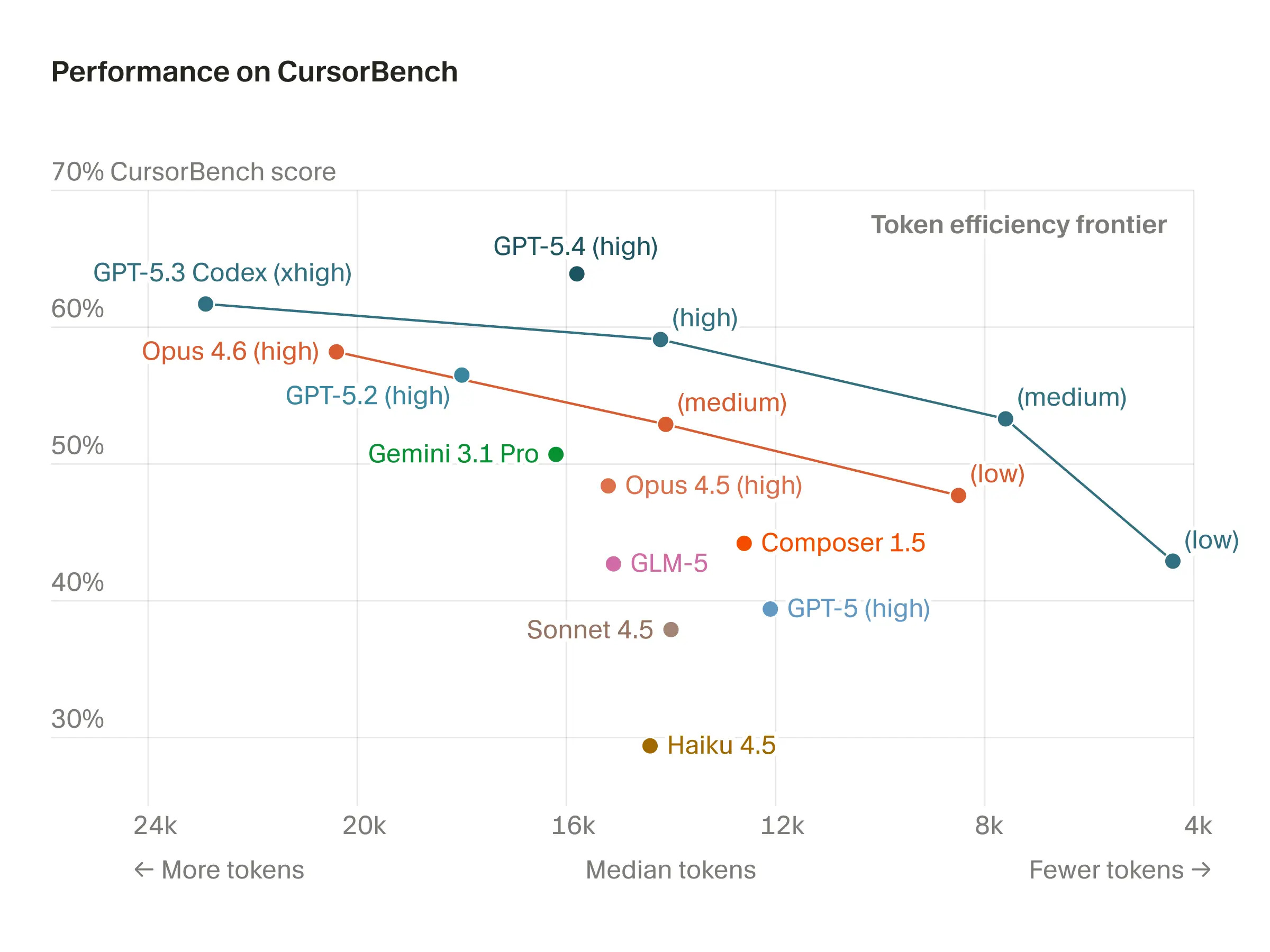
Showing 21–30 of 30 episodes