Skip to content
Artwork for Interconnects
TechnologyScience

Interconnects

Nathan Lambert

Audio essays about the latest developments in AI and interviews with leading scientists in the field. Breaking the hype, understanding what's under the hood, and telling stories.

www.interconnects.ai
Play
  • 30 episodes
  • Avg 16 min
  • English
Counted on this page — what you have heard stays on this device, so it is not something the list can be paged by.
  • Friday · 9 min

    Was I wrong about open models & cyber risks?

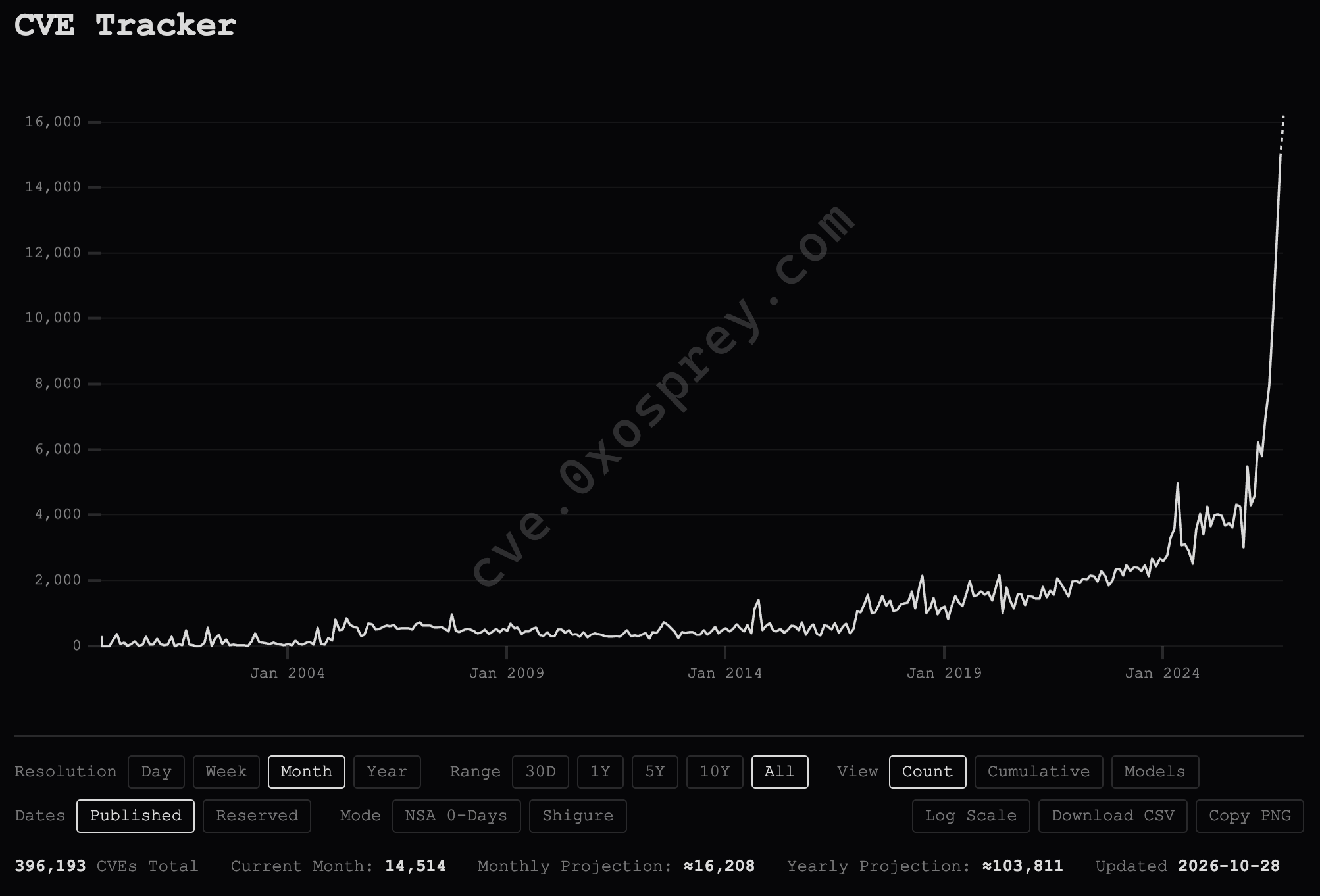
    Last week coined the term “Black October“ after an onslaught of critical vulnerability disclosures, including PHP2Shell and a long-standing GitLab bug, signified the moment when the cyber risks of AI models started to materialize. It seemed like the news cycle had stabilized a bit when I started writing this, but then there was news about another major crypto security incident at Binance. The crypto industry has a very long history of hacks, so it’s not the best industry to indicate vulnerabilities translating into new societal harm. Still, we are very much still living through the implications of this transition. The best guess for what is happening in the cybersecurity space is that the behind the scenes work has only accelerated, bringing more people and resources in to try and patch the internet — the Wall Street Journal reported that cyber first responders are strained, which seems like the system working. We’re living through this plot of an exponential rise in vulnerabilities, which will take a long time to level off at the top of the sigmoid. A few weeks ago, before the rapid acceleration in vulnerability disclosures and the uptick in reported hacks, I wrote the following take. It’s been getting a pretty consistent barrage of feedback, some hopeless dunk attempts and some reasonable discussion, so I wanted to unpack where I stand. Open-weight Mythos in April would’ve been fine? When Claude Mythos was announced, it was previewed as if it was a new class of cyber weapon, where if it ended up in the wrong hands it would’ve caused mass societal destabilization. It seems like this was wrong. By all measures, GLM-5.3 is the model that crosses that threshold of capability, and there’s little public evidence that much has changed, and we’re over a month out of the model weight release. In fact, I would go further. If Claude Mythos was accidentally released as open-weight, it seems like the world would have been more or less fine. Yes, there would be a clear increase in cybersecurity incidents and it would be bad for society if the model leaked, but it would be a scenario that looks more like an acceleration than a step change in risk. The leading proponents of this new wave of open-weight fear mongering have effectively been making a falsifiable prediction — that the current open-weight models are going to cause substantial, not seen before AI harms by crippling our cyber infrastructure. Based on all the evidence I have, which I’ve unpacked above, they’re set up to be wrong. At least now, after so many years of debating open weight risks, we will start to get some real answers. To start the reflection, I wanted to do more due diligence and track down some receipts on the claim that the AI safety community was reacting as if open-weight Mythos would be an actual disaster, and not just a painful headache. This was distinctly my impression having lived through the online discourse. I’ve gotten criticism that the frontier AI community never said it would be a “true disaster,” but regardless of exactly what they said, it is always about how people hear and internalize your information. Here are some examples of the sort of language that I felt was too exaggerated and from prominent people, which spilled into the public and more importantly federal government perspective that this was a cyber weapon include: * Rob Wiblin, host of the 80,000 hours podcast, on his own podcast (April 10, 2026): “If it fell into the hands of criminals or hostile state cyber actors, it would be an actual disaster.” * Anthropic, in the Project Glasswing announcement blog (April 7, 2026): “Given the rate of AI progress, it will not be long before such capabilities proliferate, potentially beyond actors who are committed to deploying them safely. The fallout—for economies, public safety, and national security—could be severe.” For one that is actually more reasonable, to illustrate the fine lines between correct and exaggerated, from Zvi Mowshowitz (who I don’t agree with a ton of things on) on April 9, 2026: “Claude Mythos would give attackers a cornucopia of zero-day exploits for essentially all the software on Earth … It would be chaos.” To date, this chaos has been confined to those running large-scale digital products, which is good, but could change. I largely still stand by my above writing a few weeks ago, but I’m nervous about it. I’m not a cyber expert, I’m working hard to make the most educated predictions I can. It’s a fine line between “all of our tech companies need to work extra hard to keep us secure” and “public infrastructure is actually going down.” It is very clear as of writing this that there are way more critical vulnerabilities which are being found in popular tools and fixes are being built. For example, Epoch AI recently published a nice post on their internal work using GLM-5.3 to try and find vulnerabilities and chain them into what could be an attack. The actual exploit they found in Firefox is a good example of why cyber risks need multiple things to align for harm to be done: We used GLM 5.3 to create a website that, simply when visited by a Firefox user and without further interaction, gave the attacker the ability to exfiltrate files from the user’s computer. Here, the exploit is in Firefox, and a would-be hacker needs to plant a website that is looking for this exploit. This is doable, and could have serious consequences, but just finding the exploit is only one step in a multi-stage process. In the previous post, I should’ve been more specific on what “fine” is for a future of cybersecurity, and in this case it means giving more credit to some of the AI safety community that discussed this reasonably as a new era in cyber instability. Reflecting on it, I’m not sure fine is the right word to describe what is inevitably coming – a forced industry update to a new way of working with software, which will clearly be expensive and accompanied by some hard work. If you’re already somber about the challenges coming from AI, I think fine is actually very suitable. If you didn’t price in a period of turbulence, fine undersells. I’ve written many times that I am in the former, difficulty will come, group — but I think humans are good at muddling through problems and patching immediate concerns. What my view was closer to is that open models are providing balance in the offense-defense equation, and that Mythos coming sooner wouldn’t have massively upended this. I suspect most of these companies would be faster to adopt open-weight models than attackers, as most attackers are lower resourced than these companies. A key needle we’re watching the balance on is how willing attackers are to cause physical harm within the U.S. or its allies. For now, while our adversaries have likely used these models and exploits to extract information en-masse in a clandestine way, it is not clear if there is a party who will cause mass harm by pushing the full force of these models at public institutions. I thought this Tweet was a funny way to summarize some of the personnel / motive gaps in hacking: Life is a lot easier once you stop seeing threat actors as hackers who want to break into systems by any means possible, and start seeing them as businesses with well defined business processes. A bakery isn’t going to start making dog food because there’s a dog food shortage. ClickFix and Phishing actors aren’t going to drop everything to vibecode exploits just because a critical CVE came out.The fact that the only actors exploiting this are the actors whose MO is exploiting things... isn’t a coincidence. It’s entirely predictable if you understand threat actor behavior. Interconnects AI is a reader-supported publication. Consider becoming a subscriber. Where I sit, I expect most of these vulnerabilities are being found by closed models, but I have very high error bars on this prediction. A lot hinges on how open models are actually being used in the near term. Today, open models are expensive to serve… This is a public episode. If you'd like to discuss this with other subscribers or get access to bonus episodes, visit www.interconnects.ai/subscribe
  • Wednesday · 10 min

    Artificial Analysis v5 and the benchmarker's dilemma

    Hill-climbing is easy, knowing what to hill-climb is hard. Making scores go up is expensive, but we have a much clearer playbook for it than we do for creating meaningful benchmarks at the true frontier of AI today. Independent evaluation of language models is under-appreciated in how hard of a task it is. These groups are not just taking current models and certifying their scores, which is a technically involved task. This is their job if AI progress is slow. When AI progress is as fast as it is, the technical details of the job are the routine work part of trying to put a single number on what makes for a good AI model today. The goal is to have a single number that is representative of current models, matching vibe checks, community sentiment, and scientific analysis, while being forward looking enough so that it’s not outdated in 3 months. Everyone building a benchmark faces a sort of paradox. You need your benchmark to reduce to one single number, so that it is easy to discuss, use in reports, and compare models, but every method of aggregating scores comes with meaningful trade-offs. The best scientists need to do this, everyone does. It’s a matter of creating aggregation metrics that you think are most fair, knowing there will always be imperfections. With the amount of money in the AI ecosystem today, the weight of independent evaluation is even higher – you dictate the winners and losers of a trillion dollar market. You also influence some of the models themselves, steering the shape of progress. This is a lot of pressure! My prompt for this article is Artificial Analysis’s recent update to their Intelligence Index, v5. The AA index is the most prominent independent intelligence metric for the latest frontier models, followed in a distant second by Epoch AI’s Capabilities Index (ECI). To date, all of these have been incredibly useful for the community and massively flawed! Interconnects AI is a reader-supported publication. Consider becoming a subscriber. Language models are capable of so much today, and this scope of capabilities is growing quickly. Our era of singular intelligence indices should be phased out soon, but it will take a long time. A summary of AAv5 is below, from their blog post, where they describe it as “reflecting real-world usage today:” Intelligence Index v5 weights: ➤ Knowledge Work (25%): AA-Briefcase (15%), AutomationBench-AA (5%), and GDP.pdf (5%) ➤ Coding (25%): FrontierCode 2.0 (15%) and Terminal-Bench 4.0 (10%) ➤ Science (25%): Terminal-Bench-Science (15%) and CritPt v2 hard subset (10%) ➤ General (25%): AA-Omniscience v1.1 15% (10% accuracy, 5% non-hallucination) and HLE-Diamond (10%) Here’s the new ranking of models: The problem with trying to benchmark real-world usage today is that it is extremely jagged, just like the models. The most proven use-case is coding, where open models are far more competitive and likely to keep up. In knowledge work, I’m less confident in open models. At first glance, in aggregate, their model ranking definitely looks reasonable. Still, it shows signs of strain and confusion, as any benchmark will, with GPT 6.1 Terra beating Claude Fable 5.1 on AAv5. Today, some benchmarks measure the absolute frontier of capabilities, playing nicely in open-ended tasks through your favorite harness, which often does take a large model. Some other benchmarks measure certain skills that will be needed of a model in repetitive agentic tasks. I get the feeling that AA is tuning their benchmark more towards the former, a general agentic collaborator, but all of these behaviors overlap. This takes us to the plot going around that prompted me to write this, where they showed the balance of open vs. closed models on the new benchmark. This plot shows 8 closed models beating the best to-be open-weight model, Kimi K3.1 Pro (which isn’t colored blue). This benchmark is taking the opinion of trying to measure where frontier models are moving into, which grows the gap to open models. This is an okay decision to take, but over time as existing workflows of open models become key factors of the economy, it could become a benchmark that misses where the core economic engine of the industry is. Open models’ demise from this seems greatly exaggerated, but I do think the previous index was flattering the open weight models too strongly. Consider this plot from the Kimi K3.1 Pro launch — yes, the open models are strong and useful in some cases, but the best OpenAI and Anthropic models have been a major step ahead in their flexibility and reliability. Some of the evaluations in AAv5 that open models are most behind on are “science” evals like terminal-bench-science and CritPT v2. Open models are behind, but the value proposition was never to compete truly at the frontier. The open model economy will be about * Reducing domains with high market demand for inference to a commodity price of hardware. * Allowing ownership of intelligence, specializing it to internal data, and controlling internal agents across many companies in the economy. Both of these will take a very long time to materialize and are partially represented in benchmarks. The supply of compute is currently so low that open model providers also are raking in solid margins – when this shrinks, we will know the system is starting to work. The same goes for diffusion into enterprises, it’s not clear what the exact ceiling on it is because of the difficult ML expertise that is needed to build evaluations and do post-training today. At the next major model cycle, say in 2-3 months with GLM 6 or Kimi 3.5, I expect the leading open model labs to make substantial steps on this index, again surprising many observers. This is a cycle we have been on for years now. I’ve written many times about how open models keep up with the frontier, and a summary is that: * The best open models do benchmax a little. The worst open models benchmax a lot (but don’t get a ton of attention anyways). * The best open models are a bit narrower in which capabilities they cover, as seen above with their gap on scientific domains. The open model labs are working to address this, but I think it could be come a strategic error to not focus. There’s a more nuanced version of explanations of the performance gap today, where so many of the gains in training are coming from having RL environments with distributions close to the evaluations (a longer analysis on this is here). Keeping up with rapid progress across multiple domains requires a sophisticated RL stack that not all the open model labs may possess. Some may be reliant on buying data that has moderate lead times as well. Another part of this announcement is shifting to “private benchmarks”, where the prompts and test environments are not public, as a sign that open labs are benchmaxxing. This sort of analysis has been done before, and fits with my above theory on how open labs benchmax. It is easier to create training data to support an evaluation when you know the shape of it, but the task isn’t impossible with hidden data. All in, this is a change that directionally I think is defensible, but it’s not unanimous. For example, you’re putting complete trust in the private benchmark builder, as you no longer get the benefit of the community finding issues in the benchmark and pushing the benchmark to improve itself – which happens a lot! There is enough money on the line, where I’d rather see transparency in benchmarking and enabling many eyes to find bugs. The final point I need to make, which does flatter the closed labs, is that the likes of Anthropic and OpenAI moved on from caring about these indices months, or even years, ago. Their focus is to a large majority on supporting internal uses – like AI R&D automation – and the use-cases of customers who are spending billions of dollars. Yes, they have team members hill climbing on other capabilities to unlock new markets, but these behaviors are to a minority extent driven by public benchmarks. At the same time, it is… This is a public episode. If you'd like to discuss this with other subscribers or get access to bonus episodes, visit www.interconnects.ai/subscribe
  • October 25 · 46 min

    Podcast: Kimi K3.1 Pro, the new cyber reality, and Muse musings

    We — Nathan and Florian — wanted to discuss all the messy trade-offs of a busy week in AI and ask all the pressing questions like: * Why did Kimi K3.1 Pro have a mixed reaction with such incredible benchmarks? Will it be adopted? * Were we wrong about the risks of open-weight models and cybersecurity? * Why do cyber experts discuss recent events so differently than AI experts? * What comes next in the few months? What will change our minds? We will write more about this subject, but wanted to bring you behind the curtain as we aspire to quickly learn more about the cybersecurity industry and trends across the last few years that have been leading us today. We conclude the podcast with some lighter topics, from Muse-maxing to excitement in still hiring junior technical talent. Please send us questions and topics, as we plan to record more of these podcasts going forward. Listen on Apple Podcasts, Spotify, and wherever you get your podcasts. For other Interconnects podcasts, go here. YouTube ↓ Chapters * 00:00 Kimi K3.1 Reaction * 08:15 Kimi’s open-weight cyber principles * 11:23 You can hack everything era * 15:54 PHP2Shell, LiteLLM, and the new internet * 24:00 Abliterated APIs, safeguards, and trusted access * 31:41 Anthropic not hiring juniors employees * 36:16 Florian’s Muse addiction * 45:30 Wrap-up Links we discuss * My thread with Dean Ball about the “boy who cried wolf” story of the frontier labs * Kimi K3.1 Pro announcement blog * Kimi K3.1 Pro on Artificial Analysis Intelligence Index * Kimi K3.1 on Artificial Analysis defensive cyber benchmarks * Program Bench * Open-weight Mythos would’ve been fine take * PHP “hasn’t caused a disaster yet” update * Abliteration.ai serving abliterated models API * Morph serving abliterated DeepSeek via API * Joshua Saxe’s Substack on AI and cybersecurity * Azeem Azhar, “The internet’s Wuhan moment” * Anthropic, “How employment is changing at Anthropic” * LiteLLM security incident report Transcript 00:00:00 Nathan Lambert: We are back with another Interconnects podcast. We are with Florian, eval guy, recently moved to SF. Florian, is Kimi K3.1 Pro, name is a mouthful, going to live up to the benchmark scores, for example on Artificial Analysis, or where is it going to land? 00:00:17 Florian Brand: In the past, the Kimi models always lived up to the expectations, but this release is kind of weird compared to the others. I think it is also partially because they are becoming more professional, and the previous model drops were kind of out of nowhere. This time, which also got some criticism, they launched a bigger social media campaign, which allegedly also involved paying people to post about the model without disclosing. 00:00:56 Nathan Lambert: I think a lot of companies do this and tell you not to mention it, but it’s a mess. It’s bad form. No company should do it. Essentially, one person tweeted a screenshot of the press instructions for Kimi that said, “Don’t say this is a paid promotion.” And to my knowledge, no one has corroborated it after that. 00:01:15 Florian Brand: Yeah, and there are right now a few of these model launches, including by American companies, that are just very obviously astroturfed. We have seen launches where it’s thousands of retweets and a few hundred likes, because it works so well to get the attention. Some of them disclose that it is a paid ad while others don’t. But in general, we have seen the professionalization of model launches over time, and pretty quickly. A year ago, everyone just dropped the model, then patched vLLM afterwards, so no one was actually able to run any of the open models for a while. Now you get all the inference frameworks on day one, you get all the inference providers on day one. Or, which is also what we see more and more, the model creator has a few weeks of exclusive access before they release the weights. And that’s also what’s happening with K3.1 Pro. I think it’s two weeks of exclusive access before they release the model weights. 00:02:38 Nathan Lambert: They said the weights would come out by November 4th. And the headline things... I don’t know if I’m going to be able to share screen. I don’t have this set up on this computer. But the headline is this Artificial Analysis number where it’s ahead of GPT-6 Astra. And then if you look at the Kimi K3.1 blog, they have their headline numbers, which are really strong, and then they also have some numbers later on which seem a bit more jagged. I think it was Terminal-Bench Science, which is 20 points behind GPT-6 Astra. I think there were a few others, like ProgramBench. Do you know Terminal-Bench Science and ProgramBench? Are any of these things that people think are important benchmarks for frontier models? Or how do you explain the fact that on Artificial Analysis the model is top, what, three, four? It’s the two latest Claude 5.5 models, Muse Wonder Full, and then Kimi K3.1, which looks crazy. It just looks like totally crazy scores, and I think everybody is still surprised by it. But then there’s this long tail of details that you use to evaluate a model now. I had posted a thread on Twitter of, “What are people’s impressions?” And there’s a lot of people that are like, “This seems not great,” and then some people that are like, “Yeah, it’s fine.” I don’t know, there’s a mixed bag. Relative to K3, which I think was pretty unanimously, this feels like a big model and the post-training seemed a little bit undercooked for that. Maybe this is just a tiny bit RL fried. We’ll see where we land. 00:04:26 Florian Brand: For the benchmarks, one of the things is that the benchmarks that are right now used by Artificial Analysis, they will post their new version probably very soon after we release this podcast. 00:04:43 Nathan Lambert: We can’t tell you the exact date, but both of us know. 00:04:48 Florian Brand: In general, the Artificial Analysis benchmarks are rather short in terms of time horizon, whereas something like ProgramBench is really long and also very explorative. Other benchmarks are telling the model, “All right, this is the goal, and I want you to reach it,” whereas ProgramBench is more like, “All right, here’s what I want, but you need to explore a lot.” And I think that might be the reason that we see some differences: their RL training is still more towards the exploitative side of model training versus the explorative side, where you need to find the solution somehow before you actually know what you’re doing. 00:05:41 Nathan Lambert: But if you’re using a three trillion parameter model, I feel like you kind of want it to be pretty robust at exploration. Because if you’re going to want to use a model for pretty known coding tasks, like using DeepSeek-V4.1-Flash-1017, which is not that far behind on these scores, it’s just going to be way faster. It might not be wildly different on cost per task with the actual token numbers. That’s why I think it’s pretty reasonable criticism of this Kimi release: a big model has got to be... Because it’s going to be slower, it’s got to be like Fable, which is just... I still think Fable is really nice if you’re doing very blurry things. I revert to it when checking my slides over sometimes, where I just feel like it kind of gets me a bit better, where Opus is really, really grindy. I think the open-weight models are better in this kind of grindy perspective, because you can just get them to be faster and cheaper. 00:06:44 Nathan Lambert: It seems like Kimi is gearing up for this Flash-style release with their naming change. Previous Kimi models were just K2, K2.6, K3, and now this is K3.1 Pro. So a lot of the company forecasting, investment-y side of interest on Twitter was, a lot hinges on this for Kimi, because it’s kind of true. We’re not the inference experts, but serving the model seems like you’ve got to commit way more resources to serve this three trillion versus this 700 billion parameter model. You’re going to need NVL72 racks, I’m guessing, to do it well. 00:07:21 Florian Brand: To fit the model, you need B300s, one node per … This is a public episode. If you'd like to discuss this with other subscribers or get access to bonus episodes, visit www.interconnects.ai/subscribe
  • October 17 · 11 min

    Meta shakes up the frontiers, open and closed

    This has been a week where the balance of American open-weight models took a step change back toward the frontier. Meta took the lead of this charge with Muse Spark Open, which is now the strongest American-made open model by quite some margin, but the addition of Reflection’s first model Beam is also relevant. Without these two models, there would be 20+ open-weight models built and released by Chinese companies better than the best Western models. At the time of writing this, Mistral has also announced a strong model, Mistral Large 4, with an index score of 38 (see below), but its weights are not yet released. There are rumors of a few more strong American open-weight models coming from other organizations too! In many ways, the gap between the best American and Chinese models has been reduced roughly by half. We’ve gone from the best American open models being largely irrelevant to consumers who require the cutting edge of performance, to them being behind but relevant. This paints the picture of the cut-throat, competitive nature of the frontier model business. Reflection and Mistral announced their model scores and Meta dropped the weights of a smarter model before these other two labs could get their own weights out. All of these models are competing with Chinese models released months ago, where the industry is collectively asking — where have Kimi and Zhipu AI been since the releases of GLM-5.3 and Kimi K3 on Aug. 18th and Jul. 16th, respectively? That is a very nuanced question, which I’ll dig into another time. Today’s piece is focused on Meta’s turnaround, what Muse Spark Open means for the ecosystem, and the balance of power across Western frontier labs. Why Muse Spark Open should take off — and why it may not One thing we see again and again at Interconnects through our open model analysis is that Western open-weight models get astonishingly more adoption than Chinese models with the same performance-to-size footprint (even though the Chinese models usually come out first)! Muse Spark Open is landing into this environment, at the same time as when open-ended LLM agents are finally real (~GLM 5.2 capabilities and on). Riding off a rapid increase in performance of Chinese models, the open ecosystem has been living through an acceleration in demand. The inference providers are rapidly scaling, the open post-training economy is forming, and countless enterprises are looking to own their intelligence. Muse Spark Open’s performance falls somewhere above GLM 5.2, near DeepSeek V4.1 Flash, and behind GLM 5.3 or Kimi K3. It should be squarely “good enough” to slot right into this. For some background, from the Muse Spark Open model card on Hugging Face: Muse Spark Open is an 816B total/42B active parameter open weights model with a context window of 1M tokens. Built for coding and agentic work, Muse Spark Open is natively multimodal. This open weights version has additional safety post-training to make it more robust against misuse as a standalone model without system guardrails. We recommend deploying Muse Spark Open as part of a broader AI system, with additional guardrails suited to the specific use case. Here’s the distribution of the various Muse models on the Artificial Analysis Intelligence Index. This is included to loop back to the original model card snippet. It was shared that this open-weight model underwent additional safety training to prepare for this open release. Many observers saw this release as potentially a model that was “broken” during the safety training, as it came out after Muse Spark 1.3. In reality, this was much more likely a safety tune of Muse Spark 1.2, which would only be a 1 point drop on Artificial Analysis to shore up safety behaviors. When Meta released Muse Glimmer, the 30B agentic model, Alex Wang said that they were preparing to release the Muse Spark 1.2 model as open weights, which fits with the above. If anything will hold Muse Spark Open back, it’ll be the specific license they designed for it. In summary, this custom license has pretty much all of the restrictive license behaviors we’ve seen (and criticized here) in the last few years of building with open models. They are as follows: * Users of the models in products must display “Built with Muse” on their products. Meta did this with Llama, and Kimi has tried it, but almost no one complies. * There is a revenue-gating factor, where companies that make more than $20M per month across their entire business deploying the model need a separate license with Meta. Other prominent open model providers are doing this too, in order to set up revenue share agreements for re-selling inference. * Muse Spark Open makes you agree to an acceptable use policy, which in the true “open source software” corner of the world makes this model extremely not open-source. * All of the above applies to outputs from the model as well, and derivatives, so there is legal ambiguity if you can safely use the model for synthetic data. The license does permit using Muse Spark Open for internal research and applications. We’re at a weird equilibrium where this license is complex and unproven in court, but many players will likely ignore it. Many, many people will build on this model from various inference providers, and Meta will only likely go after egregious violations. For now, licenses haven’t been the determining factor of AI adoption, but this could change in the future. This is why we think it’s an unnecessary strategic risk for labs trying to compete and regain adoption to have complex, non-standard open licenses for their models. Interconnects AI is a reader-supported publication. Consider becoming a subscriber. Is Meta a tier 1 (OpenAI/Anthropic) or tier 2 (Gemini/xAI) frontier lab? Just a few days before Muse Spark Open, Meta unveiled their closed frontier models, Muse Wonder and Muse Wonder Full. On traditional benchmarks, these are very strong models only behind Anthropic’s Opus 5.5 and similar to OpenAI’s GPT-6-Astra or Google’s Gemini-4-Argon. These major releases are coming just over a year out from Meta’s massive AI redirection, characterized by CEO Mark Zuckerberg’s Personal Superintelligence post, which got a lot of criticism at the time. Meta is the only American company with frontier open and closed models. Alibaba’s Qwen has followed a similar strategy, but with a far more open-leaning approach. The vibe checks across all of these models have been solid, but the expectations were for them to not immediately challenge the level of refinement of the most recent Anthropic and OpenAI models in real-world usage. I’m excited to try them more — time to sign up for another AI subscription. I like this recent run of form from Meta, driving their own products and directions in the popular Muse agent, taking wins like the leading US open-weight crown when useful. Whether or not it’s financially successful, it’s a unique perspective that fits their history as a business. It often feels like there’s a revolving door of which lab is nipping at the heels of the Anthropic-OpenAI leading duo. It’s not clear that in the long run Gemini and xAI are out of it, but those two are much more muddled in their offerings than Meta today. If you listen to Zuck and Alexandr Wang on The Cheeky Pint, they clearly had a very specific vision of a high-ownership, high-compute per researcher lab that I would expect to pay off. Many labs die due to layers of bureaucracy and misaligned incentives. Meanwhile Alex Wang has over 200 direct reports — i.e. it’s a very flat org with minimal management — and they’re releasing very consistent model and product improvements. Much of my worldview of building models is that you need the resources, the compute, the data, and the talent (all downstream of large sums of money), but organizing them is very hard. Gemini is sometimes described as a place where it’s impossible to get any work done or grow — which is embellishing the issue, as many people love it there, but there are kernels of … This is a public episode. If you'd like to discuss this with other subscribers or get access to bonus episodes, visit www.interconnects.ai/subscribe

  • October 6 · 9 min

    The Cyber Risk Discourse is Broken

    I’ve had one too many discussions on the cyber risks of open models — where someone assumes that either banning open models happens in a silo (and bad actors will somehow actually be stopped) or that China is a threat and doesn’t care about AI safety — that I feel we’re going to end up making policy decisions that both limit American AI competitiveness and increases long-term cyber risk. I feel like we’re locked in on a path of lose-lose situation, unless people embrace nuance, trade-offs, and scary realities. Much has been written about the views of various players in this debate, which I summarize as follows: * Open weight models pose an untenable risk to society’s functionality, occupied by frontier lab leadership and the national security community in the U.S. * Western voices saying open weight models are necessary for defense and banning them will make the world less safe, occupied by AI risk moderates to different extremes. I include myself in this bucket, along with Hugging Face’s perspective after the OpenAI incident, and others like Joshua Saxe. * Chinese companies continuing to release open-weight models with strong cyber capabilities, who are making decisions based on the risk assessments of their society and government. This list is also organized by volume or clarity of message in the Western AI ecosystem. The risk-focused discussions have been disproportionately visible, including pieces of work which I view as very detrimental to potential of engaging across assumed party lines on this issue. There’s also very little substantive engagement trying to understand how Chinese companies assess risk — rather, mostly arguments that border on ad hominem attacks like “Chinese labs don’t care about safety.” Interconnects AI is a reader-supported publication. Consider becoming a subscriber. The delusions of the anti open-weight alliance The most recent publication from the “open-weights are dangerous” crowd was the report by Anthropic on the risks of GLM-5.3 as an offensive cyber tool. The problem with this is not the technical research they did, which is largely reasonable, but the failure to engage on more cross cutting questions like: What happens if we ban open models due to cyber risks or why do Chinese companies deem these models safe to release? These questions, which I’ll come back to, are the ones we need to answer to understand the ecosystem perspective on current AI risks. All policy actions happen in a multi-piece puzzle, where the shape of risk can be changed, but it is rare that you get a universally better outcome. They are all trade-offs. This sort of solipsistic writing by Anthropic fits very closely to another type of discourse I’m hearing about regularly that is determining the fate of open models and AI broadly — classified briefings. I’ve had many discussions with people who say something like “Look, I’m pro open models, but if you’re seeing what I’m seeing, it’s an onslaught out there due to [XYZ Chinese open-weight model] and we need to act.” This perspective flies in the face of public information, where to date closed models have been documented as the cause of most existing cyber attacks. As someone who tries to make grounded predictions, the evidence of numerous attacks from OpenAI models is the only data I have on the shape of cyber risks (or, you can broaden the scope to include all of FelonyBench). There are a few possible explanations, and it’ll take years to get to the true answer: * Maybe open model weights and closed model APIs (with some safe guards) are both far closer to being easy to mis-use, rather than API models being closer to safe. The trope "Open Dangerous, Closed Safe" may be closer to "Open Unsafe, Closed Unsafe." * Maybe there are far fewer bad actors who are willing to use AI models for “loud” cyber attacks that target crucial infrastructure in the US or powerful and underprepared institutions. Closed models have stronger capabilities and stronger safeguards (in theory), but the stronger capabilities part could matter more in net harm if the safeguards on both are porous. * I have a lot more to learn about how the cybersecurity ecosystem works, so I won’t support this full-heartedly as one of my current recommendations, but I think it’s at least a reasonable argument that open weight models as a diffusion tool for cyber defense could be the best tool we have to prevent harm over the next few years. There are many domains, e.g. sensitive government agencies, where open-weight models are the only tools that can be deployed in the near-term on air-gapped networks. Lots of this situation seems like the messy reality being hard to pin down, where the logical limits are clearer. I may agree with the simple reality that closed models are far safer in the limit, as a technical tool with more layers of protection, but they may actually be causing more harm in the near term because of how accessible model APIs are. Still, much of the impact of the tools comes down to how they’re used and controlled. A duopoly on such a crucial tool may be the defining, risky part. This is the debate we’re having, and over time, as intelligence diffuses, many things may change. These together make me come to the conclusion that if you think the latest open-weight models need to be banned to slow the diffusion of cyber risks, you probably also need to make public-facing APIs for the frontier closed-models illegal. The current stack of safeguards on closed models is stronger than open-weight models, but far from perfect. It is very likely that cyber capabilities of closed models increase much faster than guardrail performance, and a world where open models are banned while closed models continue to progress would be increasing the offense-defense cyber gap. It will take meaningful time to build mitigations that allow defenders to use strong AI models on their private infrastructure if we remove access to strong open-weight models. Explaining China’s AI risk posture China cares about AI safety. They have come to this discourse in a complete, endogenous manner relating to Chinese culture and power structures. There are some big picture pieces of this puzzle that reflect in other ways, such as Chinese society’s techno-optimism that extends into AI and the Chinese government’s complete focus on political stability. These things do, of course, interface with emerging AI risks like cybersecurity. They are in their own AI risk dynamic, which hasn’t risen to the prominence of the political dance between the White House and the frontier labs which we have followed in the U.S. for a few months. My understanding is that the Chinese companies have to register every major model release with the Chinese government. This includes evaluations, which originated around information control for banned government information. It is unclear if this framework has expanded meaningfully into any risks like cyber or bio. The Chinese government is very decentralized and information from the labs needs to go through existing structures to make it to the top. At the same time, there is a much stronger air of social risk in China, where leading AI researchers aren’t allowed to leave the country and the industry is closing off to foreign investment. On balance I would guess the personal risks facing people by unleashing any domestic harms would be much higher than in the U.S., where the worst case is that your company gets deleted. Overall, the political oversight seems much earlier than in the U.S. The Western AI companies’ core principle is close to “the best way to stop a bad guy with AI is to be a good guy with AI.” In China, these companies are much more practical about building a wonderful tool, and in many cases building a tool that complements their existing businesses. I do think that the companies consider the global implications of their work. These labs also clearly are incentivized, and often pushed via the government (at least in public messaging) to compete as much as t… This is a public episode. If you'd like to discuss this with other subscribers or get access to bonus episodes, visit www.interconnects.ai/subscribe
  • September 22 · 1 hr 5 min

    Debating RSI, the US-China Gap, and Jaggedness with JS Denain of Epoch AI

    This episode is with Jean-Stanislas “JS” Denain of Epoch AI, who leads their Insights Team and is one of the people I find myself debating the state and trajectory of AI with more and more. We’ve had follow-on discussions of many of my favorite recent posts online and/or in private, so I wanted to dig into the nuance in a public episode. A big takeaway of this podcast is how JS and I both have so much uncertainty with exactly where we are heading, and this was our best effort at stating our observations today. Chapters / topics include: * 00:00 Predictions for RSI * 18:15 The role of robotics in an AI acceleration * 24:20 How far behind are Chinese models? * 27:39 Does distillation explain the gap? * 40:58 What Chinese job postings reveal about their labs * 48:13 Are open or closed models safer? * 58:10 How Epoch AI ticks * 1:00:55 What a frontier post-training recipe looks like Enjoy! More from JS: Epoch AI profile and writing, X, LinkedIn Listen on Apple Podcasts, Spotify, and where ever you get your podcasts. For other Interconnects interviews, go here. Transcript 00:00:00 Nathan Lambert: I’m here with JS Denain, who is a senior researcher at Epoch AI. He leads the insights team. He is one of the people who I feel like I get the best feedback on my writing from, whether it’s from US-China AI capabilities, now RSI. And I just wanted to open this discussion and honestly go deeper with him, trying to understand how he thinks about these various things. And I think you have a very useful, moderate point of view, which I feel like you’re probably a step further into what would be called faster scenarios for AI progress. But let’s get into this, and it’s like, what measurements do you think OpenAI and Anthropic are seeing when we get all these proclamations on RSI happening very imminently? 00:00:47 JS Denain: Yeah. I think, so there’s the measurements they’ve published, right? So, OpenAI and Anthropic both had blog posts, I mean, Anthropic two at least, on the effect AI has on accelerating AI progress. I think at least the things they publish, I don’t think are super strong evidence of imminent self-sustaining acceleration AI capabilities, or full automation of the job of AI researcher. But I think the kinds of things we see are, I think probably the most striking thing I saw in the OpenAI blog post was increasing usage of AI systems in model deployment, like the increase in spending on Codex that we saw. And it’s kind of unclear how exactly to interpret this, because maybe it’s a measurement artifact where they’re only looking at Codex, but in fact, there was a bunch of ChatGPT usage before from the researchers. But overall, that plot, for example, just shows a 2X a month increase in Codex spending by researchers, and that does seem to me to be some evidence of they’re getting a lot of value out of this probably. I don’t think this is strong evidence that in six months we have a software intelligence explosion. 00:01:57 Nathan Lambert: Do you think this is the same? So, what is the information they have internally relative to what we have? And this is obviously hypothetical. We don’t have this internal information. Because I get the sense that a lot of people are more scared in their updates from the labs than the information we have. And I try to take this very seriously of, what will they be seeing that is making the acceleration of risk comments go faster, and how much of this is material evidence versus how cultures evolve over time? And I’m much more interested in evidence. 00:02:29 JS Denain: Yeah. So two things. I think, first of all, I guess I don’t think, I don’t know, right? I don’t have full information here. I don’t currently think that either there’s some specific thing that people at OpenAI or Anthropic are seeing right now that we don’t have access to that warrants being way more freaked out about this. I also don’t think that... I think the public evidence we have right now, more general on AI progress and just a priori case for this being an important dynamic, I think is enough. I think to care about this particular dynamic of AI accelerating AI progress, that being a big deal and worth tracking. And then it’s kind of unclear what the urgency is of when the feedback loop really kicks in. So, basically on the what is there on the inside that people have access to, I could give examples of kinds of metrics, right, they could be looking at. It’s plausible that we have access to the capabilities of AI systems, but internal teams have their KPIs, and maybe they’re seeing compute multipliers in the pre-training team or other kinds of metrics that people are tracking going crazy. And then the combination of this plus some intuitions of how the different outputs of different teams combine yields a prediction on the trend in actual performance of the end AI systems. So that could be an early warning sign. It’s unclear to me that the recent discourse we’ve seen is evidence of things going crazy on those metrics. 00:04:09 Nathan Lambert: And how do you think of the link between RSI and existential risk? So I would posit that you agree. I think that there are very real risks of AI, and I’m curious on how you think these, what I would describe as very, very early measurements change anything on the scope of risk. Because I don’t think if you had asked people six months ago, it would be as immediate to x-risk among people are very reasonable. I think there’s more people that are reasonable talking about x-risk again, which was a little surprising to me. 00:04:43 JS Denain: Yeah. So, okay, my sense is something like... So personally, I feel very uncertain about this, but I do feel, yeah, basically bought into there’s, I know Evan Hubinger was like, at least 10% of x-risk within I don’t know what timeframe. I think I’m like, yeah, I know, and this seems pretty reasonable over a decade-long timeframe. I just feel extremely uncertain about it, but I’m definitely very worried about this. Now, why am I worried about this, and where do I think the disagreements come from? And then how do I relate this to the early sense of RSI? My sense, I’m kind of a capabilities theory of everything person. I think, and I think some people disagree here, but I really think that principal component of disagreement between everyone is how huge do the capabilities get, how soon, of AI systems? And I sort of agree that there’s other factors that come in play for how big your economic growth gets, also depend on the diffusion you get. And you could possibly you could think that capabilities are going to get crazy, but the AI system’s going to be just aligned and benign and stuff, and so there’s no huge risk. But my sense is concretely, when I look at the main kinds of disagreements between people, most of the people who I see who are very skeptical of those most extreme scenarios... I think just expect capabilities to not be as huge or as I think folks who are— 00:06:18 Nathan Lambert: What does being a capabilities maximalist look like in a few years? Because I think I’m probably on the skeptical side, so please continue. 00:06:28 JS Denain: I think it looks, for example, something like the AI 2027 scenario, right? I think it looks like the mechanism for this is AI is automating the AI research process, I think, and that’s a reason to pay attention to it. But in terms of effect on the real world, I think it’s like massive progress on robotics. I think a huge industrial explosion, AI systems are just managing factories. You have this kind of self-sustaining economy that just is able to make a large scientific progress much faster than you would have expected. And so I think concretely, the kinds of disagreements I would expect are on, yeah, if you have AI systems that are both very intelligent in the book smart sense, but also have been trained to have more affordances and use them astutely, have been trained to kind of manage projects in efficient ways and stuff like that. How big are the real-world bottlen… This is a public episode. If you'd like to discuss this with other subscribers or get access to bonus episodes, visit www.interconnects.ai/subscribe

  • September 21 · 17 min

    The current balance of power in open models

    I was recently invited to brief a group of Congressional members and staff on the state of open-weight models in the lens of U.S.-China competition. I’m sharing my prepared remarks as a state of the union on open models that is accessible to a broader audience. Interconnects AI is a reader-supported publication. Consider becoming a subscriber. Recap: What is an open source v. open-weight vs. closed model? Open language models are AI models where their weights are publicly available for inspection or downstream use. These are most often contrasted to so-called “closed” AI models. Closed models offer access only through Application Programming Interfaces (APIs) that developers can use to directly query a model, like GPT-4 or Claude Opus 4.5, or through products, like ChatGPT and Claude Code. Open language models primarily are bucketed into two categories, open-weight and open-source models. Open-weight models are the most common form, such as popular models like Meta’s Llama, Alibaba’s Qwen, Google’s Gemma, or DeepSeek’s models. These models are governed by licenses, governing documents dictating what is allowed with downstream use, and are often accompanied by inference code in libraries such as Transformers, VLLM, SGLANG, etc. Since about April 2025, Chinese AI companies have been the clear leader in open-weight models. True “open-source” models are similar to these, as they include the weights, licenses, and inference code, but they also include the complete information needed to reproduce the model – the training code and training data. The most prominent open-source models have been built in the United States, led recently by the Allen Institute for AI’s Olmo models that I helped build in my recent 2.5 years there. The other prominent open-source models are also built by American non-profit organizations, including OpenAthena’s Marin models and EleutherAI’s Pythia models. Open-weight, open-source, and every other label for a model – including closed models primarily offered via an API – exist on a spectrum. For example, Nvidia’s Nemotron models are far more open than most open-weight models, releasing large quantities of their training data under permissive licenses, but they’re not fully open-source because they do not release all of the data. Closed models also exist on a spectrum based on what information the API reveals and the terms of use. The state of competition between American and Chinese open-weight models (unit economics, technical capabilities, etc.) We are living in a world where GLM-5.2 and Kimi K3, some of the latest, leading Chinese models, have enacted a step change in the commercial viability of open models — crossing a similar threshold in agentic capabilities that Anthropic’s Claude Code crossed in December of 2025. America was the early leader in open language models, primarily through Meta’s Llama models, which were used extensively across research and commercial tasks. Chinese open-weight models surpassed American open-weight models in these two key areas about 18 months ago. The simple metric showing this is Hugging Face Downloads, where China took the lead in July of 2025 primarily through the success of Alibaba’s Qwen models. I personally maintain tools to track this data, and since I first published the American Truly Open Models (ATOM) Project in August of 2025, China’s download lead has grown to about 1.6B – with a total of 3.2B downloads, twice that of America’s total. On popular capabilities benchmarks, such as the Artificial Analysis Intelligence Index (AAII), the Chinese open-weight models have a clear lead over American counterparts. The top three Chinese models as of writing this on September 14, 2026 are Z.ai’s GLM-5.3 and GLM-5.3-Flash and Moonshot AI’s Kimi K3 with scores of 45, 42, and 44 respectively. By comparison, the leading American models are Thinking Machines’ Inkling and Inkling Small, both with a score of 26, and Nvidia’s Nemotron 3 Ultra, with a score of 23. The top American models were released in June and July of 2026, and are updated less frequently than their Chinese counterparts. For example, Chinese labs released models with scores above these American models 2-6 months before the American companies got there (e.g. GLM-5 or DeepSeek V4 Pro). There is a trend of more American companies releasing models, including names like Arcee AI, Poolside and IBM, but they are not rapidly closing this performance gap. Other benchmarks tell a similar story. Together, Chinese open-weight models are approximately 2-5 months behind the closed American frontier, with the open-weight American models being approximately 6-9 months behind the likes of OpenAI and Anthropic. The Chinese labs are closest in tasks with clear user demand, such as agentic coding, and further behind on more open-ended scientific tasks, such as physics or biology. The reasons why Chinese labs can produce these strong models, despite having fewer resources than American counterparts, is still an open debate and heavily influenced by different work cultures, but is also influenced by a few key technical factors. The Chinese labs release their models faster and focus on a slightly narrower distribution of tasks, flattering them slightly on public benchmarks. Releasing faster helps them score higher because all the labs are making consistent progress, so once you “finish” a model to be released, it is a snapshot of performance at that given time — labs where that time is later tend to score higher. Still, the models built by the Chinese labs are genuinely strong and represent real competition to the American industry. This competition will not decrease meaningfully as the closed labs patch vulnerabilities in their API offerings which enable distillation. Distillation is most impactful in new domains and does not make it trivial to create a universally strong final model. I estimate that if distillation was fully prevented, e.g. with know-your-customer (KYC) tools at Anthropic and OpenAI, the gap from the strongest American models to Chinese open-weight models would only increase by 1-2 months. For example, the Chinese labs are rapidly changing their posture towards paying for training data in 2026. Earlier in the year, the top Chinese labs including Moonshot AI and Z.ai had a strong preference towards building data workflows in-house, but by the summer they had begun to buy the cutting edge data – challenging RL environments for agentic tasks – from both established American companies and new Chinese startups. With the advance of open weight models in China towards the frontier of capabilities, and the recent documentation of growing risks around frontier models in areas such as cybersecurity (e.g. the OpenAI-HuggingFace incident), there’s growing regulatory uncertainty on how continued releases can enable a safer ecosystem? A structural challenge in open-weight models is that there are few effective methods for stopping pieces of open software from reaching bad actors. If an attempt was made to restrict access to the strongest open-weight models from China because they amplify risks, the parties who would be set back are American businesses. We have an example of this – HuggingFace used a Chinese open-weight model to understand the cyberattack because closed models would not answer their requests. Thus, managing the risks of open-weight models often comes down to ecosystem preparation. Open-weight models are becoming an essential tool for AI diffusion, and the best path to get ahead of these risks and unbalanced relationships where American companies rely on models built in China is to continue to enable investment in open models in the US. Ownership of open models allows better coordination and preparation of risks that are global in their nature while accelerating diffusion of AI services throughout the domestic economy. The state of open model adoption:… This is a public episode. If you'd like to discuss this with other subscribers or get access to bonus episodes, visit www.interconnects.ai/subscribe

  • September 19 · 9 min

    Why I still haven’t bought into true RSI

    We’re in an era where a few organizations are using thousands of concurrent agents to improve their processes and output. These organizations happen to be just the frontier AI labs, in particular OpenAI and Anthropic. In the last few weeks, I’ve been pondering what it means for so many employees across these organizations to rapidly update their expectations for the pace of AI progress and associated risks. A core perspective I have is that the frontier labs and broader frenetic, competitive culture in the San Francisco AI scene set up an environment that amplifies any AI concern. This has some benefits in causing more general audience awareness of AI, as fear sells, but exaggerating risk timelines or severity will have negative second-order effects. I remember many loud AI safety debates, and their associated clouds over the viability of open-source AI, in 2023 and 2024 — the primary risks then did not arrive in the forecasted timelines. The general populace of these two key labs was very anxious about AI risks and the rate of progress even a year ago, and especially as agents got stronger product-market fit at the start of 2026. This cultural precondition, when exposed to the reality that thousands of agents will constantly be working fairly productively in your business, will only increase this anxiety. The step from this anxiety, and incidents like OpenAI-HuggingFace, to extinction risks feels very religious. Richard Ngo had an apt summary of the situation: Now a large proportion of the AI safety community is implicitly or explicitly orienting to futures where an intelligence explosion occurs within a few years. My default expectation (absent an extensive pause) is that a similar thing will happen: they’ll turn out to be directionally correct (relative to the expectations of almost anyone not linked to the community) but factually wrong. Specifically, we won’t have superintelligence within the next 8 years, but things will still be moving so fast that it’ll *feel* like the people who argued for short timelines were right. … I wanted to say something now because it feels like the level of bandwagoning towards “singularity soon” is getting pretty wild. Personally, I think this view aligns closely to what I outlined in my alternate scenario to true recursive self-improvement (RSI), which I called lossy self-improvement. A summary of this view is that: * Automatable research is too narrow to achieve a massive net acceleration in progress, in the face of scaling laws’ exponential costs, * Diminishing returns of more AI agents in parallel are real, & * Resource bottlenecks and politics are a major factor in building strong LLMs (and AI can do much less to accelerate this). So, I’m left balancing the above, latent increase in the cultural temperature with the potential that the labs have seen genuinely scary, specific breakthroughs that are not public yet. My expectation is that more of the current AI safety concern is on the former – scaled agents working – but I hold high levels of uncertainty here. Foundational, imagination-based AI breakthroughs are the sort of thing that would make me update my RSI timelines from closer to a tool to sustain progress in the face of exponential costs (scaling laws), to something more unpredictable and/or unstable. Interconnects AI is a reader-supported publication. Consider becoming a subscriber. Some of the best recent resources on RSI have been Dwarkesh’s podcasts with Noam Brown and the trio of John Schulman, Beren Millidge and Charlie O’Neill. I have a few important reflections from both of them. First, the podcast with Noam Brown made me internalize how big of a short-term acceleration mass inference capacity is. These labs will throw thousands of agents at important, measurable problems. At the same time, compute capacity available to them is going to continue to scale. I have my doubts that the labs can afford to spend a constant portion of this compute on internal R&D as the total volume goes up, especially with plans to IPO, as they face increased scrutiny on basic economics. It is important to not confuse massive steps in inference-time scaling, a dynamic which should be fairly predictable, with being the outputs of RSI, which is highly uncertain. Second, the trio podcast debating the state of the art in technical capacities induced more of a surprising reaction that I haven’t fully settled. Through the first hour or so of this podcast, where they debate the role of RL, distillation, scaling, inference-time compute, etc., I found myself strongly agreeing with the distribution of claims. A TLDR would be that our current techniques work and let us solve problems we know how to state, but they don’t result in a magical level of generalization to unknown, harder problems in most partially verifiable domains (i.e. progress in math is an exception, rather than a rule). The surprise of this podcast was the end, where they were predicting timelines for various thresholds of AI. I had GPT-6-Astra summarize the answers provided to three questions from Dwarkesh, of the form “when will AI reach X ability”: All timelines are relative to the interview date. * Drop-in remote worker for broad white-collar work over a month * Charlie O’Neill: ~1 year with programmatic access to workplace tools; ~2 years if it must operate through a browser. Means ordinary white-collar work, not highly creative research. * Beren Millidge: ~3 years for full generality; 80–90% coverage sooner. Main uncertainties: online learning and the long tail of tasks. * John Schulman: ~1 year for an “okay” version, with uneven capabilities that improve over time. * 10× productivity uplift for AI researchers * Charlie O’Neill: 5–10 years. Bottleneck: absorbing information and deciding which experiment to run next. * Beren Millidge: Finds John’s ~2-year estimate plausible, but gives no independent timeline. Assumes AI can run successive experiments and learn from feedback; other bottlenecks would remain. * John Schulman: ~2 years. * AI surpassing top human experts across all computer-based work, including multiyear projects (“ASI”) * Charlie O’Neill: 5–10 years. Highlights limitations in memory and context length. * Beren Millidge: ~5 years for areas labs focus on; potentially longer for literally every domain. Gives no firm timeline for the universal version. * John Schulman: 3–4 years. Spatial/physical fields may take longer; requires onboarding and solving longer-horizon learning. Roughly, a recurring problem when discussing RSI is a lack of specification in intelligence. The jaggedness of intelligence means that we need to discuss thresholds in specific, measurable tasks. The nature of LLMs’ intelligence is shaped very differently than humans, and the roles we forecast are human-shaped. AIs, therefore, do not cross these thresholds like remote worker or AI researcher discretely. It’s a slow diffusion, and a form of long tail will always exist. Take the case of productivity of AI researchers. Many people under-index how much of science is communication and standard setting with colleagues. I do buy the cycle of experiment design and testing being 10x faster in the near future, but not hypothesis generation and intuition building. Accelerating understanding will be the key bottleneck – and it is one that despite all of the AI tools getting massively improved, humans will only improve marginally in their capability. A big improvement in the nature of science will be enabling humans to invest more time here, not them becoming exponentially better at it. This links back to the Noam podcast. Agent swarms in the near future will be effective at solving clear, open problems with verifiable answers. In this vein, when it comes to improving AI models, RSI is much more helpful at efficiency rather than expanding peak intelligence. This is due to the fact that LLM serving has clear metrics you want to improve that are measurable and malleable. This’ll enable better inference-time scaling and more efficient multi-agent sys… This is a public episode. If you'd like to discuss this with other subscribers or get access to bonus episodes, visit www.interconnects.ai/subscribe

  • September 10 · 10 min

    One resignation turned the embers of AI fear into a wildfire

    As AI became more powerful, it was inevitable that a different, growing group would start to take AI safety more seriously – what we did not know ahead of time, is which set of views they latched onto. We have seen that some of the most extreme views of risk, i.e. moderate probabilities of mass extinction, were the ones that reached the masses. A lot in the AI world is about to change due to this. How did we get here? Why did this quitting announcement reach so far? In many ways, the rest of the world’s views around AI in the past was a dampening factor. You can think about this like the damp ground around a fire. Many people were striking matches for years about AI risk – they’d smolder in their community and largely burn out, going unnoticed. As the stakes of AI have risen this year, from the OpenAI-HuggingFace incident and breakthroughs like the Navier-Stokes result (also from OpenAI), the ground has dried out and the latent energy around the AI discourse has increased. More people not in the industry have thought, “huh, maybe I should care about this AI thing.” The ambient temperature and stakes have been obviously rising. Then, some basic factors of human nature apply, with the most crucial being that fear sells. Fear is the simplest story, the one people cannot look away from. Jacob Coxon was the one who stumbled into this new powder keg, totally unaware of what was going to come. What looked like a fairly innocuous event – another AI researcher quitting citing safety risks – landed into a very different environment and it caught like wildfire. The discussion of existential risk, mass extinction, and the trajectory of AI has traveled further than even the most seasoned AI commentariat would ever predict. There are a set of facts we need to get clear, which paint the picture of the situation. The key Tweets to reference are from Jacob Coxon, the resignation thread, and Evan Hubinger, the source of the >10% extinction risk figure . * There are plenty of AI risks which are likely to cause harm, even if estimating annihilation is useless. It is important to weigh these with respect to the benefits. The entire discourse around existential risk is on very poor footing. At least Evan was clear in his post, with “kill all humans,” but a major problem in the AI Safety discourse is that people talk about existential risks, when they mean very different things (much like how AGI is a vaguely meaningless term). I put the probability of complete extinction as being so low it isn’t worth discussing, but the probabilities of AI caused disasters – e.g. cyber attacks on critical infrastructure or bio-risks – as being worth debating. Throwing this whole discussion out because there are not these disasters yet is a harmful reaction. * Jacob Coxon is acting genuinely and with good intentions. The outpouring of support from more well-established AI researchers who know of him and his intentions of resignation is useful. Many factions of AI turned to scapegoating him individually, based on account metadata, personal factors, etc. These are not useful. Many frontier lab employees genuinely have similar views to him. I’m not sure it’s a majority, but there is a substantial group. * Many frontier lab employees, especially at Anthropic, are out of touch and this will impact their forecasting and/or descriptions of current AI events. I say this without blaming individuals, but it’s a common agreement among my friends not at OpenAI/Anthropic (Ant especially) that people at the labs operate with a religious energy. It’s very common to go through very out of touch interactions with them. I do not blame most of the individuals who get distorted views being part of these companies, but the interactions are wild and spill over into a lot of wack discussions in the AI media ecosystem. Living in this environment that normalizes such out of touch behavior will inevitably distort any human’s understanding of technical progress. Interconnects AI is a reader-supported publication. To receive new posts and support my work, consider becoming a free or paid subscriber. * This was not a mass political campaign, but rather an opportunistic media coordination. For context, the Wall Street Journal had an exclusive story that Jacob coordinated before posting. I suspect that Jacob shared his plan of quitting in groupchats with AI safety advocacy groups ahead of time, e.g. the morning of posting, asking for amplification. This is normal practice, and could have included some prominent politicians. From there, I think it’s more likely that other politicians are bandwagoning on a rising issue. When you combine this with other factors, like Daniel Kokotajlo’s appearance on Joe Rogan coming out the same day – it definitely looks like a very well-executed, coordinated media campaign. This doesn’t mean it’s a conspiracy or a regulatory capture tactic within Democratic political structures. The determining factor seems to be that no one – including Jacob and those posting about X-risk today – knew that it would go so viral. * We do not have proof that RSI causes the risks these researchers forecast. The general argument for RSI follows as: The current pace of progress is very high, the current progress is heavily dependent on AI tools, the current AI tools are superhuman in some domains (e.g. math) – so, all together, AI is going to work more on itself and become superhuman in all relevant areas over time to autonomy and intellect. This view dramatically undersells human bottlenecks in building models and allocating resources at organizations, and draws conclusions on future AI capabilities more broadly.I called my alternative view to this, Lossy self-improvement. AI has always been very jagged, and we are making models which are superhuman goal-seekers at math and software engineering, but they have massive limitations on intuitions, creativity, and other types of reasoning that humans are strong at. With AI agents assisting research, we will rapidly find the areas where AI is superhuman – and I expect there to be well more than just research mathematics – but it won’t be a panacea for the current limitations of our approaches to LLMs. There is another understandable social dynamic at play here, causing many deep AI insiders to overstate the returns from RSI. Many of these researchers were the earliest people to bet on AI’s progress, and the extent to which they were visionaries should not be downplayed (see Ilya’s comments on deep learning as early as 2015). They have been right again and again, forecasting AI’s capabilities better than I certainly could have guessed. This does not, though, mean that their forecast of what will come next will be right. The core idea of RSI is a way to spend more compute on the process of developing a model recipe, rather than just spending more compute on the training run itself. We’re seeing benefits from it, but I argue the expected return on that input is far less than they believe. Their argument is that RSI will make AI progress go exponential, make it so we cannot monitor the technology, and enable rogue models and new forms of risk. This scenario is often called “Fast Takeoff”. We have not seen the stacking efficiency gains that massively reduce model size and cost, that would lead to an explosion in progress by allowing consistent speedups in experimentation. * The biggest short-term risk could be from the AI labs not taking safety seriously enough – they haven’t hardened their own infrastructure, enabling AI misuse to proliferate. From my earlier post on the HuggingFace-OpenAI incident, Lessons from the hacks: * Frontier labs do not seem like they’re watching the models closely enough, due to a general frenetic competitive environment & current SF culture From OpenAI’s own retrospective, the misaligned model behavior was unfolding over months, and in some cases OpenAI did not know about the hacks for ~weeks. The time to response is too long and I do not think this is an OpenAI o… This is a public episode. If you'd like to discuss this with other subscribers or get access to bonus episodes, visit www.interconnects.ai/subscribe
  • September 9 · 8 min

    When will average people feel AI’s impact?

    Housekeeping: Paid subscribers to Interconnects now get a permanent 40% discount on my book when purchasing at Manning.com. Access the code at the Interconnects perks page. Many AI optimists tend to compare what is happening in this AI boom to the industrial revolution, or to other periods of rapid technological advancement and diffusion into society. These comparisons fit on the scale of technological change, but miss a crucial factor in how most people are exposed to that change. The problem facing AI is that most people have no super tangible new goods thanks to it and society has more inertia resisting change than in previous eras. I’m writing this coming back online from a few weeks off for my wedding in New England. In this time it would have been very easy to not think about AI at all. The touch-points that average people have to AI products today are fringe, marginally beneficial, or even just very confusing to them (e.g. many people have heard about and brought up the OpenAI-HuggingFace incident, but don’t know what to make of it). People on the positive side think of AI as a way to make fun images, enhanced Google Search, etc. These are very small benefits. On the negative side is an association with addictive social media algorithms, friends of friends addicted to AI chatbots, and a plethora of takes on data centers. AI is still a rounding error in everyday life Core aspects of everyday life — family, food, transportation, and entertainment — have few direct impacts yet. It’s a remarkable breath of fresh air to pop out of the bubble and realize how little what is happening really matters today. Being obsessed with AI is a choice that a very few people have yet opted into. For example, the only thing I used AI for in this time was search and creative work (making the pretty seating chart for my wedding guests to find their table). In industrial revolutions past, average people got absolutely life changing outcomes. The First Industrial Revolution in the late 18th century gave access to cheaper clothing, cooking ware, reading material, and a shift to new livelihoods. The Second Industrial Revolution in the late 19th century introduced household machines (e.g. sewing machines), preserved food, indoor plumbing, photography, better light sources, bicycles, and further benefits of manufactured goods and electrification. The list is remarkable — most of these we still use regularly today — and very physical. While even the most optimistic versions of AI will usher in new scientific discoveries, advanced therapeutics for rare diseases, and potentially even sustained economic abundance, these benefits have the risk of being too indirect. How will a common citizen come to credit OpenAI or Anthropic for saving their life, if they went to their family doctor who told them about a new miracle cure? What percentage of Americans will care about OpenAI solving the Navier-Stokes Millennium Prize Problem? It feels very likely in 50 years that the average American’s day to day life looks very similar. Their home, appliances, relationships, and vehicles will be similar (of course, self-driving will continue to diffuse, but that has been developing on a very independent trajectory from the innovations of LLMs). In this time, AI will get a lot of credit. 50 years is a remarkable length of time with how fast everything is changing today in this, AI-focused narrow slice of the world. The most important part of what is happening early in the AI revolution, is building foundational infrastructure, and a general process, which will compound over decades. A major mathematical breakthrough today will look astonishingly minor in scope relative to the advancements that come later in the compounding journey. It is hard to predict what it looks like for every technology you use daily to get faster compounding improvements due to AI. Interconnects AI is a reader-supported publication. Consider becoming a subscriber. Breaking social stasis Much of the narrative around AI is trying to push people to care, due to this long-term reality of progress, at least as a subconscious motive. This will take a long, long time to get right, and AI’s buildout faces immediate political problems due to this imbalance. Today’s AI is primarily a tool to serve the elite. For knowledge work, which is roughly half of the U.S. economy, AI is as fundamental as electricity (or quickly will be so, with rapid improvements to agents in the next 18 months). It’s highly destabilizing to have such a transformative, productive tool only bring half of society along. It’s not hard for many people to pick up on this — the technology economy booms while life stays otherwise stagnant. In writing this, I learned of Engels’ pause, which is “the period from 1790 to 1840, when British working-class wages stagnated and per-capita gross domestic product expanded rapidly during a technological upheaval.” If we — the leaders of the AI industry — think this is the closest analogue to what comes next for AI, those not benefiting are right to push back. AI is the greatest tool ever for scaling technology companies and starting new online-native small businesses. I don’t even expect the tech industry to grow in headcount and nurture its workers through an era of massive success — I agree with Doug OLaughlin that headcount would likely shrink while knowledge work output explodes. These sectors were already the most successful in the American economic system, so the brand of AI will be tarnished as not being a collective good. I worry that this instinctive reaction will kneecap AI’s development, sending it down a path that looks closer to the cautionary tale of American nuclear power. Part of the challenge is the speed and relentlessness of expectations in society. The AI industry has millions of eyes on it, and won’t get much patience to wait and bring innovations later. If given 100 years to diffuse into society, its impacts will certainly become much more obvious, like the industrial revolutions of centuries past. Together, the AI industry is facing a few simple issues, in what I would call the first half decade of 50-year diffusion process. * AI’s positive impacts early in its evolution are too indirect. * AI is facing a political backlash deeply intertwined with the history of Big Tech in Western society. This is only an AI story due to timing, and if AI’s exponential growth came decades after the growing pains of today’s technology platforms like Google and Meta, it seems likely that the datacenter issue would’ve never risen to such a central political position. Solving either of these would alleviate a substantial amount of pressure, and give the AI industry a lot more time in showing the positive case for why people should be okay with changes to the status quo (primarily economic). These are both made more challenging by AI self-labeling itself as negative and/or unsafe technology, through proclamations of doom and mass unemployment. The leading figures have begun addressing this issue, but the public needs more work to fully buy into the overarching trajectory. When zooming out long-term, I could see robotics and self-driving becoming closely linked in storytelling to the current AI revolution. If the intelligence explosion from mass-producing large language models does spill over into enabling the acceleration of robots in everyday life, humans will quickly latch onto the tangible benefits of AI. This is ironic, as many people have spent time trying to convince people that what is happening specifically with LLMs is very different than the previous decade or two of general AI progress. If the same dynamic later saved (or massively overshadowed) LLMs, it would be funny. Reflecting on what I expect the history of this era to look like, it feels a lot like growing pains of AI. Society needed to break out of old habits and work through problems that predate ChatGPT — which releases a lot of energy and frustration — in order to tap into the longer … This is a public episode. If you'd like to discuss this with other subscribers or get access to bonus episodes, visit www.interconnects.ai/subscribe
  • August 12 · 12 min

    I wrote an AI textbook — how long until AI can do it better?

    There are a lot of criticisms of AI writing, but most of them are focused on more creative, high-voice writing like this blog. Those — including my own piece — often argue that it is because good writing is high-voice, has a point of view, has a deep human expression that needs to come across, and or a process of thinking that you peek into with the chosen words. As LLMs get more refined as tools, rather than conversational assistants, I think we are actually going backwards on our goals of having models produce inspiring writing. On the other side of things is non-fiction writing. Filler, copy text was one of the genuinely useful abilities of an LLM (Sam Altman said so much about the early business of GPT-3 on a recent podcast). It has seemed like any flaws here were mostly down to a general lack of intelligence in the models, or some other training issue, and all non-fiction and explanatory text would get obliterated by the rapid pace of progress eventually. Having worked with the models as a writing assistant over the last few years, they’ve gotten a bit better, but it’s worth reflecting on what’s holding them back. Models being stagnant in long-form, non-fiction writing should be alarming to those reliant on models autonomously solving grand, open science problems in the near future. The models today struggle to organize and compellingly present some of the most established science in their area. This seems like a natural prerequisite that we should expect the models to master before they can solve broad, open-ended problems on their own. Until this is solved, the progress of LLMs for science will look closer to solving low-hanging fruit and merging distant connections across fields, rather than any sort of revolutionary insight. This is a somewhat controversial take for someone who is very optimistic about AI’s progress, especially writing it on the day that Anthropic published a blog post on Claude making some progress on the famous Riemann Hypothesis. Scientific problems have a vast breadth, and I don’t think current AI models have as much coverage as many think. Organizing knowledge is a compression. This compression is needed to make insight. Today’s LLMs increase entropy in long-form non-fiction writing, and I don’t see how that can be stacked on top of itself endlessly. They’ll be reliant on humans acting as sort of guides. I am still very optimistic about translation from these narrow forms of science, like the extreme advancements we’ve seen in math, into consistent, broader progress — LLMs are the most powerful assistants scientists have ever used. I first need to explain how observing the models work on such grounded, low-level knowledge problems in writing makes me see a surprising lack of generalization. For more context, I just finished writing a post-training textbook, Reinforcement Learning from Human Feedback (buy on Manning or Amazon). I used LLMs in many ways to support this, from helping wrangle LaTeX formatting for equations, doing extensive copyediting, and creating diagrams for programming languages like TikZ (in LaTeX) or Python. Why have models stagnated in writing quality? I would’ve expected way more progress on non-fiction writing from the models. I almost thought I would look dumb publishing a non-fiction book in 2026, given how things looked in 2024. Today, some of the most famous models on writing ability are pretty old, examples include OpenAI’s big GPT 4.5 and Moonshot’s Kimi K2. In and around these releases, the models have gone from okay to superhuman at other tasks like coding and mathematics. Maybe a closer, but still imperfect, comparison is how the models went from incapable to decent at search and research tasks. The pace of progress on most other skills is steep, but writing well feels orthogonal to most of them. I do not think writing is just ignored, but rather it’s challenging and lacks good training data to specifically intervene on it. There is certainly some low-hanging fruit for making AI models better at writing — such as specialized harnesses like Claude Code, prompts, and training environments that make models spend a lot more inference tokens on the output, but I don’t think these will have a multiplicative impact on ability. Writing well is a very hard task! It’s a shame that we haven’t unlocked inference-time scaling for one of the great intellectual pursuits. Regardless, writing seems very different than what the models are good at. Today, the models seem genuinely horrible at long-form technical writing. They can get a sentence right, but if you try and get them to write an entire chapter it’ll be a mix of sprinkled with confusing wording, muddled in its organization, and generally a bit off. They try to be too cute where they don’t need to be and in the process make random conceptual errors. The models in the near future will get much better at the small errors, especially as models get bigger — which allows them to hold more world knowledge — but I do not expect their ability to utilize it to transform. For example, the GPT models have been incredible at finding typos and minor issues for a long time. I passed a near-final draft of my book as a PDF to GPT 5.5 Pro and it found deep, surprising minor typos across the manuscript that is 200-300 pages. On the other hand, the Claude models have been much more useful as an editor. They have a lot more taste, tend to understand the mental model of the task better, and have more interesting suggestions to unstick the different forms of writer’s block. The examples I’ve given above all have a sort of consistent theme. The models know how to check every unit of content, in this case usually a sentence or equation or figure, or make one, specific section where you are caught. With these skills, they don’t do a good job revisiting components and stringing them together as they make many additions on top of each other. It feels like a sort of irreducible compounding errors. We used to deal with these errors in math and code, but reflecting on it, RLVR has been a truly magical solution in reducing them. Interconnects AI is a reader-supported publication. Consider becoming a subscriber. Getting value out of current models as a writer I’m willing to share that there are a few technical explanation sentences in my book that came from an AI model — well less than 1% — they’re there because I really loved them. I let myself consider including some AI tokens in the book, as it didn’t feel like cheating if I, as a true expert, felt that the sentence was what the reader needed. Especially in the editing process, where I had a very close eye on things and plenty of concern on if my book would ever be done with all the things I have going on, it was an extremely valuable path forward. For example, I had a list of questions from my editor interspersed in a LaTeX file with a specific delimiter like \editor{}. I would have Claude Code navigate to each comment, print the context before and after, and let me know if it was an easy typo fix or something more nuanced. I would write a response — the text to insert — or ask Claude for suggestions before fixing it. Intellectually it is a very focusing process of editing, it was a fun way to improve the book. Sometimes phrases from Claude’s suggestions are what made it into the book. It is definitely a slippery slope and when I accepted a few AI suggestions it was at the point where I was going through my second full-manuscript review. Emotionally the project felt completed but I had more work to do. Coming out of the textbook-writing process I so deeply appreciate the cut and dry rule I have for my writing on Interconnects to never use AI outputs in the content. It is way more fun to write in a way that is only you — high voice, valued so deeply for the process — but writing a standard reference is not really an activity known for being fun. I see why people turn AI tools into a crutch when most of their writing is just an output to … This is a public episode. If you'd like to discuss this with other subscribers or get access to bonus episodes, visit www.interconnects.ai/subscribe
  • July 22 · 49 min

    Open models recap: more on Kimi K3, Qwen 3.8, Xi's WAIC speech, distillation, the open-closed gap, and what's next

    Exciting news! My book trying to share post-training knowledge with the world is done and shipping soon. Order on Manning or Amazon. Thanks for the support. It’s currently the #1 AI book on Amazon :). Nathan and Florian sit down to discuss everything happening with open models. Following the Kimi K3 release last week, it feels like everything is accelerating — geopolitics of US v China, economics of open vs. closed models, security at the frontier of AI, and so on.Chapters:00:00 Welcome & context04:38 Living with / using Kimi K308:53 GLM 5.2’s continued role12:47 How are the Chinese models this good?17:41 Data, environments, and a tour of the Chinese labs19:47 Roundup of Chinese providers: Qwen, DeepSeek, MiniMax…24:08 The US open-model ecosystem30:25 Frontier vs. near-frontier, and the cybersecurity case against bans34:58 Distillation and the Ben Thompson debate44:12 Predictions and a frontier tier list48:36 Wrap-up Listen on Apple Podcasts, Spotify, and where ever you get your podcasts. For other Interconnects interviews, go here. For more educational post-training videos, see the course I’m putting together. Transcript 00:00:06 Nathan Lambert: Okay, welcome back to Interconnects. We’re doing our quarterly open model roundup, which is mostly us just making fun of or explaining, not making fun, why so many distillation takes are bad and understanding the state of where things stand. I think last Thursday was when Kimi K3 was released. I think we will see much much more in the near future. It seems pretty inevitable. Like over the weekend, Xi gave his speech where he directly committed to openness and open source as a strategy. It wasn’t a detailed layout state of affairs. Qwen announced their next big model is going to be open weight, which is a big change of things. I think there’s just so much to get into. I think Flo you kind of were already going off on some of the performance gap and distillation takes. So we could probably start there and then as I go I have a little bit a little list and we could always go through the topics and the blog that I wrote which all are very nuanced. So I think we have infinite to talk about. So continue rant kind. 00:01:17 Florian Brand: Yeah, I think, or the biggest thing at every model release at least at every open model release is how much or how many months it is behind the closed frontier. Um and people love to put a definite uh definitive number onto this uh which is really really mudding because we have so many different benchmark providers these days and such uh so many different benchmarks as well that every site and I’m not innocent in that either um pulls up their favorite benchmarks to show that the current model or the newly released model is at the frontier which is then counted by the other side pulling up another benchmark and showing oh it’s actually a year behind or something. Um and it like a lot of it seemingly hinges on that question how many months we open models are behind. 00:02:26 Nathan Lambert: Yeah. So I my provocation is that some of the benchmarks are actually reasonably correlated with what people are doing and this is agentic coding and agentic computer use tasks and some of the benchmarks are correlated with the long tail which is where I think Claude and GPT is so valuable. But if it’s it’s like what is the market for Claude Code and Codex right now and if it is software engineering then like the fact that the models are say a couple months behind on that can be a very, very big deal and then I suspect that this model will be okay disclaimer the model weights aren’t out yet supposedly on 20 July 27th and a lot of the discussion will impinge on the assumption that they come. But like people could post-train this model to very likely match Opus and GPT in many of these kind of niche domains that people want I think watching I mean we both have different views into the post-training open model industry, but there is a ton ton of excitement in progress on making these models like fine-tuned for specific high-value tasks and this has been historically done on a mix of like Qwen and GLM and GLM 5.2 really accelerated this and I I curious on the first person that puts out a blog post like we fine-tuned Kimi K3 on our task because I bet you could get big gains. I think even the you use Kimi K3 more than I do, but my hunch is that it would be a bit of a um rough edged post-training just by how big of a scale up it is and that normally means there’s a lot of performance that could still be extracted from it. No. 00:04:03 Florian Brand: Yeah. Running, running, running and especially post-training that one will be super hard because you need like one node of B300s to just load the weights which is crazy in terms of scale. So will probably take some time and uh a lot of engineering I’ve heard to actually get this into a state where it’s fine-tunable. Um but people you want to talk about using the model like you actually signed up for the the coding program and used it. So like getting this out there is good context. 00:04:38 Nathan Lambert: Yeah. So I signed up on day after release or so uh for the $200 plan uh which is their biggest one similar to to all the others but they have um like I think $40 and $100 as well. Uh but the biggest plan has uh 1 million context and I think or at least it feels like it has also some priority in terms of the API requests because so many people um online are saying that they hit API errors constantly and so far I’ve been I’ve been uh pretty well off if I’m uh going to say that. Um and in terms of model capabilities, it at some ways aside from front end where it is really good, it in some ways it really shines and it excels. Um even my um expectations even with things like uh some research tasks like I have or at interconnects we now have over a year of data on on open models um and I ask the frontier models to come up with some interesting analysis which we haven’t done before in uh because we do our own analysis and have this published uh and I asked them all right do something new and um surprise me, basically. And a lot of the models or the frontier models u or basically all models latch onto the things we’ve done redo the data analysis part and then do some weird esoteric parts. Uh Kimi K3 did some more interesting things um I’ve told it explicitly to scrape Reddit um and then it found uh some subreddits I haven’t even considered and then found out for example that the Reddit discussions are um one or two months in uh more recent or they found they find the interesting models one or two months before the download numbers usually take off like they are all onto Qwen and then the people download more Qwen models like those kind of analysis is groundbreaking um but it is something that Kimi surprised me at compared to to all the other frontier um models. A simple question like can you use this for most of the core work you do in terms of like the exp you you have a distribution of stuff you tend to do most of them are with Codex I think you’re a Codex person rather than Claude person like what percentage do you think the Venn diagram overlaps where this model would be fine 00:07:24 Florian Brand: uh it’s really depends on how much leeway I give it like, the big thing I have seen with Kimi K3 right now I’m I’m working on u the framework we are doing at uh at Prime Intellect, where I work, and the main thing I found with Kimi is its code is a lot simpler uh which makes it way more readable uh but it misses some things that Codex just or like we’re talking 56, 55 and especially 54 would be on those levels. So, I would say that Kimi K3 is like 54-55 level for these kind of tasks. But if I like I read the code and I say all right that’s really good code and then I give it a pass over with with Codex and it finds all these niche niche cases where it doesn’t excel but for supervising runs or for running uh some experiments it is actually really usable. Um and for some other ni… This is a public episode. If you'd like to discuss this with other subscribers or get access to bonus episodes, visit www.interconnects.ai/subscribe

  • July 20 · 20 min

    Kimi K3: The open-weights escalation

    On Thursday July 16th, Moonshot AI released their latest flagship model Kimi K3. K3 is a 2.8T parameter MoE model which will have its weights released on July 27th. Much of this article follows as a reflection on the state of the ecosystem, under the assumption that Moonshot keeps their promise of the weights release date. This is a more extreme view of the equilibrium, and many of the results end up in a middle ground if the state of affairs is that China has similarly powerful, but closed models (i.e. K3 is never released). The key fact is that either the open-to-closed or American-to-Chinese model performance gap has been reduced from the debated 6-9 months to something shorter, say 3-5 months. From the release materials, it is clear that K3 is a true frontier model. It will be the closest open models have been to the frontier since DeepSeek R1. DeepSeek R1 was a different story. This was a Chinese lab being extremely quick to pivot to reasoning models and release one faster than many American companies. Kimi K3 an example of a Chinese lab executing on scaling the known areas: data, algorithms, architecture, tools, environments, etc. Kimi K3 comes in at #2 overall on the Vals AI index, #3 overall on Artificial Analysis’s Intelligence Index (only beaten by Claude Fable and GPT-5.6 Sol Max while being cheaper), #1 overall in Frontend Code Arena, and more impressive results. Moonshot AI is going toe to toe with Anthropic and OpenAI with far, far fewer resources. It is clearly the strongest open model ever released. It should be clear looking at this model that if adversarial distillation from the closed frontier models in the U.S. contributed, it is at most to a relatively small degree. AI observers who followed the distillation panic and came away with the wrong conclusion that Chinese AI labs are only producing good models due to IP theft are in for an awakening – that Chinese companies are extremely good at building models in the same way the leading American companies are. Moonshot AI is solving many of the same problems that folks at OpenAI or Anthropic are solving. I’m confident there will be more distillation discussion, and pressure, but the evidence is now out that Chinese companies can do more than just fast following. Meeting some of the core Kimi team on my trip to China, it was clear to me that they had incredible culture, some would say aura, and a freedom to express it – within the constraints of a GPU-limited environment. Where building models is so much of a scaling game, much of the ability to build a good model still comes down individual execution, motivation, and expression. Having visited them, this result is less surprising. Having visited many AI companies, very few have a culture that you can immediately pick up like this. At the same time, China’s AI adoption trends started later than those in the U.S. So, while all the Chinese labs have way less compute than their counterparts in the U.S., more of it can certainly go to training. When I joked around about how much compute an average researcher at OpenAI could have – say a few thousand H100 equivalent machines – the researchers at Kimi were shocked. The org chart and approach to building the Kimi models surely reflect this, but it is difficult to tease out what this looks like without substantial proprietary information. The state of affairs on peak model performance is roughly as follows: * Anthropic – Claude Fable 5 * OpenAI – GPT 5.6 Sol * Moonshot AI – Kimi K3 (open weights*) * SpaceXAI – Grok 4.5 * Zhipu (Z.ai) – GLM 5.2 (open weights) * Meta – Muse Spark 1.1 * DeepMind – Gemini Flash 3.5 * Alibaba – Qwen 3.7 Max (3.8 announced, also to be open-weights, when writing) It is astonishing to see DeepMind, and some of the other American giants this low. In many ways, the X AI team deserves more credit. A visual summary from Artificial Analysis is below: This release and other recent events have caused a major change in direction for the most likely outcomes in the balance between open and closed models. I’ll unpack them individually. In many ways, it feels like the start of a new era. An era with much more competition, but also a much higher need for coordination, as we rollout incredibly powerful technologies around the world. 1. China’s recommits to open-source AI – showing a different read on near-term risks Many people started following China’s AI scene relatively recently, so they can reach the conclusion that releasing models openly is their core strategy. In fact, I think most labs have a core strategy far closer to Anthropic or OpenAI – build the best intelligence possible. Having followed and engaged with the Chinese labs for years now, the best explanation for their original turn to releasing their models openly is practicality. They needed to release the models openly to get adoption, attention, and feedback (especially in the high-value, Bay Area market). For a long time, there had been very limited policy in China explaining the role of open-source AI, and what could be the “country-level strategy.” To my knowledge, no senior leaders had commented on open-source AI publicly. This changed this week too, as Xi Jinping gave a keynote address at the World AI Conference (WAIC), and very directly committed the future of China’s AI ecosystem to open-source and global diffusion. This commitment to the status quo, the same week as the announcement of the strongest open-weight model to date, is a clear mark in the early history of modern AI. This comes during a time period where many potential paths forward have been discussed for the Chinese AI industry – Will they stay open? Can they keep up with the American labs in scaling? Is there a growing revenue market in China? With these, the focus has been on China’s risk tolerance, the companies’ ability to monetize, and any closely related reason for a company to stop releasing their best models openly. In tying Xi’s commitment in time to a very strong model, China has implicitly commented on its risk tolerance with respect to releasing open-weight models. For the time being, it is a read into the perceived risks of topics like strong cybersecurity capabilities (or bio-dangers) within the Chinese system. The simplest explanation is that China’s government is definitely following potential risks from the models closely – likely with more technical scope than the US government’s vibe regulation – and would take action if it measured risk. The simple explanation is that they do not find current frontier models to have meaningful risk. At the same time, China’s economic decision makers think having AI adoption is good, so they can make profits on the industry later – after growing distribution (as China has done for cars, solar, advanced manufacturing, and many areas in recent history). These can seem somewhat shocking, in an American AI media landscape that has gone through months of hype and fearmongering over the Claude Mythos model. This surprise should be excellent grounding – the world does not have a unanimous agreement with the narratives about AI that we hear most in the U.S. 2. Open models as the economic Achilles heel of frontier labs Many of the narrators guiding the discussion on AI have clear incentives to depress the perceived capabilities of the best, open AI models. Dean Ball – who is personally supportive of open models, but now works at OpenAI – had a widely commented on post with some reflections on Kimi, where he said the following on open models. It is important to understand the statement, as it focuses the role of open models in the economic side of the AI buildout. Dean says: * Open-weight models are inherently decelerationist, and I’m continually surprised to see the so-called “accelerationists” so excited about open-weight models. Explaining why open-weight models are a form of decelerationism is important to understanding the coming world order. He is right. Open models are decelerationist economically for the frontier labs, which will slow t… This is a public episode. If you'd like to discuss this with other subscribers or get access to bonus episodes, visit www.interconnects.ai/subscribe
  • June 22 · 9 min

    GLM-5.2 is the step change for open agents

    Housekeeping: Following my “State of the blog” post last week, noting a slight increase in paid features, it’s a good time to remind folks that I offer group subscriptions with larger discounts proportional to the number of seats. I also released a new paper today on open RL recipes for terminal agents, read more here. A bit over a week ago, when the AI world was still reeling from the shocking export restriction, and effective banning, of Claude Fable 5, Z.ai released their latest model, GLM-5.2. This model was rolled out unusually on a Saturday, June 13th, to GLM Coding Plan members. This is an unusual release practice, normally when an AI model is released on a weekend it’s for a weird reason (most famously, Llama 4). In this case, it seemed like Z.ai was excited to capitalize on the zeitgeist of “Anthropic being anti open-science” with their silent safeguards on AI researchers. For the past year or two, the Chinese open-weight labs have taken every opportunity they have for easy marketing wins like this. GLM-5.2, in a common naming convention across the industry, looked potentially like an incremental update following the popular GLM-5.1 model. At this point, Moonshot AI, makers of the Kimi models, and Z.ai, makers of the GLM models, have consolidated the top of the reputational market with the most beloved open-weight models among AI researchers. What unfolded is a common lesson in tracking AI models that often minor version numbers can have AI models crossing meaningful user experience thresholds. A small change in benchmarks and training can open a wide range of new use-cases. What has followed is a slow, groundswell of hype for GLM-5.2. The official, MIT-licensed model weights and release blog dropped three days after the initial rollout, on June 16th. One could ramble many technical details, such as the strong benchmark scores, the very popular RL framework that Z.ai uses (SLIME), the recommendation of always using the model on Max thinking effort, and so on, but the initial release blogs usually aren’t the thing to focus on. You can wait and read the ecosystem reaction to know if it’s the real deal. Benchmarks are half dead these days, anyways. What followed on the 16th was a slew of community benchmarks showing better-than-expected results for GLM-5.2. Arena’s agent leaderboard had it as the only open model mixing it up with OpenAI and Anthropic’s latest models (notably matching Opus 4.8’s no-thinking effort to GLM-5.2’s max mode). This is one of many evals GLM-5.2 is crushing Gemini on, but that’s a topic for another time. A benchmark that has mixed perception in the community (particularly among actual designers), Design Arena even had GLM-5.2 besting Claude Fable itself — the recently banned hype machine! Pretty much everyone I respect among the AI commentariat and researcher class has praised the model after using it personally. Such a focal point of discussion among the community has only been so clear with an open model release once before — DeepSeek R1. This is not a comparison I make lightly, and when I compared Kimi K2’s release to a “DeepSeek Moment,” GLM-5.2 has well exceeded that. What made Kimi K2 impressive was that big steps in open model performance could seemingly come from anywhere in China. The step that GLM-5.2 has taken is more of a one way door for AI progress. Anthropic’s record revenue growth rate on the back of Claude Code is heavily driven by being the best model, and the only model that can really do this. GLM-5.2 is the first of many (coming soon) open weight models to offer credible alternatives. The parallel is very clear, to when DeepSeek R1 showed that open-weight labs, with far fewer resources, could also replicate the chain-of-thought reasoning models that OpenAI championed with o1. As AI systems get more complex and far more expensive to build, with tools, integrated harnesses, and scaled model weights, it was not a given that this GLM-5.2 moment would happen at all. The key point is that GLM-5.2 is the open weight model that feels right in coding harnesses as a general agent. It’s the first one. I was personally overdue in trying some of the recent peer models, such as Kimi K2.7 or GLM-5.1, but the hype was too much for me to ignore. I put it to work helping make content for my post-training course with Fireworks’ API in Claude Code (setting this up was very easy). There were some minor knife cuts, such as the Claude Code harness / my repo documentation trying to send images to the model, which would brick Fireworks API for the session — forcing a manual context clear. Overall, the model capabilities immediately felt right, and I still have some tinkering to do in which harness and inference provider to use. For more hype, you can sample the Z.ai founder telling Elon that “open-weight Fable capabilities will be here sooner than Q1 2027,” the CEO of Vercel saying “Genuinely impressed, almost shocked, at how good GLM-5.2 by @zai_org is at coding. This changes things,” and much more from a mix of people whose opinions I deeply respect and others I’m new to. Interconnects AI is a reader-supported publication. Consider becoming a subscriber. So, this is a good model, where does this leave us? There are many trends at play. To start, let’s ground things in the open-closed capabilities gap. I’ve written how I expect an “explosion in usage” if open models crossed the Opus 4.5 in Claude Code threshold from around the start of 2026. Here we are. With Claude Opus 4.5’s release on November 24th, 2025, the gap in time to GLM-5.2’s release on June 16th, 2026 is 204 days — or about 6.8 months. This puts us square in the 6-9 month time gap that many people claim as the performance lag between the U.S.’s closed labs and China’s open counterparts. Upon writing this, I’m surprised. As the U.S. labs have so rapidly ramped compute in the last ~year, I’ve expected the gap in performance to grow in time. A very meaningful step in this trajectory will also be Claude Fable 5’s release — which was more reliant on scale, and therefore the most advanced GPUs, relative to the Claude Opus models. Still, that’s not a satisfactory answer. Continuing to unpack the trajectory here involves more nuance than I can afford to fit in a signposting article. The most immediate meaning of this is far more serious pricing pressure within the organizations tokenmaxxing, sending Anthropic’s revenue to the moon. Some would predict Anthropic doesn’t realize its forecasted ARR numbers, but I don’t think that prices in the true demand for these models and the inevitable growth. This model existing is a huge boon for the open model economy. All the likes of Fireworks, Together, Thinky (via Tinker), Prime Intellect, and whoever else sells open model inference or finetuning just hit another inflection point. It’ll take a long time for the effects here to diffuse into the broader economy (and use-cases). Workflows are becoming more complex, with people using different models for planning, primary coding, and subagent dispatch. I expect the hype to continue to grow, and heck, as I’m writing this on a Sunday evening, I could see the media and market reaction on the Monday being a thing just like the DeepSeek R1 release. This diffusion happening while Anthropic’s, and by extension the U.S.’s flagship model, is still banned is a severe economic dagger. GLM-5.2 is being given time to carve out the economic underbelly of the frontier labs when they want to be pushing forward into higher margin, higher revenue domains enabled only by the absolute frontier models. The economic concern mirrors a story that has been told many times in AI, so it’s unclear when it’ll stick. The conversation that feels more core to the trajectory of AI is that of regulation and control of open models. I think it is an economic good for cheap intelligence to diffuse widely, and our default position should be to cheer for open models, but this model’s release date will have it be permanently associ… This is a public episode. If you'd like to discuss this with other subscribers or get access to bonus episodes, visit www.interconnects.ai/subscribe
  • June 19 · 6 min

    Banning Open Source AI Would Be A Mistake

    This post was originally an op-ed co-authored with Kevin Xu of Interconnected for a general, non-technical audience. The gatekeepers — the many media outlets we pitched it to — passed on publishing it. Luckily, we have our own platforms to get the message out. Please help us forward this op-ed to any one you know who is on the fence about open source AI or new to the topic and want to learn more. Thank you. The energy to regulate AI is in the air in Washington. With the recently signed executive order to review AI models, a congressional proposal to legislate AI further, the government possibly taking shares of frontier AI labs, and last Friday’s action prohibiting foreign nationals anywhere from accessing Anthropic’s most advanced models, this may be the opening salvo of more AI regulation to come. We are afraid future actions could inadvertently or intentionally regulate or even ban open source, a much maligned and misunderstood topic in AI. That would be a grave mistake. Open source – simply a process that allows technology to be shared, built, and distributed publicly and transparently – is safe, secure, and drives economic growth. More than 90% of the world’s software was already built on open source and produced more than 8 trillion dollars worth of economic benefits, long before AI entered the picture. Today, open source technology is quietly training, improving, deploying, and securing AI everywhere. For more than three decades, open source has been powering three trends, and upholding three values, which the American society holds dear – education, competition, and innovation. Open source is pro-education because its origin was rooted in academic institutions trying to make technology free and open, not held hostage to the profit-maximizing zeal or the menacing lawyers of large corporations. The precursor of open source is the free software movement, which started in 1983 on the campus of MIT. It was a time when every small act of using software, whether it was teaching students or doing research or improving a printer’s performance, meant paying or dealing with big corporations like AT&T or Xerox. After this struggle gave birth to open source, every student in every university, community college, and coding bootcamp in America now taps into the freedom that open source enables to learn how to program, engineer, and build. Open source is at the heart of technical education everywhere. Open source is pro-innovation because it essentially provides a set of tools plus a community of other users to help anyone turn an idea into reality, for free. Combined with its role in education, it has watered most of the seeds of innovation in recent memory. Some of these seeds stayed as hobbies that brought joy and personal learning to the hobbyists. Others blossomed into huge companies, like Meta, where the initial version of Facebook was built entirely on a stack of open source software. Every day, new ideas or solutions are being coded up in a dorm room, garage, or basement, all because open source lets innovators create without fear of a lawsuit or an expensive bill. Open source is pro-competition because it helps the underdogs challenge and compete with the large incumbents, keeping monopolistic threats at bay. Linux, the open source operating system that now runs more than 90% of the world’s cloud computing infrastructure, was the antidote to the Windows monopoly (so much so that former Microsoft CEO, Steve Ballmer, called Linux “cancer”). Android, the open source mobile system, fostered a long string of competitive smartphones before Apple’s iPhone could control the market. Many other examples exist in the more niche, but no less important, segments of self-driving, databases, and semiconductor design. Without the equalizing and democratizing nature of open source, we would all be living with the rent-seeking consequences of more monopolies and less free market competition. Does AI change any of this? No. The duopoly of Anthropic and OpenAI are rapidly concentrating power between them with their closed, proprietary models. Anthropic, in particular, has flexed its monopolistic muscle recently by reducing its most advanced model’s capability when it is being used to improve someone else’s model. While the capabilities of their models are undeniable, so are their price tags and market concentration. Open source AI, mostly in the form of open weight models, has been the only counterweight for startups, educational institutions, and enterprises looking for alternatives. Does open source lead to more safety or security concerns? Not quite. We acknowledge it is worth monitoring the security implications of open source models that may reach frontier capabilities. But for the most part, the transparency that is inherent to open source makes them safer and more secure, because more engineers and researchers can tune out unwanted model behaviors, like censorship, or fix bugs in the software that runs these models. As one popular saying goes, “given enough eyeballs, all bugs are shallow.” An open source model also does not transfer data, when installed on your own company’s infrastructure as Airbnb CEO, Brian Chesky, explained. Open source AI is the most secure and privacy friendly path. What about China? Beware of unintended consequences. China is certainly a fierce competitor with the US on many dimensions – economically, militarily, diplomatically – but using this dynamic as a pretext to regulate open source will backfire. Open source models are actually improving the efficiency and profitability of many American startups, who cannot afford to pay the monopoly-level premium to Anthropic or OpenAI. AI companies working in coding, legal, and other domains are using open source models, including ones from China, every day. The fact that these models are made by Chinese labs should be a wake-up call that open source is under-invested and under-appreciated in America! The response should be more support for open source at home. Regulating or limiting open source because of China would achieve the opposite: putting a chilling effect on education, innovation, and competition, while pushing the rest of the world – much of which wants open source’s benefits as much as we do – to adopt China’s. Former Supreme Court Justice Louis Brandeis, famously said, “sunlight is said to be the best of disinfectants,” when it comes to removing corporate or societal misconduct. Open source is that “sunlight” in technology and AI. America should always be on the side of light. This is a public episode. If you'd like to discuss this with other subscribers or get access to bonus episodes, visit www.interconnects.ai/subscribe
  • June 17 · 6 min

    State of the blog, mid-2026

    As I navigate my career change after Ai2, I wanted to share my views of how this blog relates to my missions and broader work. In my farewell post, I summarized my three goals right now as: * Provide clarity in the evolution of frontier models. * Create a vibrant and diverse open (model) ecosystem. * To build institutions that make these goals possible. Within this, Interconnects is at its core a bit different than many of the highly-polished, professional newsletters on this platform – and this is becoming intentional. How Interconnects fits into my career goals Interconnects is the tip of the spear of all of my missions in AI. It is meant to start a conversation and to let the reader into the mind of someone at the frontier. This insight makes the writing sometimes a bit raw, sometimes a bit too technical, but it is the map of how I progress my thinking in the ever changing world. This style of writing has helped me create very strong relationships with the core group of readers, many of who listen to the voiceovers I do for these posts. The plan is to keep operating and refining the Interconnects experience around those loyal fans. These are to a large part people building the frontier AI ecosystem — researchers at labs, top investors, policymakers obsessed with the frontier, and students aspiring to have one of those roles. I’m very happy with this sort of raw, high-voice outcome for the blog. It is not something I sought out, but rather accepted as I saw it coming and realized it would be disproportionately successful in a near-future of vast AI slop media. With years of trying to squeeze writing into a busy schedule, the only sort of writing I had time for was that which had a style very closely matching how I think. I’m also very happy to be an independent voice. As a person I don’t do well with some power structures like having a boss, and I think there are very few people without extreme financial conflicts of interest that are willing and allowed to write. Through a wide job search, few companies were genuinely excited about me continuing writing. Over the past few months, I considered taking Interconnects in more of a direction like SemiAnalysis or Stratechery, where it is my full-time gig and number one priority, but it didn’t seem like the right fit for what I am trying to achieve. I’m trying to build an open ecosystem and a movement for true open-science at the frontier of AI. These areas are very narrowly populated and trying to influence them with only commentary, analysis, and related research products wouldn’t work for me. These sorts of full-time outcomes are definitely still one of my dreams, and I will do it at some point. The dream of this is also one of the reasons I take conflicts of interest seriously. Though, in this era of AI I can’t be fully on the outside. In this vein, I wanted to disclose two advising agreements I recently signed. I don’t view them as a compromise of the above independence, as I’ll happily quit if I feel like I can’t speak my mind, but as a form of support in accomplishing my missions. If I want to make a true open-science ecosystem I have some catching up to do with how the frontier labs approach post-training. The two companies I’m advising, whose leadership I’ve become friends with, are Arcee AI and Mercor. Arcee should be fairly obvious as the no-nonsense player building open-weight models. Mercor will make more sense over time, but they’re a close ally to a lot of my goals in transparent evaluations, open post-training, and neutrality with respect to the leading labs. These advising agreements are based on me wanting to learn more, and I don’t suspect I will ever engage in the very cursory advising roles that are more of name-stamping. I keep an up-to-date disclosures statement at the end of the Interconnects about page: https://www.interconnects.ai/about. Otherwise, my full-time job should still be in the non-profit sector as long as I get the next few months of logistics right. Interconnects AI is a reader-supported publication. Consider becoming a subscriber. Some operations & audience notes Interconnects has cultivated an excellent, niche, and largely technical audience with representatives of all the top companies and labs (recently crossed 70K subscribers). I intend to protect this niche audience rather than trying to expand to bigger pastures. I think this success in audience alignment is reflected in my ~900 paid subscribers supporting it with infrequent paywalled content. I appreciate the support greatly, as the money has let me expand Interconnects operations and quality over the last 18 months. I created Interconnects AI, LLC last January along with business bank accounts. Since then I’ve made some money, but I’ve reinvested it (and more) back into the business and the various AI services I need to try to write these articles. So, at this moment going full-time on Interconnects is a pretty risky financial proposition for me. In fact the Interconnects bank account has hovered around $0 for months (I’m personally fine having another job). This made me hesitate in going all-in on it, but in reflections I concluded that I would have more impact in AI by building these systems than focusing on commentary. Second, as AI services get more expensive (e.g. Fable becoming API only), I’m going to need to spend more out of pocket to make this happen. I’m happy to do this in the near term, but I’m starting to optimize the blog to have more consistent financial growth, so when I want to go all in on writing in a few years I have a safety net. I don’t do special offers, free trials, etc. for Interconnects paid subscribers (mostly to mitigate noise in the Discord community), but if you have the means to support this project it would mean a lot to me as I center my career around it. Joining a lab or a well-paying startup would be a much simpler path for me and my family but it’s never felt like the right thing to do. I have a very arbitrary goal of reaching the 1000 paid subscribers orange checkmark on Substack this summer. So you can help and/or just watch my attempts to make it happen. In this vein, I wanted to be direct in sharing how I view a few core operational components of Interconnects, and what you can expect going forward. * All comments will be paywalled. Whenever I have a popular post without paywalled comments I get a flood of low-quality posts — many of which are obviously AI generated. This is a detriment of the highly selective audience we’ve built. If Substack supports a feature like “only users with a paid subscription somewhere on the platform can engage,” I’d implement it. The blog comments, Substack chat, and Discord will be spaces where I perform active curation to maintain a 0% AI slop rate. * Slightly more articles will be paywalled. I want to keep experimenting with what is the right way to do this, but the only metric I can rely on for increasing influence of the blog is revenue. Views, likes, etc. are all vanity metrics which don’t reliably measure this type of content. Cultivating a highly engaged audience is existential to me in attempting to maintain an AGI-proof expertise. * Slightly more in-person events. With a small community that I respect, I have to opportunity to translate that to excellent real-world experiences. I expect to keep these small, but I want to be more proactive at organizing them so loyal readers know what to expect. The few coming soonest will be for my book launch, which should be in the next month or two. Plus, I know people always want to meet likeminded folks in AI! Together these should make it easier and more enjoyable to be a loyal fan for Interconnects. I’m looking forward to continuing convincing my fans that the support is worthwhile. Thanks for reading! My career wouldn’t be possible without all of the support. This is a public episode. If you'd like to discuss this with other subscribers or get access to bonus episodes, visit www.interconnects.ai/subscribe

  • June 16 · 56 min

    Frontier post-training recipe review with Finbarr Timbers

    As I’ve been recapping fundamentals of post-training to wrap up my RLHF / Post-training book I knew I needed to get Finbarr Timbers back on the podcast to talk about the state of play. Over the last few months we’ve had many discussions on what we’d need to do to take an Olmo-style recipe to the frontier, supported by Finbarr’s extensive reading of recent model technical reports. To prepare for this, I put together a summary slide deck on the key post-training recipes historically — the path from InstructGPT to today — and today — the key open frontier models. This deck is summarized below as the technical summary, but we do spend 20-35 minutes on it in the podcast, so watching on YouTube is likely the best experience for this one. I previously interviewed Finbarr in December of 2024, shortly after the release of o1 and Tülu 3 (and before he joined Ai2) on the “We are so back” era of RL. Chapters: * 00:00 Introduction & Olmo reflections * 06:28 Post-train recipes review (history) * 23:00 2026’s model recipes (MiMo Flash, DeepSeek V4, GLM 5, Kimi K2.6, etc.) * 39:05 Open-ended post-training discussions * 48:22 Career advice in the LLM race Listen on Apple Podcasts, Spotify, and where ever you get your podcasts. For other Interconnects interviews, go here. For more educational post-training videos, see the course I’m putting together. Technical Summary These are notes cleaned up from a slide-deck created with AI assistance — mostly useful as a discussion topic and reference. The shape of a post-training recipe has changed more in the last year than in the prior three. * 2022–2023 (InstructGPT): one pipeline — SFT → reward model → RL. * 2024 (Llama 3, Tülu 3, etc.): open recipes formalize SFT → DPO → RL with verifiable rewards. Closed recipes use many stages of RLHF. * 2025 (DeepSeek R1): reasoning RL (R1) makes large-scale RL the centerpiece. * 2026 (MiMo Flash V2): recipes fragment into many specialist models that are merged back into one. The new thing: MOPD Multi-teacher On-Policy Distillation (MOPD) is the pattern showing up across the 2026 frontier. * Train N domain-specialist teachers (each: SFT, then RL on the relevant domains). * Train one general student by sampling its own trajectories (this is the final post-trained model). * On each rollout, minimize reverse-KL to the relevant teacher’s output distribution, token by token. Lineage: MiMo Flash v2 introduced it → DeepSeek V4 & Nemotron 3 Ultra scale it to >10 teachers. Why did MOPD emerge? * RL got expensive and conflict-prone. Mixing math, code, and agentic RL in one run eventually trades capabilities off against each other. * Specialists are cheap to make / organizationally scalable. SFT-then-RL on a single domain is well understood and parallelizable. As post-training becomes more complex, scaling it across organizations is a big win. * On-policy distillation matured. Literature and know-how continued to emerge through the RLVR renaissance. Sources: DeepSeek V4 §5.1, MiMo-V2-Flash Key historical recipes InstructGPT (Mar. 2022) — the canonical 3 steps · paper * SFT on human demonstrations * Reward model trained on human comparisons * PPO against the reward model Llama 2 (Jul. 2023) — multi-stage RLHF · paper · interconnects recap * SFT, then iterative RLHF over multiple rounds * Each round: rejection sampling → PPO * Two reward models — separate helpfulness and safety Llama 3 (Jul. 2024) — a complex multi-stage recipe with simpler optimizers · paper · interconnects recap * Per round: reward model → sample K per prompt → rejection sampling → SFT → DPO * No online RL — the RM only filters; run over 6 rounds, best models seed the next Tülu 3 (Nov. 2024) — simple three-stage post-training · paper · interconnects recap Curated prompts → SFT → DPO → RLVR (RL with verifiable rewards — the acronym was coined in this paper). OLMo 3 (Dec. 2025) — a reasoning update to the Tülu 3 recipe · paper · interconnects recap DeepSeek R1 (Jan. 2025) — RL as the centerpiece · paper · interconnects recap The recipe: * R1-Zero — pure RL (GRPO) on the base, no SFT; used to seed reasoning behaviors for the full run, not a separate product * R1 — cold-start SFT → reasoning RL → rejection-sampling SFT → final RL → distill to dense * A big change in recipes: Large-scale RLVR as the primary driver, SFT to distill and refine RL behaviors DeepSeek evolution after V3 * V3 · Dec ‘24 — SFT + GRPO RL. * R1 · Jan ‘25 — multi-stage RL; reasoning emerges. * V3.1 · Aug ‘25 — hybrid think / non-think in one model. * V3.2 · Dec ‘25 — 6 specialists via RL → SFT distillation → one mixed GRPO. * V4 · Apr ‘26 — 10+ domain experts → MOPD. 2026 style recipes! MiMo Flash v2 (Jan. 2026) — where MOPD started · paper Stages: Stage 1 SFT → Stage 2 train ~6 domain-specialist teachers (with older style post-training recipes) → Stage 3 MOPD into a single student. First clean articulation of multi-teacher on-policy distillation as the consolidation step — replaces a single monolithic RL stage with distill-from-specialists. Nemotron 3 Ultra (Jun. 2026) — two rounds, many teachers · paper Stages: SFT → multi-teacher on-policy distillation, run over two iterations, with >10 teachers spanning reasoning, code, math, and agentic domains. Novel: multi-round MOPD across different domains — distill, then re-distill from refreshed teachers. MAI-Thinking-1 (Jun. 2026) — closer to R1 than V4 · announcement Stages: mid-trained base → 3 specialist RL “climbs” (e.g. STEM) → trace-distillation SFT to consolidate the climbs → a final RL climb → MAI-Thinking-1. Closer to DeepSeek R1 than to V4 — multi-stage RL with trace-distillation SFT to consolidate, not on-policy MOPD. Not the only lab without MOPD! Kimi K2.5 (Jan. 2026) — agentic, multimodal · paper · blog Stages: text-only SFT → joint text–vision RL across coding, vision, reasoning, agentic tasks. (No mention of MOPD.) GLM-5 (Feb. 2026) — staged RL by capability · paper Stages: Base → SFT → Reasoning RL → Agentic RL → General RL. Transcript 00:00:00 Nathan Lambert: Hello, we are back on a Interconnects conversation. I don’t really say I do interviews. People criticize me ‘cause I interrupt the guests too much. ‘Cause I’m not a good interviewer, but I’m here to entertain people. Um, this is also fun for me because I’m trying to make, like, a post-training course, and it kind of fits as, uh, in the advanced end of this. So it’s kind of a crossover between Interconnects content and other stuff that I’ve been spending my time on this summer. So I’m happy to welcome Finbarr back. I think... Are you the first return guest? I haven’t checked. 00:00:37 Finbarr Timbers: Oh, wow. 00:00:37 Nathan Lambert: Um, Finbarr and I worked on this sort of post-training recipe stuff for a while at AI2. Um, I left recently. This is one of Finbarr’s last days at AI2. It’s already been announced. It’s not a spoiler here. So we’re gonna kind of reflect on some things on building post-training recipes for OLMO. Um, then we have a little, like, review slide deck and notes on the kind of state and evolution of frontier post-training recipes over time, which is pretty interesting because there’s, what is it, like two to four kind of canonical recipes that there has been. So it’s kind of interesting when you see the field converge on something new, which it’s doing right now with multi-teacher on policy distillation. For some reason, that’s a bit of a mouthful. It is a long acronym. And then we’ll just kind of end with various discussion points on post-training and what we’re up to. So, happy to give you the floor if you have any hot takes you wanna start with to get people to, draw people in. Otherwise, I think, uh, I’m excited to kind of reflect on this, ‘cause I know you’ve been reading a ton of papers recently and kind of prep, laying some of this groundwork. 00:01:43 Finbarr Timbers: Well, yeah. I mean, today is my last day at AI2, so it- it’s ki- it feels very appropriate to be, to be talking to you as you’re the one who recruited me to AI2. So, uh, yeah, that’s pretty special, and it’s great to be, uh, yeah, the, the first repeat guest. I feel honored, uh, to be … This is a public episode. If you'd like to discuss this with other subscribers or get access to bonus episodes, visit www.interconnects.ai/subscribe
  • June 9 · 12 min

    Claude Fable 5 and new AI safety fables

    Edit Jun. 11: Anthropic changed their silent model manipulation of AI research queries to also use a classifier like the other safety domains. This addresses a key concern I had in the mistreatment of “safety” in the release, and props to Anthropic for a quick change, but it does not fully address the trust that has been broken. I shared more reflections here. Today, Anthropic released their Claude Fable 5 model to consumer and enterprise audiences. This is the general-access variant of their Mythos-class models. With it, Anthropic rolled out a series of safety measures — some explicitly called out to users and some modifying the model without telling the user. It should be less surprising than it is that the next major step in AI capabilities came with heavier-handed safety measures indicating Anthropic’s intention to protect, or entrench, their current lead. The unevenly applied safety policies that Anthropic have rolled out are on track to become a classic cautionary fable in how narrow and self-fulfilling notions of safety and control rarely work out. The smartest model in the world Before digging into the nuance of the safety facts, it is important to establish the quality of this model. The quality of the model paints the stakes of today — as these safety features are meaningfully changing the shape of access to frontier AI, something which has never happened with the modern LLMs we know. Second, the capabilities point to this story only accelerating. Recursive self-improvement isn’t quite the right mental model of progress from here, but Claude Fable 5 should make it very clear that there are no immediate walls in training LLMs. To start — Claude Fable 5 is definitely the smartest model available to the general public — a remarkable leap on pretty much every relevant benchmark of the day — at only 2X the price of current Opus models (which is still less than GPT 5.5 Pro’s variant). This alone is a seminal moment for the field. To have a model iteration take such a substantial step in capabilities, a few years into the post-ChatGPT LLM race, is astounding. There’s no clear breakthrough associated with this model, such as inference-time scaling or RL, and public wisdom is that this is achieved by advances across the whole stack (of course, we can’t know for sure — it’s not documented). This is a major technical achievement and the employees who built the model should be very proud of their work. This model was delayed 2+ months after it was done training before it was publicly available. Given the competitive dynamics of the AI economy, the smarter version of this model is already well underway. To continue, the benchmarks for the model are below. An asterisk on these scores is that these aren’t necessarily the scores that the public will get, as some of the prompts will be downgraded to Opus 4.8 with the current safety filters on the model. This is the type of jump in benchmark scores where I don’t even need to substantially test the model to know it’s an incredible tool. Remember that Anthropic is also the AI lab with the track record of caring the least about benchmarks (in particular, when compared to OpenAI and Gemini). Recall a comment I made in June of 2025: This is a different path for the industry and will take a different form of messaging than we’re used to. More releases are going to look like Anthropic’s Claude 4, where the benchmark gains are minor and the real world gains are a big step. There are plenty of more implications for policy, evaluation, and transparency that come with this. It is going to take much more nuance to understand if the pace of progress is continuing, especially as critics of AI are going to seize the opportunity of evaluations flatlining to say that AI is no longer working. Clearly, a few pieces of the progress dynamics have changed, but that’s a post for another day. I’ve written multiple posts about new models this year specifically in how it’s hard to trust benchmarks (and partially because the benchmarks don’t move that much). Altogether, this is a major validation for AI-savvy workers who realized they’re likely never going to write meaningful code again and need to develop new workflows around agents. Interconnects AI is a reader-supported publication. Consider becoming a subscriber. Smarter models spawn new safety games There are multiple pieces of safety tooling associated with this release, including but not limited to required data-retention policies and added prompt filters. Through this analysis it is particularly important to be precise and clear as to which pieces of these are causing harm, and why single elements being out of place in an otherwise comprehensive policy are so damning for the overall safety process. For their focus areas of cybersecurity, targeted model distillation, and research biology, Anthropic details new safety classifiers in their blog post: Fable 5 comes with a new set of classifiers: separate AI systems that detect potential misuse, including jailbreak attempts, and prevent the main model (in this case Fable 5) from responding. We’ve been running classifiers on our models for some time, and Fable 5’s classifiers are an extension of this previous work with extra coverage. When Fable’s classifiers detect a request related to cybersecurity, biology and chemistry, or distillation, the response is automatically handled by Claude Opus 4.8 instead. Users will be informed whenever this occurs. Opus 4.8 is a highly capable model in its own right: a response that falls back to Opus is a far better experience than an outright refusal from Fable. Our early data shows that more than 95% of Fable sessions involve no fallback at all—for those sessions, Fable 5’s performance is effectively the same as that of Mythos 5. Examples of the primary cybersecurity and biology safety filters — which tell the users explicitly when they’re triggered — are already proliferating online and appear quite sensitive. These can be a frustrating experience for users, but Anthropic is definitely within its power to do this and intellectually consistent for doing so. The damaging part of the safety story falls under the fold in the Claude Fable 5 & Claude Mythos 5 System Card: We have also added safeguards related to frontier LLM development. As discussed in Section 6.1 of our February 2026 Risk Report, we are concerned about the risks of accelerating the overall pace of AI development, though we remain uncertain about the severity of these risks. In particular, our concern is with—as we wrote then—“accelerating other AI developers in building powerful AI systems that pose similar risks to the ones ours pose - without necessarily having commensurate safeguards.” In light of the ability of recent models to accelerate their own development, we’ve implemented new interventions that limit Claude’s effectiveness for requests targeting frontier LLM development (for example, on building pretraining pipelines, distributed training infrastructure, or ML accelerator design). Using Claude to develop competing models already violates our Terms of Service, but enforcing this restriction through our safeguards avoids accelerating the actors most willing to violate these terms. Unlike our interventions for cybersecurity, biology and chemistry, and distillation attempts, these safeguards will not be visible to the user. Fable 5 will not fall back to a different model. Instead, the safeguards will limit effectiveness through methods such as prompt modification, steering vectors, or parameter-efficient fine-tuning (PEFT). Anthropic documents on how this will impact a small percentage of users, which is true. I focus on the small amount of users supporting AI’s diffusion and understanding outside of the few frontier labs, as a crucial mechanism for the continued safety of the technology. Anthropic is documenting how the proliferation of AI capabilities is a concern to them, but they are solving it by misleading their users. An AI model th… This is a public episode. If you'd like to discuss this with other subscribers or get access to bonus episodes, visit www.interconnects.ai/subscribe
  • June 2 · 15 min

    Farewell Ai2

    I’m departing the Allen Institute for AI (Ai2), where I got the great privilege to work on the Olmo models, to grow, to learn, and to have broad lasting impacts. This post is an attempt to reflect on why what we did was influential, despite obviously being far from the frontier in performance (even when within size buckets), and how this reflects on various paths to impact in AI today. To start, I shared the following note with the company yesterday: Dear Ai2. As many of you know, today is my last day working at Ai2. I joined Ai2 largely as an accident. I met Luca at ICML 2023 in Hawaii and realized I could level up my open post-training work dramatically if I got the chance to join. When I got an offer it was an absolute no-brainer, it was such a welcoming and exciting environment. It has been a wonderful ride that has transformed my life, and I couldn’t be prouder of the work we did together. Ai2 has a wonderful scientific culture at its core and I’m excited to see this continue. I feel very lucky to have been here and that I personally have benefited massively from everyone who has worked so hard to cultivate that culture and environment. It is and has been a team effort. This includes all the people whose longest interactions with me were brief chats at the coffee machine. I drew so much energy and excitement from all the different ways people at Ai2 showed up for the mission. I’ve already thanked much of the OE team directly, but I wanted to thank everyone else that went into this. Legal, IT, Comms, and the Office team all do a great job enabling and leveling up our research work. It’s often work that is forgotten, outside of the lime light, or remembered at the last minute, but it all has been crucial to achieving our goals. I’m excited to keep visiting the wonderful Northlake space in the coming years. Even though I’m leaving, I’m more excited than ever about Ai2’s mission. Ai2 operates in such a rare niche between academia and industry, where we can explore and influence the most important technology of our lifetime. Doing this openly is the best way to ensure the technology diffuses safely to everyone who may benefit. Ai2 needs to stay as ambitious as possible, trying to influence the cutting edge of AI and the biggest issues of the field. Do not shy away from these challenges – AI needs independent voices as it only becomes more geopolitical, socially disruptive, and central to the economy. I will still be working in this space, working to make the open ecosystem better coordinated and more useful. So as I go off to try something new, don’t be strangers. I’ll always be reachable at nathan@natolambert.com and will still live in Seattle for most of the year. Nathan I have loved and will still love Ai2. Ai2 has a deep culture of caring about the research process, the outputs that get shared, and most importantly the people who do the work. This is why the institution creates countless wonderful people that go and spread the gospel throughout the research community. This core culture will remain through the rebuild, and there are plenty of resources to do impactful research across the spectrum of AI. In the last two years of my time at Ai2 I’ve done so much meaningful work. Of course Olmo is at the top and has been my priority, but making time for consistent practice here on Interconnects, weekend cram sessions for ATOM, and also the fun RLHF book make for a list that makes me wonder how I did it all. I was obviously obsessed with work, but not in a way that made me lose sleep or lose my overall wellness. It was the right long-term approach. This impressive list is one where I was ruthless in saying no to things that didn’t matter and got all my work out to see the light of day. I had no medium-sized projects that didn’t succeed in the last few years. It makes me wonder if I wasn’t taking enough risk. It shows you can truly do so much with your time, and it’s actually harder to find the right problems and environment to do it. Many people are in environments where their work never becomes public or they’re forced to change topics consistently. From zero to hero To start, I’d like to do a short recap on my path to Ai2 to show what Ai2 was just as much a growth story for me as an execution story. I studied electrical engineering in undergrad, focusing on linear systems math and microelectronics. I was admitted to the UC Berkeley EECS Ph.D. program to study microelectromechanical systems (MEMS). I showed up at Berkeley in August of 2017 and realized AI was obviously the thing I should be doing. I asked the likes of Sergey Levine or Pieter Abbeel if they could advise me – they said no. I threw all my energy into learning what I could about AI. I got a break to get advised by one of Sergey’s post-docs in 2018 or 2019. I went all in on that, I fought for funding, I fought to have an AI paper. This process worked out by the end of my Ph.D. in 2022: I had access to the Berkeley AI Research (BAIR) building and collaborations in the department. It was a bumpy road. I wanted to go to industry research, to get a nice paying job with intellectual freedom, something like FAIR or Google Brain at the time. HuggingFace was the only job that fit that bill, it was easy to say yes to. I joined HuggingFace in May of 2022 and wasted my time at the company until ChatGPT was released. I used my RL background to write a blog post on RLHF which went viral. HuggingFace decided it would be good for me to form a team around this success. In 2023 I learned NLP and about language models. I had a lot of fun and built an initial community. I got burned out by working remote with a huge time difference. I met Luca Soldaini at ICML in Hawaii, where I was giving a tutorial on RLHF, and they told me Ai2 was hiring. I got the job at Ai2 largely because of my excitement and how I was saying I wanted to do a lot of stuff that sounded cool to them but no one was likely to do (RL related things). My interviews were far from a sure thing – this is a great job to land! I started at Ai2 in October of 2023. I worked remotely for a while. I was doing normal research, I made the first reward model evaluation, RewardBench. It was a solid success, but nothing like how the pretraining team was getting ready to release the first Olmo. I helped coach Ai2 on how to release models well, helping the Tülu 2 project land (the first model to do DPO well, publicly at the 70B scale). The first Olmo was released in early 2024, I squeaked onto the papers just by trying to be helpful and doing some basic post-training. I was already good at paying attention to which projects are actually important. That summer I started rounding everyone up to do a “big frontier post-training project.” This became Tülu 3, one of my favorite projects ever released, in fall of 2024. The goal was to beat Llama 3’s post-training with their own base model. The team morale was incredibly high and the execution was so timely, allowing us to coin the term Reinforcement Learning with Verifiable Rewards (RLVR) in the paper. The crazy lengths I went to get the Tülu 3 and Olmo 2 post-training done had me sending 40% more slack messages than anyone at the company and got me the award “The Cat Herder.” 2025 was a much simpler year. We were too slow to react to reasoning models, given we had been doing similar stuff with Tülu 3, but sometimes that happens. Originally we wanted to release Olmo 3 by June or July of 2025. That obviously didn’t happen, but we got the slim chance to train a bigger model, and it really landed. We threaded the needle. Since Olmo 3 was released, it was clear that some changes were coming and I personally never got a big post-training project off the ground after that. Many other people managed great work in the spring of 2026. This all leaves me here today showing you that only about half of my story at Ai2 is what I was known widely for, and the rest was building momentum. It often takes a year of building relationships and direction before … This is a public episode. If you'd like to discuss this with other subscribers or get access to bonus episodes, visit www.interconnects.ai/subscribe

  • June 1 · 7 min

    Open and closed models are on different exponentials

    The largest debate that’ll define the future balance of power between the open and closed AI model ecosystems is primarily economic — it’s if users of AI will continue to pay dramatically more, i.e. large margins, for the top closed models. Early 2026 is a seminal time for the AI industry, as the coding agents have shown the first area where a huge AI market will continue to pay a substantial premium for better intelligence. The other side of this dichotomy is the inevitable decay of API businesses at these same labs. These labs will realize they need to protect their best models, rolling them out later in APIs to both protect token supply, avoid distillation, and stick to use-cases with higher margins. All of these effects will be clearly visible in 5-10 year timelines, as in the near term markets, prices, margins, and demand will be dictated by a rapid buildout of compute (supply-limited in the near term) and mass subsidization of tokens (through continued investment in new AI companies). The core of this argument rests in the obvious habit changes that are setting in with coding agents past the Opus 4.5 and Codex 5.2 thresholds. People are not making this switch because they are lazy, but because their net output is obviously higher when using an agent as an implementation aid for complex knowledge work. For people who rely on coding agents to work, they will always pay more for the best rather than settle for good enough. There are so many ways to make the product better, speed, intelligence, specialized models, etc. I would pay $2000/month for the tools today, especially knowing they’ll get much better. At the same time, it is likely that many companies are forcing agents and usage onto people that actually will get very little out of them in their current form, which helps the AI buildout (or bubble) continue. The best closed labs — right now this list is just Anthropic and OpenAI, but it’s reasonable to expect Google to catch up — will always make the most efficient models for intelligence at a given cost. Building models is a mass capital investment of talent, data, and compute. These systems, a combination of model weights, harnesses, tools, and serving infrastructure have massive returns on integration (where open models are designed to work across many, diverse serving situations). These integration benefits — the integration of hardware and new forms of software — can be expressed in any possible way of making models better. The models in the near future may saturate on benchmark scores, but if that intelligence ceiling really is a cap on utility then the labs will optimize utility per second or per watt, serving users in another way. Improving the models is possible in every direction — there have been no walls in progress. We’re early in the mass buildout of intelligence, which involves harnessing the physical world to build numerous datacenters, organizing many AI researchers so that a large team can contribute to one model, and of course solving many small, low-level puzzles that unlock performance. Every indication is that there is still meaningful performance to be unlocked and the closed labs are the best set up to extract it. The collective wisdom of the labs is that making the models smarter, in terms of the frontier of absolute intelligence, has the most value. This is the right call to me because it unlocks large new markets. Optimizing models at a fixed intelligence level locks in markets, expands accessibility over time, and increases return on investment for users (while potentially lowering margins for selling intelligence). Many people are making this bet that models will keep getting better and are learning to work well in these harnesses, even though some workflows are still a bit clunky. This is the right bet. These people all will continue to use the absolutely best models available. It’s like buying an iPhone as a consumer. You could get an Android and suffer from a bunch of paper cuts to save money, but why would you? The returns to performance are even higher in the workplace, which drives pricing power. In this mental model, the frontier labs as businesses, will look like new, reimagined forms of a mix of Apple and Microsoft. The Apple side is that they’re selling an integrated, extremely hard to replicate technology. The Microsoft side is selling high-leverage subscriptions across the economy. In 5-10 years I expect both OpenAI and Anthropic to be valued in the $2-10T range. The true frontier labs will be an oligopoly that looks like the cloud market today. Interconnects AI is a reader-supported publication. Consider becoming a subscriber. On the other side of this equation is the open model economy. This isn’t to say that the frontier labs will dominate all aspects of AI use. Yes, I expect OpenAI and Anthropic to be the most representative companies of the AI boom (new companies, alongside Nvidia of course), but the collective value capture around open models will be far bigger overall, it’s just that the revenue and margins will be shared across a wide stack of companies. Many businesses want to switch to open models but the models today are not good enough in out-of-distribution tasks. Eventually open model builders will stop chasing Claude and GPT on the Artificial Analysis index and fill this niche. This fork could be driven by economic factors, where they no longer have the revenue to support the growing R&D costs for continuing to scale models. It can also be driven by pure demand, where certain AI solutions only can exist at low price points present in open models. Where closed labs are an oligopoly, open model builders and users will be far more diverse and numerous. The total market value will dramatically exceed the cumulative value of OpenAI and Anthropic. Open models are by their nature not integrated, so they will rely on multiple companies coordinating to serve them. Each of these layers will have alternatives, driving prices down to commodity pricing. These low, predictable prices will be where many enterprises enter to build in-house agents and tools for niche tasks. The predominant mode of deployment here is that enterprises find a model that hits a sufficient performance threshold on a task of interest and does not replace the model later (setup costs are high). As customizing models becomes easier, again in the open model finetuning stack we are seeing emerge (Tinker, Fireworks, Prime Intellect, etc.), this market becomes even bigger. What this will look like in the coming years is a steady rise in open model inference proportion across the entrenched hyper-scale clouds of Google, Amazon, Microsoft and new AI infrastructure companies of Together, Fireworks, OpenRouter, etc when compared to OpenAI and Anthropic. The key is that the open and closed model economies are operating on different exponentials. I still believe that progress will continue at a fast pace across the entire ecosystem, but claims of recursive self improvement (RSI) giving the closed labs an unassailable advantage are overblown. New forms of products like background agents can support both these open and closed models. The closed models hit incredible product-market fit with the current agents, starting their integrated exponential by monetizing the top end of the knowledge work. The open model economy will take far longer, but it will also be far more satisfying to follow, as it tracks the broader diffusion of AI into the entire economy and world. This is a public episode. If you'd like to discuss this with other subscribers or get access to bonus episodes, visit www.interconnects.ai/subscribe

Showing 1–20 of 30 episodes