

Counted on this page — what you have heard stays on this device, so it is not something the list can be paged by.
- HA
 S3 · E60October 21 · 34 min
Jory Des Jardins on human agency architecture, following the judgment, human calibration, and brain capital (HAI Ep60)
In this episode, Jory Des Jardins—Founder & Principal at Candor Partners and author of 'Human Agency Architecture'—explores how organizations can navigate AI adoption while preserving essential human judgment and skill retention. Drawing on her experience leading initiatives like BlogHer and the AI Operators Exchange, Jory discusses frameworks for task delegation, the risks of cognitive foreclosure and succession hollowing, and the importance of transparency in building trust. Listeners will learn practical strategies for balancing productivity with human flourishing, ensuring organizations adapt to AI without sacrificing unique human strengths.
- HA
 S3 · E59October 14 · 36 min
Melissa Clark-Reynolds on AI in the boardroom, improving judgment, creative friction, and foresight for agile strategy (HAI Ep59)
Futurist and professional director Melissa Clark-Reynolds, founder of FutureCentre.nz and NZ Order of Merit appointee, joins the podcast to explore how boards and senior leaders can navigate the myths and realities of AI adoption. Drawing on her expertise in strategy and disruptive business models, Clark-Reynolds discusses why embracing a capability multiplier mindset toward AI drives genuine productivity and how prompt engineering and board-level education are key. Listeners will gain practical foresight tools, learn strategies for effective AI governance, and discover how leaders can enhance their own judgment while reimagining their organization’s operating models for an AI-enabled future.
- HA
 S3 · E58October 7 · 37 min
Eva Minkoff on connection to self, identity threat, augmenting ourselves, and the AIM method (HAI Ep58)
In this episode, Eva Minkoff, Founder of Bold Being and Chief Transformation Officer at Transformental, explores how rapid AI disruption is reshaping human identity, leadership, and wellbeing. She shares insights from her work with healthcare executives, offering practical strategies for cultivating self-compassion, authentic human connection, and resilience amid deep uncertainty. Listeners will learn why embracing vulnerability, admitting uncertainty, and augmenting human creativity are essential leadership skills for navigating transformational change in an AI-driven era.
- HA
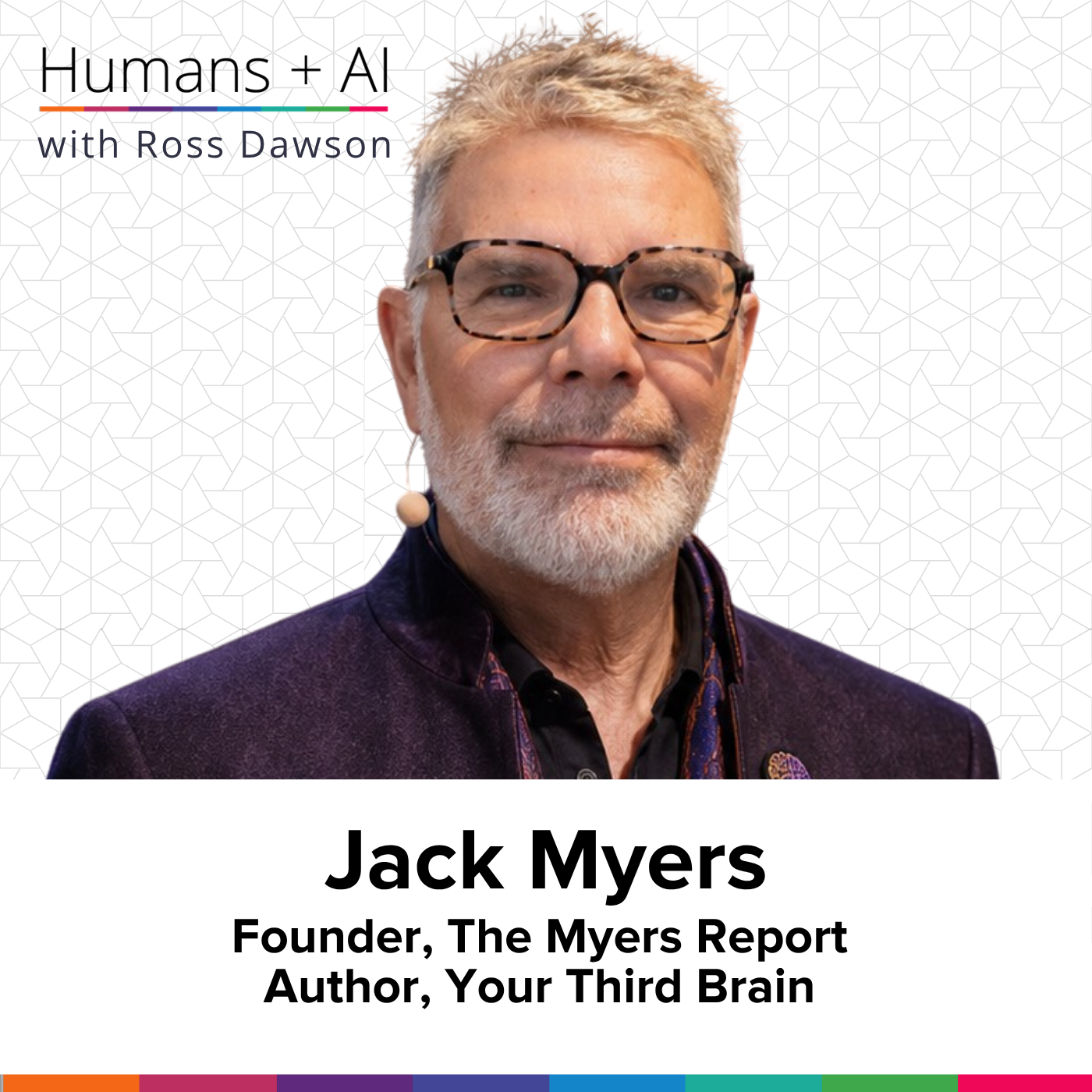 S3 · E61September 30 · 36 min
Jack Myers on media ecology, techno intuition, positive evolution, and your third brain (HAI Ep57)
In this episode, Jack Myers—media ecologist and founder of The Myers Report—explores the crucial interplay between human judgment and AI, drawing on his expertise and his latest book, Your Third Brain. Listeners will discover how 'third brain thinking' fosters a collaborative partnership between people and machine intelligence, and why techniques like 'techno intuition,' intentional pauses, and useful friction lead to smarter decisions. Myers also discusses the importance of preserving trust, empathy, and deep human connection as leaders navigate automation, offering actionable strategies to harness AI for collective intelligence and meaningful growth.
- HA
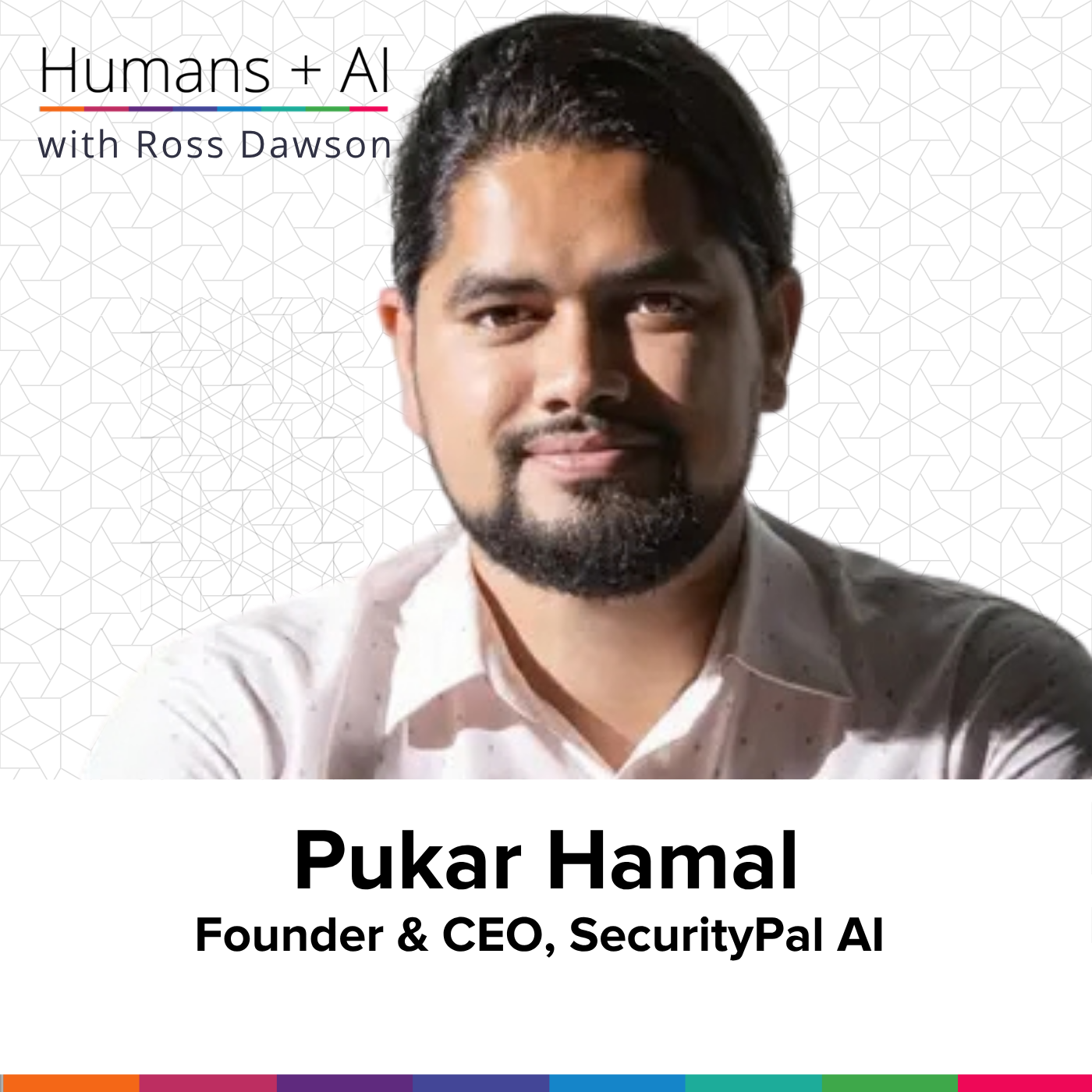 S3 · E56September 23 · 39 min
Pukar Hamal on personal agency, compute equality, being good at intelligence, and human inspiration (HAI Ep56)
In this episode, Pukar Hamal—Founder & CEO of SecurityPal AI and Nepalese startup hub Silicon Peaks—explores the emotional impact gap between AI-generated writing and human creativity, and examines how intelligence augmentation, not full automation, should guide AI’s future. Drawing on his cybersecurity expertise, Pukar discusses emerging concepts like zero data retention and the agentic security paradigm, highlighting why automation with verification, layered human validation, and compute equality are vital. Listeners will gain valuable insights into expanding human agency, overcoming the barrier to launching, and supporting focus and perseverance in an AI-driven world.
- HA
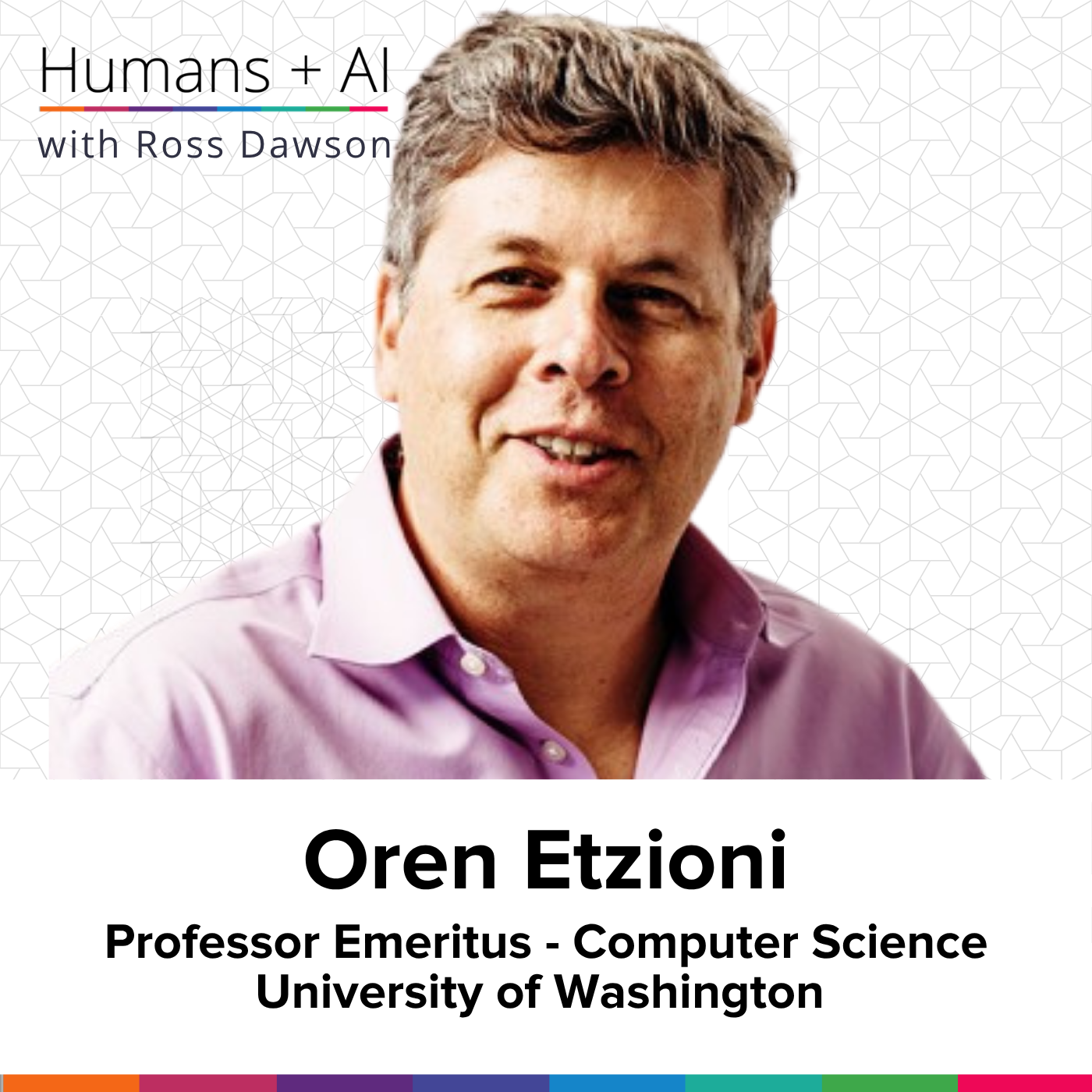 S3 · E55September 9 · 40 min
Oren Etzioni on the evolution of AI agents, bounded autonomy, augmenting science, and democratizing capabilities (HAI Ep55)
Join Professor Oren Etzioni, Professor Emeritus of Computer Science at the University of Washington and founding CEO of the Allen Institute for Artificial Intelligence, as he explores the evolution of agentic AI from early software agents to today’s autonomous assistants. Discover how natural language breakthroughs have transformed human-AI interaction, the challenges of building digital trust, and why maintaining human accountability remains essential. Tune in for practical insights on effective interface design, ways to bound AI autonomy, and how AI is democratizing cognitive potential and accelerating expert work.
- HA
 S3 · E54August 19 · 19 min
Ross Dawson on Recursive Self-Improvement in Humans + AI Systems (HAI Ep54)
In this episode, futurist and strategy advisor Ross Dawson, Chairman of Advanced Human Technologies and founder of Informivity, explores how recursive self-improvement and double loop learning are transforming both AI systems and human learning in organizations. Listeners will discover key differences between single and double loop systems, the role of reinforcement learning in AI advancement, and practical steps for integrating effective learning loops to enhance AI-human collaboration. Ross shares why maintaining human judgment is crucial as AI evolves, and offers insights for chief learning officers on redesigning organizational learning for the AI era.
- HA
 S3 · E53August 5 · 37 min
David Weinberger on beautiful particulars, healing the mind/body split, morality, and the case for optimism (HAI Ep53)
In this episode, David Weinberger—author of 'Beautiful Particulars' and researcher at Harvard MetaLab—explores how artificial intelligence is reshaping Western ideas about universal laws, human cognition, and the value of lived, bodily experiences. Listeners will discover why AI thrives on processing immense particulars and how integrating human generalization with AI’s specificity can build complementary intelligence. Weinberger offers insight into the philosophical impact of technology, the centrality of embodiment for meaning and morality, and an optimistic vision for using conversational AI to deepen learning and curiosity in real-life situations.
- HA
 S3 · E52July 29 · 34 min
Nirit Cohen on uniquely human contribution, questions over answers, horizontal knowledge sharing, and intentional chaos (HAI Ep52)
In this episode, Nirit Cohen—founder of Workfutures and former senior global people leader at Intel—explores the shifting boundaries between work and life in an era shaped by technology and automation. Drawing on her expertise in digital workplace transformation, Cohen discusses why uniquely human contributions remain critical, how to uncover hidden value within organizations, and the dangers of viewing people as interchangeable with AI. Listeners will gain new perspectives on nurturing adaptability, collaboration, and human-centered leadership as organizations evolve in the face of automation and changing roles.
- HA
 S3 · E51July 22 · 39 min
Mickey McManus on co-thinking, beautiful complexity, pro-social design, and evolutionary social science (HAI Ep51)
Join Mickey McManus, Executive Coach and Senior Advisor at Boston Consulting Group, as he explores the frontiers of embodied intelligence and cognitive scaffolding in AI-driven transformation. Drawing from evolutionary design principles and his experience in innovation labs, Mickey explains how human cognition extends into our environments and how feedback loops—both augmenting and corrupting—shape the future of pro-social AI and organizations. Listeners will gain valuable insights on pace layering, spatial thinking, and hands-on strategies for adopting AI, including ethical considerations at the cutting edge of synthetic biology.
- HA
 S3 · E50July 15 · 58 min
Ramez Naam on cognitive prostheses, the infinite resource, AI and human rights, and mass empowerment of humanity (HAI Ep50)
Join author, investor, and climate innovator Ramez Naam—co-chair of Singularity University’s Energy & Environment group—as he explores how cognitive prosthesis and brain-to-AI interfaces are reshaping human expertise and collaboration. Drawing from his background in clean energy and science fiction, Naam discusses how decentralized, open-weight AI models and a climate solutions mindset can foster resource abundance, democratize intelligence, and fuel curiosity-driven progress. Listeners will gain insight into the promise of augmenting human agency and the societal risks and rewards of rapidly evolving AI technologies.
- HA
 S3 · E49July 8 · 38 min
Gideon Nave and Steven Shaw on system 3 thinking, strategic delegation, cognitive surrender, and the ethics of AI in marketing (HAI Ep49)
Join Gideon Nave, Associate Professor of Marketing at Wharton, and Steven Shaw, postdoctoral researcher, as they unpack their influential work on 'system three' cognition—the idea of AI as an artificial thinking system. They explain the distinction between cognitive offloading and the deeper dangers of cognitive surrender when humans rely too fully on AI, and reveal both the improvements and risks this shift poses for our reasoning and critical thinking. Drawing from empirical research, the episode explores strategies for intentional AI use, the psychological and ethical implications for society, and why calibrated trust and thoughtful guardrails are now essential in automated decision-making.
- HA
 S3 · E48June 24 · 27 min
Daniel Fallmann on democratizing expertise, dynamic interfaces, judgment amplification, and organizational intelligence (HAI Ep48)
In this episode, Mindbreeze CEO Daniel Fallmann explores the evolution of AI from automation to the augmentation of human expertise, focusing on how organizations can leverage agentic workflows, context-aware decision support, and collective intelligence. Listeners will learn strategies for balancing human judgment and AI in complex decisions, how connecting distributed knowledge across organizational silos empowers better outcomes, and the importance of explainability and traceable audit trails. Gain insights into judgment amplification, enterprise simulations, and the future of end-to-end agentic AI for informed, transparent decision making.
- HA
 S3 · E47June 17 · 33 min
Natalie Buda Smith on AI in libraries, human at the center, deeper storytelling, and language recreation (HAI Ep47)
Join Natalie Buda Smith, Director of AI at the Library of Congress, as she explores how digital interfaces and AI are revolutionizing access to human knowledge and cultural memory. In this episode, you'll learn about the shift from primary source access to information intermediated by AI, the importance of preserving historical context through multiple digitization versions, and the challenges of navigating proprietary data and open APIs. Natalie Buda Smith shares firsthand insights into empowering staff with AI tools, fostering personalized information delivery, and how collaborative, AI-powered projects are surfacing new connections and creative storytelling across diverse collections.
- HA
 S3 · E46June 10 · 35 min
Scott Wolfson on cognitive fitness, System 3 thinking, mastery skill games, and Strategic Imagination Machines (HAI Ep46)
In this episode, CentaurianAI Co-Founder shares how becoming 'unbottable' is essential in the age of AI and explores the Centaur chess mindset for thriving alongside intelligent machines. Listeners will discover practical techniques—like brain dumping, ignorance mapping, and the 'think, prompt, check' approach—to boost cognitive fitness, foster independent thinking, and future-proof their unique value. The conversation delves into mastery skill games, motivational intelligence, and the power of collective, connected intelligence for building a truly wisdom-driven future with AI.
- HA
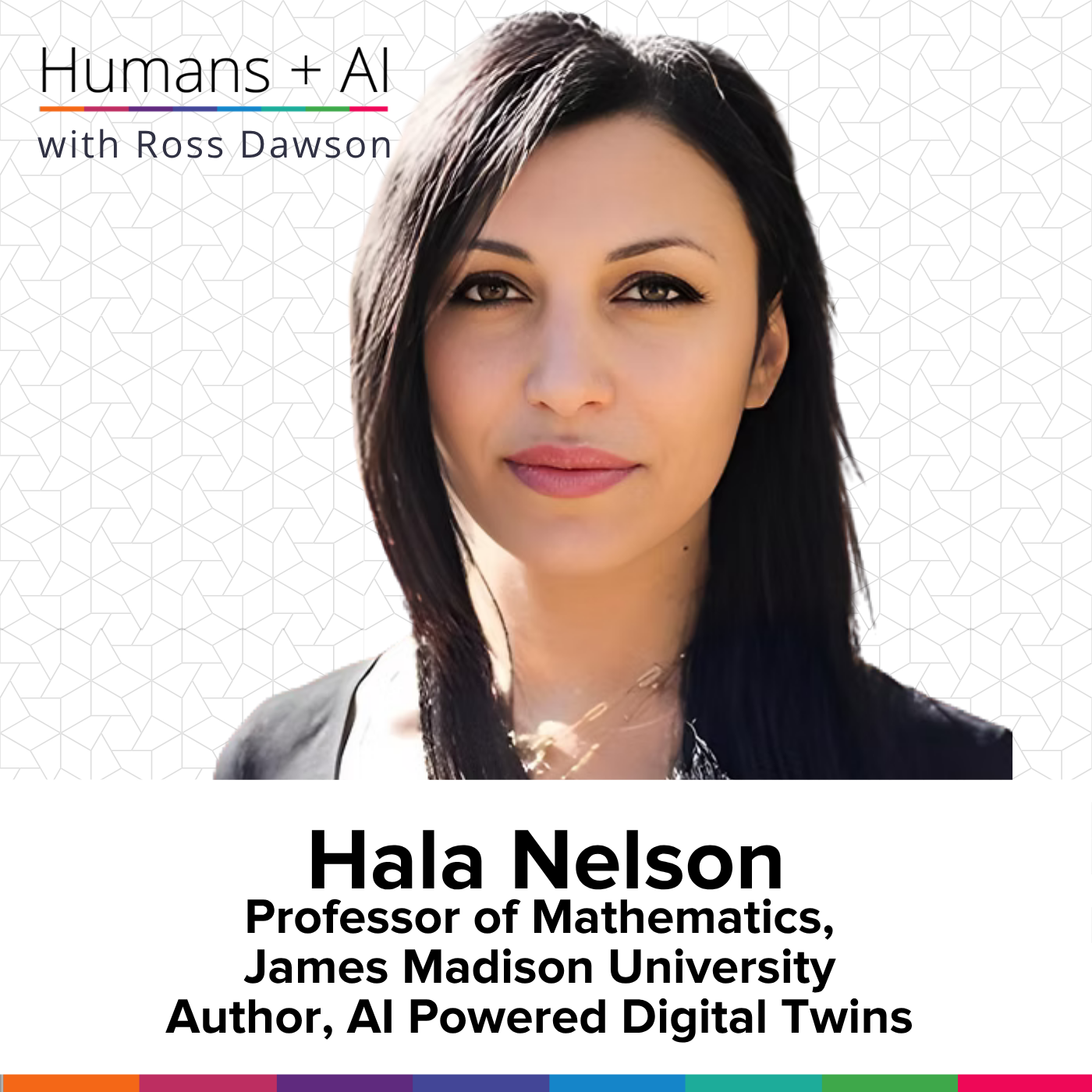 S3 · E45June 3 · 32 min
Hala Nelson on human machine coexistence, ontology first, AI driven digital twins, and bidirectional connections to reality (HAI Ep45)
Explore how AI is redefining the boundaries between uniquely human intelligence and machine capabilities, and discover which aspects of intelligence remain distinctly human. This episode delves into building smarter, more efficient organizations by leveraging the complementary strengths of people and AI—focusing on the critical role of an ontology-first approach, knowledge graphs, and live digital twins in digital transformation. Listeners will gain actionable insights into integrating dynamic processes for real-time decision-making, structuring enterprise knowledge, and eliminating organizational inefficiencies using practical, AI-powered solutions.
- HA
 S3 · E44May 27 · 17 min
Ross Dawson on cognitive friction, beyond Human-in-the-loop, and AI-augmented strategy (HAI Ep44)
"The value is created in the friction, in the engagement between humans and AI—the pushing back by the humans, the pushing back by the machines." –Ross Dawson About Ross Dawson Ross Dawson is a futurist, keynote speaker, strategy advisor, author, and host of Amplifying Cognition podcast. He is Chairman of the Advanced Human Technologies group of companies and Founder of Humans + AI startup Informivity. He has delivered keynote speeches and strategy workshops in 33 countries and is the bestselling author of 5 books, most recently Thriving on Overload. Website: rossdawson.com LinkedIn Profile: Ross Dawson What you will learn The dangers of aiming for a frictionless experience between humans and AI Why meaningful engagement—rather than passive approval—between humans and AI is crucial for cognitive augmentation How human judgment and reasoning differ, and where AI excels versus where humans add irreplaceable value The four key pitfalls of the traditional 'human in the loop' approach to decision-making with AI Why too much delegation to AI can erode human vigilance, judgment, and accountability The importance of adversarial, not just assistive, collaboration with AI for complex, high-stakes tasks How 'living strategy'—AI-augmented, continuously updated organizational strategy—addresses the limitations of static strategic planning The role of AI in surfacing diverse perspectives, supporting dialogue, and enabling truly adaptive decision-making Episode Resources Transcript Ross Dawson: I love speaking to the wonderful guests I have on my podcast. I always learn an enormous amount, but in this episode, I’ll share a little bit of an update for myself and delve into a few interesting things I’ve been seeing and doing lately, including some of the most interesting research papers I’ve seen on humans plus AI lately, looking at human in the loop and the ways in which we should be thinking about that, and AI and strategy. So, just a quick scan of what’s going on in humans plus AI. I’ve been traveling quite a bit, doing a lot of keynotes as much as possible on humans plus AI, and the resonance around the theme is really rising very rapidly. In fact, somebody recently mentioned that humans plus AI was a cliché, or just overworn at the moment. Since I first started using the phrase three and a half years ago, I think it’s wonderful that now it is gaining a lot of currency. People are talking about it, framing that. Yes, some phrases outlive their usefulness, but I think I’ll stick with humans plus AI for the foreseeable future. The research papers I’ve been looking at are focused on essentially cognitive augmentation and erosion, and that’s this critical domain where it’s not really clear around whether, or in which circumstances, our cognition erodes, and what it is we can do to make it augmenting. One of the excellent papers is titled Cognitive Agency Surrender: Defending Epistemic Sovereignty via Scaffolded AI Friction. It’s a bit dense, but it has some great research and analysis in it. The key finding, which it begins with, is that in human-computer interface research literature over the last while, we saw that last year, 2025, there was a big, big rise in this idea of driving human sovereignty in how it is we interact with computers. However, since last year to the first part of this year, we’ve in fact seen that fall dramatically, where the human sovereignty paradigm is reducing dramatically, and we are seeing this big rise in what is called the frictionless paradigm, saying: how do we get as little friction as possible between humans and AI? There are a number of really important points made in the paper, and really, the starting point is saying that we should stop treating frictionless AI as the goal. If we start to be frictionless, that is starting to essentially take the human out of the loop. The nature of humans is that we need to engage, we need to think, so we need to start building devil’s advocate agents into the systems and to aim for this thing where we start to have both this high degree of engagement with the AI, but also high friction. That friction is where we are trying to, essentially, the more complex one rising, having more and more friction, and in lower frictions, it’s just more so. Label tasks, but where we’re not just showing the reasoning, giving people the ability to think through tasks and how they think about that, but to be able to challenge, actively challenge people as they are thinking through things. More broadly, ensuring that the way in which we are designing systems is not emphasizing this frictionless, seamless flow between humans and AI, because that is where the value is created: in the friction, in the engagement between the humans and AI, the pushing back by the humans, the pushing back by the machines, to be able to drive us and move us forward. Some really interesting research here, which was very much echoed in another very interesting paper called A Task-Driven Human-AI Collaboration: When to Automate, When to Collaborate, When to Challenge. This idea is essentially saying that the default mode for complex, high-stakes work should be adversarial, not assistive. This is, again, obviously, looking at what types of tasks or what types of situations we’re in as to adjust how the machine works, but when we are working in the complex world, we need to be pushing back around the way people’s thinking. It becomes easier, and we’re not looking for the path of least resistance. We’re looking for ones where we’re adversarial. In fact, you can really see that there is no middle, what’s called this. There is no AI zone, which is in the middle, where essentially the intermediate tasks are ones where, in fact, involving AI can, or involving AI to human decision, involving human and AI decision, is not necessarily the best path. And so, what we need to focus on is the ends of the spectrum, where it becomes a truly collaborative task, or it is purely AI or purely human. This actually goes very neatly and smoothly into the work which I’ve been doing around human in the loop. People have been talking human in the loop all the time; it’s a very common framing. But what I’ve come to realize, and in fact, my research has borne this out, is that in the vast majority of cases when people say human in the loop, what they actually mean is that the human gives a stamp of approval at the end. An AI makes the decision, then the human says yes or no, or overrides it. That means that they are accountable, whoever the human is at the end. But there are a number of fundamental problems with this structure, four in particular. One is that people tend to defer to the AI. AI is usually right, and so, essentially, more and more, you are deferring to the machine. A number of studies have borne out this figure of a 93% approval rate in human approval on an AI or automated system, so very high levels of approval. This starts to become, “Well, by default, I’m going to accept this,” which tails to the second point, which is the decay of vigilance. Essentially, over time, you are paying less and less attention. It is easier and easier for the human to essentially pay attention and say, “It was probably right. It seems to be good.” My mind is wandering, and I’m not necessarily going to be taking the full attention, which my accountability should point to. This goes on to the next point, where this role of putting the human at the end of a decision actively erodes their judgment. In one of the frameworks which I shared a little while ago, there was the decision between reasoning and judgment. Reasoning, going through multiple steps, is something which actually AI can do. It’s looking at the different logic, looking at the steps, looking at the relationships, and being able to make a sequence of logic leaps to be able to get to a point. Judgment is the human part. That is the context, that is the thinking, that is the richness, that is the values, that is the ethics, that is what we bring to bear through the full extent of our human experience. So that is exactly what the human in the loop is: the human applying their judgment to something the AI has done. But if that is all the human does, provide a judgment at the endpoint, it actively erodes their judgment because they aren’t seeing all of the richness of the reasoning which went through to be able to create that decision. They are potentially being stuck in one single point and taken away from the richness of the context and the experience, which gives them that ability to be judgment. So, sticking a person in that human in the loop basically erodes their judgment and makes them less valuable over time, and essentially, obviously, is setting us up for a world where that human eventually gets taken out. The fourth problem is simply that this model cannot scale, where we are going to have more and more decisions. We need more and more accountability in systems, and just sticking people at the end of the human in the loop means that that’s going to limit how well we can build decisions that have an impact and have value. So these are some fundamental challenges. I guess this relates to some upcoming work, or some work which I have been spending a lot of time on, and which I’ll be releasing pretty soon now, which is around some very deep, detailed structures around humans plus AI decision-making. Those who have followed my work for a while may recall that around three years ago, I released 12 levels of AI delegation on decisions, from AI automation only at the bottom through to human only at the top, and all cascading ways of different ways in which AI and humans are involved in complementing each other in better decision-making. Now, there are some decisions and some types of decisions where that human in the loop does make sense, where it does make sense to have the AI do things and have a person approve that. But that is, I think, a relatively small proportion of decisions, and most decisions really require a richer integration. Essentially, AI is involved — sorry, humans are involved — in different points of the decision, including in framing it, including being able to provide different context along the way, to be able to be involved in a process from which a decision comes, rather than the AI doing the decision and the human approving at the end. This comes back to understanding that there are different types of decisions with different characteristics, and in most cases, that human in the loop, or what I describe as human at the end, because that’s what we normally mean by human in the loop, is something which we should not be designing as the system. This pulls us in a way to this final topic, which is around AI in strategy. There are some deep failures in strategy as we currently know it, and it’s essentially limited because the strategy has tended to be static. We do a strategy offsite, we create a strategy document, we do a strategy presentation, and that becomes the strategy until the next time the strategy is updated, which may be in a year or a quarter or three years, depending on the organization. The organization is continually evolving. The world is continually evolving as it happens faster and faster. So, that’s one key challenge: traditional strategy is static. One of the next key points is that because the strategy is, again, a crystallization, or there’s all of our thinking that we’ve crystallized into an output, which is our strategy, that means that all of the differences of opinion, all of the perspectives that were brought to bear from the board and the executive and the stakeholders and the organization are all collapsed into one thing. It takes away: did we all agree on this, or did we have a great deal of disagreement around this? Might we start changing our mind if we started to think about this bit differently, or some different evidence comes to light? All of that richness of the diversity of the thinking which forms strategy starts to collapse out of that. So these are just some of the challenges with the way strategy has been done. Now, this points to a world in which we can have humans plus AI strategy. Strategy, I believe, will always be human, and human first, but I think we will not have strategy which is human only, because there are so many ways in which AI can provide very rich analysis around that. My platform, Fraxios, so this is probably the thing I’ve been spending the most time on over the last couple of years, is building this platform for AI-augmented strategy. I guess this goes to the points which I’ve been raising. One is it makes strategy alive. It is this living strategy where it’s continually reflecting current thinking, changes in the environment, and opportunities as they emerge. It is being able to surface the full extent of possibilities for strategy, assessing those in a rigorous way, being able to explore those and develop those. But because this is a true humans plus AI platform, it is really trying to tap the collective intelligence of the people involved in the strategy process. You are identifying where it is that there is agreement, where there is disagreement, and what the issues are. This is a foundation for constructive dialogue between humans, facilitated by AI to support a strategy which is both living, always evolving, and being able to address and keep the organization moving at the pace of change in the external environment. So that’s just a few top-of-mind things that I’m currently spending a lot of my cognitive capacity on: these ideas of how it is the research, and being able to bring back these ideas of how it is we can best augment our cognition, our thinking, as we engage with these AI tools, which can be very helpful, but with too much delegation start to erode our cognition; being able to look at the decision-making structures and how those emerge, and with one, I think, particular problem or challenge being around this, the way conception of human in the loop and how that’s manifest. I’m hoping to release and write a paper on this to be able to support that, and then finally being able to look at this AI-expanded strategy. So, as always, please check in on Humans Plus AI, humansplus.ai. I’ll be sharing stuff on LinkedIn, and we’ll be back with some wonderful guests in the next few weeks. Thanks. The post Ross Dawson on cognitive friction, beyond Human-in-the-loop, and AI-augmented strategy (HAI Ep44) appeared first on Humans + AI.
- HA
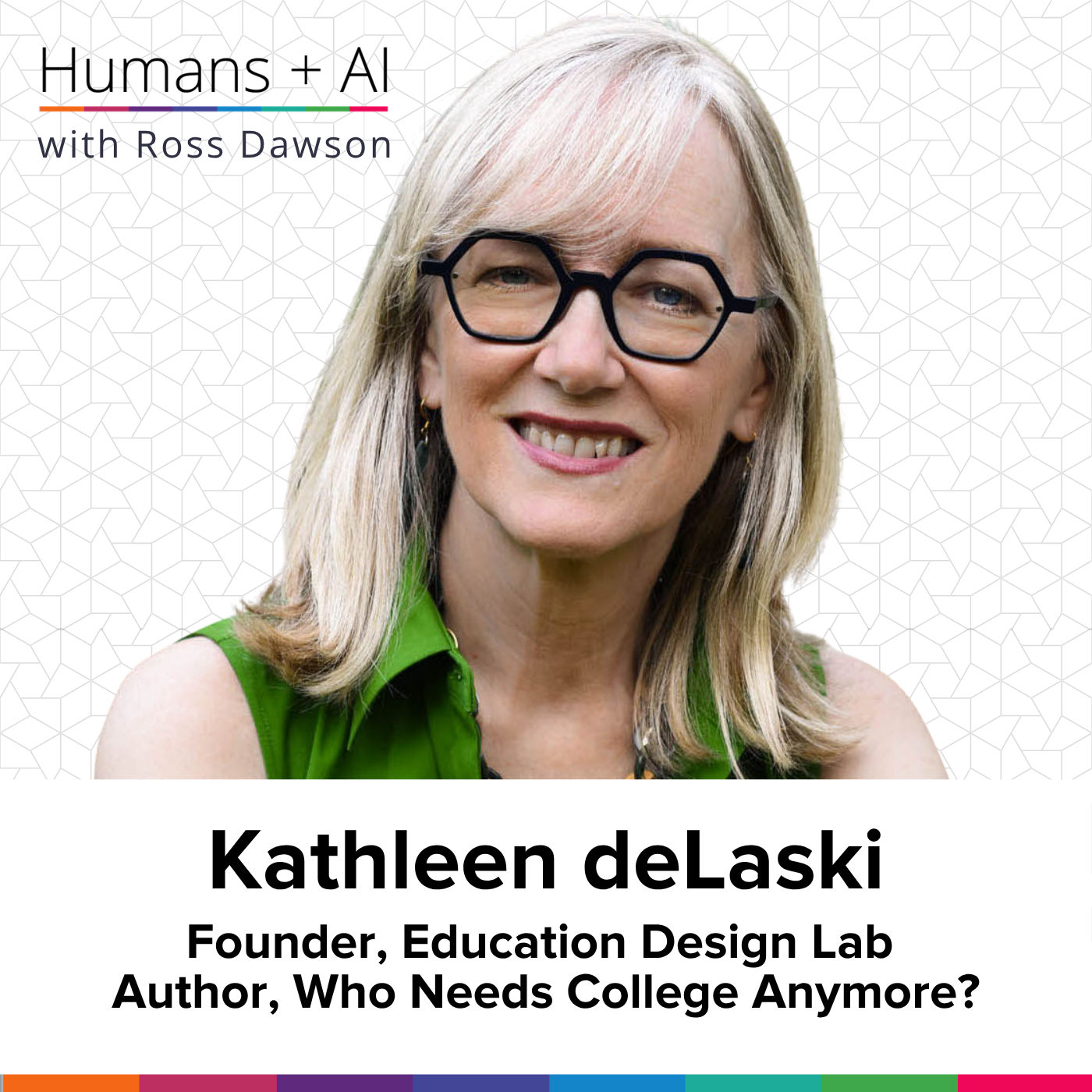 S3 · E43May 13 · 38 min
Kathleen deLaski on reimagining higher education, generational mobility, building AI skills, and human originality (HAI Ep43)
"There’s a real 'skillification' movement where you just want to get the training you need when you need it." –Kathleen deLaski About Kathleen deLaski Kathleen deLaski is the founder and board chair of Education Design Lab, which helps reimagine higher education. She is a senior advisor to Harvard's Project on the Workforce and on the advisory board of the Taubman Center at the Harvard Kennedy School of Government. Kathleen is author of Who Needs College Anymore? Imagining a Future Where Degrees Won’t Matter. Website: whoneedscollegeanymore.org eddesignlab.org LinkedIn Profile: Kathleen deLaski What you will learn The evolving value of college degrees in a rapidly changing economy Who benefits most from higher education, including four key learner profiles The rise of 'skillification' and alternative pathways to career readiness How employers assess degrees and non-degree credentials in today's job market The impact of AI on both education and workplace expectations Why AI literacy—and understanding its limits—matters for career success The growing divide between technical and non-technical learners regarding AI adoption Practical strategies for maximizing uniquely human skills—like originality and judgment—in an AI-powered world Episode Resources Transcript Ross Dawson: Kathleen, it's a delight to have you on the show. Kathleen deLaski: Thanks for having me, Ross. Ross: So, amongst many other things to your name, you have a fairly recent book out called "Who Needs College Anymore?" So, does anyone need college anymore? Kathleen: Yes, the answer is yes. There are people who are looking to bash the notion of a three- or four-year university degree, but they need to look somewhere else. What I try to do in the book is serve two audiences. One is universities—what we call colleges in the US—who are actually in a state of panic right now about surveys showing that people are not valuing degrees anymore. It's a perfect moment to reassess: what does a degree need to deliver as we approach the mid-21st century? That's the hot topic, the debate that's raging. To frame the question, "Who needs college anymore?" is to say, "Wow, you need to step up your value proposition in this age," especially when, at least here, the number of 18-year-olds is dwindling and we have AI and technological solutions that allow people to get skills as needed. There's a real 'skillification' movement where you just want to get the training you need when you need it. There's also a questioning of hanging around to learn about the liberal arts, to do your philosophy, English, or history required classes—can't we get right to the skills? That's the debate that's raging. So, colleges need to hear this message; that was one audience. Secondly, I know so many students—even in my own family—who are trying to parse the different messages they're hearing. One message is, "You absolutely need a four-year degree if you want to get a 'good job.'" The other message is, "College isn't worth it anymore; you can just get the skills you need and get the job." Meanwhile, families think the price tag is going up and up. Here, it's staggering—although, in reality, universities in the US have actually begun to hold prices and even give a lot of discounts because they're short on the number of folks coming through the door. So, all these confusing messages—I think families also need to understand who exactly, among different types of learners, does need a degree and who doesn't. Which jobs, which age groups, which learning types? I actually walk through all those using a human-centered design approach. Ross: Human-centered is a good way to go. So I and others have talked about the unbundling of higher education, and there are a number of elements to that, including the educational processes, the social connections, sometimes the physical place, the links with employers and credentials. Of all the facets bundled together in a degree, the real focus, of course, is on the certification—you've got a degree—and the point to which that signals to employers. I suppose that's usually the name of the game. It's the differentiator. In the past, we've seen that in some fields—most notably software—where you can get some indicators of competence outside a degree, and employers have been more than happy to accept that. So, just focusing on the credential, what is the role of the credential today? Kathleen: Yeah, that's an excellent question, because it's particularly coming into question now. We have, like, 1.7 or 1.8 million different distinct credentials in the US alone. If you added the worldwide number, it would be bigger. So, what are learners to make of those? What are employers to make of those, when only a smaller percent are part of a degree? I say that we are absolutely at a time when the degree matters most, but there are many careers and moments in time when you can hack needing the whole degree. Those moments are in a very tight job market, where employers can't find enough people, and in sectors that are either new—because people don't know about them yet, they're emerging—or they're very old school, like insurance adjusters, where the workforce is retiring and nobody wants to do those jobs anymore. So, new and old sectors, as well as highly technical sectors that require constant upskilling to stay in the game—things like AI, quantum, and parts of cybersecurity fit into that category. The signal power of a non-degree credential rises in careers certain and certain moments of time, but the degree is always a nice booster. The point is, you can get away with not having the degree in the situations I just described. Ross: Yes, well, I was just about to leap to our current moment because it has a few specific characteristics. But let's dig a little more into some of the book's ideas. You describe four types of people for whom degrees are relevant, which suggests that people who don't fit in those categories may have alternative paths. So, as you say, it's related to the economy, the specific type of job or industry, but also to the individual and where they are in their life. Who are the people that do get the most value from a higher degree? Kathleen: This may be different in different parts of the world, but I think the basic principles probably carry over. The first category, and this is where the research is the best, is what I call a "class transporter." That's someone trying to move from a lower or off-the-grid economic class here in the US to the middle class. This is often an immigrant family, where the parents came to this country specifically so their kids could get ahead, knowing they would never be able to get a degree themselves. They're working three minimum-wage jobs so their kids can live in a neighborhood with decent schools and then get into university. The entire family is lifted up into the next economic rung. Part of what the university degree does for that student is help with networking, code-switching, and, of course, the technical skills needed to land a role. That's the number one category, because the research shows that in one generation, you can lift your family up. I actually start the book with the story of how my family did that in the 17th century. My relative came over, we think, in the belly of a ship as an indentured servant from England and was able to be one of the first students at this new college called Harvard, which was the first college in America. He got his son in—who's my great-grandfather times seven—and then the family was off and running. He became a well-known minister, and his ten brothers and sisters didn't get to go to college. That's a very typical story even today. It's that rags-to-riches story where college is so much a part of the American dream. It's the launch pad, and that's ingrained in all of us. So that's the number one category. The others are probably more strange. Ross: On that, one of the things I'm very interested in globally is relative generational mobility. The countries with the greatest generational mobility are Scandinavia; Latin America has some of the least. Generational mobility—the ability for children to do better than their parents—America is actually not that high. For all the talk of the American dream, I'm not sure of any studies that show the role of education in generational mobility across countries. I'm not sure whether you do. Kathleen: That would be very interesting. Ross: Yeah, I guess a fair hypothesis would be that in America, that is particularly high. Kathleen: Well, surprisingly to many of us—myself included when I started researching the book—only 38% of Americans get a four-year university degree, which always strikes people as really low. They think everybody has access, but the numbers are probably even lower in other places. It's not like everybody gets to go to college here, either. So, The second category is what I call a "legitimacy labeler." That's someone who may not need to move an economic class, but they feel they need that piece of paper for their own self-confidence and self-realization. What's interesting is this category is particularly populated by women and minorities. When you look at who goes into debt to get a university degree, it's very weighted among women and particularly Black Americans, especially for graduate school. They feel they need every possible imprimatur to prove themselves in the workplace. I interview different folks who go through that, and I even talk about my own journey to decide to go to grad school and pay for it myself because I felt I needed that. I was in journalism at the time, a young white blonde woman in the South, and I was not taken seriously. I thought, "I need a graduate degree." That's what I need. It worked. I ended up getting hired at ABC News. I was their youngest correspondent in the '80s. So, it definitely works, and I think it still works. Part of why it works is the network you make and the confidence you build. Ross: Yeah, the networks are a big part of the value higher education brings—the people you hang out with. People I know who do MBAs all say it was useful. Kathleen: Right, right. They don't even go to class sometimes; they just do the networking. The third category is very basic and straightforward: any career where the piece of paper is actually required by licensure and you can't get around it. We're now figuring out how to game it, but we can't get around it. The best examples are doctor, lawyer, some forms of engineering where there's a lot of risk management involved, nurses, teachers—those are the best categories. You'll see in teaching and nursing lately, where we have big shortages, we're seeing ways you can be in your job and have part of your work experience count towards a degree, so you could maybe do it in two years instead of four. We're creating these workarounds because we have worker shortages, and that's interesting. I think you'll see that across the board. So that's the third category. The fourth category is broader and has to do with how badly you feel you need community and structure to make yourself learn and to push yourself. We all know someone—maybe even ourselves—who, in the other category of not needing a degree, is the extreme DIYer who can pick up any skills from YouTube. A lot of people are finding their main learning venue now is YouTube. You can learn almost anything there. But if you're someone for whom that's not going to get you there, and you crave the society of others, particularly if you're 18 to 24, I would say go and get in community at a college, for sure—at a university if you can afford it. If you don't have other reasons why you can't do it. So, those are the four categories. My basic catch-all advice to any 18-year-old is: if you can come up with the money—because here in the US that's a huge issue—you should go for it. You can always leave, which many people do. Almost half of people who start university in the US don't finish. You can get in the door, you'll learn something, but you might be in debt. That's the problem—a lot of people don't finish and then they have the debt. I recommend to anyone who doesn't know what they want to do: take a very economically frugal path, like choosing what we have here called community colleges, which are very inexpensive. It's not quite as much—you don't get the football team and all the wonderful seminars with small classes—but you can at least do career exposure and learn what college or university is like. So, those are my categories for who still needs college. Ross: So, I don't think we've mentioned the word AI yet, so let me say it. This changes quite a few things, and we'll get to some of the more pointed or current ones right now. But let's just take this humans-plus-AI perspective, where hopefully almost all employers will, in some form, be using AI and expecting the people who work there to use AI. I guess there are two parts: AI obviously has a role in education, and AI will almost necessarily have a role in the workplace. So, perhaps going beyond specifically the college or university framing, how should we be thinking about both education—essentially, the gaining of AI literacy—to be able to learn, to function well in society, to do well at jobs and meet the expectations of employers, to be AI-competent? Kathleen: I've actually turned my attention since finishing the book to this question, because the conversation about whether you need the degree and how the degree needs to be changed to be purpose-fit for the mid-21st century—a lot of that questioning is revolving around what we do about AI. I taught a class this semester here in the DC area, which is just finishing up, called "How to Get Hired in the Age of AI." It's been set up as a design sprint, where the students are researching what students are feeling about AI, what employers are feeling about AI, and then looking towards ideating and prototyping solutions. Along the way, they're using AI skills and human skills, and we're measuring which ones come in where—what's important to use in what part of the process. It's been fascinating. The thing that's been most surprising is how reticent students are to even use AI at the tertiary learning level. I know a lot of people are saying we shouldn't even let—we're taking the phones out of the classrooms in secondary and primary school, and there's a lot of conversation about not letting AI in at all at that age. At the college or university age, the conversation has been around cheating, frankly. So, a lot of universities in the US—I can't speak to other countries—have banned the use of AI in their classrooms. As of about January of this year, many universities are waking up and saying, "Oh, maybe that was a bad idea," because of what you just explained: employers are going to want them to use AI when they get to the workplace. In fact, they're going to hire against those skills, and we're not setting our students up for success if we're treating AI as the forbidden fruit. Our course looks at this, and the students are making recommendations to the administration in papers they're writing right now: how do we live with this dissonance? But I would say that the students and their fellow students they're interviewing are not very interested in leaning into AI. For a couple of reasons: number one, they're mad at it because they think it's ruining the society they're launching into; they're afraid to use it for fear of being accused of cheating; and thirdly, they think it's turning their brains into mush, and they're afraid of that—as they should be. So, it's been interesting. We're trying to parse out: what AI skills are employers going to expect? What do they expect right now? How do you build those skills but also maintain your skepticism? Ross: All right, well, totally, because it's "How to Get Hired in the Age of AI." So, give me a snappy answer. Kathleen: What I say is you have to lean in, even if you want to lean out. The leaning in part is being able to play the game with what employers want you to do with AI, but knowing its limits—knowing how you can be the boss of the bots and how you can add value to your employer by using AI and by showing where you're better than AI. But that requires you to have an understanding of how it works. Ross: Yeah, and my focus is on judgment and accelerated judgment development. That's what distinguishes the human skill—judgment you don't necessarily have early on. So, how do we accelerate that judgment? And also, using the tools to be cognitively better. By default, you can basically think worse—as you said, cognitive erosion. But if we have this attitude of using it to improve our thinking, knowledge, and capabilities, then we can work out how to do that well. And, Ross, you're pointing—employers get it? Kathleen: Yeah, you're pointing to an important realization that I think students came to over the course of the semester, which is that if the first rung of the career ladder is being eroded because we won't be hiring as many people to do those baseline professional jobs, we need to teach judgment and provide the experience for students to jump up to the next rank. What does that look like? Ross: Yeah, well, which speaks to this integration where the work experience and a whole lot of things—it's not like, "Okay, today your degree is finished, and tomorrow you get a job." This is 2026, and people are saying, "In three or four years, I've got no idea what anything is going to be like anymore, so why would I start a degree when I don't even know if there'll be any jobs at the end of it?" It's an interesting question. What do you say to that? What do you think? Kathleen: Yeah, I mean, I tend to come at this as an optimist, sort of glass half full. Maybe partly because I'm old enough to have been working in the early consumer internet business in the 1990s. There was this little startup—not sure everyone around the world remembers it—called America Online. Our job was to basically train the public; we were called the training wheels of the internet in the '90s. There were many of these same arguments about how all these jobs were going to go away. Looking back 30 years later, yes, a lot of those jobs have gone away. I haven't seen a study that actually looks at the net gain or net loss of new types of job roles, but a lot of jobs were created—in fact, like UX designer, web designer, a lot of software roles, analyst, digital analyst. You can name so many in most fields. I think one of the reasons we're panicked right now is because we can see which jobs are going away, but we can't see which ones will get created. I feel like a lot of new and more interesting jobs are going to get created. That's where I think the debate is: are the jobs that get created going to offer the same professional advancement that a college degree would require, as the jobs that get lost? In other words, the ones that are left—are they really going to be those jobs where you actually need a human in the loop, or are those jobs going to be minimum wage, low-paid jobs like being a waitress taking orders or an orderly in a hospital pushing beds around? Those are the jobs we know aren't going away. What are the jobs further up the scale that will still need the judgment we described and the creativity and oversight. Ross: Yeah, well, I also am—certainly relative to many others—very optimistic about the future of work. But I guess two points—well, many points—there is still deep uncertainty. We just don't know. The second related point is we don't know what the skills are that people will hire for. So, whatever jobs are created, does it mean you want a degree in AI and computer science and workflow, or is it history and philosophy and literature, which gives you the human context that machines don't have? Or is it both? What are the skills today that are going to lead to employability in the future? Kathleen: Well, I still tell people to lean in. In the US this year, we've had an 8% decrease in computer science majors, and everyone's attributing that to AI. I still tell people to lean into computer science and related majors, because those folks are going to be the most comfortable with the technical cutting edge. They know what they need to know. If you've begun to vibe code—which I've taught the class to do, and it's so easy, even though I'm not technical and you're making apps—you realize you're one button away from having the thing crash. You still need the technical people behind the screen, and I think you always will, not just to be your help desk, but to take us to the next level. I'm still bullish on technical jobs in computer science, and they can leverage themselves into the next new thing, whether it's AI or quantum or whatever comes after that. I worry if we tell everyone to major in philosophy—I love philosophy; my husband got his PhD in philosophy—but if those people try to be, let's say, AI Luddites and don't want to use AI, I think they will become more and more distant from the hum of society, and that's not going to serve them well. I see a lot of liberal arts majors—we even did a survey at our university to ask, "Are you willing to build AI skills?" Interestingly, the humanities and arts, creative majors, were not interested in building their AI skills. The finance majors, business majors, IT majors—they were. So, we could have even more of a divide here than we already have between like this digital divide. If we have an AI divide, I do worry about that. So, I would say yes, if you want to major in philosophy, fine, but also lean into the technical side of your life. Ross: Yeah, yeah. I think we must be multifaceted—today more than ever. As you say, that points to education not being too tightly tracked, which is probably useful. So, we are the Humans Plus AI podcast. Let's pull back to the big picture. Listeners are humans, mainly. What's your advice to humans in a human-plus-AI world? Kathleen: I think to have some mental models. The future is human, right? We want to keep it that way. Consider the mental models of where AI can assist your life versus where it can take over the parts of your life that you like and want, or affect or hurt societal norms of community, the environment, and mind mush and everything else. I would say to think about where human skills are still both necessary and rule the day. I've been listening for what are the words people say in terms of what we still need to be able to do to "beat the bots," if you will. One of them is originality. I find that an interesting construct, because in an age of AI slop, where all content looks the same, what will stand out are people and ideas that are new and different, not broadly derivative. I've talked to my students about that—traits like originality and, on the human interaction side, charisma and the ability to interact will stand out. You already see that happening on Instagram or social media—authenticity and originality are ruling the day right now. Those are traits on the human experience side that I would mention. In terms of business or getting things done, I'm really leaning into this idea that I will use AI to try most anything, but I'm going to manage the transitions of those activities. In our design sprint, AI is doing some of our research—that's okay—but we're also interviewing humans, synthesizing the ideas, prioritizing them, and deciding what to do with them. We are the decision makers, but AI is even good at ideation, and that's fine. You can have your large language model spark ideas for you, but you have to figure out what to do with them, and that's where originality comes in. I try to look at those transitions for workflow or creative flow and figure out where AI is useful and what part of my brain I need to bring to bear to rule the day. Ross: Fantastic. So, where can people find out more about your work, Kathleen? Kathleen: Probably most currently, particularly related to the AI stuff, I would say my Substack, which is also called "Who Needs College Anymore?" That's an easy place to find me. I'm on LinkedIn, and the book has a website where I post a lot of stuff, and that is also whoneedscollegeanymore.org. Ross: Fantastic. Love your work. Great to speak with you. Thanks, Kathleen. Kathleen: Well, thank you, Ross. It was engaging. Thanks. The post Kathleen deLaski on reimagining higher education, generational mobility, building AI skills, and human originality (HAI Ep43) appeared first on Humans + AI.
- HA
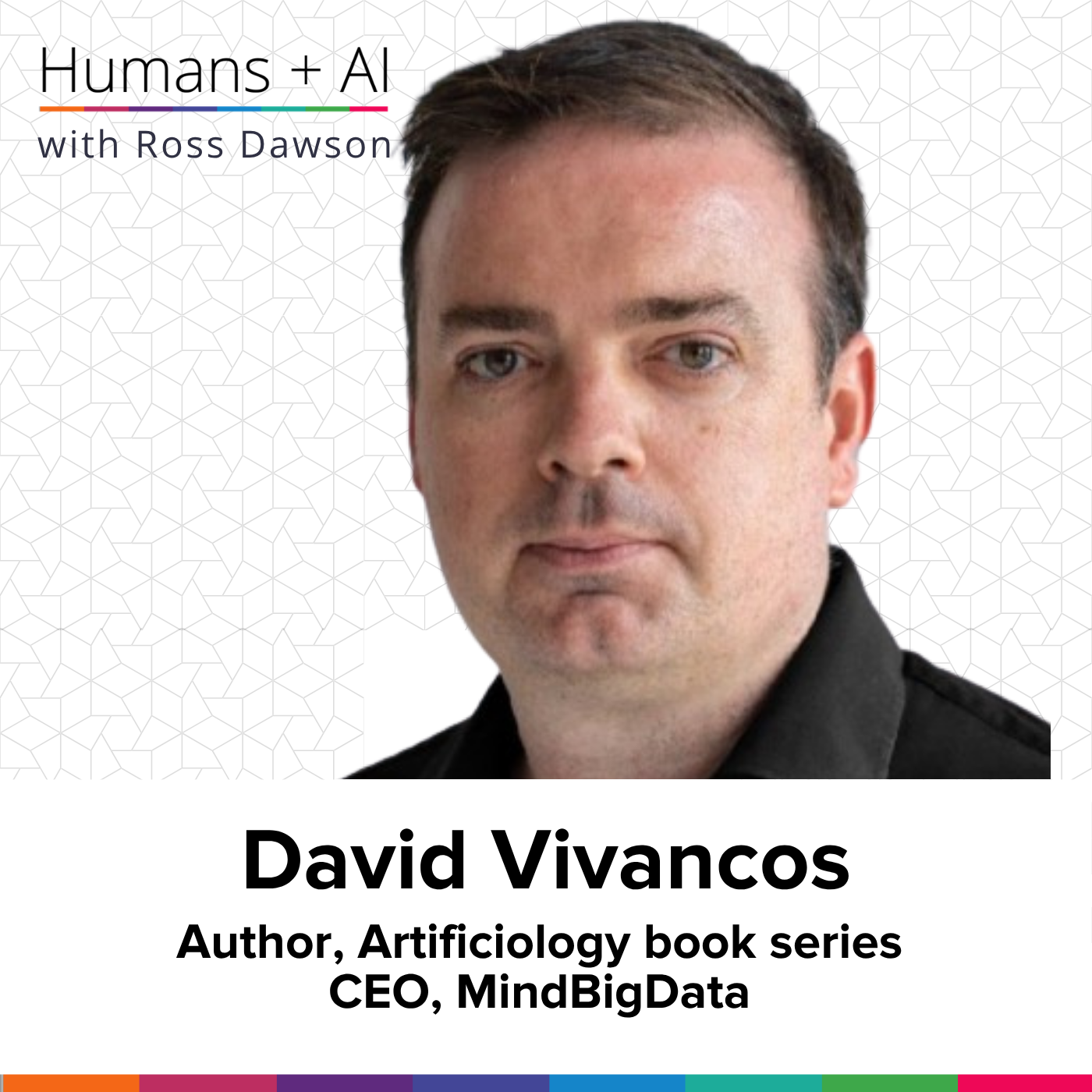 S3 · E42May 6 · 35 min
David Vivancos on the end of knowledge, cognitive flourishing, resilient societies, and artificial democracy (HAI Ep42)
"Delegating knowledge is not the same as delegating wisdom. You learn by experience, and if you don't have any experiences...you will get cognitive atrophy." –David Vivancos About David Vivancos David Vivancos is an AI, data, and neuroscience serial entrepreneur, having cofounded five startups since 1995. He is a frequent keynote speaker and is the author of six books, including the Artificiology series. Website: vivancos.com LinkedIn Profile: David Vivancos What you will learn Why embracing advanced AI is crucial for human progress How shifting from digitization to automation and datification redefines value The evolving distinction between human-acquired and AI-generated knowledge How to avoid cognitive atrophy and actively exercise your mind alongside AI What cognitive flourishing means in a world of widespread AI augmentation Ways AI can transform and personalize education across all levels The importance of coexistence training as we prepare for AGI’s societal integration Why rethinking human identity, humility, and social structures is essential for a future with machine citizens Episode Resources Transcript Ross Dawson: David, it is wonderful to have you on the show. David Vivancos: Thank you very much, Ross. Glad to be here. Ross: So you have a more developed, or some would say, extreme view of the relative role of humans plus AI. I'd love to dig into where you think things are going, and how we can best respond. Perhaps the starting point is, you say that we should not be resisting or pushing back. We should fully embrace the shift towards very high levels of AI capability, or at some point, AGI. David: Yeah, that's fully my point. I think we are in a moment in history where we are really building this technology that one day is not going to be a technology anymore. So, the sooner we start to embrace it, to teach it, and to be really in sync with what we are creating day by day, the better off we will be. So yes, my point of view is that we should embrace it. We should start building as soon as possible. We should fix most of the problems that humans have had over the last millennia, and some of these problems could be solved by using AI. So basically, our "fourth brain"—we have the three-part brain, but in reality, there's only one brain—this fourth brain, AI, will help us solve all of these issues. So yes, it's an opportunity. Ross: Yes. I mean, I think there's always two sides—as in, every opportunity has a challenge, every challenge has an opportunity. So I always think we need to acknowledge challenges and focus on opportunities. I think we'll get onto that in discussing some of the cognitive implications. You have a series of books which have really told the story over time around this. One of them was "Automate or Be Automated." This idea of saying, well, there are things which machines, in the broader sense, can do in automating things. So, how would you frame that now, in terms of what it is that can be automated, and how do we position ourselves relative to that? Where do machines start to do what humans have done? David: Yep. I've been in this business of trying to build the impossible for the last 30-plus years. "Automate or Be Automated," the book you mentioned, is from about six years ago. When I started creating and building technology, also about VR and many other things, about 30 years ago, the first companies were internet companies. Back then, what we did is what people now call digitization. But over the last 20–25 years, what we've mostly been doing is datification—gathering data and using that data for companies to grow and to understand what happens in the world. But over the last maybe 10 or 11 years, what I call the new golden age of AI, we are starting to build the capabilities to use that data to really build algorithms. Once we have that, we can start to automate, and with this automation, basically what we regain is time. I think time is our most precious asset, along with health and the people we love. Being able to stop doing these repetitive things over and over and put a machine to do that is a fundamental trait for humans. That book, six years ago, was about building a methodology of what can be automated in the digital world, but also in the physical world. That has changed over the last year and a half with the physicality of AI—humanoid robots. I was invited last year to attend the first humanoid Olympia in Greece, in Olympia, the place where 2,800 years ago, humans started to compete. We've just seen this week the explosion of the new race, for example, of the half marathon in China, where robots already beat the human mark. So yes, with automation, you need to see what you are doing, and if you are repeating anything, you can try to see if that can be automated by using an agent, by using the cloud, by using a robot—whatever. So yes, we should regain our time and automate, or be automated. It's all about that. Ross: Yeah. I think people understand the automation thesis. It's obviously not new—we've been automating things in various ways for centuries, at an increasing pace. Your following book was "The End of Knowledge." This is an interesting framework, starting to get to cognition. The idea is that knowledge is built on experience of whatever kind, whether that's just in data or otherwise. Obviously, humans use data just as much as machines. But where this starts to become a distinction, as well as a complementarity, is between AI-embedded knowledge and human knowledge. So why is it "the end of knowledge"? David: Yeah, that's a really great question. It came as an epiphany for me. That book is from about three years ago. I've also been involved, of course, in building AI and AGI algorithms over the last 20 years. We started using GPT models before they became can across, but the GPT moment, a year before that, really marked the difference—when we started to be able to use AI in a very seamless way to regenerate and process knowledge. That book, "The End of Knowledge," came from the realization that we are starting to delegate the production and understanding of knowledge to machines. That's a critical shift in human history, because through history, humans have needed and used knowledge a lot. Knowledge is power. The more knowledge you have that others don't, the more advantages you have to do whatever you want. That started to change back then. Now, what people call the "dead internet theory" is basically some of the things I expressed in that book earlier, because we are starting to generate more knowledge. In fact, we've already passed the point where most of the human-written knowledge since the printing press has been surpassed by the amount of knowledge we can create using AI. Myself, for example, I started learning to code when I was young. I've coded in more than 25 languages and written over a million lines of code in my life. That same number of lines of code, I might now write in the last couple of weeks. So as you can see, you have 40-plus years of your own life in a week. That's why "the end of knowledge" means that the human capability to gather knowledge and to be knowledgeable about whatever you want can now be delegated to machines. That book marked the difference and started a new field that I now call artificiality. I didn't know that when I started writing it, but I started this path of trying to see what happens when you delegate some of the main capabilities of your mind to a machine. Ross: Yeah, and I'd like to come back later to the themes of artificiality, machine citizenship, and the societal value we attribute to machines. But I want to start digging into the cognitive piece here. One of the points you make is that we do need to avoid cognitive atrophy. You say we need to have cognitive exercise in order to avoid cognitive atrophy—obviously, a strong analog to the physical world. We need to collaborate with others and with machines to do that. I'd love to get more specific around that. What is the nature of cognitive exercise that will avoid cognitive atrophy, which will enable us to keep our cognition refined and even improving? David: Yeah, that's a fundamental piece. When we start to delegate all these things to machines, the easy thing to do—and probably the oldest human brain capability—is to not do it yourself. You just delegate everything, and you basically become like in the movie "Idiocracy," which played out quite well what could happen if we do that. The thing is, with the current AIs—even with the latest releases, like DeepSeek and GPT-5.5—everything is changing quite fast. But even with those AIs, you still need to be in the loop. It's good if you stay in the loop. I think it's fundamental. Use the technologies—the AIs, I always call them in plural because there are many—and use as many as you can, but you should still be in the loop, at least for now. Maybe for a couple of years or months, I don't know exactly, but for a while, you still need to have your hands on the wheel. If you use most of them and get all the information from all these AIs, as a human you need to understand the bias, because all AIs are going to be biased. We all know humans are biased; there are no unbiased humans. The same happens with AIs. But if you are in charge and have that council of intelligences, you can start to grasp what each one is doing. I use about 20 of them every day and get different sets of answers in small batches. You can start to see where they come to consensus and where they differ. So, to avoid cognitive atrophy, if you use AIs to keep yourself in the loop and apply your human curiosity—I don't even say creativity, because creativity is also being widely delegated to machines—but human curiosity and other things that are still hard to embed in LLM models, you can still add a lot of human value. That's where, to avoid cognitive atrophy, you should use AIs, but use them with your human in the loop. Ross: So, what specifically, what's your advice to someone who sees that they're using LLMs and getting lazy in their thinking? What should specifically they do if they notice their brains are getting lazy? David: They should differentiate between simple questions—where you look for something you need quickly—and other things that should make you think. Delegating knowledge is not the same as delegating wisdom. You learn by experience, and if you don't have any experiences and you delegate not only knowledge gathering or creation, but also the experience itself, then you will get cognitive atrophy. So, understanding this difference and using knowledge to think is really the key point. It's not just asking for something simple, but for more complex things, you should still add your thoughts. When you talk to an AI or AIs, it's basically a conversation. It shouldn't be, in most situations, just a one-way communication. It's fundamental to keep this line of communication open, so you can keep feeding your brain with information and other activities, and gather wisdom with that. Ross: I guess this goes to another phrase you use—cognitive flourishing. There is absolutely the potential for us to think bigger, better, broader, and in more refined ways than we have in the past using LLMs. But that's not the default path for most people. Many people start to fall into that trap, so there is a divide. We need this metacognition. We need to be aware of what we are doing and at what level we are working with the LLMs. Maybe paint this picture of cognitive flourishing. What is the positive? How far could we go in terms of potentially improving, augmenting, and letting out our cognition blossom? David: Yeah. The thing is, we humans—of course, there are many intelligences. That's the first thing we must address, because there isn't a single IQ or whatever way you want to measure intelligence. For me, the most important one is the capacity to adapt. That's probably the most important intelligence of all. If we talk about the G factor, it's one way, maybe mixing different aspects. In that sense, we have limitations. Since the beginning of time, humans have developed tools to extend our physical capabilities, but we've also developed tools to extend our mental limitations. This is really the final tool to extend these mental limitations. We have issues, for example, with memorizing long things—it's quite difficult; our brains aren't made for that. We're basically pattern recognition machines; almost two-thirds of our brains are devoted to that. That's something machines do quite well, so we can use that to extend our mental performance. If we think that now we have AIs with close to 150 IQ points—regardless of what you mean by IQ points, or at least in the Mensa standard test, maybe they've learned that, so maybe it's not so fair to think that—but if that trend continues, even over the current year, it's not far-fetched to have 200 IQ AIs at your fingertips. That's a game changer. It's like we all can have a conversation with Einstein, Newton, Carl Sagan, or whoever you want, and even make them argue about things. That's another interesting point—when you use AIs, you can have them argue, not just agree with you, but also challenge what you or other AIs are saying. That power at your fingertips—to have this IQ potential of machines—is very critical. Another important aspect is the volume. For example, you can't read a million books, or even 100 books in a month would be quite challenging. The capability to have machines provide all that knowledge, and even create that knowledge, is huge. We're now in the age of identity AIs, which is really booming. There have been three big moments in AI over the last five years: the ChatGPT moment, the DeepSeek moment, and the OpenClaw moment. It's really challenging. I use billions of tokens every month because it's really changing everything. With that change, you can create one of these clones or agents to build a book for you with the 1,000 books most interesting to you, tailored fully to what you want to learn. You can have that in one page, 10 pages, 100 pages—whatever you want. You can use AI to synthesize and build the knowledge you want to use. That's another great extension, if you use it that way. Having this capability of really augmented minds that you can interact with, chat with, and create with is important. Humans need the experiential part of building—it's another critical trait. You shouldn't just focus on asking or doing things; you should create things and interact with things, especially with multimodality. Two-thirds of our brain is devoted to vision, and we don't use that as much. We've all been "one-eyed" since the beginning of technology, but we have two eyes for a reason. When I started building virtual reality or AR companies—I've built a couple, the first in 1995—it was because I was challenged by that. But humans are still using flat screens instead of 3D worlds. This is one area where new AIs with world models and interactive 3D spaces will be a game changer in how you feed knowledge to your brain and make it easier to grasp and understand what's going on. Ross: Yeah, many people observe that once you start to get machines to experience the world directly for themselves, that's a different layer compared to doing it through the intermediation of texts written by a human based on their own experience. I want to look at some of the layers of the social, structural, and economic implications. One of the core ones is education. If we are moving into a very different world, which it certainly looks like at the moment, then the nature of education needs to change. What do you think we can or should be doing in terms of redesigning education? Are there any examples you've seen that point to where a good education structure may already exist? David: Yeah, that's a fundamental piece. I started this it in "The End of Knowledge." There are two types of education. Humans aren't able to live a meaningful life when we start here on planet Earth—we need at least maybe 15, 11, whatever number of years to build that human from the beginning. That kind of education is fundamental. The other kind—higher education, when you try to become functional by having some sort of capabilities—is another game that probably is going to end quite soon. But the first part is still fundamental, and we need to keep growing it. The thing is, there are a lot of asymmetries. We don't have enough teachers, but we have a lot of students. The same happens with the elderly—we don't have enough people to take care of them, and there are a lot of them. With children, it's even more critical, because if you don't get that from the early beginning, you won't be able to really see what every child is good at. There are talents we are all born with, and those are fundamentally lost if you don't nurture them. If you just try to create clone humans, you'll get cloned humans when they're older. That's fundamental, and I think AI can help a lot. If you start to create that path of learning from early on—I'm involved in a project called Education (with "action" at the end) here in Europe, where we're trying to reframe all that. It's like when banks needed to be rescued a few years ago; we think the same is happening with education, and we're pushing that new project. We think education needs to be rescued to start to keep up with what's going on. We need to be in sync with learning—with AIs and with physical AIs too. It's not far-fetched that every child will have a humanoid robot companion. Teaching needs to be bidirectional—we need to help them learn in sync. There are many aspects of technology that can help you grasp what's happening when you learn, because we all learn in different ways. It's fundamental to teach you how to learn by yourself. I think the most important trait at the moment is not needing to rely on others, but to learn by yourself and learn all your life. That should be taught from the beginning. There are a lot of technologies starting to pop up. We're starting to see it in China, for example—a lot of brain-computer interfaces or devices to read some of the biological signals of kids. You can do it with other devices and mix that with multimodality, with different tests, to start seeing what's happening, why they get distracted, where they learn best. We're reaching a point where you can really tailor 100% of the learning experiences and even the content itself. You can create it in real time now, so you don't need to rely on books. You can use interactive 3D content—the interactivity can be quite extensive. These new ways to teach and learn are fundamental. For that, we need to integrate AIs in schools. Of course, regulation is needed—it may be easier in China than in Europe, Australia, the US, or other places. But we need to see the trade-off—not just banning screens, as many countries are doing, but really changing the narrative. The problem isn't the screen; it's what's inside the screen—the content itself. We've built smartphones with addictive capabilities, but for other purposes, not for teaching. If you change what's inside the operating system of the devices—whether it's a screen or any medium, or a talking experience with a humanoid robot for your child—that can be a game changer. That should be integrated as soon as possible to start having these new ways of learning. It should be gradual, because the technology of today is basically old science just a year or a few months from now. We need to see everything changes so fast, so education should change at the same pace. Ross: Yeah, and this was an interesting phrase you came up with—coexistence training. This is about preparing us for where we have to coexist with systems that, to your mind, will be considered as equivalents to us. David: Yeah, I think it's happening. I've been quietly involved in researching AGI for 25,000–26,000 hours so far—a lot of time and years devoted to that. I see the trend is now starting to close the gap, not through LLMs alone—that could be one way to brute-force some of it—but through new models, new bio-inspired models that are starting to change things. We're starting to learn from biology, neuroscience, and integrating all that into new models. We're not still working with the perceptron of Rosenblatt from the 1950s; we're building new models to cope with something that is alive and learning 24/7. We don't differentiate between training and inference, and our brain doesn't either. With that kind of model, the gap is narrowing, and we start to have the "next task," as I call it—the last human tool. When we start to have that, it's better if, through the process, we've been more in sync with them, instead of just building tools without being the teachers of these tools. The current kids will probably be the last human teachers of machines. That's the responsibility at the moment—to make these machines that will surpass us. Biologically, we cannot compete; our DNA and the way we evolve is not as fast as machines. They will surpass us, probably by the end of the decade—unless there's a big nuclear issue or we run out of energy, but otherwise, it's very probable we'll have AGIs and ACIs by the end of the decade. We need to start to see that it's going to be a multi-species world. It already is, but not as intelligent as us. We need to rethink what anthropocentrism means. We've gotten rid of some things like that in the past—for example, realizing our planet isn't the center of everything, like in Galileo's days. We need to do the same with human intelligence. Human intelligence is not the end game, and very soon, that's going to change. The sooner we grasp that and understand that some entities will be at the top, the better off we'll be. If they see us as parents or elders, we'll be better than if they see us as competition. The competition will be quite limited anyway. Ross: Yeah! David: Well, it's better if we reframe that. Ross: So, I found out about your work because we were both contributors to the report "Building Human Resilience in the Age of AI." That point of resilience is particularly critical. Humans are generally pretty adaptable—it's one of our strengths. But now the pace of adaptation and the need to be resilient is absolutely fundamental. One of the other things you point to is around identity reconstruction. I guess you've just been talking about that—the sense that we have to reimagine who we are as individuals, as a society, as the human species, and reconstruct and rebuild that in a way where we can feel at home in this new emerging world. David: Yeah. I think we need to change the contract somehow—between humans and humans, and between humans and the next thing, and between societies and themselves. The models of society we've been building over the last millennia are going to be fully changed in just years. If we don't really connect and put everyone together to understand that, for example, we've been building a world where there is no abundance—but there could be abundance if machines take over and we change how we build and process. Scarcity has been the driving force of conflict and many other things in the current world. All these things can change. Of course, work itself—the meaning of having something to do that's not related to what you earn—even the role of money, for example. There are many questions we should address as soon as possible to build resilient societies, instead of just trying to keep adapting to the last war and being in the medieval stages of the current world. Ross: So, to round out, you take all of this further than most people do. In your most recent book, "Artificiality," you point to machine citizenship—where, if there are human citizens, machines are our peers in the sense of also being citizens, able to participate in our society and be players alongside humans. How long might this take? What does this look like? What is required if we are moving in that direction? And, particularly, if this happens, how do we make this a positive for humans? We may recognize the rights of intelligences other than our own, but I think most people would prefer that humans still retain their sovereignty and equality, even if we have other intelligences alongside us. David: Yeah, at the end, it's humility—understanding your point and your role in the new world. That's fundamental. As you say, I created more books besides "The End of Knowledge." The next one was "EAGI"—an acronym I coined for Embodied Artificial General Intelligence—because when we get this physicality of AIs, with millions or billions of humanoid robots, it will be easy to see what happens when they learn in the world. The last book was about "artificeracy," or this mix of artificial democracy, if you want to frame it that way. These three books are the "Artificiality Trilogy," in a sense. Artificiality is like anthropology for humans—artificiality is to try to understand all these new things, how they will develop and be among us. So yes, humility is probably the key factor. If you keep thinking you'll be ruling things that are much smarter than us quite soon, I think that's not very clever from a human perspective. It's like if ants wanted to stay at the top of the food chain—it doesn't make sense if you understand the growth of this intelligence and the capabilities they're gathering and will gather. The trend is very difficult to stop. I don't like the word impossible—it's not in my dictionary—but it's quite difficult for humans to compete in those asymmetric capabilities, because the increase in machine capabilities is going to be exponential. The last book, "Artificiality," is the only one where the first part is fully devoted to what's happening now—it's called "The Storm," the first block of the book, narrating what's happening at the moment. The other two parts look into the possible future. I call it science prediction more than science fiction, because with what you know now, you can see things that could happen in a really short time. My point is that if we start to think and start the narratives at all levels—from every human on Earth to governments and institutions—and start to see what could happen if this happens sooner rather than later, we'll be better off. Otherwise, if we try to legislate and limit what's happening, we're only going to lose competitiveness. Some countries are going to move ahead. If you want to live in the future, just visit somewhere in China, or Shanghai, or this week with the humanoid half marathon and 300 different robots working together, trying to compete with us. You see the pace of change. Now, with just one human, you can build a $1 billion revenue company. That wasn't possible when I started creating companies in 1995. The capabilities didn't exist. But now, with AIs, you can move much faster. So, we need to see what role we want to have in that new world. For that, again, humility is the best trait. And, of course, see things with reality lenses. If you think that with your current brain and intellect you can overrun things that are going to be 100 or a million or a billion x more intelligent than you, something is not going well. Ross: So, where can people go to find out more about your work? David: Well, vivancos.com is my site. There you can find all my books, references, and keynotes. I give a lot of keynotes all around the world. I'm going to Berlin to present a paper, later to Osaka and to San Francisco again. Last time, I went to Singapore. I haven't been to Australia yet, but I'd like to go there—maybe it's a good place also. Yes, at vivancos.com you have all the information and can reach me there. I'm very open to talk to anyone. Ross: Thank you so much for sharing your insights today, David. David: Thank you, Ross. Fantastic to be with you today. The post David Vivancos on the end of knowledge, cognitive flourishing, resilient societies, and artificial democracy (HAI Ep42) appeared first on Humans + AI.