Skip to content
Artwork for Hello Monday with Jessi Hempel
BusinessCareers

Hello Monday with Jessi Hempel

LinkedIn

Ever wish you had a pal who could break down the biggest ideas of the new world of work and distill them into actionable insights you could apply to your own life, right away? Meet LinkedIn's Hello Monday with Jessi Hempel! Each week, Jessi explores the changing nature of work and how that work is changing us. Jessi welcomes big thinkers to share their best ideas: everyone from game-changing entrepreneurs like Aurora James, to research-based experts like Daniel Pink, to notable figures like Megan Rapinoe and Bozoma Saint John. Start your week by joining us every Monday for a dose of fresh ideas, then join us in community and conversation on LinkedIn.

New episodes weekly.

Play
  • 22 episodes
  • weekly
  • Avg 29 min
  • English
Counted on this page — what you have heard stays on this device, so it is not something the list can be paged by.
  • August 31 · 29 min

    What Behavioral Science Says About Leading Under Pressure

    For a lot of people, work feels especially chaotic right now.. Projects start and don't finish. Layoffs happen, then reorgs, then new strategies, and through all of it, managers are expected to have the answers. Caroline Webb spent 25 years coaching leaders through exactly this kind of turbulence. She's a behavioral scientist, a former economist and the author of the new book Leadership Intelligence: Science-Backed Strategies for Mastering 21 Everyday Management Challenges. This week she joins Jessi to talk about what the science of the human brain tells us about leading through uncertainty. In this episode, Jessi and Caroline discuss: Why the current moment hits a stress trifecta — demanding, uncontrollable and unpleasant — and what that does to your team's brains The "know-be-do" framework: how to lead people through uncertainty when facts are in short supply Why naming how you feel is one of the most powerful things a leader can do and what affect labeling actually does in the brain What "measured authenticity" means, and why "terrified" is not a word you want your manager to use How to be honest with your team when you know more than you can say Why letting projects die quietly is one of the most demoralizing things a manager can do, and what to do instead What Astro (Google X's moonshot factory) does when it kills a project, and why it works The "when-then" method for taking the sting out of worst-case scenarios before they happen "Compassionate clarity": what it means in practice when layoff season arrives Why walking people out of the building immediately is almost never necessary and what a seasoned CHRO said about it Follow Caroline Webb and Jessi Hempel on LinkedIn Join us for Hello Monday Office Hours, Wednesday at 3pm EST Listen to Caroline’s previous Hello Monday episode on how to have a good day at a bad job
  • August 24 · 31 min

    How to Make the Most of the Time You Have

    We spend a lot of energy trying to optimize our time, but what happens when we're forced to surrender to it? Writer, meditation teacher and lifetime student of Buddhism Sebene Selassie has been living with cancer for more than twenty years. In that time, she's learned something most of us spend a lifetime avoiding: how little control we actually have, and how to find joy anyway. This is the third and final episode in our month-long series on time. We’ve discussed how we spend our minutes, our days, our months and our years. Today you’ll hear about how we make the most of all of it.. In this episode, Jessi and Sebene discuss: Why a cancer diagnosis at 34 became the entry point to a deeper spiritual life, and eventually, to teaching The tight relationship between fear and control, and how Sebene has spent twenty years slowly loosening her grip on both What Sebene’s ticking clock has taught her about the present moment The difference between joy and happiness, and why joy is available even in the hardest moments Why meditation isn't about feeling better, and what the saccharine corporate version gets wrong The paradox at the heart of Sebene’s book You Belong: A Call for Connection How grasping for time is often just grasping for control, and what we miss when we do this What it means to show up to life openhearted, fully as yourself Follow Sebene Selassie and Jessi Hempel on LinkedIn. Join us this Wednesday at 3pm EST for the return of Office Hours!

  • August 17 · 29 min

    The Case for Working Slower with Cal Newport

    Being busy and being productive are not the same thing. Cal Newport, computer science professor at Georgetown and author of Slow Productivity: The Lost Art of Accomplishment Without Burnout, has spent years making that case. This is the second of three episodes from the archive that we're revisiting this month on the subject of time. In it, Cal joins Jessi to zoom out and ask: what does it really mean to get meaningful work done over the course of our weeks, our months, and even our years? In this episode, Jessi and Cal discuss: Why "pseudo-productivity" — using visible activity as a proxy for real work — was always a bad idea, and why mobile computing made it unsustainable How the pandemic pushed knowledge work past a breaking point The administrative overhead trap: why agreeing to too many things at once is slowing you down How to say no to new work without actually saying no, and why transparency is the key Why boredom is essential What your phone has to do with short-circuiting the most human productivity tool we have Cal's rule for his kids on smartphones and social media, and the age he thinks unrestricted internet access becomes safe Why doing fewer things at once will get you to the finish line faster What AI tools like ChatGPT are actually good for, and what Cal is waiting for them to do instead The difference between technology that helps you do things faster and technology that takes things off your plate entirely Follow Jessi Hempel on LinkedIn.

  • August 10 · 33 min

    You Have More Time Than You Think. Here's How to Use It.

    Most of us are convinced we don't have enough time. Laura Vanderkam argues that we have enough time, we just aren’t using it with enough intention. This month, we're revisiting our series of episodes on time, and how we make the most of it. We’re starting here, with the bestselling author of numerous books on time management and the host of the daily four-minute podcast Before Breakfast. In this episode, Jessi and Laura discuss: Why 5 PM on Thursday is actually the exact midpoint of your week, and what that reveals about the time you're losing How Laura has tracked every half hour of her life since April 2015, and what nine years of data taught her The biggest time waster of all (it's not email or your phone) Effortful fun versus effortless fun, and why doing a little of the first before the second changes everything Why you should give yourself a bedtime, and how most adults are already getting more sleep than they think The case for moving for 10 minutes by 3 PM every day Why busy people need a hobby The Friday punch list: how batching your small tasks protects your best hours for the work that actually matters Follow Laura Vanderkam and Jessi Hempel on LinkedIn.

  • August 3 · 29 min

    Why Baratunde Thurston Fired ChatGPT—and What he Learned

    Baratunde Thurston fired ChatGPT. And ChatGPT helped him do it. This week, the Emmy-nominated storyteller, writer and host of Life with Machines joins Jessi in the studio to talk about what it actually means to have agency in a moment when we’re still figuring out the rules and norms of AI. In this episode, Jessi and Baratunde discuss: Why Baratunde fired ChatGPT and what the chat bot taught him on his way out What he means when he says we're not using a tool, we're entering a relationship The "direction, not perfection" principle for navigating an imperfect landscape of AI companies and choices Why switching platforms is itself a practice of agency, and proof that you can leave What AI tools reveal about you that you didn't know you were sharing The two people living inside every employee at an AI all-hands: the one on-program, and the one who's scared and skeptical What the kids opting out of AI are trying to tell us What the internet could look like if we treated it as a public utility instead of a commercial space Why token-maxing is a "flagrant foul" in an era of climate change What executives get wrong when rolling out AI, and the questions they should be asking their teams instead Follow Baratunde Thurston and Jessi Hempel on LinkedIn.

  • July 27 · 26 min

    Busy But Not Productive? Daniel Pink on How to Fix It

    Daniel Pink is a seven-time New York Times bestselling author, a three-time Hello Monday guest, and one of the most trusted voices on motivation and performance. This week, he joins Jessi in the studio to talk about productivity and regret: how to actually get meaningful work done, how to protect your time and attention in an age of infinite distraction, and how to use the things you wish you'd done differently as a map for what you actually care about. Jessi and Dan discuss: Why productivity shouldn’t be measured in units of output, it should be measured in meaningfulness The MIT method: why Daniel writes his single most important task at the top of his to-do list before anything else How to design your environment for deep focus instead of trying to willpower your way there The to-don't list: how to treat the things that drain your time with the same seriousness as the things you need to do Why you probably overestimate how disappointed people will be when you say no, and how to say it cleanly The SNL rule for shipping work: "We don't go on because we're ready. We go on because it's 11:30." What to do when your boss keeps changing the priorities The Pomodoro technique: whether it still holds up, and Dan thanked its inventor in the acknowledgments of one of his books Why regret is one of the most misunderstood and underused emotions we have The four core regrets that show up across 26,000 people in 130 countries, and what they reveal about what we actually value This conversation was originally recorded live and broadcast to LinkedIn Premium members. Premium members can find the extended version here. Follow Daniel Pink and Jessi Hempel on LinkedIn.

  • July 20 · 29 min

    Why a Break From Work Might Be the Best Career Move You'll Ever Make

    Most of us approach a long break from work with some anxiety. Whether it’s a layoff, parental leave, or a season of caregiving, there’s tension around if and when we’ll return to work and how we’ll explain the gap on our résumé. DJ DiDonna, senior lecturer at Harvard Business School and author of the new book Big Time Off, wants to change that. This week, he joins Jessi to make the case that stepping away from routine work — for whatever reason, for however long — is one of the most strategic things you can do for your career and your life. Jessi and DJ discuss: What a sabbatical actually is, and why two-thirds of them happen because of a negative catalyst, not a choice Why immediately job-searching after a layoff is like grocery shopping while hungry The difference between a vacation, a corporate "sabbatical," and the real thing, and why it takes six to eight weeks just to feel like yourself again What DJ calls "fertile emptiness," and why most of us never let ourselves get there How to use a sabbatical to run experiments on possible future versions of yourself The story of a CTO who went to Norway, built a text-to-speech app, and redesigned his entire relationship with work and money Why functional workaholism is the thing most of us are living with What AI has to do with the case for stepping back, and why learning from a place of fear versus curiosity makes all the difference How Jessi's own three-month hiatus from the workplace, during which she wrote a book and raised a newborn, turned out to be a sabbatical she didn't know she was taking How to start planning for a sabbatical five years from now, even if taking one today feels impossible Follow DJ DiDonna and Jessi Hempel on LinkedIn.

  • July 13 · 29 min

    Dr. Becky’s Framework for Leading Through Hard Moments

    You can't lead a team through a hard moment if you can't manage yourself first. That's the core of Dr. Becky Kennedy's work. The clinical psychologist and founder of Good Inside built a global movement teaching parents how to navigate the hardest moments with their kids. It turns out those same skills are exactly what the modern workplace needs. This week, Dr. Becky joins Jessi in the studio to translate her parenting playbook for managers, leaders, and anyone who's ever had to deliver hard news, hold a line they didn't fully believe in, or hold it together when someone on their team fell apart. In this episode, Jessi and Dr. Becky discuss: Why conviction matters more than confidence, and how to tell if you actually have it before walking into a hard meeting The AVP method (acknowledge, validate, permit) for regulating your own emotions before they spill into the room Why self-regulation isn't a two-minute fix, and what Dr. Becky calls "the road to reactivity" How to separate behavior from identity when giving feedback, and why conflating the two is what makes hard conversations go wrong Why sturdiness is the key to managing a team through uncertainty and layoffs The sentence structure to use when you don't have all the answers but still need to show up as a leader Why empathy requires boundaries, and a tennis court visualization that keeps other people's feelings on their side of the net What anger is actually telling you, and how to use it productively instead of letting it drive the conversation Why Dr. Becky is skeptical of the feedback sandwich, and a feedback method to use instead A simple question managers can ask every week to make upward feedback feel safe and specific This conversation was originally recorded live and broadcast to LinkedIn Premium members. Premium members can watch the extended version here. Follow Dr. Becky Kennedy and Jessi Hempel on LinkedIn.

  • July 6 · 29 min

    The FBI Hostage Negotiator's Guide to Getting What You Want at Work

    Most of us think of negotiation as something reserved for high-stakes boardrooms—or even hostage situations. But Christopher Voss, former FBI lead hostage negotiator and bestselling author of Never Split the Difference, says negotiation is everywhere: in salary talks, in team meetings, even in conversations with your kids. In this episode from the Hello Monday archives, Jessi Hempel sits down with Chris to explore how we can all become better negotiators by focusing on empathy, collaboration, and trust. Drawing on decades of experience, Chris shares practical tools you can use to move conversations forward—whether you’re asking for a raise, dealing with a difficult boss, or navigating conflict at home. Chris and Jessi discuss: Why negotiation is really about collaboration and long-term relationships How to shift from seeking control to building influence The power of labeling emotions to build trust and lower defenses Why “no” is often more powerful than “yes” How to recognize when a negotiation is over—or when it’s time to walk away Strategies to reframe salary conversations and show your value This episode was recorded live in-studio. For an extended, behind-the-scenes version, watch on LinkedIn Premium.

  • June 29 · 29 min

    The AARP CEO's Playbook for Staying Competitive After 50

    We tend to talk about AI and the future of work as a young person's game. Dr. Myechia Minter-Jordan, CEO of AARP, is here to challenge that notion. A physician turned healthcare executive turned nonprofit leader, she joins Jessi in the studio to talk about ageism, AI, and what it means to not just stay relevant, but to move ahead, in the second half of a working life. In this episode, Jessi and Dr. Minter-Jordan discuss: How the fifty-plus workforce is upskilling faster than other generations How to reframe experience as an asset in a job search, and why soft skills are having a moment The move Dr. Minter-Jordan made that surprised everyone: going back to business school in her thirties, while practicing medicine Why mentorship is one of the most powerful tools an older worker has for demonstrating value, and why stepping back from it is a mistake How Dr. Minter-Jordan got her current job as CEO of AARP What the trillion-dollar caregiving economy means for employers, and why the policies aren't keeping up How to approach AI without feeling overwhelmed: start small, stay consistent, and focus on what's relevant to your field Whether you should de-age your résumé How to be strategic about timing a career pivot, especially when you have real responsibilities What Dr. Minter-Jordan would tell a thirty-five-year-old building a career for the long arc This episode was originally recorded live and broadcast to LinkedIn Premium members. Premium members can watch the extended version here. Follow Dr. Myechia Minter-Jordan and Jessi Hempel on LinkedIn.

  • June 22 · 28 min

    Why Nobody Feels Financially Secure Anymore

    “It’s not your fault.” This is the message Alissa Quart has spent over a decade trying to get people to believe when it comes to economic hardship. Right now, it feels harder than ever to embrace. Alissa Quart is the executive director of the Economic Hardship Reporting Project, the nonprofit Barbara Ehrenreich built after writing her groundbreaking exposé Nickel and Dimed. A journalist herself, Alissa is the author of seven books, including Squeezed: Why Our Families Can’t Afford America and Bootstrapped: Liberating Ourselves from the American Dream. She's spent over a decade reporting on class, caregiving, and economic precarity. In this episode, Jessi and Alissa discuss: Why "insecurity" is a more honest and unifying framework than "affordability," and how it builds solidarity across class lines The data behind it: 52% of US families are now financially insecure by one measure, and nearly half of workers lack confidence they could find a job they'd want "Apocalyptic insecurity": the new framework Alissa and economist Lynn Parramore developed to describe how employers use AI dread to manipulate workers The Frederick Taylor parallel: how AI is repeating the logic of scientific management, a century later "AI brain fry": the exhaustion of performing enthusiasm for AI at work while feeling something very different about it personally Why losing the narrative of generational progress is its own kind of psychological injury The AI dividend, universal basic income, and what a modern New Deal could look like Why naming the problem matters: how failing to recognize insecurity as systemic — rather than personal failure — can curdle into self-blame and even disordered coping What Alissa tells her own daughter about finding agency in an uncertain future Follow Alissa Quart and Jessi Hempel on LinkedIn.

  • June 15 · 26 min

    Most Companies Are Built to Fail Their Mission. Here's the Fix.

    We've built an economy that rewards destroying value. Eric Ries wants to know how we got here, and whether we can build our way out. Eric wrote The Lean Startup in 2011 and helped define a generation of entrepreneurs. Since then, he's watched promising, mission-driven companies get hollowed out, and he thinks he knows exactly why. His new book, Incorruptible: How Good Companies Go Bad and How Great Companies Stay Great, is his attempt to name what's happening, explain how we got here, and lay out a blueprint for building something better. In this episode, Jessi and Eric discuss: What Eric calls "financial gravity": the systemic force that pulls organizations away from their mission and toward extraction Why shareholder primacy isn't ancient law; it's a 1980s invention that was never voted on by anyone The private equity problem: how you can taste the cost-cutting in your food when private equity buys your favorite restaurant Why today's best practices are actually value-destroying, and what the data says about the alternative The Public Benefit Corporation filing: a two-page form that could change what your company is legally obligated to do Why "it's always too early until it's too late," and how founders miss their window to protect their mission The AI layoff glee: why Eric thinks companies racing to replace people with robots is slow-motion suicide How to find opportunity in this moment, even if you've been laid off, and why trust is the most underrated asset in business today Follow Eric Ries and Jessi Hempel on LinkedIn.

  • June 8 · 29 min

    Lessons From a Year of Letting AI Do Everything

    Joanna Stern spent a year using AI to do (almost) everything: write her emails, analyze her medical records, text her wife, drive her around, and even fold her laundry. The result is her new book, I Am Not a Robot, which documents what she learned testing AI as a journalist, a parent, and a newly independent founder. Joanna spent over a decade as a tech reporter at The Wall Street Journal before leaving to launch her own media outlet, New Things. She brought the same approach that's defined her career — hands-on, consumer-first testing of the technology itself — to her year-long experiment in living with AI.What she found was more nuanced than the hype: some of it works, some of it really doesn't, and some of it needs guardrails. In this episode, Jessi and Joanna discuss: Why the same AI technology that's transforming cancer detection is also upselling you at the dentist The data privacy moves everyone should make right now, including the settings most people never touch What happened when Joanna tried to let AI handle all her communications Why robots are bad at folding clothes How AI gave Joanna the confidence to leave a staff job and start a business The emotional difference between work you make yourself and work a machine makes for you What it means to raise kids in a world where the struggle of figuring things yourself might disappear entirely Follow Jessi Hempel and Joanna Stern on LinkedIn.

  • June 1 · 28 min

    Jenny Hagel on How to Build a Creative Career When the Odds Are Against You

    Comedy writer Jenny Hagel has six Emmy nominations. The other week, she wrote 20 jokes. One made it to television. She doesn’t see this as failure, though. It’s the nature of the job. And it might offer the most useful career lesson you'll hear all year. Jenny is a writer on Late Night with Seth Meyers, where she also regularly appears on camera in the popular segment Jokes Seth Can’t Tell. She is also the author of a new book of essays called Advice No One Asked For. In this episode, Jessi Hempel sits down with Jenny to talk about the arc of her non-traditional career, and what it actually takes to keep going in the face of failure. In this episode, Jessi and Jenny discuss: The live advice show Jenny built during the writer's strike, and how a room full of strangers asking earnest questions accidentally became the most community-building thing she's ever done How humor acts as a spoonful of sugar that lets us endure the heavy stuff a little longer The 411 call that landed Jenny a grad school internship Why the find-yourself period matters, and what gets lost when young people skip it The writing advice Jenny gives everyone: the part where you create and the part where you judge have to be two completely separate steps How growing up queer in the '80s and '90s inadvertently became a blueprint for every out-the-box decision she's made since Why a creative career isn't all-or-nothing, and what the middle actually looks like Find Advice No One Asked For wherever books are sold, and follow Jessi Hempel on LinkedIn.

  • May 28 · 15 min

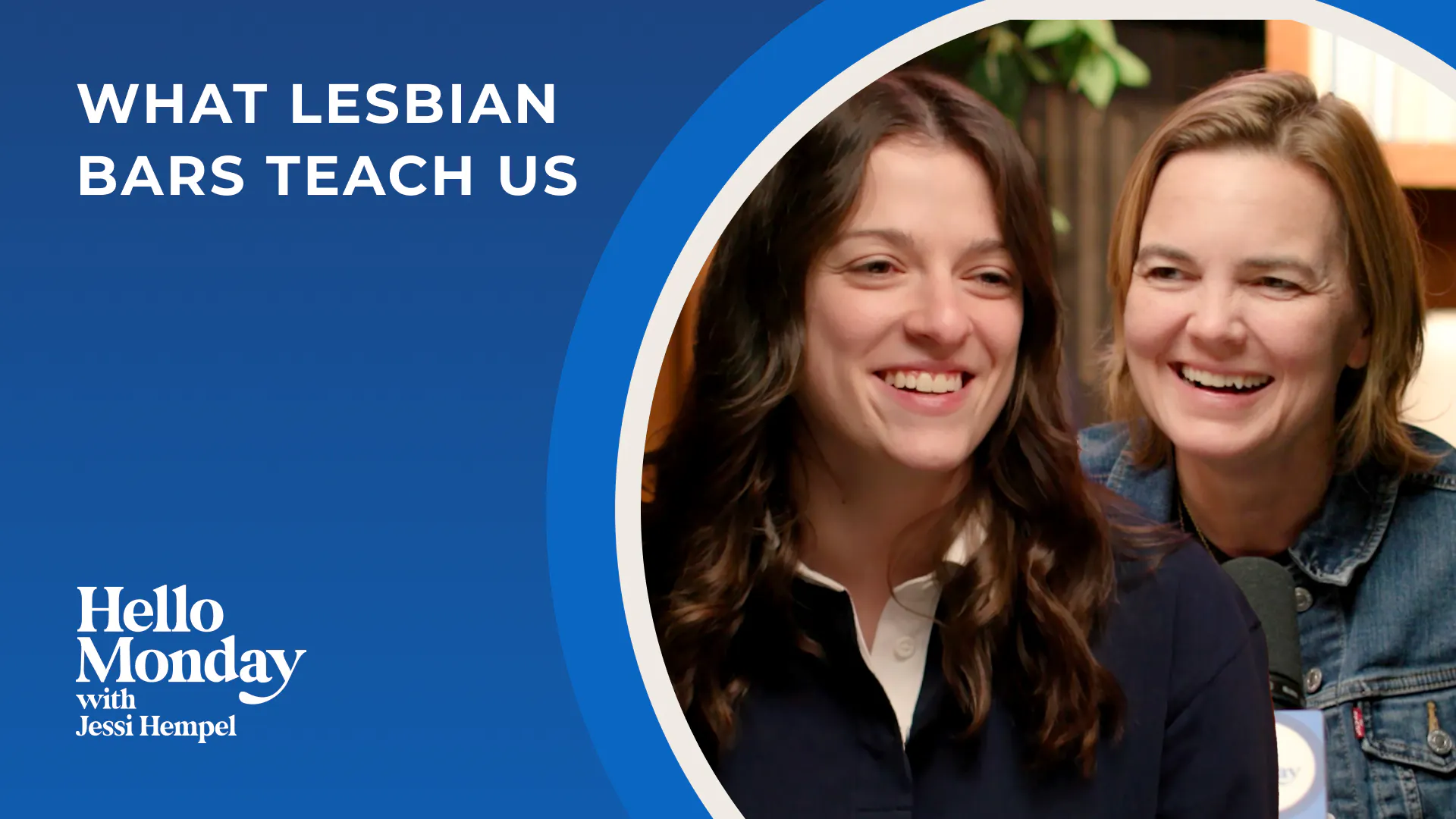
    Bonus: Lesbian Bars and the Secret Formula for Belonging

    Lesbian bars aren’t just nightlife, they’re evolving spaces of community and chosen family, and they have a special place in Jessi Hempel’s heart. On this bonus episode, Jessi sits down with one of Hello Monday’s own producers, Rachel Karp, to talk about her new book The Lesbian Bar Chronicles: The Living History and Hopeful Future of America's Dyke Dives and Sapphic Spaces. Rachel’s journey started as a passion project: a documentary podcast in which the Cruising podcast team went on a road trip to visit every lesbian bar in the US. Their goal was to tell the history of lesbian bars and stories of the people who go to them. Now, those stories– and the lessons we can learn from them about how to create real-life community spaces–are in a book. In this episode: Why Rachel and the Cruising podcast team went on their road trip Why lesbian bars have endured, even as culture, technology, and rights have shifted What makes physical spaces of belonging different from digital communities The role of leadership in shaping inclusive, values-driven spaces What “chosen family” looks like in practice, and why it matters What anyone (queer or not) can learn from lesbian bars Follow Jessi Hempel and Rachel Karp on LinkedIn.

  • May 25 · 29 min

    How to Build a Career You Actually Believe In

    We're trained to climb ladders and chase titles, but what if the real metric of career success was the positive impact you have on the world? In this episode from the Hello Monday archives, host Jessi Hempel sits down with Rutger Bregman to explore moral ambition—a framework for building a career based on what positive impact you can have on the world. Rutger's groundbreaking book, Moral Ambition: How to Stop Wasting Your Talent and Start Making a Difference, is a wake-up call for anyone who's felt something was missing from their work. Whether you're early in your career, questioning your path, or rebuilding after a layoff, this conversation offers a practical roadmap for pivoting toward meaningful work. In this episode, Jessi and Rutger explore: What moral ambition is, and why it's the antidote to burnout Why "follow your passion" is the wrong advice for building a sustainable career How to shift from success-driven to service-driven work Which industries funnel talented people into unfulfilling roles, and how to break free Real-world examples of people solving humanity's biggest problems How to build coalitions and find collaborators aligned with your values The hidden cost of prestige, and how to redefine what winning looks like This episode is a call to action for anyone who wants to do good—and do it well. Follow Rutger Bregman and Jessi Hempel on LinkedIn

  • May 18 · 28 min

    We're Lonelier Than Ever. Ritual Is the Answer.

    Rituals work. They help us make meaning, process transition, and connect with each other. That’s why we’ve been doing them for more than 300,000 years. So why, in this century, have we largely abandoned them? This week, bestselling author, repeat Hello Monday guest, and longtime friend Bruce Feiler joins us in the studio to talk about his new book, A Time to Gather: How Ritual Created the World and How It Can Save Us. Bruce traveled to 16 countries on six continents to explore why ritual matters and identify how we can bring it back into our everyday lives. In this episode: Why ritual is the original human algorithm and why we've abandoned it The difference between self-care and group care, and why the latter matters so much The rise of new rituals: cancer-versaries, sober-versaries, infertility ceremonies, and divorce parties Why funerals are disappearing, and what we're losing when they do A live ritual design class: Bruce walks Jessi through building one for her daughter's preschool graduation The three things every ritual needs: a beginning, a middle, and an end From "rites of passage" to "bites of passage": why small, frequent moments of connection matter as much as the big ones Virtual vs. ritual: why 2026 feels like the year we're choosing to come back together in person Follow Jessi Hempel and Bruce Feiler on LinkedIn. And let us know how you’re incorporating ritual into your own life.

  • May 14 · 40 min

    Feed Drop: WorkLife with Molly Graham

    You might think the biggest, most prestigious job is always the right career move. Patty Stonesifer — founding CEO of the Bill & Melinda Gates Foundation and an early Amazon board member — says that’s exactly the wrong way to decide what to do next. So what should guide your career? In this special episode from WorkLife with Molly Graham, Patty shares the nine-word personal mission statement she’s used for decades to filter opportunities, turn down what doesn’t fit, and speak up for what matters. Patty shares how you can write your own, and even coaches Molly through creating hers in real time. WorkLife is a podcast from TED where host and company builder Molly Graham and her expert guests talk through the messy feelings we all experience at work. Ambition and failure, joy and burnout, confidence and self-doubt — this show digs into it all to help you build a career without losing yourself. Listen now: https://link.mgln.ai/7r9KAe

  • May 11 · 29 min

    23,000 People Tried Moving Every 30 Minutes. Here's What Happened.

    We talk a lot about what technology is doing to our minds. But what about everything below the neck? This week, Jessi is joined by Manoush Zomorodi, host of NPR's TED Radio Hour and author of Body Electric: The Hidden Health Costs of the Digital Age, and New Science to Reclaim Your Wellbeing. Unfortunately, a killer workout or a standing desk won’t save us from the long-term health consequences of a sedentary lifestyle. But five minutes of gentle movement every half hour could. In fact, Manoush helped run a clinical trial with 23,000 people to prove it. Jessi and Manoush discuss: Why sitting all day drains your energy even when you haven't done anything The Columbia study that got 23,000 people moving, and what it proved Why standing desks aren't actually the fix we thought they were The "garden hose" model of what happens to your arteries when you sit or stand too long How people can restructure their workdays (and their calendars) to make movement stick What "information athletes" can learn from dancers, musicians, and pilots The shift from screen-shaming to something kinder and more practical This one might make you want to stand up and take a lap while listening. That's kind of the point. Follow Manoush Zomorodi and Jessi Hempel on LinkedIn.

  • May 4 · 28 min

    Feeling Powerless at Work? Here’s Where Your Agency Still Lives

    Work has always been demanding, but lately, it feels like the ground is constantly shifting. Business is moving faster, projects disappear overnight, expectations change without warning. Under pressure, teams see more tension and uncomfortable moments. So how do you stay steady through these times and even use workplace tensions to grow and improve? This week on Hello Monday, Jessi Hempel talks with Aiko Bethea, leadership coach and author of Anchored, Aligned, Accountable: A Framework for Transcending Bullsh*t and Transforming Our Lives. Aiko’s book comes with a forward from Brené Brown, and offers a road-tested framework for navigating modern work with more clarity and intention. Instead of looking outward for stability, she argues that the real work starts within: understanding your values, recognizing your impact, and reclaiming your sense of agency. In this conversation, Jessi and Aiko discuss: Why work feels more chaotic than ever What it really means to be “anchored” in your values—and why most of us get this wrong How to align your decisions and behavior with what actually matters to you A more generous, effective way to think about accountability (hint: it’s not about blame) The many forms of power operating inside organizations Why curiosity is the key to better leadership and stronger relationships How to stop waiting for external conditions to improve and start creating your own stability This episode is for anyone looking for a way to regain clarity, ownership, and direction in the middle of constant change. Follow Aiko Bethea and Jessi Hempel on LinkedIn.

Showing 1–20 of 22 episodes