Skip to content
Artwork for Flying Free
Religion & SpiritualityChristianityEducationSelf-Improvement

Flying Free

Natalie Hoffman

Flying Free is a support resource for women of faith who need hope and healing from hidden emotional abuse, spiritual abuse, and narcissistic abuse. Because of misogynistic theology taught in controlling and spiritually abusive churches, many Christian women find themselves in destructive marriages where there is an uneven power dynamic. Male partners use their status as a husband to gain power and control over a woman’s mind, emotions, body, social life, finances, and more. When she tries to get help from her equally abusive church environment, she is betrayed and re-abused. Flying Free offers a Christ-centered, gospel-oriented perspective on domestic abuse that protects and honors the voices and autonomy of women. Tune in each week to hear conversations with emotional abuse advocates and fellow survivors who will walk with you on your journey up and out. We hear you. You are not alone. Learn more at https://flyingfreenow.com

Play
  • 30 episodes
  • weekly
  • Avg 39 min
  • English
Counted on this page — what you have heard stays on this device, so it is not something the list can be paged by.
  • #373
    March 31 · 1 hr 2 min

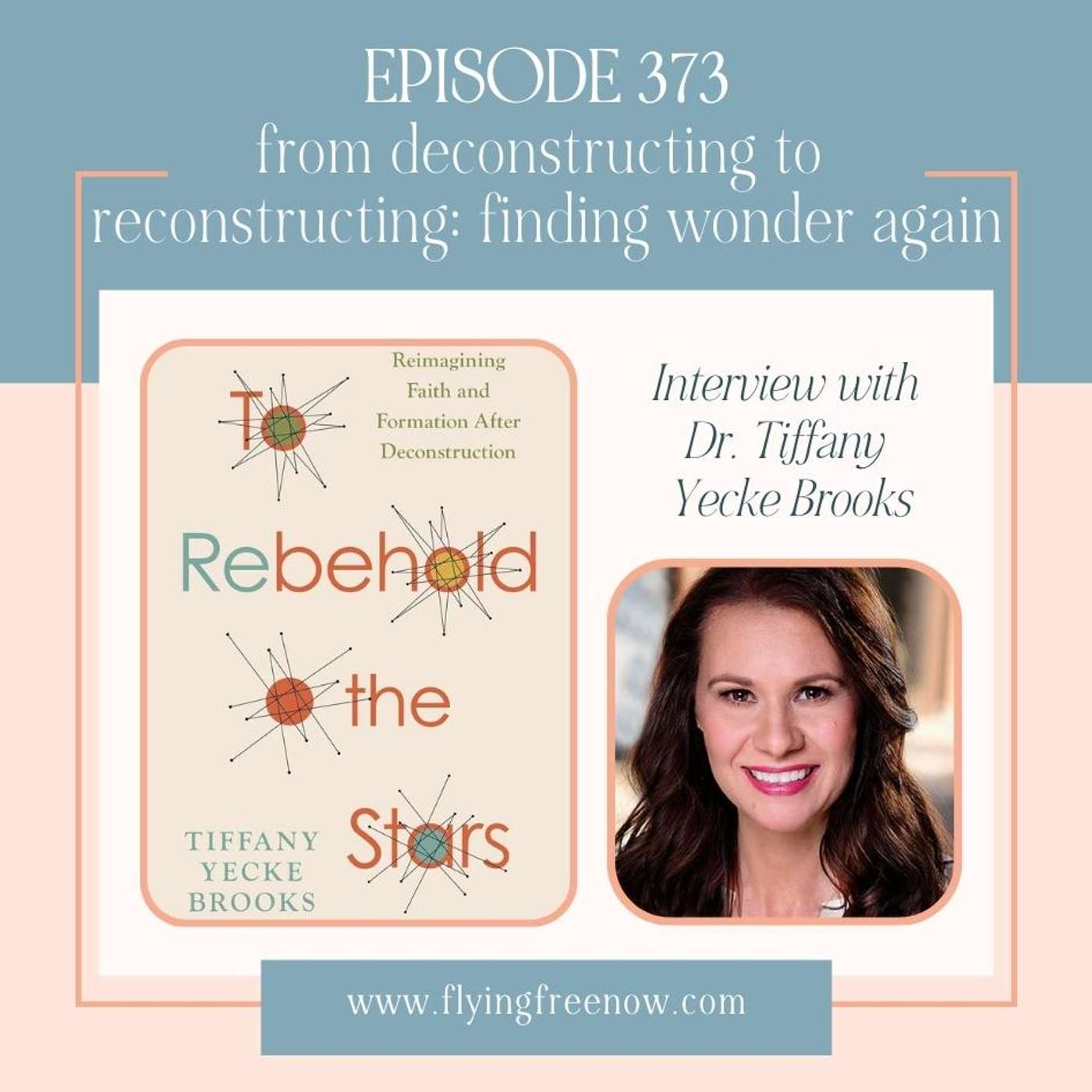
    From Deconstructing to Reconstructing: Finding Wonder Again [373]

    This is one of my favorite interviews! Today I’m talking with my friend, Dr. Tiffany Yecke Brooks, author of Gaslighted by God, Holy Ghosted, and her brand-new book, To Rebehold the Stars: Reimagining Faith After Deconstruction. If you've walked through the painful process of deconstructing the toxic theology you inherited, this conversation is going to knock your socks off. Drawing from Dante's Inferno (I know, right?!), classical literature, and deep theological study, Tiffany shows you how to create a new spiritual lexicon that actually reflects the heart of God. (Listen to find out what that even is!) This isn't about burning it all down. It's about holding up each piece to the light and deciding: Does this stay or go? 🔑 Key Takeaways: The one thing fundamentalism can't tolerate (and why that's actually your doorway to freedom) What Dante's Inferno has to do with your faith journey, and why the final line matters so much The Greek word that completely reframes what forgiveness actually means Why the images you were given for God might be keeping you stuck in an outdated script What happens when you stop trying to be perfect and start focusing on being good Resources mentioned: 📰 Tiffany’s Substack Newsletter (but only if you like to laugh - otherwise stay away) 📚 Her new book: To Rebehold the Stars: Reimagining Faith After Deconstruction. 🎧 Her OTHER interviews with me (all AMAZEBALLS): Confronting Religious Trauma Overcoming Spiritual Anxiety 👹 The book Dr. Brooks copy-edited for me AND that is a perfect illustration of what her book Holy Ghosted is talking about: All the Scary Little Gods 🆓 And hey - listen to my book FREE by going to scarylittlegods.com! Tiffany Yecke Brooks is the lead or contributing writer on more than two dozen books, including multiple New York Times bestsellers. She is the coauthor of Fear Is a Choice: Tackling Life’s Challenges With Dignity, Faith, and Determination (with NFL running back James Conner), Limitless: The Power of Hope and Resilience to Overcome Circumstance (with Paralympic gold-medalist Mallory Weggemann), and the narrative nonfiction historical thriller Espionage and Enslavement in the Revolution: The True Story of Robert Townsend and Elizabeth (with historian Claire Bellerjeau). Her newest book, To Rebehold the Stars: Reimagining Faith After Deconstruction, was released in March 2026 by Eerdmans. She has also published articles in peer-reviewed journals and the Smithsonian. Tiffany holds a PhD from Florida State University, where her dissertation covered, in part, cultural adaptations of stories from the book of Genesis, and an MA from the University of Bristol in the UK, where her thesis examined cultural influences and literary techniques in the Gospel of Luke. A popular speaker for student groups, faith conferences, and academic lectureships, Tiffany has taught literature and writing at Abilene Christian University, McMurry University, and the University of South Carolina – Beaufort.

  • #372
    March 24 · 21 min

    Why Do Your Friends Believe the Person Who Abused You? [372]

    What happens when seeing your ex derails all your progress? And why do your friends think he's such a great guy when you know the truth? 🔑 Key Takeaways: Why seeing your ex after months can feel like all your progress disappeared (it didn't) What trauma bonding actually does to your memory of the relationship Why emotionally abusive people seem so great to everyone else The false equivalency that keeps people from believing abuse survivors How to know if you're lonely for him or for something else entirely 🎁 I want to give you a free gift. It’s the audio version of my book, All the Scary Little Gods. It’s a spiritual memoir about healing from religious trauma and toxic programming. You can listen to it FREE by going to scarylittlegods.com I will also send you my weekly Hope Letters for Christian women in emotionally and spiritually abusive marriages.

  • #371
    March 17 · 23 min

    Navigating Discard, Revenge, and Unsupportive Friends [371]

    In this episode we tackle three questions: What happens when the abuser is the one who leaves? How do you live with the fear of post-separation or post-divorce revenge? And what do you do when your friends just don't get it? 🔑 Key Takeaways: Why some abusers discard their victims (and what it reveals about your progress) The difference between fear you should listen to and fear that steals your peace What actually helps kids navigate their father leaving The one question to ask yourself when trying to help someone understand your experience Why chasing validation from people who don't get it creates unnecessary suffering Get Today’s Free Resource: 📒 Take a free Emotional Abuse Assessment by going to emotionalabusequiz.com I will also send you my weekly Hope Letters for Christian women in emotionally and spiritually abusive marriages.

  • #370
    March 10 · 19 min

    How My Word for 2026 is Playing Out So Far (personal message) [370]

    This isn't my typical podcast episode. Today I get personal, sharing why I’ve decided to pursue graduate studies in theology after experiencing profound spiritual abuse throughout my entire life. If you've read All the Scary Little Gods, you know my story, and you might be wondering why I’d ever step back into that world. I invite you into my journey of healing, my commitment to simplicity in 2026, and the real reason I keep this podcast free. Get Today’s Free Resource: 🎁 I want to give you a free gift. It’s the audio version of my book, All the Scary Little Gods. It’s a spiritual memoir about healing from religious trauma and toxic programming. You can listen to it FREE by going to scarylittlegods.com I will also send you my weekly Hope Letters for Christian women in emotionally and spiritually abusive marriages.

  • #369
    March 3 · 15 min

    If It’s Not "Narcissism," What Is It? (The Answer) - The Narcissism Trap Series Part Four [369]

    In Episode 369 of the Flying Free Podcast, you’ll learn a term that's more accurate than "narcissistic abuse,” and it's actually being recognized in courts of law. This is part four of The Narcissism Trap Series, and it shifts everything from trying to diagnose your partner to recognizing what's really happening to you. If you've been stuck wondering whether he meets the clinical criteria for narcissism or whether therapy could change him, this episode will free you from that trap. Natalie breaks down coercive control—what sociologist Evan Stark calls a "liberty crime"—and why understanding this pattern matters more than any personality disorder diagnosis ever could. 🔑 Key Takeaways: Why sociologist Evan Stark calls coercive control a "liberty crime" (and what that means for you) The calculated reason behind those "small" controlling acts that don't seem like abuse What happens in your brain when you start to self-police your own thoughts and feelings Why England made this a criminal offense in 2015 (and which U.S. states are following) The internal checkpoint questions that reveal if you're living in coercive control right now Get Today’s Free Resource: 🧐 Are you wondering what is happening inside your own painful and confusing marriage? I wrote a book just for you called Is It Me? Making Sense of Your Confusing Marriage. Get a free chapter by going to isitmebook.com I will also send you my weekly Hope Letters for Christian women in emotionally and spiritually abusive marriages.

  • #368
    February 24 · 22 min

    Why Your Lawyer Cringes When You Say “Narcissist” - The Narcissism Trap Series Part Three [368]

    In this third episode of The Narcissism Trap series, we shift from personal validation to legal strategy, exploring why the very word that brought you clarity could be the thing that sinks your court case. We’ll look at how judges actually view labels like "narcissist" and why focusing on clinical diagnoses can unintentionally dilute accountability and hand a "gift" to your ex’s legal team. 🎯 Key Takeaways: The label that saved your sanity might lose you your case. While identifying narcissistic patterns is vital for your personal healing, using that language in a courtroom often leads judges to label you as "high conflict" rather than a victim of abuse. Judges don't care about "psychobabble"; they care about concrete behaviors. An armchair diagnosis of NPD carries no weight in family court. To get the court's attention, you must swap labels for facts, like financial lockout, surveillance, and threats. Calling it a "sickness" can accidentally excuse the harm. If you frame his behavior as a mental illness he "can't help," you invite the court to suggest treatment instead of accountability. In reality, his actions are often calculated, strategic choices, not symptoms of a disordered brain. There is a more powerful legal framework: Coercive Control. While the court may ignore "narcissism," they are primed to hear about patterns of isolation, degradation, and entrapment. This shift moves the focus from who he is to what he does, which is a language the law is beginning to criminalize. Deep-diving into his psychology keeps you stuck. Spending years analyzing his "damaged inner self" or "Dark Triad" traits prevents you from the real work of safety planning and documenting the behavior that matters for your future. You don’t need a diagnosis to justify seeking safety. You cannot heal from a diagnosis; you heal from harm. Stop waiting for professional validation or a formal evaluation that will likely never come, and start tracking the ongoing patterns of intimidation and control. Get Today’s Free Resource: 🧐 Are you wondering what is happening inside your own painful and confusing marriage? I wrote a book just for you called Is It Me? Making Sense of Your Confusing Marriage. Get a free chapter by going to isitmebook.com I will also send you my weekly Hope Letters for Christian women in emotionally and spiritually abusive marriages.

  • #367
    February 17 · 31 min

    Narcissist? Or Just Plain Evil? (Know the Difference!) - The Narcissism Trap Series Part Two [367]

    In this second episode of The Narcissism Trap series, we open up the DSM-5 and walk through the actual clinical criteria for Narcissistic Personality Disorder but with a crucial twist. 🎯 Key Takeaways: The diagnosis you're hunting for might be the least of your problems. Even if your partner doesn't meet all nine DSM-5 criteria for NPD, you can still be experiencing serious harm in your relationship. Everyone has narcissistic traits, but it's about pattern, pervasiveness, and pathology. The difference between normal self-esteem and a personality disorder comes down to whether the behavior is consistent, shows up everywhere, and causes real damage. Not all narcissists look the same. Grandiose narcissists bulldoze you with charm and dominance. Vulnerable narcissists guilt-trip you with sensitivity and victimhood. Both cause devastation. You're likely dealing with coercive control, not just a difficult personality. This systematic pattern of isolation, gaslighting, financial control, and micro-regulation is psychological warfare, and it's actually a criminal offense in some countries. The label matters less than the behavior. Whether he's a clinical narcissist, has traits from the Dark Triad, or is just plain abusive, what matters is the harm you're experiencing, and you don't need a diagnosis to know it's not okay. Stop waiting for him to be diagnosed. Narcissistic traits are "ego-syntonic” which means he sees them as strengths, not problems. He'll never walk into a therapist's office asking for help, which means you can't wait for professional validation to seek safety. Get Today’s Free Resource: 📒 Take a free Emotional Abuse Assessment by going to emotionalabusequiz.com I will also send you my weekly Hope Letters for Christian women in emotionally and spiritually abusive marriages. 🦋 Join me and hundreds of other Christian women for the transformation of your life inside the Flying Free Kaleidoscope! Learn more at joinflyingfree.com

  • #366
    February 10 · 16 min

    Stop Calling Him a “Narcissist” (Use This Word Instead) - The Narcissism Trap Series Part One [366]

    In this kickoff to a powerful new series, The Narcissism Trap, Natalie Hoffman challenges a popular narrative in abuse recovery: labeling an emotionally abusive partner as a “narcissist.” While that term may feel validating at first, Natalie explains how it can actually work against your healing by keeping you locked in the wrong story. If you've been Googling “narcissist” at 2 a.m. to make sense of your painful marriage, this episode is for you. 🎯 Key Takeaways: Stop giving the abuse a medical label. Narcissism is a clinical diagnosis that can distract from the very real pattern of covert oppression you’re living in. Start calling it what it is: oppression. This isn’t about someone who’s mentally ill or just "struggling." This is about power, control, and silencing your voice. Shifting the language helps you shift your mindset. When you stop analyzing him and start focusing on your own story, healing becomes possible. You're not crazy or overreacting. You're likely experiencing strategic emotional abuse often invisible to outsiders but deeply damaging inside your home. Get Today’s Free Resource: 🧐 Are you wondering what is happening inside your own painful and confusing marriage? I wrote a book just for you called Is It Me? Making Sense of Your Confusing Marriage. Get a free chapter by going to isitmebook.com I will also send you my weekly Hope Letters for Christian women in emotionally and spiritually abusive marriages.

  • #365
    February 3 · 54 min

    She Stopped Asking for Permission: Jillian's Story [365]

    What happens when you stop asking for permission in an abusive marriage? Today, Jillian shares her story of waking up to covert abuse in her Christian marriage and what it took to finally get out. You'll hear how she recognized the patterns, why she chose to leave despite having a young son, and what life looks like now on the other side. If you've been wondering whether things could actually be different, this conversation will show you what's possible when you start rescuing yourself. 🔑 Key Takeaways: The warning signs started immediately after marriage: Jillian noticed holiday ruining, rage, silent treatment, and passive aggression within the first year—but spent nine more years trying to fix it. The permission trap: When Jillian hired a life coach without asking, her husband threatened consequences and demanded she "ask permission"—revealing his need for control. Staying "for the kids" actually harms them: Jillian left because of her son, not despite him, knowing that growing up watching dysfunction would hardwire toxic patterns into his brain. Divorce doesn't have to be a war: Jillian's divorce took just three months because she was willing to "buy her freedom" and give him what he wanted (money, custody, reputation). Post-divorce transformation is real: Two years out, Jillian has rebuilt her self-trust, started a successful business, and is leveling up emotionally—proof that change isn't just possible, it's exponential. Get Today’s Free Resource: 📒 Take a free Emotional Abuse Assessment by going to emotionalabusequiz.com I will also send you my weekly Hope Letters for Christian women in emotionally and spiritually abusive marriages.

  • #364
    January 27 · 56 min

    Can AI Help Christian Women in Emotionally Abusive Marriages? [364]

    What if an AI could help you organize your abuse evidence, understand your trauma, and save you thousands in legal fees? Aimee Says isn't just another AI tool—it's a specialized digital health platform that understands power and control dynamics, helps you document patterns of abuse, organizes your evidence for court, and keeps your data completely private and encrypted. Whether you're trying to understand what's happening in your marriage, preparing for custody battles, or just need someone to help you see the patterns you can't yet name, this tool could change everything. 🔑 Key Takeaways: Privacy matters: Unlike ChatGPT, Aimee Says doesn't use your data to train AI models, and your conversations are encrypted and completely private which is critical when you're dealing with abuse. Specialized training: Aimee is educated in power and control dynamics, trauma-informed care, family court systems, and the intersection of faith and abuse. Timeline and documentation: The paid version tracks everything you tell it, creates timelines of abuse, identifies patterns, and organizes evidence in ways that family court judges and attorneys actually want to see. Removes the emotion: Aimee takes your raw, emotional experiences and translates them into clean, professional documentation that won't trigger the "allergic reaction" judges have to trauma responses. You are the one rescuing you: The women who fare best are those who stop waiting for someone else to save them and use tools like this to take back control of their own stories. Get Today’s Free Resource: 🧐 Are you wondering what is happening inside your own painful and confusing marriage? I wrote a book just for you called Is It Me? Making Sense of Your Confusing Marriage. Get a free chapter by going to isitmebook.com I will also send you my weekly Hope Letters for Christian women in emotionally and spiritually abusive marriages. Anne Wintemute is the Co-Founder and CEO of Aimee Says, the AI companion for victims and survivors of domestic violence. She is a fierce champion for the rights of survivors and children, and systems that hold perpetrators accountable. Prior to working with survivors, Anne founded and directed an elementary school that became a model for micro-schools across the United States. In her spare time, she enjoys urban homesteading with her partner and their blended family in Denver, Colorado.

Showing 21–30 of 30 episodes