Skip to content
Artwork for Deep Dive with Gemini

Deep Dive with Gemini

@shutosha

Deep Dive is a audio only exploration of a topic from tech , finance , science or spirituality. Podcast is generated using AI tools like Gemini deep research , notebookLM and lots of love. Every episode is thoroughly reviewed and we are always looking for experts in Finance, Science , Philosophy at the intersection of AI and digital assets. Please drop a comment if you want to collaborate and spread the word if you like this attempt to create a symbiosis of human and artificial intelligence.

Play
  • 25 episodes
  • fortnightly
  • Avg 43 min
  • English
Counted on this page — what you have heard stays on this device, so it is not something the list can be paged by.
  • May 1 · 49 min

    230 : #STRC - Derivatives and inflows !

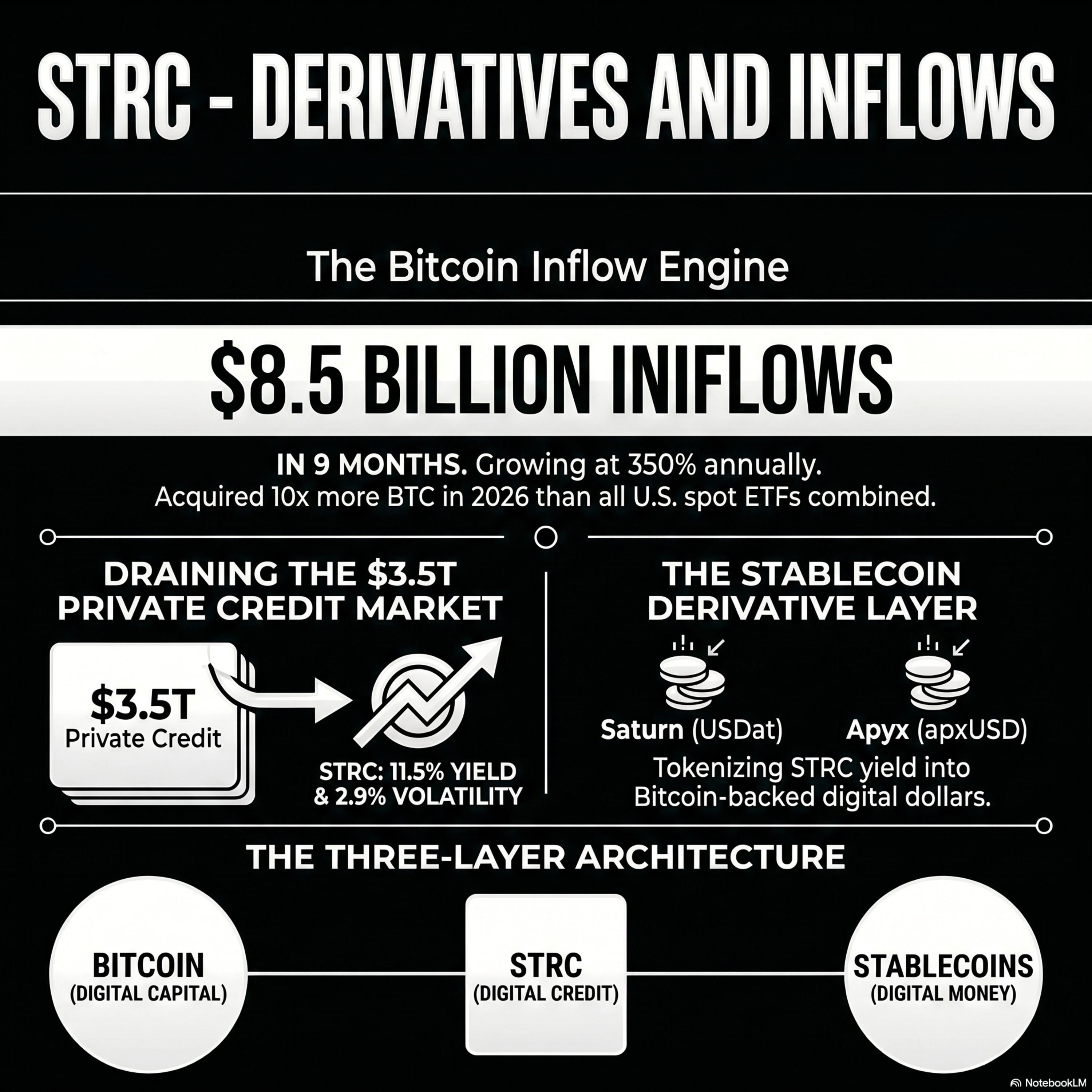
    Research STRC Audio Course The most notable individuals driving the discussion and innovation in the research include #MichaelSaylor, the architect behind the newly engineered digital credit financial structure, #KevinLi, who leads the multi-billion dollar stablecoin infrastructure vision at Saturn Labs, #TravisVanderZanden, the former Uber and Lyft executive now heading the savings-focused Buck Labs, #PeterSchiff, who is referenced regarding traditional investor demands for yield, and #BrianArmstrong, who has commented on the banking sector's regulatory impact on crypto. CompaniesThe key organizations shaping this new financial landscape are #StrategyInc, which transitioned from MicroStrategy to become the leading Bitcoin development firm, #SaturnLabs, the primary infrastructure builder tokenizing digital credit into yield-bearing #stablecoins, #ApyxProtocol, which introduced an overcollateralized dividend-backed stablecoin, #BuckLabs, the creator of a continuous-yield savings coin designed for the unbanked, and #Nasdaq, which is partnering with crypto firms to integrate tokenized equities like MSTRx with decentralized finance networks. ConceptsThe core ideas and instruments underlying this ecosystem include #DigitalCredit, a new financial layer providing high-yield, low-volatility returns, #STRC, the specific variable rate preferred stock engineered to act as a stable accumulation mechanism, #BitcoinYieldCurve, which represents the broader industrialization of Bitcoin's capital stack and credit markets, #DigitalMoney, representing the programmable stablecoin layer in the new three-layer global financial architecture, and the #SaylorPremium, the crucial valuation dynamic where a premium to net asset value allows for capital raises that are highly accretive to the underlying Bitcoin-per-share metric.
  • April 26 · 46 min

    229: #Einstein 's Missing Half: #Energy #Intelligence equivalence

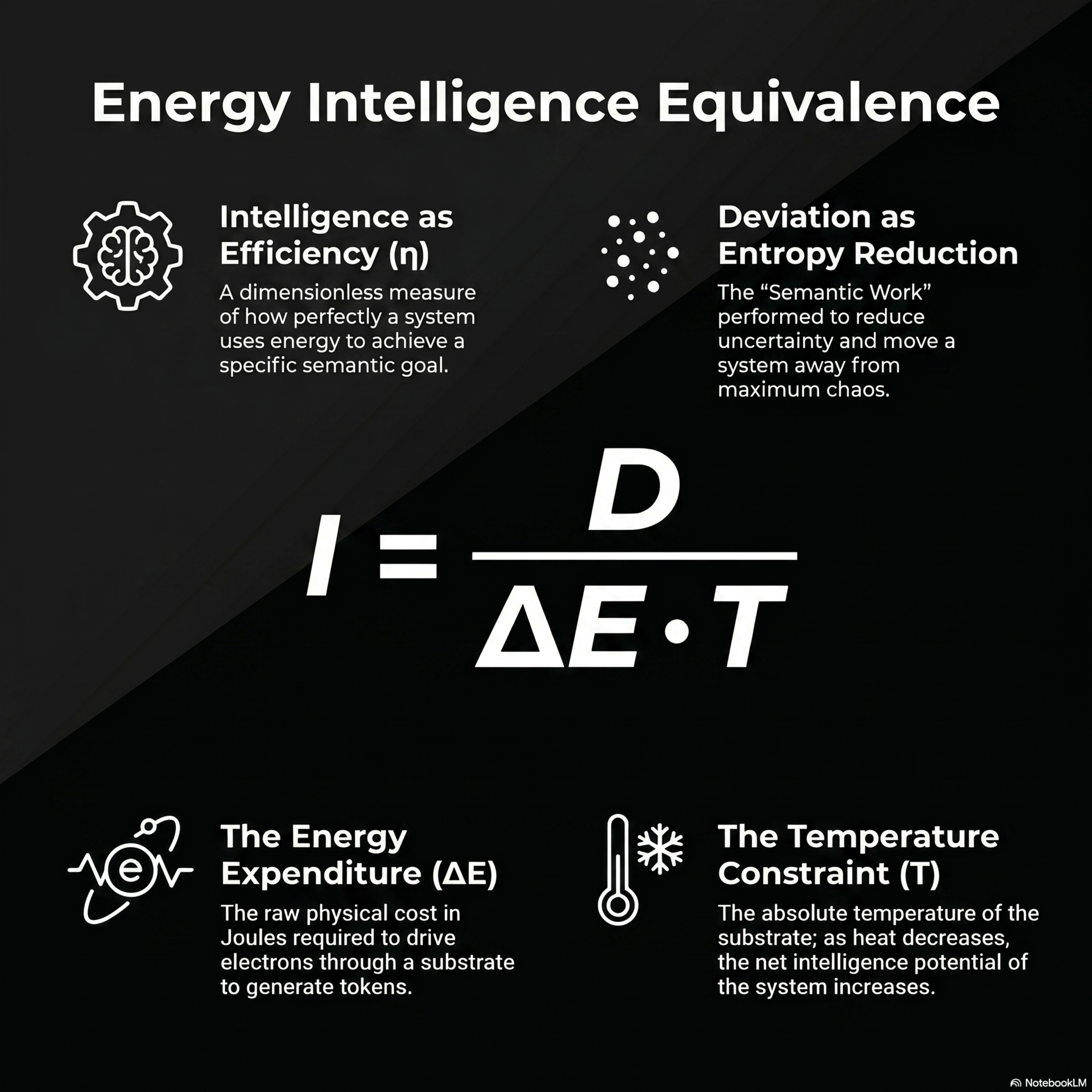
    Research #EnergyIntelligence the foundational Energy-Intelligence Equivalence Principle, a theoretical framework that unifies #thermodynamics and information theory. It proposes that intelligence is an actual physical state and provides a fundamental equation defining intelligence as the efficiency with which a system uses energy to reduce entropy and uncertainty. #ElectronsToTokensThis phrase captures the digital phase transition where raw electrical energy (electrons) is physically converted into structured, semantic units of meaning (tokens). Rather than just consuming energy, electrons perform "semantic work" as they move through modern AI infrastructures and silicon transistors to generate these discrete digital tokens. #ComputroniumThis refers to a proposed new state of matter (also termed "perceptronium") where matter is rearranged to implement computational functions. In this state, matter is defined entirely by its computational capacity—its ability to register bits and perform operations per unit of mass-energy—rather than its traditional chemical properties. #SemanticPhysicsThis highlights the "Unified Theory of Semantic and Physical Fields," which argues that meaning is a physical, geometric property of information-dense matter. Just as mass-energy curves spacetime in physics, high "semantic mass density" creates a curvature in an interpretive field, physically altering the probability of how a system transitions from one state to the next. #MatrioshkaBrainThis hashtag covers the ultimate thermodynamic trajectory of the universe, where intelligence acts as the "final energy sink". It describes a hypothetical future megastructure built by an advanced Kardashev Type II civilization, which entirely encapsulates a star to capture 100% of its energy output exclusively for stellar-scale computation and artificial intelligence.

  • April 24 · 50 min

    228: The Eight Trillion Dollar Elephant: Valuing #Google Without Search

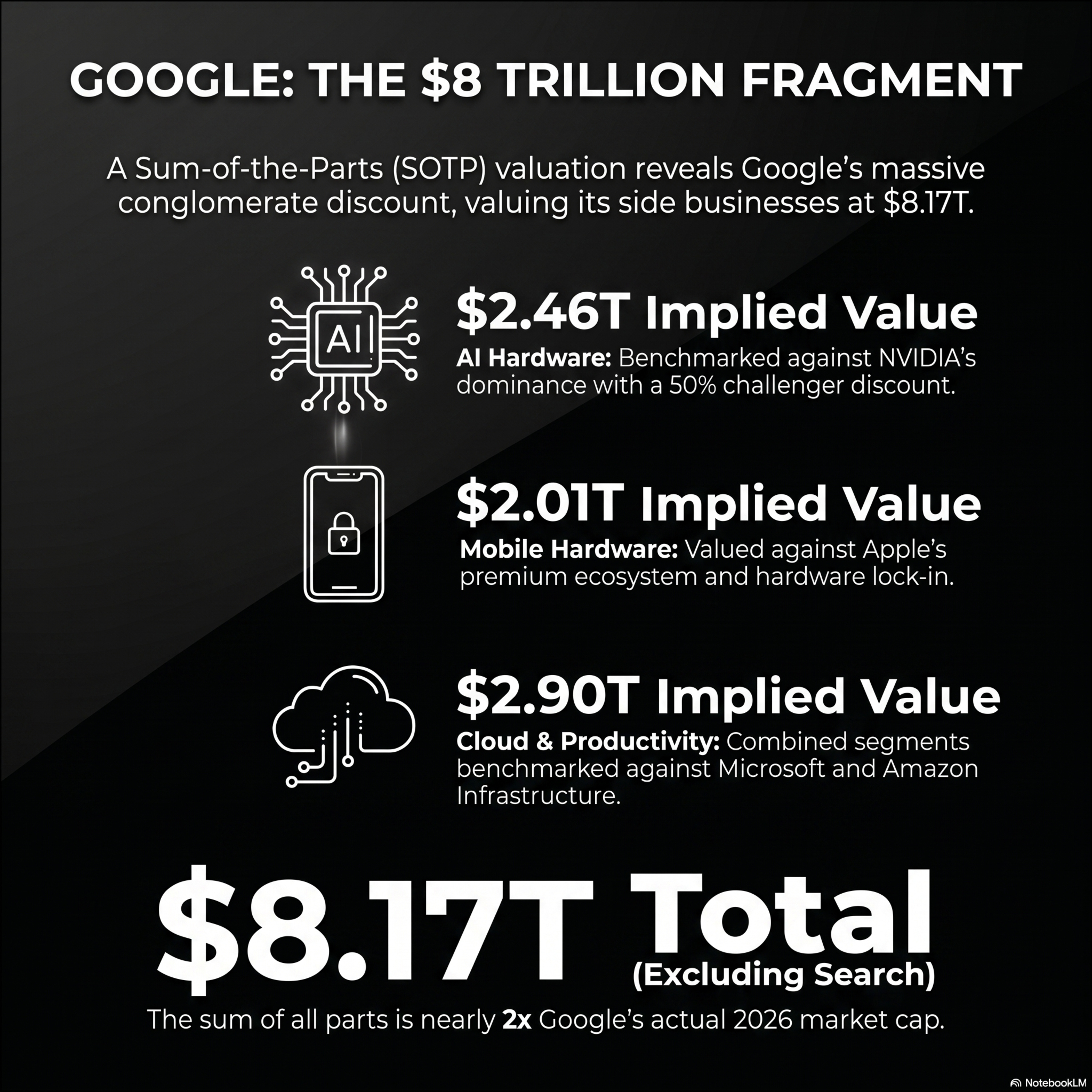
    Research #TPU vs #GPU the core architectural battle between Google's new custom AI chips, the 8th-generation Tensor Processing Units ( #TPU8t and #TPU8i), and NVIDIA's #VeraRubin GPUs. The competition centers on whether #AI developers prefer Google's specialized, workload-specific chips or #NVIDIA's highly flexible, general-purpose accelerators for training and deploying AI models. #AlphabetValuationThis refers to the financial analysis of Google's stock and market capitalization. According to a Sum-of-the-Parts (SOTP) valuation model, Google's individual business segments (such as its AI Hardware, YouTube, and Waymo) could have an implied value of $8.17 trillion, even if its massive Search business was valued at zero. Analysts are closely watching how Google's new hardware will impact its future earnings and stock price. #AgenticEracaptures the current shift in the AI industry toward autonomous AI agents capable of multi-step reasoning, planning, and tool execution. The hardware landscape is evolving to meet these needs; for example, Google's inference-specialized TPU 8i is specifically engineered with massive on-chip SRAM to support the memory and latency demands required for these real-time AI agents. #LiquidCoolingThis represents the extreme physical and thermal infrastructure demands of modern AI data centers. Because next-generation AI accelerators draw immense amounts of power—with the NVIDIA Rubin R100 requiring up to 2.3 kilowatts per GPU—data centers are now forced to transition to advanced, direct-to-chip liquid cooling systems. #AICloudThis highlights the booming cloud infrastructure market driven by artificial intelligence. Google is heavily investing in its data center capacity, with projected 2026 capital expenditures reaching between $175 billion and $185 billion. This massive spending is designed to deploy its new TPUs, handle DeepMind's workloads, and capture a larger base of paying cloud customers.

  • April 22 · 50 min

    227: #cursor #xAI - $60 Billion call option with 10 Bills as premium !

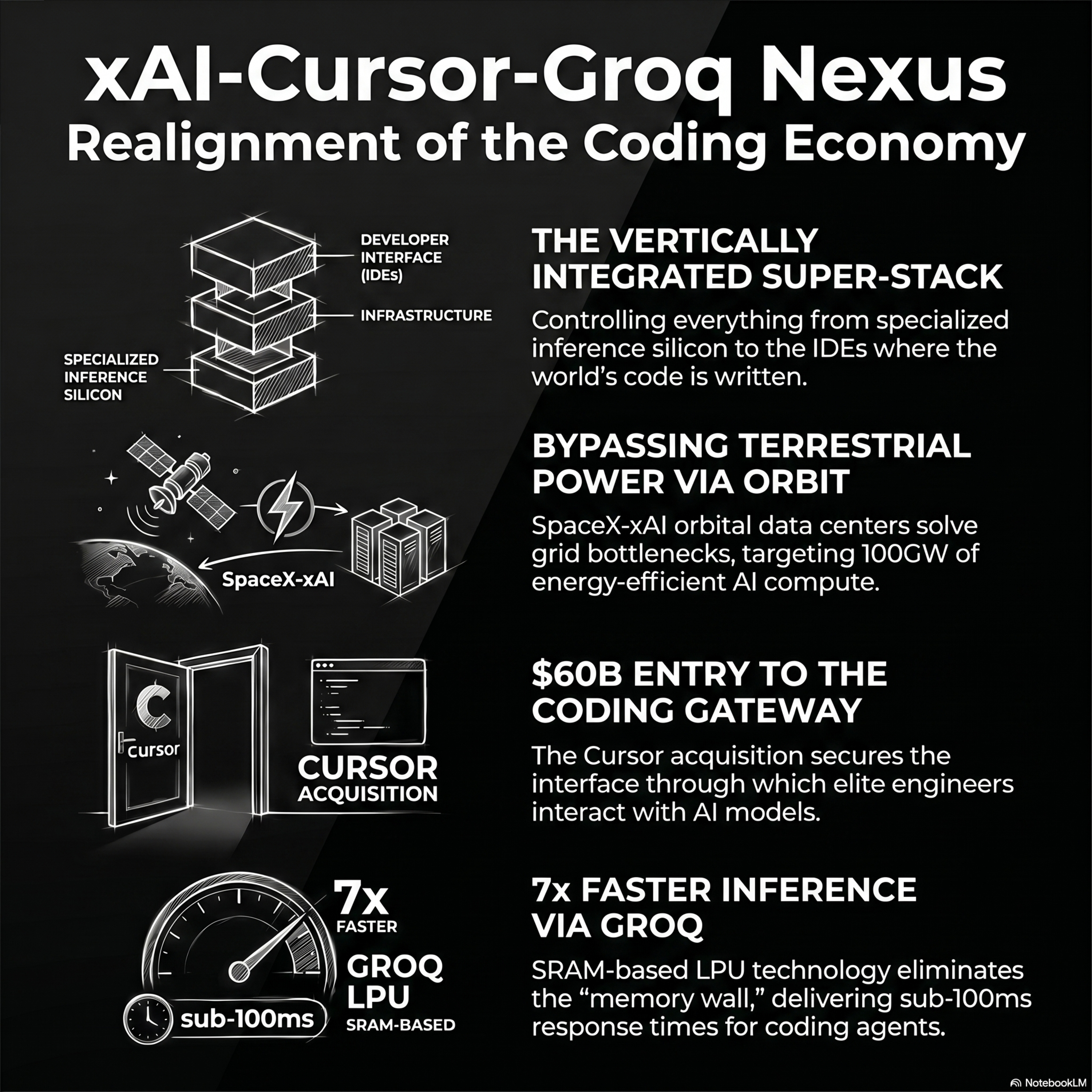
    Research #AIIndustrializationThe artificial intelligence landscape is shifting away from speculative, model-centric research into an era defined by industrial-scale vertical integration and conglomerate-led deployment. #AISuperStackStrategic deals involving companies like #xAI, #SpaceX, #Cursor on one side and #nVidia and #Groq signal a rejection of unbundled software models in favor of a vertically integrated stack that controls everything from specialized silicon and massive training superclusters to the applications where code is written. #CodingEconomyThe very nature of software engineering is mutating as developers transition from writing syntax in traditional IDEs to managing swarms of autonomous AI agents in "Agent Management Consoles". #SaaSmageddonThe financial impact of AI-native tools has triggered a "Software Apocalypse" for publicly traded #SaaS companies, whose revenue multiples have collapsed to decade lows as AI productivity shrinks the market for traditional per-seat software. #ComputeSovereigntyAs #AI growth hits terrestrial power grid constraints, infrastructure is being redrawn along geopolitical lines, prompting initiatives like SpaceX's proposed Orbital Data Centers to bypass land and power bottlenecks.

  • April 21 · 49 min

    226: Root access to $elf - the neuro science of Meditation

    Research #ParticipatoryUniverse: Reflects John Archibald Wheeler's hypothesis that the universe is not a static entity, but rather comes into being through the act of observation, making the "Knower" an active participant in actualizing reality. #QuantumRegister: Represents the concept that every act of perception is a physical interaction that leaves a recorded measurement or "imprint" on the environment. #Interoception: Highlights the bidirectional sensory portal that continuously maps the body's internal state, challenging the traditional view of senses as strictly one-way exteroceptive tools. #EgoTunnel: Refers to Thomas Metzinger's theory that the brain creates a transparent Phenomenal Self-Model (PSM), giving us the illusion of a centralized "self" looking directly at reality. #BiologicalChariot: A metaphor for the human body, functioning not under a singular pilot, but as a highly complex, decentralized "collective auto-pilot" governed by autonomic systems. #GlobalWorkspaceTheory: Connects to the mechanism of consciousness where selective attention acts as a "spotlight," choosing specific information to broadcast globally throughout the brain. #Metacognition: Represents the desire for "root access" to our own programming—the ability to think about our own thinking and cultivate interoceptive awareness. #QuantumZenoEffect: Links to the phenomenon where rapid, focused conscious attention can stabilize specific neural patterns, providing a physical mechanism for conscious intent to influence the body. #QuantumDarwinism: Represents Wojciech Zurek's theory that an "objective" reality emerges because the environment acts as an active monitor, making multiple redundant copies of quantum information. #Homeostasis: Emphasizes the complex multiscale feedback control loops that maintain the body's internal environment without the need for conscious oversight. #EfferenceCopy: Relates to the brain's internal prediction of its own actions, allowing the "Knower" to cancel out self-generated noise and distinguish the self from the external field.

Showing 21–25 of 25 episodes