Skip to content
Artwork for Cybercrimeology
ScienceEducationTechnology

Cybercrimeology

Cybercrimeology

Cybercrimeology is a podcast about cybercrime, its research and its researchers. We talk to top researchers from around the world to learn about different forms of cybercrime and their research. We learn about cybercrime theory, organized crime online, Darknet drug markets, cybercrime awareness and crime prevention, technology-facilitated intimate partner violence and much more.
The podcast has been running since November of 2019 and there is still so much to learn. I am happy to have you along for the journey into this fascinating subject.

Play
  • 20 episodes
  • monthly
  • Avg 35 min
  • English
  • #135
    Sunday · 35 min

    This research is going places: Cyberspace topology and online offender mobility

    Where do cybercriminals go when they go online? Dr Asier Moneva returns to Cybercrimeology to discuss how defining places in cyberspace might help us understand the journeys offenders make. We talk about why defining a cyber place is trickier than it sounds, how researchers can track and visualize movement online and what this approach could mean for cybercrime prevention and detection.

  • #134
    October 1 · 40 min

    It's Just a Meme: The Aesthetics of Cruelty
    How can people share hateful and disturbing content online? Dr. Alessandro Moretti from the University of Copenhagen joins us to discuss his research into the aesthetics of cruelty. We explore how this challenges traditional neutralization theory, the importance of context in online communities and what happens when offensive memes escape into the wider internet.

  • #133
    September 1 · 24 min

    Whodunit.gov.org: Behaviour and Cyber Attribution

    Can the choices made during a cyberattack help tell us who is behind it? Priscilla F. Aybar from Florida International University joins us to discuss her research examining the behaviour of state-sponsored and non-state cyber actors. We talk about rational choice, behavioural signatures, the challenges of cyber incident data and what different approaches to visibility, targeting and disruption might tell us about attribution.

  • #132
    August 1 · 23 min

    A Treacherous Land: Cyberstalking and Harassment on Dating Apps
    How can the features that make dating apps convenient also create opportunities for harassment? Jennifer Ayerza from George Mason University joins us to discuss how people use dating apps, what they disclose on their profiles and how these choices can affect their experiences. We also discuss what users, platform operators, schools and governments can do to make online dating safer.

  • #131
    July 1 · 29 min

    Snapshots of Society: Studying Cybercrime Every Here
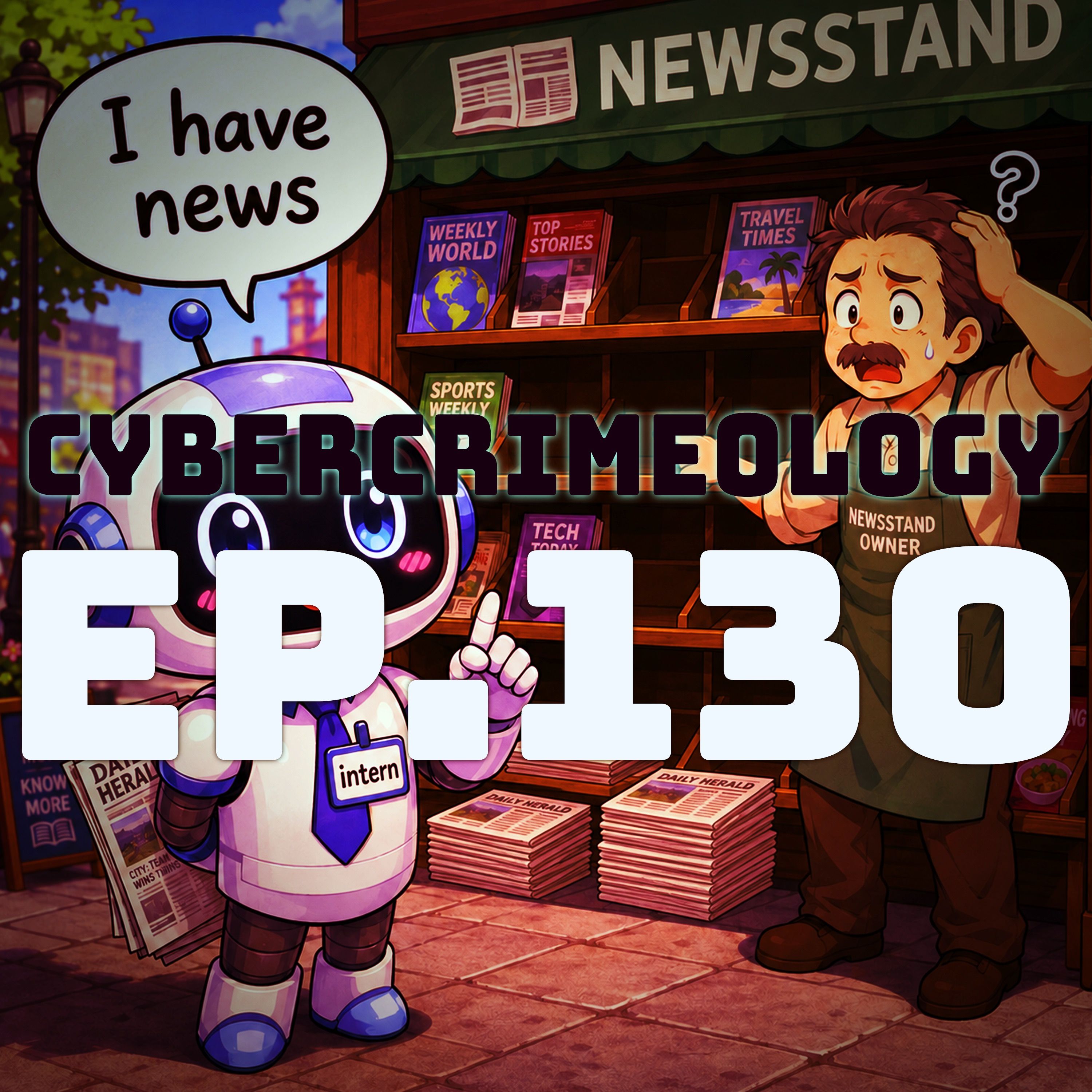
    How do we study cybercrime when the usual data sources are limited, uneven or built around assumptions from the Global North? Irnasya Hadi joins us to discuss cyber insecurity in Indonesia, public responses to government data breaches and her Snapshot of Society approach to studying digital harm in the Global South. We talk about critical criminology, data breach fatigue, insider and outsider perspectives and why apparent public indifference may actually reveal exhaustion, resignation and instit

  • #130
    June 1 · 34 min

    No News is Bad News: AI Agents, Information Value, Accountability & Democracy

    AI agents are changing how people find, consume and evaluate news. Dr. Aengus Bridgman from McGill University joins us to discuss how AI systems interact with journalism, what happens when news is summarized without clear attribution or compensation and why this matters for the future of the information environment.

  • #129
    May 1 · 34 min

    Public Interest Technology: Making Sense of Security in an AI World
    How should we think about security when many of the most important problems are not purely technical? Bruce Schneier joins us to discuss the challenge of communicating complex security ideas to non-technical audiences, the lasting relevance of security theatre, and why psychology, economics, and governance often matter as much as code. We also explore artificial intelligence, manipulated media, cybercrime, regulation, and the growing need for people who can bridge the worlds of engineering, poli

  • #128
    April 1 · 30 min

    Who You Gonna Call?: Cybercrime Types and Expectations of Police Response
    Dr. Rachel McNealey joins us to examine how people understand cybercrime and why existing response systems often fail to meet their needs. We explore how perceptions of police capability differ across types of cybercrime, and what happens when gaps in response are filled by private actors.

  • #127
    March 1 · 36 min

    Disordered Sense-Making: Conflict Narratives in the Digital Era
    Dr Samuel Tanner offers a reflective monologue tracing his intellectual journey from doctoral research on war crimes in the Balkans to contemporary work on right-wing extremism, disinformation, and what he calls pop masculinism. Across these projects runs a persistent question: how do people make sense of a world that feels as though it is slipping out of alignment? Drawing on fieldwork, policing research, and analysis of digital platforms, Dr Tanner explores the relationship between violence, i

  • #126
    February 1 · 25 min

    Beyond “The Cybercriminal”: Understanding Diversity in Cyber Offenders
    Who commits cybercrime, and are all cybercrime offenders the same? In this episode, We speak with Dr. Luuk Bekkers about what criminological and psychological research reveals about cybercrime perpetrators. They discuss differences between financially motivated and technically skilled offenders, the overlap between online and offline crime, and why understanding offender types matters for prevention, policing, and policy.

  • #125
    January 1 · 49 min

    Systematically Improving Cybersecurity Training
    How do we change cybersecurity behaviour rather than simply improve awareness? In this episode, Julia Prümmer joins Cybercrimeology to discuss cybersecurity training through the lens of psychology, systematic reviews, and behavioural theory. The conversation examines why many training programmes improve knowledge and attitudes but struggle to produce sustained behavioural change, and how differentiating between types of cybersecurity behaviour may lead to more effective interventions.

  • #124
    Dec 1, 2025 · 33 min

    The Human beneath the Hoodie: Profiling pathways into cybercrime
    What leads someone from early curiosity in technology to criminal hacking? Dr Melissa Martineau joins us to discuss cyber profiling, pathways into cyber dependent offending and what distinguishes those who drift toward crime from those who enter cybersecurity. We talk about motivations, early developmental factors and what her research reveals about opportunities for prevention and diversion.

  • #123
    Nov 1, 2025 · 1 hr 4 min

    Courses, Clicks and Consequences: Empiricizing Enterprise Security
    We speak with Dr Grant Ho from the University of Chicago about a large-scale field evaluation of anti-phishing training inside a major health organisation. The conversation examines annual awareness training, embedded “teach-at-click” exercises, and the role that engagement plays in any observed benefit. We also discuss how to measure programme value realistically and why careful experimental design matters when organizations make investment decisions.

  • #122
    Oct 1, 2025 · 44 min

    The many minds of MITRE: building multidisciplinary human insider-risk research
    How do insider-risk programmes work when they are built around people, not just data? Dr Deanna D. Caputo, Chief Scientist for Insider Threat Capabilities at MITRE, explains what multidisciplinary, human-centred insider-risk work looks like in real organisations, why user-activity data has limits, and how carefully designed field experiments can improve reporting and detection. We also touch on new research exploring whether typical insider-risk telemetry contains early indicators of suicide ris

  • #121
    Sep 1, 2025 · 30 min

    Follow the Honey: Experiments in Cybercriminal Decision-Making
    How do cybercriminals decide which targets to pursue, and how can researchers study these decisions in real time? In this episode, we talk with **Daniëlle Stibbe** a PhD Candidate and researcher at the Netherlands Institute for the Study of Crime and Law Enforcement (NSCR). Daniëlle shares her journey from psychology to criminology and explains her work using honeypots, leaked credentials, and online experiments to examine offender behaviour. We also discuss the challenges of running experiment

  • #120
    Aug 1, 2025 · 29 min

    Crime Online: Hashtag Like and Subscribe, or don't
    What does influence look like when there are no formal memberships, no application processes, and no leaders? In this episode, Dr. Francesco Carlo Campisi shares insights from his doctoral research on how deviant online movements like Anonymous and QAnon mobilize participation using social media. We talk about emotional engagement, visibility as a resource, and how theory can help us understand participation in loosely organized but powerful digital collectives.

  • #119
    Jul 1, 2025 · 27 min

    The Human in_security - deception, weapons, crime & culture
    In this episode we have a wide ranging discussion on the human in cybersecurity with Dr. Iain Reid from the University of Portsmouth. We get into the application of psychology to cybersecurity including deception, risk perception, and responsibility We talk about who carries the burden of defence, how software developers think about security, and what deception looks like in both cybercrime and cyberwarfare.

  • #118
    Jun 1, 2025 · 27 min

    Visualizing Conti: Revealing the Business of Ransomware-as-a-Service through New Analytical Techniques

    What can leaked internal messages from a ransomware group reveal about how cybercrime operations really work? In this episode, Estelle Ruellan discusses the analysis of the tens of thousands of chat messages leaked from the Conti ransomware group she created with colleagues. They to mapped the internal roles and communication patterns of this group using natural language processing and Latent Dirichlet Allocation analysis to better understand this notorious ransomware-as-a-service outfits. We ex

  • #117
    May 1, 2025 · 39 min

    Fake It Until You Break It: The pay-to-publish paper mills exploiting the over metrification of Science

    When fake science can be bought, what happens to the value of real research? Dr. Sarah Eaton from the University of Calgary and Dr. Sabina Alam from Taylor & Francis discuss the collaborative efforts of United2Act.org to combat the global threat of scientific paper mills. We explore what these organizations are, how they operate, and what can be done to push back against fraudulent publishing in the digital age.

  • #116
    Apr 1, 2025 · 38 min

    DeReact, DeFatigue and Deceive: Psychology for Better Cybersecurity Design

    What happens when people get tired of cybersecurity? Dr. Andrew Reeves from the UNSW Institute for Cyber Security joins us to explore how psychological principles—like fatigue, reactance, and decision-making under pressure—shape both how users engage with cybersecurity and how attackers and defenders can exploit them. We talk about what goes wrong with security training, why users push back against well-meaning policies, and how simple design choices can reduce cognitive load and increase compli

Showing 1–20 of 20 episodes