Skip to content
Artwork for Cx1DJs We Do Things Different Podcast
NewsEntertainment NewsTV & FilmFilm InterviewsExplicit

Cx1DJs We Do Things Different Podcast

Cx1DJs We Do Things Different Podcast LLC

We will showcase and highlight underground artists, musicians, DJs, actors, athletes, authors, singers, fashion, news, sports, politics and ordinary people with a voice. We will also cover events, live performances, documentaries, movies, reality shows, tournaments, live streams and more. This podcast will be hosted by celebrity DJ, Djbutterrock, the CEO of Cx1DJs Coalition LLC.

Play
  • 30 episodes
  • daily
  • Avg 2 hr 8 min
  • English
Counted on this page — what you have heard stays on this device, so it is not something the list can be paged by.
  • #159
    Yesterday · 2 hr 29 min

    Cx1DJs We Do Things Different Podcast "Untold Stories of Three 6 Mafia" hosted by DJButterrock

    Cx1DJs We Do Things Different Podcast "Untold Stories of Three 6 Mafia" hosted by DJButterrock Three 6 Mafia is an American hip-hop group from Memphis, Tennessee, formed in 1991. Emerging as a horror-themed underground hip-hop group, they went on to enjoy mainstream success.[1] The group's 1995 debut album Mystic Stylez became an influential cult classic.[2] They have released music on independent labels such as Prophet Entertainment and their own Hypnotize Minds label, as well as Relativity, Loud, and Columbia Records. Two of their albums are RIAA-certified platinum: When the Smoke Clears: Sixty 6, Sixty 1 (2000) and Most Known Unknown (2005), with the latter featuring their hit single "Stay Fly". In 2006, the group won the Academy Award for Best Original Song at the 78th Academy Awards for their song "It's Hard out Here for a Pimp" from the film Hustle & Flow. The group's latest studio album, Last 2 Walk, was released in 2008. Three 6 Mafia's worldwide album sales stand at 5.5 million as of 2016.[3] History 1988–1990: Origins Three 6 Mafia's founding members became musicians at young ages. In 1988, DJ Paul, at age 11, was taking piano lessons, and his half-brother,[4] Lord Infamous, age 15, was a singer practicing bass and electric guitar. The two would compose songs together, with Paul playing piano and drums while Infamous played bass, guitar and sang. At the same time, in North Memphis, Tennessee, Juicy J, at age 13, was learning how to DJ as well as rap. He had initially wanted to be a singer, but in the late 1980s and early 1990s he fell in love with the gangsta rap style, and he, like his future founding group members across town, wanted to make music like popular artists at the time such as N.W.A and Geto Boys.[5] In 1989, DJ Paul and Lord Infamous formed the duo "Da Serial Killaz".[6] It was at this time they distributed their own mixtapes of popular songs at school, and Lord Infamous had started rapping with his signature triple time flow. Juicy J was also creating his own mixes by this time but was not putting his raps on tapes just yet. 1991–1992: The beginning By 1991, DJ Paul had already begun to make a name for himself in the local hip-hop scene through DJing at local clubs, such as Club 380 Beale, where he got his first opportunity to perform. His mixtapes, which were gradually evolving to include more and more original content of "Da Serial Killaz", also helped spread word of his talents.[7] At the time, the hip-hop scene in Memphis had not taken a fully fledged form yet, but early works by artists such as DJ Spanish Fly and DJ Squeeky were hinting at what was to come.[8] Meanwhile, Lord Infamous was still rapping and evolving his lyrical style. In North Memphis, Juicy J was slowly building a name for himself as well, now that he was making his own songs and distributing them with his mixtapes, as well as DJing at local clubs with his mentor. That same year, DJ Paul and Juicy J first crossed paths after Juicy sought out Paul in 1991 for help making beats. The two quickly grew fond of each-other's musical styles and the two subsequently teamed up with Lord Infamous to form the group "The Backyard Posse". DJ Paul and Lord Infamous still continued work as "Da Serial Killaz" by themselves, and in 1992 released the first legitimate original recording to come out of the eventual Three 6 Mafia camp, "Portrait of a Serial Killa". Featuring dark beats by Paul and horrorcore-styled lyrics from Lord Infamous and DJ Paul, this tape is recognized in its raw form as a pioneering work of horrorcore hip-hop. Juicy J in the meantime released his debut hard copy mixtape, Volume 5, that same year, as well as his seminal track in its original form, "Slob on My Knob". 1993–1996: Debut, Mystic Stylez and Chapter 1: The End The first notable release from members of the group that dropped in 1993 was DJ Paul and Lord Infamous's Come With Me to Hell, which featured original forms of future Three 6 Mafia hits such as "Tear da Club Up" and "Porno Movie". Paul's "DJ Paul Volume 12" mixtape was also released at this time. That same year, while recording music for "The Backyard Posse", Lord Infamous rapped a line referring to his crew as the "Triple Six Mafia". The group later adopted the name, seeing that the name more closely matched the bleak and dark imagery of their music.[6] Juicy J had yet to release a notable work of his own at this point, but in 1994 that would change with Vol. 9: It's On and Vol. 10: Chronicles of the Juice Manne. Similar to Paul and Infamous's works the previous year, these tapes featured what would turn out to be some of the framework of future hit songs.
  • #158
    Thursday · 2 hr 27 min

    Cx1DJs We Do Things Different Podcast "Untold Stories of UGK" hosted by DJButterrock

    Cx1DJs We Do Things Different Podcast "Untold Stories of UGK" hosted by DJButterrock UGK (short for Underground Kingz) was an American hip-hop duo from Port Arthur, Texas, formed in 1987 by Mitchell "Big Mitch" Queen and Chad "Pimp C" Butler. Big Mitch later left the group to pursue a football career,[1] and was replaced with Bernard "Bun B" Freeman, although Mitch remained a frequent collaborator of the duo. They released their first major-label album, Too Hard to Swallow, in 1992, followed by several other charting releases on the Billboard 200 and Top R&B/Hip-Hop Albums charts, including their fifth album, Underground Kingz (2007), which spawned the hit single "International Players Anthem (I Choose You)" (featuring Outkast) and debuted atop the Billboard 200, in August 2007. The duo also appeared on singles for other artists, such as "Big Pimpin'" by Jay-Z and "Sippin' on Some Syrup" by Three 6 Mafia. Pimp C founded UGK Records in late 2005. The duo ended following Pimp C's death on December 4, 2007. Background Originally from Port Arthur, Texas, UGK members Pimp and Bun were from the same town as Janis Joplin and Robert Rauschenberg. Though the town of 60,000 has a significant African American population, it was not known for its rap scene. They called themselves "Underground Kingz" because their country rap style was so full of "slang and twang" they thought it was inaccessible for outsiders. UGK blended "deep bluesy textures, triumphant church organs, thick funk and meaty soul".[2] Bun's rap style was described as a "speeding-train delivery" with lyrics that "feel sanded-down and coated by heavy lacquer". Born Bernard Freeman, his childhood nickname "Bunny" was shortened to Bun.[2] Pimp, or Chad Butler, is the son of a trumpet player and has had an interest in music since childhood: "I come from a classical background, I came up singing Italian sonnets, Negro spirituals, and shit of that nature." Even before studying musical notation in school he learned to play many instruments by ear including piano, trumpet, drums and flugelhorn. His vocal style is of a "high-voiced, unstable and provocateur, as likely to slap your face as to sing you a love song". Influenced by Run-DMC, he started synthesizing beats to rap over after receiving a drum machine and keyboard one Christmas. Following the advice of Pimp's stepfather to "put some music in that shit", Pimp decided to move beyond Run-DMC's kick-snare formula also known as boom bap, building on this by replacing the drum sound specifically with the Roland TR-808 and supplementing the cymbals with mainly the hi-hats, which added another important rhythmic layer to the whole thing..[2] Career and recordings In 1992, UGK was signed to Jive Records under a five-album contract, releasing their major-label debut album Too Hard to Swallow.[3] While it featured several new recordings, it also featured several songs that had been culled from The Southern Way.[4] However, several songs that had been intended to be included on the album were excised at the last minute, apparently due to their overly explicit content. Five of these songs would surface two months before the release of Too Hard to Swallow, on an EP distributed by Bigtyme Recordz; appropriately enough, the EP was titled Banned. A popular song from the album, "Pocket Full of Stones", was also included on the Menace II Society soundtrack in 1993. Their second album, Super Tight, was released two years later, on August 30. Unlike their previous album, Super Tight managed to break into the Billboard 200 and ultimately peaked at #95; their third album, Ridin' Dirty, peaked at number 15.[5] Ridin' Dirty would also be UGK's last album for the time being, as they went on a five-year hiatus not long afterward. The year 2000 became a breakthrough year for the group. UGK made a high-profile guest appearance on Jay-Z's smash hit "Big Pimpin'" and also appeared on Three 6 Mafia's hit "Sippin' on Some Syrup". Both of these collaborations greatly increased their reputation, and helped fuel anticipation for their next project [citation needed]. Jive Records failed to capitalize on this new-found interest in the duo, as their fourth album, 2001's Dirty Money, came and went with little fanfare. Further problems arose when Pimp C was incarcerated for an aggravated gun assault charge in 2002.[6] Throughout the time of his incarceration, Bun B carried on the UGK name by making numerous guest appearances on songs by other artists, with every appearance either mentioning Pimp C or featuring a "Free Pimp C!" or "Free the Pimp" chant. Many of UGK's peers did the same, and mentioned Pimp C in their own songs with or without Bun B.[7] During this period, Jive Records released a Best of UGK album, as well as a Chopped & Screwed remix album.[8] As a result of Pimp C's incarceration, both members of UGK began solo careers out of necessity.

  • #157
    Wednesday · 1 hr 48 min

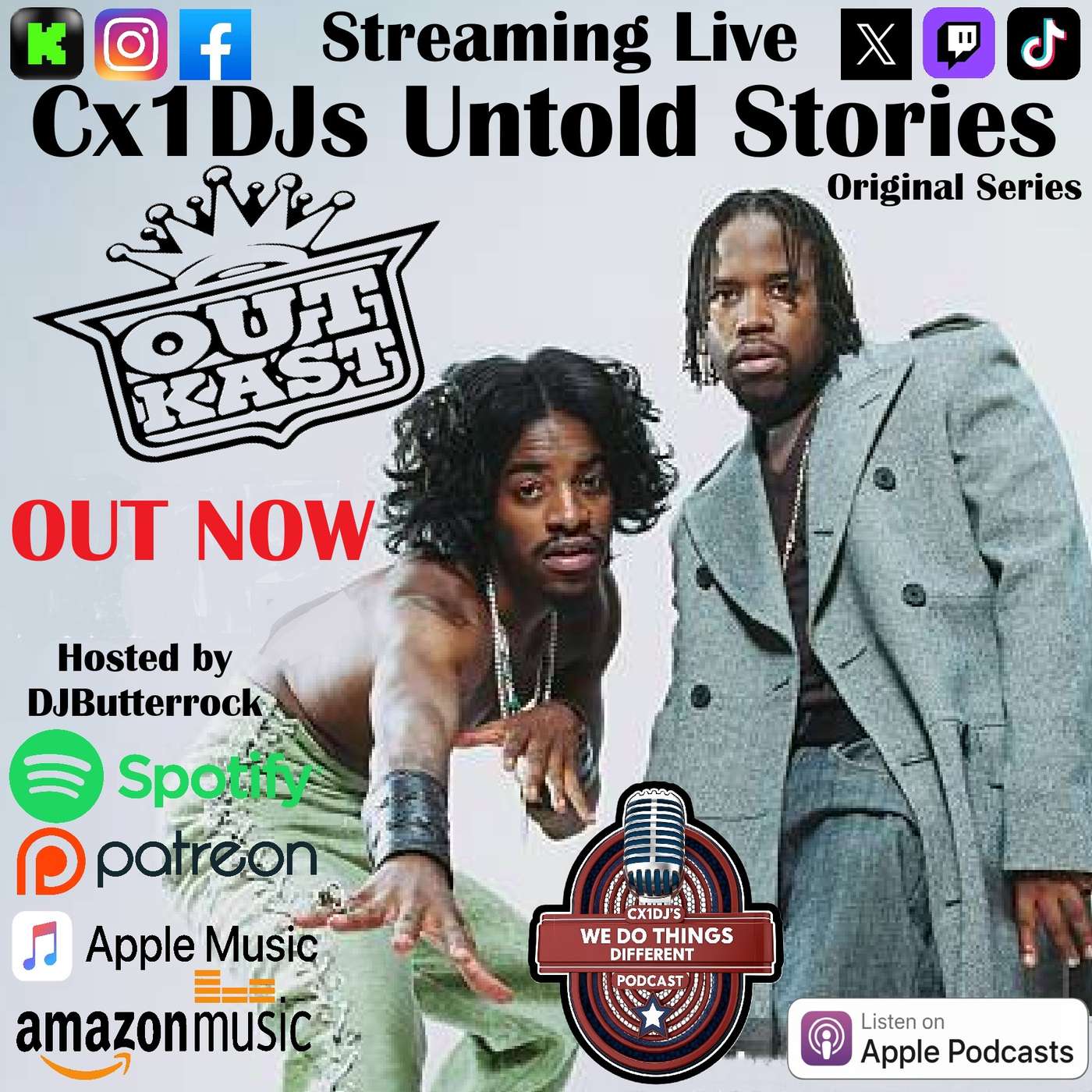
    Cx1DJs We Do Things Different Podcast "Untold Stories of Outkast" hosted by DJButterrock

    Cx1DJs We Do Things Different Podcast "Untold Stories of Outkast" hosted by DJButterrock Outkast (sometimes written as OutKast) was an American hip-hop duo formed in Atlanta, Georgia, in 1992, consisting of Big Boi (Antwan Patton) and André 3000 (André Benjamin, formerly known as Dré).[1] Widely regarded as one of the greatest and most influential hip-hop acts of all time,[4][5] the duo achieved both critical acclaim and commercial success from the mid-1990s to the mid-2000s, helping to popularize Southern hip-hop[1] with their intricate lyricism, memorable melodies, and positive themes,[6] while experimenting with a diverse range of genres such as funk, psychedelia, jazz, and techno. Patton and Benjamin formed Outkast as high school students. They released their debut studio album Southernplayalisticadillacmuzik in 1994, which gained popularity after its single "Player's Ball" peaked atop the Billboard Hot Rap Songs chart. The duo further experimented and honed their sound with their second and third albums ATLiens (1996) and Aquemini (1998), both of which were met with critical acclaim. They then achieved mainstream recognition and continued acclaim with their fourth album Stankonia (2000), which was supported by the singles "B.O.B." and "Ms. Jackson", the latter of which topped the Billboard Hot 100 and won Best Rap Performance by a Duo or Group at the 44th Annual Grammy Awards. The duo then released the double album Speakerboxxx/The Love Below (2003), their only album to debut atop the Billboard 200. It received Diamond certification by the Recording Industry Association of America (RIAA), was supported by the number one singles "The Way You Move" (performed by Big Boi) and "Hey Ya!" (performed by André 3000), and won Album of the Year at the 46th Annual Grammy Awards. Outkast starred in the 2006 musical film Idlewild and recorded the film's accompanying soundtrack, which was released as their final album three days before the film's release. The duo split the following year, and both members have pursued solo careers. Outkast temporarily reunited in 2014 to celebrate their debut album's 20th anniversary with performances at more than 40 festivals worldwide, beginning at the Coachella Festival in April 2014.[7] Along with being one of hip-hop's most influential acts, Outkast is also one of the most successful, having certified sales of 20 million records between six studio albums and a compilation album, as well as having earned six Grammy Awards.[8][9][10][11] In 2015, Rolling Stone ranked them No. 7 on its list of the "20 Greatest Duos of All Time",[12] while publications such as it and Pitchfork have listed their albums among the best in all of hip-hop and of all time. Outkast was inducted into the Rock and Roll Hall of Fame on November 8, 2025.[13][14]

  • #156
    Tuesday · 2 hr 28 min

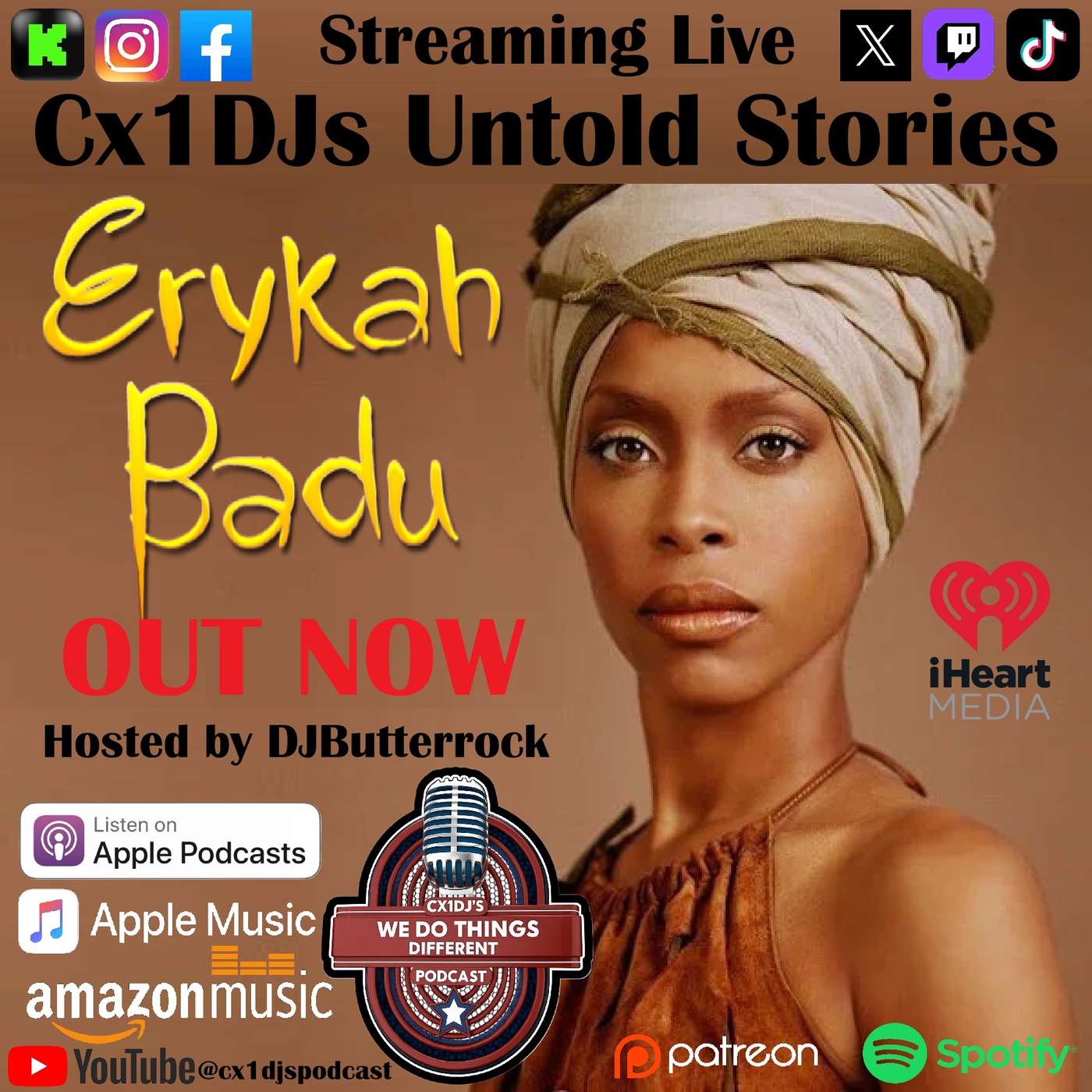
    Cx1DJs We Do Things Different Podcast "Untold Stories of Erykah Badu" hosted by DJButterrock

    Cx1DJs We Do Things Different Podcast "Untold Stories of Erykah Badu" hosted by DJButterrock Erica Abi Wright (born February 26, 1971),[2] known professionally as Erykah Badu, is an American singer, songwriter, record producer, and actress. Influenced by R&B, soul, and hip-hop,[2] Badu rose to prominence in the late 1990s when her debut studio album Baduizm (1997), placed her at the forefront of the neo soul movement, earning her the nickname "Queen of Neo Soul" by music critics. Badu's career began after opening a show for D'Angelo in 1994 in Fort Worth, which led to record label executive Kedar Massenburg signing her to Kedar Entertainment.[2] Badu's first album, Baduizm, was released in February 11, 1997.[3] It spawned four singles: "On & On", "Appletree", "Next Lifetime" and "Otherside of the Game". The album was certified triple platinum by the Recording Industry Association of America (RIAA).[4] Badu's first live album, Live, was released in November 1997, and contained her signature song "Tyrone" and was subsequently certified double platinum by the RIAA.[4] Badu's second studio album, Mama's Gun, was released in 2000.[5] It spawned three singles: "Bag Lady", which became her first top 10 single on the Billboard Hot 100 peaking at number 6, "Didn't Cha Know?" and "Cleva". The album was certified platinum by the RIAA.[4] Badu's third album, Worldwide Underground, was released in 2003.[6] It generated three singles: "Love of My Life (An Ode to Hip-Hop)", "Danger" and "Back in the Day (Puff)", with the first becoming her second song to reach the top 10 of the Billboard Hot 100, peaking at number 9. The album was certified gold by the RIAA.[4] Badu's fourth album, New Amerykah Part One, was released in 2008.[7] It spawned two singles: "Honey" and "Soldier". New Amerykah Part Two was released in 2010 and fared well both critically and commercially. It contained the album's lead single "Window Seat", whose music video sparked controversy. Badu's voice has been compared to jazz singer Billie Holiday.[8][9][10] Early in her career, Badu was recognizable for her style, which often included wearing very large and colorful headwraps. She was a core member of the Soulquarians. As an actress, she has played a number of supporting roles in movies including Blues Brothers 2000, The Cider House Rules and House of D. She also has appeared in the documentaries Before the Music Dies and The Black Power Mixtape 1967-1975.

  • #155
    Monday · 2 hr 28 min

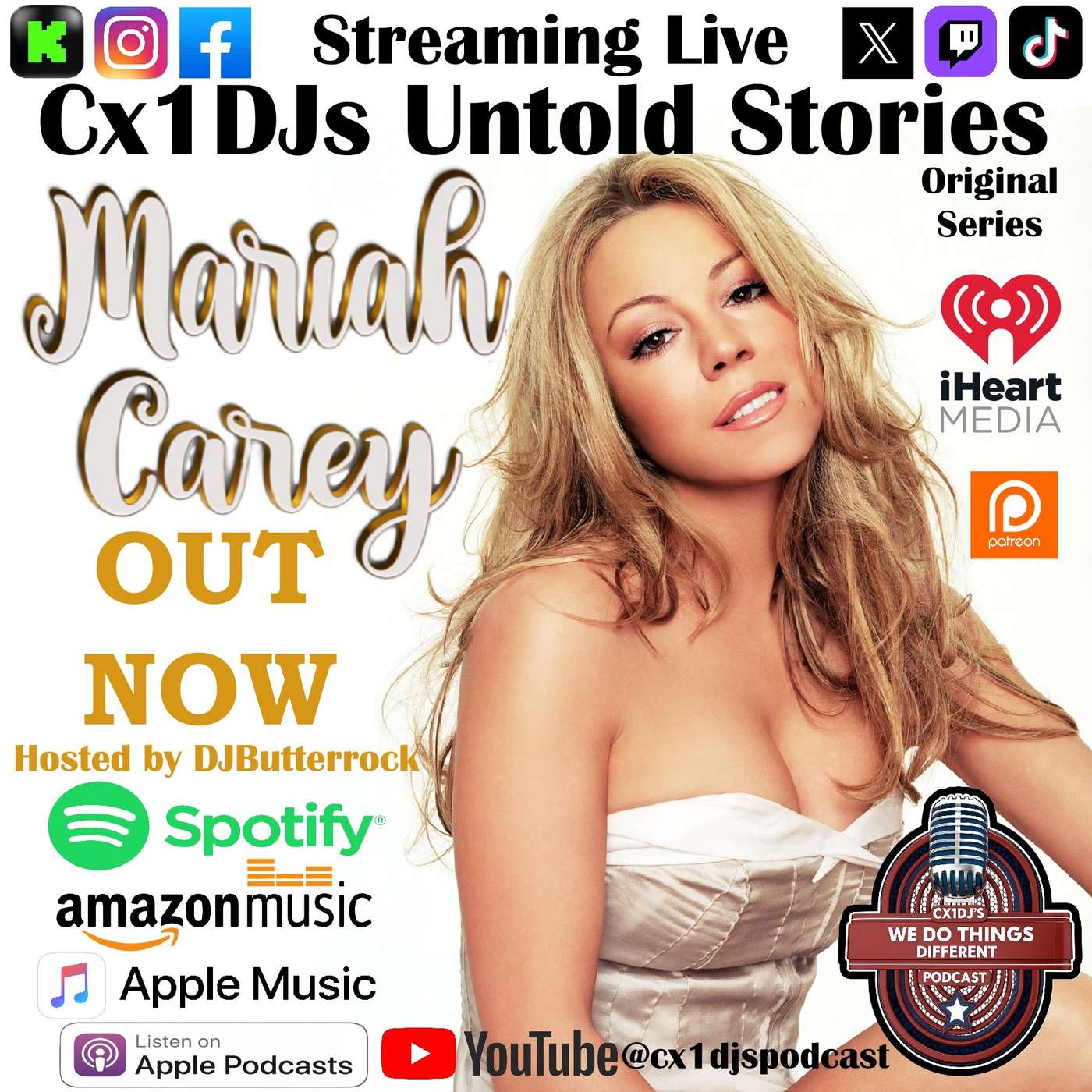
    Cx1DJs We Do Things Different Podcast "Untold Stories of Mariah Carey" hosted by DJButterrock

    Cx1DJs We Do Things Different Podcast "Untold Stories of Mariah Carey" hosted by DJButterrock Mariah Carey (/məˈraɪə/ ⓘ mə-RY-ə;[1]: 0:01 born March 27, 1969)[a] is an American singer, songwriter, record producer, and actress. Dubbed the "Songbird Supreme", Carey is known for her five-octave vocal range, melismatic singing style, signature use of the whistle register, and diva persona. An influential figure in popular culture, she was ranked as the fifth-greatest singer of all time by Rolling Stone in 2023. Carey rose to fame with her 1990 self-titled debut album and became the only artist to have their first five singles reach number one in the US, from "Vision of Love" to the title track of her second album, Emotions (1991). She achieved international success with the best-selling albums Music Box (1993) and Daydream (1995). The remix to "Fantasy", with Ol' Dirty Bastard, introduced her new image and hip-hop-inflected sound, which she later embraced on Butterfly (1997) and Rainbow (1999). With eleven consecutive years of US number-one singles, Carey was named by Billboard as the Artist of the Decade. Following a career decline, she made a comeback with The Emancipation of Mimi (2005), her 21st-century bestseller. Carey's life and career have received widespread media coverage. She has been dubbed the "Queen of Christmas" due to the enduring popularity of her Christmas music, particularly Merry Christmas (1994), one of the best-selling holiday albums. Its lead single, "All I Want for Christmas Is You", is the longest-running number-one song on the Billboard Hot 100 and the best-selling holiday single by a woman. Outside of music, she co-founded the youth program Camp Mariah in 1994; starred in films such as Glitter (2001), Precious (2009), The Butler (2013), and The Lego Batman Movie (2017); and served as a judge on American Idol (2013). Her 2020 memoir, The Meaning of Mariah Carey, reached number one on The New York Times Best Seller list. Carey is one of the best-selling music artists in history, with estimated sales of over 220 million records. She has the most Billboard Hot 100 number-one singles of a solo artist (19), a female songwriter (18), and a female producer (15), spending a record 101 weeks atop the chart. "One Sweet Day" and "We Belong Together" were ranked by Billboard as the most successful songs of the 1990s and 2000s, respectively. Her accolades include 5 Grammy Awards, a Grammy Global Impact Award, 10 American Music Awards, 19 World Music Awards, 14 Billboard Music Awards, the Michael Jackson Video Vanguard Award, and an induction into the Songwriters Hall of Fame. One of the highest-certified artists in the US, Carey has four diamond certifications from the Recording Industry Association of America

  • #154
    September 11 · 2 hr 7 min

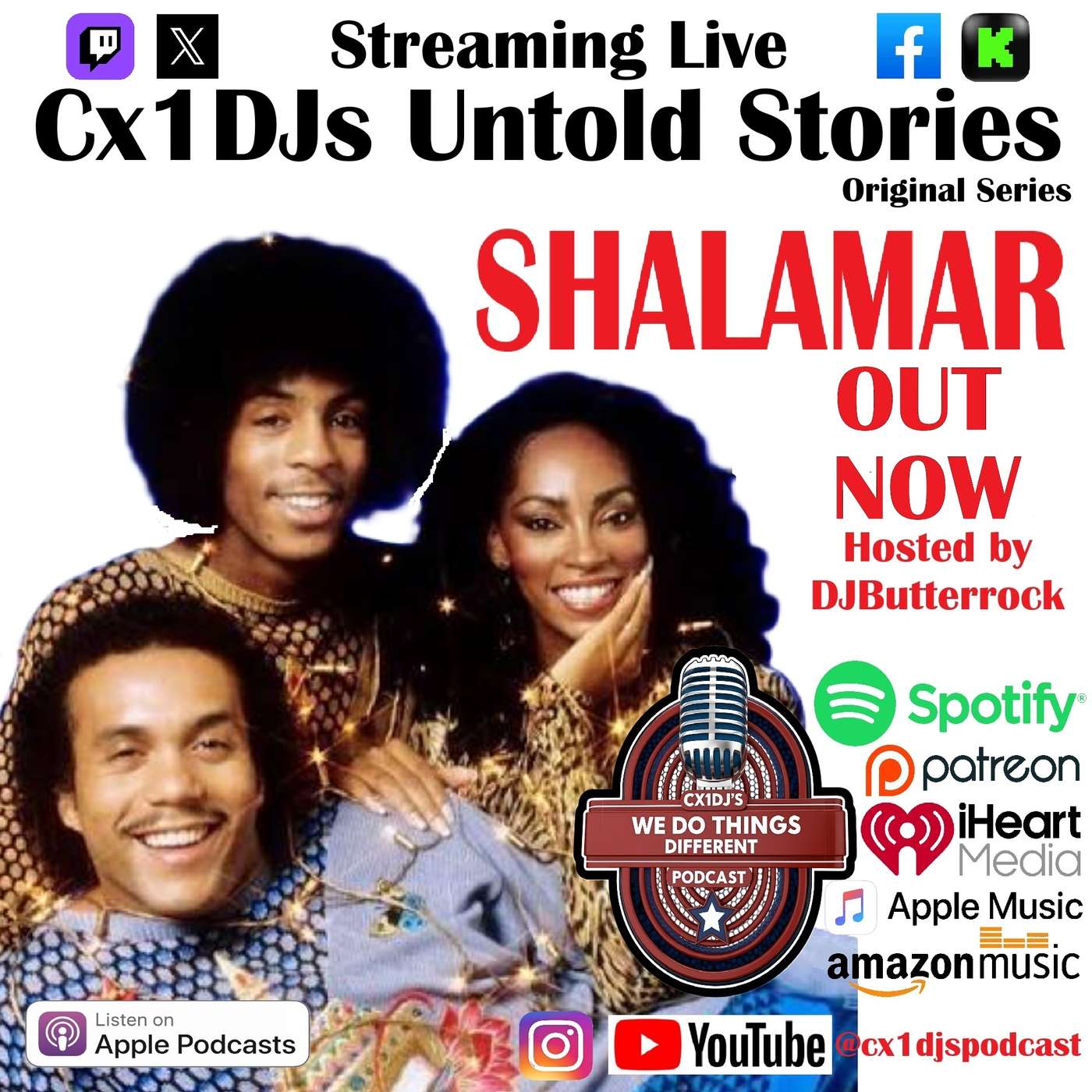
    Cx1DJs We Do Things Different Podcast "Untold Stories of Shalamar" hosted by DJButterrock

    Cx1DJs We Do Things Different Podcast "Untold Stories of Shalamar" hosted by DJButterrock Shalamar (/ˈʃɑːləmɑːr/, /ˈʃæ-/) is an American R&B and soul music vocal group created by Dick Griffey and Don Cornelius in 1977 and active throughout the 1980s. Shalamar's classic lineup on the SOLAR label consisted of Howard Hewett, Jody Watley, and Jeffrey Daniel. It was originally a disco-driven group created by Soul Train booking agent Dick Griffey and show creator and producer Don Cornelius.[1][2] They went on to be an influential dance trio managed by Dick Griffey. Initially signed to Soul Train Records they transferred to Griffey's Solar Records after the Cornelius-Griffey Entertainment company was dissolved.[3] According to British Hit Singles & Albums, they were fashion icons and trendsetters, and helped to introduce "body-popping" to the United Kingdom.[3] Their name was created by Griffey.[4] Career Shalamar in 1982 The first hit credited to Shalamar was "Uptown Festival" (1977), which was recorded at Ike & Tina Turner's studio Bolic Sound in 1976.[5] It was released on Soul Train Records. Its success inspired Griffey and Don Cornelius to replace session singers with popular Soul Train dancers Jody Watley and Jeffrey Daniel, to join original Shalamar lead singer Gary Mumford. Gerald Brown took over the spot vacated by Mumford for the group's second album, Disco Gardens (1978), which featured the hit "Take That to the Bank". After conflicts over lack of payment from Griffey and SOLAR (short for Sound of Los Angeles Records), Brown left the group.[6] Howard Hewett replaced Brown in 1979.[2] The group was joined up with producer Leon Sylvers III in 1979, signed with SOLAR, and scored a US million seller with "The Second Time Around" (1979).[7] The "classic" lineup of Hewett, Watley and Daniel would be the most successful. Shalamar in 1982 In the UK, the group had a string of hits with songs such as "Take That to the Bank" (1978), "I Owe You One" (1980), and songs from the Platinum-certified[8] Friends (1982) album: "I Can Make You Feel Good" (1982), "A Night to Remember", the BPI Silver-certified[9] "There It Is", and the title track "Friends".[1] The album, which crossed the genres of pop, disco, and soul, was also a big seller in the UK in 1982.[10] The band's record sales in the UK increased when Daniel demonstrated his body-popping dancing skills on BBC Television's music programme, Top of the Pops, which had premiered the moonwalk on television for the first time.[11] Michael Jackson was a fan of Shalamar, particularly Daniel and his dance moves, after watching him on Soul Train.[11] Daniel and Jackson co-choreographed Jackson's "Bad" and "Smooth Criminal" videos from the album Bad (1987).[12] Shalamar in 1982 The Hewett-Watley-Daniel lineup of Shalamar scored a total of three Gold albums in the U.S.: Big Fun (1979), Three for Love (1980) and Friends (1982).[1][7] In 1983, prior to the release of The Look, Watley and Daniel left Shalamar due to conflicts within the group as well as issues with Dick Griffey and SOLAR.[13] Although The Look wasn't as successful as Friends had been the previous year, it still went Gold in the UK,[14] where it yielded a number of hit singles, including "Disappearing Act", the Grammy-nominated "Dead Giveaway", and "Over and Over", and featured more of a new wave/synth-pop sound than previous albums. After Micki Free and Delisa Davis replaced Daniel and Watley in the group's lineup,[2] Shalamar reached number 17 on the Billboard Hot 100 with "Dancing in the Sheets", featured on the Footloose soundtrack album, and contributed "Don't Get Stopped in Beverly Hills," written by Hewett, Free, and David "Hawk" Wolinski, to the Beverly Hills Cop soundtrack, which won the 1985 Grammy Award for Best Album of Original Score Written for a Motion Picture or Television Special; the award was given to all 14 of the soundtrack's songwriters. Both "Dancing in the Sheets" and "Don't Get Stopped in Beverly Hills" were included on Shalamar's eighth album, Heartbreak, released in November 1984. Hewett departed the group in 1985 to begin a solo career, later returning in 2001 and current member since. Sydney Justin took over as lead vocalist for Circumstantial Evidence (1987),[2] coproduced by Babyface and L.A. Reid, and Wake Up (1990), Shalamar's final pair of albums before they disbanded.

  • #153
    September 10 · 1 hr 38 min

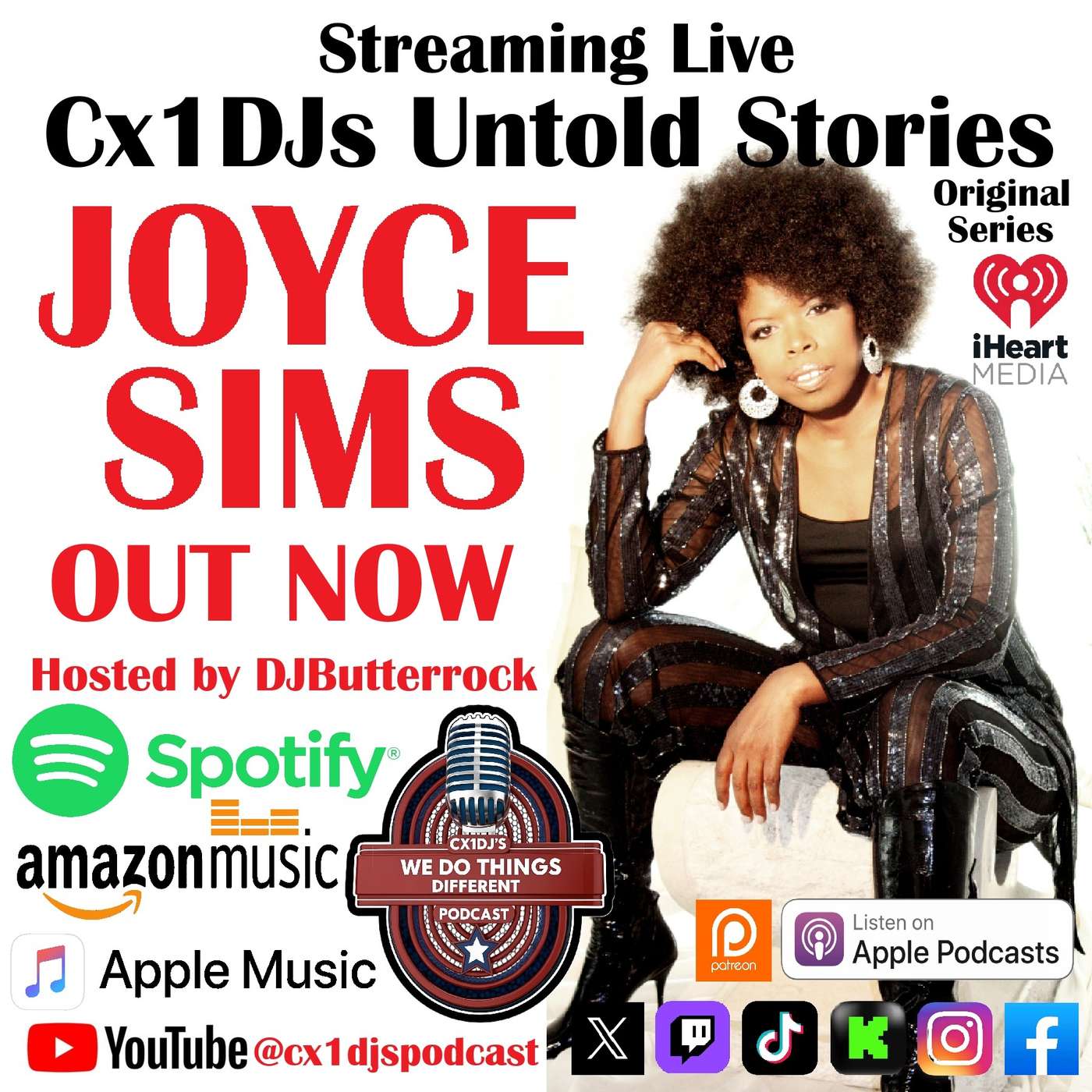
    Cx1DJs We Do Things Different Podcast "Untold Stories of Joyce Sims" hosted by DJButterrock

    Cx1DJs We Do Things Different Podcast "Untold Stories of Joyce Sims" hosted by DJButterrock Joyce Elizabeth Sims-Sandiford (August 6, 1959 – October 13, 2022) was an American singer and songwriter, whose biggest hit single, "Come into My Life", reached the top 10 in both the US Billboard R&B Chart and the UK Singles Chart in 1987. Early life and education Sims was born in Rochester, New York,[2] on August 6, 1959.[3] She formally studied music in college, learning a number of instruments. Sims was of the Baptist faith.[4] Career In 1986, Sims signed with the now-defunct record label Sleeping Bag Records.[2] Her first hit single was "(You Are My) All and All" in 1986, which was produced by Kurtis Mantronik and reached No. 16 on the UK Singles Chart. It entered the US Dance Chart at #51; peaking at No. 6. Sims followed up in 1988 with "Come into My Life" also produced by Kurtis Mantronik which peaked at No. 10 on the US Billboard R&B Chart and No. 7 on the UK Singles Chart. This became her biggest success, although it was her only top-10 single on the R&B chart. Both "All and All" and her remake of "Love Makes a Woman" with Jimmy Castor were also chart entries.[2] Sims' debut album, Come into My Life, reached No. 22 in the US R&B album chart and No. 5 in the UK Albums Chart[5] following the Top 10 success of the title track in the UK Singles Chart.[5] All songs on the album were written by Sims except for "Love Makes a Woman". Sims' second album, All About Love, was released in 1989 and reached No. 64 in the UK Albums Chart.[5] In 1994, Sims released the single "Who's Crying Now" on Warlock Records, which absorbed her Sleeping Bag Records contract after purchasing the label in 1992. In 2006, she released the single "What the World Needs Now is Love," from her album A New Beginning, after teaming up with record producers Junior Vasquez and Glen Frisica. In 2009, Come into My Life: the Very Best of Joyce Sims, a double-CD of her greatest hits and remixes was released, which includes the original studio versions on the first disc and extended mixes on the second disc. That same year, she formed a record label, August Rose Records, and started work on a new album. In 2014, Sims released the album Love Song, which includes a duet with reggae vocalist Maxi Priest. Sims' music can be heard on the soundtrack of the film Species, and her songs have been recorded or sampled by Randy Crawford, Angie Stone, and Snoop Dogg.[citation needed] Sims released "Wishing You Were Here" on her own record label, August Rose Records, and another album, Back in Love Again.[6]

  • #152
    September 9 · 2 hr 2 min

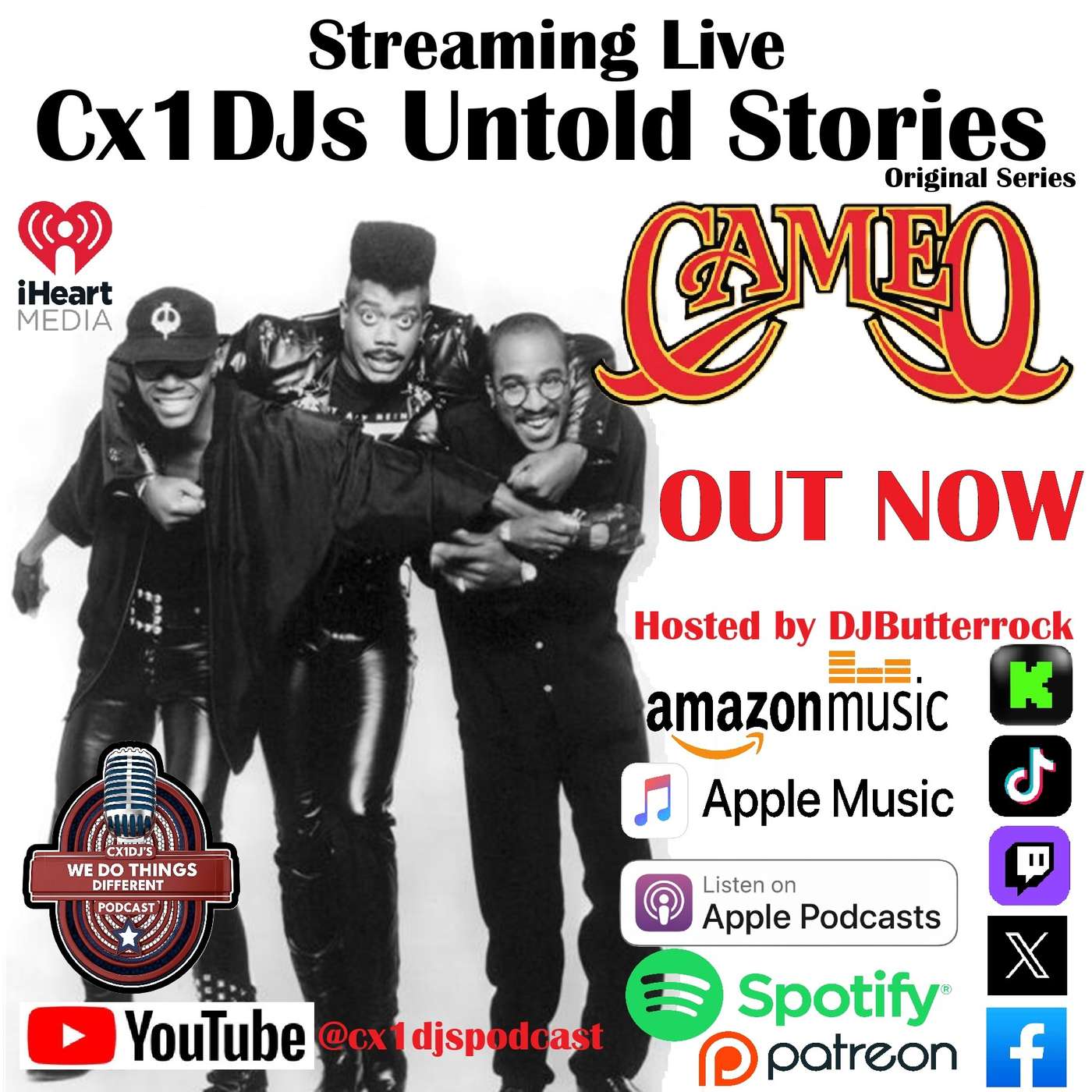
    Cx1DJs We Do Things Different Podcast "Untold Stories of Cameo" hosted by DJButterrock

    Cx1DJs We Do Things Different Podcast "Untold Stories of Cameo" hosted by DJButterrock Cameo's first album was Cardiac Arrest which included the hit single, "Rigor Mortis". Follow up albums We All Know Who We Are, Ugly Ego and Secret Omen contained dance floor songs such as "I Just Want to Be" and "It's Serious", the latter of which was used for a dance contest scene in the 1978 film Thank God It's Friday. The band's debut single, "Find My Way", was a disco song that was used in the film, and was included on the Thank God It's Friday soundtrack. ("Find My Way" was their cover of a 1972 Three Degrees and a 1969 Tymes tune.) Bassist Aaron Mills joined the band in 1978, after a stint in Donald Byrd's jazz-funk collective N.C.C.U., which toured with Cameo. [7] 1979–1993: Mainstream breakthrough The 1979 single, "I Just Want to Be", reached number 3 on the Billboard magazine Top R&B/Hip-Hop Albums chart, and along with the follow-up single, the top 10 R&B ballad "Sparkle", pushed the album Secret Omen to gold status with sales of over 500,000 copies, the band's first album to achieve this status. Their next album, Cameosis, came out in 1980 and also achieved gold status thanks in large part to the funk classic "Shake Your Pants", the mid-tempo single "We're Goin' Out Tonight", and the ballad "Why Have I Lost You" (a re-recording of a song from their 1978 album We All Know Who We Are). It reached number 1 on the Billboard R&B chart and number 25 on the Billboard 200 chart. Their second album of 1980, Feel Me, 1981's Knights of the Sound Table and 1982's Alligator Woman also went gold and saw the band playing up their eclectic style. Band members Aaron Mills, Thomas "TC" Campbell and Jeryl Bright briefly left the band in 1983 to form a spinoff group called MCB.[7] The band released She's Strange in 1984, which performed well and hit number 1 on the Billboard R&B chart and 26 on the Billboard 200. The album's title track, eponymous single became the band's first number 1 R&B hit, as well as their first charting pop single; reaching number 47 on the Billboard Hot 100. 1985's album Single Life, featuring the title track and "Attack Me with Your Love", hit number 2 on the Top R&B chart. The single "Word Up!" was released in 1986 and reached number 1 on the Billboard R&B chart, plus number 6 on the Billboard Hot 100, becoming the band's biggest single on the pop chart. The follow-up single "Candy" reached number 1 R&B and 21 pop, while their next release, "Back and Forth", went to number 3 R&B and number 50 pop. Meanwhile, the accompanying album also hit numbers 8 and 1 on the Billboard 200 and Top R&B charts respectively, becoming their highest-charting album.[1] Two years later, Cameo released Machismo to mixed critical reviews and dropped to chart at numbers 10 and 56 on the Top R&B/Hip-Hop Albums and Billboard 200 charts respectively. Cameo then followed up with 1990's Real Men... Wear Black and 1992's Emotional Violence. The previous release was followed by two compilation albums in between the time of their next recording.[1] 1994–2000: Later years In 1994, In the Face of Funk was released on the band's independent label and hit 10 on the Top R&B/Hip-Hop Albums chart. This album was then followed by a six-year unofficial hiatus with several compilation releases, until the next album Sexy Sweet Thing in 2000. The album hit 64 on the Top R&B/Hip-Hop Albums chart, and is their most recent charting release.

  • #151
    September 8 · 2 hr 1 min

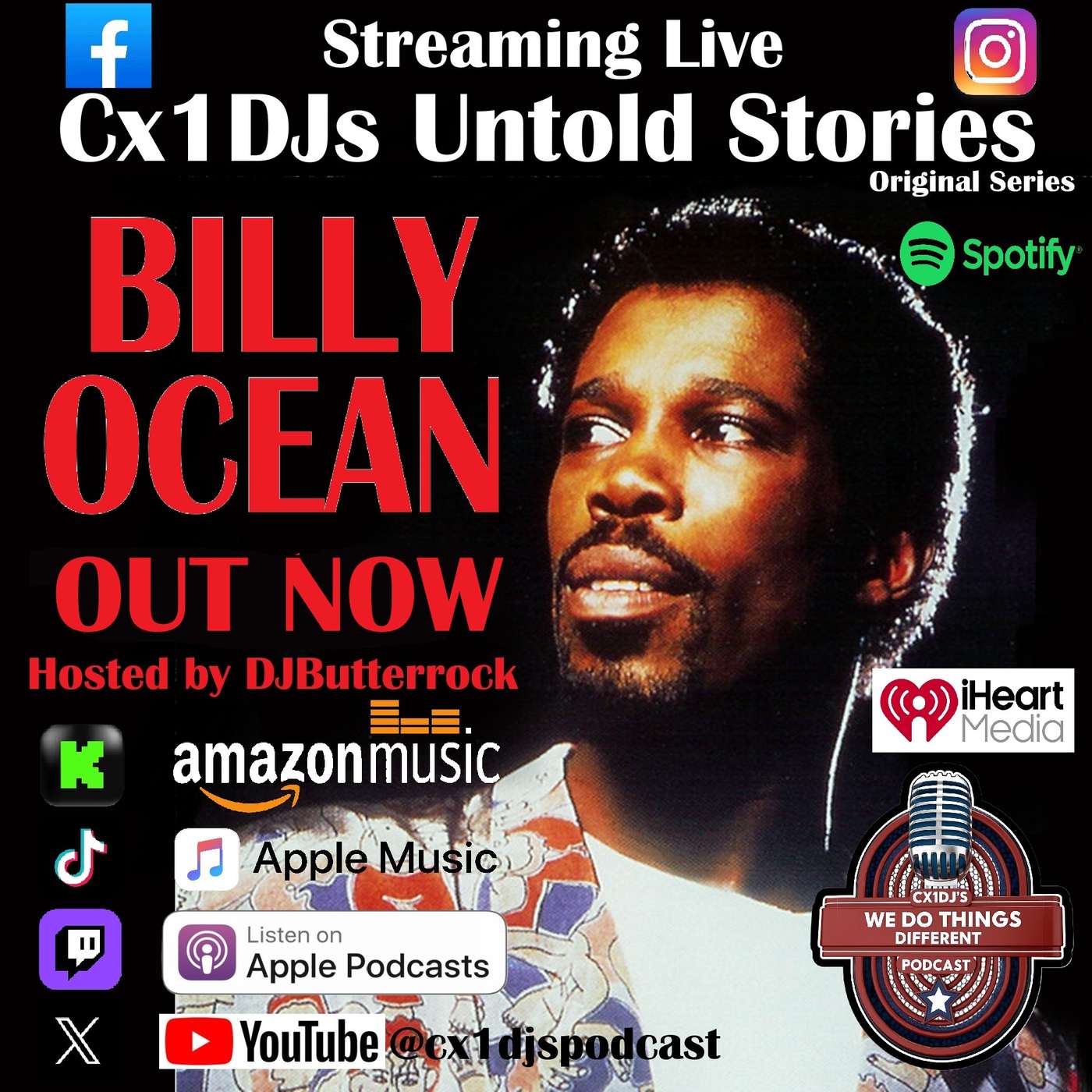
    Cx1DJs We Do Things Different Podcast "Untold Stories of Billy Ocean" hosted by DJButterrock

    Cx1DJs We Do Things Different Podcast "Untold Stories of Billy Ocean" hosted by DJButterrock Leslie Sebastian Charles (born 21 January 1950), known professionally as Billy Ocean, is a Trinidadian-British singer and songwriter. Between 1976 and 1988, he had a series of hit songs in the UK and internationally. He achieved breakthrough success with the 1976 single "Love Really Hurts Without You". His second single was released under the stage name Billy Ocean, and peaked at no. 2 in the UK and no. 3 in Australia. In 1977, his single "Red Light Spells Danger" also peaked at no. 2. He released the single "Caribbean Queen (No More Love on the Run)" in 1984. In the UK, the song peaked at no. 6. In the U.S., it entered the Billboard Hot 100 at no. 85 but peaked at no. 1 ten weeks later. Ocean won the 1985 Grammy Award for Best Male R&B Vocal Performance for the song. It also charted in Australia, Canada, Ireland, New Zealand, South Africa and across Europe under three different titles. In 1985, "When the Going Gets Tough, the Tough Get Going" peaked at no. 1 in the UK and no. 2 in the U.S. the following year. In July of 1986, he achieved an American no. 1 with the single "There'll Be Sad Songs (To Make You Cry)". In 1988, his single "Get Outta My Dreams, Get into My Car" reached no. 1 in the U.S. and no. 3 in the UK. In 2010 he received a Lifetime Achievement Award at the MOBO Awards and he was appointed Member of the Order of the British Empire (MBE) in the 2020 New Year Honours for services to music. Early life and stardom Ocean was born on 21 January 1950 in Fyzabad, Trinidad and Tobago, to Violet and her husband Hainsley Charles, a Grenadian musician.[1][2][3][4] He moved to Romford, Essex, England, when he was 10 years old, shortly before Trinidad and Tobago became independent in 1962.[5] While also working as a tailor in London's Savile Row he sang regularly in a London nightclub.[2] He was discovered by his first manager, John Morphew, who recorded a double A-side single at Pye Studios in London with a full orchestra. However, the ballad-singing style of Ocean was going out of fashion, and Morphew was unable to get any major label to release it, so remains unreleased. Ocean's father — who had countersigned the management contract as Ocean was underage — asked Morphew to release him from the recording contract, which he did without penalty. On 3 March 1969, he joined a local London band as lead vocalist, the Shades of Midnight, who were still active in 2024.[6] He left The Shades of Midnight on 20 July 1969 with keyboard player, Les Thompson to form Dry Ice. It was with this band he was discovered by David Myers and John Worsley playing at The Marquis of Salisbury in Balls Pond Road N1. With them the band recorded one of Les Thompson's compositions, "Never", but session musicians were engaged to back Les Charles singing "Nashville Rain",[7][8] his first single, backed with "Sun in the Morning", in 1971 for Spark Records. Les Charles left Dry Ice in February 1971 and for two years fronted a studio band called Scorched Earth, with whom he released "On The Run" backed with "Super Woman, Super Lover" in 1974. In an interview with Myf Warhurst on ABC Radio Melbourne, Ocean stated that the story of his stage name being taken from the local Ocean Estate, Stepney in London's East End,[9] where he was living at the time, was incorrect. According to the interview, the name was derived from a local football team that was in his home town in Trinidad and Tobago, who called themselves "Oceans 11".[10]

  • #150
    September 7 · 2 hr 10 min

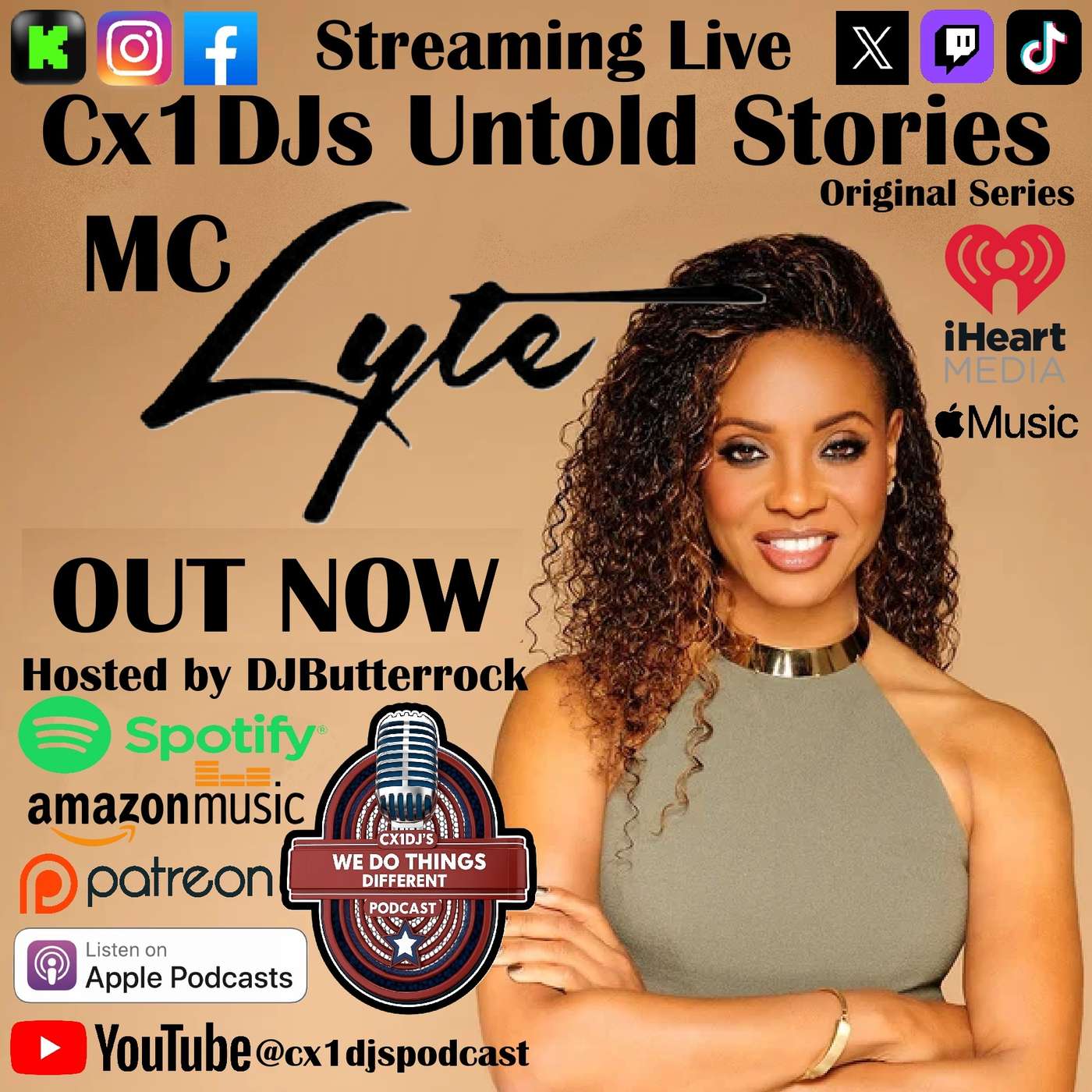
    Cx1DJs We Do Things Different Podcast "Untold Stories of MC Lyte" hosted by DJButterrock

    Cx1DJs We Do Things Different Podcast "Untold Stories of MC Lyte" hosted by DJButterrock Lana Michele Moorer (born October 11, 1970), better recognized by her stage name MC Lyte, is an American rapper, songwriter, actress, television announcer, and businesswoman. Regarded as a pioneer in the field of female rap,[5][6][7] MC Lyte initially gained fame in the late 1980s, becoming the first female rapper to release a full solo album with 1988's critically acclaimed Lyte as a Rock. The album spawned the singles "10% Dis" and "Paper Thin".[8][9] In 1989, she joined the supergroup Stop the Violence Movement, and appeared on the single "Self Destruction", which was the inaugural number-one single on the Billboard Hot Rap Singles chart. That same year, she released her second album Eyes on This, which became one of the first albums by a female solo rapper to chart on the Billboard 200.[10][11] That album included the single "Cha Cha Cha". In 1991, MC Lyte released the hit single "Poor Georgie", which marked her first appearance on the Billboard Hot 100. Her 1993 single "Ruffneck", made her the first solo woman rapper to achieve a gold certification from the Recording Industry Association of America (RIAA).[12] In 1994, she collaborated with Janet Jackson on the song "You Want This", and was featured alongside Queen Latifah and Yo-Yo on the remix track "I Wanna Be Down" by Brandy. Throughout her ongoing career, MC Lyte also had collaborations with mainstream artists such as Sinéad O'Connor, Will Smith, Mary J. Blige, Jay-Z, Moby, Aerosmith, Beyoncé and will.i.am. Her 1996 single "Keep On, Keepin' On" featuring Xscape, reached the top ten on Billboard Hot 100. She then collaborated with Missy Elliott on the hit song "Cold Rock a Party", which was her fifth number-one song on the Hot Rap Singles chart. In 2004, she was nominated for a Grammy Award for Best Female Rap Solo Performance for the track "Ride Wit Me". In addition to her current career as a rapper, she has worked in parallel as voiceover talent for various events, writer, DJ and has starred in various roles in film and television. In 2022, has her directional debut with the short film Break Up In Love.[13] Lyte has worked with several charities, including her own foundation, Hip Hop Sisters.[14] Lyte has been cited as an influence to many women in hip-hop. In 2023, Billboard and Vibe ranked her as one of the 50 greatest rappers.[15] She has received the "I Am Hip Hop" Icon Lifetime Achievement from the BET Hip Hop Awards, and was honored at the VH1 Hip Hop Honors. In October 2014, Lyte become the first female artist to perform Hip Hop at the White House.[16] In September 2016, she was awarded with the W. E. B. Du Bois Medal, Harvard University's highest honor in the field of African and African-American studies.[17] In 2026, MC Lyte was inducted into the Rock and Roll Hall of Fame through the influence category.[18]

  • #148
    September 4 · 1 hr 59 min

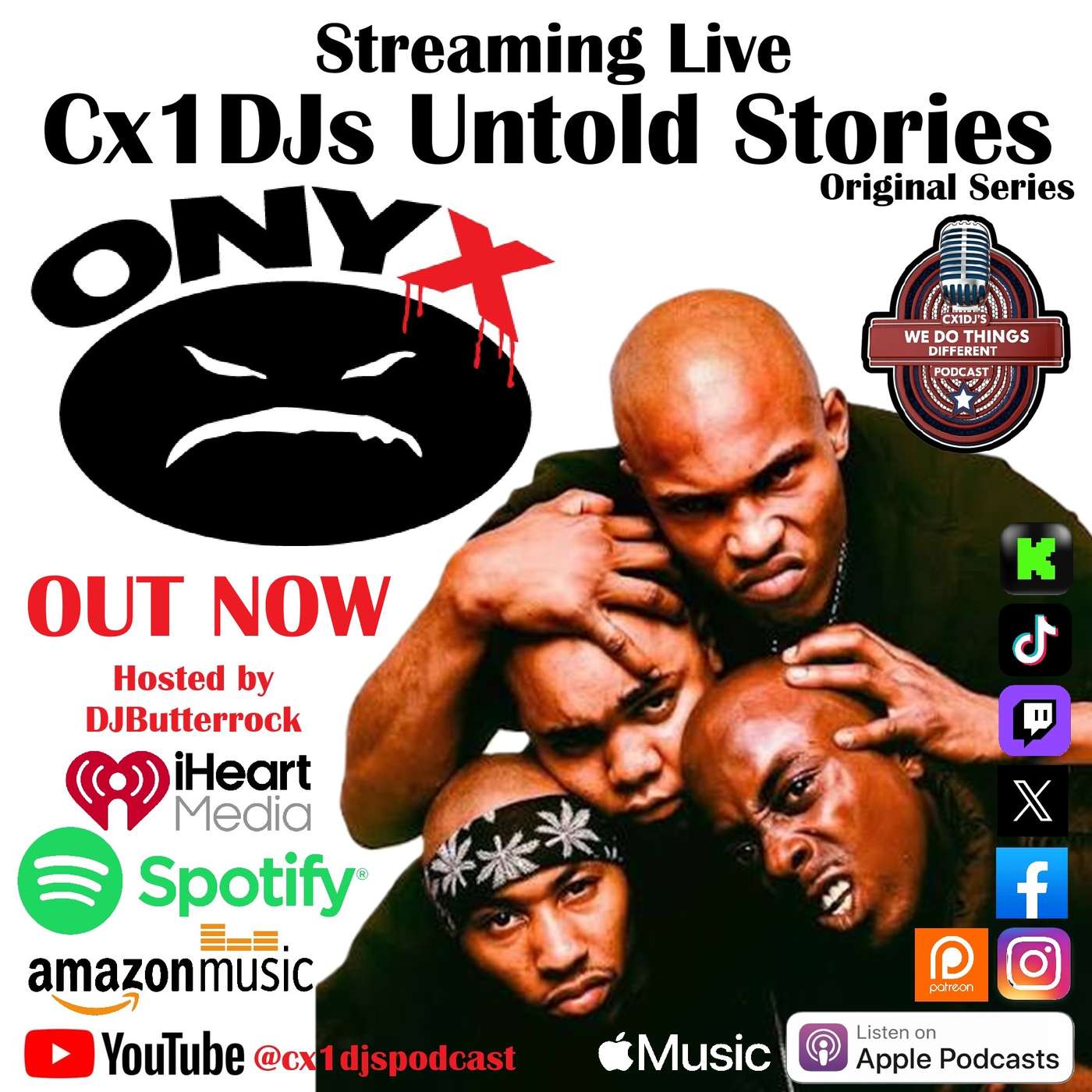
    Cx1DJs We Do Things Different Podcast "Untold Stories of Onyx" hosted by DJButterrock

    Cx1DJs We Do Things Different Podcast "Untold Stories of Onyx" hosted by DJButterrock Onyx is an American hardcore hip hop group from New York City, formed in 1988 by Fredro Starr, Suavé (also known as Sonny Seeza) and the late Big DS. Sticky Fingaz joined the group in 1991. They are best known for their 1993 platinum hit single "Slam",[2] which The Source magazine described as a song that introduced the art of slam dancing into hip-hop.[3] The group has released eight studio albums, three of which have charted in the Billboard 200 albums chart Top 25. Their debut album, Bacdafucup, has been certified platinum,[4] won Best Rap Album at the Soul Train Music Awards and was selected as one of The Source magazine's 100 Best Rap Albums.[5] They have been quoted as describing their style as loud screaming, aggression, fighting with each other, stage diving, throwing water, rapping with grimy voices, and bald head fashion.[6][7][8][9][10][11] History Onyx was formed in 1988 by schoolmates Fredro Starr, Sonny Seeza, and Big DS. They decided to name the band after the onyx stone.[12] The band began recording their first demos in the basement of B-Wiz with drum machine beats from an SP-12.[13] In 1989, Onyx signed Jeffrey Harris as their manager, who helped them secure a contract with the label Profile Records. On April 25, 1990, the group released their first single, Ah, And We Do It Like This, to low sales.[14][15] On July 13, 1991, while in a traffic jam at The Jones Beach GreekFest Festival, the band members met music producer Jam Master Jay,[16][17] who agreed to give them two months to submit a demo to his record company. When the deadline came, Seeza and Big DS couldn't make it to the studio to record the demo,[18] so Jeffrey Harris, the manager of Onyx, asked Fredro to come to the studio with his cousin, Kirk Jones, who at the time was doing a solo career under the name Trop. Fredro and Jones recorded two records for the demo, "Stik 'N' Muve" and "Exercise".[19] The demo was accepted by Jam Master Jay, who signed the band to his record label, Jam Master Jay Records. Jones subsequently joined the band with the stage name Sticky Fingaz. In 1991 the band lost all of its records when its music producer, B-Wiz, was killed while selling cocaine in Baltimore.[15] Later that year, Onyx hired Chyskillz as its new music producer.[13] In 1993, Onyx released their debut album, entitled Bacdafucup. The album proved to be successful, receiving a platinum certification from the RIAA and peaked at No. 10 on the Billboard 200, the group's highest debut at that point. In 1998, the album was selected as one of The Source's 100 Best Albums. Three of the album's songs reached the Billboard charts; "Throw Ya Gunz", "Slam", and "Shiftee". Their breakout single, "Slam", was aired on MTV and BET, causing the song to reach No. 4 on the Billboard Hot 100. "Slam" was certified Platinum by the RIAA on August 10, 1993. In 1994, Big DS left the group to start a solo career, producing music under his own record label called Illyotic Music. In 1995 Onyx released its second album, All We Got Iz Us,[20] and founded its own record label, Armee Records, distributed through MCA Records. Through its record label, the band produced music by Gang Green, All City, Panama P.I., and Choclatt.[21] In April 1995 Marvel Music, a short-lived imprint of Marvel Comics, released a comic book based on the band called "Onyx: Fight!". Written by Karl Bollers and drawn by Larry Lee, the comic depicted a post-apocalyptic New York City where Onyx forms an underground rebellion.[22] In 1998 the band released their third album Shut 'Em Down, which featured appearances from other bands, including X-1, DMX, 50 Cent, All City, Mr. Cheeks, Wu-Tang Clan, N.O.R.E., and Big Pun. Produced by Keith Horne, Self, and others, the album peaked at No. 10 on the Billboard 200, selling 500,000 units.[23] Three of the album's songs reached the Billboard charts; The Worst, Shut 'Em Down, and React. Shut 'Em Down was Onyx's last album on the Def Jam Recordings label.[24] In 2001, Onyx released their fourth album, Bacdafucup Part II, through Koch Records.[25] Produced by Davinci, DR Period, and others, the album included twelve new tracks,[26] including "Feel Me", which was recorded on the night of September 11, 2001, and was dedicated to the events that had happened that day.[27] In 2003 Onyx released their fifth album, Triggernometry, consisting of ten new tracks, with eleven stories from the lives the group's members in between the tracks. On May 22, 2003, former Onyx member Big DS died in a hospital in Queens, New York at the age of 31 after receiving chemotherapy for lymphatic cancer.[28][29][30]

  • #147
    September 3 · 1 hr 41 min

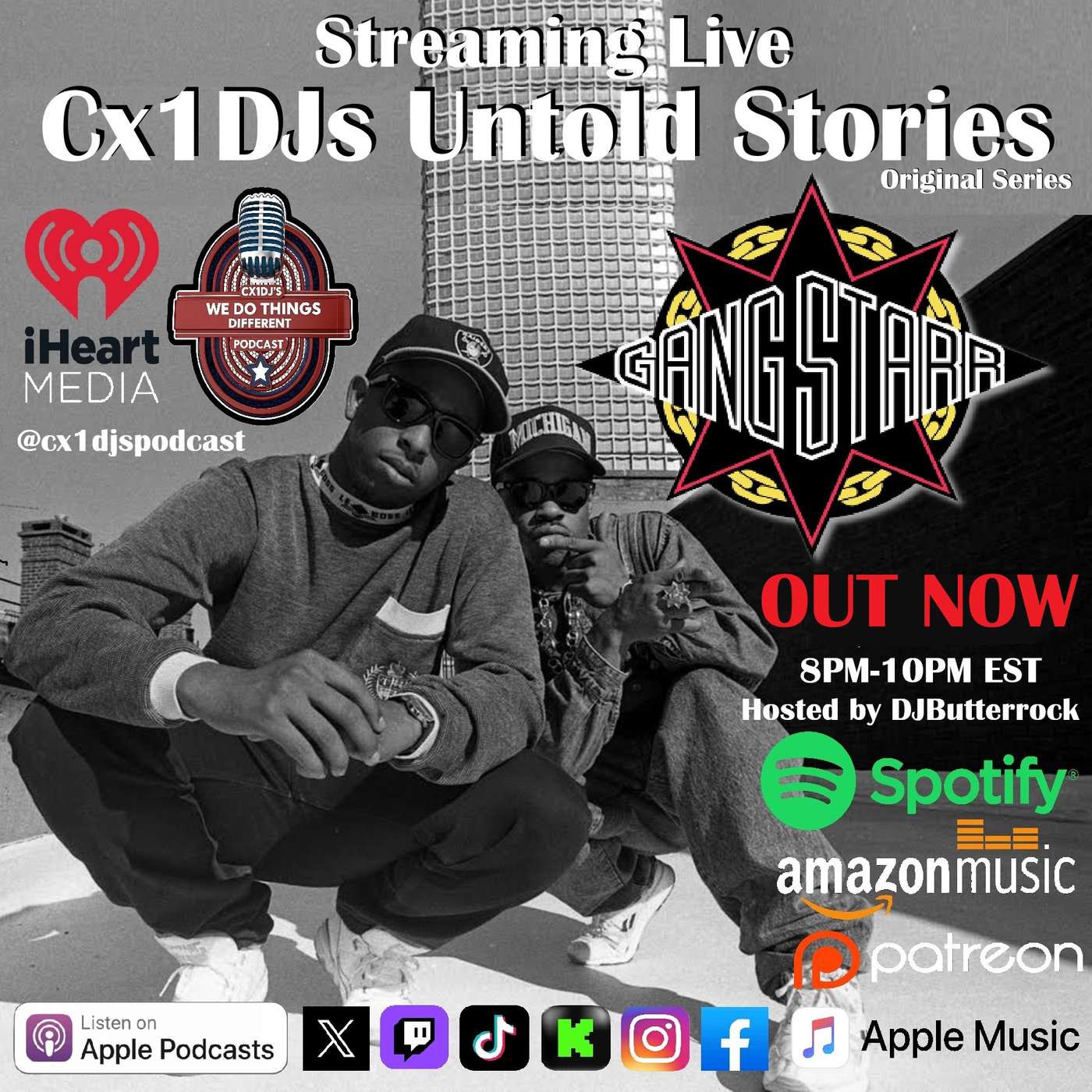
    Cx1DJs We Do Things Different Podcast "Untold Stories of Gang Starr" hosted by DJButterrock

    Cx1DJs We Do Things Different Podcast "Untold Stories of Gang Starr" hosted by DJButterrock Gang Starr were an American hip hop duo, consisting of Houston-born record producer DJ Premier and Boston-based rapper Guru.[1] Gang Starr was at its height from 1985 to 2003, and is considered a widely influential MC-and-producer duo.[2][3] They are recognized for being one of the pioneers of jazz rap active during the golden age of hip hop.[3][4] Some of their top hits include "Mass Appeal", "Take It Personal", "Moment of Truth", "Full Clip" and "Above The Clouds".[5] Career Original and second group lineups The original Gang Starr group was founded in Morehouse College by three friends from Boston, Massachusetts: Guru (then known as MC Keithy E.) who had planned to be a rapper/singer, Big Shug as the main MC and DJ Suave D (Shug's younger brother Dana) as their DJ. After Shug was imprisoned, Suave D quit the group, leaving Guru to enlist the services of MC Damo D-Ski and DJ 1, 2 B-Down (also known as Mike Dee)[6] with various producers, such as Donald D, J.V. Johnson or the 45 King helping out. Their earliest recordings were in 1986 where they made various demos.[7] In 1987 and 1988, Gang Starr released three 12-inch vinyl singles on Wild Pitch Records. Breakup and partnering with DJ Premier Gang Starr performing in Hamburg in 1999 In 1989, the group split for the second time and the only member willing to continue under the name was Guru. He got in touch with Houston, Texas native DJ Premier (then known as Waxmaster C) who submitted a tape of beats to Wild Pitch records, which Guru liked. He invited DJ Premier to join Gang Starr, relocate with him to Brooklyn and in that same year they released their first single "Words I Manifest" along with the album No More Mr. Nice Guy (1989).[1] In 1990, the group was signed to the Chrysalis record label by then A&R director Duff Marlowe, a former DJ and Los Angeles Times rap music critic. The label offered Guru and Premier unlimited artistic license and major-label distribution worldwide, a platform the group used to become one of the most influential hip hop acts of that decade. During their career Gang Starr helped pioneer the New York City hardcore hip hop sound. The Gang Starr catalog, especially Step in the Arena (1991), Daily Operation (1992), Hard to Earn (1994) and Moment of Truth (1998) are well respected among underground rap fans and critics. Their track "Jazz Thing" was featured on the soundtrack to Spike Lee's film Mo' Better Blues.[1] Gang Starr provided a track, "Battle", for the soundtrack of the 2002 movie 8 Mile. After several albums and tours, in late 2002 DJ Premier left Europe to go back to the United States. Once again Guru was faced with continuing alone and became involved in a European tour in 2003–04 with an alternate DJ. In 2006, Guru indicated in several interviews that Gang Starr had reached its end.[8]

  • #146
    September 2 · 2 hr 35 min

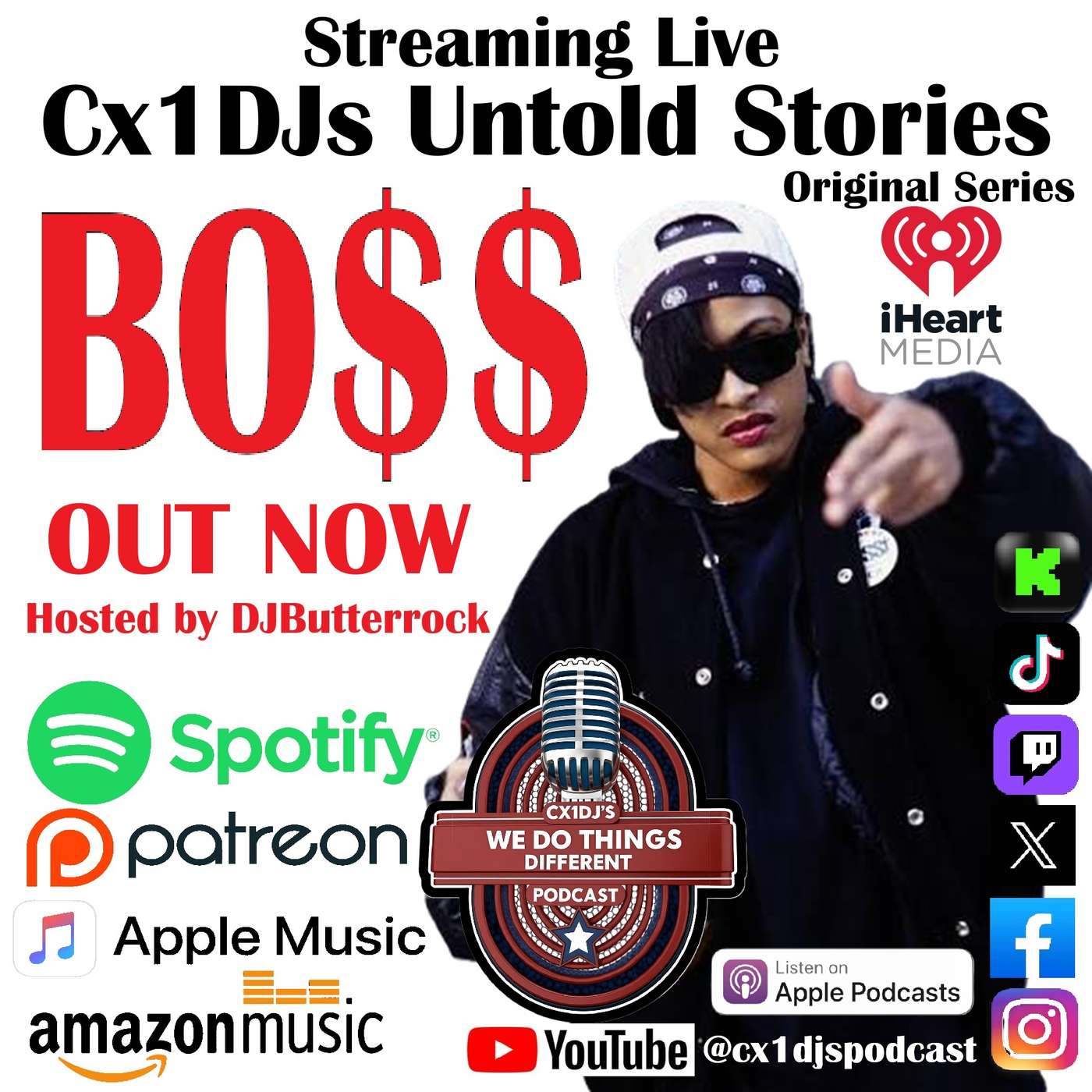
    Cx1DJs We Do Things Different Podcast "Untold Stories of Bo$$" hosted by DJButterrock

    Cx1DJs We Do Things Different Podcast "Untold Stories of Bo$$" hosted by DJButterrock Lichelle Marie Laws (September 12, 1969 – March 11, 2024),[2] better known by her stage name Boss (stylized as Bo$$), was an American rapper from Detroit. Her debut album, Born Gangstaz, reached number three on Billboard's Top R&B/Hip-Hop Albums chart in 1993. Laws became best known as a part of the burgeoning West Coast gangsta rap scene in the early ’90s.[3] Life and career Laws was born in Detroit to Joe Laws, an autoworker, and Lillie, who took her master's degree in education and was a teacher at junior high and middle schools, formerly a teacher of business education at Lewis College of Business, Detroit. Her parents were both church deacons. She had two elder sisters.[4][5] Laws relocated to Los Angeles after graduating high school, accompanied by her DJ Irene 'Dee' Moore. She was spotted by DJ Quik who stuck her on a track with AMG[citation needed]. Russell Simmons liked the track and promptly signed her to Def Jam West.[4] Her debut album Born Gangstaz was released in 1993,[6] and the singles, "Deeper" and "Recipe for a Hoe", hit number one on the Billboard Hot Rap Tracks chart.[7] On the track "Progress Of Elimination", Bo$$'s line "Yes sir master, no sir master- I'll work faster" is an homage to the rapper who influenced her style, Detroit's Derek "Chef Word" Washington. It was a frequent Chef Word bar. In 1994, Laws was interviewed by a reporter from The Wall Street Journal, who revealed that she grew up in a middle-class neighborhood (on the West Side, Detroit), studied ballet and piano, and attended Catholic private school (where she was a cheerleader), before majoring in business for two years at Oakland University.[4][5][8][9] Laws had never attempted to disguise the truth of her upbringing; the intro of her 1993 album Born Gangstaz, "Intro: A Call from Mom", has her mother Lillie describe her as "a young lady who was brought up through Catholic school for 12 years; and dance schools, tap dance, jazz, piano lessons and all of that; plus, you went to college for three years..."[10] "The album is, in fact, bracketed with a mockery of her rearing; phone messages from mama and papa particularizing a privileged suburban upbringing (Catholic-school, piano-playing, tap-dancing)" belying the record's "unyielding vulgarity and embroidered aggression" with a "brilliant... self-mocking disclaimer". Def Jef, who produced the album and suggested the inclusion of Laws's parents, observed, "I can't believe none of the reviews saw the irony of that. No one did!" Having left Detroit for south-side Los Angeles in 1990, Laws and Moore encountered its "squalid side... derelict hotels, feudal gangs, dealing and hustling". Prior to securing a record deal, they lived in poor circumstances, selling drugs, sleeping on benches, and living in low-rent hotels. Her parents were unaware of the lifestyle she was leading. In the wake of her first album, Laws and Moore stopped working together, Laws noting, "We couldn't work together anymore, but we were still cool"; Moore's Def Jam deal never came to anything.[4][5] In the mid-1990s, Laws relocated to Texas to record songs with Ricardo Royal, a.k.a. "Coco Budda", a rapper whose work she had admired. Laws settled in Houston, entered a relationship with Royal, and had a son, Lamar. Although living a more relaxed life, Laws recorded demos for a second album, funded by Def Jam, but the label rejected them, and she was dropped from the label. Laws took this development in stride, noting, "I was used to that kind of shit... I thought I was good enough to get another deal. But I just chilled in Texas. Then I got sick." Still performing shows despite waning popularity in light of her lack of new releases, Laws moved to Dallas with Royal, where she took a job as co-host of a nightly hip-hop radio show on KKDA-FM, where she stayed for five years, recalling in 2004 "that was a bomb job". By 1999, she was suffering kidney failure; she and Royal amicably split up, and she went to live with her parents, undergoing dialysis for three and a half years, experiencing "every complication that you have with... bad kidneys", and given a poor prognosis. At times of comparatively better health, Laws recorded with Def Jef, who praised her dedication, lack of self-pity, and resolve in the face of her health problems. In 2001, she

  • #145
    September 1 · 2 hr 10 min

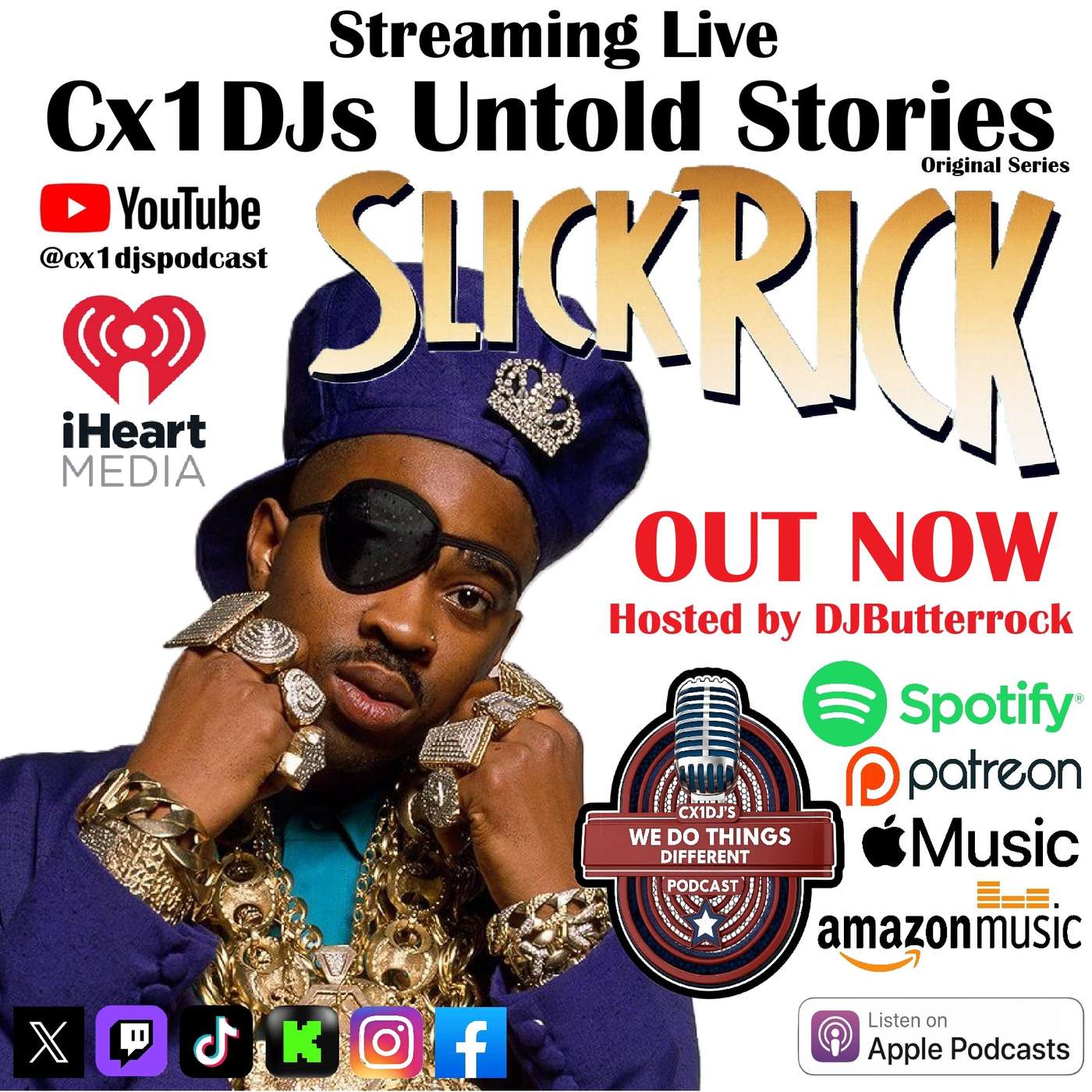
    Cx1DJs We Do Things Different Podcast "Untold Stories of Slick Rick" hosted by DJButterrock

    Cx1DJs We Do Things Different Podcast "Untold Stories of Slick Rick" hosted by DJButterrock Ricky Martin Lloyd Walters[1] (born January 14, 1965),[2] known professionally as Slick Rick, is a British and American rapper and record producer based in New York City. He rose to prominence as part of Doug E. Fresh & the Get Fresh Crew in the mid-1980s. His songs "The Show" and "La Di Da Di" are considered early hip-hop classics, and "La Di Da Di" is considered one of the most sampled songs in history.[3] As Slick Rick, Walters became the third artist to sign with Def Jam Recordings in 1986.[4] He debuted with The Great Adventures of Slick Rick (1988), showcasing his storytelling structure mixed with humor and complex rhymes, including his signature song, "Children's Story". Facing murder charges and incarceration, Walters released two albums: The Ruler's Back (1991) and Behind Bars (1994). After being released from prison in 1997, Walters made a comeback with his fourth studio album, The Art of Storytelling (1999).[5] In 2025, he dropped Victory on Mass Appeal Records. A VH1 Hip Hop Honors honoree, About.com ranked Slick Rick No. 12 on its list of the Top 50 MCs of Our Time,[6] while The Source ranked him No. 15 on its list of the Top 50 Lyricists of All Time.[7] Early life, family and education Ricky Martin Lloyd Walters was born January 14, 1965 in the southwest London area of Mitcham to Jamaican parents.[8] He was blinded in the right eye by broken glass as an infant, which led him to adopt his signature eye patch in his career.[9] In 1976, when Walters was 11, his family immigrated to the United States, settling in the Baychester area of the Bronx in New York City[10]. While he attended the Fiorello H. Laguardia High School of Music & Art, Walters majored in visual art and met fellow student Dana Dane. The pair became close friends and formed the Kangol Crew,[11] performing in school contests, parks, and small local clubs. Walters met Doug E. Fresh at a 1984 talent showcase.[12] Fresh was impressed by Walters' talent and made Walters a member of his Get Fresh crew. Fresh's beatbox and Walters' fresh flow turned "The Show"/"La Di Da Di" into international anthems that showcased hip-hop in its early years. Walters became the launching pad for "hip-hop's greatest storyteller."[13] Career

  • #144
    August 31 · 2 hr 5 min

    Cx1DJs We Do Things Different Podcast "Untold Stories of 2 Live Crew" hosted by DJButterrock

    Cx1DJs We Do Things Different Podcast "Untold Stories of 2 Live Crew" hosted by DJButterrock 2 Live Crew is an American hip-hop group from Miami, Florida, formed in 1984. The group was originally composed of DJ Mr. Mixx (David Hobbs), Fresh Kid Ice (Christopher Wong Won), and Amazing Vee (Yuri Vielot). However, its most well-known lineup emerged later with the addition of Brother Marquis (Mark Ross) and the replacement of Amazing Vee by Luther "Luke Skyywalker" Campbell, who also served as the group's manager and promoter. Known for their provocative lyrics and sexually explicit content, 2 Live Crew gained widespread attention in the late 1980s and early 1990s, becoming pioneers of the Miami bass genre and influential figures in the development of Southern hip hop. Their breakthrough album, The 2 Live Crew Is What We Are (1986), introduced their signature sound, blending booming basslines with humorous and risqué themes.[1] The group achieved both commercial success and controversy with their 1989 album, As Nasty As They Wanna Be, which was certified double platinum by the Recording Industry Association of America (RIAA) and featured the hit single "Me So Horny." The album's explicit content led to legal battles over obscenity, most notably when it was declared legally obscene by a federal judge in 1990—an unprecedented ruling for a music recording in the United States. This decision sparked a high-profile First Amendment case, eventually overturned by the United States Court of Appeals for the Eleventh Circuit in 1992, cementing the group's legacy as defenders of free expression in music. Despite lineup changes and legal challenges, 2 Live Crew continued to release albums, including Banned in the U.S.A. (1990), the first album to bear a Parental Advisory label, and remained active until their official disbandment in 2016 following the death of Fresh Kid Ice in 2017. The group's influence endures in hip hop culture, particularly for their role in pushing boundaries of artistic freedom and popularizing bass-heavy production.

  • #143
    August 28 · 2 hr 16 min

    Cx1DJs We Do Things Different Podcast "Untold Stories of Beastie Boys" hosted by DJButterrock

    Cx1DJs We Do Things Different Podcast "Untold Stories of Beastie Boys" hosted by DJButterrock The Beastie Boys were an American hip-hop and punk group formed in New York City in 1981.[1] Their main line-up consisted of Adam "Ad-Rock" Horovitz (vocals, guitar), Adam "MCA" Yauch (vocals, bass), and Michael "Mike D" Diamond (vocals, drums). The Beastie Boys were previously members of the hardcore punk band the Young Aborigines, with Diamond on drums, Jeremy Shatan on bass guitar, and John Berry on guitar. Kate Schellenbach later joined on drums.[2] When Shatan left in mid-1981, Yauch replaced him on bass and the band was renamed the Beastie Boys. Berry left shortly thereafter and was replaced by Horovitz, the guitarist of The Young and the Useless. After achieving local success with the 1983 comedy hip-hop single "Cooky Puss", the Beastie Boys made a full transition to hip-hop and Schellenbach subsequently left, with the group's final lineup consisting of Diamond, Horovitz and Yauch. Yauch, a filmmaker, directed many of the Beastie Boys' music videos under the alias Nathanial Hörnblowér. The Beastie Boys toured with Madonna in 1985, after she discovered them while frequenting Danceteria.[3] In 1986, they released their debut album, Licensed to Ill, the first rap album to top the Billboard 200 chart and was heavily influenced by their beginnings in rock.[4] Their second album, Paul's Boutique (1989), was made with the Dust Brothers and consisted almost entirely of samples. It was a commercial failure but received critical and cult acclaim. Check Your Head (1992) and Ill Communication (1994) found mainstream success, followed by Hello Nasty (1998), To the 5 Boroughs (2004), The Mix-Up (2007), an entirely instrumental album, and Hot Sauce Committee Part Two (2011), their final album. Their last live performance was at the 2009 Bonnaroo Music Festival, before they stopped due to Yauch's diagnosis of parotid cancer.[5] In 2012, the Beastie Boys became the third rap group to be inducted into the Rock and Roll Hall of Fame. Later that year, Yauch died and the Beastie Boys disbanded.[6] Retrospective works include the Beastie Boys Book, a documentary and a compilation album.

  • #142
    August 27 · 2 hr 26 min

    Cx1DJs We Do Things Different Podcast "Untold Stories of Mystikal" hosted by DJButterrock

    Cx1DJs We Do Things Different Podcast "Untold Stories of Mystikal" hosted by DJButterrock Michael Lawrence Tyler (born September 22, 1970), better known by his stage name Mystikal, is an American former rapper and actor from New Orleans, Louisiana. He is noted for his brash and explosive vocal delivery, characterized by a Southern rasp. He signed with the New Orleans-based record label Big Boy Records to release his self-titled debut studio album (1994), which was re-released by Jive Records the following year as his major label debut, Mind of Mystikal (1995). He then parted ways with the former label in favor of its local competitor, Master P's No Limit Records, through which he released his second and third albums, Unpredictable (1997) and Ghetto Fabulous (1998), and Goodfellas (1999) as a member of its flagship group, 504 Boyz. Following his departure from No Limit, he remained signed in a joint venture with Jive Records. His 2000 singles, "Shake Ya Ass" (featuring Pharrell Williams) and "Danger (Been So Long)" (featuring Nivea), peaked at numbers 13 and 14 on the Billboard Hot 100, respectively. Both preceded the release of his fourth album, Let's Get Ready (2000), which debuted atop the Billboard 200; followed by Tarantula (2001). Early life and education Tyler was born and raised in New Orleans, Louisiana's 12th Ward. His father, who ran a small neighborhood store, died when Tyler was seven. He attended Cohen High School and afterward joined the United States Army, where he served as a combat engineer during the Gulf War.[1] Career 1994–1996: Early career and stint with Big Boy Records As an aspiring rapper, he opened for Run-DMC and Doug E. Fresh at an outdoor concert at the Treme Center. Leroy "Precise" Edwards, the in-house producer for the Kenner, Louisiana-headquartered independent record label Big Boy Records, was in the audience, and granted him a contract with the label.[2] Mystikal's debut album, Mystikal, was released on Big Boy in 1994. The album was one of Big Boy's most successful albums and gained major success for Mystikal. The album's success caught the attention of major record labels, which resulted in Mystikal signing to Jive Records later that year.[3] In 1995, he found himself involved in conflict with fellow New Orleans rappers signed to rival Cash Money, including U.N.L.V. and The B.G.'z. They dissed him on tracks like "Drag 'Em in Tha River" by U.N.L.V. and "Fuck Big Boy" by The B.G.'z. He struck back with "Beware" and "Here I Go" which were on his second album, Mind of Mystikal. Mystikal's sister, Michelle Tyler, sang the chorus on "Not That Nigga" and her fate became a major influence on Mystikal's music after her death in September 1994.[1] The songs "Dedicated to Michelle Tyler", "Murder" (both on Mind of Mystikal), "Murder 2", "Shine" (both on Unpredictable) and "Murder III" (on Let's Get Ready) refer to her death. Mystikal and Lil Wayne would eventually squash their feud and become collaborators.[4] 1995–2000: Mind of Mystikal and stint with No Limit In 1995, Mystikal signed to Jive and released Mind of Mystikal. In 1996, he signed to Master P's No Limit and released Unpredictable in November 1997. He appeared on many of the No Limit albums released from 1997 to 2000. He also collaborated with Mariah Carey on her Rainbow album on the track 'Did I Do That'. In late 1998, he released Ghetto Fabulous. That was his last album with the label. He and No Limit parted ways in July 2000 during the recording of Let's Get Ready.[5] 2000–2004: Let's Get Ready, Tarantula and prison In 1999, he had begun recording his fourth album before leaving No Limit. Let's Get Ready was released in 2000 and contained "Danger (Been So Long)", which featured rising pop star Nivea, and was the Billboard Hot R&B/Hip-Hop Songs number-one single in June 2001. Let's Get Ready debuted at number one on the Billboard 200, making it Mystikal's only chart-topping album to date. The album also featured the popular, Neptunes-produced hit "Shake Ya Ass". Mystikal's most recent solo release was the 2001 album Tarantula, which contained the hit single, "Bouncin' Back (Bumpin' Me Against The Wall)". Though it presented Mystikal's typical and funky flow style, which had the distinction of drawing comparison to legendary R&B soul screamers Little Richard and James Brown,[6] the song also saw a blending of jazz and swing elements with hip-hop. The well received album was nominated for a Grammy Award for Best Rap Album in 2003, and Mystikal was nominated for a Grammy Award for Best Male Rap Solo Performance that same year.[7] Mystikal was also featured prominently in the single, "Move Bitch" by Ludacris as well as "I Don't Give a Fuck" by Lil Jon & The East Side Boyz along with Krayzie Bone, both in 2002. In 2003 he starred in the film 13 Dead Men.

  • #141
    August 26 · 2 hr 8 min

    Cx1DJs We Do Things Different Podcast "Untold Stories of C Murder" hosted by DJButterrock

    Cx1DJs We Do Things Different Podcast "Untold Stories of C Murder" hosted by DJButterrock Corey Miller (born March 9, 1971),[1] better known by his stage name C-Murder, is an American rapper. He initially gained fame in the mid-1990s as a part of his brother Master P's label No Limit Records, primarily as a member of the label's supergroup, TRU. Miller went on to release several solo albums of his own through the label, including 1998's platinum Life or Death. C-Murder has released nine albums altogether on six different labels, No Limit Records, TRU Records, Koch Records, Asylum Records, RBC Records, and Venti Uno. In 2002, Miller was arrested in connection with the murder of 16-year-old Steve Thomas, and was sentenced to life in prison on August 14, 2009. Miller is serving his sentence at the Louisiana State Penitentiary.[2][3] Controversy surrounding witnesses involved in Miller's trial came to light in 2018 when two key witnesses recanted their statements, stating they had been pressured into testifying against Miller by authorities. Miller maintains his innocence, and he, his brothers, and his nephew have all called for a new trial numerous times.[4][5] Early life Corey Miller was born in Uptown New Orleans, Louisiana on March 9, 1971.[1] He grew up in the Calliope Projects in the 3rd Ward of New Orleans with his sister Germaine, and brothers Silkk the Shocker and Master P and Kevin Miller. Military service After graduating from high school, Corey Miller enlisted in the United States Army. He served as a combat medic and was deployed to the Persian Gulf during the Gulf War.[6][7][8] Music career In 1998, Miller released his first album Life or Death[1] which peaked at No. 3 on the Billboard 200[9] and was eventually certified platinum.[citation needed] He also was featured on the theme for the nWo Wolfpac.[10] In 1999, he released Bossalinie which peaked at No. 2 on the Billboard 200[9] and was certified gold.[citation needed] In 2000, he released Trapped in Crime which peaked at No. 9 on the Billboard 200.[9] The album included the single "Down for My N's"[11] In 2001, he released C-P-3.com, his last album with No Limit Records. It peaked at No. 45 on the Billboard 200[9] and included the singles "What U Gonna Do" and "Im Not Just".[citation needed] In 2003, he was convicted of the murder of fan Steve Thomas.[2] He recorded three hit albums while under house arrest awaiting re-trial: The Truest Shit I Ever Said (2005) which reached No. 41 on the Billboard 200, Screamin' 4 Vengeance (2008) which reached No. 130, and Calliope Click (2009) which peaked at No. 68 on the Billboard R&B Albums chart.[9] In 2009, he lost his appeal[12] and pleaded no contest to two counts of attempted murder in an unrelated incident.[13] While in prison he self-released a mixtape Ricochet (2013) and four albums, Tomorrow (2010), Ain't No Heaven in the Pen (2015), Give Me Freedom Or Give Me Death (2021), and the compilation Oldies but Goodies (2018).[citation needed] In 2016, he released a diss track accusing rapper 2 Chainz of using the slogan and name style of his former group TRU[14][15] and record label TRU Global Records.[16]

  • #140
    August 25 · 1 hr 51 min

    Cx1DJs We Do Things Different Podcast "Untold Stories of EPMD" hosted by DJButterrock

    Cx1DJs We Do Things Different Podcast "Untold Stories of EPMD" hosted by DJButterrock EPMD is an American hip hop duo from Brentwood, New York. The duo's name is an initialism for "Erick and Parrish Making Dollars", referring to its members: emcees Erick Sermon ("E" a.k.a. E Double) and Parrish Smith ("PMD" a.k.a. Parrish Mic Doc). During an interview on college radio station WHOV in 1987, Parrish Smith stated that the name evolved from the original: "We were originally known as "EEPMD" (Easy Erick and Parrish the Microphone Doctor), but chose to go with EPMD because it was easier to say." He also stated that they dropped the two "E's" because N.W.A's Eric Wright was already using "Eazy-E" as his stage name. The group has been active for 39 years (minus two breakups in 1993 and 1999). History Early years and mainstream success: 1987–1992 Hailing from Brentwood, Long Island, New York, EPMD's first album, Strictly Business, appeared in 1988 and featured the underground hit "Strictly Business," which sampled Eric Clapton's version of Bob Marley's "I Shot the Sheriff." Many critics cite this first album as the group's most influential.[citation needed] The group's brand of funk-fueled sample-heavy hip-hop proved to be a major force in the genre. Unlike old school hip hop, which was originally based on disco hits but eventually became more electronic, EPMD based its music mainly on lifting funk and rock breaks for samples and helped to popularize their usage, along with Marley Marl and Public Enemy. "You're a Customer" combined snippets of Steve Miller's "Fly Like an Eagle," Kool & the Gang's "Jungle Boogie, the bass line from ZZ Top's "Cheap Sunglasses" and drum beat (Roger Linn LM-2 machine). "Jane," about a romantic rendezvous gone bad, would be revisited on no less than five sequels; a first for hip-hop. "You Gots to Chill" used 1980s funk band Zapp's "More Bounce to the Ounce," which has become one of the most enduring sample sources for hip-hop. EPMD later appeared on the single "Everybody (Get Up)" by Zapp frontman Roger Troutman on his last solo album, Bridging The Gap, in 1991. "I'm Housin'" was covered some 12 years later by Rage Against the Machine. Managed early on by Russell Simmons' RUSH Management, the group toured with such hip-hop luminaries as Run-DMC, Public Enemy, and DJ Jazzy Jeff & the Fresh Prince.[2] Promotional EPMD T-shirt for its 1990 Business as Usual album EPMD signed with Fresh/Sleeping Bag Records, which eventually released its debut album, Strictly Business, by electro funk pioneer Kurtis Mantronik, who also worked as an A&R representative for the label. Propelled by several strong singles ("You Gots to Chill" and the album's title track), the album was eventually certified gold, selling over 500,000 copies[citation needed], as did 1989's follow-up, Unfinished Business. Financial frustrations followed when Sleeping Bag went under in 1992. The two EPMD albums and Nice & Smooth's debut album were acquired by Priority/EMI Records before the label was sold to Warlock Records. The duo's Sleeping Bag contract was acquired by Def Jam. EPMD returned in 1990 with Business As Usual and Business Never Personal two years later. By 1992, the group presided over an extended family dubbed the Hit Squad, which included Redman, K-Solo, Das EFX, Hurricane G, and Knucklehedz.[2] In 1992, EPMD had a hit with its song "Crossover," which lamented rappers making blatant concessions to pop sensibilities in order to get mainstream attention from music audiences.[2] The song became a hit, peaking at No. 42 on the Billboard Hot 100 and in doing so becoming their biggest hit to date.

Showing 1–20 of 30 episodes