Skip to content
Artwork for Cx1DJs We Do Things Different Podcast
NewsEntertainment NewsTV & FilmFilm InterviewsExplicit

Cx1DJs We Do Things Different Podcast

Cx1DJs We Do Things Different Podcast LLC

We will showcase and highlight underground artists, musicians, DJs, actors, athletes, authors, singers, fashion, news, sports, politics and ordinary people with a voice. We will also cover events, live performances, documentaries, movies, reality shows, tournaments, live streams and more. This podcast will be hosted by celebrity DJ, Djbutterrock, the CEO of Cx1DJs Coalition LLC.

Play
  • 72 episodes
  • Avg 2 hr 7 min
  • English
Counted on this page — what you have heard stays on this device, so it is not something the list can be paged by.
  • #201
    Yesterday · 1 hr 36 min

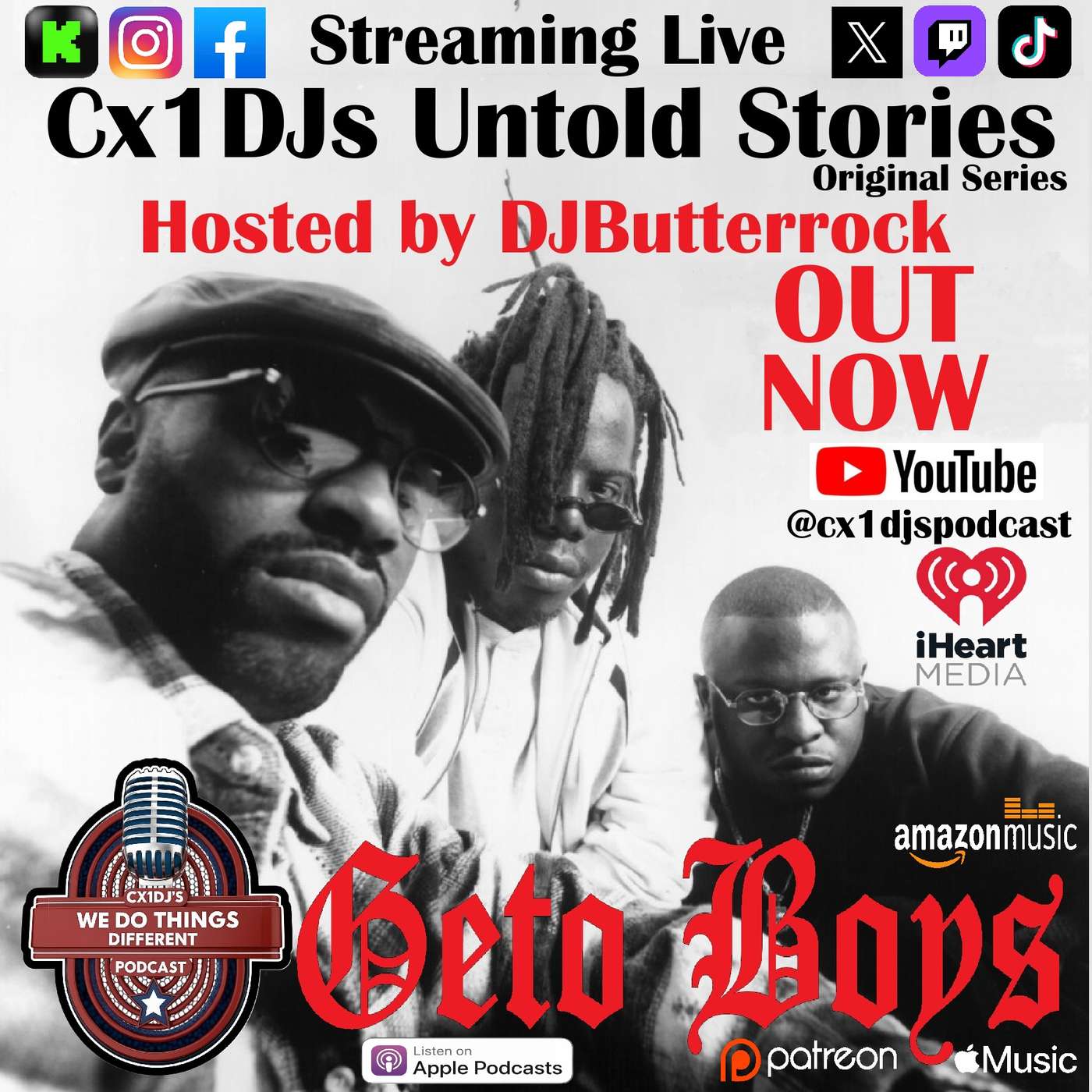
    Cx1DJs We Do Things Different Podcast "Untold Stories of Geto Boys" hosted by DJButterrock

    Cx1DJs We Do Things Different Podcast "Untold Stories of Geto Boys" hosted by DJButterrock The original Ghetto Boys consisted first of Raheem, The Sire Jukebox, and Sir Rap-A-Lot. When Raheem and Sir Rap-A-Lot left, the group added DJ Ready Red, Prince Johnny C, and Little Billy, the dancer who later came to be known as Bushwick Bill. The first single the group released was "Car Freak" in 1986, which then followed with two singles: "You Ain't Nothin'/I Run This" in 1987, and "Be Down" in 1988. In 1988, the group released its debut album, Making Trouble. With the release receiving very little attention, the group broke up shortly thereafter and a new line-up was put together in which Bushwick Bill was joined by Scarface and Willie D, both aspiring solo artists. This new line-up recorded the 1989 album, Grip It! On That Other Level. The group's 1990 album, The Geto Boys, caused Def American Recordings, the label to which the group was signed at the time, to switch distributors from Geffen Records to Warner Bros. Records (with marketing for the album done by Warner Bros. sister label Giant Records) because of controversy over the lyrics. In the early 1990s, several American politicians attacked rap artists associated with the subgenre gangsta rap including the Geto Boys. A high-profile incident in which Bushwick Bill lost an eye in a shooting helped boost sales of the group's 1991 album We Can't Be Stopped. The album cover features a graphic picture of the injured Bushwick being carted through a hospital by Scarface and Willie D. On the album's title track, the group responded to Geffen Records ending its distribution deal with Def American. The album featured the single "Mind Playing Tricks on Me," which became a hit and charted at No. 23 on the Billboard Hot 100. Scarface rapping at Free Press Summer Fest in Houston, June 2013 After Willie D left the group, Scarface and Bushwick Bill continued with the Geto Boys with the addition of Big Mike, who made his debut appearance with the group on 1993's album Till Death Do Us Part.[3] Till Death Do Us Part was certified gold. The album spawned one top 40 hit in "Six Feet Deep" which peaked at No. 40 on the Billboard Hot 100. Then Big Mike was dropped and Willie D returned for 1996's critically acclaimed The Resurrection, and the 1998 followup Da Good Da Bad & Da Ugly, of which Bushwick Bill was not a part. After three years on hiatus, the group reunited in 2002 to record its seventh album, The Foundation, which was released on January 25, 2005. The Geto Boys were featured on Scarface's My Homies Part 2 album. The song "Street Life" from Till Death Do Us Part was featured on the motion picture South Central. A video clip for the song with footage from the film was released.[4] Although the band rarely releases albums or perform together, the group came together for a reunion at Cypress Hill's SmokeOut festival in San Bernardino, California on October 23, 2009.[5] In 2010, Bushwick Bill was threatened with deportation to Jamaica.[6] In a 2015 DJ Vlad interview, Scarface said that he will not be involved in another Geto Boys album.[7] On August 24, 2018, founding member DJ Ready Red died at the age of 53, from an apparent heart attack.[8] After the stage 4 pancreatic cancer diagnosis of Bushwick Bill in early 2019, a farewell tour, titled The Beginning of a Long Goodbye, The Final Farewell was announced, with a portion of the proceeds being donated to pancreatic cancer awareness.[9] However, the tour was canceled just before its anticipated start. On June 9, 2019, Bushwick Bill died as a result of pancreatic cancer, at the age of 52.[10]
  • #200
    Tuesday · 1 hr 33 min

    Cx1DJs We Do Things Different Podcast "Untold Stories of Yella Beezy" hosted by DJButterrock

    Cx1DJs We Do Things Different Podcast "Untold Stories of Yella Beezy" hosted by DJButterrock Markies Deandre Conway (born October 21, 1991),[2][3] better known by the stage name Yella Beezy, is an American rapper and convicted murderer from Dallas, Texas. He is best known for his 2017 single "That's On Me", which entered the Billboard Hot 100 and received gold certification by the Recording Industry Association of America (RIAA). His 2019 single, "Bacc At It Again" (with Quavo and Gucci Mane), also did so.[4][5] On November 11, 2026, Conway was found guilty of capital murder by a Dallas County jury in connection with the 2020 killing of fellow rapper MO3 (Melvin Noble). The jury unanimously convicted Conway of capital murder for remuneration, and he was sentenced to life imprisonment without the possibility of parole. Early life Conway was raised in Dallas, Texas. When Conway was 12, his father was murdered at their home on Mother's Day.[6] Throughout his childhood he played basketball and football and his original aspiration was to become a professional football player.[7][8] He attended Obanion Middle School in Garland and later graduated from Lancaster High School.[9] Career 2017–present: Billboard success and charting mixtapes Yella Beezy performing at a concert in 2018 Conway began writing song lyrics and rapping at the age of 13. He was inspired by artists such as Boosie Badazz and Kevin Gates. At the age of 14 he released his first mixtape, Mash Mode Overload. In 2012, his second mixtape, Lil Yella Mane, was released. Conway's first hit single came in 2015 with "Trap in Designer" off of his mixtape Broke Nights Rich Days.[7] In 2017, Yella Beezy released his mixtape Lite Work, Vol. 2. It featured the song "That's On Me", which peaked at number 56 on the Billboard Hot 100 and also led to Yella Beezy getting signed by Chris Turner (A&R) to L.A. Reid's label Hitco.[5] In 2018, the mixtape Ain't No Goin Bacc was released. It included the hits "What I Did" (featuring Kevin Gates), "Up One" (featuring Lil Baby) and a remixed version of "That's On Me" (featuring 2 Chainz, T.I., and Boosie Badazz).[10] That same year, Yella Beezy began earning fame from opening for Jay-Z and Beyoncé in Dallas and Houston during the On the Run II Tour.[11] In 2019, the mixtape Baccend Beezy was the first mixtape by Yella Beezy that was released under his label Hitco. The mixtape featured the hit singles "Bacc At It Again" (featuring Quavo and Gucci Mane) and "Restroom Occupied" (featuring Chris Brown).[12] He was featured on American rapper and model Rubi Rose's single "Hit Yo Dance" featuring NLE Choppa. 2018 shooting On October 14, 2018, Conway was shot on the Sam Rayburn Tollway in Lewisville, Texas at around 3:30 AM. Reports say that his vehicle was fired at 3 times. Conway was hospitalized and survived, while the shooter was never officially identified.[13]

  • #199
    Monday · 2 hr 36 min

    Cx1DJs We Do Things Different Podcast "Untold Stories of Heavy D" hosted by DJButterrock

    Cx1DJs We Do Things Different Podcast "Untold Stories of Heavy D" hosted by DJButterrock Dwight Arrington Myers⁠[2]⁠⁠[3]⁠ (May 24, 1967 – November 8, 2011),⁠[4]⁠ known professionally as Heavy D, was a ⁠Jamaican-American⁠ rapper, record producer, and actor. He was the leader of Heavy D & the Boyz, a group that included dancers/⁠hype men⁠ G-Whiz (Glen Parrish) and ⁠"Trouble" T. Roy⁠ (Troy Dixon), as well as DJ and producer ⁠Eddie F⁠ (Edward Ferrell). The group maintained a sizeable audience in the United States through most of the 1990s. The five albums the group released included production mainly by ⁠Teddy Riley⁠, ⁠Marley Marl⁠, ⁠DJ Premier⁠, Myers's cousin ⁠Pete Rock⁠, and "in-house" ⁠beatmaker⁠⁠Eddie F⁠. Myers also released four solo albums and discovered ⁠Soul for Real⁠ and ⁠Monifah⁠.⁠[5]⁠ Dwight Arrington Myers was born on May 24, 1967, in ⁠Mandeville, Manchester⁠, ⁠Jamaica⁠, the son of nurse Eulahlee Lee and machine technician Clifford Vincent Myers.⁠[6]⁠ In the early 1970s, his family moved to ⁠Mount Vernon, New York⁠,⁠[7]⁠ where he was raised. In an interview, his mother stated that he spent most of his childhood hanging out with his brother, Floyd, and his friend, Mo.⁠[8]⁠ Heavy D & the Boyz was the first group signed to ⁠Uptown Records⁠, with Heavy D as the ⁠front man⁠ and only rapper. ⁠Eddie F⁠ was his business partner in the group, DJ, and one of the producers. The other two members, T-Roy and G-Wiz were the dancers. Their debut, ⁠Living Large⁠, was released in 1987. The album was a commercial success. ⁠Big Tyme⁠ was a breakthrough that included four hits. "⁠Trouble T. Roy⁠" died at age 22 in a fall on July 15, 1990, in ⁠Indianapolis⁠. Dixon's death led to a tribute on the follow-up ⁠platinum album⁠, ⁠Peaceful Journey⁠. ⁠Pete Rock & CL Smooth⁠ created a tribute to ⁠Trouble T. Roy⁠ called "⁠They Reminisce Over You (T.R.O.Y.)⁠" which is regarded as a hip hop classic.⁠[5]⁠ In 1989, Heavy D performed a guest ⁠rap⁠ on ⁠Janet Jackson⁠'s hit single "⁠Alright⁠", an early example of rap appearances on pop songs.⁠[9]⁠ It was also the highest peaking song which he had performed on in the ⁠Billboard Hot 100⁠.⁠[10]⁠ In 1992, he appeared on ⁠Michael Jackson⁠'s single "⁠Jam⁠", and also gained a higher profile by singing the ⁠theme song⁠ for the television program ⁠In Living Color⁠ and also ⁠MADtv⁠. He also collaborated with Jamaican DJ ⁠Super Cat⁠ on the hit track "Dem No Worry We." Heavy D then began focusing on his acting, appearing in various television shows before returning to the music charts with ⁠Nuttin' But Love⁠. After appearing in the ⁠off-Broadway⁠ play Riff Raff at ⁠Circle Repertory Company⁠, Heavy D returned to recording with the hit ⁠Waterbed Hev⁠.⁠[5]⁠ In 1997, Heavy D collaborated with ⁠B.B. King⁠ on his duets album ⁠Deuces Wild⁠, rapping in the song "Keep It Coming". Heavy D was referred to in the song "⁠Juicy⁠" by the ⁠Notorious B.I.G.⁠, and appeared in his music video for "⁠One More Chance⁠". Heavy D & The Boyz were also referenced by American rapper ⁠Eminem⁠ in his single "⁠Rap God⁠". While still an artist at Uptown Records, Myers was instrumental in convincing ⁠Andre Harrell⁠ to originally hire ⁠Sean "Diddy" Combs⁠ for his first music business gig as an ⁠intern⁠. He became the president of Uptown Records. During this time, Myers also developed the ⁠boy band⁠⁠Soul for Real⁠, and was the ⁠executive producer⁠ and principal writer of several songs on the group's breakout album, Candy Rain.⁠[11]⁠ He later became senior vice president at ⁠Universal Music⁠.⁠[12]⁠ As an actor, Heavy D is perhaps best known for his role in the 1999 drama film <...

  • #198
    November 13 · 1 hr 54 min

    Cx1DJs We Do Things Different Podcast "Untold Stories of Lil Mo" hosted by DJButterrock

    Cx1DJs We Do Things Different Podcast "Untold Stories of Lil Mo" hosted by DJButterrock Cynthia Karen Loving[1] (born November 19, 1978), known professionally as Lil' Mo, is an American R&B singer, songwriter, radio personality, television personality and actress. She is best known for her 2001 single "Superwoman Pt. II" (featuring Fabolous), which peaked at number 11 on the Billboard Hot 100 and is credited with launching Fabolous' career.[6] Regarded as Missy Elliott's protégé, Elliott guest appeared on Lil Mo's 1998 debut single "5 Minutes", which was released for the Why Do Fools Fall in Love film soundtrack. The following year, Lil' Mo appeared alongside Nas, Eve, and Q-Tip on Elliott's 1999 single "Hot Boyz".[7] She guest performed alongside Vita on Ja Rule's 2000 singles "Put It on Me", as well as his 2001 single "I Cry", the former of which was nominated for Best Rap Performance by a Duo or Group at the 44th Annual Grammy Awards. Early life Mo was born into a military family. Her father, Bishop Jacob D. Loving, and her mother, First-Lady Cynthia Loving Sr.,[8] raised her primarily in Long Island, but moved regularly due to her father's military assignments. The family lived in Texas, Georgia and North Carolina before settling in Baltimore. As an adult, Mo moved to New York City's Manhattan borough to pursue her music career.[9] Career Beginnings (1996–2000) Mo began her career as a backing vocalist, session musician and songwriter. In early 1998, while submitting demo material to Elektra Records for Nicole Wray's 1998 debut album, Make It Hot, Mo caught the attention of Missy Elliott,[10] who helped land her a contract deal with Elektra. On June 29, 1998, Mo released her debut single "5 Minutes" from the soundtrack for the Frankie Lymon biographical film Why Do Fools Fall in Love. The song was planned to appear on Mo's debut album, however when it underperformed in the US, it was pulled from the final track listing. Mo's debut album was originally set to be released in March 1999,[11] however, it was pushed back multiple times during Elektra's attempts to revamp Mo's image and sound.[12] Mo gained further exposure during this time for her features on Ol' Dirty Bastard's cover of Billie Holiday's "Good Morning Heartache", Missy Elliott's record-breaking single "Hot Boyz", which spent 18 weeks at number one on the Hot Rap Singles from December 4, 1999, to March 25, 2000, and Ja Rule's single "Put It on Me", which was a hit on both urban and pop radio, and reached number eight on the US pop charts.[13] More collaborations by Ja Rule and Lil' Mo followed, including "I Cry", which repurposed The O'Jays' 1978 hit "Cry Together". Breakthrough, Based on a True Story (2001) On April 10, 2000, Mo released "Ta Da", her first solo single. After years of successful collaborations and features, Mo would finally release a successful hit of her own, "Superwoman Pt. II", her second single from her upcoming album. The single was released on March 6, 2001, and peaked at No. 11 on the Billboard Hot 100, helping bring then-underground rapper Fabolous to mainstream attention.[13][14] On June 26, 2001, Mo's debut album, Based on a True Story was released to generally favorable reviews. The album peaked at No. 14 on the Billboard 200 and attained a gold certification from the RIAA, making it Mo's successful album to date. In August 2001, Mo released the follow-up single "Gangsta (Love 4 the Streets)", however, it failed to match the success of its predecessor.[13] Meet the Girl Next Door, career struggles (2002–05) Loving in 2005. While recovering from being assaulted with a champagne bottle after a performance in San Francisco, Mo began her radio career, working as a part-time anchor for Baltimore urban radio station WERQ-FM.[15] That same year, Mo began preparations for her second album, Meet the Girl Next Door. The album was released on April 29, 2003, preceded by the singles "4Ever" and "Ten Commandments".[16] While Mo promoted the singles on shows such as Jimmy Kimmel Live! and Soul Train,[15] she would later criticise Elektra for their lack of support and minimal promotion for the album, which she attributed to being pregnant at the time.[17] Mo's contract with Elektra expired as the label was absorbed by Atlantic Records, and in July 2004, she signed Universal's Cash Money Records to record her third album, then titled Syndicated: the Lil' Mo Hour.[18][19] The album was scheduled for an early 2005 release, before being pushed back to October, after its four singles (including "Hot Girls" and "Dem Boyz") failed to create any buzz. Following the destruction of Cash Money's New Orleans studio by Hurricane Katrina,[20] Mo was dropped from the Cash Money roster and Syndicated was shelved.[20]

  • #197
    November 12 · 2 hr 4 min

    Cx1DJs We Do Things Different Podcast "Untold Stories of The Game" hosted by DJButterrock

    Cx1DJs We Do Things Different Podcast "Untold Stories of The Game" hosted by DJButterrock Jayceon Terrell Taylor (born November 29, 1979), better known by his stage name The Game or simply Game, is an American rapper and actor. Born in Compton, California, he initially released a series of mixtapes under the wing of fellow West Coast rapper JT the Bigga Figga. After releasing his debut album Untold Story independently in 2004, he was discovered by record producer Dr. Dre and signed to his Aftermath Records label imprint. The Game rose to prominence following the release of his major-label debut album The Documentary (2005), which peaked the Billboard 200 along with its sequel, Doctor's Advocate (2006). The former album received double platinum certification by the Recording Industry Association of America (RIAA) and two Grammy Award nominations—Best Rap Song and Best Rap Performance by a Duo or Group for its single, "Hate It or Love It" (featuring 50 Cent). A rising artist in the 2000s, the Game was considered to be a driving force in the resurgence of West Coast hip-hop into the mainstream, and competing with many of his East Coast counterparts.[1][2][3] The Game was placed into G-Unit by Dr. Dre and Interscope Records co-founder Jimmy Iovine. As a result of his disputes with group leader 50 Cent, Game left Aftermath and signed with Geffen, another label under Universal's Interscope Geffen A&M corporate unit to terminate his contractual obligations with G-Unit in 2006. This foresaw the release of Doctor's Advocate, which was met with continued success and spawned the singles "It's Okay (One Blood)" (featuring Junior Reid), "Let's Ride," and "Wouldn't Get Far" (featuring Kanye West).[4] The Game found similar critical and commercial success with his third and fourth albums, LAX (2008) and The R.E.D. Album (2010), which peaked at numbers two and one on the Billboard 200, respectively. His fifth album, Jesus Piece (2012), served as his final release with Interscope and peaked within the chart's top ten, along with his next self-released albums: The Documentary 2, The Documentary 2.5 (2015), and 1992 (2016). His ninth album, Born 2 Rap (2019) was announced as his final; however, his career continued with the release of his tenth album Drillmatic – Heart vs. Mind (2022), which was met with mixed critical reception.[5] Early life The Game was born Jayceon Terrell Taylor[6][7] on November 29, 1979,[8] in Compton, California,[9] to parents George Taylor[10] and Lynette Baker,[11] who both were members of the Crips street gang. He grew up in a primarily Crip-controlled neighborhood known as Santana Blocc,[9] although Taylor himself grew up to become a member of the Cedar Block Piru Bloods through his brother.[12][13] In an October 2006 interview with MTV News correspondent Sway Calloway, the Game described his family as "dysfunctional". His older half-brother, George Taylor III, a.k.a. the rapper Big Fase 100, was a Cedar Block Piru Bloods leader in West Compton, California.[14] Taylor and his sibling spent six years in foster care.[11] Taylor attended Compton High School.[15] He went on to attend the community colleges Antelope Valley College, Harbor Community College and Cerritos College each for a time before leaving school.[14] By the early 2000s, Taylor had become heavily involved in selling drugs and participating in gang activities.[16]

  • #196
    November 11 · 1 hr 58 min

    Cx1DJs We Do Things Different Podcast "Untold Stories of Keefe D" hosted by DJButterrock

    Cx1DJs We Do Things Different Podcast "Untold Stories of Keefe D" hosted by DJButterrock On September 7, 1996, at 11:15 p.m. (PDT), Tupac Shakur, a 25-year-old American rapper, was shot in a drive-by shooting in Paradise, Nevada. The shooting occurred when the car carrying Shakur was stopped at a red light at East Flamingo Road and Koval Lane.[5] Shakur was struck by four rounds fired from a .40-caliber Glock 22 pistol[2] — two in the chest, one in the arm and one in the thigh.[6] The driver, Death Row Records executive Suge Knight, was struck in the head by bullet fragments. Shakur died from his injuries six days later.[7][8] Orlando 'Baby Lane' Anderson, a member of the South Side Compton Crips gang, was suspected in the murder but denied being involved and was never charged; he was killed in an unrelated gang shooting in 1998.[9] On September 29, 2023, Duane "Keffe D" Davis,[10][11][12][c] Anderson's uncle, was arrested after being indicted by a grand jury for first-degree murder of Shakur.[13][14] On August 31, 2026, Davis was found guilty of murdering Shakur,[15] and on October 13, was sentenced to 40 years to life in prison.[16] Background Shakur Tupac Shakur was an American rapper born on June 16, 1971. His debut album, 2Pacalypse Now (1991), made him a prominent figure in West Coast hip-hop.[17] His music featured a mix of gangsta rap and political themes, addressing topics such as racism, police brutality, gang violence and the war on drugs.[18] Shakur faced repeated criminal charges. In 1993, he was charged with two counts of aggravated assault for shooting two off-duty police officers,[19] though the charges were later dropped.[20] He was convicted of sexual assault in 1994 and served eight months in prison, but was released pending appeal in 1995.[21] Following his release, he signed to Death Row Records, the label founded by Suge Knight.[22] East Coast–West Coast feud The murder occurred at the height of the East Coast–West Coast hip-hop rivalry, a focal point of which was the feud between Shakur and the East Coast rapper Biggie "the Notorious B.I.G." Smalls.[22] The two rappers were initially friends but had a falling out after Shakur was shot in a building where Smalls was recording in November 1994. Shakur accused Biggie and Sean Combs, the head of Smalls's label Bad Boy Records, of setting up or having prior knowledge of the shooting.[22][23] In 1995, Shakur interpreted the release of the Smalls song "Who Shot Ya?" as a diss track targeting him,[24] and later that year, Knight made a speech at the 1995 Source Awards in which Knight insulted Combs and Bad Boy.[22] In June 1996, Shakur released the diss track "Hit 'Em Up", which journalist Chuck Philips described as "a caustic anti-East Coast jihad in which the rapper threatens to eliminate Biggie, [Combs], and a slew of Bad Boy artists and other New York City acts".[25] "Hit 'Em Up" is regarded as the feud's centerpiece[26] and a turning point in which things were said and rapped that could never be taken back.[27] The publication of VIBE magazine's 1996 Juice issue, featuring Biggie and Combs on the cover along with the caption "East vs. West", was seen as an escalation of the rivalry.[28][better source needed] Prior events Orlando Anderson, a member of the South Side Compton Crips, had been in a feud with various employees of Death Row Records. In July 1996, Anderson and his crew mugged Death Row employee Trevon "Tre" Lane, a member of the rival Mob Piru Bloods, at a Foot Locker store at the Lakewood Mall in Lakewood, California and stole his company medallion,[29] which is what caused Suge Knight's security team to target him later in Las Vegas. Anderson had been under intermittent surveillance by the Compton Police Department's gang unit due to his suspected involvement in localized gang warfare and multiple unsolved homicides in Compton. Gang investigators later noted that Anderson was being actively monitored during the summer of 1996 as a person of interest in regional gang shootouts.[30] On the evening of September 7, 1996, Shakur and Knight attended the Bruce Seldon vs. Mike Tyson boxing match at the MGM Grand in Las Vegas, Nevada. After leaving the match, Lane spotted Anderson in the MGM Grand lobby.[29] Lane informed Shakur, who in turn attacked Anderson in the lobby. Shakur asked Anderson if he was from the "South" (South Side Crips) and punched him in the face, knocking him to the ground.[29] Shakur and Knight's entourage assisted in assaulting Anderson. The fight, which was captured on the MGM Grand's video surveillance, was broken up by hotel security.[31]

  • #195
    November 9 · 1 hr 54 min

    Cx1DJs We Do Things Different Podcast "Untold Stories of Big U" hosted by DJButterrock

    Cx1DJs We Do Things Different Podcast "Untold Stories of Big U" hosted by DJButterrock Eugene Henley Jr. (born 1966)[2] known professionally as Big U, is a music manager, CEO of "Big U Enterprises", and alleged leader of the Rolling 60's Neighborhood Crips. He has managed the rappers Kurupt and Nipsey Hussle. Career Eugene "Big U" Henley Jr., is the alleged leader of the rolling 60's Los Angeles "Crips" street gang. After serving 13 years in prison for a robbery gone bad in 1991 Henley resurfaced, and assumed the role of a music manager, and community activist. Henley first became a part of the Hip Hop music industry by managing Dogg Pound rapper Kurupt. Henley is noted as a key figure in the rise of Los Angeles rapper Nipsey Hussle's career.[3] His ties in the music industry was further developed with the assistance of Death Row Records co-founder Suge Knight. Henley also became known for the practice called "Checkin In" which is, when a Hip Hop artist, musician or high profile individual from out of town visits a city and meets with the local street gang representative. They would then pay this person a "tax' or "fee" to be able to move around the city without the fear of being met with violence or conflict.[4][5][6] On October 31, 2025, Henley's son, Jabari "Baby Uiie", was shot and killed outside of a smoke shop in South Los Angeles.[7] Legal Issues In April 2025, a federal grand jury returned a 43 count indictment against Henley. Federal authorities have compared his Big U Enterprises to a mafia like criminal organization. Charges brought against Henley include fraud, robbery, extortion, tax evasion, embezzlement and attempted murder.[8] Authorities claim he used his influence with his street gang to intimidate business owners and the citizens of Los Angeles. Henley deceived celebrities such as Shaquille O'Neal, Draymond Green and other donors into believing his Big U Enterprises was helping young athletes to achieve their dreams.[9] He also led them to believe his organization was helping to curb gang violence. In reality Henley was amassing the funds for his own financial gain. According to authorities Henley also received federal grants for his charity, which were also diverted to fund his criminal enterprise.[10] Henley remains in Federal custody.[11][12] References Arora, Ashim (November 2, 2025). "How many children does Big U have? Alleged crips leader's son Jabari Henley reportedly shot dead on Halloween night". primetimer.com. Retrieved August 30, 2026. Mejia, Brittny; Jany, Libor (April 22, 2025). "L.A.'s Rollin' 60s Crips: The rise of a notorious gang and its reputed boss 'Big U'". Los Angeles Times. Retrieved August 30, 2026. "Eugene "Big U" Henley | Hip Hop Uncovered". FX. Retrieved 2025-05-05. Marie, Erika (2025-04-01). "Who Is Big U? From Street Legend To Accused Industry Enforcer". HotNewHipHop. Retrieved 2025-05-05. Marie, Erika (2025-04-03). "Big U RICO Case: What Does It Mean To 'Check In'?". HotNewHipHop. Retrieved 2025-05-05. "Schoolboy Q's Comments on 'Checking In' Have Resurfaced". Complex. Retrieved 2025-05-05. Conybeare, Will (November 1, 2025). "Son of rap executive, alleged Rolling 60's Crips leader shot dead in L.A." KTLA. Retrieved August 30, 2026. "Feds say L.A. gangster spoke of 'the orange man,' wanted Trump to intervene in case". Los Angeles Times. 2025-04-22. Retrieved 2025-05-05. "Big U Allegedly Defrauded Shaq and Draymond Green". Complex. Retrieved 2025-05-05. Jeong • •, Helen (2025-04-08). "Eugene 'Big U' Henley Jr. pleads not guilty". NBC Los Angeles. Retrieved 2025-05-04. "Feds Say "Godfather of Rap" Big U Ran Mafia-like Enterprise Behind Anti-Gang Nonprofit". Yahoo News. 2025-03-27. Retrieved 2025-05-05. Watkins (@GrouchyGreg), Grouchy Greg (2025-05-03). "EXCLUSIVE: Big U Buried Under 20,000 Wiretaps As Prosecutors Introduce New Evidence". AllHipHop. Retrieved 2025-05-05.

  • #194
    November 6 · 1 hr 15 min

    Cx1DJs We Do Things Different Podcast "Untold Stories of Trina" hosted by DJButterrock

    Cx1DJs We Do Things Different Podcast "Untold Stories of Trina" hosted by DJButterrock Katrina Laverne Kearse (née Taylor; born c. 1974 or 1975)[1] is an American rapper. She gained recognition for her collaborations on fellow Florida-based rapper Trick Daddy's 1998-2001 singles "Nann Nigga", "Shut Up", and "Take It to da House". She signed with the Miami-based label Slip-N-Slide Records to release her debut album, Da Baddest Bitch (2000), which spawned her first Billboard Hot 100 entry as a lead artist, "Pull Over". Her second album, Diamond Princess (2002), spawned the single "B R Right" (featuring Ludacris) and peaked at number 14 on the Billboard 200. Trina's third album, Glamorest Life (2005), spawned the single "Here We Go" (featuring Kelly Rowland), which was certified gold by the Recording Industry Association of America (RIAA). Her fourth album, Still da Baddest (2008), peaked within the top ten on the Billboard 200, while her fifth album, Amazin' (2010), peaked within the top 15. She was described by XXL as "the most consistent female rapper of all time".[2] In 2014, Trina was included in Billboard's list of the "31 Female Rappers Who Changed Hip-Hop".[3]' Early life Katrina Laverne Taylor was born in Miami[4] and she grew up in the Liberty City area of the city.[5] Her father is Dominican,[6][7][8] while her mother, Vernessa Taylor,[9] was Bahamian.[8] They separated when Trina was a child. She attended Miami Northwestern Senior High School, where she was a majorette,[10] and where she graduated in 1992.[1][11] Taylor initially educated herself towards becoming a real estate agent, before switching her career path to music. Career Breakthrough, Da Baddest Bitch (1998–2000) In 1998, Trina was studying to get her real estate license,[12] when she caught the attention of Miami rapper Trick Daddy, who asked her to appear on his track "Nann Nigga". The song was released as the lead single from Trick's second studio album, www.thug.com on July 14, 1998, reaching No. 62 on the US Billboard Hot 100 and No. 3 on the Rap Songs chart. This kickstarted Trina's rap career, leading to a record deal with Slip-n-Slide Records with distribution from Atlantic Records. On March 21, 2000, Trina released her debut album Da Baddest Bitch,[13] which debuted at No. 33 on the US Billboard 200 and No. 11 on the Top R&B/Hip-Hop Albums chart.[14] It stayed on the Billboard 200 chart for 39 weeks and on the Hip-Hop/R&B album chart for 49 consecutive weeks[15] and was certified Gold by the RIAA by November of that year.[16] The album was preceded by the singles "Da Baddest Bitch" on December 22, 1999, and "Pull Over" on February 13, 2000, which reached No. 93 on the Hot 100, No. 46 on the Hot R&B/Hip-Hop Songs chart, and No. 41 on the Rap Songs chart.[17][18] Diamond Princess (2001–2003) Trina began working on her second studio album in 2001 with Missy Elliott,[19] enjoying more creative control than ever before, saying in interviews that the album was "more what Trina's about, how Trina looks, how Trina feels, the things that Trina consists of."[20] During this time, she started her own record label imprint, Diva Enterprises. In September 2002, she signed 9-year-old recording artist Lil' Brianna, who would appear on her track "Kandi" and later be known as Brianna Perry. On August 27, 2002, Trina released her second studio album Diamond Princess,[21] which debuted at No. 14 on the Billboard 200 and No. 5 on the Top R&B/Hip-Hop Albums chart, selling 67,000 units in its first week.[22] The album was preceded by "Told Y'all", featuring Rick Ross, which reached No. 64 on the Hot R&B/Hip-Hop Songs chart and appeared on the soundtrack to the action comedy All About the Benjamins, and "No Panties", featuring Tweet, which reached No. 88 on the Hot R&B/Hip-Hop Songs chart and No. 45 on the UK Singles Chart. On October 22, 2002, Trina released the album's third and final single, "B R Right", featuring Ludacris, which reached No. 83 on the Billboard Hot 100, No. 50 on the Hot R&B/Hip-Hop Songs chart, and No. 24 on the Rap Songs chart. Glamorest Life (2004–2005)

  • #193
    November 5 · 1 hr 54 min

    Cx1DJs We Do Things Different Podcast "Untold Stories of Trick Daddy" hosted by DJButterrock

    Cx1DJs We Do Things Different Podcast "Untold Stories of Trick Daddy" hosted by DJButterrock Maurice Samuel Young (born September 27, 1974), better known by his stage name Trick Daddy, is an American rapper. He is best known for his 2004 single "Let's Go" (featuring Twista and Lil Jon), which peaked at number seven on the Billboard Hot 100. The album of which it preceded, Thug Matrimony: Married to the Streets (2004) peaked at number two on the Billboard 200 albums chart; both of which remain his most successful releases to date. Prior, he signed to local record label Slip-n-Slide Records for the release of his debut album Based on a True Story (1997) and its sequel, www.thug.com (1998). Becoming the flagship artist for the label, he signed a joint venture deal with Atlantic Records to release Book of Thugs: Chapter AK Verse 47 (2000), Thugs Are Us (2001), and Thug Holiday (2002), which were met with moderate commercial success. He followed up Thug Matrimony with the albums Back by Thug Demand (2006) and the independently-released Finally Famous: Born a Thug, Still a Thug (2009), and notably guest appeared on hometown native DJ Khaled's singles "I'm So Hood" in 2007 and "Out Here Grindin'" in 2008.[1] Early life Maurice Samuel Young was born on September 27, 1974, at Jackson Memorial Hospital in Miami, Florida.[2][3][4] His mother, Pearl Brockington of South Carolina, raised him and his 10 brothers and sisters in the Liberty Square a public housing project in Liberty City after relocating from Goulds. The building where he grew up was colloquially known as "Pork-N-Beans" in reference to the color of the apartment doors.[3] His father, Charles, was a local pimp. While Young was a teenager, Charles took him and his brother Derek "Hollywood" Harris to live with him, and during that time, Young and Hollywood began to deal crack cocaine on the streets.[3] At 15 years old, Young was arrested for drug and firearm possession. The day he was released, Young was arrested on an attempted-murder charge for shooting a man during a street fight. He was convicted and sent to prison at 20 years old.[5] His brother was murdered the same year.[6] After he was released from prison, Ted Lucas, founder of Slip-n-Slide Records, urged Young to focus on a rap career and stay off the streets. Music career Trick appeared on the track "Scarred" by former 2 Live Crew member Luther "Luke" Campbell, produced by Darren "DJ Spin" Rudnick, from Luke's 1996 album Uncle Luke. The song became a hit and immediately caught the attention of fans and record producers alike. Ted Lucas, a former concert promoter and then-CEO of Slip-n-Slide Records, signed the rapper to the newly formed record label. Slip-n-Slide released Trick Daddy Dollars' debut album Based on a True Story in 1997; the album was popular in the Miami area.[4] In 1998, when his next album www.thug.com was released, Trick removed "Dollars" from his stage name. Club-oriented track "Nann Nigga", featuring Trina, became a national hit, peaking at the third spot of the Billboard Hot Rap Singles chart.[7] Atlantic Records signed Trick Daddy to the label in 1998 and released Book of Thugs: Chapter AK Verse 47 that year. "Shut Up", was the lead single from Book of Thugs. His next single, "America" (featuring Society), was a poignant political track that writer Omar Burgess compared to other sociological tracks in Trick's catalog such as "Ain't No Santa".[8] Thugs Are Us, released in 2001, featured the hit single "I'm a Thug" (released March 20, 2001) which reached No. 17 on the Billboard Hot 100.[7] His fifth studio album Thug Holiday contained two singles, "In da Wind" and the title track. In 2004, Thug Matrimony: Married to the Streets was released, with hit single "Let's Go", produced by Lil Jon, featuring Twista, and sampling the guitar riffs from the Ozzy Osbourne hit "Crazy Train".[4] That year, Trick Daddy guest-performed on the Ying Yang Twins' "What's Happnin!", which reached No. 30 on the Hot 100, No. 7 on the Rhythmic Top 40, and No. 9 on the Hot Rap Singles.[9] "Let's Go" peaked on No. 7 on the Hot 100, No. 4 on the Rhythmic Top 40, and No. 4 on Hot Rap Tracks.[7] Back by Thug Demand followed in 2006,[4] with singles "Bet That" and "Tuck Ya Ice" charting on the Hot R&B/Hip-Hop Singles & Tracks chart.[7] This album launched the career of Trick Daddy's Group, Dunk Ryders with their record "Damn Right" featuring Dray Skky, and Trick's Joint Venture Label Deal with Cash Money Records.

  • #192
    November 4 · 2 hr 10 min

    Cx1DJs We Do Things Different Podcast "Untold Stories of Meek Mill" hosted by DJButterrock

    Cx1DJs We Do Things Different Podcast "Untold Stories of Meek Mill" hosted by DJButterrock Robert Rihmeek Williams (born May 6, 1987),⁠[2]⁠ known professionally as Meek Mill, is an American rapper. Born and raised in ⁠Philadelphia⁠, Pennsylvania, he embarked on his career as a ⁠battle rapper⁠, and later formed the short-lived rap group the Bloodhoundz. He signed with ⁠T.I.⁠'s ⁠Grand Hustle Records⁠ as a solo act in 2008, but parted ways with the label in 2011 without any releases. He then signed with ⁠Rick Ross⁠'s ⁠Maybach Music Group⁠ (MMG) later that year, and rose to further recognition following his appearances on the label's ⁠Self Made Vol. 1⁠ (2011) compilation album; his song "⁠Tupac Back⁠" (featuring Rick Ross) served as the album's ⁠lead single⁠, while its follow-up, "⁠Ima Boss⁠" (featuring Rick Ross), became his first entry on the ⁠Billboard Hot 100⁠. Meek Mill's debut studio album, ⁠Dreams and Nightmares⁠ (2012)—released in a ⁠joint venture⁠ with MMG and ⁠Warner Bros. Records⁠—peaked at number two on the ⁠Billboard 200⁠ and was led by the single "⁠Amen⁠" (featuring ⁠Drake⁠). His second album, ⁠Dreams Worth More Than Money⁠ (2015), debuted atop the Billboard 200, while his third album, ⁠Wins & Losses⁠ (2017), peaked at number three. His fourth album, ⁠Championships⁠ (2018), debuted atop the chart once more; its lead single, "⁠Going Bad⁠" (featuring Drake), peaked at number six on the Billboard Hot 100 and remains his highest-charting song. His fifth album, ⁠Expensive Pain⁠ (2021), also peaked at number three, and his collaborative album with Rick Ross, ⁠Too Good to Be True⁠ (2023), peaked at number 23. He founded the record label ⁠Dream Chasers Records⁠ in 2012, which has released his own projects and signed other artists including ⁠Yung Bleu⁠, ⁠Vory⁠, and ⁠Lil Snupe⁠. In November 2017, Meek Mill was sentenced to two to four years in prison for violating parole, before being released pending appeal after serving five months. All the convictions were eventually overturned. In August 2019, a documentary series about his battle with the criminal justice system, ⁠Free Meek⁠, was released on ⁠Amazon Prime Video⁠. ⁠Jay-Z⁠ executive produced the series; he and Meek Mill also co-founded the nonprofit ⁠Reform Alliance⁠ that same year, which focuses on national ⁠prison reform⁠.⁠[3]⁠ Robert Rihmeek Williams⁠[4]⁠ was born on May 6, 1987,⁠[2]⁠ in the ⁠South Philadelphia⁠ area of Philadelphia, Pennsylvania, the son of Kathy Williams. He has an older sister, Nasheema Williams. Kathy grew up in poverty and her mother died when she was young. Meek's father was killed when Meek was five years old, apparently during an attempted robbery. His uncle, Robert, described Meek Mill's father as a "⁠black sheep⁠ of the family". After her husband's death, Kathy moved with Meek and his sister to ⁠North Philadelphia⁠, where they lived in a three-bedroom apartment on Berks Street. Their financial condition was poor and she started cutting hair, doing other jobs, and shoplifting in order to support her family.⁠[5]⁠ At home, Meek was shy and rarely spoke. As a kid, he became acquainted with another of his father's brothers, who under the MC name Grandmaster Nell was a pioneering ⁠disc jockey⁠ (DJ) in the late-1980s Philadelphia hip-hop scene and influenced rap artists ⁠Will Smith⁠ and ⁠DJ Jazzy Jeff⁠. Meek's interest in ⁠hip-hop⁠ grew as a result of these early influences. He was also influenced by the independent hip-hop artists Chic Raw and Vodka, whom he learned to emulate by watching their DVDs.⁠[6]⁠⁠[7]⁠ During his early teenage years, Meek often took part in ⁠rap battles⁠ under the ⁠pseudonym⁠ Meek Millz. He often stayed up well past midnight filling notebooks with phrases and verses that he later drew on. Later he and three friends formed the rap group The Bloodhoundz. They bought blank ⁠CDs⁠ and jewel cases at ⁠Kinkos⁠, encouraging friends to burn them with the group's songs and distribute them.⁠[7]⁠ Early life

  • #191
    November 3 · 2 hr 11 min

    Cx1DJs We Do Things Different Podcast "Untold Stories of Rick Ross" hosted by DJButterrock

    Cx1DJs We Do Things Different Podcast "Untold Stories of Rick Ross" hosted by DJButterrock William Leonard Roberts II (born January 28, 1976), known professionally as Rick Ross, is an American rapper and music executive.[1] Noted for his booming vocal presence and vivid lyrical imagery, Ross' music is built upon a rags to riches narrative.[2][additional citation(s) needed] Prior to releasing his debut single, "Hustlin'" in March 2006, Ross was the subject of a bidding war—receiving offers from Diddy's Bad Boy Entertainment and Irv Gotti's Murder Inc.—and ultimately signed a multimillion-dollar deal with Jay-Z on Def Jam Recordings.[3][4] His debut studio album, Port of Miami (2006), peaked atop the Billboard 200,[5][6] along with his second and third albums, Trilla (2008) and Deeper Than Rap (2009). His fourth album, Teflon Don (2010) spawned the single "Aston Martin Music" (featuring Drake and Chrisette Michele)—which received triple platinum certification by the Recording Industry Association of America (RIAA)—while his fifth and sixth albums, God Forgives, I Don't (2012) and Mastermind (2014), peaked the Billboard 200 twice more.[7] Outside of his solo career, Ross was a lead member of the hip-hop group Triple C's, alongside fellow Florida rappers Gunplay and Torch in 2005. Ross founded the record label Maybach Music Group (MMG) in 2008, through which he has signed artists including Meek Mill, Wale, French Montana, and Omarion, among others. MMG entered a joint venture with Def Jam and later Epic Records to release his subsequent albums: Hood Billionaire (2014), Black Market (2015), Rather You Than Me (2017), Port of Miami 2 (2019), and Richer Than I Ever Been (2021). After which, it entered a joint venture with Gamma to release his collaborative album, Too Good to Be True (2023) with Meek Mill. Ross received nine Grammy Award nominations, and has been named "Man of the Year" by hip-hop magazine The Source in 2010 and 2011, as well as "Hottest MC in the Game" by MTV in 2011.[8] Early life William Leonard Roberts II was born on January 28, 1976, in Clarksdale, Mississippi,[9][10] and raised in Carol City, Florida.[11] After graduating from Miami Carol City Senior High School, he attended the historically black college Albany State University on a football scholarship.[12] Roberts worked as a correctional officer for 18 months from December 1995, until his resignation in June 1997.[13] Career Career beginnings In his early years at Suave House Records, Roberts initially made his debut under the pseudonym Teflon Da Don. He made his recording debut on the song "Ain't Shhh to Discuss" on Erick Sermon's lone album for DreamWorks, Def Squad Presents Erick Onasis.[14] In the mid-2000s, he changed his name to Rick Ross. He derived his stage name from the former drug kingpin "Freeway" Rick Ross, to whom he has no connection.[15] After being signed to Suave House Records, former label for rap duo 8Ball & MJG, he eventually signed a deal with Slip-n-Slide Records, which has been under the Def Jam label since 2006. While signed to Slip-n-Slide, Roberts toured with fellow rapper Trick Daddy and made guest performances on other Slip-n-Slide albums.[11] 2006–2008: Port of Miami and Trilla Main articles: Port of Miami (album) and Trilla His debut album Port of Miami was released in August 2006 and debuted at the top spot on the U.S. Billboard 200 album chart, with sales at 187,000 units during the first week.[5][6] Christian Hoard of Rolling Stone magazine predicted that it would be "the summer's biggest rap record".[16] The second single was "Push It", which samples "Scarface (Push It to the Limit)", the theme song from the gangster film Scarface.[17] The music video for "Push It" was modeled after the film.[18] During that time, Ross made guest performances on two singles from DJ Khaled's debut Listennn... the Album: "Born-N-Raised" and "Holla at Me". Port of Miami received Gold certification from the Recording Industry Association of America on November 8, 2006. In March 2008, his second album Trilla was released and, as its predecessor Port of Miami had, debuted at the top of the Billboard 200.[7] Its lead single "Speedin'" featuring R. Kelly peaked at number 21 on the U.S. Billboard Bubbling Under Hot 100 Singles; the next one, "The Boss" featuring T-Pain peaked at number 17 on the Hot 100. The third single "Here I Am" featured Nelly and Avery Storm.[19] MTV News ranked Ross on the fourth spot in its 2008 "Hottest MCs in the Game" list among ten rappers.[20] The fourth single "This Is The Life" featured Trey Songz and was released in July.

  • #190
    November 2 · 2 hr 3 min

    Cx1DJs We Do Things Different Podcast "Untold Stories of Kevin Gates" hosted by DJButterrock

    Cx1DJs We Do Things Different Podcast "Untold Stories of Kevin Gates" hosted by DJButterrock Kevin Jerome Gilyard (born February 5, 1986),[2][3] known professionally as Kevin Gates, is an American rapper, singer, and songwriter. He is currently signed to Bread Winners' Association with a partnership with Atlantic Records.[4][5] His debut studio album, Islah, released in January 2016 and peaked at number two on the U.S. Billboard 200 chart.[6] Prior to Islah, Gates also released a number of mixtapes, including Stranger Than Fiction (2013), By Any Means (2014), and Luca Brasi 2 (2014), all of which peaked in the top 40 on the Billboard 200 chart.[4] Early life Kevin Jerome Gilyard was born on February 5, 1986, to a Puerto Rican mother and a Moroccan father; his family name is that of his mother's.[7][8] He and his family relocated to New Orleans, Louisiana,[9] before settling in Baton Rouge.[9][2] Gates was arrested for the first time in 1999 at the age of 13 for joyriding in a stolen vehicle as a passenger. He lost contact with his father at a young age, but he later reconnected with him.[citation needed] When Gates was a teenager, his father died of complications from AIDS, which he contracted from sharing needles during drug use.[10] Gates has spoken about having been sexually abused as a child.[11] When he was 17, he briefly attended Baton Rouge Community College.[4] 2007–2012: Early career, setbacks, and Young Money Gates began his career in 2007 by signing to local label Dead Game Records.[12] His career blossomed along with fellow Baton Rouge natives Boosie Badazz and Webbie in the mid-2000s. The three collaborated on Gates' first mixtape, Pick of Da Litter, in 2007. Another mixtape, All or Nuthin', was released in 2008 and featured what Gates described as "a lot of pain...a lot of true stories."[13][14] In 2008, both Gates and Boosie were incarcerated in separate cases, effectively pausing Gates' music career.[13] He spent 31 months in prison between 2008 and 2011.[15][16] During this time, Gates claimed he earned a master's degree in psychology through a prison program. He was released early from prison for good behavior.[4] After his stint in prison, Gates began working on music again almost immediately.[13] In 2012, he gained attention with the mixtape Make 'Em Believe.[17] He also caught the attention of Lil Wayne's record label, Young Money Entertainment. Gates was signed to the management wing of the label later that year.[13][14] Although he was signed to the management wing, Gates never signed a record deal with Young Money. He noted, however, that it was Birdman who gave him the idea to start his own record label, named Bread Winners' Association, later on.[18] 2013–2014: Atlantic Records and mixtape breakthroughs In early 2013, Gates released the mixtape, The Luca Brasi Story, via his Bread Winners' Association record label. The mixtape received critical praise with Pitchfork saying it, "imbues trap's claustrophobic bleakness with an emotional nakedness, capable lyricism, and melodic certitude many of its recent breakout stars have lacked."[19][2

  • #189
    October 30 · 2 hr 2 min

    Cx1DJs We Do Things Different Podcast "Untold Stories of Whitney Houston" hosted by DJButterrock

    Cx1DJs We Do Things Different Podcast "Untold Stories of Whitney Houston" hosted by DJButterrock Whitney Elizabeth Houston (August 9, 1963 – February 11, 2012) was an American singer, actress, film producer, and record producer. Commonly referred to as "the Voice", Houston is one of the best-selling music artists of all time, with sales of more than 220 million records worldwide. She is among the most awarded artists of all time. A cultural icon, Houston broke down gender and racial barriers through her artistic achievements, Hollywood crossover, and music videos. Known for her vocal delivery, gospel singing style, crossover appeal, and live performances, she was ranked second on Rolling Stone's list of the greatest singers of all time in 2023. Houston became one of the first black women to appear on the cover of Seventeen after becoming a teen model in 1981. She signed to Arista Records at the age of 19. Her first two studio albums, Whitney Houston (1985) and Whitney (1987), topped the Billboard 200 for 14 and 11 weeks, respectively. The former remains the best-selling debut album by a solo artist, while the latter made her the first woman to debut atop the US and UK charts. Houston took a more urban turn with her third album, I'm Your Baby Tonight (1990), and performed an acclaimed rendition of "The Star-Spangled Banner" at Super Bowl XXV in 1991. She then starred in the films The Bodyguard (1992), Waiting to Exhale (1995), The Preacher's Wife (1996), Cinderella (1997) and Sparkle (2012), and produced the film franchises The Princess Diaries (2001–2004) and The Cheetah Girls (2003–2006). Soundtracks of The Bodyguard and The Preacher's Wife, respectively, rank as the best-selling soundtrack album and gospel album of all time, with the former winning the Grammy Award for Album of the Year and topping the Billboard 200 for 20 weeks. Following the success of My Love Is Your Love (1998), Houston's first studio album in eight years, she renewed her contract with Arista Records for $100 million in 2001, one of the largest recording deals of all time. However, her drug use and a tumultuous marriage to singer Bobby Brown tarnished her "America's Sweetheart" image, overshadowing her next albums, Just Whitney (2002) and One Wish: The Holiday Album (2003). After divorcing Brown, Houston returned to the top of the Billboard 200 with her final album, I Look to You (2009). On February 11, 2012, Houston accidentally drowned in a bathtub at the Beverly Hilton hotel in Beverly Hills, California, with heart disease and cocaine use as contributing factors. News of her death coincided with the 54th Annual Grammy Awards and broke Internet and television records. Houston's death was covered internationally along with her memorial service. Houston's first two albums, along with The Bodyguard soundtrack, rank among the best-selling albums of all time and made her the first black artist to score three RIAA diamond-certified albums. "I Wanna Dance with Somebody (Who Loves Me)" and "I Will Always Love You" are among the best-selling singles ever; the latter remains the best-selling single by a woman and has been certified diamond by the RIAA. Houston scored eleven number-one singles on the Billboard Hot 100 and remains the only artist to have seven consecutive singles top the chart. She has been inducted into multiple halls and walks of fame, including the Rock and Roll Hall of Fame, the Rhythm & Blues Hall of Fame, and the Grammy Hall of Fame (twice). Guinness World Records named Houston the highest-earning posthumous female celebrity. Her assets amounted to $250 million, earned over a 25-year career. Her life and career have been the subject of multiple documentaries and television specials.

  • #188
    October 29 · 1 hr 59 min

    Cx1DJs We Do Things Different Podcast "Untold Stories of Ray J" hosted by DJButterrock

    Cx1DJs We Do Things Different Podcast "Untold Stories of Ray J" hosted by DJButterrock William Ray Norwood Jr. (born January 17, 1981),[1] known professionally as Ray J, is an American R&B singer, rapper, songwriter, television presenter, and actor. Born in McComb, Mississippi, and raised in Carson, California, he is the younger brother of singer and actress Brandy.[3] Ray J's 1997 debut single, "Let It Go", was released by EastWest Records for the soundtrack to the F. Gary Gray film Set It Off. Both moderate hits, the song peaked within the top 40 of the Billboard Hot 100 and additionally served as lead single for Ray J's debut studio album, Everything You Want (1997), which entered the Top R&B/Hip-Hop Albums chart. He then signed with Atlantic Records to release his second album, This Ain't a Game (2002). Led by his second top 40 single, "Wait a Minute" (featuring Lil' Kim), the album became his first to enter the Billboard 200–at number 21. His 2005 single "One Wish" peaked at number 11 on the Billboard Hot 100 and preceded his third album, Raydiation (2005), which commercially trailed the success of both the song and his previous album. The albums were each met with mixed critical reception. In 2007, he co-starred in the controversial adult film Kim Kardashian, Superstar, opposite then-relatively unknown actress Kim Kardashian. This foresaw the release of his fourth album, All I Feel (2008), which was critically panned, but yielded his furthest commercial success and peaked at number seven on the Billboard 200; it also spawned the single "Sexy Can I" (featuring Yung Berg), which peaked at number three on the Billboard Hot 100 and remains his highest charting song. Released independently, his 2013 single "I Hit It First" (featuring Bobby Brackins) peaked at number 51 on the chart, providing a brief period of resurgence as it talked about his previous affair with Kardashian. In January 2017, he competed in the nineteenth season of the British reality television series Celebrity Big Brother. In his entrepreneurial career, he launched the technology company Raytroniks in 2016, as well as the Raycon line of direct-to-consumer earbuds in 2017.[4] Early life William Ray Norwood Jr. was born on January 17, 1981, in McComb, Mississippi, to Willie Norwood and Sonja Bates-Norwood. His older sister Brandy is a multi-platinum recording artist. Early in his life, he moved with his family from McComb to Carson, California, a suburb of Los Angeles. In 1989, started appearing in television commercials for different companies. In 1989, at the age of eight, Norwood began auditioning for and appearing in television commercials; he played the foster son in The Sinbad Show, from 1993 to 1994. This period in Norwood's life would shape his acting career. According to Bradley Torreano of AllMusic, "his easygoing image and boyish looks appealed to the producers of Brandy's television show, Moesha, giving him a role on the UPN series as Dorian "D-Money", a role he played from 1999 until the show ended in 2001. Career 1995–2006: Everything You Want, This Ain't a Game, and Raydiation He signed to Elektra Records in 1995 and he began to record his debut album Everything You Want the same year. The album, released in March 1997, spawned the lead single "Let It Go", which appeared on the Set It Off soundtrack. "Let It Go" peaked at number 25 in the U.S. and number 11 in New Zealand. The second single peaked at number 54 on the U.S. R&B chart. In 1997, he was dropped from the label. In 1998, he appeared on the Dr. Dolittle soundtrack with the single "That's Why I Lie". He produced for toy company Mattel, putting together the music for several commercials and a few of the demos for his second record.[1] Ray J recorded "Another Day in Paradise" with Brandy, which was a Top Ten success in Austria, UK, Germany, Sweden, Switzerland, Belgium, Norway, Ireland, and the Netherlands, and number 11 in Australia and France. The song was the lead single of the R&B/Hip Hop tribute Urban Renewal, in which he co-produced and performed songs. Norwood also worked with the Neptunes, Rodney Jerkins and Lil' Kim, and several other producers and singers for his second studio album This Ain't a Game. The album was recorded over 18 months, and was released on June 26, 2001, with Atlantic Records. The lead single "Wait a Minute" peaked at #30 on the U.S. Billboard Hot 100 chart and #8 on the Hot R&B/Hip-Hop Songs chart. "Formal Invite" followed at #54 on the R&B chart.[5]

  • #187
    October 28 · 1 hr 54 min

    Cx1DJs We Do Things Different Podcast "Untold Stories of TLC" hosted by DJButterrock

    Cx1DJs We Do Things Different Podcast "Untold Stories of TLC" hosted by DJButterrock TLC is an American girl group formed in 1990 in Atlanta, Georgia. The group's best-known line-up was composed of Tionne "T-Boz" Watkins, Lisa "Left Eye" Lopes, and Rozonda "Chilli" Thomas. The group enjoyed success during the 1990s,[1] with nine top-ten hits on the Billboard Hot 100, including four number-one singles: "Creep", "Waterfalls", "No Scrubs", and "Unpretty".[2] TLC also recorded four multi-platinum albums, including CrazySexyCool (1994), which received a diamond certification from the Recording Industry Association of America (RIAA).[3] They became the first R&B group in history to receive the million certification from the Recording Industry Association of Japan (RIAJ) for FanMail (1999).[4] Having sold over 60 million records worldwide, TLC is one of the five best-selling American girl groups of all time.[5][6] VH1 ranked TLC as the greatest female group, placing them at number 12 among the 100 Greatest Women in Music.[7] Billboard magazine ranked TLC as one of the greatest musical trios,[8] as well as the seventh-most-successful act of the 1990s. The group's accolades include five career Grammy Awards, five MTV Video Music Awards, and five Soul Train Music Awards. Twenty years after their debut, TLC received the Outstanding Contribution to Music award at the 17th MOBO Awards and the Legend Award at the 2013 MTV Video Music Awards Japan. After Lopes' death in 2002, instead of replacing her, the remaining members chose to continue as a duo.[9] In 2017, they released their eponymous fifth album TLC. In 2022, the group was inducted into the Black Music & Entertainment Walk of Fame.[10] History 1990–1991: Formation and early years Record producer Ian Burke, based in Atlanta, and one of his clients, a teenager Crystal Jones came up with a concept for a girl group with a tomboyish, hip-hop image, similar to the blend of contemporary R&B and hip-hop music of new jack swing act Bell Biv DeVoe in 1990.[11] Jones put out a call for two more girls to join her, eventually answered by Tionne Watkins, a native of Des Moines, Iowa who had moved to Atlanta with her family at a young age, and Lisa Lopes, a rapper who had just moved to the city from her native Philadelphia with a small keyboard and $750 ($1,848 today). The group, then named "2nd Nature", was formed with Jones, Watkins, and Lopes, who then began working with producers Jermaine Dupri and Rico Wade on demo tape material.[11] TLC members Rozonda "Chilli" Thomas (left), Tionne "T-Boz" Watkins (right) performing in Toronto, September 2016 Through a connection at the hair salon where Watkins worked,[12] the group eventually managed to arrange an audition with singer Perri "Pebbles" Reid, who had started her own management and production company, Pebbitone. Impressed by the girls, Reid renamed the group TLC, an initialism for the names Tionne, Lisa, and Crystal. Reid arranged an audition for them with local record label LaFace Records, run by Kenneth "Babyface" Edmonds and Reid's then-husband, Antonio "L.A." Reid. Antonio Reid saw potential in Watkins and Lopes as performers, but felt that Jones should be replaced. According to Jones, things began to unravel for her after Pebbles denied the group the opportunity to take home the contracts that Pebbitone had drafted. Jones did not want to sign before having the contract reviewed by others and perhaps a lawyer.[11] In contrast, Watkins's recollection of Jones's departure is that both she and Lopes asked Jones to leave the group before their initial contracts were negotiated.[12] On February 28, 1991, Watkins and Lopes signed production, management, and publishing deals with Pebbitone,[13] with Perri Reid becoming their general manager. As they looked for a replacement for Jones, the two-member TLC made its first recorded appearance on a track for LaFace act Damian Dame's self-titled 1991 LP.[14] Pebbles found the third member in Rozonda Thomas, one of Damian Dame's part-time backup dancers. Thomas was signed to the act in April 1991, and to maintain TLC's name as an acronym for the girls' names, Watkins became "T-Boz", Lopes became "Left-Eye", and Thomas became "Chilli".[13] The girls were then signed to LaFace in May through the production deal with Pebbitone;[13] their records would be distributed by Arista Records/BMG. TLC was immediately set up to go into the studio with Reid and Edmonds, Dallas Austin, Jermaine Dupri, and Marley Marl producing their first album. The new trio debuted as backing vocalists on "Rebel (With a Cause)", a track on Jermaine Jackson's sole album for LaFace, You Said (1991).

  • #186
    October 27 · 1 hr 39 min

    Cx1DJs We Do Things Different Podcast "Untold Stories of Roc-A-Fella Records Part 2" hosted by DJButterrock

    Cx1DJs We Do Things Different Podcast "Untold Stories of Roc-A-Fella Records Part 2" hosted by DJButterrock Roc-A-Fella Records was an American record label and music management company founded in 1994 by record executives and entrepreneurs Damon Dash, Shawn "Jay-Z" Carter, and Kareem "Biggs" Burke.[1] Carter issued his debut album, Reasonable Doubt (1996), as the label's first release, in a joint venture with Priority Records. The label signed and released albums for acts including Kanye West, Memphis Bleek, Jadakiss, DJ Clue?, State Property, and The Diplomats before its dissolution in 2013.[2][3] History 1994–2000: Formation and early years Roc-A-Fella Records was founded in 1994.[4] After Shawn "Jay-Z" Carter had been rejected by major record labels, it began as an independent outlet for the rapper's debut album. Carter, Damon Dash and Kareem Burke started the label through Priority Records, using finances from Payday Records due to their singles-only deal.[5][6] The name "Roc-A-Fella" was conceived by rapper Tone Hooker as a double entendre for Rockefeller and a rapper dominating his opponent ("rocking a fella").[7] Though Reasonable Doubt (1996) didn't earn immediate commercial success, it spawned successful singles and earned Jay-Z regional popularity in hip hop. Starting out as Roc-A-Fella's only artist, Jay-Z was supported by the Notorious B.I.G.'s producer DJ Clark Kent and Camp Lo's producer DJ Ski; affiliated rappers, Sauce Money, Jaz-O, and a young Memphis Bleek, though only Memphis Bleek would eventually sign with the label in 1996. By this time, Roc-A-Fella's headquarters were located at 17 John Street in Lower Manhattan.[8] In June 1997, Roc-A-Fella agreed to a 50/50 partnership and distribution deal with Def Jam Recordings. In November 1997, Roc-A-Fella released their first two albums under Def Jam's distribution, Jay-Z's sophomore album, In My Lifetime, Vol. 1, as well as R&B duo Christión's debut and only album for the label, Ghetto Cyrano, on the same day. Roc-A-Fella and Jay-Z saw increasing popularity, mainly due to a high-profile appearance by Jay on The Notorious B.I.G.'s posthumous Life After Death, complete with Roc-A-Fella and Damon Dash references. While Memphis Bleek signed with Roc-A-Fella, Sauce Money chose to pursue a deal with Priority, and Jaz-O refrained from signing anywhere and provided production for only one song on In My Lifetime, Vol. 1, "Rap Game/Crack Game." Despite Jaz-O not signing to Roc-A-Fella, he became Memphis Bleek's manager. In 1998, Roc-A-Fella Records released the movie Streets Is Watching and the accompanying soundtrack; the film compiles various Jay-Z videos into a continuous story, and the album introduced more affiliated, later Roc-A-Fella Records acts like Noreaga, M.O.P., and DJ Clue, as well as producer Irv Gotti and the short-lived group, Murder Inc. (namesake of Irv's record label, Murder Inc.). Jay's 1998 album, Vol. 2... Hard Knock Life, saw him largely depart from his previous entourage and venture forth with producers Swizz Beatz, Timbaland, The 45 King and Jermaine Dupri. Vol. 2 spawned his first major hit, "Hard Knock Life", and became the label's first Platinum-RIAA certified release; it was the last Roc-A-Fella release to see appearances by Jaz-O or Sauce Money, and the first to feature new Roc artists Beanie Sigel and Amil. The label closed out 1998 with the December release of DJ Clue's debut album, The Professional, which saw guest appearances from Jay-Z, Memphis Bleek, and an appearance from later Roc-A-Fella artist Cam'Ron. The album was certified platinum by the RIAA, making DJ Clue the first act other than Jay-Z on the label to achieve platinum status. Meanwhile, DJ Ski had, at the time, formed the production company Roc-A-Blok, although the company folded when Ski moved out of New York to take a break from music.[9] In August 1999, Memphis Bleek released his debut album Coming of Age through Roc-A-Fella. The album was executive produced by Kareem "Biggs" Burke, Damon Dash, and Jay-Z, and featured guest appearances from Roc-A-Fella artists Beanie Sigel and Jay-Z, as well as Dark Half and Da Ranjahz, who were signed to the label's subsidiary, The Carter Foundation. Despite their contributions, both Dark Half and Da Ranjahz eventually parted ways with The Carter Foundation. While Coming of Age didn’t reach the same level of success as Jay-Z’s albums, it achieved Gold status in the U.S., driven by the single "What You Think of That" featuring Jay-Z. Jay-Z's 1999 album Vol. 3... Life and Times of S. Carter continued Jay's new affiliations with then-popular producers; in 2000, the label saw a redefinition in both sound and roster. Jay-Z put out The Dynasty: Roc La Familia as a solo album. Originally intended

  • #185
    October 26 · 1 hr 56 min

    Cx1DJs We Do Things Different Podcast "Untold Stories of Roc-A-Fella Records" hosted by DJButterrock

    Cx1DJs We Do Things Different Podcast "Untold Stories of Roc-A-Fella Records" hosted by DJButterrock Roc-A-Fella Records was an American record label and music management company founded in 1994 by record executives and entrepreneurs Damon Dash, Shawn "Jay-Z" Carter, and Kareem "Biggs" Burke.[1] Carter issued his debut album, Reasonable Doubt (1996), as the label's first release, in a joint venture with Priority Records. The label signed and released albums for acts including Kanye West, Memphis Bleek, Jadakiss, DJ Clue?, State Property, and The Diplomats before its dissolution in 2013.[2][3] History 1994–2000: Formation and early years Roc-A-Fella Records was founded in 1994.[4] After Shawn "Jay-Z" Carter had been rejected by major record labels, it began as an independent outlet for the rapper's debut album. Carter, Damon Dash and Kareem Burke started the label through Priority Records, using finances from Payday Records due to their singles-only deal.[5][6] The name "Roc-A-Fella" was conceived by rapper Tone Hooker as a double entendre for Rockefeller and a rapper dominating his opponent ("rocking a fella").[7] Though Reasonable Doubt (1996) didn't earn immediate commercial success, it spawned successful singles and earned Jay-Z regional popularity in hip hop. Starting out as Roc-A-Fella's only artist, Jay-Z was supported by the Notorious B.I.G.'s producer DJ Clark Kent and Camp Lo's producer DJ Ski; affiliated rappers, Sauce Money, Jaz-O, and a young Memphis Bleek, though only Memphis Bleek would eventually sign with the label in 1996. By this time, Roc-A-Fella's headquarters were located at 17 John Street in Lower Manhattan.[8] In June 1997, Roc-A-Fella agreed to a 50/50 partnership and distribution deal with Def Jam Recordings. In November 1997, Roc-A-Fella released their first two albums under Def Jam's distribution, Jay-Z's sophomore album, In My Lifetime, Vol. 1, as well as R&B duo Christión's debut and only album for the label, Ghetto Cyrano, on the same day. Roc-A-Fella and Jay-Z saw increasing popularity, mainly due to a high-profile appearance by Jay on The Notorious B.I.G.'s posthumous Life After Death, complete with Roc-A-Fella and Damon Dash references. While Memphis Bleek signed with Roc-A-Fella, Sauce Money chose to pursue a deal with Priority, and Jaz-O refrained from signing anywhere and provided production for only one song on In My Lifetime, Vol. 1, "Rap Game/Crack Game." Despite Jaz-O not signing to Roc-A-Fella, he became Memphis Bleek's manager. In 1998, Roc-A-Fella Records released the movie Streets Is Watching and the accompanying soundtrack; the film compiles various Jay-Z videos into a continuous story, and the album introduced more affiliated, later Roc-A-Fella Records acts like Noreaga, M.O.P., and DJ Clue, as well as producer Irv Gotti and the short-lived group, Murder Inc. (namesake of Irv's record label, Murder Inc.). Jay's 1998 album, Vol. 2... Hard Knock Life, saw him largely depart from his previous entourage and venture forth with producers Swizz Beatz, Timbaland, The 45 King and Jermaine Dupri. Vol. 2 spawned his first major hit, "Hard Knock Life", and became the label's first Platinum-RIAA certified release; it was the last Roc-A-Fella release to see appearances by Jaz-O or Sauce Money, and the first to feature new Roc artists Beanie Sigel and Amil. The label closed out 1998 with the December release of DJ Clue's debut album, The Professional, which saw guest appearances from Jay-Z, Memphis Bleek, and an appearance from later Roc-A-Fella artist Cam'Ron. The album was certified platinum by the RIAA, making DJ Clue the first act other than Jay-Z on the label to achieve platinum status. Meanwhile, DJ Ski had, at the time, formed the production company Roc-A-Blok, although the company folded when Ski moved out of New York to take a break from music.[9] In August 1999, Memphis Bleek released his debut album Coming of Age through Roc-A-Fella. The album was executive produced by Kareem "Biggs" Burke, Damon Dash, and Jay-Z, and featured guest appearances from Roc-A-Fella artists Beanie Sigel and Jay-Z, as well as Dark Half and Da Ranjahz, who were signed to the label's subsidiary, The Carter Foundation. Despite their contributions, both Dark Half and Da Ranjahz eventually parted ways with The Carter Foundation. While Coming of Age didn’t reach the same level of success as Jay-Z’s albums, it achieved Gold status in the U.S., driven by the single "What You Think of That" featuring Jay-Z. Jay-Z's 1999 album Vol. 3... Life and Times of S. Carter continued Jay's new affiliations with then-popular producers; in 2000, the label saw a redefinition in both sound and roster. Jay-Z put out The Dynasty: Roc La Familia as a solo album. Originally intended

  • #184
    October 23 · 2 hr 8 min

    Cx1DJs We Do Things Different Podcast "Untold Stories of WuTang" hosted by DJButterrock

    Cx1DJs We Do Things Different Podcast "Untold Stories of WuTang" hosted by DJButterrock Wu-Tang Clan is an American hip-hop group formed in Staten Island, New York City, in 1992.[4] Its members include RZA, GZA, Method Man, Raekwon, Ghostface Killah, Inspectah Deck, U-God, Masta Killa, and, until his death in 2004, Ol' Dirty Bastard. Close affiliate Cappadonna later became an official member. They are credited for revitalizing East Coast hip hop[5][6] and are widely regarded as one of the greatest hip hop groups of all time.[7][8] After signing to Steve Rifkind's label Loud Records in 1992, Wu-Tang Clan released their debut album Enter the Wu-Tang (36 Chambers) in 1993; initially receiving positive reviews, it has since garnered widespread critical acclaim and is widely considered to be one of the greatest hip hop albums of all time.[9][10][11] Members of the group released solo albums between 1994 and 1996. In 1997, the group released their second album, Wu-Tang Forever. It debuted atop the Billboard 200 and was nominated for Best Rap Album at the 1998 Grammy Awards. The group later released the albums The W (2000), Iron Flag (2001), 8 Diagrams (2007), and A Better Tomorrow (2014), to less popularity. The only copy of their seventh album, Once Upon a Time in Shaolin (2015), was purchased for $2 million by former hedge fund manager Martin Shkreli,[12] making it the most expensive work of music ever sold.[13][14] In 2026, the group will be inducted into the Rock and Roll Hall of Fame.[15][16] Wu-Tang Clan has introduced and launched the careers of a number of affiliated artists and groups, collectively known as the Wu-Tang Killa Bees.[17] History Founding In the late 1980s, cousins Gary Grice, Robert Diggs, and Russell Jones formed a group named Force of the Imperial Masters, later known as the All in Together Now Crew.[18] Each member went under an alias: Grice as The Genius, Diggs as Prince Rakeem or The Scientist, and Jones as The Specialist.[19] The group never signed to a major label, but caught the attention of the New York City rap scene and was recognized by rapper Biz Markie.[20] By 1991, The Genius and Prince Rakeem were signed to separate record labels.[21] The Genius released Words from the Genius (1991) on Cold Chillin' Records and Prince Rakeem released Ooh I Love You Rakeem (1991) on Tommy Boy Records.[21] Both were soon dropped by their labels. They then adopted new monikers; The Genius became GZA (pronounced "jizza"), and Prince Rakeem became RZA (pronounced "rizza").[22] The Specialist also took on a new name and became known as Ol' Dirty Bastard. RZA began collaborating with Dennis Coles, later known as Ghostface Killah, another rapper from the Stapleton Houses in Staten Island. The duo decided to create a hip-hop group whose ethos would be a blend of "Eastern philosophy picked up from kung fu movies, Five-Percent Nation teachings picked up on the New York streets, and comic books".[22] Wu-Tang Clan assembled in late 1992, with RZA as the de facto leader and the group's producer.[17] RZA and Ol' Dirty Bastard adopted the name for the group after the film Shaolin and Wu Tang.[23] The group developed backronyms for the name (as hip-hop pioneers such as KRS-One and Big Daddy Kane did with their names), including "We Usually Take All Niggas' Garments", "Witty Unpredictable Talent And Natural Game", and "Wisdom of the Universe, and the Truth of Allah for the Nation of the Gods".[23] 1992–96: Enter the Wu-Tang (36 Chambers) and solo albums "C.R.E.A.M." Duration: 24 seconds.0:24 "C.R.E.A.M." features two verses from Raekwon and Inspectah Deck, who discuss their upbringings while living in New York City. It samples the Charmels' 1967 song "As Long As I've Got You". Problems playing this file? See media help. Following their 1993 independent single "Protect Ya Neck", Wu Tang Clan began to gain a sizable underground following. Though there was some difficulty in finding a record label that would sign the Wu-Tang Clan while still allowing each member to record solo albums with other labels, Loud/RCA finally agreed, releasing their debut album, Enter the Wu-Tang (36 Chambers), in November 1993. The album loosely adopted a Shaolin vs. Wu-Tang theme, dividing the album into Shaolin and Wu-Tang sections.[24] The album received critical acclaim, and to date is regarded as one of the greatest hip hop albums of all time.[25][26][27] The success of their debut album established the group as a creative and influential force in the 1990s, allowing individual members to negotiate solo contracts.[21] RZA spoke on the Wu-Tang Clan's unorthodox business model:

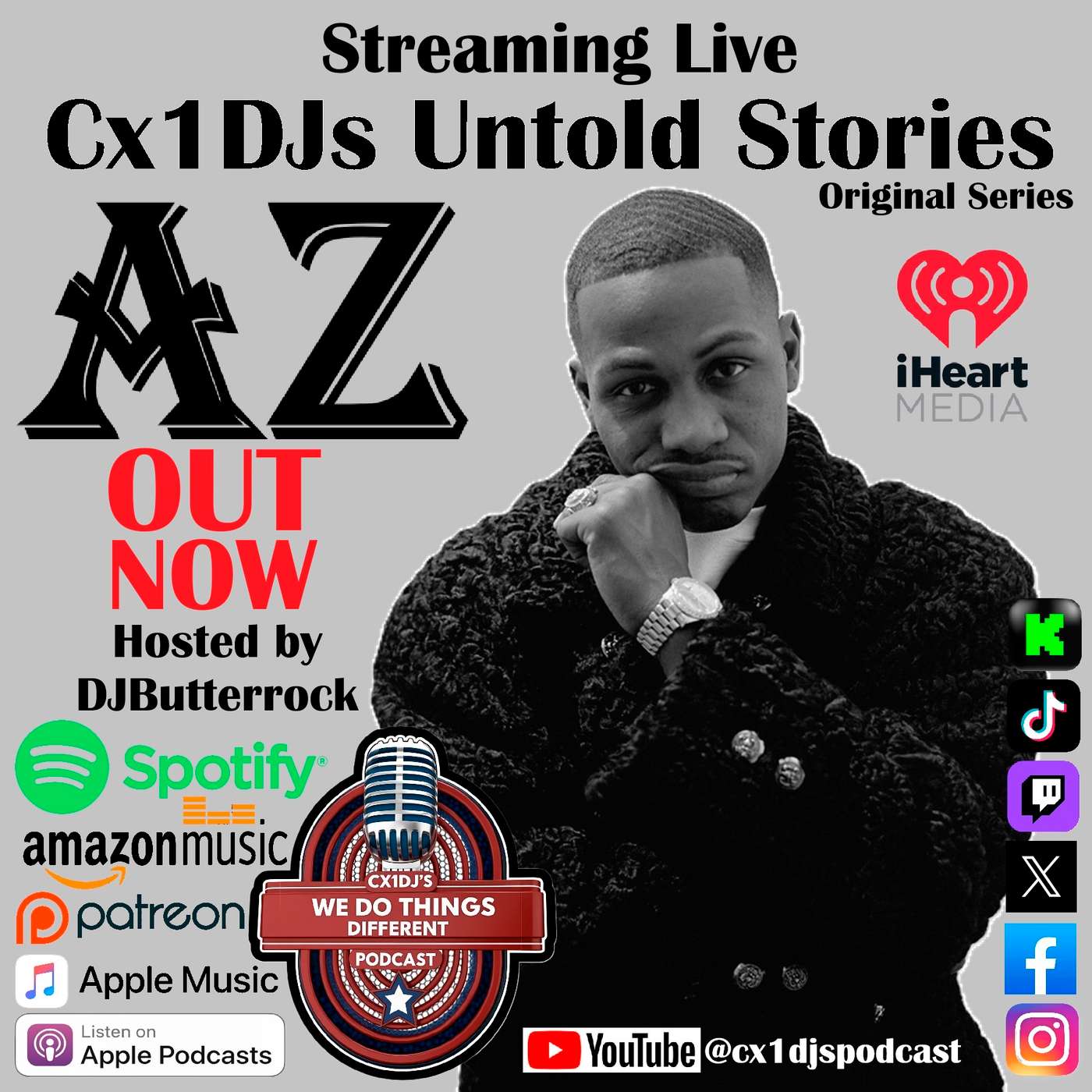
  • #183
    October 22 · 2 hr 15 min

    Cx1DJs We Do Things Different Podcast "Untold Stories of AZ" hosted by DJButterrock

    Cx1DJs We Do Things Different Podcast "Untold Stories of AZ" hosted by DJButterrock Anthony Cruz (born March 9, 1972), better known by his stage name AZ, is an American rapper. Best known for his work with fellow East Coast rapper Nas, the two formed the New York City-based hip hop group the Firm in 1996, along with Foxy Brown, Cormega and Nature. Cruz most notably guest appeared on Nas' 1994 single "Life's a Bitch," and signed with EMI to release his debut studio album, Doe or Die (1995), which was met with critical acclaim. Its lead single, "Sugar Hill" (featuring Miss Jones) peaked at number 25 on the Billboard Hot 100 and received gold certification by the Recording Industry Association of America (RIAA). Moreover, The Firm's sole album (1997) peaked atop the Billboard 200 chart despite unfavorable critical response; the group disbanded two years later.[1] Upon EMI's dissolution, he was transferred to its sister labels, Noo Trybe Records and Virgin Records, through which he released his second album, Pieces of a Man (1998), to continued acclaim. Afterward, Cruz signed with Motown and Universal Records to release his third and fourth albums, 9 Lives (2001) and Aziatic (2002).[2] The latter contained the song "The Essence" (featuring Nas), which earned a nomination for Best Rap Performance by a Duo or Group at the 45th Annual Grammy Awards.[2] Online magazine About.com listed AZ as the "Most Underrated [Rapper] of All Time".[3] AZ also made it onto the site's "Top 50 MCs of Our Time (1987–2007)", where he was named "arguably the most underrated lyricist ever". Early life AZ was born in Bedford–Stuyvesant, Brooklyn[4] to an African-American mother and a Dominican father. He grew up in East New York, Brooklyn, with his mother and sister.[4][5] AZ started writing rap lyrics when he was 12 years old.[5] He attended Eli Whitney High School, with fellow Brooklyn rapper Jay-Z, until the vocational school closed down in the late 1980s.[6] In the early 1990s, he became friends with Nas, a young rapper from Queens.[4] Nas started working on his debut album Illmatic and invited AZ to work with him in the studio. AZ appeared on the album intro and had a verse on "Life's a Bitch". After Illmatic was released in 1994, EMI Records offered AZ a record deal.[4] Career 1995–2001: Doe or Die, Pieces of a Man and 9 Lives AZ performing in 1997 AZ's debut album Doe or Die was released by EMI Records on October 10, 1995. It features guest appearances by Nas and production from N.O. Joe, Pete Rock, L.E.S., and Buckwild, among others. Doe or Die was known for popularizing the theme of mafioso rap, alongside several albums, namely Jay-Z's Reasonable Doubt and Nas's It Was Written. Doe or Die produced several singles, including "Mo Money, Mo Murder", "Gimme Yours", "Doe or Die" and "Sugar Hill", the last of which became his highest-charting single domestically and his sole Top 40 hit on the Billboard Hot 100, being certified Gold by the RIAA in September 1995.[7] In 1998, Pieces of a Man, AZ's second album, was released via Noo Trybe Records.[8] His third album, 2001's 9 Lives, was released via Motown, peaking at No. 58 on the Billboard 200. 2002–2007: Aziatic, A.W.O.L. and The Format AZ's fourth album Aziatic features a duet between AZ and long-time friend and collaborator, Nas, "The Essence", which was nominated for a Grammy Award for Best Rap Performance by a Duo or Group.[9] The album was mostly well received by critics, one such positive review from Brad Mills at Allmusic, states: "AZ has been looked upon to do amazing things with his music. Has he lived up to those high expectations on this album he has from start to finish. The beats on this album are complex, inventive, and almost perfectly suited for AZ's style of rhyming. He's carefully crafted this album rather than slapped it together overnight to meet his quota, and it shows. It helps immensely that he's brought along people like DR Period, Az Izz, Nas, and Buckwild, but they don't outshine the younger AZ as he holds his own well. AZ has come up with his best work in a long time on this album."[10] On September 6, 2005, A.W.O.L., his fifth album, was released, becoming the first AZ album to be released on his own imprint, Quiet Money Records.[11] AZ's sixth studio album The Format features production from Lil' Fame of M.O.P., Face Defeat, Emile, J. Cardim, Phonte, Statik Selektah and DJ Premier.[12] The album's lead single is its title track "The Format", which was produced by DJ Premier, with "Vendetta" as its B-Side. The Format also features the bonus track "Royal Salute", a retaliation to 50 Cent's song "What If" which included a line aimed at AZ. On October 7, 2007, Quiet Money released The Format (Special Edition), adding six bonus tracks including "Royal Salute".

  • #182
    October 21 · 2 hr 20 min

    Cx1DJs We Do Things Different Podcast "Untold Stories of Papoose" hosted by DJButterrock

    Cx1DJs We Do Things Different Podcast "Untold Stories of Papoose" hosted by DJButterrock Shamele Mackie[2] (born March 5, 1978), known professionally as Papoose (/pæˈpuːs/), is an American rapper. Known for his freestyles and prolific mixtape output, Papoose began his career in 1998 and has released 4 studio albums and 29 mixtapes. Born in New York, Mackie made his recording debut on Kool G Rap's 1998 album Roots of Evil. Papoose produced and distributed his own mixtapes during the early 2000s, and signed with Jive Records to record his debut studio album, The Nacirema Dream from 2005 to 2006. It failed to release in the latter year due to label conflicts, although it was released independently in 2013 and entered the Billboard 200.[3] His second album, You Can't Stop Destiny (2015), followed thereafter. Early life Shamele Mackie was born on March 5, 1978. He was raised in the Bedford–Stuyvesant neighborhood of Brooklyn. While an early rumor stated that his ancestry traced back to Liberia, a matrilineal DNA test through African Ancestry, Inc. revealed that he actually descends from the Tikar people living in present-day Cameroon.[4] The nickname "Papoose" was given to him by his grandmother for his resemblance as a baby to a Native American child.[5] Career Beginnings (1998–2004) In 1998, Papoose made his rap debut on Kool G Rap's Roots of Evil album. In 2004, he released his debut single, "Thug Connection", which featured the b-side "Alphabetical Slaughter".[6] Select Records offered him an eight-album deal, which he rejected.[7] Breakthrough, independent mixtapes (2005–2012) After a stint at Rikers Island, Papoose began producing and selling mixtapes independently,[8] one of which he presented to DJ Kay Slay outside the offices of New York's Hot 97, who then invited Papoose onto his radio show.[2] Impressed by his rendition of "Alphabetical Slaughter", Kay Slay signed him to his Streetsweepers imprint. Papoose continued to release mixtapes at a prolific rate, over a dozen between 2004 and 2006,[8] and won the Justo Mixtape Award for Best Underground Artist in 2005.[6] During this time, he became associated with Busta Rhymes's Flipmode Squad, appearing on the remix of "Touch It". On August 24, 2006, Papoose announced that he had signed with Jive Records in a deal worth $1.5 million.[8] and was planning his debut album, The Nacirema Dream.[9] In September 2007, Kay Slay revealed that he and Papoose had left Jive, saying that they had "almost (became) victims of A&R hell."[10] Papoose continued to release his work independently, dropping nine mixtapes between 2007 and 2012.[11] On the 2009 mixtape 21 Gun Salute, Papoose admitted that he was able to keep the $1.5 million from Jive, despite not releasing an album. The Nacirema Dream, You Can't Stop Destiny (2012–2015) After seven years of development and 27 mixtapes in all, Papoose secured a deal with Fontana Distribution to release his debut album The Nacirema Dream.[12] The album was released on March 26, 2013, to positive reviews from music critics and debut at number 97 on the U.S. Billboard 200.[13] It was preceded by the single "On Top of My Game", featuring Mavado.[14][15] On June 2, 2013, Papoose "crashed" Hot 97's Summer Jam with the help of Top Dawg Entertainment, performing The Nacirema Dream's third single "Get At Me" with Ron Browz.[16] Following the release of "Control", Papoose took offence to Kendrick Lamar claiming the title of "King of New York" and dissed him in a remix of the track. Lamar called Papoose's response "comical"[17] and threw shots back at him during the BET Hip Hop Awards cypher.[18] On October 4, 2013, Papoose responded by saying that Lamar would never be "able to shine my shoes, lyrically" and that he was planning to release another diss track on an upcoming mixtape.[18] On November 4, 2013, Papoose released Hoodie Season his first mixtape since his debut album.[19] He would release two more mixtapes, Hoodie Season 2 and Cigar Society, before releasing his second studio album You Can't Stop Destiny on July 17, 2015.

Showing 1–20 of 72 episodes