

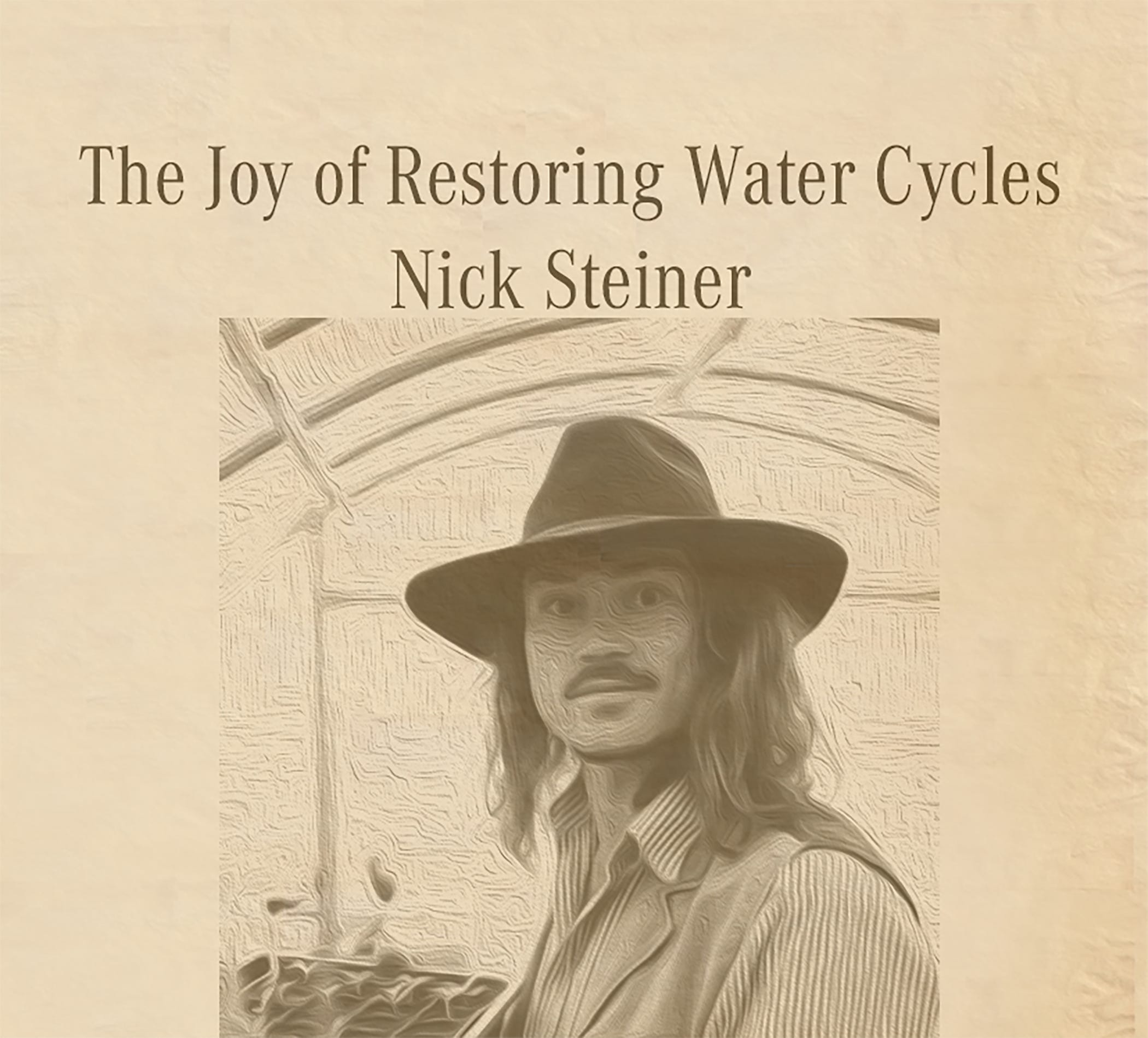
The joy of restoring water cycles : Nick Steiner
Nick Steiner’s delight in restoring the water to our lands emerges as I talk to him. He works in watershed management, his service is called PermaNick , helping landowners grow regenerative landscapes that slow and absorb more of the rain. He is a passionate advocate and speaker about the larger vision of restoring our water cycles. His home is in Canary Islands, where they only have a couple of inches of rain a year, and yet he has found a way to guide the rainfall so he can harvest it for his own use and also to hydrate the land. He’s working with Water Stories to birth the larger educational movement of training the next generation of water practitioners. There are many landowners seeking to have their land hydrated, and their is much more work than there are practitioners now. We thus need to train a lot of people to do this work, and that is what Water Stories does. If you are interested in signing up for the Water Stories educational courses you can choose to use this link here (I became an affiliate because I believe in their work) Nick has a captivating essence about him, which makes one want to become enthusiastic and do the work of digging a hole to get a tree to have more water, to have your driveway guide the water into the land. So I hope some of you reading this get inspired and start looking at how to do the work on a piece of land. There is something that grounds all this water theory - when you start going out in the rain observing how the water flows, and working the land to guide the flow of water. I had been planning on putting on a water workshop by myself before talking to him. After our interview, we got excited about putting on a workshop together. So here it is. In the workshop you will learn about the theory and practice of restoring water cycles. You will also get a chance to get to connect with others who come to the workshop, as we build a community around this work. I debated whether to charge for the workshop, and decided to make it free, with the hope that some of you will sign up for paid subscriptions to this newsletter, so it will be easier for me continue offering more workshops in the future. The workshop will be on Sun Jul 7th noon-2pm EST . At that time you can open this link on Zoom https://us02web.zoom.us/j/87354624137?pwd=5Av53IbHhI9LWVmBAvyE1gQY66u5ka.1 …. Here is a transcript of part of our interview, edited for brevity, clarity, and understanding: Nick Steiner Interview Alpha: Today, I'm excited to have Nick Steiner on the podcast. Welcome, Nick. Nick: Yeah, thanks so much for having me. Super excited to be here. Alpha: How did you get into this water work? Nick: So it started also pretty much 10 years ago when I when I first got got into permaculture and then got more into this whole regenerative world where I was just experimenting on really small scale with water. Then on slightly bigger water projects. I did lots of different courses that I could find, read all the books I could find. And at some point, a friend of mine, Oliver Gauthier of the Regenerative Skills podcast, he told me that he had just spoken with Zach Weiss and that he's planning on launching a course about water cycle restoration called Water Stories. I thought that's spot on what I want to be doing. I did this course in its founding round thing around two years ago. That was just completely life changing because before I was working on small projects and working indirectly with others, but I didn't quite feel ready to do this work full time. After doing the Water Stories course, I started saying, OK, now I feel kind of well-prepared to actually take on landscape projects. I started working with landowners, small projects, and bigger ones, some larger farms on the size of a few hundred hectares. That was really the kickoff point to get really serious about working with water. Now I'm also now part of the Water Stories team, the goal is to educate and have hundreds or thousands of people to work in water cycle restoration. The water cycles are so critical, we need to get them right. If its only in theory, we're not going to get far. We need the people on the ground to actually build these landscapes. And that's kind of the mission that we're on at Water Stories Alpha : Can you say a little bit about how the Water Stories course works? Do you have a bunch of cohorts online or in person? What were some of the things you learned in that course? How long did it take? Nick: It was actually a really interesting approach because so many online courses are just videos and you just watch lots of videos and then you click a button that says, okay, I know how to do this now, but you don't really. Specifically with working with water and landscapes, you need to get your hands dirty. And that's what I loved about the course there, where it was more like you have some theory in a video format with Zach explaining concepts about water cycles, but also about all the different things you need for the kind of work. We had to complete a lot of tasks. At the beginning, it's more like, okay, we need to observe different landscapes, go out in a rainstorm, see what happens when it rains, where does the water flow? Where does it accumulate? What kind of plants are growing? We had to build small models. So build like a tiny little dam with clay and see at which consistency does the clay behave in a certain way with how well it holds water? Then we built large things. Then the final project of the course was actually working for a client. So doing a full project where you build a water retention feature. That was always supported by cohorts. We had regular calls with them where we could ask all our questions. And that way, it wasn't just watching videos, but it was also not the problem of having to be at a specific site at a specific point. And in that way, it was just getting my hands dirty, watching some videos, and then working with clients. Alpha : Was Zach your main mentor, or did you have other mentors too? Nick: I've also had the great pleasure through Climate Farmers to meet Mark Sheppard in person. I also learnt a lot from him. Also Darren Doherty, you know, they're from Regrarians. So many people I got to learn from. But I would say Zach definitely had the biggest influence since I also spent most time with him. We have many weekly calls. When I have projects, I can just always ask and get Zach’s feedback on things. Alpha: How did he design his course? Nick: Zach learned from many different people, his water heroes, as he called them. He tried to modelled the approach of working more with landscapes and reading more into them. There’s a lot of these different elements you would do on a site. You can do a Permaculture Design Course (PDC) first to learn about water. After doing just a PDC though I've never talked to anyone who felt ready yet to build proper water features, except maybe a swale. So you can do the Water Stories course after. Alpha: So I guess you learn a lot of different techniques to slow water, like terraces and ponds. When you work with a piece of land, how do you decide which features you want to do use in relation to water? Nick: The biggest part is observing the land, and ideally observing it when it rains or directly after a rainfall. Sometimes when you walk after rainfall, you see these spots that are super wet, and you see other spots that are dry, and the landscape kind of tells you like, hey, this is a good spot to hold water. Or sometimes you realize there's an area that's super dry, where it would be great to hydrate it a bit more. I also really love working with digital mapping software and analysis software for landscapes. I'm doing terrain analysis. For a farm, I get the rough outline, and then I can download kind of 3D data of how it looks. And then there's different algorithms that you can run to get an idea of when it rains, this is where the water will flow. This is the catchment size. This is where you could put potential wat… This is a public episode. If you'd like to discuss this with other subscribers or get access to bonus episodes, visit climatewaterproject.substack.com/subscribe
- Transcript