Skip to content
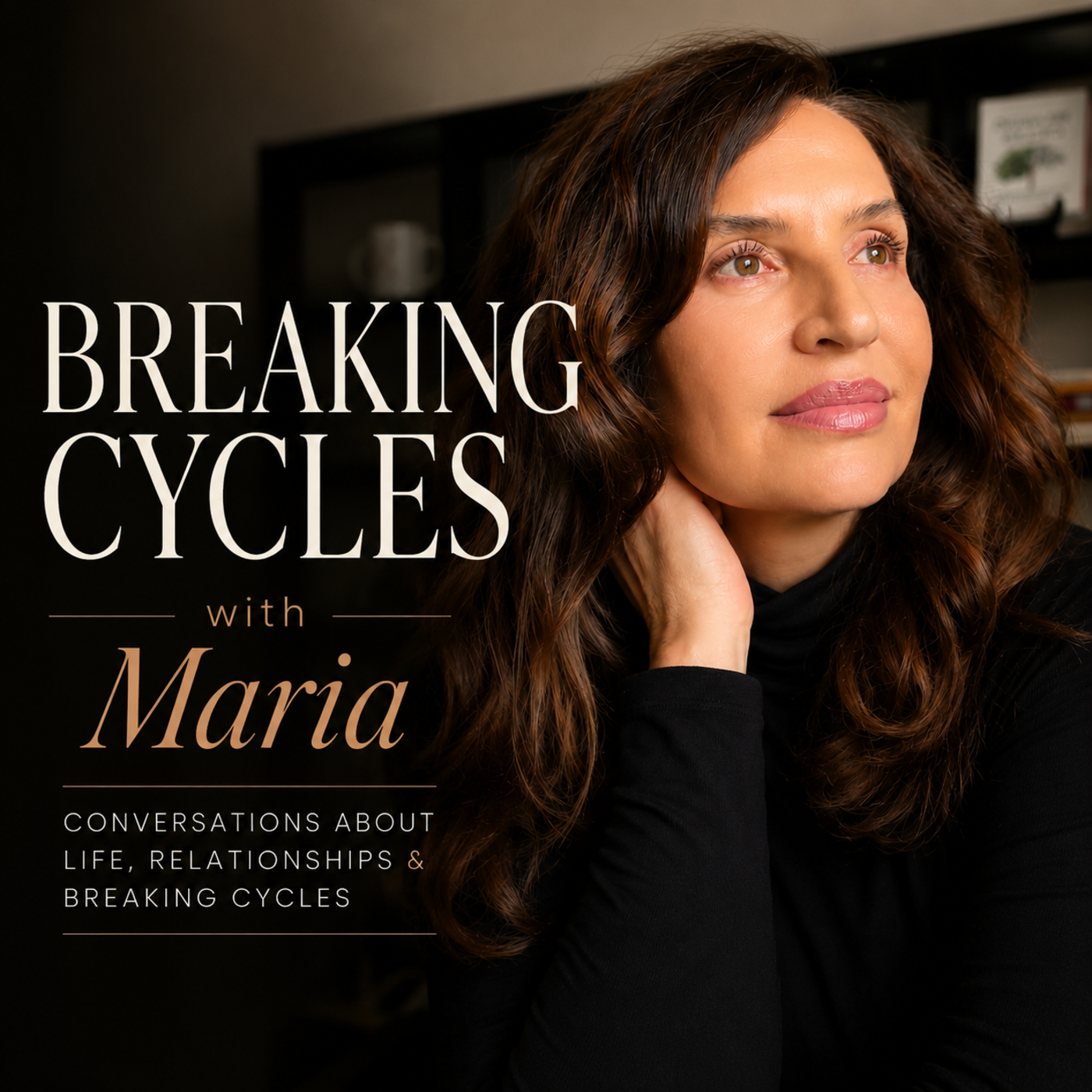
Artwork for Breaking Cycles with Maria
Health & FitnessMental Health

Breaking Cycles with Maria

Maria Shkreli

Breaking Cycles with Maria is an honest and relatable podcast about relationships, emotional patterns, self-awareness, anxiety, attachment, dysfunctional dynamics, and the things we normalize without even realizing it.

Hosted by Maria Shkreli, LMHC, author of Breaking Cycles and Breaking Up with Toxicity, the podcast explores the messy, complicated, and very human side of life — from unhealthy relationship patterns and family dynamics to workplace stress, life transitions, emotional reactions, and the cycles that quietly shape us.

Some episodes are educational. Some are conversational. Some may challenge the way you see yourself, your relationships, or the people around you.

Because the truth is… we all have patterns.
Some help us grow.
Some quietly keep us stuck.

Through real conversations, psychological insight, personal reflection, and a little bit of spice, Maria helps listeners better understand the patterns they repeat, the emotional experiences they normalize, and how to navigate life with greater awareness, clarity, and emotional health.

No perfection. No pretending. Just real conversations about life, relationships, and breaking unhealthy cycles.

Play
  • 20 episodes
  • Avg 23 min
  • English
  • S1 · E34
    Thursday · 31 min

    EP 34: Four People, Four Attachment Styles: When a Family Keeps Missing Each Other

    What happens when four people in the same family love each other—but each one reaches for safety differently? In this episode of Breaking Cycles with Maria, I take attachment styles out of the dating world and bring them into the family. Through one family, we look at anxious, avoidant, fearful-avoidant, and secure attachment—and what can happen when those different needs for closeness, reassurance, independence, and space collide under one roof. But this isn't about diagnosing your parents, your partner, or your children. It's about recognizing the pattern—including your part in it. Through real-life family scenarios, we'll look at how worry can start sounding like control, how needing space can turn into emotional withdrawal, why someone may push you away and still want connection, and how the “mature” child can quietly become the family regulator. And here's the challenge: What do you do when you stop feeling emotionally safe—and what does your way of protecting yourself trigger in the people around you? Sometimes families aren't fighting because they don't love each other. They're fighting because they're trying to feel safe in completely different ways.

  • S1 · E33
    October 8 · 25 min

    EP 33: When Helping Becomes Control

    When does helping someone stop being support and start becoming control? In this episode of Breaking Cycles with Maria, I’m looking at something that can be difficult to recognize because it often comes from a good place. We love someone, we see them struggling, and naturally we want to step in. But when we constantly fix problems, give advice, rescue, remind, manage, or remove consequences, our help may actually be making it harder for the other person to develop confidence and independence. I talk about how this shows up between parents and adult children, in marriages and relationships, and even in friendships. We’ll look at over-functioning, anxiety and control, financial rescuing, family boundaries, the need to be needed, and why some of us have such a hard time watching someone we love struggle. This isn’t about becoming cold or refusing to help. It’s about learning the difference between supporting someone and taking over for them. And sometimes the harder question isn't, “Why do they need me so much?” It’s: “Why do I need to be needed?” Before you step in and fix the next problem, ask yourself: Am I helping this person build capacity—or am I making myself necessary? Topics discussed: family dynamics, parents and adult children, controlling parents, boundaries, codependency, over-functioning, people-pleasing, anxiety and control, emotional independence, relationship patterns, rescuing, enabling, parenting adult children, marriage and communication, healthy relationships, and emotional boundaries.

  • S1 · E32
    October 1 · 26 min

    EP 32: Love Bombing or Just Intense? Why We Need to Stop Diagnosing Every Strong Connection

    Someone texts you every morning, wants to see you constantly, brings flowers, gives compliments, and seems completely taken with you. Today, we’re quick to call it love bombing. But is it? Love bombing and emotional manipulation are real—but intensity can also come from anxious attachment, insecurity, loneliness, fear of abandonment, borderline traits, poor relationship pacing, or simply genuine excitement. In this episode of Breaking Cycles with Maria, Maria Shkreli, LMHC looks beyond the label and asks a more important question: What happens when you slow things down, set a boundary, say no, disagree, or spend time apart? Because the difference between intensity and manipulation may not be in the flowers, compliments, or constant texting. The pattern often reveals itself when boundaries and reality enter the relationship. Sometimes it is love bombing. Sometimes it’s a human being navigating their own fears, attachment patterns, insecurities, and emotions. Before you diagnose the behavior, understand the pattern. Topics: love bombing, anxious attachment, emotional manipulation, borderline traits, insecurity, dating, boundaries, narcissism, intimacy, relationship patterns, and healthy relationships.

  • S1 · E31
    September 19 · 36 min

    EP 31: Why Knowing Better Doesn’t Mean Doing Better — The Cycle Breaker Method™

    In this episode of Breaking Cycles with Maria, Maria Shkreli, LMHC introduces the Cycle Breaker Method™, a practical framework for understanding how everyday behaviors and interactions become repeated patterns—and where we have the power to interrupt them. Drawing from more than two decades of clinical experience, Maria explores the space between knowing and doing. Why do we keep rescuing, chasing, overexplaining, people-pleasing, giving in, or saying yes when we already know the pattern isn’t working? Maria also explores how the Cycle Breaker Method™ complements popular behavior-change approaches such as James Clear’s Atomic Habits and BJ Fogg’s Tiny Habits —while going deeper into what happens when emotions, relationships, guilt, fear, boundaries, and other people enter the equation. You’ll be introduced to the five-part Cycle Breaker framework: Event → Interpretation → Response → Reinforcement → Normalization Because sometimes you don’t need more information. You need to understand what keeps the pattern alive. You’re not stuck. You’re patterned. And a pattern can change.

  • S1 · E30
    June 11 · 44 min

    EP 30: Maria & Madge: The Fixer’s Trap — When Control Becomes Comfort

    In this episode of Breaking Cycles with Maria, Maria and Madge explore a question many people quietly struggle with: Why do some of us feel responsible for fixing everything—and everyone? What begins as a conversation about problem-solving quickly reveals something deeper: the connection between anxiety, control, perfectionism, and the need to keep everything "just right" in order to feel okay. Maria challenges Madge to examine how fixing, organizing, cleaning, and managing situations can become ways of soothing internal discomfort. Together, they discuss anxiety, OCD tendencies, self-imposed rules, retirement, loneliness, and the difficulty of sitting with discomfort instead of immediately trying to make it disappear. The conversation also takes a personal turn as they explore friendship, aging, health challenges, independence, and what it means to stop fixing everyone else and start focusing on yourself. If you've ever thought: "I'll feel better when this is done." "I have to take care of everything." "No one will do it right unless I do it." "I can't relax until everything is in order." This episode is for you. Because sometimes the thing we're trying to control isn't our environment—it's our anxiety. And sometimes the hardest thing to fix is ourselves.

  • S1 · E29
    June 5 · 31 min

    EP 29: Maria & Madge: Picking Up Where We Left Off

    Life got busy, schedules filled up, and before we knew it, another conversation was waiting to happen. In this episode, Madge and I reconnect and pick up where we left off. We talk about friendship, changing seasons of life, personal growth, and what happens when people come back together after time has passed. Some friendships reconnect instantly, while others take time to find their rhythm again. We explore how relationships evolve, why some people remain in our lives while others drift away, the impact of major life changes, and how our expectations can shape the way we experience others. Along the way, I also share part of the journey behind the development of the Cycle Breaker Method™. Many people are familiar with Atomic Habits and the idea that small habits create lasting change. The Cycle Breaker Method™ approaches change from a different angle by focusing on the response—the moment where patterns are either reinforced or interrupted. Because what gets repeated becomes reinforced. What gets reinforced becomes normalized. A genuine conversation about friendship, perspective, self-awareness, and the patterns that quietly shape our lives. Most people aren't stuck. They're patterned.

  • S1 · E28
    May 21 · 32 min

    EP 28: The Narcissistic Mother Blueprint Part 3 — Mother–Son Dynamics, Loyalty, and Emotional Enmeshment

    In Part 3 of the Narcissistic Mother Blueprint Series, Maria Shkreli, LMHC, explores the often misunderstood mother–son dynamic and how emotional loyalty, guilt, enmeshment, and cultural expectations can quietly shape a son’s identity, boundaries, and adult relationships. Maria breaks down how emotional over-responsibility can develop early in childhood and why many sons grow up feeling emotionally responsible for protecting, stabilizing, or emotionally carrying a parent without fully realizing it. The episode explores how these patterns later show up in adulthood through guilt, conflict avoidance, divided loyalty, emotional shutdown, difficulty setting boundaries, and relationship struggles. This episode also takes a deeper look at how survival-based and immigrant cultures — including many Albanian family systems — may unintentionally reinforce emotional enmeshment through messages around sacrifice, loyalty, obligation, image, and family responsibility. Maria explains why these dynamics are not about blaming parents or culture, but about understanding how emotional systems are formed and repeated across generations. Through psychological insight, cultural context, and real-life examples, this episode helps listeners better understand the deeper emotional blueprint behind many mother–son relationships and why awareness is often the first step toward healthier boundaries, differentiation, and breaking unhealthy cycles.

  • S1 · E27
    February 19 · 29 min

    EP 27: Part 2 of the Narcissistic Mother Blueprint Series

    Part 2 — Mother–Daughter Dynamics | Narcissistic Mother Blueprint Series This episode is Part 2 of the Narcissistic Mother Blueprint Series on Breaking Up with Toxicity, where we explore how narcissistic parenting dynamics, dysfunctional family systems, and early attachment patterns shape identity, boundaries, and adult relationships. In this episode, we focus specifically on mother–daughter dynamics, examining how subtle competition, approval tied to performance or appearance, emotional withdrawal, criticism disguised as guidance, and identity mirroring can quietly shape daughters’ self-concept, emotional development, and relational expectations across childhood, adolescence, and adulthood. We discuss how these patterns often intensify during the teenage years — when identity formation, independence, and social visibility naturally increase — and how many daughters begin learning that independence may trigger guilt, comparison, or emotional disconnection within the family system. Over time, these experiences can contribute to adult patterns such as people-pleasing, perfectionism, overthinking, fear of disapproval, difficulty setting boundaries, approval-seeking, and anxiety around visibility or independence. This conversation is not about blaming mothers. It is about understanding narcissistic family dynamics, enmeshment, emotional conditioning, trauma patterns, attachment styles, and relational blueprints so individuals can recognize patterns and begin building relationships based on reciprocity, emotional safety, and differentiation rather than emotional monitoring. If you’ve ever found yourself over-explaining, second-guessing your decisions, feeling responsible for others’ emotional reactions, or struggling with the tension between authenticity and acceptance, this episode will help you understand where those patterns may have formed — and how awareness becomes the first step toward breaking them. Listen to Part 1 of the Narcissistic Mother Blueprint Series to understand the foundational dynamics that shape daughters and sons differently, and stay tuned for upcoming episodes exploring mother–son dynamics, adult relationship carryover, guilt-based loyalty patterns, and boundary transformation. Breaking the blueprint begins with understanding it.

  • S1 · E26
    February 17 · 16 min

    EP 26: Part 1 of the Narcissistic Mother Blueprint Series

    In this episode of Breaking Up with Toxicity, Maria Shkreli, LMHC, begins the Narcissistic Mother Blueprint Series, a multi-part series exploring how narcissistic maternal dynamics shape emotional development, family roles, identity formation, attachment patterns, and adult relationship experiences. Drawing from attachment theory, developmental psychology, trauma research, and decades of clinical work on narcissistic personality structures — including the foundational contributions of Otto Kernberg and contemporary clinical education from Ramani Durvasula — this episode explains how early emotional environments create relational blueprints that often continue influencing boundaries, communication patterns, and emotional decision-making long into adulthood. Topics explored include: narcissistic parenting and maternal narcissism emotional enmeshment and approval-based family systems attachment styles and developmental trauma intergenerational transmission of relational patterns the difference between narcissistic traits and Narcissistic Personality Disorder (NPD) how early emotional environments shape long-term relationship patterns This is Part 1 of a multi-episode series. In the upcoming episodes, we move deeper into the mother–daughter and mother–son relational dynamics, examining how these early patterns show up in adult relationships and what begins to help individuals break long-standing relational cycles. If you’ve ever wondered why certain emotional patterns repeat across relationships, this series provides the psychological framework to begin understanding — and changing — those cycles. Disclaimer: This podcast is for educational and informational purposes only and is not intended to replace therapy, diagnosis, or professional mental health treatment. Content discussed does not constitute clinical assessment or diagnosis of any individual. Listeners are encouraged to seek professional support for their own circumstances.

  • S1 · E25
    February 5 · 20 min

    EP 25: When Healing Feels Like Grief: The Part No One Warns You About

    When Healing Feels Like Grief: The Part No One Warns You About Healing is supposed to feel empowering… right? So why does it sometimes feel lonely, heavy, or heartbreaking instead? In this episode of Breaking Up With Toxicity, Maria Shkreli, LMHC talks about the part of healing no one prepares you for—the grief that comes with growth. The grief of outgrowing relationships that can’t come with you. The grief of letting go of survival patterns that once kept you safe. The grief of realizing how much you adapted, endured, or went without. This episode explores why healthy change can feel painful, isolating, and confusing—even when you’re finally doing the “right” things. We talk about mourning old versions of yourself, releasing fantasies about people changing, navigating quieter phones and shifting relationships, and why sadness during healing is not a sign of failure—but a sign of honesty. If you’ve ever wondered: Why setting boundaries hurts more than staying the same Why healing feels lonely before it feels freeing Why growth brings sadness, not instant relief Or why you miss people you know weren’t good for you This episode is for you. Healing doesn’t always feel good—but it feels true. And if healing feels like grief, you’re not broken. You’re processing. You’re not alone in this part of the journey. Disclaimer: This podcast is for educational and informational purposes only and is not intended to replace therapy, diagnosis, or professional mental health treatment. Content discussed does not constitute clinical assessment or diagnosis of any individual. Listeners are encouraged to seek professional support for their own circumstances.

  • S1 · E24
    January 29 · 10 min

    EP 24: Not Everyone Is a Narcissist: Personality Traits Are Not Diagnoses

    Narcissist. Borderline. Toxic. But here’s the problem—personality traits are being confused with personality disorders, and that confusion is costing people clarity, peace, and the ability to respond accurately in their relationships. In this episode of Breaking Up With Toxicity, licensed mental health counselor Maria Shkreli breaks down the real difference between personality traits and personality disorders, using clear, real-life examples from romantic relationships, families, and everyday interactions. You’ll learn: What personality traits actually are and how they show up under stress What makes a personality disorder fundamentally different Why clinically diagnosed personality disorders are far less common than social media suggests How mislabeling people can keep you stuck—or push you to leave too fast The key question that helps you tell the difference between discomfort and danger This episode isn’t about diagnosing anyone. It’s about discernment, nuance, and understanding what you’re actually dealing with—so you stop outsourcing clarity to the internet. If you’ve ever wondered whether you’re overreacting, minimizing something serious, or trying to fix something that was never flexible to begin with, this episode is for you. Disclaimer: This podcast is for educational and informational purposes only and is not intended to replace therapy, diagnosis, or professional mental health treatment. Content discussed does not constitute clinical assessment or diagnosis of any individual. Listeners are encouraged to seek professional support for their own circumstances.

  • S1 · E23
    January 22 · 12 min

    EP 23: Social Media Has Created a New Kind of Abuse

    What actually qualifies as abuse? When does abuse become domestic violence? And how did social media turn these life-saving terms into weapons of confusion? In this episode of Breaking Up with Toxicity, Maria Shkreli, LMHC breaks down the critical differences between dysfunction, toxicity, abuse, and domestic violence—and explains why misusing these terms can cause real harm. As a society, we’ve evolved. Behaviors that were once normalized—like yelling, explosive tempers, and emotional volatility—are now being questioned. That progress matters. But somewhere along the way, context and nuance were replaced with certainty and fear. Today, social media, influencers, and non-professionals are shaping how people understand abuse—often without training, assessment, or accountability. Complex mental-health and safety issues are reduced to viral sound bites, leading people to label discomfort as danger and conflict as violence. In this episode, Maria also challenges a harder truth: Social media has created a new kind of abuse—one rooted in misinformation, fear-based advice, and unqualified authority. When people are told what to think instead of how to think, autonomy erodes, discernment disappears, and real victims are drowned out. You’ll learn: What domestic violence actually is—and what it isn’t How abuse and domestic violence are related but not the same Why DV does not require physical violence to exist How insecurity and low self-esteem can look like DV without coercive control How online misinformation creates psychological harm Why precision and context are essential when safety is involved This conversation isn’t about minimizing harm. It’s about protecting the meaning of words meant to save lives. Because when everything is called abuse, no one is safe. Disclaimer: This podcast is for educational and informational purposes only and is not intended to replace therapy, diagnosis, or professional mental health treatment. Content discussed does not constitute clinical assessment or diagnosis of any individual. Listeners are encouraged to seek professional support for their own circumstances.

  • S1 · E22
    January 15 · 13 min

    EP 22: Pulled Apart: How Parental Alienation Breaks Families

    Parental alienation is one of the most misunderstood and emotionally charged dynamics in family systems—and when it’s oversimplified, it can cause real harm. In this episode of Breaking Up With Toxicity, Maria Shkreli, LMHC, breaks down what parental alienation actually is, how it develops, why it happens, and what it looks like in real families—without blame, labels, or sound-bite psychology. This conversation explores: What parental alienation is—and what it is not How children become caught in adult pain and loyalty conflicts The emotional and psychological patterns that drive alienation Different types of parents who may alienate a child (without diagnosing) Real-world examples involving children, teens, and adult children The long-term impact of alienation on identity, relationships, and trust How healing begins for parents and adult children alike This episode is not about choosing sides or dismissing real abuse. It’s about understanding patterns, protecting children, and breaking cycles of emotional harm. Disclaimer: This podcast is for educational and informational purposes only and is not intended to replace therapy, diagnosis, or professional mental health treatment. Content discussed does not constitute clinical assessment or diagnosis of any individual. Listeners are encouraged to seek professional support for their own circumstances.

  • S1 · E21
    January 8 · 13 min

    EP 21: Estrangement: Healing, Harm — or Something In Between?

    Estrangement isn’t just “cutting people off.” It can be protection… and it can also be avoidance disguised as healing. In this episode, Maria Shkreli, LMHC breaks down the truth behind estrangement — what it actually is, the different types, and why it’s far more complex than social media makes it seem. We explore how trauma, family dynamics, and unresolved attachment wounds can lead to distance — but also how trend-driven messages, including the popular “Let Them” narrative popularized by Mel Robbins, can quietly push people toward isolation without reflection, context, or accountability. In this episode, we talk about: • the five main types of estrangement, with real-life examples • when distance is necessary and protective vs. when it becomes harmful and avoidant • how trauma and emotional regulation influence estrangement decisions • how “cut them off” culture can damage vulnerable people • why the “Let Them” theory can backfire when misunderstood or misapplied • the questions to ask before making permanent relational decisions This episode challenges viral narratives and invites deeper reflection — so your choices come from clarity, not impulsive pain. Estrangement isn’t a trend. It deserves wisdom, thoughtfulness, and compassion. If this episode resonates, share it with someone who needs it — and don’t forget to follow the show.

  • S1 · E20
    Dec 18, 2025 · 11 min

    EP 20: They’re Not Defiant — They’re Insecure (Parents, You’re Missing the Signs)

    What if the behavior you’re calling defiance isn’t defiance at all? In this episode of Breaking Up With Toxicity, licensed mental health counselor Maria Shkreli breaks down one of the most misunderstood dynamics in parenting: the difference between true defiance and deep insecurity in kids and teens. You’ll learn why so many children are punished for fear, shame, and overwhelm — and how mislabeling insecurity as defiance quietly damages trust, communication, and emotional safety. Maria explains what defiance actually is, what insecurity looks like at different developmental stages, how behavior changes from childhood into adolescence, and why teens often mask fear with anger, attitude, or withdrawal. With real-life examples straight from clinical work, this episode challenges common parenting myths and offers a clearer lens for understanding difficult behavior without excusing it. If you’ve ever felt stuck in power struggles, confused by your child’s reactions, or unsure whether discipline is helping or hurting, this episode is for you. Because not every child who pushes back is defiant — sometimes they’re just afraid and don’t know how to say it. Awareness is where change begins. View the pdf here: "They're Not Defiant" pdf. Disclaimer: This podcast is for educational and informational purposes only and is not a substitute for therapy, diagnosis, or individualized mental health treatment. Listening does not establish a therapist–client relationship. Examples discussed are illustrative and not diagnostic. If you have concerns about a child’s behavior or emotional wellbeing, consult a qualified mental health professional.

  • S1 · E19
    Dec 11, 2025 · 12 min

    EP 19: When Empathy Meets Attachment: Why You Misread People Even When You Think You Understand Them

    Ever wonder why your partner’s “help” feels cold… why their silence triggers panic… or why you keep having the same arguments even when you both mean well? In this episode, Maria Shkreli, breaks down the powerful intersection between your attachment style and your empathy style — the two systems that secretly shape how you love, comfort, react, and communicate. You’ll learn why: • Anxious attachers crave emotional empathy • Avoidant attachers default to logical empathy • Secure attachers offer balanced, compassionate empathy • Disorganized attachers switch their empathy based on fear and overwhelm Through real, relatable scenarios — the unread text, the “we need to talk,” the shutdown, the emotional whiplash — Maria shows how love gets misinterpreted simply because you and your partner speak different emotional languages. If you’ve ever felt misunderstood, unseen, or confused by someone’s reactions, this episode finally connects the dots.

  • S1 · E18
    Dec 4, 2025 · 25 min

    EP 18: Attachment Styles: The Silent Saboteurs — How They Screw Up Your Relationships (and How They Can Save Them)

    Your reactions aren’t random — they’re wired. Your fears aren’t “too much” — they’re patterns. And your relationship struggles aren’t failures — they’re attachment styles playing out in real time. In this episode of Breaking Up With Toxicity, Maria Shkreli, LMHC exposes how your attachment style was shaped long before you ever dated anyone… and how it still dictates the way you love, fight, connect, shut down, panic, or pull away today. Maria breaks down the four attachment styles — Secure, Anxious, Avoidant, and Disorganized — using real, relatable everyday scenarios: the unread text that sends you spiraling, the partner who shuts down when you want to talk, the sudden panic when things get “too close,” the push-pull dynamic that feels like emotional whiplash. You’ll learn: • Why anxious attachers overthink and fear abandonment • Why avoidant partners pull back when emotions get intense • Why disorganized attachers crave connection but fear it at the same time • How secure partners can stabilize — or unintentionally trigger — other styles • Which pairings create healing… and which create chaos without awareness This episode gives you the emotional clarity you’ve been missing — the “Oh… THAT’S why I do that” moment your relationships have been waiting for. And stay tuned: next week we bring this full circle with “Empathy Meets Attachment: Why You Misread People Even When You Think You Understand Them.”

  • S1 · E17
    Nov 29, 2025 · 15 min

    EP 17: You Think You’re Empathetic… But You’re Probably Not: The Three Empathies You Never Learned

    Most people walk around proudly believing they’re “empathetic.” But here’s the truth: you probably only have **one** of the three empathies — and the misalignment between what you think you’re giving and what others actually need is quietly blowing up your relationships. In this episode, Maria Shkreli breaks down the REAL psychology of empathy: Cognitive, Emotional, and Compassionate. What they are, how they develop, why most people only master one, and how these mismatches create conflict, resentment, emotional distance, and constant misunderstandings. You’ll hear: • The full explanation of each empathy type • Why empathy exists on a spectrum — not a personality trait • Six real-life scenarios that expose how misalignment shows up in partners, friends, parents, and coworkers • Why you keep expecting people to show up emotionally in ways they are literally not wired or trained to do • And the twist that makes all of this even more complicated: **your attachment style** By the end of this episode, you’ll finally understand why you feel misunderstood, why others seem insensitive or “too emotional,” and why some people are amazing in crisis but terrible at comfort. This is the episode that will make you see yourself — and everyone around you — differently. Next week: When Empathy Meets Attachment: Why You Misread People Even When You Think You Understand Them.

  • S1 · E16
    Nov 6, 2025 · 37 min

    EP 16: It’s Not Your Anger — It’s Your Relationship With It

    Anger isn’t the problem — it’s how we use it. In this raw and eye-opening episode, Maria Shkreli, LMHC, breaks down anger, the three faces of toxic rage — Intermittent Explosive Disorder, Splitting, and Narcissistic Rage — the enabler, and how they destroy connection, trust, and peace. You’ll learn how these emotional explosions start, what fuels them, and why they’re more about fear and control than strength. Maria shares powerful examples of what this looks and sounds like in real life — from the partner who screams to feel seen, to the parent who weaponizes silence, to the coworker who burns bridges to protect their ego. Most importantly, you’ll learn how to recognize, stop enabling, and start healing from the rage that runs deep in dysfunctional systems. Because you can’t call it passion when it’s really pain. Listen if you’ve ever: Walked on eggshells around someone’s temper Confused chaos with love Felt guilty for setting boundaries Or realized your anger has been running the show It’s time to face the fire without letting it burn you.

  • S1 · E15
    Oct 30, 2025 · 20 min

    EP 15: When the Narcissist Is a Woman: The Silent Storm No One Talks About

    We talk endlessly about narcissistic men — but what happens when the narcissist is a woman? In this episode, Maria Shkreli, LMHC, breaks down why narcissistic women are often harder to recognize, confront, and recover from — whether she’s your mother, your partner, or your boss. You’ll learn how manipulation hides beneath care, how control disguises itself as love, and how living with this dynamic rewires your entire sense of self. Many of these women grew up watching their mothers destroy men — and swore they’d never do the same. But unhealed daughters don’t break cycles; they repeat them. Maria explores the silent epidemic of women raised by narcissistic mothers — women who tear down the kind men who love them, twist truth into victimhood, and still get celebrated for being “strong.” It’s time to talk about the men who were silenced, shamed, and finally set free. Tune in for a raw, unapologetic conversation about female narcissism — the unspoken power dynamic that leaves no visible bruises but deeply scars the soul. Real love doesn’t require control — it requires accountability.

Showing 1–20 of 20 episodes