Skip to content
Artwork for Best AI papers explained
Best AI papers explained · Sunday · 24 min

Retrofitting language models to operate over bytes

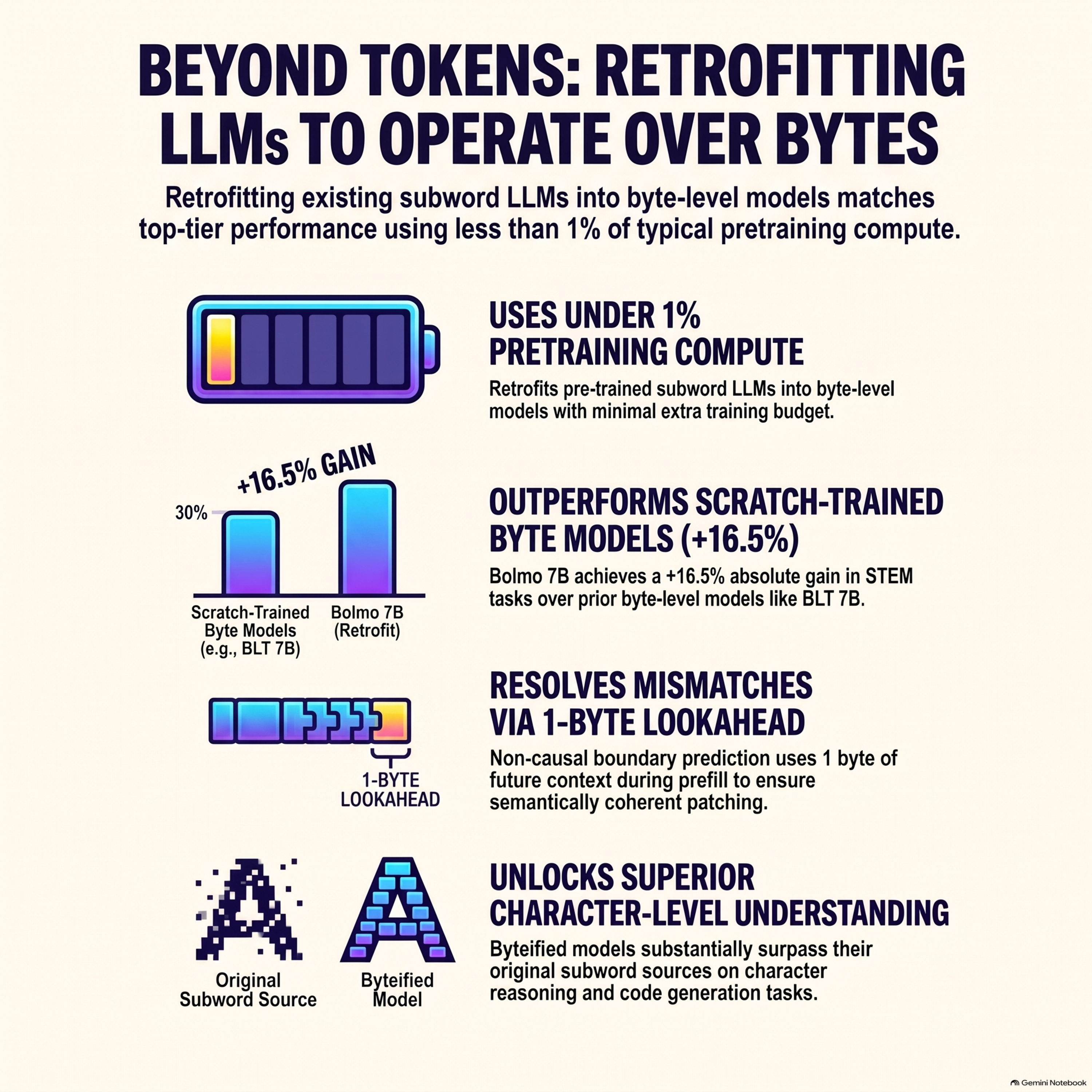
This Nature paper discusses Byteification, which offers a novel method to convert traditional subword-based large language models into efficient byte-level models that handle raw text encodings natively. By introducing a two-stage training procedure and a latent tokenizer architecture with non-causal boundary prediction, researchers can bypass the limitations of traditional tokenization—such as English-centric biases and poor character understanding—while preserving the core capabilities of established models. These byteified models achieve competitive performance on par with state-of-the-art systems while enabling high-throughput scientific applications and efficient task arithmetic post-training. Ultimately, this approach removes long-standing performance barriers and significantly reduces the computational investments typically required to build byte-level language models.

0:00-24:02

transcript

No transcript — this publisher did not publish one.

show notes

This Nature paper discusses Byteification, which offers a novel method to convert traditional subword-based large language models into efficient byte-level models that handle raw text encodings natively. By introducing a two-stage training procedure and a latent tokenizer architecture with non-causal boundary prediction, researchers can bypass the limitations of traditional tokenization—such as English-centric biases and poor character understanding—while preserving the core capabilities of established models. These byteified models achieve competitive performance on par with state-of-the-art systems while enabling high-throughput scientific applications and efficient task arithmetic post-training. Ultimately, this approach removes long-standing performance barriers and significantly reduces the computational investments typically required to build byte-level language models.