Skip to content
Artwork for Best AI papers explained
Best AI papers explained · Yesterday · 23 min

Emergent Capabilities Arise Randomly from Learning Sparse Attention Patterns

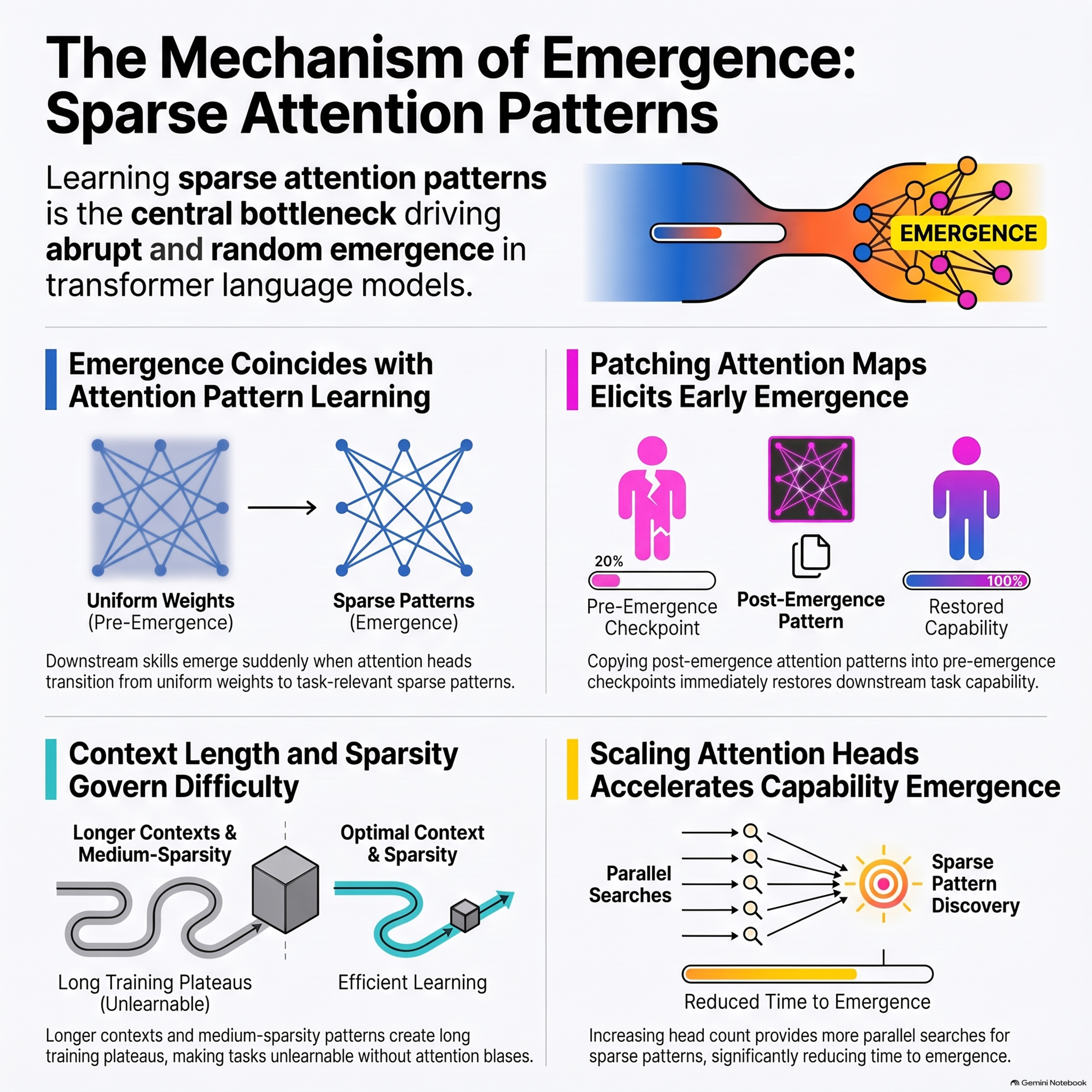
This paper investigates why transformer language models display sudden, emergent capabilities during training by analyzing how they learn attention patterns. Through experiments on both real language models and synthetic tasks like linear maps and cellular automata, the authors demonstrate that acquiring downstream skills correlates with the abrupt mastery of sparse attention mechanisms. Furthermore, the study reveals that larger models overcome this learning bottleneck earlier because they acquire these essential attention maps more efficiently. The research also shows that activation patching can artificially trigger these capabilities at earlier training checkpoints, highlighting the crucial role that attention heads play in model performance.


0:00-23:59

transcript

No transcript — this publisher did not publish one.

show notes

This paper investigates why transformer language models display sudden, emergent capabilities during training by analyzing how they learn attention patterns. Through experiments on both real language models and synthetic tasks like linear maps and cellular automata, the authors demonstrate that acquiring downstream skills correlates with the abrupt mastery of sparse attention mechanisms. Furthermore, the study reveals that larger models overcome this learning bottleneck earlier because they acquire these essential attention maps more efficiently. The research also shows that activation patching can artificially trigger these capabilities at earlier training checkpoints, highlighting the crucial role that attention heads play in model performance.