Skip to content
Artwork for Best AI papers explained
Best AI papers explained · Thursday · 20 min

Hybrid Reasoning Agents

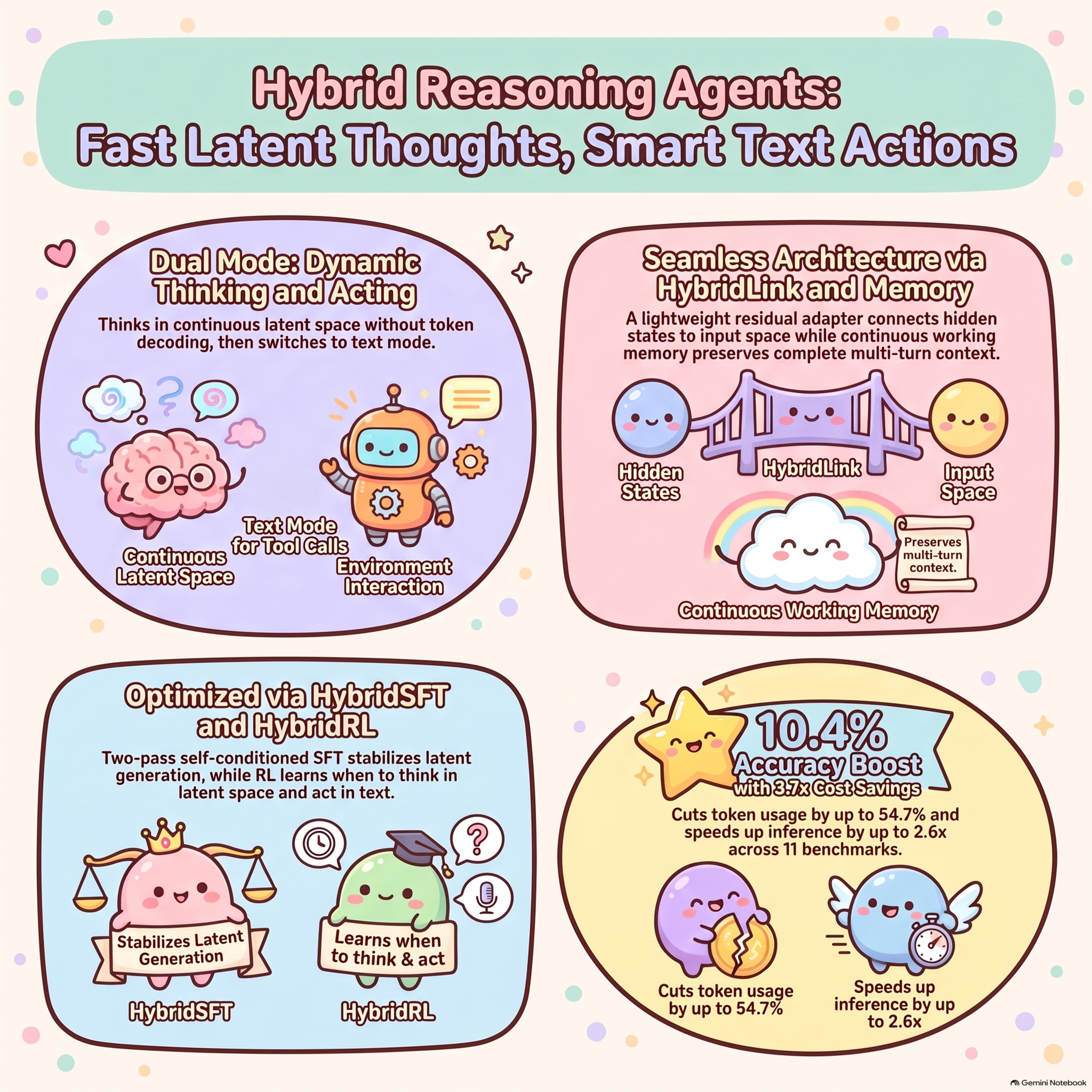
This paper introduces HybridAgents, a novel framework that blends continuous latent reasoning with explicit text interactions within a unified generation framework. By utilizing a lightweight adapter called HybridLink, the system seamlessly transitions between internal thinking modes and external tool usage without losing crucial context. The model leverages continuous working memory to maintain multi-turn hybrid generation, effectively eliminating the need for traditional token-space reconstruction across different conversational steps. Furthermore, specialized post-training protocols involving Hybrid Supervised Fine-Tuning and Hybrid Reinforcement Learning stabilize generation and scale reasoning capabilities. Extensive empirical evaluations demonstrate that this architecture significantly outperforms standard language models, achieving superior accuracy while concurrently reducing inference latency, token consumption, and computational overhead.

0:00-20:13

transcript

No transcript — this publisher did not publish one.

show notes

This paper introduces HybridAgents, a novel framework that blends continuous latent reasoning with explicit text interactions within a unified generation framework. By utilizing a lightweight adapter called HybridLink, the system seamlessly transitions between internal thinking modes and external tool usage without losing crucial context. The model leverages continuous working memory to maintain multi-turn hybrid generation, effectively eliminating the need for traditional token-space reconstruction across different conversational steps. Furthermore, specialized post-training protocols involving Hybrid Supervised Fine-Tuning and Hybrid Reinforcement Learning stabilize generation and scale reasoning capabilities. Extensive empirical evaluations demonstrate that this architecture significantly outperforms standard language models, achieving superior accuracy while concurrently reducing inference latency, token consumption, and computational overhead.