Skip to content
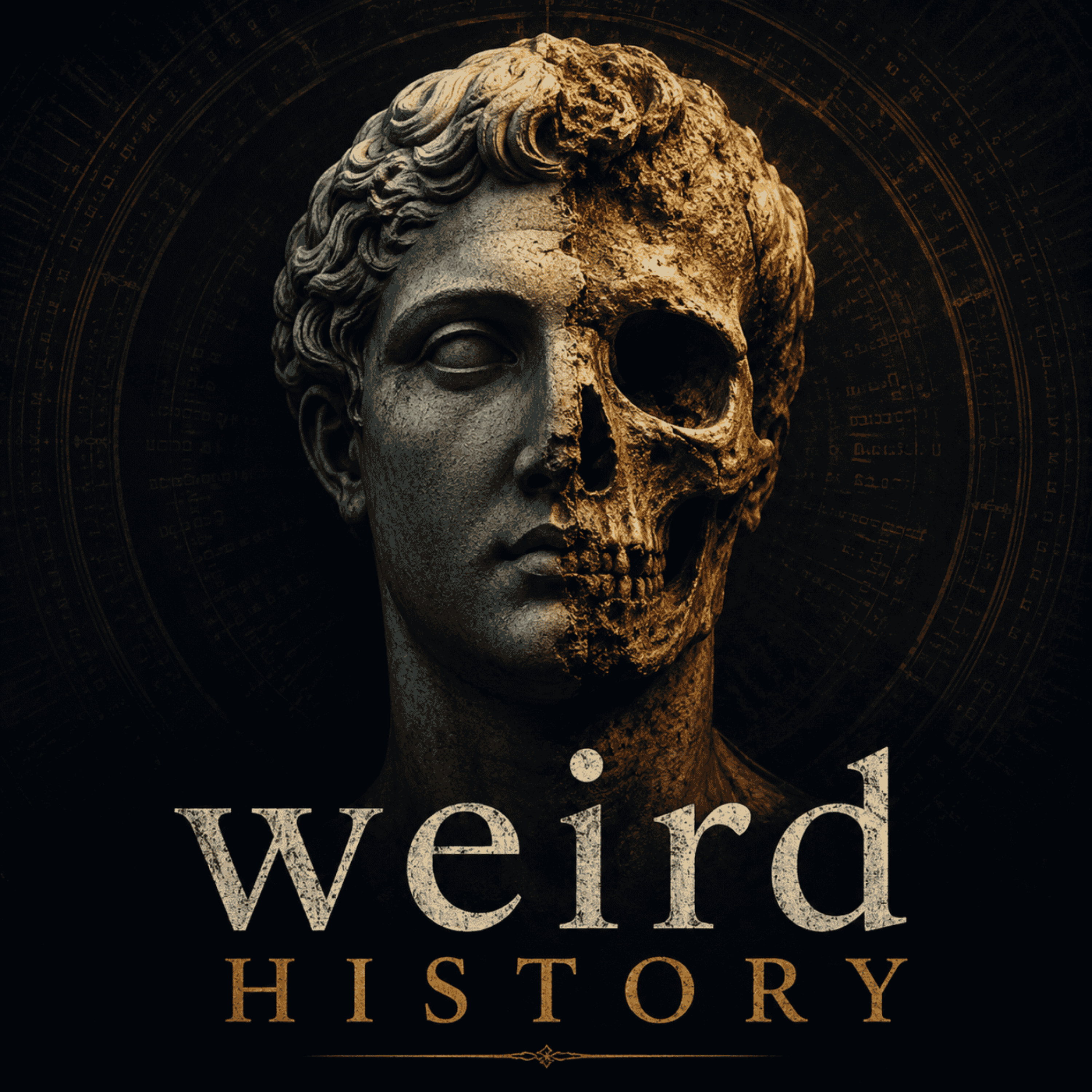
Artwork for Weird History

Weird History

Forbidden Knowledge Network

History is stranger than fiction — and the past is filled with bizarre, unexplained, and unbelievable true stories that still defy logic today.

Hosted by Ben Carter, Weird History Podcast explores the strangest moments in history, uncovering real events that sound too unbelievable to be true. From bizarre inventions and forgotten traditions to mysterious deaths, historical conspiracies, cults, hoaxes, and the most shocking coincidences ever recorded — each episode reveals the hidden, unusual side of human history.

If you’re fascinated by weird facts, strange historical events, unexplained my

Play
  • 21 episodes
  • weekly
  • Avg 22 min
  • English
Counted on this page — what you have heard stays on this device, so it is not something the list can be paged by.
  • Yesterday · 21 min

    Red Flags, Eight-MPH Speeding, and the Exploding Signal

    Victorian Britain tried to manage road machines before its roads, laws, and signals were ready for them. Parliament required road locomotives to creep along with attendants and, for a time, a red flag carried ahead. Outside Parliament, John Peake Knight’s railway-style street signal used semaphore arms and red-and-green gas illumination before an explosion injured the constable attending it. Then Walter Arnold drove through Paddock Wood at about eight miles per hour, was pursued by bicycle, and became widely recognized as Britain’s first motorist convicted of speeding. This podcast uses artificial intelligence in its research, writing, production, and narration. Episodes are editorially reviewed before publication. #WeirdHistory #BritainSRedFlagLawForRoadLocomotives #JohnPeakeKnightSExplodingWestminsterTrafficSigna #WalterArnoldSEightMilePerHourSpeedingCase #RedFlagAct YES OR NO: Did Britain’s road rules change too slowly for early motorcars?

  • September 11 · 22 min

    Fake Trees, Dazzle Ships, and Exploding Rats

    Three real wartime inventions turned perception into a battlefield. On the Western Front, British camouflage specialists copied shattered trees, built hollow steel replicas, and installed them near enemy lines so soldiers could observe from inside a piece of fake landscape. At sea during the First World War, dazzle-painted ships wore loud geometric patterns that were not meant to hide them, but to confuse estimates of heading, speed, and distance during submarine attacks. In the Second World War, Britain’s Special Operations Executive prepared dead rats packed with explosives for use near coal-fired boilers, only for the shipment to be intercepted before the devices could be used. Each scheme was documented, each had a tactical logic, and each leaves a different problem of proof: the trees clearly functioned as observation posts, dazzle impressed many sailors but resisted clean statistical judgment, and the explosive rats may have caused their strangest effect only after capture. This podcast uses artificial intelligence in its research, writing, production, and narration. Episodes are editorially reviewed before publication. #WeirdHistory #TheFakeTreesOnTheWesternFront #TheShipsPaintedToConfuseUBoats #TheDeadRatsBuiltForSabotage #FakeTrees YES OR NO: Did the intercepted explosive rats still have a military effect?

  • September 3 · 21 min

    A WWII Soldier With a Sword and Bow, Operation Paul Bunyan, and Castle Itter

    Three military events sound too strange to survive scrutiny, yet each rests on real historical evidence. In Korea in 1976, a United Nations Command mission to remove one poplar tree was backed by engineers, soldiers, armor, aircraft, B-52 bombers, and an American carrier task force after two U.S. officers were killed during an earlier tree-trimming attempt. In the Second World War, British officer John Malcolm Thorpe Fleming Churchill went to war with a sword, a longbow, and bagpipes, building a genuine Commando career that later became attached to one famous but disputed archery claim. And in the final days of the war in Europe, American soldiers, German military personnel, Austrian resistance figures, and French prisoners defended an Austrian castle against Waffen-SS attackers. This podcast uses artificial intelligence in its research, writing, production, and narration. Episodes are editorially reviewed before publication. #WeirdHistory #OperationPaulBunyan #JackChurchill #CastleItter #KoreanDMZ YES OR NO: Was Operation Paul Bunyan's massive show of force justified?

  • August 28 · 22 min

    Telegraph Sparks, Halley’s Comet Fear, and Europe’s Volcanic Fog

    Three times in history, the sky seemed to interfere with life on Earth in ways that sounded impossible. In 1859, during one of the strongest geomagnetic storms ever recorded, telegraph operators on the Boston-Portland line disconnected their normal batteries and still found that signals could pass, powered for a short time by currents induced through the wire itself. In 1910, Halley’s Comet returned under worldwide attention after astronomers detected cyanogen in its tail, a real toxic gas that newspapers helped turn into fears of planetary poisoning, comet pills, protective gadgets, and grim countdowns to May 18. And in 1783, a strange dry fog spread across much of Europe, dimming the Sun and staining it red, while the true source lay far away in Iceland, where the Laki fissure eruption released sulfur gases, poisoned pastures, killed livestock, and helped bring famine. Each story begins with witnesses facing a sky they could see, but not yet fully understand. This podcast uses artificial intelligence in its research, writing, production, and narration. Episodes are editorially reviewed before publication. #WeirdHistory #TheTelegraphWiresThatWorkedWithoutBatteries #TheCometTailScareOf1910 #TheDryFogFromIceland #CarringtonEvent YES OR NO: Would you have trusted the battery-free telegraph signals during the 1859 solar storm?

  • August 21 · 21 min

    The Great Moon Hoax, The Cardiff Giant, and The Fairy Photographs That Fooled Sir Arthur Conan Doyle

    Three famous hoaxes show how manufactured evidence can become powerful when it borrows the authority of something real. In rural Yorkshire, two cousins took photographs that seemed to show fairies near a stream, and the images eventually won the support of Sir Arthur Conan Doyle, the creator of Sherlock Holmes. In New York in 1835, a penny newspaper reported that a celebrated astronomer had discovered forests, animals, temples, and winged humanoids living on the Moon. And in 1869, workers digging a well near Cardiff, New York, appeared to uncover the petrified body of a ten-foot ancient giant, creating a public spectacle so successful that P. T. Barnum made his own counterfeit version of the counterfeit. This podcast uses artificial intelligence in its research, writing, production, and narration. Episodes are editorially reviewed before publication. #WeirdHistory #TheCottingleyFairies #TheGreatMoonHoax #TheCardiffGiant #GreatMoonHoax YES OR NO: Would you have suspected these three hoaxes at first?

  • August 14 · 26 min

    The Blood Rain Panic, The Man Who Sold Fake Moon Land, and The Queen Who Kept a Human Zoo

    In this episode, three documented events begin with ideas that sound impossible. First, chronicles from ancient and medieval Europe describe rain that appeared to fall red as blood. Without modern meteorology, communities could read these storms as warnings of war, death, divine anger, or apocalypse, even though modern science offers natural ways for rain to turn red. Then, in 1980, Dennis Hope claimed he had found a loophole in the Outer Space Treaty and began selling lunar property certificates through the Lunar Embassy, creating a business around land no customer could visit and no court generally recognizes as privately owned. Finally, Madrid in 1887 hosted the General Exhibition of the Philippine Islands under Queen Regent Maria Christina of Austria. Built around imperial display, museum collections, tropical plants, architecture, and the Crystal Palace in Retiro Park, the exhibition also included Indigenous Filipinos displayed before visitors in recreated environments. The queen did not secretly keep a private human zoo; the documented truth is larger and more unsettling: an official colonial exhibition put living people on public display. This podcast uses artificial intelligence in its research, writing, production, and narration. Episodes are editorially reviewed before publication. #WeirdHistory #TheBloodRainPanic #TheManWhoSoldFakeMoonLand #MadridSHumanZoo #BloodRain YES OR NO: Would you buy a Moon deed if you knew it had no recognized legal ownership?

  • August 7 · 22 min

    Ghost Ship Court, 21 Grams, and the Town That Banned Kissing

    Three documented episodes from history begin with scenes that sound invented. First, an abandoned ship is found crossing the Atlantic with its cargo still aboard, its people gone, and its rescuers expecting a salvage reward. Instead, the Mary Celeste becomes the center of a Gibraltar court proceeding filled with suspicions of murder, fraud, mutiny, and mysterious stains that did not prove what officials hoped they would prove. Then, in early twentieth-century Massachusetts, Dr. Duncan MacDougall tries to answer an ancient question with a mechanical scale, placing dying patients on specially built weighing beds in an effort to measure the human soul. Finally, the story turns to Swedesboro, New Jersey, where a reported 1969 local prohibition treated kissing and hugging in specified public recreational areas as conduct serious enough for a possible fine. This podcast uses artificial intelligence in its research, writing, production, and narration. Episodes are editorially reviewed before publication. #WeirdHistory #TheMaryCelesteInCourt #DuncanMacDougallAndThe21Grams #SwedesboroSPublicKissingBan #MaryCeleste YES OR NO: Did Swedesboro go too far by targeting public kissing and hugging?

  • July 31 · 27 min

    The Great Animal Trial, The File Hidden in a Cake, and The Cemetery That Charged Rent

    This episode follows three real historical practices that sound like someone made them up after reading too many legal forms. First, medieval and early modern European courts sometimes treated animals as legal defendants. Pigs accused of killing children could be seized, confined, tried, sentenced, and executed, while rats and crop-destroying insects could be summoned through church proceedings when they threatened harvests. The famous viral versions are often exaggerated, but the legal practice itself was real. Then, a prison cliché gets its day in court: the cake with a file inside. Long before cartoons turned it into a joke, historical reports described attempts to smuggle tools, weapons, messages, and other contraband into prisons through food deliveries. The same principle also shaped spycraft, where coins, chess pieces, batteries, and clothing became hiding places for secret material. Finally, the episode visits cemeteries where a grave may not be land purchased forever, but a burial right granted for a fixed term. In places such as Paris and parts of the United Kingdom, families may hold concessions or exclusive burial rights that can expire, renew, or eventually be reclaimed under local law. Together, these stories show courts, prisons, and cemeteries following their own rules into places where the results seem absurd, macabre, and completely real. This podcast uses artificial intelligence in its research, writing, production, and narration. Episodes are editorially reviewed before publication. #WeirdHistory #ThreeDocumentedStoriesShowingHowOrdinaryInstitut #ThreeWeirdHistoryStories #MedievalAnimalTrials #AnimalsInCourt YES OR NO: Should graves ever be reused when burial space runs out???????

  • July 24 · 20 min

    A Corpse Trial, a Royal Toilet, and a Ghost Marriage

    A dead pope is pulled from his grave, dressed in papal robes, and seated before a church court in early medieval Rome. The judge is his successor, and the verdict is meant to erase not only a man, but every official act he performed in life. From there, the episode moves to Tudor England, where Sir John Harington, courtier and godson of Queen Elizabeth the First, publishes a satire that also contains plans for a flushing water closet centuries before modern plumbing can support it. Finally, in the final years of the Eastern Han dynasty, the young Cao Chong dies before adulthood, and his powerful father, Cao Cao, arranges a posthumous marriage to a deceased girl from the Zhen family. None of these events is just odd for the sake of oddness. Each one reveals a system under pressure: papal politics using law against a corpse, sanitation technology arriving before the city beneath it exists, and family ritual reaching beyond death to preserve lineage and status. This podcast uses artificial intelligence in its research, writing, production, and narration. Episodes are editorially reviewed before publication. #WeirdHistory #WeirdInventionsAristocraticDeathRitualsAndMediev #SirJohnHarington #ElizabethTheFirst #FlushingToilet YES OR NO: Would you consider a legal trial of a corpse a real trial???????

  • July 17 · 23 min

    The Great Stink of London, the Man Who Sold the Brooklyn Bridge, and the Coffins With Safety Bells

    In this episode, three documented strange-history stories begin with problems that sound almost fictional but grew out of very real fears, failures, and opportunities. In Victorian London, the River Thames had become so polluted with human waste, industrial refuse, and contaminated mud that the smell reached the Houses of Parliament during the hot summer of eighteen fifty-eight. The crisis, remembered as the Great Stink, helped force long-delayed action and gave Joseph Bazalgette the authority to build a sewer system that reshaped the city. Across the Atlantic, New York confidence man George C. Parker became notorious for fraudulent property schemes, most famously the reported sale of the Brooklyn Bridge to people who believed they were buying a profitable landmark. His story shows how forged documents, social pressure, and unfamiliar laws could make an impossible deal appear official. Finally, the episode turns underground, to the eighteenth- and nineteenth-century fear of premature burial. Inventors patented safety coffins fitted with bells, flags, air tubes, windows, and alarms, not because such rescues were common, but because the fear of waking up in a grave was powerful enough to inspire real engineering. This podcast uses artificial intelligence in its research, writing, production, and narration. Episodes are editorially reviewed before publication. #WeirdHistory #StrangeButDocumentedHistory #GreatStinkOfLondon #RiverThames #VictorianSanitation

  • July 9 · 20 min

    The Great Emu War, The Pope Who Dug Up His Predecessor, and The Man Who Survived Two Atomic Bombs

    https://www.FKNpods.com Dive into the twisted corners of history where truth is stranger than fiction. Join us as we unravel the bizarre saga of Australia's Great Emu War, where soldiers armed with machine guns waged a futile battle against flightless birds. Then, journey back to medieval Rome for the Cadaver Synod, a grotesque political spectacle where a deceased pope faced trial. Finally, explore the remarkable tale of Tsutomu Yamaguchi, the man who survived both Hiroshima and Nagasaki atomic bombings, becoming a symbol of resilience against unimaginable odds. Each story sheds light on humanity's attempts to exert control over the uncontrollable, whether through misguided military campaigns, political vengeance, or sheer survival. This episode of Weird History underscores the unpredictability of life and the folly of human systems clashing with reality. 🔒 Subscribe now for full access to all our video podcasts. Unlock exclusive bonus content and everything on The Forbidden Knowledge Network. 👉 https://www.patreon.com/theforbiddenknowledgenetwork 🎧 Search The Forbidden Knowledge Network wherever you listen to podcasts. #WeirdHistory, #GreatEmuWar, #CadaverSynod, #AtomicSurvivor, #HumanResilience

  • July 7 · 21 min

    The War Over a Bucket, The Corpse Synod, and The City That Put Animals on Trial

    https://www.FKNpods.com In this episode of Weird History, we unravel the bizarre tales behind three historical events that defy modern logic. Imagine a war sparked by a wooden bucket, a trial held for a dead pope, and a city that put animals on trial. These stories share a common theme: the absurd lengths to which institutions will go to assert control over chaos. The War of the Bucket showcases the rivalry between Modena and Bologna, where a simple object became a legendary symbol. The Corpse Synod reveals the church's dramatic power plays as Pope Stephen VI put the deceased Pope Formosus on trial to rewrite history. Lastly, the strange practice of medieval animal trials highlights how human legal systems once reached into the animal kingdom, reflecting ancient beliefs about law and moral order. Join us as we delve into these astonishing stories of authority meeting absurdity head-on. From the battlefield where a bucket became an icon to the eerie courtroom drama involving a corpse, and finally, to the surreal trials where animals stood as defendants, we explore the fascinating intersections of power and spectacle. Each segment builds on the next, painting a vivid picture of how institutions throughout history have sought to impose their narratives on the world, often in the most unexpected ways. These events, though they may sound like the stuff of legend, reveal deep truths about human nature and the enduring struggle for control. 🔒 Subscribe now for full access to all our video podcasts. Unlock exclusive bonus content and everything on The Forbidden Knowledge Network. 👉 https://www.patreon.com/theforbiddenknowledgenetwork 🎧 Search The Forbidden Knowledge Network wherever you listen to podcasts. #WeirdHistory, #MedievalMisadventures, #BizarreTrials, #AbsurdAuthority, #StrangePowerPlays

  • July 2 · 17 min

    The Dancing Plague, Window Taxes, and Chocolate Medicine

    https://www.FKNpods.com Dive into the peculiar past with this episode of Weird History, where we unravel three bizarre historical tales that defy logic and reason. Discover the 1518 Dancing Plague, where a strange outbreak of uncontrollable dancing gripped Strasbourg, leading authorities to attempt unusual solutions. Next, explore the absurdity of the Window Tax, a policy that unintentionally reshaped architecture across Europe. Finally, uncover the curious medical history of chocolate, once hailed as a miraculous cure-all in early modern Europe. Each story highlights the strange ways societies have tried to manage the inexplicable, offering a fascinating glimpse into the absurdity of historical institutions. 🔒 Subscribe now for full access to all our video podcasts. Unlock exclusive bonus content and everything on The Forbidden Knowledge Network. 👉 https://www.patreon.com/theforbiddenknowledgenetwork 🎧 Search The Forbidden Knowledge Network wherever you listen to podcasts. #DancingPlague #WindowTax #ChocolateMedicine #WeirdHistory #HistoricalOddities

  • July 2 · 22 min

    How Ketchup Was Once Sold as Medicine, The Forgotten Art of Tattooing Mummies, and The Highwayman Who Became a Folk Hero—and Then a Member of Parliament

    https://www.FKNpods.com In this episode of Weird History, we delve into the peculiar past where ketchup was sold as medicine, mummies bore tattoos revealing ancient secrets, and a notorious highwayman turned from criminal to politician. Discover how ketchup, originally a fish-based sauce from Asia, was marketed in the 19th century as a cure-all by figures like Dr. John Cook Bennett. Transition to the sands of ancient Egypt, where tattooed mummies defy modern perceptions of body art, offering insights into ancient rituals. Finally, explore the story of a highwayman, possibly Dick Turpin or Claude Duval, who transformed from a symbol of rebellion into a respected member of Parliament, challenging societal norms. These tales illustrate how society has historically assigned unexpected roles to everyday objects, practices, and people. Each story reveals a bizarre twist in historical perception—whether it's ketchup's medicinal claims, tattoos as cultural symbols, or the fluid identity of a criminal turned folk hero. Join us as we explore these historical oddities and reflect on the ever-changing nature of societal roles and values. 🔒 Subscribe now for full access to all our video podcasts. Unlock exclusive bonus content and everything on The Forbidden Knowledge Network. 👉 https://www.patreon.com/theforbiddenknowledgenetwork 🎧 Search The Forbidden Knowledge Network wherever you listen to podcasts. #WeirdHistory, #TattooedMummies, #KetchupMedicine, #HighwaymanHero, #HistoricalOddities

  • June 29 · 22 min

    The Great Molasses Flood of 1919, The Time a Meteor Was Declared a Religious Relic, and The Town That Tried to Build a Giant Dome to Block Out the Sky

    https://www.FKNpods.com Plunge into the bizarre world of history where molasses turns deadly, celestial objects become divine, and towns hatch grandiose plans to shut out the sky. This episode of Weird History takes you on a journey through the surreal events of The Great Molasses Flood of 1919, the declaration of a meteor as a religious relic, and the ambitious yet impractical attempt by a town to build a giant dome. Discover the absurd lengths humanity will go to in its quest to control or interpret the uncontrollable forces of nature. Each story reveals a fascinating intersection of human ambition and nature's unpredictability, leaving you to ponder the limits of our attempts to master the world around us. Unravel the chaos of the Great Molasses Flood, where industrial negligence met nature's power in an unexpected disaster that reshaped Boston's legal landscape. Venture into the tale of a celestial object that transcended science to become a spiritual symbol, showcasing the human desire to find meaning in the unexplained. Finally, witness the peculiar ambition of a town determined to shield itself from the sky, reflecting our relentless drive to exert control over our environment. These stories are as strange as they are true, highlighting the mysterious dance between human folly and nature's might. 🔒 Subscribe now for full access to all our video podcasts. Unlock exclusive bonus content and everything on The Forbidden Knowledge Network. 👉 https://www.patreon.com/theforbiddenknowledgenetwork 🎧 Search The Forbidden Knowledge Network wherever you listen to podcasts. #MolassesFlood1919, #MeteorRelic, #GiantDomeProject, #WeirdHistory, #NatureVsHuman

  • June 25 · 20 min

    The Lighthouse That Disappeared Overnight, The Pope Who Had a Pet Elephant Named Hanno, and The Victorian ‘Cure’ That Involved Sitting on Radioactive Sand

    https://www.FKNpods.com 🔒 Subscribe now for full access to all our video podcasts. Unlock exclusive bonus content and everything on The Forbidden Knowledge Network. 👉 https://www.patreon.com/theforbiddenknowledgenetwork 🎧 Search The Forbidden Knowledge Network wherever you listen to podcasts. In this episode of Weird History, explore three astonishing tales where human ambition, power, and desperation collide with unexpected results. First, unravel the enigma of a lighthouse that disappeared overnight, leaving a community in Scotland bewildered and grappling with theories ranging from natural disasters to supernatural forces. Then, step into Renaissance Rome and meet Pope Leo X, who cultivated an unlikely friendship with Hanno, a majestic elephant that symbolized the Pope's grandeur and the cultural exchanges of his time. Finally, venture into the Victorian era's misguided medical practices, where people sat on radioactive sand in a desperate quest for health, unaware of the lurking dangers. Each story offers a glimpse into the bizarre intersections of belief and misunderstanding that have shaped our past. From the mysterious to the downright absurd, these historical events serve as reminders of the unpredictable nature of human actions and the strange paths they carve through history. Listen as we delve into these peculiar narratives, shedding light on the curious ways in which history often surpasses fiction in its strangeness. #LighthouseMystery, #PapalElephant, #VictorianMedicine, #HistoricalOddities, #WeirdHistory

  • June 18 · 22 min

    How Stalin Tried to Breed Half-Man, Half-Ape Soldiers, The Grave Robbers Who Invented Modern Surgery, and The Island That Declared War on Germany—and Won

    https://www.FKNpods.com In this episode of Weird History, we delve into some of the most bizarre and unsettling chapters of human ambition and ingenuity. From Stalin's surreal attempt to create hybrid soldiers by breeding humans with apes, to the grave robbers whose macabre practices laid the foundation for modern surgery, these stories reveal the strange intersections of power, science, and legacy. Our journey concludes with the curious tale of a tiny island that audaciously declared war on Germany—and emerged victorious. 🔒 Subscribe now for full access to all our video podcasts. Unlock exclusive bonus content and everything on The Forbidden Knowledge Network. 👉 https://www.patreon.com/theforbiddenknowledgenetwork 🎧 Search The Forbidden Knowledge Network wherever you listen to podcasts. #WeirdHistory, #StalinExperiments, #GraveRobbers, #RomanConcrete, #StrangeLegacies

  • June 12 · 23 min

    The Time a Zoo Mistook a Human for an Ape—And Put Him on Display, How Ketchup Was Once Sold as Medicine, and How the CIA Tried to Use Psychic Spies

    https://www.FKNpods.com In this episode of "Weird History," we delve into the bizarre lengths institutions have gone to when driven by misunderstanding, pseudoscience, or desperation. First, we explore the ethically questionable decision of a zoo in the early 20th century, which displayed a human as an exhibit, blurring the lines between curiosity and exploitation. Next, we travel back to the 19th century when ketchup was marketed as a medicinal cure, highlighting the intersection of marketing, medicine, and public gullibility. Lastly, we uncover the CIA's strange foray into psychic espionage during the Cold War, illustrating the extremes of governmental experimentation in the name of national security. Each story in this episode serves as a testament to the absurdity of institutional actions that defy logic and reason. From a zoo's misguided attempt at education to the marketing of ketchup as a health remedy, and the CIA's psychic spy program, we reveal moments when the unexpected became reality. Join us as we unravel these comical yet thought-provoking tales that remind us of the unpredictable nature of human behavior and the peculiar paths history can take when driven by unusual beliefs or pressures. 🔒 Subscribe now for full access to all our video podcasts. Unlock exclusive bonus content and everything on The Forbidden Knowledge Network. 👉 https://www.patreon.com/theforbiddenknowledgenetwork 🎧 Search The Forbidden Knowledge Network wherever you listen to podcasts. #WeirdHistory #BizarreTales #HistoricalOddities #StrangeInstitutions #UnbelievableStories

  • June 5 · 21 min

    The Medieval Laws That Outlawed Time Travel (Sort Of), How a Fake Country Joined the Olympics, and The Pope Who Resigned by Dressing as a Monk

    https://www.FKNpods.com Step into the world of Weird History as we unravel the bizarre moments when authority took unexpected turns. Discover how medieval laws seemed to preemptively address the impossibility of time travel, reflecting a mindset grappling with the unknown. Journey with us to the Olympics, where a fictional country cleverly infiltrated the games, exposing the vulnerabilities within even the most prestigious institutions. Finally, delve into the story of a pope who chose to resign in an unorthodox manner, dressing as a monk, revealing the personal and political dynamics within the papacy. These tales highlight the absurdity of authority, showing how institutions sometimes react to challenges with surreal actions. Join us for an exploration of these captivating historical events, each showcasing the unpredictable nature of human decision-making. The medieval laws offer a glimpse into a society where reality and imagination blurred, while the fake country's Olympic participation reveals the occasional oversights within international sports. The pope's resignation underscores the complex interplay of personal and religious factors in the Catholic Church. Together, these stories reflect on how authority can veer into the surreal, leaving a lasting impression on history. 🔒 Subscribe now for full access to all our video podcasts. Unlock exclusive bonus content and everything on The Forbidden Knowledge Network. 👉 https://www.patreon.com/theforbiddenknowledgenetwork 🎧 Search The Forbidden Knowledge Network wherever you listen to podcasts. #TimeTravelLaws, #FakeCountryOlympics, #PopeResignation, #HistoricalAbsurdity, #WeirdHistory

  • May 28 · 22 min

    The Hidden History of the World's Oldest Vending Machine Scam, Why People in the Middle Ages Thought Beavers Bit Off Their Own Testicles, and The Town That Turned a Bear Into a Police Officer

    https://www.theforbiddenknowledgenetwork.com Explore the bizarre intersections of belief, deception, and institutional absurdity throughout history in this intriguing episode. Uncover the world's oldest vending machine scam, delve into medieval misconceptions about beavers, and learn about the town that made a bear a police officer. These stories highlight the strange outcomes of human imagination and societal structures, reflecting the oddities of belief systems and the peculiarities of historical institutions. 🔒 Want the full experience? Get complete video episodes, exclusive bonus content, and access to everything on The Forbidden Knowledge Network — only on Patreon. 👉 https://www.patreon.com/theforbiddenknowledgenetwork 🎧 Search The Forbidden Knowledge Network wherever you listen to podcasts. #WeirdHistory, #StrangeBeliefs, #HistoricalOddities, #BizarreStories, #UnbelievableHistory

Showing 1–20 of 21 episodes