Skip to content
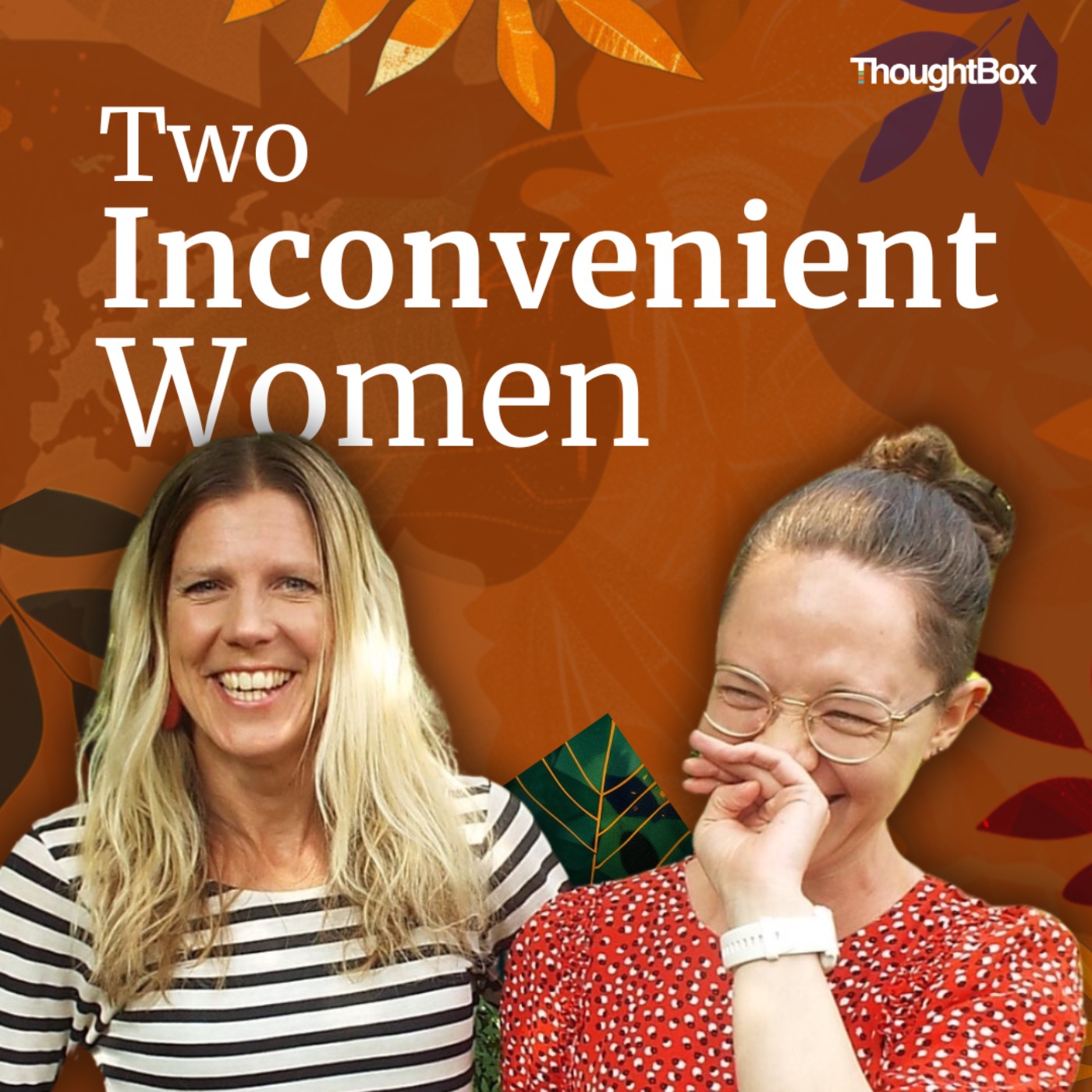
Artwork for Two Inconvenient Women
EducationScienceNatureSociety & Culture

Two Inconvenient Women

ThoughtBox Education

In a world which can feel increasingly volatile and uncertain, join Holly and Rachel from ThoughtBox as we explore some of the inconvenient truths, possibilities and opportunities of our rapidly changing world.


Each episode we’ll be diving deep into the big, tricky issues of our time, exploring what it means to be ‘inconvenient’ in our work to transform lives, communities and mindsets towards a healthier future for people and planet.


To find out more about the work we do at ThoughtBox Education, visit www.thoughtboxeducation.com.


Hosted on Acast. See acast.com/privacy for more information.

Play
  • 23 episodes
  • weekly
  • Avg 49 min
  • English
Counted on this page — what you have heard stays on this device, so it is not something the list can be paged by.
  • S7 · E105
    Friday · 1 hr 4 min

    Exploring energy and power: 'Jackdaw' and the menopause

    In this season's conversations, Holly & Rachel each bring something that has caught their attention during the week, and spend time exploring what these provocations inspire and ignite. After breaking news about the UK government UK’s approval of the Jackdaw gas-field, Holly brought the hard news of this decision to the table with a wider-perspective beyond the shoulds and should nots of more fossil-fuel extraction; so supportive in shifting us towards the story of "the great turning" (as Joanna Macy coined it), and away from the limits of 'business as usual'. In our companion conversation, we talked about the menopause; following Rachel attending a cinematic event on 'Menopause Awareness Day' and wishing to explore one of the provocations raised in the film: Is the menopause inconvenient to capitalism? This week our conversation moved from two seemingly disparate topics into a convergence on energy, power and tending to the social fabric. Some of the references mentioned in this podcast include: What does the UK's approval of the Jackdaw gasfield mean? The Guardian (article) My Cinema Clinic; Menopause (website & film) Baba Yaga - a myth (PDF story) The Miracle Inn - Membership group (website) National Emergency Briefing (website, film & campaign) If you enjoy this podcast and would like to support us to continue, come and join The Inconvenient Club for just £5 per month and be part of the movement towards a healthier way of living for people and planet: www.thoughtboxeducation.com/the-inconvenient-club Hosted on Acast. See acast.com/privacy for more information.

  • S7 · E104
    October 16 · 1 hr 2 min

    Exploring convenience, courage and conformity

    In this season's conversations, Holly and Rachel each bring something that has caught their attention during the week, and spend time exploring some of the learning, unlearning, wisdom and practices that these provocations inspire. This week, Holly started us off with a poem: Small Inconveniences by Elise M. Powers which touches on the perils and potential of convenience in our lives and invites us to step more into appreciating the process. This provocation inspired an interesting discussion about food, time, the washing up and our endless pursuit of happiness and meaning. Following this - and threading quite wonderfully - we reflected together on a provocation brought by Rachel asking if conformity was the opposite of courage. From being authentic to the challenges of culture and belonging, conversations were rich and went in all sorts of unexpected and delicious directions. Some of the resources mentioned in this podcast include: Small Inconveniences - Elise M. Powers (poem) The Story of Stuff - Annie Leonard (short video) The Care Calculator - a ThoughtBox resource (PDF) Slow Food University - venue and movement (website) For a Student Who Used AI to Submit a Paper - Joseph Fasano (poem) The Ones Who Walk Away From Omelas - Ursula K. Le Guin (short story/ PDF) Perhaps the World Ends Here - Joy Harjo (poem) The Anxious Generation - Jonathan Haidt (book) Triple WellBeing in Practice - ThoughtBox (online course) If you enjoy this podcast and would like to support us to continue, come and join The Inconvenient Club for just £5 per month and be part of the movement towards a healthier way of living for people and planet: www.thoughtboxeducation.com/the-inconvenient-club Hosted on Acast. See acast.com/privacy for more information.

  • S7 · E103
    October 9 · 1 hr 5 min

    Exploring protest & anger, resonance & dissonance

    In this season's conversations, Holly and Rachel each bring something that has caught their attention during the week, and spend time exploring some of the learning, unlearning, wisdom and practices that these provocations inspire. This week, Rachel brought her interest resonance and what is happening when there is resonance - or dissonance - in the air between us. This was sparked by some of the reflections from a group of strangers after a weekend of singing together. This discussion linked quite pertinently to Holly's inquiry, provoked by recent protests in different parts of the world. She has been reflecting on the role that anger plays in protest, and whether it is an emotion that supports us to move more into a state of health. As ever, conversations were rich and went in all sorts of unexpected directions. Some of the resources mentioned in this podcast include: Finding your voice - Schumacher College (singing workshop) Triple WellBeing in Practice - ThoughtBox (online course) Karpman Drama Triangle (website) Jon Alexander - Citizens (website) Inner Resonance - singing workshops and resources (website) If you enjoy this podcast and would like to support us to continue, come and join The Inconvenient Club for just £5 per month and be part of the movement towards a healthier way of living for people and planet: www.thoughtboxeducation.com/the-inconvenient-club Hosted on Acast. See acast.com/privacy for more information.

  • September 4 · 3 min

    Summer Break: Rachel shares a short poem by Wendell Berry

    In our last week of the summer break, Rachel finishes the summer season with a poem - sharing some of the beautiful sentiments of the late poet Wendell Berry, who passed away just a few days ago aged 92. The Peace of Wild Things - Wendell Berry- When despair for the world grows in me and I wake in the night at the least sound in fear of what my life and my children’s lives may be, I go and lie down where the wood drake rests in his beauty on the water, and the great heron feeds. I come into the peace of wild things who do not tax their lives with forethought of grief. I come into the presence of still water. And I feel above me the day-blind stars waiting with their light. For a time I rest in the grace of the world, and am free. Hosted on Acast. See acast.com/privacy for more information.

  • August 27 · 1 hr

    What were your top 3 episodes of the year so far?

    As the Two Inconvenient Women are on our summer break over August, we're doing a round-up of some of our favourite episodes from the last couple of seasons. This week, we share your top 3 episodes of the year so far. Here are our most downloaded episodes of Season 6: Why is play so important (and not just for children)? What's the point of hope? Red Alert: can we talk about the climate emergency now? There's an inconvenient movement growing... It's not rebellion, exactly. More of a quiet refusal to look away. We're inconvenient. And if you feel it, then maybe you are too. Join us. Join The Inconvenient Club from £5 a month. Find out more at www.thoughtboxeducation.com/the-inconvenient-club Hosted on Acast. See acast.com/privacy for more information.

  • August 21 · 1 hr

    What were Rachel's top 3 episodes of the year so far?

    As the Two Inconvenient Women are on our summer break over August, we're doing a round-up of some of our favourite episodes from the last couple of seasons. This week, Rachel shares her top 3 episodes: E87 - Does childhood need reclaiming? E69 - Why is singing so good for us? E66 - What does it mean to winter? There's an inconvenient movement growing... It's not rebellion, exactly. More of a quiet refusal to look away. We're inconvenient. And if you feel it, then maybe you are too. Join us. Join The Inconvenient Club from £5 a month. Find out more at www.thoughtboxeducation.com/the-inconvenient-club Hosted on Acast. See acast.com/privacy for more information.

  • August 14 · 1 hr 1 min

    What were Holly's top 3 episodes of the year so far?

    As the Two Inconvenient Women are on our summer break over August, we're doing a round-up of some of our favourite episodes from the last couple of seasons. This week, Holly shares her top 3 episodes: E85 - What's the problem with tolerating diversity? E76 - Why is the wisdom of children's books so relevant right now? E74 - Do we need to know what the future looks like? There's an inconvenient movement growing... It's not rebellion, exactly. More of a quiet refusal to look away. We're inconvenient. And if you feel it, then maybe you are too. Join us. Join The Inconvenient Club from £5 a month. Find out more at www.thoughtboxeducation.com/the-inconvenient-club Hosted on Acast. See acast.com/privacy for more information.

  • S6 · E15
    July 31 · 1 hr 5 min

    What if we see growth as spiral rather than linear?

    How can there be infinite growth on a finite planet? This question sits at the heart of many conversations about growth - especially those centred around economics, which also directly influences the cultural stories that shape the way we think, feel and act in the world. Within our educational landscapes, we're often taught to see growth as a trajectory and place to reach, and many of our cultural stories, frames and influences also encourage this sort of linearity. But what if growth wasn't linear but spiral? One of the practices that helps to see growth is returning to a familiar place or event each year (or month or however long) to see how you might see things in a similar and different way; from a wider or deeper perspective, or be feeling different in yourself about things. Helping appreciate that growth is expansion is a useful tool to appreciate growth not being linear, as it allows for spaciousness and appreciates that shedding or letting go / unlearning is as growth-ful as accumulation. So what are some of the ways that we can tap into this more spiral dynamic of growth in our personal, social and collective spheres? This week we referenced the following: Wilding (film) and the Knepp Estate (location) (website) Accidental Gods interview - Remzi Bairami (podcast) An introduction to Spiral Dynamics - Cris Reider (article) Donut Economics - Kate Raworth (website / movement) Gross National Happiness Index (website / metrics, frame & model) Spiritual Friendships - Plum Village Podcast (podcast interview) The Dunning-Kruger effect chart (graphic) ✨ Today's magic moment was about our new one-to-on Coaching offer, and our upcoming Leadership short-course✨ There's an inconvenient movement growing... It's not rebellion, exactly. More of a quiet refusal to look away. We're inconvenient. And if you feel it, then maybe you are too. Join us. Join The Inconvenient Club from £5 a month. Find out more at www.thoughtboxeducation.com/the-inconvenient-club Hosted on Acast. See acast.com/privacy for more information.

  • S6 · E14
    July 24 · 59 min

    What happens when we pay attention?

    "Attention is the rarest and purest form of generosity"(Simone Weil) and holds the power to radically and deeply shift how we think, feel and act in the world. Many people are now pointing to a shift of attention as key to unlocking humans from being stuck within so many negative behavioural patterns; inviting us to pay closer attention to what we are actually doing, why that might be and whether our thoughts, feelings and actions are serving us or future generations of life on this planet. But what does it mean to pay attention? And why is this so hard these days? In this week's podcast we dive into the complexities of staying present and alert in a culture dominated by fractured attention; reflecting on how hard it feels to be consciously alert when our attention is being grabbed and actively manipulated by social media algorithms and quick dopamine hits. We explore the pressures of staying present in an overwhelmingly complex culture, and talk about some of the practices for coming back into the 'now'; thinking about the different ways of paying closer attention to ourselves, to each other and to the wider world we are part of. In this conversation, we reference the following: The Power of Now - Eckhart Tolle (Book) Cosmic Eye (short video) Flow - Mihaly Csikszentmihalyi (book) The Master and his Emissary - Iain McGilchrist (book) Why our attention spans are shrinking - Gloria Mark (PDF) Hosted on Acast. See acast.com/privacy for more information.

  • S6 · E13
    July 17 · 1 hr

    Are we losing our humanity?

    What does it mean to be humane? And, conversely, what might it mean to be inhumane? Whilst there is no one way to be human, there are many shared qualities that encompass the human experience and that sit as the essence of what it is to be human; qualities that set us aside from other species. We are relational beings by nature, and have within us a quality drawn to connection. Yet there is a conflict within many areas of modernity which challenges this natural essence and fuels feelings of fear, disconnection whilst actively encouraging a sense of dehumanising - both of others and of ourselves. Driven by divisive political systems, media outlets and technological advancements, many areas of culture are actively encouraging a feeling of othering, with rigid control in areas such as education, healthcare, industry driven by fear conflicting with a sense of trust, dignity and wellbeing. So what does it mean to reclaim our humanity and how can we pay attention to what it is within us that makes us human and humane? In this episode we reference the following: All that we share (TV 2 advert) - Video Imagined otherness - why we dehumanise our political opponents - Dylan Walsh / Sameer Srivastava (article) Groups & Gangs resources - ThoughtBox (PowerPoint lesson resources *Found in the PEOPLE CARE section) Fox's Dancing Journey - A story about refugees - ThoughtBox (PDF) ✨ Today's magic moment was an invitation to join us next week for a free Introduction to Triple WellBeing workshop✨ There's an inconvenient movement growing... It's not rebellion, exactly. More of a quiet refusal to look away. We're inconvenient. And if you feel it, then maybe you are too. Join us. Join The Inconvenient Club from £5 a month. Find out more at www.thoughtboxeducation.com/the-inconvenient-club Hosted on Acast. See acast.com/privacy for more information.

  • S6 · E12
    July 10 · 56 min

    What's the point of hope?

    What is the point of hope? This question is so perfectly poised between nihilism and optimism, and the conversation explores the territory in between. When hope can so often feel like an avoidance of the present moment, or a vacuous space of impossibility, what does it have to offer us in such complex times? Conversely, hope is an act of faith in something far bigger than the human experience, and stands as a foundation of so many people across the world, whether through religion, spiritual practice or an inherent trust in the bigger story. Wherever we are landing with the quality of hope, it is a universal human encounter and something that may perhaps offer us a doorway into a lighter, deeper, more resilient and conscious way of living. In this episode we reference the following: Active Hope - Joanna Macy (website) The opposite of grimdark is hopepunk (website) Anti-racist pedagogy in art - Kathy Wise (article) Imagination Taking Power - Rob Hopkins (website) Interview with Elin Kelsey - Episode 1: Hopepunk - The Second Transition Podcast (podcast episode) ✨ Today's magic moment was a shout out to the fabulous ThoughtBox Team✨ There's an inconvenient movement growing... It's not rebellion, exactly. More of a quiet refusal to look away. We're inconvenient. And if you feel it, then maybe you are too. Join us. Join The Inconvenient Club from £5 a month. Find out more at www.thoughtboxeducation.com/the-inconvenient-club Hosted on Acast. See acast.com/privacy for more information.

  • S6 · E11
    July 3 · 59 min

    Why is play so important (and not just for children)?

    ✨ Today's magic moment features our new ThoughtBox website ✨ Play is not just for children; it is an essential adult survival tool. And yet we find ourselves living in so many cultures where play is being eroded from childhood and is virtually non-existent amongst adults. Beyond the core developmental qualities that play enables in children, engaging in recreational activities that bring joy lowers stress, triggers mood-boosting endorphins, fuels creativity, and strengthens relationships by building trust and empathy. Play also reminds us of the vitality of life and offers a more generative way of living. So why is it that play has disappeared and how can we welcome it back into our lives and communities? In this episode we reference the following: Dirt is Good campaign (website) How play made us and keeps us human -Maria Popov (article) OPAL- Outdoor Play and Learning - organisation (website) Play based learning at St Ebbe's Primary, Oxford (website page) How play boosts creativity and resilience - Katina Bajaj (TedTalk Podcast) Rediscovering Play - Mindful Spark (blogpost) Play Based Learning with Dr Peter Gray (video) There's an inconvenient movement growing... It's not rebellion, exactly. More of a quiet refusal to look away. We're inconvenient. And if you feel it, then maybe you are too. Join us. Join The Inconvenient Club from £5 a month. Find out more at www.thoughtboxeducation.com/the-inconvenient-club Hosted on Acast. See acast.com/privacy for more information.

  • S6 · E10
    June 26 · 1 hr

    Red Alert: can we talk about the climate emergency now?

    This week in the UK, we're in the middle of a heatwave. Record-breaking temperatures, flash floods, thunderstorms and lightning fires are all bringing the climate emergency into an immediacy of awareness for many people who previously may not have wanted or been able to look at it. But in the face of this emergency, how do we talk about what's happening without instilling more fear? And how do we find the courage to actually step into action? ✨ Today's magic moment features our Triple WellBeing Storybooks ✨ In this episode we reference: Should we be trying to save the world? with Anthea Lawson - The Examined Life (podcast episode) 'I am helping - oh no' - Webcomicname by Alex Norris (comic strip) When The Baddie Plans To Destroy The World! from Mitchell And Webb Are Not Helping (short video) Don't put economy at mercy of 'Red Ed' - Daily Mail (online article) Learning for Life - ThoughtBox Education (teaching resources) National Emergency Briefing - NEB (film and local screenings) There's an inconvenient movement growing... It's not rebellion, exactly. More of a quiet refusal to look away. We're inconvenient. And if you feel it, then maybe you are too. Join us. Join The Inconvenient Club from £5 a month. Find out more at www.thoughtboxeducation.com/the-inconvenient-club Hosted on Acast. See acast.com/privacy for more information.

  • S6 · E9
    June 19 · 59 min

    Does childhood need reclaiming?

    All of us are former children: a fact so often forgotten and yet so powerful when we remember just what is waiting inside all of us to be re-ignited. Within the wide threads of a conversation on childhood is the desire to tap beneath the cultural stories of modern childhood to re-ignite the essence of wonder that sits within us all and that is being threatened by so many of our modern problems. Growing up in our modern world is so frequently encased with pressure. Beyond the increasing pressures from school, family and the modern world, young people are navigating the hugely fracturing world of social media and - ever increasingly - feeling the weight and burden of the climate and nature crisis. All too often, children are being asked - sometimes tasked - to take on mental responsibilities and concerns well beyond their emotional capacities to hold; and the symptoms of burnout, anxiety, overwhelm and depression are skyrocketing. Knowing that the cultures we're living in shape the way we think, feel and act in the world helps to see and explore why so many different cultural experiences of childhood exist - and by digging beneath the cultural stories, we can start to tap into the essence in all of us that is filled with wonder waiting to re-emerge. So how might shifting the cultures we're living in help keep childhood alive and re-awaken the inner child in us all? In this week's conversation we reference the following: Innocent Child Well-Being Index - UNICEF (PDF) Dutch kids declared the world’s happiest (again) - Positive News (Article) Seven-year cycles of growth: Rudolf Steiner (website) The Anxious Generation - Jonathan Haidt (book/website) There's an inconvenient movement growing... It's not rebellion, exactly. More of a quiet refusal to look away. We're inconvenient. And if you feel it, then maybe you are too. Join us. Join The Inconvenient Club from £5 a month. Find out more at www.thoughtboxeducation.com/the-inconvenient-club Hosted on Acast. See acast.com/privacy for more information.

  • S6 · E8
    June 12 · 55 min

    How might criticism be enabling rather than shaming?

    Why is criticism often so hard to take? What is it inside us that shrinks when someone points out something we've missed, we lack or we've done 'wrong'? Who sets the parameters for 'right and wrong' and what does it actually mean to 'critique' someone? In this week's episode we explore the qualities of criticism and why - all too often - it can elicit feelings of shame and worthlessness in the recipient. We explore some of the nuances of shame; explore the different qualities of 'lack' that are sometimes apparent in the giver and receiver of criticism and discuss at length the value and strength of criticism that allows both parties to grow together - something that is perhaps hard to do but so generative when it happens. In the conversation we reference the following: Listening to Shame - Brené Brown (TED talk video) 'How Not to Be Defensive in Relationships' - The School of Life (video) The support/challenge matrix (PDF) Peonies opening (video) Being Nice vs Being Kind - Trevor Noah (video) There's an inconvenient movement growing... It's not rebellion, exactly. More of a quiet refusal to look away. We're inconvenient. And if you feel it, then maybe you are too. Join us. Join The Inconvenient Club from £5 a month. Find out more at www.thoughtboxeducation.com/the-inconvenient-club Hosted on Acast. See acast.com/privacy for more information.

Showing 1–20 of 23 episodes