Skip to content
Artwork for Thriving Leaders Podcast
BusinessManagementEducationSelf-Improvement

Thriving Leaders Podcast

Claire Gray

The Thriving Leaders Podcast is hosted by Claire Gray, an Australian leadership and team facilitator, executive coach, keynote speaker and author. The podcast explores high-performing teams, psychological safety, accountability, workplace culture, difficult conversations, inclusive leadership and leading through change.

Play
  • 37 episodes
  • weekly
  • Avg 38 min
  • English
Counted on this page — what you have heard stays on this device, so it is not something the list can be paged by.
  • Monday · 46 min· Video

    Why We React the Way We Do: The SCARF Model with Dr David Rock

    Ever wondered why one small comment in a meeting can trigger you, or why kindly meant feedback can land like a punch? In this episode, I'm joined by Dr David Rock, co-founder and CEO of the NeuroLeadership Institute, author of the bestseller Your Brain at Work, and creator of the SCARF model, a framework cited in more than 2,000 articles that I use with clients nearly every week. His work has reached more than 20 million people in the last decade alone, and his new book, Good with Humans, brings the neuroscience of what makes us tick and what ticks us off into everyday life at work and at home. In our conversation, David unpacks the five social needs of status, certainty, autonomy, relatedness and fairness, and how they shape the way we respond to feedback, change, conflict and each other. We explore why SCARF is the neuroscience of psychological safety, how leaders can guide their teams through AI-driven change, why offloading too much thinking to AI puts our judgment at risk, and why shared goals remain the most powerful way to break down silos. In this episode, we cover: The five SCARF domains, why a social threat always lands harder than a reward, and how to spot your own profile by asking one question. Why psychological safety is not about everyone being nice, but about challenging each other without anyone getting upset How to lead through change and reduce the threat response people are experiencing The three structural challenges every leader face as they step up Why AI can quietly erode critical thinking, judgment and collaboration, and what to keep doing yourself Why we feel more rewarded when another team loses than when our own team wins, and how to turn the out-group into the in-group Why feedback creates such a strong status threat, and why the more correct you are, the more people push back I loved hearing from the creator of a model I quite literally use every week, and getting to see it through a fresh lens. My favourite moment was David picking up what type of person I am using the SCARF model, having only a short interaction with me. It really resonated with me when he described psychological safety as a manageable level of threat, rather than an absence of discomfort. And his closing message is one I'll be sharing with every team I work with. If this episode resonated, share it with a leader or team navigating change, tricky feedback conversations or tension between teams, and let me know which part of SCARF you recognise most in yourself.

    • Transcript
  • November 17 · 8 min· Video

    Best Of | How Hive Legal Rewards Performance Without Billable Hours

    A colleague takes time to mentor someone or jumps in when another team is stretched. Where does that show up in their performance review? At Australian law firm Hive Legal, removing billable hours and individual budgets meant working out what else should count. In this Best Of from the Thriving Leaders Podcast, I ask Melissa Lyon, Hive Legal’s Executive Director and Experience Designer, and Joanna Green, a principal who works with health and government clients, how the firm approaches performance and reward. We talk about what the Thrive at Hive program was designed to recognise and how the firm connects its purpose to the work people choose to do each day. In this episode, we cover What changes when billable hours and individual budgets come out of performance conversations How Thrive at Hive recognises contributions to client outcomes and colleagues’ development Where employee ownership fits into the firm’s approach to shared success What helps people pitch in when another team has more work than it can handle How a shared purpose can guide teams as a firm grows How career conversations help people identify the work and clients they’re drawn to When I talk with leaders about team purpose, I like to bring it back to the work people do on an ordinary day. Here’s a question I’d ask before your next performance review. When someone steps in to help another team, how will you see that contribution and recognise it? Watch or listen to the Best Of, and share it with someone who’s thinking about what their team rewards.

  • November 9 · 54 min· Video

    Too Busy to Stop? The Cost of Always Being On | Melo Calarco

    What happens when pushing through becomes your normal way of working? You’re still delivering, still showing up for everyone else, but finding it harder to switch off. In this episode of the Thriving Leaders Podcast, I’m joined by Melo Calarco, mindfulness and high-performance coach, keynote speaker and author of Beating Burnout, Finding Balance. With more than 25 years of experience working with leaders, executive teams and athletes, Melo explores a challenge many of us recognise: wanting to perform well without running ourselves into the ground. We talk about the warning signs we can overlook, why slowing down feels so uncomfortable for high performers, and what being more present might mean in a life that is already full. In this episode, we cover: Where healthy pressure ends and the warning signs of burnout begin Why knowing you need a break doesn’t always make it easier to take one What constant interruptions could be costing your focus and creativity The relationship between mindfulness, attention and how we respond under pressure Why switching off at the end of the day can be harder than it sounds What presence looks like when leadership and caring responsibilities compete How to think differently about recovery and sustained performance This conversation had me reflecting on how often I’m doing one thing while thinking about the next. It’s something I want to be more intentional about, both at work and with my family. If your days are full but your energy is running low, join us to explore what a more sustainable way of performing could look like.

  • November 3 · 8 min· Video

    Best Of | AI and Team Collaboration: Are We Losing the Conversation?

    Could AI make it easier to find answers while making us less likely to ask each other? Explore what AI at work could mean for team collaboration, critical thinking and human connection. In this Best Of episode of the Thriving Leaders Podcast, Justin Williams and I discuss a question leaders need to consider: how do we use AI’s capabilities while continuing to develop the skills that help people think and work well together? We explore what teams could lose when individual prompts replace shared conversations, why active listening and curiosity still matter, and the judgement needed to question and improve an AI-generated response. You’ll hear us explore: – How AI could change the way team members ask for help – The value of different perspectives and healthy, challenging debate – Why critical thinking matters beyond the initial AI response – How emerging professionals can keep developing human skills – Using AI to enrich team conversations and learning For me, this comes back to how we create space for people to think together. Listening to learn, asking curious questions and sharing knowledge all contribute to the quality of a team’s decisions. Watch the full conversation: https://www.youtube.com/watch?v=hATSzblvpX0 I’m Claire Gray, leadership and team facilitator, executive coach, keynote speaker, and author of Thriving Leaders and Thriving Teams. Through Thriving Culture, I help leaders and teams build the skills to unite, align and achieve. Subscribe for practical conversations about leadership, workplace culture and high-performing teams.

    • Transcript
  • October 26 · 57 min· Video

    How to Deal with Difficult People at Work with Amy Gallo

    Have you ever seen someone’s name pop up in your inbox and immediately felt frustrated? Before you’ve even read their message, you already have a story about how the interaction will go. I’m joined by Amy Gallo, contributing editor at Harvard Business Review and author of Getting Along: How to Work with Anyone, Even Difficult People, to explore why work relationships can become so difficult and what we might be missing when we’re convinced the other person is the problem. From the conversations we avoid to the feedback that doesn’t land as expected, we explore the messy human dynamics leaders navigate every day. In this episode, we explore: Why certain people push our buttons What if we’re the difficult person? The fear of making a relationship worse Defensiveness, tears and the poker face when receiving feedback What a lack of disagreement might mean for your team How AI could be shaping our expectations of each other Why working across teams can bring a different set of tensions. Watch the full conversation and consider the work relationship or conversation you might approach differently. Resources Amy Gallo’s website Amy Gallo’s LinkedIn Getting Along: How to Work with Anyone (Even Difficult People) HBR Guide to Dealing with Conflict Thriving Leaders and Thriving Teams books Thriving Culture website

    • Transcript
  • October 19 · 6 min· Video

    Best Of | How to Keep Teams Aligned Under Pressure

    How do you keep a team aligned when the plan keeps changing? In this Best Of episode of the Thriving Leaders Podcast, Matt Carroll joins me to share the behind-the-scenes challenge of getting more than 1,000 Australian athletes and officials to the Tokyo Olympics and home during the pandemic. An unexpected connection with the tuna industry became part of the solution. We explore flexible planning, shared purpose and the trust needed to keep teams working together under pressure. For anyone leading across teams or through uncertainty, this conversation offers a practical perspective on what it takes to stay connected when circumstances keep shifting. Listen and consider: does every part of your team know how much their contribution matters?

    • Transcript
  • October 13 · 56 min· Video

    Why People Stay Silent at Work with Megan Reitz

    The strategy meeting ends and everyone appears to agree. Then the real conversation begins elsewhere. I’ve seen this happen in leadership teams, and it leaves me wondering: what made it difficult to say those things in the room? I’m joined by Megan Reitz, Professor of Leadership and Dialogue at Hult International Business School and Associate Fellow at Saïd Business School, Oxford University. Megan’s work explores speaking up, listening and the role power plays in our conversations. We talk about what leaders might miss when a team appears aligned, how we respond when someone offers a different perspective, and why finding space for a meaningful conversation can be harder than it sounds. In this episode, we cover: – The meeting after the meeting – Why some voices are easier to hear than others – What helps people speak honestly – How our attention shapes a conversation – Why making space to think matters for leaders Megan gave me plenty to reflect on in my own work with teams. If you’ve ever left a meeting wondering whether everyone said what they really thought, I’d love you to listen. Subscribe for thoughtful conversations about leadership, thriving teams and the way we work together. Resources: Megan’s book Speak Out, Listen Up Megan Reitz's Website Megan Reitz's LinkedIn Profile Thriving Teams by Claire Gray #leadership #psychologicalsafety #SpeakUpCulture

  • October 6 · 9 min· Video

    Best Of | Kindness and Accountability: Can Your Team Have Both?

    Can you be kind to your people and still hold them accountable? In this Best Of episode, Jeremy and I explore a distinction that can change how we lead: the difference between being kind and being nice. We talk about the conversations leaders sometimes avoid, and what that means for trust, accountability and the way a team works together. Are you saying what your team needs to hear, or what feels easier to say? Watch this Best Of to hear Jeremy’s perspective. I’m Claire Gray, a leadership and team facilitator, executive coach and author of Thriving Leaders and Thriving Teams. Subscribe for practical conversations about leadership, team effectiveness and creating cultures where people can thrive. https://www.youtube.com/@thrivingculture#accountability #psychologicalsafety #ThrivingLeaders

    • Transcript
  • September 28 · 55 min· Video

    Stop Picking Sides – Why Both/And Thinking Matters with Wendy Smith

    When two priorities both matter, why do leaders feel such pressure to choose one? The day-to-day work needs attention, but so does the future. A team needs room to act, but it also needs direction. Wendy Smith has spent more than 25 years studying these recurring tensions. She joins me to explore why an either/or decision can feel so satisfying in the moment, yet leave leaders facing the same problem again. We look at what both/and thinking asks of us in practice, including the conversations that become possible when different teams see a challenge from different sides. Wendy brings examples from organisational change, strategy and AI, and challenges the idea that holding two priorities means settling for a halfway compromise. In this episode, we explore: Why old and new priorities continue to compete as organisations change The four common organisational paradoxes Wendy studies How to spot the either/or question hidden in a difficult decision Why both/and thinking asks for more than meeting in the middle How listening reveals what each side actually needs The tension between business as usual and future strategy What AI reveals about fear, emotion and human judgement How to separate competing demands before connecting them Why a shared goal matters across organisational divides How guardrails and measures help sustain two priorities What Wendy means by balancing rather than finding a fixed balance Wendy offers a practical starting point: name the tension, explore each side properly, then ask how you might accommodate both. It will not produce an easy answer to every decision. It can open up options that a quick choice would have kept out of view. If your team keeps circling the same choice, this conversation may help you ask a better question. Resources mentioned: Both/And Thinking by Wendy Smith and Maryanne Lewis Barry Johnson’s Polarity Map Explore more leadership and team conversations: https://www.youtube.com/@thrivingculture Subscribe for practical conversations about leading people and helping teams thrive. #Leadership #BothAndThinking #ThrivingTeams

    • Transcript
  • September 22 · 9 min· Video

    Best Of | Is Your Team Talking Without Really Communicating?

    What separates a meaningful team conversation from another meeting where people simply exchange information? In this Best Of episode of the Thriving Leaders Podcast, I revisit a standout moment from my conversation with Grant about the five skills behind better team conversations. We explore why the quality of a conversation matters more than the amount of talking taking place and how greater presence, listening, courage and intention can help teams move beyond transactional exchanges. You’ll hear us explore: Why more meetings do not necessarily lead to better communication What prevents people from being fully present The skills that create greater depth and purpose in team conversations Simple rituals that strengthen trust and connection How hybrid teams can bring more humanity into the way they work If your team talks frequently but does not always reach the clarity, honesty or depth it needs, this Best Of episode offers a practical place to start. Subscribe for more standout insights from the Thriving Leaders Podcast and practical ideas for creating stronger leaders, healthier cultures and high-performing teams. Learn more about my work at Thriving Culture: https://thrivingculture.com.au #teamcommunication #leadership #highperformingteams

  • September 14 · 59 min· Video

    Why Strategy Fails (and How to Make It Real) with Alicia McKay

    Why do so many strategies sound compelling in the boardroom but struggle to shape what people actually do? In this episode of the Thriving Leaders Podcast, I speak with Alicia McKay, an Aotearoa New Zealand-based writer, speaker and strategist who has spent 15 years advising leaders on strategy, change and leadership. She is also the author of From Strategy to Action, You Don’t Need an MBA and Local Legends. In this direct and thought-provoking conversation, Alicia and I challenge familiar assumptions about strategy, leadership and collaboration. We also examine what may be lost when judgement and decision-making are increasingly handed to automated systems. If you have ever watched a strong strategy lose momentum after the planning session, this conversation will give you a different way to understand why—and what you can do about it. In this episode, we cover: How strategy is different in local government and the public sector than in corporate organisations Why strategy often loses momentum after the planning process How strategic thinking shows up in everyday leadership What leaders may misunderstand about people and change The transition from subject-matter expert to strategic leader What gets in the way of cross-functional collaboration How organisational systems influence behaviour The relationship between trust, agency and accountability What automation could mean for human judgement Watch the full episode to hear Alicia’s refreshingly direct perspective on what it really takes to turn strategy into action. About Alicia McKay Alicia McKay is a writer, speaker and strategist based in Aotearoa New Zealand. She works with executive and elected leaders to improve strategic thinking, decision-making and leadership in complex environments. Alicia is the author of: From Strategy to Action: A Guide to Getting Shit Done in the Public Sector You Don’t Need an MBA: Leadership Lessons That Cut Through the Crap Local Legends: How to Make a Difference in Local Government Resources and links Alicia McKay’s website About Alicia McKay Alicia McKay’s books You Don’t Need an MBA From Strategy to Action Subscribe to the Thriving Leaders Podcast for practical conversations about leadership, team performance and creating thriving workplace cultures.

  • September 8 · 8 min

    Best Of | Why Strong Teams Ask for Help

    Why do capable people find it so difficult to ask for help? Leo Bottary argues that strong teams treat asking for help as an act of resourcefulness—not an admission of weakness. In this Best Of episode of the Thriving Leaders Podcast, Leo and I explore the connection between psychological safety, feedback and shared accountability. We discuss why team members can struggle to speak up, how a simple change in language can make asking for help feel more inviting, and what happens when feedback becomes everyone’s responsibility. Leo also shares a memorable team exercise that demonstrates how difficult it is to improve when we are effectively working blind. You’ll hear us explore: – Why successful people view asking for help differently – How to turn a request for help into an invitation – Why teams need consistent feedback loops – The role of trusted intent when giving and receiving feedback – How preparation and shared expectations support teams under pressure Leo Bottary is an author, speaker, facilitator and the founder and managing partner of Peernovation. His work explores how peers help one another learn, perform and achieve more together. Watch the full conversation: https://youtu.be/DJa8pzThdjc I’m Claire Gray, leadership and team facilitator, executive coach, keynote speaker and author of Thriving Leaders and Thriving Teams. Through the Thriving Leaders Podcast, I share practical ideas for building stronger leaders, healthier cultures and high-performing teams. Learn more: https://thrivingculture.com.au Subscribe for practical conversations about leadership, psychological safety, accountability and creating teams where people can do their best work. #PsychologicalSafety #HighPerformingTeams #Leadership

  • September 1 · 59 min· Video

    How to Get People Contributing in Meetings with Chad Littlefield

    Most meetings are designed around content. Someone presents, everyone else listens, and contribution is invited at the end with: “Any questions?” By then, it may be too late. Chad Littlefield believes connection is not the warm-up before the real work. It is part of the work — particularly when leaders need people to think together, speak honestly and collaborate beyond their usual teams. Chad is the co-founder and Chief Experience Officer of We and Me, a TEDx speaker, and the co-author with his late partner, Will Wise, of Ask Powerful Questions and How to Make Virtual Engagement Easy. He also created the We! Connect Cards, which are used in more than 80 countries. We explore how leaders can invite contribution earlier, create connection without resorting to awkward or unrelated icebreakers, and design meetings that feel more purposeful from the moment people arrive. We also talk about a challenge I see frequently in organisations: leaders may have strong relationships within their own functions, yet struggle to build the horizontal connections needed to deliver strategy. Chad shares a practical idea for helping those relationships continue after an offsite or senior leader forum — rather than leaving everyone with good intentions that disappear once they return to work. In this episode, we cover: Why connection shapes the quality of the work that follows What changes when leaders design for contribution rather than passive listening How Chad’s Contribution Method rethinks the flow of a meeting Why “connection before content” is different from an icebreaker How a simple shift in format can change the energy in a room Why teams need the right amount of connection — not necessarily more How to extend cross-functional relationships beyond a one-off event The question Chad believes can keep a team learning If you lead meetings, bring large groups together or want stronger collaboration across boundaries, Chad offers a different way to think about the time people spend together. And he leaves us with a question that is worth returning to — as leaders, as teams and as human beings. Chapters 00:00 – Why connection is part of the work 03:00 – Chad Littlefield’s work and why connection matters 04:20 – Where Chad’s interest in connection began 09:00 – Positive social risks and Chad’s first speaking opportunity 12:00 – Why small groups are the units of transformation 16:00 – The five-part Contribution Method 20:00 – Connection before content 23:00 – Designing content for contribution 27:00 – How to close a meeting with energy 29:00 – Applying the method in everyday meetings 40:00 – The minimum effective dose of team connection 45:00 – Making cross-functional connection continue after an event 48:00 – The question that keeps a team learning 49:30 – AI, speed and the value of slowing down 51:00 – Being purposeful about time away from work Links and Resources: We and Me / Chad Littlefield We! Connect Cards Ask Powerful Questions by Will Wise and Chad Littlefield How to Make Virtual Engagement Easy by Chad Littlefield Explore more leadership resources from Thriving Culture

    • Transcript
  • August 25 · 7 min

    Best Of | How to Disagree Without Making It Personal

    How can teams disagree without damaging trust or making the conversation personal? Claire Gray and Dr Kaye Monk-Morgan explore how leaders can create healthier conflict and make honest challenge less risky. In this Best Of episode of the Thriving Leaders Podcast, Kaye explains why people sometimes need explicit permission to disagree, why challenging an idea is different from challenging authority, and how shared language can help teams work through difficult conversations. You will hear practical insights on: – Inviting healthy challenge within a team – Separating an idea from the person who raised it – Avoiding groupthink without creating unnecessary conflict – Using curiosity and shared language to depersonalise disagreement – Creating courageous spaces for honest feedback Dr Kaye Monk-Morgan is President and CEO of the Kansas Leadership Center. Claire Gray is a leadership and team facilitator, executive coach, speaker and author of Thriving Leaders and Thriving Teams. Explore leadership programs, team development, coaching and more: https://www.thrivingculture.com.au Subscribe for practical conversations about leadership, high-performing teams, psychological safety, accountability and workplace culture. #HealthyConflict #PsychologicalSafety #Leadership

  • August 17 · 59 min· Video

    Neurodiversity at Work: Beyond Labels to Belonging with Mariane Power

    Do leaders need to know who is neurodivergent before they can lead more inclusively? I’m joined by Mariane Power, a behavioural scientist and former clinical psychologist whose work sits at the intersection of neurodiversity and leadership. Mariane works with neurodivergent founders and executives, workplace and government teams, and elite sport. She is also the creator of Master Your Magic and host of the Jagged Brilliance series. Many leaders want to create a more neuroinclusive workplace, but are unsure where to begin. They may be worried about using the wrong language, making assumptions or asking people to disclose something they would rather keep private. Mariane brings a thoughtful and practical perspective to those questions. We look at what leaders can do without knowing anyone’s diagnosis, why the day-to-day experience of work matters as much as policy, and how to make space for different ways of thinking and working. We also get into one of the harder tensions in this space: how leaders can offer flexibility and support while still having honest conversations about expectations, feedback and accountability. In this episode, we cover: What neuroinclusive leadership means beyond labels and formal accommodations Why some people choose not to disclose their neurodivergence at work What leaders can ask instead of making assumptions about what someone needs How psychological safety shapes people’s experience of inclusion What universal design can teach us about creating better workplaces The opportunities and challenges facing neurodivergent leaders How flexibility, feedback and accountability can sit alongside one another I wanted to ask Mariane some of the questions leaders may be thinking but feel nervous to ask. What if someone does not want to disclose? What if a leader gets the language wrong? And what happens when a request for flexibility begins to affect the role, the team or the work? Mariane does not reduce these questions to easy answers. She gives leaders a more useful place to start. If you are thinking about neurodiversity in your team, or wondering whether your workplace genuinely works for different minds, listen to the full episode and share it with someone who is part of that conversation. 00:00 – Why neurodiversity is becoming a leadership conversation 01:00 – Mariane Power’s path from clinical psychology to neuroinclusive leadership 02:40 – Moving beyond a deficit-based view of neurodivergence 07:00 – Why leaders find neurodiversity conversations difficult 12:00 – What workplaces can learn from inclusive education 17:00 – Disclosure, stigma and psychological safety 24:00 – Difference, masking and the double empathy problem 31:00 – Why teams should not diagnose one another 34:00 – Visibility, belonging and justice 40:00 – Universal design in practice 43:00 – Practical habits of a neuroinclusive leader 46:00 – Sustainable performance for neurodivergent leaders 50:00 – Neurodivergence, feedback and accountability 54:00 – Mariane’s message for thriving teams Resources Mariane Power website: https://www.marianepower.com.au/ Mariane Power on LinkedIn: https://www.linkedin.com/in/marianepower/ Master Your Magic: https://www.marianepower.com.au/masteryourmagic Jagged Brilliance: https://www.marianepower.com.au/jaggedbrilliance Jagged Brilliance YouTube series: https://www.youtube.com/playlist?list=PLdkWnsCuGuyLa9Kh-65uJYW1q-2j-uxvg Neurodiversity in Business and Birkbeck, University of London, Research Report 2023 (McDowall & Doyle, 2023): https://www.neurodiversityinbusiness.org/research/neurodiversity-in-business-research-report-2023 Neurodiversity in Business and Birkbeck, Research Report 2026 (McDowall & Srinivasan, 2026): https://neurodiversity.org/wp-content/uploads/2026/07/Neurodiversity_in_Business_Birbeck_Research_Report_2026.pdf Six-takeaways summary by Dr Nancy Doyle (Forbes): https://www.forbes.com/sites/drnancydoyle/2026/07/29/neurodiversity-in-business-report-2026-six-key-takeaways/ The three climates for psychological safety (Bruyère & Colella, 2022): https://library.oapen.org/bitstream/id/d77b6b1d-9111-4004-a35d-b2f3257139a9/9781003023616_1043249781003023616-2.pdf The double empathy problem (Milton, 2012): https://www.tandfonline.com/doi/abs/10.1080/09687599.2012.710008 Autistic peer-to-peer information transfer is highly effective (Crompton, Ropar, Evans-Williams, Flynn & Fletcher-Watson, 2020, Autism): https://journals.sagepub.com/doi/10.1177/1362361320919286 The 7 Principles of Universal Design (Center for Universal Design, North Carolina State University, 1997): https://universaldesign.ie/about-universal-design/the-7-principles-of-universal-design/ Subscribe to the Thriving Leaders Podcast for practical conversations about leadership, team performance, psychological safety and building cultures where people can thrive. #NeurodiversityAtWork #InclusiveLeadership #ThrivingLeaders

  • August 11 · 8 min

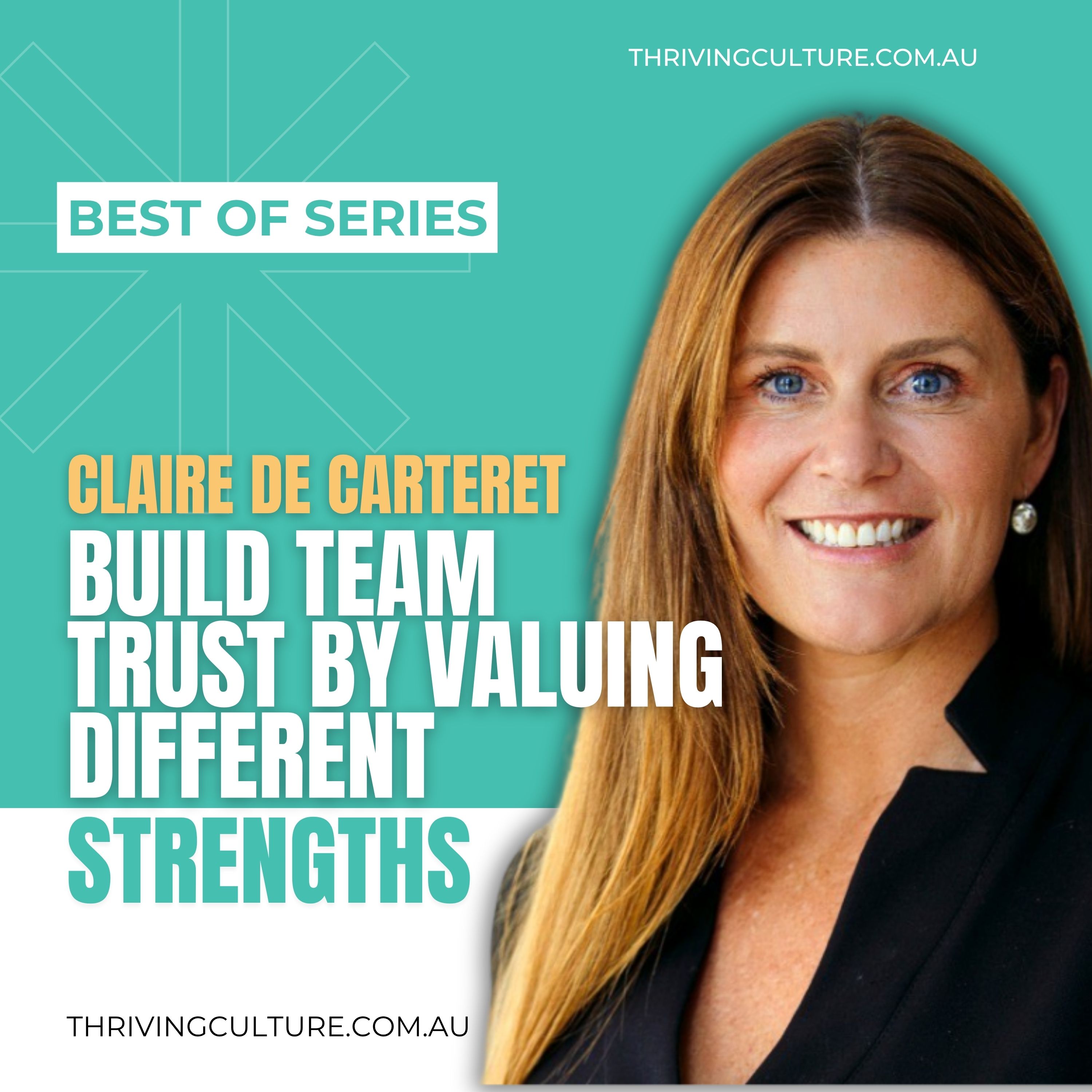
    Best Of | Build Team Trust by Valuing Different Strengths

    How can leaders build team trust when people think, communicate and work differently? Understanding different working styles helps teams turn potential friction into stronger performance. In this Best Of conversation, I speak with Claire de Carteret from Gallup about the relationship between strengths, leadership bias and trust within teams. Claire shares the example of a fast-paced leader who unconsciously judged candidates according to how quickly they walked and spoke. Recognising this bias helped her appreciate what a slower, more deliberative person could bring to the team, including deeper analysis and greater awareness of risk. In this Best Of, we discuss: - Why different working styles can create tension in teams - How a leader’s strengths can become a source of bias - Why cognitive diversity makes teams stronger - How to identify complementary strengths and partnerships - Why strengths-based leadership makes difficult conversations easier - Why focusing on strengths does not mean ignoring weaknesses Claire de Carteret is a leadership expert from Gallup. In this conversation, she shares practical insights into strengths-based leadership and how leaders can get the best from people whose natural approach differs from their own. I’m Claire Gray, a leadership and team facilitator, executive coach, speaker and author of Thriving Leaders and Thriving Teams. Through Thriving Culture, I help leaders and teams unite, align and achieve. Subscribe for practical conversations about leadership, high-performing teams, workplace culture, psychological safety and accountability: https://www.youtube.com/@thrivingculture Watch the complete conversation with Claire de Carteret: https://youtu.be/wZFFB0NBVrM?si=X01gmOieAFenLIOD Chapters 00:00 How to build trust quickly 01:00 The hidden bias towards speed 02:00 Seeing different working styles as advantages 03:00 Why differences strengthen teams 04:00 Leveraging strengths and team blind spots 05:00 Finding complementary partnerships 06:00 Strengths and difficult conversations 07:00 When feedback feels punitive 08:00 Strengths don’t mean ignoring weaknesses #teamtrust #strengthsbasedleadership #highperformingteams

  • August 3 · 52 min· Video

    The 25th Hour: How Leaders Can Stop Giving Away Time with Neal Schore

    Where does a leader’s time actually go? It is not only swallowed by meetings and email. Some of the biggest drains on our time never appear in the calendar. In this episode of the Thriving Leaders Podcast, I speak with Neal Schore, co-founder and CEO of The 25th Hour Group, former founder, president and CEO of Triton Digital, executive coach and author of The 25th Hour: How to Thrive (And Gain Ridiculous Amounts of Time) by Getting Out of Your Own Way. Neal challenges the way we typically think about time management. What if the problem is not simply an overloaded calendar, but the patterns quietly consuming our attention and energy? Neal offers a different perspective on where leaders lose time without realising it—and what it takes to break the pattern. In this episode, we cover: Why conventional time-management tactics only address part of the problem How fear, defensiveness and the need for control quietly consume time Why commiserating can masquerade as collaboration How asking yourself a simple question can prevent misinterpretation and improve performance How to stop reacting, interrupting or assuming the worst How the 10% meeting rule creates space and sharpens focus The words to eliminate from your vocabulary that can create avoidable ambiguity How small disruptions to familiar routines can strengthen awareness and creativity Why leaders need to become more comfortable with discomfort How probability-weighting a fear can stop hours of unproductive “swirling” Why “It’s my fault” is an exercise in agency rather than blame How a leader’s behaviour becomes a model for the wider team Neal’s message is not that leaders will never overthink or react defensively. It is that we can notice it sooner, manage ourselves more deliberately and stop giving away so much time. If you are working flat out but still feel as though there is never enough time, this conversation offers a different place to begin. Links and resources: Neal Schore on LinkedIn The 25th Hour Group The 25th Hour by Neal Schore SCARF Model by Dr David Rock Visit Thriving Culture website Brown, D. (2016). Compliance Test [video excerpt from Derren Brown: Pushed to the Edge]. Channel 4. Later released by Netflix as Derren Brown: The Push. Watch the excerpt on YouTube. Subscribe to the Thriving Leaders Podcast for practical conversations about leadership, team performance and creating thriving workplace cultures.

  • July 28 · 8 min

    Best Of | Why Everything Feels Urgent at Work

    When everything feels urgent, teams become trapped in reactive work—and the strategic priorities that matter most keep getting pushed aside. In this Best Of conversation, productivity expert and bestselling author Dermot Crowley explains why workplace urgency is not simply a personal time-management problem. It can become part of the team’s culture, particularly when people feel they must immediately respond to every request from a senior leader. In this Best Of, we discuss: – Why teams become stuck in constant firefighting – The two reactive patterns that reduce productivity – Why a request from the boss is not automatically urgent – How leaders can unintentionally create urgency for their teams – The importance of giving people permission to negotiate priorities – Why teams should consider importance before urgency – How clearer expectations can help people focus on work with greater impact Dermot Crowley is a productivity expert, bestselling author and founder of Adapt Productivity. He has spent more than 25 years helping leaders and teams work more effectively. His books include Smart Work, Smart Teams, Lead Smart and Urgent. Claire Gray is a leadership and team facilitator, executive coach, keynote speaker and author of Thriving Leaders and Thriving Teams. Through Thriving Culture, Claire helps leaders build aligned, accountable and high-performing teams. If you want practical conversations about leadership, team effectiveness, accountability and workplace culture, subscribe to the Thriving Culture channel. What creates the most unnecessary urgency in your team, and what would help your people focus on what is genuinely important? Chapters 00:00 Why everything feels urgent 00:38 A proactive approach to priorities 01:40 Scheduling work before it becomes urgent 02:45 The two reactive work zones 04:00 It’s not urgent because it came from the boss 05:00 How leaders unintentionally create urgency 06:10 Importance before urgency 07:35 When everything is urgent, nothing is #leadership #teamproductivity #workplaceculture

  • July 20 · 53 min· Video

    Inclusive Leadership: The Small Leadership Moments That Matter

    Why do some teams consistently outperform others, even when they have similar talent, experience and resources? The answer often isn't strategy, structure or capability. It's how people experience leadership every single day. In this episode, I'm joined by Kristy Macfarlane, Deputy CEO of Diversity Partners, executive coach and one of Australia's leading experts in inclusive leadership. Over the past decade, Kristy has helped hundreds of organisations build workplaces where people feel respected, trusted and able to contribute at their best. Before joining Diversity Partners, she led Diversity and Inclusion at NAB and has held leadership, talent and capability roles across Australia and the UK. This conversation goes well beyond diversity and inclusion. We explore the everyday leadership behaviours that shape team culture. The decisions leaders make in recruitment, performance conversations, promotions, meetings and feedback all influence whether people feel safe to contribute or quietly begin to disengage. Kristy shares practical examples that any leader can apply immediately. From reducing unconscious bias and creating fairer opportunities to encouraging different perspectives and strengthening psychological safety, this episode is full of practical leadership ideas that improve both team performance and wellbeing. In this episode, we cover What inclusive leadership actually looks like in practice The six behaviours shared by highly inclusive leaders Why psychological safety starts with everyday leadership decisions How unconscious bias influences recruitment, promotions and performance reviews Why leaders should focus on culture add instead of culture fit The "moments that matter" that shape trust and belonging Practical ways to support neurodiverse team members How AI could reduce bias or unintentionally reinforce it What "Sunflower Bias" is and why leaders should stop speaking first in meetings One simple question every leader can ask to better support their team Perhaps the biggest idea running through this conversation is that culture isn't created through policies or annual initiatives. It's built through hundreds of small leadership choices that most people barely notice. Who gets invited into the discussion. Who receives the stretch opportunity. Whose opinion gets heard. Whether curiosity replaces assumption. Those moments shape whether people feel confident to contribute, challenge ideas and do their best work. If you're leading people, this conversation will encourage you to look at your own leadership through a different lens. Learn more about Diversity Partners: Website: https://diversitypartners.com.au/ LinkedIn: https://www.linkedin.com/company/diversity-partners/ Connect with Kristy Macfarlane on LinkedIn: https://www.linkedin.com/in/kristy-macfarlane-934472109/

  • July 14 · 3 min

    Best Of | How Leadership Teams Make Better Decisions

    Why do leadership teams leave meetings believing they are aligned, only to discover later that little has changed? Often, silence is mistaken for agreement. People may support a decision in the room without feeling heard, committed or clear about what happens next. In this Best Of episode of the Thriving Leaders Podcast, I revisit my conversation with Professor David Clutterbuck, one of the world’s leading thinkers in coaching, leadership and team development. David shares a simple framework that helps teams hear different perspectives before moving into discussion. It can lead to healthier debate, clearer decisions and stronger commitment without requiring everyone to get their own way. In this Best Of, we discuss: – The three questions every leader should ask before team discussions – Why consensus is not the same as agreement – How to encourage healthy debate without creating conflict – Why feeling heard matters more than getting your own way – Practical ideas to improve leadership team decision-making immediately Better decision-making does not mean everyone gets the outcome they wanted. It means people have had a genuine opportunity to contribute, understand the different perspectives and support the way forward. If your team regularly revisits decisions, leaves actions unfinished or discovers disagreements after the meeting, this conversation offers a practical way to approach decisions differently. Watch my full conversation with David Clutterbuck here: https://youtu.be/weAsD-_7jls Subscribe to Thriving Culture for practical conversations about leadership, team alignment, psychological safety, accountability and building thriving teams. #LeadershipTeams #DecisionMaking #TeamAlignment

Showing 1–20 of 37 episodes