
Artwork for This Week in Engineering
News

This Week in Engineering

Engineering.com

This Week in Engineering explores the latest innovations and tech trends in engineering from academia, government, and industry. We cover topics in energy, transportation, aerospace, manufacturing, infrastructure, and much more.

New episodes uploaded weekly.

You can also watch these podcasts as videos on engineering.com TV: https://www.engineering.com/viewAll?category=this-week-in-engineering

  • 168 episodes
  • Updated Oct 22, 2024

Episodes168

  • Nov 1, 2022 · 5 min

    Have Drones Made Combat Pilots Obsolete?

    The use of drones for military purposes has a long history. The concept dates to World War I, and pilotless explosive-laden aircraft were used extensively by Germany in World War II. Remotely controlled precision attack drones were developed by the United States near the end of World War II, but despite predictions in the many decades after that war, crewed combat aircraft continued to rule the combat zone. The experience in Ukraine this year, however, suggests that there may be a radical change in that military doctrine. Swarms of accurate, low-cost combat and reconnaissance drones may now make it possible for a warring nation to overwhelm even sophisticated air defence systems, including piloted fighter aircraft. This shift in the definition of air superiority would be the first change in the doctrine of aerial warfare in a century. And cost engineering is key. Want to watch this podcast as a video? This Week in Engineering is available on engineering.com TV along with all of our other shows such as End of the Line, Designing the Future, and, Manufacturing the Future.


  • Oct 26, 2022 · 3 min

    Decarbonizing Chemical Production with CO2 Sequestration

    The combustion of fossil fuels is widely thought of as the cause of global CO2 emissions. While it is the major contributor, many process industries are large emitters as well, and many of those have few alternative technologies to reduce CO2 production. CF Industries, a large manufacturer of hydrogen and nitrogen products, has signed an agreement with ExxonMobil to capture and store CO2 generated by the company’s large Louisiana manufacturing complex. The development of this large-scale blue ammonia system may make ammonia a viable alternative as a motor fuel as well as an important chemical feedstock. Want to watch this podcast as a video? This Week in Engineering is available on engineering.com TV along with all of our other shows such as End of the Line, Designing the Future, and, Manufacturing the Future.
  • Oct 13, 2022 · 4 min

    Bell, Sikorsky-Boeing in a Winner-Take-All U.S. Army Helicopter Contest

    In the aerospace industry, big military contracts can come in two ways: low-volume, high value platforms, and the opposite, multirole aircraft with enough development potential to sustain production over decades. The Sikorsky UH-60 Black Hawk is an example of the latter, in production since 1979 and still on the line today, with about 4000 produced so far. The replacement rotorcraft for such a successful program has to deliver outstanding performance, and it represents a massive production commitment for the winning airframer. Bell and Sikorsky – Boeing have produced radically different aircraft in the competition for this lucrative contract. The winner may establish the standard for VTOL military aircraft for decades to come. Want to watch this podcast as a video? This Week in Engineering is available on engineering.com TV along with all of our other shows such as End of the Line, Designing the Future, and, Manufacturing the Future.

  • Oct 4, 2022 · 3 min

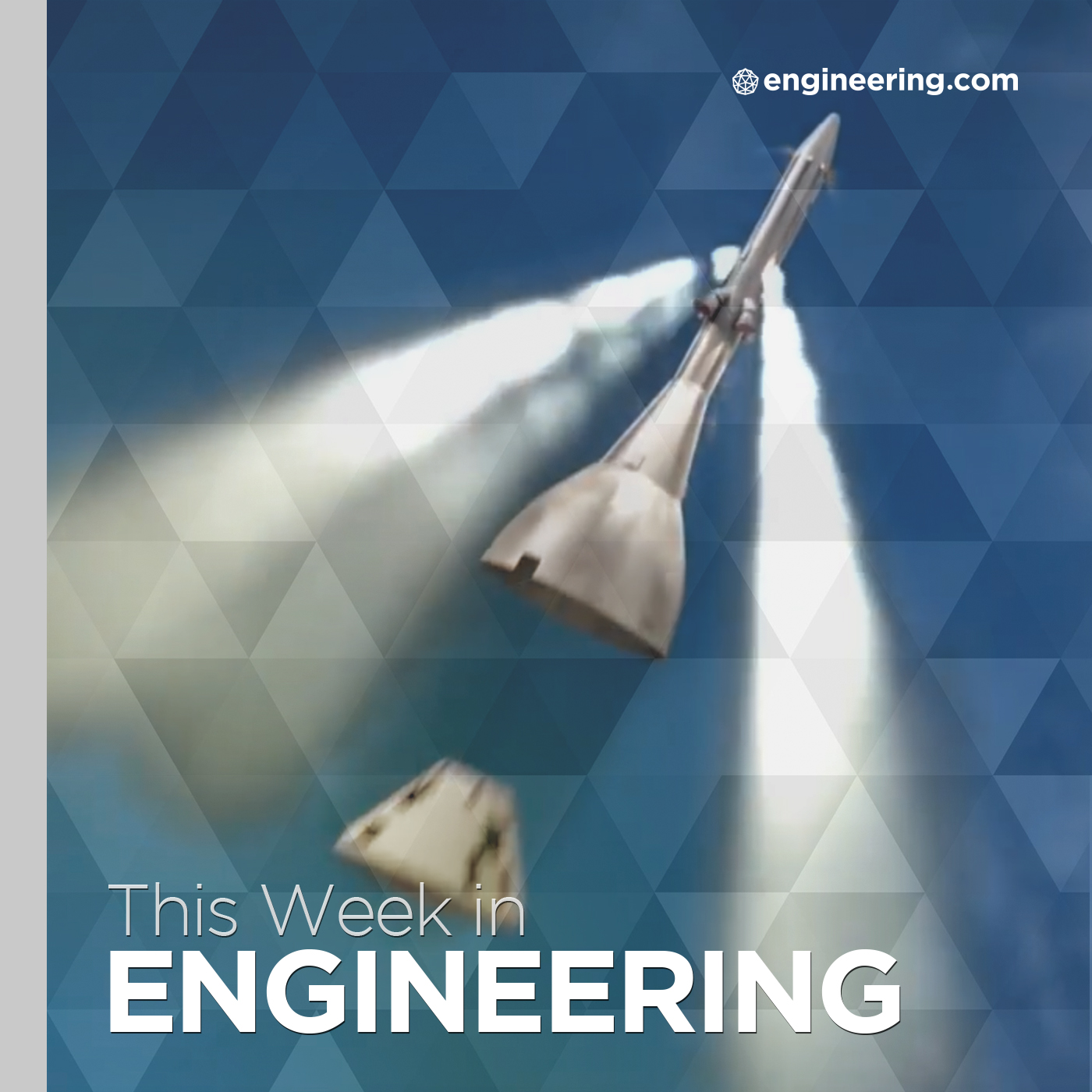
    Launch Escape Systems Saves Lives in Space Flight

    Spaceflight is hard, and dangerous. From the beginnings of crewed spaceflight in the early 1960s, ejection seats and launch escape rockets were designed to carry astronauts and cosmonauts away from the fireball of an exploding booster. Launch escape rockets can be carried on top of the spacecraft and lift it off tractor-style or be mounted under the capsule and push it free of the upper stages. Ejection seats have fallen out of favour after the second Space Shuttle flight, but both tractor and pusher type launch escape rockets are human rated today. Blue Origin and SpaceX use the pusher type, while NASA prefers the traditional tractor type. Which is better? Want to watch this podcast as a video? This Week in Engineering is available on engineering.com TV along with all of our other shows such as End of the Line, Designing the Future, and, Manufacturing the Future.

  • Sep 15, 2022 · 4 min

    LG Makes 6G Progress in Terahertz Communications

    Each generation of wireless communications technology has triggered significant and important social and economic changes. The telegraph, the telephone, microwave relays and satellite medications all made distances effectively smaller and local operations national in scale. Wireless is done the same, with each generation of service offering more bandwidth and faster download speeds, enabling new services to develop by the thousands. But each new technology generates a demand for yet more bandwidth, and faster speeds, with less latency. Six G, the next wave of terahertz frequency data transfer, is the next wave. 60 is widely expected to be the critical enabling technology for widespread adoption of VR/AR, the Internet of Things and global scale cloud computing. LG has announced a milestone test of six G transmission over 320 metres outdoors. The test used hardware developed by LG in association with the Fraunhofer Heinrich Hertz Institute in Berlin. Want to watch this podcast as a video? This Week in Engineering is available on engineering.com TV along with all of our other shows such as End of the Line, Designing the Future, and, Manufacturing the Future.

  • Jul 13, 2022 · 5 min

    Additive Initiative Brings Big OEMs and Suppliers Together

    It’s no secret that the state-of-the-art in manufacturing technology varies widely by industry sector and by enterprise scale. Large, R&D-heavy OEMs in the automotive, aerospace, energy and defence sectors have access to and implement the latest technologies, such as advanced additive manufacturing. The supply chain that supports those companies, however, have varying abilities—from capability that matches that of their customers’, to reliance on third-party and frequently offshore expertise. The AM Forward initiative, backed by the Bipartisan Innovation Act, aims to commit large U.S. companies to purchase 3D printing parts from smaller U.S.-based suppliers, as well as train those suppliers on new technologies and provide technical assistance. If successful, the program could change the traditional relationship between large manufacturers and the entire supply chain. Want to watch this podcast as a video? This Week in Engineering is available on engineering.com TV along with all of our other shows such as End of the Line, Designing the Future, and, Manufacturing the Future.

  • Jun 1, 2022 · 5 min

    This Chinese New Regional Jet May Be the Most Important First Flight in Decades

    Commercial aviation is growing rapidly in China. The emergence of a relatively affluent middle-class, plus new more maintainable and fuel-efficient airliners are making China the must win market for air-framers worldwide. To date, this has been good news for Boeing and Airbus, but Chinese maker COMAC has started production of an efficient small jet that is aimed squarely at the sweet spot in the market, currently dominated by the Airbus A320 series. Although it makes extensive use of Western engines and avionics, the emergence of a credible locally made competitor in the huge Chinese market is a shot across the bow for Boeing and Airbus. Will the global market support three major airline manufacturers? Want to watch this podcast as a video? This Week in Engineering is available on engineering.com TV along with all of our other shows such as End of the Line, Designing the Future, and, Manufacturing the Future.

  • May 24, 2022 · 5 min

    What is a Hypersonic Missile?

    Hypersonic missiles were used for the first time in combat last month in Ukraine, as Russian jets launched Kinzhal missiles from jet fighters. Hypersonic missiles are fast, flying at speeds of Mach 5 or faster, and when combined with a flat trajectory compared to ballistic missiles and maneuverability, they present a difficult problem for defense. Hypersonic missiles are under development as long-range strategic weapons, but the most intense research is in air-launched standoff systems launched from conventional military aircraft. The Kinzhal system uses conventional rocket engines, but more advanced propulsion under development in China and the U.S. uses air breathing supersonic combustion ramjets to use air as the oxidizer, adding longer range compared to rocket systems. Heat is the primary technical challenge to “scramjet” development, but test systems with run times that could allow a 300-mile range have been demonstrated. Want to watch this podcast as a video? This Week in Engineering is available on engineering.com TV along with all of our other shows such as End of the Line, Designing the Future, and, Manufacturing the Future.

  • May 9, 2022 · 4 min

    Can 3D Printing Solve the Housing Problem?

    Housing affordability all over the world has been closely tied to traditional supply and demand equilibria. Nations with growing economies and growing populations need more housing, yet the combination of cost, land availability, regulatory and environmental considerations has resulted in a significant lag between the time that housing is needed in the time that it is built. In America, Freddie Mac has reported that the housing deficit in America increased 52% between 2018 and 2020. One solution to the problem may be 3D printing, with a new generation of very large footprint machines which in the future may collapse the cost of new housing while simultaneously increasing build speed. Access all episodes of This Week in Engineering on engineering.com TV along with all of our other series.

  • May 3, 2022 · 3 min

    Precise, Accurate Aircraft Navigation Without GPS

    Navigation aircraft used to be a simple business. Early pilots often used roadmaps and flew low enough to read the names of towns from water towers and grain silos. Longer-range aircraft brought with them the need for a dedicated navigator, who used the sun and stars just as shipboard navigators did for centuries. The development of satellite-based global positioning systems, however, automated the process and effectively removed the navigator from the cockpit of modern commercial aircraft. Unfortunately, GPS is vulnerable to system attack and jamming, especially since GPS signals are used for military purposes—their original purpose. Can robust, low cost and accurate aircraft navigation systems be built without reliance on GPS? Honeywell has tested a prototype system that promises to do just that. Access all episodes of This Week in Engineering on engineering.com TV along with all of our other series.

  • Apr 25, 2022 · 4 min

    Opposed Pistons Offer New, Clean Life for Old Diesel Technology

    Internal combustion engines are all about volumetric efficiency. Like all heat engines, higher combustion temperatures mean greater efficiency, but those high combustion chamber temperatures and pressures form an ideal process for creating oxides of nitrogen in the exhaust gas stream. NOx has long been known as a major contributor to photochemical smog, and the state of California has had uniquely stringent NOx emission standards for decades. Upcoming standards set for 2027 appeared impossible to meet, but a test of opposed piston diesel built by Achates Power as part of a CALSTART research project has met the 90 percent reduction requirement without novel exhaust gas aftertreatment technologies. The engine is running in a test truck and promises better fuel efficiency and lower CO2 emissions as a bonus. Access all episodes of This Week in Engineering on engineering.com TV along with all of our other series.

  • Apr 19, 2022 · 8 min

    Generative Design: Ready for Prime Time?

    Generative design is widely regarded as the Holy Grail of design engineering automation. Simply press a button, and have artificial intelligence create an optimized part. It's a supremely difficult challenge, and, like autonomous driving, is much more difficult than it appears. Engineering.com's design engineering expert Roopinder Tara discusses the state-of-the-art in generative design with Jim Anderton. Access all episodes of This Week in Engineering on engineering.com TV along with all of our other series.

  • Apr 11, 2022 · 8 min

    Finland Opens the First European Nuclear Plant in 15 Years

    The Finnish power utility TVO has open the first new European nuclear plant in 15 years. The pressurized light water reactor is the product of a French/German design team and promises to deliver as much as 15 percent of the nation’s total electricity needs. Although it is a decade behind schedule and billions of Euros over the original cost estimates, the plant promises to deliver clean power for decades—along with ground-breaking deep storage of nuclear waste, and an interesting experiment in the use of waste heat for agriculture. Access all episodes of This Week in Engineering on engineering.com TV along with all of our other series.

  • Apr 4, 2022 · 3 min

    The Longest Suspension Bridge in the World Connects Asia to Europe

    The recently opened 1915 Çanakkale Bridge in Turkey is an engineering marvel. The world’s largest suspension bridge, the project was thought to be technically impossible as late as the mid-1990s but has emerged as a key link between Europe and Asia. The bridge required very high towers and large, submerged caissons built on-site, as well as advanced project management and planning. Some 4,000 workers built the bridge which—despite COVID-19—was completed ahead of schedule. A consortium of two Korean and two Turkish engineering firms handled the construction, and will operate the bridge for 16 years before turning control over to the Turkish government. The estimated cost of the project is $2.7 billion, and it is expected to carry as many as 45,000 vehicles per day. Access all episodes of This Week in Engineering on engineering.com TV along with all of our other series.

  • Mar 28, 2022 · 4 min

    NASA’s Return to the Moon Accelerates

    For the first time in half a century, NASA is preparing to launch a moon rocket. After multiple delays and redesigns, the giant Artemis 1 vehicle has rolled to the launch pad for the first in a series of final rehearsals for an unmanned Orion spacecraft mission around the moon. The combination of the Space Launch System and Orion spacecraft has been in development since the end of the space shuttle program and shares several key technologies with the earlier vehicle, including main engines, airframe structures and segmented solid rocket boosters. The use of proven design elements in the Artemis program is hoped to grant the system capabilities that exceed the Apollo program’s Saturn 5 launch vehicle, with better reliability and lower relative costs. And there is another similarity to the 1960s: a space race. The race today is with Elon Musk’s SpaceX, whose giant Starship is already on the launch pad undergoing tests. A firm launch date has not been set for either vehicle, although it is generally expected that Starship will likely launch first. Access all episodes of This Week in Engineering on engineering.com TV along with all of our other series.

  • Mar 21, 2022 · 4 min

    Modern Digital Twins Give New Life to Legacy Aircraft

    In the aerospace industry, airframe programs can last for decades. The 747, for example, has sustained a fifty-year production run, but maintaining legacy airframes presents a significant engineering problem: aircraft designed on paper blueprints and early CAD systems are still in service, and replacement parts and modifications are still needed. Translating old renderings into forms that can be used by modern aviation companies and operators is expensive and ad hoc. To address this problem, a USAF sponsored program by the Wichita State University’s National Institute for Aviation Research has created a digital twin of an entire B-1 Lancer airframe, a large and complex strategic bomber. The results so far demonstrate enhanced, lower cost maintenance, suggesting that digital engineering may be the way forward for the many global operators of older aircraft. Access all episodes of This Week in Engineering on engineering.com TV along with all of our other series.

  • Mar 8, 2022 · 3 min

    This Strange Air Vehicle May be the Future of Heavy Lift

    Lighter than air flying machines predate the invention of the airplane, and open so the 1930s, were the only practical way to carry passengers are significant payloads over transatlantic distances. The combination of the 1936 Hindenburg disaster and the development of longer-range fixed wing aircraft ended the age of the rigid airship, but a new hybrid type aircraft that combines features of airships and fixed wing aircraft shows promise for heavy lift, long-duration and low carbon flight. Bradford, UK-based Hybrid Air Vehicles has developed a production ready aircraft and as recently establish a basis for certification with European aviation authorities, a critical step toward type certification. The company expects their Airlander 10 vehicle to be service ready by 2025. Access all episodes of This Week in Engineering on engineering.com TV along with all of our other series.

  • Feb 28, 2022 · 3 min

    Blue Hydrogen for CO2-Free, Fuel Agnostic Diesels

    Decarbonization of transportation is a high priority in the battle to reach Paris Accord CO2 targets, but in heavy trucks and industrial power, there are few alternatives to fossil fuels with current technology. Cummins Inc., a large diesel engine maker, has developed a series of fuel agnostic diesel engines for commercial use that can run on diesel fuel, natural gas, or hydrogen gas. If run on blue hydrogen, CO2 emissions can be reduced or eliminated, and a new project at the world’s largest oil refinery will demonstrate blue hydrogen with low-cost carbon capture. The Reliance Industries Jamnagar refinery in Gujarat, India, will make blue hydrogen from syngas production, part of a coke gasifier process. Reliance expects carbon capture at 30 percent of the cost of atmospheric capture. Access all episodes of This Week in Engineering on engineering.com TV along with all of our other series.

  • Feb 21, 2022 · 3 min

    A Different Approach to Fusion Power

    There are several technologies under development to harness the almost unlimited potential of nuclear fusion. Tokomaks, stellarators, and even mechanical compression in liquid metals are underactive development, but a California-based firm, TAE Technologies, is developing a novel, linear approach that combines plasmas with linear particle accelerator physics. TAE projects that this unique approach to hydrogen – boron fusion so pathway to practical, commercial power reactors. Access all episodes of This Week in Engineering on engineering.com TV along with all of our other series.

  • Jan 31, 2022 · 7 min

    Boeing Bets on Autonomous Air Taxis and GM Makes a Massive EV Investment

    Flying taxis have been dreamed about for decades, but the combination of several technologies available today may make them a reality soon. Boeing has announced a $450 million investment in eVTOL aircraft developer Wisk, who intend to make mass producible, autonomous and electrically powered light aircraft for air taxi service. Wisk has flown prototypes under FAA’s Experimental certification, and the company sees no insurmountable technological hurdles that prevent safe flight operations with passengers. Pending FAA approval, Wisk anticipates that a fleet of autonomous air taxis could be flying in as little as five years after certification. General Motors recently announced a major redevelopment of the company’s Hamtramck assembly operations to accommodate electric vehicle production. GM has dramatically expanded that EV investment with a plan to spend more than $7 billion in four Michigan sites to increase battery cell and electric light truck manufacturing capacity. The investment represents a record for General Motors. Centrepiece of the plan will be Orion Assembly, site of much of GM’s pioneering work in flex line technology, which will receive $4 billion of the overall investment. Light truck production is expected to begin in 2024. Access all episodes of This Week in Engineering on engineering.com TV along with all of our other series.