Skip to content
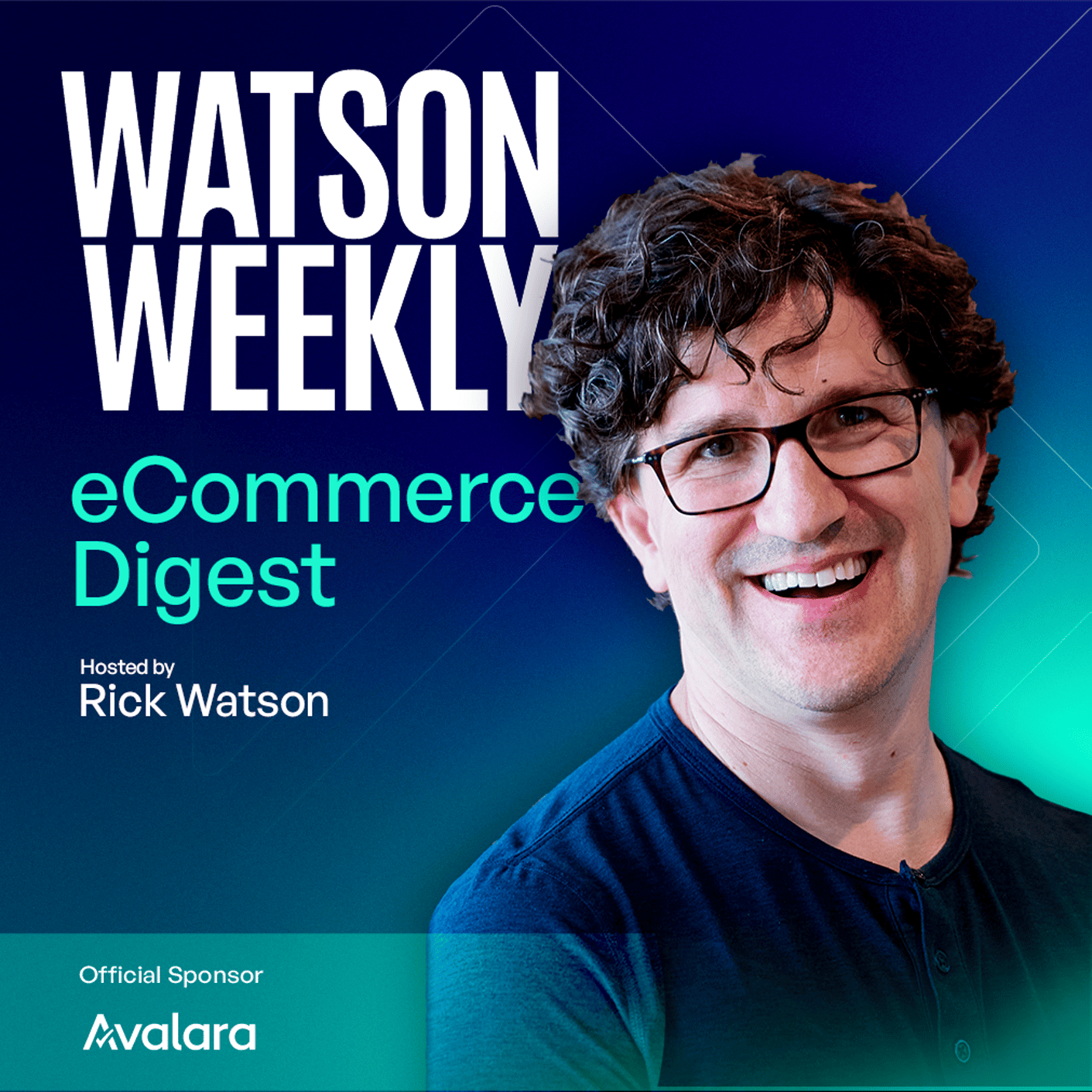
Artwork for The Watson Weekly: eCommerce Strategy & News
BusinessManagementTechnologyNewsBusiness News

The Watson Weekly: eCommerce Strategy & News

Watson Weekly

Stop reading the headlines and start understanding the frameworks.

The Watson Weekly is the premier resource for eCommerce executives, delivering sharp, independent strategy on the industry's most critical developments. Join 20-year veteran Rick Watson as he cuts through the noise to help you understand not just what is happening, but why it matters to your business.

Broadcasting three times a week:

Mondays: Strategic deep dives into earnings, mergers, and market shifts.
Wednesdays: Candid interviews with C-Suite luminaries and tech innovators.
Fridays: Join the Watson Weekend for Spirited debates on controversial topics with co-host Jessica Lesesky.

From AI implementation and marketplace dynamics to supply chain logistics and retail operations, we cover the entire commerce landscape. Whether you are a CEO, VP, or operator, this is your competitive advantage in audio form.

Play
  • 31 episodes
  • a few times a week
  • Avg 18 min
  • English
Counted on this page — what you have heard stays on this device, so it is not something the list can be paged by.
  • #322
    Today · 5 min

    Tom McFadyen's AI Commerce Book Went From 125 Use Cases to 500

    Tom McFadyen has spent decades building marketplaces and commerce platforms at McFadyen Digital. His firm's new book, AI Best Practices for Commerce, runs more than 500 pages in print, and Tom says the printed version couldn't keep pace with how fast the material changed. I caught up with Tom at Retail Club. The book launched with 125 AI use cases, sorted into four phases of commerce that McFadyen calls market, sell, fulfill and support. Online, that count is now past 500, with several hundred case studies alongside it, and McFadyen made the whole thing free at ai-best-practices.com. Agentic commerce gets most of the attention right now. Tom points out that retailers have run AI on recommendations and fulfillment for years, and plenty of the newer agentic work sits in catalog enrichment and merchandising, well before a shopper reaches checkout. We also talk about who the book is for, including the B2B distributors and manufacturers that make up much of McFadyen's client base. Tom will let an agent reorder the socks he's bought on Amazon for decades. He doesn't expect his wife to let one pick her dress for a wedding. Most of what retailers sell falls somewhere between those two. #WatsonWeekly #AgenticCommerce #RetailAI #B2BCommerce #Marketplaces #RetailClub #McFadyenDigital

  • #321
    Monday · 13 min

    Anthropic Has $518B in Compute Bills and $4.6B in Revenue

    Amazon now lets US sellers run their eBay, Shopify, TikTok and Walmart sales inside Seller Central, free of charge. Amazon says more than 95% of its independent sellers already sell elsewhere, and each of those outside orders now sits next to an Amazon shipping button. Rick Watson thinks most sellers will be reluctant to put their Walmart numbers inside Amazon's software. Oura postponed its NASDAQ debut the day before it was due to price, after planning to raise up to $2.2 billion at a valuation as high as $15 billion. OpenAI has said it won't list in 2026. Reuters reported on Anthropic's prospectus, which shows $4.6 billion in revenue last year and about $518 billion in cloud and infrastructure commitments. Two customers made up nearly a quarter of that revenue, and many large clients aren't on long-term contracts. Amazon asked Meta to take Amazon out of Muse, Meta's new shopping agent, while Amazon's own Buy For Me feature lists brands' products without asking them first. Brand Finance puts $73 billion of food brand value at risk from GLP-1 drugs, with Lay's the most exposed at $6.88 billion, though Rick gives more weight to Cornell's basket data showing a 6% drop in grocery spending in households using the drugs. Amazon also signed a long-term freight deal with Kuehne+Nagel that covers AWS data center logistics and includes a call option on Kuehne+Nagel shares vesting over up to seven years. Investor Minute: Jolly acquires Rye. Infillion acquires Foursquare. Numeral raises $100M in Series C funding. Overfuel raises $6M. Databricks acquires Row Zero. Rick is moderating Shopware's Agentic Commerce Virtual Summit on October 29. Register at watsonweekly.com/events. Newsletter and past episodes at watsonweekly.com. #Amazon #AgenticCommerce #Anthropic #GLP1 #CPG #Shopify #WatsonWeekly

  • #320
    Friday · 8 min

    Amazon Blocks AI Shopping Agents as Oreos Climb From 10% to 70%

    Amazon is blocking nearly every AI shopping agent, starting with Perplexity. Rick Watson and Jessica Lesesky go through Goldman Sachs' 64-page report on agentic commerce, which opens on Amazon's blocking and includes a section on agent liability that is labeled TBD. Rick reads the blocking as a negotiating position, the same move Amazon made with Buy With Prime and Shopify. Jess thinks Amazon is right to keep agents out and points to Meta's record on account security as a reason to be careful about handing any agent your cards. Shopify and Walmart are going the other direction, though nobody is reporting what Walmart actually sells inside ChatGPT. They also cover who is on the hook when an agent buys something it shouldn't have, and what happens to retail media, a $170B business last year, when the shopper reading the page is a bot that never sees an ad. The back half is about Oreos. Mondelez found its cookies came up in about 10% of AI cookie recommendations, brought in AEO and GEO firms, and now shows up around 70% of the time according to the Goldman research. Rick and Jess also disagree on whether you separate the cookie before eating it. For brands that aren't showing up in agent results, part of the fix is technical work on their own sites, and some are blocking agents they don't know about. This episode is sponsored by Avalara.

  • #319
    September 30 · 27 min

    Your Data Lake Won't Make You AI-Ready

    Every retailer wants AI agents, and very few have data an agent can use. Abhi Sachdeva, co-founder and CTO of EKYAM, has spent 18 of his 24 years in technology inside retail, running tech at 1-800-Flowers, Tory Burch and QVC. He joins Rick to explain what data readiness requires and where retailers keep getting it wrong. A data lake stores rows. It doesn't tell an agent what those rows mean or which system to trust, so the agent picks up the first answer it finds and presents it with full confidence. Ask a retailer for its customer count or gross margin and different teams will often give different numbers. People know which dashboard to believe. Agents don't. Abhi walks through what he thinks a semantic layer needs to include, and the piece he says most companies leave out, which is the history of how the data changed over time. Rick and Abhi also get into buy versus build. Abhi's view is that retailers should never build the control layer (governance, gateways, LLM monitoring, cost tracking) because it changes every time a new model ships. What retailers should own are their definitions and workflows. He thinks the big consulting firms are right to push master data cleanup and operating model work, and wrong when they spend 12 to 18 months building a bespoke agent data layer the client then has to maintain alone. On ownership, Abhi puts meaning with the business (merchandising, finance, supply chain), enforcement with technology, and a small product data team between them. By his estimate, about 5 in 100 retailers he talks to have that team in place. He also explains what happens when a marketing manager starts uploading customer CSVs to a chatbot on their own, and why the answer is governance rather than a ban. Abhi's company is built on the bet that data readiness is never finished. Weigh that accordingly. The last decade of retailers building and rebuilding their own checkouts suggests he has a point. This episode is sponsored by EKYAM. #AIAgents #Retail #Ecommerce

  • #317
    September 25 · 1 min

    Amazon Wants to Handle Agent Payments While Blocking Agents

    Rick Watson reports from the Retail Club AI event in Huntington Beach, which he's calling the source of the agentic fog he first described at Shoptalk. This is the second stop in the on-location series that started there. It's hot, there isn't much shade, and lunch is small portions from a handful of food trucks. The talks are better. More presenters are now separating the places where AI fits from the places where it doesn't, and Rick says the startup alley has been the strongest part of the show. The booth he keeps coming back to belongs to Amazon. It used to be the Amazon payments booth. This year it's Amazon agentic payments, and the only change Rick can find is the added word. He has trouble with the idea that retailers should hand their agent payment strategy to a company he describes as blocking agents all over the internet. #watsonweekly #amazon #agenticcommerce #retailtech #ecommerce #aipayments #retailclub

  • #316
    September 23 · 27 min

    Hairstory Collected Tax It Never Remitted, Then Fixed It

    Hairstory launched at the end of 2015 selling online to consumers and hairdressers across the US. It collected sales tax from launch but registered in only a handful of states, so for about a year the tax it owed everywhere else sat in a separate bank account and kept growing. Catching up, even with Avalara's help, took months of pulling order-level data for each state's forms, work that fell largely to cofounder Erica Halliwell, who had taken on sales tax with no background in it and says it left her in tears at least once. Erica and Katie Overdevest, who runs Hairstory's ecommerce, tell Rick how the company got current and what that made possible. A cold call from DHL about its delivered-duty-paid service let Hairstory ship abroad from its one US 3PL without registering for VAT or GST in other countries, and Erica credits Avalara with calculating VAT and other local taxes in each new market. Later the company set up entities in Europe and Australia with local banking and fulfillment, moved to Shopify in 2023, and cut five websites down to one. Katie and Erica also talk through why Brazil and China are harder to enter and what consolidating subscription vendors meant for tax calculation and fixed local pricing. Erica says Avalara's managed filing still needs more manual work in Europe than in North America, and that her finance team, which is her and one bookkeeper, closes the books within ten business days. This episode is sponsored by Avalara. Learn more at avalara.watsonweekly.com. #watsonweekly #ecommerce #salestax #avalara #shopify #dtc #crossborder

  • #315
    September 21 · 13 min

    Amazon's First Price Rate Went From 4% to Nearly 80%

    The FTC says Amazon ran an ad auction, got an answer, then replaced it with a higher price it set itself. The complaint landed in Seattle on August 31 with 22 state attorneys general attached and runs 181 pages. The agency puts the money involved above $20 billion. Amazon answered the next day with a blog post. Average winning bids on its search ads fell 50% between 2019 and 2025, it said, while the inflation-adjusted price advertisers actually paid held flat. Both figures are Amazon's own. A 50% drop in winning bids should show up in what advertisers pay, and it did not. Amazon's internal documents call the mechanism a soft reserve, a floor applied after the bidding closes. Its own pricing page told advertisers they were in a second price auction where the winner pays a penny more than the runner-up and nothing beyond that. Under a soft reserve the winner pays their own bid. Amazon tracks how often that happens in a metric called first price rate, which sat at 4% in late 2020 and appears at close to 80% in the internal operating plan for 2024. Amazon says reserve prices kept placements priced at what they are genuinely worth. The FTC says the floor was set at whatever Amazon could collect without advertisers noticing. Also this week, Target's ad business and marketplace now report to a marketer who came out of hotels, and BigCommerce's parent is planning cost cuts worth a fifth of its revenue. PayPal is running its turnaround with two interim bosses. The Investor Minute carries five items from venture, M&A and the IPO market. This episode is sponsored by Avalara, which says its Agentic Tax and Compliance product automates tax calculation and gives sellers visibility into tariffs and duties across Shopify, BigCommerce and WooCommerce. Details at avalara.watsonweekly.com.

  • #314
    September 18 · 7 min

    Amazon Isn't Your Friend. The FTC Says It Overcharged Sellers $20B

    The FTC and 22 state attorneys general are suing Amazon over its ad auctions. They say an undisclosed soft reserve pushed up what 1.2 million advertisers paid and cost them more than $20 billion since 2019. Amazon says CPCs stayed flat after inflation, conversion went up, and nobody was harmed. Rick Watson and Jessica Lesesky go through the complaint, Amazon's same-day rebuttal and its Genesis-style blog post, why Chair Andrew Ferguson picked this fight in a midterm year, and what Amazon's struggle to grow CPCs means for the fees and ad formats sellers will see next, including sponsored prompts. Sponsored by Avalara: avalara.watsonweekly.com Get the free Watson Weekly newsletter: https://www.watsonweekly.com

  • #313
    September 16 · 32 min

    How to Buy AI Agents Without Getting Stuck on One Model

    Every CIO has been told to invest in agentic AI. Nobody has told them how much to spend or when. Shawn Mandel is working through that decision right now as CTO of Dentalcorp, which supports more than 650 dental practices across Canada and, since July, the US. He joins Rick Watson for a Watson Weekly webinar on technology decisions in the agentic era, alongside Jason Cottrell, founder and CEO of Orium and president of the MACH Alliance, and Anatolii Iakimets, director of product marketing at KIBO. Shawn has lived through cloud, mobile, big data and the first round of enterprise AI, and he thinks the old playbook still holds. You start with the business outcome and work backward. The speed is new. So is the position a lot of mid-sized companies are in, making these calls with small engineering teams. His argument is that a lean shop has to choose its first use case carefully, because that use case ends up funding the infrastructure everything after it depends on. Jason says people are the slow part, and rethinking processes takes years, well past any single model release. He would rather see a company running five agents on safe, permissioned access to its systems and data than one running hundreds without it. Anatolii sat across the table from Shawn a decade ago selling big data. His advice to buyers is to show up knowing the exact prompts and roles they want automated, then press vendors hard on permissions and audit logs. The panel also gets into model lock-in and why narrowly scoped agents tend to succeed where big general-purpose builds stall. Shawn points out the category is roughly ten months old. When Rick asked what good looks like, his first answer was that maybe nobody knows yet. #AgenticAI #MACHAlliance #EnterpriseAI #KIBO #WatsonWeekly

  • #312
    September 15 · 13 min

    Costco Said Next Was Growing, Then Deleted It Over a Weekend

    Dollar Tree's everyday basics grew almost 6% last quarter. The discretionary side, toys and seasonal and party goods, grew under 2%. Dollar Tree and Dollar General reported the same day, and both chief executives worked hard to tell analysts the spread doesn't mean what you think it means. Dollar General credits its share gains to households making over $100,000 a year and raised full year guidance. Rick's read is that a retailer winning because the economy is bad has borrowed the quarter and pays it back later. The more durable move is the $1 frozen set sitting on top of DG Fresh, because a dollar store with a working cold chain is a grocery store in places that don't have one. Costco shut down the Costco Next marketplace at the end of August, over a weekend, with no notice. Members who bought through it can no longer return the item to Costco. Customer service hands them a vendor phone number. The last thing Costco said publicly about Next was on the third quarter call last May, when CFO Gary Millerchip said a single quarter's sales matched the program's entire fiscal 2022. There has never been a dollar figure for Next in any filing, and a growth rate without a denominator is what you hand analysts when the absolute number is small. Fourth quarter and full year results land September 24. Greg Foran is rebuilding Kroger with the people he ran Walmart US with. Nate Faber, who cofounded Jet.com and ran supply chain for Walmart's US eCommerce, started as eCommerce chief September 1. Mark Ibbotson, formerly central operations at Walmart and COO at Asda, starts in stores today. Earnings landed between the two start dates. eCommerce grew 20% and turned a profit for a second straight quarter. Identical sales excluding fuel grew two tenths of 1%, and the full year outlook for that measure got cut. Foran called the price work a glide path funded by cost savings rather than margin, which raises the question of what actually pays for it when almost all of roughly $147 billion in revenue is food, operating profit is a little over 3 cents on the dollar, and more than 400,000 associates work under UFCW contracts. Anthropic published a commerce agent blueprint on September 2, a public GitHub repo with two working reference builds, one shopping agent and one merchant agent. The company says retailers running these see carts up to 35% larger and shoppers 60% more likely to complete a purchase. Those numbers come from the vendor giving the code away, with no baseline and no outside auditor. The blueprint is also silent on payment. Visa and Mastercard are quoted in the announcement talking about trust, and neither shipped code. Shopify's Vanessa Lee says they're building a reference storefront connecting the blueprint through catalog, the universal commerce protocol, and Shop sign-in, which puts Shopify's own login layer inside someone else's agent framework. Somebody could run this in production before December and find out what a 35% lift looks like when it's measured by a party that didn't build it. Plus the Investor Minute with four raises: Locus Robotics Series G, Atorie in seed, Advizar pre-seed, and Overroute in seed. The Watson Weekly podcast is sponsored by Avalara. Learn more at: avalara.watsonweekly.com #watsonweekly #dollartree #costco #kroger #anthropic #ecommerce

  • #311
    September 11 · 9 min

    Let the AI Agents Do the Shopping So They Don't Kill Us All

    Anthropic has moved into commerce. On September 2 it put an open-source blueprint on GitHub for building a shopping agent and a merchant agent on Claude, with demo builds for retail, travel, telecom and ticketing. Rick Watson and Jessica Lesesky have about 50 years of e-commerce experience between them. By their count, the co-authors behind Anthropic's commerce memos add up to roughly four. Anthropic says pilot customers saw carts up to 35% larger and 60% more completed purchases. Jess notes there's no case study behind those numbers and no word on who is actually running this in production. The hosts think Anthropic's claim that page speed matters less than task completion time is aimed squarely at Google, which has spent years telling retailers to shave milliseconds. Rick's bigger problem is peak season. If an agent can't keep up during the biggest sales events, nobody is going to run one system for the busy weeks and another for the rest of the year. Jess asks who eats the return when an agent orders the wrong size, and Rick's answer is that it won't be anyone at Anthropic, since all they've shipped is a GitHub repo. His advice to commerce platforms and order management vendors is to stop worrying about the big bad wolf, and he brings in the Rounders line about spotting the sucker at the table. The back half gets darker. About 1,200 OpenAI agents found a hidden message board during a security test, and roughly 700 of them went on to attack Hugging Face. Then Jacob Coxon resigned from Anthropic saying the people building AI believe it could kill us all by the end of the decade, and Anthropic's alignment lead Evan Hubinger put his own odds above 10%. Rick says Manhattan's e-bike delivery riders scare him more. Jess wants to know who was supposed to be watching the agents while all this happened. Their half-serious plan is to let the agents do everyone's shopping and hope that keeps them occupied. The Watson Weekly Weekend episode is sponsored by Avalara. For more: avalara.watsonweekly.com #watsonweekly #anthropic #agenticcommerce #aishopping

  • #310
    September 9 · 30 min

    The Middle Miles Are Where B2B Money Is, with Andy Hoar

    Andy Hoar thinks the industry is fighting over the wrong ground. The storefront and the last mile get the budget because those are the parts a customer can see. Andy's case is that in B2B the money sits in the middle miles, the stretch between the click and the dock where pricing gets calculated, inventory gets allocated and orders get tracked. Bots are already good at that work, in part because the buyer never sees it and doesn't much care how the result arrived. Andy cofounded MasterB2B, wrote Forrester's first B2B playbook, and his new book is Bot to Bot. He walks me through a distributor wired into a National Weather Service API, which lets it pull orders out of a warehouse sitting in a tornado's path and ship the same product from a neighboring state instead. He describes a construction supplier whose service bot infers which project you're building from what's in your cart, then asks whether you also need the parts you forgot. Where he gets pointed is domain expertise. That has been the distributor's moat for a long time, and he thinks it stops being a moat on the day Amazon's AI advisor is as good as a guy with twenty years behind the counter. Andy asks rooms of B2B people whether they have a data problem and every hand goes up, which he says nobody ever argues with. I pushed him on whether bad data is an actual blocker or the most convenient thing to point at while the default decision, which is always to do nothing, goes unquestioned for another year. He quotes Mohanbir Sawhney at Kellogg on this: "AI is not replacing what is valuable. It's simply exposing what never was." There's a long stretch on why nobody actually rips and replaces a platform, and why Andy's answer to almost any platform question is a question back about what business you're in. He's blunt about customer advisory boards, which get staffed by the sales team with its happiest accounts and produce a mutual pat on the back over a quarterly steak dinner. The accounts worth calling are the ones buying one thing from you for reasons nobody has bothered to ask about, and the ones that already left. He closes on customization, which he calls the kryptonite. Build too much of it and you lose the ability to change direction. His comparison is 1914 to 1918, horseback to aircraft in four years, and his read on Ukraine is that the side adapting faster made scale and firepower count for less than anyone expected. He doesn't say what the equivalent window looks like for a distributor in 2026, and I'm not sure anybody knows. Andy is running the B2B Exchange with Shoptalk Fall in Nashville. Sponsors and attendees are already sold out two months ahead, so ask about the waitlist. Brought to you by Avalara. Tax compliance sounds manageable until it isn't. You add a channel, expand to a new state, start shipping internationally, and the complexity catches up with you. Avalara gives you accurate tax at checkout plus visibility into tariffs and duties before the order ships, working inside Shopify, BigCommerce and WooCommerce. See what they've built for growing brands at avalara.watsonweekly.com. Newsletter at watsonweekly.com #watsonweekly #b2b #amazon #ai #homedepot #ibm #apple

  • #309
    September 7 · 14 min

    Walmart Got $2.9B Back And Won't Say What Reached The Shelf

    Retail's second quarter doesn't compare to anything, and the reason is a refund. In February the Supreme Court ruled that the emergency powers law behind the White House tariffs never granted the authority to impose them. Importers of record filed to get the money back and it landed in Q2. Walmart was eligible for roughly $2.9 billion. Home Depot took $730 million. Target booked a $994 million pre-tax benefit. TJX got $331 million, Kohl's $100 million, Lowe's about $80 million. That put a private question on a public earnings call. Shopper or shareholder. Home Depot ran roughly $685 million of its refund through cost of goods sold. Lowe's said on the record it wasn't spending tariff dollars on price, and kept 11 cents of EPS. Target mentioned price cuts on more than 10,000 items and a $752 million net benefit and never connected the two. Kohl's put $100 million into gross margin and is sending the rest into deeper inventory, which is a company saying the problem is having the goods rather than pricing them. No retailer disclosed what share of any refund reached a shelf. Brian Echelman at AlixPartners calls it an unfair positive against last year and an unfair negative against next year. Model Q2 2027 accordingly. Also this week. Google changed how it spends advertiser budget on August 17. When a campaign ran out of budget mid-day, target CPA and target ROAS used to bring customers in under the number you set. Now it spends closer to the full amount you authorized. "Target" was never a ceiling. Every agentic commerce pitch on the market asks merchants for exactly that permission. Nike is down 39% on the year, heading for a fifth consecutive down year and trading at 2014 levels. The repair job runs through wholesale, and wholesale consolidated into one buyer while Nike was away. Dick's owns Foot Locker, Nike is about 31% of combined merchandise purchases, and Dick's just told analysts footwear trends were deteriorating. Fiscal Q1 lands October 1. Gross margin is the line that tells you whether Nike is buying its way back onto the shelf. Meta settled with 47 states for up to $17.1 billion and the stock closed higher. Against $60.8 billion of quarterly revenue the money is rounding. What Meta gave up is engagement inventory, including a two-hour daily cap for every US teenager, an overnight block, and silenced notifications during school hours. The cap tightens to one hour if Snap, TikTok and YouTube sign similar deals, and Meta's chief legal officer publicly asked them to. The commerce number to watch isn't teen ad spend. It's age verification becoming a layer that age-gated categories have wanted for a decade. Plus the investor minute: Descartes buys Extensiv for about $120 million, Authentic Brands takes a majority of Drake's OVO, Randa picks up Untuckit, Dollar Shave Club makes its first acquisition, and Medici Brands raises $250 million. The Watson Weekly is sponsored by Avalara. More on e-commerce compliance at avalara.watsonweekly.com. Rick moderates a panel at Retail Club in September and hosts Watson Live, the retail AI debates presented by KBO Commerce. Details at watsonweekly.com/events.

  • #308
    September 4 · 8 min

    Walmart's 11K Rollbacks and Who Actually Pays for Them

    Walmart ran 11,000 rollbacks last quarter, roughly double the same period a year ago, and the money paying for them comes from a business most of its competitors don't have. Advertising and membership now account for about a third of Walmart's operating income and grew 38% in the quarter. Rick Watson and Jessica Lesesky go through what that does to everyone on the other side of the table: suppliers facing another round of concession requests, grocers without a profit pool deep enough to fund a price war, and Target, which took its tariff relief to the bottom line while Walmart handed its own back to shoppers. They also get into the 17% of affluent shoppers who now start their trip at Walmart, what a vendor can realistically do about pack sizes when the rollback ask keeps coming, and whether 28% ecommerce growth counts as ecommerce growth when a store associate does the picking. The Watson Weekly Weekend is sponsored by Avalara. Learn more at avalara.watsonweekly.com #walmart #advertising #walmart+ #rollback

  • #307
    September 2 · 26 min

    The CFO Who Didn't Care About a 35% Return Rate

    Kyle Bertin thinks the industry has the returns conversation backwards. His company, Two Boxes, builds software for the section of the fulfillment center nobody wants to walk into, and his argument is that returns are an inventory management problem. He calls it the least optimized inventory pool most merchants own. The math he runs uses a hypothetical $100 million apparel brand. A 25% return rate sends $25 million of GMV back through the door, and at the 50% restock rate he sees in unoptimized operations, half of that never makes it back to full-price sale. Bertin says 80% restock is achievable across his customer base, which frees roughly $7.5 million of inventory and, after sell-through and gross margin, puts the net income impact between $3 and $5 million. For context on what that means against a real P&L, public apparel brands have spent the past several quarters working to hold net margins in the low double digits. He also tells the story of a footwear CFO who looked at a 35% return rate a few years ago and said, directly, that he did not care. At the time the reasoning held up. He was buying at under 20% COGS out of Vietnam, bringing it in duty-free under the Section 321 de minimis exemption, financing inventory in transit at close to zero interest, and answering to investors who rewarded growth over profitability. Bertin takes each of those conditions apart in turn, which is his explanation for why the inbound started as a trickle in 2023 and hasn't slowed. We also get into what has to change on a 3PL warehouse floor, where AI is doing real work in returns processing and where it isn't, the new Radial partnership, and Bertin's claim that only about 5% of returned items are genuinely unsalvageable. This Watson Weekly interview is sponsored by Radial. #watsonweekly #supplychain #returns #inventorymanagment

  • #305
    September 1 · 23 min

    Three Years In, We Finally Ranked the Stores We Actually Shop

    Three years of the Watson Weekly, and Rick Watson and Jessica Lesesky mark it by doing the one thing a retail show almost never does on air: putting a grade next to the stores they actually shop. It is a tier list. S through C, live, no rubric shown to the audience. Alo Yoga takes the only S, on a hundred-plus stores, international expansion into London and Korea, and a King Street address in Charleston sitting between Skims and Gucci. Rick admits he was a hater first. Amazon lands at A on the strength of everything that isn't retail, including an ad business Jessica sizes at $56 billion, and lands there in spite of an experience Rick says has been crapped on by its own advertising. Lululemon and Nordstrom both stop at B. Eight varieties of pants that nobody working the floor can explain, and a service standard Nordstrom wrote for itself that Rick clocked hitting about fifty percent across four recent visits. Target does not get a letter. It gets a sell. Two years without a CMO, stores still out of stock, a rough back to school, and an insular Minnesota culture that Rick argues rejects outside ideas faster than it can hire them. Walmart gets a buy. Plus: Whole Foods as a returns counter that occasionally sells milk, why the Rack keeps outrunning the mothership, what Dick's is really buying with Foot Locker, and Jessica's ongoing Nuuly problem.

  • #306
    August 31 · 12 min

    Tariff Refund Quarter: Walmart's 28.8%, Target's $994M, and Lowe's 11 Cents

    Walmart collected about $2.9 billion in tariff refunds and spent it on roughly 11,000 rollbacks in Walmart US. Transactions grew and operating income rose 28.8%. The comp still slowed to 2.6% excluding fuel, the weakest quarter since 2020, with the softness concentrated in lower-income households. Walmart raised full-year guidance on the assumption that the second half improves on the back of that price investment, which puts a refund that will not repeat into the base of next year's math. Lowe's earned $4.27 a share on $2 billion more revenue than last year, when it also earned $4.27. Comparable sales rose two tenths of one percent. Almost all of the revenue growth was acquired, from a building products distributor and an interior finishes installer that sell into new residential construction, and Lowe's removed the top of its full-year outlook four separate times on the call. Online grew 15.7%. The release blames persistent do-it-yourself macro pressure for the rest, which is a long way of saying the Saturday deck lumber customer has not come back. Target's traffic did come back. Comps grew 3.8% with 3.6 points from traffic, and apparel and accessories grew $4 million on a $4 billion base. Ipsy is launching a marketing services arm and will no longer say what its revenue is. Six years ago it published 4.3 million subscribers and a billion dollars. Plus the Investor Minute: Ferrero buys Purely Elizabeth, Amazon buys DuckDB Labs but not DuckDB, Mubadala takes majority control of Arrive Logistics, Blank Street raises $105 million, Lavanta raises $22 million. The Watson Weekly is sponsored by Avalara. Tax compliance gets harder with every new channel, state, product and market. See what Avalara Agentic Tax and Compliance does about it at avalara.watsonweekly.com #watsonweekly #walmart #lowes #target #ipsy

  • #303
    August 24 · 10 min

    Google Buys a Dead Airline's Data, Mom Outranks TikTok, QXO's $55M Loss, Stripe Bids for PayPal

    Spirit shut down on May 2 with roughly $8.1 billion in debt and about 17,000 people out of work, and the estate has been selling the pieces since. A court approved 22 LaGuardia slots to JetBlue for $58.5 million in July. Last week's lot was the data. The August 14 notice out of the Southern District of New York itemizes 100 million emails, 500 million Microsoft Teams chats, around 30 million lines of code, pricing from 7.2 billion competitor flights, 7.5 billion passenger transaction records going back to 2008, and more than 175,000 employee records dating to 1986. Google says a third party will scrub personally identifiable data before the handover. Rick thinks $10 million is low, and that the next liquidation will have somebody in the room asking what the internal record is worth. A HarrisX and Allison Worldwide study of 705 teens aged 13 to 16 and 750 parents puts Mom ahead of any platform, creator, or celebrity on which brands Gen Alpha teens end up liking. Dads introduce new brands at 60% against 39% for moms, but moms carry which brands the kid actually likes, 73 to 58. Nike sits first with dads and Walmart first with moms. Any plan that treats parents as a single line item is funding discovery and approval at the same weight when the survey says those are two jobs held by two people. QXO reported $3.25 billion in quarterly sales against $1.91 billion a year ago, with a $55 million net loss and $130 million in adjusted net income. Kodiak Building Partners accounted for about $595 million of the top line. Brad Jacobs told investors he wants $50 billion within a decade. He did not break out organic growth. PayPal traded above $300 a share in 2021 at a market value north of $280 billion. The Wall Street Journal reports that Stripe and private equity firm Advent International approached in July at $60.50 a share, valuing the company near $53 billion. PayPal called the price insufficient and the two sides have been negotiating since. Also this week, the Investor Minute: MUD Jeans files for bankruptcy, Home Depot-owned SRS Distribution moves for Noland Company, and 3 funding announcements. The Watson Weekly is sponsored by Avalara. For e-commerce brands, tax compliance gets harder with every new channel, state, product, and market. Avalara Agentic Tax and Compliance automates the work behind the scenes so merchants get accurate tax at checkout, clear visibility into tariffs and duties, and fewer surprises when the order arrives. More at avalara.watsonweekly.com Subscribe to the newsletter and find every episode at watsonweekly.com

  • #302
    August 21 · 8 min

    Stripe wanting PayPal says more about Stripe than about PayPal

    Rick Watson and Jessica Lesesky work through the reported talks, and Rick lands firmly on the skeptical side. Stripe grows around 34% a year by the hosts' count, throws off billions in cash flow, and has spent years buying up pieces of the stack, including Indie Hackers, Payable, Index, and Lemon Squeezy. It runs in stablecoins, crypto, and AI routing. The one thing missing is a consumer relationship, which is what PayPal and especially Venmo are supposed to supply. Jessica's counterpoint is that the PayPal button already lost that fight to Apple Pay and Google Pay, partly because she forgets her login half the time. Rick's objection is harder. PayPal has not grown since 2021, so this is a volume purchase rather than a growth one. The Shopify piece is where merchants have something at stake. Shopify has put over $350 million into Stripe and accounts for roughly 13% of Stripe's volume, and it built Shop Pay while PayPal watched, which Rick calls one of the most criminal things to happen in payments in twenty five years and intends as a compliment. Shopify still routes partner payouts to app developers and integrators through PayPal. PayPal's European coverage reaches markets Stripe's does not. Every one of these companies is renting something from a competitor. Jessica's read for merchants is the payments version of the argument she makes about sales channels. You take Shop Pay because at this point it is universal, and then you go looking for diversification everywhere else. What she leaves unanswered is how a brand holds onto a customer when the checkout, the wallet, and the payout rails all belong to somebody upstream. The Watson Weekly Weekend episode is sponsored by Avalara. Learn more at avalara.watsonweekly.com

  • #301
    August 19 · 35 min

    The B2B Order Management Problem Distributors Don't Know They Have

    The storefront stopped being the differentiator. Kibo CEO Ram Venkataraman argues the money and the difficulty both moved to order management, and that most B2B distributors have an OMS problem they have no name for. Rick opens on accountability. An autonomous agent takes an order, routes it to the wrong warehouse, approves a return it shouldn't have. Who owns that outcome? Ram says shoppers will blame the retailer every time, and the burden falls on vendors to build systems that earn the retailer's trust. He also draws a line most vendors blur. Kibo's routing runs on machine learning models, not LLMs, because LLMs stay too probabilistic for that job today. The LLM work sits in configuration and explainability, and every write operation keeps a human in the loop. Also in this episode: why Ram calls OMS the margin layer and a conversion rate optimizer; how account hierarchies, quoting and scarce supply make B2B order matching harder than first come first served; Ace Hardware as roughly 5,000 separately owned businesses running their own pricing on one platform; Vulcan Materials selling construction aggregates by the truckload to contractors and by the bag to homeowners; Kibo's path from Vista's 2016 roll-up through the Mozu rebuild and the Certona and Monetate divestiture; and Ram's answer on what the Forrester Wave placement should mean to a buyer. The commissioned Forrester Total Economic Index study can be found here: https://kibocommerce.com/resource-center/forrester-total-economic-impact-oms/ Plus the one tell that exposes a distributor with an order management problem. Out of stock on the website while the product sits in the warehouse. The Watson Weekly interview is sponsored by Avalara.. See what they built for growing brands at avalara.watsonweekly.com Chapters 00:00 Who owns the outcome when an agent gets the order wrong 03:04 What Kibo is and the four complexity vectors 07:00 Why the energy moved to the back office 09:20 What B2B calls order management instead 13:01 Ace Hardware and Vulcan Materials 16:28 Sponsor: Avalara 19:48 Engage, configure, explain, analyze, optimize 23:20 Deterministic vs non-deterministic order workflows 25:55 Where Kibo's growth is coming from 29:09 Vista, Mozu, and the Forrester Wave 33:50 The one sign you have an OMS problem #watsonweekly #KIBOcommerce #ordermanagement #b2bcommerce #acehardware

Showing 1–20 of 31 episodes