Skip to content
Artwork for The Transatlantic

The Transatlantic

Commission on Security and Cooperation in Europe

Human stories about freedom and security across oceans, political divides, and intellectual traditions hosted by Bakhti Nishanov, senior policy advisor at the U.S. Helsinki Commission.

This podcast is produced by the U.S. Helsinki Commission, a U.S. government commission that promotes human rights, military security, and economic cooperation in 57 countries in Europe, Eurasia, and North America.

Play
  • 20 episodes
  • Avg 39 min
  • English
  • S2 · E11
    June 16 · 1 hr 18 min

    Telling Ukraine's Story and Supporting Ukrainians Four Years After Russia's Full-Scale Invasion

    In this episode, Bakhti sits down with Nate Mook, an award-winning documentarian who has led organizations providing humanitarian aid to Ukraine since Russia's launched its full-scale invasion in 2022. Mook offers a firsthand account at how the organizations he has led, including World Central Kitchen and All Hands & Hearts, have adapted to provide for Ukrainians' evolving needs over the course of the war. Bakhti and Nate also discuss why Nate began working in Ukraine, how he has rallied international support for Ukraine in a challenging media environment, and what he thinks policymakers are missing about Ukrainian society. --- Nate Mook is a seasoned leader and gifted storyteller who transforms words into action and ideas into impact. From 2018 to 2022, Nate served as the first CEO of World Central Kitchen (WCK), leading its transformation from a small operation with under $1 million in revenue to a global humanitarian powerhouse raising $500 million annually. Following his time at WCK, Nate served two years as Special Advisor on Ukraine for the Howard G. Buffett Foundation. In recognition of his efforts for the Ukrainian people, Nate was awarded the Order of Merit by President Volodymyr Zelenskyy. In 2025, Nate became CEO of All Hands & Hearts, the disaster relief nonprofit co-founded by Petra Němcová. He is also a co-founder of Hachiko Foundation, supporting cats and dogs affected by war in frontline Ukrainian communities. Nate serves on the boards of March For Our Lives, a youth-led movement against gun violence, and Save Ukraine, which has rescued over 670 children abducted by Russia. He also advises Razom for Ukraine, on its advocacy efforts. Early in his career, Nate was a technology entrepreneur and later began working in film. He produced the award-winning HBO Documentary Baltimore Rising with The Wire's Sonja Sohn. Nate is an executive producer of the 2022 Emmy-nominated film We Feed People from Ron Howard about WCK's rise. In 2015, he conceived and directed the documentary Undiscovered Haiti with José Andrés, a project co-produced with National Geographic and PBS. Nate has been a longtime collaborator with TED, helping to grow the TEDx program from its start in 2009, leading the TEDxSummit in Doha, and organizing conferences in places like Mogadishu, Baghdad, Tripoli, and Mount Everest. He was named a "Change Hero" by the Bill & Melinda Gates Foundation for his work amplifying voices in underserved communities. When not working in disaster zones or traveling across Ukraine, Nate resides in Washington, DC, with his cat, Jinx Furdinand. --- This podcast is hosted by Bakhti Nishanov and produced by Alanna Novetsky, in conjunction with the Senate Recording Studio.

  • S2 · E10
    May 19 · 37 min

    Coming of Age in 1968: Youth Music, Politics, and Protest Behind the Iron Curtain

    The year 1968 has become synonymous with protest and upheaval around the world. On this episode of the Transatlantic, Bakhti talks with Adrian Matus, author of the book The Long 1968 in Hungary and Romania, about what this pivotal year looked like in Hungary, Romania, and elsewhere behind the Iron Curtain. Bakhti and Adrian discuss how the generation of eastern Europeans born amidst World War II resisted the authoritarian systems they grew up in in uncoventional ways—through universities, literature, and even making their own instruments. Adrian then shares how the legacy of the '68ers lives on in Ukrainians under Russian occupation who are keeping their culture and identity alive using many of the same methods. --- Adrian Matus is an educator and scholar annd the Editor of the Democracy and Culture section. He defended his PhD in History at the European University Institute in 2022. Subsequently, he wrote a book entitled, "The Long 1968 in Hungary and Romania." Previously he graduated from Université Sorbonne Paris IV and Babeș-Bolyai University from Cluj-Napoca. From 2020 to 2022, he curated the "Communist Parties from Non-Socialist Countries" collection at the Blinken Open Society Archives, then continued researching this topic as a postdoctoral fellow at the New Europe College Bucharest. Adrian has also worked on various educational initiatives, designing history, cultural studies and social sciences syllabi for high-school students, asylum-seekers, and refugees. --- This podcast is hosted by Bakhti Nishanov and produced by Alanna Novetsky and Carly Breland, in conjunction with the Senate Recording Studio.

  • S2 · E9
    April 28 · 45 min

    The Dissident Playbook: Soviet Lessons for Putin's Russia

    How does the Soviet Union's approach to human rights compare to contemporary Russia? Bakhti is joined by historian Benjamin Nathans to discuss the evolution of the Soviet dissident movement, what Vladimir Putin learned from his time as a KGB agent quashing dissent in the Soviet Union, and the lessons of this period for those resisting authoritarianism today. -- Benjamin Nathans teaches and writes about Imperial Russia and the Soviet Union, modern European Jewish history, and the history of human rights. Currently, he is the Endowed Term Professor of History at the University of Pennsylvania. His most recent book, To The Success of Our Hopeless Cause: The Many Lives of the Soviet Dissident Movement, was awarded the 2025 Pulitzer Prize for General Non-Fiction, the Pushkin House Book Prize, the Vucinich Prize in Russian, Eurasian and East European Studies, and the Zelnik Prize in History. It tells the story of dissent in the USSR from Stalin's death to the collapse of communism, exploring the idea and practice of rights and the rule of law in the setting of "mature socialism." Nathans is also author of Beyond the Pale: The Jewish Encounter With Late Imperial Russia and edited A Research Guide to Materials on the History of Russian Jewry (19th and Early 20th Centuries) in Selected Archives of the Former Soviet Union [in Russian]. He is a regular contributor to the New York Review of Books and the Times Literary Supplement. He is the co-editor and contributor to two scholarly volumes, Culture Front: Representing Jews in Eastern Europe (2014) and From Europe's East to the Middle East: Israel's Russian and Polish Lineages (2021). This podcast is hosted by Bakhti Nishanov and produced by Carly Breland, in conjunction with the Senate Recording Studio.

  • S2 · E8
    April 7 · 38 min

    Should free speech be absolute?

    Bakhti is joined by Sarah McLaughlin, a senior scholar focused on global expression at the Foundation for Individual Rights and Expression. Sarah and Bakhti discuss the difference in free speech traditions between the United States and Europe, threats to speech on both sides of the Atlantic, and why Americans apply free speech selectively along political lines. Sarah also talks through why Americans should defend the right to free expression even, and especially, when it is painful for them. --- Sarah McLaughlin is the Senior Scholar, Global Expression at the Foundation for Individual Rights and Expression and author of Authoritarians in the Academy: How the Internationalization of Higher Education and Borderless Censorship Threaten Free Speech. She writes regularly about the state of free speech around the world and her work has been featured in outlets including Foreign Policy, The Guardian, and The Los Angeles Times. This podcast is hosted by Bakhti Nishanov and produced by Alanna Novetsky and Carly Breland, inconjunction with the Senate Recording Studio.

  • S2 · E7
    March 24 · 39 min

    Religious Freedom as the Tip of the Spear of Comprehensive Security

    Why does religious freedom matter in today's world? Ambassador Sam Brownback draws on decades of experience to explain why it is central to advancing human rights and strengthening global security. He also examines how Russia's actions and Ukraine's wartime challenges have brought new urgency and complexity to these issues. ---- Sam Brownback has spent decades in senior public service advancing human dignity, democratic values, and freedom of religion around the world. He currently serves as Co-Chair of the International Religious Freedom Summit and Chairman of the National Committee for Religious Freedom, leading global efforts to protect religious liberty and counter repression. From 2018 to 2021, Brownback served as United States Ambassador at Large for International Religious Freedom, where he worked across regions and faith communities to confront religious persecution and advocate for the rights of believers facing state repression. His diplomatic service built on a long legislative record focused on freedom, human rights, and the rule of law. Previously, Brownback represented Kansas in the United States Senate from 1996 to 2011. During his tenure, he was a principal architect of the International Religious Freedom Act of 1998, landmark legislation that institutionalized U.S. advocacy for religious liberty worldwide, and the author of the Trafficking Victims Protection Act of 2000, the first comprehensive federal law to criminalize human trafficking and expand protections for victims. He was a commissioner with the Helsinki Commission from 1999 to 2010, serving as chairman from 2005 to 2006. While on the Commission, Brownback was outspoken about countering human rights abuses worldwide, particularly in Russia and North Korea. Earlier in his career, Brownback served in the U.S. House of Representatives representing Kansas's Second Congressional District and as Secretary of the Kansas Department of Agriculture, becoming the youngest person to hold that office. Honoring a term limits pledge, he left the Senate and ran for Kansas governor in 2010. He was inaugurated in 2011 as the 46th Governor of Kansas and was re-elected in 2014 before returning to national and international service. He is one of only six individuals in American history to have served in all four roles: congressman, senator, governor, and ambassador. A native of Garnett, Kansas, Brownback was raised on his family's Linn County farm. He earned his undergraduate degree from Kansas State University, where he served as student body president, and his law degree from the University of Kansas. He and his wife, Mary, have five children and eleven grandchildren. This podcast is hosted by Bakhti Nishanov and produced by Alanna Novetsky, in conjunction with the Senate Recording Studio.

  • S2 · E6
    March 10 · 41 min

    Keeping Hope Alive as a Journalist in Exile

    On this week's episode, Bakhti sits down with Nastassia Rouda, director of Nasha Niva, a Belarusian media outlet operating in exile in Vilnius. Rouda discusses how she and her colleagues have used new types of content and social media to remain relevant and grow their audience inside of Belarus, even as Belarusians experience economic downturn and political repression. She talks about how she and other hosts on their network rely on humor to keep hope alive for a freer future for their country and maintain interest in free media among the millions of Belarusians of all ages who tune into their online shows. --- Nastassia Rouda is the director of Nasha Niva, Belarus's oldest newspaper. Founded in 1906 upon Belarus's independence, the paper is best known for its role in preserving Belarusian language, culture, and art. The paper closed in 1914 as it became illegal to criticize their government during World War I and was re-established in 1991. In the 2010's, Nasha Niva moved online and became one of the most popular websites in Belarus. In 2020, following Nasha Niva's coverage of the Belarusian presidential election and subsequent protests, the KGB declared the paper an extremist organization, arresting reporters and forcing many others into exile. Nasha Niva continues to operate from Vilnius, Lithuania and remains popular, especially thanks to their video content, which receives millions of views on YouTube and TikTok from Belarusians. In order to remain popular and relevant, the paper has innovated in a variety of ways since 2020, finding ways to evade censorship, recruiting young reporters, and developing comedic content. Nasha Niva's online comedy and satirical shows poking fun at Lukashenka and other political elites in Belarus are particularly popular. This podcast is hosted by Bakhti Nishanov and produced by Alanna Novetsky in conjunction with the Senate Recording Studio

  • S2 · E5
    February 24 · 35 min

    What Do Americans Think About Ukraine? Views From a Bike Ride Across America

    On this episode of the Transatlantic, host Bakhti Nishanov talks to Georgiy Kent, who took an unusual detour after finishing his graduate program in May, biking over 4,000 miles across the United States to crowdsource funds for Ukraine. From the Oregon coast to Washington D.C., Kent interacted with hundreds of Americans along the way, engaging in dialogue about Russia's war on Ukraine. ---- Georgiy Kent served as a Max Kampelman Policy Fellow at the Helsinki Commission, working on political and economic projects to hold Russia accountable for its ongoing war in Ukraine. He has worked at the Aspen Strategy Group, Harvard Kennedy School, Partnership for Public Service, and Atlantic Council. A graduate of Harvard College and Johns Hopkins University School of Advanced International Studies (SAIS), Georgiy specializes in security, economy, and state development in Europe, Asia, and post-communist societies. Today, he is an Associate for Research and Client Strategy at Political Alpha, a political risk advisory firm in D.C., but this summer he decided to hop on a bicycle and cycle across America to raise money for Ukraine. This podcast is hosted by Bakhti Nishanov and produced by Alanna Novetsky, in conjunction with the Senate Recording Studio.

  • S2 · E4
    February 10 · 44 min

    What Shapes a National Identity?

    Is the United States a nation state? Does it have a national identity? On this episode of the Transatlantic, scholar Colin Woodard discusses his early career experiences as a journalist in Eastern Europe and the Balkans at the end of the Cold War and how that work informs his work on national identity in the United States. He then talks about his current research uncovering what he describes as eleven distinct nations that make up the United States and how their clashing cultures and traditions have defined the country's struggle to form a national story and identity. Colin Woodard – a New York Times bestselling historian and Polk Award-winning journalist – is one of the most respected authorities on North American regionalism, the sociology of United States nationhood, and how our colonial past shapes and explains the present. Compelling, dynamic and thought provoking, he offers a fascinating look at where America has come from, how we ended up as we are, and how we might shape our future. Author of the award winning Wall Street Journal bestseller American Nations: A History of the Eleven Rival Regional Cultures of North America, Woodard has written six books including The Republic of Pirates — a New York Times bestselling history of Blackbeard's pirate gang that was made into a primetime NBC series with John Malkovich and Claire Foye – and Union: The Struggle to Forge the Story of United States Nationhood, which tells the harrowing story of the creation of the American myth in the 19th century, a story that reverberates in the news cycle today. His latest book is Nations Apart: How Clashing Regional Cultures Shattered America, released by Viking/Penguin in November 2025. He is the founder and director of Nationhood Lab at the Pell Center for International Relations and Public Policy at Salve Regina University, an interdisciplinary research, writing, testing and dissemination project focused on counteracting the authoritarian threat to American democracy and the centrifugal forces threatening the federation's stability. He is also a Fellow of the Royal Geographical Society, a visiting scholar at the Minneapolis-based HealthPartners Institute and a POLITICO contributing writer. As State and National Affairs Writer at the Portland Press Herald and Maine Sunday Telegram he received a 2012 George Polk Award, was named Maine Journalist of the Year in 2014, and was a finalist for the 2016 Pulitzer Prize for Explanatory Reporting. A longtime foreign correspondent of The Christian Science Monitor, The San Francisco Chronicle, and The Chronicle of Higher Education, he has reported from more than fifty foreign countries and seven continents from postings in Budapest, Zagreb, Washington, D.C. and the US-Mexico border and covered the collapse of communism in Eastern Europe and its bloody aftermath. His work has appeared in dozens of publications including The Economist, The New York Times, Smithsonian, The Washington Post, The Guardian, Newsweek and Washington Monthly and has been featured on CNN, the Rachel Maddow Show, Chuck Todd's The Daily Rundown, The PBS News Hour, and NPR's Weekend Edition. A graduate of Tufts University and the University of Chicago, he's received the 2004 Jane Bagley Lehman Award for Public Advocacy, a Pew Fellowship in International Journalism at the Johns Hopkins University School for Advanced International Study and was named one of the Best State Capitol Reporters in America by the Washington Post. He lives in Maine. This podcast is hosted by Bakhti Nishanov and produced by Alanna Novetsky, in conjunction with the Senate Recording Studio.

  • S2 · E3
    January 13 · 44 min

    The Quest to Uncover Russia's Shadow War on the West

    Since Russia launched its full-scale invasion of Ukraine, it has also escalated a shadow war against the West. Using cyberattacks, destruction of property, arson, assassinations, and information operations, Russian agents sow chaos and fear, while probing and testing capabilities and responses in the event of a broader full-scale war. In a wide-ranging conversation, host Bakhti Nishanov talks to shadow war and energy expert Benjamin Schmitt about his experiences tracking Russia's sabotage attempts across the globe. They delve into Schmitt's quest to show the world how Russia's actions affect the lives and livelihoods of people throughout the West, a journey that has taken him from Chile to the Arctic to the Baltic Sea and beyond. Read "Underwater Mayhem: Countering Threats to Energy and Critical Infrastructure Across the NATO Alliance and Beyond," here: https://kleinmanenergy.upenn.edu/research/publications/subsea-sabotage-protecting-energy-infrastructure-from-hostile-aggression/ --- Benjamin L. Schmitt is a senior fellow at the University of Pennsylvania, where he holds a joint academic appointment with the Department of Physics and Astronomy and the Kleinman Center for Energy Policy. He is also a senior fellow and the director of the graduate program at Perry World House. At Penn, Schmitt focuses on the project development and field deployment of the Simons Observatory, a new set of experimental cosmology telescopes and energy support infrastructure under construction at a high-altitude site in the Atacama Desert in northern Chile. In his joint role at Penn, he also pursues research and teaching with the Kleinman Center related to European energy security, critical infrastructure protection, export controls policies, and modern sanctions regimes. At Perry World House, Schmitt focuses on national security analysis focused on the transatlantic community and the Indo-Pacific, as well as emerging space security challenges. Previously, Schmitt was a research associate and project development scientist at the Harvard-Smithsonian Center for Astrophysics, where he supported the technical design, project management, and deployment of novel instrumentation and infrastructure for next-generation experimental cosmology telescopes at the South Pole. For this work, he traveled to the Amundsen-Scott South Pole Station in Antarctica in early 2020 and received the U.S. Antarctica Service Medal. Schmitt remains an affiliate of the Harvard-Smithsonian Center for Astrophysics and is also an associate of the Harvard-Ukrainian Research Institute. Schmitt is a term member of the Council on Foreign Relations. He is co-founder of the Duke Space Diplomacy Lab, where he is also a fellow of Duke's Rethinking Diplomacy Program. Schmitt is also a senior fellow for Democratic Resilience at the Center for European Policy Analysis (CEPA). Previously, Schmitt served as European energy security advisor at the U.S. Department of State, where he advanced diplomatic engagement vital to the energy and national security interests of the transatlantic community, with a focus on supporting the resilience of NATO's eastern flank and Ukraine in the face of Russian malign energy activities. Schmitt has been an invited lecturer on energy, national security, and science policy at Harvard, Princeton, Stanford, Morgan Stanley Investment Management, the National Defense University, and more. He also regularly publishes in Foreign Policy, The Daily Beast, Newsweek, The Hill, Atlantic Council, and Harvard International Review. Schmitt regularly provides expert commentary for print, television, and radio, including The New York Times, The Washington Post, The Wall Street Journal, Foreign Policy, NPR's Marketplace, BBC World Service, Slate, Vox, The Sunday Telegraph, Voice of America, Deutsche Welle, Bild Zeitung, Handelsblatt, and the Kyiv Post. Schmitt is a past recipient of the Government of Poland's Amicus Poloniae Award, has been honored as "Ukraine's Friend of the Week" by the Kyiv Post, and has received both Superior and Meritorious Honor Awards from the U.S. Department of State. Before entering government, Schmitt served as a NASA Space Technology Research Fellow while pursuing doctoral research in experimental cosmology at the University of Pennsylvania. For this work, Schmitt received both M.A. and Ph.D. degrees in experimental physics from the University of Pennsylvania. Schmitt has also previously served as a U.S. Fulbright Research Fellow to the Max-Planck-Institute for Nuclear Physics in Heidelberg, Germany. Schmitt is an Eastman School of Music trained classical vocalist with multiple leading operatic roles and solo concert performances on his resume. He is also a member of the United States Golf Association. Schmitt is a proud native of Rochester, New York. He resides in Philadelphia, Pennsylvania. --- This podcast is hosted by Bakhti Nishanov and produced by Alanna Novetsky, in conjunction with the Senate Recording Studio.

    • Transcript
  • S2 · E2
    Dec 9, 2025 · 48 min

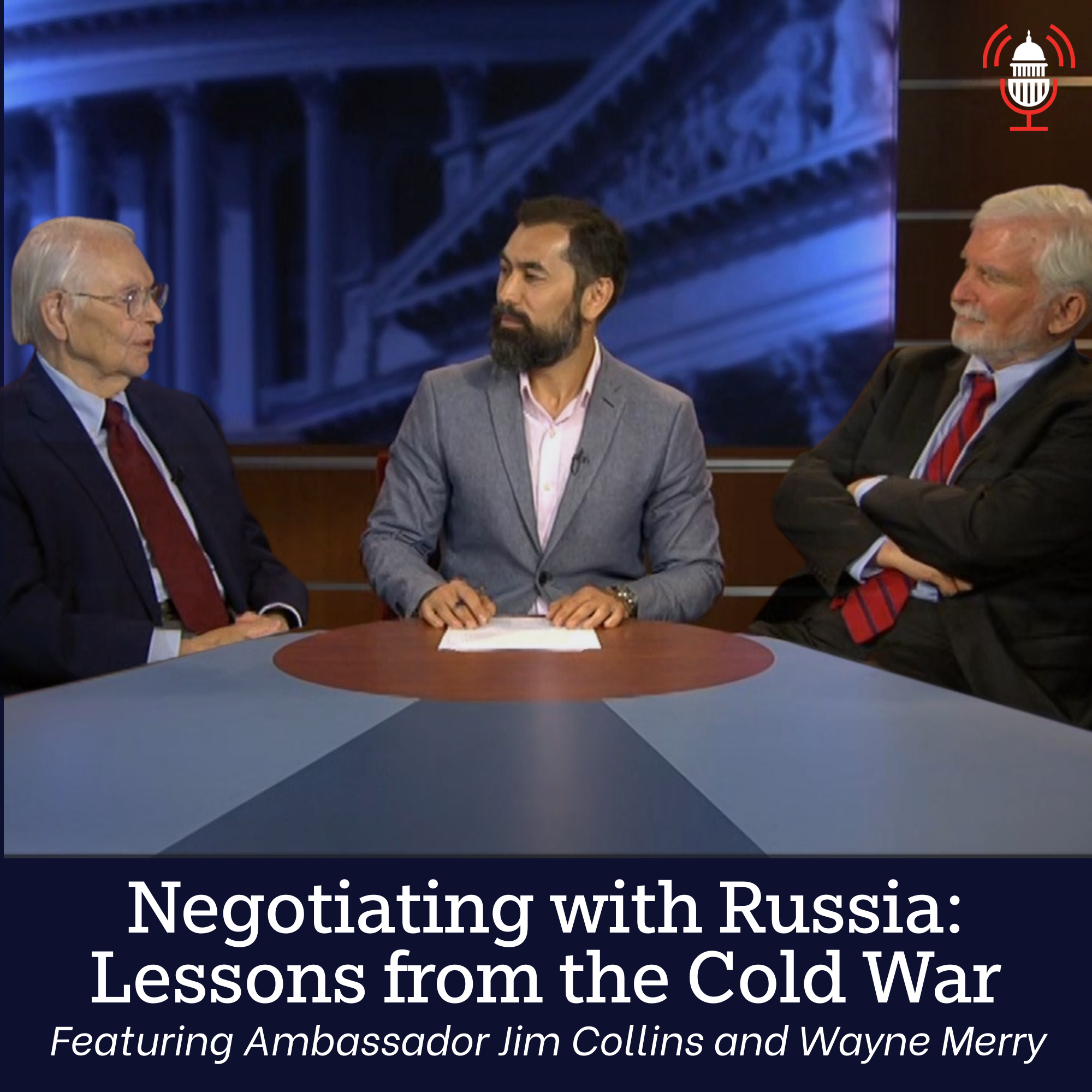
    Negotiating with Russia: Lessons from the Cold War

    For decades Western policymakers have struggled to understand the mindset of the Russian people and their leaders. This episode of The Transatlantic brings together two Russia experts who provide unique perspectives into the challenges American leaders often face when negotiating with Russian officials. Join James Collins, former Ambassador to Russia, and Wayne Merry, the officer in Embassy Moscow who authored a 1993 dissent cable predicting the adversarial turn of post-Soviet Russia, for a wide-ranging conversation about their combined decades inside Russia, a look inside the Vladimir Putin's world, and their thoughts on what will determine the future of Russia. -- Read E. Wayne Merry's Dissent Cable here: https://nsarchive.gwu.edu/document/32704-document-1-wayne-merry-dissent-channel-cable-american-embassy-moscow -- Ambassador James F. Collins is an expert on the former Soviet Union, its successor states, and the Middle East. Ambassador Collins was the U.S. ambassador to the Russian Federation from 1997 to 2001. Prior to joining the Carnegie Endowment, he served as senior adviser at the public law and policy practice group Akin, Gump, Strauss, Hauer & Feld, LLP. Before his appointment as Ambassador to Russia, he served as Ambassador-at-Large and Special Adviser to the Secretary of State for the newly independent states in the mid-1990s and as Deputy Chief of Mission and Chargé d'affaires at the U.S. embassy in Moscow from 1990 to 1993. In addition to three diplomatic postings in Moscow, he held positions at the U.S. embassy in Amman, Jordan, and the consulate general in Izmir, Turkey. He is the recipient of the Secretary of State's Award for Distinguished Service; the Department of State's Distinguished Honor Award; the Secretary of State's Award for Career Achievement; the Department of Defense Medal for Distinguished Public Service; and the NASA Medal for Distinguished Service. Before joining the State Department, Ambassador Collins taught Russian and European history, American government, and economics at the U.S. Naval Academy. -- E. Wayne Merry is Senior Fellow for Europe and Eurasia at the American Foreign Policy Council in Washington, DC. He is widely published and a frequent speaker on topics relating to Russia, Central Asia and the Caucasus, the Balkans, European security and trans-Atlantic relations. In twenty-six years in the United States Foreign Service, he worked as a diplomat and political analyst specializing in Soviet and post-Soviet political issues, including six years at the American Embassy in Moscow, where he was in charge of political analysis on the breakup of the Soviet Union and the early years of post-Soviet Russia. He also served at the embassies in Tunis, East Berlin, and Athens and at the US Mission to the United Nations in New York. In Washington he served in the Treasury, State, and Defense Departments. In the Pentagon he served as the Regional Director for Russia, Ukraine and Eurasia during the mid-nineties. He also served at the Headquarters of the US Marine Corps and on Capitol Hill with the staff of the US Commission for Security and Cooperation in Europe. He was later a program director at the Atlantic Council of the United States

  • S2 · E1
    Nov 18, 2025 · 51 min

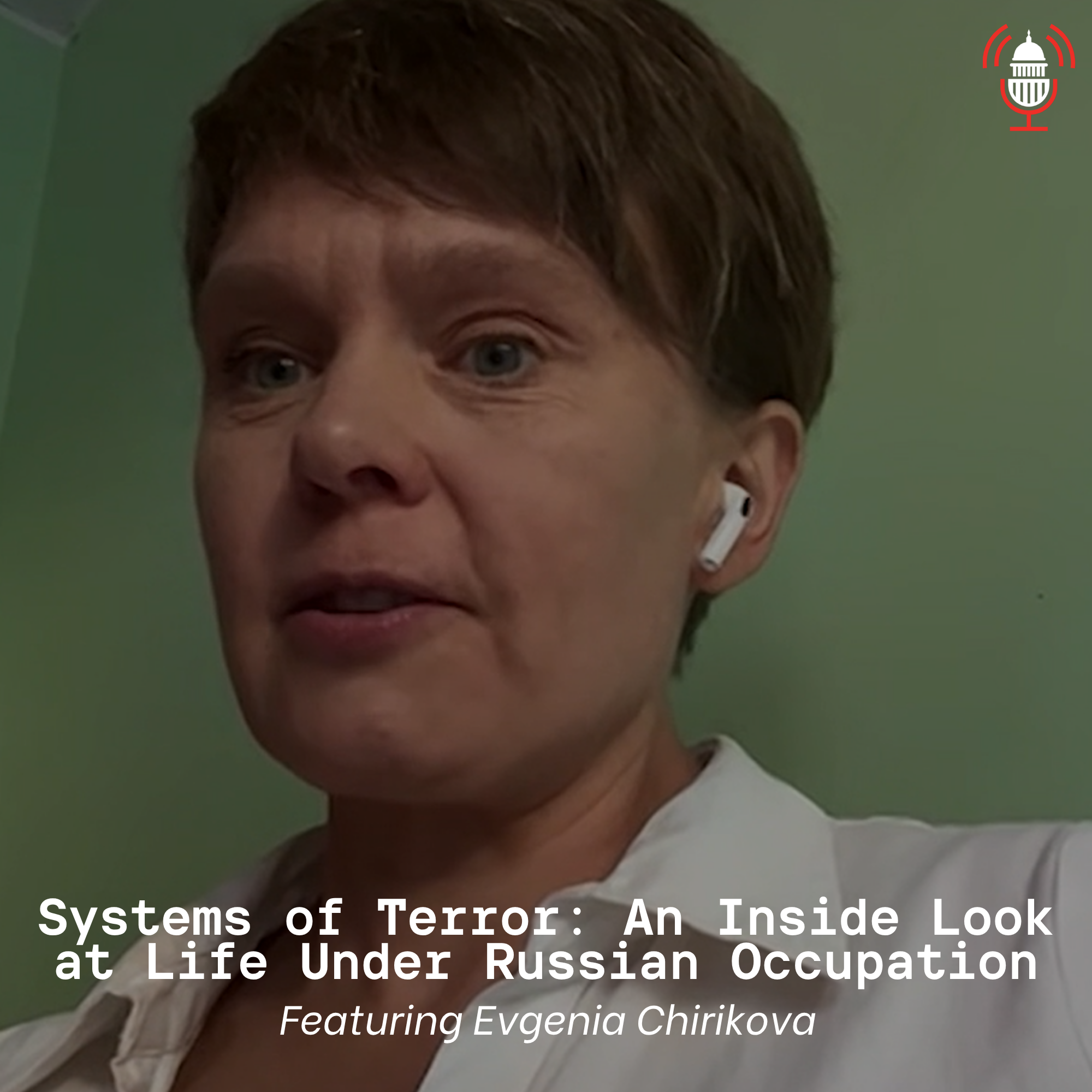
    Systems of Terror: An Inside Look at Life Under Russian Occupation

    In the years since it launched the full-scale invasion of Ukraine, Russia has subjected thousands of Ukrainian civilians to tortuous treatment in prison camps across the occupied territories. In this season premiere of the U.S. Helsinki Commission's podcast "The Transatlantic" Russian human rights activist Evgenia Chirikova discusses her experience searching for answers about what happens to those Ukrainians trapped in this system of terror and outlines the type of accountability she believes is necessary to bring the perpetrators of this abuse to justice. Watch Evgenia's two-part documentary investigation here: Prisoners. Part 1: Fates (https://www.youtube.com/watch?v=aHldWCVigHM) Prisoners. Part 2: The System of Terror (https://www.youtube.com/watch?v=_K9Vy2AWGAg&t=2166s) Evgeniya Chirikova is a Russian environmental activist who rose to prominence leading a movement opposing the building of a motorway through Khimki forest near Moscow. She also played a prominent role in the 2011–2012 Russian protests following disputed parliamentary elections in Russia. She is currently based in Estonia. Evgeniya is the co-founder of the organization Support Net, which supports civil activism in Russia, helps Russian activists who face repression, and supports Ukrainian war refugees. Since 2024, she has investigated Russia's systems of terror in the occupied territory of Ukraine and cases of Ukrainian civilian prisoners. On July 1, 2025, she premiered her film, "System of Terror" in the European Parliament. For her active support of Ukraine in resisting the Russian occupation, she has faced five criminal cases in Russia on charges of "terrorism," has been arrested in absentia in Russia twice, was included on Russia's list of "terrorists and extremists," and was recognized by the Russian Federation as a "foreign agent." She has also served as a project coordinator, investigator, and journalist at the Open Estonia Foundation, and written articles for the Washington Post, La Tribune, de Volkskrant, the Atlantic Council, Postimees, and Activatica. Among other awards, she is a recipient of the James Lawson Award, Goldman Environmental Prize, and the Woman of Courage Award, presented to her by then-Vice President Joe Biden. She is a graduate of the Russian Academy of Economy and State Service and Moscow State Aeronautical University. This podcast is hosted by Bakhti Nishanov and produced by Alanna Novetsky, in conjunction with the Senate Recording Studio.

  • S2 · E1
    Sep 30, 2025 · 34 sec

    Welcome to the Transatlantic!

    The Helsinki Commission's podcast is back! We are excited to be launching The Transaltantic, a podcast bringing you human stories across oceans, political divides, and intellectual traditions. Join our host Bakhti Nishanov as he talks to people behind the debates and developments shaping the struggle for freedom and security in the United States, Europe, Central Asia, and around the world.

  • #25
    Nov 3, 2022 · 36 min

    Russia Hates the Truth

    Transgender journalist Sarah Ashton-Cirillo, a U.S. citizen, joins host Alex Tiersky to describe her journey, first to Ukraine as a war correspondent, then her decision to enlist in the Ukrainian Armed Forces as a combat medic on the front lines, as well as becoming a high-value target for Russian propaganda, and the importance of pursuing the truth against a regime that thrives on lies.

  • #24
    Oct 17, 2022 · 28 min

    On the Precipice

    The OSCE has been central to diplomatic efforts around Russia's war against Ukraine. In this episode, Ambassador Michael Carpenter, U.S. Permanent Representative to the OSCE, discusses the ultimately unsuccessful diplomatic efforts to forestall Russia's full-scale invasion; the role of the OSCE in ensuring accountability for war crimes and atrocities; and the need to ensure Ukraine's victory and Russia's defeat.

  • Sep 9, 2022 · 39 min

    Brothers in Arms

    Since February 2022, thousands of non-Ukrainians have signed up to help defend Ukraine from Russian aggression. In this episode, two former members of the U.S. military—former U.S. Army Staff Sergeant James Vasquez and retired U.S. Marine Corps Lt. Col. Rip Rawlings—discuss their own efforts, one fighting on the ground, and the other mobilizing and coordinating support to the Ukrainian armed forces through his foundation.

  • Jul 6, 2022 · 38 min

    Russia's Arsenal of Aggression

    One particularly insidious tool in Russia's arsenal of aggression is the Kremlin's use of mercenaries, in particular against Ukraine. In this episode, experts Candace Rondeaux and Col. Chris Mayer (Ret.) discuss how Russia draws on mercenary networks such the Wagner Group, which has been linked to human rights and other atrocities including the horrific massacre at Bucha.

  • Apr 20, 2022 · 38 min

    Nobody Cheers for Goliath: How Ukraine Is Winning the Information War Against Russia

    The physical battle of tanks and bombs or territory gained and lost is only one terrible part of Russian dictator Vladimir Putin's war against the people of Ukraine. The unprovoked war is also taking place in the media, on computer keyboards, and in the hearts and mind of people in Ukraine, in Russia, and worldwide. Just as Ukraine has won important battlefield successes in the face of what appeared to be an overwhelming Russian force, Ukraine has also waged a highly sophisticated public diplomacy campaign to counter what many thought was a Russian strength. Dr. Nicholas J. Cull, a pioneering scholar and educator in the field of public diplomacy and mass communication in foreign policy, joins Helsinki on the Hill to examine the fight over narratives around Russia's unprovoked war against Ukraine, how it shapes how different audiences understand the war, and the ultimate real-world impact of information warfare.

  • Dec 14, 2021 · 37 min

    Conflict Is Not Gender Neutral

    When the UN Security Council Resolution 1325 on Women, Peace, and Security was adopted in 2000, it marked the first time that the UN Security Council acknowledged the vital role of women in the prevention and resolution of conflicts. Two decades later, meaningful progress has been made in advancing the equal participation and full involvement of women in peace and security-related efforts, but substantial challenges remain. In this episode, two senior active duty female military officers—Colonel Katherine Lee of the New Zealand Defence Force and Lieutenant Colonel Diana Morais of the Portuguese Ministry of National Defense—describe why integrating the perspective of women is essential to sustainable peace and security efforts, including those undertaken by the OSCE and its participating States.

  • Nov 10, 2021 · 29 min

    Contending with China

    The Chinese Communist Party poses major challenges to the transatlantic community's ideals of governance and human rights. In this episode, Didi Kirsten Tatlow, contributing author of the Atlantic Council report "The China Plan," discusses the Chinese Communist Party's oppression of its citizens, illustrates how that repression extends to the international system, and offers recommendations on how the transatlantic community, including OSCE participating States, can best unify to respond.

  • Aug 27, 2021 · 38 min

    Russian Intention, Russian Aggression

    From September 10 – 16, ZAPAD 2021—a major Russian military exercise that includes thousands of troops—will take place in and around Belarus. The exercise follows months of reports that the Russian military has been involved in actions that potentially could spark a major and violent confrontation between Russia and other countries, including a March deployment by Moscow of some 100,000 new troops in and around Ukraine and a June incident in the Black Sea in which Russian forces seemingly faced off against the British destroyer HMS Defender. In this episode, Lt. General Ben Hodges (Ret.) analyzes whether these developments represent a major escalation and imminent conflict with Russia; whether they are part of a deliberate, coordinated strategy by the Kremlin; and what, if any, guardrails could prevent Russian aggression against its neighbors or a direct conflict with NATO.

Showing 1–20 of 20 episodes