Skip to content
Artwork for The Third Story with Leo Sidran
MusicArts

The Third Story with Leo Sidran

Leo Sidran

THE THIRD STORY features long-form interviews with creative people of all types, hosted by musician Leo Sidran. Their stories of discovery, loss, ambition, identity, risk, and reward are deeply moving and compelling for all of us as we embark on our own creative journeys.

Play
  • 23 episodes
  • fortnightly
  • Avg 58 min
  • English
Counted on this page — what you have heard stays on this device, so it is not something the list can be paged by.
  • Wednesday · 1 hr 3 min

    329: Sofia Rei

    Argentine singer, composer and producer Sofía Rei talks about leaving Buenos Aires and rediscovering the music of home, moving beyond the boundaries of jazz, embracing electronics and production, and learning from collaborators and students. Her new album, Antónima, brings those threads together through what she calls "Folk and Futurism" a meeting place for tradition, technology and a distinctly contemporary musical identity. www.third-story.com www.leosidran.substack.com www.wbgo.org/podcast/the-third-story

  • August 21 · 1 hr 2 min

    328: Ashley Kahn

    Forty years ago this month, Paul Simon released Graceland, an album that became one of the defining records of his career, and one of the most celebrated and debated albums of its era. The record would go on to sell millions of copies and win the Grammy for Album of the Year. It would also generate enormous controversy over Simon's decision to record in apartheid South Africa during a cultural boycott. Music historian Ashley Kahn tells the whole complicated story in his new book, Days of Miracle and Wonder: Paul Simon and the Trials and Triumphs of Graceland. Here Ashley talks about his career, the making of Graceland, Paul Simon's unusual creative process, and the complicated cultural and political questions that have followed the album for forty years. www.third-story.com https://www.wbgo.org/podcast/art-of-the-story/2026-08-19/ashley-kahn-on-the-miracles-and-wonder-of-paul-simons-graceland https://leosidran.substack.com/

  • August 14 · 59 min

    327: Ben Sidran at 83

    For his 83rd birthday, Ben Sidran revisits a 1974 DownBeat profile (done when he was 30) and considers what has changed - and what hasn't - over more than half a century of music and life. In his annual birthday conversation with Leo, he reflects on aging, ambition, practice and the surprising persistence of a worldview formed long ago. www.third-story.com www.leosidran.substack.com www.wbgo.org/podcast/the-third-story https://youtu.be/SZY4QRpJCTw

  • July 22 · 57 min

    326: Ben Wikler

    Ben Wikler has spent his career moving between comedy and politics, communication and organizing. Growing up in Madison, Wisconsin, a city shaped by civic engagement, academic inquiry, and the satirical spirit that gave rise to The Onion, he developed a worldview in which humor isn't a distraction from democracy, but one of the ways people learn to trust one another enough to participate in it. Wikler has become one of the country's most closely watched political organizers. He was the chair of the Democratic Party of Wisconsin from 2019-2025, and is the author of This Is the Plan: How to End America's Meltdown and Save Democracy. But this conversation isn't about campaign tactics or election cycles. Instead, it's about the values and experiences that shaped him: the Wisconsin Idea, the role of humor in public life, the changing media landscape, and why curiosity, optimism, and solidarity remain essential ingredients of democratic life. Recorded at the Madison home where Ben grew up, and where he and his wife are now raising their own family, this is a conversation about place, purpose, and what it takes to keep believing in the promise of democracy. www.third-story.com www.leosidran.substack.com www.wbgo.org/podcast/the-third-story

  • July 3 · 31 min

    325: Ben Sidran - Free In America

    A conversation with Ben Sidran, from Greece on America's 250th birthday, about jazz, democracy, identity, and what remains when the scaffolding begins to shake.

  • June 19 · 57 min

    324: Heather Aimee O'Neill

    Before The Irish Goodbye became one of the most acclaimed debut novels of 2025, Heather Aimee O'Neill spent years quietly writing it while building a career helping other writers tell their stories. Here, she discusses the vulnerability of ambition, the challenge of living an authentic life, and the strange transition from observer to protagonist when a lifelong dream finally comes true. www.third-story.com www.leosidran.substack.com www.wbgo.org/podcast/the-third-story

  • June 9 · 1 hr 12 min

    323: Lakecia Benjamin

    Saxophonist and bandleader Lakecia Benjamin has become one of the most dynamic voices in jazz today. Here she talks about hanging up on Clark Terry, finding her way from Washington Heights to the international stage, and how the mentors, heroes, setbacks and aspirations that shaped her journey continue to inform her new album, We Dream. www.third-story.com www.wbgo.org/podcast/the-third-story

  • May 26 · 52 min

    322: Miles Davis

    Miles Davis spent his life searching. He changed the sound of jazz repeatedly, assembling generations of musicians around him and pushing constantly toward something new. Few artists loom so large over the history of the music. To mark what would have been his 100th birthday today, I'm revisiting a rare 1986 conversation between Miles and my dad, Ben Sidran, recorded on the terrace of Miles' Malibu home. At a time when Miles was reticent about revisiting his past, in this interview he reflected on Kind of Blue, his early musical development and influences, as well as his ideas about creativity, individuality and what it means to make a meaningful artistic contribution. To start the episode, Ben and I had our own conversation about the Miles interview, his memory of doing it, how it resonated at the time and how it resonates today. In the 40 years since it was recorded, the interview has become one of the definitive documents of Miles' thinking during that period. Ben's original interview with Miles Davis was originally made for his NPR program Sidran on Record, and is now part of his Talking Jazz project. The full archive is available at https://talkingjazz.bandcamp.com/album/talking-jazz Today's episode image is borrowed from "Notes from the Ertegun Jazz Hall of Fame" produced by Quoted Studios and Jazz at Lincoln Center.

  • May 18 · 53 min

    321: Julieta Venegas

    Mexican singer-songwriter Julieta Venegas on how growing up in Tijuana - a border city suspended between Mexico and the United States - developed an instinct for living "in-between," musically and personally. She traces her path from a musically curious childhood in Tijuana to her move to Mexico City, the emergence as one of Latin music's defining singer-songwriters and her return to her roots through her new album Norteña and memoir, both of which revisit the border identity and intuition that first shaped her artistic life. www.third-story.com www.leosidran.substack.com www.wbgo.org/podcast/the-third-story

  • May 3 · 1 hr 13 min

    320: Dida Pelled

    Dida Pelled on her latest album I Wish You Would, a blues-focused project recorded with Tony Scherr, Kenny Wollesen, and Sullivan Fortner. Along the way she considers her approach to tradition, identity, and finding a personal voice across genres. And she talks about she discovered the truth about her sexuality, her singing, and the six strings she loves so much. www.third-story.com www.leosidran.substack.com www.wbgo.org/podcast/the-third-story

  • April 21 · 1 hr 3 min

    319: Emily Cavanagh's Song For You

    Singer, songwriter, and founder of Song For You, Emily Cavanagh on music, service, resilience, and finding purpose in uncertain times. In the early days of the pandemic, Emily began calling hospitals with one simple question: "Does anyone need a song?" That question became A Song For You, a nonprofit that has delivered hundreds of personalized songs to patients, families, and healthcare workers. She talks about her Chicago roots, accidentally becoming famous in Ireland, relearning how to walk after a mysterious illness, running away from the altar, and why she says she's never felt lonely or lost. A warm, funny, and moving conversation about what music can do when it matters most. www.third-story.com www.leosidran.substack.com www.wbgo.org/podcast/the-third-story

  • April 14 · 48 min

    318: Michael Leviton and The Tell

    At his monthly series The Tell, writer and storyteller Michael Leviton brings together performers and audiences for an evening where nothing is scripted and no lineup is announced. At The Tell, audiences arrive without knowing who will take the stage. Each night features four storytellers and two musical performances, unfolding over two sets. The result is a dynamic and unscripted experience where stories can be funny, moving, surprising—or all three at once. Leviton created The Tell as an alternative to more formal storytelling formats. Rather than polished, rehearsed narratives, he favors stories that are chronological, unpredictable, and rooted in real experience. As he explains, he's drawn to stories that are "wild rather than relatable," and to storytellers who embrace vulnerability over resolution. Over the past decade, The Tell has grown into something more than a performance series. It has become a community—one where people connect, form relationships, and share experiences in a space built on honesty and curiosity. Despite its success, Leviton resists pressure to expand or commercialize the series. For him, the goal isn't growth—it's maintaining the spirit of the experience itself. Here he explains the philosophy behind The Tell, and what it reveals about the role of storytelling in our lives. www.third-story.com www.leosidran.substack.com www.wbgo.org/podcast/the-third-story

  • March 28 · 36 min

    317: Janis Siegel and The Scent of Danger

    When singer Janis Siegel was invited to help produce a Women's History Month event at the United Nations, everything seemed aligned—until she was told, just days before, that she would not be allowed to speak. She had been flagged for her social media posts. Here she reflects on that moment and what it reveals about a broader cultural shift. Drawing on conversations about jazz, democracy, memory, and fear—and voices ranging from Louis Armstrong to Milan Kundera—this piece explores how authoritarianism doesn't arrive all at once, but quietly, through hesitation and self-censorship. At a time when voices are still rising in protest, the question remains: what happens when speaking starts to feel like a risk? www.leosidran.substack.com

  • March 11 · 59 min

    316: Ben Sidran - Jazz and Modernism

    When I arrived in Palm Springs last month, a few days before the concert-lecture I was to play with my father, Ben Sidran, I found him surrounded by months of research notes, trying to wrestle his ideas into something coherent. The performance was part of the Palm Springs International Jazz Festival during the city's annual Modernism Week, and it grew out of an earlier program we presented at Taliesin, Frank Lloyd Wright's home and studio in Spring Green, Wisconsin. What began as a playful idea about the relationship between architecture and music gradually expanded into a deeper exploration of the natural structures that shape both. Along the way we found ourselves diving into the harmonic series, overtones, Fibonacci sequence, and the physics of vibration, asking how these natural phenomena influence the way we hear rhythm, harmony, and beauty. Drawing on conversations with musicians like Gil Goldstein, Howard Levy, and Jacob Collier, the episode is part personal story, part philosophical inquiry, and part behind-the-scenes look at how creative work actually gets made. And how, in the end, even the most abstract ideas often begin the same way: with a gig. www.third-story.com www.wbgo.org/podcast/the-third-story www.leosidran.substack.com/

  • February 6 · 1 hr 4 min

    315: Phoebe Katis

    Phoebe Katis — a UK-born, New York–based songwriter can pinpoint the moment when her life and career were quietly reoriented. It started with a single direct message. Katis traces her journey from being a young singer-songwriter in England, measuring herself against inherited ideas of success, to becoming part of a global musical community through a series of small, intentional actions — including the DM that led to her first collaboration with Cory Wong, years of touring, a move to the U.S., and a creative and personal life she never could have planned. At the center of the conversation is the idea of the inflection point — the moments that don't announce themselves while they're happening, but later reveal themselves as before-and-after lines. Katis speaks candidly about ambition, people-pleasing, pop music as a delivery system for emotional truth, and the reality of sustaining a creative life without asking your art to carry everything. Her latest album, A Coming Of Age was released in late 2025. Here she reflects on success and arrival, the value of side hustles, pop music as a delivery system for truth, how to build a creative life without asking your art to carry everything.and what it means to keep "coming of age" well into adulthood. www.third-story.com www.leosidran.substack.com www.wbgo.org/podcast/the-third-story

  • January 23 · 1 hr 13 min

    314: Keren Ann

    Keren Ann was born in Israel, spent her early years in the Netherlands, and later moved to France. The daughter of a Russian-Jewish father and a Dutch-Javanese mother, she grew up multilingual and deeply aware that identity, language, and place are always in motion. She began writing songs as a teenager and, by her mid-twenties, was already making her living as a professional songwriter — thanks in part to an unexpected collaboration with the legendary French singer Henri Salvador, for whom she co-wrote several late-career songs, including the hit "Jardin d'hiver." From her debut album La Biographie de Luka Philipsen, Keren Ann established herself as a distinctive writer, singer, and producer. Over the next two decades, she moved fluidly between French and English, between Europe and New York, releasing a body of work shaped by solitude, curiosity, and an openness to change. Along the way, her songs have been recorded by artists including Iggy Pop and Jane Birkin, and she has collaborated with musicians such as David Byrne, Questlove, and Barði Jóhannsson. In 2025, she released Paris Amour, an album inspired by and written from Paris, but not a record about Paris. Composed from her apartment in Montmartre, overlooking the city, the songs reflect a creative process rooted less in place than in solitude. Paris Amour is shaped by stillness and interior life. It's a record that acknowledges its surroundings while turning inward. In this conversation, recorded in Paris, Keren Ann reflects on creativity, solitude, and the shift from inspiration to discipline, and on why, after twenty-five years, the process still matters. www.third-story.com www.leosidran.substack.com www.wbgo.org/podcast/the-third-story

  • January 16 · 1 hr 4 min

    313: Dan Pashman

    Dan Pashman is one of those increasingly rare people who always wanted to be in radio. His career began at the turn of the millennium as a producer and reporter for NPR, Air America, and SiriusXM. But after six layoffs in under a decade—and an industry in steady contraction—Pashman found himself at a crossroads just as podcasting was beginning to emerge. In 2010, he created The Sporkful, a show he describes as being "for eaters, not foodies." With a young family in front of him and a decade of false starts behind him, Pashman saw the podcast as his last real shot at the career he'd imagined. Long obsessed with food, he finally had a platform to explore something he cared about deeply. Built on curiosity, humor, and an almost comical level of rigor, The Sporkful began with hyper-specific food debates—ice cubes, grilled cheese, cereal milk—and evolved into a broader exploration of culture, identity, business, and human connection. That evolution reached a turning point when Pashman embarked on a multi-year experiment inventing a new pasta shape, cascatelli, which became an award-winning narrative series and a real product on grocery store shelves. In this conversation, Pashman talks about creative obsession, building a sustainable podcast business, audio versus video, integrating ads without losing trust, and what he sees as a key to his success: "Never underestimate the power of desperation." It's a candid look at how a modern creative career gets built—one forkful at a time. www.third-story.com www.leosidran.substack.com www.wbgo.org/podcast/the-third-story

  • January 8 · 1 hr 17 min

    312: Kurt Elling Returns

    Kurt Elling returns for a wide-ranging conversation about vocation, gratitude, and what it means to be in service of the music. Elling first appeared on The Third Story nearly ten years ago, already one of the most celebrated singers of his generation and still deeply focused on what he calls "the work I haven't done yet." Since then, he has moved from New York back to his native Chicago, launched major projects like SuperBlue with Charlie Hunter and members of Butcher Brown, recorded intimate small-group albums in the Wildflowers series of recordings, started his Big Shoulders record label, and continued his "poetic practice" of adding new lyrics to instrumental works by artists such as Wayne Shorter and Jaco Pastorius. The immediate occasion for this reunion, however, is something entirely new: Elling is currently appearing on Broadway in Hadestown, playing the role of Hermes. Recorded in an apartment on the Upper West Side during his Broadway run, the conversation moves fluidly between jazz clubs and civic life. Elling speaks candidly about depression, aging, discipline, politics, and the moral responsibility of artists in unsettled times. Throughout, he returns to a central idea: the artist's job is not ego or display, but manifestation — to channel the song so something healing can happen in the room. www.third-story.com www.leosidran.substack.com www.wbgo.org/podcast/the-third-story

  • Dec 23, 2025 · 41 min

    311: Cafe Central, Madrid

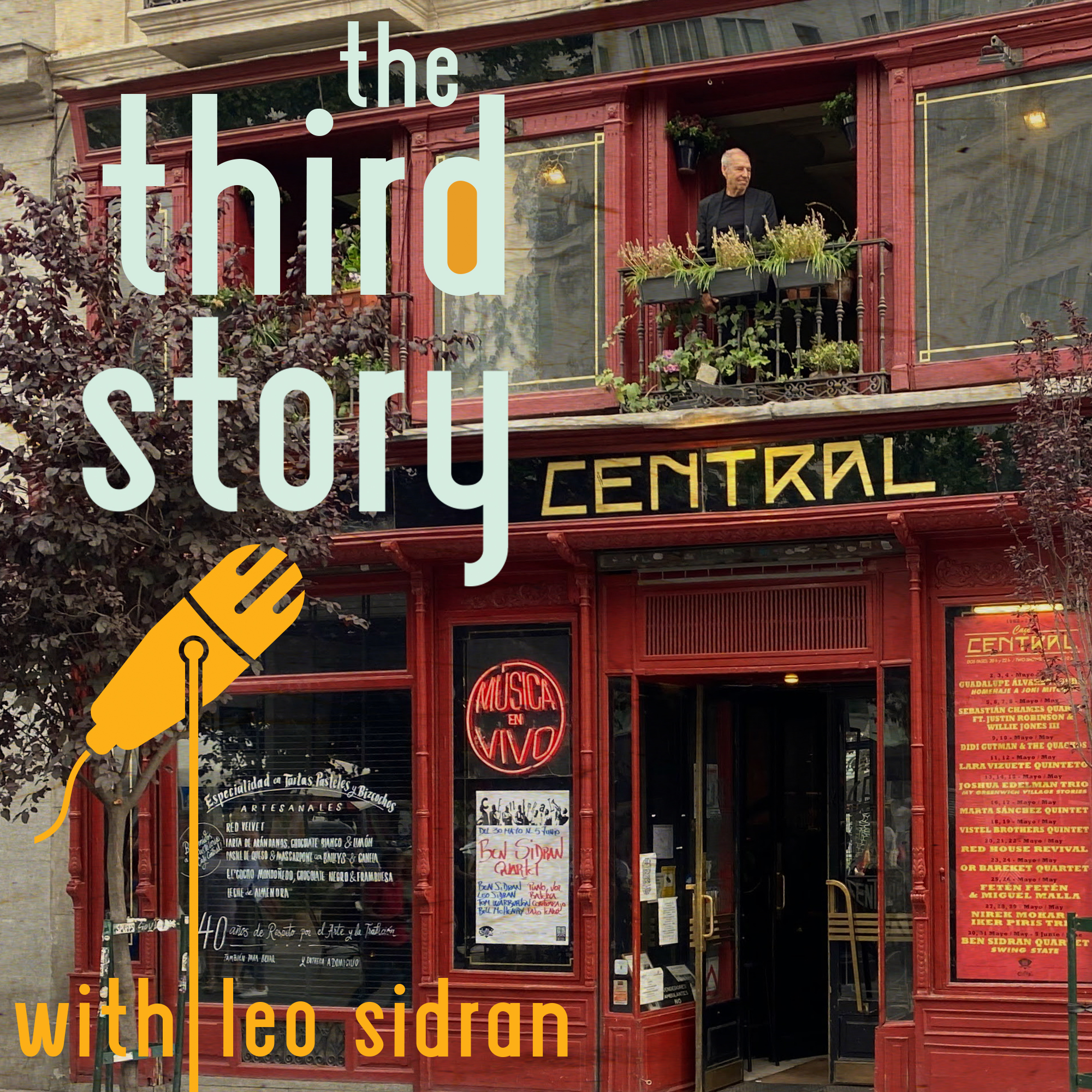
    The Café Central, a jazz club located just off Madrid's Puerta del Sol — Spain's "Kilometer Zero" — has been going out of business for more than forty years. And now, it finally might. Opened in the early 1980s during Spain's cultural reopening after Franco's dictatorship, Café Central became a rare kind of space: part jazz club, part café, part public living room. Bands were booked for full weeks — seven nights at a time — a model that favored musical development over turnover, and community over efficiency. It was never a good business. But it was a great room. For nearly thirty years, my father, jazz musician Ben Sidran, and I returned every November to play there. Over time, the ritual turned into a tradition, and the tradition turned into a legacy — not just for us, but for audiences who marked their calendars around those weeks. Café Central also reflected the city around it. For years, Madrid felt quietly provincial — less touristy, more inward-facing than other European capitals. But that changed. Tourism surged. Rents rose. The economics shifted. In 2018, new owners took over the club. The booking model changed. Week-long residencies largely disappeared, replaced by shorter runs and double seatings. The future arrived, whether anyone wanted it or not. And yet, something endured. Café Central wasn't just a place where music happened. It was where relationships formed — between musicians and audiences, between locals and visitors, between generations. It taught us that culture survives not because it's profitable, but because people show up, night after night, year after year. As Café Central prepares to close — or possibly move — it raises a familiar question: when a place disappears, what actually goes with it? The answer, I think, is never just the room. It's the memory of how it felt to be there — and the responsibility to carry that feeling forward. Featuring conversations with my father, Ben Sidran and my mother, Judy Sidran, this episode explores music, memory, and the fragile ecosystems that keep culture alive. www.third-story.com www.leosidran.substack.com www.wbgo.org/podcast/the-third-story

  • Dec 8, 2025 · 37 min

    310: Remembering Phil Upchurch

    Guitarist, bassist, composer Phil Upchurch died on November 23, and with his passing the music world lost one of its true "musician's musicians." Upchurch played on more than a thousand recordings — from Michael Jackson, Donny Hathaway, Chaka Khan, Curtis Mayfield, and George Benson to Jimmy Reed, the Staples Singers, and countless jazz, blues, and soul sessions. He belonged to the generation that didn't just shape popular music; they invented it. For my dad, Ben Sidran, Phil was also a friend for over 50 years. They recorded and toured together, shared studios, homes, families, and a deep creative kinship. Some of my earliest gigs as a drummer were with Phil, and those moments helped define my own musical path. When we heard that Phil had passed, I called my dad so we could remember him together — the sessions, the stories, the laughter, the generosity, and the unmistakable sound that made him both an insider's secret and a foundational figure in American music. This episode is a tribute — a conversation about a life lived fully in music, about reputation and legacy, and about the musicians who shaped the landscape from behind the scenes. Visit Third-Story.com for the full archive, and sign up for writing and updates at leosidran.substack.com. The Third Story is made in partnership with WBGO Studios. https://www.wbgo.org/podcast/the-third-story

Showing 1–20 of 23 episodes