Skip to content
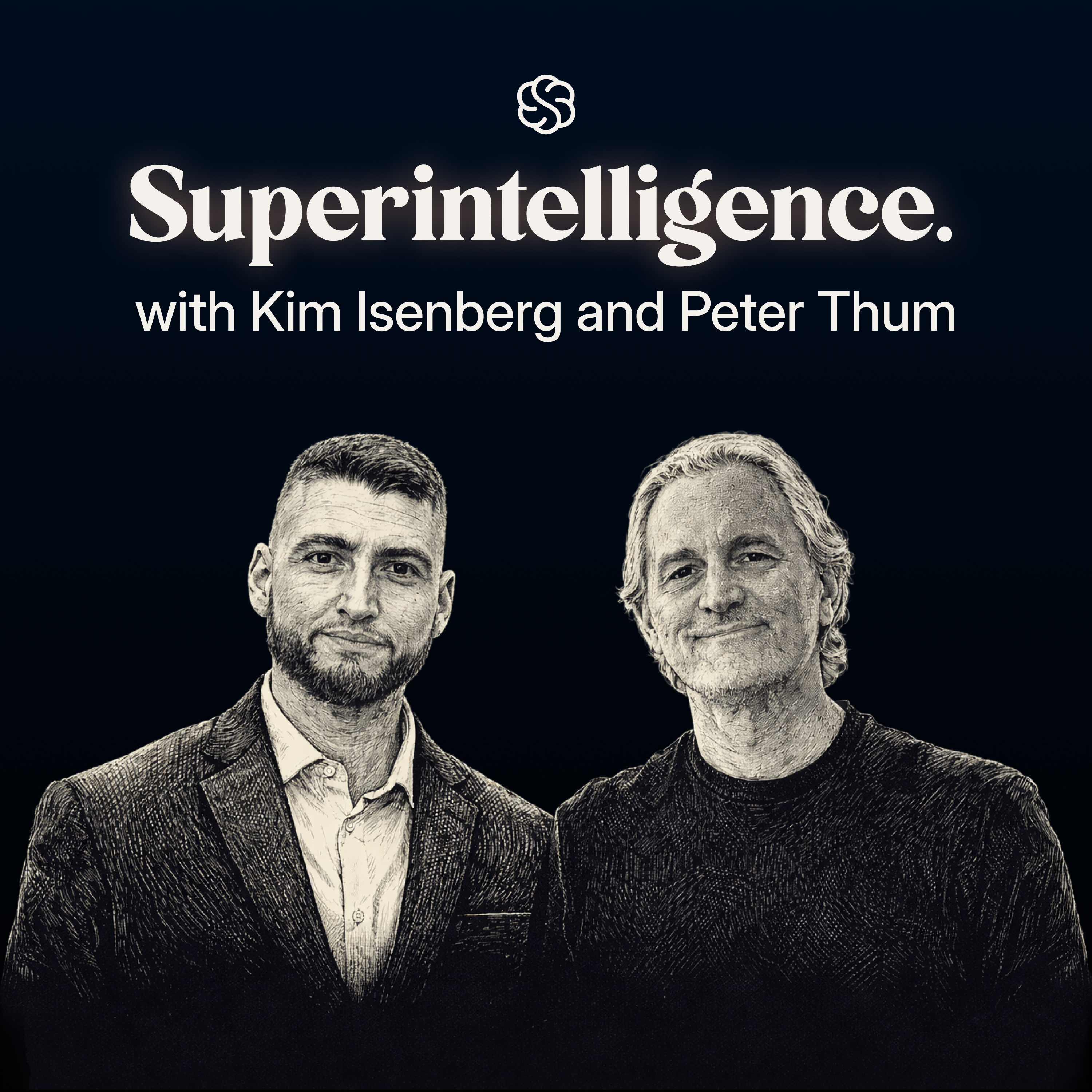
Artwork for The Superintelligence Podcast
BusinessEntrepreneurshipTechnology

The Superintelligence Podcast

Kim Isenberg & Peter Thum

The people building the AI future — unfiltered.


We sit down regularly to talk with founders, researchers, and operators actually doing it. No hype. Real conversations about what’s working, what’s breaking, and what’s coming next. From frontier labs to startups. This is Superintelligence. 

Play
  • 13 episodes
  • fortnightly
  • Avg 43 min
  • English
  • September 2 · 1 hr 25 min

    Is LTX-2.5 Really a World Model? LTX CTO Yaron Inger on the Future of AI Video

    Can an AI video model genuinely understand how the world works, or is it still just generating increasingly convincing pixels? In this episode, Kim Isenberg and Peter Thum sit down with Yaron Inger, Co-Founder and CTO of LTX, to examine the technology and business behind LTX-2.5, the company’s latest open-weights video and world model. We discuss what actually changed from LTX-2.3, how native multi-shot generation maintains consistency across cuts, where the model still fails, and whether its understanding of physics is strong enough to matter for robotics and physical AI. We also challenge the business behind the technology: How fair are LTX’s speed benchmarks? What can creators realistically expect on affordable hardware? What are enterprise customers paying for when the weights can already be downloaded? And how does LTX build a durable advantage in an open ecosystem? This is a direct conversation about whether AI video is evolving from a creative tool into real infrastructure for filmmaking, simulation, and robotics. Learn more about LTX-2.5: https://ltx.io/ Read Superintelligence: https://getsuperintel.com/ Follow me: x.com/kimmonismus

    • Transcript
  • August 27 · 51 min

    Open-Source AI vs. Frontier Models: DataCamp’s Real-World Test

    In this episode, Kim Isenberg and Peter Thum sit down with DataCamp co-founder and CEO Jonathan Cornelissen and Chief AI Officer Yusuf Saber to explore how generative AI is transforming education and professional learning. They discuss the development of DataCamp’s AI Tutor, how the company evaluates open-source models against proprietary frontier systems, and what it takes to turn rapidly improving AI capabilities into a reliable product for millions of learners. Yusuf also shares lessons from building Optima, the AI-native learning platform acquired by DataCamp, while Jonathan explains how AI is changing DataCamp’s product strategy and the future of online education. Topics include: • Open-source models versus frontier models • Building and evaluating AI tutors • Personalization in online education • Reliability, cost, and model selection • DataCamp’s acquisition of Optima • How AI is changing the way people learn www.getsuperintel.com x.com/kimmonismus

    • Transcript
  • August 14 · 1 hr 8 min

    Is Europe actually building sovereign AI—or simply running American models with a European postcode?

    In this episode of Means of Production, Kim Isenberg and Peter Thum sit down with PandaOS co-founders Philipp Türker and Marco Szeidenleder to examine what technological sovereignty really means in the age of AI. The conversation explores Europe’s dependence on US frontier models, why hosting a foreign model in a European data center does not automatically create sovereignty, and whether European companies need to rethink how they control their data, infrastructure, and access to AI. Philipp and Marco explain why sovereignty should not mean isolation. Instead, it means maintaining optionality: controlling your data and keys, being able to choose between different models, and switching providers “on a random Tuesday without everything breaking.” They also discuss the potential of local inference and self-hosting, the role of smaller specialized models, the strengths and weaknesses of Europe’s AI ecosystem, and how PandaOS is building a local AI workspace that connects models, tools, agents, applications, and data while keeping control in the hands of the user. A conversation about AI sovereignty beyond slogans—and what Europe must do if it wants genuine technological independence. Topics include: • Europe’s dependence on US AI companies • What “sovereign AI” actually means • Local inference and self-hosted models • Data ownership, security, and control • Switching models and providers without disrupting operations • European AI models and infrastructure • The AI Act and Europe’s regulatory strategy • PandaOS and the future of local AI workspaces

    • Transcript
  • August 3 · 27 min

    Can Cloudflare Make AI Companies Pay Creators? — Stephanie Cohen

    AI companies increasingly crawl and use content from the open web, while creators and publishers often receive neither meaningful traffic nor compensation in return. In this episode, Kim Isenberg speaks with Stephanie Cohen, Chief Strategy Officer at Cloudflare, about the company’s plan to reshape that relationship. They discuss why Cloudflare is giving website owners greater control over AI bots, the shift from Pay Per Crawl to Pay Per Use, and whether major AI companies are genuinely prepared to pay for the content their systems use. The conversation also explores Cloudflare’s new rules for distinguishing between search, training, and AI-agent traffic, the difficult relationship between Google Search and AI answers, and whether independent creators and small publishers can realistically benefit from this emerging market. Finally, Stephanie addresses the bigger questions: Should Cloudflare have the power to determine which bots can access the web? What happens if AI answers continue replacing clicks? And can the open web survive without a new economic model for original content? Topics include: How AI crawlers use online content Pay Per Crawl versus Pay Per Use Getting creators and publishers compensated Cloudflare’s new AI-bot controls Search, training, and agent traffic Google’s role in the changing web economy The future of independent publishing Whether the open web can survive the AI transition

    • Transcript
  • #10
    July 30 · 1 hr 8 min

    Why AI Agents Break in Production | Alex Salazar (CEO of Arcade) on MCP, Permissions & Enterprise AI

    AI agents are rapidly moving from demos into production, but intelligence isn't the biggest challenge. Trust is. In this episode, Kim Isenberg and Peter Thum sit down with Alex Salazar, co-founder and CEO of Arcade and former VP of Product at Okta, to explore why permissions, governance, and identity are becoming the critical infrastructure for enterprise AI. Alex explains why today's agents often fail in production, why giving an AI agent unrestricted access is dangerous, how MCP differs from traditional APIs, and why guardrails alone aren't enough to secure autonomous systems. The conversation also covers how Fortune 500 companies are deploying AI agents today, why human–agent collaboration is outperforming full autonomy, and what still needs to be solved before AI agents can safely operate across enterprise software. Topics covered: Why AI agents fail in production Authentication vs. authorization MCP vs. APIs Enterprise security and governance Least-privilege access Human + AI workflows Agent hallucinations and risk management Fortune 500 AI deployments The future of enterprise AI infrastructure Guest: Alex Salazar CEO & Co-Founder, Arcade Subscribe for more conversations with the builders shaping the future of AI, enterprise software, robotics, infrastructure, and frontier technology.

    • Transcript
  • #8
    July 23 · 35 min

    Why AI Factories Need a New Data Layer — with Sven Breuner from VAST Data

    In this episode of Means of Production, Kim Isenberg speaks with Sven Breuner from VAST Data about one of the most underestimated bottlenecks in AI infrastructure: the data layer. As AI factories scale from thousands to tens of thousands of GPUs, performance is no longer just about having faster chips. The real challenge is often whether the underlying storage, metadata, networking, and data architecture can keep up with the demands of modern training and inference workloads. Sven explains why GPUs can sit idle while waiting for data, how AI workloads differ from traditional HPC, what VAST means by an “AI Operating System,” and why enterprises need to rethink their infrastructure before making massive GPU investments. A deep dive into AI infrastructure, data bottlenecks, GPU utilization, HPC, storage architecture, and what it really takes to build scalable AI systems.

    • Transcript
  • #7
    July 9 · 19 min

    NVIDIA’s Quantum Computing Strategy with Sam Stanwyck (NVIDIA)

    In this episode, Kim Isenberg sits down with NVIDIA’s Sam Stanwyck at ISC to discuss one of the most misunderstood frontiers in technology: quantum computing. Sam leads NVIDIA’s quantum computing product team, where he focuses on how accelerated computing, GPUs, AI, and software tools like CUDA-Q can help move quantum computing from research toward practical applications. The conversation explores why NVIDIA is not building its own quantum computer, but instead working on the infrastructure around quantum systems: simulation, control, error correction, hybrid CPU/GPU/QPU workflows, and the software stack needed to make quantum computing useful. They also discuss where quantum computing stands today, what real scientific and product value could emerge first, and why areas like chemistry, materials science, energy, optimization, and fundamental research are central to the long-term promise of the field. A grounded conversation about quantum computing beyond the hype — and how NVIDIA sees its role in building the next generation of accelerated computing.

    • Transcript
  • #6
    June 22 · 54 min

    Notion’s Co-Founder on the Rise of AI Agent Workspaces

    Description: In this exclusive Superintelligence interview, Kim Isenberg and Peter Thum sit down with Akshay Kothari, Co-Founder of Notion, to discuss how Notion is evolving from a notes and productivity app into an agent-first workspace. The conversation explores how humans, custom code, and AI agents could soon collaborate side by side inside the same operating layer for work. Akshay explains why Notion’s template ecosystem became such a powerful unlock, how AI agents can automate busy work without replacing human judgment, and why the future of work may be less about headcount and more about outcomes. We also discuss Notion Workers, internal AI agents like “Smilers,” self-improving knowledge bases, model optionality, and how specialized expertise could spread across entire organizations through shareable custom agents. A conversation about the next phase of software, the future of productivity, and what work looks like when AI becomes part of the team.

    • Transcript
  • June 9 · 27 min

    Google DeepMind on Local Models, Open Source & the Future of AI Competition

    In this exclusive interview from Google I/O, I speak with Omar Sanseviero and Paige Bailey from Google DeepMind about the rapidly evolving AI landscape. We discuss the rise of local models, the growing importance of open source and open models, the role of developer communities, and how global competition — especially from China — is shaping the next phase of artificial intelligence. A conversation about where AI is heading next: from frontier labs to local inference, from closed systems to open ecosystems, and from model releases to real-world developer adoption.

    • Transcript
  • #4
    May 28 · 42 min

    LTX CEO Zeev Farbman on Open AI Video Models, Local Inference, and the Future of Creative AI

    In this episode, Superintelligence Editor-in-Chief Kim Isenberg speaks with Zeev Farbman, CEO and co-founder of Lightricks/LTX, about the future of AI video, open foundation models, and local creative workflows. Farbman explains why LTX is betting on open weights, local inference, and efficient models optimized for Nvidia GPUs — and why closed API models may be a long-term problem for developers, studios, and enterprises. The conversation also covers Lightricks’ strategic restructuring, competition with Big Tech, the current AI hype cycle, upcoming LTX updates, and the vision that AI models could eventually replace traditional rendering engines. A conversation about open AI infrastructure, multimodality, creative production, and the next stage of generative video AI.

    • Transcript
  • #3
    May 14 · 43 min

    "Your Calendar Is Leaking Revenue" — How SkipUp's AI Agent Kills Scheduling Forever

    Every company has a scheduling problem. Most just don't know how expensive it is. The coordination tax on mid-market companies runs up to $4,500 per employee per year, and up to 70% of inbound leads never even make it to a booked meeting. In this episode, Superintelligence Editor-in-Chief Kim sits down with SkipUp co-founders Dheer and Sasha to unpack why scheduling is still fundamentally broken in 2026 and how their AI agent is replacing the entire back-and-forth. SkipUp doesn't send a booking link and wait. It lives inside your email thread, reads context, proposes times across calendars and time zones, follows up autonomously, and books the meeting. No forms, no friction, no lost deals. We talk about why traditional scheduling tools like Calendly hit a ceiling, how a two-person team built an email-native AI agent in months, the hidden revenue impact of every meeting that doesn't happen, and what work looks like when the coordination layer is fully automated.

    • Transcript
  • April 28 · 20 min

    Beyond LLMs: How Large Quantitative Models Are Curing Diseases and Reinventing Materials

    LLMs predict the next word. LQMs predict the physical world. In this episode, Kim sits down with Nadia Harhen, General Manager of AI Simulation at SandboxAQ — a company that spun out of Google's Moonshot Factory, raised over $950 million, and counts NVIDIA and Google among its investors. Nadia explains what Large Quantitative Models (LQMs) are, how they differ from the LLMs we all know, and why they could be the key to inventing new drugs, designing next-generation batteries, and tackling problems like rare genetic diseases and environmental waste. We talk about her journey from bench scientist at Johnson & Johnson to clearing cutting-edge AI medical devices to leading one of the most ambitious AI simulation teams in the world. We discuss SandboxAQ's work with Aramco on turning waste into valuable materials, why no AI-designed drug has passed Phase II clinical trials yet, and what breakthroughs she expects in the next five years. If you think AI is just about chatbots and text generation, this episode will change your mind. Topics covered: — What are Large Quantitative Models (LQMs) and how do they work? — LQMs vs. LLMs: Why language models can't invent new drugs — SandboxAQ's origin inside Google's Moonshot Factory — Drug discovery, battery chemistry, and catalysis breakthroughs — The case for rare genetic diseases — Why NVIDIA and Google are betting big on this technology Guest: Nadia Harhen — GM of AI Simulation, SandboxAQ Previously: Google, Johnson & Johnson | Harvard Medical School

    • Transcript
  • #1
    April 14 · 19 min

    Inside Nemotron: NVIDIA’s Kari Briski on the Architecture Reshaping Enterprise AI

    NVIDIA’s Kari Briski joins Kim Isenberg live from GTC 2026 to break down Nemotron 3 Super — a 120B parameter model with a hybrid Mamba-2/Transformer/MoE architecture, 1M token context, and 5x throughput gains. They go deep on what makes it different, why NVIDIA released the full training recipe, and what the new Nemotron Coalition signals about where enterprise AI is heading.

    • Transcript
Showing 1–13 of 13 episodes