Skip to content
Artwork for The Sunday Stoic
Society & CulturePhilosophyExplicit

The Sunday Stoic

Steve and Dan

Applying ancient philosophy to modern life.


The Sunday Stoic Podcast is a weekly show for those seeking to live a life guided by reason, virtue, and resilience.  Each episode explores the timeless wisdom of ancient Stoicism through modern reflections on ancient writings, practical applications, and interviews. Whether you're new to Stoicism or deeply steeped in its teachings, the show blends clarity, curiosity, and community in a down-to-earth format designed to inspire thoughtful action.

Play
  • 22 episodes
  • weekly
  • Avg 22 min
  • English
Counted on this page — what you have heard stays on this device, so it is not something the list can be paged by.
  • Sunday · 21 min

    Musonius Rufus, Lecture 06 - On Training

    Steve and Dan discuss the sixth lecture of Musonius Rufus - On Training. In the previous lecture, Musonius Rufus argued that practice was more beneficial than studying theory for the cultivation of Virtue. In this lecture, Musonius Rufus describes what sort of training should be done by a Stoic practitioner. For example, Musonius Rufus divides training into two categories. The first category is for the soul (mind) alone, and the second category is for both the body and soul (mind) together. https://archive.org/stream/MUSONIUSRUFUSSTOICFRAGMENTS/MUSONIUSRUFUSSTOICFRAGMENTS_djvu.txt

  • September 13 · 12 min

    Musonius Rufus, Lecture 05 - What is More Effective, Theory or Practice?

    Steve and Dan present an abbreviated version of Lecture 5, and discuss whether cultivating Virtue is best brought about through the study of theory, or putting basic philosophical principles into practice every day. Many people who study philosophy favor reading a great deal of philosophical theory and give little thought to practical application in life, for example, what is done in modern academic philosophy departments. Folks who think Wisdom is attainable solely through exposure to wise thoughts through written or lecture format have been with us for a long time, going back at least as far as the Sophists of the ancient world. https://archive.org/stream/MUSONIUSRUFUSSTOICFRAGMENTS/MUSONIUSRUFUSSTOICFRAGMENTS_djvu.txt

  • September 6 · 25 min

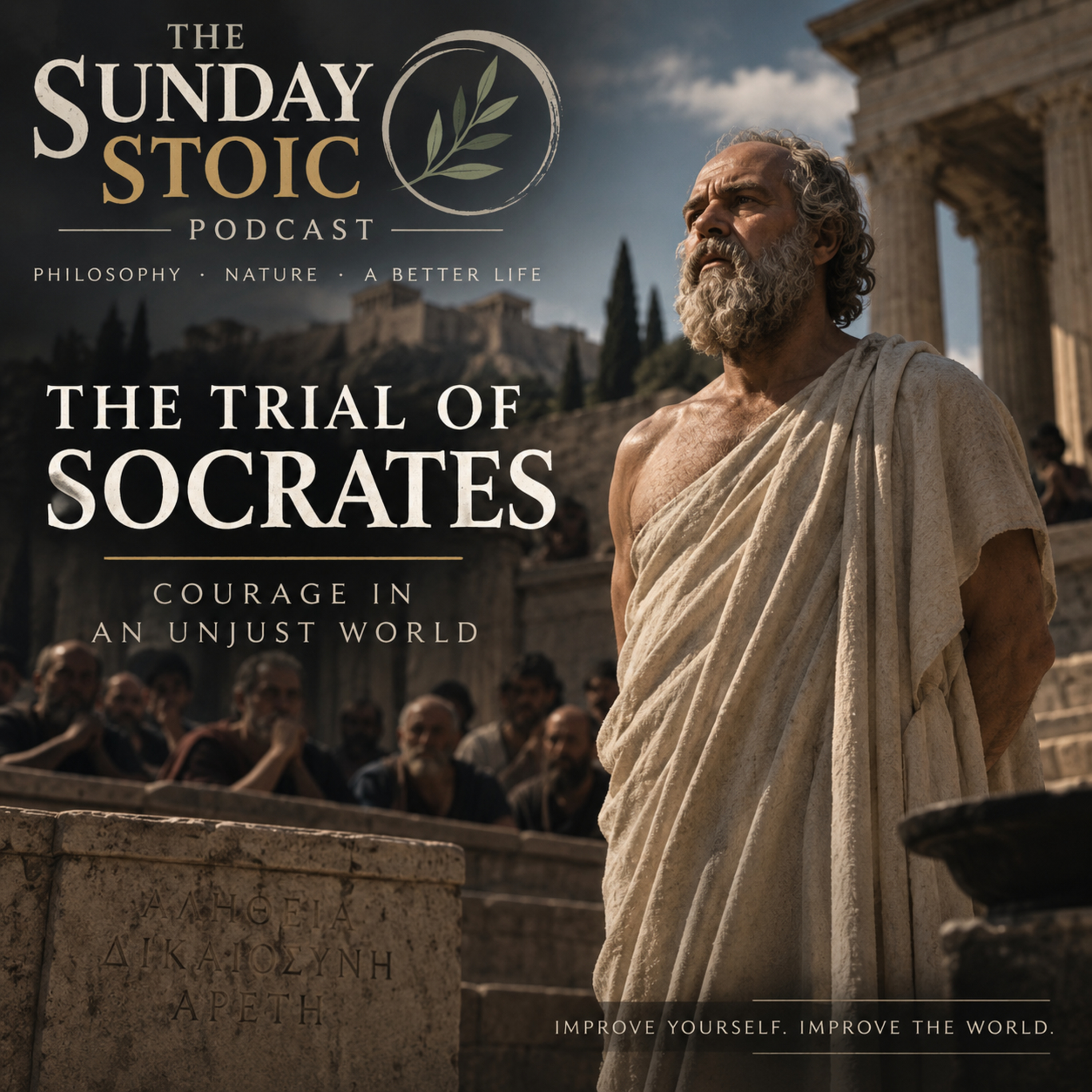
    The Trial of Socrates Part 1 and 2

    In this rebroadcast, we revisit the trial of Socrates—a pivotal moment in the history of Western civilization and a powerful influence on the Stoic tradition. Facing accusations, judgment, and ultimately death, Socrates offers an enduring example of courage, integrity, and commitment to principle.

  • August 30 · 20 min

    Musonius Rufus, Lecture 04 - Should Daughters Receive the Same Education as Sons

    Steve and Dan continue their journey through the lectures of Musonius Rufus. In this episode, they discuss Lecture 04, "Should Daughters Receive the Same Education as Sons." In Lecture 03, Musonius Rufus argued that women were equally capable as men in Reason and capacity to pursue Virtue. In Lecture 04, Musonius argued that women should receive the same philosophical education as men, and why.

  • August 23 · 18 min

    Musonius Rufus, Lecture 03 - That Women Too Should Study Philosophy

    Steve and Dan continue the journey through the lectures of Musonius Rufus. This is the third lecture, "That Women Too Should Study Philosophy." In it, Musonius argues that women should study philosophy because, just like men, they have been gifted by Nature / God with Reason.

  • August 9 · 16 min

    Musonius Rufus, Lecture 01 - No Need for Many Proofs for One Problem

    Steve and Dan discuss the first lecture of Musonius Rufus, "That There is No Need of Giving Many Proofs for One Problem." Musonius Rufus argues that rather than endless proofs of philosophical concepts, it is better to provide a few lucid and powerful proofs, enough to convince the student of the truth of the claims being presented. Musonius further argued that it is of the utmost importance that the teacher of philosophy not only be able to utter truthful and impactful aphorisms, but he must also put what he says into practice so as to be a good example to his students and avoid being a hypocrite. https://archive.org/stream/MUSONIUSRUFUSSTOICFRAGMENTS/MUSONIUSRUFUSSTOICFRAGMENTS_djvu.txt

  • August 2 · 12 min

    Can a true Stoic have friends?

    What makes a true friend? This week, Marcus Aurelius reminds us that we exist for one another, while Seneca argues that genuine friendship is an act of virtue—not a transaction based on convenience or personal gain. Join us as we explore what it means to become the kind of friend who remains loyal in hardship, gives without expecting a return, and helps strengthen the human hive. After all, the truest test of friendship isn't what we receive, but what we're willing to give.

  • July 26 · 16 min

    Usefulness of Basic Principles - Seneca, Letter 95

    Steve and Dan discuss Seneca's Letter 95, "On the Usefulness of Basic Principles." Are precepts, rules and lists of do's and don'ts sufficient to live a good life? Or do we need doctrine, a philosophical framework through which you can evaluate every sense impression and develop an impulse to appropriate action? https://en.wikisource.org/wiki/Moral_letters_to_Lucilius/Letter_95

  • July 19 · 13 min

    Cosmic Flux and Beavers

    Dan discusses how the contemplation of Cosmic Flux can reduce anxiety, put the importance of events into perspective, and help us break free from ruminations on the past and feelings of anxiety about the future. Also ... beavers!

  • July 12 · 52 min

    Stoicism and Spiritual Naturalism with Daniel Strain

    This week on The Sunday Stoic, we're joined by Daniel Strain, founder of the Spiritual Naturalist Society and former Executive Director of the Society, for a thought-provoking conversation exploring the intersection of Stoicism, Spiritual Naturalism, Humanism, and Buddhism. Together we examine how these philosophical traditions can help us cultivate wisdom, compassion, resilience, and a deeper connection to the natural world without relying on supernatural beliefs. Whether you're a practicing Stoic, a Humanist, or simply curious about finding meaning through reason and nature, this episode offers an engaging discussion on living a thoughtful and flourishing life. 🎥 Prefer to watch? This episode is also available in video format. Resources mentioned in this episode: • The Spiritual Naturalist Society: https://www.snsociety.org/ • Stoicism and Compassion: https://www.snsociety.org/compassion/ • British court ruling recognizing Stoicism as a protected philosophical belief: https://www.dailymail.co.uk/news/article-8962815/Stoicism-recognised-religion-landmark-legal-ruling.html • Daniel Strain's Stoic Emblem and the story behind its design: http://humanistcontemplativeblog.blogspot.com/ If you enjoy conversations that bridge ancient wisdom with modern life, be sure to subscribe and share the episode with a friend.

  • July 5 · 22 min

    Facing the World With Confidence - Seneca, Letter 105

    Steve and Dan discuss Seneca's Letter 105, wherein Seneca has advice for how to lead a more tranquil life. Seneca describes how to minimize other people's envy, hatred, fear and contempt, so as to have a smooth flow of life.

  • June 21 · 5 min

    Don't Forget to Live

    Stoicism often gets a reputation for being stern and unyielding, but the ancient Stoics never intended us to become detached spectators of our own lives. Their goal was to help us engage more deeply with the world around us. In this episode, we talk about the importance of balancing philosophy with joy—getting out there, making memories, appreciating the people we love, and living a full and meaningful life.

  • June 21 · 41 min

    The Havamal: Nordic Philosophy with Ben Waggoner

    This week I’m revisiting a conversation with my former colleague Dr. Ben Waggoner, who joined me to explore his translation of the Hávamál. This Old Norse poem—preserved in medieval Iceland—offers a blend of practical wisdom, sharp observations about human nature, and guidance for living well. In our discussion, Ben walks us through the cultural background of the text, the challenges of translating Old Norse, and the surprising ways the Hávamál echoes themes familiar to students of Stoicism. If you’d like to hear more from Ben, you can find his podcast Heathen History at: https://www.heathenhistory.com/ His translations of Old Norse and related works are available through The Troth:https://www.thetroth.org/shop/books-and-magazines.html

  • June 11 · 15 min

    Circumscribing the Present

    In this episode, Dan discusses the Stoic Spiritual Exercise of Circumscribing the Present. Dan describes how Circumscribing the Present can: - Ensure we do not suffer more than is necessary, - Help us in moments when circumstances are threatening to overwhelm us, and - Help us to be more effective actors in the world while we are fulfilling our social roles through appropriate action. Dan also touches on how Circumscribing the Present intersects with other Stoic practices and concepts like Prosoche and the Dichotomy of Control.

  • June 7 · 19 min

    Voluntary Hardship

    Steve and Dan discuss the Stoic practice of Voluntary Hardship (aka Voluntary Discomfort and Voluntary Suffering), which is physical discomfort that we choose to expose ourselves to for the purpose of improving ourselves. Voluntary Hardship is implemented for practice in the Discipline of Desire & Aversion with a view to cultivating the Cardinal Virtues of Temperance and Courage. Examples of Voluntary Hardship include things like fasting, confining beverage consumption to water, wearing light clothing in cold weather, strenuous exercise, and foregoing other pleasures, among many others.

  • May 31 · 28 min

    Diogenes the Dog - the Original Cynic

    Steve and Dan discuss Diogenes the Dog (aka Diogenes of Sinope), who founded the Cynic movement, and was a precursor of the Stoic school. Some of the most important Stoic concepts come to Stoicism though Diogenes. For example, Living According to Nature, Virtue is the Only Good, and Cosmopolitanism. Steve and Dan discuss their favorite Diogenes the Dog anecdotes, who was an undeniably shocking and revolutionary thinker. SundayStoic@Gmail.com

  • May 24 · 24 min

    Amor Fati - Love Your Fate

    In this episode, Steve and Dan discuss the Stoic concept of Amor Fati (Love Your Fate). They explore whether Amor Fati is tenable under different conceptions of Divine Providence.

  • May 17 · 15 min

    Marriage and Stoicism - Part 2

    Dan expands on the discussion regarding Marriage and Stoicism that began in Part 1. Dan begins by presenting the position of Musonius Rufus that it is the duty of a Stoic practitioner to marry and have children, and then presents his reasons to disagree with that position. Dan goes on to discuss how the Stoic Spiritual Exercises of Prosoche and Memento Mori relate to marriage. He also expands the discussion regarding the importance of evaluating the character of the person you are choosing as a spouse-to-be, and why it is important to avoid choosing a spouse based on their Externals, like their beauty, wealth, power, influence, prestige, etc.

  • May 12 · 40 min

    What Kind of Person Will You Be? Stoic Parenting and the Art of Living Part 2.

    In this continuation of Mary Miller’s interview on The Sunday Stoic, Steve and Mary explore how Stoic philosophy can shape courage, leadership, parenting, resilience, and moral clarity in the modern world. Drawing from her father’s deeply practical wisdom, Mary shares unforgettable stories from her childhood, her groundbreaking career in the nuclear Navy, and the hard-earned lessons that taught her to lead with integrity under pressure. The conversation weaves together the teachings of Epictetus, Marcus Aurelius, and James Stockdale with real-life experiences involving bullying, authority, toxic workplaces, emotional discipline, religion, and the importance of protecting one’s mind from manipulation and social pressure. Mary reflects on tactical Stoicism in high-stakes naval environments, explains how practical wisdom is learned through struggle rather than theory, and discusses how parents can model virtue through their actions instead of merely preaching it. The episode also explores the dangers of modern “brainwashing” through media and social influence, the importance of choosing one’s battles wisely, and how true leadership often means creating safety and accountability for others. This episode is a profound meditation on Stoic virtues—wisdom, justice, temperance, and courage—and how ancient philosophy can still guide us through the chaos of modern life.
Showing 1–20 of 22 episodes